Serena’s Review: “Wicked Saints”

36118682Book: “Wicked Saints” by Emily A. Duncan

Publishing Info: Wednesday Books, April 2019

Where Did I Get this Book: NetGalley

Book Description: A girl who can speak to gods must save her people without destroying herself.

A prince in danger must decide who to trust.

A boy with a monstrous secret waits in the wings. 

Together, they must assassinate the king and stop the war.

In a centuries-long war where beauty and brutality meet, their three paths entwine in a shadowy world of spilled blood and mysterious saints, where a forbidden romance threatens to tip the scales between dark and light.

Review: This was book-cover love through and through. Sure, the description sounds good enough, but there were also some warning signs there (love triangle??) that would typically make me a bit wary. But I love the simplicity of this cover and the way the colorization is used. Alas, by the end of the book, the cover was still probably my favorite part.

Nadya can speak to the gods, an entire pantheon of them. But for most of her life, she has been hiding and training in a remote monastery, a secret weapon that hasn’t been used yet in a growing political war. One day, that war arrives on her doorstep, quite literally, and everything changes. Now caught up in events moving in ways she barely understands, Nadya finds herself working a boy she’s not sure she can trust but who might also be the key to it all.

Honestly, there wasn’t much I loved about this book. That’s not to say I hated a lot of it either, but more like, I felt like I had read much of it before and read it better. Russian-based fantasy stories have been the rage for a few years it seems, and as such, there have been a million and one entries into the sub-genre with a wide range of quality, as far as I’m concerned. There have definitely been worse ones than this, but when I just finished up the last book in the “Winternight” trilogy, it’s hard to look at this one and not be a bit disappointed.

Aside from that trilogy, the more direct comparison for this book would be Bardugo’s “Grisha” trilogy. I’m pretty sure there have been quite a few comparisons already floated around between the two and I can definitely see it.

The biggest similarity comes with the romance and the enemies-to-lovers trope that is at the heart of both (sort of). On its own, I think this is one of the harder love arcs to right and I would say its this aspect specifically that sunk Bardugo’s series for me as I could never buy this part of the story. So, here, too, I struggled. I could never understand the “whys” behind any emotion our two romantic interests had for each other. Why did they really hate each other in the first place? Patriotic prejudices can only go so far as an explanation. And then, worse, why do they fall for each other? The motivation behind either emotion wasn’t fully fleshed out in any way, and when you’re dealing with some of the strongest emotions out there, love and hate, you need a pretty darn good reason to have your character feel them, and even more so, change from one to another. Throughout the story, the male love interest lied repeatedly to Nadya, and yet somehow, we’re meant to buy her continued interest in him. By about halfway through the book, I started to give up on getting the strong character I wanted from Nadya and was resigned to the fact that she was mostly a love interest in her own story.

I also struggled with the magic system. Again, as it was incorporated in the story, it felt very similar to other Russian-based fantasies I’ve read, but here it only skimmed the surface. The end of the story in particular seemed to really highlight this struggle as aspects of the magic system seemed to come out of nowhere or operate in ways that didn’t really make sense all of a sudden.

On top of that all, I was just bored throughout most of this. Other than the frenetic last few chapters of the story, I just felt like I was following the predictable footsteps of a well-worn path. There wasn’t anything new here, and in a subgenre that has so many offerings, I’d say if you’re looking for Slavic fantasy, you can find better. Just this year there was the final book in the “Winternight” trilogy, “The Winter of the Witch” by Katherine Arden and “Spinning Silver” by Naomi Novik. And if you want a better “enemies to lovers” story, you can check out “Sherwood” by Meagan Spooner.

Rating 6: Nothing terribly bad, but also not really holding its own in a pretty packed subgenre of YA fantasy.

Reader’s Advisory: 

“Wicked Saints” is included on these Goodreads lists: “Villain as Romantic Love Interests” and “Creepy, Dark YA and MG Books.”

Find “Wicked Saints” at your library using WorldCat!
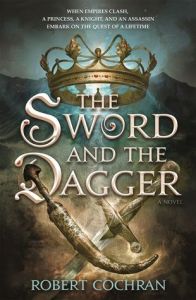
 

Serena’s Review: “The Sword and the Dagger”

39863306Book: “The Sword and the Dagger” by Robert Cochran

Publishing Info: Tor Teen, April 2019

Where Did I Get this Book: NetGalley

Book Description: During the time of the Crusades, an unlikely trio—a Christian princess, her affianced prince, and a Muslim assassin—embarks on a quest to the court of the most fearsome warrior the world has ever known, Genghis Khan.

A rousing tale of adventure and romance about three young people who must grapple with fundamental issues of loyalty, friendship, faith, honor, and courage against the backdrop of conflicts that still resonate today.

Review:  I placed a request for this book based on the strength of its plot description and the beautiful cover. Even though there was a massive red flag telegraphed to me with the love triangle set up, I thought “Sure, why the heck not? Who doesn’t like a good ole fun trip into the time of the Crusades?” Alas, right off the bat I struggled to get into this book, and by the last page I was more confused by the editing (or lack thereof?) of this book than anything else.

The story follows our three intrepid adventureres: Princess Elaine, her betrothed Conrad, and Rashid, an assassin sent to kill Elaine. All three are made up of a complicated mixture of the best and worst aspects of their respective belief systems, be those religious or cultural, as well as a myriad of other aspects that go to prove that no person can be defined so simply. While journeying together through various trials and tribulations, they all must learn that their fellow travelling companions are just as complex as they themselves.

As I said, I didn’t love this book. But before I get into its challenges for me, I want to highlight some aspects of the book that I did enjoy. Firstly, I liked the historical setting and the way that was tied into the book. I also really liked a lot of the broader concepts about prejudice and tolerance that our three main characters explored throughout the story. There were the obvious debates about religious disagreements came to by the Christian Conrad and the Muslim Rashid, but the story also explored gender roles with the limitations placed on Elaine as a woman growing up in a time where very little was expected, or permitted, of women. Overall, there was a nice combination of action and adventure mixed in with these larger debates in a way that allowed the book to explore some pretty big topics without coming across as overly preaching. The fast pace of the story also helped in this regard.

So those are my pros. But mixed within some of those same things that I enjoyed were also the parts of this book that I struggled with. As I said, I liked the historical setting of this book and the fast paced nature of the adventure made for a snappy read. But mixed together, it also left the book feeling oddly light and surface-level as far as its world. Our main characters jump from place to place and action piece to action piece so quickly that I never really felt like I had time to really sit back and examine the intricacies of the setting in which these events were taking place. For a book that covers of settings and ground, I never felt like I was really given any time to appreciate that fact. The plot was too busy getting from point A to point B to allow for this.

The fast paced nature of the story was also fun, but it also felt like it undercut some of the more somber moments in the story and restricted some of the character development. While overall I did like the three main characters, I also never really felt overly attached to any one of them. They often felt like the standard, expected characters for a story like this. So, too, the story they were travelling through also felt pretty expected. There weren’t any big surprises, and the few twists that there were, were exactly the ones you’d come to expect. I don’t need huge surprises around any corner, but at a certain point a sense of newness does help.

But my biggest problem came down to the writing itself and one very specific thing: the POVs would change without any indication or warning. Even in the middle of paragraphs! Even to characters who weren’t one of the main three. In the very first chapter, we’re introduced to Elaine, but then random sentences come through from the perspective of those around her commenting on Elaine herself. There’s no explanation for why we’re suddenly in this new character’s mind and then just as suddenly, we’re back to Elaine. It was incredibly distracting and quickly started to drive me crazy as we went on. I’m not sure what was going on there, but this specific aspect is where I think a good editor was needed. This is the kind of writing tic/flaw that a good editor will flag and help an author work through during the revision process. For some reason that didn’t happen and what could have been a better story suffered for it.

Ultimately, this writing issue was really the nail in the coffin of my enjoyment of this book. There are some good bones here, but for me, I couldn’t get past the distraction of this. That, plus the light descriptions of setting and sometimes too-fast nature of the story, ended up outweighing the parts of the story that I did enjoy. This could be good for fans of historical fiction, especially those interested in this time period. But we warned that if you’re sensitive to writing quirks, this one might be a struggle.

Rating 5: It had some good things to say about prejudices and tolerance, but the weird POV issue was too much for me.

Reader’s Advisory: 

“The Sword and the Dagger” is a newer title so it isn’t on many relevant Goodreads lists, but it is on “2019 YA Historical Fiction.”

Find “The Sword and the Dagger” at your library using WorldCat!


Serena’s Review: “The Shadowglass”

38504533Book: “The Shadowglass” by Rin Chupeco

Publishing Info: Sourcebooks Fire, March 2019

Where Did I Get this Book: Edelweiss+

Book Description: Tea is a bone witch with the dark magic needed to raise the dead. She has used this magic to breathe life into those she has loved and lost…and those who would join her army against the deceitful royals. But Tea’s quest to conjure a shadowglass—to achieve immortality for the one person she loves most in the world—threatens to consume her heart.

Tea’s black heartsglass only grows darker with each new betrayal. And when she is left with new blood on her hands, Tea must answer to a power greater than the elder asha or even her conscience…

Previously Reviewed: “The Bone Witch” and “The Heart Forger”

Review: Given the timing of when I started reading this series, I was able to get through the first two books quite close together. Which meant I had a long wait ahead of me getting to this one. And, since the storytelling presented in this book is broken into two portions, there were quite a number of cliffhangers and unresolved plotlines left dangling after the second book. All the more nerve wracking as I waited for this, the final book in the trilogy. And, well, I’m not sure that the extra time between reads worked in this book’s favor. Or perhaps I was already on a downward trajectory overall. Either way, unfortunately, I felt like this was a frustrating end to the series.

Things are finally starting to come ahead for both Teas, past and present. The past version of our main character is beginning to feel the walls close around her as one disaster after another seems to strike. Surrounded by a small band of loyal followers, she finds herself on the run from not only the elder Asha but entire nations. Driven by the knowledge that secrets about shadowglass and bone witches are being kept from her and the world, Tea goes on a path of discovery that will lead ultimately to her banishment and the death of many of her loved ones. Present Tea, on the other hand, has come fully into her own, surrounded by her powerful beasts and on a rampage throughout nations. Her plans are not fully clear, but it’s clear that those who stand in her way are not coming out of things on the winning side. Is Tea’s mission one of justice or is it simply the darkness inside of her fully taking control?

I’ve always found these books a bit confusing. The world-building is incredibly unique, and that’s a huge pro for the series. But there is something about its execution that doesn’t read clearly. The writing style, perhaps, leaves something wanting in the clarity department, and the choice to alternate between two story lines, each with its own complications and mysteries, doesn’t help matters. There are aspects of past Tea’s life that are referenced way back in book one, but aren’t answered until this, book three. That’s simply too long for me to have kept track of everything involved in the timeline, especially when all references made in the “present” timeline are obscured through the strange way that present-Tea is made to speak.

This has annoyed me from the start: Tea’s sudden tendency to rattle of pert little phrases of wisdom and mystery. It’s not a natural way to talk and reads in stark contrast to the past Tea who reads and speaks more like a typical person. The mode of present-Tea’s speech added extra layers of confusion to all of the references she made to events from the past. This being the case, as I was reading this book, I constantly felt like I was missing things. And then when I referenced back to the first book, I would fine that present-Tea has entirely misrepresented the situation, usually, again, with some type of unnecessarily cryptic remark. This made for an incredibly frustrating reading experience. I was lucky that I still had copies of the first two books on hand, but even so, I found this need to refer back very annoying.

I also had had some concerns from the very start about how well these two storylines would merge, and I was right to worry. Again, Tea’s sudden transformation from the past version of the character to the cryptic, almost all-powerful Tea of the present didn’t read as natural. Had the chapters been laid out in order, the jump would have been sudden and strange, and the fact that it was broken up over three books didn’t do enough to obfuscate the matter.

I was also unsatisfied with the reveals themselves. Like I said, there were about a million and one referenced mysteries that had been dropped throughout the first two books that needed resolutions here. But as these resolutions appeared, I found them increasingly annoying. Several of the referenced events don’t really make much sense and require characters to be willfully blind to some pretty basic facts to pull off. Tea’s own regrets and feelings of guilt also don’t make sense, now seeing some of these events play out. Everything just felt a bit off.

This feeling of being offkilter was all the worse because the bones (pardon the pun) of the story are still good. Like I said, the worldbuilding is incredibly unique, and I’m always going to applaud an author for creating a complicated world, magic system, and arc for her story. But the slight “offness” of everything, be it the writing itself  or the way the storyline actually unfurled, became increasingly hard to read as the series progressed.

Like I said, maybe the fact that I was able to read the first two books more closely together played in their favor. I definitely had to spent a lot more time reminding myself of a lot of details of this world, character, and story as I got into this book which made it hard to simply sink in and enjoy it. I also feel like the time away left me freed up to think more critically about the story and character arc itself, as well as be a bit more put off by the writing style.

This was a disappointing return to the series. Though, I will say that now that the series is complete, readers might have more luck and enjoyment if they are able to read all three books back to back. That mode of reading could play highly in the series’ favor, reducing the confusion of a returning reader and retaining the interest of readers across books. If you do like dark fantasies, I still recommend checking this series out, but definitely plan on reading them all at once. As for returning readers, your experience may be different than mine, but I was left disappointed by this conclusion, not because of the ending itself, but by basic mechanics of the storytelling that seemed to stand out in a more negative light in this book than they had in the first two.

Rating 6: For me, a disappointing end. The writing felt more strained and the storylines didn’t feel like they ultimately linked up together naturally.

Reader’s Advisory: 

“The Shadowglass” is on these Goodreads lists: “Asian Fantasy & Science Fiction” and “Speculative Fiction by Women of Color.”

Find “The Shadowglass” at your library using WorldCat!

Rah Rah for RA!: Urban Fantasy and Other) Books

Occasionally we here at Library Ladies get an email asking for some Reader’s Advisory. Sometimes it’s a general ‘what should I read next?’, and sometimes it’s a specific genre or theme that the reader is asking for. We do our best to match the reader to some books that they may like based on the question they give us. 

Hello,

I recently read a Discovery of Witches by Deborah Harkness and enjoyed that very much. I like urban fantasy that features a protagonist who may have supernatural abilities, but either struggles to use them or is challenged to solve problems without them. Madeline Miller’s Circe was another recent favorite. She was a character who had potion-making abilities, but she had to learn through trial and error over centuries exactly which amount of which herb produced which effect. She also could not rely exclusively on magic to solve every challenge she faced.  On the flip side, I like urban fantasy that features ordinary people who outsmart/outmanoeuvre the villain who may have supernatural abilities, i.e. a werewolf ( like Stephen King’s Silver Bullet) or a vampire ( think Van Helsing Vs. Dracula).  I will also add that I don’t like zombies because I like my monsters/villains to have a personality. Looking for adult fiction, btw.

I hope that is enough information. Let me know if it isn’t…

Best,

T.L.

Hi, T.L!

It sounds like you have a large swath of interests within the genre, and that’s great! Going by what you’ve laid out in the email, we’ve come up with a few options that may appeal to you.

9317452Book: “The Peter Grant Series” by Ben Aaronovitch

When talking about characters who have to adjust to newly found powers, Aaronovitch’s “Peter Grant” books may be a good fit. Grant is an officer in London’s MPS, and after having a run in with a ghost he is transferred to a division of the Force that deals with all things supernatural. He himself doesn’t start out with powers, but becomes an apprentice wizard once he joins this team. The series follows Grant as he deals with a number of mysteries and conflicts, from warring River Gods to serial killers to magical attacks, Grant has to adjust to a world he didn’t know existed. The best part is that this is a series, so if you like the first book (“Rivers of London” or “Midnight Riot” if you’re in the U.S.) you will have a few more to sink your teeth into!

31147267Book: “The Changeling” by Victor LaValle

Victor LaValle is an author who has consistently come out with stories that deconstruct well explored tropes and injects them with themes of social justice and long unnoticed voices. “The Changeling” is a modern day fairy tale/dark fantasy that is set in New York City, and it involves a humble book seller named Apollo and his wife Emma and their new baby. But when the wife starts to think that their child isn’t really their child, and something truly awful happens because of this belief, Apollo has to go on a journey to find Emma, and perhaps find their child as well. Along the way he meets magical figures, haunted places, and has to contend with a world he knew nothing about. With elements of Changeling folk lore and inspirations from the book “Outside Over There” (and in some ways the movie “Labyrinth”, in turn), “The Changeling” is a mysterious and dreamy book that brings fairy tales to a modern time and place.

11250317Book: “The Song of Achilles” by Madeline Miller
We put this out there because of your enjoyment of Miller’s newest book “Circe”. Miller does a similar treatment with this book, this time exploring the myth of Achilles and his lover Patrocles, and the tragedy that awaits them during the Trojan War. Miller once again uses her immersive and engrossing writing style to put her own spin on a long known epic, and gives the characters more complexity and depth than the original source material does. Both Achilles and Patrocles are given quite a bit of plot to work with, and their relationship is slowly developed and gets the reader fully invested, even though the foregone conclusion of what’s going to happen to them is always lingering. It also explores Achilles’s strengths and weaknesses as a being that has God-like abilities, except for his one fatal flaw. It’s a story that may need to be read with tissues at the ready, but it’s also one of great beauty and power.

35297405

Book: “School for Psychics” by K.C. Archer

What happens when you take a plucky con artist with some psychic powers, and put her in a school that nurtures people with these powers? You get “School for Psychics”, a fantasy story with a New Adult twist. Teddy has always used her innate abilities to read people to grift them out of money, but after she’s had one too many run in with the law she finds herself recruited by the U.S. Government for a top secret program. This program takes psychics of all types, from empaths to pyrokinetics to soothsayers, and hopes to train them to serve the United States at the highest levels of government. As Teddy slowly learns to harness her powers, she moves closer to accepting a very dangerous assignment that could cost her everything. This is a fun and fast paced thriller with people trying to hone their talents, and figure out where they belong in the world.

What books do you recommend for people looking for stories with supernatural, or non-supernatural, main characters? Let us know in the comments!


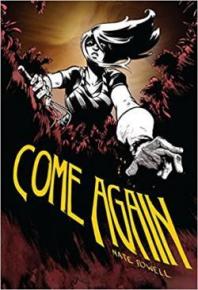
Kate’s Review: “Come Again”

36710841Book: “Come Again” by Nate Powell

Publishing Info: Top Shelf Productions, July 2018

Where Did I Get This Book: The library!

Book Description: The first and only comic book artist ever to win a National Book Award returns with a haunting tale of intimacy, guilt, and collective amnesia.

As the sun sets on the 1970s, the spirit of the Love Generation still lingers among the aging hippies of one “intentional community” high in the Ozarks. But what’s missing?

Under impossibly close scrutiny, two families wrestle with long-repressed secrets… while deep within those Arkansas hills, something monstrous stirs, ready to feast on village whispers.

Nate Powell, artist of the National Book Award-winning March trilogy returns with a new creator-owned graphic novel.

Review: I have read a couple of graphic novels that Nate Powell did the artwork on, and given that one of those was the stupendous “March” Trilogy I hold him in high regard. I first heard about his new graphic novel, “Come Again”, at work, when a coworker had requested it and couldn’t remember why. When she told me what it was about and who wrote it, I requested it myself. Not only was I interested in a supernatural story that takes place on a commune in the fading days of communes, I was also curious to see what Nate Powell would do as a writer as well as an illustrator.

“Come Again” has a number of themes that it addresses, and some of these themes work better than others. I will start with the aspects that I liked, because I liked them a lot. Our main character, Haluska, has lived in an Ozark based ‘intentional community’ (or as some laymen may call it, a commune) with her close friends and son Jake for the greater part of the 1970s. The idealistic 1960s are long over, though when Hal, her ex Gus, and their friends Adrian and Whitney first started living there it was 1971, and the world seemed filled with possibility. Now we are at the end of the decade, and though the community remains it has shrunk considerably, and Hal has been carrying on an affair with Adrian that is based in an underground cave they found in the forest. Their affair doesn’t seem to have much joy or passion to it, though neither seem willing to give it up, even though they have to take it literally underground. Haluska certainly feels guilt, but not enough to end it, and her attachment to a comfortable relationship that may not be what it used to be resonates within the greater storyline. The ideals of the Love movement, and the commune itself, are fading away, and with that change comes uncertainty and the impulse to cling harder to something that may not be there anymore. There was a moment that I found to be quite powerful, when Hal and Adrian go into town to sell goods at a farmer’s market. Their somewhat strained relationship with the ‘traditional’ town has been buoyed by the give and take system they have with each other. But on this specific day, a local band has been booked to perform. They happen to be a punk band, and their angry song of rebellion angers the townsfolk, but connects with Hal in ways she may not totally understand in that moment. Knowing that the 80s are coming, and the cynical and predatory social changes that are in store, it feels like a greater reflection of what’s to come, though Hal may not know it. These aspects of this book, of isolation, and guilt, and the secrets we keep from even the ones we love most, worked supremely well for me.

It was the dark fantasy and supernatural elements that fell a bit flat. There is something living in the cave that Hal and Adrian use, a disembodied voice that sinks into the various pages. After Hal’s son Justin and Adrian’s son Shane find the cave, Shane is lost within the depths, depths that may not be there all the time. This, of course, helps feed into Hal’s guilt about her affair with his father, but then it becomes clear that something supernatural is going on that only Hal can see. While I usually really like strange supernatural elements (and am enough of a ghoul that missing people is a theme that I like), I didn’t feel that this part of the book was as strong as it could have been. We don’t know what it is that is living in this cave, we don’t know why the spell it casts manifests in the way that it does, and as we see the consequences of the disappearance and spell start to unfold, we don’t really get answers as to why or how it’s happening. I understand that ambiguity is a key component of a story like this, and I can appreciate it to a point, but in this story I was left more confused than anything else. It ultimately leads to a sacrifice that Hal has to make, and though I understood the resonance of the sacrifice it also felt a bit like a cop out when it came to her having to own up to some of her past mistakes (and the mistakes that others have made as well). I think if the story had leaned in more to the magical or supernatural system I would have liked that part more, but it could have easily functioned as a historical fiction meditation on self, secrets, and guilt.

But Nate Powell’s style is still very unique and stands out in my mind. I liked seeing how he used shades, shadows, and a semi-realistic stylization to tell this story. I especially liked how the disembodied voice of the monster/whatever was written, in ways that made it seem like it was literally floating on the wind.

comeagain_01
(source)

“Come Again” was a book that didn’t quite give me what I want from the premise and author. It certainly had strong moments, but overall it didn’t have to ghostly oomph I expected.

Rating 6: While I enjoyed the broader themes of isolation, secrets, and guilt, the supernatural elements left much to be desired.

Reader’s Advisory:

“Come Again” isn’t on many Goodreads lists, but it is included on “NPR’s Best Books of 2018”.

Find “Come Again” at your library using WorldCat!

Serena’s Review: “Throne of Jade”

14069Book: “Throne of Jade” by Naomi Novik

Publishing Info: Del Rey Books, April 2006

Where Did I Get this Book: audiobook from the library!

Book Description: When Britain intercepted a French ship and its precious cargo–an unhatched dragon’s egg–Capt. Will Laurence of HMS Reliant unexpectedly became master and commander of the noble dragon he named Temeraire. As new recruits in Britain’s Aerial Corps, man and dragon soon proved their mettle in daring combat against Bonaparte’s invading forces.

Now China has discovered that its rare gift, intended for Napoleon, has fallen into British hands–and an angry Chinese delegation vows to reclaim the remarkable beast. But Laurence refuses to cooperate. Facing the gallows for his defiance, Laurence has no choice but to accompany Temeraire back to the Far East–a long voyage fraught with peril, intrigue, and the untold terrors of the deep. Yet once the pair reaches the court of the Chinese emperor, even more shocking discoveries and darker dangers await.

Previously Reviewed: “His Majesty’s Dragon”

Review: After discovering the absolute joy that was “Hi Majesty’s Dragon,” it was all I could do to wedge in “The Loneliest Girl in the Universe” before going straight to the next on in this series. Already, this series feels like a comfort read, where I know what I’m going to get, to a good extent, and I’m there for it. I can just relax back and enjoy.

At the end of the last book, Temeraire and Laurence discovered that, while they always knew Temeraire was special, he was even more unique than they had thought: a rare Celestial dragon of the sort to only partner with Chinese royalty. His egg had been meant as a gift for Napoleon, but now that they have realized the error, a delegation has been sent to express their insistence that Temeraire be parted from Laurence and returned to China. Refusing to be parted, both dragon and captain must now set off on the long sea voyage across the world. And once arriving at their destination, both are shocked to realize that perhaps there is more to dragon-human relations than they had presumed.

In some ways, I was just as surprised by this book as I had been by the first. In the first, I had expected a lot more military action and was surprised to find such an intense focus on characterization, especially the building relationship between Laurence and Temeraire. But then in the end, we got that great battle scene where Temeraire’s “super power” essentially came to light and I thought “Ok, now we’re going to move into the military action series I had been expecting!” And then I started this book and found…a long sea voyage with political espionage as the main action of the story.

But, as I said, my expectations not being met just turned into yet another delightful surprise once again! I loved the sea voyage. There were a lot of little episodic moments sprinkled throughout that had to deal with Great Britain’s relationship to the slave trade, the relationships between the various military arms (navy vs aerial), cultural distinctions that don’t translate well between countries, and even sea monsters! And many of these domains were made all the more interesting being seen and discussed through the very different eyes of Laurence and Temeraire. Laurence must confront his own assumptions and prejudices, and Temeraire must work through his understanding of humanity, especially as it deals with dragons.

Like Laurence and Temeraire, the reader so far has only been presented with Great Britain’s approach to dragons. While in the previous book Laurence had already challenged a lot of the obvious negatives that popped up, throughout this book, we learn more and more about the true limitations of the Western approach. It was fascinating to explore the cultural differences in how dragons exist in each of these societies.

I also liked the added wrinkle this added to Laurence and Temeraire’s relationship. Temeraire is rightly curious about the country of his origin. And, like I said, he had already been asking questions regarding the limitations and prejudices put upon dragon-kind back in Great Britain, so he is all the more fascinated and intrigued by the freedoms and independence offered in Chinese society. From Laurence’s side of things, however, he also sees a great country in China, but one that has also treated poorly with his beloved Great Britain, and specifically himself and Temeraire. From the comfort and surety of the relationship that was built up in the first book, this one offers challenge upon challenge to both Temeraire and Laurence. Who needs tons of action when you’re on the edge of your seat with worry about how your precious dragon/captain pair are going to make it through this all??

Given the nature of the story and the need to keep some of the mysteries held close until the end of the book, this did read a bit slower than the first. I was fine with it, however, as, like I said, I’m mostly here for the relationship between Temeraire and Laurence. But if you go into this one expecting an uptick in the military action, you’ll probably be disappointed. However, I do feel like there were a healthy number of action scenes that were perfectly sprinkled throughout the story, so I feel like this is only the most nit-picky of nit-picks. If you enjoyed the fist book in this series, I’m sure you’ll love this one too!

Rating 8: An excellent sequel, all the better for once again offering a surprise in the overall direction the series is taking.

Reader’s Advisory:

“Throne of Jade” is included on these Goodreads lists: “Non-Western Speculative Fiction” and “Historical Military Adventure.”

Find “Throne of Jade” at your library using WorldCat!

Serena’s Review: “The Unbound Empire”

40618519Book: “The Unbound Empire” by Melissa Caruso

Publishing Info: Orbit, April 2019

Where Did I Get this Book: ARC from the publisher!

Book Description: While winter snows keep the Witch Lord Ruven’s invading armies at bay, Lady Amalia Cornaro and the fire warlock Zaira attempt to change the fate of mages in the Raverran Empire forever, earning the enmity of those in power who will do anything to keep all magic under tight imperial control. But in the season of the Serene City’s great masquerade, Ruven executes a devastating surprise strike at the heart of the Empire – and at everything Amalia holds most dear.

To stand a chance of defeating Ruven, Amalia and Zaira must face their worst nightmares, expose their deepest secrets, and unleash Zaira’s most devastating fire.

Previously Reviewed: “The Tethered Mage” and “The Defiant Heir”

Review: I have loved this series from the get-go, so it was with very mixed emotions that I picked up and started this book. On one hand, I was dying to know how everything would be wrapped up in one, admittedly long, book. And on the other hand, I didn’t want it to end and had some concerns about whether it would stick the landing. The last book really does make or break a series, and while so far the books have only gotten better and better…you just never know. Luckily, this was a solid landing, and now I’ll just have to wait to see what the author has up her sleeve for a next book/series!

Amalia is coming into her own, heading up her first political action with the introduction of a new law that would grant the magic-wielding Falcons unprecedented freedoms. On top of this all, she is still balancing her complicated feelings for Captain Marcello and the witch-lord Kathe, whom she has been courting for months now. Add to that the mad witch-lord Ruven who is making increasing threats to the Empire and may finally push things to the point where Amalia and Zaira will have to confront the harsh reality of using Zaira’s balefire in combat. But nothing is too great a challenge for a Cornaro. Or is it?

What makes this series special has been the sheer number of points of interest and enjoyment that have pulled me in throughout story. Not only have I enjoyed Amalia as a main character, but I’ve loved her relationship with Zaira. The balance between political and military action has always been on point. The romance has gone in unexpected directions, somehow avoiding gaping pitfalls that many series fall into. And throughout it all, the story tackles larger questions regarding duty, loyalty, and the balance between freedom and safety. This book continued to deliver in all of these areas.

To start with characters (because we all know how much I love character-driven stories), Amalia and Zaira have traversed quite a journey throughout this trilogy and we see the dividends of this slowly built relationship pay off big time in this book. On their own, they are each excellent characters. Amalia’s sense of duty and her clear-eyed vision of her role in the world and the privileges, sacrifices, and burdens that come with it has never been more clear. She is so blessedly free of angst regarding this all. She sees the true dangers of her role (the hardening of one’s heart that comes with making life and death decisions), but doesn’t get caught up in any self-pity or dramatic indecision of the kind that we see all too often from YA protagonists. Zaira, too, is still her prickly self. However, she’s also come to value the relationships she’s built with those around her, and with these connections, she sees her own role in the Empire in a different light. She is still terrified of her balefire and its seeming control over her, but now, with people she loves in danger, she’s willing to risk herself in a way that would never have been true of the self-focused Zaira from the first book.

And together, Amalia and Zaira have come so far. They don’t where BFF bracelets or anything, but the respect and genuine love and friendship between them feels earned and true after the struggles of the first two books. And it’s only through that slow-growth that the almost impossible choices they must face in this book can be believable.

Ruven is also an excellent villain. Not only is he fun to hate, but he is actually given a bit more depth to make him, well, not relatable, but a bit more understandable. And his abilities are legitimately challenging to the point that a way through the threat he presents is never quite clear until the very end, and even then readers are left on the edge of their seat.

And then, of course, we have the romance. In the second book, the author somehow managed to introduce a love triangle that I didn’t hate. I honestly didn’t think this was possible. Much of it comes down to, again, Amalia and her dramatic-free, pragmatic approach to her life and the requirements that come with it. It is believable that she would have feelings for both Kathe and Marcello, and that these feelings could exist at the same time and still be wholly separate from each other. I was incredibly nervous to see how this would ultimately play out, and I was so pleased to find that the resolution presented felt natural and satisfactory. I guess this goes to show that even the most hated tropes don’t always hold true!

This is a long book, however, and it is this length that forces me to drop it down from a perfect 10. There’s a bunch of story here, and it’s not that I was bored at any point. However, especially in the beginning with the ins and outs of Amalia’s political actions to get her Falcon bill approved, there were a few points where I feel like a bit of editing could have been done to streamline the story. When there are all of these greater factors swirling around, this beginning portion almost felt like it was from a different book at times. But not a bad book, even then! Just a different one.

Other than that small, very tiny quibble, I absolutely loved this book and this series as a whole! I so hope that it gets all the attention that it so rightly deserves, and if you haven’t read any of these books yet, just you wait! You have an excellent ride ahead of you!

Rating 9: Perfectly sticks the landing in what turned into one of my favorite trilogies to read in a long time!

Reader’s Advisory:

“The Unbound Empire” is a new book so isn’t on many Goodreads lists, but it is on “Best Political Fantasy.”

Find “The Unbound Empire” at your library using WorldCat!


Serena’s Review: “Through the White Wood”

39735900Book: “Through the White Wood” by Jessica Leake
Publishing Info: HarperTeen, April 2019

Where Did I Get this Book: Edelweiss+

Book Description: Katya’s power to freeze anything she touches has made her an outcast in her isolated village. And when she loses control of her ability, accidentally killing several villagers, she is banished to the palace of the terrifying Prince Sasha in Kiev.

At the castle, though, she is surprised to find that Sasha is just like her—with his own strange talent, the ability to summon fire. Instead of punishment, Sasha offers Katya friendship, and the chance to embrace her power rather than fear it.

But outside the walls of Kiev, Sasha’s enemies have organized their own army of people who can control the very earth. Bent on taking over the entire world, they won’t stop until they’ve destroyed everything.

Katya and Sasha are desperate to stop the encroaching army, and together their powers are a fearsome weapon. But as their enemies draw nearer, leaving destruction in their wake, will fire and frost be enough to save the world? Or will they lose everything they hold dear?

Review: I’ve had some good luck recently with Russian-based fairytale/fantasy novels. Plus, I’m always on the look out for a good standalone as I have way too many series I’m currently invested in. It’s a problem. All of that plus a pretty cover, and I was quick to place a request to read an early coy of this. Ultimately, however, it didn’t live up to all of the expectations I had placed on it.

Katya’s life has been one of fear and isolation, except by the elderly couple who has raised her. One night, her worst fears are realized when she releases her incredible power over ice with horribly destructive results. But her banishment turns out nothing like she had imagined. Instead of punishment, she finds more of her kind, people with incredible powers over elements. Even the Prince of Kiev whose own power over fire seems to perfectly balance her own. Now, not only has she found a place of acceptance, but she finds herself drawn into a greater conflict where her rare abilities may be the turning point that saves her entire nation.

As a pro for this book, the greatest thing that stood out to be was the commitment to the darkness at the heart of Katya’s story and the true danger of her powers. This isn’t just Elsa from “Frozen.” People die when Katya loses control. The original incident that results in her banishment is rightly horrifying, and while yes, she is definitely provoked into it, we see how terrible the results are, not only for the villagers but for Katya herself, as at this point in time, she only has limited control of how her abilities manifest. Then, further into the story, when we begin to hear about the larger threats against the country itself, these incidents aren’t left as purely stories of terrible things happening elsewhere to other people. Again, we see the results of these attacks, and it has a direct impact on Katya and her story. I really appreciated that the author made not only the dangers of Katya’s powers, but the villains themselves, feel more real by raising the stakes in this way.

But other than that, this book simply felt too standard to spark my real interest. Even trying to type out that summary above was a struggle because it just sounds so similar to so, so many stories that are just like it. Ice powers, fire powers, what have you. A book about a teenage girl who has some incredible power, is misunderstood, and then turns out to be the “chosen one” essentially to save a nation? Been there, seen that. Add in a love story with, of course, the prince, and you have pretty much checked off every requirement for the base model of YA fantasy novels.

Katya herself could be incredibly frustrating at times, especially early in the story. Yes, her initial confusion about what is going on and what her role is in everything makes sense. But as the story continues, she bizarrely flips back and forth between being trusting of and then suddenly antagonistic against those around her. And there is never any clear instigating factor behind the switch. It never read as a natural reaction to events happening around her, and instead felt like authorial intervention to add drama.

I also hated the romance. It was a terrible case of instalove where I couldn’t see any true chemistry built between the characters and it happened incredibly fast, especially on Sasha’s side. While Katya is going through her little song and dance of “I like him! I don’t trust him! But he’s great! But no, I must be opposed to him!” Sasha was pretty fully invested in Katya from the start. But…why? Again, no reason is actually presented in the book. We’re simply told that this is how it is.

There was nothing truly bad about this book. But there was also nothing that made it stand out to me. The story felt incredibly familiar. The characters seemed to be just going through the motions that we expect from YA fantasy. And the entire read felt slow and plodding, except for a few instances of action thrown in here and there. I can’t even say the idea behind the book was exceptional, as, like I said, it felt very familiar to many other fantasy YA stories featuring powered young women. If you really love those stories, this is more of the same, and you’ll probably like it. But if you’re looking for a new take on things, this isn’t it.

Rating 6: Pretty much exactly what you’d expect after reading the book description. No surprises here, and that was a bad thing.

Reader’s Advisory:

“Through the White Wood” isn’t on many relevant Goodreads lists, but it is on “2019 Must Read Fantasy.”

Find “Through the White Wood” at your library using WorldCat!


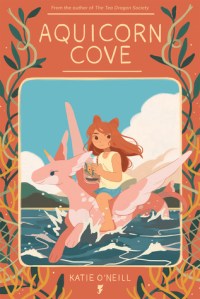
Kate’s Review: “Aquicorn Cove”

36482829Book: “Aquicorn Cove” by Katie O’Neill
Publishing Info: Oni Press, October 2018

Where Did I Get This Book: The library!

Book Description: When Lana and her father return to their seaside hometown to help clear the debris of a storm, the last thing she expects is to discover a colony of Aquicorns—magical seahorse-like residents of the coral reef. As she explores the damaged town and the fabled undersea palace, Lana learns that while she cannot always count on adults to be the guardians she needs, she herself is capable of finding the strength to protect both the ocean, and her own happiness.

Review: When I saw that Katie O’Neill had another graphic novel coming out, I knew, I KNEW, that I had to read it. I loved “The Tea Dragon Society” so very much, and gentle and vibrant cuteness was something that I was needing after a stressful couple of weeks. While aquatic mythical creatures may not catch my attention as much as dragons do (unless it’s a sea serpent, as those are basically water dragons if we’re being honest), the cover alone had me screeching with joy. A girl riding some kind of weird water unicorn Pegasus thing?!

giphy-3
The contrast of this with the horror graphics on my stack was striking. (source)

But the thing that I noticed about “Aquicorn Cove” from the get go is that there is a far more bittersweet undercurrent running through this story than there was with “The Tea Dragon Society”. While the imagery is just as cute and serene as the imagery in that book, the premise here is a bit darker. Lana is a girl whose mother was killed during a violent ocean storm, and that is why she and her father left their hometown in the first place. They are coming back to visit her maternal Aunt Mae as well as clean up the wreckage after another bad storm. Lana has a genuine connection to the ocean like Mae and her mother did, even though being back is painful for her and her father. When she finds an injured baby aquicorn she wants to nurse back to health, her love of the ocean has a tangible element it can attach to. Mae, too, has a connection to the sea, given that she is a fisherwoman and she makes her living because of it, but there is always going to be the painful reminder that the thing she loves took her sister away. They are both coping with the trauma of the loss, but they cope in different ways.

The Aquicorn society that Mae and Lana interact with has it’s own issues that it brings to the story. Aure, the head of the community, has struck up a long time friendship with Mae, as they have helped each other in various ways. Mae has taken objects and products from Aquicorn Cove and has helped her own community thrive. But the give and take relationship has started to crumble, as Aure thinks that the cost for her community has started to become far too great. O’Neill has found a relatable and easy way to show kids the importance of giving back to the environment, and while you understand Mae’s need and want to keep her community alive, you see the cost it has to Aure’s and the reef. There was one panel that is especially relevant where, when pushed back on by Aure, Mae says that her community shouldn’t have to change it’s ways because ‘this is how it’s always been’, and THAT struck a chord. Mae is never presented as a bad person, per se, just someone who is unable to see the consequences that her actions have for others.

The other big theme in this story is the importance of ocean conservation, and how it can be a matter of life and death not only for sea creatures, but for the human communities that live on the seashore. Aquicorn Cove’s reef is sick and starting to die, and without the protection of the reef that can help buffer the strength of ocean storms, the severity on land is becoming more and more devastating. Climate change scientists postulate that storms will become worse and worse as time goes on, and with more of these natural buffers dying off or disappearing the costs and the losses will be higher. At the end of the book O’Neill listed a number of ocean conservation resources, as well as information for the readers on what they can do to help restore the tenuous ecosystems. What I liked about this section was that it was easy to understand for kids, and while O’Neill did simplify it she never made it seem like she was talking down to her readers. She really hits home that we may feel like in our smallness we can’t make a difference, but how we can connect to our community, which can connect to other communities, and how that can help amplify our voices for change. The message was loud and clear, and I really liked it.

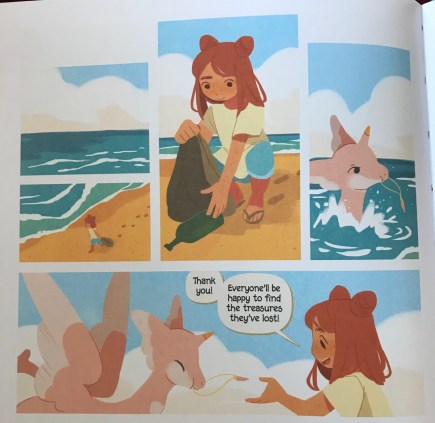
And yes, let’s look at how sweet the drawings are.

IMG_2816
EEEEE!!! (Source: Oni Press)
IMG_2817
It’s just so charming. (source: Oni Press)

The gentle design and all around charming style made the art pop and had me smiling from ear to ear.

“Aquicorn Cove” is another lovely graphic novel by Katie O’Neill, and with it’s important messages and themes it stands out from the crowd.

Rating 7: A cute graphic novel with a resonant message, “Aquicorn Cove” is a sweet story that brings out cute sea creatures and talks about the importance of our oceans.

Reader’s Advisory:

“Aquicorn Cove” is included on the Goodreads lists “Tween Graphic Novels”, and “Comics and Graphic Novels by Women”.

Find “Aquicorn Cove” at your library using WorldCat!

Serena’s Review: “A Curse So Dark and Lonely”

43204703Book: “A Curse So Dark and Lonely” by Brigid Kemmerer

Publishing Info: Bloomsbury YA, January 2019

Where Did I Get this Book: from the library!

Book Description: Fall in love, break the curse.

It once seemed so easy to Prince Rhen, the heir to Emberfall. Cursed by a powerful enchantress to repeat the autumn of his eighteenth year over and over, he knew he could be saved if a girl fell for him. But that was before he learned that at the end of each autumn, he would turn into a vicious beast hell-bent on destruction. That was before he destroyed his castle, his family, and every last shred of hope.

Nothing has ever been easy for Harper Lacy. With her father long gone, her mother dying, and her brother barely holding their family together while constantly underestimating her because of her cerebral palsy, she learned to be tough enough to survive. But when she tries to save someone else on the streets of Washington, DC, she’s instead somehow sucked into Rhen’s cursed world.

Break the curse, save the kingdom.

A prince? A monster? A curse? Harper doesn’t know where she is or what to believe. But as she spends time with Rhen in this enchanted land, she begins to understand what’s at stake. And as Rhen realizes Harper is not just another girl to charm, his hope comes flooding back. But powerful forces are standing against Emberfall . . . and it will take more than a broken curse to save Harper, Rhen, and his people from utter ruin.

Review: So, as always, another “Beauty and the Beast” retelling comes out and I line up obediently to read it. This, if anything, is proof that I am an eternal optimist, as I’ve had pretty poor luck with this particular fairytale and the versions I’ve read. Yes, “Beauty” is and likely will always be one of my absolute favorite fairytale retellings, and I loved “Uprooted.” But from there…maybe a few middling titles, but then it’s straight down to versions that I highly dislike.  So the scale is pretty heavily weighted on both sides of the extreme. Sadly, “A Curse So Dark and Lonely,” while not my least favorite version, joins the ever expanding ranks of disappointments for this story.

In the fairly standard layout of the story, Rhen is our cursed prince, doomed to relive one season over and over again, attempting to win over a new girl every three months. But, what’s worse, his failures don’t simply reset things, but end with his transformation into a terrible beast that kills all those in his path. Harper, a girl growing up in D.C. and with struggles of her own, suddenly finds herself pulled away from her life (one full of its own strife with her ill mother and a brother caught up in crime rings in an attempt to pay off the family debt) and thrust into the middle of this curse, the most recent would-be curse breaker. To make matters worse, this will be the last season and Rhen’s last chance to break the curse and avoid a life ever after as a monstrous beast.

This book has received a lot of positive reviews, so I just want to say right away that there’s a good chance much of what bothered me with this book wouldn’t hold true for others who enjoy YA fairytales. There have been comparison to “A Court of Thorns and Roses,” for example. Which, given the massive appeal of that series, means many will ultimately really like this. I hated ACOTAR, on the other hand, so that comparison might be even more apt. I didn’t hate this book, but it definitely wasn’t for me.

The good thing about this book is that it does what it sets out to do. We have a unique (ish) take on the “Beauty and the Beast” tale that leans into its darker elements (beast!Rhen is truly destructive and dangerous). A heroine who represents those with disabilities in a really great way (she has what seems to be a high functioning version of cerebral palsy). And a story that delivers both action and romance (eventually).

But, for me, it did all of these things in a very “meh” way. The world-building, for one, was an immediate let-down. Emberfall is simply “such and such, generic fantasy world with magic.” There is no real explanation or true creativity behind any of it. The castle itself has some of the standard magical elements that we expect to see (ooooh, musical instruments that play themselves) and even those that we are given are too few and far between. It’s just enough to set the stage as a fantasy land, but not enough to make it stand out in any way from the millions of other fantasy lands we’ve seen.

And when juxtaposed against the “real world,” this lack of world-building is made even more stark. It’s one thing to set a book entirely in a fairly bland fantasy world, but when you have the “real world” as an element in your book and characters from that world, it’s inevitable that the “hows” and “whys” of it all should come more to the forefront. If everyone lives in this fantasy world, there’s more of a “get out of jail free” card in that, naturally, everyone (and thus the reader) would take things at face value. That’s simply not the case when you have “real world” characters who should be asking these questions.

Beyond that, while there was nothing overtly objectionable with Rhen or Harper, neither of them were particularly intriguing either. Obviously, the inclusion of Harper’s disability is an interesting take and, not having any experience with this of my own, seems to be represented well. But that is not enough to make her a fully-fleshed out character. Rhen, too, was just kind of…fine. I just never felt fully invested in either of them, and there wasn’t enough given to either to make them feel like much more than the fairly standard “beauty” and “beast” cut-outs we’ve come to expect.

And, from the get-go, the story set off on the wrong foot. Pretty early in the book, right after Harper is kidnapped and brought to the castle, we start in on the “she’s so different than the other girls” lines of thought. I almost just put the book down at this point for how much I hate this way of writing. For one, it’s lazy. If you can’t make Harper look good without including negative comparisons to “other girls,” than you have a character problem on its own. Beyond that, Rhen is something like 300 years old at this point. So, how many seasons would that be? You’re telling me that in that entire time, girls have been kidnapped from the modern world and ALL of them have only ever been interested in dresses and NONE of them wanted anything to do with daggers or, I don’t know, trying to escape? Not only is this incredibly insulting (especially when it’s linked to another comment about how originally Rhen would ask for beautiful women in particular, so of course they’re also frivolous and, I don’t know, scared of weapons??), but it’s also beyond the point of belief. These women have been kidnapped. There is no way that they all simply got distracted by sparkles and sat around meekly adoring their wardrobes. It’s as if to say that, for women, the standard reaction to kidnapping is complacency, especially if your kidnapper is rich and handsome. And that Harper’s reaction of immediately trying to escape is somehow unique and note-worthy. I could go on and on with my frustrations with this, but I think I’ve made my point and any more would just be indulging myself in ranting.

So yes. This book wasn’t my favorite and sadly joins the list of “Beauty and the Beast” retellings that I won’t be recommending. Like I said, a lot of people have liked this book, so there is definitely an audience for it. But, for me, the world-building and characters were simply too bland to hold my interest and the early introduction of “other women shaming” into the story was an immediate turn-off.

Rating 5: Not for me, alas. Maybe check it out though if you liked ACOTAR?

Reader’s Advisory:

“A Curse So Dark and Lonely” is a newer book, so it isn’t on many relevant Goodreads lists. It is on this one (though I disagree about the “best” in this title): “Best retellings of Beauty and the Beast.”

Find “A Curse So Dark and Lonely” at your library using WorldCat!