Serena’s Review: “The Hippopotamus Pool”

126730Book: “The Hippopotamus Pool” by Elizabeth Peters

Publishing Info: Grand Central Publishing, June 1997

Where Did I Get this Book: audiobook from the library!

Book Description: A masked stranger offers to reveal an Egyptian queen’s last tomb… and Amelia Peabody Emerson and her irascible archaeologist husband are intrigued, to say the least. When the guide mysteriously disappears before he tells his secret, the Emersons sail to Thebes to follow his trail, helped – and hampered – by their teenaged son, Ramses, and beautiful ward, Nefret. Before the sands of time shift very far, all will be risking their lives foiling murderers, kidnappers, grave robbers, and ancient curses. And the Hippopotamus Pool? It’s a legend of war and wits that Amelia is translating, one that alerts her to a hippo of a different type – a nefarious, overweight art dealer who may become her next archenemy!

Previously Reviewed: “The Crocodile on the Sandbank” and “The Curse of the Pharaohs” and “The Mummy Case” and “Lion in the Valley” and “Deeds of the Disturber” and “The Last Camel Died at Noon” and “The Snake, the Crocodile, and the Dog.”

Review: This is the most privileged-person reading problem ever: how do I continue to find creative ways of praising these books and this author without just sinking into repetitive gushing?? It’s problem, people.

Let’s just say that the strengths of this series are just as present in this book as they have been in the many before it. Amelia is ever the entertaining heroine (I’ve been listening to the audiobook version for the past several books, and it’s almost impossible now to separate the Amelia of the page and the Amelia that is brought to life with Barbara Rosenblatt’s expert and canny reading of her). Emerson, an excellent romantic hero, foibles and all.  A mystery, complicated and full of new suspects. Villains, some old and some new.

But I will focus on a few of the newer bits of this story. For one, while there is comfort in the stability of Amelia, Emerson, and their relationship, it’s a nice balance to have it contrasted with the ever-evolving lives of their children. Ramses and Nefret are now teenagers, Ramses on the young teen side and Nefret right smack in the middle, an especially complicated age for a young woman of fortune.

For his part, Ramses is beginning to evolve his relationship from child-with-adults to putting out feelers establishing himself as an independent entity. His changing relationship with his parents is perfectly illustrated in small changes (calling them “mother and father” rather than “mama and papa”). But also comes into play in larger ways as he pushes for independence and respect. However, Ramses’s relationship with them is firmly bound in familial love and respect. So these struggles often present themselves instead in strained interactions with his “sister” Nefret.

The two are at a perfect point for frustration. Sixteen and fourteen are around the exact ages when two years represents a world of difference and both the older and younger sibling struggle. In this case, it is all the more challenging in the fact that while Nefret has been adopted by the Emersons, she is not their natural born daughter.

Peters strikes the perfect balance in this sibling relationship. They bicker and argue like all the best siblings, but there is also a clear underlying tension in the knowledge of their non-typical family relationship. Further, Nefret is still adjusting to life in British Society, with all of the ridiculous rules and impositions that come with it. Yes, she’s growing up with a “mother” who shirks much of this (lucky for Nefret!),  but society itself has a way of pushing back, this time in the form of “suitors.”

I particularly loved Amelia’s attempts to parent a young daughter. She went from having one child, a very non-typical boy, at that. To having a pre-teen daughter who came with the added complications of being smart, headstrong, beautiful, and an heiress. But like anything, Amelia is up to the task. Theirs is a very nice example of female relationships, both maternal and friendly.

As I said, most of these stories come with the addition of new characters and you never quite know which ones are “one offs” or which are there to stay. We had Nefret introduced recently, but Peters wasn’t done there! Here we have the addition of David, a young boy (around Ramses’s age) who is loosely related to Abdullah, but through various mishaps has lead a life estranged from his family and raised to a life of crime. This will not do, of course! Particularly since Ramses forms a close, brotherly bond with David throughout this book. I feel confident that David is a character that is here to stay, and I’m excited to see what role he falls into in this strange family.

Beyond characters, this story is one of the first in a while to truly delve into a major dig, this time with the discovery of a queen’s tomb. While Egyptology is always important to these stories, there are varying degrees in each. I very much enjoyed having another mystery focused so closely on a dig.

Lastly, this book tackles some difficult topics with the sudden death of Evelyn and Walter’s infant child. Through Amelia’s eyes we see Evelyn’s struggle with this loss, the strain that is put on her and Walter’s marriage, and the process of living through grief. This also leads to Evelyn and Walter playing a much larger role in this book than they have for quite a long time. While the reason was tragic, I loved having these two characters back in a book. Evelyn especially. Not only does Amelia’s relationship with her lead to a deeper exploration of loss and depression, but Evelyn also rises through it into a role that was surprising and fun to read. Walter, on the other hand, had moments where I wanted to slap him upside his head. I can’t quite remember whether he always had some of the tendencies he put on display in this book, or whether this is evidence of Peters evolving his character over time and through experience. Don’t get he wrong, however, I still finished the book enjoying his character.

Well, hopefully I managed to cover some new ground in my praise of this book! But really, I’ll take the challenge of tricky reviews for the assurance of enjoyable novels any day. For fans of the Amelia Peabody mysteries, this is yet another to check out!

Rating 8: Yet another excellent story. This one tackles some tough issues, but handles them well and introduces another (hopefully!) main character.

Reader’s Advisory:

“The Hippopotamus Pool” is included on these Goodreads lists: “Regency and Victorian Mysteries” and “Archaeology Novels.”

Find “The Hippopotamus Pool” at your library using WorldCat.


Book Club Review: “Word By Word: The Secret Life of Dictionaries”

30781490We are part of a group of librarian friends who have had an ongoing bookclub running for the last several years. Each “season” (we’re nerds) we pick a theme and each of us chooses a book within that theme for us all to read. Our current theme is a “Dewey Call Number” theme. This book comes from a Dewey Decimal Call Number range, and has to fit the theme of that range.
For this blog, we will post a joint review of each book we read for bookclub. We’ll also post the next book coming up in bookclub. So feel free to read along with us or use our book selections and questions in your own bookclub!

Book: “Word By Word: The Secret Life of Dictionaries” by Kory Stamper

Publishing Info: Pantheon Books, March 2017

Where Did We Get This Book: The library!

Dewey Decimal Call Number: 400s (Language)

Book Description: Do you have strong feelings about the word “irregardless”? Have you ever tried to define the word “is”? This account of how dictionaries are made is for you word mavens. 

Many of us take dictionaries for granted, and few may realize that the process of writing dictionaries is, in fact, as lively and dynamic as language itself. With sharp wit and irreverence, Kory Stamper cracks open the complex, obsessive world of lexicography, from the agonizing decisions about what to define and how to do it, to the knotty questions of usage in an ever-changing language. She explains why small words are the most difficult to define, how it can take nine months to define a single word, and how our biases about language and pronunciation can have tremendous social influence. And along the way, she reveals little-known surprises–for example, the fact that “OMG” was first used in a letter to Winston Churchill in 1917.

Word by Word brings to life the hallowed halls (and highly idiosyncratic cubicles) of Merriam-Webster, a startlingly rich world inhabited by quirky and erudite individuals who quietly shape the way we communicate.

Kate’s Thoughts

So it will surprise no one here that I love to read. What may surprise people is that even though I love reading and the words that ultimately come with it, I don’t have much interest in the history or said words. When this was picked for book club, I will totally own up to the fact that I basically groaned internally. I have a hard enough time with non fiction as it is (unless it’s narrative, memoir, or true crime), so I worried that this would be a terribly boring slog to get through. The good news is that I wasn’t totally correct in this. The bad news is, like the scorpion in that old folktale, it’s in my nature to have a hard time with this kind of book no matter how engaging it is.

But I’m going to focus mostly on the good since the bad isn’t any fault of Stamper’s. “Word By Word” was a well done, and at times quite funny, overview of what it’s like to work at Merriam-Webster, and the intricacies that go into adding words to and defining words for a dictionary. I guess that until I read this book it never occurred to me that there would be questions and consistently changing definitions to words, or that sometimes it can take months to settle on a most representative definition. Stamper not only talks about what it’s like to work at Merriam-Webster in this capacity, she also talks about how people like her have to take so many different variables into account just to function in the best way possible. For some, some of the most interesting concepts were focused on how society perceives dictionaries, and how they actually are supposed to function. Within this was the authority myth, in that if a word is defined one way in the dictionary, this is the bottom line because the dictionary said so. Stamper points out that this just isn’t the case; dictionaries are not supposed to be authorities on definitions, they are merely there to record and relay these definitions. Language is always changing, and therefore the meanings of words are changing too.

My reservations and hesitations about this book (aka why it was a slog) was going back to my nature: I am very picky about my non fiction. I merely want to reiterate that for my ultimate rating, because it was based on form, not substance. This book also gave our book club a LOT to talk about, which was really, really excellent. So while “Word By Word” wasn’t really my cup of tea, I can see it being very appealing to a lot of people who aren’t me.

Serena’s Thoughts

As evidenced by the content of this blog, neither Kate or I are big nonfiction readers. If anything, Kate is more of a nonfiction reader than I am, and as seen in her thoughts above, she’s still not that into it. At least she has true crime to back her up as not completely stuck in the “fiction only” section that I am. I don’t think I’ve reviewed a single nonficton book on this blog. I don’t say this out of pride or anything. I really wish I liked nonfiction more than I do. There are a few exceptions to this, but usually it’s when books are thrust upon me my trusted friends and family. So, while I would never have picked up this book on my own, I’m so glad that our fellow bookclub librarian, Katie, recommended it! I found myself very much enjoying it, and while it isn’t changing my mind on nonfiction as a whole, that’s too big of an ask for any book.

I’ll also confess that I didn’t read this book in the traditional front-to-back method, and I really think this is one of the reasons I enjoyed it more than I would have otherwise. Instead, I picked a chapter here and a chapter there, skipping forward and backward through the book based on my interests. For example, I started with the “irregardless” chapter, because, yes, that word and all the controversy around it does intrigue me! From there, I found myself in a chapter document acronyms and how rarely the much bandied explanations for words’ origins having to do with acronyms is true. We’ve all probably heard of some acronym for the “f” word, for example. The author does an excellent job exploring why acronyms are so rarely involved with a word’s definition.

As I read, I mostly found myself gather ammo for word-related conversations. As a librarian and book lover, these are the exact sorts of disagreements and discussions that I regularly find myself in, and I loved getting some more detailed background knowledge on my side going forward. As Kate said, for this reason, I’m sure, our bookclub probably had more to say with regards to this book than we’ve had for many other books recently. In this way, this book is an excellent choice for other bookclubs out there. Especially for those that have members who may not be totally bought into nonfiction. I recommend my reading strategy, specifically, for those folks. I think I had an easier time than Kate just because of this. By hopping around, picking it up to read a chapter here and a chapter there, I never had to confront the general dismay about the long slog ahead that results from starting in the beginning, especially starting with a non-enthralled position.

I also really think that had I not found my calling as a librarian that working on a dictionary like this like may have been another dream job. I had an assignment in a publishing class back in undergrad to create an index for a book, and similar to that, dictionary work seems appealing nit-picky and focused on organization. I also would have had a lot of fun writing snarky answers to the people who wrote in with complaints about the inclusion of the word “irregardless” in the dictionary. Really, could I just have that job? Answering dictionary-related complaint mail?

Kate’s Rating 6: An enlightening examination of how dictionaries are compiled and the role they play, as well as fascinating questions raised about language in modern society. It was a bit of a dry read for me at times, but overall a worthwhile one.

Serena’s Rating 8: I was shocked by how much I enjoyed this! There was a lot of history of words and details of dictionary work that I didn’t know, and by reading it one chapter at a time I was able to hold off my own non-fiction antipathy.

Book Club Questions

  1. Were you surprised about anything about this job? Would you want it?
  2. Grammar snobs: heroes or obnoxious?
  3. What do you think about the social justice implications of language/dialects?
  4. Does the history of words, or etymology, interest you? Why or why not?
  5. What words do you hope get added to future dictionaries?

Reader’s Advisory

“Word For Word: The Secret History of Dictionaries” is on the Goodreads lists “Microhistory: Social Histories of Just One Thing”, and “Best Non-Fiction Books About Books and Reading”.

Find “Word For Word: The Secret History of Dictionaries” at your library using WorldCat!


Kate’s Review: “Into the Drowning Deep”

34523174Book: “Into the Drowning Deep” by Mira Grant
Publishing Info: Orbit, November 2017

Where Did I Get This Book: I received an ARC from the publisher.

Book Description: Seven years ago, the Atargatis set off on a voyage to the Mariana Trench to film a “mockumentary” bringing to life ancient sea creatures of legend. It was lost at sea with all hands. Some have called it a hoax; others have called it a maritime tragedy.

Now, a new crew has been assembled. But this time they’re not out to entertain. Some seek to validate their life’s work. Some seek the greatest hunt of all. Some seek the truth. But for the ambitious young scientist Victoria Stewart this is a voyage to uncover the fate of the sister she lost.

Whatever the truth may be, it will only be found below the waves.

But the secrets of the deep come with a price.

Review: A special thanks to Orbit for providing me with an ARC of this book!

I’ve come to learn many truths within this literary world, and one of those truths is that if you want some well plotted out techno-horror, Mira Grant is the person to go to. I’ve mentioned her “Newsflesh” Series here before, and I reviewed the most recent book “Feedback”, as well as her short story “Final Girls”. Basically, Mira Grant is one of the most original and fun tech horror writers out there, and she needs more attention. I will admit that I went into “Into the Drowning Deep” with little knowledge about it. So imagine my surprise when early on it became quite clear what kind of story I was getting myself into.

Killer. Mermaids.

giphy1
BEHOLD, I BRING TIDINGS OF GREAT JOY! (source)

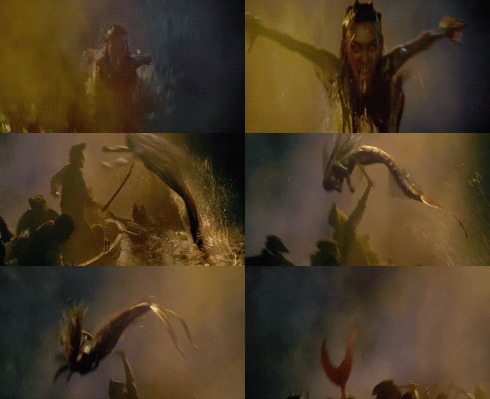
I mean, honestly, at this point she had me and I was guaranteed to give it a solid review. But let’s talk about why I liked this book so much, beyond mermaids disemboweling people. To start, the plot is exciting and interesting from the get go. While we don’t see much about the ‘doomed voyage’ of the Atargatis (but if you want to, the prequel story “Rolling in the Deep” is about that voyage), we do get to see those who have been affected by it and their motivations for wanting to follow up with it. The range of reasons is wide for our characters. For Tory it is because her older sister was the media face for Imagine, the network that sent the movie crew out to the Mariana Trench in the first place. Tory is an Ahab-esque character, though far more likable. She has a vendetta out for whatever killed her sister Anne (in “Rolling in the Deep”), and her pain and rage makes her a very human and sympathetic person to follow. You also have Dr. Jillian Toth, who is an Academic who has always believed in mermaids. This is both a validation of her work, but also a painful reminder that her enthusiasm and certainty of their existence was one of the motivators that sent the Artagatis out in the first place. Along with that is the fact her estranged husband Theo is on board too, who left his conservation activism life after an accident left him in chronic pain…. and joined Imagine as a suit. And you have Olivia, the new face for Imagine Entertainment, who finds herself in a mutual attraction with Tory, even though she has the job that Anne had. Which, of course, leads to some angst for Tory. You also have big game hunters, cryptozoologists, scientists, and others that round out our cast, all of them feeling very real and human, a skill that Grant has always had a knack for.

Grant is known for bringing a certain amount of fascinating at at times ‘hard’ (at least for me!) science into her horror stories. As someone who isn’t terribly science minded, she manages to make some pretty complex (to me) concepts and break them down for the average person like me, and to effortlessly weave them into her story lines without forcing them to fit. In “Into the Drowning Deep” that science is climate change, and how it could potentially change our oceans, as well as potential technology that could come forth because of it. “Into the Drowning Deep” takes place in 2020, and works under the assumption that in a mere four years things will be getting to the point of dire, ocean ecosystem wise, and this book brings up these ideas while incorporating them into the greater plot. She also peppers a lot of the story with facts about the ocean and sea life, and this fan of Monterey Bay, California was pleased as punch that a lot of the action at the beginning takes place there. Grant’s science has always been a bit of a trademark, and this book continues that grand tradition.

And even though perhaps the idea of ‘killer mermaids’ sounds silly to you, this book is so well done that it completely sells it. Grant does a great job of giving these mermaids an evolutionary basis, and finds them a place in the ocean ecosystem that makes them seem like they could, in fact, exist. The slow build of found footage descriptions to the reveal of the deadly mermaids deep under the sea, all the way to the inevitable slaughter had me flipping through the pages quickly, needing to find out what comes next. While this book could have come off as cheesy, it never does, and the stakes are high as Grant holds no sacred cows, character wise. You have to go into a Grant book assuming that at LEAST one of your favorite characters isn’t going to make it out alive, and even knowing this I still was caught off guard and saddened by a few of those who become mermaid chow.

“Into the Drowning Deep” was a scary and entertaining read that I had a hard time walking away from. Mira Grant is absolutely one of those authors who I am always going to be on the look out for, and I hope that the wait for the next in the series isn’t that long. I think that the literary world could use more killer mermaids, and I can’t wait to see where Grant takes them next.

Rating 8: A fun, frightening romp through the dangers of the ocean, “Into The Drowning Deep” kept me on the edge of my seat and a smile on my face. Bring on more killer merfolk!

Reader’s Advisory:

“Into the Drowning Deep” is a new book and not on any relevant Goodreads lists. But I think that it would fit in on “Oceanic/Marine Science Fiction”, and “Sea Monster Books!”.

Find “Into the Drowning Deep” at your library using WorldCat!

Kate’s Review: “New Super-man: Made in China”

33232743Book: “New Super-man (Vol.1): Made in China” by Gene Luen Yang, Viktor Bogdanovich (Ill.)
Publishing Info: DC Comics, June 2017

Where Did I Get This Book: The library!

Book Description: #1 New York Times best-selling author and National Book Award nominee Gene Luen Yang continues his work at DC with New Super-Man, Volume 1, a part of DC Universe: Rebirth!

An impulsive act of heroism thrusts an arrogant young man into the limelight of Shanghai as China begins to form its own Justice League of powerful heroes. As the government creates their own Superman, will they live to regret the person they’ve chosen? Rising from the ashes of Superman: The Final Days of Superman and the death of the Man of Steel, will this New Super-Man step up to the challenge, or be crushed under the weight of his hubris and inexperience? 

Award-winning writer Gene Luen Yang (American Born Chinese, Superman) and on-the-rise art star Viktor Bogdanovic (Batman: Arkham Knight) introduce readers to Kong Kenan, an all-new superhero who could change the world…or be the end of it, in New Super-Man, Volume 1.

Review: For those of you keeping track, one of the best moments that I had at the ALA Annual Conference this year was getting to hear Gene Luen Yang speak about his career and his “Reading Without Walls” Initiative. Yang has written some of the best graphic novels I’ve read, and I was thrilled to hear that he not only really likes Superman, but writes Superman stories for DC. He focuses on the idea of Superman as an immigrant, and when he was writing Superman stories before this new endeavor the question of identity was a huge theme in those arcs. But now with Rebirth, Yang is doing something different: He’s writing a new Superman story, with whole new characters. Was I skeptical? I mean, kinda? After all, isn’t Clark Kent Superman? But I also knew that Yang is super awesome, so skepticism aside, I was all over getting my Superman loving mitts all over it.

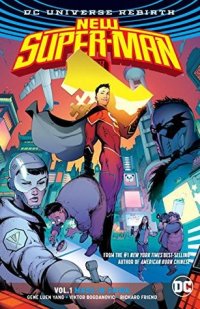
One of the things that “New Super-Man” does right is the origin story. Instead of giving Clark Kent a completely new origin, or getting rid of Kent to make room for a new person to take over the Superman mantle, Yang goes in another direction. Kong Kenan is a regular teenage boy in Shanghai, China whose random and out of character act of heroism gets the attention of Dr. Omen, a scientist for the Chinese Government. China has decided that it wants to have a group of superheroes not unlike America’s Justice League, and Kenan is recruited to be Super-Man. One super science experiment later, and he is given super human powers. Sometimes I have a hard time swallowing it when old secret identities are swept aside for new ones, but when they’re done right I think they can be great. Yang does it so right. It not only avoids a new character being shoe horned into a role that’s already been well defined, but it also gives the familiar role, i.e. Superman, a new mythology that is more about expanding mythos instead of changing it.

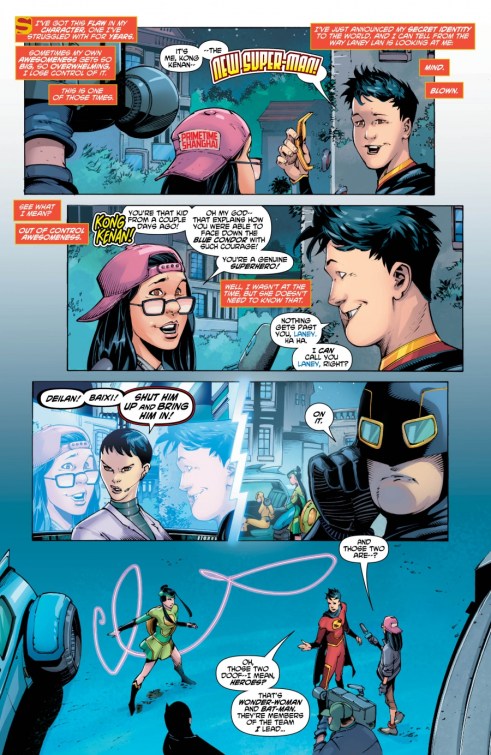
Kong Kenan himself is a very complex and interesting character. When we think of Superman we tend to think of earnest and loyal and dutiful Clark Kent, an all American hero and Boy Scout. With Kenan, well, it’s a little different. He’s not a bad person at all, but he is definitely flawed. He’s kind of a bully, as we meet him bullying a classmate (whose father is the CEO of an airline, the airline that Kenan’s Mom was on when her plane went down), and then acting like a bravado filled narcissist for the TV cameras. But he is also desperate to impress his father, who is an outspoken critic of the Chinese Government who has been emotionally shut off ever since his wife died. It isn’t exactly the environment of Ma and Pa Kent, but it does give Kenan some difficult emotional issues to work through. His Super-Man powers are freeing for him, which is kind of a fascinating dichotomy when compared to Clark, who has always had an underlying sense of Otherness because of them. But I also really liked that we didn’t just get Super-Man, but we also get Bat-Man and Wonder-Woman, as China wants their powers too. Wang Baixi is a chubby tech nerd who has taken on the Bat-Man cowl, and I love his dry with and quiet seriousness. But Wonder-Woman is the most fascinating, as Peng Deilan is very determined and willing to call Kenan out on his nonsense as well as being a moral center in a lot of ways. She feels like the true leader of the team, and I want more more MORE of her in later issues. And yes, there is a Lois Lane equivalent, which is definitely important! Her name is Laney Lan, and she’s very adorable. And it’s refreshing that she actually doesn’t seem to hold any torch for Super-Man, at least not yet. Don’t get me wrong, they should probably absolutely be together, but she’s very focused on getting the story and not the superhero.

I also greatly enjoy the art in this series. I’m so used to Yang’s own artwork, but it wouldn’t really fit for the superhero/DC aesthetic. Viktor Bogdanovich’s artwork definitely feels more comic book-y, and I love the vibrant splashes of color and the vibrancy. I love the greens and reds and blues, and love how the characters tread the line of realism and pure comic pop.

nsm_3_1
(source)

I am so excited to see where Yang takes his characters in this take on Superman! I knew that I didn’t have to worry, but it’s still great knowing that he’s really doing the original story all the justice in deserves.

Rating 8: An action packed and fun filled ride, “New Super-Man (Vol.1): Made in China” is a creative and splendid new take on the Superman story.

Reader’s Advisory:

“New Super-Man (Vol.1): Made in China” isn’t on any relevant Goodreads lists at the moment. But I think that it would fit in on “Diverse Heroes in Comics/Graphic Novels”, and “Comic Creators of Color”.

Find “New Super-man (Vol.1): Made in China” at your library using WorldCat!

Serena’s Review: “Weaver’s Lament”

31375770Book: “Weaver’s Lament” by Emma Newman

Publishing Info: Tor, October 2017

Where Did I Get this Book: NetGalley

Book Description: Charlotte is learning to control her emerging magical prowess under the secret tutelage of Magus Hopkins. Her first covert mission takes her to a textile mill where the disgruntled workers are apparently in revolt.

But it isn’t the workers causing the trouble. The real culprits are far more extranormal in nature.

And they have a grudge to settle.

Previously Reviewed: “Brother’s Ruin”

Review: The second novella in Newman’s “Industrial Magic” series see Charlotte still learning to control her powers in the hopes of avoiding life in the restrictive, but privileged, Royal Society. Her brother, however, has been recently admitted to the Society, and is beginning to run into problems of his own. There is something going on at the textile mill that he has been tasked to oversee. He recruits Charlotte to work undercover and discover what is going on. But what she finds is more than he expected, or either of them wanted to know. “Weaver’s Lament” raises all the stakes, and I found myself enjoying it even more than I did the first!

Charlotte, as ever, is an excellent protagonist. She’s capable, curious, and still a bit naive about the Royal Society and, especially, the role her brother is now playing by being involved within it. I had a fairly good understanding of her motivations and character from the first book, and this one simply built upon what we already knew. More and more, we understand why she resists joining a society that in many ways would elevate her to a life of riches and success. But her characterization wasn’t one of the stumbling blocks I found in the first story.

After reading the first book, most of my confusion and qualms came from not understanding who I was supposed to be rooting for among the cast of secondary characters. Charlotte’s own confusion here didn’t help. But as this story moves along, I was relieved to see that, while Charlotte may still have the wool pulled over her eyes, we, as readers at least, are beginning to understand the roles these other characters play in her life. Specifically, we begin to see the true colors of her brother Ben and Mage Hopkins, the member of the Royal Society who has been training Charlie over the last several months. At the same time, as we begin to understand the motivations, priorities, and loyalties of these two men, we are still seeing them through Charlotte’s eyes and her perspective is very much colored by her experiences and wishes. She wants her brother to be the same man he was when he left, and even her evaluation of the man he was then is forever seen through the lens of her love for him as a sibling. Mage Hopkins, too, is both the man who is training her as well as her greatest liability for being turned in to the Royal Society should he ever suspect that her training is not enough to keep her from going “wild.”

The primary mystery was also very compelling. Not only did it expose more tidbits of knowledge of how the magic system in this world works, but we saw how the Royal Society uses its magic in industrial work like the textile mill. But the other half of the story is the more human one: Charlie’s shock and horror at the conditions of the mill workers and, at best, the complacency of those in power to the situation. At worst, she finds active participation and collusion.

We also learn more about what it means for an untrained mage to “go wild,” as Charlie struggles to hold herself and her power in check. But even as she discovers the price that comes with remaining free, she, and the reader, begins to question the truth behind any of it. There were a couple surprises wrapped up in this aspect of the story that added new layers to the fantasy aspects of this world. I’m excited to see where Newman is going with all of this.

There’s a lot going on in a very short book, but I thoroughly enjoyed every aspect of it. My only criticisms would come down to a writing style that at times felt stunted, perhaps due to the constraints of the shorter page count. But this by no means hindered my reading experience, and I would highly recommend both this book, and the previous novella, to any fans of historical fantasy fiction or steampunk fantasy.

Rating 8: It’s always thrilling when a second book out performs the first, and here we really see Newman coming into her stride with this series!

Reader’s Advisory:

“Weaver’s Lament” is a newer book and isn’t on any Goodreads lists, but it should be on “Gaslamp Fantasy.”

“Weaver’s Lament” does not yet have a library catalog entry, but request it from your local librarian!

Serena’s Review: “The Dire King”

31438747Book: “The Dire King” by William Ritter

Publishing Info: Algonquin Young Readers, August 2017

Where Did I Get this Book: the library!

Book Description: The fate of the world is in the hands of detective of the supernatural R. F. Jackaby and his intrepid assistant, Abigail Rook. An evil king is turning ancient tensions into modern strife, using a blend of magic and technology to push Earth and the Otherworld into a mortal competition. Jackaby and Abigail are caught in the middle as they continue to solve the daily mysteries of New Fiddleham, New England — like who’s created the rend between the worlds, how to close it, and why zombies are appearing around. At the same time, the romance between Abigail and the shape-shifting police detective Charlie Cane deepens, and Jackaby’s resistance to his feelings for 926 Augur Lane’s ghostly lady, Jenny, begins to give way. Before the four can think about their own futures, they will have to defeat an evil that wants to destroy the future altogether.

Previously Reviewed: “Jackaby,” “Beastly Bones,” and “Ghostly Echoes”

Review: “Ghostly Echoes” did a nice job of tying together all the pieces methodicly laid out in the previous two books. More than that, it gave us some much needed history for many of our main characters, as well as, importantly, the villain. The stage was set, and all that remained was whether or not Ritter would be able to balance the light tone and quirkiness at the core of the series with this more serious plotline. The answer is mostly! While there are spots that I believe could have been improved or more fleshed out, I’m happy to report that I finished this book, and this series, pleasantly satisfied.

There was a lot to get done in this book. The supernatural world has been exposed to the general public, once and for all. The series “big bad” is gearing up to make its move. And there are two romantic plotlines that needed to be handled, both with fairly large obstacles standing in there way. Charlie is still a wanted man for this actions back in book one that exposed his identity as a shapeshifter. And now, in a city that is spooky at the barest hint of the strange, his position and future are all the more uncertain. And Jenny, while making great strides forward with her ability to function more fully in the living world, is still, well, a ghost.

After learning that his wife is a supernatural being who has been operating behind the scenes for years in the service of her villainous leader, the governor of New Fiddleham is not messing around. But with this new found belief comes fanaticism, and Abigail and Jackaby are horrified to see the city’s jail cells filling up with all manner of innocent, supernatural beings. It’s a literal witch hunt. I very much enjoyed this portion of the story. Many of the side characters we’ve met throughout this series were either already familiar with the supernatural world, or, for whatever reason, more open-minded to the positive aspects of these beings. Here, we see the negative side of humanity when confronted with beings they don’t understand, and I think this balance added a healthy dose of realism to a series that could, at times, veer into the twee with its characters.

I also very much enjoyed the exploration of the two main romantic plotlines to the story. Jenny and Jackaby’s relationship has been later to the show, and while I’m still not convinced that this was a necessary addition, I was pleasantly surprised with the way this played out. Importantly, Jackaby’s utter cluelessness wasn’t undercut by his being turned into a second romantic hero. While I may still have preferred the series to have left his character single in the more traditional “Sherlock Holmes” manner, I was satisfied with what Ritter did with him here.

Abigail and Charlie, however, have been slowly building towards this point throughout the series. They have had to confront not only the challenges of Charlie’s public image issues, but also explore the balance between their personal and professional lives. It was fun seeing these two work together on a case in this book, witnessing the fact that they work together not only as romantic interests, but as equals who respect what the other brings to the table.

The larger story, that of the Dire King himself, was also very intriguing. The fae world was blown out and we see that up to this point we, and the characters, have mostly been operating in a tiny slice of this strange and complicated world.

The story concludes on a bitter sweet and more serious note than I had expected. But I found this to be particularly refreshing. When I picked up this book, it took me a bit of time to again slip into the particular tone of this series. All four books have been written in a rather simple style, often playing with words and phrases in a comedic way. This style, while fun, also tends to undercut more serious moments in the story, and knowing that this was the conclusion to the series, I was a bit more put off my this lightness when dealing with these more serious issues. However, Ritter doesn’t shy away from consequences in this book, light writing tone or no light writing tone.

All in all, I very much enjoyed this book and the series as a whole. Definitely check it out if you enjoy re-imagingings of Sherlock Holmes type characters, and historical fantasy. The writing style is on the lighter side, however, something that may read as strange to fans of adult fiction. But keep an open mind! For all of its quirkiness, there are real monsters hidden in this text!

Rating 8: A great conclusion to a unique, creative series!

Reader’s Advisory:

“The Dire King” is included on this Goodreads list: “Teen & YA Detective Mysteries.”

Find “The Dire King” at your library using Worldcat!

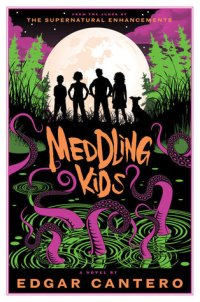
Kate’s Review: “Meddling Kids”

32905343Book: “Meddling Kids” by Edgar Cantero
Publishing Info: Doubleday Books, July 2017

Where Did I Get This Book: The library!

Book Description: For fans of John Dies at the End and Welcome to Night Vale comes a tour de force of horror, humor, and H.P. Lovecraft. The surviving members of a forgotten teenage detective club (and their dog) must reunite as broken adults to finally solve the terrifying case that ruined them all and sent the wrong man to prison. Scooby Doo and the gang never had to do this!

1990. The teen detectives once known as the Blyton Summer Detective Club (of Blyton Hills, a small mining town in the Zoinx River Valley in Oregon) are all grown up and haven’t seen each other since their fateful, final case in 1977. Andy, the tomboy, is twenty-five and on the run, wanted in at least two states. Kerri, one-time kid genius and budding biologist, is bartending in New York, working on a serious drinking problem. At least she’s got Tim, an excitable Weimaraner descended from the original canine member of the team. Nate, the horror nerd, has spent the last thirteen years in and out of mental health institutions, and currently resides in an asylum in Arhkam, Massachusetts. The only friend he still sees is Peter, the handsome jock turned movie star. The problem is, Peter’s been dead for years.

The time has come to uncover the source of their nightmares and return to where it all began in 1977. This time, it better not be a man in a mask. The real monsters are waiting.

With raucous humor and brilliantly orchestrated mayhem, Edgar Cantero’s Meddling Kids taps into our shared nostalgia for the books and cartoons we grew up with, and delivers an exuberant, eclectic, and highly entertaining celebration of horror, life, friendship, and many-tentacled, interdimensional demon spawn.

Review: Though I was definitely more of a “Pup Named Scooby-Doo” viewer as a child, “Scooby-Doo, Where Are You?” was definitely a show that I was pretty familiar with thanks to visits to Grandma’s house and the local video store. I can’t say that I have a huge nostalgia for it, but it’s enough of a cultural icon that I am familiar with it and all the references, tropes, and influences that come with it. When my friend David sent me this book title on Facebook, I was immediately intrigued. Given that I love send ups of classic shows like “The Venture Bros”, “Sealab 2021”, and “Harvey Birdman: Attorney At Law”, I was stoked to see that FINALLY someone decided to take on “Scooby-Doo, Where Are You” and add in some Lovecraftian horror elements to boot.

giphy
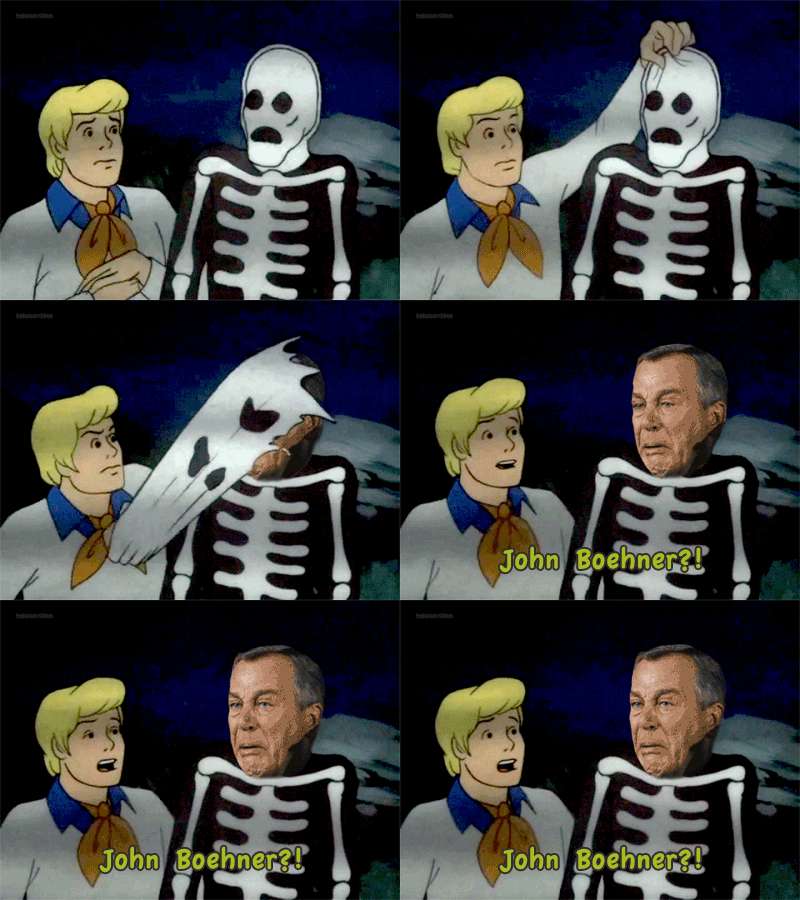
The start of way too many “Scooby-Doo” gifs. (source)

To start, I really enjoyed how Cantero took the characters that we are oh so familiar with and gave them some serious issues, issues that would make perfect sense for a bunch of kids who chased after criminals. Meet the Blyton Summer Detective Club: Kerri (Velma) was an incredibly smart girl, a genius, but has ended up an alcoholic tending bar. Andy (I think she’s supposed to be a inverted Daphne? She doesn’t really fit) was the tomboy of the group, who went on to get military training but is now on the run from the law. Nate (Shaggy) was the geeky and carefree one, but has voluntarily committed himself to Arkham Asylum (of Lovecraftian fame, not “Batman”)… Mainly because he keeps seeing Peter (Fred), who died of a drug overdose a few years prior. Throw in Tim (Scooby-Doo), the canine descendant of their original group, and there you have it. I liked how Cantero explored the damages that their friendship and group wrought upon them. Seeing all of these broken people try to come back together to fight the one case they didn’t quite solve was bittersweet and heavy, and I really appreciated that Cantero explored how a scenario like this may go. Kerri and Andy have a deep bond, stemming from childhood when Andy was almost in love with Kerri, and seeing them reconnect is very sweet, even if it feels like doom could come for them at any time. Nate’s struggle with his mental illness is also very revealing, though at times you are kind of wondering if maybe Peter’s ghost really is with him. After all, if monsters are real, why not this? They all need each other as much as they wish they didn’t, and that was both lovely and tragic because at the heart of it they are all survivors of a terrible trauma, and they need to confront it before they can move on with their lives. Cantero does a great job of reminding us that they were kids when this terrible stuff happened to them, and that sometimes you can’t just walk away and that’s the end of the story. Sometimes it’s not just a kook in a mask.

giphy1
This is so dated but I had to. (source)

I also really liked that Cantero has taken the ol’ chesnut that is Lovecraft and has applied it to this kind of story. Given that the original “Scooby-Doo” always ended with the villain being a plain old person in a mask, for them to be facing actual monsters and magic is SUPER fun, and at times genuinely creepy. From lake monsters that decompose at an alarming rate to mysterious books and words in an attic, Cantero has really taken the inter-dimensional horror theme and given it a fun little spin here. It’s meta as well as creepy and weird, and it’s just different enough that I wasn’t feeling like he was trying too hard to make two different themes fit together. He also did a good job of retaining the plausible explanation theme, as while a guy in a mask isn’t a solution, there are other natural disasters that pose just as much risk to these people as the supernatural creatures. That isn’t to say that this book is just doom and gloom and a Nolan-like take on “Scooby-Doo”. As a matter of fact, this is not only kind of sad, at times it’s a VERY funny book. The snide and sarcastic banter between the characters had me in stitches, as well as the occasional insight into Tim’s doggie mind (his love for a toy penguin, for example, is delightfully whimsical when it’s from his POV).

That isn’t to say that it was a perfect book. I will admit that I had a hard time with some of the stylistic choices, as it could jump from a novel narrative to a playwright’s dialog in the same scene, even the same breath. I found it to be a bit distracting, but it was never so jarring that I had to stop. I also do kind of question some of the influences that Cantero took from, specifically that sometimes it felt like he was kind of appropriating some indigenous legends, even if he put his own spin on them in the end. It kind of treaded the line, and while I don’t think that he ever really crossed it, I’m no expert. I would probably have to do more research and get other people’s opinions on the matter.

giphy2
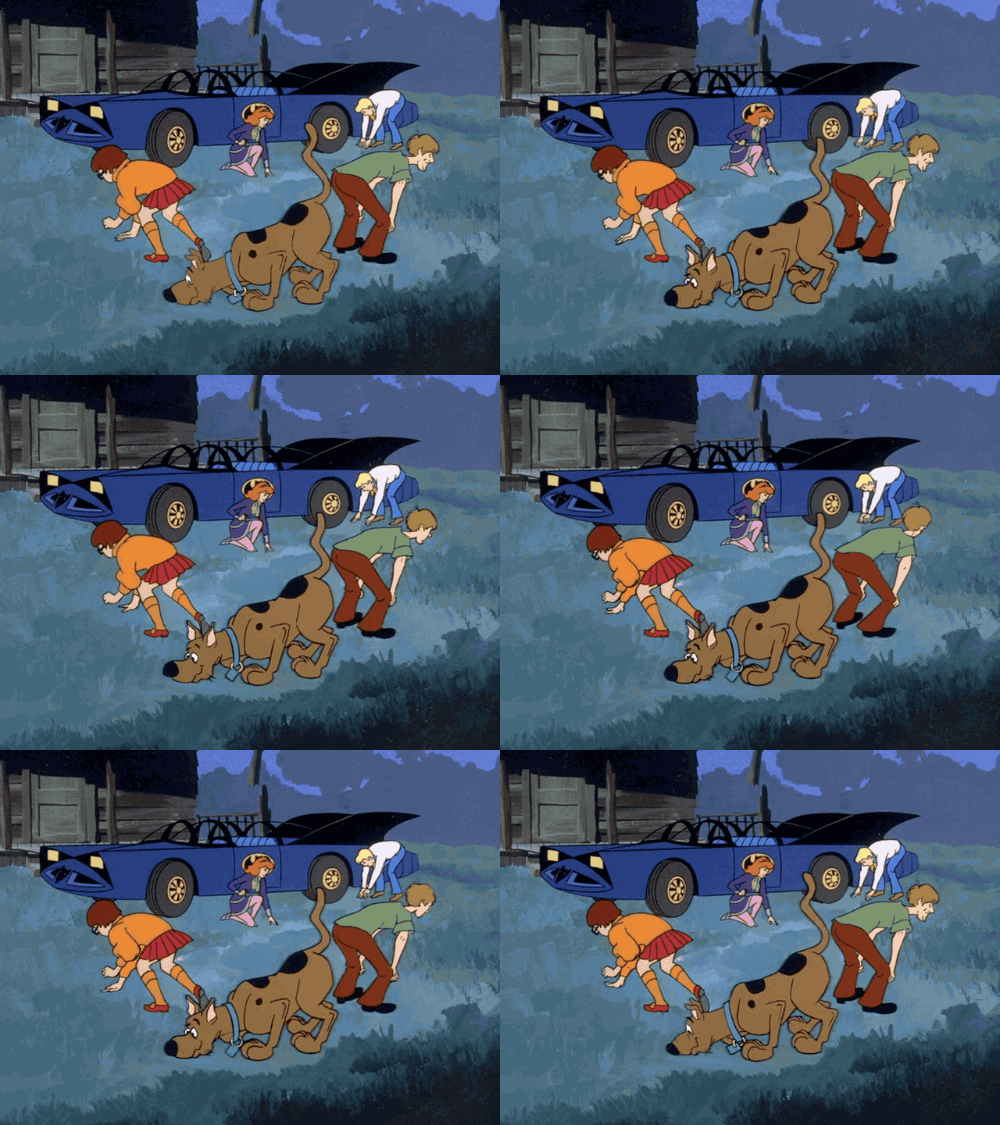
Or perhaps I should say look for clues… (source)

Overall, I really liked “Meddling Kids” and think that it’s both super fun and super creative. I also liked how it took the familiar tropes of a beloved series and spun them on their head.

Rating 8: Both a nostalgic send up and solid adventure/horror story, “Meddling Kids” brings some real world insight and consequences to a group of former teen detectives with heart and scares.

Reader’s Advisory:

“Meddling Kids” is included on the Goodreads lists “Counter-Lovecraft”, and “Nerdventure”.

Find “Meddling Kids” at your library using WorldCat!

Kate’s Review: “DC Bombshells (Vol.4): Queens”

35500613Book: “DC Bombshells (Vol.4): Queens” by Marguerite Bennett, Laura Braga (Ill.), Mirka Andolfo (Ill.), and Marguerite Sauvage (Ill.)

Publishing Info: DC Comics, June 2017

Where Did I Get This Book: The library!

Book Description: The explosive creative team of writer Marguerite Bennett (BATWOMAN) and artists including Laura Braga (Witchblade), Mirka Andolfo (Ms. Marvel) and Marguerite Sauvage (Faith) bring an all-new chapter in the acclaimed alternate-history saga inspired by the hit DC Collectibles in DC COMICS: BOMBSHELLS VOL. 4: QUEENS.

Technology and terror form an unholy alliance in a world at war, and only the heroines known as the Bombshells can shut it down!

As World War II rages around them, Batwoman, Catwoman and Renee Montoya take a journey to Africa to get help from an old ally: Vixen, Queen of Zambesi and co-founder of the Bombshells.

But they’re not alone. The lethal Cheetah has her claws out, and she’s digging them directly into a forbidden site: the dwelling place of the mechanical gods, whose incredible powers could spell triumph for the Reich and the destruction of all that the Bombshells hold dear.

Now Vixen, her fellow Bombshells founder Hawkgirl and the rest of the squadron must face their biggest threat yet! Can this brilliant but beleaguered African queen count on the support of a fellow royal-Wonder Woman-to turn the tide?

Find out in DC COMICS: BOMBSHELLS VOL. 4: QUEENS. This volume contains the debuts of Vixen and Hawkgirl-and the secret origin of the Bombshells! Collecting issues #19-24.

Review: As you all know, I really really REALLY love the “DC Bombshells” series because damn does it give my favorite superheroines something to do. There is something so organically feminist about this series, and it keeps the thrills, action, humor, and pathos balanced out expertly. Seeing some of the best and brightest DC ladies at the forefront is a delight, and whenever a new one comes out I can’t wait to read it. We are now on Volume 4, and after an action packed Volume 3 in which the Nazis were dealt a severe blow by our Bombshells, we’ve moved the action to North Africa and been introduced to Vixen and Hawkgirl! Also mechanical animals and Cheetah, aka the woman who killed Batgirl and Renee’s adopted son Jacon!

I sometimes get worried when new characters get brought into the fold in comics, especially since sometimes I have a hard time keeping track of characters as it is. But with “Bombshells” I am always excited to see which classic heroines will show up next and in what capacity, and Vixen and Hawkgirl were no exception. Vixen (aka Mari) was especially great, as we got to see her stand up to Hitler and steal his dog Blondie, as well as see her in a position of power as the Queen of Zambesi. She and Hawkgirl (who is delightfully tech minded and a very clever inventor) also helped found The Bombshells, so we got to see them interact with the team they created, as well as interact with each other as confidants, partners, and lovers. I think that ultimately the relationships between the women in these stories are the strongest parts of them, and these two fit right in in that regard. I liked seeing more interaction and background between Kate (aka Batgirl) and Renee as they faced their past relationship and the death of Jacon, but I have to admit that I’m kind of not digging the fact that Kate seems to have completely forgotten about Maggie back on the home front. Sure, Batwoman and Renee Montoya have a shared past and a shared pain, but Maggie is Kate’s present.

Speaking of Maggie, we got a fun story back on the homefront with the Batgirls again. I had thought that they were going to be a one-off story, seeing as so much is going on with the Bombshells in Europe, but I really liked seeing them and Lois get some more time to shine. I think that my favorite aspect of it is the way that their presence is handling some familiar storylines. And with that, I give you a

giphy5
(source)

I think I mentioned that Harvey (eventually Two Face) Dent was in the previous Batgirls storyline as a mayor who was promoting an “America First” agenda. Well, he eventually got over that and had become an ally to the Batgirls, with self reflection and redemption on the mind. But given that Harvey really does have to turn into Two Face, I braced myself for it, and indeed, it does happen in this collection (won’t say how, but it does). Ever since I read the classic “Long Halloween” story arc, I’ve felt so incredibly bad for Two Face and the road that he takes, and I was worried that it was going to happen here as well. After all, Batman couldn’t help him in that universe, so my hope was slim. But in this one….. he doesn’t take the road to villainy, at least he hasn’t yet. Because while yes, he’s been horrifically scarred and has had something of a fall from grace, The Batgirls have done what Batman never could: they have rallied around him and affirmed that he is still Harvey Dent, imperfect but trying to be better Harvey Dent, and that they are going to support him and be there for him. And it seems that because of this, he’s MAYBE going to stay on the side of good, and remain their ally and friend. Cheesy? Maybe. But I think that it’s also a testament to the power of empathy and understanding towards those who have experienced trauma, something that Batman just couldn’t ever pull off the way that a bunch of awesome ladies can. The last panel of the Batgirls embracing him got me like

giphy6
I have so many feels. (source)

But all that said, I was a bit disappointed seeing that the big problem to overcome this time around was a group of mechanized animals from another planet. I liked the Zambesi setting to be certain, but it felt like a whole lot more conflict crammed into a story that is already rife with conflict. Plus, given that it’s more ‘Nazis want to get their hands on otherwordly weaponry’ stuff, it kind of feels like more of the same. The good news is that we get a couple returns here, including Wonder Woman, Lex Luthor, and Supergirl, all of whom I dearly missed in the last collection. I just wish that we could have seen more Wonder Woman and Supergirl (seriously, Kara was barely in this), before the last fourth of the book.

So while this is the weakest “Bombshells” collection for me so far, it’s still incredibly strong and I can’t wait for the next one. And I think I only have to wait a little while longer for that!! “DC Bombshells”, you still got it!

Rating 8: While I enjoyed the new characters quite a bit and the Batgirls story was heartwarming, I wasn’t totally sold on mechanical animal fights, and wish that Wonder Woman and Supergirl had been in it more.

Reader’s Advisory:

“DC Bombshells (Vol.4): Queens” isn’t on many Goodreads list at this time. But it is included on “Graphic Novels Featuring LGBTQ Themes”, and would fit in on “Female Power Comics”.

Find “DC Bombshells (Vol.4): Queens” at your library using WorldCat!

Previously Reviewed: “DC Bombshells (Vol 1): Enlisted!”, and “DC Bombshells (Vol 2): Allies”, and “DC Bombshells (Vol.3): Uprising”.

Movie Review: “It” (2017)

As much as we like books, sometimes we like to check out the movie world as well. And perhaps you thought that this had fallen to the wayside, this movie review thing. Well, not anymore, as how could Kate pass up the chance to talk about one of her favorite horror novels and the movie that took it on. Today Kate reviews “It” with a special guest host, her friend Laura. We talk about our history with the book and Stephen King in general, the propensity for strange tween girls to binge on his stories, and the differences between the movie, the miniseries, and the book that they both took their inspiration from (all while I positioned the camera awkwardly. My bad!). Stay tuned until the end to see our book recommendations if you liked the movie (titles also listed below).

Laura’s Recommendations:

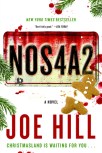
17406545“NOS4A2” by Joe Hill


25533076“Hex” by Thomas Olde Heuvelt


Kate’s Recommendations:

54607“Something Wicked This Way Comes” by Ray Bradbury


9897624“Summer of Night” by Dan Simmons

Kate’s Review: “The Changeling”

31147267Book: “The Changeling” by Victor LaValle

Publishing Info: Spiegel & Grau, June 2017

Where Did I Get This Book: The library!

Book Description: One man’s thrilling journey through an enchanted world to find his wife, who has disappeared after seemingly committing an unforgiveable act of violence, from the award-winning author of the The Devil in Silver and Big Machine. Apollo Kagwa has had strange dreams that have haunted him since childhood. An antiquarian book dealer with a business called Improbabilia, he is just beginning to settle into his new life as a committed and involved father, unlike his own father who abandoned him, when his wife Emma begins acting strange. Disconnected and uninterested in their new baby boy, Emma at first seems to be exhibiting all the signs of post-partum depression, but it quickly becomes clear that her troubles go far beyond that. Before Apollo can do anything to help, Emma commits a horrific act—beyond any parent’s comprehension—and vanishes, seemingly into thin air. 

Thus begins Apollo’s odyssey through a world he only thought he understood to find a wife and child who are nothing like he’d imagined. His quest begins when he meets a mysterious stranger who claims to have information about Emma’s whereabouts. Apollo then begins a journey that takes him to a forgotten island in the East River of New York City, a graveyard full of secrets, a forest in Queens where immigrant legends still live, and finally back to a place he thought he had lost forever. This dizzying tale is ultimately a story about family and the unfathomable secrets of the people we love.

Review: Victor LaValle is one of our most under-appreciated dark fantasy/horror writers today, and I say this with conviction. Everything I have read by him I have really enjoyed. I was sufficiently creeped out by “The Devil in Silver” and deeply fascinated by his Lovecraft deconstruction “The Ballad of Black Tom”. And now I come to his newest book, “The Changeling”. Changelings, as I’m sure you may know, were a superstition that people back in the day had, in which a fairy or other kind of creature would kidnap a child and leave an imposter, or ‘changeling’, in it’s place. This concept no doubt led to a lot of abuse, cruelty, and murder towards children over the years, specifically those with developmental disabilities. Nowadays we just think of them as folklore, seen in books like “Outside Over There”, or as metaphors like in the movie “The Changeling” with Angelina Jolie. But LaValle has taken the changeling myth and given it a new, dark story that I deeply enjoyed.

One of the many things I liked about “The Changeling” is that it really kept me guessing as I read it. While it’s true that at the end of the day I knew that yes, this HAD to have supernatural elements to it, it also made me think about the very real issue of post-partum depression and the pressure on new parents, mothers in particular, to be great at it right from the start. If this book had been about an untreated mental illness and the tragedies that can happen because of it, LaValle would have told a sensitive and thoughtful story about tragedies that we just don’t like to talk about or acknowledge. Even though it was fantasy, so many elements of it felt incredibly real and plausible, from the horrors of modern technology making us less safe than we can imagine, to the struggles new parents face from family, society, and themselves. He also does a great job incorporating themes of race and gender into this story, with racism and misogyny being underlying and indirect villains towards Apollo and Emma alike. So many real world horrors come into this book and yet all have a dreamy sort of air about them, and it left me feeling under a spell as well as on edge.

There is also a lovely theme in this book that has to do with books and storytelling. Apollo is not only a book dealer, he is greatly attached to a copy of the book “Outside Over There”, one of the few things that his father left for him before he up and vanished. Apollo’s love for this book about a girl who needs to save her baby sister from those that stole her away may seem a bit on the nose for the story, but the other themes of paternal abandonment and parental failure and anxiety are also present. Apollo’s father wasn’t there for him, much like Ida’s father is away. Apollo’s love for his child blinds him when things may not be what they seem, just as Ida’s love for her sister blinded her. Parental failings and anxieties both in “Outside Over There” and “The Changeling” dance between the pages, as Ida has to grow up fast when her mother isn’t there for her emotionally and Apollo has to grow up fast when his mother can’t be there for him physically. Even New York becomes a dreamy fairy world you can’t quite trust, just like the world of Outside Over there, which Ida falls into when she starts her journey going out the window the wrong way. And there are fair reminders in this book that trolls are no longer just mystical creatures that want to eat up children, but are very real dangers in a world where your life is online for the entire world to see. That kind of felt heavy-handed at times, but overall it was just another clever way to update our fairy tale for an NYC setting.

I think that if I had a quibble with it, it would be that it was mostly from a male point of view. I would have liked to have seen some of Emma’s journey as well. I understand that revealing her secrets was another subversion of fairy tales and the roles that women are held to (damsels or witches), but I think that her own path would have been highly enjoyable to read.

A haunting and breathtaking story, “The Changeling” is dark and sad, but also hopeful and vibrant. If you want a modern and dark fairy tale, this book should be one that you put on your ‘to read’ list.

Rating 8: A complex and dark fairy tale, “The Changeling” is a beautiful and striking work of dark fantasy/horror with a modern twist and a relevant commentary.

Reader’s Advisory:

“The Changeling” is included on the Gooreads lists “Beautifully Disturbing”, and “2017 SFF by Authors of Color”.

Find “The Changeling” at your library using WorldCat!