Serena’s Review: “The Tethered Mage”

34219880Book: “The Tethered Mage” by Melissa Caruso

Publishing Info: Orbit, October 2017

Where Did I Get this Book: ARC from the publisher

Book Description: In the Raverran Empire, magic is scarce and those born with power are strictly controlled — taken as children and conscripted into the Falcon Army.

Zaira has lived her life on the streets to avoid this fate, hiding her mage-mark and thieving to survive. But hers is a rare and dangerous magic, one that threatens the entire empire.

Lady Amalia Cornaro was never meant to be a Falconer. Heiress and scholar, she was born into a treacherous world of political machinations.

But fate has bound the heir and the mage. And as war looms on the horizon, a single spark could turn their city into a pyre.

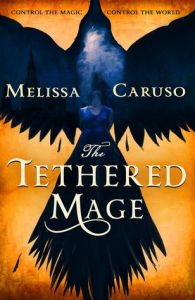
Review: My first props (of many to come) for this book is to whomever designed the cover art. I’ve ranted in the past about cover art tendencies in which publishers try to piggy-back off the designs of other popular books, regardless of whether or not that style or art subject matches the topic of the actual book they are producing. And yes, I know that it’s a business, and I understand the marketing behind it. But that’s the case with every cover art decision ever, and “The Tethered Mage”‘s cover art shows that publishers are perfectly capable of creating unique, pertinent, and striking art for an individual book without needing to reference others to sell. I knew next to nothing about this book, but clicked through to read the description based on this art alone, and largely this was due to its originality. I hadn’t seen a book like this before, therefore I didn’t have expectations going into checking outs its details.

My second props comes for this same originality carrying throughout the book itself. I may not have had many expectations from the art, but reading the descriptions, I had a few guesses (concerns) about the story. Yet another fire mage with a “past.” Likely a duo protagonist situation. Two women protagonists, none the less, creating potential for the ever-dreaded competitive women themes. But almost immediately after reading the first few chapters, I was ecstatic to realize that not only some of these assumptions, but all of them, were completely off base.

While the story does focus on these two women, it is told only from the perspective of Amalia Cornaro, a young woman who is in line to inherit her powerful and canny mother’s position on the Council of Nine, a group of nobles who essentially rule the land. But when she helps a young Captain bring a fire mage under control, she finds herself in a precarious position, the Falconer of the only current fire mage in the realm, and one who had done her best to avoid capture her entire life. Now Amalia must not only win the friendship of this wary and angry young woman, but larger forces are moving within the Empire, threatening its peace and tempting its rulers to now use this suddenly gained powerhouse of a Falcon/Falconer duo, regardless of said Falcon/Falconer’s opinions on the matter of burning down entire cities.

I loved that this story comes from Amalia’s point of view. While I like the magical aspects of fantasy fiction as much as the next person, I have been finding myself growing a bit weary with the fire mage young woman protagonists who litter the genre, currently. No exaggeration, I’ve read three books in the last month that feature a young woman fire mage of some sort.

But while Zaira is a focal point of the story, and gets an intriguing arc of her own, she’s secondary to Amalia, an ordinary young woman who is beginning to understand the burden she will be inheriting as an up-and-coming political leader. She’s also a scholar who, while not magically gifted herself, gets herself and others out of several binds using her knowledge of the intricacies of magical formulas. She’s also a perfect example of a character rising to meet the challenges she’s presented with. Her arc is full of personal growth and courage, and while intimidated by her circumstances at times, she’s blessedly free of unnecessary drama or indecision.

Supporting Amalia, we have her mother, La Contessa, her Falcon, Zaira, and the Captain of the Falcon guards, Marcello. All of these relationships were incredibly drawn, speaking to the unique challenges they each represent to Amalia. I was especially pleased with the portrayal of Amalia’s relationship to her mother, La Contessa. So rarely do we get to see truly loving and supportive mother/daughter relationships in fiction. That’s not to say that Amalia and her mother are without conflict, but they handle their disagreements within the larger understanding and comfort of their love for one another.

Zaira, and her relationship with Amalia, is notably free of the overly typical woman on woman competition and sniping. Given the circumstances of their partnership, their relationship is built on a lot of mistrust and misunderstanding, but these circumstances, never the specifics of the other woman, are what drives their conflict and growth. And through these challenges grows a tentative friendship, free of competition and jealousy. Zaira is also a diverse character, expressing interest in both a powerful lord and one of her fellow Falcons, a young woman.

My third props goes to this story’s portrayal of a complicated society and its approach to its magical members. The system that has been created, wherein children with magical abilities have no choice but to join the Falcon system where there powers are tied to the control of a nonmagical Falconer who can, at will, release or bind the Falcon’s abilities, is one filled with problematic issues. But on the other side we see the legitimate dangers that unbound mages present to the city. Mages are incapable of controlling their powers beyond a certain point, getting lost within these forces. In the very first chapter, Zaira, with her fire ability running out of control, could have burnt down the entire city. And throughout the story we learn of other, more tragic, events that have occurred when mages are left free. I very much enjoyed the careful exploration of the many sides of this complicated system. The story touched on free will, choice, and sacrifices made for the good of the public, delving into the many aspects of these topics, without preaching on a correct answer to this complicated problem.

Lastly, the setting and politics. The story takes place in a world that loosely connects to historical Venice. Raverra is also made up canals and waterways, and it was easy to overlay images of Venice onto this new city. The politics of the region were also key to the plot of this story, with a powerful northern realm making inroads into the treaties that hold together many city states that used to operate independently, but now all fall within the oversight of the Empire. The mystery was compelling, and the action fast-moving.

I was incredibly surprised by how much I enjoyed this story. The characters are nuanced, the plot is complicated, and the book doesn’t shy away from confronting large issues that may not have a clear right answer. This is a must for fantasy lovers everywhere! Now I just have to anxiously wait for the sequel!

Rating 9: A wonderful surprise worth adding to your fantasy TBR shelf!

Reader’s Advisory:

“The Tethered Mage” is included on the Goodreads lists: “Covers With Beautiful Art” and “‘Gender Is No Object’ Second-World Fantasy.”

Find “The Tethered Mage” at your library using WorldCat!


Kate’s Review: “The Followers”

Layout 1Book: “The Followers” by Rebecca Wait

Publishing Info: Europa Editions, July 2017

Where Did I Get This Book: The library!

Book Description: On the windswept moors of northern England, a small religious cult has cut itself off from society, believing they have found meaning in a purposeless world. Led by their prophet, Nathaniel, they eagerly await the end times. But when the prophet brings in Stephanie and her rebellious daughter Judith, the group’s delicate dynamic is disturbed. Judith is determined to escape, but her feelings are complicated by a growing friendship with another of the children, the naive and trusting Moses, who has never experienced the outside world. 

Meanwhile, someone else is having doubts, unleashing a horrifying chain of events that will destroy the followers’ lives.

In the aftermath, the survivors struggle to adjust to the real world, haunted by the same questions: if you’ve been persuaded to surrender your individual will, are you still responsible for your actions? And is there any way back?

Review: I’ve been deeply interested in cults since I was in California during the Heaven’s Gate mass suicide. I remember seeing footage of the crime scene on the television, and being completely horrified and yet taken with the idea that this group believed that a spaceship was on the tail of Hale-Bopp comet. Ever since then, I’ve had a twisted interest in books about cults, be they true stories or not, and the way that people can fall into them. So when I stumbled upon a New York Times article about “The Followers” by Rebecca Wait, I requested it, thinking that it was going to be a thrilling yarn about a scary cult wreaking havoc. While I sat on the couch reading it (making a lot of scandalized noises that my husband kept enquiring about, until the fifth time and he just stopped asking), I was totally engrossed. This was everything I wanted it to be, but it was a bit more than I bargained for as well. After all, at the heart of this is the story of a woman who takes her daughter and whisks them both away at the whims of a religious fanatic who has completely cast her under his spell. So, you know. Fun times.

The thing that stuck me most was that it shifted between various levels of believer/non believer. First we have Stephanie, the single mother who falls in love with “The Prophet” Nathanial. She feels so doted on and loved by Nathanial when they first start dating, and she feels so trapped in her life as a single working mother, that his affection is enough to make her pick up her entire life and follow him anywhere. As I read it was clear that Nathanial was big trouble, but I could also completely understand why Stephanie wanted to go with him, even if I was cursing her and the terrible decisions she was making. Then there is the perspective of Stephanie’s daughter Judith, whose adolescent rebellion is only kicked up a few notches when they move to the commune. She’s a strong willed girl who may have treaded towards unbelievable in her mental strength, but she felt so real and so well realized that I didn’t even care. Then you have Moses, the only friend that Judith makes at the commune, who was born into it and fully believes that not only is Nathanial the Prophet and the ourside world the road to hell, but that his birthmark on his face is a mark of the devil. At first I was very worried about him and his intentions towards Judith, but he really is just the epitome of naive wonderment, raised in a warped society that is all he’s known. And finally you have Thomas, a long time member of Nathanial’s thrall, but who has started questioning it. With these different characters on different parts of the belief scale, Rachel Wait has done a great job of showing the full gamut of emotions for the members.

I loved the description of the commune, which is located in the Moors of England. The isolation was palpable, both physically (with the description of few buildings and many bogs, forests, and other barriers) and emotionally. The members are told that if they leave they can never come back, and will be doomed to stay in “Gehenna” and probably rot with all the nonbelievers when the end of days comes. The manipulation that Nathanial administered to his disciples was also incredibly creepy, through kind syrupy promises and yet no physical action of his own to place his controls upon them. I think that Wait hit the nail on the head with Nathanial, and he was the perfect villain, just as Stephanie, Moses, and the other members were perfect victims. And yet this was told in such a way that it always felt a couple steps up from your run of the mill thriller. We also got to see beyond the cult moments, and where Judith and Stephanie ended up after all was said and done. Spoiler alert, it’s pretty bleak. But along with the overarching bleakness, there was also a fair amount of purity and hope, specifically through the friendship between Judith and Moses. They are both outcasts in their own ways in the commune, and while he’s a true believer and she’s a non believer, they forge a bond that was absolutely sweet and powerful. They really do bring out the best in each other, and their types of belief and non belief feel more constructive than those of Stephanie and Thomas. Every time they were together, my heart would grow ten sizes bigger.

And yes, the slow build up of terror as the cult starts to fall apart was absolutely riveting. I love a good slow burn build up, and “The Followers” really nails the ‘frog in a pot of boiling water’ pace.

All in all, “The Followers” was an entertaining and insightful story that exceeded my expectations. If a good and twisty cult story is your idea of a good time, definitely pick this one up. You’ll get a bit more than you bargained for in the best way possible.

Rating 9: A sad and suspenseful tale about fanaticism, family, and the way that tenuous bonds can be broken if a monster figures out how to exploit them.

Reader’s Advisory:

“The Followers” is not on many relevant Goodreads lists, but I think that it would fit in on “Cults and Communes in Fiction”.

Find “The Followers” at your library using WorldCat!


Serena’s Review: “All the Crooked Saints”

30025336Book:  “All the Crooked Saints” by Maggie Stiefvater
Publishing Info: Scholastic Press, October 2017

Where Did I Get this Book: the library!

Book Description: Here is a thing everyone wants: a miracle.
Here is a thing everyone fears: what it takes to get one.

Any visitor to Bicho Raro, Colorado is likely to find a landscape of dark saints, forbidden love, scientific dreams, miracle-mad owls, estranged affections, one or two orphans, and a sky full of watchful desert stars.

At the heart of this place you will find the Soria family, who all have the ability to perform unusual miracles. And at the heart of this family are three cousins longing to change its future: Beatriz, the girl without feelings, who wants only to be free to examine her thoughts; Daniel, the Saint of Bicho Raro, who performs miracles for everyone but himself; and Joaquin, who spends his nights running a renegade radio station under the name Diablo Diablo.

They are all looking for a miracle. But the miracles of Bicho Raro are never quite what you expect.

Review: I have been a fan of Stiefvater for a while now. I have  distinct memory of picking up “Shiver” like ten years ago before she was a big name in the YA community and very much enjoying it. But what makes her special, in opinion, is the way she has grown as an author in the year’s between. Every book I’ve read by her seems to be better than the last: the plotting more meticulous, the characters more fleshed out, and, most importantly, the lyrical, poetic style of her writing more beautiful and heartbreaking than ever before. All of this remains true for her latest novel “All the Crooked Saints.”

When Pete wanders into the Bicho Raro ranch, he’s only there to work off the price of a box truck that he hopes to use to start a moving business. He’s heard something about miracles, owls, and saints on his way, but not until he arrives does he fully understand. Now, surrounded by pilgrims whose miracles were not what they expected, Pete finds himself becoming entranced by the entire Soria family, but particularly the “emotionless” Beatriz.

While I have framed my summary around Pete, there is no one character who serves as a central point for the story, truly. Perhaps the Soria family as a whole? Throughout what is really a very small book, I found myself sinking down deeply into this strange family, their history, and the beautiful imagery and philosophy behind what constitutes a miracle. We learn bits about every one of the Soria family, their hopes, their fears, what has them, like the pilgrims around them, seemingly stuck with their first miracle, unsure how to move forward.

Stiefvater’s creativity is boundless. The entire concept is beautiful and terrifying, terrifyingly beautiful, just like the stark desert in which the story takes place. The miracles that the pilgrims experience are surprising and new: twin sisters caught in a tangle of snakes, a man who is growing moss, a woman covered in butterflies whose own personal cloud dumps rain on her head constantly. What makes this all the more special is that we can see how these miracles (lessons) connect to the darkness each of these characters are walking through, but none of them are too on the nose or expected. It would have been very easy for this idea to slip into the trite.

Beyond this, the characters are all gloriously complicated, damaged, and lovely. It’s a true testament of skill to not only work in a complicated magic system, fill the pages with beautiful prose that speaks to complicated philosophies and theologies, as well as create a large cast of characters that all have their own distinct story and appeal, all within such a short page count.

Pete, hard-working, but feeling betrayed by a heart to weak to allow him to serve his country in the military, like his family before him. Beatriz, too comfortable with her own lack of emotions. Joaguin, with dreams of being bigger than his little life on the ranch, feeling the judgement of a family who may deem him frivolous. And Daniel, the current Saint, whose parents died due to their darkness and by breaking the taboo to help the pilgrims who visit them. And while these are our “main” characters, the generation of Sorias before them, too, get their own snips of chapters and histories, loves and heartbreaks.

Throughout this all Stiefvater delves into the meaning of family, questions what makes up love, and explores the courage and fear that comes with recognizing what is dark within ourselves. And, importantly, how necessary this process is, for everyone.

I feel like this review may have been all over the place, but I truly don’t know how to best portray the beauty that was this story. Thinking back on it, I mostly see images: barren, but vivid landscapes of the desert, owls grouped on a porch, strange beings wandering among scattered out-buildings, and a family, gathered closely together, but somehow apart and drifting alone. If you’ve read any of Stiefvater’s work in the past, this will all make more sense to you, knowing her skill and particular style of writing. And if you haven’t, this is an excellent place to start, as a stand-alone book that perfectly illustrates all the gifts Stiefvater has to offer.

Rating 9: Vivid and gorgeously rendered, but challenging readers to look deeper within themselves and wonder “What would my miracle look like?”

Reader’s Advisory:

“All the Crooked Saints” is fairly new and isn’t on many relevant Goodreads lists, but it is on “2017 YA/MG Books With POC Leads.”

Find “All the Crooked Saints” at your library using WorldCat!


Kate’s Review: “My Favorite Thing Is Monsters (Vol.1)”

29069374Book: “My Favorite Thing Is Monsters (Vol.1)” by Emil Ferris
Publishing Info: Fantagraphics, February 2017

Where Did I Get This Book: The library!

Book Description: Set against the tumultuous political backdrop of late ’60s Chicago, My Favorite Thing Is Monsters is the fictional graphic diary of 10-year-old Karen Reyes, filled with B-movie horror and pulp monster magazines iconography. Karen Reyes tries to solve the murder of her enigmatic upstairs neighbor, Anka Silverberg, a holocaust survivor, while the interconnected stories of those around her unfold. When Karen’s investigation takes us back to Anka’s life in Nazi Germany, the reader discovers how the personal, the political, the past, and the present converge. Full-color illustrations throughout.

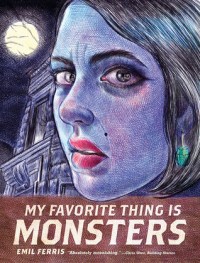
Review: I remember the moment that I first laid eyes on the book “My Favorite Thing is Monsters (Vol.1)”. I was unloading boxes of new books at work, and I literally gasped when I saw it. I mean, my GOD. Just look at this cover. THAT IS ALL BALLPOINT PEN, GUYS. And plus, it has ‘monsters’ in the title. My boss said she was surprised that the request wasn’t for me, and I admitted that I hadn’t even heard of it. So I said that I was going to request it…. And then I didn’t. It entered in and out of my mind for the next few months, until I was at a staff training and it was on the shelf. So… I grabbed it. I wish that I had grabbed it sooner. Because “My Favorite Thing Is Monsters” was just amazing.

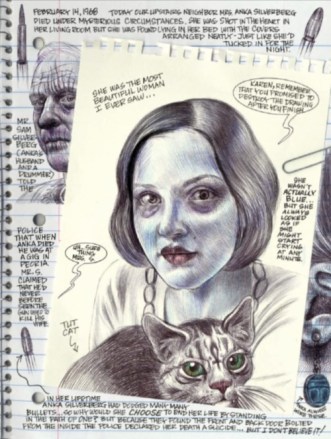
I mean, I just need to talk about the art. Like I said, this is all done in pen, and it just pops off the page. It’s seriously astounding. The detail and the coloring, as I kept turning page after page in this book I just kept saying ‘wow’ as I would see a new image that took my breath away. Ferris really dives into her artwork, and the painstaking detail is so evident up close, while seeming to be a la Robert Crumb from a further distance. It’s a style that I really enjoy, and while it seems to be a little surrealistic in some ways, in other ways it was so human and so real. There are images of people, images of monsters, and images of urban landscapes that all take their own lives through her style. She also draws classic artwork through this lens, when Karen and her brother Deeze go to the art museum in Chicago, and seeing these works recreated in this style was also incredible. I loved the use of colors as well, as sometimes she would draw characters certain shades to describe different feelings. The premise is that these are the drawings of our ten year old narrator within her lined journal, and even that is consistent and well laid out.

slide3
I mean, it’s just gorgeous, right? (source)

The story itself if both a charming and bittersweet coming of age story, and a gut punch and tense mystery. Karen, or narrator, is a ten year old girl who is quite precocious in a lot of ways, and fancies herself as a Wolfman-esque monster who takes on the role of detective. I gotta say, the images of this little Wolf-creature in a trench coat is precious and funny, Seeing her try to piece together the possible murder of her upstairs neighbor, Anka, is classic bildungsroman in it’s premise, but in it’s execution it feels fresh. Karen is delightful, as her imagination sparks on the pages and her personality shines as she starts to learn more about those around her and learn more about herself. You also get to see late 1960s Chicago and all of it’s political turmoil through her eyes, which gives it a unique, and even more heart wrenching, perspective (I’m thinking of one specific scene where she is very nearly sexually assaulted by some bullies in her neighborhood, and she just writes about it matter of factly and as if it’s just something that could happen, but didn’t, so life goes on. It’s rough.). Karen loves monsters, and is starting to learn that monsters are very real, but not in the way that she would like them to be. We hear of an see violence and racism around her, and we see her reaction (and the reaction of her friend Franklin, an African American boy) to the murder of Martin Luther King Jr. Her family life isn’t easy by any means, as Dad is out of the picture, her older brother Deeze is loving but reckless, and their mother is kind and gentle but has some problems Karen isn’t quite privy to, though the reader is. We also see the struggles of being a lower class family of multiracial descent, as the fact that Karen and her brother Deeze are part Latino and part Native is thrown at them by the white people around them from time to time. Struggles and all, I loved this family, and it’s tenuousness made me love them even more, and ache for them as well.

The mystery of Anka’s death is one of the main themes of this book, and we see some of her own childhood mirrored in Karen’s through diary entries. Anka came of age in Weimar Germany, and as a young woman was taken to a concentration camp because she was Jewish. This story is another example of monsters in this world, and the rumors of a potential Nazi in town is one of the threads in the mystery that Karen is hoping to solve. But to tell you the truth, even though this mystery is ongoing (as there is another volume of this coming out next summer!), I’m more interested in the journey getting there and Karen learning things about Anka and the world around her then actually finding out who killed her.

There is one storyline that I’m not quite feeling as of right now, and that involves Karen and her friend Sandy, a malnourished little girl who may actually be a ghost. But hey, I suppose in a book about monsters it doesn’t hurt to have something of the supernatural there to shake things up.

Rating 9: A sumptuous and beautiful book with a gripping mystery, “My Favorite Thing Is Monsters (Vol.1)” is a great book and a huge achievement. The art is gorgeous, the story is bittersweet and haunting, and I can’t wait for the next book to come out.

Reader’s Advisory:

“My Favorite Thing Is Monsters (Vol.1)” is included on the Goodreads lists “Best Comic Books and Graphic Novels of 2017”, and “NPR’s 100 Favorite Graphic Novels and Comics”.

Find “My Favorite Thing Is Monsters (Vol.1)” at your library using WorldCat!

Serena’s Review: “City of Miracles”

31522139Book: “City of Miracles” by Robert Jackson Bennett

Publishing Info: Broadway Books, May 2017

Where Did I Get this Book: Blogging for Books

Book Description: Revenge. It’s something Sigrud je Harkvaldsson is very, very good at. Maybe the only thing.

So when he learns that his oldest friend and ally, former Prime Minister Shara Komayd, has been assassinated, he knows exactly what to do — and that no mortal force can stop him from meting out the suffering Shara’s killers deserve.

Yet as Sigrud pursues his quarry with his customary terrifying efficiency, he begins to fear that this battle is an unwinnable one. Because discovering the truth behind Shara’s death will require him to take up arms in a secret, decades-long war, face down an angry young god, and unravel the last mysteries of Bulikov, the city of miracles itself. And — perhaps most daunting of all — finally face the truth about his own cursed existence.

Previously Reviewed: “City of Stairs” and “City of Blades”

Review: It’s no secret that I absolutely adored “City of Stairs” and “City of Blades.” In both books, Bennett established a seemingly endless world full of wonder and madness. He also accomplished the rare feat of producing a second book that I believe was even better than the first! It seems that resting on his laurels is simply something Bennett is incapable of doing, as “City of Miracles” is a perfect closely act for this trilogy.

It’s been 13 years since the events of “City of Blades,” and Sigrud lives a lonely, tired existence on the edge of society, waiting and waiting for a call from his former partner and friend Shara to call him back to the fight. To the world. To anything. The call finally comes, but not in a way he could ever have wished for: Shara has been assassinated. With this news, and the consuming grief and rage that has driven him throughout his life, Sigrud comes to live once again, blazing his way through the world hoping to servce justice for his friend’s senseless murder. Along the way, he finds new purpose in protecting Tatiana, Shara’s adopted daughter, and a girl who is tangled up in much more than Sigrud can imagine. Once again, the Divine is at work in the world. And once again, Sigrud will rampage through anything and everything in his way to protect and avenge those he loves.

What made “City of Blades” stand out from the first book in the series, was the added gravitas of subject matter that was layered upon an already fantastical story and world. The fantasy elements, the miraculous, even the Divine, served only as platforms upon which Bennett explored the deeply complicated history, purpose, and definition of warfare and what makes up the mind of a solder.

“City of Miracles” is excellent for following in this pattern. We have all the boundless creativity that can now be expected of this author and this world: Divinities of Night itself, steampunk-ish tramcars that trek across arctic mountainscapes, magical clothes and wondrously impossible buildings. But through these flashes of fantasy action and detailed world-building, Bennett is telling a much more grounded story.

Sigrud’s life is one of tragedy. The villain’s life is one of tragedy. The villain’s parent’s life is one of tragedy. It is all circular, and death follows death, vengeance and justice doling out the same misery and atrocity they work to revenge. Through Sigrud’s own life, and those he works to aid in this book, we see this pattern replay itself endless. Where is the live between justice and simply committing more crimes? At what point does the power gained through grief justify more grief itself to perpetuate its own existence? The the book before it, this story challenges its readers to think beyond common storytelling tropes. We’ve re-defined the soldier through a woman whose seen the damage and power that warfare brings. And here we’re redefining the avenging hero as more than the white knight we’re always given.

I was also pleasantly surprised by the inclusion of characters from previous books and the ways their stories were tied into the narrative of this book. Further, the new characters who are introduced were intriguing, particularly Ivanya, a character we met oh, so briefly back in book one but who plays a critical role in this story.

The author also cuts out quite a lot of work for himself with this story. It’s the final book in a trilogy, so our main characters’ story lines must all be tied off and resolved, any lingering questions about their pasts drawn to a close. But he also takes it upon himself to provide much needed information on the years that came before the first book itself. The ending is bittersweet and perfect. It closes in small moments and fantastic explosions (both literally and figuratively). These characters’ stories may be ending, but we’re left with a wide open world of possibility stretching out ahead.

I’m not sure if the author has any plans of revisiting this world, but if he is, the groundwork has been lain for a continuation, and I would be the first one in line at the bookstore. I can’t recommend this book, and this series, enough! If you enjoy fantasy with complicated heroes and challenging ideas, definitely check these out!

Rating 9: An excellent conclusion to an excellent trilogy. Fun, fast-paced, and challenging its readers at every turn!

Reader’s Advisory:

“City of Miracles” is included on these Goodreads lists: “Best Science Fiction & Fantasy Books” and “Best Fantasy Books of the 21st Century.”

Find “City of Miracles” at your library using Worldcat!

More Information: book information & author information.

Serena’s Review: “The Beautiful Ones”

335741431Book: “The Beautiful Ones” by Silvia Moreno-Garcia

Publishing Info: Thomas Dunne Books, October 2017

Where Did I Get this Book: e-book from NetGalley

Book Description: In a world of etiquette and polite masks, no one is who they seem to be.

Antonina Beaulieu is in the glittering city of Loisail for her first Grand Season, where she will attend balls and mingle among high society. Under the tutelage of the beautiful but cold Valérie Beaulieu, she hopes to find a suitable husband. However, the haphazard manifestations of Nina’s telekinetic powers make her the subject of malicious gossip.

Yet dazzling telekinetic performer and outsider Hector Auvray sees Nina’s powers as a gift, and he teaches her how to hone and control them. As they spend more and more time together, Nina falls in love and believes she’s found the great romance that she’s always dreamed of, but Hector’s courtship of Nina is deceptive.

Review: Like my recent review of “The Goblins of Bellwater,” I think this book is another example of a poorly written book description. Unlike “Goblins” which read more as contemporary romance, the more true genre focus (historical romance) of this book happens to be one that I enjoy and was particularly in the mood for, thus coloring my reaction to this initial misdirection. Like in that case, however, I do think both of these books would be better received had they been marketed more appropriately to the groups of readers who are true fans of these types of books.

I know that “fantasy” is kind of going through a boom right now, but targeting every book towards that community when there may only be the barest hint of actual fantasy elements in your book, is unlikely to be met with a positive reaction. This book, for example, is presented as if it is going to be a “fantasy apprenticeship” type book, leading the reader to assume much of the book is about Nina learning to navigate her own abilities. Not so. This is much more closely aligned with historical romance fiction with a brief dash of fantasy.

Getting off that soap box and on to the review itself! As I mentioned above, “The Beautiful Ones” ticked many boxes for me, and the fact I was surprised by the story I was getting almost added to my personal enjoyment. Nina is has come to the city to experience her first Grand Season. Under the tutelage of her glittering and popular married cousin Valerie, she soon comes to realize that she does not fit the typical mold of a debutante. Luckily, she meets Hector Auvrey, a performer who has leveraged his own telekinetic powers to raise himself to position and influence. But Hector and Valerie have a history of their own.

The story is told from the perspectives of all three characters, something that I was initially skeptical of (my own personal preference is always to follow one main character), but I quickly grew to love this format. Nina, Valerie, and Hector all have distinct voices and are fully realized characters of their own, each with strengths, weaknesses, and their own agendas. Valerie, in particular, is the type of villainous character who you simply love to hate. And Hector is the perfect example of a flawed hero. Nina, on the other hand, may have read as a bit too perfect, but her naivete and the growth she goes through, particularly in the last half of the story, are enough to keep her from falling into a “special snowflake” category. Further, with Valerie and Hector being as frustrating as they were at times, Nina’s chapters proved a bit of a relief.

We all know my feelings on instalove plot lines (recently I DNF’d “Juliet Immortal” for committing this sin in the most blatant way, choosing to not even review the book on this blog out of sheer and utter frustration). “The Beautiful Ones” seems to be Moreno-Garcia’s answer to this trend. It serves as a perfect rebuttal to all the things that are wrong with an instalove storyline. Not only is the main romance a slow burn story, based on many interactions, and taking place over a full year, but the failures of previous romances that followed the instalove equation are fully explored and the repercussions are serious.

This book is almost completely character driven. There is little action (other than balls and visits to the country side). The fantasy elements of this story are very minimal. You could remove them all together, honestly, and not much would change in this story. There are many scenes of characters simply talking to each other. In this way, it is a slow read, and yet, loving this genre as I do, I blew through it in a day. If you enjoy historical romances, ala Jane Austen, this is the perfect book for you!

Rating 9: A complete and utter surprise with characters you couldn’t help but root for, both to succeed and fail miserably!

Reader’s Advisory:

“The Beautiful Ones” is on these Goodreads lists: “2017 Latinx/Latin American SFF” and “Fantasy of Manners.”

Find “The Beautiful Ones” at your library using WorldCat

Kate’s Review: “The Last Days of Jack Sparks”

28765598Book: “The Last Days of Jack Sparks” by Jason Arnopp

Publishing Info: Orbit, March 2016

Where Did I Get This Book: The library!

Book Description: Jack Sparks died while writing this book. This is the account of his final days.

In 2014, Jack Sparks – the controversial pop culture journalist – died in mysterious circumstances.

To his fans, Jack was a fearless rebel; to his detractors, he was a talentless hack. Either way, his death came as a shock to everyone.

It was no secret that Jack had been researching the occult for his new book. He’d already triggered a furious Twitter storm by mocking an exorcism he witnessed in rural Italy.

Then there was that video: thirty-six seconds of chilling footage that Jack repeatedly claimed was not of his making, yet was posted from his own YouTube account.

Nobody knew what happened to Jack in the days that followed – until now. This book, compiled from the files found after his death, reveals the chilling details of Jack’s final hours.

Review: I’ve probably mentioned it before, but I don’t find stories about demonic possession particularly scary. I think that there are certainly elements to them that can be creepy, but movies like “The Exorcist” and “The Exorcism of Emily Rose”, while well done, don’t get my fear levels on the rise. The book “A Head Full of Ghosts” is probably my favorite exorcism related book, but even that one is filled with ambiguities instead of solid fact and over the top devilry. And then there is, of course, “My Best Friend’s Exorcism”, but that one is in it’s own little category since it’s so 80s candy coated and about the power of female friendship. So when I picked up “The Last Days of Jack Sparks”, I figured that it would at the very least be entertaining. Little did I know that I was going to be basically freaking out on an airplane while reading this book. And then once again while walking down a dark hallway at two in the morning days after the fact. Yep. “The Last Days of Jack Sparks” has sufficiently messed me up, y’all.

giphy
(source)

This story is built on the premise that notorious journalist Jack Sparks died while working on a new book, and that we are reading his writings around the time of his strange death. So right out the gate, we’re pretty certain that we are dealing with an unreliable narrator. Sparks is an established addict, narcissist, and sanctimonious prick, so having him as a narrator is maddening but also absolutely perfect. It’s made even better because throughout the book we are also given other perspectives from those that he interacts with, in footnotes from Sparks’ brother Alistair, transcripts of conversations, and personal diary entries. The moment that I realized that I really couldn’t trust anything that ANYONE was saying, it blew my mind. This set up made it all the more paranoia inducing, as I really didn’t know what to believe from anyone involved. It also made it so that clues that were given throughout the story could harken back in multiple formats and through multiple lenses, and seeing the puzzle pieces come together in different layers was mind boggling for me.

Sparks himself is a fabulous component to the story. Yes, he’s absolutely terrible for much of the narrative, as an egomaniacal, pretentious and abusive liar, but as he slowly starts to fall apart you see the other parts of him bit by bit, which makes him feel all the more human and relatable. I went in thinking that I was going to be just fine with him getting his comeuppance, but as he becomes more desperate and as his identities fall away I ended up being really attached him him, as rotten as he can be at times. I also liked other characters in this book, specifically Sherilyn Chastain, a combat magician who Sparks sort of teams up with on one of her cases involving a houseboat haunting in Hong Kong. She not only provided a centered and badass female voice in all of this, she was also a way for Arnopp to really delve into some deep philosophy about faith, belief, and the supernatural. While some of the other characters felt a little trope-y, such as Sparks’ love interest/flatmate Bex with her cool girl persona, I did feel that Arnopp had a place for each and every one of them.

And finally, this book is pretty darn scary. This is coming from a self professed snob when it comes to demon possession stories. I think that this one had a lot of other factors within it that made it feel unique from the others in the genre, and given that it also bent genres a bit into some science fiction principles it felt all the more creative. The imagery of a dark apartment with a silhouette in the corner is always going to set me on edge, and Arnopp really knows how to make this scenario complete and total nightmare fuel. His use of social media like youtube and twitter and things like that really gave it a modern horror flair as well, as while I was skeptical at him just describing a video would be scary, I was totally wrong. It was terrifying, especially since it totally sounded like one of those weird unexplained viral horror videos that pop up occasionally. I also really liked, and perhaps this is a bit spoilery so tread carefully, that the entire premise of this book is that the Devil (or whatever demon Sparks is dealing with) really hates having the spotlight taken off of him/it when on a serious dramatic tear.

giphy1
Come on, Pazuzu, share the attention. (source)

“The Last Days of Jack Sparks” was a freaky and fun read that I cannot recommend enough. If it can make this skeptic towards the genre cheer, think of what it can do for those of you who always love your possession stories.

Rating 9: A tense, creepy, disturbing, and fresh feeling horror novel for the social media age. It had me on the edge of my seat and I think that it’s must read for horror fans.

Reader’s Advisory:

“The Last Days of Jack Sparks” is included on the Goodreads lists “Unconventional, Seductive, Intelligent, and Dizzyingly Surreal”, and “Terrifying Tearjerkers”.

Find “The Last Days of Jack Sparks” at your library using WorldCat!

Serena’s Review: “An Enchantment of Ravens”

30969741Book: “An Enchantment of Ravens” by Margaret Rogerson

Publishing Info: Margaret K. McElderry Books, September 2017

Where Did I Get this Book: ARC from ALA

Book Description: Isobel is a prodigy portrait artist with a dangerous set of clients: the sinister fair folk, immortal creatures who cannot bake bread, weave cloth, or put a pen to paper without crumbling to dust. They crave human Craft with a terrible thirst, and Isobel’s paintings are highly prized among them. But when she receives her first royal patron—Rook, the autumn prince—she makes a terrible mistake. She paints mortal sorrow in his eyes – a weakness that could cost him his life.

Furious and devastated, Rook spirits her away to the autumnlands to stand trial for her crime.

Review: This was an ARC that I nabbed at ALA purely because of the beautiful color and my vague guess that it was probably some type of fairytale…maybe? Honestly, ALA is such a mad house that I don’t think I even got around to reading the book description until I was back in my hotel. But man, what luck! This story was one giant mash-up of all of my favorite things about fairtyales: a relatable heroine, a hilarious and charming hero, and the darker side of magic.

In Isobel’s village, fairies are common customers. Humans possess the ability to make Craft, construct things out of materials, something that is deadly to fairies, and thus fascinating to these long-lived beings. Isobel is a prodigy portrait artist, and as such, as worked with fairies most of her teenage life, becoming quite familiar with the quirks and dangers of these people. In exchange for her work, she is paid with magical favors, like chickens that produce a certain number of eggs each week. But in every fairy gift, there lurks the potential for disaster, so Isobel has gotten quite skilled at carefully wording every request she makes. More so than other in her village, she understands that even the ultimate fairy gift, a drink from the Green Well which grants immortality and is reserved for only the most special cases of humans who posses Crafting talent over and beyond the usual and who come along maybe once every century, is not all its cracked up to be. So when whisked away by an unhappy fairy prince client, Isobel knows that her trip to the fairy realms is rife with potential disaster.

Isobel herself was one of my favorite parts of this book. From the very beginning, we see that she has grown wise through her experience with the fairies. She doesn’t trust them and sees the loss that immortality has inflicted upon them. They can’t seem to relate to others or feel real emotion about anything. In fact, the presence of emotion is what makes Rook stand out to her, and the painting of it is what gets her carried away. And even then, trapped in the fairy world with a volatile prince, Isobel never loses her head. The relationship she develops with Rook over their travels develops in a natural way and Isobel always retains her common sense about the dangers this is presenting to both her and him, since relationships between humans and fairies are forbidden.

Rook, too, was exactly the type of romantic hero I love. He’s lovably arrogant about his own kind, a trait that both amuses and exasperates Isobel. There were several laugh out loud moments for him throughout the story. He’s also given a strong backstory to justify the differences between him and the other fairies. But never loses his inherent “otherness.”

As readers of this blog know, my favorite fantasy stories often mix a good dash of darkness and horror into the story (see: “The Beast is an Animal”). Here, the fairy court is like a brilliant confectionery cake, but once you cut into it, you see the mold. Time has not been kind to beings who live forever. There is madness, isolation, and loneliness mixed behind every aspect of the fairy realm.  At the center of it is the Summer King, the ruler of the fairies, who has withdrawn from the world, but whose madness lurks and has begun to trickle into the human world as well.

For a fairytale not directly tied to re-telling any of the tales we are familiar with, “An Enchantment of Ravens” reads as a staple in the genre. Magic, adventure, danger, comedy, and romance are all balanced in this story, held together by two protagonists you quickly grow to love. I can’t recommend this enough to fans of fairytale retellings!

Rating 9: What a wonderful surprise! Sometimes judging a book by its cover has a massive upside!

Reader’s Advisory:

“An Enchantment of Ravens” is on these Goodreads lists: “Traveling in the Faerie Realms” and “Dark Fairy Tales.”

Find “An Enchantment of Ravens” at your library using WorldCat!

Kate’s Reviews: “Everything Is Teeth”

26109143Book: “Everything Is Teeth” by Evie Wyle and Joe Sumner (Ill.)

Publishing Info: Johnathan Cape, August 2015

Where Did I Get This Book: The library!

Book Description: From the award-winning author of All The Birds, Singing, a deeply moving graphic memoir about family, love, loss, and the irresistible forces that, like sharks, course through life unseen, ready to emerge at any moment.

Ever since she was a little girl, passing her summers in the brutal heat of coastal New South Wales, Evie Wyld has been captivated by sharks—by their innate ruthlessness, stealth, and immeasurable power. Young Evie would listen intently as farmers and fishermen told stories about being alone on the water at dusk; she would lose herself in books about legendary shark attacks, mesmerized by the photos of the victims. And even though she returned to London at the end of each summer, Australia’s sharks never released their hold on her imagination. Now, in this quietly penetrating narrative of personal memories, beautifully rendered by illustrator Joe Sumner, Evie Wyld lends her exceptional voice to the telling of a story all her own.

Review: When I was four years old, I discovered sharks. We were on a family trip out to California to visit my aunt, uncle, and cousin. They lived in San Jose, but we would take many family trips to the ocean up and down the coastline between San Francisco and Monterey. This meant that there was a lot of driving to be had, and ya gotta find ways to spend the time. My parents bought my cousin, who is a few years older than me, a cassette tape and accompanying book about sharks. It was short and informational, but it did have some kind of creepy music to go with it. Because “Jaws”, probably. Turns out, it was too much for my cousin, who thought that it was way too scary to listen to. My parents, not wanting to waste the thing, gave it to me, four year old Kate, thinking that maybe I’d be able to handle it. And I guess I pulled a full Raffi on them, insisting they play it over, and over, and OVER again the entire trip… And then more when we got back home to Minnesota. And thus, my lifelong love of sharks was born.

giphy11
Actual image of my Dad having to listen to that tape for the 63rd time. (source)

So the graphic memoir “Everything is Teeth” by Evie Wyld is so incredibly relatable for me that it was kind of uncanny. Evie Wyld grew up in England and spent family trips in Australia, and she first found her love for sharks when her older brother was given a set of shark jaws for the holidays. She then started reading books about sharks, and shark attacks, her first celebrity crush being Rodney Fox, famed shark attack survivor and conservationist (another thing I can relate to, because I TOO loved Rodney Fox during my most fevered obsession time). But this memoir is a bit different from other graphic memoirs that I’ve read in the past, as instead of having a full linear narrative it’s more a collection of snapshots into her childhood, framed through the shark obsession. But the shark obsession and the anxieties that go with it, of course, speak to deeper childhood fears and worries, from isolation to familial loss. The irrational fear of sharks served as a tangible fear to stand in for the ones that Wyld couldn’t quite articulate at the time, and as a child who was also riddled with anxieties about just about everything, this, too, was a familiar thing to me as I read it.

You don’t get the events in her childhood spoon-fed to you, you have to surmise what is going on. During a viewing of “Jaws”, she recounts how her loving yet somewhat detached father drank glass after glass of wine. After being unable to sleep one Australian night, she and her mother go for a night swim in the pool, as her mother was dealing with one of her regular bouts of insomnia. When her older brother would come home from school bloodied and beaten up, he would come to Evie and ask her to tell him shark stories. We learn about Evie’s family and their pretty common issues, but always with the context of the love of, and fear of, sharks. It’s a quiet story that ultimately unwinds to show how these intangible fears ultimately become tangible as time goes on, and that a fear of sharks disguises a fear of loss that eventually most everyone will experience in their life. It is ultimately a sweet, and sad, story about a girl who comes of age like many do, and her childhood interest in sharks that shapes her along the way, and I found it just as powerful as some of the graphic memoirs I’ve read that deal with childhood trauma or tragedy. There is no specific trauma or tragedy here; it’s just bits of her life, some parts sad, some parts not, all parts incredibly real.

I also liked that even the bits that were sad or upsetting were still muted, letting the reader figure out why. There is a scene where Evie’s Dad takes her to a shark attack museum, thinking that she will enjoy it. What they find is a spectacle, with graphic photos of shark attack victims with no context (just showing Rodney Fox’s wounds, not his calm demeanor or how he persevered), broad brush strokes painting sharks as mindless man eaters, and a stuffed and shabby white pointer, which is Australian terminology for great white, that is decaying on it’s platform. Child Evie is awash with nausea and discomfort, and while it’s never explained why, the reader is as well. Wyld never has to tell you it’s wrong; you just know that it is.

Joe Sumner did the illustrations for this graphic novel, and I really loved his style. He has a huge range from the flat out cartoonish (Evie and her family members), to the more realistic (stills from “Jaws” and pictures of shark attack survivors in the aftermath), to the hyperrealistic that I could have sworn were photographs (almost all the sharks in this book).

eit20interior201-thumb-500x632-457444
(source)

I was completely struck by this art style and how effective it was.

“Everything Is Teeth” is a very subdued read, but it’s one that struck a chord with me. If you are looking for a graphic memoir that isn’t necessarily steeped in tragedy and trauma, but still packs an emotional punch, it may be the one for you.

Rating 9: A quiet, resonant, and somewhat haunting graphic memoir about growing up, loss, and sharks. The illustrations are great and the story is compelling and relatable.

Reader’s Advisory:

“Everything Is Teeth” is included on the Goodreads lists “Women Creators in Comics”, and “Comics for Teen Girls (That Are Not Japanese Manga)”.  Side note: I’m hoping that this list isn’t intended to diss manga, because there’s nothing wrong with it.

Find “Everything is Teeth” at your library using WorldCat!

Serena’s Review: “Scythe”

28954189Book: “Scythe” by Neil Shusterman

Publishing Info: Simon & Schuster Books for Young Readers, November 2016

Where Did I Get this Book: Giveaway from ALA 2017!

Book Description: Thou shalt kill.

A world with no hunger, no disease, no war, no misery. Humanity has conquered all those things, and has even conquered death. Now scythes are the only ones who can end life—and they are commanded to do so, in order to keep the size of the population under control.

Citra and Rowan are chosen to apprentice to a scythe—a role that neither wants. These teens must master the “art” of taking life, knowing that the consequence of failure could mean losing their own.

Review: Confession: I had never really heard of Neal Shusterman before attending the YA Coffee Klatch at ALA with Kate and hearing her get excited cuz apparently he’s a big deal. So big miss for me! What’s worse is the day before I had walked by a line where he was signing this book and passed it up, not knowing who he was! But after hearing from Kate that he was quite good and hearing his own synopsis for “Scythe” when he came around our table, I tool the time to seek out a copy of his book later that day. Alas, no signature, but these are the trials.

Shusterman described his book as growing from the question “What would happen if the world solved all of its problems? What would people do in a true Utopia?” “Scythe” is his answer to that question. There are so many interesting concepts presented in this book that I don’t even know where to start!

First off, the basic premise of the story is incredibly original and ripe for exploration. Immortality has been reached, but for reasons only briefly touched upon in this book, space exploration was a failure, so humanity is stuck with the world it has. This being the case, overpopulation is a real concern. To solve this problem, the Scythe organization came into existence. Their task is to randomly (emphasis on random) cull the population by killing a certain number of people per year. The family of this person is then granted immunity from culling for the next year. There are so many interesting ideas packed into this seemingly straightforward concept that I can’t begin to cover them all: the methods by which Scythes choose their victims, the methods by which they kill them, the combination of hero worship and fear they inspire in the population, the punishment for defying being chosen to die, and the fact that the odds are incredibly low that you will be chosen, though Scythes are a visible presence in the world. So much great stuff!

As mentioned in the synopsis, the central conflict of the story revolves around our two protagonists, Citra and Rowan who have both been chosen to be apprentices to a Scythe. The story alternates between these two and each character was well-drawn and presented a unique reason for why they were selected and how they approach the challenges of killing people for a living. Essentially, neither wanted the job, and that’s why they have it. Through their eyes, the layers of the Scythedom are peeled away and we begin to see that for all of its advancement, when left to their own devices for long enough, even the most well-intentioned organization begins to grow rot. There are deviations and factions of the Scythedom, all fighting for control and to shape the direction of the future. Should Scythes remain on the periphery of society, chosen for their distaste of their work but equipped with a strong sense of moral obligation? Or should a “new guard” take over, one that relishes in its task and in the glory that is allowed to all Scythes?

All of this and I still haven’t touched on half of the creative and unique world-building aspects of this book. There is the Thunderhead, a rare example of a benign A.I., that essentially runs society. There’s Rowan’s friend who loves “splatting,” jumping off high places only to inevitably be brought back to life each time. There’s Citra’s and Rowan’s training, and there are the well-drawn Scythe elders who alternatively take them under their wing, or force them forward down paths they wish not to tread. Throughout it all, Citra and Rowan form a tenuous alliance, each experiencing very different paths through their year of apprenticeship. The final act was tension filled, and I was on the edge of my seat waiting to see how the many conflicts laid out throughout the story would be wrapped up. The end was satisfying, but did its job and left me all too eager for the next!

I honestly can’t say enough good things about this book. It’s been a long time since I’ve read a story that was so totally engrossing, perfectly balancing an action-packed plot, complicated characters with clear story arcs, and fully realized world-building. Definitely check this one out of you are interested in sci-fi or dystopian fiction!

Rating 9: One of the most unique and creative reads of the year so far!

Reader’s Advisory:

“Scythe” is on these Goodreads lists: “Fiction Books About Grief, Death and Loss” and “Grim Reaper Books.”

Find “Scythe” at your library using WorldCat