
This post may contain affiliate links for books we recommend. Read the full disclosure here.
It’s been eighteen years since Suzanne Collins wrote “The Hunger Games”, the smash hit literary sensation that continues to feel relevant and capture the attention of readers. This ongoing series will be a review series of both the Suzanne Collins books, as well as the film adaptations of the novels. I will post my review on the last Thursday of the month as we revisit the totalitarian world of Panem and the hope of the Mockingjay.
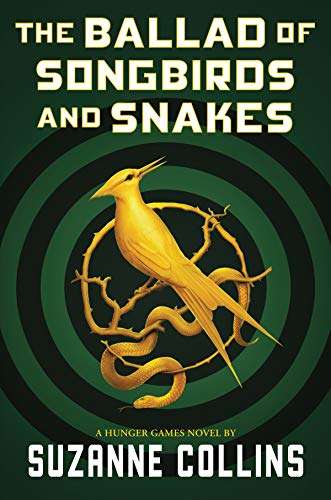
Book: “The Ballad of Songbirds and Snakes” by Suzanne Collins
Publishing Info: Scholastic Press, May 2020
Where Did I Get This Book: I own it
Where You Can Get This Book: WorldCat.org | Amazon | Indiebound
Book Description: Ambition will fuel him.
Competition will drive him.
But power has its price.
It is the morning of the reaping that will kick off the tenth annual Hunger Games. In the Capitol, eighteen-year-old Coriolanus Snow is preparing for his one shot at glory as a mentor in the Games. The once-mighty house of Snow has fallen on hard times, its fate hanging on the slender chance that Coriolanus will be able to outcharm, outwit, and outmaneuver his fellow students to mentor the winning tribute.
The odds are against him. He’s been given the humiliating assignment of mentoring the female tribute from District 12, the lowest of the low. Their fates are now completely intertwined — every choice Coriolanus makes could lead to favor or failure, triumph or ruin. Inside the arena, it will be a fight to the death. Outside the arena, Coriolanus starts to feel for his doomed tribute… and must weigh his need to follow the rules against his desire to survive no matter what it takes.
Review: A few years after “The Hunger Games” trilogy wrapped up with “Mockingjay”, the announcement was made that Suzanne Collins was going to write a prequel story. It was a bit vague at first, and I remember the buzz and anticipation that was tittering throughout the fandom. Who could it be about? Maybe Haymitch’s Games? Or maybe it was going to be about Mags? I was thinking it was maybe going to be about my gal Johanna Mason to see how she played everyone to think she was a scaredy cat and then eventually came out on top through brutality and managed expectations. And then it was announced that it was going to be about Coriolanus Snow, the brutal dictator in charge of Panem in the original trilogy. And I remember people being PISSED.

I wasn’t as put off by the concept. It did take me some time to read the book initially, but I did enjoy it, and re-reading it this year made me appreciate it even more. Because once again, Suzanne Collins knows EXACTLY WHAT SHE IS DOING.
So I will say right off the bat that this is probably my least favorite of the “Hunger Games” books, but that isn’t because it’s a bad book. I still really like this book. But there is a big narrative shift from the original trilogy to follow Katniss Everdeen and all of her innermost thoughts to Coriolanus Snow as a teenager and all of his innermost thoughts. But it’s still a very well written book that only expands more of the lore of Panem and builds the world even more in a way that makes it all the more intriguing. When we follow Coriolanus as he mentors Lucy Gray Baird from District 12 in the 10th Hunger Games, we get to see Panem in a transition period. It’s post-War/Rebellion, and the Capitol is still in shambles (which means you know the districts are having a rougher time as a whole). The Games right now aren’t the big entertainment event that they are when Katniss is reaped; if anything they are kind of run down and gritty. I really loved seeing the huge difference between the two time frames, and it goes to show just how much Snow influenced the Games and how much inspiration he took from his mentee Lucy Gray. Because Lucy Gray is the first one to weaponize her personality to be likable and to make it a bit of a spectacle with her singing and performance to make people root for her. If Coriolanus is a grating narrator (as he is supposed to be), Lucy Gray is a shining light of a character who has moxie and a drive to survive at all costs, even if it means cuddling up with Coriolanus (though I do believe that she DID care for him at one point, even if it wasn’t at the level of obsession and possession that he saw her at; notice I say obsession and possession as opposed to love). I also really liked seeing Lucy Gray’s Covey community, as by the time we get to the original trilogy in the timeline The Covey, a group that was trapped in District 12 after the rebellion after years of being nomadic, have all but disappeared, at least culturally. Seeing how Panem has changed between this book and the original trilogy is jarring but also so, so interesting.
I also liked getting some insight into the Capitol side of things in this book, be it with Coriolanus and his fellow students at The Academy being recruited to mentor the Tributes for the games, or the faculty indoctrinating them and manipulating their every move. We spend so much time in the Districts in the “Hunger Games” trilogy and only see the opulent and decadent Capitol in very specific instances, and in “Ballad” we see a Capitol that is grimy and, as I said, in transition, but it still has the superiority complex and the hints of totalitarianism that is still in shaky stages and is only waiting for a truly ruthless leader to bring it to its full horrific potential. It’s also interesting seeing the politics and ideologies of how the Capitol views the Districts at this point, still dehumanizing them but in a far more overt way at this point, like the Tributes being held in literal zoo cages. Or the way fellow students and Coriolanus look at Sejanus Plinth, who grew up in District 2 and whose family became wealthy and was able to essentially able to buy its way into the Capitol through loyalty and money, but is still looked down upon by others and feels like he is in an identity crisis. There are so many layers here and I greatly appreciated seeing this side of Panem, if only to get context.
Now, I may be treading into some kind of controversial territory here, but I kind of want to address one of the biggest hang ups people have about this book. There were a lot of people I saw, be it in my own life or online, who were very put off by the idea of this book following something of an origin story for President Snow. I had a few people say ‘I am not interested in getting a villain origin story that humanizes PRESIDENT SNOW’, and I mean, hey, that’s a valid worry about the book because there have been some stories where a clearly bad or villainous person gets some kind of redemption arc because of a sad backstory. But I never really had the fear that Collins was going to do that with Snow, as I know that she isn’t going to be an apologist for a fascist dictator just based on the original trilogy. Yes, Coriolanus Snow grew up during a time or war that left his life in shambles, even if his family was on the ‘winning’ side. He and his cousin Tigris are living with their completely indoctrinated grandmother in abject poverty, and while he comes from a prestigious family with name recognition (especially at the school he is attending), he has a huge victim complex because he isn’t living the life he was promised as a Snow. And that victim complex simmers as resentment, then turns into ambition, then turns into a thirst for power at any cost which turns into violence. I have always said that Collins’s “Hunger Games” stories always, ALWAYS have something to say, and the clear message of “The Ballad of Songbirds and Snakes” is about the way that young men can be radicalized by fascist ideology in times of instability within their lives, and while she explains it, she never excuses it with young Coriolanus, especially since we get into his head so deeply and he is just awful. This came out in 2020 when we had been seeing the starts of the Manosphere, and white male grievances were motivating a lot of young white men to embrace far right values, and unfortunately it has only gotten worse since then. So while I understand people not wanting to read about Coriolanus Snow as anything but an irredeemable villain, I also think that turning away from uncomfortable truths about radicalization of people like him in real life just helps the problem grow and grow. Collins doesn’t excuse his actions throughout the book, which are reprehensible even before he becomes president. But to dismiss this kind of exploration as being apologia for his actions is missing the point Collins is trying to make.
So while “The Ballad of Songbirds and Snakes” is probably my least favorite of the books about Panem, I still really enjoy it whether it’s the new lore and expanded world building of Panem, how it has changed over time and how the Games themselves have changed, and how it explores the dangers of radicalization through one of the biggest monsters in the series. Suzanne Collins does not miss. Next up I take on the next prequel book and the final book in the series “Sunrise on the Reaping”. Haymitch’s moment is upon us.
Rating 8: While it’s probably the weakest of the books for me, I still find it to be compelling and complex with a lot of relevant things to say. Also, I love seeing the huge differences in Panem between Katniss’s time and Snow’s time as a mentor.
Reader’s Advisory:
“The Ballad of Songbirds and Snakes” is included on the Goodreads list “YA Dystopia Novels”.
 The Library Ladies