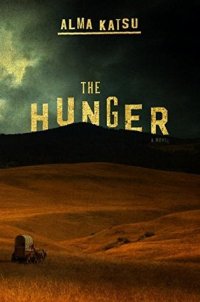
Kate’s Review: “The Hunger”

30285766Book: “The Hunger” by Alma Katsu

Publishing Info: G.P. Putnam’s Sons, March 2018

Where Did I Get This Book: The library!

Book Description: Evil is invisible, and it is everywhere.

Tamsen Donner must be a witch. That is the only way to explain the series of misfortunes that have plagued the wagon train known as the Donner Party. Depleted rations, bitter quarrels, and the mysterious death of a little boy have driven the pioneers to the brink of madness. They cannot escape the feeling that someone–or something–is stalking them. Whether it was a curse from the beautiful Tamsen, the choice to follow a disastrous experimental route West, or just plain bad luck–the 90 men, women, and children of the Donner Party are at the brink of one of the deadliest and most disastrous western adventures in American history.

While the ill-fated group struggles to survive in the treacherous mountain conditions–searing heat that turns the sand into bubbling stew; snows that freeze the oxen where they stand–evil begins to grow around them, and within them. As members of the party begin to disappear, they must ask themselves “What if there is something waiting in the mountains? Something disturbing and diseased…and very hungry?”

Review: Back in college I took a super awesome Cultural Studies and Comparative Literature course called Monsters, Robots, and Cyborgs. In this class we would read horror and science fiction books and texts and then put them in the context of the time period and place that they were written. When we were focusing on stories about zombies and “Night of the Living Dead”, or historical comparison was that of The Donner Party. Having had a fascination with The Donner Party since grade school. My first encounter with it was a particular Far Side comic that my mother had to explain to me….

8c887d87d8224f181fcbce6795dc224d
And it still makes me laugh. (source)

The next encounter was a TV movie called “One More Mountain”, which starred Meredith Baxter as Margaret Reed, one of the survivors of the whole ordeal. From then on I was hooked. So  back to college: I remember going to that class the day we were learning about it with a whole lot of food to share with my classmates (and trying to troll my professor, who was my very favorite and was very tolerant of my edgy, and no doubt obnoxious, sense of humor). Had that class been taught today, I think that Alma Katsu’s “The Hunger” would be the perfect text for the syllabus. Not only does it cover some very solid ground within what actually happened to that tragic wagon train, it adds a whole new element of horror and suspense by throwing in a supernatural twist.

It should be noted first and foremost that Katsu did some extensive research to write this book, even going so far as to retracing the route the Donner Party took as best she could (as the road by car doesn’t take the exact path). So she knows what she is talking about when it comes to the ultimate fates and broad stroked experiences of the people within the group. Because of this, even had there not been a supernatural element, “The Hunger” is gripping, visceral, and feels very, very real. While she may take some liberties here and there to make some of the players more vibrant (and she addresses some of this within her author’s notes), the characters are very relatable to the modern reader, many of them experiencing problems and hardships that many people still face today. Just goes to show that some things like abuse, misogyny, racism, and Othering are timeless, sadly. The details that Katsu put into this book, from the cast of players to the setting itself, were meticulous, and I was sucked into the story easily and felt like I could clearly see everyone and the settings that they found themselves as they moved west. I could picture the prairie, the mountains, and all the problems of the environment that they came to face, especially when the snow began to fall. Along with a traditional narrative, the story is also slowly unfolded through flashbacks at the end of each chapter (usually focusing on a certain character), and then letters that are written mostly by Edwin Bryant, who had gone off ahead of the Party and has possibly discovered some dark realities. The way all of these pieces come together is deeply satisfying, and Kutsu is skilled at making sure they weave together in precise ways.

The unique part of this book that really grabbed me was the horror element. We don’t really know WHAT it is that is plaguing the Donner Party as they make their way, as Katsu is sure to be vague outside of the reveal as to what the origin is (but that would be a spoiler, so I won’t go into details beyond that). But that is part of the horror in and of itself. I loved the descriptions of figures moving in the woods, and the descriptions of the body horror that some of the members start to experience. Katsu derives the supernatural element from many different sources, from folklores from around the world, to superstitions, to implications about illness and madness. What we do know is that something is following The Donner Party as it goes up into the mountains, and that it’s wreaking havoc, sometimes unknowingly. And Katsu does play with some unreliable elements to the story: is this force doing the most damage, or are the people doing far more damage to themselves because of madness, greed, and desperation? What if the absolute and worst horrors in this book are the violent and merciless people, especially once they are driven into a corner.

But there is a whole other kind of horror in this book, and that horror is the truth of what happened to The Donner Party. It isn’t just the fact that the wilderness is dangerous, especially in high stakes situations, but the actual fate of this wagon train is frightening even without the supernatural element. This group took a bad trail based on bad information, hubris, and the entitlement of Manifest Destiny, and therein ended up stranded in the mountain wilderness during winter. Then, when they started to succumb to exposure, cannibalism became the only option for some to survive. That is unsettling without the help of outside forces. I remember being unsettled during that class back in college as I realized that I no longer had the appetite for the food I so gleefully brought with me. And Katsu captures it perfectly, because even though you know what is going to happen, you still dread it.

“The Hunger” is a superb horror novel that will stay with the reader long after the last page is turned. If you are feeling extra daring, save it for a cold winter night, perhaps when it is snowing outside and you might be able to see strange shadows in the trees…

Rating 9: A tense and detailed historical fiction/horror novel, “The Hunger” brings a creepy twist to the already creepy true story of the Donner Party.

Reader’s Advisory:

“The Hunger” is included on the Goodreads lists “Best Wilderness Horror Stories”, and “Horror Novels Set (Largely) in Winter/Snow”.

Find “The Hunger” at your library using WorldCat!

Serena’s Review: “The Ape Who Guards the Balance”

64255Book: “The Ape Who Guards the Balance” by Elizabeth Peters

Publishing Info: William Morrow, September 1998

Where Did I Get this Book: audiobook from the library!

Book Description: The prospects for the 1907 archaeological season in Egypt seem fairly dull to Amelia Peabody. Despite her adored husband’s brilliant reputation in his field, his dashing-yet-less-than-diplomatic behavior has Professor Radcliffe Emerson ignominiously demoted to examining only the most boring tombs in the Valley of the Kings — mere leftovers, really. All the Peabody Emersons profess stiff upper lips and intend to make the best of a bad situation, but this year the legendary land of the pharaohs will yield more than priceless artifacts for the Emerson expedition. For the desert guards even deeper mysteries that are wrapped in greed — and sealed by murder.

In a seedy section of Cairo, the youngest members of the expedition purchase a mint-condition papyrus of the famed Book of the Dead, the collection of magical spells and prayers designed to ward off the perils of the underworld and lead the deceased into everlasting life. But for as long as there have been graves, there have also been grave robbers — as well as those who believe tomb violators risk the wrath of gods like Thoth, the little baboon who protects the scales used to weigh such precious commodities as hearts and souls.

Previously Reviewed: “The Crocodile on the Sandbank” and “The Curse of the Pharaohs” and “The Mummy Case” and “Lion in the Valley” and “Deeds of the Disturber” and “The Last Camel Died at Noon” and “The Snake, the Crocodile, and the Dog.” and “The Hippopotamus Pool”

Review: It’s been a while, but we’re back with another Amelia Peabody novel. I usually turn to these when I find myself in a reading slump, but luckily I’ve had a pretty good run on books recently. But I still found myself with a hankering for my favorite female sleuth, and so here we are!

Back in Egypt, Amelia and her family find themselves looking forward to what will likely be a long, boring season. They have been “banished,” essentially, to some of the lesser tombs in the Valley and aren’t likely to make any grand discoveries. However, adventure is sure to find them, this time in the appearance of a priceless artifact that is recovered by Ramses, Nefret, and David. But following the artifact is a wake of mayhem and murder. Determined to find out who is behind these disturbances, Amelia and co. are on the case! Matters are only muddied, however, when their extended family (Walter, Evelyn, and their daughter, Lia) arrive and previously unknown attachments are revealed.

Many of the tried and true aspects of this series that I have always enjoyed are still present. While the narration is now more broken up, with the introduction of manuscripts and letters written from the perspectives of Ramses and Nefret, we still spend much of our time with our familiar and beloved Amelia. Here, however, the story really does take a new turn with regards to our heroine and her role in these stories. Up to this point, Amelia has been a solid point of reason, sound thinking, humorous commentary, and an adventurous spirit. All of these aspects of her personality remain here, however we are also exposed to a new reality: even Amelia herself has flaws and falls prey to certain prejudices that she wasn’t even aware of in herself. While it is difficult to see our reliable main character clash up against points of view that the modern reader immediately recognizes as traps of prejudices, I loved the full exploration of how this type of latent viewpoint could exist even within the most modern and intellectual beings of the time. And, be assured, even this challenge, as unexpected as it may have been for our heroine, is one that she is up to conquering!

As these books have continued, readers become more and more invested in the goings ons and thoughts/feelings of the younger group of the Emerson party. And this is probably the first book where I felt like these sections truly came into their own. Ramses continues to struggle with his repressed feelings for Nefret. Nefret, herself, continues to run into the barriers that are set against her due to her age and sex (even by members of her own family). And David struggles to find his role in a world that would often judge him first by the color of his skin, even when strong connections exist between him and those who might judge.

The mystery itself was also enjoyable. While I was able to predict certain twists and turns, the romp was still worth the ride. Many familiar faces play a role in this mystery, wandering in and out of scenes in some unexpected ways. I was particularly pleased to see the return of a certain villain who often creates many disturbances in the Emerson clan. What’s more, the stakes in this mystery are much higher than they have been in the past. While the book is still a “feel good” mystery, there was much more darkness and tragedy than I have come to expect. I never love crying over a book, but in this instance, I felt like the sadder moments were not only well-earned but a necessary send-off to certain storylines.

The archeological portions of the story were also quite compelling. We’ve gotten so used to our meticulous and studious main characters, that reading this book and its descriptions of the mishandling of a tomb found by another excavation team, I found myself almost getting as emotionally worked up as Emerson himself!

As I’ve said, many portions of this book felt familiar, but in the best way. There are significant strides made in advancing the storylines of the younger generation, which I’m sure we’ll see continue to play out in books to come. It also takes a new approach to examining Amelia’s own character, forcing her to confront some weaknesses in her own perceptions, an aspect of the story that I particularly enjoyed. As always, for fans of this series, keeping plugging along! You won’t be disappointed!

Rating 8: Continues the series’ long line of success, but adds new layers with an exploration of Amelia’s own flaws and an extra focus on the lives of Ramses, Nefret, and David.

Reader’s Advisory:

“The Ape Who Guards the Balance” is on these Goodreads lists: “Best Archaeology Thriller Books” and “Strong Female Characters Written by Female Authors.”

Find “The Ape Who Guards the Balance” at your library using WorldCat!


Serena’s Review: “The Hollow of Fear”

363423301Book: “The Hollow of Fear” by Sherry Thomas

Publishing Info: Berkley, October 2018

Where Did I Get this Book: Edelweiss

Book Description: Under the cover of “Sherlock Holmes, consulting detective,” Charlotte Holmes puts her extraordinary powers of deduction to good use. Aided by the capable Mrs. Watson, Charlotte draws those in need to her and makes it her business to know what other people don’t.

Moriarty’s shadow looms large. First, Charlotte’s half brother disappears. Then, Lady Ingram, the estranged wife of Charlotte’s close friend Lord Ingram, turns up dead on his estate. And all signs point to Lord Ingram as the murderer.

With Scotland Yard closing in, Charlotte goes under disguise to seek out the truth. But uncovering the truth could mean getting too close to Lord Ingram—and a number of malevolent forces…

Previously Reviewed: “A Study in Scarlet Women” and “A Conspiracy in Belgravia”

Review: I warned you in our “Highlights” post that a review was coming quickly! Thanks to the lovely Edelweiss, I’ve had access to this title for a while but had been trying to resist reading it until closer to its publication date. Torture indeed. And at this point, after three amazing books (spoiler: I loved this one), it’s such a pleasure to find another series that I can now put full faith into the fact that I’m sure to love future titles as well. Why can’t they all just be out now though?? They should defy space and time and arrive ala Netflix binging. But enough of that, on with the review!

The fallout of the events that took place in “A Conspiracy in Belgravia” are still being felt, most largely by Lord Ingram himself whose world has crumbled after the discovery of his wife’s involvement with the criminal mastermind Moriarty. But a bad situation can always get worse and very much does with the discovery of Lady Ingram’s body on his own property. Of course, Charlotte Holmes would never watch idly as disaster befell her dear friend. But still banished from society and with a gossip-worthy connection with Lord Ingram himself, how can she involve herself in the case in a useful manner? In disguise, of course!

Oh where, oh where to start my crazed ranting! I think part of my love still comes down to the very fact that this series exists and exists as well as it does. I’ve recommended it to a few people lately, including my husband, and his and many other’s responses have often been the same. Something like “…really? but…why?” For some, this is simply because they see no reason to adapt the character once again at all and for others there is a general distrust that a series could effectively gender swap the character while also maintaining its historical setting. And really, these are both legit concerns. In the last several years, though it has been waning a bit recently, it seems the entire world was under a certain “Sherlock” fever, with a new adaptation, either written or on some screen or another, announced every other day. But to these skeptics I say a loud and resounding “nay!” There is always room for another adaptation if and when an author is truly capable of bending these classic characters into something truly new without losing the essence of said characters and stories. And that is what makes Sherry Thomas’s books so amazing.

“The Hollow of Fear” is no exception. By this point, we know that Thomas has tackled the biggest challenge: creating a new version of Sherlock that both rings true to the original but also has enough novel factors to stand alone among other adaptations. And from there, it’s just a matter of releasing said character into another plot and seeing what happens. I think what makes this story stand out in particular is the fact that it is more of a direct sequel to its predecessor than the original. The first two definitely had connected through lines, but could perhaps be read individually. Here, this story directly pulls from the events of the last and is stronger for having a more robust mystery built upon information and puzzles that have been laid down through both books now.

I also enjoyed that the story largely takes place in a small space, Lord Ingram’s estate. We jump here and there to a few places in the surrounding community, but in many ways it reads like a classic mansion mystery where a large group gathers, a murder is committed, and the culprit and method must be sought out amidst the question of how such an event could occur with so many witnesses around.

All of our favorite characters make an appearance though the amount of page time for each is switched around a bit. Here, we spend a lot more time with Charlotte’s sister, Livia and got to see her come a bit into her own, building confidence as she went. We also spend a good amount of time with Detective Treadles, and I particularly enjoyed his storyline here. In the last few books, he’s been a bit unlikable due to his feelings and prejudices about his wife, but here we see him truly have to confront these aspects of himself. In retrospect, I very much enjoy this slow transformation. I think it reads as a much more honest version of this type of change and the moments that lead him to real inner reflection in this book also ring true for what would open one’s eyes about one’s own behaviors and thoughts with regards to these types of prejudices.

Charlotte herself is of course amazing. I very much enjoyed her undercover work, and it was a fun twist to see her more fully interacting with the mystery as the story unfolded. Due to her gender and outcast status, she always had to operate a bit on the sidelines in the past books, and while that lead to some really great moments too, this was a nice change of pace from what could have become a predictable set of events.

Her relationship with Lord Ingram was also further explored, and while I still very much enjoy this building relationship, there were a few things at the end that were particular to this couple that lead me to drop my rating from a full 10. Some of the explanations for past actions I’m not sure truly made sense or were necessary in the grand scheme of things. Instead, they almost read as excuses to include certain parts of the story that were hard to work in otherwise. And then were largely reset again at the end of this book. I’m curious where things will go from here, however, as I don’t think this type of bait-and-switch will work twice, so at some point this complicated relationship is going to need to be dealt with in another way.

The mystery itself was also very good and remains one of the strongest pros of the entire series. Here there were a few moments where I thought I had guessed at crucial information and was feeling quite smug about it only to later discover that, nope, that wasn’t right at all. And while there were a few very satisfying scenes at the end where Charlotte was able to put some self-important police investigators in their place, part of that reveal also relied on one concept that felt a bit too convenient. But, again, that’s a very nit-picky criticism. Because overall, for fans of historical mysteries, this series is turning out to be a must read!

Rating 9: Sherry Thomas continues to make the difficult task of writing a new version of Sherlock Holmes seem “elementary” indeed!

Reader’s Advisory:

“The Hollow of Fear” is a newer title and isn’t on many relevant Goodreads list, but it is on “Historical Mystery 2018.”

Find “The Hollow of Fear” at your library using WorldCat!


Kate’s Review: “Exit Stage Left: The Snagglepuss Chronicles”

36686229Book: “Exit Stage Left: The Snagglepuss Chronicles” by Mark Russell and Mike Feehan (Ill.)

Publishing Info: DC Comics, August 2018

Where Did I Get This Book: I received an eARC from NetGalley.

Book Description: Heavens to Murgatroyd! Hanna-Barbera’s very own Snagglepuss is reimagined in a brand-new series, EXIT STAGE LEFT: THE SNAGGLEPUSS CHRONICLES, by author Mark Russell (THE FLINTSTONES)!

It’s 1953. While the United States is locked in a nuclear arms race with the Soviet Union, the gay Southern playwright known as Snagglepuss is the toast of Broadway. But success has made him a target. As he plans for his next hit play, Snagglepuss becomes the focus of the House Committee on Un-American Activities. And when powerful forces align to purge show business of its most subversive voices, no one is safe!

Written by Mark Russell, the critically acclaimed mastermind behind the award-winning PREZ VOL. 1 and THE FLINTSTONES, EXIT STAGE LEFT: THE SNAGGLEPUSS CHRONICLES, enters the Hanna-Barbera reimagined universe! Collects issues #1-6.

Review: A special thanks to NetGalley for providing me with an eARC of this book!

Though I feel like I watched a good amount of Hanna-Barbera cartoons as a child, one character that I don’t have specific memories of is Snagglepuss. I remember him existing, and I remember a few of his quirks (like his catch phrase ‘exit, stage left!!’ and his smooth personality), but I don’t think I ever saw a full cartoon with him as the star. But even with my passing familiarity of the character, I still knew that I ABSOLUTELY needed to read “Exit Stage Left: The Snagglepuss Chronicles”. It’s not exactly an obvious premise: Snagglepuss is a closeted Southern playwright in 1950s New York during the McCarthy Witch Hunts and the Lavender Scare, and finds himself and his friends targeted for their lifestyles. Is this a story I thought I’d see Snagglepuss in? No. Is it one of the best, if not the very best, graphic novels I’ve read this year. Heavens to Murgatoyd, yes.

giphy1
No longer is my go to Snagglepuss reference a throwaway “Simpsons” joke! (source)

The thing about Snagglepuss as a character is that he was written at a time where gay characters were coded into entertainment, and they were usually portrayed as villains, buffoons, or, if people were feeling progressive, tragic victims who couldn’t survive the story if they wanted to be true to themselves. Snagglepuss is fussy, dapper, has a smarmy affectation, and acts ‘flamboyant’, so it’s probably safe to assume he was coded as gay, and meant to be laughed at. So to take this character and to give him this story is a very neat deconstruction of what the character was initially, especially since this story is set within the same general time frame that Snagglepuss first was introduced to the world (if not a little before). Mark Russell, the man responsible for other DC/Hanna-Barbera edginess like his take on “The Flintstones” and “Scooby-Doo”, has given Snagglepuss a similar, dark treatment where people thought darkness couldn’t possibly be found. But darkness there is, as Snagglepuss finds himself caught up in the fear of the House of Un-American Activities Committee, with it’s head Gigi Allen setting her sights on him specifically. Through this backdrop we get to explore and examine the hypocrisy, corruption, prejudice, and rampant fear that had the American Government and people in an uproar. Snagglepuss himself is reluctant to become a symbol of rebellion; on the the contrary he’s perfectly content living his life as a success on Broadway, meeting up with his lover at the Stonewall Inn and basking in his fame as an intellectual elite. What I liked the most about him as our main character is that he is thrust into this role of rebellion, and his complicated feelings about it make him a well rounded character who has his OWN privileges that he hides behind when others can’t. He is a compelling iteration of the original character, and someone who can’t accept how bad things have gotten until it’s too late. 

Other familiar faces pop up in this story, from Hanna-Barbera stallwarts to actual players during the Red and Lavender Scares. We get cameos from the likes of Marilyn Monroe, Lillian Hellman, and the Rosenbergs, whose execution is one of the darker plot points within this book. At the end of the graphic novel Russell has put together a handy dandy set of notes on various people and moments he includes in the story, and I found that to be very helpful and thoughtful of him (I had never heard of the great Cornfield War between Khruschev and an American farmer. Look it up, it’s hilarious!). On the Hanna-Barbera end, Quick Draw McGraw and Squiddly Diddly play key roles and have their own forms of prejudice to contend with (Quick Draw being a closeted cop on the Stonewall beat and Squiddly being an immigrant), but the stand out is Huckleberry Hound. Huckleberry is Snagglepuss’s childhood best friend, and has become a well known Southern Gothic novelist whose marriage has fallen apart because of his sexuality. They are exact opposites, with Snagglepuss being flitty and carefree and Huckleberry being anxious and depressed. The way that their relationship grows and changes, and how they cope, or don’t cope, is one of the saddest aspects of this book, and the one that had me weeping openly of Hanna-Barbera characters. I never thought I’d see the day. But that just goes to show how excellent Russell is as a writer: he takes two dimensional cartoon characters and breathes life into them, redefining them and bringing relevant social concepts to life through them.

The artistic style that Mike Feehan brings to this story is also incredibly compelling. The characters look realistic, with Snagglepuss absolutely designed like a mountain lion in stature and gait, but not out of place within the real world they are mingling in. The animals are the right amount of anthropomorphized without feeling uncanny or eerie.

Screen Shot 2018-08-06 at 12.08.25 PM
(source: DC Comics)

“Exit Stage Left: The Snagglepuss Chronicles” feels timely because the rise of paranoia and corruption within our current administration, and the constant Othering of various groups that don’t fit into the mold that they deem as ‘true Americans’. It feels like a warning, and it makes it all the more intense and powerful of a read. But it also feels like you’re reading about familiar friends, and are learning a great deal about them that you never knew, even though they were always like this. It’s ingenious and effective, and I loved every bit of it. And it’s stories like this that make me run back to DC Comics, because this is by and large one of, if not the, best graphic novels I have read in a very long time. I have my issues with DC, but I stand by the fact that I find some of the stories they tell to be incredibly ambitious and outside the box. And, heavens to Murgatroyd, I cannot recommend “Exit Stage Left” enough.

Rating 10: This brilliant and poignant story takes a well known character and gives him depth, heart, and complexity. Snagglepuss and his friends jump off the page in a story that feels as timely as it does foreboding.

Reader’s Advisory:

“Exit Stage Left: The Snagglepuss Chronicles” isn’t on many specifically relevant Goodreads lists, but I think it has a place on “My Country, The Enemy”, and “Graphic Novels Featuring LGBTQ Themes”.

Find “Exit Stage Left: The Snagglepuss Chronicles” at your library using WorldCat!


Kate’s Review: “Bombshells United: American Soil”

37489649Book: “Bombshells United (Vol. 1): American Soil” by Marguerite Bennett, Marguerite Sauvage (Ill.), Marcelo DiChiara (Ill.), and Siya Oum (Ill.).
Publishing Info: DC Comics, July 2018

Where Did I Get This Book: The library!

Book Description: The DC Bombshells unite in this collection BOMBSHELLS UNITED VOL. 1, continuing the hit franchise!

Author Marguerite Bennett (DC BOMBSHELLS, BATWOMAN) unites the women of DC BOMBSHELLS in an alternate history tale with Wonder Woman on the front lines of battle.

The Bombshells are back in an all-new series! As our new tale begins, the year is 1943 during WWII, and Wonder Woman is called to Arizona for help by two young girls named Cassie Sandsmark and Donna Troy! The girls’ friends and families are being displaced from their homes and forced into internment camps! To save them, can Wonder Woman fight against the same people she once fought alongside?

To make matters worse, Clayface has infiltrated the camp and is disguised as loved ones to throw Wonder Woman off. Collects issues #1-6.

Review: Thus, we being with the first collection of the final series of DC Bombshells. I’m still livid and bitter that this series was cancelled, but I’m going to see it through and enjoy it/support it until the very end. What I found most fascinating when I read about the “Bombshells United” series is that this one isn’t going to just look at the ills that foreign nations committed during WWII, but also the rotten things that happened on the home front, and in the country that The Bombshells swore to protect. To me, it’s refreshing that Marguerite Bennett decided to turn scrutiny on the United States for this next arc, because we did some absolutely shameful stuff during WWII. The big theme of “Bombshells United: American Soil” is that of Executive Order 9066: Japanese Internment. And given that we seem to have forgotten our own history, it’s an important reminder that we are not unfamiliar with grievous civil rights abuses. Especially since we seem to be on the path to repeating them.

We get to see Wonder Woman back at the forefront at the start of this new series, and it is always a breath of fresh air to see her. Diana Prince is truly one of the most pure and good DC Superheroes, and it felt fitting that she would be the Bombshell to be confronting the evils of the Japanese Internment. It allows us as a reader to measure up our very imperfect (and in this case horrendous) policies to Wonder Woman as the ideal we should strive for. But what makes it a bit more interesting is the introduction of Donna Troy and Cassie Sandsmark, two Wonder ladies in their own right (both of them filling the Wonder Girl role at different times). Cassie and Donna in this both have vested and personal interests against the Japanese internment, as they are both Japanese American (though Cassie is white passing, she still would have been imprisoned based on the law). You throw in Emily Sung and Yuri and Yuki, and you have a group of marginalized people who are participating in the dissent and the resistance, which in turn makes it so Wonder Woman doesn’t act solely as a white savior. It’s pretty well done, and I liked the dynamic that Bennett created between them and Wonder Woman (as they eventually form to become The Wonder Girls) that allows them to fight against heinous domestic policy. In fact, at the end of this arc in the collection, Bennett lists a great number of resources people can look up regarding the Japanese Interment (along with some additional resources about how Indigenous peoples were treated during this time; Dawnstar does show up, and while I liked how powerful and important she was I’m a LITTLE afraid that Bennett is kind of falling into the ‘magical Indian’ trope with her).

HOWEVER, there were a few stumbling moments in this series to me. The first involves the introduction of Clayface. He is the face of antagonism in this series, as he’s a former soldier who is very in favor of the internment. It all comes back to him seeing the American Ideal that must be protected at all costs, and he is obsessed with Wonder Woman because to him, that’s what she represents. This in and of itself is a very intriguing concept and metaphor for blind nationalism. But my problem is less to do with that and more to do with the pay off. For those who don’t want to know, we have our usual

16693958
(source)

Clayface, of course, sees the light through compassion, empathy, and the selfless sacrifice of Wonder Woman. This does two things: it makes it so the Wonder Girls get a little bit more to do in their own story (which is fine), but it also trades in one really well done and rounded character at this point for five new characters who are brand new to the story and not very complex as of yet. Donna is the exception, but the rest of the Wonder Girls as of now could VERY easily get lost in the crowd, which is a similar problem with the Bat Girls in previous issues. Speaking of the Bat Girls, the story of Harvey Dent going from villain to ally all through the power of love has basically been regurgitated with The Wonder Girls, as now Clayface is fighting on the side of good. We’ve seen this already! And I want to see more of that kind of thing with Harvey, if I’m being honest! Oh, and it happens with Baroness Paula van Gunther, as she ALSO shows up for about three seconds to say that SHE TOO has seen the error of her ways! WHY? In execution it’s because of Dawnstar, but in terms of why it has happened characterization wise, that remains to be seen. The good news is that Wonder Woman isn’t gone for good, as she has pretty much reappeared by the end of the collection (SORT OF, she’s kind of become a hybrid of Diana and Donna, it’s complicated), but it definitely feels like she may be stepping aside. Which I have a lot of feelings about.

On top of that, it has become very clear that even MORE Bombshells are going to be added to this universe. The heartening thing about that is that Bennett really wants to give all these awesome ladies their due, but the worrying aspect is we are getting VERY close to fantasy bloat territory here. I worry that by adding all these characters, they REALLY won’t be able to shine properly because they will always be competing for page time. Especially since the series was so unceremoniously cancelled before it could go as far as it wanted to. But hey, there is some good news in this slew, and I mean SLEW, of new faces.

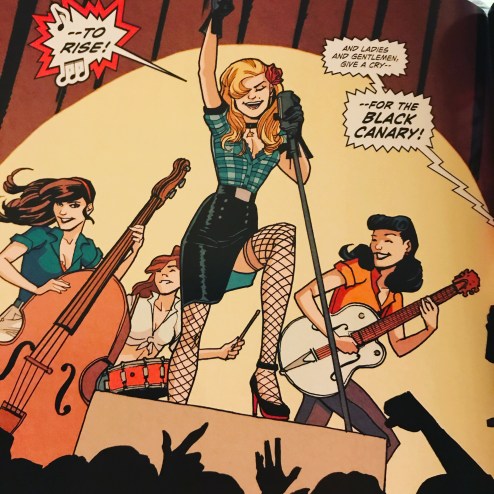
BLACK CANARY IS HERE!!!!!

IMG_2350
Looking good, Dinah! (source: DC Comics)

So overall, BOMBSHELLS UNITED was an important collection with an important story, but I’m starting to worry that this series is getting overcome with the number of characters it has. I really don’t want it to get bogged down. But that said, I’m excited to see where it goes next!

Rating 7: An important message and mostly responsible storytelling kicks off this new Bombshells series, but some of the recycled themes and explosion of new characters was a bit harder to swallow this time around.

Reader’s Advisory:

“Bombshells: United (Vol.1): American Soil” is included on the Goodreads lists “If You Liked Agent Carter, Try…”, and “Historical Fiction About Japanese Internment Camps”.

Find “Bombshells: United (Vol.1): American Soil” at your library using WorldCat!

Previously Reviewed:

Serena’s Review: “The Phantom Tree”

32618152Book: “The Phantom Tree” by Nicola Cornick

Publishing Info: Graydon House, August 2018

Where Did I Get this Book: NetGalley

Book Description: Browsing antiques shops in Wiltshire, Alison Bannister stumbles across a delicate old portrait – supposedly of Anne Boleyn. Except Alison knows better… The woman is Mary Seymour, the daughter of Katherine Parr who was taken to Wolf Hall in 1557 as an unwanted orphan and presumed dead after going missing as a child.

The painting is more than just a beautiful object from Alison’s past – it holds the key to her future, unlocking the mystery surrounding Mary’s disappearance, and the enigma of Alison’s son.

But Alison’s quest soon takes a dark and foreboding turn, as a meeting place called the Phantom Tree harbours secrets in its shadows…

Review: This is probably one of the first historical fiction novels that is NOT a mystery that I’ve read in quite a while! As such, I was quite excited to return to the genre, especially when comparisons to Phillipa Gregory’s books were being routinely listed (though I’ve had a fairly hit and miss experience with Gregory, I will always love “The Other Boleyn Girl.”) The book had a bit of a slow start and didn’t grab me as much as some of Gregory’s better books, but over all, I still enjoyed “The Phantom Tree,” especially its take on a lesser known and minor character in Tudor history.

Allison is a woman out of her own time, and while she’s managed to scramble a life together for herself, calling upon her vast stores of sheer determination and stubbornness, she still longs to return to her original time back in the 16th century where she was forced to leave behind her infant son. Her only clues are connections to Mary Seymour, a fellow orphan left to be raised at Wolf Hall, and a young woman with a mysterious ability of her own. But Mary has been lost to time, with many scholars believing she died in infancy. When Allison discovers a painting of an adult Mary, she finally is able to begin picking up the clues that may finally lead her home.

This story is pieced together through the perspectives of both Allison and Mary. Allison’s portions consist of her life in the present and her search to return to the past. And through Mary’s eyes, we see the events that lead to Allison’s journey to the future and the events that have unfolded after she’s gone missing, and which Allison herself is now piecing back together centuries later.

Both Allison and Mary were compelling characters, however the nature of the story and the way their stories unfolded did lead to the book feeling as if it had a slow start. Further, both of them were initially a bit unlikeable, with Allison coming off as a bit of a ignorant brat (mostly her past self) and Mary as too wilting and unwilling to take action in her own life. However, from these weaker beginnings, both characters ultimately grew into women I found myself greatly rooting for.

I didn’t know much about Mary Seymour before going into this book, so I did end up doing a bit of background reading to try and figure out how much if this story is based on history. Mary disappeared from history when she was around 2 years old and is presumed to have died in young childhood. That leaves the majority of this story as operating in a fictional setting. However, what made it stand out was the creative way the author managed to tell Mary’s story in a way that made it believable that she may have lived longer but still been absent from history. The fantastical elements come in early, especially with regards to Mary, so there’s never any real question about the authenticity of the tale, but it still added a nice layer that the book never strayed too far into the unbelievable as far as her actual life.

Allison is, of course, a completely fictional character. What I most appreciated about her story was the build-up for her character back in the 16th century that helped establish her as a person capable of adapting to a completely different life in modern times. Think about it: that’s a huge ask of a character and the book explores a few other characters who also time traveled and were less successful with it. The same brashness and stubborn refusal to bend that made her rather dislikable as a teenager in the past were also the traits that let her survive on her own in a completely new world.

The time travel and fantastical elements did end up playing a larger role in the story than I initially anticipated, and there were a few twists and turns towards the end that were especially surprising. At the same time, I never felt like these aspects of the book overran the historical setting of the past sequences or the modern version of the story that focused on Allison’s search for family, her discovery of self and what she wants from her life, and the burgeoning romance with a historical researcher.

By the end of the story, I was actively rooting for both of these main characters, made all the more tense by the knowledge that something dark had to be looming to explain Mary’s sudden disappearance in history. This particular element of the book did wrap up rather suddenly, and while it helped build the believablity of the mystery, it was also a bit traumatic to experience with one of your main characters.

I very much enjoyed “The Phantom Tree.” It was a strange mix of fantasy/time travel, historical fiction, and even modern romance. Both Mary and Allison were compelling heroines, though I never quite escaped a certain sense of distance from the story which prevented me from becoming fully enthralled. For fans of time travel stories, however, and especially those interested in the Tudors, I would definitely recommend this book!

Rating 7: A solid new entry into the subgenre of historical/time travel fiction, though I didn’t connect with it as fully as I may have wished.

Reader’s Advisory:

“The Phantom Tree” is a new book so it isn’t on many Goodreads lists, but it should be on “Historical Fiction/Time Travel.”

Find “The Phantom Tree” at your library using WorldCat.


Serena’s Review: “A Treacherous Curse”

26244626Book: “A Treacherous Curse” by Deanna Raybourn

Publishing Info: Berkley, January 2018

Where Did I Get this Book: NetGalley

Book Description: London, 1888. As colorful and unfettered as the butterflies she collects, Victorian adventuress Veronica Speedwell can’t resist the allure of an exotic mystery—particularly one involving her enigmatic colleague, Stoker.

His former expedition partner has vanished from an archaeological dig with a priceless diadem unearthed from the newly discovered tomb of an Egyptian princess. This disappearance is just the latest in a string of unfortunate events that have plagued the controversial expedition, and rumors abound that the curse of the vengeful princess has been unleashed as the shadowy figure of Anubis himself stalks the streets of London.

But the perils of an ancient curse are not the only challenges Veronica must face as sordid details and malevolent enemies emerge from Stoker’s past.Caught in a tangle of conspiracies and threats—and thrust into the public eye by an enterprising new foe—Veronica must separate facts from fantasy to unravel a web of duplicity that threatens to cost Stoker everything. . . .

Review: I am now completely caught up on the Veronica Speedwell novels! Yay!! There are now no more Vernoica Speedwell novels to read until MARCH 2019! Boo!! But, as always, it is best to focus on the present instead of dreading the long, cold dreary months until next spring when the next book is finally released. And, surprising no one, this book was delight, and I blazed through it much more quickly than I would have liked!

Veronica and Stoker are minding their own business, busily cataloging the items that have been gathering dust in their patron’s expansive properties for generations. All seems well until a sensationalist story of a cursed expedition to Egypt begins making a splash across the local newspapers. But what should have remained a simple curiosity, becomes much more dire when the pair realize that the linchpin for the mystery is a man who was formerly Stoker’s partner. What’s worse, this partner was the one to run off with Stoker’s ex-wife. So when this man disappears, Stoker finds himself squarely in the cross-hairs of an investigation that is only too likely to recast him, once again, as a villain of society. Veronica, of course, has something to say about this, and so with her leading the charge, the pair set out to unravel the mystery and secure Stoker’s reputation and future.

I’ve made comparisons to the Amelia Peabody series from the start, but the subject matter of this one really hits that nail squarely on the head. I’ve always been interested in Egyptology (I blame my unrepentant love of 90s “The Mummy!”), so I was excited to see it as a focal point of this book. There are the requisite references to ancient gods, a few curses running around, and ancient jewelry that’s gone missing. And what would a good Egyptian mystery be without a mummy? So of course there is one of those as well. I enjoyed the sprawling cast of characters that made up the suspect pool of the story, all having an extensive history together working on digs in that area of the world. The tangled relationships and roles left me constantly guessing as to the motives of each player and how they could be involved with the disappearance of Stoker’s former friend.  It was even more fun reading these bits than usual, as references to famous hotels and locations in Eygpt were familiar from my reading of the Amelia Peabody books.

While I did like these elements of the mystery and my general appreciation for the topic remained, I was a bit put off by the constant comparisons to the other series that was going on in my mind. The line was just a bit too close between the two. Not Stoker and Veronica themselves, since as characters they have enough established to differentiate themselves from Amelia and Emerson. But the way the mystery unfolded and the roles the characters involved played did start to feel a bit predictable having come off reading so many historical mysteries featuring similar topics.

Veronica and Stoker were excellent as always. Veronica, especially, seems to really come into her own in this book. Stoker, understandably, struggles with the entire situation and is thrown into numerous scenes that shake him quite badly, most notably a confrontation with his ex-wife. I particularly liked Veronica’s tongue-lashing of Stoker when he too often fell into bouts of self-pity. Stoker’s arc and past have been slowly unrolling for the past several books, but I do hope that this confrontation with his past as forced upon him by this story will put an end to some of the more mopey and melodramatic moments he could be prone to. Veronica always plays nicely off this aspect of him, but at a certain point, there needs to be a bit more growth on Stoker’s side. So while I liked the situations that arose here, I’m hopeful that this will be the end of this particular plot point.

A complaint I’ve had in the past has had to do with the endings often feeling rushed and too convenient. This book mostly avoids that same pitfall. Mostly. Instead, there are various reveals scattered throughout the story. This allows what is really a very complicated mystery with a ton of moving pieces to come together in a more natural and less info-dumpy manner. However, again, the ending did fall prone to the convenience factor with the villains neatly doing away with themselves. It seems to be a common trait.

The romance between Veronica and Stoker was understandably muted in this story, given the nature of the mystery and the involvement of Stoker’s ex, whom he still struggles to move on from. Similarly to his tendency towards the morose, I’m hopeful that this book marks a turning point in their relationship as well. No need to rush to the alter or anything, but a bit more progress in this area would be nice.

I very much enjoyed “A Treacherous Curse.” It remained true to all the aspects that I’ve enjoyed previously, most notably the strength of its two leads and the inclusion of a legitimately puzzling mystery. The topic of the mystery was a bit dampened  by comparisons to the Amelia Peabody books, because let’s be honest, there’s no beating those stories as far as historical mysteries in Egypt go. But this goes down as another solid entry in this series, and if you haven’t already, definitely check it out. Or save it up a bit until March is closer so you’re not waiting forever like me.

Rating 8: While Egypt remains Amelia Peabody’s stronghold, Veronica and Stoker are setting up camp as a strong second.

Reader’s Advisory:

“A Treacherous Curse” is included on these Goodreads lists: “Regency and Victorian Mysteries” and “Historical Mysteries and Thrillers Featuring Women.”

Find “A Treacherous Curse” at your library using WorldCat.


Book Club Review: “Deathless”

8694389We are part of a group of librarian friends who have had an ongoing bookclub running for the last several years. Each “season” (we’re nerds) we pick a theme and each of us chooses a book within that theme for us all to read. Our current theme is “B-Sides,” where we pick different books from previous authors that we read in the club.

For this blog, we will post a joint review of each book we read for book club. We’ll also post the next book coming up in book club. So feel free to read along with us or use our book selections and questions in your own book club!

Book: “Deathless” by Catherynne M. Valente

Publishing Info: Tor Books, March 2011

Where Did We Get This Book: Kate from the library, Serena owns it.

A-Side Book: “The Girl Who Circumnavigated Fairyland in a Ship of Her Own Making”

Book Description: Koschei the Deathless is to Russian folklore what devils or wicked witches are to European culture: a menacing, evil figure; the villain of countless stories which have been passed on through story and text for generations. But Koschei has never before been seen through the eyes of Catherynne Valente, whose modernized and transformed take on the legend brings the action to modern times, spanning many of the great developments of Russian history in the twentieth century.

Deathless, however, is no dry, historical tome: it lights up like fire as the young Marya Morevna transforms from a clever child of the revolution, to Koschei’s beautiful bride, to his eventual undoing. Along the way there are Stalinist house elves, magical quests, secrecy and bureaucracy, and games of lust and power. All told, Deathless is a collision of magical history and actual history, of revolution and mythology, of love and death, which will bring Russian myth back to life in a stunning new incarnation.

Serena’s Thoughts

This was my bookclub book choice. After reading and loving the entire “Fairyland” series, I was eager to see what Valente had to offered with a new fantasy setting and topic. How would her lyrical writing style and witty twists of nonsense translate to the seemingly much more dark and serious tone of a Russian fairytale?

As a young girl growing up, Marya sees more than most. She sees the bird-forms that her sisters’ husbands wore before changing into men and asking for their hands. She’s visited the small beings who run her house via committee. She knows there is magic in the world, and she is ready and waiting for her turn. But what she gets is Koschei, a dark being who has served as the nightmare in Russina folklore. However, Marya is no wilting flower herself, and over the years proves to be the challenging equal of even a being so great as Koschei.

This is the story of Marya, but it is also the story of Russia. And with that dual focus and the time period during which this is set, there is a darkness that permeates the story. There are some incredibly rough scenes that draw from historical events and Valente doesn’t back down from the tragedy of it all. It was quite the change from the up-beat and fuzzy tone of her other books, but not a change for the worse. I don’t have a strong foundation in Russian history, so there were various points where I had to put the book down out of curiosity about the real-life events that were being referred to. However, the book and fairytale aspects are also strong enough on their own that this type of extra research was by no means necessary.

I very much enjoyed Marya herself and the way she moved through her own fairytale. I also wasn’t familiar with the original folktale, so I read up on that as I went along, too. The story was slow to start, but once it gets into the truly fantastical elements and onto Marya’s own adventures and quests, I was able to zip along.

I did struggle a bit more with Valente’s flowery way of writing in this story. While she still had several very beautiful lines and highly quoatable sections, there were also portions that felt like they just dragged on just for the sake of lyrical lines. But those lines were actually adding anything to the story. It felt like an editor could have been used to really pair these sections down. This would have not only helped the pacing, which, like I said, could be slow at times, especially in the beginning. But it also would have left the remaining beautiful bits as stronger for being more rare.

Kate’s Thoughts

I was the person in book club who didn’t really care for “The Girl Who Circumnavigated Fairyland in a Ship of Her Own Making”, but when I heard the plot of “Deathless” I was game to give Valente another try. I don’t know much about Russian folklore outside of Baba Yaga, and my knowledge of Russian history is admittedly limited, but I thought that this could be a fun break from the usual fairy tale retellings that usually have a huge focus on Western European stories. And these aspects were the things that I liked best about this book.

I had never heard of the Marya and Koschei story, but found myself completely taken in by their admittedly problematic relationship. Yes, he kidnapped her as a child and there was certainly a fair amount of manipulation to begin with (very “V for Vendetta”, as we agreed in book club). But ultimately, like in “V for Vendetta”, Marya became more than Koschei, became an incredibly tough and strong protagonist who takes back her agency, and has a new kind of connection to Koschei. Sure, in real life this isn’t a good thing, but HEY GUESS WHAT I DON’T EVEN CARE!! I was one hundred percent invested in them and was rooting for them, even when Ivan showed up (as he does in the original story), because Ivan can’t POSSIBLY get Marya like Koschei does. I went back and looked up the original Marya and Koschei the Deathless fairy tale, and I liked how Valente subverted it to fit along with important, and sometimes dark as night, moments in Russian history.

But ultimately, I still have a very hard time with Valente’s writing style. While I liked the plot, I found myself slogging through this book because of how detailed and flowery her writing is, and also found myself having to skip back and re-read sections just to figure out what was going on. I don’t like having to do that repeatedly in a book, and I was doing that a fair amount in “Deathless”. I think that her writing style and the way that she likes to make her fantasy worlds (another thing I am not keen on) are just not conducive to how I like my stories.

I’m glad that we read “Deathless” if only because we stretched our reading muscles a bit and covered unknown folk tales from a not as familiar culture and history.

Serena’s Rating 7: I enjoyed this book, especially the darker fairytale aspects and the tie-ins to Russian history, however I felt that Valente’s writing style too often distracted from the story itself or needlessly dragged out sections of the plot.

Kate’s Rating 6: I’m still not really into fantasy and think that Valente’s style is a bit too flowery for me, but I liked the Russian fairy tale aspect, and I was deeply invested in the messed up romance between Marya and Koshchei.

Book Club Questions:

  1. This is a fairytale re-telling. How does it compare to other fairytales you’ve read? Were you familiar with the original fairytale this was based on? Or Russian fairytales in general?
  2. The story blends fairytales with historical fiction. How did this work for you? Were there parts you particularly intriguing or you felt could have been expanded upon more?
  3. There was also some subtle or not too subtle commentaries on politics and the Communist regime, like the committees of house imps and references to Party slogans. How did these work for you?
  4. Mixed with the topics of war and fear, the story explores love and marriage. Marya and Koschei have a tumultuous (to say the least) relationship. What did you think of the arc of their story? How did you feel about the character Ivan and his role in the story?
  5. Valente has a very unique writing style. Did this add or detract from the story in your opinion?

Reader’s Advisory:

“Deathless” is included on the Goodreads lists “Dark, Lyrical Fairytales”, and “Russian Motifs in Fantasy”.

Find “Deathless” at your library using WorldCat!

Next Book Club Book: “Moonshot: And Indigenous Comics Collection (Vol. 2)” by Hope Nicholson

Kate’s Review: “Scarlett Hart: Monster Hunter”

34499251Book: “Scarlett Hart: Monster Hunter” by Marcus Sedgwick and Thomas Taylor (Ill.)

Publishing Info: First Second, April 2018

Where Did I Get This Book: The library!

Book Description: Scarlett Hart, orphaned daughter of two legendary monster hunters, is determined to carry on in her parents’ footsteps—even if the Royal Academy for the Pursuit and Eradication of Zoological Eccentricities says she’s too young to fight perilous horrors. But whether it’s creepy mummies or a horrid hound, Scarlett won’t back down, and with the help of her loyal butler and a lot of monster-mashing gadgets, she’s on the case.

With her parent’s archrival, Count Stankovic, ratting her out to T.R.A.P.E.Z.E. and taking all the monster-catching rewards for himself, it’s getting hard for Scarlett to do what she was born to do. And when more monsters start mysteriously manifesting than ever before, Scarlett knows she has to get to the bottom of it and save the city… whatever the danger!

In his first adventure for middle-grade readers, acclaimed YA author Marcus Sedgwick teams up with Thomas Taylor (illustrator of the original edition of Harry Potter and the Philosopher’s Stone) to create a rip-roaring romp full of hairy horrors, villainous villains, and introducing the world’s toughest monster hunter—Scarlett Hart!

Review: Rarely can you find an author who can jump from genre to genre with ease. A lot stick within their strengths, which may  be limited to one or two genres. It’s true that sometimes you get some who can shift between them and be strong in all of them (Stephen King and J.K. Rowling come to mind for me), but I wouldn’t necessarily expect it of an author, great ones included. So Marcus Sedgwick just keeps completely surprising me. He has written dark fantasy (“Midwinterblood”), straight up horror (“White Crow”), speculative Science Fiction (“The Ghosts of Heaven”), and realistic crime fiction with a literary zest (“Saint Death”). And he does a good job in all of them. Now we can add children’s graphic fantasy to his already impressive list of genre jumping, with “Scarlett Hart: Monster Hunter”. Given that the last book I read by him was the brutal and violent and depressing “Saint Death”, I thought that he couldn’t POSSIBLY make a realistic shift to a fun fantasy for children.

And yet “Scarlett Hart: Monster Hunter” is exactly that. Scarlett is a mix of Anne Shirley and Buffy Summers, as she’s a plucky monster hunter with a lot of heart but also a bit of sad baggage. She is determined to follow in the footsteps of her parents, both renowned monster hunters in their own right who died in the line of duty, but is too young according to The Royal Academy for the Pursuit and Eradication of Zoological Eccentricities (T.R.A.P.E.Z.E.). With the help of her guardian/former servant Napoleon White she breaks the rules, wanting to make her parents proud. I loved Scarlett, for her tenacity and her recklessness, and I loved how she and Napoleon banter and work together in their monster hunting. Napoleon himself is a fun stereotype/send up of the stuffy Gilded Age British  butler, with his worry about the state of his car and restrained frustration with Scarlett’s antics. Their interactions are both funny and sweet, and you get a good sense of both their motivations and devotions to her late parents as well as his devotion to her because of a sort of surrogate parental instinct. It’s very Buffy and Giles.

giphy12
With all the father/daughter-esque joy and none of the angst. (source)

The monsters themselves are pretty standard villains, but they have some fun tweaks and twists added to them. We’ve all heard of the Hound of the Baskervilles Church Grims, and mummys and gargoyles. But while they are presented as menacing and definitely scary, the tone is lighthearted enough that kids who may not like scary things will probably be able to enjoy the monster hunts themselves. The true villains of this story are Count Stankovic, who was the arch rival of Scarlett’s parents and hates her just as much, and, in some ways, society. T.R.A.P.E.Z.E. is a very strict group, seeming to  be mirrored off of old Victorian secret societies that you might see in other books like this, and one of the rules is that Scarlett is too young to officially hunt, under threat of punishment if she is caught. But given that is her main source of income now that she has been orphaned, she has little choice, especially since women during this time period (Victorian? Edwardian? I’m not totally certain) really didn’t have many options if they were on their own. Seeing her fight against norms of the society she lives in is fun and encouraging, and I think that a lot of people, kids and teens alike, will find a lot to relate to with her.

I also really enjoyed the artwork for this book. It’s cartoony enough to be entertaining to the audience it’s written for, but there is a lot of depth to it as well. I’m not too surprised, given that Thomas Taylor was the original artist for the cover of “Harry Potter and the Philosopher’s Stone” in the U.K. He’s made a career for himself beyond that, but he was the first. And his talents are definitely on display in this book.

Screen Shot 2018-05-22 at 3.28.56 PM
(source)

“Scarlett Hart: Monster Hunter” is a comic that I think will be perfect for end of summer reading for kids and teens alike. Heck, if stories about spunky orphans getting into some daring do is your thing, you’ll probably like it too! Marcus Sedgwick has now branched his writing talents into the middle grade community, and I think that he is going to fit in just swimmingly!

Rating 8: A fun and sweet romp with good characters and a solid premise, “Scarlett Hart: Monster Hunter” is just another example of Marcus Sedgwick’s talent as a writer.

Reader’s Advisory:

“Scarlett Hart: Monster Hunter” is fairly new and not on many Goodreads lists. But it is included on “Great Graphic Novels for Girls”, and I think it would fit in on “Women Leads: Kids Books and Comics”.

Find “Scarlett Hart: Monster Hunter” at your library using WorldCat!

Serena’s Review: “Seeing a Large Cat”

66526Book: “Seeing a Large Cat” by Elizabeth Peters

Publishing Info: Grand Central Publishing, 1997

Where Did I Get this Book: audiobook from the library!

Book Description: No villain is safe in 1903 Egypt as feisty archaeologist Amelia Peabody embarks on her ninth adventure.

According to an ancient Egyptian papyrus, dreaming of a large cat means good luck. And that’s just what Amelia Peabody could use, as her growing family matures in the new century. What’s more, Amelia’s dashing husband Emerson has received a mysterious warning not to enter the Valley of the Kings. To Emerson’s annoyance, Amelia’s meddling distracts her attention as she exposes a fraudulent spiritualist, saves a marriage, and plays matchmaker. But diabolical forces are at work when an unknown tomb reveals a shocking murder — and the Peabody family dodges bullets from an assassin determined to put an end to their discoveries.

Previously Reviewed: “The Crocodile on the Sandbank” and “The Curse of the Pharaohs” and “The Mummy Case” and “Lion in the Valley” and “Deeds of the Disturber” and “The Last Camel Died at Noon” and “The Snake, the Crocodile, and the Dog.” and “The Hippopotamus Pool”

Review: I know, right?! Finally, we’re back with another Amelia Peabody book! I mean, yes, the Veronica Speedwell books have been a nice stand-in, but I can’t write a single review of those without referencing the OG female sleuth, Amelia. Plus, as much as I like the slow-burn romance in that book, I was also hankering for a nice, established relationship where I could just lounge in all of the lovely romance.

This book takes another pretty big leap in time between it and its predecessor. For the most part, the books before went year to year. But when we start this one, we see Amelia and Emerson waiting for the return of their son Ramses, who, now a young man, has spent the summer with the tribes and is only just not rejoining his family. I believe he is around 16 in this book? With Neferet being around 19? I was doing a lot of mental math throughout the book, and at a certain point, it was just distracting, so we’ll go with that.

Anyways! Reunited, the Emersons find themselves once gain caught up in a mystery. With dire warnings coming their way (which Amelia ignores, of course!) and old friends reemerging with romantic entanglements of their own, Amelia never wavers in her confidence that she is prepared to handle it all. This book also marks a change in that we get several chapters that are written in third person, detailing the goings-on of the younger generation. Here, we finally see behind the curtain and realize that while yes, Amelia does have a good understanding of much that is happening, her rapscallion child and wards also get up to a good amount of mischief that does fly beneath her ever-watchful radar.

It took a bit for me to get used to having to share my narrative time with these third-person chapters. Part of the reason I love these books so much is the brilliance of Amelia’s narrating voice, so it felt like a loss to give that up, even briefly. It was also unclear who actually wrote these other chapters. The rest of the books have clearly stated that Amelia is writing them for posterity. Who, then, is writing these? Especially since it is written in third person? It seems as if it has to be either Ramses or Neferet. But as the story progressed, I did begin to appreciate more and more this inner look into the “childrens'” eyes. One has to assume that as the series progresses, their own story lines will also begin to take more precedence (especially the thwarted love that Ramses feels for Neferet), and this device is a clever way of balancing both.

The mystery itself was also quite complicated and good. I also love the fact that Amelia’s penchant for match-making often seems to play a role in these stories. And here, that thread takes on a very different role with the return of two characters whom she had previously matched and who are now struggling quite a bit. From my view of things, I think the man in question never redeems himself and I was pleased to see Amelia think equally poorly of him for his failings. But, because these are happy books, things are resolved eventually.

Amelia and Emerson were as great as ever. Their banter and bond remain one of the biggest draws for the series. I also liked the action of this story, particularly the final scene. Of course the family ends up in quite a scrap, but the way things resolved was surprising and took on an unexpected, but appreciated, serious tone. I’m curious to see what the fall-out of this experience will be for the entire family.

All told, this was another solid entry into the series. I feel that it is ushering in a new age for the series with the introduction of the Manuscript H sections that feature the younger generation. But I was pleased to see that these sections never over-shadowed the real draw: Amelia herself!

Rating 8: An excellent return to a favorite series! This book brought forward new views on this familiar and beloved family.

Reader’s Advisory:

“Seeing a Large Cat” is included on these Goodreads lists: “Brainy/Genius Romantic Heroes” and “Sleuths in Silks.”

Find “Seeing a Large Cat” at your library using WorldCat.