Kate’s Review: “Bombshells United: Taps”

40996636Book: “Bombshells United (Vol.3): Taps” by Marguerite Bennett, Sandy Jarrell (Ill.), David Hahn (Ill.), and Aneke (Ill.)

Publishing Info: DC Comics, March 2019

Where Did I Get This Book: The library!

Book Description: The Batgirls are back…but some will be called to leave Gotham City behind. Alysia and Felicity head for Hawaii to investigate the mysterious radio signals causing trouble across the world, but they find a new voice for the revolution!

However, their findings leave the Bombshells divided! The Batgirls are determined to track down the source of their friends’ misfortunes, and their investigation leads to an eerie spit of land, where a lone radio tower projects a deadly signal that curses all who hear it.

Spinning off of the hit DC Collectibles statue line, Marguerite Bennett (Earth 2: World’s End) concludes this alternate reality where super-powered women are on the front lines fighting for justice!

Review: We’ve come to the point that I have been dreading basically since I first picked up the “Bombshells” books: the end. At first I dreaded the end because I loved the stories so very much. I remember the absolute joy I felt when reading the very first collection, “Enlisted”. I was blown away by the creativity, the feminism, the diversity, and the optimistic spunkiness, all being showcased in an alternate WWII universe. But once we got into “Bombshells: United”, and the series was abruptly cancelled by DC, my dread became less about missing the stories, and more about how much they had to wrap up in a short amount of time. And, unfortunately, my fears were not unfounded. “Bombshells United: Taps” was an unfocused and rushed mess of an ending.

But first, as always, let’s look at the positive. And there is a good amount of positive before I get to the negative, specifically the entire first half of this collection. The second to last arc of the series not only brings back The Bat Girls, but it also ropes in The Suicide Squad, Black Canary, and introduces Bumblebee! When a mysterious signal is going out over a pirate radio station, it turns listeners into violent, hypnotized automatons. The Batgirls, specifically Alyssa and Felicity, just want to know who has incapacitated their friends. The Suicide Squad has orders to take out Black Canary, as it’s her radio station AND her lover Oliver Queen has gone missing. Two scrappy side teams with very different ethos converging in Hawai’i was a very fun and suspenseful storyline, and anything that is going to showcase Dinah Lance is going to get positive snaps from me. Both the Batgirls and The Suicide Squad have different approaches on how to handle this situation, but as they all start to lose friends to the mysterious radio waves they have to find a way to work together to try and take it down. This side story was a fun one, and the solution harkened back to an older storyline, which I quite enjoyed seeing wrapped up in such a way. It felt like an appropriate send off for The Suicide Squad and The Bat Girls before this series has it’s final farewell, and a nice arc for Dinah Lance that fits her at times morally ambiguous personality.

But the last half, which is the final wrap up of the entire series, was confounding. I want to make clear that I do NOT completely fault Bennett and the other creative minds behind “Bombshells: United” for how this all went down. After all, to be cancelled so suddenly with so many open storylines and brand new ideas had to be not only devastating, but daunting. How could they properly wrap up so many things with such limited time left? It’s a monumental task no matter how you slice it. But instead of perhaps focusing on the core group of women and characters who started out the story, and giving them proper, well thought out send offs, instead it was decided that EVERYONE needs to be addressed, and that we need to wrap up the ENTIRE WAR in spite of the fact we left off in 1944, and we’ve barely addressed much outside of the Western Front! So the final wrap up jumps from Wonder Woman and her gang in one place, to Harley and Ivy in another, to Supergirl and her gang in another, AND YET STILL FEELS A NEED TO INTRODUCE NEW CHARACTERS AND THREATS, in the forms of Parademons, The Black Lanterns, and Lena Luther who happens to be an ALIEN (oh and so is LEX). Oh, and guess who else decides to show up? THE JOKER. As if it wasn’t already a bit nuts that Joker’s Daughter, whom we haven’t seen since the original Bombshells series, pops back in in hopes of snatching up Zatanna AGAIN. No, we also have to throw in THE JOKER, just so Harley can have her ‘I REJECT YOU, YOU BAD BOYFRIEND!’ moment that didn’t feel at all necessary, especially since her relationship with him was barely touched upon AND didn’t seem to have any kind of baggage remaining until this very moment. Why are you wasting time with this when there are so many Bombshells that need addressing? Oh, and The Flash even shows up for a couple of frames, and gets her own wrap up at the end for some reason in spite of the fact she for real pops in, and pops out, and everyone is like ‘who was that?’ So we are STILL introducing new Bombshells when I feel like the focus really ought to be on trying to do justice to the ones you already had, especially when you only have a couple issues to wrap up an entire war and a plethora of storylines. And so unfortunately, when you have a lot of characters and a lot of storylines that need to be wrapped up, none of them feel like they get their due, and a number of them get killed off in unceremonious berserker ways like Family FREAKIN’ Tyrell in “Game of Thrones”. But even there at least they got a send off; for some of our Bombshells that we’ve been following since the first arcs, it happens off page and barely gets a note of acknowledgement.

bombshells
This is one page. The next page does the same thing. Constant action. (source: DC Comics)

And then we get an “American Graffiti’ style wrap up with a ‘here is how they all ended up’ montage. It’s fine, but it’s a bit twee, and it is another reminder that there was so much going on, and so many characters who were barely given anything to do in the last story. It’s Selina who wraps everything up for us as she’s prepping Bruce Wayne to become a ‘space age’ superhero, while reminding him that, essentially, he ain’t shit compared to the ladies she’s seen in her day (oh and since his parents aren’t dead  he was raised with hope and love, because remember, there is nothing more powerful in this universe than the power of LOVE).

giphy-1
It was too much. (source)

Look, ultimately I am going to have fond, fond memories of “Bombshells” as a whole, because while the ending was rough, I can’t place all blame on the creators. And the entire first series was so inspirational and important. Hell, the “United” series has some solid moments as well, some of which are in this issue. I think that the unbridled ambition came back to bite it in the ass, as nothing is guaranteed in this very unfair world where you can keep rebooting tired male superheroes/villains over and over, and women characters need to be ten times more interesting to be even given a shot to keep going. It’s unfair. It’s frustrating. But it doesn’t change that the ending to this series was lackluster, and that isn’t just on the injustice of it being cancelled too soon. Goodbye, Bombshells. You will definitely be missed.

Rating 5: A muddled and frenzied end to a series that I will legitimately miss, “Bombshells United: Taps” was a bit of a mess. I can’t fault it completely, but I was very disappointed that this is how we left my beloved Bombshells.

Reader’s Advisory:

“Bombshells United: Taps” is included on the Goodreads lists “2019 Queer SFF”, and “Upcoming 2019 SFF With Female Leads/Co-Leads”.

Find “Bombshells United: Taps” at your library using WorldCat!

Previously Reviewed:

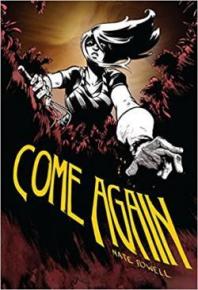
Kate’s Review: “Come Again”

36710841Book: “Come Again” by Nate Powell

Publishing Info: Top Shelf Productions, July 2018

Where Did I Get This Book: The library!

Book Description: The first and only comic book artist ever to win a National Book Award returns with a haunting tale of intimacy, guilt, and collective amnesia.

As the sun sets on the 1970s, the spirit of the Love Generation still lingers among the aging hippies of one “intentional community” high in the Ozarks. But what’s missing?

Under impossibly close scrutiny, two families wrestle with long-repressed secrets… while deep within those Arkansas hills, something monstrous stirs, ready to feast on village whispers.

Nate Powell, artist of the National Book Award-winning March trilogy returns with a new creator-owned graphic novel.

Review: I have read a couple of graphic novels that Nate Powell did the artwork on, and given that one of those was the stupendous “March” Trilogy I hold him in high regard. I first heard about his new graphic novel, “Come Again”, at work, when a coworker had requested it and couldn’t remember why. When she told me what it was about and who wrote it, I requested it myself. Not only was I interested in a supernatural story that takes place on a commune in the fading days of communes, I was also curious to see what Nate Powell would do as a writer as well as an illustrator.

“Come Again” has a number of themes that it addresses, and some of these themes work better than others. I will start with the aspects that I liked, because I liked them a lot. Our main character, Haluska, has lived in an Ozark based ‘intentional community’ (or as some laymen may call it, a commune) with her close friends and son Jake for the greater part of the 1970s. The idealistic 1960s are long over, though when Hal, her ex Gus, and their friends Adrian and Whitney first started living there it was 1971, and the world seemed filled with possibility. Now we are at the end of the decade, and though the community remains it has shrunk considerably, and Hal has been carrying on an affair with Adrian that is based in an underground cave they found in the forest. Their affair doesn’t seem to have much joy or passion to it, though neither seem willing to give it up, even though they have to take it literally underground. Haluska certainly feels guilt, but not enough to end it, and her attachment to a comfortable relationship that may not be what it used to be resonates within the greater storyline. The ideals of the Love movement, and the commune itself, are fading away, and with that change comes uncertainty and the impulse to cling harder to something that may not be there anymore. There was a moment that I found to be quite powerful, when Hal and Adrian go into town to sell goods at a farmer’s market. Their somewhat strained relationship with the ‘traditional’ town has been buoyed by the give and take system they have with each other. But on this specific day, a local band has been booked to perform. They happen to be a punk band, and their angry song of rebellion angers the townsfolk, but connects with Hal in ways she may not totally understand in that moment. Knowing that the 80s are coming, and the cynical and predatory social changes that are in store, it feels like a greater reflection of what’s to come, though Hal may not know it. These aspects of this book, of isolation, and guilt, and the secrets we keep from even the ones we love most, worked supremely well for me.

It was the dark fantasy and supernatural elements that fell a bit flat. There is something living in the cave that Hal and Adrian use, a disembodied voice that sinks into the various pages. After Hal’s son Justin and Adrian’s son Shane find the cave, Shane is lost within the depths, depths that may not be there all the time. This, of course, helps feed into Hal’s guilt about her affair with his father, but then it becomes clear that something supernatural is going on that only Hal can see. While I usually really like strange supernatural elements (and am enough of a ghoul that missing people is a theme that I like), I didn’t feel that this part of the book was as strong as it could have been. We don’t know what it is that is living in this cave, we don’t know why the spell it casts manifests in the way that it does, and as we see the consequences of the disappearance and spell start to unfold, we don’t really get answers as to why or how it’s happening. I understand that ambiguity is a key component of a story like this, and I can appreciate it to a point, but in this story I was left more confused than anything else. It ultimately leads to a sacrifice that Hal has to make, and though I understood the resonance of the sacrifice it also felt a bit like a cop out when it came to her having to own up to some of her past mistakes (and the mistakes that others have made as well). I think if the story had leaned in more to the magical or supernatural system I would have liked that part more, but it could have easily functioned as a historical fiction meditation on self, secrets, and guilt.

But Nate Powell’s style is still very unique and stands out in my mind. I liked seeing how he used shades, shadows, and a semi-realistic stylization to tell this story. I especially liked how the disembodied voice of the monster/whatever was written, in ways that made it seem like it was literally floating on the wind.

comeagain_01
(source)

“Come Again” was a book that didn’t quite give me what I want from the premise and author. It certainly had strong moments, but overall it didn’t have to ghostly oomph I expected.

Rating 6: While I enjoyed the broader themes of isolation, secrets, and guilt, the supernatural elements left much to be desired.

Reader’s Advisory:

“Come Again” isn’t on many Goodreads lists, but it is included on “NPR’s Best Books of 2018”.

Find “Come Again” at your library using WorldCat!

Kate’s Review: “Wet Hot American Summer”

38749157Book: “Wet Hot American Summer” by Christopher Hastings and Noah Hayes (Ill.)

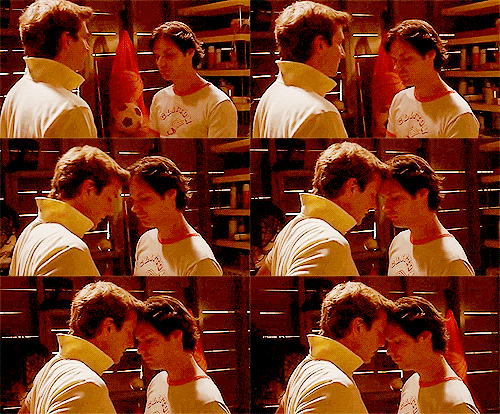
Publishing Info: BOOM!Studios, November 2018

Where Did I Get This Book: I own it.

Book Description: It’s time to shut up and return to Camp Firewood in the first-ever, all-new original graphic novel for the beloved, cult classic, Wet Hot American Summer. To tell you all about it, here’s Camp Director Beth.
 
“Well guys, we made it through the first week of camp in one piece . . . except for a few campers who now are lepers. Anyway, so I gave the Camp Firewood counselors the night off to head into town to do whatever it is teenagers do and some old coot—excuse me, old sea hag whore face—called the fuzz, which led to a surprise camp inspection! Not only did they find out that we have a kid who doesn’t shower but apparently the entire camp isn’t up to code! Now we have 24 hours to clean up our act or they’re going to shut down Camp Firewood. Luckily, I have the best counselors in the whole wide world…wait, where are those little jackasses…in town still?! We are so screwed…”

There you go! Join Beth, Coop, Katie, Andy, Susie, Gene, Nancy, Victor, Ben, McKinley, J.J., Gary, Gail, and probably some other people in this unforgettably tender story of camp spirit and spreading mud on your ass written by the hilarious, deliciously irreverent Christopher Hastings (Deadpool) and illustrated by artistic dungeon master Noah Hayes (Goldie Vance). What are you waiting for? Go read it.

Review: If you were to ask me what my favorite movie was, I would immediately say “Wet Hot American Summer”. This wacky ensemble camp comedy is a cult classic, and has so many people in it who either were comedic favorites at the time (Janeane Garofalo and David Hyde Pierce) , or became comedic favorites as time went on (Paul Rudd, Amy Poehler, Bradley Cooper, the list goes ON). In 2015 Netflix produced a prequel miniseries called “First Day of Camp” in which almost the entire original cast came back to reprise their roles, and I loved every minute of it. They somehow managed to recapture the charm, irreverence, heart, and humor of the cult classic in spite of the fifteen year gap. Then in 2017 they tried again with a sequel series called “Ten Years Later”… And I wasn’t terribly impressed. At that point it felt forced, and like it was beating a dead horse. So when I heard about a graphic novel story about “Wet Hot American Summer”, with a whole new plot but familiar characters during the same 1981 summer, I was stoked, but hesitant. While I welcome new WHAS content, it wasn’t the original writers. Would it go the way of “First Day of Camp”, or “Ten Years Later”?

I’m happy to report my fears were for nothing. Because “Wet Hot American Summer”, the graphic novel, was mostly a delight.

giphy-7
And there was much rejoicing. (source)

The plot is pretty simple, even if it’s outlandish. Which, as a WHAS story, it needs to be. A night on the town from the teenage counselors leaves a local woman scandalized, which leads to a camp inspection. Camp Firewood has one day to fix all of the problems of the camp will be shut down for good. Is there any suspense about whether or not this will happen? Of course not. Is it fun seeing various characters have a week’s worth of nonsensical misadventures in one day’s time? Hell yes. Christopher Hastings, the writer, does a fantastic job of creating ludicrous situations and tidbits that feel like any of the random non sequiturs that the original creators and writers would have done. From a long forgotten boy’s wash house of spa like proportions to a number of campers who go feral, the antics are at a very outlandish, and therefore WHAS level. And while the stakes in terms of the eventual outcome of the camp’s survival aren’t exactly high, Hastings still built suspense regarding friendships and interactions, which did keep me a little nervous and on edge. My dear sweet sweethearts Ben and McKinley are fighting?! NOOOO!

giphy-8
I am far too invested in these precious, precious cuties. (source)

In terms of the characterizations of the cast, Hastings overall did a pretty good job of writing them the way they are supposed to be. Coop is still a hopeless idealistic, Susie is still a theater obsessed control freak, Andy is still a bad boy doofus, and Gene, well… is Gene. It felt like David Wain and Michael Showalter themselves brought us a whole new story, they were all so spot on. If I did have an issue with this book, it would be that the distribution of character focus was a little unbalanced. While we would get a lot of focus on Andy, or Ben and Susie, or Beth and Gene, we barely saw anything from other characters, and sadly it was mostly women, like Katie and Lindsay and Abby Bernstein. I know that you can only do so much with a huge swath of characters, all of them amazing, and only so many pages, but it was still a little disappointing that it was women who were more likely to fall to the wayside. Especially since Lindsay played such an important role in “First Day of Camp” (whether this followed the canon of “FDOC” isn’t very clear; there are some hints but nothing is said outright in reference to it).

I also should probably mention that if you have no working knowledge of WHAS and what it tries to do, this will probably seem nonsensical and insane. It is definitely written for fans of the movie and various shows, and while it nails it for the fans, if there is no familiarity of it from the reader they will almost assuredly be lost, and perhaps frustrated. There are tiny throwbacks and Easter eggs within the narrative that make it extra fun for people like me, but I can’t imagine that the completely ridiculous plot and exaggerated characters will resonate for those who have never seen the movie. And along with that, if the wackiness of the movie didn’t appeal to you, there is no way that this graphic novel would.

The illustrations, done by Noah Hayes, are the perfect design for the tone of the story. They feel like a mix of YA favorites such as Raina Telgemeier and the over exaggerated emotions of manga or manga inspired narratives that Bryan Lee O’Malley might make.

wethotamericansummer_sc_press_13
Coop continues to be adorable, even in comic form. (source)

“Wet Hot American Summer” was a funny and heart filled revisit to my favorite summer camp. I would love it if Hastings and Hayes teamed up to bring us more stories from Camp Firewood, but even if this was it, I’d be happy with what we have.

giphy-9
Show me the fever, into the fire, taking it hiiigher and hiiiiighter.. (source)

Rating 8: A fun romp of new content for my favorite movie, “Wet Hot American Summer” does a pretty great job of capturing the humor and irreverence of Camp Firewood and its staff!

Reader’s Advisory:

“Wet Hot American Summer” isn’t included on any Goodreads lists, but I think that it would fit in on “Books Set During the Summer”.

Find “Wet Hot American Summer” at your library using WorldCat!

Happy Birthday Batman!: Essential Batman Reading For His Birthday

On March 30th, 1939, “Detective Comics” introduced the world to Batman, the Caped Crusader known for fighting petting criminals and mental patients so that Gotham City would be a safer place! We kid, we kid (kinda). We’re both Batman fans here (though Serena is decidedly #TeamSupes when it comes down to it). Since it’s the brooding billionaire’s birthday this year, here are some essential takes on Batman through the decades. Happy 80th, Batman!

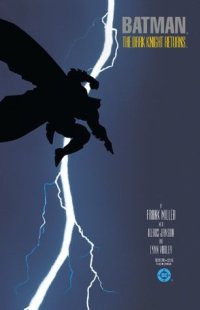
19030845Book/Arc: “The Dark Knight Returns” by Frank Miller

The 1980s was a serious shift for comics, with titles taking on darker and more existential story lines. One of those seminal comics series was Frank Miller’s “The Dark Knight Returns”, which brings a middle aged Bruce Wayne to it’s pages. Gotham is being overrun by a gang called The Mutants, and Bruce Wayne decides that it’s time to bring Batman back to try and get some justice. But age and time has taken it’s toll, and Bruce isn’t certain he can do this alone. Especially when old foes start to come out of the woodwork, and have decided to take this moment to wreak as much havoc as possible. But it’s when Superman is enlisted to fight back against Batman as ordered by the Government that things take a real turn for the dramatic. Miller’s story is a favorite with many fans, and it brings darkness that hadn’t really been seen with Batman up until this point. While it isn’t one of Kate’s favorites, it’s hard to deny the impact that this story had for Batman in the years to come.

96358Book/Arc: “The Killing Joke” by Alan Moore and Brian Bolland (Ill.)

A controversial title to say the very least, Alan Moore wrote this essential, dark as night one shot story that changed the course of a few of the Batman characters in significant ways. The Joker is up to his old tricks, and this time he decides to hit Batman where it really hurts: by hurting his friends. Yep, this is the story where Barbara Gordon is shot in the spine and then, potentially, sexually assaulted. It is absolutely a rough read (and so on brand for Moore, who is one of Kate’s problematic faves in the comics biz), but it did so much for Batman stories from then on out that it has to be included. It gave Joker his most accepted back story that influenced Tim Burton’s “Batman”. It gave us Oracle, the superhero Barbara turned into after she was paralyzed, who became arguably the most powerful of the Bat Family because of her hacking and information skills. “The Killing Joke” has its detractors, and rightfully so. But its influence is indisputable.

106069Book/Arc: “The Long Halloween” by Jeph Loeb and Tim Sale (Ill.)

While many people think of the deranged super villains that Batman fights, sometimes we forget that he also has helped take down organized crime syndicates in Gotham. The Falcone and Maroni Families takes a prominent role in “The Long Halloween”, a collection where Batman has to try to stop a mob war all while trying to figure out who is killing people on each holiday of the year. Not only do the crime families and their intricacies get a big slice of the plot pie, this is also the collection that give Harvey Dent his most complex and accepted back story as he goes from idealistic district attorney to crazed criminal. It should also be noted that this is a story arc that gives Bruce and his lady love Selina “Catwoman” Kyle a fairly functional relationship! Well, as functional as the two star crossed lovers can be, anyway. And keep an eye out for a whole slew of enemies like Poison Ivy, Scarecrow, and, of course, The Joker.

51078Book/Arc: “Knightfall” by Chuck Dixon, Jo Duffy, Alan Grant, Dennis O’Neil, and Doug Moench
Bane gets no respect when it comes to his movie counterparts. In “Batman and Robin” he was a weird street punk turned feral roided out monster, and in “The Dark Knight Rises” he is relegated to a crony role to Talia Al Ghul of all people! Is that any way to treat The Man Who Broke The Bat? “Knightfall” is the story line that introduced Bane as the first adversary who could not only intimidate Batman, but to put him out of commission when he broke his back on his knee (which “The Dark Knight Rises”, admittedly, adapted properly). Bane is a super genius as well as being suped up on Venom, a man who was born in a prison and had to serve the time his parents had racked up. He is a formidable foe to be sure, and to take down Batman and put him on the sidelines for an extended period of time? THAT is impressive.

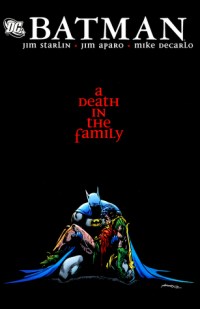
107032Book/Arc: “A Death in the Family” by Jim Starlin and Marv Wolfman (Ill.)
We tend to think of Batman as someone who always comes out on top. But there was one time that when he failed, it was the worst failure he could have made. And that was when he couldn’t prevent the death of Jason Todd, aka Robin. Jason Todd was always a controversial figure in the comics; he was the second Robin, and a very different character from Dick Grayson, whose shoes were already VERY big to fill. The fans didn’t care for him, and when the creators gave the fans the chance to vote on whether he lived or died, he was given a resounding death sentence. Unfair? Perhaps. But it was one of the most powerful stories because Batman was bested when the stakes were at their highest. This storyline has been alluded to, if not directly addressed, in newer iterations of Batman mythos, and while they tried to replicate it with “Death of the Family” (and the death of Bruce’s son Damian), the initial power and gut punch of “A Death in the Family” will probably never be replicated.

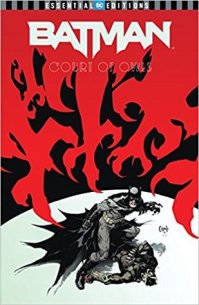
39018271Book/Arc: “The Court of Owls” by Scott Snyder and Greg Capullo (Ill.)
The New 52 was the expansive reboot series DC did in the 2010s, and The Court of Owls is arguably the best story line to come from this era of Batman comics. It’s a little more secretive and clandestine than other Batman villains. Usually the villain is apparent and in our face. But with the Court of Owls, very little is known about the Illuminati-esque secret society that may be pulling the strings in Gotham City. Even Batman goes in with very little information, and can’t rely on his vast (and sometimes SUPER convenient) knowledge when facing off with these foes. It’s nice to see Bats at a disadvantage every once in awhile, and The Court of Owls puts him at a vast one.

What Batman stories are your favorites? Let us know in the comments!


Kate’s Review: “Aquicorn Cove”

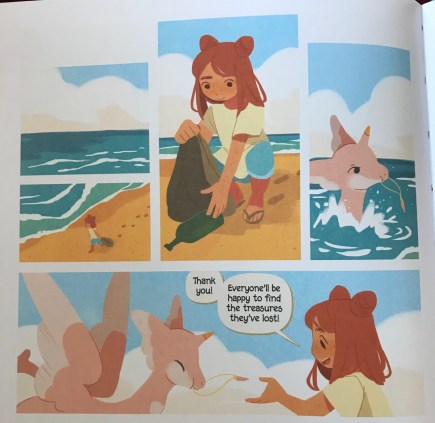
36482829Book: “Aquicorn Cove” by Katie O’Neill
Publishing Info: Oni Press, October 2018

Where Did I Get This Book: The library!

Book Description: When Lana and her father return to their seaside hometown to help clear the debris of a storm, the last thing she expects is to discover a colony of Aquicorns—magical seahorse-like residents of the coral reef. As she explores the damaged town and the fabled undersea palace, Lana learns that while she cannot always count on adults to be the guardians she needs, she herself is capable of finding the strength to protect both the ocean, and her own happiness.

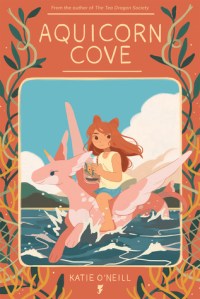
Review: When I saw that Katie O’Neill had another graphic novel coming out, I knew, I KNEW, that I had to read it. I loved “The Tea Dragon Society” so very much, and gentle and vibrant cuteness was something that I was needing after a stressful couple of weeks. While aquatic mythical creatures may not catch my attention as much as dragons do (unless it’s a sea serpent, as those are basically water dragons if we’re being honest), the cover alone had me screeching with joy. A girl riding some kind of weird water unicorn Pegasus thing?!

giphy-3
The contrast of this with the horror graphics on my stack was striking. (source)

But the thing that I noticed about “Aquicorn Cove” from the get go is that there is a far more bittersweet undercurrent running through this story than there was with “The Tea Dragon Society”. While the imagery is just as cute and serene as the imagery in that book, the premise here is a bit darker. Lana is a girl whose mother was killed during a violent ocean storm, and that is why she and her father left their hometown in the first place. They are coming back to visit her maternal Aunt Mae as well as clean up the wreckage after another bad storm. Lana has a genuine connection to the ocean like Mae and her mother did, even though being back is painful for her and her father. When she finds an injured baby aquicorn she wants to nurse back to health, her love of the ocean has a tangible element it can attach to. Mae, too, has a connection to the sea, given that she is a fisherwoman and she makes her living because of it, but there is always going to be the painful reminder that the thing she loves took her sister away. They are both coping with the trauma of the loss, but they cope in different ways.

The Aquicorn society that Mae and Lana interact with has it’s own issues that it brings to the story. Aure, the head of the community, has struck up a long time friendship with Mae, as they have helped each other in various ways. Mae has taken objects and products from Aquicorn Cove and has helped her own community thrive. But the give and take relationship has started to crumble, as Aure thinks that the cost for her community has started to become far too great. O’Neill has found a relatable and easy way to show kids the importance of giving back to the environment, and while you understand Mae’s need and want to keep her community alive, you see the cost it has to Aure’s and the reef. There was one panel that is especially relevant where, when pushed back on by Aure, Mae says that her community shouldn’t have to change it’s ways because ‘this is how it’s always been’, and THAT struck a chord. Mae is never presented as a bad person, per se, just someone who is unable to see the consequences that her actions have for others.

The other big theme in this story is the importance of ocean conservation, and how it can be a matter of life and death not only for sea creatures, but for the human communities that live on the seashore. Aquicorn Cove’s reef is sick and starting to die, and without the protection of the reef that can help buffer the strength of ocean storms, the severity on land is becoming more and more devastating. Climate change scientists postulate that storms will become worse and worse as time goes on, and with more of these natural buffers dying off or disappearing the costs and the losses will be higher. At the end of the book O’Neill listed a number of ocean conservation resources, as well as information for the readers on what they can do to help restore the tenuous ecosystems. What I liked about this section was that it was easy to understand for kids, and while O’Neill did simplify it she never made it seem like she was talking down to her readers. She really hits home that we may feel like in our smallness we can’t make a difference, but how we can connect to our community, which can connect to other communities, and how that can help amplify our voices for change. The message was loud and clear, and I really liked it.

And yes, let’s look at how sweet the drawings are.

IMG_2816
EEEEE!!! (Source: Oni Press)
IMG_2817
It’s just so charming. (source: Oni Press)

The gentle design and all around charming style made the art pop and had me smiling from ear to ear.

“Aquicorn Cove” is another lovely graphic novel by Katie O’Neill, and with it’s important messages and themes it stands out from the crowd.

Rating 7: A cute graphic novel with a resonant message, “Aquicorn Cove” is a sweet story that brings out cute sea creatures and talks about the importance of our oceans.

Reader’s Advisory:

“Aquicorn Cove” is included on the Goodreads lists “Tween Graphic Novels”, and “Comics and Graphic Novels by Women”.

Find “Aquicorn Cove” at your library using WorldCat!

Kate’s Review: “Infidel”

38812871Book: “Infidel” by Pornsak Pichetshote and Aaron Campbell (Ill.)

Publishing Info: Image Comics, September 2018

Where Did I Get This Book: The library!

Book Description: A haunted house story for the 21st century, INFIDEL follows an American Muslim woman and her multi-racial neighbors who move into a building haunted by entities that feed off xenophobia.

Bestselling editor Pornsak Pichetshote (Swamp Thing, Daytripper, The Unwritten) makes his comics writing debut alongside artist extraordinaire Aaron Campbell (The Shadow, James Bond: Felix Leiter), award-winning colorist and editor Jose Villarubia (Batman: Year 100, Spider-Man: Reign), and letterer / designer Jeff Powell (SCALES & SCOUNDRELS).

Review: Even though horror has almost always had stories with some kind of hidden themes within their works, I feel like as a genre people are starting to really realize the possibilities of metaphor for greater ills beyond a monster or a ghost. With books like “Lovecraft Country” and movies like “Get Out”, we are starting to see more expansion and room for not only POC characters, but also critiques of racism within our culture and society. “Infidel” by Pornsak Pichetshote is the most recent story of this kind that I have come across, and I can tell you that I was waiting very impatiently for my hold on it to be filled at my library. Given that NPR listed it on their ‘100 Greatest Horror Stories of All Time’ selection, my enthusiasm and anticipation was greater than most other books I request. It was also a lofty claim to make, and while I was open to the claim I wondered how much my own final opinion of it would line up with it.

Our story follows Aisha, a Muslim American woman who has recently moved into an apartment building with a tragedy attached to it. A few years before, a Middle Eastern man’s homemade bombs went off, killing a number of the tenants. Aisha and her friends, most of whom come from non-white backgrounds, are aware of the history, and aware of how the white tenants aren’t as welcoming to them as they are to non POCs. What Aisha and her friends don’t know is that the building is haunted by a very angry and aggressive set of ghosts. It’s Aisha that first sees the twisted and violent entities that haunt the complex, their rage focusing on her. The visual manifestations of these things are truly horrific, as they are warped and filled with rage and able to cause serious physical harm. Much like “Lovecraft Country”, racism and bigotry is the true villain of this book, with the ghosts targeting Aisha because of her Muslim faith and their association that gives them to the man whose bombs were their demise. Aisha isn’t the only one who has nasty encounters with the ghosts, as their ire holds a lot of the other characters hostage and puts them at risk as well. It starts slowly for all of them, noticing it bit by bit and making them wonder if they ACTUALLY saw something, or if it’s just a figment of their imaginations, a direct metaphor for those who are victims of racism in our day to day lives.

But the other kind of racism that Pichetshote shows in this book isn’t just the over the top obvious kind in ghost form; rather, it’s mostly micro-aggressions and fear based on ignorance and paranoia. Aisha is dating a while man named Tom, who has a daughter named Kris from a previous relationship. Kris’s mother is dead, and Kris is very connected to Aisha. Tom’s mother Leslie has just started warming up to Aisha and seems to be trying, though in the past she’s shown discomfort and flat out hostility towards Aisha and her culture. Aisha is more inclined to give her the benefit of the doubt, though Tom and her childhood best friend Medina are not. There are also other tenants in the buildings who are more mistrustful of Aisha because of her faith. From a neighbor who is convinced she saw Aisha committing a crime (though Aisha herself at this point is a clear victim), to a woman who is actually in Aisha’s circle of friends but still doesn’t trust her fully, it’s these interactions that left me a bit more unsettled than the ghosts that pop out of the walls. These moments are based in realism, and show how people can be influenced by fear and prejudice even if they think they are open minded and accepting.

The artwork is stunning. There is a certain jarring atmosphere that the artist, Aaron Campbell, creates, with lots of vibrant colors and use of shadows. The ghosts within the building are especially grotesque, their distorted features harkening to disease and decay. At one point Medina refers to racism as a cancer, and the entities absolutely reflect that.

05_infidel1
Literal nightmare fuel. (source)

I think that one of the few criticisms I did have about this book was that it ended a little too quickly. I realize that this was very much a mini series, as it was only five issues all together, but for it to build slowly and complexly and then to be wrapped up very fast left me a little feeling unsatisfied. There were a couple of plot points that were tossed out into the fold that sounded like it would take a lot of work to get through, only to be resolved quickly, sometimes off page. Because of this, I did close the book wanting more.

“Infidel” is an effective story with some genuine scares. I highly encourage horror fans to pick it up, but know that it may feel a bit rushed by the end. That said, I am very much looking forward to see what Pornsak Pichetshote brings us next.

Rating 8: A unsettling ghost story that takes on racism and xenophobia in our culture, “Infidel” is a graphic novel with as many real world horrors as supernatural ones.

Reader’s Advisory:

“Infidel” is included on the Goodreads lists “Best Horror Comics/Graphic Novels”, and “Against the Fascist Creep”.

Find “Infidel” at your library using WorldCat!


Kate’s Review: “Victor LaValle’s Destroyer”

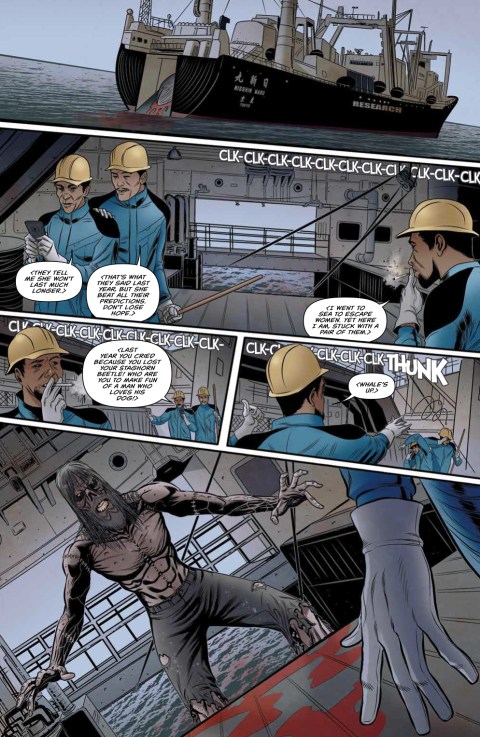
36100937Book: “Victor LaValle’s Destroyer” by Victor LaValle, Dietrich Smith (Ill.)
Publishing Info: BOOM! Studios, March 2018

Where Did I Get This Book: The library!

Book Description: The legacy of Frankenstein’s monster collides with the sociopolitical tensions of the present-day United States.

Mary Shelley’s Frankenstein beseeched his creator for love and companionship, but in 2017, the monster has long discarded any notions of peace or inclusion. He has become the Destroyer, his only goal to eliminate the scourge of humanity from the planet. In this goal, he initially finds a willing partner in Dr. Baker, a descendant of the Frankenstein family who has lost her teenage son after an encounter with the police. While two scientists, Percy and Byron, initially believe they’re brought to protect Dr. Baker from the monster, they soon realize they may have to protect the world from the monster and Dr. Baker’s wrath.

Written by lauded novelist Victor LaValle (The Devil In Silver, The Ballad of Black Tom), Destroyer is a harrowing tale exploring the legacies of love, loss, and vengeance placed firmly in the tense atmosphere and current events of the modern-day United States.

Review: Victor LaValle is an author whom I greatly enjoy, as I don’t think I’ve read one thing by him that underwhelmed me. I really liked his mental institution horror story “The Devil In Silver”, I found “The Ballad of Black Tom” to be a fun deconstruction of a racist Lovecraft tale, and I REALLY liked “The Changeling” and how it made a modern day dark fairy tale out of New York City. So when my friend Tami told me that he had written a graphic novel that decided to take on “Frankenstein”, I absolutely had to read it. It was a long wait at the library, but when “Destroyer” finally came in I sat down and devoured it in one setting. Even if it ran me through the wringer and then some. I guess I never thought about how “Frankenstein” could be combined with present day socio-political themes, and yet LaValle meshed them so well that I was blown away.

The Monster has emerged from the Arctic in modern times, and his former longing of being included and understood has been thrown out the window. He is a beast that is intent on destruction of the human race, as he believes that it has wronged him, as well as everything else around it, and does not deserve to go on. In contrast, we meet a modern day descendent of Victor Frankenstein. Her name is Dr. Baker, and she, too, has her heart set on destroying the society that she has continuously wronged her. For her, though, that is mostly because she lost her son Akai after a witness mistook his little league bat for a gun, and police killed him. Her science experiment has brought Akai back from the dead, though her scientific genius has made him a wonder of modern technology as well as an undead twelve year old. It’s the perfect metaphor for the rage and despair that parents like her have felt over and over again, and her urge to destroy every part of the racist society that destroyed her life. Her rage and plotting is utterly terrifying, but damn does it make sense. I loved Dr. Baker, as you get to see her life before Akai’s death through flashbacks, including her time at a top scientific research organization (that basically fired her when she got pregnant, because heaven forbid a woman in a STEM profession want to start a family). That organization has also stolen her ideas and technology and intends to use it against her, which is another indictment of power structures stealing ideas from groups that it wrongs. LaValle does a very good job of showing how she could go from a bright eyed and enthusiastic young scientist to a revenge intent victim, and while I don’t think he ever makes it seem like her urge to kill everyone in society is correct, he makes you really understand why she’d feel that way.

Dr. Baker a great juxtaposition to The Monster, who has also decided to take a path of destruction because of his grievances. It takes those themes of science gone too far and what makes a monster and applies them to a T. Hell, the other little homages are also on point, like the names of the agents Percy and Byron, named for the two men to whom Mary Shelley first shared her vision of a Modern Prometheus. The Easter eggs are plentiful, and I had a hell of a time finding them. It’s a really fun thought exercise about what The Monster would possibly be like today if it finally left the Arctic, and boy is it bleak. I don’t know if I really like the idea of The Monster being reduced to, well, a monstrous/brainless being, because far too often has Shelley’s vision been misinterpreted from the thinking, and therefore plagued, creature of her intention. But in this case, I think that LaValle does it in a way that would be a potential foregone conclusion, and it does add to the symbolism all the more.

I really enjoyed the art work that Dietrich Smith brought to this story. It felt sufficiently comic book, but it also had bits of depth and darkness and shadow that conveyed various points of tragedy and sadness. I also liked the more abstract design of the cover (done by Micaela Dawn), though the drawing style inside was the design that I preferred. The details from the gore and the violence to the varied facial expressions are very well done.

Destroyer_001_PRESS_6
(source)

“Destroyer” is a superb reinterpretation of a classic story of horror and tragedy, and LaValle has once again shown his talent and retelling stories with a socially conscious lens that reflects today’s ills. It’s another update of “Frankenstein” that I think Mary Shelley would appreciate.

Rating 8: A dark and biting retelling of “Frankenstein”, “Victor LaValle’s Destroyer” takes a classic story and applies it to modern social justice themes with powerful results.

Reader’s Advisory:

“Victor LaValle’s Destroyer” is included on the Goodreads lists “Frankenstein Revisionist Novels”, and “Black Lives Matter Library Ideas”.

Find “Victor LaValle’s Destroyer” at your library using WorldCat!

Kate’s Review: “Bombshells United: War Bonds”

39208018Book: “Bombshells United (Vol.2): War Bonds” by Marguerite Bennett, Stephen Byrne (Ill.), Mirka Andolfo (Ill.), Sia Oum (Ill.), and Sandy Jarrell (Ill.).

Publishing Info: DC Comics, October 2018

Where Did I Get This Book: The library!

Book Description: Years ago, before she became the battling Bombshell known as Batwoman, Kate Kane and Renee Montoya loved and fought together in the Spanish Resistance, and even formed a family with their adopted son Jasón. But their lives were turned upside down, and Kate found a new life and a new love for herself in Gotham City.

Now Kate is back in Spain, working with Renee once again to save the country from a tyrannical ruler…only this time the despot has unstoppable occult powers. His name is Black Adam, and he’s lived for millennia seeking the moment he can gain control of the powers of life and death.

Batwoman, Renee and Black Adam are all defined by whom they’ve loved and lost. But beneath the ancient streets of Madrid, a mystical labyrinth conceals the means to bring life back to the dead: a Lazarus Pit. 

With this incredible power, will Black Adam gain the final piece he needs to crush the entire world under his heel? Or will the dead have their own say in it?

Writer Marguerite Bennett (Batwoman) and artists Mirka Andolfo (Harley Quinn), Siya Oum (Lola XO) and Stephen Byrne (Green Arrow) bring fan-favorite Bombshell Kate Kane back to where she began…but how much will her past define her future? Collects Bombshells: United #7-12.

Review: I’m feeling a bit morose that this is going to be the second to last “Bombshells” story collection for the foreseeable future. I’ve moved on from being angry to depressed when it comes to this series being cancelled, and I’m thinking that I’m moving closer and closer to acceptance. There are a couple of reasons for this acceptance that are more on the unfortunate side, but more on that in a little bit. Because at the end of the day I still think that it is a damn travesty that DC cancelled this title just because of how unique it is and how it covers a vast swath of characters who come from diverse backgrounds and give diverse voices to the stories they are telling. And now it sounds like I’m reverting back towards anger, so before that happens let’s get to the nitty gritty of what worked, and what didn’t, in “Bombshells United: War Bonds”.

It’s been a little while, but we once again have caught up with Kate Kane and Renée Montoya, aka Batwoman and The Question. They have moved on from their final battle and have ended up back in Spain, where they first met and fell in love. But it’s also where they lost their adopted son Jasón, when mercenary The Cheetah murdered him for the hell of it. The loss is still gaping, and while Kate and Renée have found each other again the pain lingers. I liked that we got to see their grief in this way, as something that will always be with them, even if it isn’t as all encompassing as it had been initially. This theme of grief is where the crux of this story comes in, post-Franco Spain,’s new ruler is a whole new tyrant that we know as Black Adam, who is also haunted by a terrible loss from his past. He is looking for a way to resurrect his dead queen Isis, and has heard of a pit with magical powers that can bring people back to life. But it’s Kate and Renée who stumble upon it first, finding this Lazarus pit in the middle of an underground labyrinth. And who else do they find there, but Talia Al Ghul and Cheetah. And Cheetah is there because she has brought Jasón back to life, as she is now driven by guilt and a need for forgiveness and redemption.

giphy
Me as I realized that this kind of plot point seemed VERY familiar… (source)

Okay folks, it’s real talk time. I really, REALLY appreciate that Bennett is trying to think beyond the usual physical and violent conflict resolution that we see in superhero stories, and I understand that it’s a fun way to show that women’s roles and stereotypes of being peacemakers and nurturers can be subverted into something powerful enough to stand up against super villainy. But, for the love of God, this is the fourth time that a nemesis has seen the evil of their ways thanks to spending time with the Bombshells (or in Cheetah’s and Paula Van Gunther’s cases, just kind of needing the conflict resolution to fit an upcoming plot device), and it is getting old. I am all for redemption arcs, and I think that it’s especially important that bad women in fiction get these arcs since it feels like men do when it suits the storyteller. But I want them to be complex and interesting, not just tossed together in a moment because of peace love and understanding. It also makes it so that our cast of villains becomes smaller and smaller, and you instead need to introduce new (albeit familiar) antagonists to stir the pot, like Black Adam. I will admit that I’m not as familiar with him, as Shazam (aka Miri Marvel as she is in this story) was never a title that I got into very much. But even if I had been into him, I feel like introducing a new huge big bad at this point was just another example of fantasy bloat that “Bombshells” is starting to see more of.

That makes it sound like that I didn’t like anything about this turn of events, and that’s not totally true. Like many stories with similar themes that come before it, Kate and Renée will have to contend with the unforeseen consequences of Jasón’s resurrection. Though it isn’t full on zombie Jasón or anything like that, you do get the sense as the story goes on that perhaps things won’t be as happily ever after as Cheetah intended it to be. I also liked that for Kate and Renée, Cheetah’s actions weren’t automatically welcomed with open arms. They didn’t forgive her automatically because of this, and I thought that that was a realistic and refreshing turn of events. It’s one thing of the Batgirls or Wonder Girls  are able to take a former enemy into the fold and show them compassion. But Harvey Dent and Clayface didn’t murder their kids just for the fun of it. I thought that Bennett hit that nail on the head, that atonement doesn’t automatically earn forgiveness.

The art in this collection worked better for me than it did in “Bombshells United: American Soil”, mainly because it didn’t feel as cutesy. There were also nice moments of pondering or waxing poetic on mythology that felt more muted and subdued, and I really took to it. Maybe it helped that during one of these sequences Kate ACTUALLY ACKNOWLEDGED THAT MAGGIE SAWYER IS STILL BACK HOME WAITING FOR HER. In any case, I thought that the design worked well and added a lot to the retro style narrative.

a615d3fbcae22150f3ce5761beb3ff36._SX1280_QL80_TTD_
(source)

As mentioned above, we are only getting one more collection of “Bombshells United” before it’s over. One more. There are so many things that haven’t really been addressed across the other characters, and given that there has been a new explosion of characters I’m worried that the focus is in no way going to be brought back to where it needs to be to have a totally satisfying ending where all loose ends get tied up. And while that is in part certainly the fault of the cancellation (I’m sure that Bennett had lots of really good ideas and paths on how and when she was going to take them on), it’s also in part an example of why exploding character rosters and plot lines can come back and bite you in the butt. As I slide closer to acceptance that this series has ended, I hope that in the next, and final, issue I will walk away with some satisfaction. And that Kate, Diana, Kara, Harley, and all the rest are given their due that they so richly deserve.

Rating 6: There was a lot to like about “Bombshells United: War Bonds”, but repetitive storytelling is starting to take it’s toll.

Reader’s Advisory:

“Bombshells United (Vol.2): War Bonds” is not on any Goodreads lists as of yet, but I think that it would fit in on “Girls Read Comics”, and “Show Me Your Queers”.

Find “Bombshells United (Vol 2): War Bonds” at your library using WorldCat!

Previously Reviewed:

Kate’s Review: “Monstress (Vol. 2): The Blood”

33540347Book: “Monstress (Vol. 2): The Blood” by Marjorie Liu and Sana Takeda (Ill.)
Publishing Info: Image Comics, July 2017

Where Did I Get This Book: The library!

Book Description: Maika Halfwolf is on the run from a coalition of forces determined to control or destroy the powerful Monstrum that lives beneath her skin. But Maika still has a mission of her own: to discover the secrets of her late mother, Moriko. 

In this second volume of Monstress, collecting issues 7-12, Maika’s quest takes her to the pirate-controlled city of Thyria and across the sea to the mysterious Isle of Bones. It is a journey that will force Maika to reevaluate her past, present, and future, and contemplate whether there’s anyone, or anything, she can truly trust–including her own body.

Review: A popular definition of ‘insanity’ is repeating the same behaviors and expecting a different outcome each time. In this regard, I can call myself ‘insane’, because even though I wasn’t totally taken in by “Monstress” in it’s first volume, I went into “Monstress (Vol. 2): The Blood” thinking that perhaps this time something would be different. I really want to like this series, because it has so many features that draw me in: the art is beautiful; the world is dark and foreboding; two of the main characters are a Fox/human child and a necromancing CAT! Plus, monsters. Like, a seriously CREEPY monster. And yet, the joy that others get from “Monstress” continues to elude me.

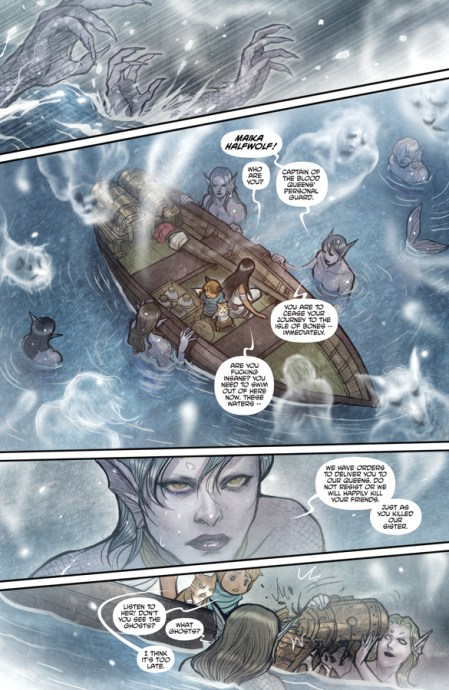
I will start with the positives of this volume of Maika’s journey. Marjorie Liu has certainly made a creative world that her characters roam in. It continues to be complex and intricate, and it just keeps expanding. This time we get to spend time with a band of pirate Arcanics (those that are part human and part Ancient, and tend to have Animal characteristics), and on a mysterious Island of Bones where an Ancient creature named Blood-Fox resides. Maika is desperate to get answers about her mother, and perhaps figure out how to get rid of the Monster that’s living inside of her. All the while she’s being pursued by the Dawn Court’s Warlord, a military leader who also happens to be Maika’s Aunt. Ultimately, “Blood” isn’t really about the blood of battle, but the blood that runs in our veins and whom it connects us to. I liked seeing Maika try to find out some answers, and I liked that both Maika AND the Monster inside of her have to confront truths about their pasts that make them both uncomfortable. I also still have a great affection for Maika’s sidekicks, the sweet and adorable Kippa, and the sarcastic and somewhat mysterious necromancing cat Ren. As these three continue to travel together, they become more connected to each other, and they all balance each other out.

The art also continues to be gorgeous. There is less time in urban settings in this volume, in favor of taking it to the high seas and to a creepy as all get out island, which means there’s a bit less Art Deco influence. But Takeda’s style remains intricate and sumptuous, and I found my breath taken away a number of times as I turned the pages. The style for her characters also feels so unique, as all of the characters are stark contrasts from each other in their designs. I was especially impressed with the ghostly imagery that’s found on and near the Isle of Bones, as the ghosts are both ethereal but very present.

monstress10_3
(source)

But, like with the first volume, “Monstress: The Blood” still hasn’t made me fall head over heels for this series. I like the characters and the art, but the high fantasy aspects have not worked for me, and I found myself not as interested in it as I had hoped I would be. As the world continued to expand, I wanted more focus on the witches we’d seen in the previous volume. I’m connected to Maika as a character, but I’m not really invested in her story, which is hard for me to wrap my head around. Ultimately, it just comes back to my tastes about high fantasy, and how limited they are. That isn’t “Monstress”‘s fault.

And yes, I’m going to keep going. Even though I have been kind of left cold by the first and second volumes of this series, I REALLY want to like it, and I think that there are shades within these two volumes that make me think that I still can. So I’ve put Volume Three on my request list. And maybe next time I will have a more positive review to give. For now, know that my opinions of “Monstress (Vol. 2): The Blood” probably don’t and shouldn’t reflect the merits and positives of this series. So, like I said in my previous review, if you like high fantasy that has a bit of a darkness to it, you should absolutely check this series out. It will probably work for you better than it does for me.

Rating 6: Once again, I’m blown away by the amazing artwork, and I have a fondness for a few of the characters. But the high fantasy setting still isn’t gelling with me.

Reader’s Advisory:

“Monstress (Vol. 2): The Blood” is included on the Goodreads lists “Girls Read Comics”, and “SFF Written by WOC and Non-Binary People of Color”.

Find “Monstress (Vol. 2): The Blood” at your library using WorldCat!

Previously Reviewed:

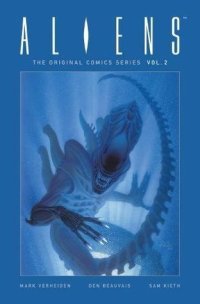
Kate’s Review (and Mini Brief History): “Aliens: The Original Comics Series”

33161041Book: “Aliens: The Original Comics Series” by Mark Verdheim, Den Beauvais (Ill.), Sam Kieth (Ill.)
Publishing Info: Dark Horse Books, April 2017

Where Did I Get This Book: The library!

Book Description: In 1986, James Cameron’s “Aliens” brought to theaters the horrors of a new kind of war against a terrifying enemy. Long before Alien3 was even a glint in director David Fincher’s eye, Dark Horse Comics was already crafting a terrifying post-Aliens continuity for Ripley, Hicks, and Newt. 

Earth is overrun by xenomorphs with no hope of saving it for humanity. But that doesn’t mean just leaving it to the Aliens. Ripley has a plan to capture, from what they believe is the Alien homeworld, a “Queen Mother”–a super queen that rules multiple nests–and bring it back to Earth. There the Queen Mother will command the xenomorphs to gather where they can all be destroyed by nuclear bombs.

Collects Aliens: Nightmare Asylum #1-#4 and Aliens: Earth War #1-#4. Includes cover art for all issues.

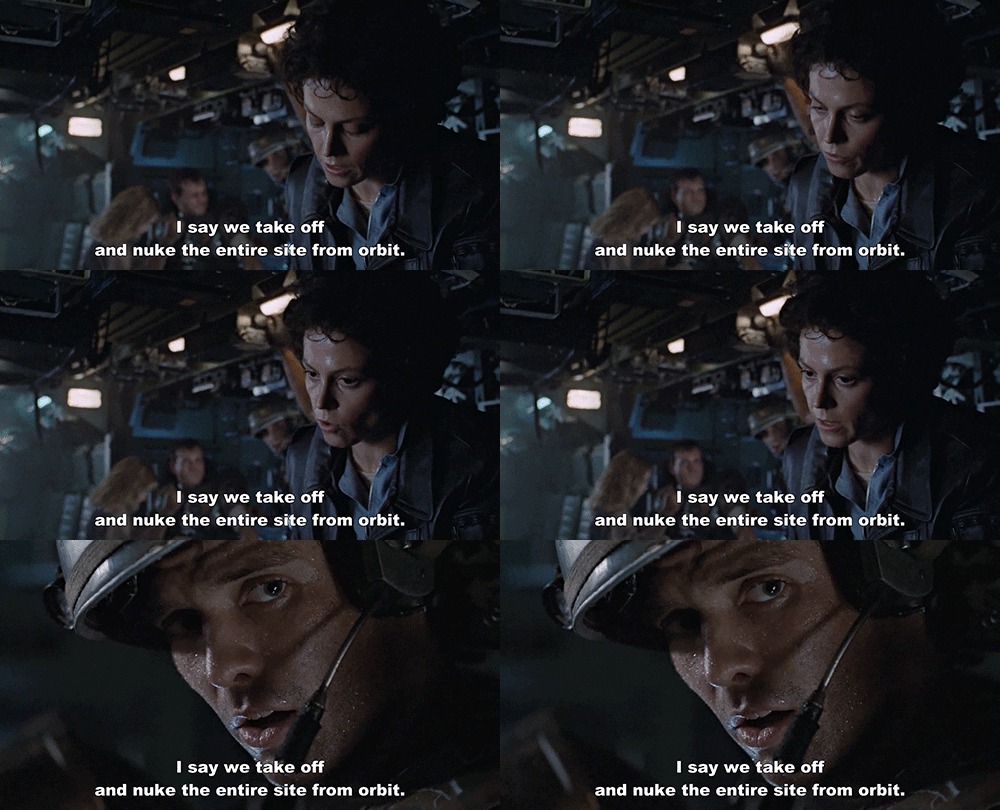
Review: Even though Science Fiction isn’t really my preferred genre, if there is an excellent horror theme to it I’m assuredly going to be game. So it most likely isn’t shocking that I love both the movies “Alien” and “Aliens”. Not only does it have a solidly excellent female protagonist (Ellen Ripley for LIFE!), it also has a very scary adversary in the Xenomorph, a creature that is essentially a giant parasitic space bug that you COULD fight, but you have significantly better odds if you just run away. The first two movies in the “Alien” franchise are awesome, and while I love them both my heart probably belongs to “Aliens” the most. Not only does Ripley get to kick more butt, but she picks up a rag tag group of friends along the way, specifically the Colonial Marine Corporal Hicks, the android Bishop, and the orphan Newt, a girl saved from an overrun colony. “Aliens” ends with the Alien Queen vanquished, and Ripley looking forward to taking her life back with her new found family in the wake of the one she lost while drifting in space post “Alien”.

…. And then “Alien 3” happened, and it completely trashed that perfect ending by crashing the ship, killing off Hicks, Newt, and Bishop, and throwing Ripley into a new clusterfuck of a PRISON COLONY SETTING because apparently she doesn’t get ANY breaks whatsoever.

giphy4
How I feel about the “Alien” franchise post “Aliens”, if I’m being honest. (source)

What does this have to do with “Aliens: Nightmare Asylum and Earth War” you may ask? More than you’d think. SO, after “Aliens” came out, Dark Horse created two mini series set within the “Alien” universe, focusing on Hicks, Newt, and Ripley a few years after the action in “Aliens”. But when David Fincher’s dark for the sake of dark “Alien 3” came out, Dark Horse decided that it had to be retconned because HEAVEN FOR FUCKING BID THAT HICKS AND NEWT REMAIN ALIVE IN COMIC FORM. So Dark Horse went back and changed the names of Hicks and Newt to Wilkes and Billie, and they were SOMEHOW not Hicks and Newt in spite of the fact they were CLEARLY Hicks and Newt, and re-released the two series with a brand new ‘now agreeing with film continuity!’ seal of approval. Given how “Alien 3” ended and what happened to Ripley, what with her DYING, I don’t understand why the comics decided to change Hicks and Newt to fit THEIR deaths, but let Ripley come back unaffected. But whatever, what do I know? Happily, in 2017 Dark Horse went back and righted this wrong, and both “Nightmare Asylum” and “Earth War” were re-released in a hard cover collection with Hicks and Newt back in tact. And now that this “Short Brief History” has concluded, let’s get to the review.

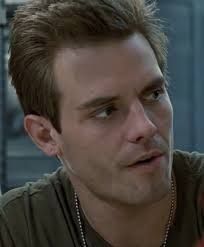
I’ll start with “Nightmare Asylum”. Ripley wasn’t seen much in this story, but I was surprisingly okay with this because it gave Hicks and Newt some time to shine. Set a fewish years down the line from “Aliens”, Newt is now a young woman, and has been living as a surrogate daughter/sister/friend to Hicks. They have been floating in space, as Earth has been taken over by the Xenomorphs and they escaped by the skin of their teeth (along with an android named Butler with whom Newt has been in a relationship). But unfortunately they run afoul a crazed General named Spears, who has gone full General Kurtz and thinks that he can make an army of Xenomorphs to fight against the Xenomorphs on Earth, namely by torturing and trying to condition an Alien Queen to make her control her brood lest he destroy her eggs. And while Ripley is nowhere to be seen for the most part, I REALLY enjoyed “Nightmare Asylum”, if only because Hicks and Newt (her in particular) had some fantastic story lines and moments of riveting action. Given that I have ALL the love for both Hicks and Newt, I am a-okay with the focus being on the two of them. For Newt it’s because she has taken on the role of the determined and scrappy Ripley character, and it shows how she has gone from scared orphan girl to be saved to an adult who is out to save the world. For Hicks it’s his continued journey of being a tough and competent soldier who is more than happy to let the tough ladies around him take the reins. He had the utmost respect for Ripley and trusted her, and  he has the same respect for Newt. And also, Hicks was played by Michael Biehn, who was foxy as HELL in the role, so yes, my libido has SOME influence over my affinity.

350f76ae28d780981ca49ee77d09f286
AM I WRONG?! (source)

But I also REALLY liked the main plot with the crazed General trying to use the Xenomorphs to his own ends. Any “Alien” fan worth their salt is going to know that this is a TERRIBLE idea, but it feels original enough that it could totally fit within the hubris that we see so often in this universe. And with new but familiar protagonists coming in to deal with it it doesn’t feel like just another instance of  ‘Ripley is right AGAIN and why doesn’t anyone listen to her?’. Ripley can be right til the cows come home, but admittedly it would get a bit old. And yes, Ripley DOES show up, right at the end, so it doesn’t feel like she’s been forgotten or thrown to the side. One note I do have, though: I didn’t like that there were so many sexualized drawings of Newt. Sure, she’s an adult in this story arc, but was it REALLY necessary to have multiple shots of her in skimpy underwear and spread legs?

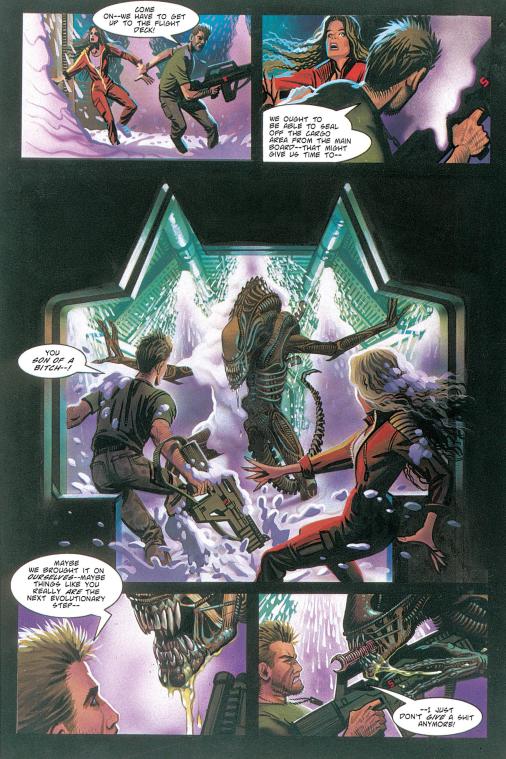
“Earth War” was next, and that one brings Ripley more into the fold. As she, Hicks, and Newt (along with other brave fighters) gather together to try and take Earth back, Ripley also has to contend with her leaving Newt and Hicks behind after “Aliens”. I liked the device that was used in this case, as it doesn’t feel too cheap (like “Alien 3” did, and no I will NOT shut up about how much I hate that movie) and also feels wrenching. To Ripley Newt was sort of seen as a stand in for her daughter, who died while Ripley was in hypersleep out in space, and so it was important to give a GOOD explanation as to why Ripley would have disappeared after “Aliens”. “Earth War” absolutely achieves that. But I think that the reason I found it to be the weaker of the two, in SPITE of Ripley’s presence, is that it feels very rushed. While the smaller story of “Nightmare Asylum” works in four issues, trying to cram a reunion for Ripley and her friends, information as to where she was that whole time, AND a battle to take Earth back from the Xenomorphs in the same number feels VERY rushed. Plus, I think that for me there was a HUGE disconnect from the artwork between the two, and I much preferred Den Beauvais:

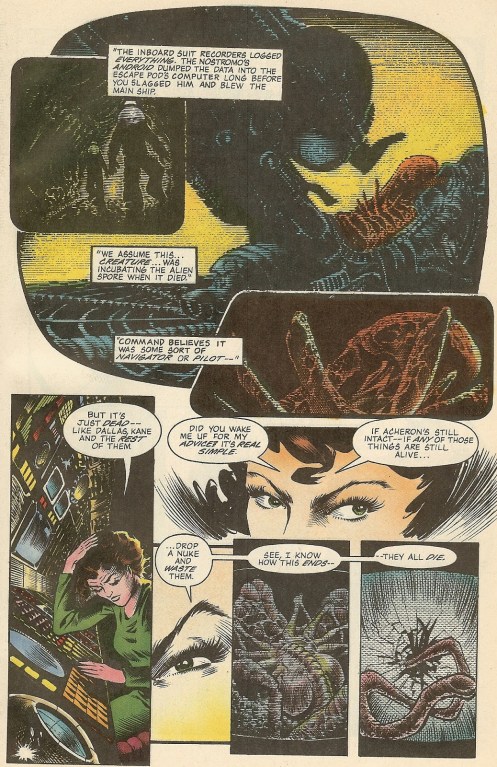
aliens-nightmare-asylum-int
(source)

Versus that of Sam Kieth:

scan0078
(source)

I generally like Kieth (I REALLY like his work on “Sandman”), but I didn’t feel like it fit in as well with the content at hand. Which means I was taken out of it a bit more than I would have liked.

All that said. this collection is FINALLY back the way it is supposed to be, and I am SO happy that I finally got to read it. “Aliens: The Original Comics Series” gives “Alien” fans the stories that we’ve always deserved, and it gives Ripley, Hicks, and Newt a lot to do without getting dour or unnecessarily bleak. I greatly enjoyed this series as a whole.

Rating 9: The “Alien” continuation that we deserve to have, “Aliens: The Original Comics Series” is action packed, powerful, and a shining light on favorite characters from the first two movies.

Reader’s Advisory:

“Aliens: The Original Comics Series” isn’t on any Goodreads lists, but I think that it would fit in on “Supernatural (Not Superhero) Comics”.

Find “Aliens: The Original Comics Series” at your library using WorldCat!