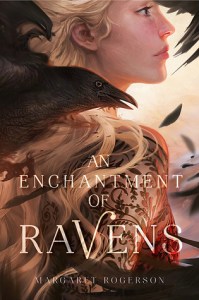
Serena’s Review: “An Enchantment of Ravens”

30969741Book: “An Enchantment of Ravens” by Margaret Rogerson

Publishing Info: Margaret K. McElderry Books, September 2017

Where Did I Get this Book: ARC from ALA

Book Description: Isobel is a prodigy portrait artist with a dangerous set of clients: the sinister fair folk, immortal creatures who cannot bake bread, weave cloth, or put a pen to paper without crumbling to dust. They crave human Craft with a terrible thirst, and Isobel’s paintings are highly prized among them. But when she receives her first royal patron—Rook, the autumn prince—she makes a terrible mistake. She paints mortal sorrow in his eyes – a weakness that could cost him his life.

Furious and devastated, Rook spirits her away to the autumnlands to stand trial for her crime.

Review: This was an ARC that I nabbed at ALA purely because of the beautiful color and my vague guess that it was probably some type of fairytale…maybe? Honestly, ALA is such a mad house that I don’t think I even got around to reading the book description until I was back in my hotel. But man, what luck! This story was one giant mash-up of all of my favorite things about fairtyales: a relatable heroine, a hilarious and charming hero, and the darker side of magic.

In Isobel’s village, fairies are common customers. Humans possess the ability to make Craft, construct things out of materials, something that is deadly to fairies, and thus fascinating to these long-lived beings. Isobel is a prodigy portrait artist, and as such, as worked with fairies most of her teenage life, becoming quite familiar with the quirks and dangers of these people. In exchange for her work, she is paid with magical favors, like chickens that produce a certain number of eggs each week. But in every fairy gift, there lurks the potential for disaster, so Isobel has gotten quite skilled at carefully wording every request she makes. More so than other in her village, she understands that even the ultimate fairy gift, a drink from the Green Well which grants immortality and is reserved for only the most special cases of humans who posses Crafting talent over and beyond the usual and who come along maybe once every century, is not all its cracked up to be. So when whisked away by an unhappy fairy prince client, Isobel knows that her trip to the fairy realms is rife with potential disaster.

Isobel herself was one of my favorite parts of this book. From the very beginning, we see that she has grown wise through her experience with the fairies. She doesn’t trust them and sees the loss that immortality has inflicted upon them. They can’t seem to relate to others or feel real emotion about anything. In fact, the presence of emotion is what makes Rook stand out to her, and the painting of it is what gets her carried away. And even then, trapped in the fairy world with a volatile prince, Isobel never loses her head. The relationship she develops with Rook over their travels develops in a natural way and Isobel always retains her common sense about the dangers this is presenting to both her and him, since relationships between humans and fairies are forbidden.

Rook, too, was exactly the type of romantic hero I love. He’s lovably arrogant about his own kind, a trait that both amuses and exasperates Isobel. There were several laugh out loud moments for him throughout the story. He’s also given a strong backstory to justify the differences between him and the other fairies. But never loses his inherent “otherness.”

As readers of this blog know, my favorite fantasy stories often mix a good dash of darkness and horror into the story (see: “The Beast is an Animal”). Here, the fairy court is like a brilliant confectionery cake, but once you cut into it, you see the mold. Time has not been kind to beings who live forever. There is madness, isolation, and loneliness mixed behind every aspect of the fairy realm.  At the center of it is the Summer King, the ruler of the fairies, who has withdrawn from the world, but whose madness lurks and has begun to trickle into the human world as well.

For a fairytale not directly tied to re-telling any of the tales we are familiar with, “An Enchantment of Ravens” reads as a staple in the genre. Magic, adventure, danger, comedy, and romance are all balanced in this story, held together by two protagonists you quickly grow to love. I can’t recommend this enough to fans of fairytale retellings!

Rating 9: What a wonderful surprise! Sometimes judging a book by its cover has a massive upside!

Reader’s Advisory:

“An Enchantment of Ravens” is on these Goodreads lists: “Traveling in the Faerie Realms” and “Dark Fairy Tales.”

Find “An Enchantment of Ravens” at your library using WorldCat!
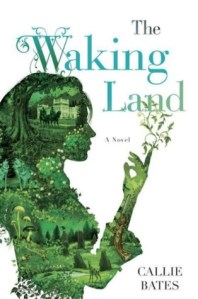
Serena’s Review & Giveaway: “The Waking Land”

32671619Book: “The Waking Land” by Callie Bates

Publishing Info: Del Rey Books, June 2017

Where Did I Get this Book: ARC giveaway from Goodreads & ARC NetGalley e-book

Book Description: Lady Elanna Valtai is fiercely devoted to the King who raised her like a daughter. But when he dies under mysterious circumstances, Elanna is accused of his murder and must flee for her life.

Returning to the homeland of magical legends she has forsaken, Elanna is forced to reckon with her despised, estranged father, branded a traitor long ago. Feeling a strange, deep connection to the natural world, she also must face the truth about the forces she has always denied or disdained as superstition powers that suddenly stir within her.

But an all-too-human threat is drawing near, determined to exact vengeance. Now Elanna has no choice but to lead a rebellion against the kingdom to which she once gave her allegiance. Trapped between divided loyalties, she must summon the courage to confront a destiny that could tear her apart.

Review: First off, thank you to the publisher and Goodreads for providing me this book through a give away! I also read a portion of it through an e-book ARC provided by NetGalley. You know, cuz I need to be able to read the book at ANY GIVEN MOMENT and thus need copies available in every format.

giphy5
(source)

Anywho! On to the review! Beyond the beautiful cover (yes, I do judge a book by its cover when it suits me, thank you very much), I was instantly intrigued after reading the story synopsis. It sounded like an appealing mix of political intrigue, manners and etiquette, and, of course, magic. And while it was all of those things, there were a few stumbling blocks along the way.

First off, the political intrigue. It became very clear early in the book that the author was drawing inspiration from the Jacobite rebellion between Scotland and England to create the history and heart of the conflict in her story. There are two countries occupying an island nation, one has been overthrown in recent history, but still hopes to put their own choice leader on the thrown and regain independence for their portion of the country. Obviously, there’s much more to it than this, but at its core, it’s fairly straightforward. I was very pleased with this portion of the story. It was interesting finding similar threads to real history sprinkled within this fantasy novel, especially when those threads diverged from the path with which we are familiar.

Bates clearly had a lot of world building she was trying to pack in this novel. Beyond these tie-ins to the Jacobite rebellion, there’s a complicated history that goes back centuries before it, involving not only these two nations, but another powerful nation who had conquered the entire region at one point and then retreated again.  Detailed histories likes this make a story interesting, but they also present a challenge to authors. All too often books end up with large info-dumps presenting all of these details, which no one loves. But here, we saw the opposite side of the coin. I was a good 150 pages into this story and was still trying to work out the timeline of who conquered who when and why. At a certain point, it was so frustrating that I simply gave up trying to understand. I hesitate to recommend more info dumping, but in circumstances like this, it’s probably the better option than sprinkling in details throughout a long-ish book where much of the plot revolves around the political implications of this history and readers end up just confused.

I did love the magical set up that was brought into the story. Sure there was the cool magic that Elanna was able to create, but the more interesting part was, again, the detailed framework and history behind her power. Not only are her powers needed for the rebellion, but the symbol that she represents as a corner of the tri-part governing force that traditionally ruled the land is highly motivating to the people.

I had mixed feelings with regards to Elanna herself. Her history (the stolen child of a failed rebel leader being held to keep the other side in check) is one that sets her up to have many conflicting feelings and views of those around her. Things like family, friendship, and even national loyalty are all tied together in knots. She feels abandoned by one family, guilty for developing attachments to her captors, questions everyone’s motives around her, questions her own loyalties. Much of this was very interesting and created a rich character arc for her to travel. Unfortunately, all too often she would perform complete 180s on a dime with very little explanation for why she changed her mind. She hates her father! She’ll join her father in this rebellion! Also, while the stress and frustration that would arise from her situation is understandable, at times she read as very unlikable and immature. I never could quite decide how I felt about her. Ultimately, I think I was more invested in the story that she was living than in her as a character on her own.

So there are my thoughts! To be summed up, I was very conflicted with this book. It had true moments of brilliance with a unique and complicated history, both political and magical, and the main character also had flashes of greatness. But I was also all too often confused by the same history and frustrated with Elanna herself. I would still likely recommend this book to readers who enjoy historical “fantasy of manners” type books based on its strengths. Want to judge for yourself? Enter our giveaway to receive an ARC of this book!

Enter to win an ARC of ‘The Waking Land!”

Rating 6: Had so many things going on (complicated history, complicated characters) that it didn’t quite manage to fully flesh it all out.

Reader’s Advisory:

“The Waking Land” is new and isn’t included on any relevant Goodreads lists, but it should be on “Fantasy of Manners” and “Best Books Containing Elemental Powers.”

Find “The Waking Land” at your library using WorldCat!

Serena’s Review: “Thick as Thieves”

8306741Book: “Thick as Thieves” by Megan Whalen Turner
Publishing Info: Greenwillow Books, May 2017

Where Did I Get this Book: the library!

Book Description: Deep within the palace of the Mede emperor, in an alcove off the main room of his master’s apartments,. Kamet minds his master’s business and his own. Carefully keeping the accounts, and his own counsel, Kamet has accumulated a few possessions, a little money stored in the household’s cashbox, and a significant amount of personal power. As a slave, his fate is tied to his master’s. If Nahuseresh’s fortunes improve, so will Kamet’s, and Nahuseresh has been working diligently to promote his fortunes since the debacle in Attolia.

A soldier in the shadows offers escape, but Kamet won’t sacrifice his ambition for a meager and unreliable freedom; not until a whispered warning of poison and murder destroys all of his carefully laid plans. When Kamet flees for his life, he leaves behind everything—his past, his identity, his meticulously crafted defenses—and finds himself woefully unprepared for the journey that lies ahead.

Pursued across rivers, wastelands, salt plains, snowcapped mountains, and storm-tossed seas, Kamet is dead set on regaining control of his future and protecting himself at any cost. Friendships—new and long-forgotten—beckon, lethal enemies circle, secrets accumulate, and the fragile hopes of the little kingdoms of Attolia, Eddis, and Sounis hang in the balance.

Review: As I made abundantly clear in my gushing ALA posts, I’ve very much been looking forward to “Thick as Thieves,” the fifth installment in the “Queen’s Thief” series and was beyond thrilled when I got to meet Megan Whalen Turner several times and snag a signed copy of the book. It immediately jumped to the top of my reading list, and I am happy to report that it was worth the wait for its release!

As is now the pattern with these stories, our protagonist has once again changed in this story. This time around we follow Kamet, a slave to the Mede ambassador. We technically met this character several books ago when the Mede ambassador was visiting Attolia and attempting to bully the queen into an alliance. It was quite a lot of fun watching him be sent home in shame, Kamet in tow. Here, we meet up again with Kamet in the years that have followed. From his perspective, while the embarrassment of what happened to his master was unfortunate, Attolia is still a backwaters country with a fool of a king and in all respects he would like to simply wash his hands of his time there. Besides, good things are coming his way. Slave or not, he sees a future of power and influence ahead as the right hand man to the to-be Mede emperor.

These beginning scenes documenting Kamet’s life as a slave serve as an important insight into his head. As a reader, we are trained to look at his situation and pity him. He’s a slave, no amount of power and influence should be worth it. Kamet is both a reliable and unreliable narrator in this way. His perspective is not completely false; he does have power and influence in his position, much more so than other slaves, and, importantly, more so even than other free men. Not only does he choose to remain a slave when he is initially presented with the opportunity to flee, but throughout the story we see that he has become very arrogant from this position. He thinks quite a lot of himself and the role he has played, often looking down on the other slaves as well as entire countries like Attolia.

But on the other hand, Kamet is unreliable. He’s clearly suffering from some version of Stockholm syndrome, more worried about the embarrassment of being seen to have been beaten after an error in judgement than enraged that he was beaten at all. He blames himself for causing the situation that forced his “good” master’s hand.

After he is forced to flee Mede after the death of his master, it was great reading about the slow transition Kamet undergoes. The Attolian guard is a steady, consistent presence of another way to live. He doesn’t speak much at all, and when he does, Kamet must constantly re-evaluate his views of Attolia, the Attolian soldier, and himself.

The story is essentially a travelogue following these two characters’ flight through Mede attempting to gain passage by ship back to Attolia. For a book that has many action sequences (fleeing from slavers, hiding from guards, etc), it also felt like a steady character study of these two characters, but particularly Kamet himself. I’ve always loved Whalen Turner’s ability to make the reader fall in love with each new character she presents. Even more challenging, she often starts with characters we aren’t pre-disposed to love. Kamet is the same; his arrogance and seemingly wilful ignorance can make him frustrating in the beginning. But there’s great chemistry between him and the Attolian and it was a lovely story reading about Kamet essentially rediscovering who he is now that the one thing he has defined himself as, a powerful slave, has been taken away from him.

Other than great characters, we can always expect great twists from this author, and this book is no different. I was actually able to predict a few of the story turns, but there were others that took me completely by surprise. Never fear, Gen does make an appearance towards the end and is just as clever, confusing, and appealing as ever. Throughout the series, the scope of his schemes has had to constantly expand, from tricking a few people in the first book, to maneuvering entire countries and empires in later books. The thrill remains as we watch him triumph, oh so casually, over these other power houses who have all dismissed him as so much foolishness.

Coming as no surprise now, I completely recommend this story. It is fairly necessary to have read the other books in the series before reading this one, I would say. But hey, if you haven’t already, all the more exciting for you since they are all so great!

Rating 10: Worth any wait.

Reader’s Advisory:

“Thick as Thieves” is a new book and isn’t on m any relevant Goodreads lists (other than ones titled things like “Books that need to come out sooner!!!”), but it should be on “Books with Unreliable Narrators.”

Find “Thick as Thieves” at your library using WorldCat!

Previously Reviewed: “The Thief” and “The Queen of Attolia” and “The King of Attolia” and “A Conspiracy of Kings”

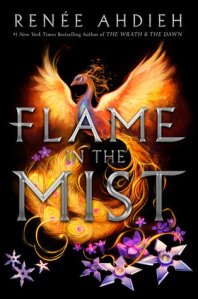
Serena’s Review: “Flame in the Mist”

23308087Book: “Flame in the Mist” by Renee Andieh

Publishing Info: G.P. Putnam’s Sons Books for Young Readers, May 2016

Where Did I Get this Book: e-ARC from NetGalley!

Book Description: The only daughter of a prominent samurai, Mariko has always known she’d been raised for one purpose and one purpose only: to marry. Never mind her cunning, which rivals that of her twin brother, Kenshin, or her skills as an accomplished alchemist. Since Mariko was not born a boy, her fate was sealed the moment she drew her first breath.

So, at just seventeen years old, Mariko is sent to the imperial palace to meet her betrothed, a man she did not choose, for the very first time. But the journey is cut short when Mariko’s convoy is viciously attacked by the Black Clan, a dangerous group of bandits who’ve been hired to kill Mariko before she reaches the palace.

The lone survivor, Mariko narrowly escapes to the woods, where she plots her revenge. Dressed as a peasant boy, she sets out to infiltrate the Black Clan and hunt down those responsible for the target on her back. Once she’s within their ranks, though, Mariko finds for the first time she’s appreciated for her intellect and abilities. She even finds herself falling in love—a love that will force her to question everything she’s ever known about her family, her purpose, and her deepest desires.

Review: Right off the bat, there were several things going for this book when I first saw that it was coming out. First and foremost, I had very much liked Abdieh’s previous YA fantasy duology, a re-telling of “One Thousand and One Nights, “The Wrath and the Dawn” and “The Rose and the Dagger.” Together they made up a unique re-telling of one of the few remaining fairytales that hasn’t been beaten into the ground (this coming from an avid fan of fairytale re-tellings), and the style of writing appealed to me with its lyrical quality. “Flame in the Mist” had the same elements. To its detriment.

I want to applaud the author, however, for sticking to her guns in choosing lesser known stories and focusing her world-building and characters on non-European/western settings and cultures. Here we have what is essentially a “Mulan” re-telling set in a proto-Asian setting. I don’t have a wealth of knowledge of Chinese/Japanese/etc cultures, so I can’t speak to those aspects of the book (similar to my lack of knowledge of the “realism” of the Middle Eastern setting used in her previous duology). However, both that series and this are set in fantasy worlds, for all their similarities, so outside of blatant issues (which there were none that I could tell), there was a lot of free reign to build a completely new world order/culture with this story. This was one aspect of the story that I really enjoyed. It was refreshing to read a fantasy story that takes place in an eastern setting. This left not only the fantasy elements to learn and to explore, but also the immersive quality of being quite outside my own culture, while still having threads to tie back to what little I do already know of the regions of the world that this story draws from. Full marks for world building.

Unfortunately, that leads me to the rest of the story, all of which I had more issues with. First off, I feel that, as a reader, I would have been better served having this book not presented to me as a “Mulan” re-telling. For better or worse, my knowledge of that story is pretty well tied up with the Disney version. I know the story is based on a traditional Chinese fairytale of a young woman who dresses and fights as a man, but I haven’t read it and couldn’t even speak to the accuracy of Mulan. So…Disney’s all I’ve got with this one. And as far as this book goes I got far too little of this:

giphy1

And far too much of this:

giphy

One of the things that made Disney!Mulan’s story appealing were the noble and, most importantly in this case, understandable reasons for why she does what she does. Her hand is quite literally forced, for love of her father and nothing more. Sure, she feels out of place in her own skin and that she is letting her family down, but she never contemplates abandoning home until the situation with her father being called to war comes to play. Not so with Mariko.

For all intents and purposes, Mariko is quite acceptable as a daughter. Sure she’s frustrated and angered by the fact that she is being traded away in marriage, but alas, such is the life she was born to lead. In the short introduction we are given to her character before the action sets in, we are given every reason to think that Mariko is above all a practical and dutiful daughter. These are traits she prides herself in. But then her caravan is attacked, her guards and maid killed, and she finds herself wandering around in the woods alone. And this is where I first knew there were going to be issues for me with this book. Mariko rightly worries that her situation is going to be problematic for her family to explain; when/if she returns home, her virtue could be called into question due to this, and through this, her family’s honor. What is to be done? Obviously, running away, disguising herself as a boy, and tracking down those who attacked her so that she can save her virtue. Somehow.

I’m a fantasy reader, I’m more than happy to turn my brain off and go on many an adventure where implausible things happen. But only so far as the world allows. This type of blatant, plot-serving faulty logic drives me bonkers. How in the world could dressing up as a boy and hanging out with a bunch of (male!) thieves improve her chances of retaining her family’s honor and her own virtue? Nothing about it makes sense. And unfortunately, this type of backwards thinking continues for Mariko throughout the story. She sometimes even made the right decision, but made it for such the wrong reason that I couldn’t even give her credit for it.

Beyond this, I’ve found that in this, the third book I’ve read by this author, the writing is starting to get on my nerves. What came off as lyrical and appropriate in the previous duology, read as strained and forced here. Perhaps the focus on storytelling that was at the center of the other two books simply lent itself better to this type of writing, and now, removed from that topic, it simply felt awkward. It’s hard to even describe, really, as sentence-by-sentence there’s nothing wrong with the writing. But as I kept reading, it just kind of built up as an annoyance, and enough of one that I repeatedly found myself putting the book down.

“The Flame in the Mist” was not for me. I could never get behind Mariko as a main character with her blatantly contradictory thought process and decision making, and the more dramatic and lyrical writing style seemed to rub uncomfortably with this more action-oriented tale. For those looking for a good woman/warrior story, pull out the classic “Alanna” series instead. Or, hey, check out the “Bloodbond” series that I recently finished up and loved.

Rating 4: My expectations were too high for this wanna-be-Mulan story.

Reader’s Advisory:

“The Flame in the Mist” is included on these Goodreads lists: “SF & F Atlas – Asia” and “Fairytales for Wild Girls.”

Find “Flame in the Mist” at your library using WorldCat!


Serena’s Review: “Julia Vanishes”

22400015Book: “Julia Vanishes” by Catherine Egan
Publishing Info: Doubleday Canada, June 2016

Where Did I Get this Book: audiobook from the library!

Book Description: Julia has the unusual ability to be . . . unseen. Not invisible, exactly. Just beyond most people’s senses.

It’s a dangerous trait in a city that has banned all forms of magic and drowns witches in public Cleansings. But it’s a useful trait for a thief and a spy. And Julia has learned–crime pays.

Her latest job is paying very well indeed. Julia is posing as a housemaid in the grand house of Mrs. Och, where an odd assortment of characters live and work: A disgraced professor who sends her to fetch parcels containing bullets, spiders, and poison. An aristocratic houseguest who is locked in the basement each night. And a mysterious young woman who is clearly in hiding–though from what or whom?

Worse, Julia suspects that there’s a connection between these people and the killer leaving a trail of bodies across the frozen city.

The more she learns, the more she wants to be done with this unnatural job. To go back to the safety of her friends and fellow thieves. But Julia is entangled in a struggle between forces more powerful than she’d ever imagined. Escape will come at a terrible price.

Review: This book is a strange combination of a million and one elements that shouldn’t work together, but somehow, do! We’ve got an “Ocean’s Eleven” style thieves guild, essentially, operating in a world that is similar to our own, but at an undefined period of time (there are carriages, but also “electric” carriages, people use swords, but there are also muskets, at one point they use an elevator in a building, but they also sail their boats…), There is an inquisition-style hunt going on for witches, but there are also other magical beings that are thought only to exist in folklore. And in the middle of the story we’re presented with an entire new level of world-building with the introduction of a new set of beings with a god-like relation to history and current events.

Throughout this all, what holds things together is Julia, her narrative style and individual character arc. Julia, and her brother Dek (the spelling of character names/places is always confusing when you listen to an audiobook and never see the name spelled out! Ah, the challenges of book reviews!), are the orphaned children of a father who drank and then abandoned what remained of his family when their mother is convicted and executed as a witch. They are taken in by Esme, a woman who runs a successful thieves underground system, and grow up working jobs for this new family. Which all leads to the current circumstance that places Julia, requested by the client for her unique ability to go “unseen” by others when she chooses, as a spy in the household of Mrs. Och and thus caught up in complicated mystery that surrounds the young woman and her toddler son who are taking refuge there.

Julia’s growth through the story was one of its strongest appeals. Not only does she not understand her own abilities, especially when she discovers there is more to them then simply becoming invisible for a bit, but her own world views, and her understanding of her place in it, are consistently challenged. I particularly enjoyed the parallel that is drawn between Julia and another character, Pia, and the example they each set for the consequences that come from making the choices we do in life. Julia, at first, has a very pragmatic approach to her life and her work. She does the job, she gets paid. And this is a comfortable arrangement, allowing her to morally set herself back from her own actions. But when this approach comes to a head in the middle of the book, Julia must question her own definition of “living.”

While Julia’s is obviously the main arc of the story, I also appreciated the other views into poverty and the choices that are available to those struggling to get by that are presented by the other characters. Her brother, Dek, is a talented inventor, but due to their status as orphans and thieves, and his own deformities from a childhood illness, he worries about every being financially compensated if he came forward in an attempt to sell his goods. Another character, Wyn, hopes to be an artist, but struggles to get his foot in the door with an apprenticeship or a place in an art program. Again and again, we see these characters have doors shut in their faces and can understand the comfort that comes from the stability found in their role in this thieves guild, even if the work itself is morally questionable.

As for the story itself and the world-building, I was very surprised when about halfway through the book the plot suddenly expanded massively to include world-changing characters and events. Before it had been a rather simple murder mystery with a strange monster and a mysterious woman with a past. Suddenly these were all small pieces in a much larger moving plot machine. While I liked these expanded elements, they did seem to come out of the blue, forcing the entire story to shift completely, resolving some of the initial elements suddenly in the middle of the story while introducing new ones at the same time. It almost felt like two completely different books. I think this was simply a matter of pacing and of a few info-dumpy passages that were overwhelming. Ultimately, things did become clear, but there was a bit in the middle where I was honestly confused about who was after who and why.

The story does resolve itself for the most part in this book, however the door is clearly left open for sequels. Now that the cards are shown, per se, about the grander conflict going on in the series, I have hopes that any future books would be more settled in their own skin with what story they are wanting to tell. I was also given just enough of Julia’s abilities and origins to keep me coming back for the second book to find more answers alongside her. “Julia Defiant” will be up shortly, I suspect!

Rating 7: A great main character and interesting new world. But it felt like two books mashed together at times, with one focused on a simple monster story and the other setting up larger-than-life characters and plots.

Reader’s Advisory:

“Julia Vanishes” isn’t on any relevant Goodreads lists, but it should be on “Fantasy Books about Thieves.”

Find “Julia Vanishes” at your library using WorldCat!


Serena’s Review: “A Great and Terrible Beauty”

3682Book: “A Great and Terrible Beauty” by Libba Bray
Publication Info: Simon and Schuster, December 2013

Where Did I Get this Book: audiobook from the library!

Book Description: A Victorian boarding school story, a Gothic mansion mystery, a gossipy romp about a clique of girlfriends, and a dark other-worldly fantasy—jumble them all together and you have this complicated and unusual first novel.

Sixteen-year-old Gemma has had an unconventional upbringing in India, until the day she foresees her mother’s death in a black, swirling vision that turns out to be true. Sent back to England, she is enrolled at Spence, a girls’ academy with a mysterious burned-out East Wing. There Gemma is snubbed by powerful Felicity, beautiful Pippa, and even her own dumpy roommate Ann, until she blackmails herself and Ann into the treacherous clique. Gemma is distressed to find that she has been followed from India by Kartik, a beautiful young man who warns her to fight off the visions. Nevertheless, they continue, and one night she is led by a child-spirit to find a diary that reveals the secrets of a mystical Order. The clique soon finds a way to accompany Gemma to the other-world realms of her visions “for a bit of fun” and to taste the power they will never have as Victorian wives, but they discover that the delights of the realms are overwhelmed by a menace they cannot control. Gemma is left with the knowledge that her role as the link between worlds leaves her with a mission to seek out the “others” and rebuild the Order.

Review: You may be wondering…a book about snarky popular girls? Why is Serena reviewing this and not Kate, the keeper of snarky girls’ clubs? Well, after I started this book, I found out that Kate did in fact read this book before we started this blog, and I’m now just playing catch up. But, in many ways, this book also sounded like something that would be up my alley. I love historical books, and especially those that fall into the very specific “fantasy of manners” category that often mixes Regency/Victorian fiction with magical worlds and systems. So, while the snarky girls did get on my nerves at points, these other elements that are more typical of my usual reading wares were definitely working in its favor.

The story starts out with us meeting Gemma, a spoiled and rather bratty teenage girl living in India with her parents and dreaming of London. After tragedy strikes and her mother dies in the midst of some strange dark magic, Gemma finds her “dreams” coming true, but not in the ways she would expect. Yes, she’s now in England. But being the new girl isn’t all that she thought it would be, and not only is she set apart by this status, but she’s hiding a dark secret of her burgeoning magical abilities. All too quickly, things begin to spiral out of control and now Gemma needs to not only manage learning her own powers, but finding a way to keep her new friends safe in the process.

While I found myself wanting to smack each of these girls up side the head at one point or another, I loved the clear-eyed look at the harsh realities that were forced upon Victorian young ladies. Each girl has her own struggles to overcome. The beauty who is being essentially sold to the highest bidder in a marriage of convenience. The powerful, popular girl whose charm and magnetic personality allows her to reign over the school but whose control over her self and her decisions doesn’t translate to a life where she has been abandoned by her mother and ignored by her father. The orphan, attending school on a scholarship and whose dreams of beauty and singing are being squashed beneath the realities of an almost unavoidable future as a governess. And Gemma, herself, who is being told again and again by the men around her to keep her head down, be a good girl, and definitely don’t learn anything more about her own magical abilities.

Each of these girls was distinct, and each responded differently to the sudden power and freedom they discover in Gemma’s abilities and the mystical Order, a group of magical women that existed for centuries before coming to a mysterious and tragic end a few decades ago. I loved the slow reveal of the Order and the truth behind the girls who had been at the center of its downfall. There were plenty of surprises, and some that, while I was able to guess the result, were just as delicious in the telling.

tumblr_mv5eutsn5w1rp57r0o7_250
I was pretty much picturing scenes from “Practical Magic” throughout this entire book. (source)

My few qualms with the story are purely personal preference. There’s a reason why Kate is the queen of the snarky girls groups and I’m not. At various points in the story, but especially towards the last third, I would get increasingly frustrated with the nonsense of these girls. While the tenuous balance of their friendships read as true of teenage girls, even if I found it annoying at times, it was the complete lack of thought that went into some of their actions towards the end that really got to me. The author did a good job of building up the desperation, frustration, and fear of the future that drove these actions, but I still had a hard time with the complete idiocy that made up some of these decisions, given the information they had about past events. However, this last third was saved by some good action sequences, and a realistic bout of consequences for everything that occurred.

My last point will be that there was the seemingly required romance sub plot in this story. And when I say sub plot, I mean sub sub plot. It was barely there to the point that whenever it was referenced, it almost felt like it was coming out of the blue. The boy in question was rarely involved in the action of the story, would be absent for large chunks of time, and really had no relationship building with Gemma, leaving any feelings she had for him based purely on physical appearance. Luckily, the relationship doesn’t develop much, which felt on par with the above mentioned limitations, but I was left wondering whether it needed to be included at all. I’m guessing that more will come of this in the next few books, which may, in retrospect, make this element read better a second go-around.

All in all, I very much enjoyed this book. I loved the setting of a Victorian boarding school, with the strict boundaries set before these girls as the force upon which the freedoms and power of the magical elements worked against. While I can only hope that in future books the girls wisen up a bit, and maybe snap at each other a bit less, I’m definitely interested enough to continue with the series.

Rating 8: While my tolerance for bratty girls may be rather low, I still loved the magic and the Victorian setting.

Reader’s Advisory:

“A Great and Terrible Beauty” is included on the Goodreads lists “Best Victorian Historical Fiction Set In Britain” and “Fantasy of Manners.”

Find “A Great and Terrible Beauty” at your library using WorldCat!

Serena’s Review: “Skullsworn”

29939037Book: “Skullsworn” by Brian Staveley

Publishing Info: Tor, April 2017

Where Did I Get this Book: the library!

Book Description: Pyrre Lakatur doesn’t like the word skullsworn. It fails to capture the faith and grace, the peace and beauty of her devotion to the God of Death. She is not, to her mind, an assassin, not a murderer–she is a priestess. At least, she will be a priestess if she manages to pass her final trial.

The problem isn’t the killing. Pyrre has been killing and training to kill, studying with some of the most deadly men and women in the world, since she was eight. The problem, strangely, is love. To pass her Trial, Pyrre has ten days to kill the ten people enumerated in an ancient song, including “the one you love / who will not come again.”

Pyrre is not sure she’s ever been in love. If she were a member of a different religious order, a less devoted, disciplined order, she might cheat. The Priests of Ananshael, however, don’t look kindly on cheaters. If Pyrre fails to find someone to love, or fails to kill that someone, they will give her to the god.

Pyrre’s not afraid to die, but she hates to quit, hates to fail, and so, with a month before her trial begins, she returns to the city of her birth, the place where she long ago offered an abusive father to the god and abandoned a battered brother—in the hope of finding love…and ending it on the edge of her sword.

Review: Readers first met Pyrre in Staveley’s debut trilogy, “Chronicle of the Unhewn Throne,” the badass assassin whose religious order, the Skullsworn, worship the deity of death, Anashael. When I heard that he was writing a spin-off (prequel?) that centered around this character’s origin story, essentially, I was a bit skeptical. Sure, Pyrre was great in her supporting role, but she at times came across as unbeatable, and thus having no conflict, and, while we got into a few of the details of her religion in those first books, it also seemed like its seemingly callous philosophy would present a challenge to creating a sympathetic main character. But, lo and behold, this book blew me away, setting all of those concerns to rest and reminding me just how much I’ve been craving good, standalone fantasy fiction.

Death is at the center of the story. And if that sounds morbid, well, Pyrre, and Staveley, have much to say on the subject. We meet Pyrre at the cusp of her journey to become a full priestess of Anashael, wherein she must complete her final trial, killing ten types of individuals all listed in an ancient song of the order. She has a specific number of days to complete this, all overseen by two witnesses, the grumbly, but deadly Kossal, and the bright, complicated Ela. To do this, she returns to her childhood home of Dumbang.

Having already been introduced to this world, I was particularly thrilled with the setting of Dumbang for this story, a confusing maze of swamp, floating islands, and deadly creatures. The culture, history, and city itself all tied neatly into the greater world we are already familiar with, but were so unique that they stood alone as a completely new slice of this world. Reading this story, I could almost feel the heavy presence of this city, its beauty, its mystery, and the foreboding sense that people are treading where they should not. It perfectly mirrors the philosophy that Pyrre and the Skullsworn abide by: that death is inevitable and, in many ways, the most merciful part of life. Not something to be feared, but to be lived alongside.

The story itself is so compelling, mixing action with adventure, comedy with heartbreak, and neatly tying together the pieces of Pyrre’s life to perfectly illustrate how she came to be who she is and how she will continue to grow into the woman we meet in later stories. Kossal and Ela are great characters off whom Pyrre bounces, challenging her, and the reader, to expand her thinking on what it means to worship Anashael and to live a full life. Ela, specifically, was brilliant, jumping off the page and stealing every scene she was in. At first I was concerned that she was going to fall into a fairly established character type, all smooth sexuality and arrogant charm. But as the story continued, I began to have greater and greater hopes for her as a character and her ultimate role in the story. All of which were ultimately met, much to my joy and relief.

Bizarrely, Run Lan Lac, the man who Pyrre seeks out with the goal to love and to kill, was one of the weaker characters for me. But, given the overall commentary on love and death, upon further reflection, I’ve almost come to feel that this might have been intentional? He plays his role, and I was glad to see that his character remained true throughout all the revelations of the story.

Towards the end, the plot takes a massive leap out into the greater mythology of the world. And, while I have read the original trilogy which lent these reveals some interesting added perspectives, the story itself remained contained within its own pages, and I feel that it is still approachable for new readers even with this more expansive later plotline.

I can’t say enough about the strength of Staveley’s writing. As I said earlier, there were so many challenges he gave himself with the premise of this story. A main character who worships death and kills people with few qualms who must be made into a sympathetic and appealing leading lady. A new setting with a complex history that must still fit within the constraints of a previously built world. Multiple religions with a variety of gods, some familiar from previous  books, some new. All while trying to create a standalone novel that is approachable to new readers, but also familiar and appropriately laying the groundwork for a character known to readers of the original series. He not only does all of this, but the book was laugh-out-loud funny at parts and had me on the brink of tears at others. Staveley is quickly climbing the ranks of “must read” fantasy authors.

Rating 9: The epitome of setting tough writing goals and then  blowing them all out of the water!

Reader’s Advisory

“Skullsworn” is a newer title and isn’t included on any relevant Goodreads lists, but it should be on “Book with Heroes/Heroines Who are Assassins.”

Find “Skullsworn” at your library using WorldCat


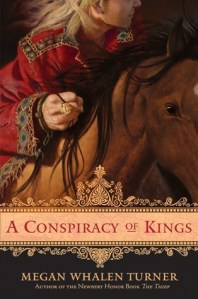
Serena’s Review: “A Conspiracy of Kings”

6527841Book: “A Conspiracy of Kings” by Megan Whalen Turner
Publishing Info: Greenwillow Books/HarperCollins Publishers, March 2010

Where Did I Get this Book: audiobook from the library!

Book Description: Sophos, under the guidance of yet another tutor, practices his swordplay and strategizes escape scenarios should his father’s villa come under attack. How would he save his mother? His sisters? Himself? Could he reach the horses in time? Where would he go? But nothing prepares him for the day armed men, silent as thieves, swarm the villa courtyard ready to kill, to capture, to kidnap. Sophos, the heir to the throne of Sounis, disappears without a trace.

In Attolia, Eugenides, the new and unlikely king, has never stopped wondering what happened to Sophos. Nor has the Queen of Eddis. They send spies. They pay informants. They appeal to the gods. But as time goes by, it becomes less and less certain that they will ever see their friend alive again.

Across the small peninsula battles are fought, bribes are offered, and conspiracies are set in motion. Darkening the horizon, the Mede Empire threatens, always, from across the sea. And Sophos, anonymous and alone, bides his time. Sophos, drawing on his memories of Gen, Pol, the Magus and Eddis, sets out on an adventure that will change all of their lives forever.

Review: After blazing through the first three books in this series last fall, I decided I needed to pump the brakes so I could stand the wait until the fifth book’s publication this spring. Delayed gratification and all of that. But by now the next book has dropped, I’m on the waiting list at my library, and it’s time to finally catch up with the last book in the series to this point.

One thing that I have commented about in all of the previous books in this series, is the way the author plays where her narrator and narrative method. For a series that has such a strong character as Gen, it’s a brave choice to focus the story on periphery characters and leave your star player benched, essentially, for large chunks of the story. Here, she takes an even bolder risk by throwing the story into the hands of Sophos, a character who played a large role in the plot of the first book “The Thief” but has been entirely absent, apart from random asides, throughout the rest of the series.  He was an interesting enough character there, but it is always hard to tell how truly compelling any character is on their own when they’re working of the character of Gen who seems to draw out the best parts of many characters. So if you’d asked me whether I was interested in an entire book seen through his eyes and regarding his struggles with family and kingship, I’d probably have been like “…meh?” But, as usual, I should never have doubted!

One of the few things I remembered about Sophos as a character was his crippling insecurity. Here, after the events of “The Thief” and back in his home country under a new tutor, we can see why he struggles with this. His father is completely disappointed in him as a son and heir and never misses an opportunity to rub this fact in. So in many ways this is a story of self-discovery and self-confidence, all wrapped beneath an action packed plot. After Sophos’ family is attacked and he is sold into slavery, he finds himself completely alone in the world, and, for the first time, anonymous. How can he escape his current situation and re-claim his throne? And, more importantly, does he even want to?

As I mentioned earlier, Whalen Turned doesn’t just change up narrators between books, but she also changes the way she tells the story. Here, very early on, it is clear that Sophos is relating his experience to a listener, but it is not clear who that listener was. This plot device was both interesting and endlessly frustrating as I kept coming up with guesses for who he was talking to and the purpose of telling the story the way he was.

I don’t think it’s a spoiler to say that yes, he eventually does meet up with Gen, Attolia, and, most importantly Eddis again. As leaders of their own countries, each are valuable allies for the displaced Sophos. But much has happened since he last left them, most importantly the upstart theif Gen is now King of Attolia. And Eddis…he’s not quite sure where he stands with her. I loved seeing all of these characters through the eyes of Sophos who has been gone for much of the series and missed the progression of change that we the readers have had time to come to terms with. Further, all three rulers have different approaches to what it means to lead a country and how they go about it. I loved the insights they each provided Sophos as he began to realize the depth of the decisions before him.

The only thing that knocks this book down from a perfect score is the complicated politics of the regions. And I even hesitate to mention it because this aspect of the series is also one that makes it stand out and has been one of the draws for me as a reader. And it still is here. However, there were times when the plans and actions of the characters were confusing to me and I had to re-read portions to fully understand how everyone knew what when. But, like I said, I’d rather things be more complicated than be spoon-fed the plot, so take this “criticism” how you will.

Surprising no one, I loved this book. And surprising no one, all the doubts I had going in where laid fully to rest. I will now go back to obsessively refreshing my library hold account page to see if the line of people before me is dwindling for the next book “Thick as Thieves.”

Rating 9: Another great entry in a great series!

Reader’s Advisory:

“A Conspiracy of Kings” is on these Goodreads lists: “Political themed YA fiction” and “Royalty.”

Find “A Conspiracy of Kings” at your library using WorldCat!

Previously Reviewed: “The Thief” and “The Queen of Attolia” and “The King of Attolia”

Serena’s Review: “Princess of Thorns”

18782855Book: “Princess of Thorns” by Stacey Jay

Publishing Info: Delacorte Press, December 2014

Where Did I Get this Book: audiobook from the library!

Book Description: Though she looks like a mere mortal, Princess Aurora is a fairy blessed with enhanced strength, bravery, and mercy yet cursed to destroy the free will of any male who kisses her. Disguised as a boy, she enlists the help of the handsome but also cursed Prince Niklaas to fight legions of evil and free her brother from the ogre queen who stole Aurora’s throne ten years ago.

Will Aurora triumph over evil and reach her brother before it’s too late? Can Aurora and Niklaas break the curses that will otherwise forever keep them from finding their one true love?

Review: I picked up this audiobook in a spur of the moment panic brought about by previously requested audiobooks not being ready at the library and a long, traffic-filled commute staring me down. This book had been hanging out for so long on my to-read list that I have completely forgotten how it go there and (an even worse habit!) I had begun to assume that because I hadn’t gotten to it in so long, I must not really have been that interested in the first place. Reading the description, some type of bizarre fairytale re-telling about the Sleeping Beauty’s daughter it sounded like something that would be right up my alley, so why hadn’t I gotten to it?! Ah, the mysteries of life, and one that burned me in the end here for ignoring such a delightful story for so long.

Just as the description suggests, this is indeed a fairytale type re-telling, if by “re-telling” you mean “tragic post script to the ‘Sleeping Beauty’ story that, depending on the translation, is already pretty horrifying.” The prince who wakes up the Sleeping Beauty is indeed a jerkwad of the “hide your multiple wives” variety. And things only get worse when an Ogre prophesy puts her two children at risk, leading to her imprisonment and some truly terrible forced choices. The story then picks up 17 years later following Aurora who is now working off a tight deadline to rescue her brother from the Ogre Queen and raise an army to save her kingdom. All with the help of Niklaas, a seemingly shallow prince who is hell-bent on marrying a princess.

Niklaas was one of the most surprising elements of this story. Based on the cover, the book description, and, let’s be honest, the tons of YA fairytales that have come before it, I went into this assuming that Aurora would be our one and only POV character. So color me surprised when Niklaas shows up and steals away half the story for his own! And I couldn’t be more happy about it. Niklaas brings his own fairytale to the book, this time a twisted version of the “Seven Swans” story, and his own personality to the page. His is one of my favorite character types to stumble upon. Witty, but flawed. Self-aware, but delusional about how he comes across to others. He’s the type of character you should hate (as Aurora first does as well) for all of his egotism and blatantly stereotypical and demeaning opinions about women. But he’s so charming and hilarious that you end up loving him anyways, gleefully waiting for the inevitable slap to the face that will knock him out of his narrow way of thinking. He was a perfect foil to the more impulsive (reckless!) Aurora, and a humorous balance to her own more straight-laced approach to the trials and tribulations they find themselves in.

Aurora, herself, was also a great character. Not only did we have Niklaas showing up as one of my favorite types of romantic leads (the kind that exist as more than a romantic lead in the first place), but with Aurora I had another favorite trope: girls disguised as boys. The biggest challenge with this approach is balancing the friendship/romance between the two main characters in a believable way. For Aurora’s perspective, it is easier, as she is in on the sham the entire time. So for her, it was most enjoyable simply watching her slowly realize that for all of his foibles, Niklaas might be a good guy. But for Niklaas, it’s harder. His relationships with Aurora starts out purely platonic, with him believing that she is her younger brother. Their friendship and camaraderie during this period was great, and I was beyond pleased with the way the author transitioned this relationship once the secret comes out (this is NOT a spoiler, cuz…obviously). Particularly, I loved that the challenges of this reveal weren’t hand-waved away. Not only does Niklaas have to come to terms with the new reality he’s living, but also that he’s been actively lied to for weeks. Full points for the author in her handling of this entire storyline.

Beyond these two, the most surprising part of this story was the inclusion of a handful of story chapters from the POV of the Ogre Queen herself. Initially I was rather put off by this as I had been having a grand ole time romping around in the woods with Niklaas and boy!Aurora. But the Ogre Queen’s chapters, and the character herself, brought a necessary level of severity to a story that could have easily slipped into pure silly escapism (though there’s a healthy dose of that, for which I was glad as well). For the few number of pages she’s allotted, the Ogre Queen’s transformation and story arc was probably the most compelling. Her story was unique and completely unexpected, probably bring the only truly “new” portions to this fairytale from the long lists of marks that are almost always hit in these types of books.

My only frustrations came towards the end. Throughout the story, Aurora’s character is pushed to grow and adapt from her particular brand of bravery that often revealed itself in foolhardy decision making with results that could have been prevented if a bit more thought had gone into them. With all of the build up, I went into the final act ready for her to complete this arc. And…in a way she does? But not really. She ultimately makes all the wrong choices and is only saved by the courage and sacrifice of those around her. There’s a very brief moment where she does confront this reality and make one good decision that does have major ramifications. But only after making ALL OF THE WRONG decisions up to that point, with only luck leaving her this one last opportunity to make it right. She does pay a steep price, but I ultimately felt that her arc was left rather incomplete in this area. Did she really learn a lesson here? Was it really satisfying that everything ended up aces for her out of pure luck? I wasn’t completely satisfied on either account.

But let’s not end on that note! Even with those frustrations, this book was completely and utterly a joy to read! It may have hit me at just the right moment when I needed a bit of humor, romance, and adventure without too many complicated strings attached. But as a beach read, I think it’s perfect, so make sure to grab a copy before you head off on vacay this summer!

Rating 8: Pure fun! If only brought down a few points by a bit too much luck in the end for my taste.

Reader’s Advisory:

“Princess of Thorns” is included on the Goodreads lists “Girls Disguised as Boys” and “Fairy Tale Retellings: Hidden Gems.”

Find “Princess of Thorns” at your library using WorldCat!

Emily’s Corner: “Ready Player One”

20170202_140222Emily and I (Serena) have been friends since the first week of freshman year of college. Other than a lost purse (I did the losing, Emily did the calming), take a wild guess as to what we bonded over? Yes, that is correct: books. And the fact that we both had plans to be English majors and would go on to coordinate our schedules to have as many similar classes as possible! All that said, Emily has agreed to be a semi-regular contributor to our blog, so keep your eyes open for posts from her in “Emily’s Corner” on random Mondays going forward!

9969571Book: “Ready Player One” by Ernest Cline

Publishing Info: Ernest Cline sold the novel in June 2010 in a bidding war to the Crown Publishing Group, a division of Random House. The book was published on August 16, 2011.

Where Did I Get this Book: Barnes and Nobles

Book Description: In the year 2044, reality is an ugly place. The only time teenage Wade Watts really feels alive is when he’s jacked into the virtual utopia known as the OASIS. Wade’s devoted his life to studying the puzzles hidden within this world’s digital confines—puzzles that are based on their creator’s obsession with the pop culture of decades past and that promise massive power and fortune to whoever can unlock them.

But when Wade stumbles upon the first clue, he finds himself beset by players willing to kill to take this ultimate prize. The race is on, and if Wade’s going to survive, he’ll have to win—and confront the real world he’s always been so desperate to escape.

Review: I adore science fiction, though I often lament the cheesiness that plagues the genre. So I was utterly floored by this book. This is the kind of science fiction that would convert even the most ardent sci-fi hater. Ernest Cline absolutely hit it out of the park on his first try.

“Ready Play One” is set in our world, less than thirty years into the future. The world is a bleak place, with a gaping divide between rich and poor, where the OASIS is the only respite from a reality of war, famine, violence, and disease. This book is believable because both the reality and virtual reality presented hit close to home. Global war is the norm, the populace consists of the uber-wealthy and people living on the streets, there is no middle class. In-game commerce is more valuable than hard cash, and the OASIS has more engaged voters than the actual government does. This isn’t Star Trek; it’s a future that feels hauntingly close at hand.

Wade is the perfect protagonist. Yes, he’s a teenager. He’s whiny at times, and you want to smack him upside the head when he pines too long after his love interest. But you can’t help rooting for him because he represents what it means to be the little guy, to go up against “the man” against all odds. He’s brilliant, but flawed enough that he doesn’t get preachy.

Wade’s story pivots around a global treasure hunt set up within the OASIS by its’ creator, a treasure hunt that is in itself a love letter to pop culture of the 80s. I loved the references I caught (shout-out to Wil Wheaton, who also narrates the audio book!), but wasn’t distracted by the ones that went over my head. I’m too young to catch the majority of the early 80s gaming references, but if anything it made me want to research Pong-era gaming systems. Atari, anyone?

The treasure hunt within the game is an engrossing adventure, complicated by real-world villains in the book, the IOI conglomerate who want to monetize and control the OASIS. Wade, known as Parzival in the OASIS, becomes the first player to crack the first of three clues that lead to both in-game and real-world treasure. He becomes the target of the IOI and cautiously teams up with other top players, known as Art3mis (pronounced Artemis), Aech (pronounced like the letter “H”), and brothers Daito and Shoto to win the game and keep IOI from dominating the OASIS.

“Ready Player One” is a great springboard for discussion on issues of technology, privacy, monetization, and legal liability which are hot topics today. It also provides thoughtful commentary on the positives and negatives of a fully immersive virtual world and the risks inherent to addictive technology. This is a thoughtful book, one that immerses you in the story but also makes you question your own addictive tendencies. Personally, I was struck by the idea that books were the first virtual reality, and wondered if I, as a self-proclaimed book addict, could really judge people who spend hours on video games.

There is a great twist near the end of the book, as Wade’s in-game friends introduce themselves to him in the real world. If nothing else, the reveal of Aech’s identity is worth reading the book for. There is also a teaser at the end which could leave room for a sequel. My guess is that Ernest Cline will wait to see how the movie adaptation turns out before deciding whether or not to pick up the story again.

Rating 10: This is one of the best books I’ve read in a long time, one that may just get added to my annual reads list.

Reader’s Advisory:

“Ready Player One” is included on these Goodreads lists: “Books About Video Games and Virtual Reality” and “Nerdventure.”

Find “Ready Player One” at your library using Worldcat!