Book Description:In the anticipated sequel to “Silver on the Road,” Isobel is riding circuit through the Territory as the Devil’s Left Hand. But when she responds to a natural disaster, she learns the limits of her power and the growing danger of something mysterious that is threatening not just her life, but the whole Territory.
Isobel is the left hand of the old man of the Territory, the Boss—better known as the Devil. Along with her mentor, Gabriel, she is traveling circuit through Flood to represent the power of the Devil and uphold the agreement he made with the people to protect them. Here in the Territory, magic exists—sometimes wild and perilous.
But there is a growing danger in the bones of the land that is killing livestock, threatening souls, and weakening the power of magic. In the next installment of the Devil’s West series, Isobel and Gabriel are in over their heads as they find what’s happening and try to stop the people behind it before it unravels the Territory.
Review: After reading and loving “Silver on the Road,” I was excited to pick up this prequel. In the first book we were introduced to the unique, re-imagined West that is ruled by the enigmatic Devil who has sent out 16-year-old Isobel to travel the territory as his own brand of magical justice. In many ways, this book simply doubled-down on the same elements readers were presented with in the first novel, in some ways to its benefit and in others, less so. But ultimately, the “freshness” of the story/world/characters pulled through, leaving me with favorable impression of this second book in the series.
As before, the atmospheric world of the West was one of the biggest appeals with this book. The story starts out with Isobel traveling alone, and through her eyes we once again get to experience this strange, untamed landscape that effortlessly blends the ruthlessness of nature (with some added teeth from the magical elements) alongside the stark beauty of the rolling plains. Of course, there would be no story if something wasn’t amiss, and Isobel’s “sixth sense” leads her down a path of darkness and mystery.
While I enjoyed Isobel’s independent moments in the story, I was also very happy when she was reunited with Gabriel, as their friendship/mentorship was one of my favorite parts of the first book. I was pleasantly surprised to find that this book also continued down these relationship paths without any addition of romance. Each respects and admires the other, but, if anything, they read as siblings on the page. It is refreshing to read a story about a 16-year-old female protagonist that proves you can draw an interesting tale and create viable and intriguing relationships without the need to insert romance into the equation. Believe it or not, teenage girls are capable of forming other types of relationships with those around them.
I did have a few frustrations with the story, however. And, like the pros to the tale which all built upon elements I loved from the first book, the negative aspects came from the same quibbles I had with the first as well. Namely, the pacing and the magical system. While the slow and meandering travels allow readers to fully immerse themselves in the world that has been built, it can also deflate the story from the brief action sequences that can be found, leaving readers wondering just how many descriptions of dusty saddles are really necessary. The last third of the book involves some high stakes and challenging moral considerations (of the kind that really make you wonder about the Devil’s thinking in sending out an untrained, teenage girl to deal with the forces at work in the Territory), but it takes a long time to get to this point, and I wish there had been a way to tighten up some of the storytelling of the first two-thirds.
And lastly, the magical system. I love the uniqueness of the magic that is set up in this book, especially that which is connected to the animals (the buffalo’s herd magic, and the speaking snakes). But as far as Isobel’s own particular brand of power, it is just as frustrating as it was in the first book. She does things, but never knows how she is doing what she is doing. And more often than not just lead into an action by an undefined “feeling.” I understand that she is learning what her role is as the Left Hand, but that means she must actually learn. Just discovering that something worked without any explanation or knowledge of how/when/in what circumstance she could hope to repeat the process, at a certain point simply feels like lazy writing. And a bit boring.
But, as I said, at this point in the series, the uniqueness of the world and the appealing nature of Isobel and Gabriel and their friendship is enough to keep me interested. But don’t take my word for it! Check it out for yourself and enter to win a hardcover copy of “The Cold Hand!”
Where Did I Get this Book: audiobook from the library!
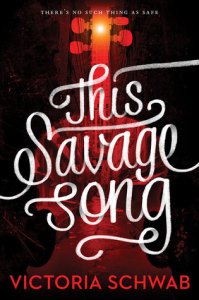
Book Description:There’s no such thing as safe in a city at war, a city overrun with monsters. In this dark urban fantasy from author Victoria Schwab, a young woman and a young man must choose whether to become heroes or villains—and friends or enemies—with the future of their home at stake. The first of two books.
Kate Harker and August Flynn are the heirs to a divided city—a city where the violence has begun to breed actual monsters. All Kate wants is to be as ruthless as her father, who lets the monsters roam free and makes the humans pay for his protection. All August wants is to be human, as good-hearted as his own father, to play a bigger role in protecting the innocent—but he’s one of the monsters. One who can steal a soul with a simple strain of music. When the chance arises to keep an eye on Kate, who’s just been kicked out of her sixth boarding school and returned home, August jumps at it. But Kate discovers August’s secret, and after a failed assassination attempt the pair must flee for their lives.
Review: After reading and loving Victoria Schwab’s “Darker Shade of Magic” series, I decided to go ahead and check out her young adult offerings. And while I still prefer her adult fantasy trilogy (though this was a very high bar so most books should be excused from not reaching the same highs, even those by the same author), I very much enjoyed this first book in what will be a completed duology once the final book comes out one week from now.
Schwab herself described this book as “Romeo and Juliet” but with monsters and without romance, and since my biggest problem with “Romeo and Juliet” wanna-be stories is the often trite romantic flounderings of the protagonists, I was excited to see how she would pull this off. I mean, what even is a “Romeo and Juliet” story without romantic nonsense? Turns out its pretty much a gang war in a city that has been taken over by demons of its own creation.
The world building was strong, right out of the gate, from the equally hellish northside and southside of the city and their various approaches to life in a now monster-filled world, to the monsters themselves. Born from human acts of hatred and violence, the city is plagued by three types of beasts. The Corsai, a viscous shadow-like creature that lurks in the dark places of the world only to emerge at night and shred its victims. The Malchai who resemble skeleton-thin humans and drink blood, similar to vampires in all but their ability to walk during the day. And the Sunnai, most rare and least understood of the monsters who can steal a soul with their song. Years ago, with the sudden appearance of these monsters, the city’s population sank into warfare only creating a tenuous peace after a massive disaster took out several city blocks. Since then, the city has been split, north and south, with one side fighting against the monsters and enforcing a strict rule of law for those committing crimes (and creating more monsters in the process), and the other ruled by a gang lord who has managed to rope the monsters into some semblance of control and requires his citizens pay for protection. These are the two sides from which our main characters come. Kate, the daughter of said gang lord, eager to prove herself stronger than the mother who attempted to flee the city so many years ago only to meet a tragic end. And August, a Sunnai, and adopted son of the fighters’ leader, who wishes he weren’t a monster and who struggles to find his role in this war.
Both Kate and August were intriguing, complicated characters. Each struggles with their own tenuous understanding of family, from Kate’s complicated relationship with a father who has distanced himself from her throughout her entire life, to August’s role, alongside his “brother” and “sister,” the only other two Sunnai, who all have been adopted by the leader of the resistance. Not only do the two not fully understand the war that they’ve inherited and the people who have already been fighting it, but each struggles with their own understanding of what is and what is not “monstrous” in this world.
August’s Sunnai abilities were particularly interesting, both the connection to his music and his own limitations. The Corsai and Malchai are fairly clearly described early in the book, while the Sunnai remain mysterious, even while having chapters featuring a Sunnai himself. This exploration of what it means to be a monster and what it means to be a Sunnai specifically was very compelling. All three Sunnai, August, his brother, and his sister, are all different in their abilities, their philosophy on the use of those abilities, and the arc they travel throughout the story.
Throughout all of this detailed world and character-building, Schwab manages to insert an action-packed plot full of danger and mystery. Every time that it felt like the plot was reaching a crescendo (ha!), she would wisely pull back for a quiet, character-driven moment. It was this delicate balance between action, adventure, and quite frankly, a lot of violence, with these these slow, beautiful, character introspections that really made this book stand out.
The only thing I will say as a negative was that while I loved Kate and August as characters in their own right, they didn’t jump off the page the same way that Lila and Kel did. There were a few scenes that read a bit flat, a few instances where I felt that Kate and August were slow to pick up the clues that were laid before them, and just a few missteps with dialogue that rang a bit forced. But, really, take all of these criticisms with a gigantic grain of salt. Again, see the overly high expectations that were set by the “Shades of Magic” series. For fans of young adult fantasy who are looking for a completely unique magical setting and two main characters who are blessedly free (so far) of romantic entanglements, definitely check out “This Savage Song.”
Rating 8: A great new YA fantasy, blessedly free of love triangles and any romance at all, really!
We are part of a group of librarian friends who have had an ongoing bookclub running for the last several years. Each “season” (we’re nerds) we pick a theme and each of us chooses a book within that theme for us all to read. Our current theme is a “Book Challenge!” theme. This book comes from a “Pick A One Word Title” challenge.
For this blog, we will post a joint review of each book we read for bookclub. We’ll also post the next book coming up in bookclub. So feel free to read along with us or use our book selections and questions in your own bookclub!
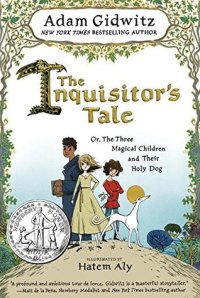
Book: “The Inquisitor’s Tale: Or, The Three Magical Children and Their Holy Dog” by Adam Gidwitz, Hatem Aly (Ill.)
Publishing Info: Dutton Books for Young Readers, September 2016
Where Did We Get This Book: The library!
Book Description:1242. On a dark night, travelers from across France cross paths at an inn and begin to tell stories of three children. Their adventures take them on a chase through France: they are taken captive by knights, sit alongside a king, and save the land from a farting dragon. On the run to escape prejudice and persecution and save precious and holy texts from being burned, their quest drives them forward to a final showdown at Mont Saint-Michel, where all will come to question if these children can perform the miracles of saints.
Join William, an oblate on a mission from his monastery; Jacob, a Jewish boy who has fled his burning village; and Jeanne, a peasant girl who hides her prophetic visions. They are accompanied by Jeanne’s loyal greyhound, Gwenforte . . . recently brought back from the dead. Told in multiple voices, in a style reminiscent of The Canterbury Tales, our narrator collects their stories and the saga of these three unlikely allies begins to come together.
Beloved bestselling author Adam Gidwitz makes his long awaited return with his first new world since his hilarious and critically acclaimed Grimm series. Featuring manuscript illuminations throughout by illustrator Hatem Aly and filled with Adam’s trademark style and humor, The Inquisitor’s Tale is bold storytelling that’s richly researched and adventure-packed.
Beautifully illustrated throughout! Includes a detailed historical note and bibliography.
Kate’s Thoughts
Guess who has never read “The Canterbury Tales”? Me! Guess who isn’t really into Medieval Fiction? Also me! And guess who knows little to nothing about religion and the philosophy of it beyond the most basic tenants of Judaism and United Church of Christ Christianity? This girl! So I feel like all of these factors combine (as well as some spates of bathroom humor, one of the few types of humor that doesn’t especially appeal to me) to make “The Inquisitor’s Tale” a book that isn’t written for me. So yes, while I understand the praise for this book and the appeal of it, and understand why it works so well as a children’s book and does so much more than other children’s books, I never really got into it myself.
That isn’t to say that there wasn’t anything I liked about it. I liked that it asked some pretty deep philosophical questions that you usually don’t see in children’s literature. I feel like Gidwitz doesn’t patronize to his audience, and that he knows that these are hard questions to wrap minds around regardless of what age you are. What makes a Saint? How can some people say that they hold certain values and beliefs, and not realize that they are perpetuating cruelty towards others, especially those that they claim to care about? What are ways that stories can be told and passed on, and how can these stories be changed based on the storyteller? I also liked that Gidwitz had three very different protagonists to show different walks of life and different experiences that would have been common during this time period. You have Jeanne, the peasant girl who can see parts of the future, who has to function in a society where women and peasants hold no value. You have William, a boy raised to be a monk who is both of African and Muslim descent, and stands out among those around him. And there’s Jacob, a Jewish boy in a France where King Louis persecutes the Jews as heretics. Seeing all these kids come together (along with Jeanne’s resurrected dog Gwenforte) and try to understand each other is a great message.
I also had a very hard time reading about the anti-Semitism in this book, be it villages being burnt to the ground, Jews being humiliated and threatened with violence, and Talmuds being burnt. I know that it was the reality of the time period, but for whatever reason I really struggled with it and had to set the book down a number of times and calm down before I could continue reading. I appreciate that Gidwitz was being honest about this time period, of course, and I really liked the extensive historical notes that he put in the back of the book, and yet I wasn’t really on board for the ‘Louis was a complex person who thought he was doing what was right, no matter how wrong it was’ stuff. Because at the end of the day, no matter how noble Louis thought he was being, it WAS wrong. And I have less and less time for those kinds of explanations these days.
My personal issues with this book shouldn’t necessarily reflect this book. It just wasn’t for me, but I definitely see how it would be an appealing read for other people.
Serena’s Thoughts
From the other side of the spectrum, I have read “The Canterbury Tales!” I am into Medieval fiction (at least as far as the fact that much fantasy is set in some type of medieval-like world)! And I was raised Lutheran, so at least the Christian theological philosophy was fairly familiar to me! So I think Kate is right, there are some factors going in that if you have as a reader you’re perhaps more likely to immediately engage with the book. However, massive caveat in this whole theory is that this is a middle school children’s book and let’s be real, how many kids have read “Canterbury Tales” or have a strong understanding of religious philosophy??
So, while I did enjoy the story more than Kate did, I do have to agree with her on a few of the downsides of the book. Most notably the potty humor and, for me, the suspension of disbelief in a few parts.
But first the pros! Since by an large I did very much enjoy this book. I won’t repeat what Kate said about the great diversity of the cast, except for one extra note. I really appreciated the close up look at exclusion/inclusion that the narrator took with these three children. Yes, they are all in this together. And yes, they are all friends. But at various points throughout the book, even with the friendships that have formed from their shared experiences, they each have to confront the sense of “otherness” that comes from their own unique walk of life. For William, he’s a black boy with two white children. For Jeanne, she’s a girl with two boys. For Jacob, he’s a Jewish boy with two Christian children. I loved the various triangles that were made up and the constant shift that was in play from situation to situation with each of their “ins” or “outs” becoming a strength or something that made them stand out as different. I felt that this was a really important message for a book like this: privilege comes in all shapes and forms and at any given moment any single person can be on the in or the out, so we must all be aware and kind.
I’ll also throw in a few good words for the illustrations! I loved the metacommentary of the way the book was illustrated, mimicking the images that monks would draw into the margins of their transcribing work. Some would align with the action of the story while others were intentionally obtuse (a fact that is noted in the beginning of the story, that the illustrator would draw what came to him, with some images existing without connection to the story or explanation).
The ties to “The Canterbury Tales” were also fun, with the story being told by various narrators. I loved the way this element of the book came to life towards the last third, drawing these outside forces into the story itself. There were a few very clever twists with this that I don’t want to spoil! That said, as I mentioned above, I doubt any kid reading this will have read “The Canterbury Tales” and I don’t think there is anything missing for it. It’s more just a fun plug for those English nerds out there who have plowed through that thing and all of its incomprehensible Old English.
But I also agree with a few of the down points that Kate mentioned, notably the potty humor. This is purely a personal preference thing, as I know many kids (and adults!) love this type of humor. But there was one side plot that really lost me as it focused almost entirely on these types of jokes. Secondly, there were a few points in the story where my suspension of disbelief was called into question. We’re dealing with magical children, so for the most part I was ready to just go with this. But there were a few scenes, notably a fight scene where William beats up a bunch of bandits with a donkey leg, that pushed me out of the story a bit wondering how much of the “real world” this story was supposed to be set in.
Those issues aside, I really enjoyed this book. It is a tough read in parts like Kate mentioned. Serious issues are tackled and the persecution and tragedy of the time period weren’t glossed over. I appreciated this fact, but it does make for some sad happenings. But ultimately I would recommend this book to middle schoolers and adults. It’s one of those rare children’s books that can equally appeal to adults.
Serena’s Rating 8: A strong middle school story set in a unique time period with a lot to say about history, religion, and inclusiveness.
Kate’s Rating 6: I see the value and I understand the praise, but I had a harder time with this book than I would have liked.
Book Club Questions
This book is told from multiple perspectives when a group of people gather in a pub to recall the story of the three kids. Did you have a favorite perspective voice?
The illustrations in this book are similar to that of illuminated texts that are seen throughout history in religious works. Have you ever encountered this kind of illustration before? What did you think of the illustrations?
King Louis IX was an actual person in history, as was his mother Blanche, as were other people mentioned in this book. What did you think of using real people in this fictional story?
Each of the main characters comes from a different walk of life, has their own set of challenges to overcome, and their own magical powers. Did one of these characters stand out more to you? Why?
This story tackles a lot of big questions about religion and diversity. Did any of these points stand out to you as particularly strong? Could any have been improved upon or weren’t fully realized?
Book Description:Alyssa ana’Raisa is the reluctant princess heir to the Gray Wolf throne of Fells, a queendom embroiled in a seemingly endless war. Hardened by too many losses, Lyss is more comfortable striking with a sword than maneuvering at court. After a brush with death, she goes on the offensive, meaning to end the war that has raged her whole life. If her gamble doesn’t pay off, she could lose her queendom before she even ascends to the throne.
Across enemy lines in Arden, young rising star Captain Halston Matelon has been fighting for his king since he was a lýtling. Lately, though, he finds himself sent on ever more dangerous assignments. Between the terrifying rumors of witches and wolfish warriors to the north and his cruel king at home, Hal is caught in an impossible game of life and death.
Review: I told Kate that I was struggling with how to start off this review because I have noticed a trend in my own reviews: nit-picky focusing on covers! I mean, the fact that I devoted time to griping about this cover in the limited word count available for our little features in “Highlights” posts…and then STILL want to rant about it more here? But I will resist, so please refer to our “April Highlights” post for my thoughts on this travesty.
“Shadowcaster” is the second book in Cinda Williams Chima’s “Shattered Realms” series that takes place a generation later in her “Grey Wolf Throne” world. I struggled with the first one, feeling that the characters were less interesting than the original cast and that the romance was a bad example of insta-love. So going into this, I wasn’t sure what to expect. Which, as it turns out, was the appropriate approach as, in many ways, this is almost a second beginning to the series. We’re introduced to a whole new cast of characters and a timeline that is largely running alongside the events of the first book. There were still aspects of the series that I am struggling with, but I did find myself enjoying this book more than the first (a bit of a trend, I’ve found with this author, as I had the same experience with her first series in this world.)
This time around, our two main characters (though there are several others with POV chapters, including a few from Jenna, a character from the first book) are Lyss, the reluctant heir to the Grey Wolf Throne, and an Ardenian captain, Halston, who after being capture by the enemy begins to learn more about the other side of this war and story.
First off, I think the main reason I enjoyed this book more than the first was the fact that I enjoyed both of these main characters more. Lyss especially was very fleshed out and well drawn. Her struggles with identity and with her relationship with the queen, her mother, are thoroughly explored throughout the course of the story. After her sister’s death, a sister who Lyss and the entire country revered as the ideal princess heir, Lyss finds herself in the impossible role of needing to fill those shoes. Further, her own talents for warfare and military strategy, combined with her physical fighting prowess, call her to a role of action. Throughout the years, she has gained respect and acumen for her success in the war against Arden, but whenever she returns home, the duties of ruling chafe, especially given her penchant for frank and perhaps less diplomatic language and ideas. All of this, plus the shared loss of all their family (or so Lyss believes, not knowing as we do that her brother lives) creates an ongoing tension point in her relationship with Raisa, the queen. Lyss was a brilliant character, and her journey throughout the book neatly tied the plot’s action to Lyss’s own growth and challenges.
Halston received less page time, but he too was a compelling character. Throughout the story, Halston’s story makes it clear how difficult life in Arden is. Politics is tangled around every aspect of life, with the fear of angering the cruel king tinging every decisions. After being captured by Lyss and her troops, Halston begins to see the falsehoods that have been spread by the King about the war and the northern country with whom they fight. However, loyalty and a fierce desire to protect his family must drive his every decision.
One of my primary concerns with the first book was the insta-love relationship that seemingly evolved out of nowhere. With that in mind, I was extremely pleased to see the more developed and extended relationship that was drawn between Lyss and Halston. Both characters are given the proper amount of time and shared experiences to make a budding relationship between the two enemies believable. I was much more invested in this relationship than I ever was with Jenna/Ash.
While Ash was referenced in this book, only Jenna had page time out of the original characters. Ultimately, while I did like elements of her chapters, especially now that we have her dragon pal to appreciate, I did question these inclusions. Her story line felt largely separate from the rest of the action and her reference to Ash only reminded me how much I disliked that relationship from the first book. There were a few plot points that were introduced and helpful to driving the larger story line crossing between books, but these chapters were so few and so disconnected from our main characters and plot that I question there inclusion.
Adding to all of these POVS is another, fourth perspective from a young man who has a mysterious gem or mage mark on the back of neck similar to Jenna’s. His role is more important to the driving factors in this story, and as a character I found his story and history interesting.
However, all of this highlights my biggest concern with this book and now the series as a whole. There are so many characters! The first book had around 4 POVs if I remember correctly, and this one introduced another 3. It was obvious in the first book that certain narrators were stronger than others, and the rushed elements of the book (the romance, specifically) I directly attributed to the choice to include so many. There is simply not enough page time in an already lengthy book to fully develop this many characters and their relationships with each other. So, here, we are given even more characters. And while I liked the main characters in this story more than I did those in the first, this just presents me with more concerns. Even in this book I found myself skimming through characters’ chapters (specifically Jenna’s) to get back to Hal and Lyss. What’s going to happen going forward when they all need to share page time together? I don’t want to lose the awesomeness of Lyss, for the less interesting Ash. Or, even worse, focus on the shallow Jenna/Ash relationship at the expense of Lyss/Hal.
While I enjoyed this book more than first, largely due to the strength of its main characters, I came out of the reading experience even more worried about the direction of the series as a whole than I did in the first. After that book, I had hoped that my concerns would be addressed by spending more time with Jenna/Ash so that I could get more on board with these characters and see their relationship flesh itself out further from its unfortunately rapid beginning. But now not only is that not the case, but I’ve been given character alternatives whom I enjoy even more and who are ultimately will have to give up their page time and stories to these originals. Not only do I not know how all of these characters will be given their due in a limited number of pages left in the series, but I now have a strong bias for/against a few of them. But I guess I’ll just have to wait and see, fingers crossed.
Rating 7: A stronger book than the first, but one that raises questions for the series as a whole.
Reader’s Advisory:
“Shadowcaster” is a newer title and isn’t included on any relevant Goodreads list, but it should be on “Music in Fantasy Fiction.”
Where Did I Get this Book: audiobook from the library!
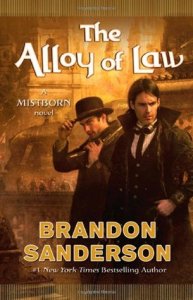
Book Description:Centuries after the Mistborn trilogy, Scadrial is on the verge of modernity – railroads, electric street lights, and skyscrapers. Waxillium Ladrian can Push on metals with his Allomancy and use Feruchemy to become lighter or heavier at will. After 20 years in the dusty Roughs, in the city of Elendel, the new head of a noble house may need to keep his guns.
Review: I have resisted reading this book for a while based completely on my utter love of the first Mistborn trilogy and the continuing and endless sadness that came about in the wake of leaving that cast of characters behind. However, Sanderson is one of my all time favorite authors and while I impatiently wait for the next book in his current epic fantasy series, I decided that it was about time to check out “The Alloy of Law.”
First off, while this book is technically the beginning of a new a trilogy and can be read without first reading the original “Mistborn” series, I would strongly recommend doing that first anyways. Sanderson does a good job of re-describing his world and the elements of his magic system, especially with regards to how these abilities are changed in this new industrial era, but there’s still a lot of strings that need to be picked up from the first book. As I said, I read and loved the original trilogy, but it has been years since I finished it, so in many ways I was coming into this book with similarly new eyes as a first time reader. I had just enough knowledge to know what I was missing, essentially. There are references to the original cast scattered here and there (particularly their influence on the various religions that have formed in the last three centuries), and the complicated magic system gets a brief re-fresh, but the fully detailed accounting of the ins and outs of all the various abilities are not presented again. As I said, the book is technically approachable as is, but I feel that new readers are missing out on quite a bit if they don’t read the first trilogy before diving into this one.
Sanderson is best known for his brilliant magic systems and once again he does not disappoint. Many elements that show up here are carry-overs from the original, but as even the name of the book itself implies, over the years these abilities have merged and changed with the creation of metallic alloys. Essentially, allomancers are those born with the ability to swallow and “burn” flecks of different metals, each metal granting them a distinct ability. Our two main characters, Wax and Wane each have a combination of these abilities. Wax has one of the most common gifts, the ability to push against metals, as well as the ability to increase/decrease his own weight. With Wane, Sanderson introduces one of the new allomantic powers, the ability to create time bubbles; he is also able to store/use health, allowing him to heal wounds with stored health from self-enforced sicknesses. These abilities were all incredibly well thought out and utilized throughout the story. In particular, I loved the exploration of how allomancy has changed in a new industrial era that now has things like railroad lines, guns, and many other metal creations that would affect how allomancers can use their powers.
The western setting was also a nice change from the original trilogy which adhered to a more typical fantasy setting. Government, business, society as a whole, has all moved forwards from the cataclysmic events of the first books. I’ve particularly enjoyed this recent trend of western/fantasy crossovers, but I understand how the appeal might be strange for fans looking for more traditional fantasy. And, while the western elements were engaging, it was also clear that Sanderson’s strengths lie with the fantasy portions. There were a few bits that felt too on the nose or too closely mirrored classic western storytelling for me. I applaud the effort, but wish he had been a bit more gutsy with the setting and western style as a whole.
Characters wise, this book is solid. Fans of Sanderson will be familiar with the character type that Wax represents: strong, lawful good, a conflicted hero who must choose to join the fight once again. I like this character type however, so while Wax felt familiar in many ways, I still very much enjoyed reading his story. Wane was a great counter balance to Wax, less serious and bringing the more raucous joy to the book. The main female character, Marasi, sadly, felt less fleshed out than I have come to expect from the author who brought us the awesome Vin. There was all together too much blushing on her part, and while she was crucial to the success of the group’s plan, she was also a damsel in distress a few too many times. The other two main female characters had potential, but had so little page time that they each felt rather one dimensional in their own way. Lastly, for characters, I will say that I very much enjoyed the villain of this story. In many ways, the villain’s perspective was relatable and sympathetic, something that always makes for a stronger nemesis, and his abilities were sufficiently intimidating for readers to respect the challenge he posed for our heroes.
I very much enjoyed “The Alloy of Law.” My biggest concerns (the less developed world-building with the western setting and simpler female characters) can all be laid at the foot of the book’s shorter page length. I’m used to Sanderson’s fantasy tomes and all the goodies that come with spending hundreds and hundreds of pages on one story. However, even with the condensed page length, this book was a solid start to a new trilogy in the “Mistborn” world, and I am excited to see where the story goes from here!
Rating 8: Only suffering for not being longer and letting loose the full power of the author’s creativity and characterization!
Book Description:The year is 1850 and Great Britain is flourishing, thanks to the Royal Society of the Esoteric Arts. When a new mage is discovered, Royal Society elites descend like buzzards to snatch up a new apprentice. Talented mages are bought from their families at a tremendous price, while weak mages are snapped up for a pittance. For a lower middle class family like the Gunns, the loss of a son can be disastrous, so when seemingly magical incidents begin cropping up at home, they fear for their Ben’s life and their own livelihoods.
But Benjamin Gunn isn’t a talented mage. His sister Charlotte is, and to prevent her brother from being imprisoned for false reporting she combines her powers with his to make him seem a better prospect.
When she discovers a nefarious plot by the sinister Doctor Ledbetter, Charlotte must use all her cunning and guile to protect her family, her secret and her city.
Review: I’m trying to increase my short story/novella reading, and so I was excited when I heard about this new steampunk, fantasy novella put out by Emma Newman. And while I feel like the novella aspect of the book may have weakened aspects of the story, overall, I was very pleased with this story which is the beginning of what looks to be an ongoing series.
Charlotte is in hiding. Not only is she a successful illustrator who must publish under a false name to hide her gender which might cripple her chances at success in a male-dominated profession, but she’s also a talented mage. And to be a mage is to give up one’s life to God and Country, be removed from one’s family (though the family is compensated based on the potential ability of their soon-to-be-lost family member), and be trained into serving in the elite Royal Society of the Esoteric Arts. Charlotte has no interest in losing her family, her burgeoning profession, or, worst of all, her fiance. Mages aren’t allowed to marry, and as Charlotte is already engaged to a perfectly pleasing man, so being discovered for the Latent that she is would be catastrophic. Instead, when her family hits hard times, her father recognizes the signs of a magic in his house, but falsely attributes it to his son, and brings in the society mages to test him for abilities. Charlotte must help her brother trick them into accepting him into their group, all while solving a dark mystery into which Charlotte’s father’s debts have dragged them all.
I very much enjoyed the originality of this world. The mages’ society is both something to be esteemed and feared, and this balance is struck again and again throughout the novel. Families can greatly profit from sending a family member to be trained, but they also lose their loved ones in the process, and that loved one gives up the chance to lead a normal life. In one of the opening scenes, Charlotte and her brother witness a young boy being dragged away from his mother once he’s been discovered as a Latent mage. The horror and the tragedy of this early scene is an important reminder as the story progresses and the true danger that her family faces at the hands of her father’s debt collectors becomes clear. It would be easy to question why Charlotte doesn’t simply bring herself forth. In many other fantasy series, having great powers is always shown as a purely good thing. But the sacrifices that come with this life are made clear throughout the entire story. Not only does one give up one’s planned life, but the mages society itself is not without its own dangers and dramas.
Charlotte was a very good lead character. Through her eyes, we can see the fears that have driven her throughout her entire life. Not only does she need to hide her magic, but her own success as an illustrator, a profession that she shares, nay exceeds at, with her own father. He, of course, is unaware of this commonality and the fact that Charlotte has spent much of her own money supporting her brother, in particular. Also, right away, her relationship with her fiance is set up as a challenge. Charlotte has not been honest with him either about these aspects of her life. In truth, her closest relationship is with her sickly brother, the only one to fully know her.
One of the bigger challenges for me in this story was the introduction and use of the mage who aides her in investigating the debt collectors. He is presented as a very attractive man whom Charlotte is drawn to right off the bat. However, throughout the story he routinely misleads her, sends her into dangerous situations without giving her complete knowledge, and out-and-out manipulates her. This behavior is explained, but, for me, he never quite recovers as a heroic character. While Charlotte and her fiance are clearly not well-suited (talk about a wet blanket relationship), I wasn’t as able to forgive the flaws of this new love interest as easily as Charlotte seemed to. The end of the book sets them up to work together in the future, with only the barest hints of romance alluded to (she’s still engaged, mind you), so I’ll be curious to see what comes of this going forward.
My only other struggle was with the pacing and the writing in spots. Charlotte had a few revelations that felt out of the blue and un-earned, and the pacing was jarring in the middle when the plot had to gallop along to cover all the multitude of plot points that were jammed into such a short story. I feel that the story could have benefited from an extra 25-50 pages to fully flesh out the deeper emotional beats and ensure that the plot ran more smoothly.
The world building was strong, however, and Charlotte was a fun main character, so I’m definitely on board to see what troubles she finds herself in in the future! And to see what becomes of her brother, Ben, another character I very much enjoyed who is now trapped in a magical society that thinks he is more than he actually is.
Rating 7: A great start to a new series, if only rubbing up a bit against the restraints of a shortened page length.
Book Description:Beauty knows the Beast’s forest in her bones—and in her blood. Though she grew up with the city’s highest aristocrats, far from her father’s old lodge, she knows that the forest holds secrets and that her father is the only hunter who’s ever come close to discovering them.
So when her father loses his fortune and moves Yeva and her sisters back to the outskirts of town, Yeva is secretly relieved. Out in the wilderness, there’s no pressure to make idle chatter with vapid baronessas…or to submit to marrying a wealthy gentleman. But Yeva’s father’s misfortune may have cost him his mind, and when he goes missing in the woods, Yeva sets her sights on one prey: the creature he’d been obsessively tracking just before his disappearance.
Deaf to her sisters’ protests, Yeva hunts this strange Beast back into his own territory—a cursed valley, a ruined castle, and a world of creatures that Yeva’s only heard about in fairy tales. A world that can bring her ruin or salvation. Who will survive: the Beauty, or the Beast?
Review: Just in time to cash in on my “Beauty and the Beast” phase that has been reignited by the recent movie release (though, let’s be real, I’m almost always interested in “Beauty and the Beast” stories) comes this new release by Meagan Spooner with a re-imaging of the classic fairytale. And, what a relief, it is actually a true re-imagining! And a very enjoyable one at that!
Similar to my love of Jane Austen re-tellings, I’m always on the look out for a good fairytale re-imagining, and my favorite is “Beauty and the Beast.” And, just like the Jane Austen wanna-bes, many of them fall sadly short, so I’m always slightly nervous going in. Will this one be yet another let down? Or…?
In Spooner’s version, Beauty, or Yeva, and her two older sisters are the daughters of a wealthy merchant father. But this time, her father’s rise to fortune came upon the back of his skill as an archer and hunter in the mysterious forest that surrounds the city. From him, Yeva has also learned to tread the forest pathways, bow in hand, and developed a deep love for the woods and its denizens, both the ordinary and the fabled. After the family’s inevitable fall from fortune and her father’s subsequent disappearance on a hunting trip, Yeva sets out to find him only to become entangled in the plot of a Beast who is on the lookout for a skilled hunter to free him from a curse.
What I most loved about this book was the blending of familiar aspects from the classic tale (the main plot points are all there) alongside the truly unique new take on the story as a whole. And these new aspects weren’t only superficial changes. The entire curse is changed in a way that effects the action of the story, the characterization of its main characters, and the gradual build in the relationship between Yeva and the Beast.
First, for the familiar aspects. I was overjoyed to see one of the only other examples I can think of of a “Beauty and the Beast” story where the sisters were as well-handled as they were in my all-time favorite version, Robin McKinley’s “Beauty.” In particular, Asenka, the middle daughter who was born with a clubbed foot, is incredibly well-rounded and made to be a character in her own right. The relationship between all the sisters is lovely, shown and not told through small moments, like their ritual of break-making each night, and the larger interactions that come from the traumatic events that befall the family throughout the story. We all know that I am a sucker for sister stories, and this one was completely satisfying in every way.
And, as I said, the main bullet points of the fairytale are all there in this book. The family’s fall from fortune, Beauty’s time with the Beast, her return to her family, and her choice to go back to the Beast and save him from the curse. But, as I said, all of these traditional plot points were handled in completely unique ways. Beauty’s motivation for staying with the Beast is different. His motivations for wanting her there are different (we get small insights into his thoughts between chapters). Their relationship develops along different lines than those we expect (hunting trips in the woods rather than elaborate, enchanted dinners in a castle.) And the curse itself is set up in a completely new way.
I loved how naturally all of these elements came together, new and traditional. Yeva’s love of hunting isn’t simply thrown in as an aside that makes here character “strong” but is actually integral to the story. The relationship between the two builds slowly and naturally, never easily side-stepping the challenging aspects of the situation they find themselves in. There is no quick forgiveness or trust, but instead, a natural transformation. I also particularly liked what Spooner did with the Gaston-like character, Solomir. He was another excellent example of fleshing out a character who can often come across as just another stock character.
Lastly, Spooner added a level of depth to Yeva’s internal struggle throughout the book. Yes, circumstances force her into situations that she wouldn’t have chosen for herself, but from the very beginning her desire for something more is made clear. I appreciated how deeply the author delved into this sense of wanting and dissatisfaction, and how neatly these aspects of Yeva’s character were tied to the story and curse as a whole. Again, it wasn’t an aside to make Yeva more well-rounded, but an important aspect of the story itself. My only complaint would be that I feel Spooner may have missed an opportunity to push this theme further in the end of the book. It seemed like she walked right up to the edge of making a more powerful statement about this, but then side-stepped it a bit. She still made her point clearly and tied it together well, but I personally feel like it could have been taken a bit further, even.
All in all, I very much enjoyed this book. It is always so exciting to see an excellent fairytale retelling, especially of “Beauty and the Beast” which I think is probably one of the more challenging tales to do well. I strongly recommend this book to fans of the original story and of fairytale retellings in general!
Rating9: An excellent story, perfectly blending the familiar elements of the fairytale and unique characters and plots!
Where Did I Get this Book: audiobook from the library!
Book Description:Unbeknownst to most of Alden, King Erik, in thrall to a cruel bloodbinder, is locked away in his own palace, plotting revenge. To save her king, Lady Alix must journey behind enemy lines to destroy the bloodbinder. But her quest will demand sacrifices that may be more than she can bear.
Meanwhile, as the Warlord of Oridia tightens his grip on Alden, the men Alix loves face equally deadly tasks: her husband, Liam, must run a country at war while her brother, Rig, fights a losing battle on the front lines. If any one of them fails, Alden could be lost—and, even if they succeed, their efforts may be too late to save everyone Alix holds dear…
Review: The final book in the “Bloodbound” trilogy starts out with our heroes in what appears to be an unwinnable situation. King Erik is being controlled by a bloodbinder making him erratic and prone to paranoia (the extreme kind that leads to executions of close friends and family for “treason”). Rig’s battle at the front line has pretty much reached its limit with invasion imminent. Alix must venture deep into enemy territory to attempt to kill the bloodbinder who is controlling the King. And Liam is left to manage a country that is on the brink of destruction, all while hiding the fact that he has the King locked up in a room in the castle. A fact that would surely lead to his immediate death if it were to be discovered. The stakes are high.
At this point, it’s almost hard to remember that this series started out more as a romantic romp with some military/fantasy aspects thrown in than anything else. Sure, there was a large battle at the end and some political maneuvering here and there. But there were a lot of quieter moments where Alix’s personal life was the primary focus. Then the second book came along and everything changed. That entire book was just one massive failure after another for our heroes. And here, in the third, everything just seems kind of hopeless. All of the odds are stacked against them, and even their best case scenarios look grim. I mean, sure, if Alix saves the King, great! But they still have to deal with the fact that they have no allies (having blown their ambassadorial trips in the second book) and an enemy with an army that doubles their own.
I was happy to see that Alix once again played a major part in this story. While I still very much enjoyed the second book, her reduced presence was my biggest complaint. Instead, understandably, given his brain-washed state, Erik takes a back seat to the other characters here. I also liked the fact that Alix’s story line once again took us into the neighboring realms, this time their occupied neighbor whose resistance fighters had helped Rig win significant battles in the second book. Vel, also, played a more important role in this book, joining up with Alix on her quest to find the bloodbinder. I still struggled to like Vel as a character, though she had some good moments in this book. While it made sense to pair up these two women both for the plot and due to the dynamics that come from their relationships with Rig, I think that it also had the unintended result of negatively contrasting Vel to Alix. But this is a pretty subjective viewpoint of my own, more than anything.
Due to the high stakes nature of most of the action in this book, the story definitely kept me on the edge of my seat. There were parts of it where I seriously struggled with the fact that because I was listening to an audiobook and wasn’t able to skim forward and relieve any of the tension. The author did a great job balancing her parallel viewpoints and story lines in a way that just ratcheted up the stress levels on all fronts. And, while the series as a whole is obviously set up to be a generally “feel good” read, the grim realities of war are never glossed over and there were a few tough moments. Alix, in particularly, had a rough road to travel.
And, importantly, the personal relationships between our main characters were not shunted to the side even in the midst of all of this narrative upheaval. Alix and Liam’s marriage is still new and being tested by their own insecurities. Liam and Erik are still learning what it means to be brothers, especially given the effects of Erik’s brainwashing and his lingering pain due to the death of his other brother in the first book. Rig and Vel…yeah, I cared less about this. But it was fine, too.
Ultimately, this series was a very satisfying and consistent read. All three books were strong and the characters and plotlines built steadily over the course of the series with very few stumbling blocks. I would recommend this series for fans of political/military fiction with a strong female lead more than for fantasy lovers. While the fantasy element is important to the story, it is definitely less of a focal point than the rest. This is a lesser known series, but one that I hope begins to get the recognition it deserves!
Rating 8: A solid ending to the trilogy!
Reader’s Advisory:
“The Bloodsworn” is a newer book and isn’t on many Goodreads lists, but it should be on “Military Fantasy.”
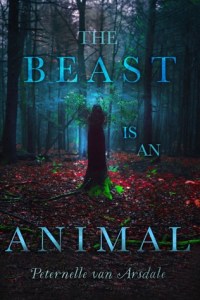
Book: “The Beast is an Animal” by Peternelle van Arsdale
Publishing Info: Margaret K. McElderry Books, February 2017
Where Did I Get this Book: the library!
Book Description:A girl with a secret talent must save her village from the encroaching darkness in this haunting and deeply satisfying tale.
Alys was seven when the soul eaters came to her village.
These soul eaters, twin sisters who were abandoned by their father and slowly morphed into something not quite human, devour human souls. Alys, and all the other children, were spared—and they were sent to live in a neighboring village. There the devout people created a strict world where good and evil are as fundamental as the nursery rhymes children sing. Fear of the soul eaters—and of the Beast they believe guides them—rule village life. But the Beast is not what they think it is. And neither is Alys.
Inside, Alys feels connected to the soul eaters, and maybe even to the Beast itself. As she grows from a child to a teenager, she longs for the freedom of the forest. And she has a gift she can tell no one, for fear they will call her a witch. When disaster strikes, Alys finds herself on a journey to heal herself and her world. A journey that will take her through the darkest parts of the forest, where danger threatens her from the outside—and from within her own heart and soul.
Review: I am going to start this review by talking about the cover, because it is rare that I see a cover that so perfectly sets up the atmosphere of the book. Dark, yet beautiful. Indistinct, yet you feel drawn in, almost against your will. The tall dark trees, shadows, and bright red flowers all spark instinctive warning symbols in your head and that looming shape in the middle….is it a person? A creature? Or simply a strangely shaped tree stump? Whoever came up with this art design in the publishing house should be awarded major points for exactly matching book art to its source. Like this cover, “The Beast is an Animal” was beautiful, and terrifying, and I couldn’t look away.
At its core, this is a book about fear and about the horrors that a simple emotion can inflict on an individual, a family, and an entire community. Neighbors, always on the look out for witches to blame for poor weather, poor crops, posed almost a greater danger than the dark, looming forest around which many small communities exist. It is into this world that Angelina and Benedicta are born, twin sisters whose looks, down to unique birthmarks, exactly mirror the other. After a poor farming season, they, and their mother, are blamed and banished to live in the woods, and a husband/father who should have been their protector slinks away to begin his life again with a new, fresh-faced woman. Their mother doesn’t flourish. Angelina and Benedicta do, slowly being eaten away with bitterness and anger at the fear that lead to their banishment. And thus, two monsters are born.
After all of this set up, we meet Alys, our main character who throughout the book also struggles with the fear of “otherness” that floats around her. After her whole town is destroyed by the souleaters, excepting all of the children under 15, she and her fellow orphans go to live in a new town. While they do take the children in, this new community is even more stifled, building walls around their small town and forcing the children to guard it every night, all night.
We watch this story unfold over three periods of Alys’s life. First, when she is 7 and her town falls to the souleaters. Second, when she is 12 and begins to suspect that she has more in common with the souleaters and the mysterious Beast that haunts the woods. And finally, at age 15 when she must confront both the truth about herself, and the darkness that is growing in the heart of the woods.
What I loved about this book was how it plays with the topic of fear and bad/good. Are Angelina/Benedicta evil? Or were the “normal folk” who banished them? Where does the Beast fall on this spectrum? What about the community that takes in the children? While the supernatural elements were scary in their own right, it was the oppressive fear of the people themselves that made the book truly creepy. Alys, and the medicine woman who adopts her in the new town, are constantly on the look out for any hint that they are beginning to fall under suspicion for being different. The devices and tortures used against these supposed “witches” were more terrifying than the supernatural souleaters if only because we know from history that these things existed.
As I said in the beginning, what makes this story truly compelling is the atmospheric tone of the writing. It feels like a new fairytale, containing not only the darker elements that are typical to original fairytales, but also reads with a lyrical flow, combining beautiful imagery with poignant insights into the deep tragedy at the heart of the story.
Alys is a strong protagonist around which to center this story. However, Mother, the woman who adopts Alys in the new community, was the breakout character for me. She doesn’t have a lot of page time, but she provides a window into a world, and life, that Alys is trying to avoid. Mother is a midwife whose skills are depended on, but who must also constantly hide what she is doing and how she is doing it for fear that she would be labeled a witch. Her own personal tragedies, as well, must be similarly hidden. When Alys first meets her, she dislikes her, noting that she is cold and unemotional. But as the story goes on, we see that this is a coping mechanism and self-preservation tactic from a woman who has devoted herself to aiding a community of people who would as soon see her burned at the slightest sign of strangeness.
Like I said, the supernatural elements were very creepy (much more than I expected and in some ways this might have been a more “Kate book” than mine), but the descriptions of life in these walled up and fearful communities was almost unbearable to read. I was just so angry at these people! And it is this aspect that really marks this book as a success. The reader falls into the same trap as Angelina/Benedicta, and even Alys, thus making these characters all the more sympathetic, for all of their evil deeds. Fear leads to anger. And anger leads to…
I can’t say enough good things about this book! If you enjoy original fairytales and can handle a healthy dose of creepiness, this book is definitely worth checking out!
Rating 9: A beautiful, standalone dark fantasy novel. I absolutely loved it!
Occasionally we are approached with the opportunity to promote books that may be of interest to our readers. And occasionally in lieu of a full review of the book, we will let it speak for itself by posting an excerpt from it. So if you like what you see in one of these excerpts, we have good news! You have the chance to win a copy of it! What could be better?
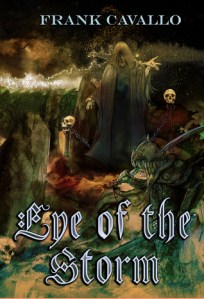
Book: “Eye of the Storm” by Frank Cavallo
Publishing Info: Dark Serpent/Ravenswood Publishing, August 2016
Book Description: On a research mission in one of the most remote regions of the world, former Navy SEAL Eric Slade and Dr. Anna Fayne are caught in a mysterious storm. Catapulted through a rift in space-time, they are marooned on a lost world.
Struggling to survive and desperate to find a way home, they must confront the dangers of this savage land—a dark wizard and his army of undead—a warrior queen and her horde of fierce Neanderthals that stands against him—and a legendary treasure with the power to open the gateway between worlds, or to destroy them all: the Eye of the Storm.
My Notes:
I received a paperback copy of this book in exchange for this promotional post. I want to thank Kelsey B., who sent it to me and gave our blog this opportunity.
This book is perfect for fans of Sword & Sorcery fantasy novels, with its action packed sequences and the always enjoyable use of stranding modern people in strange new worlds. My nostalgia bells were going off constantly with this book (specifically for things like “The Land that Time Forgot”), and who can resist a healthy dose of nostalgia? Red City Review gave the book 4 stars saying “Cavallo spins a fast-paced tale in his latest read…with a unique cast and setting…a flurry of twists and turns…quite a page turner, Eye of the Storm is bound to be a favorite among fantasy enthusiasts.”
This is by no means Frank Cavallo’s first book on the scene, coming in with several fantasy novels already under his belt, and another that was just released this last January, “Rites of Azathoth,” which sounds like X-Files (Scully’s character at least, as a female FBI agent is the hero of the story) meets Stephen King. For more information on the author, you can find him on Facebook, Twitter, and Goodreads, as well on his website http://www.frankcavallo.com/.
Enter the giveaway below to try and win yourself a free copy of “Eye of the Storm” and read the excerpt below! – Serena
The halls were dusty and cold as they headed into the heart of the citadel, climbing towards the Keep by Azreth’s vague directions. Spider-webs hung like curtains along the walls. Every corridor and passage was choked with the detritus of war. A hiss seethed from somewhere in the shadows.
At the crest of a winding staircase, they found a gallery-like corridor that opened under a vaulted ceiling. Despite having stalked the ruins for hours, their torches were no lower, and they cast a reddish light upon the whole of the grand hall. The walls were plastered from floor to ceiling, in brilliant shades of violet, green and gold. Unfamiliar characters were set in relief across both sides.
They continued on, hoping to glean some direction from the strange decorations. With a few of the glyphs there were images of figures. Men and beasts, elegant in detail but difficult to see in the torch-light, cavorting as if frozen in time. Some frolicked in festival, while others looked to be at war, painted blood dripping from their swords.
Each wall had several such murals, of men and women in long white robes and gold sashes. The designs were intricate and beautiful and savage.
At the far end of the hall, looming over the entrance of an inner hold, a stone carving larger than a man’s height peered down at them. It was no human face. The features of the carving were a caricature of humanity, still as sharp as from the sculptor’s hand; like everything else uncannily preserved from the ravages of time.
Horns like a bull’s grew from the temples. Jowls like a hound’s hung open, with rows of teeth flanked by twin fangs.
“We’re getting close,” Azreth said. “I remember this. The bust of Wrael. This is the passage into his throne chamber.”
They all studied it for a moment, but had little time to consider. A rumbling grew up, as if the walls were coming to life. The stone began to vibrate, and the floor shifted beneath them. It was no quake. The thunder was organic, the growling of a carnivore.
“You remember this too?” Slade asked.
“The beast king’s guardian,” Azreth whispered. “The basilisk.”
Spawned from the darkness, something slinked out from beneath the statue. Though at first as black as the shadow itself, it moved of its own accord. Only its crimson eyes were visible. Threya gripped her sword. The thing shrieked. Slade pulled Azreth behind him. Kerr ducked with him, even as he drew a dagger from his cloak.
A lizard-beast leaped into the firelight. It drooled from a snout like a wolf’s, but its body was lean and scaly. The monster slashed at Slade. The force of its thrust knocked him to the floor, a gash torn in his arm.
Threya’s sword whistled through the air, slicing into the basilisk’s haunches before it could strike again. Her second slash tore open its back. The beast flicked its spiked tail, climbing halfway up the wall in a momentary retreat. It eyed Threya with a burning scarlet glower.
It leaped next toward her, throwing itself upon the warrior-queen. Again, the force of its landing was too much, and she collapsed under it, leaving the beast perched on top of her. Its powerful legs pinned her arms to the floor, holding down her sword. It reared its jaws over her, spilling hot, fetid breath in her face.
Back on his feet, Slade jumped from behind and Kerr from the other side. Both plunged their blades through the creature’s torso. Slade clamped his arms around the beast’s throat as it howled, until it squealed with a weakened yelp as the leper’s dagger choked the life out of it. Azreth neared, poking at the carcass with his staff.
 Book: “The Cold Eye” by Laura Anne Gilman
 Book: “This Savage Song” by Victoria Schwab
 We are part of a group of librarian friends who have had an ongoing bookclub running for the last several years. Each “season” (we’re nerds) we pick a theme and each of us chooses a book within that theme for us all to read. Our current theme is a “Book Challenge!” theme. This book comes from a “Pick A One Word Title” challenge.
 Book: “Shadowcaster” by Cinda Williams Chima
 Book: “The Alloy of Law” by Brandon Sanderson
 Book: “Brother’s Ruin” by Emma Newman
 Book: “Hunted” by Meagan Spooner
 Book: “The Bloodsworn” by Erin Lindsey
 Book: “The Beast is an Animal” by Peternelle van Arsdale
 Book: “Eye of the Storm” by Frank Cavallo
 The Library Ladies