Giveaway: “The Obsidian Tower”

50147675._sx318_sy475_Book: “The Obsidian Tower” by Melissa Caruso

Publishing Info: June 2020, Orbit

Book Description: The mage-marked granddaughter of a ruler of Vaskandar, Ryx was destined for power and prestige at the top of Vaskandran society. But her magic is broken; all she can do is uncontrollably drain the life from everything she touches, and Vaskandar has no place for a mage with unusable powers.

Then, one night, two terrible accidents befall her: Ryx accidentally kills a visiting dignitary in self-defense, activating a mysterious magical artifact sealed in an ancient tower in the heart of her family’s castle.

Ryx flees, seeking a solution to her deadly magic. She falls in with a group of unlikely magical experts investigating the disturbance in Vaskandar—and Ryx realizes that her family is in danger and her domain is at stake. She and her new colleagues must return to the family stronghold to take control of the artifact that everyone wants to claim—before it destroys the world.

Giveaway Details: I really enjoyed Melissa Caruso’s original trilogy, so I was super excited when I saw that she was coming out with a second series set in the same world. Her first trilogy stood out for its amazingly competent and practical leading lady, the strong female friendships, a completely unique world, and an interesting take on a love triangle. From this description, it looks like we’ll have at least one of the same: an interesting-sounding young woman protagonist!

This description doesn’t really clarify when this story is set in comparison to the original, but I have to imagine it’s some time after. One of the things I’m most intrigued by is the fact that it is set in Vaskandar and our heroine hails from that nation. In the previous series, Vaskandar was largely an enemy nation. Their vivomancers wielded incredible power and their succession system was full of conflict. It will be interesting to see what this story has to offer featuring a main character from this land. Are the political tensions the same? I’m assuming she will feature in some type of heroic role, so how will that feature in Vaskandar’s competitive and sometimes brutal society?

I’m also really interested to learn more about Ryx’s broken powers. In the previous book, our main character herself didn’t have any magical abilities, but instead was a Falconer for her powerful, fire-wielding friend. And we know that Riverra and Vaskandar place very different values on those with and without magic. How will Ryx feature in this when she technically seems to have abilities, but they’re so dangerous that she accidentally kills her fellows?

I’ll have my full review for this book this Friday. But in the mean time, make sure to enter to win an ARC copy of “The Obsidian Tower.” The giveaway is open to U.S. residents only and ends on June 17.

Click here to enter the giveaway!


Kate’s Review: “The Sandman (Vol.1): Preludes and Nocturnes”

23754Book: “The Sandman (Vol.1): Preludes and Nocturnes” by Neil Gaiman, Sam Kieth (Ill.), Mike Dringenberg (Ill.), and Malcolm Jones III (Ill.)

Publishing Info: Vertigo, 1989

Where Did I Get This Book: I own it.

Book Description: New York Times best-selling author Neil Gaiman’s transcendent series SANDMAN is often hailed as the definitive Vertigo title and one of the finest achievements in graphic storytelling. Gaiman created an unforgettable tale of the forces that exist beyond life and death by weaving ancient mythology, folklore and fairy tales with his own distinct narrative vision.

In PRELUDES & NOCTURNES, an occultist attempting to capture Death to bargain for eternal life traps her younger brother Dream instead. After his 70 year imprisonment and eventual escape, Dream, also known as Morpheus, goes on a quest for his lost objects of power. On his arduous journey Morpheus encounters Lucifer, John Constantine, and an all-powerful madman.

This book also includes the story “The Sound of Her Wings,” which introduces us to the pragmatic and perky goth girl Death.

Review: After re-reading “Transmetropolitan”, I knew that I wanted to re-read another comic series that I have great affection for. I wasn’t sure which one I wanted to tackle, as I have a few that I REALLY love, but then fate interceded and announced that Audible was going to do an adaptation of Neil Gaiman’s magnum opus, “Sandman”. “Sandman” is probably up there with “Watchmen”, “The Dark Knight Returns”, and “Maus” when it comes to influential graphic novels and comics. It is absolutely my favorite of Neil Gaiman’s works, and now the time has come to get reacquainted with Dream, Death, and all the other Endless and dream worlds.

giphy
I don’t know why I waited so long. (source)

When we first meet Morpheus, aka Dream, he’s become a prisoner to those who wanted to try and capture his sister Death for their own devices. “Preludes and Nocturnes” is not only the story of how he escapes, but his quest to gather his three sacred objects: his bag, his helmet, and his ruby. Along the way Morpheus meets familiar faces from the DC Universe, as this is a Vertigo title (RIP you magnificent company) and we’re bound to see other licensed characters. It’s great seeing the likes of Martian Manhunter, Scarecrow, Mr. Miracle, and more, as it gives us a familiar footing to introduce us to a VERY complicated world and mythos that Morpheus is coming from. As of now in the story, Morpheus is rather one track minded, desperate to get his objects back and going to many lengths to do so. His journeys lead him to some very dark places, and the plot and tone is what tells you that this is starting out as dark fantasy that is right in the middle of fantasy and horror. I had forgotten how dark this volume goes until I was in it, and it gave me chills. There are moments of sheer horror, absolutely, but they almost always have a dreamy feel to them, as they should (though I’m excluding all the stuff that happens with John Dee in the diner… You’ll know what I mean when you get to it. It’s just complete nightmare fuel). All the while, Morpheus remains stoic and intimidating, and yet feels ruminative and introspective as well. As of now we don’t know much about him and his backstory, but you still get the feel that he contains multitudes that are just waiting to be explored. It gets you hyped to keep going on.

For me, however, the most effective and greatest tale of this volume, and one of the best of the entire “Sandman” story, is the standalone “The Sound of Her Wings”. It is within this tale that we actually get to meet Dream’s older sister Death, the original target for the capture that Dream got caught up in. It’s a quiet, bittersweet tale of Dream accompanying her as she makes her rounds, releasing mortals from their lives, and seeing the peace for the dead, and the anguish for those left behind. Death is a Top 3 Sandman character for me, and probably most fans, as she is kind, bubbly, and compassionate. She also looks like a fan of the Cure circa 1987, but that just adds to her charm. This is probably the story I remembered best in all of the “Sandman” lore, and reading it again was just as lovely and emotional as it was the first time.

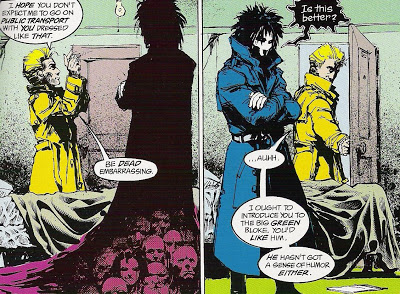
Finally, the artwork is so of it’s time but also very well done. Sam Kieth has been seen on this blog before, probably most notably in the review of the “Alien” comic series. While I didn’t feel that Kieth’s work matched the tone of that endeavor, it is pitch perfect for “Sandman”. The use of shadow and blanched colors is great on it’s own, but it’s the weird little details that are put in to give an extra sense of unreality.


dreamalittledreamofme
Look at that cape!! Just look at it! (source)

Honestly, if you are a fantasy fan and you haven’t read “Sandman”, I really encourage you to do so. It’s Gaiman’s best work, and “Preludes and Nocturnes” will get you hooked with just a little taste of what is to come.

Rating 9: A dark and dreamy introduction to one of the greatest comic series of all time, “Sandman: Preludes and Nocturnes” builds a world that is wholly unique and almost otherworldly.

Reader’s Advisory:

“The Sandman (Vol.1): Preludes and Nocturnes” is included on the Goodreads lists “500 Essential Graphic Novels”, and “Quality Dark Fiction”.

Find “The Sandman (Vol.1): Preludes and Nocturnes” at your library using Worldcat, or at a local independent bookstore using IndieBound!

Serena’s Review: “The Guinevere Deception”

43568394Book: “The Guinevere Deception”  by Kiersten White

Publishing Info: Delacorte Press, November 2019

Where Did I Get this Book: audiobook from the library!

Book Description: There was nothing in the world as magical and terrifying as a girl.

Princess Guinevere has come to Camelot to wed a stranger: the charismatic King Arthur. With magic clawing at the kingdom’s borders, the great wizard Merlin conjured a solution–send in Guinevere to be Arthur’s wife . . . and his protector from those who want to see the young king’s idyllic city fail. The catch? Guinevere’s real name–and her true identity–is a secret. She is a changeling, a girl who has given up everything to protect Camelot.

To keep Arthur safe, Guinevere must navigate a court in which the old–including Arthur’s own family–demand things continue as they have been, and the new–those drawn by the dream of Camelot–fight for a better way to live. And always, in the green hearts of forests and the black depths of lakes, magic lies in wait to reclaim the land. Arthur’s knights believe they are strong enough to face any threat, but Guinevere knows it will take more than swords to keep Camelot free.

Deadly jousts, duplicitous knights, and forbidden romances are nothing compared to the greatest threat of all: the girl with the long black hair, riding on horseback through the dark woods toward Arthur. Because when your whole existence is a lie, how can you trust even yourself?

Review: I’ve been a big fan of White’s work since I read her re-imaging of the life of Vlad the Impaler, gender swapping the main character and creating a tension-filled and deeply stressful (but fantastic) trilogy. From that reading experience, when I heard of this book, a re-imaging of the Camelot story from Guinevere’s perspective, I knew the author was up to the task! And I wasn’t wrong!

Guinevere arrives at Camelot with a mission: to marry Arthur. But that’s only the beginning of her story, for she’s not really Guinevere at all, but a protector sent by Merlin to watch over Arthur himself from all magical threats. While well-versed in magical protections and wards, Guinevere soon learns there is much more to this task than simply being on the look-out for threats to the king. She must actually be the queen, as well, something she feels much less suited for. And as she begins to peel back the layers of the mysterious Camelot and its political maneuverings, she starts to see that there is more at stake than she had thought, and that even she, the woman sent to protect Arthur, may not know the whole story.

This book surprised me in many ways, not least of all in its protagonist herself. We soon discover that Guinevere is not a reliable narrator. I love it when books can pull off an unreliable narrator approach as it opens up so many new doors for discovery as the story unfolds. Here, Guinevere herself isn’t aware of her own unreliability, and in many ways, the reader begins to put together pieces before she does herself. We know that she is an envoy sent by Merlin to protect Arthur. But we don’t know much more than that. It’s only as the story begins to move forward that the layers in Merlin’s plots become clear, and Guinevere begins to suspect larger things at play than a simple protection task.

She’s a very sympathetic character, a necessity for one of fiction’s most vilified female characters. Like she did with Lada Dracul, White builds open and adds to the original character blocks in such a way that the character is easy to understand and root for. Beyond that, the author doesn’t hold back from re-imaging all of the characters involved. If you suspect you know the role that any given familiar name will play, prepare to be surprised. I saw a few of these twists coming, but there were definitely one or two that took me by surprise. Luckily, one of the biggest twists towards the end was one of those surprises.

This was also one of the books I referenced a few weeks ago that has a love triangle that I miraculously didn’t hate. I guess I shouldn’t have been surprised since White also included an unconventional love triangle in her “And I Darken” series. But, again, here I was very pleased with the direction this love story ended up taking. Again, knowing the author’s way, I won’t pretend that this book really establishes any end game as far as the romance goes, but for this book, I was satisfied. It’s always nice to be reminded that even much-detested tropes can be done right by a skilled writer.

The story also doesn’t answer all the mysteries it sets up. There are still a bunch of questions on the table, and I have my own theories about Guinevere’s past and the role she will play going forward. The stage has been set with magical mysteries, old villains and new, and a main character who has only now realized just how under-prepared she really is. I can’t wait to see where it goes from here!

Rating 8: Another excellent twist on a classic tale from Kiersten White!

Reader’s Advisory:

“The Guinevere Deception” is on these Goodreads lists: “Best Retellings of fairytales, legends and history” and (just for kicks) “Covers With Beautiful Art.”

Find “The Guinevere Deception” at your library using WorldCat!

Serena’s Review: “Into the Crooked Place”

INTO_THE_CROOKED_PLACE6Book: “Into the Crooked Place” by Alexandra Christo

Publishing Info: Feiwel and Friends, October 2019

Where Did I Get this Book: Edelweiss+

Book Description: The streets of Creije are for the deadly and the dreamers, and four crooks in particular know just how much magic they need up their sleeve to survive.

Tavia, a busker ready to pack up her dark-magic wares and turn her back on Creije for good. She’ll do anything to put her crimes behind her.

Wesley, the closest thing Creije has to a gangster. After growing up on streets hungry enough to swallow the weak whole, he won’t stop until he has brought the entire realm to kneel before him.

Karam, a warrior who spends her days watching over the city’s worst criminals and her nights in the fighting rings, making a deadly name for herself.

And Saxony, a resistance fighter hiding from the very people who destroyed her family, and willing to do whatever it takes to get her revenge.

Everything in their lives is going to plan, until Tavia makes a crucial mistake: she delivers a vial of dark magic—a weapon she didn’t know she had—to someone she cares about, sparking the greatest conflict in decades. Now these four magical outsiders must come together to save their home and the world, before it’s too late. But with enemies at all sides, they can trust nobody. Least of all each other.

Review: I never got around to reading Christo’s “To Kill a Kingdom,” but I heard a lot of good things about it. So when I saw she had another book coming out this fall, I was eager to jump in and see what the fuss was about. I’ll admit, I was a bit wary when reading the book description, because I think these ensemble/gang/YA fantasy stories ala “Six of Crows” have become the number one genre to regularly burn me recently. But I thought I’d still give it a go based on the recommendations for the author herself. Unfortunately, my wariness was deserved, and this book wasn’t the hit I was hoping for.

Creije is both a wondrous and dangerous place. But whether if is dangerous or wondrous depends largely on one’s own abilities. And four different individuals know that with the right combination of magic, wits, and guts, the streets are where you make a life for yourself. Each with their own role to play and their own proficiency, a simple misunderstanding will quickly draw them together in an adventure where no one can be trusted.

Confession: I read this book back in the fall closer to when it was actually published. But I had also just reviewed (rather negatively) several other books that were very similar to this (ensemble, YA fantasy novels that centered around gangs/heists) and was, frankly, too tired out to want to right up yet another review. But as I did receive this book from a publisher, I thought better late than never. Alas, all of that leads to the obvious point: this book was not my jam and was way too familiar to a million other books that I’ve read just like it.

Look, I loved “Six of Crows.” But in retrospect I’m starting to hold a serious grudge against the deluge of similar YA titles that have now flooded the market. I swear, there was a point where I read about five of these in a row and was beginning to confuse them all (there’s at least two others that I’ve read and *sigh* will get around to reviewing at some point). I mean, the genre has always had trends that come and go, but for some reason this one seems worse than others. I think its because, other than “Six of Crows,” I’ve yet to come across a version of this trope/subgenre that I’ve actually liked.

I hate love triangles (a previous trope found all too often), but I can name at least two books I’ve read in the last year that had this trope and were still good! Because the authors still managed to make it their own and add new and interesting twists to the concept. But for some reason, with these ensemble, YA gang stories…they’re all almost literally exact copies of each other. To the point that some of the staple characters could be interchanged between books with a simple name change and not much would alter. Their personalities are the same. Their relationships are the same. The general mood/banter in the group as a whole is the same. It’s just…exhausting. I don’t know if there’s just not enough to plum with this this particular subgenre or whether “Six of Crows” just set too high of a bar. But something has gone wrong here, and it needs to stop.

And look, I’ve written two entire paragraphs without even talking about this book itself. And that’s because it’s just the same as all of the others. The characters feel like bland re-imaginings of characters we’ve seen before. The dialogue was tired and familiar. The relationships were…ok, I liked that they added the relationship between the two women, but the other was super familiar and predictable. The plot did pick up about half way through the book, but it never felt like it was really coming into anything of its own. Instead, it feels like the author just cobbled together a bunch of things that have been popular in other stories and whipped this one out there as fast as she could. There’s really not much to say in reviewing this book that I haven’t said before about similar books in the past that have tried and failed at this plot.

Eventually, I guess, I’ll have to get around to reviewing the other two books like this I’ve read. One I won’t be continuing and the other I already have the sequel to (though this more a case of “not as bad as the others” than anything else). But I have to space them out so my poor readers don’t have to just re-read the same review from me over and over again. I’m sorry! I just seem to keep reading the same book over and over again, and this is the result!

Rating 5: Adds nothing to a tired and needs to be put to bed subgenre of YA fantasy.

Reader’s Advisory:

“Into the Crooked Place” isn’t on any relevant lists (other than ones having to do with the year of its publication), which I think is telling. But it probably should be on “Villain Protagonists.”

Find “Into the Crooked Place” at your library using WorldCat!

Serena’s Review: “The Glass Magician”

45046558Book: “The Glass Magician” by Caroline Stevermer

Publishing Info: Tor Books, April 2020

Where Did I Get this Book: NetGalley

Book Description: What if you could turn into the animal of your heart anytime you want?

With such power, you’d enter the cream of New York society, guaranteed a rich life among the Vanderbilts and Astors, movers and shakers who all have the magical talent and own the nation on the cusp of a new century.
You could. If you were a Trader.

Pity you’re not.

Thalia is a Solitaire, one of the masses who don’t have the animalistic magic. But that is not to say that she doesn’t have talent of another kind—she is a rising stage magician who uses her very human skills to dazzle audiences with amazing feats of prestidigitation. Until one night when a trick goes horribly awry…and Thalia makes a discovery that changes her entire world. And sets her on a path that could bring her riches.

Or kill her.

Review: I was intrigued by the original sounding premise of this book. Set in New York, turn-of-the-century time period, and some type of new class system that is based around one’s magical ability to turn into an animal. All sounds like cool concepts and all put together, I really had no idea what to expect from this book. Unfortunately, it didn’t really turn out to be much of anything at all, so no expectations was about right.

After inheriting her father’s magic business, Thalia has been making her living as a stage magician. Not blessed with actual magical abilities that would vault her into the upper class of New York society, she is still managing to make a name for herself by performing wondrous and dangerous tricks in her act. One night, however, a trick goes wrong and Thalia discovers there is more within her than she had ever known. Now with abilities she doesn’t know how to control and a murder added to the mix, Thalia’s life is beginning to change. Will it be for the better or for the worse?

For the pros for this book, I will say that I still liked the uniqueness of the time period during which it was set and the choice to have it take place in New York City. It’s always a breath of fresh air to find a fantasy novel that isn’t set in some generic “medieval times” setting. And even more so to find one that is set in a city that exists today. However, I do think the author left a lot on the table with regards to what all could have been done with these two elements. The other positive worth noting was the writing itself. It didn’t stand out to me in any particular way, but it was of the sort that is strong enough to get the job done without distracting the reader. And, considering that I didn’t love much about this book, I think it’s a real strength of the writing that it was strong enough that I didn’t ever really feel like just putting the book down for good.

Unfortunately, as I mentioned with the time period and the setting, it felt like the author came up with some cool, individual ideas, but didn’t spend any time really building up the world or system around them. Like, people have this magic to turn into animals and society has been built in such a way that possessing this ability puts you into an elite class. But the why or how of this is never really explained. The history of how this system came to be in place is lacking. And there is really not magic system of any kind to explain the rules, limitations, or even, to some extent, the benefits of having these abilities. The entire world that has been created depends on these magical factors, and yet we get next to nothing about what they really are. It felt like the author simply didn’t want to bother with the details of these things, instead wanting to just jump into her heroine’s own story.

But there, too, I had problems. Thalia is an interesting enough character on her own, but the book simply didn’t have enough story for her. The entire book feels made up of either Thalia struggling to learn to control her new abilities or making small bits of progress solving a murder mystery. I was pretty surprised, actually, when the murder mystery aspect of it became apparent since there wasn’t any hint of that in the general description. But I’m all for historical murder mysteries, so this should have been a benefit to the story. Instead, again, it felt like only the most basic aspects of this part of the story were really explored. Things all come way too easily to Thalia, with people often behaving against their own best interest or out of character to help her on her way.

To make up page time for the lack of world-building, magic system, or complications in the murder mystery, we instead spend an incredible amount of time just in Thalia’s mind exploring her feelings. I don’t have a problem with books that center largely around the introspective thoughts of a main character, but there just has to be more to the story itself to support this. I also didn’t love the romance we were given. It felt forced and lacked chemistry.

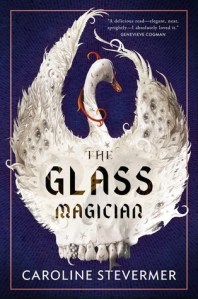
I also have to spend a moment on that cover. Yikes. It’s the kind of thing that immediately attracts the eye (indeed, I clicked on it in NetGalley just because of the swan motif), but the more you look at it, the worse it gets. It’s all kinds of creepy with the teeth and eyes, and I’m not sure it really represents well the book we have. Instead, if I had noticed these details when choosing the book off the shelf, I think I would have most likely put it back just due to how unnerving I find it all.

Overall, I wasn’t impressed with this book. It felt like the author had some really neat ideas at the very core of it, but didn’t spend enough time to fully develop anything. The writing was strong enough, but there wasn’t enough story to go around.

Rating 6: Lack luster and thin, this book didn’t hold up to the promises of its premise.

Reader’s Advisory:

“The Glass Magician” is a newer title and isn’t on any relevant lists. Bizarrely (and inaccurately) it is on “Historical Fiction 2020.”

Find “The Glass Magician” at your library using WorldCat!

Book Club Review: “Gods of Jade and Shadow”

36510722We are part of a group of librarian friends who have had an ongoing bookclub running for the last several years. Each “season” (we’re nerds) we pick a theme and each of us chooses a book within that theme for us all to read. Our current theme is “American Girl Readalikes”, in which we each pick an American Girl book and a book that can be connected to it, however tenuous as it may be.

For this blog, we will post a joint review of each book we read for book club. We’ll also post the next book coming up in book club. So feel free to read along with us or use our book selections and questions in your own book club!

Book: “Gods of Jade and Shadow” by Silvia Moreno-Garcia

Publishing Info: Del Rey, July 2019

Where Did We Get This Book: We both bought it!

American Girl Book: “Josefina Saves the Day” by Valerie Tripp

Book Description: The Jazz Age is in full swing, but Casiopea Tun is too busy cleaning the floors of her wealthy grandfather’s house to listen to any fast tunes. Nevertheless, she dreams of a life far from her dusty small town in southern Mexico. A life she can call her own.

Yet this new life seems as distant as the stars, until the day she finds a curious wooden box in her grandfather’s room. She opens it—and accidentally frees the spirit of the Mayan god of death, who requests her help in recovering his throne from his treacherous brother. Failure will mean Casiopea’s demise, but success could make her dreams come true.

In the company of the strangely alluring god and armed with her wits, Casiopea begins an adventure that will take her on a cross-country odyssey from the jungles of Yucatán to the bright lights of Mexico City—and deep into the darkness of the Mayan underworld.

Serena’s Thoughts

I read this book for the first time last summer and raved all about it. But when it came time for me to pick my book for bookclub, I was having a hard time finding one that I felt matched up at all with the “American Girl” I had. I tossed out this book’s title and as no one else had read it, that was all the excuse I needed! Not only to pick it as my bookclub book, but to order a copy for myself for this re-read.

This second time around, I enjoyed the story just as much as the first time. I was reminded just how unique of a story this is. I haven’t read any other book about this time period and place, and I’ve especially never read anything combining it with traditional Mayan folklore and all of the fantasy elements the author threw in. While the beginning of the story definitely has a “Cinderella” vibe, it deviates from that traditional tale so quickly and so completely that it wasn’t even until this re-read that I made that connection at all.

Like my first read through, what really stood out was the writing itself and the way the use of the unique narration style was able to really draw complete, full-bodied pictures for the reader. The images of these locations and cities, both real and fairytale, all feel so vivid and colorful that it’s impossible not to be drawn in, even if one has no familiarity to base any of these visuals on. The writing is strong enough to get you there on its own.

I obviously still really enjoyed Casiopea herself. She’s a very strong protagonist and her journey of self-discovery was compelling. She learns many of the same lessons anyone who travels from home the first time does: that the world is both much larger and grand than you ever could have imagined, but it’s also still just people, going about their lives, no matter the change of scenery. This time around, I was able to focus more Hun-Kame’s story and his slow transition from godhood to humanity. I really appreciate the way the author went about this, as all of his changes were subtle and believable, something that can be hard to pull of with this type of story arc.

Overall, I still really enjoyed this book. I’ve loved everything I’ve read by her, and she has a new book, “Mexican Gothic,” that’s coming out this June that I can’t wait to check out! If you want to read my full review from last summer, you can find it here.

Kate’s Thoughts

I have been interested in digging into Silvia Moreno-Garcia for a bit now. I have “Mexican Gothic” waiting for me in eARC form at the moment, so when Serena suggested that she pick “Gods of Jade and Sorrow” for book club I was wholeheartedly in favor. True, while fantasy isn’t necessarily my cup of tea, mythology is an exception to that general rule. Especially mythologies that I’m not as familiar with (though when I was in grade school we had a unit on the Mayans and the mythology associated with it. Of course, it was by no means expansive).

I quite enjoyed “Gods of Jade and Shadow”, for a few reasons. The first, like Serena mentioned, was the time and place. 1920s Mexico isn’t a setting I’ve encountered much in the books I’ve read, and while I have a working knowledge of some aspects of it thanks to reading about Frida Kahlo and Diego Rivera in the past, it’s still fairly novel. The road trip and journey that Casiopea and Hun-Kamé take together all over Mexico and into the U.S. is engaging and entertaining, and the other magical beings they encounter were fascinating and well crafted. I thought that their very important journey aligned with Casiopea’s own journey of self-actualization against a backdrop of a burgeoning freedom of society was stark and powerful.

And, like Serena, I also enjoyed Casiopea herself. She grows and changes, but always remains true to herself and her characterization. She has a lot to learn, but she also has a lot that various characters, be it Hume-Kamé or her cruel cousin Martín, could learn from her. Some of the choices that she makes when it comes to how to deal with the cruelty and viciousness of others are refreshing in that they are steeped in more empathy and compassion as opposed to revenge or evening the score.

And of course, the Mayan Mythology was great. I have vague recollections of Xibalba and the various Death Gods from my early experiences of reading up on them in grade school, and seeing them put into this story and really dug into was awesome. It also gives the feel of this story a distinctly Indigenous one, which I greatly appreciated, especially since an Own Voices author was taking on the subject matter.

Overall, I really liked “Gods of Jade and Shadow”, and I’m even more stoked to dig into Moreno-Garcia’s next works!

Kate’s Rating 8: A fun and unique coming of age story with a distinctly Indigenous voice, “Gods of Jade and Sorrow” really entertains.

Serena’s Rating 10: I loved this book just as much the second time around and highly recommend it for fantasy-lovers looking for a story set in a time and place not typically found in the genre.

Book Club Questions

  1. Casiopea’s story starts out as a sort of “Cinderella” tale that involves into one of self-discovery and independence gained. What stood out to about her story arc or characterization?
  2. In many ways, Casiopea and Hun-Kame’s relationship evolves from city to city as they travel. What did you make of this progression? Did you enjoy the romance in this story? What did you think of the larger balance being struct between humanity and godliness?
  3. The story takes place during the Jazz Age in Mexico and covers a lot of ground. Was there a particular location or aspect of this time/place that stood out to you?
  4. The author combined traditional Mayan words and stories with her own unique tale. Were there any aspects of the fantasy elements that stood out to you? Were you familiar with any of these terms or Mayan tales previously?
  5. The narration for this story is omniscient, allowing the author to provide a lot of detail and context for her tale as it meanders across Mexico. It also provides insights into the villain’s perspectives. What did you make of this narrative style and the balance between characters that we’re given?

Reader’s Advisory

“Gods of Jade and Shadow” can be found on these Goodreads lists: “Aztec, Maya & Inca – Fiction” and “2019 Adult SFF by Authors of Color.”

Find “Gods of Jade and Shadow” at your library using Worldcat!

Serena’s Review: “The Ranger of Marzanna”

51113661._sx318_sy475_Book: “The Ranger of Marzanna” by Jon Skovron
Publishing Info: Orbit, April 2020

Where Did I Get this Book: ARC from the publisher

Book Description: When their father is murdered by imperial soldiers, two siblings set out on opposite paths—one will destroy the Empire forever and the other will save it—in this thrilling new Russian inspired epic fantasy from Jon Skovron.

Sonya is training to be a Ranger of Marzanna, an ancient sect of warriors who have protected the land for generations. But the old ways are dying, and the rangers have all been forced into hiding or killed off by the invading Empire.

When her father is murdered by imperial soldiers, she decides to finally take action. Using her skills as a ranger she will travel across the bitter cold tundra and gain the allegiance of the only other force strong enough to take down the invaders.

But nothing about her quest will be easy. Because not everyone is on her side. Her brother, Sebastian, is the most powerful sorcerer the world has ever seen. And he’s fighting for the empire.

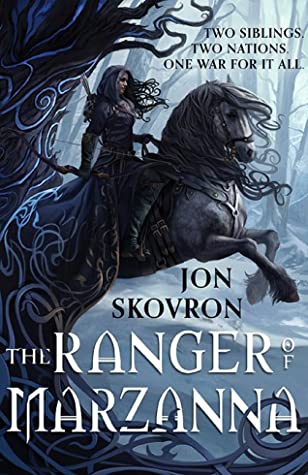
Review: Between the beautiful cover art and the intriguing book description, this was a no brainer for me to request. I always love stories about warrior women, and the fact that it was based on Russian folklore is just the cream on top. I was definitely getting some “The Bear and the Nightingale” vibes off this, which couldn’t have been more of an inducement since I’m still in mourning that that trilogy ended…like more than a year ago now. Get over it! Sadly, however, this book wasn’t quite that. There were some strengths to it, but not quite what I was looking for, in the end.

Sonya is in training to be a Ranger, a member of an elite fighting force. In pursuit of this goal, she travels around the countryside attempting to help her people against the doings of the invading imperial soldiers. While away, however, her family is attacked and her father killed. Her brother, however, a powerful sorcerer-in-training, survives and begins to make a new life for himself, one that sides with the very people who murdered their father. Now these two siblings find themselves on very different paths, paths that will eventually intersect to devastating effect.

So, to start with a few things I liked. I did like the Russian/Ukranian influences on the culture, location, and folklore of the story. The elemental magic system was also interesting enough. It’s not a super new concept, but I felt like the author put enough new twists into how it all works to keep it from feeling flat. I particularly liked the cult-like religion that followed Marzanna and the sacrifices that were required of those who committed themselves to her path (as we see through Sonya’s story.) But, sadly, I had a really hard time connecting to either of the two main characters, and I felt like the pacing and writing of the story weren’t helping matters out.

First, Sonya. I did end up liking her half of the story better than her brother’s, but again this was mostly due to the intriguing concept of having to give up parts of oneself to become a full follower of Marzanna. However, even in this part of the story, I didn’t feel like the author truly explored this concept completely. In many ways, it mostly just made Sonya less likable. She starts out incredibly bad-ass and so some of her struggles then appear out of character. But at the same time, growth for the character comes out of these moments, but never felt like it was really being applied completely. It’s hard to get at exactly what my problem was. I think maybe it was just that the actual character herself felt too flimsy to hold up the more grand adventure she was supposed to be having. And by the time we got to some of the darker portions of her tale, the part where readers have to begin questioning her actions and motives, it’s too late to really feel invested enough in it all.

As for Sebastian, I didn’t like him from the start, and it didn’t get any better as we went along. In the very first chapter we meet him, his father his killed and he and his mother are shipped back to the capitol city. His entire inner thought process of these events was summed up with an actual line saying that he didn’t really get along with his father that much so that must be why he’s not really grieving. From there, it just got worse as he literally teams up with the very people who killed his father and pretty much goes “meh” about the idea that his powers are now going to be used against his own people. There simply wasn’t enough (or any!) real conflict shown between Sebastian and his father to justify to bewildering turn for his character. Sebastian is either a sociopath who can’t care about others or an outright villain. Neither are likable. It’s especially confusing as he’s presented in a way that makes it clear that the author expects you to sympathize with him and read him as an equal protagonist. I just didn’t get it, and what I did get, I didn’t like.

I also felt like the writing and pacing of story were just a bit off. The characters spoke in a very YA manner, but this didn’t mesh well with the super violent descriptions that came with the action scenes. What’s more, the author had an unfortunate habit of info-dumping in his dialogue making it read as unnatural and stiff. Overall, I was pretty disappointed by this book. I know that the author has a fairly popular series already published, so I’m not sure if this was an aberration or whether this story just didn’t mesh with me specifically. If you are a fan of his other work and want to give this one a shot, don’t forget to enter the giveaway for an ARC copy of this book!

Rating 6: The two unlikable protagonists were too much for me to get past.

Reader’s Advisory: 

“The Ranger of Marzanna” is a newer title, so it isn’t on any Goodreads lists. But it should be on “Warrior Women.”

Find “The Ragner of Marzanna” at your library using WorldCat!

Giveaway: “The Ranger of Marzanna”

51113661._sx318_sy475_Book: “The Ranger of Marzanna” by Jon Skovron
Publishing Info: Orbit, April 2020

Where Did I Get this Book: ARC from the publisher!

Book Description: When their father is murdered by imperial soldiers, two siblings set out on opposite paths—one will destroy the Empire forever and the other will save it—in this thrilling new Russian inspired epic fantasy from Jon Skovron.

Sonya is training to be a Ranger of Marzanna, an ancient sect of warriors who have protected the land for generations. But the old ways are dying, and the rangers have all been forced into hiding or killed off by the invading Empire.

When her father is murdered by imperial soldiers, she decides to finally take action. Using her skills as a ranger she will travel across the bitter cold tundra and gain the allegiance of the only other force strong enough to take down the invaders.

But nothing about her quest will be easy. Because not everyone is on her side. Her brother, Sebastian, is the most powerful sorcerer the world has ever seen. And he’s fighting for the empire.

I was excited to receive an ARC copy of this book from Orbit. For one thing, the cover is absolutely stunning and the exact sort of thing that would draw me in when browsing the shelves at a bookstore (oh, how I long to return to browsing shelves…). I was also really interested in the idea of two siblings coming towards some sort of conflict. The book description definitely focuses on the sister more, so I’m curious to see if this book will be a duel narrator situation or what. Her side alone, however, sounds pretty badass!

My full review for the book will go up this Friday. But get a head start on things and enter to win an ARC copy of this book. The giveaway is open to U.S. residents only and ends on May 20.

Enter to win!

Serena’s Review: “The Will and the Wilds”

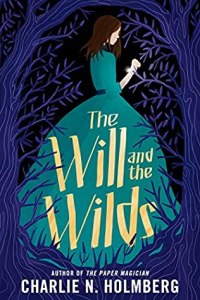
44646004._sy475_Book: “The Will and the Wilds” by Charlie N. Holmberg
Publication Info: 47North, January 2020

Where Did I Get this Book: NetGalley

Book Description: Enna knows to fear the mystings that roam the wildwood near her home. When one tries to kill her to obtain an enchanted stone, Enna takes a huge risk: fighting back with a mysting of her own.

Maekallus’s help isn’t free. His price? A kiss. One with the power to steal her soul. But their deal leaves Maekallus bound to the mortal realm, which begins eating him alive. Only Enna’s kiss, given willingly, can save him from immediate destruction. It’s a temporary salvation for Maekallus and a lingering doom for Enna. Part of her soul now burns bright inside Maekallus, making him feel for the first time.

Enna shares Maekallus’s suffering, but her small sacrifice won’t last long. If she and Maekallus can’t break the spell binding him to the mortal realm, Maekallus will be consumed completely—and Enna’s soul with him.

Review: I read “The Paper Magician” by this author a few years back. It was a simple, straight-forward, enjoyable little fantasy story that I quite enjoyed (though I haven’t gotten around to reading any of the other books in the series). But when I came across this title by the same author, I was excited to see what looked like a new fairytale story. It’s always refreshing to find something that isn’t a retelling and the element involving the exchange of souls between the main characters was intriguing.

Enna has always yearned to study mystings that roam the wildwood near her home. But they are as dangerous as they are mysterious, so much of her time is spent instead on warding her home against them in an attempt to protect her and her father from the viscous death her mother suffered when Enna was just a baby. Soon enough, however, she finds herself tangled up with a mysting named Maekallus, a powerful being who steals the soul with a kiss. Now, entwined in a deal that is dooming them both, Enna and Maekallus must unravel the secrets of an enchanted stone Enna’s father stole from the mystings long ago and that may be more powerful than Enna ever imagined.

Like “The Paper Magician,” this was another sweet, little story. There wasn’t anything particularly challenging or unique about the story itself. The world-building was pretty straight-forward. And the characters were all likable. Putting it all together it sounds like I’m criticizing the book for being bland, but I think that a story such as this has just a much a place on most readers’ shelves as even the most complex and deep stories do. While I may not have found myself blown away by any aspect of it, the entire experience of the story was like sinking into a nice warm bath with some low level candles flickering. It was comfortable and safe, something that is even easier to appreciate in times such as this when frankly all I want to do is re-read comfort books all day long.

The most intriguing part of this story was around the idea of the soul and what it provides to those who possess it. Enna, a human girl, naturally goes about life never questioning the role her soul plays in her existence. But when she meets Maekallus and enters into a sort of transactional agreement with him that sees her slowly losing pieces of her soul, we begin to see what it costs her. And, conversely, what Maekallus lacked before gaining pieces bit by bit. The romance between the two is accordingly a slow burn love story.

I will say that there were points in the middle of the book where the plot began to feel a bit repetitive and meandering. There isn’t a whole lot of fast-paced action in this story, and some of the conflicts, such as they are, feel relatively low stakes and don’t add much tension to the proceedings. The main plot line, of course, has some action to it. But as that takes part mostly in the beginning and end of the book, there are some side quests in the middle that don’t seem to add a lot. I also felt like the main confrontation at the end of the  book was fairly anticlimactic, all things considered.

But, like I said, the love story was sweet and our two main characters were interesting enough. If one is looking for a quick fairytale fantasy, this is a good go-to. But if you’re looking for anything of the more “epic” or grand variety, this isn’t going to do the trick. It’s definitely a “right mood” kind of book, and I think I was in it when I read it. Objectively, I think it was probably a bit slower and less developed than it could be, though.

Rating 7: A nice little story, but not one that is pushing any sort of boundaries.

Reader’s Advisory:

“The Will and the Wilds” isn’t on many relevant Goodreads lists, but it is on  “slow-burn romance.”

Find “The Will and the Wilds” at your library using WorldCat!

Serena’s Review: “The City We Became”

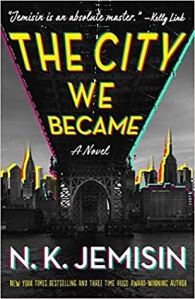
42074525._sy475_Book: “The City We Became” by N.K. Jemisin

Publishing Info: Orbit, March 2020

Where Did I Get this Book: Edelweiss+

Book Description: Every city has a soul. Some are as ancient as myths, and others are as new and destructive as children. New York City? She’s got five.

But every city also has a dark side. A roiling, ancient evil stirs beneath the earth, threatening to destroy the city and her five protectors unless they can come together and stop it once and for all.

Review: I’ve been a fan of Jemisin’s since years ago when I first read “The Hundred Thousand Kingdoms.” But my love for her didn’t really set in until after I read the “Broken Earth” trilogy. Those books blew me away with the sheer scope of imagination and dexterity of language that were required to pull off such a feat. With those in mind, I went into this book knowing that if anyone could handle the strange set-up that was offered in the book description, it would be Jemisin. And she definitely does! Sadly, this book didn’t hit quite the same mark as the others of hers that I’ve read, but I suspect much of that is just down to my own reading preferences.

Birth is a painful, messy business. It can be as frightening as it is beautiful. A city’s birth is no different, especially for one such as New York City, a behemoth whose very soul can’t be contained in one vessel. Instead, when things begin to go wrong as NYC strives towards its own new life, five individuals are selected to represent the myriad of faces and lives that make up this one spirit. Together they must become the protectors the city needs and fight off a great evil that threatens this new life.

Even though this book wasn’t the huge hit for me that I was hoping for, there is still a lot to praise it for. As always, Jemisin’s creativity is without bounds. The idea of great cities developing souls is just fantastic, and the book takes that theme and runs with it into some crazy and unexpected places. The strength of writing needed to make some of these completely foreign fantasy elements make sense is mind boggling, and it’s here that Jemisin has always shined. There were a bunch of lines that not only jumped off the page, but more so slammed into my unprepared mind with all the beauty and shock of a firework. It was truly impressive.

Part of my struggle, however, also had to do with the writing. Not so much maybe the writing, but the way that it was so clearly an homage to New York City and the many cultures made up within that huge city. I’ve only visited NYC on one frantic, 24 hour period visit. So I know very little about the actual city itself. And for a book so focused on the heart of this city and the pieces that make it unique and tick, I was often left feeling like I was an outsider looking in. Many of the stronger pieces of writing I could see objectively as great, but I couldn’t connect to personally as it was so clearly talking about a specific place and people that I personally don’t know much about. And, unlike most second world fantasy where all readers are “newbies” learning about a world they don’t understand, this was clearly written to some extent with the idea that readers would know and connect to some of these elements, without the book itself needing to do that extra legwork. So, in this way, some of the mileage of this book might depend on the reader’s own familiarity, and to a lesser extent, interest, in New York City itself.

I also had a hard time feeling truly connected to many of the POV characters. The story starts off quite quickly and doesn’t spend much time laying out many details for readers. In some regards, this is a staple trick of Jemisin’s and one can have faith that the answers will come eventually. They do here as well. But this trick then depends on the reader connecting to and investing in the main characters themselves early on to carry one through until plot details begin to clarify. I’m not sure quite what the problem was here for me. Perhaps there were just too many characters, and combining that with the slow moving pieces of putting the plot together, was just too much.

Jemisin is also well-known for putting diverse characters first and foremost in her books, often strong women of color. And here, too, the cast is diverse across all kinds of lines. But there were also moments where I felt like the message (for lack of a better word) was a bit more hamfisted here than the incredibly powerful observations and mirrors that were held up in her previous works.  Really, it felt in some ways like this entire book was a bigger statement (particularly in response to the Lovecraft stuff that has pervaded SFF for so long) that the author needed to get out into the world.  And that’s a good thing! But it also, again, left it a bit harder for me to fully sink into this book as a reading experience.

Overall, I think this book is incredibly powerful and highlights again the strength of Jemisin’s skill as an author, both in her masterful world-building as well as just the strength of her writing. That this one didn’t really hit home for me could, in part, simply be due to my own lack of knowledge of (or real interest in) NYC itself. But for those with a stronger connection to that city, I’m sure some of these elements in particular will strike a much stronger chord. Fans of Jemisin’s work should definitely still try this out and those looking for an urban fantasy novel that breaks the mold for what urban fantasy typically offers are sure to be intrigued!

Rating 7: Incredibly unique with a widely diverse cast, but it was a bit harder to become invested in than other works by this author.

Reader’s Advisory:

“The City We Became” is on these Goodreads lists: “Adult Sci-Fi/Fantasy Releases of 2020” and “SFF Set in Global Cities (No YA).”

Find “The City We Became” at your library using WorldCat!