Kate’s Double Review: “The Real Lolita” and “Rust & Stardust”

Books: “The Real Lolita: The Kidnapping of Sally Horner and the Novel that Scandalized The World” by Sarah Weinman; “Rust & Stardust” by T. Greenwood

Publishing Info: Ecco, September 2018; St. Martin’s Press, August 2018

Where Did I Get These Books: The library; I was sent an ARC from the publisher

Book Descriptions: Vladimir Nabokov’s Lolita is one of the most beloved and notorious novels of all time. And yet very few of its readers know that the subject of the novel was inspired by a real-life case: the 1948 abduction of eleven-year-old Sally Horner.

Weaving together suspenseful crime narrative, cultural and social history, and literary investigation, The Real Lolita tells Sally Horner’s full story for the very first time. Drawing upon extensive investigations, legal documents, public records, and interviews with remaining relatives, Sarah Weinman uncovers how much Nabokov knew of the Sally Horner case and the efforts he took to disguise that knowledge during the process of writing and publishing Lolita.

Sally Horner’s story echoes the stories of countless girls and women who never had the chance to speak for themselves. By diving deeper in the publication history of Lolita and restoring Sally to her rightful place in the lore of the novel’s creation, The Real Lolita casts a new light on the dark inspiration for a modern classic.


When 11 year-old Sally Horner steals a notebook from the local Woolworth’s, she has no way of knowing that 52 year-old Frank LaSalle, fresh out of prison, is watching her, preparing to make his move. Accosting her outside the store, Frank convinces Sally that he’s an FBI agent who can have her arrested in a minute—unless she does as he says. 

This chilling novel traces the next two harrowing years as Frank mentally and physically assaults Sally while the two of them travel westward from Camden to San Jose, forever altering not only her life, but the lives of her family, friends, and those she meets along the way.

Review: I want to extend a special thank you to St. Martin’s Press for sending me an ARC of “Rust & Stardust”.

For someone who reads a whole lot for her profession and her pleasure, I have a pretty gaping hole in my literary experience when it comes to ‘the classics’. Between taking not so typical literature classes in high school and majoring in psychology, my exposure to classic books was limited, and while I’ve tried to pick up the pieces here and there I still have many left on the ‘theoretically to read’ list. So no, I have not read “Lolita” by Vladimir Nabokov, though the notoriety of the story means that I am pretty familiar with it as a whole. I’m in no rush to read it, not for any other reason than there are so many other books out there that interest me more. But when I got an ARC of the book “Rust & Stardust” by T. Greenwood, the fact that it was based on the very real story of Sally Horner, the girl who served as inspiration to Dolores Haze in Nabokov’s book, caught my attention. And then I heard that a nonfiction book about Sally Horner, called “The Real Lolita” by Sarah Weinman, was also soon to be available. So I decided to bide my time, and to read the two as a pair so that I could compare and contrast the two, which each tell the same story in very different ways.

And perhaps it’s implied, but just in case, I need to give some serious content warnings for both of these books. They do, after all, involve the kidnapping, rape, and abuse of a little girl.

“The Real Lolita” is a non fiction work that juxtaposes Sally Horner’s kidnapping at the hands of Frank La Salle with Vladimir Nabokov trying to write “Lolita”. Weinman surmises that Nabokov, who had been having stumbling block after literary stumbling block as he tried to write what would become his most famous work, heard the sensationalized news stories surrounding the case and used it in his work. Nabokov denied this again and again, but Weinman lays out the similarities between the two cases, and the timeline that he was working within and how it wa well within the highest media furor surrounding the case. It isn’t really a criticism of Nabokov’s decision to use this story as inspiration so much as it’s an indictment of him lifting a girl’s very real pain to profit from it without giving her any credit. I appreciated that she wasn’t going after the inspiration piece, because it isn’t uncommon for creatives to take inspiration from real life horrors and to make them into a fictional work. The issue is that Nabokov was too proud to admit that he in all probability did find inspiration in this trauma victim, which is deeply problematic in and of itself, and couldn’t be bothered to even acknowledge her pain and how successful of a novel it was. Her evidence is well researched and carefully laid out, and the details that she found regarding the Horner case and what her life was like before, during, and after the ordeal gives voice to a girl whose trauma was appropriated for a novel with the subject of her inspiration twisted and misinterpreted  into a nymph-like seductress (even if that wasn’t Nabokov’s intention). It’s a book that I had a hard time reading because of the awful manipulations and abuses La Salle did to Horner, though I appreciated how frank and ‘just the facts’ Weinman was because of the horrors of the case. I also liked that she wasn’t particularly fiery in her critiques of Nabokov, but that she simply presented the evidence as it was and let it speak for itself. Weinman’s book gives this girl a voice, a voice that wasn’t afforded to her in the moment, and that has been drowned out because of time and a novel that overshadowed it.

“Rust & Stardust” is also the Sally Horner story, but it has been adapted into a work of fiction. T. Greenwood  makes it very clear in a long author’s note that she approached this story through the eyes of a fiction author, but tried to keep a good number of the details, especially in regards to Sally’s experience, realistic and plausible. The prose flows neatly and succinctly, and while it is a longer book than “The Real Lolita” I found that it felt like a quicker read just because Greenwood paced it so well. The story is pretty much what you’d expect; Sally Horner is caught by Frank LaSalle as she’s stealing a notebook from the store, and what follows is the story of Sally’s kidnapping, captivity, and return, as well as the perspectives of those in her life during her absence. While it was definitely hard to read at times, Greenwood never made it feel lurid or exploitative. The emotions were there, but were able to remain untangled from bad taste. Greenwood also gave herself some creative plot leeway (though not in regards to Sally, which was good) so that she could highlight the problematic attitudes of the post-War American culture, specifically when it comes to abuse towards girls and women. Whenever someone would raise doubts about Sally’s relationship to Frank, almost every time they were told to be quiet because the very notion of bad intentions was disgusting and inappropriate. Frank is able to get away with his predation because the people around him and Sally don’t want to face that it’s happening. Which brings me back to the criticisms of “Lolita”, in that some people, be it Nabokov’s intent or not, have romanticized the story of Humbert Humbert and the ‘nymph’ he fixates on. Greenwood doesn’t give any leeway for that because the story is Sally’s, and those who care about her.

Reading “The Real Lolita” and “Rust & Stardust” has given me a larger picture of a tale I thought I knew, and in their own ways they tell the side that has been lost to time and literary critique and accolades. If you like “Lolita”, and even if you don’t like it, these books will give it more context, a context that it has probably always needed.

Ratings 8: Though the backstory to “Lolita” has been glossed over and outright ignored by some (and denied by others), “The Real Lolita” and “Rust & Stardust” strive to give Sally Horner the ability to tell her story.

Reader’s Advisory:

“The Real Lolita” is included on the Goodreads lists “Women’s Lives”, and “Best Crime Books of 2018”.

“Rust & Stardust” is included on the Goodreads lists “#MeToo”.

Find “The Real Lolita” and “Rust & Stardust” at your library using WorldCat!


Kate’s Review: “Infidel”

38812871Book: “Infidel” by Pornsak Pichetshote and Aaron Campbell (Ill.)

Publishing Info: Image Comics, September 2018

Where Did I Get This Book: The library!

Book Description: A haunted house story for the 21st century, INFIDEL follows an American Muslim woman and her multi-racial neighbors who move into a building haunted by entities that feed off xenophobia.

Bestselling editor Pornsak Pichetshote (Swamp Thing, Daytripper, The Unwritten) makes his comics writing debut alongside artist extraordinaire Aaron Campbell (The Shadow, James Bond: Felix Leiter), award-winning colorist and editor Jose Villarubia (Batman: Year 100, Spider-Man: Reign), and letterer / designer Jeff Powell (SCALES & SCOUNDRELS).

Review: Even though horror has almost always had stories with some kind of hidden themes within their works, I feel like as a genre people are starting to really realize the possibilities of metaphor for greater ills beyond a monster or a ghost. With books like “Lovecraft Country” and movies like “Get Out”, we are starting to see more expansion and room for not only POC characters, but also critiques of racism within our culture and society. “Infidel” by Pornsak Pichetshote is the most recent story of this kind that I have come across, and I can tell you that I was waiting very impatiently for my hold on it to be filled at my library. Given that NPR listed it on their ‘100 Greatest Horror Stories of All Time’ selection, my enthusiasm and anticipation was greater than most other books I request. It was also a lofty claim to make, and while I was open to the claim I wondered how much my own final opinion of it would line up with it.

Our story follows Aisha, a Muslim American woman who has recently moved into an apartment building with a tragedy attached to it. A few years before, a Middle Eastern man’s homemade bombs went off, killing a number of the tenants. Aisha and her friends, most of whom come from non-white backgrounds, are aware of the history, and aware of how the white tenants aren’t as welcoming to them as they are to non POCs. What Aisha and her friends don’t know is that the building is haunted by a very angry and aggressive set of ghosts. It’s Aisha that first sees the twisted and violent entities that haunt the complex, their rage focusing on her. The visual manifestations of these things are truly horrific, as they are warped and filled with rage and able to cause serious physical harm. Much like “Lovecraft Country”, racism and bigotry is the true villain of this book, with the ghosts targeting Aisha because of her Muslim faith and their association that gives them to the man whose bombs were their demise. Aisha isn’t the only one who has nasty encounters with the ghosts, as their ire holds a lot of the other characters hostage and puts them at risk as well. It starts slowly for all of them, noticing it bit by bit and making them wonder if they ACTUALLY saw something, or if it’s just a figment of their imaginations, a direct metaphor for those who are victims of racism in our day to day lives.

But the other kind of racism that Pichetshote shows in this book isn’t just the over the top obvious kind in ghost form; rather, it’s mostly micro-aggressions and fear based on ignorance and paranoia. Aisha is dating a while man named Tom, who has a daughter named Kris from a previous relationship. Kris’s mother is dead, and Kris is very connected to Aisha. Tom’s mother Leslie has just started warming up to Aisha and seems to be trying, though in the past she’s shown discomfort and flat out hostility towards Aisha and her culture. Aisha is more inclined to give her the benefit of the doubt, though Tom and her childhood best friend Medina are not. There are also other tenants in the buildings who are more mistrustful of Aisha because of her faith. From a neighbor who is convinced she saw Aisha committing a crime (though Aisha herself at this point is a clear victim), to a woman who is actually in Aisha’s circle of friends but still doesn’t trust her fully, it’s these interactions that left me a bit more unsettled than the ghosts that pop out of the walls. These moments are based in realism, and show how people can be influenced by fear and prejudice even if they think they are open minded and accepting.

The artwork is stunning. There is a certain jarring atmosphere that the artist, Aaron Campbell, creates, with lots of vibrant colors and use of shadows. The ghosts within the building are especially grotesque, their distorted features harkening to disease and decay. At one point Medina refers to racism as a cancer, and the entities absolutely reflect that.

05_infidel1
Literal nightmare fuel. (source)

I think that one of the few criticisms I did have about this book was that it ended a little too quickly. I realize that this was very much a mini series, as it was only five issues all together, but for it to build slowly and complexly and then to be wrapped up very fast left me a little feeling unsatisfied. There were a couple of plot points that were tossed out into the fold that sounded like it would take a lot of work to get through, only to be resolved quickly, sometimes off page. Because of this, I did close the book wanting more.

“Infidel” is an effective story with some genuine scares. I highly encourage horror fans to pick it up, but know that it may feel a bit rushed by the end. That said, I am very much looking forward to see what Pornsak Pichetshote brings us next.

Rating 8: A unsettling ghost story that takes on racism and xenophobia in our culture, “Infidel” is a graphic novel with as many real world horrors as supernatural ones.

Reader’s Advisory:

“Infidel” is included on the Goodreads lists “Best Horror Comics/Graphic Novels”, and “Against the Fascist Creep”.

Find “Infidel” at your library using WorldCat!


Kate’s Review: “My Sister, The Serial Killer”

38819868Book: “My Sister, The Serial Killer” by Oyinkan Braithwaite

Publishing Info: Doubleday Books, November 2019

Where Did I Get This Book: The library!

Book Description: Satire meets slasher in this short, darkly funny hand grenade of a novel about a Nigerian woman whose younger sister has a very inconvenient habit of killing her boyfriends.

“Femi makes three, you know. Three and they label you a serial killer.”

Korede is bitter. How could she not be? Her sister, Ayoola, is many things: the favorite child, the beautiful one, possibly sociopathic. And now Ayoola’s third boyfriend in a row is dead. Korede’s practicality is the sisters’ saving grace. She knows the best solutions for cleaning blood, the trunk of her car is big enough for a body, and she keeps Ayoola from posting pictures of her dinner to Instagram when she should be mourning her “missing” boyfriend. Not that she gets any credit.

A kind, handsome doctor at the hospital where Korede works, is the bright spot in her life. She dreams of the day when he will realize they’re perfect for each other. But one day Ayoola shows up to the hospital uninvited and he takes notice. When he asks Korede for Ayoola’s phone number, she must reckon with what her sister has become and what she will do about it.

Sharp as nails and full of deadpan wit, Oyinkan Braithwaite has written a deliciously deadly debut that’s as fun as it is frightening. 

Review: Satire is one of my favorite forms of humor, but I think that you have to be careful in how you implement it. If you aren’t mindful, you could end up being either unfunny or flat out offensive. Some of my favorite satire usually has to deal with dark things like murder and mayhem (hence my love for Caroline Kepnes’s “Joe” books), so that means that I’m usually treading into dangerous territory. Because for every “Joe” book there are a few “Summer Is Ended And We Are Not Yet Saved”: books that try for biting commentary, but just end up with things that make me feel icky.

giphy-7
Because I don’t see the wit in a book about a religious zealot systematically murdering children in horrific ways, but THAT’S JUST ME. (source)

Luckily, “My Sister, The Serial Killer” is solidly in the first camp, and reading it was a twisted delight! Braithwaite is very skilled when it comes to creating believable, yet comical, plot points and characters that have done pretty terrible things. Our main protagonist and first person is Korede, a woman who is a hardworking nurse and who has constantly had to live in the shadow of her effervescent, and potentially psychopathic, sister Ayoola. When we meet them both, Korede is helping Ayoola dispose of the body of her most recent boyfriend. Korede is written in such a way that you feel super bad for her, but also can find humor and pathos in her exasperation about being put in this position (again). She is the only one who can see what a danger and terrible person her sister is, and while she resents her and berates her, she is also fiercely protective of her. Hence, the assisting in disposing of a body. Korede is a character that is flawed and well rounded, and also super relateable in her plight. And her running, frustrated, commentary about the inconveniences that crop up because of Ayoola’s psychopathic decisions is always amusing, which I think is the reason it works as proper satire. I didn’t find Ayoola as well rounded, but then again, all perspectives we are getting are from Korede, and as such that may be part of the point.

I also really liked the themes about sisterly loyalty, and how complicated it can be. I have a sister, so a fair amount of the feelings and complications that were between Korede and Ayoola felt very real and familiar (outside of the murdering others thing). Be it vying for attention from their mother, who sees Ayoola as the golden child, or romantic affection from Dr. Tade, a colleage of Korede’s who falls hard for Ayoola, the sisters are at odds, even if Korede is the only one who sees it. Korede loves her sister, but is jealous of her sister and scared of her sister, so while she wants to stay quiet about the multiple murders and her involvement, her resentment grows. Her only outlet is talking to a coma patient at the hospital where she is a nurse, as her reasoning is that he’s asleep so it’s not like he can rat her out (as you can imagine, this logic may be a little flawed as the story goes on…). Korede’s stark isolation because of her secrets is constantly on the page, and it simmers throughout the narrative, but it also means that her cynicism makes for some very funny moments in how she reacts to her circumstances. I found myself laughing out loud a few times while reading.

Braithwaite also gives a glimpse into the family history of Korede and Ayoola, and the abuse they and their mother had to suffer at the hands of their father, which gives some insight into how and why Korede feels the way she feels, and perhaps shows an origin of Ayoola’s instability, be it learned or innate. Getting to see their interactions throughout their entire lives really added to this book, and lifted it above just simple satire and made it a little more tragic, at least for Korede.

“My Sister, The Serial Killer” is a very fun and unique thriller that takes on the bonds of sisterhood. It accomplishes walking the line between tension and satirical romp, and I will be very interested to see what Oyinkan Braithwaite comes out with next.

Rating 8: A darkly amusing thriller about murder, rivalries, and sisterly love, “My Sister, The Serial Killer” is a wicked read.

Reader’s Advisory:

“My Sister, The Serial Killer” is included on the Goodreads lists “African Fiction”, and “Books in the Freezer Podcast”.

Find “My Sister, The Serial Killer” at your library using WorldCat!

Kate’s Review: “The Lost Man”

39863488Book: “The Lost Man” by Jane Harper

Publishing Info: Flatiron Press, February 2019

Where Did I Get This Book: I received an eARC from NetGalley.

Book Description: Two brothers meet at the border of their vast cattle properties under the unrelenting sun of outback Queensland, in this stunning new standalone novel from New York Times bestseller Jane Harper.

They are at the stockman’s grave, a landmark so old, no one can remember who is buried there. But today, the scant shadow it casts was the last hope for their middle brother, Cameron. The Bright family’s quiet existence is thrown into grief and anguish. Something had been troubling Cameron. Did he lose hope and walk to his death? Because if he didn’t, the isolation of the outback leaves few suspects…

Dark, suspenseful, and deeply atmospheric, The Lost Man is the highly anticipated next book from the bestselling and award-winning Jane Harper, author of The Dry and Force of Nature.

Review: I want to extend a thanks to NetGalley for sending me an eARC of this novel!

I was late hopping on the Jane Harper train, but now I like to think of myself as a loyal fan. Her “Aaron Falk” series has had two pretty strong installments, and given that I liked the second one more I feel/hope that the trajectory can only go up as the series goes on. What I didn’t realize was that she has also decided to write standalone novels. So when I saw that her newest book, “The Lost Man”, was available on NetGalley I assumed that I was requesting the newest Aaron Falk adventure. Once I did a little more digging I realized that it was actually a new story with whole new characters, but that was just fine by me. The description fell more in line with the kind of mystery I like anyway, less of a ‘whodunnit’ and more of a ‘dark secrets of family badness coming to light’ kind of story.

Our location is still in Australia, this time in a small outback town in North Queensland, and our story concerns the Bright Family. Three brothers grew up in this small town, Nathan, Cameron, and Bub. Cameron has been found dead, and Nathan, Bub, and the rest of the family are left to wonder why it is that Cameron ventured out into the scorching heat on his own with no supplies or transportation. From the beginning you get the feeling that there is more to the Bright family than meets the eye, and with our focus on Nathan, the oldest and one with a fair amount of baggage in his own right, the secrets start to unfold. His relationships with just about everyone in his life are filled with complications; his late father was abusive, his youngest brother Bub resents him (and he had also resented Cameron), his divorce was acrimonious and it has left his son Xander in the middle. Even his relationship with Cameron’s wife, Ilse, is a bit messy, given that Nathan had been with her first and cared for her very deeply. It hadn’t gone anywhere because of some fallout from an in the moment mistake that Nathan had to pay for dearly. Nathan is kind of a mess, but his complexity, his background, and his eagerness to do the right thing make him easy to root for. The setting is still isolating and sprawling, and the Outback itself feels like its own character. 

The mystery at the heart of “The Lost Man” is less about what happened to Cameron, though it does play a large part, and is more about what kinds of secrets Cameron and the rest of the Brights have been keeping under wraps. Nathan thinks that he knows everything there was to know about his brother, but as he digs deeper and starts to find more pieces about his life, he begins to see truths that he never wanted to see. It brings up a lot of questions and themes about family and the loyalties that we think we owe them, and how cycles and systems of abuse can take their tolls in different ways. It’s because of this focus that I found myself enjoying “The Lost Man” more than I might have enjoyed another mystery with a detective with not as much of a personal stake in the outcome. While it’s true that this isn’t another Aaron Falk story (though if you keep your eyes open you will find a connection that is buried in the narrative to Falk and his past), it’s a more powerful and gripping story because it feels more urgent. It goes to show that Harper can create characters and settings outside the story that put her on the map, and is a testament to her skills.

“The Lost Man” was very enjoyable and suspenseful read. The twists and turns weren’t severe, but they had bite to them. I’m pleased to see that Harper is able to flex beyond what could be trappings of a notable series, and while I’m excited for the next Aaron Falk novel, now I’m also excited to see what her next standalone might be!

Rating 8: A dark and tangled mystery that raises questions about family loyalty, “The Lost Man” is an engrossing and powerful standalone from Jane Harper.

Reader’s Advisory:

“The Lost Man” is included on the Goodreads lists “Best New Australian Fiction 2018”, and “Great New Thrillers and Suspense for 2018”.

Find “The Lost Man” at your library using WorldCat!

Kate’s Review: “Victor LaValle’s Destroyer”

36100937Book: “Victor LaValle’s Destroyer” by Victor LaValle, Dietrich Smith (Ill.)
Publishing Info: BOOM! Studios, March 2018

Where Did I Get This Book: The library!

Book Description: The legacy of Frankenstein’s monster collides with the sociopolitical tensions of the present-day United States.

Mary Shelley’s Frankenstein beseeched his creator for love and companionship, but in 2017, the monster has long discarded any notions of peace or inclusion. He has become the Destroyer, his only goal to eliminate the scourge of humanity from the planet. In this goal, he initially finds a willing partner in Dr. Baker, a descendant of the Frankenstein family who has lost her teenage son after an encounter with the police. While two scientists, Percy and Byron, initially believe they’re brought to protect Dr. Baker from the monster, they soon realize they may have to protect the world from the monster and Dr. Baker’s wrath.

Written by lauded novelist Victor LaValle (The Devil In Silver, The Ballad of Black Tom), Destroyer is a harrowing tale exploring the legacies of love, loss, and vengeance placed firmly in the tense atmosphere and current events of the modern-day United States.

Review: Victor LaValle is an author whom I greatly enjoy, as I don’t think I’ve read one thing by him that underwhelmed me. I really liked his mental institution horror story “The Devil In Silver”, I found “The Ballad of Black Tom” to be a fun deconstruction of a racist Lovecraft tale, and I REALLY liked “The Changeling” and how it made a modern day dark fairy tale out of New York City. So when my friend Tami told me that he had written a graphic novel that decided to take on “Frankenstein”, I absolutely had to read it. It was a long wait at the library, but when “Destroyer” finally came in I sat down and devoured it in one setting. Even if it ran me through the wringer and then some. I guess I never thought about how “Frankenstein” could be combined with present day socio-political themes, and yet LaValle meshed them so well that I was blown away.

The Monster has emerged from the Arctic in modern times, and his former longing of being included and understood has been thrown out the window. He is a beast that is intent on destruction of the human race, as he believes that it has wronged him, as well as everything else around it, and does not deserve to go on. In contrast, we meet a modern day descendent of Victor Frankenstein. Her name is Dr. Baker, and she, too, has her heart set on destroying the society that she has continuously wronged her. For her, though, that is mostly because she lost her son Akai after a witness mistook his little league bat for a gun, and police killed him. Her science experiment has brought Akai back from the dead, though her scientific genius has made him a wonder of modern technology as well as an undead twelve year old. It’s the perfect metaphor for the rage and despair that parents like her have felt over and over again, and her urge to destroy every part of the racist society that destroyed her life. Her rage and plotting is utterly terrifying, but damn does it make sense. I loved Dr. Baker, as you get to see her life before Akai’s death through flashbacks, including her time at a top scientific research organization (that basically fired her when she got pregnant, because heaven forbid a woman in a STEM profession want to start a family). That organization has also stolen her ideas and technology and intends to use it against her, which is another indictment of power structures stealing ideas from groups that it wrongs. LaValle does a very good job of showing how she could go from a bright eyed and enthusiastic young scientist to a revenge intent victim, and while I don’t think he ever makes it seem like her urge to kill everyone in society is correct, he makes you really understand why she’d feel that way.

Dr. Baker a great juxtaposition to The Monster, who has also decided to take a path of destruction because of his grievances. It takes those themes of science gone too far and what makes a monster and applies them to a T. Hell, the other little homages are also on point, like the names of the agents Percy and Byron, named for the two men to whom Mary Shelley first shared her vision of a Modern Prometheus. The Easter eggs are plentiful, and I had a hell of a time finding them. It’s a really fun thought exercise about what The Monster would possibly be like today if it finally left the Arctic, and boy is it bleak. I don’t know if I really like the idea of The Monster being reduced to, well, a monstrous/brainless being, because far too often has Shelley’s vision been misinterpreted from the thinking, and therefore plagued, creature of her intention. But in this case, I think that LaValle does it in a way that would be a potential foregone conclusion, and it does add to the symbolism all the more.

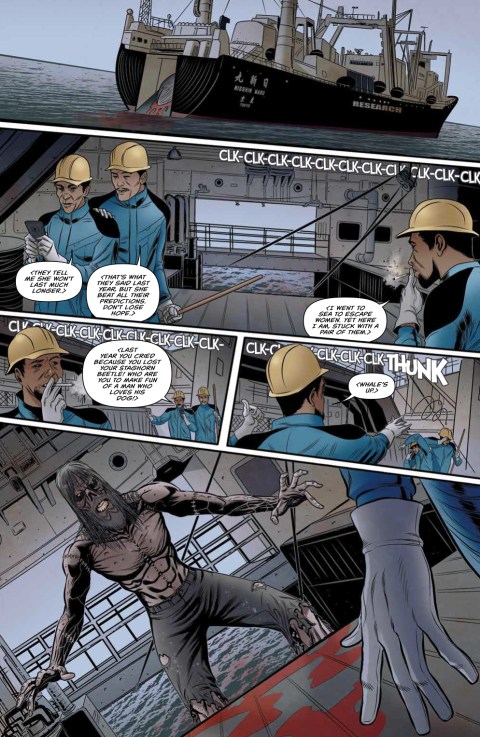
I really enjoyed the art work that Dietrich Smith brought to this story. It felt sufficiently comic book, but it also had bits of depth and darkness and shadow that conveyed various points of tragedy and sadness. I also liked the more abstract design of the cover (done by Micaela Dawn), though the drawing style inside was the design that I preferred. The details from the gore and the violence to the varied facial expressions are very well done.

Destroyer_001_PRESS_6
(source)

“Destroyer” is a superb reinterpretation of a classic story of horror and tragedy, and LaValle has once again shown his talent and retelling stories with a socially conscious lens that reflects today’s ills. It’s another update of “Frankenstein” that I think Mary Shelley would appreciate.

Rating 8: A dark and biting retelling of “Frankenstein”, “Victor LaValle’s Destroyer” takes a classic story and applies it to modern social justice themes with powerful results.

Reader’s Advisory:

“Victor LaValle’s Destroyer” is included on the Goodreads lists “Frankenstein Revisionist Novels”, and “Black Lives Matter Library Ideas”.

Find “Victor LaValle’s Destroyer” at your library using WorldCat!

Serena’s Review: “Once Upon a River”

40130093Book: “Once Upon a River” by Diane Setterfield

Publishing Info: Atria/Emily Bestler Books, December 2018

Where Did I Get this Book: ARC from the publisher!

Book Description: A dark midwinter’s night in an ancient inn on the Thames. The regulars are entertaining themselves by telling stories when the door bursts open on an injured stranger. In his arms is the drowned corpse of a little child.

Hours later the dead girl stirs, takes a breath and returns to life.

Is it a miracle?

Is it magic?

Or can it be explained by science?

Review: I’ve heard the name “Diane Setterfield” tossed around here and there over the last few years. Her novels, that often combine fantastical elements and historical settings, are the type that would likely appeal to me, so she’ll pop up on lists here and there that I glance through. All that said, for some reason or another, I’ve never actually taken the time to pick up one of her books. Big mistake! Apparently, I needed someone to take the choice out of my hands, so I’m very thankful for the publisher sending me a copy and giving my butt a good kick towards this excellent book and author.

There is an inn on a river. An inn where late nights are full of stories, tellers and listeners all gathering together over their beers to share new and familiar tales. Until one night, a story unfolds at their feet with the unexpected appearance of a little girl, apparently dead until…she’s not. But who is she? Where did she come from? Everyone has their own story, their own connection to this strange young girl. But what is the truth?

The very first thing that struck me is the writing tone of this book. In my opinion, any story that is going to also focus on storytelling as its subject matter must master this element first and foremost, and Setterfield accomplishes this quickly and thoroughly. From the very first few pages, one is swept into a lyrical story that reads like the best fairytales and folklore stories. The language is simple, but beautiful, and it’s easy to imagine sitting in the very same smoky inn, drinking mulled cider, while someone recounts this story aloud. The atmosphere is set incredibly, and while it only takes a few pages for the small girl to arrive, I already felt completely immersed in this world.

As the story progressed, I enjoyed the introduction of a larger cast of characters, all with their own distinctive stories and connections to the girl. In each story, we’re given just enough to begin forming assumptions and connections ourselves, but mysteries are ever present. Half of the fun of the book was attempting to weave all of these narratives together to form a complete circle.

Further, the setting was left a bit nebulous, but in this type of story, it seemed to work. It took a while for me to settle on what time period this was taking place in, which seems like it could be a criticism. But, like the best stories, a tale should be able to simply exist, without hard dates lodging it in time. Further, as the summary alludes to, there is a running question throughout the story of the fantastical. The little girl was dead. Everyone who saw her could confirm this. But then she wasn’t. Various characters come down on different sides when attempting to prescribe an explanation for this event. And readers, too, are left questioning what exactly is going on. Is there a level of fantasy being introduced here? Or is it the type of “fantasy” that we can all see in our everyday life, now, if we really look for it?

“Once Upon a River” is a beautiful story, mysterious and ever-flowing like the river that is at its heart. Fans of Setterfield’s previous books are sure to be pleased with this more recent entry. And new readers, like me, who enjoy stories about stories and lyrical writing will also come away satisfied. It’s just the kind of cozy book that is perfect to settle down with on these cold, winter nights.

Rating 8: A story that immediately draws you in with its beautiful writing and mysterious weave of intersecting tales.

Reader’s Advisory:

“Once Upon a River” is on these Goodreads lists: “Winter Seasonal Reads” and “Historical Fiction 2018.”

Find “Once Upon a River” at your library using WorldCat!

Serena’s Review: “Spindle Fire”

30163661Book: “Spindle Fire” by Lexa Hillyer

Publishing Info: HarperCollins, April 2017

Where Did I Get this Book: audiobook from the library!

Book Description: It all started with the burning of the spindles.

No.

It all started with a curse…

Half sisters Isabelle and Aurora are polar opposites: Isabelle is the king’s headstrong illegitimate daughter, whose sight was tithed by faeries; Aurora, beautiful and sheltered, was tithed her sense of touch and her voice on the same day. Despite their differences, the sisters have always been extremely close.

And then everything changes, with a single drop of Aurora’s blood—and a sleep so deep it cannot be broken.

As the faerie queen and her army of Vultures prepare to march, Isabelle must race to find a prince who can awaken her sister with the kiss of true love and seal their two kingdoms in an alliance against the queen.

Isabelle crosses land and sea; unearthly, thorny vines rise up the palace walls; and whispers of revolt travel in the ashes on the wind. The kingdom falls to ruin under layers of snow. Meanwhile, Aurora wakes up in a strange and enchanted world, where a mysterious hunter may be the secret to her escape…or the reason for her to stay.

Review: I don’t really remember how/when this book showed up on my radar, but I have a pretty good guess that it likely had something to do with the beautiful cover. Call me a sucker, but a detailed, non-model-featuring fantasy book jacket is likely to get a second look by me most days! Plus, it’s a fairytale re-telling, and we all know how I feel about those!

In this twisted take on “Sleeping Beauty,” the cursed princess, Aurora, is joined by a half-sister, Isabelle. Together, they’ve navigated the complicated pathways of a royal upbringing, all while missing portions of their senses that were tithed away to fairies at Aurora’s birth. Aurora, beautiful and kind, has lost the sense of touch and the ability to speak; Isabelle lost her sight. Through a secret language of tapping and a strong sisterly bond, the two have faced down every challenge thrown their way. This all comes to an end, however, when a dreadful curse finally comes to pass. But Aurora isn’t just asleep; she’s somewhere else, in a new land that is rife with danger. Just as she works to find her way home, Isabelle sets out to rescue her sister, traversing the country to find a young man capable of kissing her sister awake.

While this book never hit the highs of some of my favorite fairtyale re-tellings, it did have some factors that played heavily in its favor. For one thing, in the multitude of “Beauty and the Beast” and “Cindrella” re-tellings that are out there, I haven’t come across as many “Sleeping Beauty” stories. Kind of obvious, when you think about it. It’s definitely a challenge to tell a story where the main action all takes place while your heroine is asleep. But Hillyer had a somewhat brilliant, two-fold answer to that. Not only does Aurora experience a different world while her physical body back in “reality” sleeps, but we’re given an entirely new, secondary heroine in the form of Isabelle who inherits much of the plot often relegated to the Prince.

Stating the obvious once again, I do love me some stories about strong sisterly bonds and, as that’s at the heart of this story, I was also predisposed to enjoy it for that reason. We have just enough time and background detail given in the beginning of the story to appreciate the special relationship the two sisters have built with each other. For one one thing, each is approaching the world from a challenging position. Aurora cannot feel or speak. She doesn’t know when she’s injured and can’t communicate with those around her. Isabelle can’t see. Of the two, Isabelle, through either nature or necessity, is still the much more capable one. But even with that being the case, we see how Aurora’s more quiet goodness has protected Isabelle throughout their childhoods, as well. But when separated, we truly see them shine. Aurora comes into her own, having to play a more active role in her own story without the guiding force of her sister. And Isabelle escapes the confines of a palace that has always looked down on her as mostly just a nuisance.

I did end up enjoying Isabelle’s story more, of the two. Her experiences navigating the world without sight were interesting and spoke to the strength and abilities of those who are blind. She always manages to find clever ways of accomplishing things that one would at first guess to be beyond her. She is also able to use her better developed other senses to suss out information that others might have missed. She is also given the better story arc as far as romance goes, though there is a whiff of a love triangle in the air that I didn’t appreciate.

Aurora’s story fails pretty miserable in the romance department, introducing an instalove romance quite quickly and never really delving into much more than that. But luckily, her story is the one that takes place in the heart of an enchanted land where the mysteries behind her curse are truly at play. So we’re giving a good number of distractions on that front, and the secret history of the fairies is definitely worth the wait.

The story is also broken up with various chapters from some of the fae perspectives. Not only do we get into the mindsets and histories of the two fairy sisters who brought this all to pass, but other, secondary fairies are also given perspectives. Some of these felt more useful than others, but I also found the interludes to be nice breaks from the standard POV switches between our main heroines. We were given a lot of great world-building and the fairy history and politics were padded out, as seen through the eyes of the various fairies involved.

The story doesn’t end on a cliffhanger, but it also definitely doesn’t end at all, making it necessary to read the second book to complete the story. While this one felt a bit light, as far as storytelling goes, I was definitely invested enough in the princesses’ stories to want to complete the duology. Here’s to hoping the love triangle is stomped out quick and the instalove…I don’t know, does something. For fans of fairytale retellings, I think this one is definitely worth a shot. Go in expecting a lighter, quick read and you’ll likely be left satisfied.

Rating 8: A few stumbles in the romance department, but still a sweet fairytale retelling at its heart.

Reader’s Advisory:

“Spindle Fire” is only on variations of the same list on Goodreads, so here it the broadest one: “Fairy tales & Retellings.”

Find “Spindle Fire” at your library using WorldCat!

Serena’s Review: “Radiance”

24473763Book: “Radiance” by Grace Draven

Publication Info: self-published, January 2015

Where Did I Get this Book: from the library!

Book Description: THE PRINCE OF NO VALUE

Brishen Khaskem, prince of the Kai, has lived content as the nonessential spare heir to a throne secured many times over. A trade and political alliance between the human kingdom of Gaur and the Kai kingdom of Bast-Haradis requires that he marry a Gauri woman to seal the treaty. Always a dutiful son, Brishen agrees to the marriage and discovers his bride is as ugly as he expected and more beautiful than he could have imagined.

THE NOBLEWOMAN OF NO IMPORTANCE

Ildiko, niece of the Gauri king, has always known her only worth to the royal family lay in a strategic marriage. Resigned to her fate, she is horrified to learn that her intended groom isn’t just a foreign aristocrat but the younger prince of a people neither familiar nor human. Bound to her new husband, Ildiko will leave behind all she’s known to embrace a man shrouded in darkness but with a soul forged by light.

Two people brought together by the trappings of duty and politics will discover they are destined for each other, even as the powers of a hostile kingdom scheme to tear them apart.

Review: This book showed up on some list or another that focused on lesser know romantic fantasy stories. I had already read many of them but was intrigued by the list author’s description of this one which focused on the incredibly positive romantic pairing at the heart of the story. All too often with romance novels, I find myself having to hold back my eyerolls or intentionally speed read through sections where one member of the central pairing (or both) is exhibiting behaviors that are pretty unhealthy and sometimes border on abusive. It’s one of the main reasons that I tend to avoid books where romance is too much of the focal point at the heart of the story. But since its healthy romance was at the heart of the list author’s reason for including “Radiance,” I thought that this one was worth giving a shot!

Brishen and Ildiko come from to very different races. Ildiko is a human, born to live during the day. Brishen is a Kai, a human-like being who lives at night, possesses certain magical powers, and looks terrifying to most humans with his dark skin, white eyes, and sharp teeth. Unlike the book description above would imply, both know they are destined for a marriage that would align their people and have resigned themselves to this fate. Together, they face the challenges of skepticism from their own people who resist seeing a bond such as theirs and threats of violence from outside nations who feel threaten by the increased tie between human kind and the Kai.

It was difficult to write even that short synopsis above because this book is definitely a character-driven story. There is a story arc, but it is one that is only sprinkled in here and there and comes into play only at the very end of the book. Instead, most of the story is devoted solely to getting to know Ildiko and Brishen and portraying their blessedly realistic (and devoid of instalove!) relationship.

Through them, we get some interesting world-building. Ildiko’s people seem to be standard humans. We don’t spend much time in her world, however, as the story quickly shifts to the land of the Kai, as Ildiko and Brishen travel their to establish their home. I really enjoyed the descriptions of Kai culture, their dress, food, and lifestyle. It was all very different from humanity, but also struck closely enough that a marriage between the two peoples still makes sense.

Some of the more intriguing portions of these descriptions, the cultural norms and the physical appearance of each race, came from the blunt evaluations offered up by Brishen and Ildiko. In the very first few chapters, they establish a strong, trust-based style of communication that allows them to express their bewilderment and sometimes fear at the other’s way of life and looks. See, right off the bat, healthy relationship norms! Communication, it will do wonders! These descriptions and conversations also highlight the witty dialogue that makes up much of the book and was incredibly enjoyable. Brishen teases Ildiko about her “horse-like teeth” and Ildiko points out some the disturbing aspects of Brishen’s all-white eyes.

As I said, much of the story is simply focused on these two characters and how they slowly build a friendship and romance over the course of the book. They are also, at the heart of things, both just very good people. It seems like a weird thing to have to highlight, but this aspect of the story, their inherent goodness and the healthiness of the relationship they build, is what makes this book stand out as so satisfying. There are real challenges they face and neither simply brushes off the disturbance they feel at the other’s physical appearance, but mutual respect, friendship, and trust is slowly laid out as the foundation of their growing attachment. It’s just a lovely example of how you can write a romance novel without having to make your main characters brooding, bizarrely non-communicative, or just constantly misunderstood.

It looks like there are follow up books to this story, but it can also mostly be read as a standalone novel. It’s definitely a light, romantic read, so don’t go in expecting epic world-building or elaborate magical systems. The fantasy elements are all clearly there as support systems for the character-driven story at its heart. I very much enjoyed this book, and I agree with the author of the original list (I can’t seem to find it or I would link it!): this book is rare for what it is doing right with its romance.

Also, a quick note. This is a self-published novel, but I was able to check out an ebook at the library. Just another plug for all self-published authors out there: libraries are often willing to stock your ebooks, especially if you’re local and can point to some interest in your story. There’s definitely no harm in asking!

Rating 8: A magical unicorn of a romance novel where the main pairing is based on healthy relationship norms!

Reader’s Advisory:

“Radiance” is on these Goodreads lists: “Slow-burn romance” and “Fantasy Romance.”

Find “Radiance” at your library using WorldCat!

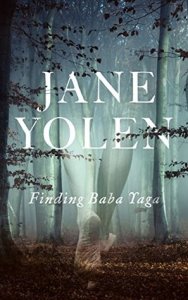
Serena’s Review: “Finding Baba Yaga”

39680799Book: “Finding Baba Yaga” by Jane Yolen

Publication Info: Tor.com, October 2018

Where Did I Get this Book: Netgalley!

Book Description:

You think you know this story.
You do not.

A harsh, controlling father. A quiescent mother. A house that feels like anything but a home. Natasha gathers the strength to leave, and comes upon a little house in the wood: A house that walks about on chicken feet and is inhabited by a fairy tale witch. In finding Baba Yaga, Natasha finds her voice, her power, herself….

Review: I don’t read a lot of novels in verse, but I’ve been a fan of Jane Yolen for quite a while. Pair that with a Baba Yaga story, and I’m in! This was a quick read, and while it took me a bit to really feel invested in the story, in the end, I really enjoyed this interpretation of Baba Yaga and the writing decisions behind presenting it as a story in verse.

The story follow Natasha, a girl running from a very unhappy home. As the cover of the book so beautifully depicts, she makes her way into the woods where she finds a certain house walking about on chicken feet. From there, the modern setting from which Natasha came mixes with the fairytale version of Baba Yaga that readers are more familiar with.

There are a bunch of incredibly strong themes in this book. Natasha, coming from a bordering on abusive home, travels an intense journey of self-discovery throughout the story. Through her, we see the struggles that face those who live in shut-down families, like the challenges to not only find one’s own voice, but even to give validation to one’s own thoughts as valid and worthy of expression. In her “new life,” she must not only tackle these growth areas, but deals with both sides of the emotional coin in loss and love. There’s also a very nice through-line about found families and the strength of connections that can be forged between two individuals who, outwardly, have nothing connecting them.

I also very much enjoyed the poetic style of the book. Like I said, I don’t read a lot of novels in verse. If anything, I’m more likely to pick up a collection of poetry than I am to read a book like this. In the past, I’ve often struggled to feel truly connected to a story that reads like a novel but is told through such a reduced number of words and often presented in challenging formats on the page itself. Maybe this comes from too many poetry classes, but I’m often so distracted trying to analyze line breaks and why a certain piece was laid out on the page the way it was and what that says about the content to maintain a consistent connection with the ongoing story.

I had the same problem with this story, but about halfway through, I was able to get more fully into the action. I think this slow dive in also had to do with the way that Yolen tells her story. Things aren’t all simply revealed from the beginning. Instead, we’re slowly introduced to who Natasha really is, what her life has been, and how the events she’s currently experiencing connects to it all.

I really enjoyed this book. It’s a very short read (not only page count, but word count), so readers are likely going to be able to finish it in one setting. If you’re skeptical about novels in verse, I’d also say that this might be a good introductory piece, especially if you have an interest in fairytales and Baba Yaga in particular (I didn’t get into her much, but I really enjoyed Yolen’s interpretation of this classic character as well!). And, of course, fans of Yolen’s work will not be disappointed by this new entry.

Rating 8: Though it starts slow, the style of the story adds power to the deeper themes it is presenting throughout, such as self-discovery and finding one’s own power in the world.

Reader’s Advisory:

“Finding Baba Yaga” is a newer title, so it isn’t on many relevant lists. But it should be on “Novels in Verse.”

Find “Finding Baba Yaga” at your library using WorldCat!

Serena’s Review: “Magic Triumphs”

Magic_Triumphs.inddBook: “Magic Triumphs” by Ilona Andrews

Publishing Info: Ace, August 2018

Where Did I Get this Book: from the library!

Book Description: Kate has come a long way from her origins as a loner taking care of paranormal problems in post-Shift Atlanta. She’s made friends and enemies. She’s found love and started a family with Curran Lennart, the former Beast Lord. But her magic is too strong for the power players of the world to let her be.

Kate and her father, Roland, currently have an uneasy truce, but when he starts testing her defenses again, she knows that sooner or later, a confrontation is inevitable. The Witch Oracle has begun seeing visions of blood, fire, and human bones. And when a mysterious box is delivered to Kate’s doorstep, a threat of war from the ancient enemy who nearly destroyed her family, she knows their time is up.

Kate Daniels sees no other choice but to combine forces with the unlikeliest of allies. She knows betrayal is inevitable. She knows she may not survive the coming battle. But she has to try.

For her child.

For Atlanta.

For the world.

Previously Reviewed: “Kate Daniels Series” and  “Magic Shifts” and “Magic Binds”

Review: It’s kind of a rare and strange thing to reach the end of an urban fantasy series. For some reason, it seems that urban fantasy in particular tends to draw forth series that go on and on. This has obvious pros and cons, but I tend to think that every story must come to an end, and I’d rather that happen on the author’s own terms than any outside factor. And, ideally, before the creativity of the world begins to leak out, something that occurs all too often with long-running series in any genre. So, it was with mixed emotions that I picked up “Magic Triumphs.”

There have really been only two urban fantasy series that I’ve followed for the last several years, the Kate Daniels series and the Mercy Thompson/Alpha and Omega series. My most recent review was from a book in the latter, and oof, it was rough and in many ways serves as a perfect example of the concerns I listed above about long-running series. With that warning in mind, I was pleased to discover that the Kate Daniels books would end with this one, but also…now what do I read as far as urban fantasy? Ah well, a problem for another day.

“Magic Triumphs” opens over a year after the events in “Magic Binds.” Kate and Curran have had their son, Conlan, and he is about a year old at this point. The rest of their lives are going as expected: continuously shoring up allies and points of strength in preparation for the ultimate show-down with Kate’s father Roland that they know could come at any time. And here, of course, it does. But not only that. Of course not only that! A new, mysterious and powerful force has attacked Atlanta, and now Kate and co. have to balance a war on two fronts.

This book was facing a pretty big challenge for me right off the bat: introducing a child character. This is completely a personal preference thing, but I often find child characters in books to have several problems. They’re often annoyingly “precocious” or “twee” and they have the tendency to re-focus all of the story’s action or the main character’s attention to them. Obviously, a new addition like this will impact the story and the main character’s relationships with everyone around them. But all too often I feel like authors somehow end up losing much of what made up the original characterization of their protagonists under this new force and drive.

Luckily, that is not the case here. While Conlan is definitely a new focal point for Kate and Curran and a huge motivation in the decisions they each make, all of the aspects of these characters that we’ve grown to know and love were still present. Kate kicks ass and takes names, but also, adorably, frets about minor issues with her son, constantly dragging him to the Pack doctor for check-ups. Curran is still protective and supportive, with his own plans on how to get his small family through the trials ahead.

There are also all of the many, many, MANY familiar faces sprinkled throughout this book. Honestly, I don’t think I had a full grasp on exactly who everyone was. The cast is so large and some characters have only had large roles in various books throughout the ten book series that I couldn’t quite pin down some of them. But, as far as it goes, Andrews gives readers enough information to catch you up on who is who and why they are important, so I was able to pretty easily just go with the flow for some of this unknowing.

I did like the addition of the new big bad that was introduced in this story. I was pretty surprised that the book even went this route, honestly. The series has been building to the show-down with Roland for books and books now, so I fully expected that to be the primary focus of this story. That made it all the more surprising when that aspect of the story took a back seat through much of it. I was sorry not to get more page time between Kate and her power-mad father, but given the situation that had been built up over the entire series, there weren’t that many options for resolving it that would have made sense, so this new addition and focus seemed to help. There were several other surprises in store throughout the book, including some hidden plans of Curran’s, an introduction to a new group of magical beings, and some pretty disgusting magical threats.

My one critique of the book comes down to pacing. The story starts off fairly slowly, taking quite a while to even get to the point where the main characters even know what they’re dealing with. And then once they do, there is very little page time left to really deal with the fallout of this situation. This then leads to a rather rushed ending and what felt like a bit of a truncated last battle and ultimate resolution. Like I said, the series has been building to this moment, so I wish there had been just a bit more given to it, be that increased page time or maybe just a bit more “oomf” put into the proceedings.

In the end, however, I was very satisfied with the conclusion to this series. I was sad to see these characters go, but I was glad they were able to go out on a high note. For fans of the series, this final chapters is definitely worth getting your hands on.

Rating 8: A bitter-sweet goodbye to what turned out to be an excellent urban fantasy series.

Reader’s Advisory:

“Magic Triumphs” is on these Goodreads lists: “NEW ADULT fantasy & paranormal romance” and “Sci-Fi/Fantasy with Healthy Relationships.”

Find “Magic Triumphs” at your library using WorldCat!