Serena’s Review: “The Girl in Red”

42881101Book: “The Girl in Red” by Christina Henry

Publishing Details: Berkley, June 2019

Where Did I Get this Book: audiobook from the library!

Book Description: It’s not safe for anyone alone in the woods. There are predators that come out at night: critters and coyotes, snakes and wolves. But the woman in the red jacket has no choice. Not since the Crisis came, decimated the population, and sent those who survived fleeing into quarantine camps that serve as breeding grounds for death, destruction, and disease. She is just a woman trying not to get killed in a world that doesn’t look anything like the one she grew up in, the one that was perfectly sane and normal and boring until three months ago.

There are worse threats in the woods than the things that stalk their prey at night. Sometimes, there are men. Men with dark desires, weak wills, and evil intents. Men in uniform with classified information, deadly secrets, and unforgiving orders. And sometimes, just sometimes, there’s something worse than all of the horrible people and vicious beasts combined.

Red doesn’t like to think of herself as a killer, but she isn’t about to let herself get eaten up just because she is a woman alone in the woods….

Review: This is another book that I put on my list sometime last year and forgot about. I rediscovered it on my audiobook list and placed a hold on it recently. All of that without really looking at the book description again. I had the idea that it was some sort of fairtyale retelling (I know, where could I have gotten that idea from??). Well, turns out it’s not so much that as a survival story after a massive global pandemic wipes out most of the population. Womp womp. Perfect timing there Serena! But I still really enjoyed this read, even if it hit a bit too close to home at times.

We first meet Red as she’s making her way through the woods, on her way to Grandma’s house. But life has not always been this lonesome, often terrorizing and violence filled trek. Through a series of flashback, we see Red’s world slowly come apart at the scenes as a global, deadly pandemic begins wiping out the population. And of her family, only Red fully realizes the extent of change ahead of them and the seemingly drastic steps they should be taking to prepare. Told in alternating chapters between past and present, we travel alongside Red as she navigates the dangers of this new reality and learns there is more to this pandemic than even she had prepared for.

So, like I said, I thought this was a fairly straightforward fairytale retelling when I requested it. I’m sure when I put it down on my TBR pile, I was aware of the actual subject matter as it’s right there in the book description. But I’d forgotten it over time. And, as with most audiobooks I read from the library, without an actual physical book to look at, I went into this one mostly blind only to realize what I was reading later. It was definitely an interesting reading experience, I have to say. There are plenty of books throughout my life that I can point to as having had different effects depending on the real-life events going on in my own life at the time I was reading them. And this was definitely one of those cases.

On one hand, Red’s extreme attention to detail and planning was intimidating for those of us just managing to get by in these times. Obviously, her pandemic, one that killed off 80% or so of the those it infected, was very different than our situation. But the human behavior that resulted was largely the same. There were those who stuck their head in the sand. Those who came up with wild theories. Those who were skeptical of the “help” being offered by the government. And those who took matters into their own hands. It was all incredibly believable and, of course, off-putting for that same “realness.”

I also really liked how we delved into Red’s own mindset in the midst of it. Unlike many other post-apocolypic/survival stories, this one doesn’t shy away from the way pop culture and media would shape the views of those going through it. Again and again, we see Red compare her own situation to that of a character in a movie and base her decisions around what those same characters did. We also see how there are both pros and cons to this inevitable comparison. On one hand, she has a healthy dose of skepticism about dark corners or splitting up as a group. But on the other hand, we see her have to grapple with the very real problem that there is never always a right choice. And not only will every choice come with its own risks, but the time spent over-analyzing which might be best comes with its own distinct risks and dangers. I really enjoyed this deep-dive into the psychology that an individual living through something like this might experience.

And, while there were definitely sad parts to the story, I appreciated that this book never wallowed in the direness of the situation. This is no “The Road,” by any means. It’s still an action/adventure book at its heart, and while tragedy is an inevitable part of it, Red herself is a hopeful character and one who keeps the story buoyed up and free from becoming overwhelmingly grim.

My only real criticism of this book comes with the ending. It kind of came out of nowhere. I looked down at my audiobook at one point and realized there were only 30 minutes left in the story and seriously thought maybe I’d made a mistake when downloading it. There was no way it could wrap up from where it was at that point to a satisfying ending! And while the ending was technically satisfying, it did feel like the author just kind of left off after the last big action scene and skipped to a final few pages of an ending. It almost read like a writing school project in that way. Like the author ran out of steam completely and just jotted something down so that they could check off the box for “has an ending” in the assignment criteria.

But, even with that, I still very much enjoyed this book. The audiobook was also very well down and the narrator did an excellent job of bringing Red’s voice to life. If you have the mental/emotional capacity for a book on this subject matter right now, I really recommend this one. Like I said, it could be tough at times, but as far as survival/pandemic stories go, it was surprisingly approachable and manageable, even during Covid times.

Rating 8: A surprising read full of twists and turns, but told from a primarily hopeful place and one that manages to pull the book up past what could have been an overly grim subject matter.

Reader’s Advisory:

“The Girl in Red” is on these Goodreads lists: “Books that are so exciting your heart palpitates like mad!” and “Smart Apocalyptic and Dystopian Fiction.”

Find “The Girl in Red” at your library using WorldCat!

Serena’s Review: “Driftwood”

9781616963460_b1ce2Book: “Driftwood” by Marie Brennan

Publishing Info: Tachyon Publications, August 2020

Where Did I Get this Book: Edelweiss+

Book Description: Who is Last?

Fame is rare in Driftwood- it’s hard to get famous if you don’t stick around long enough for people to know you. But many know the guide, Last, a one-blooded survivor who has seen his world end many lifetimes ago. For Driftwood is a strange place of slow apocalypses, where continents eventually crumble into mere neighborhoods, pulled inexorably towards the center in the Crush. Cultures clash, countries fall, and everything eventually disintegrates.

Within the Shreds, a rumor goes around that Last has died. Drifters come together to commemorate him. But who really was Last?

Review: I requested this book mostly on the premise that I have enjoyed the two books by Marie Brennan I had read before. Both were in some way part of her “Lady Trent” dragon fantasy series. This….sounded different. But as I felt that her strong writing was one of the biggest pluses for both of those other books, I was curious to see how this skill set would apply to a completely different story, one that seemed to much more science fiction and post-apocalyptic than high fantasy. And boy was I pleased!

It turns out that even worlds have a place to go when they die. Or, more accurately, when they’re still in the process of dying. After whatever sort of apocalypse suits any particular world, it makes its way to Driftwood, a place made up of many different worlds slowly shrinking and moving inwards towards the Crush where the last bits of them and their people will disappear for good. But there is one being who seems to have been around forever, Last. No one remembers his world or his people, but many remember stories of ways that Last touched their lives. Now, when he has disappeared, maybe for good, they gather to share those stories.

I wasn’t aware of this from the book description, but it turns out that this book is more of an anthology-like story than a plot-driven storyline about any specific character. I guess it’s there enough in the blurb, but I didn’t pick up on it. But it turned out to be a really nice surprise and a perfect way of creating such a unique, creative world. As much as this book is about Last and the influence he had on many people’s lives, it’s also about Driftwood. And by telling the story through these smaller narratives, we get to dip our toes into not only a bunch of really interesting new worlds, but into a variety of ideas and coping mechanisms that people have for dealing with death, the end of the world, and inevitability as a whole.

I also read the author’s blurb at the back and discovered that the author was trained as an anthropologist. This all makes so much sense. Not only for this book, but now in hindsight looking at the way the Lady Trent books were written and their focus. But here, we can really see those skill sets shine. When describing all of these different worlds and peoples, it’s not as simple as describing different ecosystems or different body types. No, Brennan creates religions, cultures, hierarchies, ways of speaking, all of the little things that really go into forming a “people.”

Last was a great character in and of himself. But he is also the type of character that we know so little about (even by the end of the book), that it quickly becomes clear that what we do “know” about him are only impressions left by those telling their unique stories of him. But through them we can parse together a really interesting character who has existed in a space that, by definition, operates to undue existence. To be the only one of his kind. To not be “known” by anyone. To go on while the “world” is shifting constantly around you. Learning new things, but also constantly losing what you know. I really liked the brief insights we got into the kind of mentality that Last had to develop to survive. And that, while bleak at times, we’re left with a character who values hope and love above everything.

The only real ding I have for this book was the ending. It felt like it came out of nowhere, was very sudden, and left me with a bunch of questions. On one hand, I’m ok with there still being secrets hidden in this world and about Last. Indeed, that’s half of what makes the book so intriguing, the feeling that you’ve only scratched the surface. But there were a few “reveals,” for lack of a better word, toward the end that left me scratching my head. I couldn’t figure out whether I was missing some grand point or not. Part of me really feels like I am. But I re-read it several times and…I still don’t really know what point the author was trying to come to, if any. Maybe others will have more success.

If you’re a fan of this author, than this is definitely another of hers to check out. But, overall, if you’re a fan of anthologies, science fiction, and stories that explore what “humanity” really is, this is an excellent read. If I had the “Beach Reads” list to do over, this is definitely the kind of book that I’d throw on there.

Rating 9: Beautifully written and incredibly unique. This is definitely a book to check out this summer!

Reader’s Advisory:

“Driftwood” is a newer title, so it isn’t on many Goodreads lists, but it is on “Hugo 2021 Eligible Novels.”


Serena’s Review: “The Faithless Hawk”

41022295._sy475_Book: “The Faithless Hawk” by Margaret Owen

Publishing Info: Henry Holt and Co., August 2020

Where Did I Get this Book: Edelweiss+

Book Description: As the new chieftain of the Crows, Fie knows better than to expect a royal to keep his word. Still she’s hopeful that Prince Jasimir will fulfill his oath to protect her fellow Crows. But then black smoke fills the sky, signaling the death of King Surimir and the beginning of Queen Rhusana’s merciless bid for the throne.

With the witch queen using the deadly plague to unite the nation of Sabor against Crows—and add numbers to her monstrous army—Fie and her band are forced to go into hiding, leaving the country to be ravaged by the plague. However, they’re all running out of time before the Crows starve in exile and Sabor is lost forever.

A desperate Fie calls on old allies to help take Rhusana down from within her own walls. But inside the royal palace, the only difference between a conqueror and a thief is an army. To survive, Fie must unravel not only Rhusana’s plot, but ancient secrets of the Crows—secrets that could save her people, or set the world ablaze.

Previously Reviewed: “The Merciful Crow”

Review: I listened to the first book in this duology as an audiobook. And in my review I credited the narrator with really pulling her weight to imbibe this story with an extra level of emotion and sense of character that helped push the book forward past what, at times, was rather slow-paced storytelling. With that in mind, I was a bit nervous when I picked up this book as a standard e-ARC through Edelweiss. Would it hold up without the narrator’s perfect voice for Fie? Yes, yes it did and not only that, but it was better than the first in all ways.

With Prince Jasimir delivered to relative safety and with an army at his back, Fie’s hope for the future, a future where Crows are protected from the vicious groups that hunt them, seems within grasp. As a Chief now herself, Fie feels this sense of responsibility to her people more strongly then ever. But one things goes wrong after another, one devastating loss after another, until Fie wakes up one morning with her people in hiding and a choice of either a future of starvation and being hunted down, or of leaving her people and going into the heart of her enemy, the castle itself, to do what needs to be done. But even there, Fie must rely on half-lost Crow magic and unravel an erased history to truly find a path forward for not only her own people, but everyone in Sabor.

As I mentioned in my intro, while I did enjoy the first book this duology overall, I did finish it with some lingering questions about the book’s pacing and ability to carry a more plot-driven storyline. So I was incredibly pleased to see both of those issues fully addressed in this second book. Not only does this book have a more action-packed plot than the first, but the pacing was sustained throughout the book without any of portions that seemed to lag (something that happened for a fairly substantial portion in the middle of the first book.)

I also really liked how much this book expanded on the magic-system and history of Sabor. I thought the hierarchy system and the unique abilities assigned to each group was interesting in the first book, so I was really excited to see this book dive much more deeply into not only how it all worked, but in the history of the system itself. I hadn’t even realized until this book started answering them how many lingering questions I had had from the first book, particularly about the Crows and Fie’s own magic. And all of this information seemed to unfold in a very organic, natural way, without any infodumps or unbelievable revelations.

I also really liked Fie’s own part in the story. She takes on a very active role in this book and faces completely different challenges than the ones she dealt with the first go-around. We see not only how she is better prepared for these greater ordeals this time, but also how the increased feeling of responsibility and the new closeness to others affects her own abilities to trust and make decisions on a grand scale vs. personal feelings. Jasimer also featured more heavily in this book than I expected, and, as I didn’t love his character so much in the first book, I was extremely pleased with what we had from the character here. We got to see a lot of the growth he experienced in the first book pay off, and, overall, he was incredibly likable this go-around. Something about being a “cat wrangler” didn’t hurt my impression of him either!

I was also pleased with the romance in this story. Things definitely didn’t go the route I expected. But some of the “twists” here were also easy enough to see through that for those of us who were worried, you can rest fairly assured that all turns out well, though perhaps not how you expected.

Overall, I was really pleased with this book, both in and of itself and as a conclusion to the duology as a whole. There were some legitimate surprises and twists that I didn’t see coming, and those that I did were so purely satisfying that I didn’t care that I could predict them in advance. I think the author had a better handle on the pacing in this book and really came into her own with the strength of writing. For those who enjoyed “The Merciful Crow,” definitely don’t miss out on this one!

Rating 9: A completely satisfying conclusion in pretty much every way!

Reader’s Advisory:

“The Faithless Hawk” is a new title, so it isn’t on many relevant Goodreads lists, but it is on “2020 YA Sequels.”

Find “The Faithless Hawk” at your library using WorldCat!


My Year with Jane Austen: “Mansfield Park” Part I

45032Book: “Mansfield Park”

Publication Year: 1814

Book Description: Adopted into the household of her uncle, Sir Thomas Bertram, Fanny Price grows up a meek outsider among her cousins in the unaccustomed elegance of Mansfield Park. Soon after Sir Thomas absents himself on estate business in Antigua (the family’s investment in slavery and sugar is considered in the Introduction in a new, post-colonial light), Mary Crawford and her brother Henry arrive at Mansfield, bringing with them London glamour, and the seductive taste for flirtation and theatre that precipitates a crisis.

History – “I read it a little as duty, but it tells me nothing that does not either vex or weary me.”

As her first book conceived and written as an adult, “Mansfield Park” reads tonally very different than her prior two works. Lacking the wit and sparkle of “Pride and Prejudice” and memorable characters of “Sense and Sensibility,” it was received with mixed reviews from its critics. That didn’t stop it from selling out its first run within six months.

The story takes a much more serious approach and spends time exploring themes that were important to Austen, now in her upper 30s. The Bertram families connection to plantations in Antigua and slavery are heavily touched on. The book also explores themes of infidelity, loyalty, and the exploration of the role that the clergy and faith play in the lives of the upper class.

This more serious approach appeals to some readers, both the modern ones and the book’s contemporaries. But others struggled with this tonal change and were perplexed by its heroine, Fanny Price, a young woman much out of line with the previous strong women to grace Austen’s pages. Though Fanny is of a more quiet sort, her strengths of perception, duty, and propriety never fail her, making her more alike to Eleanor Dashwood than any other character. However, the amount of page time dedicated to her actual speeches is much reduced than other heroines, leaving readers to pick up on the smaller, more subtle clues into Fanny’s true worth.  (source)

“I have something in hand—which I hope on the credit of P. & P. will sell well, tho’ not half so entertaining.”– Jane Austen

Part I – Chapters 1 – 25

Story – “The person, be it gentleman or lady, who has not pleasure in a good novel, must be intolerably stupid.”

Of three sisters, one marries well, becoming Lady Bertram of Mansfield Park. One marries in a middling way, becoming Mrs. Norris. And one marries for passion, but poorly, and becomes Mrs. Price. As the years pass, Mrs. Price feels the weight of many children and increasing poverty. Always looking to be useful (but to avoid expense), Mrs. Norris convinces her sister and brother-in-law, Sir Thomas, to take on one of Mrs. Price’s children as a ward. And so Fanny Price comes to live with them in Mansfield Park.

There, she finds an intimidatingly proper and uptight uncle, a lazy and selfish aunt, and another aunt, Mrs. Norris, who makes it her life’s work to remind Fanny how lucky she is to be living among her betters and how she must never forget how unimportant she herself is. Her cousins, Maria and Julia, though taught well, think much of themselves and care little for Fanny. Her oldest cousin, Tom, is too old to even notice her. And her only ally becomes her staunch friend and defender, the second oldest, Edmund. Over the years, it is only he who remembers to look out for Fanny and put her interests forward. Being reserved and polite to the point of silence, Fanny never does so herself.

Over the years, Fanny grows up and very little changes in her life. Her only connection to her family of origin is in letter writing with her brother William whom her uncle, Sir Thomas, helps into starting a career in the Navy. When Fanny is in her upper teens, it becomes necessary for Sir Thomas to travel to Antigua where the family’s sugar plantations are suffering. Though loving of his family, his removal lightens the mood greatly at Mansfield. It is lightened even further when a new set of neighbors move in bringing two young people, a Miss Crawford and her brother, Mr. Crawford. Both are elegant and entertaining, bringing much liveliness to Mansfield Park. The two Bertram sisters are particularly intrigued by the charming Mr. Crawfod. This is fine for the younger, Julia. But the elder, Maria, has been recently engaged to a rich, but not smart, gentleman, Mr. Rushworth.

At first, Edmund joins Fanny in being hesitant about the extent of Miss Crawford’s liveliness, feeling that too often her quick wits lead her astray and into moments of disrespect people and institutions that she should value more highly. But over time, Edmund becomes more and more enamored of Miss Crawford and begins to see only good in her. Fanny cannot follow him in this opinion, thinking cautiously of Miss Crawford and quite poorly of Mr. Crawford who she sees as toying with her two cousins. Edmund even verges on becoming neglectful of Fanny, borrowing out her riding horse to Miss Crawford for lessons. He realizes his error, but it still hurts Fanny, who has begun to feel more and more for her beloved cousin.

On a trip to Mr. Rushworth’s estate, Fanny’s fears for her cousin Maria come to a head as she sees her become more and more neglectful of her own fiance. At one point, while walking, Mr. Crawford and Maria send Mr. Rushworth off in search of a key to a locked gate, then shortly after he leaves, jump the fence and continue on their way without him. Fanny is distressed, even more so for being abandoned by Edmund and Miss Crawford who also make their way forward when Fanny is tired and seem to forget about her for an hour while she waits patiently. On this same trip, Miss Crawford is dismayed to learn that Edmund plans to become a clergyman in a few short months. Being neither a rich profession or a distinguished one, she is quite alarmed for she, too, has begun to imagine a future with Edmund. Fanny is dismayed to hear her speak so poorly of the profession and is astonished that Edmund tolerates even as much as he does; but he is clearly falling more and more in love with her. Mrs. Norris, who accompanies them, of course reminds Fanny just how privileged and lucky she is to experience joys like this.

That fall, Tom and his friend, Mr. Yates, join the group at Mansfield Park. Mr. Yates has the inspiring idea that they should put on a home theatrical. Everyone is all for it, except for Edmund and Fanny who protest that it is not only inappropriate but disrespectful  of Sir Thomas’s wishes, as everyone knows he would disapprove of this plan. Eventually, however, Edmund caves and takes on a role alongside Miss Crawford. Edmund justifies his change in heart as due to his wish to avoid adding stranger to their party to complete the cast, but Fanny hurts to see him become inconsistent and weak in this way.

Having managed to string both sisters along quite successfully for several months, things come to a head between Mr. Crawford, Maria, and Julia when it comes to assigning parts to the play. With only one major role for a woman left to fill, and a part that plays the love interest for Mr. Crawford’s character, Mr. Crawford shows his hand when he advocates for Maria to play the part. Crushed, Julia refuses to be in the play any longer. Maria is exultant in her triumph and pays less and less attention to her betrothed. Fanny tries to bring up her concerns to Edmund, but he doesn’t see it.

A few days before the play is to be put on, Sir Thomas arrives back home unexpectedly. With his arrival comes a swift conclusion to everything having to do with the play. He is disappointed in Edmund for allowing to happen, as well as Mrs. Norris, whom he depended upon to argue his point in situations like this while he was gone. Mr. Yates, whom Sir Thomas strongly disapproves of, makes a quick exit. So, too, follows Mr. Crawford who make very few excuses or goodbyes before leaving abruptly. Maria’s hopes are dashed, and instead she becomes even more dedicated to her marriage to Mr. Rushworth which will afford her wealth and independence. After the marriage, she and Julia depart to Brighton.

Now, as the only young lady in the house, Fanny’s position is brought further forward. Miss Crawford seeks her out as a companion, and Fanny, to Mrs. Norris’s horror, is asked to spend time with her and even attend a dinner party. Fanny sees this more as an obligation than as a joy as she is continually pained by brief moments of Miss Crawford’s inappropriateness as well as the growing attachment she sees forming between Miss Crawford and Edmund.

At her first dinner party, Mr. Crawford suddenly reappears. He means only to stay for a few weeks, but seeing an intriguing and new conquest in Fanny, he decides to stay on later. Her complete disinterest and coldness towards him only inspires him further. Miss Crawford laughs at his exploits and tells him not to toy with her too much. Luckily Fanny is warded by more than just a dislike for Mr. Crawford, but with a previous attachment to Edmund. She begins to appreciate some of Mr. Crawford’s charms, but can never forget his cruel treatment of her two cousins.

A true joy comes to Fanny in the arrival of her brother William who is currently on shore from his duties in the Navy. Sir Thomas is pleased to see him coming along well, and Fanny is in raptures having a beloved sibling by her side, someone whom she doesn’t fear, or feel inferior of, or feel obligated to. Mr. Crawford finds more opportunities to gain points in Fanny’s book by lending William his hunter for the majority of William’s stay.

Heroines – “I hate to hear you talk about all women as if they were fine ladies instead of rational creatures.”

Fanny is definitely a very different heroine to the types we’ve met before. She’s probably most like Eleanor, but with much less confidence in her own judgement. Like Eleanor, readers can fairly quickly identify Fanny’s views as the ones to hold as correct. But Fanny herself rarely voices them, and those around her, excepting Edmund, rarely know that what she is thinking. Even Edmund dismisses Fanny’s concerns about Miss Crawford in general, and the play specifically. He seems to agree with her overall, but in actions, chooses to ignore her warnings. Fanny sees what Mr. Crawford is about, warns Edmund as much as she is able, and he still does nothing. When even her most staunch supporter is not truly valuing the wisdom she has, and when the rest of her life is full of either being ignored or openly scolded, it’s no wonder that Fanny would be as reserved as she is. She is given not practical evidence that her opinions are being held of any value, and it’s to her best credit that she still stands firm behind them. And even if she doesn’t voice them often, she never wavers in her evaluation of those around her.

At some points in the story, it almost seems as if Fanny is suffering from a sort of Stockholm syndrome. Particularly where her Aunt Norris is concerned. She seems to understand, on one hand, how horrid Aunt Norris is in general, but she also has moments where she believes her all to well and is even thankful for her pointing out how lucky she, Fanny, is.

I think it is this sort of excess humility and gratitude for common decency that leaves many readers turned off by Fanny. That combined with the fact that she rarely ever speaks. We’re privy to what’s in her mind, but the book is definitely lacking the strong speeches from its heroine that books that came before had. When Fanny does speak, it often feels like she’s only saying half of what she should or indulging in a poetical moment of whimsy over nature or the clergy or some such subject. Which, while interesting enough, doesn’t really hold up to the witty speeches of Elizabeth Bennett or the strong sense of Eleanor Dashwood. And for modern readers, these lengthy speeches devoted to topics such as these can be a bit dull, especially if that’s most of what you have from your main character.

Heroes – “What are men to rocks and mountains?”

Edmund is a strange sort of hero and an even stranger romantic hero. Indeed, most of his heroic deeds are mostly limited to acts of kindness given from a beloved brother. It is clear that this is how Edmund himself views the relationship, even if Fanny begins to see him differently.

He’s also an odd hero in that we see a lot of his flaws almost from the very beginning. He falls for Miss Crawford very quickly, despite correctly identifying several of her faults right from the start. But, like all fools in love, he quickly begins to dismiss these, even when they are directly targeted towards things he holds dear, like his future profession as a clergyman. We also see her influence lead him astray. His only moments of true neglect of Fanny all come in service of following Miss Crawford’s whims and desires. Miss Crawford wants to learn to ride, so Fanny is deprived of a horse for several days before he finally notices her declining health. Miss Crawford wants to explore further at Mr. Rushworth’s estate, so Fanny is left behind on a bench for much longer than is polite or considerate. And, worst of all, he rightly expresses disapproval of the acting scheme they all take up, but is soon drawn in under only the barest of excuses.

Further, he is an odd hero to modern audiences as many of his kindnesses towards Fanny are phrased around his improving her mind and directing her interests. To those not familiar with the language of the time or unable to firmly root themselves in the specific place and time, this type of language can sound demeaning at best, and at worst, a bit like grooming. Obviously, fans of Austen’s work don’t read it this way, but it does probably add to why Edmund is one of the more forgotten of Austen’s heroes, especially on contemporary lists.

Villains – “I do not want people to be very agreeable, as it saves me the trouble of liking them a great deal.” 

As I’ll get into a bit later, there aren’t a lot of comedy characters in this book. But to make up for that lack, there are a bunch of villains or quasi-villains. To some degree or another, other than Edmund, every member of the Bertram family treats Fanny  pretty poorly. The sisters and older brother ignore her. Mrs. Bertramm only really values Fanny for what she offers herself. Sir Thomas, though generally well-meaning, is intimidating and doesn’t attempt to form a truly caring relationship with his young niece. And, of course, Aunt Norris is the worst of them all.

I think Mrs. Norris truly has to be one of the most despicable characters in all of Austen’s repoirtoire, especially considering her role. Most other villains are typically caught up in the misdeeds of the romances at the heart of the story (we see two, to varying degrees, examples of that here). But Aunt Norris is just a mean, spiteful, small person all around. One has to imagine that it is her constant nagging and heartlessness towards Fanny that largely instills in Fanny the low value she places on her own wants, needs, and opinions. With a constant negative source such as an Aunt Norris influencing her from an early age, it would only be the most stout of characters who could withstand it without some sort of psychological damage. Really, Fanny comes out of it with more self-esteem than many in position would expect to have.

And, of course, we have the Crawfords. We see the flaws in both of these characters almost immediately. Being privy to private conversations, we see that Miss Crawford not only sees her brother playing with the feelings of Maria and Julia, but seems to think the entire thing is a funny joke, showing little to no empathy for her fellow women being toyed with purely for Mr. Crawford’s amusement. And Mr. Crawford, obviously, is about nothing good with his toying with both Maria and Julia. Like Fanny, we see that he attempts to string them both along as long as possible, doing just enough to keep Julia’s attention and hopes focused his way while also devoting most of his attention to the already-engaged Maria.

And both of these two are even worse when they turn their attention to Fanny. To some extent, we can be lead to believe that Mr. Crawford does end up with some true feelings for Fanny. But it is blatantly clear that he does not start out that way. She’s a challenge and nothing else. And like before, Miss Crawford just teases him and tells him not to hurt poor little Fanny too much. This is all the worse for Miss Crawford being astute enough to recognize Fanny’s inherent good qualities, qualities that both older Bertram girls didn’t have. Plus, she knows of Edmund’s love for Fanny, something that one would think would factor into her concern for Fanny’s welfare. But no.

Romance – “A lady’s imagination is very rapid: it jumps from admiration to love, from love to matrimony in a moment.”

There is pretty much zero romance in this first half of the book for our main character. It is well-established that Fanny has feelings for Edmund, but most of her time is spent slowly reconciling herself to the fact that Edmund is falling for Mary Crawford. Given her extreme humility, she doesn’t see a future for herself with Edmund, seeing herself as not deserving of him. But she rightly also knows that Mary really doesn’t deserve him, and that Edmund is willfully blinding himself to her faults.

We’ll get to how the romance resolves at the end of the book in the second part of my review, but overall, “Mansfield Park” spends a lot more time looking at the unpleasant aspects of marriage and love and how very wrong so many people get it. How even the most reasonable people, those who seem to be the most clear-sighted, can fool themselves when infatuated with charm and beauty.

Beyond Edmund and Mary, we have the original story of Fanny’s mother marrying for love, only to be quickly disappointed by a life of poverty, excessive children, and a drunkard husband. We also have the second-hand story of Mary and Mr. Crawford’s aunt and uncle who have an unhappy marriage and, through growing up under their influence, shape these two young people’s attitudes about marriage and love. We also see Maria Bertram make a choice, not once but twice, of marriage for money. The second time, after being spurned in her love for Mr. Crawford, she’s even more willful in the choice she’s making to enter an unhappy marriage. Indeed, there are very few positives takes on love and matrimony in this entire book. It’s almost as if Austen wanted to temper her other works with their rosy pictures of love and matrimony and almost seems to go overboard here.

Comedy – “For what do we live, but to make sport for our neighbors, and laugh at them in our turn?”

There are so many villains in this book that it’s hard to find characters who play much of a comedy role. Indeed, like the romance, the comedy of the story is quite restrained in comparison to the books that came before it. In that way, it’s refreshing to think of “Emma” coming after this one, what with its plethora of hilarious characters, most of whom don’t have a villainous bone in their body.

The best examples are probably Lady Bertram and Mr. Rushworth. Lady Bertram fades into the background through much of the story and plays her own part in taking advantage of her kind niece. But it’s also clear that she really does care for Fanny, even if she doesn’t know how to express it well or prioritize her feelings or care. I think one of the funniest lines in the book is when Lady Bertram falls asleep during the discussion of the play, is woken up, claims to never have been asleep, and this is mocked by her oldest son that no one would have suspected it, what with her lolling head and deep breathing.

Mr. Rushworth, of course, is good for several laughs. But he’s also so pitiable that it’s hard to not often be distracted by that. But his repeated discussion of his many speeches and wardrobe changes for the play are definitely chuckle-worthy.

Favorite quotes – “What did she say? Just what she ought, of course. A lady always does.”

Good early quote to set the appropriate tone for Mrs. Norris throughout:

Nobody knew better how to dictate liberality to others; but her love of money was equal to her love of directing, and she knew quite as well how to save her own as to spend that of her friends.

Even early on, we see that Fanny has the right of it over Edmund, but is too unsure of herself to really put forward her opinion. Here she has a much clearer image of Mrs. Norris’s character than Edmund does, even though Edmund has grown up with her and is older than Fanny:

“I cannot see things as you do; but I ought to believe you to be right rather than myself, and I am very much obliged to you for trying to reconcile me to what must be.”

And a classic favorite, but a good one none the less:

Nothing ever fatigues me but doing what I do not like.

In two weeks, I’ll review the last half of “Mansfield Park” and share my final thoughts on the book as a whole.

Serena’s Review: “Serpent & Dove”

40024139Book: “Serpent & Dove” by Shelby Mahurin
Publishing Info: HarperTeen, September 2019

Where Did I Get this Book: audiobook from the library!

Book Description: Two years ago, Louise le Blanc fled her coven and took shelter in the city of Cesarine, forsaking all magic and living off whatever she could steal. There, witches like Lou are hunted. They are feared. And they are burned.

Sworn to the Church as a Chasseur, Reid Diggory has lived his life by one principle: thou shalt not suffer a witch to live. His path was never meant to cross with Lou’s, but a wicked stunt forces them into an impossible union—holy matrimony.

The war between witches and Church is an ancient one, and Lou’s most dangerous enemies bring a fate worse than fire. Unable to ignore her growing feelings, yet powerless to change what she is, a choice must be made.

And love makes fools of us all.

Review: Have to get all of these books that were so popular last fall in before their sequels drop this summer/fall! But one more down! I didn’t know much about this book when I placed my audiobook request other than the fact that a few of my YA librarian friends had said it was super popular last fall when it came out. So like a good little YA fan, I placed my request without much more thought. So I really had no idea what to expect when I actually got the book, so the whole thing was an interesting surprise (I never even looked at the book description until after the fact). While it didn’t blow me away, I can see why it was so popular and I’m definitely interested to see what the sequel has to offer this September!

Living undercover as a witch in hiding means Lou’s life is one of constantly looking over her shoulder and being suspicious of everyone. In a world where all women are under constant scrutiny, under threat of death by fire for being a witch, Lou must be particularly careful. But in a comedy or tragedy of errors and crossed paths, Lou suddenly finds herself in the viper’s nest itself: making her home among her enemies and married to a Chasseur, a witch hunter. Now both she, and Reid who was raised to strictly believe the evil at the heart of all of witches, must confront what they really know about the opposite side. And as their feelings for each other grow, will these differences prove detrimental?

You don’t really see too many “forced marriage” plots outside of fanfiction and romance novels, so it was definitely interesting seeing this book’s attempt to use this trope in a more mainstream YA fantasy novel. And overall, I think it was very successful. The set-up for their marriage was believable, and because the book is told through alternating perspectives, readers are able to watch the slow change and progression of feelings on both sides. Of course, it’s still all told over one book’s length, and not an uncommonly long one at that, so I do feel that the romance itself came on a bit quickly. But I also felt like the author did just enough to lay the groundwork for these changes and given her characters the room and opportunity to believably begin changing their minds about one another.

As with all stories that feature multiple POVs, I had a preference for one over the other. But in this case it wasn’t because I felt that one was more strongly written than the other; both perspectives felt grounded and believable. But Reid was definitely a bit harder to empathize with. Over the course of the book, we begin to see more of what shapes his belief system, but it’s always going to be a hard sell to be in the head of a male character who thinks burning women at the stake is a good idea. He obviously comes around, but there are some definite moments where I just wanted to smack him.

Lou, on the other hand, is your kind of standard YA heroine: strong, feisty, and independent. She didn’t blow me away as anything incredibly original, but her dialogue, both in her POV sections and in Reid’s, was always great and had some really funny bits to it. She disappears a bit towards the end of the book, and this did make that section a bit more challenging to get through. But luckily by that time Reid is coming around again and is able to take over for the most part.

There were quite a few twists and surprises throughout the book. As a reader of a lot of YA fantasy, I was able to see almost all of these coming, but that didn’t make them less enjoyable, really. And, of course, this is the kind of thing that will hit different readers in different ways. Combined with the French-focused world-building and an interesting magic system, I felt like the story itself felt fairly fresh and new.

This is the first book in what I believe is a trilogy, so the end of the book is by no means a proper “ending.” But given the fact that the next book is coming out in September, if you, like me, haven’t gotten around to this one yet, you won’t have a long wait fo

Rating 8: A solid start to a new series that will hopefully grow into something even better.

Reader’s Advisory: 

“Serpent & Dove” is on these Goodreads lists: “Characters Hate Each Other Then Fall In Love” and “Epic High Fantasy/Romance/Mythology by 2020.”

Find “Serpent & Dove” at your library using WorldCat!

Serena’s Review: “The Lost Sun”

27230933Book: “The Lost Sun” by Tessa Gratton

Publishing Info: Createspace Independent Publishing Platform, October 2015

Where Did I Get this Book: audiobook from library!

Book Description: Fans of Neil Gaiman’s “American Gods” and Holly Black’s “The Curse Workers” will embrace this richly drawn, Norse-mythology-infused alternate world: the United States of Asgard. Seventeen-year-old Soren Bearskin is trying to escape the past. His father, a famed warrior, lost himself to the battle-frenzy and killed thirteen innocent people. Soren cannot deny that berserking is in his blood–the fevers, insomnia, and occasional feelings of uncontrollable rage haunt him. So he tries to remain calm and detached from everyone at Sanctus Sigurd’s Academy. But that’s hard to do when a popular, beautiful girl like Astrid Glyn tells Soren she dreams of him. That’s not all Astrid dreams of–the daughter of a renowned prophetess, Astrid is coming into her own inherited abilities.

When Baldur, son of Odin and one of the most popular gods in the country, goes missing, Astrid sees where he is and convinces Soren to join her on a road trip that will take them to find not only a lost god, but also who they are beyond the legacy of their parents and everything they’ve been told they have to be.

Review: This is another one of those mystery books that has been hanging out on my audiobook “to read” list at the library. I have no memory of where I heard of it originally or why I requested it specifically. I mean, looking at the description, it definitely seemed interesting, but there are also a million and one fantasy books out there, so why this one? Maybe I was going through a Thor/Loki moment when I stumbled on it and put it on here? Either way, it was available the other day when I was looking for my next book, so I checked it out! It was definitely an interesting read, but also not quite all I had hoped for.

Soren’s days have been largely devoted to training, both physically in the skills of a warrior, and mentally in the self-control needed to keep the beserking rage he inherited from his father in check. Often this means missing out on social activities with friends and keeping to himself. But when Astrid, the daughter of a famed seer, joins the school, she seeks him and begins to pry into his solitary existence. After a beloved god goes missing, Soren now finds himself on a roadtrip mission with Astrid in the hopes of finding this lost deity and returning him to where he belongs. But that’s only the beginning of a journey that will take them far and uncover much about themselves, their pasts, and their future.

What stood out the most in this book was the creative world-building. What we have here is an alternate version of the United States in which the Norse gods are very real and have a very real influence on every aspect of society: government structure, education, career paths, you name it. I really enjoyed how creative the author was with such a bizarre idea, and how seamless was the end result, considering how strange it is, overall.

This is Soren’s story, so much of the history and current state of the world is told through his point of view. Soren is a good narrator, in this respect, as all of these needed details to flesh out this type of world were delivered in a believable, non-exposition manner, something that is definitely a challenge for a book written in first person. Soren’s own history, that of having a father who gave in to the beserker madness and killed innocent people, is never far from his mind, and from the very beginning we see the limited future Soren sees for himself. He is constantly battling an inner war, and his fear of himself and his abilities stains almost every choice he makes.

The  main problem for me arrived in the form of the other main character, Astrid. Right from the start she struck me as very “manic pixie dream girl” in her behaviors and descriptions. I think the character had potential, but it was really hard to get behind her part of the story when that impression was so strong right off the bat. As the story started moving more, it was easier to be distracted from it. But it was still the sort of thing that popped up throughout and left me having a hard time feeling really too compelled or interested in her part of the story. And then, since so much of Soren’s story becomes tied up with hers, I also lost some interest in him.

Overall, I thought this was a really creative, fun book. My problem most centered around some of the characterization choices that made it hard for me to feel truly invested in the story’s main characters. But if you’re into Norse mythology and want to read a new take on the subject, this might be one worth checking out!

Rating 7: A fun, unique fantasy story set in a re-imagined United States, though the characters left something to be desired.

Reader’s Advisory: 

“The Lost Sun” is on these Goodreads lists: “Best Alternate History Novels and Stories” and “Books with Lost or Found in the Title.”

Find “The Lost Sun” at your library using WorldCat!

Serena’s Review: “The Gilded Wolves”

39863498Book: “The Gilded Wolves” by Roshani Chokshi

Publishing Info: Wednesday Books, January 2019

Where Did I Get this Book: ebook from the library!

Book Description: It’s 1889. The city is on the cusp of industry and power, and the Exposition Universelle has breathed new life into the streets and dredged up ancient secrets. Here, no one keeps tabs on dark truths better than treasure-hunter and wealthy hotelier Séverin Montagnet-Alarie. When the elite, ever-powerful Order of Babel coerces him to help them on a mission, Séverin is offered a treasure that he never imagined: his true inheritance.

To hunt down the ancient artifact the Order seeks, Séverin calls upon a band of unlikely experts: An engineer with a debt to pay. A historian banished from his home. A dancer with a sinister past. And a brother in arms if not blood.

Together, they will join Séverin as he explores the dark, glittering heart of Paris. What they find might change the course of history–but only if they can stay alive.

Review: I was a bit hesitant to pick this book for a few reasons. First, as readers of this blog know, the last year or so has been made up of a lot of middling reviews from me for books that I feel are WAY too similar to “Six of Crows” to be called much more than blatant cash grabs on the part of authors and publishers who want in on the lingering popularity of that duology. And secondly, I’ve tried to read Roshani Chokshi’s books in the past because she’s a fairly beloved YA author and…haven’t loved her work. But, I thought I’d give it one more go. And, in an improvement on my opinions on her other books, this one was…ok.

Severin had been on the cusp of entering into an inheritance that would establish him into one of the most exclusive and privileged circles in the nation, if not the world. But, in the eleventh hour, he is rejected and outcast. Ever since, Severin has worked to gather up a crew of other outcasts in an attempt to regain his birthright. Each with their own speckled past and hopes for the future, this ragtag group will now find themselves caught up in conspiracies grander than they could ever had expected. But with the potential riches, comes the equally dangerous perils.

So, to start with the pros of this book. One of my major complaints about Chokshi’s work in the past was my distaste for her overly flowery writing. It was of the type too often found in YA where it seems like the authors are just playing word spaghetti and hoping to string together sentences that sound pretty. Who cares if they don’t make any actual sense or the metaphors are pure nonsense if looked at for more than half a second? But luckily, here, there was less of it, especially of the flowery type. I still think the writing left something to be desired, however. No one can fault the author for her dialogue writing, as that was witty and fast. But the actual description of how the magic system worked or some of the actions scenes were confusing, and even after re-reading, I didn’t have a solid image in my mind for what exactly she was trying to describe.

I also enjoyed most of the characters, though this two is both a positive of the book and a negative. The author does a great job of peopling her story with a diverse cast of characters. They come from different cultures, religions, orientations, you name it. However, when you’re actually reading the chapters, many of their voices sound very similar, which seems to detract from the actual celebration of differences that she seems to be setting out to accomplish. Given the author’s note at the back and the author’s own story, I don’t believe she was just trying to check boxes, but I do think that, again, her writing itself let her down where these characters were concerned. And, of course, I can’t end a section on characters and not acknowledge the giant elephant/”Six of Crows” shadow in the room: several of these characters were disturbing similar to characters in that book. The story itself was very different, but the characters….the two “main” characters and their romances were especially disconcertingly similar to that of Kaz and Ines.

I was intrigued by the world-building and the history of the magic in this world and how it worked. There were a lot of creative ideas thrown around, and some of them were definitely unique and whimsical, fitting in perfectly with the author’s style and the story she was laying out with its tone and characters. There were times, however, where I felt like there was always some magical “out” or McGuffin that the team could use to solve almost every problem. It didn’t really seem like you had to be all that clever or skilled to pull of the things they were doing, and more just needed to have the right magical tools that did the job for them. And at the same time, the existence of all these magical get-arounds seemed to undermine the dangers or protections that the crew was setting out to get around. What good are all of these magical wards if they are so easily bypassed by some other magical tool or what not? I wish the story had been a bit more clever in these areas.

So, as you can see, I had a fairly middling experience with this book. It was a fast read, and the adventure and snappy dialogue kept things moving to the point that I never felt the need to put the book down (as I have with other books by this author in the past). But on deeper reflection, once I’d finished the book, a lot of the elements involved seemed to be wanting in some way. The story definitely ends with a set-up for the next, and I’m intrigued enough to continue. I’m hopeful that as this book seemed an improvement on some of the author’s works of the past, that things will continue in that direction and the second book will feel a bit more solid. If you’re not totally burned out on “Six of Crows” read-alikes, this one might be worth checking out. If you’re a fan of this author, than definitely.

Rating 7: Most of the pros had corresponding cons, but I’m in it enough to want to continue on to the next, which is a bigger compliment than I’ve paid the author’s books in the past.

Reader’s Advisory:

“The Gilded Wolves” is on these Goodreads lists: “Speculative Fiction Heist/Caper Stories” and “YA Fantasy by WOC.”

Find “The Gilded Wolves” at your library using WorldCat!

My Year with Jane Austen: “Emma Approved” [2013]

mv5bmtq0mjewndk5of5bml5banbnxkftztgwmjuznta3mde40._v1_sy1000_cr007231000_al_YouTube Series: “Emma Approved”

Release Year: 2013

Actors: Emma – Joanna Sotomura

Alex Knightley – Brent Bailey

Harriet Smith – Dayeanne Hutton

Frank Churchill – Stephen A. Chang

Comparison – “Indulge your imagination in every possible flight.”

First off, as a comparison to the other YouTube adaptation I’ve reviewed in this series, I think this version is much more successful than the last. For one thing, I think we got to actually see more of the events we’re familiar with from the book on the screen. In the other version, we mostly had Lizzie telling the viewers second-hand stories or trying to re-enact them. Not only do I not thing that actress was fully up to the job, but it was always going to be a hard sell when you don’t have the actual people in front of you. Here, the casting is not only perfect and this Emma, I believe, is a strong actor, but many of the scenes and conversations from the book are included on screen. Having a larger and more varied cast really helps this version.

I’ll get into it more later, too, but this version also comes off better than the “Lizzie Bennett Diaries” in the romance arena. Alex Knightley is in the majority of the episodes, and it is the relationship between him and Emma that carries the show almost equal with Emma’s own arc of foibles and ultimate self-realization. Due to his being around for so much more of the story, and for the audience to have plenty of opportunities to see him and Emma together, their ultimate romantic conclusion is much less awkward and weird to watch from a viewer perspective.

As a comparison to the book, I think it does really well. It really hits most of the major plot points, and the set-up of Emma and Alex running a match-making/event organizing company really works well for much of it. I loved the clever interpretation it brought to many of the characters and important scenes. They also threw in a bunch of lines from the book that are sure to please avid “Emma” lovers.

Overall, I definitely enjoyed this version more than the other. I had wondered whether simply viewing these a second time was part of my struggle with “The Lizzie Bennett Diares,” but I really enjoyed this one, probably as much as the first time. So, I think this one is just better overall. I think the story is probably better suited for this type of thing. The acting was better. And overall, it just came together in a much more seamless, natural way.

Heroines – “I hate to hear you talk about all women as if they were fine ladies instead of rational creatures.”

I really like Joanna Sotomura’s take on Emma. I think she nails the essential elements of the character. She’s charming, witty, and overly confident. But also endearing and sympathetic, so when she blunders, it’s easy for the viewers to be in her corner and root for her ultimate success. Even early in the show, when we see her beginning to doubt the success of the Westons’ marriage, her balance of cocky over-assurance and intervention still comes off as sympathetic when paired with her obvious concern. It’s clear that she values her reputation as a success, but we also never doubt that she cares about those around her.

All of this is even more striking once Caroline Lee shows up. Alex Knightley even compares the two, saying they have a lot in common about interfering in other’s lives thinking they know best. Emma protests that she is nothing like Caroline, and while we can all see the point that Alex is making, Emma is also right. It’s distinctly clear to the viewers that they are different and while Emma blunders sometimes and doesn’t see everything clearly, she, unlike Caroline, truly does care about those she thinks she is helping and hurts for them when she messes things up.

I also really like this version of Harriet Smith and Emma’s older sister, Izzy. Harriet is a perfect modern adaptation of the character we have on the page. She clearly idolizes Emma, and while I, personally, don’t put much stock in fashion choices as a major personal improvement, we do see her gain confidence in herself.

And Izzy’s struggles with her husband are very relatable, not being able to stand up for herself in the face of her husband’s strict adherence to financial planning. Here, too, we see Emma really shine as she sees a problem that no one else, including Izzy, sees and manages to fix, albeit with a few bumps in the road. It’s actually one of the few moments where Alex’s Knightley’s criticisms of her come off as the least sympathetic, as anyone hearing Izzy’s account of how her requests have been constantly denied can see that Emma has the right of the situation, not Alex or his brother. Complaints that John feels like choices are being made behind his back land on supremely unsympathetic ears to my mind. But I’m also biased as a stay-at-home mom (for now) myself and Izzy’s situation razed my hackles immediately.

Heroes – “What are men to rocks and mountains?”

I also really like this version of Mr. Knightley. I think this is probably what stands out the most when comparing my experience watching this adaptation and “The Lizzie Bennett Diares”: there was really no escaping, there, the challenge of having your leading man absent for half of the run and then only in a handful of episodes after that. Here, Alex is almost in every single episode, and his bantering, lecturing friendship with Emma is clearly the foundation upon which all the rest of the show is built.

The actor really nails the balance between fond dismay at Emma’s actions and the more serious interventions when he sees her crossing a line. His frequent exclamations of “Emma!” are perfectly in-tune with how I’d imagine a modern Knightley would interact with Emma. The idea of them being business partners is also a clever way of keeping the two constantly in each other’s circles and Alex Knightley constantly attuned to Emma’s antics.

He also does very well with the few fights they have, lecturing Emma on her intervention into Harriet’s life (she’s not even a client!) and her poor treatment of Maddie Bates towards the end. But we also see him stand by her when it matters, catching himself in the middle of his anger about Emma’s interference in their siblings’ relationship when he realizes that Emma may truly be on to something that none of the rest of them see.

Perhaps it’s due to the increased screen time or just the character himself, but I was a much bigger fan of this actor’s Knightley than I was of Darcy in the other version. While Darcy, by the very nature of the character, is a bit harder to warm up to, the actor didn’t really have enough “oomf” to land him as endearing once he did arrive. It’s a very hard line to walk, trying to make a romantic hero who rarely smiles appealing. So this character was probably much more easy, but I still think credit goes to the actor for doing such a good job.

Villains – “I do not want people to be very agreeable, as it saves me the trouble of liking them a great deal.” 

Mr. Elton’s character is reimagined into a snobby politician, and it’s a great alternative. He’s just as insincere and ambitious as the original character, and it’s easy for audiences to quickly see that Emma is sniffing up the wrong tree with him. There’s also a great adherence to the original story with Emma misunderstanding who gifts (poems in the original, flowers/yogurt/concert tickets here) are for. And then later Emma writes a song to have Harriet perform, and Elton Tweets it out, with Emma clearly missing that he is taking the song as proof of Emma’s interest, not Harriet’s. When it all comes to a head, he is all the more unlikable for being such a stuck-up snob. This Harriet is nowhere near as “questionable” as the version in the book where things like unknown parents could be a very real detractor. What’s actually wrong with this Harriet? Nothing, other than not being as fancy as Emma or the later Mrs. Caroline Lee/Elton.

Speaking of Caroline, that has to be one of the best surprises of this entire run, and a perfect nod to fans who watched both series. Those who have know to immediately dislike her and understand her nods to “not minding documentaries.” But she’s also obviously bad enough for new viewers to not need much to equally dislike her. I love the substitution for calling Mr. Knightley “Knightley,” to calling Alex “Al.” And, of course, Emma’s complete disgust at it all.

Frank Churchill is also perfectly cast. I have to imagine he watched some other versions of “Emma” before taking this part as there seem to be direct nods to other actors’ versions of the part in the way he performs it. Even in the delivery of his lines, he just fits perfectly alongside all the other variations of this character we’ve seen. And, in a satisfying twist to the story, his truly bad actions, like flirting with Emma and dismissing Jane so harshly, are not swept under the rug. Instead, she dumps him, and the show ends with him realizing he wants her back and will have to work for it. It’s a dose of justice for the Jane Fairfax character who I always sided with Mr. Knightley on: “I feel sorry for her.”

Romance – “A lady’s imagination is very rapid: it jumps from admiration to love, from love to matrimony in a moment.”

The romance in this show is probably almost as important as the depiction of Emma herself. Unlike the book, to most media consumers, it’s pretty obvious from the start that Emma and Alex are endgame, thus their chemistry and interactions are important from the very first. Luckily, these actors have great chemistry together, and their teasing, friendly relationship is just the sort that appeals to fans of rom-coms.

We never see anything truly overt on either of their sides throughout most of the show, but it’s still pretty clear. Alex’s early dislike of Frank Churchill is probably the biggest clue on his part. And, of course, Emma’s dismissal at her friend’s theories about Alex and Jane speak to her unknowing interest in him.

I really liked how they played Emma’s realization about her true feelings for Alex. The actor really manages to nail the shock of Harriet’s confession and then through mostly subtle facial expressions, demonstrate Emma’s change of heart. It’s also really great how they play the scene where Emma is trying to be a good friend to Alex but puts him off from his confession due to her concerns that he is about to confess his love for Harriet. When she chases after him again, there’s some really nice humor in her trying to build herself up to hear the news. And then, later, Alex’s question about what she thought he was about to say when the truth.

I also really like the final payoff we get for a running joke we see throughout about flowers being romantic. Early on, Elton brings Harriet a new kind of yogurt and flowers for Emma. And it is only after the whole debacle comes to light that Emma has to re-orient herself with a new mantra: “Food means friendship. Flowers mean romance.” So it’s really great to see this come around again when Alex gives her flowers, and she, bewildered, says “But…flowers mean romance.” It’s very sweet.

On a general note, I also found this romance much less voyeuristic and uncomfortable to see come to a head. I’m not sure why. It’s probably some combination of the increased screen time for the romantic hero. The fact that the Alex character is just much easier to see in a romance plot line than the version of Darcy we had in the other YouTube series. Or the simple fact that these actors had better chemistry. It also probably helps that we see their entire relationship progress and the fact that they are so comfortable with each other from the start makes the audience more comfortable as well. Lizzie and Darcy were so awkward together that it’s no wonder they made others uncomfortable watching them!

Comedy – “For what do we live, but to make sport for our neighbors, and laugh at them in our turn?”

Emma and Alex do most of the heavy lifting as far as the comedy goes as well. They by far get the most screen time and, with their character arcs, have the most opportunities to take advantage of comedic elements in the story. Harriet is too sincere much of the time to really be funny. Jane Fairfax is almost too serious to really like in this version.While I like that her relationship with Frank Churchill ends, this was probably the one character in this show who seems the most different than their book counterpart. She’s almost so snobby in her “do-goodery” that one finds oneself coming down on Emma’s side of their conflict. In the book, it’s clear that Jane is a good natured, though quiet, woman and most of Emma’s problems with her are based purely in the fact that she makes Emma insecure. Here, however, Jane is kind of off-putting, making Emma’s discomfort feel completely natural.

This mostly leaves Maddie Bates to carry the rest of the weight for the comedy side of things. And she’s great! I really love how they carried over Mrs. Bates deafness and how Maddie Bates will dictate back conversations with her mother by starting out “And then I said ‘MOMMA!'”, yelling that last word at the camera. It’s just great. I also really liked this version’s interpretation of the Box Hill incident. Here it’s for a restaurant opening, Boxx Hill, that Emma and her company are hosting. Maddie tries to bring forward her (terrible) home-made jams, and Emma publicly mocks her for how bad they are. It’s a perfect adaptation of the incident, and even though we don’t see it, we get to see plenty of the fall-out as Jane quits the company and Alex delivers the famous “Badly done!” line. But, of course, it all ends well with Emma apologizing to Maddie Bates, and Maddie demonstrating how truly good and kind-hearted she is by quickly forgiving Emma and working to help her in Alex’s absence.

Fun facts – “Life seems but a quick succession of busy nothings.”

Not a lot for this one, it seems: the actors who played Emma and Alex Knightley were dating while they filmed this. That probably helped with the good ole chemistry. They’re also both currently in a show called “Quarantine” about out-of-work soap opera cast members in L.A. Mildly interested in checking that out, mostly due to the adorableness of these two here.

Best Movie Gif/Meme: “I dearly love a laugh.”

Just a cute little moment between these two. Really, their relationship is the funniest part of the entire thing.

In two weeks, I’ll the first half of “Mansfield Park.”


Serena’s Review: “Storm and Fury”

40291564Book: “Storm and Fury” by Jennifer L. Armentrout
Publishing Info: Inkyard Press, June 2019

Where Did I Get this Book: audiobook from the library!

Book Description: Eighteen-year-old Trinity Marrow may be going blind, but she can see and communicate with ghosts and spirits. Her unique gift is part of a secret so dangerous that she’s been in hiding for years in an isolated compound fiercely guarded by Wardens—gargoyle shape-shifters who protect humankind from demons. If the demons discover the truth about Trinity, they’ll devour her, flesh and bone, to enhance their own powers.

When Wardens from another clan arrive with disturbing reports that something out there is killing both demons and Wardens, Trinity’s safe world implodes. Not the least because one of the outsiders is the most annoying and fascinating person she’s ever met. Zayne has secrets of his own that will upend her world yet again—but working together becomes imperative once demons breach the compound and Trinity’s secret comes to light. To save her family and maybe the world, she’ll have to put her trust in Zayne. But all bets are off as a supernatural war is unleashed…

Review: This book had been hanging out on my audiobook holds list long enough that I had forgotten completely why I put it on there! Which can be a good and bad thing. For the good, it was a complete surprise, as I typically don’t read this type of book and probably wouldn’t have prioritized it if I had known that it was a modern YA fantasy. For the bad, I didn’t realize that this was a companion series to another, already finished series. Not that it had a huge effect on this read, but it was a factor. But, overall, I wasn’t super impressed with this book.

Trinity has been raised by the Wardens, taught to fight demons, and hidden from humans. But she is not any of them. Though going blind, Trinity’s unique abilities, aided by her excellent combat skills, have made her a force to be reckoned with. Her future, however, is anything but clear. It is made all the more murky when a group of stranger arrive with ill-boding news. And soon that news strikes closer than home than any of them would like. Now Trinity, with the help of the oddly appealing but supremely frustrating Zayne, must venture outside her home and put her true powers to the test.

So, as I said, this is the beginning to a companion series that had already completed. I will give props to the writer, however, for making this one feel pretty approachable all on its own. I felt like I had a pretty good understanding of the world and various players in it fairly early on. Once the main character and her love interest from the previous story showed up, I did feel like some background on their story and, particularly, their histories with Zayne would have been helpful. But even there, as they are all new to Trinity, it wasn’t hard to be introduced to them the first time through her eyes. If anything, I was more fully in her boat than I would have been otherwise, also not knowing what to believe between the various histories being told.

I also liked Trinity’s voice well enough at the beginning. She was funny and only ridiculous at times. Unfortunately, these traits swapped as the story went on, and she quickly became less funny and more ridiculous. Surprising no one, this change corresponded with the increased page time devoted to the romance. Again, not knowing the history between other characters and Zayne, it was all too easy to have to be mired in the nonsense of insecurity and drama alongside our main character.

The romance itself was everything I hated. First off, we have instalove or instattraction. Tons of mentions of how Trinity felt an inexplicable draw and interest in him. And he, too, with very little true development, is of course interested in her as well. Then you add in the forced drama in the middle. And then you get to the end and find out it was all just kind of pointless? I don’t want to spoil it or anything…but it’s another of my least favorite tropes. So the book strikes out three for three in the romance department.

The story is also incredibly long, something like 500 pages? Much of this is devoted to witty repartee and smaller character moments. Some have value, others not so much. And the few action scenes we get are brief and over before you really realize what’s going on. Overall, the story probably could have lost about 200 pages worth of filler and been a tighter, more compelling story for it.

I also really, really disliked the “reveal” at the end of the book. It wasn’t so much that I could see it coming, as that it just didn’t make that much sense. We get a bland, villain speech as an explanation, but no groundwork or character development had been laid down beforehand to make any of it feel earned or believable.

Yeah, so not much about this book worked for me. I was mildly intrigued by the characters who were introduced from the other book, but I also don’t trust this author anymore as far as developing an interesting, trope-free romance. So, I think I’ll probably skip those and not continue this either. If you’re a fan of her other series, this may be worth checking out. But if you’re new to this author, I can’t recommend this. If it sounds like your thing, probably just read the other series first and go from there.

Rating 5: A cringe-worthy romance really killed the mood on this one.

Reader’s Advisory:

“Storm and Fury” is on a bunch of fairly random Goodreads lists, but this one made me laugh and given my rating…“I’ve Thought About Reading… But I Probably Won’t.”

Find“Storm and Fury” at your library using WorldCat!

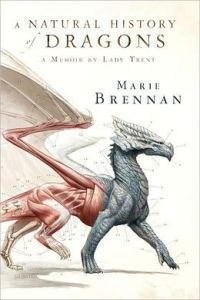
Serena’s Review: “A Natural History of Dragons”

12974372Book: “A Natural History of Dragons”by Marie Brennan

Publishing Info: Tor Books, February 2013

Where Did I Get this Book: audiobook from the library!

Book Description: Tor Books, February 2013

Book Description: All the world, from Scirland to the farthest reaches of Eriga, know Isabella, Lady Trent, to be the world’s preeminent dragon naturalist. She is the remarkable woman who brought the study of dragons out of the misty shadows of myth and misunderstanding into the clear light of modern science. But before she became the illustrious figure we know today, there was a bookish young woman whose passion for learning, natural history, and, yes, dragons defied the stifling conventions of her day.

Here at last, in her own words, is the true story of a pioneering spirit who risked her reputation, her prospects, and her fragile flesh and bone to satisfy her scientific curiosity; of how she sought true love and happiness despite her lamentable eccentricities; and of her thrilling expedition to the perilous mountains of Vystrana, where she made the first of many historic discoveries that would change the world forever.

Review: When I read “Turning Darkness into Light” a year or so ago, I didn’t realize that it was connected to Marie Brennan’s “Lady Trent” series. It was still an enjoyable read, however, and it inspired me to go back and put the original series on my list. Of course, that now makes reading this series, set quite a bit before “Turning Darkness,” into a very different reading experience than it would have been had I been approaching without any prior knowledge. But, overall, I really enjoyed this read!

Before she was the well-known adventurous, Lady Trent, Lady Isabella was just a young woman with an unladylike interest: dragons. But ever determined, she set out to make a life for herself where she could pursue this unlikely passion as far a a lady of her time could hope for. Instead, she got more than she ever wished for. Finding a marriage of true affection with a liberal minded man who eventually even concedes to allowing her to travel on expeditions alongside her. Never did he suspect that she, herself, would be the one to begin making the most extraordinary discoveries of their time!

This book was both what I expected and very different than I expected. On one hand, it’s kind of your staple historical fantasy story featuring an intrepid lady going and doing what no lady has done before. Lady Trent’s voice was very familiar, if a bit less bland than the likes of Amelia Peabody and Veronica Speedwell. But her story was unique enough to stand alone. For one thing, I appreciate the way the story is grounded in the realities of the “time” for a lady such as herself.

Her marriage is not made from wild romance, but from the practical choice of two individuals with unique interests to team up with another who can appreciate their eccentricities. It was a nice change of pace to read about this type of relationship and how their feelings towards each other change and grow over the years as they are put to different, unexpected tests. Her husband doesn’t simply jump onboard with her wanting to travel the world, but very realistically expresses concern that he will be judged for not protecting his wife as a proper husband should. Of course, he quickly sees reason and realizes that her wants and needs are more important than this judgement, but I appreciated that the challenge of living so far outside the norm was addressed.

The story was a bit slower to get started than I may have liked, but once Lady Isabella actually begins her explorations, I really enjoyed it. Even then, the dragons were much more often an idea or passing fear than ever being very present. This, of course, was part of the mystery of them, but it did leave the pacing of the story itself a bit stilted. Here, mostly, is where it was strange that I had read the companion book before this actual series. Many secrets and truths had been taken as common knowledge in that book, but here Lady Trent had yet to make any of these discoveries. It did add a strange, new layer of intrigue for me, personally, as I spent a lot of time trying to guess how all of these smaller clues would lead to the bigger reveals I knew were coming at some point. Even knowing some of the outcomes, I still wasn’t able to put much together beforehand.

I really liked the narrator for this audiobook, and I highly recommend reading the book that way if you like audiobooks at all. The slower pace and, at points, removed feeling one has from the characters themselves did knock this back a few points in my rating. But I plan on continuing the series and hopefully those aspects will pick up in the next one.

Rating 7: A fun historical fantasy story, if a bit plodding at times.

Reader’s Advisory:

“A Natural History of Dragons” is on these Goodreads lists: “Fantasy of Manners” and “Dragons/Serpents.”

Find “A Natural History of Dragons” at your library using WorldCat!