Kate’s Review: “Harrow Lake”

Book: “Harrow Lake” by Kat Ellis

Publishing Info: Dial Books, August 2020

Where Did I Get This Book: Ebook from the library!

Book Description: Things I know about Harrow Lake: 1.It’s where my father shot his most disturbing slasher film. 2.There’s something not right about this town.

Lola Nox is the daughter of a celebrated horror filmmaker–she thinks nothing can scare her.

But when her father is brutally attacked in their New York apartment, she’s quickly packed off to live with a grandmother she’s never met in Harrow Lake, the eerie town where her father’s most iconic horror movie was shot. The locals are weirdly obsessed with the film that put their town on the map–and there are strange disappearances, which the police seem determined to explain away.

And there’s someone–or something–stalking her every move.

The more Lola discovers about the town, the more terrifying it becomes. Because Lola’s got secrets of her own. And if she can’t find a way out of Harrow Lake, they might just be the death of her.

Review: Even though I generally have my finger on the pulse of upcoming horror fiction, it does happen that I miss titles here and there. Because of that, I like to see various lists of horror and thriller titles that are in the pipeline. “Harrow Lake” by Kat Ellis ended up being one of those titles, as I hadn’t heard of it before I saw it on a YA horror list. I was rather bummed that I missed it, as the elements of a slasher movie, a secretive small town, and an urban legend check a lot of boxes for my horror fiction jollies. Luckily the wait wasn’t too long for the eBook hold list, and I got “Harrow Lake” in a timely manner.

As mentioned, “Harrow Lake” has a lot of potential when it comes to hitting many a thing that I like in horror fiction. Our protagonist, Lola, is the daughter of a notorious slasher film director, so we get a fun and extensive look into a fictional filmography of splatter gore flicks that sound like a hoot. We also have the small town of Harrow Lake that has some strange inhabitants, a reputation because of the movie Lola’s Dad filmed there (where he met her mother, who disappeared from her life when she was little). The eeriness of the town was palpable and built slowly, which was a nice way to build unease as well. The biggest factor in the strangeness is the urban legend of Mister Jitters, a being that sounds like he has chattering teeth and who keeps haunting Lola at every turn as she finds herself stranded in Harrow Lake with her maternal grandmother after her father is attacked and hospitalized. I loved the lore of Mister Jitters, the kind of small town monster story that I never got to experience as a child given my upbringing in a bustling urban area, and I thought that Ellis really captured it well. Her writing style was also interesting, giving me a good feel for the town itself and the reasons why it was the way it was.

But as the book kept going, it became pretty clear that “Harrow Lake” wasn’t living up to the potential that was oozing from its description. Lola is an unreliable narrator in a lot of ways, but I didn’t really find myself connecting with her even as the story went on. It does start to make sense as to why she is the way that she is, but even that reveal and explanation didn’t quite make up for a cliched personality and uninteresting characterization. The ways that her background was slowly pulled out felt a little garbled in some ways, with the sudden appearance of an imaginary friend feeling abrupt while other ways that addressed her mental state not feeling well explored. I could see a few of the twists coming from a mile away, and there were a few plot points that built up mysteries that didn’t really pay off for me. And I don’t want to spoil anything for those who do want to go on and read it, but let’s just say that Mister Jitters didn’t live up to all that I had hoped for him. Ultimately the pay off wasn’t that scary, and I had gone in with high hopes of urban legend scares.

At the end of the day, I felt like there were a lot of missed opportunities in this book, and that was really too bad. It may be that this book will connect with other people who give it a try, but for me it was a bit of a miss. I could see myself trying again with Ellis as her writing style was intriguing, but this one didn’t work.

Rating 5: There was a lot of interesting potential here, but “Harrow Lake” never quite clicked with me.

Reader’s Advisory:

“Harrow Lake” isn’t on many specific Goodreads lists, but it would fit in on “Small Towns with Secrets“.

Find “Harrow Lake” at your library using WorldCat, or a local independent bookstore using IndieBound!

Serena’s Review: “Siege of Rage and Ruin”

Book: “Siege of Rage and Ruin” by Django Wexler

Publishing Info: Tor Teen, January 2021

Where Did I Get this Book: Edelweiss+

Book Description: Isoka has done the impossible–she’s captured the ghost ship Soliton.

With her crew of mages, including the love of her life Princess Meroe, Isoka returns to the empire that sent her on her deadly mission. She’s ready to hand over the ghost ship as ransom for her sister Tori’s life, but arrives to find her home city under siege. And Tori at the helm of a rebellion.

Neither Isoka’s mastery of combat magic, nor Tori’s proficiency with mind control, could have prepared them for the feelings their reunion surfaces. But they’re soon drawn back into the rebels’ fight to free the city that almost killed them.

Previously Reviewed: “Ship of Smoke and Steel” and “City of Stone and Silence”

Review: After blowing through the first two books in this trilogy last January, I had to hunker down for the long wait until January 2021 to finally get the to the release of the final book. As much as I like being current with many of the books coming out in real-time, I have to say, there’s something to be said for just waiting for a series/trilogy to be finished so you can enjoy it in one, big, binge read. Ah well. And, while this wasn’t my favorite book in the trilogy, I was overall quite pleased with this book and for the way the series wrapped up as a whole.

On her way back to her home city, Isoka imagines that nothing ahead can pose a bigger challenge than what she’s accomplished already. She simply needs to rescue Tori and head back to the mysterious land from which Soliton came. But Tori is no longer the innocent girl Isoka remembers. Instead, she’s a rebel leader caught up in a revolution that seems to be on the brink of failure. What’s more, she has a powerful magical ability to influence the minds and actions of others, a power she had kept hidden from Isoka for all of these years. Together, the sisters must work to re-learn the sibling they thought they knew while also saving a city that seems doomed to fall.

While I did enjoy this book and still love the heck out of Isoka as a main character, I did struggle with this one more than the first two. I think there are a few reasons for this. First, like the second book in this trilogy, Isoka now shares the narrative with Tori which essentially splits her portion in half.

Tori isn’t a bad character in her own right, but she simply can’t compete with the explosive force that is Isoka. Tori’s own story is much less sympathetic and her overall arch feels less complete. The last book saw her do some pretty terrible things and that’s never really addressed going forward. On one hand, I like the fact that the book doesn’t shy away from the terrible things that are done in revolutions, even by those fighting for the “good” side. But Tori also never seems to resolve her feelings of being “monstrous” in any real way. Isoka kind of just brushes the whole thing aside when she learns about it, and Tori just seems to get over it suddenly at the end for no apparent reason.

Isoka’s own story feels like it takes a back seat to Tori’s as this book is largely about the revolution Tori started and thus naturally falls more in her wheelhouse. I still loved Isoka’s chapters, if mostly because her voice and character feel so alive and compelling. But, like Tori, it didn’t feel like she had much of a character arc in this story. She’d already come into her own as a leader and recognized the fact that she didn’t enjoy brutal killing. So there’s nowhere really for her to go in this story.

The second challenge, beyond the lack of character arcs for our two leads, was my own personal preference for the unique, fantastical elements presented in the first two books. There was so much creativity to the fantasy aspect of the story in the first and second book, between the ship Soliton and the Harbor with its spooky leader, Prime. Here, the story of a fairly straightforward rebellion and a pretty predictable resolution just wasn’t cutting it. I really missed the fantasy aspects of the series and was disappointed that not much new was introduced. I never was very invested in Tori’s rebellion and to have this entire last book focused on that was a pretty big let-down. But this was definitely more a matter of personal preference than anything else.

The writing itself was still incredibly strong and Wexler shines with his action scenes. Isoka’s fights were as thrilling as ever and her companions were fun supporting characters. I think it’s telling of Wexler’s skill that Jack, who could easily have become gimmicky and annoying, served well in her role as comedic relief throughout. I was also pleased to see Tori’s romance plotline take a decided backseat role, as that was another aspect of the second book that I was not at all invested in.

Overall, this was definitely the weakest of the three books, but it did tie up the story well and ended in a satisfactory manner. Readers’ enjoyment of it will likely be directly tied to their interest in Tori and the storyline that was introduced with her in the second book. But I’d say that fans of the first two, regardless of preference, should definitely check this last book out.

Rating 7: Lacking the fantasy elements that I’ve come to love, but still a satisfying end to the trilogy.

Reader’s Advisory:

“Siege of Rage and Ruin” isn’t on many Goodreads lists yet, but it is on Can’t Wait Sci-Fi/Fantasy of 2021.

Find “Siege of Rage and Ruin” at your library using WorldCat!

Kate’s Review: “Atonement”

Book: “Atonement” (Cerenia Chronicles 3) by Angela Howes

Publishing Info: Fine Tuned Editing, January 2021

Where Did I Get This Book: I received an eARC from the author.

Book Description: They stopped Absalom. They saved the city. But what if recovery isn’t quite so easy? What if there are more monsters lurking inside the city walls? What if the true monster is one of them? In the much-anticipated conclusion to the Phoebe Ray series, Phoebe, Sky, Noah, and the gang must face a new kind of villain, make amends with the past, and learn what it means to truly belong.

Review: Thank you to Angela Howes for sending me an eARC of this novel!

There is a song by The Who called “Won’t Get Fooled Again”, which has the line ‘meet the new boss, same as the old boss’. While I wouldn’t say that it’s an anti-revolutionary ditty, I do think that it brings up a good point of you can’t always know that those you back who have lofty promises of change can be trusted to follow through. I also kind of liken it to how the French Revolution ultimately ended up with Napoleon in charge after all was said and done. In any case, whenever you hear Roger Daltrey yell “YEAAAAAAAAH”, it’s almost guaranteed that it’s from this song, and it’s legendary.

I am so sorry, I had to use this GIF, just pretend he’s yelling YEAAAAAH! (source)

I was thinking a lot about that song as I read “Atonement” by Angela Howes, the final story in the Cerenia Chronicles. After all, at the end of the previous book, “Containment”, our protagonist Phoebe had helped end the dictatorship that was run by Absalom, and Cerenia was on the cusp of a new dawn, as the system of Ones and Twos was finally to be done away with, and Phoebe was going to help rebuild society into something better. But as we soon learn, if only it were THAT easy.

We left “Containment” with Phoebe, boyfriend Sky, ex boyfriend Noah, and her other friends and family dealing with the fallout from Abasalom, the previous leader, being thrown in prison. “Atonement” decides to focus on how Phoebe is trying to change society from within the confines of its power structure, and that is already an interesting take that I haven’t encountered in my YA dystopia literature. Phoebe is confident that she and the Council can rebuild, but it’s pretty clear that it’s not going to be that easy, and that someone else in power likes the idea of a power grab. Our narrative focuses on Phoebe trying to keep everything together, as well as balancing out her relationships, the safety of those she loves, and trying to figure out the best way to rebuild a society that has a lot of damage and long lasting effects that can’t just be done away with so easily. I loved this focus, and I loved seeing her have to see how damn hard it is to fix things even after the corruption is gone. She has to make hard decisions that others don’t necessarily understand, and it gave her more depth and complexity.

Our perspectives expand once again from the last book to this one. While we still have the three main lines of Phoebe, Sky, and Noah, other characters like Phoebe’s sister Violet, fellow councilmember Roderick, and others have been added to the shuffle. I can’t really decide what I think about all the new perspectives, as on one hand I liked having more insight into how all of these other people are adjusting, some of them just felt a little superfluous. I was still mostly interested in Phoebe as she tries to weed out corruption, but it was Sky’s that brought the next most interesting themes, as he is clearly dealing with trauma and PTSD after the events in the previous book. Given that Sky and Phoebe are my favorite characters and I’m invested in their relationship, I was happy(?) to see that one of the central conflicts coming between them wasn’t Noah. Not that trauma is something I WANT for a couple as a hurdle, but it felt more realistic than trotting out a love triangle just for the sake of the drama.

And in terms of plot and pacing, the action and suspense in this book builds slowly and then really amps up the stakes as the story goes on. When things start to spiral, the action just increases, and I found myself very on edge about what was going to happen. There were a good number of twists thrown in too, and throw backs to previous plot points that all come back together for the grand finale. All in all, I was quite satisfied with how things shook out, for better or for worse.

“Atonement” went in a direction that I wasn’t expecting, and I think that it was better for it. We may not see as much dystopian fiction in YA these days, but The Cerenia Chronicles is definitely a worthy series to add to the selection.

Rating 8: A satisfying ending to an enjoyable series.

Reader’s Advisory:

“Atonement” isn’t on any Goodreads lists as of yet, but if you like books like “Divergent”“Matched”, or “The Testing” you will probably find this one fun as well!

“Atonement” isn’t in very many libraries as of now, but you can find it on Amazon.

Previously Reviewed:

Book Club Review: “I Will Always Write Back”

We are part of a group of librarian friends who have had an ongoing bookclub running for the last several years. Each “season” (we’re nerds) we pick a theme and each of us chooses a book within that theme for us all to read. Our current theme is “Around the World”, in which we each picked a continent and had to match a book that takes place there and/or is written by an author from that continent or of that continent’s descent.

For this blog, we will post a joint review of each book we read for book club. We’ll also post the next book coming up in book club. So feel free to read along with us or use our book selections and questions in your own book club!

Book: “I Will Always Write Back: How One Letter Changed Two Lives” by Caitlin Alifirenka, Martin Ganda, and Liz Welch

Publishing Info: Little, Brown Books for Young Readers, April 2015

Where Did I Get This Book: The library!

Continent: Africa

Book Description: The true story of an all-American girl and a boy from an impoverished city in Zimbabwe and the letter that changed both of their lives forever.

It started as an assignment. Everyone in Caitlin’s class wrote to an unknown student somewhere in a distant place. All the other kids picked countries like France or Germany, but when Caitlin saw Zimbabwe written on the board, it sounded like the most exotic place she had ever heard of–so she chose it.
Martin was lucky to even receive a pen pal letter. There were only ten letters, and forty kids in his class. But he was the top student, so he got the first one
.

That letter was the beginning of a correspondence that spanned six years and changed two lives.

In this compelling dual memoir, Caitlin and Martin recount how they became best friends –and better people–through letters. Their story will inspire readers to look beyond their own lives and wonder about the world at large and their place in it.

Kate’s Thoughts

Well when we started our “Around the World” Series for Book Club, we thought that it would outlast quarantine and that it would be a fun way to pass that time. The reality is that we’re in an even worse place than we were back when we started once this session ended. But even if we have more COVID times ahead of us where we have to meet virtually, I’m glad that we did our “Around the World” cycle, as we got to read books that I may not have read otherwise. Our last book was “I Will Always Write Back”, a dual memoir by Caitlin Alifirenka and Martin Ganda, two pen pals whose friendship became so much more.

I went into this book with a very rudimentary knowledge of Zimbabwe under Mugabe’s regime, and with the unease that we may have been starting a ‘white savior’ narrative. But “I Will Always Write Back”, I think, did a good job of walking that line without crossing it, and I think that the main reason for that is because we got both Caitlin’s perspective, that of a teenage white American living in a comfortable economic situation, and Martin’s, who is a Black Zimbabwean who was living in abject poverty. Getting to hear Martin’s side of the story in his own words and getting his perspectives and experiences really helped keep it away from centering Caitlin’s journey in the narrative, which was good. Martin’s chapters were the ones that I most looked forward to, as while Caitlin was relatable (we are the same age, so I was doing and experiencing similar teenage America girl things that she was in this book), I wasn’t as interested in her story. I think that there could have been a little more introspection on her part at times, but then again, she was a teenager and young adult through the crux of it, so maybe throwing that in would have felt out of place. Luckily Martin’s sections gave the reader a lot to think about, and I feel like I got more from this story from him.

I was interested in seeing their friendship grow and change, however, and liked seeing the two of them interact with each other. You can feel the love and care they have for each other within this books pages, and seeing the two of them have each other’s backs was absolutely uplifting. Given that any pen pal situation that I had in grade school completely floundered, the fact that they kept this friendship going and changed each other’s lives so much is a lovely story in and of itself. This is the kind of book that I would recommend to teens who are wanting to start looking at cross cultural themes and issues, as I think it’s a good introduction to the idea of reaching out to others who may not have the exact same life as you, but could have very similar goals and dreams that you have.

Kate’s Rating 7: An undeniably uplifting memoir about friendship and cross cultural connection, “I Will Always Write Back” has heart and earnestness, though not as much introspection as I was hoping for.

Book Club Questions

  1. What were some of your reactions to the comparisons and contrasts when it came to the lives that Caitlin and Martin were living when they started their correspondence?
  2. Were you knowledgable about the history and the cultural and societal situation of Zimbabwe during Mugabe’s rule?
  3. Do you think that teenagers today would relate to the teenage voices of the people in this book who were teens twenty years ago?
  4. As the book goes on, we learn that Caitlin and her family help Martin out in many ways. How do you think this changed and affected their friendship?
  5. Recently there has been criticism of publishers elevating and publishing ‘white savior’ narratives in books and the publishing industry. Do you think that “I Will Always Write Back” could be considered a white savior narrative? Why or why not?

Reader’s Advisory

“I Will Always Write Back” is included on the Goodreads lists “Must Read Memoirs”, and “Southern Africa”.

Find “I Will Always Write Back” at your library using WorldCat!

Next Book Club Book: “Sailor Moon: Eternal Edition Vols. 1 &2

Serena’s Review: “Truly, Devious”

Book: “Truly, Devious” by Maureen Johnson

Publishing Info: HarperCollins, January 2018

Where Did I Get this Book: audiobook from the library!

Book Description: Ellingham Academy is a famous private school in Vermont for the brightest thinkers, inventors, and artists. It was founded by Albert Ellingham, an early twentieth century tycoon, who wanted to make a wonderful place full of riddles, twisting pathways, and gardens. “A place,” he said, “where learning is a game.”

Shortly after the school opened, his wife and daughter were kidnapped. The only real clue was a mocking riddle listing methods of murder, signed with the frightening pseudonym “Truly, Devious.” It became one of the great unsolved crimes of American history.

True-crime aficionado Stevie Bell is set to begin her first year at Ellingham Academy, and she has an ambitious plan: She will solve this cold case. That is, she will solve the case when she gets a grip on her demanding new school life and her housemates: the inventor, the novelist, the actor, the artist, and the jokester. But something strange is happening. Truly Devious makes a surprise return, and death revisits Ellingham Academy. The past has crawled out of its grave. Someone has gotten away with murder. 

Review: As is probably pretty evident by now, Kate is the true crime aficionado on our blog. I’ve casually looked into a few cases based on her recommendations, but my penchant for mysteries often falls into the historical, detective fiction more than anything. I also don’t read too many contemporary YA novels. So in a lot of ways, this book didn’t really meet many of my usual criteria for picking a new book. But it had fabulous ratings on Goodreads and happened to show up on my audiobook list right when I was between reads. And here we are!

Stevie Bell is shocked when she’s accepted into the exclusive, expensive private school of Ellingham Academy. It’s most highschoolers’ dream, but only accepts a handful of applicants per year. At that, they don’t even specify what they’re looking for! But apparently Stevie interest in and proficiency with true crime investigations hit some mark. What’s more, Ellingham Academy itself is the location of one of history’s most notorious unsolved crimes, the abduction of the founders wife and infant daughter. The only clue was an enigmatic riddle that has been poured over and pondered now for decades. But Stevie Bell is determined that once she’s on the grounds, she will solve this cold case. What she doesn’t expect is for this cold case to suddenly warm up with a new murder and the return of “Truly, Devious.”

So there were things I enjoyed about this book, and there were things I didn’t. Before I even get to the things I didn’t, I’ll just say again that this book has really high ratings on Goodreads, so there’s a fairly decent chance that most of the things that didn’t work for me were due to the fact that the book was way outside my usual genres of choice. But on to the good!

For one thing, I was not expecting the format that this book is told from. It’s not simply Stevie’s story while at Ellingham trying to solve this cold case. Instead, the story is told in alternating chapters between the present, which follows Stevie as she works a new murder as well, and the past, where we see various characters’ perspectives on the events that lead up to and during the abduction of Mr. Ellingham’s wife and infant daughter. I really enjoyed these chapters in the past. They really helped bring to life this cold case and avoided what otherwise would have had to be a pretty info-dumpy style of writing to give the reader the same information that Stevie would have already had. It also leaves readers free to begin making their own connections and theories, outside the influence of Stevie’s own thoughts on the mystery.

I also really liked Stevie herself. She’s your typical highschooler, in many ways, but I liked the way the story incorporated her struggles with anxiety and the differences she feels between herself and her parents. She deals with a lot of the fears and challenges that any new student comes across at a new school, but it’s made all the more interesting by the eccentric friends she meets there. The way Ellingham is described, it’s definitely the kind of school I would have loved to attend as a highschooler myself!

My problems with the book, however, also come from the modern timeline of the book. I wasn’t into the romance at all. I felt like it came out of nowhere but was also so entirely predictable that it landed flat immediately. The book tries to insert some more tension and mystery towards the end, but I just didn’t care enough about this couple to have any strong feelings about the drama or reveals. I also thought that the modern mystery was fairly predictable. The motive and history of the victim were especially obvious which just undermined Stevie’s own prowess as a burgeoning detective.

Lastly, I wasn’t expecting this book to not solve the mystery of the cold case. So there’s definitely a cliff-hanger sort of ending as far as that goes. If this book was up your alley, maybe this wouldn’t bother you as much. But for me, who enjoyed it for the most part but wasn’t in love by any means, I was just annoyed that I’d be forced to continue reading to get more answers to the one part of the book that really intrigued me. As it is, we’ll see if I get around to it or not. I’m guessing it will be a similar story, that if I do read it, it will be more a matter of happy chance than anything else. Fans of contemporary mysteries and true crime, however, will likely really like this. Just a bit too far out of my genres of choice to really hit home for me.

Rating 7: A tale of two stories: one of the past, which was excellent, and one of the future, which was more meh.

Reader’s Advisory:

“Truly, Devious” is on these Goodreads lists: Young Adult Crime/Murder Mysteries and Dark Academia.

Find “Truly, Devious” at your library using WorldCat!

Kate’s Review: “This Is Not a Ghost Story”

Book: “This Is Not a Ghost Story” by Andrea Portes

Publishing Info: HarperTeen, November 2020

Where Did I Get This Book: I received an eARC from NetGalley.

Book Description: I am not welcome. Somehow I know that. Something doesn’t want me here.

Daffodil Franklin has plans for a quiet summer before her freshman year at college, and luckily, she’s found the job that can give her just that: housesitting a mansionfor a wealthy couple.

But as the summer progresses and shadows lengthen, Daffodil comes to realize the house is more than it appears. The spacious home seems to close in on her, and as she takes the long road into town, she feels eyes on her the entire way, and something tugging her back.

What Daffodil doesn’t yet realize is that her job comes with a steep price. The house has a long-ago grudge it needs to settle . . . and Daffodil is the key to settling it.

Review: Thank you to NetGalley for providing me with an eARC of this novel!

I love haunting and eerie ghost stories of the Gothic variety, though I will admit that I sometimes find them to be predictable. The genre itself has such specific building blocks to it that a little bit of a road map is in place from the get go, which is perfectly okay. Because of this, I thought that I knew where “This Is Not a Ghost Story” by Andrea Portes was going to go when I picked it up. I was still excited to read it, mind you, but my overconfident ass thought that it wouldn’t have much new to say. But lo and behold, this story took me by surprise in all the best ways possible.

While the set up definitely seems run of the mill (money strapped college student agrees to house sit an isolated home, strange things start happening), Portes has created a Gothic ghost story that feels unique and fresh specifically because of how she has chosen to tell it. Daffodil, our first person protagonist, has a stream of consciousness and anxious voice in her narration, and as she tells the reader what is happening to her in this house and in the town around it, we have a slow build up of dread in the way that Daffodil would be experiencing it. As she tries to write off strange occurrences as they happen, we see the panic rise and rise until she is unable to deny that something very bad is happening, which I REALLY liked. From things that could very easily be explainable to the absolutely disturbing, Daffodil’s stream of consciousness builds the tension and also becomes VERY relatable as the story goes on. And all along she is cracking wise, making funny observations, and generally cracking me up, which helped cut the tension but didn’t ruin it. But along with the present bad things happening inside the house and on the grounds, we also get a slow unfolding of Daffodil’s past, and why her anxiety and unease is ever present. Most of this involves a love story with her high school boyfriend Zander, someone that she had always felt was out of her league but who loved her very much. Their high school romance felt real, and as it runs its course in her memories and unfolds in tragic ways, you see a whole other side to Daffodil that makes her all the more endearing.

In terms of scares and plotting, “This Is Not A Ghost Story” has some elements that are old hat, and some reveals that didn’t quite catch me by surprise in the way that they were probably supposed to do. But Portes still manages to write these elements and reveals in a way that made them enjoyable, and they still felt pretty fresh and convincing. I worry that if I say too much we’ll start getting into spoiler territory, but I do want to mention two aspects that worked really well for me. The first is the uncanny creepiness, of things going missing or ending up in places that don’t make sense. The other is the slow building unease with the people on and around the property, from a construction worker on the guest house named Mike to a nosy and stuffy neighbor named Penelope. We think one thing about them at first, but Portes picks away at our perceptions of them and makes them suspenseful in their own way (though I will say that Daffodil does the thing that MANY women do when it comes to men who may be threatening: she second guesses herself and her instincts. THIS was so well done that it felt like a GREAT way to show the target audience that no, your instincts should probably be listened to).

So while it may not have shocked me or really scared me too much, “This Is Not A Ghost Story” was an enjoyable and poignant ghostly tale of trauma, forgiveness, and the things that haunt us. Fans of Gothic horror should definitely check it out!

Rating 8: A haunting, bittersweet, and sardonically funny Gothic tale, “This Is Not a Ghost Story” will keep you guessing, and will stay with you.

Reader’s Advisory:

“This Is Not a Ghost Story” is new and not on many specific Goodreads lists, but I think it would fit in on “Modern Gothic”, and “Not the Normal Paranormal”.

Find “This Is Not a Ghost Story” at your library using WorldCat, or a local independent bookstore using IndieBound!

Kate’s Review: “The Good Girls”

Book: “The Good Girls” by Claire Eliza Bartlett

Publishing Info: HarperTeen, December 2020

Where Did I Get This Book: I received an eARC from NetGalley.

Book Description: The troublemaker. The overachiever. The cheer captain. The dead girl.

Like every high school in America, Jefferson-Lorne High contains all of the above. After the shocking murder of senior Emma Baines, three of her classmates are at the top of the suspect list: Claude, the notorious partier; Avery, the head cheerleader; and Gwen, the would-be valedictorian. Everyone has a label, whether they like it or not–and Emma was always known as a good girl. But appearances are never what they seem. And the truth behind what really happened to Emma may just be lying in plain sight. As long-buried secrets come to light, the clock is ticking to find Emma’s killer–before another good girl goes down.

Review: Thanks to NetGalley for providing me with an eARC of this novel!

I am not too proud to admit that while I was an outcast and a weirdo in high school, I was not without my own faults when it came to judging other people, especially girls. It takes a lot of time and effort to try and unlearn the malignant lessons that society teaches you when it comes to how girls are supposed to be and act, and even as a woman in her mid thirties I’m STILL learning. I wish that I had read books at that age that would have helped the process along a bit. The good news is that girls these days can pick up books like “The Good Girls” and get some pretty good insight into how to reject internalized misogyny and rape culture! What I thought was going to be a YA thriller turned into something that had more value than I anticipated when it comes to theme and message.

The strongest aspect of “The Good Girls” is how Bartlett examines the damage that rape culture and misogyny wreaks upon young women no matter what their ‘social standing’ is, and how the damage can manifest in different ways. I think that one of the more popular ways to address it in teen fiction these days is to give a perspective to an ‘outcast’ character who is seen as promiscuous or ‘bad news’ in other ways. We do get that here with Claude the party girl and (deceased) Lizzy the addict, but we also see how it can still be damaging to girls who are seen as ‘good’ or ‘successful’, like cheer captain Avery and ‘good girl’ Emma. I think it’s especially important for this kind of ‘representation’ (for lack of a better term) in YA literature, as those who aren’t targeted in the more obvious ways may be less able to recognize it. I also liked that this book addresses that sometimes people in authority positions, because of their own biases, can stumble and fail when it comes to protecting those who are victimized. Or, even worse, use their position of authority to intimidate others into silence, or perpetuate abuse themselves. I thought that “The Good Girls” tackled these themes really well.

All of that said, in terms of mystery and thrills, “The Good Girls” missed the mark for me. While the characterizations were valuable and felt pretty realistic, they also managed to not work outside the box of the tropes that they fit into. I liked all of the main characters well enough, but none of them felt that different from other iterations of the boxes that they fell into. And when it comes to the mystery of who pushed Emma into the river, and what actually happened to Lizzy and how the two connect, I didn’t find myself raring to find the answer or terribly shocked by how it all played out. Even the smaller mysteries that add into the larger parts didn’t really surprise me, and I called a couple of the reveals pretty early on. Admittedly a couple caught me by surprise, but even then I wasn’t wowed. It just feels pretty run of the mill when it comes to the story itself. Not bad by any means. But also not unique. And at the end of the day, valuable message and explorations aside, I read “The Good Girls” because I was looking for a thriller, which it didn’t really provide.

I think that if you go into “The Good Girls” looking for a character study on the effect of misogyny and rape culture on girls from all kinds of labels, you will find something interesting, and certainly something with an important message that could help YA readers. But in terms of mystery and thrills, it isn’t really anything new.

Rating 6: I really liked the themes that take on rape culture and misogyny, but the story itself didn’t feel much different from other stories that have similar characters and plot points.

Reader’s Advisory:

“The Good Girls” is included on the Goodreads list “YA Mysteries and Thrillers”, and would fit in on “Small Towns with Secrets”.

Find “The Good Girls” at your library using WorldCat, or a local independent bookstore using IndieBound!

Kate’s Review: “Dragon Hoops”

44280830Book: “Dragon Hoops” by Gene Luen Yang

Publishing Info: First Second, March 2020

Where Did I Get This Book: The library!

Book Description: In his latest graphic novel, New York Times bestselling author Gene Luen Yang turns the spotlight on his life, his family, and the high school where he teaches.

Gene understands stories—comic book stories, in particular. Big action. Bigger thrills. And the hero always wins.

But Gene doesn’t get sports. As a kid, his friends called him “Stick” and every basketball game he played ended in pain. He lost interest in basketball long ago, but at the high school where he now teaches, it’s all anyone can talk about. The men’s varsity team, the Dragons, is having a phenomenal season that’s been decades in the making. Each victory brings them closer to their ultimate goal: the California State Championships.

Once Gene gets to know these young all-stars, he realizes that their story is just as thrilling as anything he’s seen on a comic book page. He knows he has to follow this epic to its end. What he doesn’t know yet is that this season is not only going to change the Dragons’s lives, but his own life as well. 

Review: Though I’m not really a huge sports fan in general, if you asked me what my least favorite ‘mainstream’ sport to watch was, I’d undoubtedly say basketball. I can’t even tell you why that is, but I’ve never enjoyed it, even when I was playing on the basketball team in sixth grade. But given that Gene Luen Yang is one of my favorite comics writers, I knew that I was going to read his newest book “Dragon Hoops”, even if it was about basketball. Looking into it more, I realized that this wasn’t going to be a book that was just about basketball. And because of that, I was immediately hooked on this story that’s part memoir, part history, and part inspirational sports story.

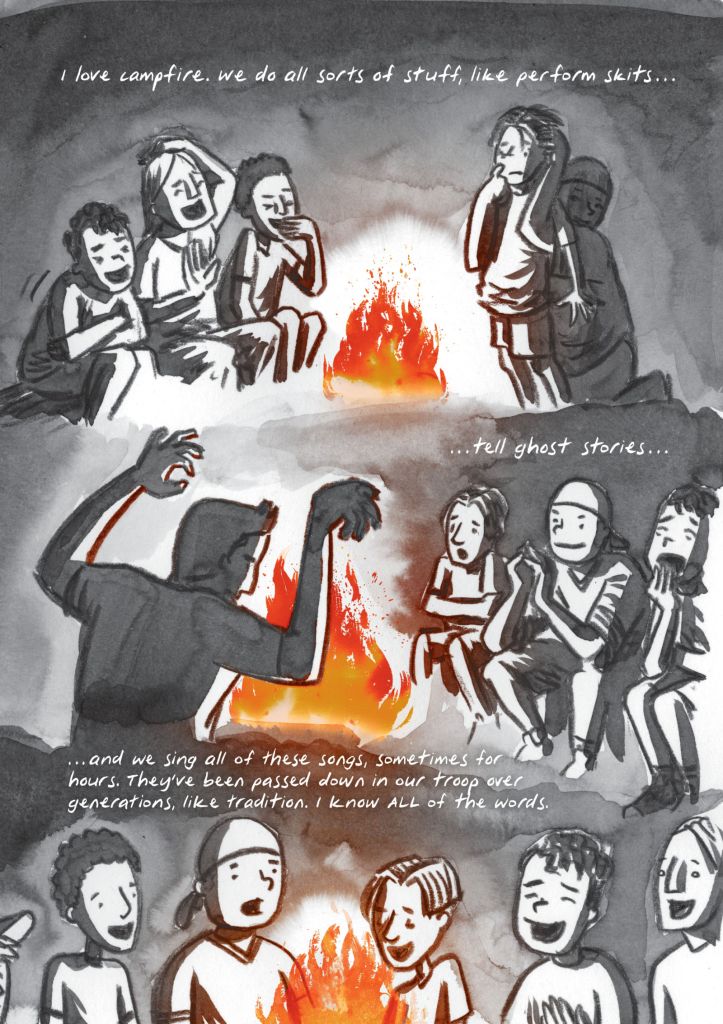
We follow Yang as he’s following his school’s basketball team in it’s journey to hopefully win State, and he finds a lot of layers and depth and heart to put on display. While he could have had a structure that was purely factual, or perhaps a story that profiles just one player, or even a story that focuses on a coach’s deferred dreams that are possibly going to come true, he manages to take aspects of all these things and balance them into a combination. We get profiles of the various members of the team, from the players themselves and their varied backgrounds, to Coach Lou and his own personal connection as a former player, to Yang himself as he is thinking about his own dreams. I really enjoyed getting the context of the various team members, but I thought that Yang putting his own story in there was a nice touch, as it shows that even those who don’t have a specific sports connection can find commonality with these inspirational, and sometimes difficult, sports stories that we hear about ever so often. He uses devices and symbolism that repeats throughout the story, and it almost always landed. Yang has always been really good at showing the deeper meaning of what he’s trying to say without outright saying it, and it comes through in this non fiction story just as well as it does in his fictional stories. I also really enjoyed Yang’s way of toying with the fourth wall, as he would have have himself in comic form acknowledge things that were being done for story telling purposes, as well as toying with the other characters perceptions of things that were going on or had gone on. While the action of the basketball games still kind of lagged on the page for me, I do acknowledge that Yang really captured the action and the tension of the moments as the Dragons are trying to get to State.

But ironically enough, it was the introductions to each section which focused on different parts of the history of basketball that clicked with me the most. Yang would give us a pretty easy to follow but comprehensive moment of history of the game, and that moment would then provide context or connect with the focus on that chapter, which was usually another member of the team or support system. I’m a history buff to be sure, and the way that Yang grounded his story within the context of this history was really well done. Plus, it all connects to the fact that Coach Lou, after his dreams of basketball success ended prematurely, decided to focus his education on history because he knows that history can inform us in the present. LOVED that, and it’s exactly the kind of theme I would expect from Yang.

And, of course, I love Yang’s style of artwork. It’s definitely a bit cartoony, but that doesn’t make it any less resonant or emotional when it needs to be. There were multiple moments where the emotions being portrayed were so well done both in writing and in imagery that I was moved to tears. Yang’s style is unique and well known at this point, but it always works.

dragon-hoops-gene-meets-coach-lou_orig
(source)

“Dragon Hoops” is another triumph for Gene Luen Yang! And if you’re hesitant to read it because of the basketball thing, take it from me. It’s absolutely worth it.

Rating 8: A charming graphic novel about basketball dreams, and dreams of doing something great, “Dragon Hoops” is a personal and emotional story from one of my favorite comics writers.

Reader’s Advisory: 

“Dragon Hoops” is included on the Goodreads lists “Project LIT”, and “Asian American Pacific Islander Heritage Month Book List”.

Find “Dragon Hoops” at your library using WorldCat, or a local independent bookstore using IndieBound!

Serena’s Review: “Broken Wish”

Book: “Broken Wish” by Julie C. Dao

Publishing Info: Disney Hyperion, October 2020

Where Did I Get this Book: Edelweiss+

Book Description: 1865
Hanau, Germany

Sixteen-year-old Elva has a secret. She has visions and strange powers that she will do anything to hide. She knows the warnings about what happens to witches in their small village of Hanau. She’s heard the terrible things people say about the Witch of the North Woods, and the malicious hunts that follow. But when Elva accidentally witnesses a devastating vision of the future, she decides she has to do everything she can to prevent it. Tapping into her powers for the first time, Elva discovers a magical mirror and its owner—none other than the Witch of the North Woods herself. As Elva learns more about her burgeoning magic, and the lines between hero and villain start to blur, she must find a way to right past wrongs before it’s too late.

Review: I’ve only read one other book by Dao, but it was one I definitely liked. She had a steady, beautiful way of writing that really captured the feeling or essence of a place and time. This is just the story of writing technique that is required for writing good fairytales, in my opinion. So, like always, I was excited to see a new fairytale book make its way onto the publication lists and even more intrigued when I saw that Dao was the author.

The 1800s in Germany is a time and place where women have very few options. But for Elva, it’s not only the typical things that are off-limits, but a part of her very identity: her magical abilities. Growing up, her family has instilled in her the importance of always, always keeping her abilities a secret. The dangers of being thought of as a witch are very real. But when Elva discovers a real witch and sees a glimpse into a terrible future, she realizes that she can’t hide from who she is and what she can do forever.

I feel like the book description is a bit off, as Elva herself doesn’t show up for about a third of the story. Instead, we follow the developing friendship of Elva’s mother with a local witch. The fall-out of this relationship is what puts Elva’s feet on the path of this story. Part of my struggle with this book was how much I really loved this first third, unfortunately. I really liked the beautiful friendship that was built up between Elva’s mother and the witch and then the inevitable moment where things go wrong. It had all the right markers of a fairytale while also focusing on the type of relationship (friendships between adult women) that is rarely seen in just these sorts of stories.

I did like Elva’s story well enough when she did show up. But the story took a more dramatic turn in YA stereotypes at this point, too. There were elements that seemed all too familiar, and I wasn’t super into the romance that we got either. I did like the magic and Elva’s struggles between obeying her parents and recognizing the obligations that come with the power she has. Not only the typical obligations that you usually hear about, but ones that have to do with righting past wrongs, which I thought was an interesting new take on the general concept.

The concept of this series is also interesting. Here, we have Elva’s story and the development of the curse that follows her family (for every two good things that happen, a very bad one follows). The next three (I think three?) books will jump generations and tell new stories focusing on different characters. They will also be written by different authors. This could either be really cool, or it could lead to the series feeling very disjoined and mismatched. Dao’s style of writing worked perfectly for the type of dark fairytale she’s trying to tell here. Will the next books also read like fairytales? Or will they have different tones? And will the other authors being able to capture these tones correctly?

For all the good things (the strength of Dao’s writing and the first third), I did struggle with this book once we got to Elva and the more typical YA fare. But I am curious to see where new authors will take the story in the future and how much they will verge away from or remain true to the story that was started here. Fans of fairytales or Dao’s previous books will likely enjoy this!

Rating 7: An interesting start to an interesting new series, though a bit too reliant on some YA tropes near the end.

Reader’s Advisory:

“Broken Wish” isn’t on many Goodreads lists, but it is on Oct 2020 – Middle Grade/YA – New Releases.

Find “Broken Wish” at your library using WorldCat!

Kate’s Review: “The Cousins”

Book: “The Cousins” by Karen M. McManus

Publishing Info: Delacorte Press, December 2020

Where Did I Get This Book: I received an eARC from NetGalley.

Book Description: From the #1 New York Times bestselling author of One of Us Is Lying comes your next obsession. You’ll never feel the same about family again.

Milly, Aubrey, and Jonah Story are cousins, but they barely know each another, and they’ve never even met their grandmother. Rich and reclusive, she disinherited their parents before they were born. So when they each receive a letter inviting them to work at her island resort for the summer, they’re surprised . . . and curious.

Their parents are all clear on one point–not going is not an option. This could be the opportunity to get back into Grandmother’s good graces. But when the cousins arrive on the island, it’s immediately clear that she has different plans for them. And the longer they stay, the more they realize how mysterious–and dark–their family’s past is.

The entire Story family has secrets. Whatever pulled them apart years ago isn’t over–and this summer, the cousins will learn everything.

Review: Thank you to NetGalley for sending me an eARC of this novel!

I don’t know what we did to deserve it, but the book world gave us two YA thrillers by Karen M. McManus this year. Maybe it was to try to balance the scales of this year just a little bit? Whatever the case may be, it’s hard to deny that McManus is a hot commodity in YA thriller publishing, and “The Cousins” is her newest foray into the genre. Had this book come out a little later, it certainly would have been on my list in our upcoming Highlights Post. It wasn’t easy letting it sit on my Kindle as long as I did, but once I dove in I found myself pretty well ensnared.

Like a couple of McManus’s other stories, “The Cousins” involves a group of teenagers who are thrown together under strange circumstances, even though they are not alike in any way, shape, of form. Milly, Aubrey, and Jonah are cousins who never spent time together as kids, as their parents are generally estranged from each other and completely estranged from their grandmother Millicent. We get the perspectives of each cousin, who all have their own secrets, insecurities, and reasons that they want to get back in their grandmother’s good graces. Milly is desperate to know more about her family, if only because her mother has been so cold to her over the years that she wants to know what made her that way. Aubrey wants to please her father, as his indifference towards her that borders into disdain is a constant hurt that has only amplified as of late because of his escalating callousness. And Jonah, well, Jonah is a bit of a mystery. He wants to meet his grandmother, but he has ulterior motives that aren’t as clear as Milly’s and Aubrey’s. Each of these characters had a distinct voice and read like teens coming from the backgrounds that they do, and their authentic personalities were easy to latch on to, even as their various flaws and, in some cases, lies come to light. I wouldn’t say that any of them were super outside of the box from what I’ve come to expect from McManus, but that’s more than okay because I liked all of them. While I expected myself to like Milly the best (who doesn’t love a sarcastic and somewhat privileged protagonist?), it was Jonah whose voice stood out the most. His frustration, resentment, and ultimate softening towards Milly and Aubrey was a nice journey, and he does get a well set up and believable romance to boot. He was just so easy to care for, and I wasn’t expecting that at first. McManus really has a knack for writing characterizations that really click.

The mystery itself, and the sub mysteries within, were also fairly strong, though once again my jaded self was able to figure out a couple a few steps before I probably was supposed to. I wasn’t as interested in the answer as to why Millicent cut her children out, because as far as I was concerned they probably DID deserve it. But as things became to be not as they seemed my expectations shifted a bit, and I was more interested. Again, sometimes the clues to the various mysteries and secrets sprinkled throughout the story were a little obvious and therefore the solutions predictable. But the pace was fast and I was going through quick enough that I didn’t find myself hindered by my abilities to guess what was coming up. I think that there are still a good amount of surprises here that are, indeed, well set up but well shrouded as well. So even if you do find yourself predicting some things, I can almost be positive that you won’t get them all.

“The Cousins” is fun and quick, and should be on the lists of anyone who likes YA thrillers. Karen M. McManus has a lot of talent and I am very excited to see what she comes up with next!

Rating 8: Another fun mystery thriller from Karen M. McManus!

Reader’s Advisory:

“The Cousins” is included on the Goodreads lists “Best YA Mystery/Spy books”, and “YA Suspense/Thriller/Mystery”.

Find “The Cousins” at your library using WorldCat, or a local independent bookstore using IndieBound!