Serena’s Review: “Tongues of Serpents”

Book: “Tongues of Serpents” by Naomi Novik

Publishing Info: Del Rey Books, July 2010

Where Did I Get this Book: audiobook from the library!

Book Description: Convicted of treason despite their heroic defense against Napoleon’s invasion of England, Temeraire and Laurence—stripped of rank and standing—have been transported to the prison colony at New South Wales in distant Australia, where, it is hoped, they cannot further corrupt the British Aerial Corps with their dangerous notions of liberty for dragons. Temeraire and Laurence carry with them three dragon eggs intended to help establish a covert in the colony and destined to be handed over to such second-rate, undesirable officers as have been willing to accept so remote an assignment—including one former acquaintance, Captain Rankin, whose cruelty once cost a dragon its life.

Nor is this the greatest difficulty that confronts the exiled dragon and rider: Instead of leaving behind all the political entanglements and corruptions of the war, Laurence and Temeraire have instead sailed into a hornet’s nest of fresh complications. For the colony at New South Wales has been thrown into turmoil after the overthrow of the military governor, one William Bligh—better known as Captain Bligh, late of HMS Bounty. Bligh wastes no time in attempting to enlist Temeraire and Laurence to restore him to office, while the upstart masters of the colony are equally determined that the new arrivals should not upset a balance of power precariously tipped in their favor.

Eager to escape this political quagmire, Laurence and Temeraire take on a mission to find a way through the forbidding Blue Mountains and into the interior of Australia. But when one of the dragon eggs is stolen from Temeraire, the surveying expedition becomes a desperate race to recover it in time—a race that leads to a shocking discovery and a dangerous new obstacle in the global war between Britain and Napoleon.

Previously Reviewed: “His Majesty’s Dragon” and “Throne of Jade” and “Black Powder War” and “Empire of Ivory” and “Victory of Eagles”

Review: Per the usual, I got back around to this series when my audiobook hold list at the library ran into a snag and I had a long wait for my next book to come in. Cue me returning to either this series or the Amelia Peabody series, to long-running series with excellent audiobook narrators. The “Temeraire” series is a bit harder to return to than the Amelia Peabody series, however, as there is a larger cast of characters (most side characters, but still a lot) and the books are more firmly connected to one another as an ongoing story. Still, never say I’m put off by a little thing like needing to take a bit to orient oneself at the beginning of a book. It’s a skill that any solid fantasy reader will develop, I think.

Convicted of treason, Temeraire and Laurence have been banished to Australia, a land that is barely understood, other than the small colonized areas that have been created as a holding pen for miscreants. Temeraire and Laurence, however, hold a unique position. Not only were their actions considered heroic by many of their friends and allies, but there is no effective way of “imprisoning” a powerful dragon like Temeraire. In reality, all that holds either of them is Laurence’s strong sense of patriotism and duty. Desperate to keep themselves out of any other political skirmishes, they embark on a dangerous mission into the interior of the continent. Only to find themselves caught up in a situation much larger than the one from which they had fled.

One of my favorite things about this series is how we travel the world alongside Temeraire and Laurence and get to witness first hand the way that dragons existing in this world has influenced known locations and historic events. Obviously, the Napoleonic wars is the big one. But we’ve also seen the effect of dragons on the slave trade and the difference in colonialism in that location when we travelled to Africa. As well, the threat that some Western cultures see in China with their very different (more advanced) way of interacting with and utilizing their dragons. Here, obviously, we go to Australia. Like Africa, this is a very wild, unknown location, so as the reader is discovering the wonders and threats of the country, so, too, are Temeraire and Laurence.

Most of what I liked about this book came down to this exploration of Australia. Novik had some very original ideas of how to work in the Aborigines, as well as a host of new flora and fauna. There were unexpected threats around every corner, and she did an excellent job painting a picture of this remote, completely foreign landscape. I almost wish the story had stuck strictly to this aspect of the plot. For some, it may read as the slower parts, but I enjoyed it for what it offered.

The political clashes were a bit on the predictable side. We know what side of things Temeraire and Laurence will usually come down on, so their moral struggles carry less weight as the series progresses. There were a few instances here, however, where we saw them at odds in unexpected ways, and I enjoyed that. The book also set up some larger conflicts between the various nations, to some extent, all struggling with how to manage Napoleon, even in his seeming current defeat.

The dragons, like always, stood out a bit more than their human counterparts. Laurence is, of course, excellent, but I’d struggle to actually name many of the other human characters. I know their roles, of course, but there’s not a whole lot more to them than these various stations. The dragons, on the other hand, all have distinct, colorful personalities and we had a few new ones added to the group this go around. More and more, we seem to be seeing how unique Temeraire is even within other dragonkind. Yes, their treatment by the British and other European countries, has been fairly poor. But we also see how it has taken this long for it to be challenged. Many of the dragons we have met so far, while strong in many ways, do fall prey to easily manipulated temptations. Their seemingly innate desire for riches and glory can be easily exploited by a crafty captain.

The conflict at the end of the book did seem to come a bit out of nowhere. And then was followed by a second, oddly tacked-on-feeling conflict. However, there were some newly introduces war tactics that were so interesting in the way they shifted the power of certain groups that I found it to be fine in the end. I’m definitely curious to see where Laurence and Temeraire will go from here. Fans of the series should definitely check this one out, though I admit that it’s probably one of the slower entries in the series so far.

Rating 8: Another solid entry, if it does feel a bit like a placeholder at times.

Reader’s Advisory:

“Tongues of Serpents” is on these Goodreads lists: Napoleonic Novels and Best Books Set in Australia.

Find “Tongues of Serpents” at your library using WorldCat or at a local independent bookstore using IndieBound!
Serena’s Review: “Under the Whispering Door”

Book: “Under the Whispering Door” by TJ Klune

Publishing Info: Tor Books, September 2021

Where Did I Get this Book: Edelweiss+

Book Description: When a reaper comes to collect Wallace Price from his own funeral, Wallace suspects he really might be dead.

Instead of leading him directly to the afterlife, the reaper takes him to a small village. On the outskirts, off the path through the woods, tucked between mountains, is a particular tea shop, run by a man named Hugo. Hugo is the tea shop’s owner to locals and the ferryman to souls who need to cross over.

But Wallace isn’t ready to abandon the life he barely lived. With Hugo’s help he finally starts to learn about all the things he missed in life.

When the Manager, a curious and powerful being, arrives at the tea shop and gives Wallace one week to cross over, Wallace sets about living a lifetime in seven days.

Review: First off, props to the publisher for another awesome cover for one of Klune’s books. Does it subtly imply that it’s a sequel to the massively successful “House on the Cerulean Sea” with its similarities? Yes. Is it in fact that? No. However, as it’s still a neat cover in its own right, I’ll give it a pass. The fact that there are so few good standalone adult fantasy novels also supports that pass. Let’s dive in!

Young and successful, Wallace never dreamed the end could be so close. But when a reaper shows up for him, he realizes it must be so. Angry and confused, he meets Hugo, a magical being who helps ferry souls to the beyond. Soon Wallace begins to discover that the life he had thought was fulfilling had been an empty thing, bereft of all that makes life well-lived in the end. With only a few precious days remaining to him, Hugo and Wallace set out to give Wallace that last chance at discovering a true life and his true self.

There was a lot to like about this book, but it also wasn’t the high I had been expecting after enjoying Klune’s previous book so much. To begin with what did work, however, Klune’s flair for comedic moments was on point. In particular, the beginning of the story and the flames thrown towards corporate drones were hilarious and apt. As the book progressed, there were several other laugh-out-loud moments. However, as the story continued, even these sometimes began to feel a bit repetitive.

The characters were also quirky and compelling. This is largely a story of Wallace’s transformation from said corporate drone into an emotionally-realized individual, so nailing his character was key to the book working. And for the most part, this works. His interplay with Hugo is well done, and the two characters and their relationship is heartwarming.

However, as I went along, I kept wanting more. The characters were ok, but really just ok. The romance was sweet, but lacked the true heart that I was looking for. And most disappointingly, the message of the book, that of living one’s best life, felt at times trite and repetitive. There were a few times even when the moralizing fell completely flat, with Klune trotting out platitudes that have been overused many times before. Given the general set-up of the book, I knew what I was getting into. But I had hope that Klune would shine a new light on the topic. Or at least offer up some unique ways of looking at a common topic. Alas, not so.

Overall, the book was by no means bad. It just wasn’t what I had hoped to find. It’s perfectly acceptable in what it sets out to do, but knowing Klune’s previous work, I can’t help thinking he could have done better. There were parts of this book that almost felt phoned in, and the story started to drag towards the middling, struggling to keep up its pacing and momentum. Fans of Klune’s work will be pleased to see his trademark humor and strong characters, but he’s also had stronger outings in the past.

Rating 7: A bit disappointing, relying too heavily on tried and true platitudes instead of carving its own space.

Reader’s Advisory:

“Under the Whispering Door” is on these Goodreads lists: 2021 Queer SFF and 2021 Contemporary/Romance Releases.

Find “Under the Whispering Door” at your library using WorldCat or at a local independent bookstore using IndieBound!
Kate’s Review: “Slewfoot: A Tale of Bewitchery”

Book: “Slewfoot: A Tale of Bewitchery” by Brom

Publishing Info: Tor Nightfire, September 2021

Where Did I Get This Book: I received an eARC from NetGalley, and a preview from Tor Nightfire via a giveaway.

Book Description: A spirited young Englishwoman, Abitha, arrives at a Puritan colony betrothed to a stranger – only to become quickly widowed when her husband dies under mysterious circumstances. All alone in this pious and patriarchal society, Abitha fights for what little freedom she can grasp onto, while trying to stay true to herself and her past.

Enter Slewfoot, a powerful spirit of antiquity newly woken… and trying to find his own role in the world. Healer or destroyer? Protector or predator? But as the shadows walk and villagers start dying, a new rumor is whispered: Witch.

Both Abitha and Slewfoot must swiftly decide who they are, and what they must do to survive in a world intent on hanging any who meddle in the dark arts.

Review: Thank you to NetGalley for providing me with an eARC of this novel, as well as Tor Nightfire for sending me a preview with illustrations.

I’ve crowed on here about how much I love the historical horror film “The Witch” probably dozens of times. If you are sick of it, sorry! But I really love the story of a Puritan family being tormented by a coven that lives in the woods by their farm…. Or is it their own hubris and mistreatment of their teenage daughter Thomasin that is the true horror of that movie? Who can say? Best movie ending EVER. When I was reading up on “Slewfoot: A Tale of Bewitchery” by Brom, I was getting serious “The Witch” vibes, which made me super eager to get my grubby little paws on it, and I sat down one night thinking I’d start it, and enjoy the first few chapters. But then the ol’ Soup Brain happened, because I basically read this book in one sitting.

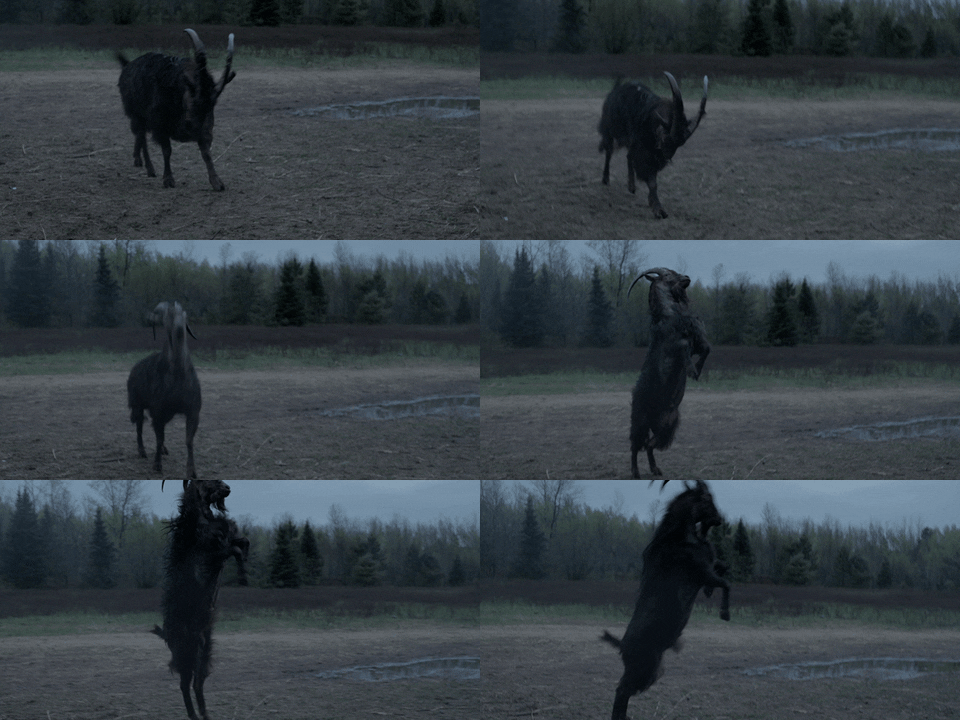
Jumping for joy at this book, truly. (source)

I never knew that I needed a “Beauty and the Beast” meets “The Witch” story, and yet here we are and “Slewfoot” gave me LIFE. Brom has created two compelling main characters who are isolated, angry, scared, and in need of companionship, and makes you care about both of them so, so much. Our first is Abitha, an Englishwoman who was sent to The Colonies to become a bride for a farmer (at a price, of course, as her father had no need for her but need for drinking cash). Abitha’s husband Edward is caring and a little awkward, and while they aren’t really romantic there is an intimacy there that is lovely, as well as short lived. When Edward dies tragically, Abitha takes over the farm, lest his nasty brother Wallace take it over and take her in as an indentured servant. And then we have a nameless forest spirit who awakens after a slumber, hungry and egged on by other spirits to kill and feed, in hopes that a mysterious Pawpaw tree will rebloom and recapture the magic of the forest. When Abitha and this being meet, thus begins a slow burn friendship, quasi-romance that both their worlds don’t approve of.

For me Abitha’s story was the more compelling one, as she is a headstrong woman in a Puritan community, and tales of this kind of strife are always my jam (especially if there is hope for the woman taking her freedom… and maybe a little revenge). Abitha is very easy to root for, and watching her slowly start to trust ‘Slewfoot’ (as her community calls The Devil, and she isn’t so sure this being she befriends ISN’T a devil of some kind) and come into her own ‘cunning’ powers through his assistance and friendship is so, so gratifying. You want her to remain powerful, you want her to get the best of Wallace as he plots against her and turns the town against her, and you want her and Slewfoot to just be together, be it romantic or platonic or a third kind of love that transcends both.

I also liked seeing Slewfoot slowly learn that he can be more than just a slayer and avenger for nature, which is what the wildfolk Forest, Creek, and Air have told him he is. Slewfoot has no memory of what he was before he went into this stasis, and while he starts out hungry and violent and frankly a bit terrifying, he starts to yearn to be more than this, and to connect with Abitha as they tentatively begin to interact with each other. I did find some of the folklore stuff to be interesting, though it KIND OF also felt a bit appropriative as Brom does take stories from Indigenous cultures of the region and applies them to this tale in some ways. It sounds like he did a lot of research and also spoke to members of the Pequot community to be as accurate and respectful as possible, which is definitely good, but there were some elements of the story that felt glossed over in regards to themes involving Indigenous people and their role in the narrative.

And the horror elements of this story are pretty on point, though they are few and far between until they are REALLY front and center. I would almost consider this more of a dark fairy tale or fantasy than a horror story, but that said I’m going to keep it as horror because there are definitely moments of body horror and just the horror of terrible humans that set me on edge. Slewfoot has his moments (especially when he’s still in the cave at the beginning of the book), but it’s really more the horrors of a fanatical community that will commit terrible acts in the name of God that really made me uncomfortable. As this kind of story always does. Abitha is so beaten down and abused by most of the town (with a few exceptions), that by the time she has to make a choice about mercy or revenge, you almost assuredly will be rooting for revenge. But that is also interesting, because as the story goes on and Slewfoot’s true identity is slowly parsed out, it becomes clear that sometimes the things we see as evil are actually neutral in the big scheme of things, and the things we consider righteous and good are deeply insidious. It’s a direction that I am all for, and I was wholly satisfied with how everything in this book gets wrapped up.

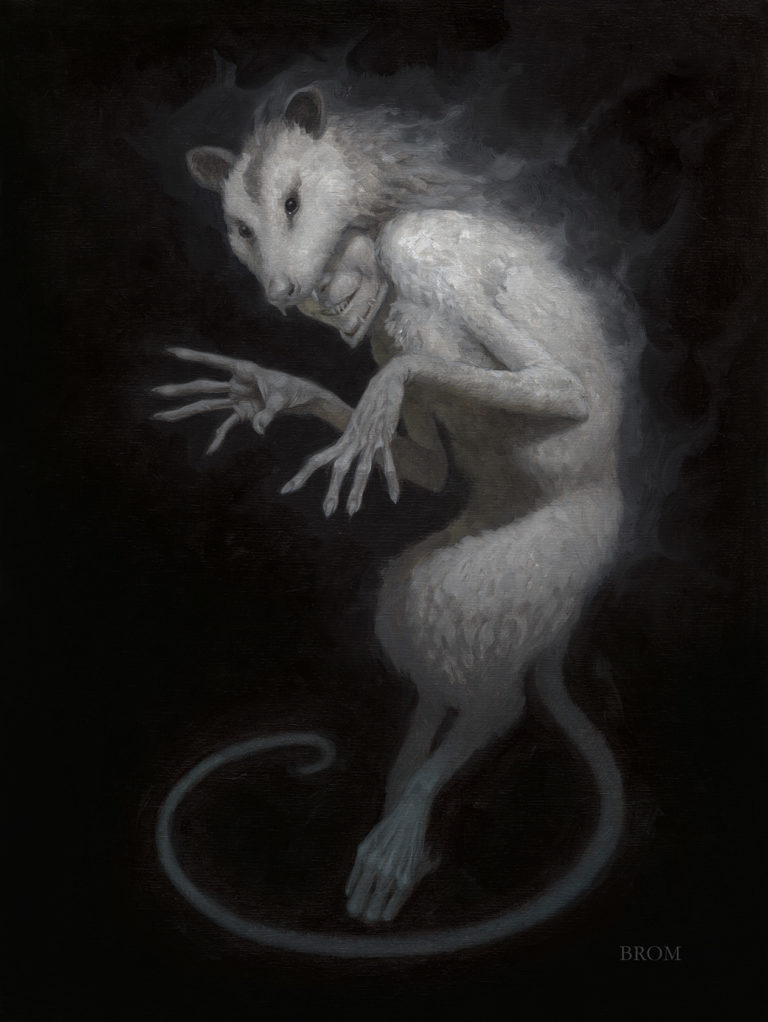
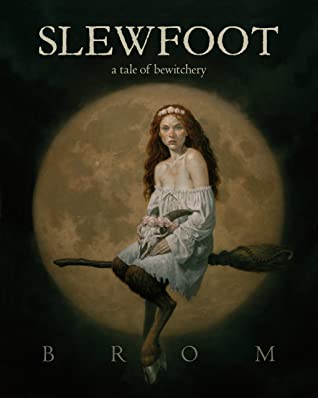
And finally, I have to mention the illustrations. The eARC that I received from NetGalley didn’t have any illustrations, but I was lucky enough to win a giveaway of a preview of the book from Tor Nightfire, which had a written sample of the story and a sampling of some of the artwork that Brom has included in the book. It’s haunting and feels very traditional in its design, and I know that when I do eventually get the book in print (as I need this to be a part of my home library) I will be excited to see what other images there are beyond the handful in the preview.

“Slewfoot: A Tale of Bewitchery” is one of the most enjoyable reads I’ve had this year to be sure. If you like “The Witch”, this book will probably be a good fit for you. It’s just so damn good.

Rating 10: Magical, dark, angry, and wondrous, “Slewfoot” is a fantastic tale of witchcraft and finding out where you belong.

Reader’s Advisory:

“Slewfoot: A Tale of Bewitchery” is included on the Goodreads list “2021 Horror Releases”, and would fit in on “Witch Hunts”.

Find “Slewfoot: A Tale of Bewitchery” at your library using WorldCat, or at a local independent bookstore using IndieBound!

Serena’s Review: “The Midnight Bargain”


Book: “The Midnight Bargain” by C.L. Polk

Publishing Info: Erewhon, October 2020

Where Did I Get this Book: Edelweiss+

Book Description: Beatrice Clayborn is a sorceress who practices magic in secret, terrified of the day she will be locked into a marital collar that will cut off her powers to protect her unborn children. She dreams of becoming a full-fledged Magus and pursuing magic as her calling as men do, but her family has staked everything to equip her for Bargaining Season, when young men and women of means descend upon the city to negotiate the best marriages. The Clayborns are in severe debt, and only she can save them, by securing an advantageous match before their creditors come calling.

In a stroke of luck, Beatrice finds a grimoire that contains the key to becoming a Magus, but before she can purchase it, a rival sorceress swindles the book right out of her hands. Beatrice summons a spirit to help her get it back, but her new ally exacts a price: Beatrice’s first kiss . . . with her adversary’s brother, the handsome, compassionate, and fabulously wealthy Ianthe Lavan.

The more Beatrice is entangled with the Lavan siblings, the harder her decision becomes: If she casts the spell to become a Magus, she will devastate her family and lose the only man to ever see her for who she is; but if she marries—even for love—she will sacrifice her magic, her identity, and her dreams. But how can she choose just one, knowing she will forever regret the path not taken? 

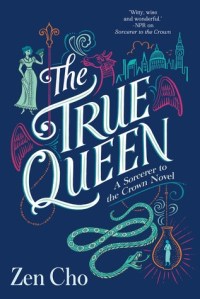
Review: I requested this one last fall, mostly because I always like historical fantasy novels and because of the simple, but beautiful, cover art. Romance is always a plus too! But here we are in the spring of 2021 before I finally got around to it. Part of that is due to my own poor management of my TBR pile, of course. But my recent enjoyment of “Sorcerer to the Crown,” a title to which this one sounds similar, was really the kick in the pants I needed top finally pick this one up. Unfortunately, that same comparison that spurred my renewed interest is also the thing that ultimately hurt this book for me in the end.

For Beatrice, the life path laid out before her is as set-in-stone as it is unwanted. With a destitute family depending on her, she unhappily looks ahead to a life where she will be forced to give up her magic in order to marry well and restore her family’s prospects. In her efforts to avoid this life, Beatrice pursues a powerful, magical book that will unlock her abilities and make her a Magnus. But as she gets closer and closer to this opportunity, the choices before her become harder and harder. When she meets an intriguing young man, she begins to realize that she will have to lose one of her loves: a beloved husband or her magic.

While I didn’t love this book, there were a few things that stood out to me on the positive side. I thought the integration of the magical system and the Regency world-building was interesting and unique. It was fairly simplistic, but in some ways I think that worked well for this book that was trying to span at least three different genres: fantasy, historical fiction, and romance. And what included was interesting in its own right, with the grimoires and the summoning of spirits at the heart of the fantasy. I also thought the complication of the dangers magic posed to childbearing was an interesting, if a bit heavy-handed, wrinkle to throw in the fold.

However, there were a few too many things that got in the way of my enjoying those aspects of the story too much. Immediately, I struggled with the writing. There is a lot of telling and a distinct lack of showing in the style of the story. And this is especially tedious in the beginning of the story where many bits of information are rather inexpertly dumped on to readers with very little done to obscure this goal. This is a personal preference, of course, but I also found myself becoming increasingly distracted and annoyed by the use of exclamation points in the writing. Not simply in dialogue, but in the actual description of events. It made many of these passages read as juvenile and a bit ridiculous.

I also found the main character fairly unlikable, coming across more annoying than fierce. The love story was also very superficial. It’s pretty much your typical insta-love story, and from there all the “drama” feels artificial and contrived. None of which helps the main character’s likability in the least. The conflict between her (instant) love with the hero, who seemed like obviously a genuinely good guy right from the start, and retaining her magic began to lose its weight fairly early.

The story itself had strange pacing, seeming to drag for long periods in the middle only to pick up again, briefly, towards the end. This wasn’t helped by the fact that, all told, it’s a fairly straight-forward and predictable affair. I struggled quite a bit to maintain interest, which is always a fairly bad sign when I reflect back on my feelings on a book. Overall, I think there are likely better examples of books like this, “Sorcerer to the Crown” (obviously) and also “The Dark Days Club” and its sequels come to mind.

Rating 6: A unique idea falters under poor pacing and a plot that veers to closely to predictable tropes.

Reader’s Advisory:

“The Midnight Bargain” is on these Goodreads lists: Fantasy of Manners and Something Wicked This Way Comes.

Find “The Midnight Bargain” at your library using WorldCat!

Serena’s review: “The True Queen”

Book: “The True Queen” by Zen Cho

Publishing Info: Ace, March 2019

Where Did I Get this Book: from the library!

Book Description: When sisters Muna and Sakti wake up on the peaceful beach of the island of Janda Baik, they can’t remember anything, except that they are bound as only sisters can be. They have been cursed by an unknown enchanter, and slowly Sakti starts to fade away. The only hope of saving her is to go to distant Britain, where the Sorceress Royal has established an academy to train women in magic.

If Muna is to save her sister, she must learn to navigate high society, and trick the English magicians into believing she is a magical prodigy. As she’s drawn into their intrigues, she must uncover the secrets of her past, and journey into a world with more magic than she had ever dreamed. 

Previously Reviewed: “Sorcerer to the Crown”

Review: Kate and I both read “Sorcerer to the Crown” for bookclub a few months ago. It had been my pick, a book that had been sitting on my shelf inexplicably unread for years. Boy could I have kicked myself for that after getting through with it! I loved the fantasy of manners feel of the book, and the main characters were incredibly compelling. I also liked how the book tackled complicated issues surrounding race, identity, and sexism all within a book that, overall, still felt light0hearted and fun. With all that to recommend it, I was fully committed to continuing on with the series as soon as possible. And, while I didn’t enjoy this one quite as much of as the first, I still had a blast reading this second entry.

Muna and her sister Sakti wake up on a beach with no memory of who they are or where they came from. They know they are sisters, but nothing else. Muna is satisfied to lead a quiet life, but when Sakti begins to succumb to a curse that sees her slowly disappearing, Muna must venture forth to save her sister. But with no magic to her name, Muna’s task is a perilous one. In a foreign country, and with the aide of the powerful Sorcerer to the Crown, Prunella, Muna must convince everyone that she is in fact a powerful magical force in her own right. Soon, she is more steeped in magic and magical beings than she ever would have wished. But to save her sister, Muna will brave most anything.

One of the main things that still stands out to me when now reading this second book by Cho is the perfect marriage of old-fashioned-style writing and unique, fantasy elements. If there weren’t dragons and talk of the land of Fae in every other sentence, it would be easy to imagine one is simply reading a good Jane Austen novel or any other historical fiction story written in that time. Now, the mileage of that style of writing really varies from reader to reader as, indeed, it’s a style that lends itself towards long, drawn out sentences. But I love this type of verbose writing, so this kind of book is right up my alley.

10 Most Unforgettable JUSTIFIED Quotes | Movie TV Tech Geeks News
Regency authors and Boyd Crowder apparently have a lot in common.

I was also pleased to see that while Muna has the majority of the POV chapters, we also returned to Prunella as well. In fact, the contrast between the two almost made each stronger. Prunella was still her confident, action-oriented self. However, Muna was a much more reserved character. From the start, she is only pushed into this adventure in a desire to save her sister. For herself, she would have been happy with a quiet life, only faintly disturbed by her missing memories. She was an excellent foil to Prunella, and, while the two faced similar barriers to their roles in society (as women, and, worse, women with magical abilities), we see how Muna is affected by these forces and reacts differently than Prunella.

I also enjoyed the additional layers that were added to the fantasy elements in this story. Most especially, I enjoyed the deeper look into the world of Fae itself, with its strange habits and fearsome (and sometimes very funny!) cast of characters. It was also interesting seeing how various nations understood this magical world, and the different ways they approached their relationship with this powerful place and its people.

Once again, the book also delved into some social aspects and themes that aren’t often found in a historical work like this. I’m not quite sure if this was as successful as the first book was, however. The romance between the two women, for one things, feels very out of the blue and tacked on at the very end. It is definitely possible to read this as a building romance between the two the entire time, but when one character is in a straight relationship for almost the entire book only to suddenly switch at the end…it’s just not very deftly handled.

Overall, I really enjoyed this book. It contained much of what I enjoyed from the first book, and Muna was a fantastic new main character. I’m still very intrigued by this world and would love to re-visit it whenever Cho chooses! Fans of the first book should definitely check this one out!

Rating 8: A smart, Regency fantasy that continues to build on the excellent foundation of social commentary that the first book established.

Reader’s Advisory:

“The True Queen” is on these Goodreads lists: LGBT Scifi and Fantasy 2015-2020 and Asian Adult Fiction 2018.

Find “The True Queen” at your library using WorldCat!

Serena’s Review: “The Shadow in the Glass”

Book: “The Shadow in the Glass” by J.J.A. Harwood

Publishing Info: HarperVoyager, May 2021

Where Did I Get this Book: Edelweiss+

Book Description: Once upon a time Ella had wished for more than her life as a lowly maid.

Now forced to work hard under the unforgiving, lecherous gaze of the man she once called stepfather, Ella’s only refuge is in the books she reads by candlelight, secreted away in the library she isn’t permitted to enter.

One night, among her beloved books of far-off lands, Ella’s wishes are answered. At the stroke of midnight, a fairy godmother makes her an offer that will change her life: seven wishes, hers to make as she pleases. But each wish comes at a price and Ella must to decide whether it’s one she’s willing to pay it.

Review: I’m always up for a good fairy-tale retelling. The story of “Cinderella” is probably right up there with “Beauty and the Beast” as a favorite in the genre as well. There are a bunch of them out there, with some I like better than others. “Ella Enchanted” will probably always be my favorite, and I was alone in the crowd as being underwhelmed by “Cinder.” But it’d been a while since I’d read one, and the summary for this version seemed to indicate a darker take on the classic tale. The darkness delivered. The rest of the book….well.

Ella had once had a future. One filled with coming out balls, high society, and if she was fortunate, a wealthy marriage. But when her wealthy sponsor and the lady of the house dies, Ella finds herself in very different circumstances. Now, a lowly maid with no prospects, Ella spends her nights sneaking into the library and dreaming of what once was. When she triggers a magical event and a powerful fairy appears offering her a way out, Ella is quick to bargain. But as she wishes for more and more, will the price be more than she is willing to pay?

So, like always, I’ll try to start this review with the things that I liked. The biggest pro I have for this book unfortunately ties into a negative aspect as well, but we’ll go for the good side first. The story is definitely a darker re-imaging of the classic tale. There were moments that were legitimately creepy, and I enjoyed the way these darker portions of the story built one upon another, ramping up the tension and sense of inevitable doom as the story progressed. This is definitely not the floofy, Disney version of Cinderella, and it was refreshing to read a very different take on a well-covered story.

On the other hand, this darkness began to overwhelm the story. The deep dive into the psychological aspects of what having wishes that will grant you almost anything can do to one’s own moral compass began to feel a bit exhausting. Ella continues to make the same mistakes over and over again, seemingly learning very little from her previous errors. It also ends up making Ella a very unlikeable character much of the time. She quickly becomes incredibly greedy and self-centered. And while I thought this exploration of what wishes can do to a person was interesting enough, the actual reading experience of it was not very enjoyable.

As part of this dark feel to the book, the story delves into a few tougher issues. They weren’t botched by any means, but I also am not sure the author really covered them as well as I would have liked. The atmosphere of the story is very grim and it did begin to feel stifling at times, made all the harder by my dislike for the main character.

I appreciate that this story wasn’t like many other cookie-cutter versions of the “Cinderella” fairytale, and at times the Gothic feeling of the story was quite successful. The version of the fairy godmother, in particular, was striking. But between the almost oppressive tone of the story and unlikable main character, it wasn’t for me. Those you enjoy darker fairytales might enjoy this, but if you’re a reader who goes into books hanging most of your hopes of enjoyment on your main lead, this probably isn’t for you.

Rating 6: Not to my taste, but an interesting take on a darker version of “Cinderella.”

Reader’s Advisory:

“The Shadow in the Glass” is a new book, so it isn’t on many Goodreads lists, yet. But it is on 2021 Gothic.

Kate’s Review: “Hour of the Witch”

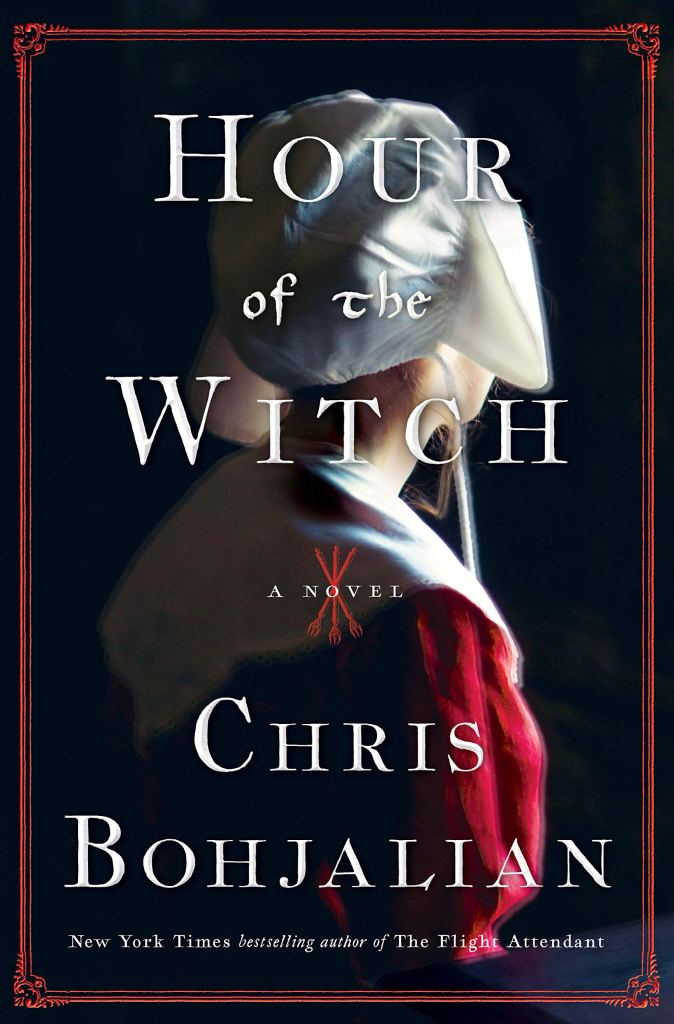
Book: “Hour of the Witch” by Chris Bohjalian

Publishing Info: Doubleday Books, May 2021

Where Did I Get This Book: I received an eARC from NetGalley.

Book Description: A young Puritan woman–faithful, resourceful, but afraid of the demons that dog her soul–plots her escape from a violent marriage in this riveting and propulsive historical thriller from the #1 New York Times bestselling author of The Flight Attendant.

Boston, 1662. Mary Deerfield is twenty-four-years-old. Her skin is porcelain, her eyes delft blue, and in England she might have had many suitors. But here in the New World, amid this community of saints, Mary is the second wife of Thomas Deerfield, a man as cruel as he is powerful. When Thomas, prone to drunken rage, drives a three-tined fork into the back of Mary’s hand, she resolves that she must divorce him to save her life. But in a world where every neighbor is watching for signs of the devil, a woman like Mary–a woman who harbors secret desires and finds it difficult to tolerate the brazen hypocrisy of so many men in the colony–soon finds herself the object of suspicion and rumor. When tainted objects are discovered buried in Mary’s garden, when a boy she has treated with herbs and simples dies, and when their servant girl runs screaming in fright from her home, Mary must fight to not only escape her marriage, but also the gallows. A twisting, tightly plotted thriller from one of our greatest storytellers, Hour of the Witch is a timely and terrifying novel of socially sanctioned brutality and the original American witch hunt.

Review: Thank you to NetGalley for providing me with an eARC of this novel!

Back in middle school I decided to read “The Crucible” by Arthur Miller, after my drama class chose it as one of the scenes that we’d perform and I was voted to be Mary Warren in said scene. After reading the whole play my thirteen year old self was super indignant, and I basically have had a seething anger deep in my soul for any kind of witchcraft or Satanic Panic fueled hysteria ever since. Because of this, I was eager to snatch up the new historical fiction thriller “Hour of the Witch” by Chris Bohjalian. I’ve enjoyed Bohjalian’s stories in the past, I love me a good historical fiction thriller, and demolishing the Patriarchy in Puritan times? We ALL know how I feel about that!

Yes please. (source)

Now I don’t want anyone thinking that “Hour of the Witch” is a pro-Witchcraft-As-Way-To-Smash-Misogyny kind of tale. Instead, Bohjalian takes the idea of a community turning on a strong minded woman and tries to tell it in a way that would be realistic towards the time and culture. Mary isn’t a woman who ends up turning to Satan because it’s the only clear path to agency in her life. Instead, we get a tale of a woman who dares stand up for herself and wants to advocate for her health and happiness against an abusive husband while still being God fearing and devout, and while also questioning power structures that are hypocritical. I admittedly don’t have as much breadth of knowledge in this part of American history and Puritan times, but from the historical notes in the back it seems like Bohjalian did his very best to make it realistic, and therein I found Mary to be believable. Her story of trying to divorce her abusive husband Thomas, and being the target of scorn and then witchcraft accusations for daring to push against the misogynistic norms, is suspenseful, frustrating, and incredibly readable. I loved Mary as a character, and seeing her fight in the face of powerful and abusive men was both cathartic, but also tense, as we all know how the power structures during the Puritan times could easily cry ‘witch’ and have a person killed (that said, while this story really does a good job of addressing the oppression that women faced, little is noted of the Indigenous groups in the area. I’m not sure how Bohjalian could have tackled such a huge aspect from Mary’s perspective without feeding into paternalistic or oppressive views, but when the groups were mentioned it felt like a nod without doing much work beyond that. Take that as you will).

In terms of plot, “Hour of the Witch” is definitely steeped in suspense, as well as a little bit of mystery. Working against Mary in her endeavors are her husband’s standing in the community, the fact that no one has seen him hurt her as he’s always careful to do it when they are alone, and the fact that some three tined forks were found buried in her yard, which at the time were thought to be ‘the devils tines’ due to the three prongs resembling a pitchfork (side note: when I worked at a historic fort that had a context set during the Georgian period, a dining demonstration did mention the lack of three tined forks in America in spite of the fact they were prevalent in Europe. We didn’t talk about ‘the devils tines’ aspect, however). The questions are 1) is Mary going to be able to escape her husband without being convicted of witchcraft, and 2) who IS the one who is setting her up to look like a witch? Such moments will make you shake with rage, but it also just goes to show that some things never change. Mary is accused of lying for attention, lying to offset the fact she hasn’t been able to have children as of yet, lying because she’s lustful, and lying because she’s a witch. These days, maybe we don’t see as much ‘witch’ stuff, but the rest of those accusations against an abused woman in hopes of painting her as a liar are all too familiar. And as for what is really going on with the buried forks in her yard, I really enjoyed trying to figure out what was going on there, as Bohjalian has a whole SLEW of suspects and possibilities, some one which are not as they seem. I was left on pins and needles worrying about what was going to happen to Mary, as well as wanting to spit nails out of rage when looking at how the men in the community (with a couple exceptions) and some of the women were treating her because of the misogyny that was rife. BE PREPARED TO BE MAD.

Overall, I thought that “Hour of the Witch” was a pretty good read, with a unique setting that felt timeless all the same. It may not be the Satanic feminism that I tend to love, but I still enjoyed it!

Rating 8: Suspenseful and unique in voice and setting, “Hour of the Witch” tells a tale as old as time about misogyny, women, and a society that uses one to keep the other in its place no matter what the outcome.

Reader’s Advisory:

“Hour of the Witch” is included on the Goodreads lists “Witch Hunts in Historical Fiction”, and “2021 Gothic”.

Find “Hour of the Witch” at your library using WorldCat, or a local independent bookstore using IndieBound!

Serena’s Review: “A River in the Sky”

Book: “A River in the Sky” by Elizabeth Peters

Publishing Info: Harper Collins, April 2010

Where Did I Get this Book: audiobook from the library!

Book Description: August 1910. Banned from the Valley of the Kings, Amelia Peabody and husband Emerson are persuaded to follow would-be archaeologist Major George Morley on an expedition to Palestine. Somewhere in this province of the corrupt, crumbling Ottoman Empire—the Holy Land of three religions—Morley is determined to unearth the legendary Ark of the Covenant.

At the request of British Intelligence, Emerson will be keeping an eye on the seemingly inept Morley, believed to be an agent of the Kaiser sent to stir up trouble in this politically volatile land. Amelia hopes to prevent a catastrophically unprofessional excavation from destroying priceless historical finds and sparking an armed protest by infuriated Christians, Jews, and Muslims. Meanwhile, Amelia’s headstrong son, Ramses, working on a dig at Samaria, encounters an unusual party of travelers and makes a startling discovery—information that he must pass along to his parents in Jerusalem…if he can get there alive.

Previously Reviewed: “The Crocodile on the Sandbank” and “The Curse of the Pharaohs” and “The Mummy Case” and “Lion in the Valley” and “Deeds of the Disturber” and “The Last Camel Died at Noon” and “The Snake, the Crocodile, and the Dog.” and “The Hippopotamus Pool” and “The Ape Who Guards the Balance” and “Guardian of the Horizon”

Review: It’s been quite a while since I’ve returned to my beloved Amelia Peabody series. Not from any lack of continued interest, just the continuous growth of my TBR which shames me into reading more current books more often than not. But I felt like it was high time to return to a comforting favorite, so here we are! What adventures will Amelia and her family get up to this time?

The season ahead looks bleak for Amelia and Emerson. They are forbidden from working in their beloved location in the Valley of the Kings and have no fruitful prospects before them. But, sure enough, adventure arrives on their doorway in the form of spy craft and intrigue. This time they are sent by the British government to follow the activities of a would-be archeologist whom the intelligence community suspects of being an agent of disruption sent by the Kaiser to sew chaos in Palestine. But Amelia and Emerson are archeologists at their hearts and can’t help getting caught up in the man’s mad quest to uncover the Ark of the Covenant (and prevent the man from blundering up the entire affair to boot!)

Following what seems to be a bit of a trend, this book largely sees our party split up, with Amelia and Emerson working their own case, and Ramses off on his own (with some other friends) doing his own thing. The story intertwine in a creative way, but I think, overall, I’m always a bit disheartened by the books that playout like this. So much of what makes these stories so good is the interaction between its very charismatic cast of characters. Other than perhaps Amelia herself, I’ve never felt like any of the other cast can really stand well on their own. I think this book is making a case for Ramses being more of his own character, and perhaps that will just be the way later books go and he will begin to flesh out more as we move forward. But for now, I still miss the amusing parental/grown-child interactions that we see from this family unit when they’re all together.

For whatever reason, I also struggled a bit more with the mystery in this book. Some of this could just be due to the chopped-up nature of my reading experience, only listening to chunks here and there when I could catch a minute. But I had a hard time keeping track of the cast of characters, especially between the discoveries we learn from Ramses’ plotline and those we were discovering with Amelia and Emerson. I did like, however, that the general flow of both of these sections felt very different. Amelia and Emerson’s plotline largely felt familiar, with the pair travelling to an excavation site and finding their trip and work constantly interrupted by baffling experiences. Ramses, however, followed a much more action-packed story that was less a mystery than it was a thriller. The combination of both tones made for an interesting reading experience. It was just a bit tough reacclimating when we switched from one to the other.

I also really liked the new setting. The last book saw the crew return to the Lost Oasis, and that was a breath of fresh air from the usual Egyptian setting. But here we had an entirely new location, one we had never visited previously. This is where I wish our family group had been together more of the time, and the story could have devoted more of its page time to exploring the ins and outs of this region. As it was, we only had Amelia and Emerson’s chapters to really dive into Jerusalem and its political/cultural/religious quagmire.

I really enjoyed returning to this series. I do think that my piece-meal approach to reading these later books is hurting my experience a bit, though. I can see that the author is really trying to grow Ramses into a fully fledged lead character in his own right, but because I have such long gaps in my reading experience, he always is the least interesting to me, something that may become more of a problem going forward. Hopefully I can get to the next one more quickly and start to become more invested in him in his own right. But fans of the series are sure to be pleased with this one, especially if you’re already more onboard the Ramses train.

Rating 8: A fun new adventure that mixes the traditional mystery with a more action-packed thriller style of storyline.

Reader’s Advisory:

“A River in the Sky” is on these Goodreads lists: Novels That Let You Travel in Retro Style and Historical Mysteries and Thrillers Featuring Women.

Find “A River in the Sky” at your library using WorldCat!

Kate’s Review: “The Forest of Stolen Girls”

Book: “The Forest of Stolen Girls” by June Hur

Publishing Info: Feiwel & Friends, April 2021

Where Did I Get This Book: I received an eARC from NetGalley.

Book Description: After her father vanishes while investigating the disappearance of 13 young women, a teen returns to her secretive hometown to pick up the trail in this second YA historical mystery from the author of The Silence of Bones.

Hwani’s family has never been the same since she and her younger sister went missing and were later found unconscious in the forest, near a gruesome crime scene. The only thing they remember: Their captor wore a painted-white mask. To escape the haunting memories of this incident, the family flees their hometown. Years later, Detective Min—Hwani’s father—learns that thirteen girls have recently disappeared under similar circumstances, and so he returns to their hometown to investigate… only to vanish as well.

Determined to find her father and solve the case that tore their family apart, Hwani returns home to pick up the trail. As she digs into the secrets of the small village—and reconnects with her now estranged sister—Hwani comes to realize that the answer lies within her own buried memories of what happened in the forest all those years ago.

Review: Thank you to NetGalley for providing me with an eARC of this novel!

Last year I read June Hur’s novel “The Silence of Bones”, and quite enjoyed it. It’s always great to see new Own Voices authors getting new stories out into the world, especially within genres that tend to be associated with whiteness. While I know that there are a myriad of historical mysteries out there from many backgrounds, in my experience and the experiences of people around me the general thoughts on the genre tend to skew towards European or American settings. I want to stretch and challenge this thought in my own reading. So given that “The Silence of Bones” took place in 19th Century Korea, it was a fresh feeling setting when I read it, and I liked that a lot. When I saw that Hur had a new historical myster/thriller coming out called “The Forest of Stolen Girls”, I was massively excited to read it, hoping that it would live up to “The Silence of Bones” in terms of plotting and mystery. And I have great news: it exceeded it.

Let’s start with the time, setting, and characters. Given that Hur really connected with me on all three of these points with “The Silence of Bones”, I had high hopes that same would be said for “The Forest of Stolen Girls”. And this time she went even above and beyond my expectations. Once again we are in historical Korea, though we’ve gone even further back in time to the 15th Century on Jeju Island. The setting is isolated and remote, and for Hwani, who has spent a few years on the mainland it is a jarring return because of culture shifts and also because of the trauma that she suffered there. I loved the descriptions of the island and the nature and wilderness that surrounds the village, and I also loved that Hur did throw in tidbits of historical facts (like the Haenyeo divers, and how on Jeju girls weren’t much less valued than boys because it was the girls who did the diving), about the area. It just felt like a unique setting, one that lends itself very well to the plot, and it was one that I greatly enjoyed. I also really liked our main characters, Hwani and Maewol, two sisters separated by distance and also their shared trauma and the fallout. The strong bond that they share as sisters has been tested and strained because of Hwani being sent to the mainland to live with her aunt, while Maewol was left behind, a decision made by their father. Hwani has the utmost respect for him, while Maewol resents him. Hwani felt constrained by her time on the mainland, while Maewol felt abandoned. Their frustrations and resentments, of course, come out and target each other, but this felt realistic and true to how sometimes sibling relationships can be fraught because of circumstances they can’t always control. I loved seeing both of them have to learn to trust each other again, and have to team up and use each other’s various skills to try and solve what had happened to their father, and what had happened to the local girls.

In terms of the mystery itself, I found it to be very engaging, suspenseful, and well crafted. There are a number of people in their town who could be very believable suspects when it comes to who is taking teenage girls, and Hur makes sure to give believability as well as deniability to almost all of them. The way that the mystery connects to Hwani and Maewol is well done, as is the compounded mystery of what happened to their father when he tried to go solve it once and for all. And on top of all that, for added context Hur adds a historical note at the end of the book that talks about human trafficking, specifically that of girls and women, during this time period in Korea, which really put into perspective that while the years and centuries can keep on going and progress and changes can be made, but some things just keep on happening and one of those things is violent misogyny.

“The Forest of Stolen Girls” is another great historical mystery/thriller from June Hur. If you are looking to shake up your historical fiction content and reading lists, definitely give this one a look! I cannot wait to see what Hur comes out with next.

Rating 8: A dark, suspenseful novel with timeless themes and a unique setting, “The Forest of Stolen Girls” is a solid historical mystery!

Reader’s Advisory:

“The Forest of Stolen Girls” is included on the Goodreads lists “Asian Historical Fiction”, and “2021 YA Mysteries and Thrillers”.

Find “The Forest of Stolen Girls” at your library using WorldCat, or at a local independent bookstore using IndieBound!
Serena’s Review: “The Brass Queen”

Book: “The Brass Queen” by Elizabeth Chatsworth

Publishing Info: CamCat Books, January 2021

Where Did I Get this Book: Edelweiss+

Book Description: In 1897, a fiery British aristocrat and an inept US spy search for a stolen invisibility serum that could spark a global war.

Miss Constance Haltwhistle is the last in a line of blue-blooded rogue inventors. Selling exotic firearms under her alias, the ‘Brass Queen,’ has kept her baronial estate’s coffers full. But when US spy, Trusdale, saves her from assassins, she’s pulled into a search for a scientist with an invisibility serum. As royal foes create an invisible army to start a global war, Constance and Trusdale must learn to trust each other. If they don’t, the world they know will literally disappear before their eyes.

Review: I haven’t reviewed a lot of them, but that’s because I don’t really see them around that much, but I do really enjoy a good steampunk fantasy when I can find it. It’s a neat, little quirky subgenre in fantasy fiction that is kind of bizarre in the specific elements that are seemingly expected from the genre: must involve steam-powered machine, often set in the Victorian period or some historical-feeling setting, has a decent overlap with Manners period pieces, etc. Those are all things I typically enjoy, so combine them well, and you’ve probably got a winner for me! Ah, but combining them well….

Constance must marry. Her family home is in danger, and with an absent father and no other recourse before her, the marriage market is her only way forward. Of course, she must find a husband who can either ignore or not see the other identity that Constance keeps under tight wraps: her position as the “Brass Queen,” a well-respected, underground weapons dealer. All is going exactly not to plan when her debut ball is interrupted by thieves. She quickly finds herself caught up in an elaborate plot that extends past Britain’s own borders. Not only that, she’s paired up a ridiculous U.S. spy whom she’s not sure she can even trust. What could go wrong next?

Like I said, I generally enjoy steampunk fantasy stories, and this one in particular had some interesting things going for it, like our heroine’s secret life as the Brass Queen. I also liked the way the author explored the idea of this imagined version of England with its machines and mechanized creations. The very first scene sees Constance opening a ball in a room overseen by towering animatronic suits that can be piloted by riders within. Constance’s own alternate identity gives the reader a direct line into the ins and outs of how this type of weaponization has and could be used. There was a lot of creativity here and elements to pique one’s interest.

But other than these aspects of the world-building, I struggled with this story. Constance, for one thing, was a walking, talking contradiction whom I could never quite understand or believe in as a living, breathing person. On one hand, she’s this weapons dealer who works with great power players all of the time. And yet in the very first scene, we’re supposed to believe that she’s been bumbling around the ball room this entire time and is about to fall to pieces over a simple speech? Someone who runs an underground weapons dealership would surely have a firm hand on proper decorum and behavior and much experience talking to strangers, likely to even more important people and with greater stakes at play. This contradiction continued throughout the book. I just had a hard time buying a lot of Constance’s actions when set against the idea that she was supposed to be this powerful, underground operator (as many characters remind us).

I also felt like the romance was a bit off the entire time. I’m not sure if this was because I was constantly distracted by Constance, or what exactly the problem was. I think part of it was Trusdale had a very “American cowboy in Britain” thing going on that I also had a hard time taking seriously. The book was clearly trying to incorporate a good amount of humor, and some the bantering between these two was actually quite good. But the balance was just slightly off and some of the humorous moments early on made it hard for me to take either of these characters too seriously or care overly much about their romance as a whole.

I also struggled with the writing in general. I had a hard time picturing some of the elements of the story, never a good thing for a fantasy book. And the story sometimes had jarring jumps between one scene and another. The formatting on my Kindle e-galley didn’t help with this. Hopefully the finalized version will have better page breaks to distinguish these scenes a bit better.

Overall, I had a fairly middling response to this book. There was nothing that I really disliked, but I also didn’t care about the story that much. The writing wasn’t quite strong enough to support some of the more fantastical elements, and the characters weren’t complicated enough to add any weight to the action. If you really enjoy steampunk fantasy stories, this might be worth checking out, but it wasn’t quite all I had hoped it would be.

Rating 7: Fun enough at times, but not all I had hoped it could be.

Reader’s Advisory:

“The Brass Queen” is on these Goodreads lists: Gaslamp Fantasy and 2021 Swoony Awards.

Find “The Brass Queen” at your library using WorldCat!