Kate’s Review: “Bury the Lede”

Book: “Bury the Lede” by Gaby Dunn & Claire Roe (Ill.)

Publishing Info: Boom! Studios, October 2019

Where Did I Get This Book: The library!

Book Description: Twenty-one-year-old Madison T. Jackson is already the star of the Emerson College student newspaper when she nabs a coveted night internship at Boston’s premiere newspaper, The Boston Lede. The job’s simple: do whatever the senior reporters tell you to do, from fetching coffee to getting a quote from a grieving parent. It’s grueling work, so when the murder of a prominent Boston businessman comes up on the police scanner, Madison races to the scene of the grisly crime. There, Madison meets the woman who will change her life forever: prominent socialite Dahlia Kennedy, who is covered in gore and being arrested for the murder of her family. The newspapers put everyone they can in front of her with no results until, with nothing to lose, Madison gets a chance – and unexpectedly barrels headfirst into danger she never anticipated.

Review: As I continue to try and up my graphic novel stats after a few months of a whole lot of novels, I found “Bury the Lede” by Gaby Dunn on a list about dark graphic novels with LGBTQIA+ themes and characters. Both wanting to get out of the fantasy realms of graphics, and always wanting to read more books by LGBTQIA+ authors about LGBTQIA+ characters, I found it at my library and placed it on hold. When it came I was a little shocked to see how short it was, but hey, a story about a young wannabe reporter getting close to a potential murderer in hopes of solving a baffling case? That could be covered in a trade paperback collection sized graphic, right? Right. Then it was too bad that “Bury the Lede” had far more plot points and aspirations than just that, because it’s a lot to cram into one thin book.

In terms of what did work for me, there were some really cool ideas in this book. I love the concept of a budding journalist wanting to prove herself getting in a bit over her head. I really liked the sapphic obsessive relationship that our journalist, Madison, starts up with accused murderess and socialite Dahlia. On paper it sounds very “Silence of the Lambs”, with a prisoner perhaps manipulating an investigator, but also leading them to a much bigger case nonetheless. I thoroughly enjoyed every scene that Madison and Dahlia had together, the weird sexual chemistry oozing and crackling when you aren’t exactly certain if this is something you’re supposed to be cool with. That works so, so well. I also enjoyed the ‘ripped from the headlines’ character of Raquel Stief, a woman in an education position that is being considered for a place in the President’s circle of advisors and administrators, and who is CLEARLY based on that demon Betsy DeVos. There may have been some living vicariously going on here as I read, given that one of the true monsters in this story is Stief, and Madison is hoping to take her down. And hell, I liked that there was a broader conspiracy afoot, because something like that is a really good idea that has a lot of potential to explore. And as mentioned earlier, this book does have numerous LGBTQIA+ characters and themes, and any time we get some diversity in graphic novels written by Own Voices authors, it’s going to be positive.

But oh, the stumbles within the good ideas and broad themes. While the idea of a sweeping political conspiracy theory with implications that could go all the way to Washington D.C. is very interesting, this isn’t a very long book, and it all feels like it goes VERY fast. Madison uncovers connection after connection at break neck speed, and it gave very little space to breathe by the time we get to the big reveal and climax of the book. And while the book pulls you in with the mystery of Dahlia, the murder of her husband, and her missing child, by the time we do get to the revelations involving that whole thing, it feels like a bit of a cobbled together afterthought. So does the connection that Dahlia has to Stief. By the end it feels more like Dunn wanted to have an “All the President’s Men” kind of story, but thought that the only way to get people to read such a thing in graphic novel form was to throw in a nice carrot on a stick in the form of murder. And by the end, neither aspect felt wholly explored. Hasty plot points aside, in terms of the characters, there really isn’t anyone to root for. I like that Madison is determined, but not only do we really only get to see this one side of her, she is also wholly, WHOLLY unethical in her journalistic ways. I’m sure that it was meant to establish her as a morally gray character whose drive to do ANYTHING for a story is damaging, but that’s not exactly a new theme to stories about journalists. And if anything, she left the morally gray area and went into straight up villain territory (mild spoiler alert: she roofies someone to get information out of them. Like, holy shit.), but it never seemed to be treated as such.

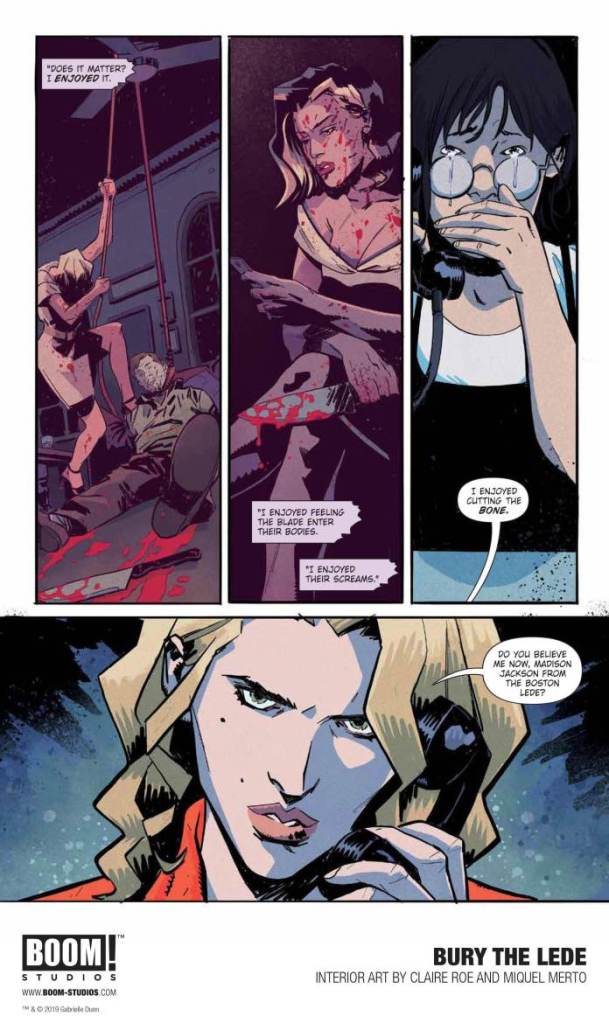
But, I did like the artwork and the character designs. Claire Roe uses some effective shadows and colors to establish mood, and it definitely felt neo-noir in her illustrations.
I had expectations for “Bury the Lede” that weren’t met. Though it had glimmers of really cool ideas, the execution didn’t get off the ground.

Rating 5: Definitely has a well conceived plot with some good ideas, but it just felt like it was executed a little too quickly with not enough focus. Throw in unlikable characters, and it’s just meh.

Reader’s Advisory:

“Bury the Lede” is included on the Goodreads lists “Journalists, Photographers, Etc. in Comics”, and “Novels with Bisexual Protagonists”.

Find “Bury the Lede” at your library using WorldCat, or at a local independent bookstore using IndieBound!

Kate’s Review: “The Sandman (Vol. 9): The Kindly Ones”

Book: “The Sandman (Vol.9): The Kindly Ones” by Neil Gaiman, Marc Hempel (Ill.), Richard Case (Ill.), D’Israeli (Ill.), Teddu Kristiansen (Ill.), Glyn Dillon (Ill.), Charlie Vess (Ill.), Dean Ormston (Ill.), & Kevin Nowlan (ill.).

Publishing Info: Vertigo, 1995

Where Did I Get This Book: I own it.

Book Description: The Penultimate volume to the phenomenal Sandman series: distraught by the kidnapping and presumed death of her son, and believing Morpheus to be responsible, Lyta Hall calls the ancient wrath of the Furies down upon him. A former superheroine blames Morpheus for the death of her child and summons an ancient curse of vengeance against the Lord of Dream. The “kindly ones” enter his realm and force a sacrifice that will change the Dreaming forever.

Review: If I’m being totally honest, as I was going through my “Sandman” re-read, “The Kindly Ones” was the issue that I was most dreading. For one, it’s long. It’s the longest of all the volumes. Normally length doesn’t daunt me, but knowing what was coming, added thickness just wasn’t getting me stoked for this part of my re-read. And the bigger reason, without spoiling too much, is that “The Kindly Ones” is really where the big, sad, frustrating and beautiful climax happens for this series. Yes, we have one more volume to go, but that’s all release and wrap up. “The Kindly Ones” is the action part of the finale, and it packs an emotional wallop.

Pardon me while I go stare aimlessly at a wall for a good long time. (source)

“The Kindly Ones” is the volume in which everything comes to a head. In “Worlds’ End” we saw a haunting funeral procession in the sky. In “Brief Lives”, Morpheus finally released Orpheus from his eternal life, though the consequences were sure to be dire. In the middle of the series, a faerie named Nuala stays in the Dreaming to live her life in a lonesome way. And way back, early in the series, we saw Morpheus tell Lyta Hall that her son Daniel would always belong to him in some way, as a child conceived in the Dreaming. All of these moments come together in “The Kindly Ones”, and lead to a huge consequence that destroyed me the first time I read this book. And knowing it was coming didn’t make it any less painful. But let’s move back a little bit.

“The Kindly Ones” is about vengeance, and retribution, and paying the Piper. It opens with an image of a ball of string, and ends with the image of a ball of string, symbolizing the circular events that this series has always been about, at least in part. Plot set up wise, Lyta Hall’s son Daniel is suddenly kidnapped. She assumes that not only is her only child, and last tie to her dead husband, dead, but it is at the hands of Dream because of what he told her about Daniel way back when, that he would always belong to Dream. Lyta, already a bit emotionally unstable because of her husband’s death, is basically destroyed, and hellbent on revenge. So she turns to The Furies (also known as The Kindly Ones), hoping that they will grant her vengeance against Dream and all he holds dear. It’s been building and simmering awhile, and now it has come to fruition: Lyta’s rage has serious consequences through the Furies, and characters that we met and have grown to love, or at least expect to be there, are victims to her wrath.

And it all feels inevitable, like the pages in Destiny’s book. Gaiman pulls out all the stops and spares nothing, and as we are reunited with some characters, we say goodbye to others. And all the while, we watch Dream as he has to meet with his own destiny, and has to do so in the same lonely, isolated way that he’s had to endure so much before this. My God, it just hurts as you read it. Through the entire series Dream has been about responsibility above most other things, sometimes to his detriment, and because of his responsibility to another character he made a promise to in this arc, it leads to a terrible fallout. It feels both devastating and incredibly in character for him. We also have a lovely and incredibly painful call back to the first time we saw Dream and Death interact, amongst a flock of pigeons, as they have their inevitable moment before everything changes. Gaiman, you monster!

I will say, however, that “The Kindly Ones” has probably my least favorite artwork of the entire series. I know some people who love it, and hey, to each their own, but it feels discordant when compared to what is going on in the narrative.

“The Kindly Ones” is arguably the most epic and consequential of “The Sandman” series. It was a hard read again, even knowing what was to come. Up next is the epilogue to this series, “The Wake”.

Rating 8: “The Kindly Ones” isn’t a story that I really ‘enjoy’ because it hurts so much, but it’s a really well done bit of storytelling from Gaiman.

Reader’s Advisory:

“The Sandman (Vol.9): The Kindly Ones” is included on the Goodreads lists “Death Gods and Reaper Protagonists”, and “Mythic Fantasy Comics”.

Find “The Sandman (Vol.9): The Kindly Ones” at your library using WorldCat, or at a local independent bookstore using IndieBound!

Previously Reviewed:

Kate’s Review: “The Magic Fish”

Book: “The Magic Fish” by Trung Le Nguyen

Publishing Info: Random House Graphic, October 2020

Where Did I Get This Book: The library!

Book Description: Tiến loves his family and his friends…but Tiến has a secret he’s been keeping from them, and it might change everything. An amazing YA graphic novel that deals with the complexity of family and how stories can bring us together.

Real life isn’t a fairytale. But Tiến still enjoys reading his favorite stories with his parents from the books he borrows from the local library. It’s hard enough trying to communicate with your parents as a kid, but for Tiến, he doesn’t even have the right words because his parents are struggling with their English. Is there a Vietnamese word for what he’s going through?

Is there a way to tell them he’s gay?

A beautifully illustrated story by Trung Le Nguyen that follows a young boy as he tries to navigate life through fairytales, an instant classic that shows us how we are all connected. The Magic Fish tackles tough subjects in a way that accessible with readers of all ages, and teaches us that no matter what—we can all have our own happy endings.

Review: I will be the first to admit that outside of my re-read of “The Sandman”, I’ve been slacking on the graphic novels as of late. But after dropping the ball on that, I have promised myself that I will try to be better, and make an effort to get some more in the review rotation. And let me tell you, I have a good one to start with, by a local author no less! I hadn’t heard of “The Magic Fish” by Trung Le Nguyen until I saw it pop up on my Goodreads feed, and once I felt comfortable getting physical library books again after our Fall/early Winter surge I requested it. I went in with little knowledge and expectations, and was thoroughly impressed with what I found.

“The Magic Fish” has a number of themes that swirl in its pages, and all of them connect through the importance and power of stories, namely fairy tales. The plot follows Tiến, a middle school boy who is the son of Vietnamese immigrants who left Viet Nam as refugees, and who don’t speak much English. To practice mother Hiền will have Tiến check out fairy tales from the library and they will read them together. We follow Tiến as he starts to accept his sexuality, and as he wonders and worries about what his parents will think when he tells them that he’s gay. This takes place in the 1990s, and while Tiền’s friends seem to be accepting, people at school, and society at large, is not as much, which makes him feel Othered. Meanwhile, Hiền left her home in the aftermath of the Viet Nam War, and hasn’t returned to see her family in many years. She and her husband are doing their best to raise their son in Minnesota, but being away from the home he had to leave is hard, and when she does go back it’s due to a very significant loss. I liked seeing both the themes of identity and immigration being addressed in the ways that they were, through some subtle and bittersweet longings, anxiety, and hope.

And then, the fairy tales. Both Hiền and Tiền bond through and are drawn to fairy tales, which intersperse within the narrative. The first two are various takes on the “Cinderella” story, one being the German “Allerleirauh”, and the other being the Vietnamese “Tấm Cám”. Story one is shared between Hiền and Tiền at their home, while the second is one that Hiền is revisiting while she is back in Vietnam. Both interpretations and presentations play into what we’re seeing in the moment, be it Tiền hiding his true self from his mother, or Hiền being reminded that sometimes fairy tales don’t have the happily ever afters that everyone seeks. But it’s the re-telling of “The Little Mermaid” that I liked the best, another shared between Hiền and Tiền, and subverted in a way that shows that we tell our own stories, and that we get to choose how they end. It’s all so seamless and lovely, and I greatly enjoyed it.

And the artwork. THE ARTWORK. Different stories have different designs, and again, they tie into what is going on in the moment on the surface and beneath it. For example, the three fairy tales all had different aesthetic designs for the art styles (my personal favorite was “Tấm Cám”, influenced by a 1950s Viet Nam French Colonial style), while moments in reality may have different colors depending on time and place. It always works, and all of it is beautiful.

“The Magic Fish” is a charming story that reads and feels like a modern fairy tale. I highly recommend that you read it if you love graphic novels.

Rating 8: A lovely coming of age story with magical moments and gorgeous artwork, “The Magic Fish” is a joyful and emotional tale of family and the power of stories.

Reader’s Advisory:

“The Magic Fish” is included on the Goodreads lists “Queer Graphic Novels”, and “Comic Book Club Recommendations”.

Find “The Magic Fish” at your library using WorldCat, or a local independent bookstore using IndieBound!

Kate’s Review: “The Sandman (Vol.8): Worlds’ End”

Book: “The Sandman (Vol. 8): Worlds’ End” by Neil Gaiman, Mike Allred (Ill.), Gary Amaro (Ill.), Mark Buckingham (Ill.), David Giordano (Ill.), Tony Harris (Ill.), Steve Leialoha (Ill.), Vince Locke (Ill.), Shea Anton Pensa (Ill.), Alec Stevens (Ill.), Bryan Talbot (Ill.), John Watkiss (Ill.), & Michael Zulli (Ill.)

Publishing Info: Vertigo, 1993

Where Did I Get This Book: I own it.

Book Description: Caught in the vortex of a reality storm, wayfarers from throughout time, myth and the imagination converge on a mysterious inn at WORLD’S END. In the tradition of Chaucer’s The Canterbury Tales, as the travelers all wait out the tempest that rages around them, they share stories of the places they’ve been, the things they’ve seen… and those that they’ve dreamed.

Review: We’ve entered the last fourth of my “The Sandman” re-read, and after the strong note that we ended on at the end of “Brief Lives” I was, admittedly, disappointed to see the number of illustrators coming into “The Sandman (Vol.8): Worlds’ End”. That many illustrators can only mean one thing: we’re getting a number of stand alone short stories. This has been something we’ve seen Gaiman tinker with as the series has gone on, but given that I haven’t remembered many of them as I’ve gone through this re-read, it kind of goes to show that for me these moments of pushing boundaries of storytelling aren’t as effective as the main plot of Morpheus and his siblings. I figured that the same would be said for “Worlds’ End”, and for the most part I was right. Except for one significant moment near the end. But I’m getting ahead of myself.

“Worlds’ End” is an homage to “The Canterbury Tales”, as a number of travelers have found themselves at a mysterious tavern that seems to meet at the nexus of dimensions. There are humans, creatures, entities, and spirits, and all have wound up at the Worlds’ End Tavern due to a strange ‘reality storm’ that has thrown all of them out of their home planes. We arrive with Brant Tucker and his travel companion Charlene, after he crashes her car in the middle of a snowstorm that happens to be occurring in June. Clearly something is up, and as he and Charlene take shelter, the other travelers engage each other with stories to pass the time. As someone who hasn’t read “The Canterbury Tales”, I wasn’t lost, per se, but I was wondering if I was missing something because of my ignorance. The stories range from fantasy to surrealist to creepy. Two really stood out for me in the stand alone stories list. The first is “Hob’s Leviathan”. For one, it brings back fan favorite and Morpheus friend Hob Gadling, but it doesn’t center him at the heart. Instead it focuses on “Jim”, a girl who has disguised herself as a boy to travel on sailing ships. As Jim and Hob travel, their ship encounters a humungous sea serpent. Jim wants to tell the world; Hob knows that the world won’t listen. I liked this one for two main reasons. The first is the reintroduction of Hob. I love Hob! He’s a fun character and it was fun seeing him through the eyes of someone else. The other is Jim, as any tale that has a woman trying to extend past societies expectations is a-okay in my book.

The other story I really liked was “The Golden Boy”. At one point during DC Comics’s Bronze Age there was a character named Prez Rickard, who was a teenage president of the United States. In “The Golden Boy”, Gaiman expands and adds complexity to this concept, following Prez as he maneuvers as President through multiple crises of 20th Century America, which is very clearly a country that has burned brightly but on the verge of starting to burn out. While Prez is never swayed by corrupting influences (specifically an otherworldly entity called Boss Smiley, who looks like the Smiley Face Icon from the 1970s), the ills of the world beat him down and he fades slowly out. It’s a strange and bittersweet but also hopeful story, and one that was VERY weird to read in the America that we’re living in right now.

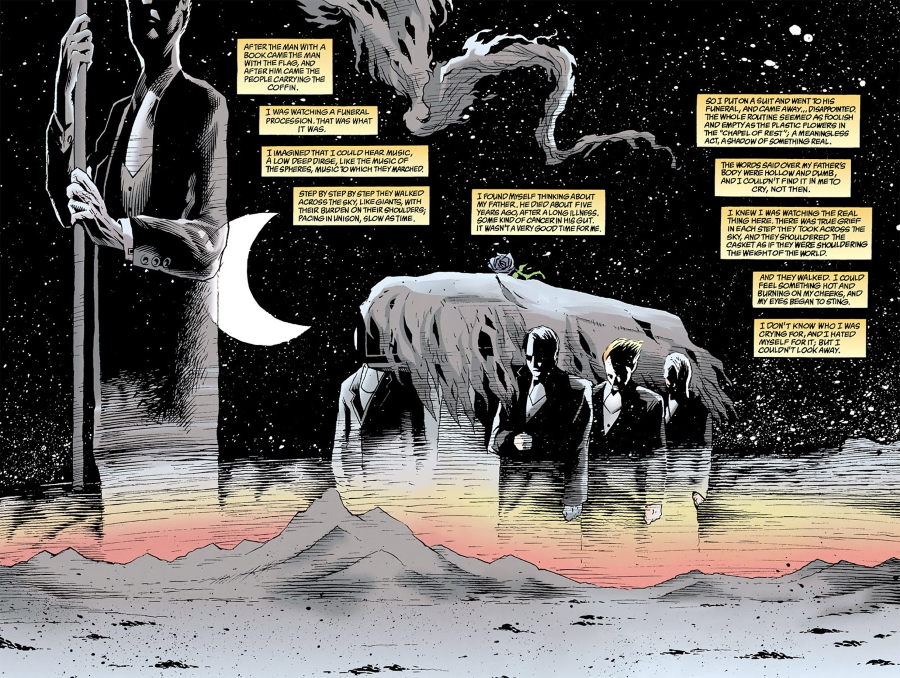
The other original stories in this collection didn’t really connect with me. But there is one final story that is by far my favorite in its power, its emotion, and what it shows is on the way. The last tale is that of the travelers at Worlds’ End who are still waiting out the storm, and wondering what has caused this strange event, as it certainly must be something significant and ghastly to do such damage to reality. And then, across the sky, they see a funeral procession. They don’t know what they are seeing. We as readers don’t really know what we are seeing. But we do see various Endless in the procession, with Delirium and Death trailing behind at the end. Brant describes the entire thing in a sorrowful and yet dreamy way, and once we get to the end and see Death and the look on her face…. Guys, I wept. I think that in part it’s because I know what’s coming. But it’s also such a beautiful moment filled with poignancy and loss. This story was my favorite, and if shifted my perception.

The artwork in this collection is, as you may imagine, incredibly varied (LOOK AT ALL THE NAMES AT THE TOP OF THIS POST). Gaiman says in an afterword in my edition that he wanted to showcase all these different artists talents, and he does. But my favorite was definitely Gary Amaro, who created the funeral procession with such celestial grace and dejection that it just cuts me to the bone.

“The Sandman (Vol.8): Worlds’ End” is the last of the standalone story collections in the series. I’m glad to move on to the rest of the main storyline and characters, but I will say that the end of this one is probably the most powerful moment in the series for me. I’m glad to have been reminded of it.

Rating 7: Another collection of unrelated stories shows off Gaiman’s creativity and the illustrators’s talents. But after a strong previous story arc I was a little underwhelmed, outside of a powerful moment of foreshadowing…

Reader’s Advisory:

“The Sandman (Vol.8): Worlds’ End” is included on the Goodreads lists “Best of Vertigo Comics”, and “Books for the INFJ”.

Find “The Sandman (Vol.8) Worlds’ End” at your library using WorldCat, or at a local independent bookstore using IndieBound!

Previously Reviewed:

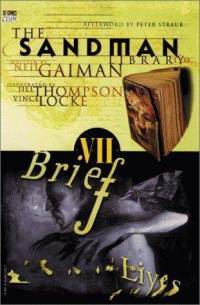
Kate’s Review: “The Sandman (Vol.7): Brief Lives”

Book: “The Sandman (Vol.7): Brief Lives” by Neil Gaiman, Jill Thompson (Ill.), & Vince Locke (Ill.).

Publishing Info: Vertigo, 1993

Where Did I Get This Book: I own it.

Book Description: Dream’s youngest sister, the loopy Delirium, convinces him to go on a quest for their missing brother, Destruction. But Dream may learn that the cost of finding his prodigal sibling is more than he can bear.

Review: This was the storyline in “Sandman” that I was most looking forward to revisiting. My love for Morpheus’s younger sister Delirium knows no bounds, and I remembered that the story that has so much to do with her was the one that touched me the most on my first read through of this series. Her childlike innocence and whimsy, which is also steeped in the darkness of her past, has always been so utterly charming and lovely, and “Brief Lives” puts her at the forefront as she gets in her mind the idea of finding the long lost Endless Sibling, Destruction. When both Desire and Despair say no, she turns to Dream, who is mourning the end of a romantic relationship and decides to go. What comes next is a story that sets the wheels in motion for where this series eventually ends. As well as a road trip tale between the unlikeliest of companions, Delirium and Dream. And I LOVE a good road trip.

Someday we will road trip again! (source)

I, of course, loved “Brief Lives” thanks mostly to Delirium, whose character and design is just a joy as well as a little sad. She is very clearly not in her right mind, gravitating towards those who are in the same boat, so seeing her and the stoic and matter of fact Dream is both quite amusing and bittersweet. It is interesting, however, that she is the Endless that is so determined to find Destruction, who left the family and disappeared three hundred years previously. We see flashbacks of Destruction interacting with some of his siblings, as well as the moment that he decided to go, foreseeing that the Age of Enlightenment and a move towards reason across humanity would bring forth things that would almost make him a bit pointless. Delirium is the perfect sibling to want to find him, as one must only seek Destruction if they were in a similar place as she is. I hesitate to say ‘crazy’. It’s far more complex than that. We get some great moments of humor with her and Dream on this trip, as her driving a car or interacting with nonplussed humans is really great fun.

We also get to see that she didn’t start as Delirium, but as Delight, and that the change she went through was in part thanks to Destruction. This change or multi faceted characterization is a HUGE theme in this tale, especially for the dysfunctional siblings; Destruction talks about how the Endless are two sided coins and aren’t just one thing, but also the inversion of that thing. Delirium is insane, but also one of the most clear headed of her siblings. Death brings, well, Death, but is also the kindest. Desire is both filled with want, but also incredibly vicious. And so forth. I loved seeing these concepts explored as Dream and Delirium go on their journey, inadvertently causing destruction on their quest to find Destruction. This is probably the arc in which we get to see the intricate relationships between The Endless, who are both otherworldly beings with scope and metaphysical attributes that tie into humanity, but also a dysfunctional family group with shifting alliances, petty grievances, and old hurts that siblings know far too well.

And finally, we do get a final visit to the relationship between Morpheus and his son Orpheus, who, cursed with immortality, is just a head being cared for by a family on an island off of Greece. As we saw in “Fables and Reflections”, Orpheus begged his father to kill him, as he is really the only one that can grant him that wish, and Dream turned his back on his son. Now Morpheus has to confront that decision, and to face the child that he abandoned for reasons that Orpheus does not understand. I don’t really want to spoil how this all plays out, but it’s significant and sets the course for what is going to happen next in the series. Also, it made me weep.

And finally, once again, the artwork is lovely. I haven’t gushed enough about Delirium’s design, which is excellent and cheerful and creepy at once. But there was one particular panel that really stuck out to me near the end that just sums up the vast, ever-changing realities of The Endless and their worlds.

Source: Vertigo

“Brief Lives” is a significant story arc and is still my favorite thus far. It really captures the philosophy, the humor, the pathos, and the wonder of the entire series.

Rating 10: A lovely story arc about family, grief, and change, “The Sandman: Brief Lives” is my favorite tale in the series.

Reader’s Advisory:

“The Sandman (Vol.7): Brief Lives” is included on the Goodreads lists “Mythic Fiction Comics”, and “Death Gods and Reaper Protagonists”.

Find “The Sandman (Vol.7): Brief Lives” at your library using WorldCat, or at a local independent bookstore using IndieBound!

Previously Reviewed:

Kate’s Review: “The Sandman (Vol.6): Fables and Reflections”

Book: “The Sandman (Vol.6): Fables and Reflections” by Neil Gaiman, Bryan Talbot (Ill.), Stan Woch (Ill.), P. Craig Russell (Ill.), Shawn McManus (Ill.), John Watkiss (Ill.), Jill Thompson (Ill.), Duncan Eagleson (Ill.), & Kent Williams (Ill.)

Publishing Info: Vertigo, 1993

Where Did I Get This Book: I own it.

Book Description: FABLES & REFLECTIONS follows the Lord of Dreams through nine remarkable tales as he touches lives from the mists of the past to the nightmares of the present. In these episodes, kings and spies, emperors and actors, ravens and werewolves all share their stories and their dreams–dreams of life and love, and of power and darkness.

Review: When I picked up “The Sandman (Vol.6): Fables and Reflections”, I sighed in disappointment. We were once again going to be focusing on stories that exist within the universe and within Morpheus’s world and realities (or unrealities). While I do appreciate how expansive Gaiman is when it comes to his various mythologies, I admit that coming on the heels of “Game of You” I really just wanted to jump back in with Dream, Death, and the like. But as I started getting back into “Fables and Reflections”, I realized that even though we are still off the main storyline track, there are a lot of really excellent moments in these side stories.

The main thematics of “Fables and Reflections” is various dreamers and leaders throughout history, and how dreams and their dreaming natures affected their lives for better or for worse (worse probably being the story “Thermidor”, which focuses on Robsepierre during the Reign of Terror, the time that no one likes to think about when it comes to revolution fantasies). I had a couple of stories that I especially liked, the first being “Three Septembers and a January”. In this tale, we focus on the obscure but real story of Emperor Norton, a man who just kind of declared himself the Emperor of the United States back in the 1800s. Yes, he was real, and a bit of a local celebrity in San Francisco. In this tale, we get to see snippets of his life as the Endless siblings engage in a wager as to which will claim him before Death does so permanently (with Dream being the least nefarious in his intentions, though Delirium can’t know what she’s doing, she’s Delirium dammit!). We get to see Norton live his life under the delusion of his ‘power’, but also see that while he may be ‘mad’, he’s also just a harmless and pretty good guy. There is a lovely moment between him and Death at the end, which emphasizes the overarching point of the “Emperor” in this collection who had the least amount of power is the one who was the best and kindest ‘ruler’ (see Robespierre above, though Augustus also shows up in this collection). It’s a sweet story that really resonated with me.

The other story that stood out has the most connection to Dream and the Endless, and that is “The Song of Orpheus”. As mentioned in earlier collections, in this universe Orpheus is the son of Calliope and Morpheus, and this is basically a retelling of the Orpheus and Euridyce myth with that twist. It’s a story of fathers and sons, lost love, fate, and how parents can fail their children. It is a gut punch seeing Dream have to reconcile with the fact that Orpheus went against his warnings, and in turn refuses to put Orpheus out of his misery after his dismemberment by the Maenads, dooming his son to live eternity as a disembodied head, all because Orpheus didn’t listen to him about saving Eurydice (well, and because of a ‘rule’ The Endless have about killing family, but that feels second to his own wounded ego). It really emphasizes that while Dream is a great character in a lot of ways, he is horrifically pig headed when it comes to those that he loves, to the point where he treads away from morally grey and into villain territory. But, all the more complexity and depth that will no doubt be explored later!

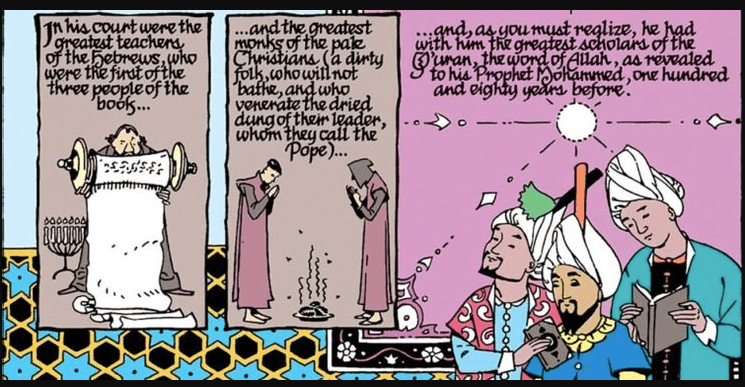
The artwork shifts between the stories (did you SEE the list of artists at the top?!), and the strongest style for me was in “Ramadan”, a story of Harun al-Rashid ruling in historical Baghdad (I will also say that this story has a lovely grace to it, as it was written during the first Gulf War and Gaiman isn’t afraid to make comment of that). P. Craig Russell is the main artist for this story, and WOW. The style appears to be influenced by art from the time and place, as well as illuminated religious texts, and my goodness it’s just beautiful and vibrant.

(source: Vertigo)

All in all, I ended up enjoying “The Sandman: Fables and Reflections” more than I thought I would on this re-read. It’s wistful and dreamy, and it adds a lot of depth to this amazing world.

Rating 8: A ponderous collection of stories about power, empires, love, and death, “The Sandman: Fables and Reflections” doesn’t really advance the plot, but adds flourish to the universe it exists within.

Reader’s Advisory:

“The Sandman (Vol.6): Fables and Reflections” is included on the Goodreads lists “Mythic Fiction Comics”, and “Graphic Novels With The Best Artwork”.

Find “The Sandman (Vol.6): Fables and Reflections” at your library using WorldCat, or a local independent bookstore using IndieBound!

Previously Reviewed:

Kate’s Review: “Flamer”

Book: “Flamer” by Mike Curato

Publishing Info: Henry Holt and Co. BYR-Paperbacks, September 2020

Where Did I Get This Book: I own it.

Book Description: Award-winning author and artist Mike Curato draws on his own experiences in Flamer, his debut graphic novel, telling a difficult story with humor, compassion, and love.

I know I’m not gay. Gay boys like other boys. I hate boys. They’re mean, and scary, and they’re always destroying something or saying something dumb or both.

I hate that word. Gay. It makes me feel . . . unsafe.

It’s the summer between middle school and high school, and Aiden Navarro is away at camp. Everyone’s going through changes—but for Aiden, the stakes feel higher. As he navigates friendships, deals with bullies, and spends time with Elias (a boy he can’t stop thinking about), he finds himself on a path of self-discovery and acceptance.

Review: I never did the whole summer camp thing as a kid. As far as I got was the YMCA Day camp program, but I was such an anxious kid with separation anxiety issues like whoa, overnight sleep away camp was NEVER going to work. I do feel like I missed something, especially since my sister did do one and really enjoyed it. So I do like reading stories that take place at summer camp. I stumbled upon “Flamer” by Mike Curato on Goodreads, and the themes sounded very much in my wheelhouse.

In some ways, “Flamer” feels a bit like the graphic memoir “Honor Girl” in that it has a teenager at camp struggling with their sexuality in the mid 90s. But for me the difference is that Aiden, our main character and fictionalized portrayal of Curato, has a lot more self loathing and and a lot more fear about his sexuality. Aiden is an outsider already, in that he’s bi-racial, he’s on the chubbier side, and he’s an easy target at his middle school, as well as for his emotionally abusive father. So while he has usually felt like he fits in at Scout Camp, his burgeoning sexuality starts to drive his anxiety up, especially as the micro aggressions and flat out bigotry of the time start to become more and more apparent. The story is mostly the last week at Scout Camp, as his safe space starts to feel less safe, and he moves towards an unknown future of high school and self discovery. Curato doesn’t shy away from the ugliness that Aiden has to deal with, be it because of his heritage, because of how he presents as more femme than his fellow Scouts, and how these stresses and the bullying is taking a toll on him and driving him to dark places. Aiden could be a mirror for many kids who are dealing with their own identity discoveries, and how the world around them can make those discoveries hard. The cruelty isn’t limited to fellow Scouts, but also pops up with Leaders who seem supportive, but have their own prejudices that they are harboring and that aren’t as hidden as they may think.

There is also a prevalent theme about Aiden’s Catholic Faith, and how he has always been drawn to certain aspects of the religion and the rituals. I know VERY little about Catholicism, but I thought that Curato really evoked the appreciation that Aiden has, from being an Alter Boy to having a favorite Saint that he relates to, to the struggles he has with his sexuality because of what he believes his religion says about LGBTQIA people. It’s a really fine line that Curato walks in that he definitely condemns the bigotry of those who may practice the religion, but never points fingers at the religion itself, nor does he say that the religion is ‘bad’ in this situation. I think that it would be easy to either condemn the religion as a whole, or to let it and all of its adherents off. but Curato finds a balance in the middle, and it works very well, and makes some of the moments near the end of the story all the more heartbreaking and powerful.

Along with those aspects, Curato also has a great author’s note in the back, as well as a list of resources for kids who may be dealign with the same things that Aiden is dealing with. I love it when books do this, and it feels like a really great resource to have in this story in particular.

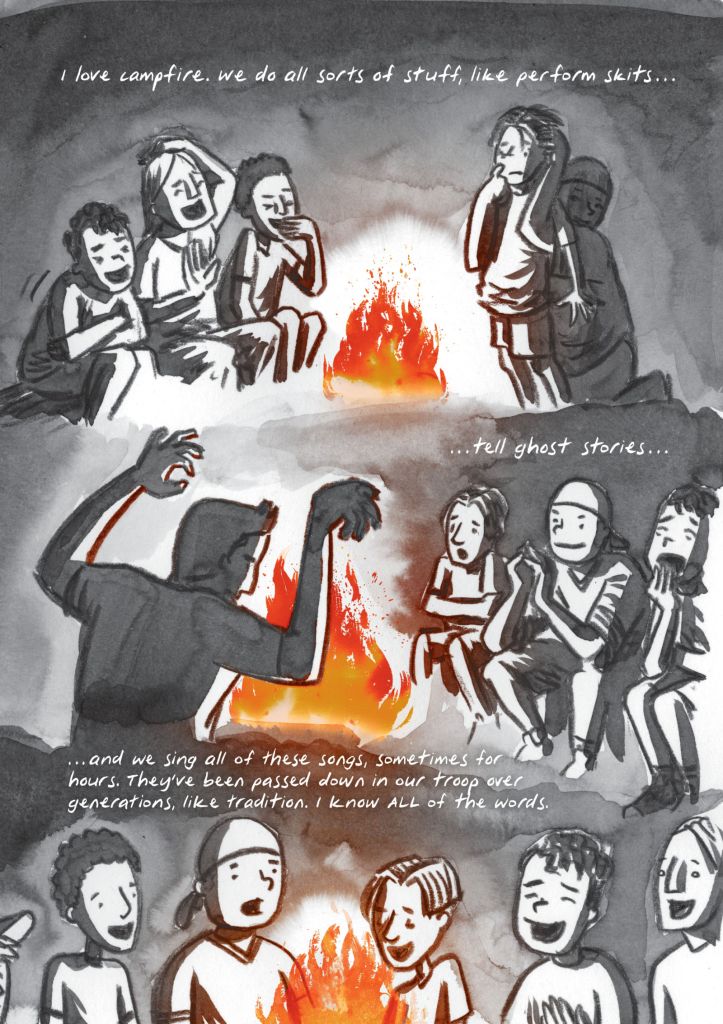
And finally, the art work. LOVED it. It’s black and white, but there are splashes of color, specifically those of reds, oranges, and yellows. All of those work for passion, for fire, for anger, for love, and it makes the moments they are used pop and all the more powerful.

“Flamer” is a bittersweet and hopeful graphic novel that I hope people get in kids hands. You never know who is going to need a story like this.

Rating 8: Evocative, emotional, and necessary reading, “Flamer” is a touching and hopeful story about learning to love and accept yourself.

Reader’s Advisory:

“Flamer” is included on the Goodreads lists “Summer Camp Teens”, and “Guides and Scouts”.

Find “Flamer” at your library using WorldCat, or a local independent bookstore using IndieBound!
Book Club Review: “Sailor Moon Eternal Edition (Vols 1 and 2)”

We are part of a group of librarian friends who have had an ongoing bookclub running for the last several years. Each “season” (we’re nerds) we pick a theme and each of us chooses a book within that theme for us all to read. Our current theme is “Outside the Genre Box”, in which we each picked a book from a genre or format that we don’t usually read.

For this blog, we will post a joint review of each book we read for book club. We’ll also post the next book coming up in book club. So feel free to read along with us or use our book selections and questions in your own book club!

Book: “Sailor Moon Eternal Edition (Vols 1 & 2)” by Naoko Takeuchi

Publishing Info: Kodansha Comics, September 2018/November 2018

Where Did I Get These Books: I own them.

Genre/Format: Manga

Book Description: The guardians in sailor suits return in this definitive edition of the greatest magical girl manga of all time! Featuring an extra-large size, premium paper, and an all-new translation and cover illustrations by creator Naoko Takeuchi!

Teenager Usagi is not the best athlete, she’s never gotten good grades, and, well, she’s a bit of a crybaby. But when she meets a talking cat, she begins a journey that will teach her she has a well of great strength just beneath the surface and the heart to inspire and stand up for her friends as Sailor Moon! Experience the Sailor Moon manga as never before in these extra-long editions.

Kate’s Thoughts

Though I have read some manga here and there and have watched a fair number of anime series (I actually just started watching “Death Note” for the first time, and I’m DIGGING it!), I never go into “Sailor Moon”. I had friends in high school who liked it, but by the time I did get into anime and ‘Magical girl’ stories, I pretty much just went with “Princess Tutu” and left it at that. So when our new Book Club session started up and one of our members wanted to read the first two books in “Sailor Moon”, I figured that now was as good a time as any to read one of the most influential Magical Girl mangas.

I think that had I been in a very specific time frame when reading “Sailor Moon” for the first time (perhaps after grade school but before I entered my ‘I’m not like other girls and too cool for girly shit’ punk and Goth phase in high school) I would have probably appreciated it more than reading it now. That isn’t to say that I don’t get why “Sailor Moon” is such a phenomenon. I liked the mythology of the Sailor Scouts, and I liked how we slowly got to meet each one and the different things that they all bring to the table. I also can tell that there is a LOT of mythology we haven’t even gotten to yet, and that as Usagi and her friends/teammates go forward there will be a lot more to learn regarding their identities, how Tuxedo Mask (the mysterious love interest) fits into it all, and how Usagi will balance this with her normal life as a teenage girl. In the first volume there is a lot of this kind of set up, while the second volume there is more solid adventuring and conflict that escalates. It was also pretty neat to see that things weren’t afraid to get dark as the plot arcs went on in Volume 2, and there were some pretty high stakes involved for Usagi and the others, as well as some legitimate peril to wrangle with. But at the end of the day Usagi herself was hard to connect with because there is a lot of effort to make her super imperfect to contrast with the amazing Sailor Moon alter ego that she has inside of her. But at the end of the day, these stories are not written for me as the intended audience, and because of that this is definitely a ‘your mileage may vary’ situation, as I DEFINITELY get the appeal in theory. Just not in my own practice.

I now feel like I have a better understanding of a story that has a very firm and well earned place in pop culture. It may not be for me, but I love that it is a story for teenage, fantasy loving girls who want their own kind of power fantasy. My hat does off to that and to them.

Serena’s Thoughts

Unlike Kate, I did read a lot of magical girl fantasy right around when this was coming out. But, unlike Kate in general, I’ve never really gotten into reading Manga or graphic novels much at all. As an adult, I’ve discovered more graphic novels that I enjoy, but it’s still not a go-to type of reading for me, even within my preferred genres. And as a middle school girl, I think I just associated any/all graphic novels with comic books and filed them away under “boring boy stuff.” I went on to have a complicated relationship with “Sailor Moon” in high school due to my on again off again boyfriend’s love of the series and my suspicion that he only wanted to date me initially based on my name being the same as the Americanized version of the main character’s. I was pleased to find that on reading the series now the main character’s name has been reverted back to the original, thus reducing my flashbacks to teenage years and highschool love letters between Serena and “Tuxedo Mask” (yes, he would sign off like that!)

With that little jaunt down memory lane out of the way, I had a lot of similar impressions to Kate. I can definitely see the appeal of this story and understand how it came to have such a far-reaching fanbase. The characters are all intriguing, the magic is fun, and the story is willing to engage with some darker themes. It also has much of the drama and awkwardness that teenagers enjoy, with Sailor Moon’s teenage identity providing a stark contrast to her magical girl persona.

Like Kate said, the second volume had more to work with after the first one spent much of its time laying down the foundation for the series. But even in the second one, it was clear that the story was just scratching the surface of all the stories it wanted to tell with these characters. I was pleased to see it go a bit deeper than the first volume did.

Overall, this also wasn’t really my thing. But I think that’s probably mostly due to my age and my generally picky approach to graphic novels and Manga. I picked up a “Pride and Prejudice” Manga at ALA a few years ago, and even that wasn’t really my jam. So this one had a steep hill to climb. But I definitely see the appeal for fans of the format and fantasy lovers in general, especially teenagers.

Kate’s Rating 6: Definitely ground breaking and assuredly appealing to magical girl fantasy fans, but not really my cup of tea at the end of the day.

Serena’s Rating 6: Approachable and fun for those who fit its audience type; unfortunately that wasn’t me.

Book Club Questions

  1. Have you read any manga before this? If so, what manga have you read and how does it compare to “Sailor Moon”? If not, what did you think of this first foray into the format?
  2. What did you think of the structure of the story as a stream of consciousness path that Usagi is taking? Did you like learning things as she did, or do you wish there had been a more organic way to explore the mythology?
  3. Did any of the Sailor Scouts appeal to you more than the others? If so, who, and why do you think that is?
  4. What did you think of the relationship between Sailor Moon/Usagi and Tuxedo Mask?
  5. Which elements, if any, of the ‘magical girl’ genre did you find most appealing?

Reader’s Advisory

“Sailor Moon Eternal Edition” Vols 1 and 2 (in other formats) are included on the Goodreads lists “Magical Girl Manga”, and “Fandom Origins”.

Find “Sailor Moon Eternal Edition” Vols 1 and 2 at your library using WorldCat, or a local independent bookstore using IndieBound!
Next Book Club Book: “The Widows of Malabar Hill”

Kate’s Review: “Redbone: The True Story of a Native American Rock Band”

Book: “Redbone: The True Story of a Native American Rock Band” by Christian Staebler, Sonia Paoloni, and Thibault Balahy (Ill.)

Publishing Info: IDW Publishing, September 2020

Where Did I Get This Book: I received an eARC from NetGalley.

Book Description: Experience the riveting, powerful story of the Native American civil rights movement and the resulting struggle for identity told through the high-flying career of west coast rock n’ roll pioneers Redbone.

You’ve heard the hit song “Come and Get Your Love” in the movie Guardians of the Galaxy, but the story of the band behind it is one of cultural, political, and social importance.

Brothers Pat and Lolly Vegas were talented Native American rock musicians that took the 1960s Sunset Strip by storm. They influenced The Doors and jammed with Jimmy Hendrix before he was “Jimi,” and the idea of a band made up of all Native Americans soon followed. Determined to control their creative vision and maintain their cultural identity, they eventually signed a deal with Epic Records in 1969. But as the American Indian Movement gained momentum the band took a stand, choosing pride in their ancestry over continued commercial reward.

Created with the cooperation of the Vegas family, authors Christian Staebler and Sonia Paolini with artist Thibault Balahy take painstaking steps to ensure the historical accuracy of this important and often overlooked story of America’s past. Part biography and part research journalism, Redbone provides a voice to a people long neglected in American history.

Review: Thank you to NetGalley for providing me with an eARC of this graphic novel!

As we all know, I am not really all that versed in Marvel movies, though I did see “Guardians of the Galaxy” once and enjoyed it overall. One of the things that made me realize I was in for a treat was when Star Lord started playing “Come And Get Your Love” on his Walkman as he went to salvage some stuff. I like that song, having first heard it via sample by Cyndi Lauper in her remix of “Girls Just Wanna Have Fun” for “To Wong Foo”. So I liked the song, but had no knowledge of the band Redbone, who sings it. When “Redbone: The True Story of a Native American Rock Band” was brought to my attention, I jumped at the chance to read it. I was expecting a pretty straightforward rock and roll biographic novel, but was pleasantly surprised to find out that it had a bit more to say.

“Redbone” tells two stories, one being a personal recollection and the other being of a growing movement in the United States. The book follows brothers Pat and Lolly Vegas (thought Pat’s eyes), who eventually formed Redbone, the first commercially successful Native rock band. We follow their history on the Sunset Strip in the 1960s, hanging out with famous acts like The Doors and Jimi Hendrix, and see how they formed their own band that seemed to be on the way to stardom. The other story is of the American Indian Movement (or AIM), a social justice/activist group that focuses on Native rights and formed in Minneapolis in the 1960s. As Pat, Lolly, and the rest of the band began to live the rock and roll lifestyle, the rights of other Native people started being promoted and fought for, which intertwined with their rock careers as they wanted to bring their heritage and own activism into the band.

I liked hearing the backstories of the band itself, and also seeing a broad but informative look into the Residential School system in this country, and AIM and the activism and protests that it brought to the public consciousness. I was fairly familiar with most of the activism and protests that this book covers, and found the explanations to be easy to understand and powerful in both the personal and the communal effects it had. Given that history classes neglect so much non-white history in our schools, I thought that this book would be a great resource for educators to use when wanting to give an introduction to AIM and the social justice issues it tackles both then and now. I also appreciated that this story did address the racism that Redbone had to face in the music industry because of their heritage, and how it’s very clear that their pride in their heritage and want to assert their rights as Native people is what ended their careers when they had SO much talent. I’m pretty damn mad that I didn’t know anything about this band before now, when their most famous song is one that I’ve known and liked for a long time. That’s partially on me, of course. And I’m happy that this book is out there to educate readers on their story, and the broader story of AIM.

I did have a little hard time with the graphic style at first. The images aren’t in a clear linear box design, in that a lot of the time they all bleed together into larger images. Sometimes I had a hard time parsing out which dialogue bits happened where, but I eventually adjusted. And it wasn’t exactly hard to figure it out based on context. Overall I like the unique and nontraditional style.

“Redbone: The True Story of a Native American Rock Band” is a great introduction to the greater fight for Native Rights in the U.S., and finally puts a spotlight on a band that had success taken from them. If you want to know more about an important part of Rock and Roll history, check this out!

Rating 8: A fascinating history of a long neglected band, as well as an overview of the beginnings and contributions of the American Indian Movement, “Redbone: The True Story of a Native American Rock Band” is an informative and interesting graphic novel!

Reader’s Advisory:

“Redbone: The True Story of a Native American Rock Band” isn’t on any Goodreads lists yet, but I think it would fit in on “Native American Biography (Non-fiction)”, and “Best Books on Rock and Roll”.

Find “Redbone: The True story of a Native American Rock Band” at your library using WorldCat, or at a local independent bookstore using IndieBound!

Kate’s Review: “Superman Smashes the Klan”

Book: “Superman Smashes the Klan” by Gene Luen Yang and Gurihiru (Ill.)

Publishing Info: DC Zoom, May 2020

Where Did I Get This Book: I own it.

Book Description: The year is 1946, and the Lee family has moved from Chinatown to Downtown Metropolis. While Dr. Lee is eager to begin his new position at the Metropolis Health Department, his two kids, Roberta and Tommy, are more excited about being closer to the famous superhero Superman!

Tommy adjusts quickly to the fast pace of their new neighborhood, befriending Jimmy Olsen and joining the club baseball team, while his younger sister Roberta feels out of place when she fails to fit in with the neighborhood kids. She’s awkward, quiet, and self-conscious of how she looks different from the kids around her, so she sticks to watching people instead of talking to them.

While the Lees try to adjust to their new lives, an evil is stirring in Metropolis: the Ku Klux Klan. The Klan targets the Lee family, beginning a string of terrorist attacks. They kidnap Tommy, attack the Daily Planet, and even threaten the local YMCA. But with the help of Roberta’s keen skills of observation, Superman is able to fight the Klan’s terror, while exposing those in power who support them–and Roberta and Superman learn to embrace their own unique features that set them apart. From multi-award-winning and New York Times bestselling author Gene Luen Yang comes an exciting middle grade tale featuring Superman. 

Review: Gene Luen Yang is no stranger to Superman. He’s written for Superman before, as well as creating an offshoot character Super-Man that is based in China (and that I have reviewed here on the blog). But I think that “Superman Smashes the Klan” is the Superman story of his that almost immediately caught my eye when I heard it was a thing. I had seen this bouncing around various book and comics circles, and bought it for myself as I love Yang’s work, and I am always in the mood to see a good smashing of racists and fascists. Especially these days.

“Superman Smashes the Klan” follows both Superman as he tries to come to terms with his own identity, as well as the Lee Family, a Chinese-American family that is moving from Chinatown to downtown Metropolis. Our main focuses are on charismatic and popular Tommy and his younger sister Roberta, who is a little more reserved and unsure of herself. While Tommy can seemingly easily code switch with the white kids in their new community, Roberta has a harder time reconciling her Chinese-American identity with this new environment. When the Lees become a target of the hate group The Klan of the Fiery Cross (more on this name in a bit), both Tommy and Roberta want to fight back in their own ways, while their parents are just trying to not make waves to keep themselves and their children safe. I liked how Yang not only addressed the full blown bigotry and violent racism of the Klan, but also the more subtle and systemic racism of society, mostly through Tommy and Roberta’s parents. Dr. Lee, their father, has taken a new job at the health department, and encourages his children and wife to assimilate (many a time does he tell his wife to speak English instead of Chinese), as well as wanting to fit in with his white colleagues and superiors and not be associated with other minorities. We also see Tommy playing down his Chinese identity by being self deprecating in hopes of fitting in too.

And as I mentioned earlier, Superman himself is dealing with his own identity crisis in this story, as he has been downplaying some of his powers that make it more clear that he isn’t just a very strong or gifted human. Specifically, he hasn’t allowed himself to really fly after an incident in his childhood where he lost control of that ability for a moment, and some people in Smallville nearly turned on him because they thought he was possessed. I LOVED this for two reasons. The first is that initially in the comics Superman couldn’t fly, he just could jump really, really high and far. It was genius for Yang to incorporate this character change into the story in this way. But the other reason is that it’s a great way to show kids who are reading this book that Superman, a strong, nearly perfect, ideal of a superhero, ALSO has struggles with his own identity, and that he too is from a group that could easily be Othered and discriminated against because he’s different.

I do want to talk about The Klan of the Fiery Cross as well. What I didn’t realize until we got to the super helpful author’s note at the end is that this is based on a story arc from the Superman Radio Show from the 1940s! That story was pretty similar, a Chinese-American family moves into a white neighborhood, and the Klan of the Fiery Cross (at the time the KKK was a powerful group after its second wave post “Birth of a Nation” with many members, and the radio show didn’t want to get sued for using their actual name) targets them, and Superman saves the day. Yang, of course, expands upon this within this new story, and it works very, very well. We see the Klan for the hate filled racists that they are, but he also touches on how some people who are really just looking for power and money will latch on to racist and fascist movements in hopes of getting the power and clout they crave (sounds familiar). You’d think that it would be hard to break this down in a kids book, but Yang does it and makes it super understandable for the audience the book has been written for.

And finally, the art work. Gurihiru has some clear manga influences and styles, and it works for the story. I also loved the use of colors and the character designs, be it body designs or period appropriate clothing.

“Superman Smashes the Klan” is a fast paced and charming story that has a lot to say without getting heavy handed or too bogged down. Yang’s story telling talents match perfectly with the story at hand, and fans of Superman should definitely read it!

Rating 9: An action-filled screed against racism that is filled with empathy and hope, “Superman Smashes The Klan” is no doubt an exciting read for children and adults alike.

Reader’s Advisory:

“Superman Smashes the Klan” is included on the Goodreads lists “Middle School Social Justice”, and “Paper Lantern Writers: Best Own Voices Historical Fiction”.

Find “Superman Smashes the Klan” at your library using WorldCat, or a local independent bookstore using IndieBound!