Kate’s Review: “Wayward Witch”

53038638._sx318_sy475_Book: “Wayward Witch” by Zoraida Córdova

Publishing Info: Sourcebooks Fire, September 2020

Where Did I Get This Book: I received an eARC from NetGalley.

Book Description: Rose Mortiz has always been a fixer, but lately she’s been feeling lost. She has brand-new powers she doesn’t understand, and her family is still trying to figure out how to function in the wake of her amnesiac father’s return home. Then, on the night of her Deathday party, Rose discovers her father’s memory loss has been a lie.
 
As she rushes to his side, the two are ambushed and pulled through a portal to the land of Adas, a fairy realm hidden in the Caribbean Sea. There, Rose is forced to work with a group of others to save Adas. Soon, she begins to discover the scope of her powers, the troubling truth about her father’s past, and the sacrifices he made to save her sisters.
 
But if Rose wants to return home so she can repair her broken family, she must figure out how to heal Adas first.

Review: Thank you to NetGalley for providing me with an eARC of this novel!

It’s been a four year journey with the Mortiz Sisters in the “Brooklyn Brujas” Trilogy by Zoraida Córdova, and what a genre bending, empowering, and unique (to me) journey it’s been. Given that books one (“Labyrinth Lost”) and two (“Bruja Born”) followed the oldest and middle sisters, Alex and Lula, I knew that “Wayward Witch”, the last in the trilogy, was destined to be Rose’s story. Rose has always been the sister that has intrigued me the most, as she has always been quiet, reserved, and a little bit mysterious because of it. I was eager to get into her head for the last story, hoping that Córdova would give her a lot to do and work with, and perhaps explore a new genre like she did with Lula. The fulfillment of those hopes was a mixed bag.

Since I want to focus on the positives, I will get my negatives out of the way, particularly as they are no fault of the book. We have gone back to a fantasy focused story in “Wayward Witch”. I had been hoping that after the genre shift in “Bruja Born” we might be experimenting with a whole other genre again, but that was not the case. As much as I can appreciate the care and detail that Córdova put into the world of Adas, and as much as it definitely was unique and steeped in cultural influence that you don’t see as much in fantasy, it’s still a world building fantasy story. And outside of very specific examples that I love, it’s a genre that doesn’t really click with me. Along with that, I had hoped to see more sister interaction like we had in “Bruja Born”, but given that Rose was on her own for a majority of the story, that didn’t happen.

But, that said, I am so happy that we finally got to Rose’s story, and that she got to have this kind of adventure that is so different from the ones that her sisters had. Rose has been dealing with magical changes in her life, as her power has shifted to being a person who can take on the powers of those around her. You enter that in with the dramatic changes in her family life (her father returning from his long absence, her family having to move to Queens after their home was destroyed, her Deathday celebration), and she is feeling stressed and unheard. Not to mention her relationship with her father is a bit strained, as she has few memories of him before he disappeared. I liked that his reappearance in her life specifically is a bit messier and more complicated. But her journey to Adas with her father allows her to see her powers in a new way, as to the fae there she is a savior and a warrior who is there to stop The Rot that is destroying their world. Seeing her function in this totally different realm could have been similar to Alex’s journey in “Labyrinth Lost”, but Rose is so different from Alex that it feels pretty new and fresh. Her magical powers are also neat to see in focus, as the upsides, and the downsides, of being a ‘magic hacker’ as she likes to refer to it are shown in different ways. Be they amusing, or potentially dangerous. And even though the fantasy themes didn’t really connect with me, I did like the characters that Córdova created in Adas, especially Princess Iris. Iris has a lot to prove to both her father, the King, and to herself as well. It was refreshing to see usual fantasy gender norms being bent between her and her twin brother Arco. While Iris is the more ferocious and determine warrior type, Arco is a bit more sensitive and reserved, and Rose’s interactions with both of them helped round out her character, and perhaps made up for the fact we didn’t see her interacting with Alex and Lula in similar ways.

So while the fantasy elements as a whole weren’t as interesting as the horror elements from the previous books, I thought that “Wayward Witch” gave Rose the attention that she deserved, and wrapped up the series in a mostly satisfying way. I’m so happy that Zoraida Córdova got to tell her story about these bruja sisters, and that YA audiences have been given a great example of how witches don’t have to be white.

Rating 7: A return to otherworldly fantasy means that this conclusion didn’t connect as much as the previous book, but “Wayward Witch” gives Rosie Mortiz a strong tale that shows off her abilities, and wraps up a fun and dreamy fantasy series.

Reader’s Advisory:

“Wayward Witch” is included on the Goodreads lists “Latina Leads in YA and Middle Grade Fiction”, and “2020 YA Books with LGBT Themes”.

Find “Wayward Witch” at your library using WorldCat, or a local independent bookstore using IndieBound!

Previously Reviewed:

Kate’s Review: “Displacement”

39908611._sx318_Book: “Displacement” by Kiku Hughes

Publishing Info: First Second Books, August 2020

Where Did I Get This Book: I received an eARC from NetGalley.

Book Description: A teenager is pulled back in time to witness her grandmother’s experiences in World War II-era Japanese internment camps in Displacement, a historical graphic novel from Kiku Hughes.

Kiku is on vacation in San Francisco when suddenly she finds herself displaced to the 1940s Japanese-American internment camp that her late grandmother, Ernestina, was forcibly relocated to during World War II.

These displacements keep occurring until Kiku finds herself “stuck” back in time. Living alongside her young grandmother and other Japanese-American citizens in internment camps, Kiku gets the education she never received in history class. She witnesses the lives of Japanese-Americans who were denied their civil liberties and suffered greatly, but managed to cultivate community and commit acts of resistance in order to survive.

Kiku Hughes weaves a riveting, bittersweet tale that highlights the intergenerational impact and power of memory.

Review: Thank you to NetGalley for providing me with an eARC of this graphic novel!

I am always going to keep hammering home the point that if we don’t know our own history, we are going to repeat it, especially now when our country seems to be determined to undercut civil liberties of its own citizens. Between police brutality, towards minorities (particularly Black people), a Muslim ban, and children in cages at the border, it feels like we are slipping more towards times in American history where we committed terrible atrocities that we haven’t really faced as of yet. That brings me to “Displacement” by Kiku Hughes, a graphic novel on the Japanese American Internment during World War II. I’ve read my fair share about this horrific practice (and reviewed another graphic novel on the topic, “They Called Us Enemy” by George Takei), and figured that this would be another powerful, but familiar, take on this period in history. And I can safely say that “Displacement” wasn’t really what I was expecting.

“Displacement” is both fiction, and non-fiction. The non-fiction aspect is that Kiku Hughes’s grandmother Ernestina was held prisoner at both Tanforan and Topaz Internment camps, and that Kiku and her mother did a lot of research into it as Ernestina didn’t open up about it while she was alive. But the fictional aspect is a device that works very well, in which Kiku tells a story of herself being transported back in time, or ‘displaced’ to the 1940s, and ending up at the same Internment sites as Ernestina, therein letting the reader see this historical atrocity through the same modern lens that Kiku may. It’s very similar to “Kindred” by Octavia Butler, and Hughes mentions her specifically in her acknowledgements. I thought that it worked really well because it makes the story feel more personal than perhaps a textbook would, and more relatable since Hughes is a young adult who doesn’t know that much about the camps and what life there was like for Ernestina. It’s a perfect read for tweens and teens who might be wanting to learn about this topic, as while it’s ‘fantasy’, it’s also very realistic and provides the same perspective that they may be going in with. I read “Farewell to Manzanar” by Jane Watasuki Houston when I was in seventh grade, and while I did like it and got a lot from it, I think that if I had something like “Displacement” I may have connected more with it just because of the modern lens. Hughes also makes very clear connections to the current political climate we are in today with Trump and his goons in power, and how there are stark, STARK similarities between the prejudices they hold and the policies they are inflicting upon marginalized groups, and the ones inflicted upon the Issei and Nisei in this country during the Internment.

While “Kindred” is the book Hughes mentions specifically as influence, I also see a lot of similarities to Jane Yolen’s “The Devil’s Arithmetic”, in which a modern day (well modern when it came out) Jewish girl named Hannah is transported back to Poland right as the Nazis take over. I kept going back to that story as I saw Kiku pre-displacement, thinking about how Hannah, like Kiku, doesn’t feel that much connection to her heritage. While “Displacement” certainly does a great job of talking about what specifically happened to her grandmother during the Internment, Hughes also makes direct connections as to how the Internment facilitated a loss of identity for Japanese Americans, and played a part in generational trauma that still lingers today. It’s a theme that I haven’t seen as much in other books, be they fiction or non-fiction, about the Internment, and it is a really powerful way to show that there are far reaching consequences that touch later generations when it comes to trauma and violence directed towards a group of people. Kiku recounts (in the true story part of this book) how she and her mother decided to do their own research about Ernestina’s life in the camps, and about the camps themselves, and find out things that neither of them knew because of survivors not wanting to talk about it due to trauma and shame. This was the aspect that stood out to me the most.

And finally, I really liked Hughe’s artwork style. It feels not dissimilar to what you might expect from modern comics, but there are undercurrents of more realistic artwork and imagery that kind of remind the reader that this is based on something real, and terrible.

wtbchhrnj1x3brfhsqpb
(source)

“Displacement” is a book that I really think educators should have in their curriculums when teaching teens about the Japanese American Internment. It’s easy to understand, easy to parse, and has a whole lot to say about identity, racist policy, and trauma that can last beyond a generation.

Rating 8: A powerful graphic novel and the perfect introduction to the subject for tween and teen audiences, “Displacement” takes on a reprehensible part of American history with a magical realism twist.

Reader’s Advisory:

“Displacement” is included on the Goodreads lists “Surviving in the Japanese Relocation Centers of WW2”, and “2020 YA/MG Books With POC Leads”.

Find “Displacement” at your library using WorldCat, or a local independent bookstore using IndieBound!

Serena’s Review: “The Faithless Hawk”

41022295._sy475_Book: “The Faithless Hawk” by Margaret Owen

Publishing Info: Henry Holt and Co., August 2020

Where Did I Get this Book: Edelweiss+

Book Description: As the new chieftain of the Crows, Fie knows better than to expect a royal to keep his word. Still she’s hopeful that Prince Jasimir will fulfill his oath to protect her fellow Crows. But then black smoke fills the sky, signaling the death of King Surimir and the beginning of Queen Rhusana’s merciless bid for the throne.

With the witch queen using the deadly plague to unite the nation of Sabor against Crows—and add numbers to her monstrous army—Fie and her band are forced to go into hiding, leaving the country to be ravaged by the plague. However, they’re all running out of time before the Crows starve in exile and Sabor is lost forever.

A desperate Fie calls on old allies to help take Rhusana down from within her own walls. But inside the royal palace, the only difference between a conqueror and a thief is an army. To survive, Fie must unravel not only Rhusana’s plot, but ancient secrets of the Crows—secrets that could save her people, or set the world ablaze.

Previously Reviewed: “The Merciful Crow”

Review: I listened to the first book in this duology as an audiobook. And in my review I credited the narrator with really pulling her weight to imbibe this story with an extra level of emotion and sense of character that helped push the book forward past what, at times, was rather slow-paced storytelling. With that in mind, I was a bit nervous when I picked up this book as a standard e-ARC through Edelweiss. Would it hold up without the narrator’s perfect voice for Fie? Yes, yes it did and not only that, but it was better than the first in all ways.

With Prince Jasimir delivered to relative safety and with an army at his back, Fie’s hope for the future, a future where Crows are protected from the vicious groups that hunt them, seems within grasp. As a Chief now herself, Fie feels this sense of responsibility to her people more strongly then ever. But one things goes wrong after another, one devastating loss after another, until Fie wakes up one morning with her people in hiding and a choice of either a future of starvation and being hunted down, or of leaving her people and going into the heart of her enemy, the castle itself, to do what needs to be done. But even there, Fie must rely on half-lost Crow magic and unravel an erased history to truly find a path forward for not only her own people, but everyone in Sabor.

As I mentioned in my intro, while I did enjoy the first book this duology overall, I did finish it with some lingering questions about the book’s pacing and ability to carry a more plot-driven storyline. So I was incredibly pleased to see both of those issues fully addressed in this second book. Not only does this book have a more action-packed plot than the first, but the pacing was sustained throughout the book without any of portions that seemed to lag (something that happened for a fairly substantial portion in the middle of the first book.)

I also really liked how much this book expanded on the magic-system and history of Sabor. I thought the hierarchy system and the unique abilities assigned to each group was interesting in the first book, so I was really excited to see this book dive much more deeply into not only how it all worked, but in the history of the system itself. I hadn’t even realized until this book started answering them how many lingering questions I had had from the first book, particularly about the Crows and Fie’s own magic. And all of this information seemed to unfold in a very organic, natural way, without any infodumps or unbelievable revelations.

I also really liked Fie’s own part in the story. She takes on a very active role in this book and faces completely different challenges than the ones she dealt with the first go-around. We see not only how she is better prepared for these greater ordeals this time, but also how the increased feeling of responsibility and the new closeness to others affects her own abilities to trust and make decisions on a grand scale vs. personal feelings. Jasimer also featured more heavily in this book than I expected, and, as I didn’t love his character so much in the first book, I was extremely pleased with what we had from the character here. We got to see a lot of the growth he experienced in the first book pay off, and, overall, he was incredibly likable this go-around. Something about being a “cat wrangler” didn’t hurt my impression of him either!

I was also pleased with the romance in this story. Things definitely didn’t go the route I expected. But some of the “twists” here were also easy enough to see through that for those of us who were worried, you can rest fairly assured that all turns out well, though perhaps not how you expected.

Overall, I was really pleased with this book, both in and of itself and as a conclusion to the duology as a whole. There were some legitimate surprises and twists that I didn’t see coming, and those that I did were so purely satisfying that I didn’t care that I could predict them in advance. I think the author had a better handle on the pacing in this book and really came into her own with the strength of writing. For those who enjoyed “The Merciful Crow,” definitely don’t miss out on this one!

Rating 9: A completely satisfying conclusion in pretty much every way!

Reader’s Advisory:

“The Faithless Hawk” is a new title, so it isn’t on many relevant Goodreads lists, but it is on “2020 YA Sequels.”

Find “The Faithless Hawk” at your library using WorldCat!


Kate’s Review: “The Sandman (Vol.3): Dream Country”

25100Book: “The Sandman (Vol.3): Dream Country” by Neil Gaiman, Kelley Jones (Ill.), Charles Vell (Ill.), Colleen Doran (Ill.), and Malcolm Jones (Ill.)
Publishing Info: Vertigo, 1991

Where Did I Get This Book: I own it.

Book Description: The third volume of the Sandman collection is a series of four short comic book stories. In each of these otherwise unrelated stories, Morpheus serves only as a minor character. Here we meet the mother of Morpheus’s son, find out what cats dream about, and discover the true origin behind Shakespeare’s A Midsummer’s Night Dream. The latter won a World Fantasy Award for best short story, the first time a comic book was given that honor. collecting The Sandman #17–20.

Review: One of the things that I need to get used to when going back and re-reading “Sandman” is that Gaiman sometimes like to meander and experiment with stories in their tone and mythologies. So while “Sandman” does have an overarching plot line, on occasion you will find tales that don’t fit in. Sometimes I really love this, as in both of our previous collections I’ve highlighted these standalone stories. So theoretically I should have been totally game with “The Sandman (Vol.3): Dream Country”, as it has four stand alone tales that don’t really focus on Dream and his journey. I’m all for experimentation, just like on my first read through, “Dream Country” didn’t live up to the books before.

Our first standalone story, “Calliope”, is one of the ones that most fascinates me, but also has some really problematic elements to it. In concerns the Muse Calliope, Morpheus’s former lover and mother of their late son Orpheus, who has been imprisoned by an author so that her influence will make him write amazing works. While in captivity Calliope is isolated and raped repeatedly, and she calls upon Morpheus for help in escaping. I greatly enjoy the concept of a person using the means of a Muse for ill will, and I liked the harkening back to the Greek Mythology that Morpheus has some part in, but I really had a hard time with the way that Calliope is abused by one man, and is basically damsel in distressed until another man saves her. The concept was my favorite of the four, but the execution was very upsetting and felt a bit tone deaf by today’s standards.

The second is “A Dream of a Thousand Cats”, a fun and kind of sad story about house cats and how they went from ruling the wild to being subjugated by human kind. Given my love for cats, the idea of cats wanting to rise up and free themselves from their human ‘captors’ is very fun, if only because it has been said that if house cats were much larger they would absolutely try to kill their owners. Morpheus is here (in the form of a cat, no less!), but it really could have been anyone waylaying this information to our feline protagonists. This probably could have worked as a short story out of the “Sandman” universe, and I wonder if Gaiman had the idea for this kind of story outside of this narrative, as it felt a bit forced into the box of the Sandman world.

The third story is “A Midsummer Night’s Dream”, a World Fantasy Award winning tale (the first comic to win this award even!) in which Morpheus brings people of the faerie realm to come watch Shakespeare’s traveling troupe put on “A Midsummer Night’s Dream”. Basically Morpheus and Shakespeare cut a deal and this is the first of two plays that Shakespeare has written for him. We get a lighthearted version of “A Midsummer Night’s Dream”, and get to see their ‘real world’ counter parts react to the way that they are portrayed within the play. Cute to be sure. I think that were I a bigger fan of the play itself I’d have enjoyed this more, but “A Midsummer Night’s Dream” isn’t a fave of mine, Shakespeare wise.

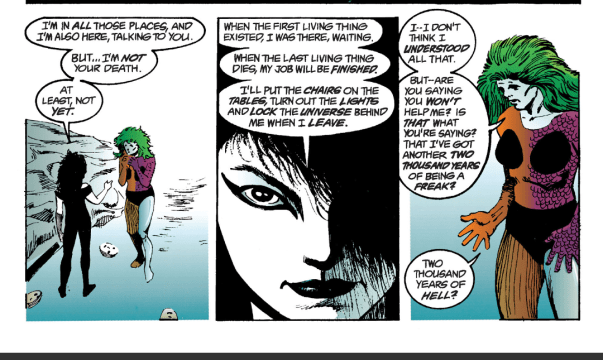
It’s the fourth story that I really, really liked, and kind of saved this whole collection for me. “Facade” is the saddest tale within this collection, and it doesn’t even have Morpheus in it! Instead we get to see my girl Death shine, though she, too, plays a smaller role in lieu of a new original character. Raine is a woman who, when on an archaeological dig in Egypt, was cursed with immortality. Though she is going to live possibly forever, her body is slowly deteriorating, rendering her isolated and scared and desperate to die. She puts on fake faces to go into public, but it’s by no means a long term solution, and after a particularly bad day Death hears her begging, and decides to talk to her. Looking at the consequences of what immortality would actually be is always sobering, and Raine is such a sad character that you ache for as the story goes on. And while it was kind of surprising to see that Morpheus wasn’t in this one, I think that Death was really the character to use given her empathetic nature (unlike Dream, who is prickly at best), and it was really nice seeing her getting a little more spotlight. She is such an intriguing character on her own, after all. I also really liked the artwork for this one. It’s a lovely design for Death.

k5ucirmlsrq31
(source)

“The Sandman (Vol.3): Dream Country” is a fine detour from the main storyline, but I’m eager to get back to see what Morpheus is up to. I definitely encourage you to read these if you are taking on the series, but if you have to go to Volume 4 before this one, that’s probably going to be fine.

Rating 7: These standalone stories are enjoyable for the most part, but they don’t really progress the plot, and feel a bit dated in some of their themes.

Reader’s Advisory:

“The Sandman (Vol.3): Dream Country” is included on the Goodreads lists “Books About Faery”, and “Mythic Fiction Comics”.

Find “The Sandman (Vol.3): Dream Country” at your library using WorldCat, or a local independent bookstore using IndieBound!

Previously Reviewed: 


Serena’s Review: “Serpent & Dove”

40024139Book: “Serpent & Dove” by Shelby Mahurin
Publishing Info: HarperTeen, September 2019

Where Did I Get this Book: audiobook from the library!

Book Description: Two years ago, Louise le Blanc fled her coven and took shelter in the city of Cesarine, forsaking all magic and living off whatever she could steal. There, witches like Lou are hunted. They are feared. And they are burned.

Sworn to the Church as a Chasseur, Reid Diggory has lived his life by one principle: thou shalt not suffer a witch to live. His path was never meant to cross with Lou’s, but a wicked stunt forces them into an impossible union—holy matrimony.

The war between witches and Church is an ancient one, and Lou’s most dangerous enemies bring a fate worse than fire. Unable to ignore her growing feelings, yet powerless to change what she is, a choice must be made.

And love makes fools of us all.

Review: Have to get all of these books that were so popular last fall in before their sequels drop this summer/fall! But one more down! I didn’t know much about this book when I placed my audiobook request other than the fact that a few of my YA librarian friends had said it was super popular last fall when it came out. So like a good little YA fan, I placed my request without much more thought. So I really had no idea what to expect when I actually got the book, so the whole thing was an interesting surprise (I never even looked at the book description until after the fact). While it didn’t blow me away, I can see why it was so popular and I’m definitely interested to see what the sequel has to offer this September!

Living undercover as a witch in hiding means Lou’s life is one of constantly looking over her shoulder and being suspicious of everyone. In a world where all women are under constant scrutiny, under threat of death by fire for being a witch, Lou must be particularly careful. But in a comedy or tragedy of errors and crossed paths, Lou suddenly finds herself in the viper’s nest itself: making her home among her enemies and married to a Chasseur, a witch hunter. Now both she, and Reid who was raised to strictly believe the evil at the heart of all of witches, must confront what they really know about the opposite side. And as their feelings for each other grow, will these differences prove detrimental?

You don’t really see too many “forced marriage” plots outside of fanfiction and romance novels, so it was definitely interesting seeing this book’s attempt to use this trope in a more mainstream YA fantasy novel. And overall, I think it was very successful. The set-up for their marriage was believable, and because the book is told through alternating perspectives, readers are able to watch the slow change and progression of feelings on both sides. Of course, it’s still all told over one book’s length, and not an uncommonly long one at that, so I do feel that the romance itself came on a bit quickly. But I also felt like the author did just enough to lay the groundwork for these changes and given her characters the room and opportunity to believably begin changing their minds about one another.

As with all stories that feature multiple POVs, I had a preference for one over the other. But in this case it wasn’t because I felt that one was more strongly written than the other; both perspectives felt grounded and believable. But Reid was definitely a bit harder to empathize with. Over the course of the book, we begin to see more of what shapes his belief system, but it’s always going to be a hard sell to be in the head of a male character who thinks burning women at the stake is a good idea. He obviously comes around, but there are some definite moments where I just wanted to smack him.

Lou, on the other hand, is your kind of standard YA heroine: strong, feisty, and independent. She didn’t blow me away as anything incredibly original, but her dialogue, both in her POV sections and in Reid’s, was always great and had some really funny bits to it. She disappears a bit towards the end of the book, and this did make that section a bit more challenging to get through. But luckily by that time Reid is coming around again and is able to take over for the most part.

There were quite a few twists and surprises throughout the book. As a reader of a lot of YA fantasy, I was able to see almost all of these coming, but that didn’t make them less enjoyable, really. And, of course, this is the kind of thing that will hit different readers in different ways. Combined with the French-focused world-building and an interesting magic system, I felt like the story itself felt fairly fresh and new.

This is the first book in what I believe is a trilogy, so the end of the book is by no means a proper “ending.” But given the fact that the next book is coming out in September, if you, like me, haven’t gotten around to this one yet, you won’t have a long wait fo

Rating 8: A solid start to a new series that will hopefully grow into something even better.

Reader’s Advisory: 

“Serpent & Dove” is on these Goodreads lists: “Characters Hate Each Other Then Fall In Love” and “Epic High Fantasy/Romance/Mythology by 2020.”

Find “Serpent & Dove” at your library using WorldCat!

Serena’s Review: “The Lost Sun”

27230933Book: “The Lost Sun” by Tessa Gratton

Publishing Info: Createspace Independent Publishing Platform, October 2015

Where Did I Get this Book: audiobook from library!

Book Description: Fans of Neil Gaiman’s “American Gods” and Holly Black’s “The Curse Workers” will embrace this richly drawn, Norse-mythology-infused alternate world: the United States of Asgard. Seventeen-year-old Soren Bearskin is trying to escape the past. His father, a famed warrior, lost himself to the battle-frenzy and killed thirteen innocent people. Soren cannot deny that berserking is in his blood–the fevers, insomnia, and occasional feelings of uncontrollable rage haunt him. So he tries to remain calm and detached from everyone at Sanctus Sigurd’s Academy. But that’s hard to do when a popular, beautiful girl like Astrid Glyn tells Soren she dreams of him. That’s not all Astrid dreams of–the daughter of a renowned prophetess, Astrid is coming into her own inherited abilities.

When Baldur, son of Odin and one of the most popular gods in the country, goes missing, Astrid sees where he is and convinces Soren to join her on a road trip that will take them to find not only a lost god, but also who they are beyond the legacy of their parents and everything they’ve been told they have to be.

Review: This is another one of those mystery books that has been hanging out on my audiobook “to read” list at the library. I have no memory of where I heard of it originally or why I requested it specifically. I mean, looking at the description, it definitely seemed interesting, but there are also a million and one fantasy books out there, so why this one? Maybe I was going through a Thor/Loki moment when I stumbled on it and put it on here? Either way, it was available the other day when I was looking for my next book, so I checked it out! It was definitely an interesting read, but also not quite all I had hoped for.

Soren’s days have been largely devoted to training, both physically in the skills of a warrior, and mentally in the self-control needed to keep the beserking rage he inherited from his father in check. Often this means missing out on social activities with friends and keeping to himself. But when Astrid, the daughter of a famed seer, joins the school, she seeks him and begins to pry into his solitary existence. After a beloved god goes missing, Soren now finds himself on a roadtrip mission with Astrid in the hopes of finding this lost deity and returning him to where he belongs. But that’s only the beginning of a journey that will take them far and uncover much about themselves, their pasts, and their future.

What stood out the most in this book was the creative world-building. What we have here is an alternate version of the United States in which the Norse gods are very real and have a very real influence on every aspect of society: government structure, education, career paths, you name it. I really enjoyed how creative the author was with such a bizarre idea, and how seamless was the end result, considering how strange it is, overall.

This is Soren’s story, so much of the history and current state of the world is told through his point of view. Soren is a good narrator, in this respect, as all of these needed details to flesh out this type of world were delivered in a believable, non-exposition manner, something that is definitely a challenge for a book written in first person. Soren’s own history, that of having a father who gave in to the beserker madness and killed innocent people, is never far from his mind, and from the very beginning we see the limited future Soren sees for himself. He is constantly battling an inner war, and his fear of himself and his abilities stains almost every choice he makes.

The  main problem for me arrived in the form of the other main character, Astrid. Right from the start she struck me as very “manic pixie dream girl” in her behaviors and descriptions. I think the character had potential, but it was really hard to get behind her part of the story when that impression was so strong right off the bat. As the story started moving more, it was easier to be distracted from it. But it was still the sort of thing that popped up throughout and left me having a hard time feeling really too compelled or interested in her part of the story. And then, since so much of Soren’s story becomes tied up with hers, I also lost some interest in him.

Overall, I thought this was a really creative, fun book. My problem most centered around some of the characterization choices that made it hard for me to feel truly invested in the story’s main characters. But if you’re into Norse mythology and want to read a new take on the subject, this might be one worth checking out!

Rating 7: A fun, unique fantasy story set in a re-imagined United States, though the characters left something to be desired.

Reader’s Advisory: 

“The Lost Sun” is on these Goodreads lists: “Best Alternate History Novels and Stories” and “Books with Lost or Found in the Title.”

Find “The Lost Sun” at your library using WorldCat!

Serena’s Review: “The Gilded Wolves”

39863498Book: “The Gilded Wolves” by Roshani Chokshi
Publishing Info: Wednesday Books, January 2019

Where Did I Get this Book: ebook from the library!

Book Description: It’s 1889. The city is on the cusp of industry and power, and the Exposition Universelle has breathed new life into the streets and dredged up ancient secrets. Here, no one keeps tabs on dark truths better than treasure-hunter and wealthy hotelier Séverin Montagnet-Alarie. When the elite, ever-powerful Order of Babel coerces him to help them on a mission, Séverin is offered a treasure that he never imagined: his true inheritance.

To hunt down the ancient artifact the Order seeks, Séverin calls upon a band of unlikely experts: An engineer with a debt to pay. A historian banished from his home. A dancer with a sinister past. And a brother in arms if not blood.

Together, they will join Séverin as he explores the dark, glittering heart of Paris. What they find might change the course of history–but only if they can stay alive.

Review: I was a bit hesitant to pick this book for a few reasons. First, as readers of this blog know, the last year or so has been made up of a lot of middling reviews from me for books that I feel are WAY too similar to “Six of Crows” to be called much more than blatant cash grabs on the part of authors and publishers who want in on the lingering popularity of that duology. And secondly, I’ve tried to read Roshani Chokshi’s books in the past because she’s a fairly beloved YA author and…haven’t loved her work. But, I thought I’d give it one more go. And, in an improvement on my opinions on her other books, this one was…ok.

Severin had been on the cusp of entering into an inheritance that would establish him into one of the most exclusive and privileged circles in the nation, if not the world. But, in the eleventh hour, he is rejected and outcast. Ever since, Severin has worked to gather up a crew of other outcasts in an attempt to regain his birthright. Each with their own speckled past and hopes for the future, this ragtag group will now find themselves caught up in conspiracies grander than they could ever had expected. But with the potential riches, comes the equally dangerous perils.

So, to start with the pros of this book. One of my major complaints about Chokshi’s work in the past was my distaste for her overly flowery writing. It was of the type too often found in YA where it seems like the authors are just playing word spaghetti and hoping to string together sentences that sound pretty. Who cares if they don’t make any actual sense or the metaphors are pure nonsense if looked at for more than half a second? But luckily, here, there was less of it, especially of the flowery type. I still think the writing left something to be desired, however. No one can fault the author for her dialogue writing, as that was witty and fast. But the actual description of how the magic system worked or some of the actions scenes were confusing, and even after re-reading, I didn’t have a solid image in my mind for what exactly she was trying to describe.

I also enjoyed most of the characters, though this two is both a positive of the book and a negative. The author does a great job of peopling her story with a diverse cast of characters. They come from different cultures, religions, orientations, you name it. However, when you’re actually reading the chapters, many of their voices sound very similar, which seems to detract from the actual celebration of differences that she seems to be setting out to accomplish. Given the author’s note at the back and the author’s own story, I don’t believe she was just trying to check boxes, but I do think that, again, her writing itself let her down where these characters were concerned. And, of course, I can’t end a section on characters and not acknowledge the giant elephant/”Six of Crows” shadow in the room: several of these characters were disturbing similar to characters in that book. The story itself was very different, but the characters….the two “main” characters and their romances were especially disconcertingly similar to that of Kaz and Ines.

I was intrigued by the world-building and the history of the magic in this world and how it worked. There were a lot of creative ideas thrown around, and some of them were definitely unique and whimsical, fitting in perfectly with the author’s style and the story she was laying out with its tone and characters. There were times, however, where I felt like there was always some magical “out” or McGuffin that the team could use to solve almost every problem. It didn’t really seem like you had to be all that clever or skilled to pull of the things they were doing, and more just needed to have the right magical tools that did the job for them. And at the same time, the existence of all these magical get-arounds seemed to undermine the dangers or protections that the crew was setting out to get around. What good are all of these magical wards if they are so easily bypassed by some other magical tool or what not? I wish the story had been a bit more clever in these areas.

So, as you can see, I had a fairly middling experience with this book. It was a fast read, and the adventure and snappy dialogue kept things moving to the point that I never felt the need to put the book down (as I have with other books by this author in the past). But on deeper reflection, once I’d finished the book, a lot of the elements involved seemed to be wanting in some way. The story definitely ends with a set-up for the next, and I’m intrigued enough to continue. I’m hopeful that as this book seemed an improvement on some of the author’s works of the past, that things will continue in that direction and the second book will feel a bit more solid. If you’re not totally burned out on “Six of Crows” read-alikes, this one might be worth checking out. If you’re a fan of this author, than definitely.

Rating 7: Most of the pros had corresponding cons, but I’m in it enough to want to continue on to the next, which is a bigger compliment than I’ve paid the author’s books in the past.

Reader’s Advisory:

“The Gilded Wolves” is on these Goodreads lists: “Speculative Fiction Heist/Caper Stories” and “YA Fantasy by WOC.”

Find “The Gilded Wolves” at your library using WorldCat!

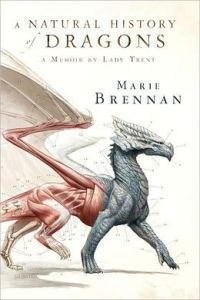
Serena’s Review: “A Natural History of Dragons”

12974372Book: “A Natural History of Dragons”by Marie Brennan

Publishing Info: Tor Books, February 2013

Where Did I Get this Book: audiobook from the library!

Book Description: Tor Books, February 2013

Book Description: All the world, from Scirland to the farthest reaches of Eriga, know Isabella, Lady Trent, to be the world’s preeminent dragon naturalist. She is the remarkable woman who brought the study of dragons out of the misty shadows of myth and misunderstanding into the clear light of modern science. But before she became the illustrious figure we know today, there was a bookish young woman whose passion for learning, natural history, and, yes, dragons defied the stifling conventions of her day.

Here at last, in her own words, is the true story of a pioneering spirit who risked her reputation, her prospects, and her fragile flesh and bone to satisfy her scientific curiosity; of how she sought true love and happiness despite her lamentable eccentricities; and of her thrilling expedition to the perilous mountains of Vystrana, where she made the first of many historic discoveries that would change the world forever.

Review: When I read “Turning Darkness into Light” a year or so ago, I didn’t realize that it was connected to Marie Brennan’s “Lady Trent” series. It was still an enjoyable read, however, and it inspired me to go back and put the original series on my list. Of course, that now makes reading this series, set quite a bit before “Turning Darkness,” into a very different reading experience than it would have been had I been approaching without any prior knowledge. But, overall, I really enjoyed this read!

Before she was the well-known adventurous, Lady Trent, Lady Isabella was just a young woman with an unladylike interest: dragons. But ever determined, she set out to make a life for herself where she could pursue this unlikely passion as far a a lady of her time could hope for. Instead, she got more than she ever wished for. Finding a marriage of true affection with a liberal minded man who eventually even concedes to allowing her to travel on expeditions alongside her. Never did he suspect that she, herself, would be the one to begin making the most extraordinary discoveries of their time!

This book was both what I expected and very different than I expected. On one hand, it’s kind of your staple historical fantasy story featuring an intrepid lady going and doing what no lady has done before. Lady Trent’s voice was very familiar, if a bit less bland than the likes of Amelia Peabody and Veronica Speedwell. But her story was unique enough to stand alone. For one thing, I appreciate the way the story is grounded in the realities of the “time” for a lady such as herself.

Her marriage is not made from wild romance, but from the practical choice of two individuals with unique interests to team up with another who can appreciate their eccentricities. It was a nice change of pace to read about this type of relationship and how their feelings towards each other change and grow over the years as they are put to different, unexpected tests. Her husband doesn’t simply jump onboard with her wanting to travel the world, but very realistically expresses concern that he will be judged for not protecting his wife as a proper husband should. Of course, he quickly sees reason and realizes that her wants and needs are more important than this judgement, but I appreciated that the challenge of living so far outside the norm was addressed.

The story was a bit slower to get started than I may have liked, but once Lady Isabella actually begins her explorations, I really enjoyed it. Even then, the dragons were much more often an idea or passing fear than ever being very present. This, of course, was part of the mystery of them, but it did leave the pacing of the story itself a bit stilted. Here, mostly, is where it was strange that I had read the companion book before this actual series. Many secrets and truths had been taken as common knowledge in that book, but here Lady Trent had yet to make any of these discoveries. It did add a strange, new layer of intrigue for me, personally, as I spent a lot of time trying to guess how all of these smaller clues would lead to the bigger reveals I knew were coming at some point. Even knowing some of the outcomes, I still wasn’t able to put much together beforehand.

I really liked the narrator for this audiobook, and I highly recommend reading the book that way if you like audiobooks at all. The slower pace and, at points, removed feeling one has from the characters themselves did knock this back a few points in my rating. But I plan on continuing the series and hopefully those aspects will pick up in the next one.

Rating 7: A fun historical fantasy story, if a bit plodding at times.

Reader’s Advisory:

“A Natural History of Dragons” is on these Goodreads lists: “Fantasy of Manners” and “Dragons/Serpents.”

Find “A Natural History of Dragons” at your library using WorldCat!

Serena’s Review: “The Poppy War”

35068705Book: “The Poppy War” by R. F. Kuang

Publishing Info: Harper Voyager, May 2018

Where Did I Get this Book: audiobook from the the library!

Book Description: When Rin aced the Keju—the Empire-wide test to find the most talented youth to learn at the Academies—it was a shock to everyone: to the test officials, who couldn’t believe a war orphan from Rooster Province could pass without cheating; to Rin’s guardians, who believed they’d finally be able to marry her off and further their criminal enterprise; and to Rin herself, who realized she was finally free of the servitude and despair that had made up her daily existence. That she got into Sinegard—the most elite military school in Nikan—was even more surprising.

But surprises aren’t always good.

Because being a dark-skinned peasant girl from the south is not an easy thing at Sinegard. Targeted from the outset by rival classmates for her color, poverty, and gender, Rin discovers she possesses a lethal, unearthly power—an aptitude for the nearly-mythical art of shamanism. Exploring the depths of her gift with the help of a seemingly insane teacher and psychoactive substances, Rin learns that gods long thought dead are very much alive—and that mastering control over those powers could mean more than just surviving school.

For while the Nikara Empire is at peace, the Federation of Mugen still lurks across a narrow sea. The militarily advanced Federation occupied Nikan for decades after the First Poppy War, and only barely lost the continent in the Second. And while most of the people are complacent to go about their lives, a few are aware that a Third Poppy War is just a spark away . . .

Rin’s shamanic powers may be the only way to save her people. But as she finds out more about the god that has chosen her, the vengeful Phoenix, she fears that winning the war may cost her humanity . . . and that it may already be too late.

Review: Whew! That book description is about half the length of my entire post usually! But I guess given that this is a 600+ page book, it kind of makes sense. There’s a lot to pack in there! This summer continues to be the summer of catching up on books that were quite a hit a year or so ago, and that for whatever reason, took me forever to get to! I have clear memories of seeing this cover and title being thrown about everywhere and yet I never really knew anything about what it was about! Which, having read it now, I kind of get! There’s a lot in here, and it’s the kind of book that’s hard to pin down or to compare to some other, obvious read-alike. And, while I was not prepared for everything in this, I really loved it!

Rin has always been a fighter. Maybe not in the classical sense, though she gets even there eventually. No, she is one who fights against the life that others have chosen for her. A war orphan from a poor providence, through sheer stubbornness and force of will she studies hard enough to earn her ticket out of an arranged marriage. Then, in a northern school that looks down on her lowly beginnings, Rin, again through sheer stubborness, finds a way to become one of their best students. And then the war hits, and her real fight begins. Not only against an almost unstoppable invading force, but the fight within herself to define her future. Will she follow a beloved teacher, warning of dark paths ahead? Or an esteemed leader who asks her to embrace every bit of power she has always hid within herself.

This book took me by complete surprise. For one thing, it almost reads as two entirely different books, so right when you’re getting settled in and think you understand the type of story you’re read, bam! Nope! The first half is your classic coming-of-age, boarding/military school story ala Tamora Pierce’s “Alanna” series. You have Rin, the girl who has nothing going for her, proving to everyone again and again that sheer stubbornness is enough to get you through most everything. She’s an outcast among her peers with the one sweet friend and the one big enemy in the local school enemy. She befriends the quirky teacher. It’s all lovely. And as familiar as that all sounds, the author imbibes her story with such a complicated history, culture, and mythology that the reader never once feels like these aspects of the story are coming off as tropes.

And then, whoops! Not the innocent school story anymore! A foreign army invades and suddenly the story takes a steep turn into a grim and gritty war story. And even that came with surprises. It starts out well enough with a few things going Rin’s way as she learns more about her abilities, her history, and her potential. She joins up with a crew of other “freaks” and they have a few wins. And then…it gets dark. Pretty suddenly even. And when I say dark, I mean dark. I’m not a prude about violence by any means, but man, I wasn’t prepared for where this book headed. I definitely teared up a number of times and had to put the book down (metaphorically, as it was an audiobook) at least two or three times. Some parts of it were really hard to get through.

I will say that this is the one part of the story that knocked it back a point from being a full “10 rating” book: at times, it felt like the violence was almost a bit too much. There was one section in particular about three fourths of the way through where I felt like the book just seemed to linger and repeat examples of the atrocities. While a lot of this was necessary for Rin’s own arc and to justify her choices and how she ends up where she does, I think the point was made even without some of the circling round again through all of the horror. It’s a fine line to walk, and it’s the kind of thing that many readers will have different tolerances for. But, the warning stands: this book goes to some awful places. I wasn’t prepared, so I’ll let you know so you can be!

I really liked Rin’s character. Her arc is incredibly compelling, especially as we see her struggle through some awful choices. And by the end, we have a character who is very different than the one we started with. But at the same time, completely recognizable. And the changes are so subtle and the influences on her pile up so slowly, bit by bit, that by the grand conclusion, we’re not shocked by what should be shocking.

I also loved the incredibly world-building, history, and mythology. This story felt completely fresh, and even after 600+ pages, I still only felt like I was scratching the surface of this world. This is the first book in a trilogy, and while I have a few guesses as to where one or two things are going, I’m also prepared to be dead wrong. Since I was completely blown off my feet with this one, it’d be the height of arrogance for me to assume I know what’s coming next! That said, I will need to give myself a bit of breathing time before getting into the second one. My heart can only take so much!

Rating 9: A little late to the game and repeating what’s been said a bunch of times already, but this book is incredible.

Reader’s Advisory: 

“The Poppy War” is on these Goodreads lists: “Asian Speculative Fiction by Asian Authors — #ownvoices” and “Fantasy of color.”

Find “The Poppy War” at your library using WorldCat!

Kate’s Review: “The Year of the Witching”

49789629Book: “The Year of the Witching” by Alexis Henderson

Publishing Info: Ace, July 2020

Where Did I Get This Book: I received and eARC from NetGalley.

Book Description: A young woman living in a rigid, puritanical society discovers dark powers within herself in this stunning, feminist fantasy debut.

In the lands of Bethel, where the Prophet’s word is law, Immanuelle Moore’s very existence is blasphemy. Her mother’s union with an outsider of a different race cast her once-proud family into disgrace, so Immanuelle does her best to worship the Father, follow Holy Protocol, and lead a life of submission, devotion, and absolute conformity, like all the other women in the settlement.

But a mishap lures her into the forbidden Darkwood surrounding Bethel, where the first prophet once chased and killed four powerful witches. Their spirits are still lurking there, and they bestow a gift on Immanuelle: the journal of her dead mother, who Immanuelle is shocked to learn once sought sanctuary in the wood.

Fascinated by the secrets in the diary, Immanuelle finds herself struggling to understand how her mother could have consorted with the witches. But when she begins to learn grim truths about the Church and its history, she realizes the true threat to Bethel is its own darkness. And she starts to understand that if Bethel is to change, it must begin with her.

Review: Thank you to NetGalley for providing me with an eARC of this novel!

So for the past few months some friends and I have been continuing our ‘Horror Movie Club’ that we had just started before social distancing became the name of the game. We log into Netflix and open up Netflix Party, then watch a scary movie every Tuesday. Back in May we watched “The VVitch”, one of my favorite witch movies because damn, that ending. I was the only one who had seen it, and when that ending twist came the chat exploded with glee and I basked in the (what I see as ) feminist message at the end. You intertwine witchcraft and feminism and I am totally there. So when I read the description for “The Year of the Witching” by Alexis Henderson, I immediately, IMMEDIATELY, requested it from NetGalley. I want MORE feminist witchcraft in my reading, after all.

giphy-1
EMPOWERMENT! HEXES! PATRIARCHY SMASHING! I WANT IT ALL! (source)

First and foremost, it should be noted that “The Year of the Witching” is a dark fantasy, bordering on straight horror story. Horror in terms of scary imagery, but also horror in terms of the horrors of fundamentalism, misogyny, racism, and corruption. Bethel is a community that seems to take some of its inspiration from Puritanism and the Fundamentalist Church of the Latter Day Saints, with nods to Puritan beliefs of witch craft and the FLDS notions of a Prophet and polygamy. Citizens are kept in line with religion, and girls and women are the ones who bear the brunt of the hardships and the punishments for stepping out of place. Immanuelle is accepted by her family and mostly by the community, but is always Othered because of her mother’s ‘sin’ and because of her race. It’s far too seldom that witch stories involve Black of brown witches (with a few recent exceptions), so for Immanuelle to have the potential for magical powers and to be biracial with dark skin is pretty awesome. It also opens up the potential to  not only explore misogyny in Bethel, but also misogynoir as well. The entire society is an exploration in how a society can use fear and religion to exert control and power over its members, and at the top of this is the Prophet, who leads the town and passes judgements that sometimes end in pyres where women and outsiders are burned for the sins of being women and outsiders. And while the people in Bethel are being subjectted to this, it’s very clear that they are still complicit in this system.

That isn’t to say that Henderson falls into the trap of ‘one side is completely evil and the other side is completely good’, as the witches of the Darkwood that Immanuelle is drawn to (as was her mother) are described as evangelists in their own right. Immanuelle is caught between two extremes, and has to suss out if out of reaction to one side she will swing all the way to the other side, which has its own malevolence. Henderson really figured out how to find the nuance, which we don’t always get to see in stories that have as much rage and revolution in them as “The Year of the Witching” does. Which is awesome. Instead of falling merely into rage, even if that rage is completely justified, Henderson lets Immanuelle explore other ways to proceed when it comes to the liberation of herself and the women in her life. And I loved that.

And yes, this is a very creepy tale with some really neat witch mythos inside of it. You have your usual ‘cast out women who were seeking power’ tale, but Henderson goes a little further with it, giving each witch in the coven a specific backstory, specific roles they played before and after the clash, and unique descriptors that harken to folk horror as well as body horror. I especially loved the descriptions of Lilith, aka The Mother, who is the leader and in direct opposition of The Father and what the people of Bethel believe. I don’t want to spoil her description because I really want it to to be a surprise to readers, but holy hell, it’s both something out of a nightmare and also powerful as hell.

“The Year of the Witching” is an excellent YA horror novel with a lot to say. Do yourself a favor and get your hands on it. Especially if you loved the end of “The VVitch”.

Rating 10: Spooky, angry, feminist and empowering, “The Year of the Witching” is a dark and scary tale of agency, independence, and discovering your inner power.

Reader’s Advisory:

“The Year of the Witching” is included on the Goodreads lists “Dystopias with Gender or Religion-specific Phobics”, and “Black Heroines 2020”.

Find “The Year of the Witching” at your library using WorldCat, or a local independent bookstore using IndieBound!