
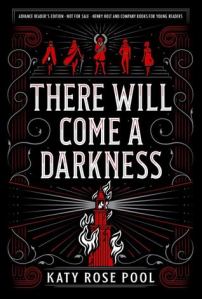
Serena’s Review: “There Will Come a Darkness”

41823536._sx318_Book: “There Will Come a Darkness” by Katy Rose Pool

Publishing Info: Henry Holt Books for Young Readers, September 2019

Where Did I Get this Book: audiobook from the library!

Book Description: For generations, the Seven Prophets guided humanity. Using their visions of the future, they ended wars and united nations―until the day, one hundred years ago, when the Prophets disappeared.

All they left behind was one final, secret prophecy, foretelling an Age of Darkness and the birth of a new Prophet who could be the world’s salvation . . . or the cause of its destruction. As chaos takes hold, five souls are set on a collision course:

A prince exiled from his kingdom.
A ruthless killer known as the Pale Hand.
A once-faithful leader torn between his duty and his heart.
A reckless gambler with the power to find anything or anyone.
And a dying girl on the verge of giving up.

One of them―or all of them―could break the world. Will they be savior or destroyer? 

Review: June has been the month of “better late than never” as far as my reading goes. This is at least the second book that I’ve read this month that was hugely popular last fall and yet…I didn’t get to it until just now. But there’s just so much good fantasy out there, and, I’ll admit, I’m always a bit hesitant about these books that seems to flare up as “the next big thing” in YA fantasy. My track record with these super popular new fantasy series hasn’t been good. But I liked “The Merciful Crow” more than I was expecting, so I thought I’d give another big title a chance. Sadly, this wasn’t as much of a hit for me, though I’ll likely still keep reading the series.

Five young people are living very different lives in very different spheres. Some from wealth, some from poverty, some who are running, and some who know that it is up to them to find what no one else can. But their world is on the brink of change, with powerful forces moving against those with magical abilities and a prophesy that has loomed over the heads of the people for generations. Each with their own role to plays, these disparate lives begin to cross and the pieces begin to fall in place. But who is the savior and who is the source of destruction?

I already gave away that this book wasn’t a hit for me, but I will start with a few positives before getting into my critiques. As the description gives away, this is an ensemble cast, but I was so pleased to find that it wasn’t another YA fantasy ensemble ala “Six of Crows.” For one thing, it’s centered around a prophesy and not heists, and more importantly, besides one exception, all of our main characters start out not knowing anything about the others. And this holds true though out most of of the story. Some characters weave in and out of other’s stories, but by the end, only a few of them have even ended up together with others still scattered to the wind.

But other than the unique approach to its ensemble cast, this book was barely even a book. Instead, it read much more like an extended prologue before the last few chapters sort of got into things. With such a large cast of characters and the fact that they all have unique histories and no nothing about each other (losing the opportunity to cross-tell their stories through various POVs that you often see in other books with large casts), the book has to devote almost two thirds of the story to introducing its main characters. The chapters were also short, so just when I felt like I was settling into one character’s life, struggles, and thoughts, I was suddenly bounced into a completely different character’s story. Between all of these switches, it was hard to become truly invested in any of them. And, like I said, it left very little room for the story to actually develop.

Frankly, very little actually happens in this book. We do get some action towards the end, but even that was a bit of a letdown. Some of the “reveals” I could see from a mile off and fell flat when they came. There was a big bad character who was talked about through much of the story, but when he finally appeared on page, he, too, felt like a let down and not nearly the threat he was meant to represent. The prophesy itself seemed interesting, but we barely scratched the surface of that here. Like I said, it read more like an extended prologue and introduction than a book itself.

Beyond that, I struggled to actually like any of the main characters. Several of them continued to make poor decisions that didn’t seem to fall in line with the roles they were in. Even as things fell apart around them and they began to see the negative consequences of their choices, they just continued to do so. It ended up being incredibly frustrating. One of the main characters, also, has an incredibly predictable story arc and was simply pretty dull all around. There were maybe two characters who I could kind of become invested in. But even I even struggled with them at times. A lot of the character choices and plot points just made several characters very unsympathetic. Even by the end of the book, it felt like many of them had learned nothing at all. This also played into the feeling that the book was an extended introduction. We don’t really see much true character growth on the page, and it ended with them all still feeling rather half-baked.

Overall, I was pretty disappointed by this book. But, like I said in the beginning, I’ll likely give the second one a go just because of the fact that this one read so much more like a prologue than a story itself. I want to see if the action will actually pick up in the next one! If you really like ensemble stories and want one that isn’t focused on heists, this may be worth checking out. But don’t go in with your expectations too high.

Rating 6: Not fully realized on its own, the plot was lacking and the characters shallow, leaving a lot of work for the sequel to improve upon.

Reader’s Advisory: 

“There Will Come a Darkness” is on these Goodreads lists: “Prophecies” and, amusingly enough, “The books that I bought during the pandemic to make me feel better….”

Find “There Will Come a Darkness” at your library using WorldCat!

Serena’s Review: “Dragonslayer”

40045979Book: “Dragonslayer” by Duncan M. Hamilton
Publishing Info: Tor Books, July 2019

Where Did I Get this Book: NetGalley!

Book Description: Once a member of the King’s personal guard, Guillot dal Villevaurais spends most days drinking and mourning his wife and child. He’s astonished–and wary–when the Prince Bishop orders him to find and destroy a dragon. He and the Prince Bishop have never exactly been friends and Gill left the capitol in disgrace five years ago. So why him? And, more importantly, how is there a dragon to fight when the beasts were hunted to extinction centuries ago by the ancient Chevaliers of the Silver Circle?

On the way to the capitol city, Gill rescues Solène, a young barmaid, who is about to be burned as a witch. He believes her innocent…but she soon proves that she has plenty of raw, untrained power, a problem in this land, where magic is forbidden. Yet the Prince Bishop believes magic will be the key to both destroying the dragon and replacing the young, untried King he pretends to serve with a more pliable figurehead. Between Gill’s rusty swordsmanship and Solène’s unstable magic, what could go wrong?

Review: While, like Kate, I prefer my dragon stories to have the dragons on the good guys’ side, I’ll take what I can get as far as they go. And the title was obvious enough! I also really like this particular cover art illustrator who does a lot of work for books published by Tor, so whenever I see one of his works, I’m often even more interested. But, while this book did deliver on what it promised, it sadly didn’t do much else.

Gill has it fairly well settled that his heroic days are in the past. Content to spend his days drinking and mourning the loss of his family, he’s shocked when he’s call upon by the Prince Bishop to kill a dragon. For one, aren’t dragons gone? And for two, why on earth would the Prince Bishop choose him of all people? But every good hero needs a companion, and Gill finds his in an unexpected place: a witch burning. While Solene has very little control over her powers, it is possible that her abilities could be necessary to dispose of the dragon. And so this odd couple sets out on what could either be a grand adventure or a grand disaster.

This is one of those strange books to review. I know it, and the other two books in the series, were very positively reviewed, and I understand why. The writing is solid. The characterization is interesting and fleshed out. And the adventure is just what is says it is: two oddballs on a dragon-slaying quest. There’s nothing technically wrong with any of these things, and I think I can say with some confidence, judging on all the positive reviews, there is definitely an audience out there who wants this type of straight-forward, non-challenging fantasy adventure. I can even be one of them sometimes, as I know I’ve definitely come across books that haven’t pushed the limit much but still scratched a particular entertainment itch. For me, though, I just wanted…more.

In many ways, we’ve seen Gill and Solene many, many times before. Especially Gill. He’s the drunken, ex-hero who lost his family and lost his vaulted position in society until he gets an unexpected call-to-arms. I get that personal loss is a deep well of emotional motivation and exploration, but man, the drunk dude who loses his wife and kid, sinks into drinking, but then once the adventure starts never gives them a second though? Seen that guy a few too many times. If you’re going to kill off the family and make the loss still poignant enough that your main character is essentially drinking himself to death over it still, I want to see the story address his actual emotional arc for getting through that. Not just have an adventure happen and have it seem like all he really needed was a distraction to put those pesky deaths out of his mind.

Solene, too, was fine enough. But again, we’ve seen the magic user with no control of her powers in a land that hates magic a million times before. The fact that others may want to use her powers for their own ends is no shocker and a theme that has been run to death. Like Gill, she’s a likable character on her own, it’s just that there wasn’t much there to make her stick out from the massive crowd of characters just like her who came before.

I think one of the best and most unique things about this book were the chapters from the antagonist’s perspective, the dragon’s perspective. This was probably one of the few major twists and interesting takes the story had to offer, and I thought the author pulled it off very well. The dragon had a very interesting voice, and hearing that side of the equation is definitely not something I had seen before in this type of book.

Overall, there’s nothing really wrong with this book. I’ve just read this type of swords and staffs fantasy adventure a million times before. The main characters didn’t have enough to make them stand out, and while the adventure was fun enough, it never seemed to dive any deeper than the surface level on any given theme. In many ways, it’s a beach read fantasy story. And that’s not an insult! Sometimes we all just need a solid, expected, non-challenging story to get us through the day. I think I had just hoped for more from this one.

Rating 6: A bit of a let down and not adding much that is new to the genre.

Reader’s Advisory: 

“Dragonslayer” isn’t on many Goodreads lists, but it is on “Fantastical, Bingeable Backlist.”

Find “Dragonslayer” at your library using WorldCat!

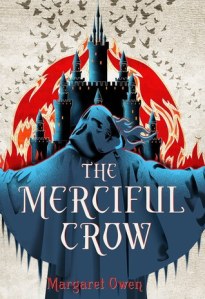
Serena’s Review: “The Merciful Crow”

36483378._sx318_Book: “The Merciful Crow” by Margaret Own
Publishing Info: Henry Holt, July 2019

Where Did I Get this Book: audiobook from the library!

Book Description: A future chieftain.

Fie abides by one rule: look after your own. Her Crow caste of undertakers and mercy-killers takes more abuse than coin, but when they’re called to collect royal dead, she’s hoping they’ll find the payout of a lifetime.

A fugitive prince.

When Crown Prince Jasimir turns out to have faked his death, Fie’s ready to cut her losses—and perhaps his throat. But he offers a wager that she can’t refuse: protect him from a ruthless queen, and he’ll protect the Crows when he reigns.

A too-cunning bodyguard.

Hawk warrior Tavin has always put Jas’s life before his, magically assuming the prince’s appearance and shadowing his every step. But what happens when Tavin begins to want something to call his own?

Review: As with many popular YA fantasy series (there are just too many!), I often don’t get around to them until I see the sequel start popping up on early release sites. And then in a temporary lapse of judgement I request the sequel only to quickly realize that means, oh wait, I have to get my hands on the first one, get it read, and review it before I can even start the book I just so eagerly requested. I do this again and again, and do I ever learn? Nope! It’s even more frustrating when I read the first book and don’t care for it, knowing I’ve already committed myself to the sequel. Luckily, that’s not the case with this one!

Fie belongs to the lowest of the low, a caste of people whose only job is to care for the dead and dying of a deadly plague that sporadically grips various villages and townships. While completely necessary to the function of society, Crows are at best ignored and at worst hunted in the night. So, when one of their typical jobs caring for two dying young men ends up with Fie and her fellow caught up in a plan of an escaping prince and his comrade, Fie takes the opportunity for all its worth, bargaining for a better future for her and her people. But first, she must find a way to deliver these two to safety, despite everything set against them.

Every once in a while when I read an audiobook, I’m aware of how my reading experience is probably affecting my overall take on the book in hand. This can go two ways, of course, with a poor narrator sinking a book almost immediately, and a skilled one catching my in more quickly than I might have been had I been reading in the traditional manner. I think this is one of the latter experiences. The narrator for this book was excellent, giving many characters, especially Fie herself, unique accents and ways of speaking. The book was certainly written to suggest that Fie had a Scottish accent of sorts, so it was great that the narrator was able to fully capture this aspect of the story. She was also able to add a lot of understated tension and emotion to Fie, something that I think probably wasn’t as obvious just on the page itself.

The book obviously had certain things in its favor regardless of media format. I really liked the bird-based caste system and world-building that the author set up. There were interesting connections and powers that neatly aligned with the type of bird that was used to represent a certain caste. Crows, obviously, deal with the dead. Hawks are skilled hunters and warriors. And so on.

While overall I understood the role the Crows played in this society, I did question the vehemence at which they were often hated by those around them. They seem to perform a pretty essential task, dealing with the plague-ridden, and as the only caste that doesn’t suffer from this plague, they’re really the only options for people. We also learn that pretty dire things happen if a plague ridden body isn’t dealt with properly. Given all of this, I can get how a Caste like this might inspire wariness from the general public, but how do we get to the state where they’re literally hunted down and killed at times? Seems pretty backward for really the only Caste that is actually necessary to the ongoing survival of a people. There were bits and pieces of the world-building like this that I never felt were fully explained or lined up properly. It was often distracting when these questions came up, as I was usually able to sink into just enjoying the main character and her journey and was only jarred out of it when these moments arose.

Fie herself was an excellent main character. She’s rough and tumble and perfectly exemplifies the type of no-nonsense person that would survive and grow into a leadership position in this type of society. She’s seen things and has no time for the nonsense of others. Her very different relationships with Tavin and Jasimir are also very interesting. The romantic relationship was perhaps a bit too easy and obvious. But I enjoyed the struggles that she went through in understanding the prince and of them both coming to a place of mutual respect. Each had to learn of the restrictions placed on the other and how their own worldviews influenced how they saw change happening going forward.

While I was interested in Fie’s own personal story, the book did drag a bit in the middle. There’s a lot of traveling.  A lot. And often if felt like not much was really happening in between some of the bigger scenes. It’s also the type of book that, while I enjoyed it in the moment, it hasn’t stuck with me as much as I had hoped. Even now, only a week or so after I finished it, I’m struggling a bit to remember exactly how things lay in the set-up for book two. That said, however, I definitely enjoyed it enough to be looking forward to the sequel and conclusion of this story. It will be interesting to see how it does not in audio format as well.

Rating 7:  A bit forgettable with some questionable world-building, but a strong main character and audiobook narrator really sold this one for me.

Reader’s Advisory:

“The Merciful Crow” for some reason isn’t on many interesting Goodreads lists, but it is on “Crows and Ravens.”

Find “The Merciful Crow” at your library using WorldCat!


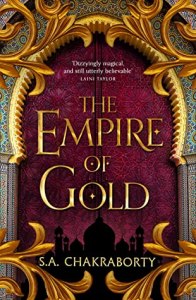
Serena’s Review: “The Empire of Gold”

46033842._sy475_Book: “The Empire of Gold” by S.A. Chakraborty

Publishing Info: Voyager, June 2020

Where Did I Get this Book: Edelweiss+

Book Description: Daevabad has fallen.

After a brutal conquest stripped the city of its magic, Nahid leader Banu Manizheh and her resurrected commander, Dara, must try to repair their fraying alliance and stabilize a fractious, warring people.

But the bloodletting and loss of his beloved Nahri have unleashed the worst demons of Dara’s dark past. To vanquish them, he must face some ugly truths about his history and put himself at the mercy of those he once considered enemies.

Having narrowly escaped their murderous families and Daevabad’s deadly politics, Nahri and Ali, now safe in Cairo, face difficult choices of their own. While Nahri finds peace in the old rhythms and familiar comforts of her human home, she is haunted by the knowledge that the loved ones she left behind and the people who considered her a savior are at the mercy of a new tyrant. Ali, too, cannot help but look back, and is determined to return to rescue his city and the family that remains. Seeking support in his mother’s homeland, he discovers that his connection to the marid goes far deeper than expected and threatens not only his relationship with Nahri, but his very faith.

As peace grows more elusive and old players return, Nahri, Ali, and Dara come to understand that in order to remake the world, they may need to fight those they once loved . . . and take a stand for those they once hurt.

Previously Reviewed: “City of Brass” and “Kingdom of Copper”

Review: Oh man, I’ve been looking forward to this book for so long! It’s pretty funny to think that I discovered the first book in this excellent trilogy when Kate and I were accidentally trespassing early in the main room of the convention hall at ALA several years ago. I nabbed a copy before we figured out that we weren’t supposed to be there. (By the by, we had planned to go to ALA again finally this year as a reward for surviving our first year as mothers…damn you, Covid!!) Anyways, there was an even longer wait between this book and the last, a year and a half compared to the usual year, so I was really excited when I nabbed an early review copy. And, best of all, this is the perfect ending to such a great series!

The wheel of violent retribution has turned, and like so many other revolutions and wars of the past, Daevabad must suffer through it. But while tragedy and violence are nothing new to a city that throughout history has been fought over, this time is different, as much more has been lost then ever before. And Dara, Nahri, and Ali are the keys to moving forward. But to do so, they each must grapple with the truths of their past: the unknown, the forgotten, and all of the things buried deep in themselves. What they each discover will not only reshape who they are but will reshape the future of Daevabad itself.

The last book in this trilogy left off on a massive cliffhanger. Daevabad had just been horrifically invaded by Dara and Nahri’s mother who used a dastardly plan that involved mass genocide of Ali’s father and people. Nahri and Ali fled the city and somehow ended up back in Nahri’s homeland of Cairo, Egypt, the powerful ring of Suileman in their possession. The stakes were nothing if not high. And given the incredibly long history of tensions between the various daeva tribes, the shafit (their part-human progeny), and the various other magical players on the board, it was almost impossible to imagine how all of the various threads would be tied up in this final book.

And obviously I won’t spoil it for you! There are so many surprises and twists and turns to this book that completely blew me away. I had a few ideas about what could come to pass. But let me just say, I’m so pleased I wasn’t the author, as not only did none of my ideas happen, but they were all massively underwhelming compared to what we were given! This book not only tackles the tangled web of politics and horrible tribal tensions within Daevabad itself, but it expands the world out so much further than we’ve seen in previous books. We spend more time in Nahri’s Cairo. We travel down the Nile and meet crocodile kings. We get captured by pirates and end up in a wondrous jungle empire. And that’s all probably in the first half of the book, before things really go crazy!

In my past reviews for this series, I’ve talked a lot about the dark history that is laid out before us in this trilogy. And all of that is here as well, with a few extra knife twists to just make it all the more grim. But what stood out to me in this book was just how incredibly funny Chakraborty’s writing is as well. As I was reading, I found myself agian and again highlighting passages on my Kindle that made me laugh out loud. I’m sure this was present in the first two books as well. Indeed, it kind of must have to balance out said darkness. But for some reason, the casual and effortless humor really stood out here. Especially with regards to Nahri and Ali’s characterization, and their tenuous relationship.

Nahri concludes this series as probably one of my all-time favorite fantasy heroines. She never loses sight of who she is throughout this entire series, and she’s just the sort of level-headed, pragmatic, no-nonsense character that I prefer. And, like I said, she’s hilarious. But Ali is really the character to go through the biggest arc in this book. In the first book, I remember being slightly put-off when I discovered I had to give up page time with Nahri to hear about this rather ridiculously idealistic princeling. But over the course of the trilogy, Ali has really come into his own, and it’s in this last book where I really fell in love with him and his story. With the world crashing around him, Ali is forced to finally confront the balance between his ideals and the world that is before him. Not only this, but his is the story that holds the most mysteries and goes to the most unexpected places.  I really loved how both of these characters’ story turned out in the end.

Dara, on the other hand…oof. We all knew his story was tragic, and it’s more of the same here. His lows are just so much lower than anyone else’s that it’s hard to know how he gets through it. He’s half villain, half victim, but you can’t help but feel for him at every turn. Really, though, any villainous acts that he commits are so out-shown by the main villain, Manizeh that it pales in comparison. The villains have always been strong in this book, but wow, she takes the cake.

The writing and world-building is just as strong here as it was in the first two books, so there’s not much new to report here other than the fact that excellence remains excellent. It’s a testament to the strength of the author though that she managed to pull out this conclusion. Like I said before, it was almost impossible to see how she would write herself out of the seemingly inescapable corner the story was in at the end of the last book. It looked like there was no possible ending that didn’t result in death and despair for at least one of our main characters. And while we did still have some of that, I will say that I was completely and utterly satisfied with the conclusion of this story. If you’ve been gobbling up these books like I have, you’re in for a treat with this last one!

Rating 10: A feat of masterful story craft, exploding out the world while also never losing sight of the intimate moments driving its main characters. Simply excellent.

Reader’s Advisory:

“The Empire of Gold” is a newer title so it isn’t on many Goodreads lists, but it is on “Upcoming 2020 SFF with female leads or co-leads.”

Find “The Empire of Gold” at your library using WorldCat!

Serena’s Review: “The Obsidian Tower”

50147675._sx318_sy475_Book: “The Obsidian Tower” by Melissa Caruso
Publishing Info: June 2020, Orbit

Where Did I Get this Book: ARC from the publisher!

Book Description: The mage-marked granddaughter of a ruler of Vaskandar, Ryx was destined for power and prestige at the top of Vaskandran society. But her magic is broken; all she can do is uncontrollably drain the life from everything she touches, and Vaskandar has no place for a mage with unusable powers.

Then, one night, two terrible accidents befall her: Ryx accidentally kills a visiting dignitary in self-defense, activating a mysterious magical artifact sealed in an ancient tower in the heart of her family’s castle.

Ryx flees, seeking a solution to her deadly magic. She falls in with a group of unlikely magical experts investigating the disturbance in Vaskandar—and Ryx realizes that her family is in danger and her domain is at stake. She and her new colleagues must return to the family stronghold to take control of the artifact that everyone wants to claim—before it destroys the world.

Review: I really loved Melissa Caruso’s original trilogy, rating and reviewing them all pretty highly. So I was excited to see that she was coming out with a new series so quickly, and one that is set in the same world, no less! Vaskandar and its very different society and approach to magic was one of the more intriguing aspects of the original series, so I was particularly interested to see how that would work in this new story. While I wasn’t quite as blown away as I was with the first book in her other trilogy, overall, I still very much enjoyed this one.

While Ryx’s life has never been ordinary (her broken magic that kills anything she touches has prevented that), she has managed to make a place for herself in her powerful grandmother’s land. She not only manages the large familial estate that houses an ancient secret, but she’s become adept at political maneuvering and negotiation. These skills become all the more important when things go deadly wrong the eve before important negotiations between Vaskandar and Ravera. But they won’t be enough to combat the ancient evil that has been unleashed, forcing Ryx to turn to a society made up of magical experts in whose hands might rest the future of both nations.

As I said, I was really interested in checking out this book when I learned it was set in Vaskadar. That country had played a fairly large role as the villains in the previous series, and their approach to magic, culture, and societal structure differed greatly from Ravera. Ryx is an interesting entry point into this world. She is born into a powerfully magical family and does have the important ring in her eyes that designates her as a magic user, a marker that distinguishes her as someone important. However, her experience with magic has been the opposite of that of most everyone else’s. Instead of opening doors and leading to a  life of power and influence, her magic has done nothing but close them. With anything she touches dying on contact, the only life she can make for herself is one that is strictly guided by distancing rules and made up of people who know to keep their distance. Where in the previous book, we saw mages struggle against the restrictions that wearing a jess (a magical tool that contains a magic user’s power) brought on, Ryx has always longed for the freedom that one would grant her.

Her story throughout this book was very compelling, learning more about her own magic and the unexpected roles she can play in a world that she had thought off limits to her. We see a character who has never felt like she belonged in her powerful family, but whose very identity is caught up in the guardianship of the land and people that family holds dear. She’s a novice at forming relationships with new people, and we see her struggle to learn how to have friends and, maybe, even romantic relationships.

I also liked the greater exploration of Vaskandar and the rules and cultural norms that were so different than what we saw of Ravera in the previous series. The power structure is built into every aspect of Vaskandar society, and we see both the strengths this gives their society as well as the weaknesses it opens up. Because their power and long lives are connected to the land, Vaskandar has an uneasy relationship with borders, and it’s easy to see why tensions have historically been high with its neighbor nations. But here, the book veers off the expected course, and we see a new enemy arise. This was a nice switch from the Vaskandar vs. Ravera tensions from the first series which would have felt like a retread had it been repeated here.

I did struggle with the pacing of the story. Thinking back over it, while there are definitely tense moments, action-packed scenes, and a nice climax at the end of the book, while reading it, I felt like it was moving very slowly. The first half in particular seemed to really strain to get going. Some aspects of the story felt rushed (the building of character relationships, for example), but many of the actual plot points were talked about quite a lot before they actually happened. I think it could have been edited down and streamlined a bit.

But, like I said, other bits felt rushed. Ryx seems to meet the members of this magical society, and then in a hot minute become instant friends with them all and implicitly trust them. She shares crucial information with them and seems to be immediately accepted on the same level. I get that her joining up with these folks was a large point of the book and the series as a whole, but it kind of felt like the author was in such a rush to get to that, that she just skipped the natural build that is needed in developing these types of relationships. I had similar problems with the romance which seemed to kind of come out of nowhere. Ultimately, I was able to get on board with it, but it was a bit jarring.

While not the perfect start to a new series, this book definitely set the stage for what could be an excellent series. Ryx is a great main character, and the author has expanded the world-building out quite a bit with the introduction of the new evil force they will be working against. I found some of the twists and turns slightly predictable, and the pacing felt off at times. But I think if you enjoyed the author’s first series, this one is well worth checking out as well!

Also, don’t forget to enter our giveaway to win a ARC version of “The Obsidian Tower!”

Rating 8: Not without flaws, but a solid start to what promises to be an interesting new series!

Reader’s Advisory:

“The Obsidian Tower” is a newer title so it isn’t on many Goodreads lists. But it is on “2020 Queer Sci-Fi Fantasy.”

Find “The Obsidian Tower” at your library using WorldCat!

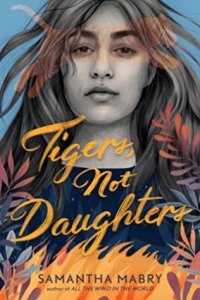
Kate’s Review: “Tigers, Not Daughters”

52776262._sx318_sy475_Book: “Tigers, Not Daughters” by Samantha Mabry

Publishing Info: Algonquin Young Readers, March 2020

Where Did I Get This Book: I own it.

Book Description: The Torres sisters dream of escape. Escape from their needy and despotic widowed father, and from their San Antonio neighborhood, full of old San Antonio families and all the traditions and expectations that go along with them. In the summer after her senior year of high school, Ana, the oldest sister, falls to her death from her bedroom window. A year later, her three younger sisters, Jessica, Iridian, and Rosa, are still consumed by grief and haunted by their sister’s memory. Their dream of leaving Southtown now seems out of reach. But then strange things start happening around the house: mysterious laughter, mysterious shadows, mysterious writing on the walls. The sisters begin to wonder if Ana really is haunting them, trying to send them a message—and what exactly she’s trying to say.
 
In a stunning follow-up to her National Book Award–longlisted novel All the Wind in the World, Samantha Mabry weaves an aching, magical novel that is one part family drama, one part ghost story, and one part love story.

Review: Give me a story with a good old fashioned haunting and I’ll probably be on board. Make that haunting a little deeper in meaning and I’ll be even happier. Sure, a random ghost is fine, but the ghosts of your past can be far more scary, given that’s the kind of haunting most people deal with in their day to day lives. I had this theme in mind when I bought “Tigers, Not Daughters” by Samantha Mabry, a story about sisters, loss, and unfinished business in both the spiritual sense and the literal sense.

“Tigers, Not Daughters” examines the life of the Torres sisters, girls who live in a house with their negligent and manipulative father, and who are grieving the loss of this oldest sister Ana, who died after falling out of a window. Jessica is filled with rage and making reckless decisions, while being caught up in an abusive romantic relationship. Iridian has pulled herself into her favorite book and into her own writing. And Rosa is trying to keep herself, and her sisters, together, while looking for a mysterious hyena that may or may not be roaming the neighborhood. All three perspectives of these sisters give us insight into how they’ve been coping with their loss, and how they are trying to move forward in spite of their own feelings of guilt and grief. We also occasionally get the perspectives of outsiders, usually from a chorus of neighbor boys who have been watching the Torres sisters for a long time. I felt that the way that Mabry interspersed all of these perspectives gave us an encompassing understanding of each sister and their emotional and mental states. The different ways each of them grieves are all very different, but they all felt realistic and well explored. And the ghostly presence of Ana adds a lot to their perspectives, seeing their personal interactions with her spirit and how that reflects how they left things before her death was clearly well thought out. I greatly enjoyed the haunting, an the unsettling descriptions of it.

What didn’t work as well for me was how rapid fire some of these perspective shifts could happen, as that tended to make the pacing feel a little rushed and stilted. We would be in Iridian’s perspective, then we’d jump to Jessica’s, then it would be Jessica’s again, then maybe the neighbor boy chorus. I also felt like the perspective that we were really lacking, and that we really could have used, was that of Ana. I definitely understand that by leaving her side of things out really emphasizes her absence, and how each sister feels like they were left not knowing Ana as much as they would have liked in the wake of her death, but the problem I had with that is that it made her feel more like an idea and just there to be a symbol, as opposed to a fully fleshed out person. And while I don’t think that Rafe, their father, needs to have much time spent on him, craven creep that he is, I feel like we could have known more about him. Was he this way before the girls’s mother died? Is his behavior a result of trauma, or mental illness, or sociopathy, or what? Again, we don’t need to focus in on him TOO much, but I think we could have known more.

So while it’s true that “Tigers, Not Daughters” didn’t quite explore as much as it could have for higher emotional impact, I did enjoy the straight forward haunting aspects of it. But something that also intrigues without much answer is that this is listed as the first in a series on Goodreads. Where could the Torres Sisters go from here? I’m kind of interested to find out where that ends up.

Rating 6: A ghost story about trauma, grief, and familial dysfunction, but it felt a little harried as it jumped from perspective to perspective without much time to process.

Reader’s Advisory:

“Tigers, Not Daughters” isn’t on many Goodreads lists yet (?!), but I think that it would fit in on “Latina Leads in YA and Middle Grade Fiction”, and “Latinx MG/YA Speculative Fiction”.

Find “Tigers, Not Daughters” at your library using WorldCat, or a local independent bookstore using IndieBound!

Giveaway: “The Obsidian Tower”

50147675._sx318_sy475_Book: “The Obsidian Tower” by Melissa Caruso

Publishing Info: June 2020, Orbit

Book Description: The mage-marked granddaughter of a ruler of Vaskandar, Ryx was destined for power and prestige at the top of Vaskandran society. But her magic is broken; all she can do is uncontrollably drain the life from everything she touches, and Vaskandar has no place for a mage with unusable powers.

Then, one night, two terrible accidents befall her: Ryx accidentally kills a visiting dignitary in self-defense, activating a mysterious magical artifact sealed in an ancient tower in the heart of her family’s castle.

Ryx flees, seeking a solution to her deadly magic. She falls in with a group of unlikely magical experts investigating the disturbance in Vaskandar—and Ryx realizes that her family is in danger and her domain is at stake. She and her new colleagues must return to the family stronghold to take control of the artifact that everyone wants to claim—before it destroys the world.

Giveaway Details: I really enjoyed Melissa Caruso’s original trilogy, so I was super excited when I saw that she was coming out with a second series set in the same world. Her first trilogy stood out for its amazingly competent and practical leading lady, the strong female friendships, a completely unique world, and an interesting take on a love triangle. From this description, it looks like we’ll have at least one of the same: an interesting-sounding young woman protagonist!

This description doesn’t really clarify when this story is set in comparison to the original, but I have to imagine it’s some time after. One of the things I’m most intrigued by is the fact that it is set in Vaskandar and our heroine hails from that nation. In the previous series, Vaskandar was largely an enemy nation. Their vivomancers wielded incredible power and their succession system was full of conflict. It will be interesting to see what this story has to offer featuring a main character from this land. Are the political tensions the same? I’m assuming she will feature in some type of heroic role, so how will that feature in Vaskandar’s competitive and sometimes brutal society?

I’m also really interested to learn more about Ryx’s broken powers. In the previous book, our main character herself didn’t have any magical abilities, but instead was a Falconer for her powerful, fire-wielding friend. And we know that Riverra and Vaskandar place very different values on those with and without magic. How will Ryx feature in this when she technically seems to have abilities, but they’re so dangerous that she accidentally kills her fellows?

I’ll have my full review for this book this Friday. But in the mean time, make sure to enter to win an ARC copy of “The Obsidian Tower.” The giveaway is open to U.S. residents only and ends on June 17.

Click here to enter the giveaway!


Kate’s Review: “The Sandman (Vol.1): Preludes and Nocturnes”

23754Book: “The Sandman (Vol.1): Preludes and Nocturnes” by Neil Gaiman, Sam Kieth (Ill.), Mike Dringenberg (Ill.), and Malcolm Jones III (Ill.)
Publishing Info: Vertigo, 1989

Where Did I Get This Book: I own it.

Book Description: New York Times best-selling author Neil Gaiman’s transcendent series SANDMAN is often hailed as the definitive Vertigo title and one of the finest achievements in graphic storytelling. Gaiman created an unforgettable tale of the forces that exist beyond life and death by weaving ancient mythology, folklore and fairy tales with his own distinct narrative vision.

In PRELUDES & NOCTURNES, an occultist attempting to capture Death to bargain for eternal life traps her younger brother Dream instead. After his 70 year imprisonment and eventual escape, Dream, also known as Morpheus, goes on a quest for his lost objects of power. On his arduous journey Morpheus encounters Lucifer, John Constantine, and an all-powerful madman.

This book also includes the story “The Sound of Her Wings,” which introduces us to the pragmatic and perky goth girl Death.

Review: After re-reading “Transmetropolitan”, I knew that I wanted to re-read another comic series that I have great affection for. I wasn’t sure which one I wanted to tackle, as I have a few that I REALLY love, but then fate interceded and announced that Audible was going to do an adaptation of Neil Gaiman’s magnum opus, “Sandman”. “Sandman” is probably up there with “Watchmen”, “The Dark Knight Returns”, and “Maus” when it comes to influential graphic novels and comics. It is absolutely my favorite of Neil Gaiman’s works, and now the time has come to get reacquainted with Dream, Death, and all the other Endless and dream worlds.

giphy
I don’t know why I waited so long. (source)

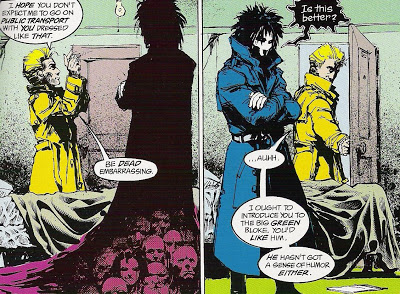
When we first meet Morpheus, aka Dream, he’s become a prisoner to those who wanted to try and capture his sister Death for their own devices. “Preludes and Nocturnes” is not only the story of how he escapes, but his quest to gather his three sacred objects: his bag, his helmet, and his ruby. Along the way Morpheus meets familiar faces from the DC Universe, as this is a Vertigo title (RIP you magnificent company) and we’re bound to see other licensed characters. It’s great seeing the likes of Martian Manhunter, Scarecrow, Mr. Miracle, and more, as it gives us a familiar footing to introduce us to a VERY complicated world and mythos that Morpheus is coming from. As of now in the story, Morpheus is rather one track minded, desperate to get his objects back and going to many lengths to do so. His journeys lead him to some very dark places, and the plot and tone is what tells you that this is starting out as dark fantasy that is right in the middle of fantasy and horror. I had forgotten how dark this volume goes until I was in it, and it gave me chills. There are moments of sheer horror, absolutely, but they almost always have a dreamy feel to them, as they should (though I’m excluding all the stuff that happens with John Dee in the diner… You’ll know what I mean when you get to it. It’s just complete nightmare fuel). All the while, Morpheus remains stoic and intimidating, and yet feels ruminative and introspective as well. As of now we don’t know much about him and his backstory, but you still get the feel that he contains multitudes that are just waiting to be explored. It gets you hyped to keep going on.

For me, however, the most effective and greatest tale of this volume, and one of the best of the entire “Sandman” story, is the standalone “The Sound of Her Wings”. It is within this tale that we actually get to meet Dream’s older sister Death, the original target for the capture that Dream got caught up in. It’s a quiet, bittersweet tale of Dream accompanying her as she makes her rounds, releasing mortals from their lives, and seeing the peace for the dead, and the anguish for those left behind. Death is a Top 3 Sandman character for me, and probably most fans, as she is kind, bubbly, and compassionate. She also looks like a fan of the Cure circa 1987, but that just adds to her charm. This is probably the story I remembered best in all of the “Sandman” lore, and reading it again was just as lovely and emotional as it was the first time.

Finally, the artwork is so of it’s time but also very well done. Sam Kieth has been seen on this blog before, probably most notably in the review of the “Alien” comic series. While I didn’t feel that Kieth’s work matched the tone of that endeavor, it is pitch perfect for “Sandman”. The use of shadow and blanched colors is great on it’s own, but it’s the weird little details that are put in to give an extra sense of unreality.


dreamalittledreamofme
Look at that cape!! Just look at it! (source)

Honestly, if you are a fantasy fan and you haven’t read “Sandman”, I really encourage you to do so. It’s Gaiman’s best work, and “Preludes and Nocturnes” will get you hooked with just a little taste of what is to come.

Rating 9: A dark and dreamy introduction to one of the greatest comic series of all time, “Sandman: Preludes and Nocturnes” builds a world that is wholly unique and almost otherworldly.

Reader’s Advisory:

“The Sandman (Vol.1): Preludes and Nocturnes” is included on the Goodreads lists “500 Essential Graphic Novels”, and “Quality Dark Fiction”.

Find “The Sandman (Vol.1): Preludes and Nocturnes” at your library using Worldcat, or at a local independent bookstore using IndieBound!

Serena’s Review: “The Guinevere Deception”

43568394Book: “The Guinevere Deception”  by Kiersten White

Publishing Info: Delacorte Press, November 2019

Where Did I Get this Book: audiobook from the library!

Book Description: There was nothing in the world as magical and terrifying as a girl.

Princess Guinevere has come to Camelot to wed a stranger: the charismatic King Arthur. With magic clawing at the kingdom’s borders, the great wizard Merlin conjured a solution–send in Guinevere to be Arthur’s wife . . . and his protector from those who want to see the young king’s idyllic city fail. The catch? Guinevere’s real name–and her true identity–is a secret. She is a changeling, a girl who has given up everything to protect Camelot.

To keep Arthur safe, Guinevere must navigate a court in which the old–including Arthur’s own family–demand things continue as they have been, and the new–those drawn by the dream of Camelot–fight for a better way to live. And always, in the green hearts of forests and the black depths of lakes, magic lies in wait to reclaim the land. Arthur’s knights believe they are strong enough to face any threat, but Guinevere knows it will take more than swords to keep Camelot free.

Deadly jousts, duplicitous knights, and forbidden romances are nothing compared to the greatest threat of all: the girl with the long black hair, riding on horseback through the dark woods toward Arthur. Because when your whole existence is a lie, how can you trust even yourself?

Review: I’ve been a big fan of White’s work since I read her re-imaging of the life of Vlad the Impaler, gender swapping the main character and creating a tension-filled and deeply stressful (but fantastic) trilogy. From that reading experience, when I heard of this book, a re-imaging of the Camelot story from Guinevere’s perspective, I knew the author was up to the task! And I wasn’t wrong!

Guinevere arrives at Camelot with a mission: to marry Arthur. But that’s only the beginning of her story, for she’s not really Guinevere at all, but a protector sent by Merlin to watch over Arthur himself from all magical threats. While well-versed in magical protections and wards, Guinevere soon learns there is much more to this task than simply being on the look-out for threats to the king. She must actually be the queen, as well, something she feels much less suited for. And as she begins to peel back the layers of the mysterious Camelot and its political maneuverings, she starts to see that there is more at stake than she had thought, and that even she, the woman sent to protect Arthur, may not know the whole story.

This book surprised me in many ways, not least of all in its protagonist herself. We soon discover that Guinevere is not a reliable narrator. I love it when books can pull off an unreliable narrator approach as it opens up so many new doors for discovery as the story unfolds. Here, Guinevere herself isn’t aware of her own unreliability, and in many ways, the reader begins to put together pieces before she does herself. We know that she is an envoy sent by Merlin to protect Arthur. But we don’t know much more than that. It’s only as the story begins to move forward that the layers in Merlin’s plots become clear, and Guinevere begins to suspect larger things at play than a simple protection task.

She’s a very sympathetic character, a necessity for one of fiction’s most vilified female characters. Like she did with Lada Dracul, White builds open and adds to the original character blocks in such a way that the character is easy to understand and root for. Beyond that, the author doesn’t hold back from re-imaging all of the characters involved. If you suspect you know the role that any given familiar name will play, prepare to be surprised. I saw a few of these twists coming, but there were definitely one or two that took me by surprise. Luckily, one of the biggest twists towards the end was one of those surprises.

This was also one of the books I referenced a few weeks ago that has a love triangle that I miraculously didn’t hate. I guess I shouldn’t have been surprised since White also included an unconventional love triangle in her “And I Darken” series. But, again, here I was very pleased with the direction this love story ended up taking. Again, knowing the author’s way, I won’t pretend that this book really establishes any end game as far as the romance goes, but for this book, I was satisfied. It’s always nice to be reminded that even much-detested tropes can be done right by a skilled writer.

The story also doesn’t answer all the mysteries it sets up. There are still a bunch of questions on the table, and I have my own theories about Guinevere’s past and the role she will play going forward. The stage has been set with magical mysteries, old villains and new, and a main character who has only now realized just how under-prepared she really is. I can’t wait to see where it goes from here!

Rating 8: Another excellent twist on a classic tale from Kiersten White!

Reader’s Advisory:

“The Guinevere Deception” is on these Goodreads lists: “Best Retellings of fairytales, legends and history” and (just for kicks) “Covers With Beautiful Art.”

Find “The Guinevere Deception” at your library using WorldCat!

Serena’s Review: “Into the Crooked Place”

INTO_THE_CROOKED_PLACE6Book: “Into the Crooked Place” by Alexandra Christo

Publishing Info: Feiwel and Friends, October 2019

Where Did I Get this Book: Edelweiss+

Book Description: The streets of Creije are for the deadly and the dreamers, and four crooks in particular know just how much magic they need up their sleeve to survive.

Tavia, a busker ready to pack up her dark-magic wares and turn her back on Creije for good. She’ll do anything to put her crimes behind her.

Wesley, the closest thing Creije has to a gangster. After growing up on streets hungry enough to swallow the weak whole, he won’t stop until he has brought the entire realm to kneel before him.

Karam, a warrior who spends her days watching over the city’s worst criminals and her nights in the fighting rings, making a deadly name for herself.

And Saxony, a resistance fighter hiding from the very people who destroyed her family, and willing to do whatever it takes to get her revenge.

Everything in their lives is going to plan, until Tavia makes a crucial mistake: she delivers a vial of dark magic—a weapon she didn’t know she had—to someone she cares about, sparking the greatest conflict in decades. Now these four magical outsiders must come together to save their home and the world, before it’s too late. But with enemies at all sides, they can trust nobody. Least of all each other.

Review: I never got around to reading Christo’s “To Kill a Kingdom,” but I heard a lot of good things about it. So when I saw she had another book coming out this fall, I was eager to jump in and see what the fuss was about. I’ll admit, I was a bit wary when reading the book description, because I think these ensemble/gang/YA fantasy stories ala “Six of Crows” have become the number one genre to regularly burn me recently. But I thought I’d still give it a go based on the recommendations for the author herself. Unfortunately, my wariness was deserved, and this book wasn’t the hit I was hoping for.

Creije is both a wondrous and dangerous place. But whether if is dangerous or wondrous depends largely on one’s own abilities. And four different individuals know that with the right combination of magic, wits, and guts, the streets are where you make a life for yourself. Each with their own role to play and their own proficiency, a simple misunderstanding will quickly draw them together in an adventure where no one can be trusted.

Confession: I read this book back in the fall closer to when it was actually published. But I had also just reviewed (rather negatively) several other books that were very similar to this (ensemble, YA fantasy novels that centered around gangs/heists) and was, frankly, too tired out to want to right up yet another review. But as I did receive this book from a publisher, I thought better late than never. Alas, all of that leads to the obvious point: this book was not my jam and was way too familiar to a million other books that I’ve read just like it.

Look, I loved “Six of Crows.” But in retrospect I’m starting to hold a serious grudge against the deluge of similar YA titles that have now flooded the market. I swear, there was a point where I read about five of these in a row and was beginning to confuse them all (there’s at least two others that I’ve read and *sigh* will get around to reviewing at some point). I mean, the genre has always had trends that come and go, but for some reason this one seems worse than others. I think its because, other than “Six of Crows,” I’ve yet to come across a version of this trope/subgenre that I’ve actually liked.

I hate love triangles (a previous trope found all too often), but I can name at least two books I’ve read in the last year that had this trope and were still good! Because the authors still managed to make it their own and add new and interesting twists to the concept. But for some reason, with these ensemble, YA gang stories…they’re all almost literally exact copies of each other. To the point that some of the staple characters could be interchanged between books with a simple name change and not much would alter. Their personalities are the same. Their relationships are the same. The general mood/banter in the group as a whole is the same. It’s just…exhausting. I don’t know if there’s just not enough to plum with this this particular subgenre or whether “Six of Crows” just set too high of a bar. But something has gone wrong here, and it needs to stop.

And look, I’ve written two entire paragraphs without even talking about this book itself. And that’s because it’s just the same as all of the others. The characters feel like bland re-imaginings of characters we’ve seen before. The dialogue was tired and familiar. The relationships were…ok, I liked that they added the relationship between the two women, but the other was super familiar and predictable. The plot did pick up about half way through the book, but it never felt like it was really coming into anything of its own. Instead, it feels like the author just cobbled together a bunch of things that have been popular in other stories and whipped this one out there as fast as she could. There’s really not much to say in reviewing this book that I haven’t said before about similar books in the past that have tried and failed at this plot.

Eventually, I guess, I’ll have to get around to reviewing the other two books like this I’ve read. One I won’t be continuing and the other I already have the sequel to (though this more a case of “not as bad as the others” than anything else). But I have to space them out so my poor readers don’t have to just re-read the same review from me over and over again. I’m sorry! I just seem to keep reading the same book over and over again, and this is the result!

Rating 5: Adds nothing to a tired and needs to be put to bed subgenre of YA fantasy.

Reader’s Advisory:

“Into the Crooked Place” isn’t on any relevant lists (other than ones having to do with the year of its publication), which I think is telling. But it probably should be on “Villain Protagonists.”

Find “Into the Crooked Place” at your library using WorldCat!