Serena’s Review: “A Conspiracy of Kings”

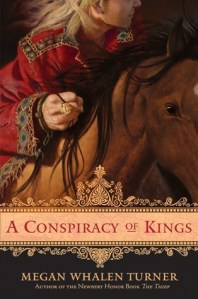
6527841Book: “A Conspiracy of Kings” by Megan Whalen Turner

Publishing Info: Greenwillow Books/HarperCollins Publishers, March 2010

Where Did I Get this Book: audiobook from the library!

Book Description: Sophos, under the guidance of yet another tutor, practices his swordplay and strategizes escape scenarios should his father’s villa come under attack. How would he save his mother? His sisters? Himself? Could he reach the horses in time? Where would he go? But nothing prepares him for the day armed men, silent as thieves, swarm the villa courtyard ready to kill, to capture, to kidnap. Sophos, the heir to the throne of Sounis, disappears without a trace.

In Attolia, Eugenides, the new and unlikely king, has never stopped wondering what happened to Sophos. Nor has the Queen of Eddis. They send spies. They pay informants. They appeal to the gods. But as time goes by, it becomes less and less certain that they will ever see their friend alive again.

Across the small peninsula battles are fought, bribes are offered, and conspiracies are set in motion. Darkening the horizon, the Mede Empire threatens, always, from across the sea. And Sophos, anonymous and alone, bides his time. Sophos, drawing on his memories of Gen, Pol, the Magus and Eddis, sets out on an adventure that will change all of their lives forever.

Review: After blazing through the first three books in this series last fall, I decided I needed to pump the brakes so I could stand the wait until the fifth book’s publication this spring. Delayed gratification and all of that. But by now the next book has dropped, I’m on the waiting list at my library, and it’s time to finally catch up with the last book in the series to this point.

One thing that I have commented about in all of the previous books in this series, is the way the author plays where her narrator and narrative method. For a series that has such a strong character as Gen, it’s a brave choice to focus the story on periphery characters and leave your star player benched, essentially, for large chunks of the story. Here, she takes an even bolder risk by throwing the story into the hands of Sophos, a character who played a large role in the plot of the first book “The Thief” but has been entirely absent, apart from random asides, throughout the rest of the series.  He was an interesting enough character there, but it is always hard to tell how truly compelling any character is on their own when they’re working of the character of Gen who seems to draw out the best parts of many characters. So if you’d asked me whether I was interested in an entire book seen through his eyes and regarding his struggles with family and kingship, I’d probably have been like “…meh?” But, as usual, I should never have doubted!

One of the few things I remembered about Sophos as a character was his crippling insecurity. Here, after the events of “The Thief” and back in his home country under a new tutor, we can see why he struggles with this. His father is completely disappointed in him as a son and heir and never misses an opportunity to rub this fact in. So in many ways this is a story of self-discovery and self-confidence, all wrapped beneath an action packed plot. After Sophos’ family is attacked and he is sold into slavery, he finds himself completely alone in the world, and, for the first time, anonymous. How can he escape his current situation and re-claim his throne? And, more importantly, does he even want to?

As I mentioned earlier, Whalen Turned doesn’t just change up narrators between books, but she also changes the way she tells the story. Here, very early on, it is clear that Sophos is relating his experience to a listener, but it is not clear who that listener was. This plot device was both interesting and endlessly frustrating as I kept coming up with guesses for who he was talking to and the purpose of telling the story the way he was.

I don’t think it’s a spoiler to say that yes, he eventually does meet up with Gen, Attolia, and, most importantly Eddis again. As leaders of their own countries, each are valuable allies for the displaced Sophos. But much has happened since he last left them, most importantly the upstart theif Gen is now King of Attolia. And Eddis…he’s not quite sure where he stands with her. I loved seeing all of these characters through the eyes of Sophos who has been gone for much of the series and missed the progression of change that we the readers have had time to come to terms with. Further, all three rulers have different approaches to what it means to lead a country and how they go about it. I loved the insights they each provided Sophos as he began to realize the depth of the decisions before him.

The only thing that knocks this book down from a perfect score is the complicated politics of the regions. And I even hesitate to mention it because this aspect of the series is also one that makes it stand out and has been one of the draws for me as a reader. And it still is here. However, there were times when the plans and actions of the characters were confusing to me and I had to re-read portions to fully understand how everyone knew what when. But, like I said, I’d rather things be more complicated than be spoon-fed the plot, so take this “criticism” how you will.

Surprising no one, I loved this book. And surprising no one, all the doubts I had going in where laid fully to rest. I will now go back to obsessively refreshing my library hold account page to see if the line of people before me is dwindling for the next book “Thick as Thieves.”

Rating 9: Another great entry in a great series!

Reader’s Advisory:

“A Conspiracy of Kings” is on these Goodreads lists: “Political themed YA fiction” and “Royalty.”

Find “A Conspiracy of Kings” at your library using WorldCat!

Previously Reviewed: “The Thief” and “The Queen of Attolia” and “The King of Attolia”

Kate’s Review: “The River At Night”

29430686Book: “The River At Night” by Erica Ferencik

Publishing Info: Gallery/Scout Press, January 2017

Where Did I Get This Book: The library!

Book Description: A high-stakes drama set against the harsh beauty of the Maine wilderness, charting the journey of four friends as they fight to survive the aftermath of a white water rafting accident, The River at Night is a nonstop and unforgettable thriller by a stunning new voice in fiction.

Winifred Allen needs a vacation.

Stifled by a soul-crushing job, devastated by the death of her beloved brother, and lonely after the end of a fifteen-year marriage, Wini is feeling vulnerable. So when her three best friends insist on a high-octane getaway for their annual girls’ trip, she signs on, despite her misgivings.

What starts out as an invigorating hiking and rafting excursion in the remote Allagash Wilderness soon becomes an all-too-real nightmare: A freak accident leaves the women stranded, separating them from their raft and everything they need to survive. When night descends, a fire on the mountainside lures them to a ramshackle camp that appears to be their lifeline. But as Wini and her friends grasp the true intent of their supposed saviors, long buried secrets emerge and lifelong allegiances are put to the test. To survive, Wini must reach beyond the world she knows to harness an inner strength she never knew she possessed.

With intimately observed characters, visceral prose, and pacing as ruthless as the river itself, The River at Night is a dark exploration of creatures—both friend and foe—that you won’t soon forget.

Review: As I have mentioned before, I have some serious guilty pleasures (though I don’t REALLY believe in guilty pleasures when it comes to reading) when it comes to the books that I stack up on my nightstand. One of those guilty pleasures is wilderness survival horror/thriller. I am not an outdoorsy person by any stretch of the imagination beyond the occasional hike or walk, and so I love stories that involve people getting messed up by wilderness. Seriously, I think that I’m so scared of nature that I love seeing fictional people finding terror in the woods, or on the open ocean, or in the mountains, or whatever. This is the girl who freaked out about the Nutty Putty Cave Incident, made her entire book club listen to a long rant about it, and then watched “The Descent” a few times in a row as personal therapy, because she LOVES that movie due to the wilderness survival theme. So yeah. When I found a book that kind of sounds like “The Descent” exists, but takes out the cave, replaces it with a river, and replaces monsters with tangible real life horrors… Oh, I was so there.

7e1e765ade6959582e218422993504ae
Me leaving the library with my copy. (source)

“The River At Night” even seems like “The Descent” in it’s premise, at least a little bit. A group of ladyfriends go on a trip that involves adrenaline pumping extreme sports, with one of them recovering from a serious loss in her life while the others don’t really know how to approach her about it. Winifred is our protagonist, and she is still reeling from her divorce and the death of her brother Marcus. Her friends Pia, Sandra, and Rachel have always been her travel companions, on out-there and intense adventures (thanks to Pia, a true free spirit with no fear), and while Wini has reservations, the thought of white water rafting in the Maine Wilderness sounds… fun? I will be the first to admit that these four women are all pretty two dimensional caricatures, with the self involved adrenaline junkie (Pia), the tightly wound recovering addict (Rachel), the quiet sweetheart with a troubled home life (Sandra), and the wounded but determined wallflower (Wini). And I will also be the first to admit that some of the situations they found themselves in were a bit convenient, and cliche, and a little bit farfetched.

But guess what? I didn’t care because DAMN was “The River At Night” a fun as hell read!!!!

giphy
Cliche, shmiche, I’m just here to be entertained. (source)

“The River At Night” has just the right amount of suspense, as well as the right amount of relationship tension, that I had a hard time putting it down once I was completely absorbed by it. I had thoughts on where things were going to go, plot wise, but I was kept guessing for a lot of the big reveals. Ferencik did a really good job of building up the tension and setting the scene, and I felt like I could very easily and plainly see the Maine Wilderness as I made my way through the story.

I also really did like Wini as a protagonist. She is, of course, the character we get to know the best, and I felt like I understood her motivations in every choice that she made. I felt for her and I really did connect to the undercurrent of pain that she was fighting against, be it the end of her marriage or the loss of her brother, who was mute, and never really fit in outside of when he was with her. Her guilt in both of these losses was never overdone, but it was always present, like a very sad elephant in the room. It was pretty refreshing that Wini and her friends were all women who were encroaching upon middle age, an age range that we don’t really get to see much when it comes to women in books such as these. The way that they interacted with each other was pretty believable in terms of how sometimes friendships can be rife with tension, especially friendships that have gone on for so long and have seen so much. I believed every single action and choice that each of the characters made, and while I liked some more than others (Rachel was just the absolute worst and Pia was also pretty insufferable) I think that each of them added a unique piece to the whole of the story.

On top of that there were very sweet moments involving Wini and a character who is introduced a little more than halfway through the story. I don’t want to give any of it away, but just know that I thought that it was very touching for a book that had a slew of moments where I thought I was going to fall of my seat because of the ratcheted up tension. It was nice to see some legitimate moments of tenderness, even if some of the circumstances were a bit hard to swallow, realism wise. I absolutely found myself a bit teary eyed at a few of these moments, especially when Wini was thinking about Marcus and how she felt she failed him.

Realistic or not, “The River At Night” was an unsettling and adrenaline pumping survival thriller that captured my attention for a full evening. Thriller fans, MAKE NOTE. This will be a great book for the upcoming summer months to take along on a vacation.

Rating 9: Super fun, pushing all my guilty pleasure buttons, and suspenseful as all get out. I really enjoyed “The River At Night” and think that any fan of a nature survival thriller should check it out ASAP.

Reader’s Advisory:

“The River At Night” is, for whatever reason, not on many relevant Goodreads lists, but I think it would fit in on “Best Wilderness Horror Stories”, and “Best Wilderness Survival Books”.

Find “The River At Night” at your library using WorldCat!

Serena’s Review: “Hunted”

24485589Book: “Hunted” by Meagan Spooner

Publishing Info: HarperTeen, March 2017

Where Did I Get this Book: the library!

Book Description: Beauty knows the Beast’s forest in her bones—and in her blood. Though she grew up with the city’s highest aristocrats, far from her father’s old lodge, she knows that the forest holds secrets and that her father is the only hunter who’s ever come close to discovering them.

So when her father loses his fortune and moves Yeva and her sisters back to the outskirts of town, Yeva is secretly relieved. Out in the wilderness, there’s no pressure to make idle chatter with vapid baronessas…or to submit to marrying a wealthy gentleman. But Yeva’s father’s misfortune may have cost him his mind, and when he goes missing in the woods, Yeva sets her sights on one prey: the creature he’d been obsessively tracking just before his disappearance.

Deaf to her sisters’ protests, Yeva hunts this strange Beast back into his own territory—a cursed valley, a ruined castle, and a world of creatures that Yeva’s only heard about in fairy tales. A world that can bring her ruin or salvation. Who will survive: the Beauty, or the Beast?

Review: Just in time to cash in on my “Beauty and the Beast” phase that has been reignited by the recent movie release (though, let’s be real, I’m almost always interested in “Beauty and the Beast” stories) comes this new release by Meagan Spooner with a re-imaging of the classic fairytale. And, what a relief, it is actually a true re-imagining! And a very enjoyable one at that!

Similar to my love of Jane Austen re-tellings, I’m always on the look out for a good fairytale re-imagining, and my favorite is “Beauty and the Beast.” And, just like the Jane Austen wanna-bes, many of them fall sadly short, so I’m always slightly nervous going in. Will this one be yet another let down? Or…?

In Spooner’s version, Beauty, or Yeva, and her two older sisters are the daughters of a wealthy merchant father. But this time, her father’s rise to fortune came upon the back of his skill as an archer and hunter in the mysterious forest that surrounds the city. From him, Yeva has also learned to tread the forest pathways, bow in hand, and developed a deep love for the woods and its denizens, both the ordinary and the fabled. After the family’s inevitable fall from fortune and her father’s subsequent disappearance on a hunting trip, Yeva sets out to find him only to become entangled in the plot of a Beast who is on the lookout for a skilled hunter to free him from a curse.

What I most loved about this book was the blending of familiar aspects from the classic tale (the main plot points are all there) alongside the truly unique new take on the story as a whole. And these new aspects weren’t only superficial changes. The entire curse is changed in a way that effects the action of the story, the characterization of its main characters, and the gradual build in the relationship between Yeva and the Beast.

First, for the familiar aspects. I was overjoyed to see one of the only other examples I can think of of a “Beauty and the Beast” story where the sisters were as well-handled as they were in my all-time favorite version, Robin McKinley’s “Beauty.” In particular, Asenka, the middle daughter who was born with a clubbed foot, is incredibly well-rounded and made to be a character in her own right. The relationship between all the sisters is lovely, shown and not told through small moments, like their ritual of break-making each night, and the larger interactions that come from the traumatic events that befall the family throughout the story. We all know that I am a sucker for sister stories, and this one was completely satisfying in every way.

And, as I said, the main bullet points of the fairytale are all there in this book. The family’s fall from fortune, Beauty’s time with the Beast, her return to her family, and her choice to go back to the Beast and save him from the curse. But, as I said, all of these traditional plot points were handled in completely unique ways. Beauty’s motivation for staying with the Beast is different. His motivations for wanting her there are different (we get small insights into his thoughts between chapters). Their relationship develops along different lines than those we expect (hunting trips in the woods rather than elaborate, enchanted dinners in a castle.) And the curse itself is set up in a completely new way.

I loved how naturally all of these elements came together, new and traditional. Yeva’s love of hunting isn’t simply thrown in as an aside that makes here character “strong” but is actually integral to the story. The relationship between the two builds slowly and naturally, never easily side-stepping the challenging aspects of the situation they find themselves in. There is no quick forgiveness or trust, but instead, a natural transformation. I also particularly liked what Spooner did with the Gaston-like character, Solomir. He was another excellent example of fleshing out a character who can often come across as just another stock character.

Lastly, Spooner added a level of depth to Yeva’s internal struggle throughout the book. Yes, circumstances force her into situations that she wouldn’t have chosen for herself, but from the very beginning her desire for something more is made clear. I appreciated how deeply the author delved into this sense of wanting and dissatisfaction, and how neatly these aspects of Yeva’s character were tied to the story and curse as a whole. Again, it wasn’t an aside to make Yeva more well-rounded, but an important aspect of the story itself. My only complaint would be that I feel Spooner may have missed an opportunity to push this theme further in the end of the book. It seemed like she walked right up to the edge of making a more powerful statement about this, but then side-stepped it a bit. She still made her point clearly and tied it together well, but I personally feel like it could have been taken a bit further, even.

All in all, I very much enjoyed this book. It is always so exciting to see an excellent fairytale retelling, especially of “Beauty and the Beast” which I think is probably one of the more challenging tales to do well. I strongly recommend this book to fans of the original story and of fairytale retellings in general!

Rating 9: An excellent story, perfectly blending the familiar elements of the fairytale and unique characters and plots!

Reader’s Advisory:

“Hunted” is on these Goodreads lists: “Best retellings of Beauty and the Beast” and “Archery.”

Find “Hunted” at your library using WorldCat!

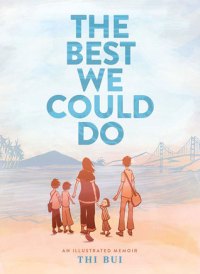
Kate’s Review: “The Best We Could Do”

29936927Book: “The Best We Could Do” by Thi Bui

Publishing Info: Abrams Books, March 2017

Where Did I Get This Book: The library!

Book Description: This beautifully illustrated and emotional story is an evocative memoir about the search for a better future and a longing for the past. Exploring the anguish of immigration and the lasting effects that displacement has on a child and her family, Bui documents the story of her family’s daring escape after the fall of South Vietnam in the 1970s, and the difficulties they faced building new lives for themselves.
 
At the heart of Bui’s story is a universal struggle: While adjusting to life as a first-time mother, she ultimately discovers what it means to be a parent—the endless sacrifices, the unnoticed gestures, and the depths of unspoken love. Despite how impossible it seems to take on the simultaneous roles of both parent and child, Bui pushes through. With haunting, poetic writing and breathtaking art, she examines the strength of family, the importance of identity, and the meaning of home.
 
In what Pulitzer Prize–winning novelist Viet Thanh Nguyen calls “a book to break your heart and heal it,” The Best We Could Do brings to life Thi Bui’s journey of understanding, and provides inspiration to all of those who search for a better future while longing for a simpler past.

Review: Stories of refugees and immigration are incredibly relevant these days. Between certain world leaders trying to impose travel bans, to the threats of building a wall all along a border, to the devastating refugee crisis being seen due to instability in Syria, the very thought of people finding a safe place to live, while leaving their home behind, has become incredibly politicized. When I first heard about “The Best We Could Do”, I knew that I needed to immediately get it on my request list so that I could read it as soon as it was available to me. It’s heartening to see that graphic novels are becoming more and more used to tell personal stories, and a story as personal as this one was only bolstered by the imagery that we found on the page. Oh boy was this a wonderful book.

And a very sad book as well. Thi Bui was born in Vietnam, just around the time that the Vietnam War was starting to wind down. Her family history is intwined within the stark differences in the Vietnamese society up to and during the war, as her mother was from the bourgeois class and her father was decidedly less well off. But this story isn’t just about a family trying to escape a violent and unsafe situation; it is also about a family that is forever affected by society around it, and a family trying to fit in in a new place that is completely new and different to them. By giving the context of her mother’s background, her father’s background, and the culture and society of Vietnam during their childhoods and her childhood as well, we get a story that is tragic, hopeful, devastating, and important all at once. She also does a very good job of showing how Western Imperialism and Colonialism, of course, had a large effect on how Vietnam dealt with a cultural conflict of the North versus the South. I really appreciated that she pointed out that for people in America during the war (those fighting it aside), it was more of a concept and something to support or speak out against. But for the Vietnamese, it was the life they were living every day, and that somehow kind of got lost in the narrative.

I also really liked the stories of her family, as imperfect and in some ways dysfunctional as it was. She has a very conflicted opinion of both her parents. Her father wasn’t a very good parent to her, and he wasn’t a very good husband to her mother either. But seeing his childhood that was filled with turmoil, poverty, instability, and broken family ties, we can completely understand why he turned into the man he became. We also see that her mother was in many ways a remarkable person who had ambitions and dreams, but then found herself in a marriage she wasn’t completely invested in, and with a family that, as cherished as they were, put an end to her ambitions, ambitions that absolutely could have been backed up by talent and know how. Bui contrasts her own journey into motherhood against the story of her own mother, and it is incredibly effective and bittersweet.

I think that what I found most effective about this story is that it has a powerful message, but it is wrapped in a family memoir. I was expecting far more about the fall of South Vietnam, and the journey out under cloak of darkness. But while that certainly does play a part, it’s really a story about a family, and how having to move from one life to another, whole new life in a whole new place caused damage that never quite repaired. Trauma, war, and displacement isn’t something that is forgotten just because you move to a new place and start a new life, and sometimes adapting to that new life can be a challenge in and of itself.

The art in this book is absolutely gorgeous. It is fairly simple at first glance, but images pop out and really take the reader’s gaze into them. I loved the colors and I loved how detailed it was, even though it looks like it’s fairly straight forward.

bestwecoulddo_p030-031_734a3facdf080b764c8fc9de660144ac-nbcnews-ux-2880-1000
(source)

I really cannot recommend “The Best We Could Do” enough. In a time where I think empathy and understanding are sorely needed when it comes to trying to understand the refugee experience, Thi Bui’s memoir will engage readers and show them how much is lost and how much is sacrificed just to stay alive. This is an incredibly important book.

Rating 9: A personal and powerful memoir with gorgeous illustrations, “The Best We Could Do” is an important book with a relevant message to the issues of immigration and the refugee crisis we are seeing today.

Reader’s Advisory:

“The Best We Could Do” is included on the following Goodreads lists: “Required Reading: Graphic Novels”, and “Vietnamese-American Novels and Memoirs”.

Find “The Best We Could Do” at your library using WorldCat!

Serena’s Review: “The Beast is an Animal”

29522966Book: “The Beast is an Animal” by Peternelle van Arsdale

Publishing Info: Margaret K. McElderry Books, February 2017

Where Did I Get this Book: the library!

Book Description: A girl with a secret talent must save her village from the encroaching darkness in this haunting and deeply satisfying tale.

Alys was seven when the soul eaters came to her village.

These soul eaters, twin sisters who were abandoned by their father and slowly morphed into something not quite human, devour human souls. Alys, and all the other children, were spared—and they were sent to live in a neighboring village. There the devout people created a strict world where good and evil are as fundamental as the nursery rhymes children sing. Fear of the soul eaters—and of the Beast they believe guides them—rule village life. But the Beast is not what they think it is. And neither is Alys.

Inside, Alys feels connected to the soul eaters, and maybe even to the Beast itself. As she grows from a child to a teenager, she longs for the freedom of the forest. And she has a gift she can tell no one, for fear they will call her a witch. When disaster strikes, Alys finds herself on a journey to heal herself and her world. A journey that will take her through the darkest parts of the forest, where danger threatens her from the outside—and from within her own heart and soul.

Review: I am going to start this review by talking about the cover, because it is rare that I see a cover that so perfectly sets up the atmosphere of the book. Dark, yet beautiful. Indistinct, yet you feel drawn in, almost against your will. The tall dark trees, shadows, and bright red flowers all spark instinctive warning symbols in your head and that looming shape in the middle….is it a person? A creature? Or simply a strangely shaped tree stump? Whoever came up with this art design in the publishing house should be awarded major points for exactly matching book art to its source. Like this cover, “The Beast is an Animal” was beautiful, and terrifying, and I couldn’t look away.

At its core, this is a book about fear and about the horrors that a simple emotion can inflict on an individual, a family, and an entire community. Neighbors, always on the look out for witches to blame for poor weather, poor crops, posed almost a greater danger than the dark, looming forest around which many small communities exist. It is into this world that Angelina and Benedicta are born, twin sisters whose looks, down to unique birthmarks, exactly mirror the other. After a poor farming season, they, and their mother, are blamed and banished to live in the woods, and a husband/father who should have been their protector slinks away to begin his life again with a new, fresh-faced woman. Their mother doesn’t flourish. Angelina and Benedicta do, slowly being eaten away with bitterness and anger at the fear that lead to their banishment. And thus, two monsters are born.

After all of this set up, we meet Alys, our main character who throughout the book also struggles with the fear of “otherness” that floats around her. After her whole town is destroyed by the souleaters, excepting all of the children under 15, she and her fellow orphans go to live in a new town. While they do take the children in, this new community is even more stifled, building walls around their small town and forcing the children to guard it every night, all night.

We watch this story unfold over three periods of Alys’s life. First, when she is 7 and her town falls to the souleaters. Second, when she is 12 and begins to suspect that she has more in common with the souleaters and the mysterious Beast that haunts the woods. And finally, at age 15 when she must confront both the truth about herself, and the darkness that is growing in the heart of the woods.

What I loved about this book was how it plays with the topic of fear and bad/good. Are Angelina/Benedicta evil? Or were the “normal folk” who banished them? Where does the Beast fall on this spectrum? What about the community that takes in the children? While the supernatural elements were scary in their own right, it was the oppressive fear of the people themselves that made the book truly creepy. Alys, and the medicine woman who adopts her in the new town, are constantly on the look out for any hint that they are beginning to fall under suspicion for being different. The devices and tortures used against these supposed “witches” were more terrifying than the supernatural souleaters if only because we know from history that these things existed.

As I said in the beginning, what makes this story truly compelling is the atmospheric tone of the writing. It feels like a new fairytale, containing not only the darker elements that are typical to original fairytales, but also reads with a lyrical flow, combining beautiful imagery with poignant insights into the deep tragedy at the heart of the story.

Alys is a strong protagonist around which to center this story. However, Mother, the woman who adopts Alys in the new community, was the breakout character for me. She doesn’t have a lot of page time, but she provides a window into a world, and life, that Alys is trying to avoid. Mother is a midwife whose skills are depended on, but who must also constantly hide what she is doing and how she is doing it for fear that she would be labeled a witch. Her own personal tragedies, as well, must be similarly hidden. When Alys first meets her, she dislikes her, noting that she is cold and unemotional. But as the story goes on, we see that this is a coping mechanism and self-preservation tactic from a woman who has devoted herself to aiding a community of people who would as soon see her burned at the slightest sign of strangeness.

Like I said, the supernatural elements were very creepy (much more than I expected and in some ways this might have been a more “Kate book” than mine), but the descriptions of life in these walled up and fearful communities was almost unbearable to read. I was just so angry at these people! And it is this aspect that really marks this book as a success. The reader falls into the same trap as Angelina/Benedicta, and even Alys, thus making these characters all the more sympathetic, for all of their evil deeds. Fear leads to anger. And anger leads to…

I can’t say enough good things about this book! If you enjoy original fairytales and can handle a healthy dose of creepiness, this book is definitely worth checking out!

Rating 9: A beautiful, standalone dark fantasy novel. I absolutely loved it!

Reader’s Advisory:

“The Beast is an Animal” is newer and thus not many relevant Goodreads lists, but it should be on “Popular Dark Fairy Tales”  and “Twin Thrillers.”

Find “The Beast is an Animal” at your library using Worldcat!

Serena’s Review: “The FitzOsbornes at War”

13414810Book: “The Fitzosbornes at War” by Michelle Cooper

Publishing Info: Knopf Books for Young Readers, October 2012

Where Did I Get this Book: the library!

Book Description: Sophie FitzOsborne and the royal family of Montmaray escaped their remote island home when the Nazis attacked. But as war breaks out in England and around the world, nowhere is safe. Sophie fills her journal with tales of a life during wartime. Blackouts and the Blitz. Dancing in nightclubs with soliders on leave. And endlessly waiting for news of her brother Toby, whose plane was shot down over enemy territory.

But even as bombs rain down on London, hope springs up, and love blooms for this most endearing princess. And when the Allies begin to drive their way across Europe, the FitzOsbornes take heart—maybe, just maybe, there will be a way to liberate Montmaray as well.

Review: I’m back for the final book in the Montmaray trilogy, and boy, am I sad to see it go! And sad for tons of other reasons cuz the story has now progressed to the point where this book is pretty much entirely made up of World War II. But, while it’s not the most perky of the series, it is definitely my favorite, so let’s get down to it!

As this series has progressed, so has the stakes. Looking back on the first book, it now seems like such a fluff pot (though of the very good variety) full of oddball characters, a bizarre little island country, and a madcap adventure at the end. The second book, with the FitzOsbornes forced away from their Nazi-invaded home, raised the stakes, though was still largely comprised of social outings and kerfuffles with their strict Aunt whose primary goal in life was marrying off her young relatives. But here, in the last book in the series, the tone is very different.

This book takes place over the longest segment of time of the three stories, covering 1939-1944. And it’s a haul for our main characters with one challenge after another. Even more so than the previous two books, it is clear just how much research Cooper put into this story. Beyond our fictional main characters and a few of their associates, most of the happenings in this book are lifted directly from the history books. And where many other authors have focused on the more dramatic events of this time period, Cooper focuses Sophie’s story on the day-to-day struggle of surviving in a war-torn country for so many years.

As an American, we have a tendency to view WWII through our own lens: one that is viewed from a more comfortable oceans-apart distance and one that is much shorter, as was our involvement. So it is a stark reminder to read a book like this that truly focuses in on life in London and just how long British citizens were living in this horrible reality. Through Sophie’s eyes we see her initial terror when the bombing starts, but then as the years go by, we see how, overtime, even the most horrific things can become one’s norm and how this change in oneself can affect  day-to-day decision making as well as one’s larger world view. This is the quieter side of the war: the hours spent in shelters every day, the constant change to the city with whole blocks disappearing over night, the sense of never knowing whether one will make it to the next day, the long lines for food, and the struggle to remain connected to the regular parts of life throughout it all.

Cooper doesn’t take any easy outs to the harsh truths of what it would be like to live through this time period. This book is fully of tragedy and hopelessness, but through it all, Sophie and Veronica still find moments of strength, beauty and even romance. Sophie truly grows up through this book, and her maturation is handled so subtly, that by the end of the book, you can’t pinpoint any one moment where this change was obvious.

I greatly enjoyed this book and series as a whole. It’s always exciting to find a series that grows in strength as it continues. For a series that started out with what could have been a rather ridiculous premise (a fictional island country with a family growing up in a crumbling castle), I would strongly recommend these books for any history buffs. The books provide a unique view on a very well-known time period (focusing on the daily life of those at home rather than the more common stories of those fighting in the war itself) and touch on many small details that you may or may not be aware of (for example, there’s even discussion of a spy scandal that went on in the American Embassy in the early part of the war). The author’s note truly hits home just how many historical facts are crammed into this novel. While the book is listed as young adult, I wouldn’t hesitate to recommend this to adult historical fiction fans either!

Rating 9: An excellent end to an excellent series.

Reader’s Advisory:

“The FitzOsbornes at War” is included in these Goodreads lists: “World War II England”  and “YA set in the 1940s.”

Find “The FitzOsbornes at War” at your library using WorldCat!

Previously Reviewed: “A Brief History of Montmaray” and “The FitzOsbornes in Exile”


Kate’s Review: “Her Every Fear”

29938032Book: “Her Every Fear” by Peter Swanson

Publishing Info: William Morrow, January 2017

Where Did I Get This Book: The library!

Book Description: Growing up, Kate Priddy was always a bit neurotic, experiencing momentary bouts of anxiety that exploded into full-blown panic attacks after an ex-boyfriend kidnapped her and nearly ended her life. When Corbin Dell, a distant cousin in Boston, suggests the two temporarily swap apartments, Kate, an art student in London, agrees, hoping that time away in a new place will help her overcome the recent wreckage of her life.

Soon after her arrival at Corbin’s grand apartment on Beacon Hill, Kate makes a shocking discovery: his next-door neighbor, a young woman named Audrey Marshall, has been murdered. When the police question her about Corbin, a shaken Kate has few answers, and many questions of her own—curiosity that intensifies when she meets Alan Cherney, a handsome, quiet tenant who lives across the courtyard, in the apartment facing Audrey’s. Alan saw Corbin surreptitiously come and go from Audrey’s place, yet he’s denied knowing her. Then, Kate runs into a tearful man claiming to be the dead woman’s old boyfriend, who insists Corbin did the deed the night that he left for London.

When she reaches out to her cousin, he proclaims his innocence and calms her nerves–until she comes across disturbing objects hidden in the apartment and accidentally learns that Corbin is not where he says he is. Could Corbin be a killer? What about Alan? Kate finds herself drawn to this appealing man who seems so sincere, yet she isn’t sure. Jet-lagged and emotionally unstable, her imagination full of dark images caused by the terror of her past, Kate can barely trust herself, so how could she take the chance on a stranger she’s just met?

Review: In February of 2016, I was on a lovely family vacation in Hawai’i. On this trip I brought a number of books, one of which was Peter Swanson’s “The Kind Worth Killing” (I reviewed it on this blog here). I read that book in the span of about one day, sitting on a Lanai on Kauai and devouring it ravenously. In February of 2017, I was in St. Cloud, Minnesota, sitting in the Stearns County Courthouse and waiting for my husband to finish up judging a Mock Trial competition. Perhaps not as glamorous of a setting, but I brought Peter Swanson’s book “Her Every Fear”. It was almost a year to the day later. And boy, did I devour this one as well.

The thing about Peter Swanson’s thrillers is that he has a knack for completely making you question everything, and taking the reader by complete surprise. Much like in “The Kind Worth Killing”, there is a moment in “Her Every Fear” where the game completely changes, and I had to set the book down for a moment and try and regroup after the big reveal. But before I talk more about the plot, I want to talk about the characters in this book, specifically Kate and Alan. I really, really appreciated how Swanson portrayed Kate and her anxiety disorder/PTSD. As someone who also has an anxiety disorder, I thought that he captured the constant, if not usually mild, fears that just kind of plague you in your day to day life, be it intrusive thoughts, or the feeling that something awful is going to happen even if there is no reason to believe so. In a lot of books like this this could be used as a character flaw to show just how broken she is, but with Kate there is nothing but sympathy for her and what she went through in her past. Alan is a character I had a harder time wrapping my head around, as he’s someone who is definitely a little bit off, mentally. I don’t want to spoil anything because there are so many reveals that are masterfully executed, but I will say that there is lots of sympathy for Alan as well in his own crippling oddness. He could have easily been painted one way, but I ended up kind of understanding him, and like that Swanson put him together the way that he did.

The mystery itself is very well done, with twists and turns that come slowly to the surface. It’s a slow burn, and you think that you may have something figured out, but then things will completely change on you. He also does a very good job of slowly turning the screws of suspense, and wrote moments that really messed with my memory and consciousness. There was a moment involving a cat being let out of Kate’s apartment, only to be found in the apartment again in the middle of the night. Not only did she question if she had let him out in the first place, I TOO QUESTIONED IT, and had to prevent myself from flipping back and checking. It’s this kind of uncanny and upsetting horror that really gets me, and makes me super squeamish (so much so that I had to set the book down and go watch “Frasier” for a couple of hours). Swanson is also deft at skillfully switching perspectives, be it Kate, or Alan, or one of the other perspective chapters of other characters (whom I shan’t spoil here). All of them had complete and well rounded voices, and I feel like he really lets the reader get into all of their heads. The puzzle pieces are laid out for the taking, and gosh did I enjoy picking them up and putting them together. While I managed to figure it out eventually, it wasn’t long before the reveal, and I was still pretty blown away by it all.

“Her Every Fear” is a great thriller, one that I tore through and highly recommend to fans of the genre. And if you haven’t already, go back and pick up “The Kind Worth Killing” as well, and treat yourself to a double header of awesome twisty thrills!

Rating 9: Another home run by Peter Swanson! I devoured this book and it had me on the edge of my seat the entire time!

Reader’s Advisory:

“Her Every Fear” is included on the Goodreads lists “Twisty Page Turners”, and “2017 Crime Novels You’re Excited For”.

Find “Her Every Fear” at your library using WorldCat!

Serena’s Review: “Heartstone”

31290944Book: “Heartstone” by Elle Katharine White

Publishing Info: Harper Voyager, January 2017

Where Did I Get this Book: the library!

Book Description: A debut historical fantasy that recasts Jane Austen’s beloved “Pride & Prejudice” in an imaginative world of wyverns, dragons, and the warriors who fight alongside them against the monsters that threaten the kingdom: gryphons, direwolves, lamias, banshees, and lindworms.

They say a Rider in possession of a good blade must be in want of a monster to slay—and Merybourne Manor has plenty of monsters.

Passionate, headstrong Aliza Bentaine knows this all too well; she’s already lost one sister to the invading gryphons. So when Lord Merybourne hires a band of Riders to hunt down the horde, Aliza is relieved her home will soon be safe again.

Her relief is short-lived. With the arrival of the haughty and handsome dragonrider, Alastair Daired, Aliza expects a battle; what she doesn’t expect is a romantic clash of wills, pitting words and wit against the pride of an ancient house. Nor does she anticipate the mystery that follows them from Merybourne Manor, its roots running deep as the foundations of the kingdom itself, where something old and dreadful slumbers . . . something far more sinister than gryphons.

Review: I keep doing it to myself, picking up books that are re-tellings of Jane Austen’s famous novels, always hoping and yet so often disappointed. But this, this, is why I do it! Every once in a blue moon an author gets it right, not feeling too beholden to the original, while also staying true to the themes and doing proper justice to the characters. I very much enjoyed “Hearstone,” both as a retelling of “Pride and Prejudice” and as an original work of fantasy fiction!

As the summary explains, only the barest of bones of the original story can be seen here. This is a different word with a different history and a different society. Fantastical beasts aren’t simply inserted into the Regency England we know from the original novels. And right off the bat this is a strength of the story. Jane Austen’s works are filled with female characters who in one way or another struggle with the limitations that dictate their lives. White does away with this aspect right away. Women not only populate this world equally, but they are active, functioning members of the world. There were many characters from the original who are gender-swapped, like Colonel Foster who becomes a female commander. This was a particularly interesting and freeing choice, I believe, as the story is laid out in a much more action-oriented manner, and White’s world allows all of her characters to play in it equally. Aliza and Anjey (the “Jane” sister) don’t simply get to know their to-be Rider beaus through balls and dancing, but by contributing to the cause to rid their land of monsters.

The story is also told from first person perspective, another change from the original. But Aliza is an entertaining and relatable leading lady. It is interesting watching her develop her opinions and prejudices from the perspective of her inner thoughts, something we don’t see from Elizabeth Bennet. Further, her change of heart as she learns the truth about Daired and grows to care for him is an interesting arc that feels news and fresh coming from this more introspective viewpoint. Daired himself is an appealing leading man. While there is no competing with Mr. Darcy, Daried’s own prejudices and points of pride make sense for the character. In some ways the fact that he manages to attach himself to Aliza based on very few interactions is both more understandable and less than Darcy’s affection for Elizabeth. The two spend more time together than Darcy/Elizabeth and in situations that would cause attachments to develop more quickly. However, as great as the Aliza is, as a character it is less obvious to see why she would stand out so much to Daired who runs into so many people throughout society. Elizabeth’s sparkly wit and uniqueness were always obvious. However, I very much enjoyed their romance, specifically the added action towards the end of the book.

As for secondary characters, it is interesting to see that White seems to have looked at Austen’s original supporting cast and essentially thought “Man, not everyone can be that obnoxious!” This, too, was a welcome change. Austen’s ability to write the ridiculous side of humanity and people is unparalleled. So rather than try to mimic it, White simply eased up on it altogether. The Mr. Collins character is still silly, but she makes him also a good man who ends up in a truly affectionate marriage. Mrs. Bentaine is still set on marrying off her daughters, but she’s also clearly a loving parent, and her insufferablness is very much cut back on. Even deplorable characters like Lady Catherine and Caroline Bingley are reformed, though still flawed. The Caroline Bingley character is a perfect example of both this more positive reimagining and the increased role that female characters play in the story, being a Rider herself alongside Daired and Brysney.

As for the world-building, I very much enjoyed how White built up her fantasy world around this classic story. Nothing felt forced, and she used the fantasy elements as motivations for the plot, not simply as window dressing to support a pre-determined system of events. All of the major plot points from the original story are inherently tied to the specific aspects of this new world.

This was one of the more enjoyable Jane Austen retellings that I can remember reading in quite a long time. If you enjoyed the originals, but also like high fantasy, I definitely recommend checking this one out!

Rating 9:

Reader’s Advisory:

“Heartstone” isn’t on any Goodreads lists yet, but it should be on “Best Jane Austen Retellings.”

Find “Heartstone” at your library using Worldcat!

Kate’s Review: “Tiny Pretty Things”

18710209Book: “Tiny Pretty Things” by Sona Charaipotra and Dhonielle Clayton

Publishing Info: HarperTeen, May 2015

Where Did I Get This Book: The library!

Book Description: Gigi, Bette, and June, three top students at an exclusive Manhattan ballet school, have seen their fair share of drama. Free-spirited new girl Gigi just wants to dance—but the very act might kill her. Privileged New Yorker Bette’s desire to escape the shadow of her ballet star sister brings out a dangerous edge in her. And perfectionist June needs to land a lead role this year or her controlling mother will put an end to her dancing dreams forever. When every dancer is both friend and foe, the girls will sacrifice, manipulate, and backstab to be the best of the best.

Review: I honestly couldn’t tell you what it is, but there is something about the “Drama and mean girl bitchery happening at a boarding school/organization for some kind of art form” trope that I am a complete and total sucker for. It doesn’t necessarily HAVE to be about ballet (after all the movie “Fame” isn’t strictly about that art form and I LOVE it), but it’s just an added bonus if it is. “Center Stage” is by no means a good movie, but if I stumble upon it on the TV I am guaranteed to watch it. “Black Swan” messed me up real good and I could have taken even MORE mental anguish and paranoia from it. Because the competition of being the best within the strict and narrow world of ballet makes people do AWFUL THINGS, according to this trope, and I live for it.

giphy12
HERE. FOR. THIS. (source)

So of course “Tiny Pretty Things” was going to appeal to me. The fact that it has an underlying mystery is really just a bonus, I would have picked it up regardless. But “Tiny Pretty Things” also surprised me in a lot of pleasant ways. In a book that could have easily been about a bunch of spoiled and rich white girls (as the ballet world and culture is disproportionately white), authors Sona Charaipotra and Dhonielle Clayton instead represented a rather diverse cast of characters, and the struggles they all face trying to fit into the ballet box. And they do this seamlessly, weaving these everyday moments of frustration or microaggressions against them into the bigger picture, so their struggles are just a natural, and yet exposed, part of their day to day realities. And there are a LOT of themes here, and since I want to break them all down, we’re going to have a lot to talk about.

One of the themes this book talks about is discrimination in the ballet world, both racial and sexual orientation. Gigi, being the only black student at the school, is always being put in the ‘Other’ role by those around her, be it fellow dancers or even the administrators. Her talents and merits are always being picked apart by those around her, and there is always a question of how much she deserves the roles that she’s getting. June, too, isn’t immune to such treatment, even if it’s to a different extent. Her biracial ethnicity has left her without a group, and since she has never known who her father is she is feeling even more like she has never known her true identity. And while they aren’t given many perspective moments, it’s mentioned that there are a number of the Korean dancers at this school who are absolutely fantastic at dance… but never get lead roles, and rarely get solos, because they just don’t ‘fit’ the part. Not only are racial biases spoken of, but so are those of sexuality and the idea of masculine and feminine ideals. There are two LGBTQIA+ characters in this book, and while neither of them have perspective chapters, you do get to learn a bit about them through the other girls eyes. William is gay, and is definitely one of the best male dancers at the school. But again, because he doesn’t meet the physical (and yes, sexual preference) ideal of how a male ballerina should be, he too is denied lead roles. And Sei-Jin, June’s enemy, is a closeted lesbian. She torments June but is also terrified that June will tell the world that she’s a lesbian, therein ruining her chances, in her mind, at stardom. I really appreciated that this was touched on in this book when it easily could have just been ignored.

Along with discrimination there is the obsession with perfection and how far you go to achieve it. Be it the eating disorders that June and another girl named Liz are living with, or the Adderall addiction that Bette has, the competition runs all of these girls completely ragged. And this is why even Bette, mean awful HORRIBLE Bette, is a character that I can’t completely hate. She is certainly entitled and spoiled and bordering on psychopathic, but it is because this is all she has been raised to know, even since she was a little girl. She has seen her perfect older sister rise into prominency in the ballet world, and now their emotionally abusive and alcoholic mother wants both of her daughters to be stars. So Bette, who has been raised to be a star, is driven to the extremes beyond her Adderall addiction to achieve this perfection, and starts to spiral into madness when it just can’t quite be achieved. I really liked that this story addresses the fact that these CHILDREN are being completely put through the ringer, and that most of them aren’t going to make it in the ways that they are being pushed to do so.

Which leads us into the mystery of this book (as yes, there is indeed a mystery). Since Gigi is new and black and doing phenomenally well, someone starts harassing her and tormenting her. And while it very well could be Bette (and some of it is Bette because she’s the worst), some of these pranks and taunts are downright violent. While I may have a pretty good idea as to who it is (this is the first in a duology, so it hasn’t been revealed yet), I’m not quite certain. And I love the fact that I’m not quite certain! There are other little mysteries in this book that are a bit more obvious(such as the identity of June’s father, which I won’t spoil here, but it’s really not too hard to figure out), and while that’s fine, the mystery in itself is pretty run of the mill. The joy and power of this book isn’t in the mystery, though there are lots of pretty amazingly over the top moments of drama that surround it. The joy is definitely in the complex issues that Charaipotra and Clayton put in here, as well as, yes, the juicy juicy drama. Whenever a book about ballerinas ends up with one of said ballerinas getting glass shards left in her ballet shoes, you KNOW that I’m going to be a total sucker for it.

I really really enjoyed “Tiny Pretty Things” and will certainly be picking up “Shiny Broken Pieces” as soon as possible. It’s definitely soapy and dramatic, but it uses this premise to talk about other, very relevant problems within the ballet culture. So it’s a double win for me. Definitely pick it up if you want something fun, light, but thoughtful.

Rating 9: Steeped with soapy and sudsy drama, but also taking on some pretty relevant issues within the ballet world, “Tiny Pretty Things” is both a trashy mystery romp and a relevant commentary. A perfect quick read.

Reader’s Advisory:

“Tiny Pretty Things” is included on the Goodreads lists “Diverse Books by Diverse Authors”, and “Hell Is A Teenage Girl”.

Find “Tiny Pretty Things” at your library using WorldCat!

Kate’s Review: “Transmetropolitan (Vol.4): The New Scum”

6941759Book: “Transmetropolitan (Vol.4): The New Scum” by Warren Ellis and Darick Robertson (Ill.)

Publishing Info: Vertigo, September 2000

Where Did I Get This Book: I own it!

Book Description: Investigative reporter Spider Jerusalem attacks the injustices of the 23rd Century surroundings while working for the newspaper The Word in this critically-acclaimed graphic novel series written by comics superstar Warren Ellis, the co-creator of PLANETARY and THE AUTHORITY.

Review: The more I revisit “Transmetropolitan”, the more I see and deeply feel parallels to our current legal situation, and in turn the more I mourn the lack of a Spider Jerusalem to jump in and start speaking ten kinds of truth. This re-read is both cathartic and upsetting, but the good news is that at least I’m finding myself laughing hysterically at many points of these comics. Because Spider, Yelena, and Channon are all so perfect and filled with snark.

We pick up where Volume 3 left off. Spider (and the world, really) is mourning the assassination of Vita Severn. She’s become a martyr and a symbol for the Callahan campaign. Spider, however, isn’t convinced that Callahan (aka The Smiler) is actually in mourning for Vita. In fact, he has a pretty good hunch that murdering Vita was a political move on the Callahan’s part. And with the election coming up, Spider wants to get the truth out in the only way he knows how. The problem is, there’s no way to win. Because the choices are The Beast, or The Smiler. And either way, Spider, and the country, is screwed….

And along with that we get a Christmas story and a story about the joys of Winter!

Ellis continues his masterful and deft political satire that continues to feel just as relevant today as it felt back when it was first written. While this collection does have a few off shoots and off story vignettes (more on that in a bit), the meat of it is about The Campaign, and Spider’s not so slow realization that there is no good solution. You either get stuck with The Beast, who has driven the country into the ground with oppressive and totalitarian policies, or you end up with The Smiler… Who has managed to prove himself far, far deadlier and menacing than his opponent behind closed doors. There are two moments in this book where Spider confronts both candidates. We get a swift reminder that The Beast is still basically the worst (and he even kind of looks like a certain presidential advisor), but at the same time you see the portrait of a man who is less beastly, and more pathetic and complacent. It was a truly unsettling moment for me as a reader, because it shows that what’s coming is going to somehow be WORSE than the worst. It was a very interesting and kind of pathos ridden final confrontation between Spider and President Beast.

And then there’s The Smiler. It is here that we get full confirmation that he is a full blown psychopath who just kind of wants to watch the world burn. So while The Beast may look like that certain Presidential Advisor, The Smiler shares ethos with him. And it is in this volume that we see Spider, wily, truth pursuing and clever Spider, is bested. Spider had an enemy in The Beast, for sure. But The Smiler is full on intent of annihilating him and wiping him from the Earth. “The New Scum” kind of feels like an “Empire Strikes Back” moment, where almost all hope has been lost and the Empire has won (even more so than Vol. 3, which ended with Vita being assassinated on live TV, and THAT was pretty dismal). Finishing that arc before the next left me feeling drained and in need of chocolate cake.

tumblr_o5pgwt0wh01si3tc1o1_500
(source)

But along with these painful and ‘oh no it’s far too true to life’ moments, there were small moments of pure hope and joy in this collection. In one of our offshoot stories, Spider finds himself meeting up with Mary, his friend who was frozen from the 20th Century and woke up in a scary and completely different future. As she talks about how different it all is, there are still the little joys that make her happy, even if the world is overwhelming and sometimes scares the crap out of her (and then Spider gives her a camera, as she was a photographer in her old life, and that just made my heart sing). In this same story Spider meets a little girl whose Mom had to pawn her favorite doll…. So Spider buys it back for her. Because he recognizes that “… all we’ve actually got is each other. You decide what that means.” And the other story that really affected me is Spider’s rumination on Winter. Winter means change. Winter means a rebirth is coming. Winter means that we can always look forward to the next one, and maybe next Winter will be better. It was a poignant and stunning one off that, true, feels a little harder to swallow these days. I don’t feel like I’m better off this Winter than I was last Winter. But the point is that Ellis knows that even when there’s all this garbage and terribleness, you can always depend on a couple things: the small joys and kindnesses that you will encounter, and that hope for change and rebirth is always there. In these moments, I was able to feel at least a little calmer.

Thanks for the hope, Spider. And thanks for staying inspirational when it comes to truth and journalism.

Rating 9: “Transmetropolitan (Vol.4): The New Scum” is one of the most hopeless and hopeful collections of this series yet. Definitely hard to read, but impossible to put down.

Reader’s Advisory:

“Transmetropolitan (Vol.4): The New Scum”is included on these Goodreads lists: “Great Non-Superhero Graphic Novels”, and “Bibles for the Revolution”.

Find “Transmetropolitan (Vol.4): The New Scum” at your library using WorldCat!

Previously Reviewed:“Transmetropolitan (Vol.1): Back on the Street”, “Transmetropolitan (Vol.2): Lust for Life”, “Transmetropolitan (Vol.3): Year of the Bastard”.