Kate’s Review: “My Favorite Thing Is Monsters (Vol.1)”

29069374Book: “My Favorite Thing Is Monsters (Vol.1)” by Emil Ferris

Publishing Info: Fantagraphics, February 2017

Where Did I Get This Book: The library!

Book Description: Set against the tumultuous political backdrop of late ’60s Chicago, My Favorite Thing Is Monsters is the fictional graphic diary of 10-year-old Karen Reyes, filled with B-movie horror and pulp monster magazines iconography. Karen Reyes tries to solve the murder of her enigmatic upstairs neighbor, Anka Silverberg, a holocaust survivor, while the interconnected stories of those around her unfold. When Karen’s investigation takes us back to Anka’s life in Nazi Germany, the reader discovers how the personal, the political, the past, and the present converge. Full-color illustrations throughout.

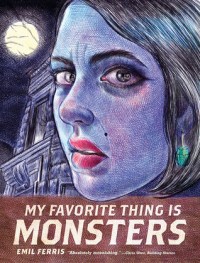
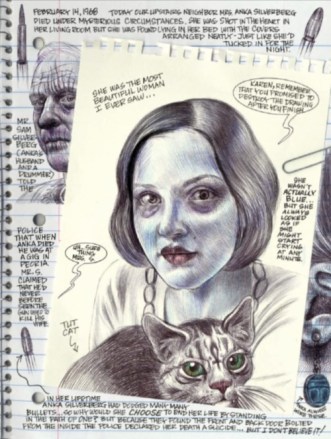
Review: I remember the moment that I first laid eyes on the book “My Favorite Thing is Monsters (Vol.1)”. I was unloading boxes of new books at work, and I literally gasped when I saw it. I mean, my GOD. Just look at this cover. THAT IS ALL BALLPOINT PEN, GUYS. And plus, it has ‘monsters’ in the title. My boss said she was surprised that the request wasn’t for me, and I admitted that I hadn’t even heard of it. So I said that I was going to request it…. And then I didn’t. It entered in and out of my mind for the next few months, until I was at a staff training and it was on the shelf. So… I grabbed it. I wish that I had grabbed it sooner. Because “My Favorite Thing Is Monsters” was just amazing.

I mean, I just need to talk about the art. Like I said, this is all done in pen, and it just pops off the page. It’s seriously astounding. The detail and the coloring, as I kept turning page after page in this book I just kept saying ‘wow’ as I would see a new image that took my breath away. Ferris really dives into her artwork, and the painstaking detail is so evident up close, while seeming to be a la Robert Crumb from a further distance. It’s a style that I really enjoy, and while it seems to be a little surrealistic in some ways, in other ways it was so human and so real. There are images of people, images of monsters, and images of urban landscapes that all take their own lives through her style. She also draws classic artwork through this lens, when Karen and her brother Deeze go to the art museum in Chicago, and seeing these works recreated in this style was also incredible. I loved the use of colors as well, as sometimes she would draw characters certain shades to describe different feelings. The premise is that these are the drawings of our ten year old narrator within her lined journal, and even that is consistent and well laid out.
slide3
I mean, it’s just gorgeous, right? (source)

The story itself if both a charming and bittersweet coming of age story, and a gut punch and tense mystery. Karen, or narrator, is a ten year old girl who is quite precocious in a lot of ways, and fancies herself as a Wolfman-esque monster who takes on the role of detective. I gotta say, the images of this little Wolf-creature in a trench coat is precious and funny, Seeing her try to piece together the possible murder of her upstairs neighbor, Anka, is classic bildungsroman in it’s premise, but in it’s execution it feels fresh. Karen is delightful, as her imagination sparks on the pages and her personality shines as she starts to learn more about those around her and learn more about herself. You also get to see late 1960s Chicago and all of it’s political turmoil through her eyes, which gives it a unique, and even more heart wrenching, perspective (I’m thinking of one specific scene where she is very nearly sexually assaulted by some bullies in her neighborhood, and she just writes about it matter of factly and as if it’s just something that could happen, but didn’t, so life goes on. It’s rough.). Karen loves monsters, and is starting to learn that monsters are very real, but not in the way that she would like them to be. We hear of an see violence and racism around her, and we see her reaction (and the reaction of her friend Franklin, an African American boy) to the murder of Martin Luther King Jr. Her family life isn’t easy by any means, as Dad is out of the picture, her older brother Deeze is loving but reckless, and their mother is kind and gentle but has some problems Karen isn’t quite privy to, though the reader is. We also see the struggles of being a lower class family of multiracial descent, as the fact that Karen and her brother Deeze are part Latino and part Native is thrown at them by the white people around them from time to time. Struggles and all, I loved this family, and it’s tenuousness made me love them even more, and ache for them as well.

The mystery of Anka’s death is one of the main themes of this book, and we see some of her own childhood mirrored in Karen’s through diary entries. Anka came of age in Weimar Germany, and as a young woman was taken to a concentration camp because she was Jewish. This story is another example of monsters in this world, and the rumors of a potential Nazi in town is one of the threads in the mystery that Karen is hoping to solve. But to tell you the truth, even though this mystery is ongoing (as there is another volume of this coming out next summer!), I’m more interested in the journey getting there and Karen learning things about Anka and the world around her then actually finding out who killed her.

There is one storyline that I’m not quite feeling as of right now, and that involves Karen and her friend Sandy, a malnourished little girl who may actually be a ghost. But hey, I suppose in a book about monsters it doesn’t hurt to have something of the supernatural there to shake things up.

Rating 9: A sumptuous and beautiful book with a gripping mystery, “My Favorite Thing Is Monsters (Vol.1)” is a great book and a huge achievement. The art is gorgeous, the story is bittersweet and haunting, and I can’t wait for the next book to come out.

Reader’s Advisory:

“My Favorite Thing Is Monsters (Vol.1)” is included on the Goodreads lists “Best Comic Books and Graphic Novels of 2017”, and “NPR’s 100 Favorite Graphic Novels and Comics”.

Find “My Favorite Thing Is Monsters (Vol.1)” at your library using WorldCat!
Serena’s Review: “City of Miracles”

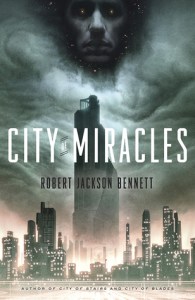
31522139Book: “City of Miracles” by Robert Jackson Bennett

Publishing Info: Broadway Books, May 2017

Where Did I Get this Book: Blogging for Books

Book Description: Revenge. It’s something Sigrud je Harkvaldsson is very, very good at. Maybe the only thing.

So when he learns that his oldest friend and ally, former Prime Minister Shara Komayd, has been assassinated, he knows exactly what to do — and that no mortal force can stop him from meting out the suffering Shara’s killers deserve.

Yet as Sigrud pursues his quarry with his customary terrifying efficiency, he begins to fear that this battle is an unwinnable one. Because discovering the truth behind Shara’s death will require him to take up arms in a secret, decades-long war, face down an angry young god, and unravel the last mysteries of Bulikov, the city of miracles itself. And — perhaps most daunting of all — finally face the truth about his own cursed existence.

Previously Reviewed: “City of Stairs” and “City of Blades”

Review: It’s no secret that I absolutely adored “City of Stairs” and “City of Blades.” In both books, Bennett established a seemingly endless world full of wonder and madness. He also accomplished the rare feat of producing a second book that I believe was even better than the first! It seems that resting on his laurels is simply something Bennett is incapable of doing, as “City of Miracles” is a perfect closely act for this trilogy.

It’s been 13 years since the events of “City of Blades,” and Sigrud lives a lonely, tired existence on the edge of society, waiting and waiting for a call from his former partner and friend Shara to call him back to the fight. To the world. To anything. The call finally comes, but not in a way he could ever have wished for: Shara has been assassinated. With this news, and the consuming grief and rage that has driven him throughout his life, Sigrud comes to live once again, blazing his way through the world hoping to servce justice for his friend’s senseless murder. Along the way, he finds new purpose in protecting Tatiana, Shara’s adopted daughter, and a girl who is tangled up in much more than Sigrud can imagine. Once again, the Divine is at work in the world. And once again, Sigrud will rampage through anything and everything in his way to protect and avenge those he loves.

What made “City of Blades” stand out from the first book in the series, was the added gravitas of subject matter that was layered upon an already fantastical story and world. The fantasy elements, the miraculous, even the Divine, served only as platforms upon which Bennett explored the deeply complicated history, purpose, and definition of warfare and what makes up the mind of a solder.

“City of Miracles” is excellent for following in this pattern. We have all the boundless creativity that can now be expected of this author and this world: Divinities of Night itself, steampunk-ish tramcars that trek across arctic mountainscapes, magical clothes and wondrously impossible buildings. But through these flashes of fantasy action and detailed world-building, Bennett is telling a much more grounded story.

Sigrud’s life is one of tragedy. The villain’s life is one of tragedy. The villain’s parent’s life is one of tragedy. It is all circular, and death follows death, vengeance and justice doling out the same misery and atrocity they work to revenge. Through Sigrud’s own life, and those he works to aid in this book, we see this pattern replay itself endless. Where is the live between justice and simply committing more crimes? At what point does the power gained through grief justify more grief itself to perpetuate its own existence? The the book before it, this story challenges its readers to think beyond common storytelling tropes. We’ve re-defined the soldier through a woman whose seen the damage and power that warfare brings. And here we’re redefining the avenging hero as more than the white knight we’re always given.

I was also pleasantly surprised by the inclusion of characters from previous books and the ways their stories were tied into the narrative of this book. Further, the new characters who are introduced were intriguing, particularly Ivanya, a character we met oh, so briefly back in book one but who plays a critical role in this story.

The author also cuts out quite a lot of work for himself with this story. It’s the final book in a trilogy, so our main characters’ story lines must all be tied off and resolved, any lingering questions about their pasts drawn to a close. But he also takes it upon himself to provide much needed information on the years that came before the first book itself. The ending is bittersweet and perfect. It closes in small moments and fantastic explosions (both literally and figuratively). These characters’ stories may be ending, but we’re left with a wide open world of possibility stretching out ahead.

I’m not sure if the author has any plans of revisiting this world, but if he is, the groundwork has been lain for a continuation, and I would be the first one in line at the bookstore. I can’t recommend this book, and this series, enough! If you enjoy fantasy with complicated heroes and challenging ideas, definitely check these out!

Rating 9: An excellent conclusion to an excellent trilogy. Fun, fast-paced, and challenging its readers at every turn!

Reader’s Advisory:

“City of Miracles” is included on these Goodreads lists: “Best Science Fiction & Fantasy Books” and “Best Fantasy Books of the 21st Century.”

Find “City of Miracles” at your library using Worldcat!

More Information: book information & author information.

Serena’s Review: “The Beautiful Ones”

335741431Book: “The Beautiful Ones” by Silvia Moreno-Garcia

Publishing Info: Thomas Dunne Books, October 2017

Where Did I Get this Book: e-book from NetGalley

Book Description: In a world of etiquette and polite masks, no one is who they seem to be.

Antonina Beaulieu is in the glittering city of Loisail for her first Grand Season, where she will attend balls and mingle among high society. Under the tutelage of the beautiful but cold Valérie Beaulieu, she hopes to find a suitable husband. However, the haphazard manifestations of Nina’s telekinetic powers make her the subject of malicious gossip.

Yet dazzling telekinetic performer and outsider Hector Auvray sees Nina’s powers as a gift, and he teaches her how to hone and control them. As they spend more and more time together, Nina falls in love and believes she’s found the great romance that she’s always dreamed of, but Hector’s courtship of Nina is deceptive.

Review: Like my recent review of “The Goblins of Bellwater,” I think this book is another example of a poorly written book description. Unlike “Goblins” which read more as contemporary romance, the more true genre focus (historical romance) of this book happens to be one that I enjoy and was particularly in the mood for, thus coloring my reaction to this initial misdirection. Like in that case, however, I do think both of these books would be better received had they been marketed more appropriately to the groups of readers who are true fans of these types of books.

I know that “fantasy” is kind of going through a boom right now, but targeting every book towards that community when there may only be the barest hint of actual fantasy elements in your book, is unlikely to be met with a positive reaction. This book, for example, is presented as if it is going to be a “fantasy apprenticeship” type book, leading the reader to assume much of the book is about Nina learning to navigate her own abilities. Not so. This is much more closely aligned with historical romance fiction with a brief dash of fantasy.

Getting off that soap box and on to the review itself! As I mentioned above, “The Beautiful Ones” ticked many boxes for me, and the fact I was surprised by the story I was getting almost added to my personal enjoyment. Nina is has come to the city to experience her first Grand Season. Under the tutelage of her glittering and popular married cousin Valerie, she soon comes to realize that she does not fit the typical mold of a debutante. Luckily, she meets Hector Auvrey, a performer who has leveraged his own telekinetic powers to raise himself to position and influence. But Hector and Valerie have a history of their own.

The story is told from the perspectives of all three characters, something that I was initially skeptical of (my own personal preference is always to follow one main character), but I quickly grew to love this format. Nina, Valerie, and Hector all have distinct voices and are fully realized characters of their own, each with strengths, weaknesses, and their own agendas. Valerie, in particular, is the type of villainous character who you simply love to hate. And Hector is the perfect example of a flawed hero. Nina, on the other hand, may have read as a bit too perfect, but her naivete and the growth she goes through, particularly in the last half of the story, are enough to keep her from falling into a “special snowflake” category. Further, with Valerie and Hector being as frustrating as they were at times, Nina’s chapters proved a bit of a relief.

We all know my feelings on instalove plot lines (recently I DNF’d “Juliet Immortal” for committing this sin in the most blatant way, choosing to not even review the book on this blog out of sheer and utter frustration). “The Beautiful Ones” seems to be Moreno-Garcia’s answer to this trend. It serves as a perfect rebuttal to all the things that are wrong with an instalove storyline. Not only is the main romance a slow burn story, based on many interactions, and taking place over a full year, but the failures of previous romances that followed the instalove equation are fully explored and the repercussions are serious.

This book is almost completely character driven. There is little action (other than balls and visits to the country side). The fantasy elements of this story are very minimal. You could remove them all together, honestly, and not much would change in this story. There are many scenes of characters simply talking to each other. In this way, it is a slow read, and yet, loving this genre as I do, I blew through it in a day. If you enjoy historical romances, ala Jane Austen, this is the perfect book for you!

Rating 9: A complete and utter surprise with characters you couldn’t help but root for, both to succeed and fail miserably!

Reader’s Advisory:

“The Beautiful Ones” is on these Goodreads lists: “2017 Latinx/Latin American SFF” and “Fantasy of Manners.”

Find “The Beautiful Ones” at your library using WorldCat

Kate’s Review: “The Last Days of Jack Sparks”

28765598Book: “The Last Days of Jack Sparks” by Jason Arnopp
Publishing Info: Orbit, March 2016

Where Did I Get This Book: The library!

Book Description: Jack Sparks died while writing this book. This is the account of his final days.

In 2014, Jack Sparks – the controversial pop culture journalist – died in mysterious circumstances.

To his fans, Jack was a fearless rebel; to his detractors, he was a talentless hack. Either way, his death came as a shock to everyone.

It was no secret that Jack had been researching the occult for his new book. He’d already triggered a furious Twitter storm by mocking an exorcism he witnessed in rural Italy.

Then there was that video: thirty-six seconds of chilling footage that Jack repeatedly claimed was not of his making, yet was posted from his own YouTube account.

Nobody knew what happened to Jack in the days that followed – until now. This book, compiled from the files found after his death, reveals the chilling details of Jack’s final hours.

Review: I’ve probably mentioned it before, but I don’t find stories about demonic possession particularly scary. I think that there are certainly elements to them that can be creepy, but movies like “The Exorcist” and “The Exorcism of Emily Rose”, while well done, don’t get my fear levels on the rise. The book “A Head Full of Ghosts” is probably my favorite exorcism related book, but even that one is filled with ambiguities instead of solid fact and over the top devilry. And then there is, of course, “My Best Friend’s Exorcism”, but that one is in it’s own little category since it’s so 80s candy coated and about the power of female friendship. So when I picked up “The Last Days of Jack Sparks”, I figured that it would at the very least be entertaining. Little did I know that I was going to be basically freaking out on an airplane while reading this book. And then once again while walking down a dark hallway at two in the morning days after the fact. Yep. “The Last Days of Jack Sparks” has sufficiently messed me up, y’all.

giphy
(source)

This story is built on the premise that notorious journalist Jack Sparks died while working on a new book, and that we are reading his writings around the time of his strange death. So right out the gate, we’re pretty certain that we are dealing with an unreliable narrator. Sparks is an established addict, narcissist, and sanctimonious prick, so having him as a narrator is maddening but also absolutely perfect. It’s made even better because throughout the book we are also given other perspectives from those that he interacts with, in footnotes from Sparks’ brother Alistair, transcripts of conversations, and personal diary entries. The moment that I realized that I really couldn’t trust anything that ANYONE was saying, it blew my mind. This set up made it all the more paranoia inducing, as I really didn’t know what to believe from anyone involved. It also made it so that clues that were given throughout the story could harken back in multiple formats and through multiple lenses, and seeing the puzzle pieces come together in different layers was mind boggling for me.

Sparks himself is a fabulous component to the story. Yes, he’s absolutely terrible for much of the narrative, as an egomaniacal, pretentious and abusive liar, but as he slowly starts to fall apart you see the other parts of him bit by bit, which makes him feel all the more human and relatable. I went in thinking that I was going to be just fine with him getting his comeuppance, but as he becomes more desperate and as his identities fall away I ended up being really attached him him, as rotten as he can be at times. I also liked other characters in this book, specifically Sherilyn Chastain, a combat magician who Sparks sort of teams up with on one of her cases involving a houseboat haunting in Hong Kong. She not only provided a centered and badass female voice in all of this, she was also a way for Arnopp to really delve into some deep philosophy about faith, belief, and the supernatural. While some of the other characters felt a little trope-y, such as Sparks’ love interest/flatmate Bex with her cool girl persona, I did feel that Arnopp had a place for each and every one of them.

And finally, this book is pretty darn scary. This is coming from a self professed snob when it comes to demon possession stories. I think that this one had a lot of other factors within it that made it feel unique from the others in the genre, and given that it also bent genres a bit into some science fiction principles it felt all the more creative. The imagery of a dark apartment with a silhouette in the corner is always going to set me on edge, and Arnopp really knows how to make this scenario complete and total nightmare fuel. His use of social media like youtube and twitter and things like that really gave it a modern horror flair as well, as while I was skeptical at him just describing a video would be scary, I was totally wrong. It was terrifying, especially since it totally sounded like one of those weird unexplained viral horror videos that pop up occasionally. I also really liked, and perhaps this is a bit spoilery so tread carefully, that the entire premise of this book is that the Devil (or whatever demon Sparks is dealing with) really hates having the spotlight taken off of him/it when on a serious dramatic tear.

giphy1
Come on, Pazuzu, share the attention. (source)

“The Last Days of Jack Sparks” was a freaky and fun read that I cannot recommend enough. If it can make this skeptic towards the genre cheer, think of what it can do for those of you who always love your possession stories.

Rating 9: A tense, creepy, disturbing, and fresh feeling horror novel for the social media age. It had me on the edge of my seat and I think that it’s must read for horror fans.

Reader’s Advisory:

“The Last Days of Jack Sparks” is included on the Goodreads lists “Unconventional, Seductive, Intelligent, and Dizzyingly Surreal”, and “Terrifying Tearjerkers”.

Find “The Last Days of Jack Sparks” at your library using WorldCat!

Serena’s Review: “An Enchantment of Ravens”

30969741Book: “An Enchantment of Ravens” by Margaret Rogerson
Publishing Info: Margaret K. McElderry Books, September 2017

Where Did I Get this Book: ARC from ALA

Book Description: Isobel is a prodigy portrait artist with a dangerous set of clients: the sinister fair folk, immortal creatures who cannot bake bread, weave cloth, or put a pen to paper without crumbling to dust. They crave human Craft with a terrible thirst, and Isobel’s paintings are highly prized among them. But when she receives her first royal patron—Rook, the autumn prince—she makes a terrible mistake. She paints mortal sorrow in his eyes – a weakness that could cost him his life.

Furious and devastated, Rook spirits her away to the autumnlands to stand trial for her crime.

Review: This was an ARC that I nabbed at ALA purely because of the beautiful color and my vague guess that it was probably some type of fairytale…maybe? Honestly, ALA is such a mad house that I don’t think I even got around to reading the book description until I was back in my hotel. But man, what luck! This story was one giant mash-up of all of my favorite things about fairtyales: a relatable heroine, a hilarious and charming hero, and the darker side of magic.

In Isobel’s village, fairies are common customers. Humans possess the ability to make Craft, construct things out of materials, something that is deadly to fairies, and thus fascinating to these long-lived beings. Isobel is a prodigy portrait artist, and as such, as worked with fairies most of her teenage life, becoming quite familiar with the quirks and dangers of these people. In exchange for her work, she is paid with magical favors, like chickens that produce a certain number of eggs each week. But in every fairy gift, there lurks the potential for disaster, so Isobel has gotten quite skilled at carefully wording every request she makes. More so than other in her village, she understands that even the ultimate fairy gift, a drink from the Green Well which grants immortality and is reserved for only the most special cases of humans who posses Crafting talent over and beyond the usual and who come along maybe once every century, is not all its cracked up to be. So when whisked away by an unhappy fairy prince client, Isobel knows that her trip to the fairy realms is rife with potential disaster.

Isobel herself was one of my favorite parts of this book. From the very beginning, we see that she has grown wise through her experience with the fairies. She doesn’t trust them and sees the loss that immortality has inflicted upon them. They can’t seem to relate to others or feel real emotion about anything. In fact, the presence of emotion is what makes Rook stand out to her, and the painting of it is what gets her carried away. And even then, trapped in the fairy world with a volatile prince, Isobel never loses her head. The relationship she develops with Rook over their travels develops in a natural way and Isobel always retains her common sense about the dangers this is presenting to both her and him, since relationships between humans and fairies are forbidden.

Rook, too, was exactly the type of romantic hero I love. He’s lovably arrogant about his own kind, a trait that both amuses and exasperates Isobel. There were several laugh out loud moments for him throughout the story. He’s also given a strong backstory to justify the differences between him and the other fairies. But never loses his inherent “otherness.”

As readers of this blog know, my favorite fantasy stories often mix a good dash of darkness and horror into the story (see: “The Beast is an Animal”). Here, the fairy court is like a brilliant confectionery cake, but once you cut into it, you see the mold. Time has not been kind to beings who live forever. There is madness, isolation, and loneliness mixed behind every aspect of the fairy realm.  At the center of it is the Summer King, the ruler of the fairies, who has withdrawn from the world, but whose madness lurks and has begun to trickle into the human world as well.

For a fairytale not directly tied to re-telling any of the tales we are familiar with, “An Enchantment of Ravens” reads as a staple in the genre. Magic, adventure, danger, comedy, and romance are all balanced in this story, held together by two protagonists you quickly grow to love. I can’t recommend this enough to fans of fairytale retellings!

Rating 9: What a wonderful surprise! Sometimes judging a book by its cover has a massive upside!

Reader’s Advisory:

“An Enchantment of Ravens” is on these Goodreads lists: “Traveling in the Faerie Realms” and “Dark Fairy Tales.”

Find “An Enchantment of Ravens” at your library using WorldCat!

Kate’s Reviews: “Everything Is Teeth”

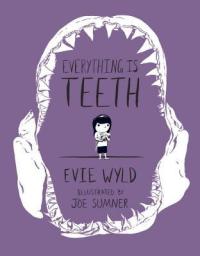
26109143Book: “Everything Is Teeth” by Evie Wyle and Joe Sumner (Ill.)

Publishing Info: Johnathan Cape, August 2015

Where Did I Get This Book: The library!

Book Description: From the award-winning author of All The Birds, Singing, a deeply moving graphic memoir about family, love, loss, and the irresistible forces that, like sharks, course through life unseen, ready to emerge at any moment.

Ever since she was a little girl, passing her summers in the brutal heat of coastal New South Wales, Evie Wyld has been captivated by sharks—by their innate ruthlessness, stealth, and immeasurable power. Young Evie would listen intently as farmers and fishermen told stories about being alone on the water at dusk; she would lose herself in books about legendary shark attacks, mesmerized by the photos of the victims. And even though she returned to London at the end of each summer, Australia’s sharks never released their hold on her imagination. Now, in this quietly penetrating narrative of personal memories, beautifully rendered by illustrator Joe Sumner, Evie Wyld lends her exceptional voice to the telling of a story all her own.

Review: When I was four years old, I discovered sharks. We were on a family trip out to California to visit my aunt, uncle, and cousin. They lived in San Jose, but we would take many family trips to the ocean up and down the coastline between San Francisco and Monterey. This meant that there was a lot of driving to be had, and ya gotta find ways to spend the time. My parents bought my cousin, who is a few years older than me, a cassette tape and accompanying book about sharks. It was short and informational, but it did have some kind of creepy music to go with it. Because “Jaws”, probably. Turns out, it was too much for my cousin, who thought that it was way too scary to listen to. My parents, not wanting to waste the thing, gave it to me, four year old Kate, thinking that maybe I’d be able to handle it. And I guess I pulled a full Raffi on them, insisting they play it over, and over, and OVER again the entire trip… And then more when we got back home to Minnesota. And thus, my lifelong love of sharks was born.

giphy11
Actual image of my Dad having to listen to that tape for the 63rd time. (source)

So the graphic memoir “Everything is Teeth” by Evie Wyld is so incredibly relatable for me that it was kind of uncanny. Evie Wyld grew up in England and spent family trips in Australia, and she first found her love for sharks when her older brother was given a set of shark jaws for the holidays. She then started reading books about sharks, and shark attacks, her first celebrity crush being Rodney Fox, famed shark attack survivor and conservationist (another thing I can relate to, because I TOO loved Rodney Fox during my most fevered obsession time). But this memoir is a bit different from other graphic memoirs that I’ve read in the past, as instead of having a full linear narrative it’s more a collection of snapshots into her childhood, framed through the shark obsession. But the shark obsession and the anxieties that go with it, of course, speak to deeper childhood fears and worries, from isolation to familial loss. The irrational fear of sharks served as a tangible fear to stand in for the ones that Wyld couldn’t quite articulate at the time, and as a child who was also riddled with anxieties about just about everything, this, too, was a familiar thing to me as I read it.

You don’t get the events in her childhood spoon-fed to you, you have to surmise what is going on. During a viewing of “Jaws”, she recounts how her loving yet somewhat detached father drank glass after glass of wine. After being unable to sleep one Australian night, she and her mother go for a night swim in the pool, as her mother was dealing with one of her regular bouts of insomnia. When her older brother would come home from school bloodied and beaten up, he would come to Evie and ask her to tell him shark stories. We learn about Evie’s family and their pretty common issues, but always with the context of the love of, and fear of, sharks. It’s a quiet story that ultimately unwinds to show how these intangible fears ultimately become tangible as time goes on, and that a fear of sharks disguises a fear of loss that eventually most everyone will experience in their life. It is ultimately a sweet, and sad, story about a girl who comes of age like many do, and her childhood interest in sharks that shapes her along the way, and I found it just as powerful as some of the graphic memoirs I’ve read that deal with childhood trauma or tragedy. There is no specific trauma or tragedy here; it’s just bits of her life, some parts sad, some parts not, all parts incredibly real.

I also liked that even the bits that were sad or upsetting were still muted, letting the reader figure out why. There is a scene where Evie’s Dad takes her to a shark attack museum, thinking that she will enjoy it. What they find is a spectacle, with graphic photos of shark attack victims with no context (just showing Rodney Fox’s wounds, not his calm demeanor or how he persevered), broad brush strokes painting sharks as mindless man eaters, and a stuffed and shabby white pointer, which is Australian terminology for great white, that is decaying on it’s platform. Child Evie is awash with nausea and discomfort, and while it’s never explained why, the reader is as well. Wyld never has to tell you it’s wrong; you just know that it is.

Joe Sumner did the illustrations for this graphic novel, and I really loved his style. He has a huge range from the flat out cartoonish (Evie and her family members), to the more realistic (stills from “Jaws” and pictures of shark attack survivors in the aftermath), to the hyperrealistic that I could have sworn were photographs (almost all the sharks in this book).

eit20interior201-thumb-500x632-457444
(source)

I was completely struck by this art style and how effective it was.

“Everything Is Teeth” is a very subdued read, but it’s one that struck a chord with me. If you are looking for a graphic memoir that isn’t necessarily steeped in tragedy and trauma, but still packs an emotional punch, it may be the one for you.

Rating 9: A quiet, resonant, and somewhat haunting graphic memoir about growing up, loss, and sharks. The illustrations are great and the story is compelling and relatable.

Reader’s Advisory:

“Everything Is Teeth” is included on the Goodreads lists “Women Creators in Comics”, and “Comics for Teen Girls (That Are Not Japanese Manga)”.  Side note: I’m hoping that this list isn’t intended to diss manga, because there’s nothing wrong with it.

Find “Everything is Teeth” at your library using WorldCat!

Serena’s Review: “Scythe”

28954189Book: “Scythe” by Neil Shusterman

Publishing Info: Simon & Schuster Books for Young Readers, November 2016

Where Did I Get this Book: Giveaway from ALA 2017!

Book Description: Thou shalt kill.

A world with no hunger, no disease, no war, no misery. Humanity has conquered all those things, and has even conquered death. Now scythes are the only ones who can end life—and they are commanded to do so, in order to keep the size of the population under control.

Citra and Rowan are chosen to apprentice to a scythe—a role that neither wants. These teens must master the “art” of taking life, knowing that the consequence of failure could mean losing their own.

Review: Confession: I had never really heard of Neal Shusterman before attending the YA Coffee Klatch at ALA with Kate and hearing her get excited cuz apparently he’s a big deal. So big miss for me! What’s worse is the day before I had walked by a line where he was signing this book and passed it up, not knowing who he was! But after hearing from Kate that he was quite good and hearing his own synopsis for “Scythe” when he came around our table, I tool the time to seek out a copy of his book later that day. Alas, no signature, but these are the trials.

Shusterman described his book as growing from the question “What would happen if the world solved all of its problems? What would people do in a true Utopia?” “Scythe” is his answer to that question. There are so many interesting concepts presented in this book that I don’t even know where to start!

First off, the basic premise of the story is incredibly original and ripe for exploration. Immortality has been reached, but for reasons only briefly touched upon in this book, space exploration was a failure, so humanity is stuck with the world it has. This being the case, overpopulation is a real concern. To solve this problem, the Scythe organization came into existence. Their task is to randomly (emphasis on random) cull the population by killing a certain number of people per year. The family of this person is then granted immunity from culling for the next year. There are so many interesting ideas packed into this seemingly straightforward concept that I can’t begin to cover them all: the methods by which Scythes choose their victims, the methods by which they kill them, the combination of hero worship and fear they inspire in the population, the punishment for defying being chosen to die, and the fact that the odds are incredibly low that you will be chosen, though Scythes are a visible presence in the world. So much great stuff!

As mentioned in the synopsis, the central conflict of the story revolves around our two protagonists, Citra and Rowan who have both been chosen to be apprentices to a Scythe. The story alternates between these two and each character was well-drawn and presented a unique reason for why they were selected and how they approach the challenges of killing people for a living. Essentially, neither wanted the job, and that’s why they have it. Through their eyes, the layers of the Scythedom are peeled away and we begin to see that for all of its advancement, when left to their own devices for long enough, even the most well-intentioned organization begins to grow rot. There are deviations and factions of the Scythedom, all fighting for control and to shape the direction of the future. Should Scythes remain on the periphery of society, chosen for their distaste of their work but equipped with a strong sense of moral obligation? Or should a “new guard” take over, one that relishes in its task and in the glory that is allowed to all Scythes?

All of this and I still haven’t touched on half of the creative and unique world-building aspects of this book. There is the Thunderhead, a rare example of a benign A.I., that essentially runs society. There’s Rowan’s friend who loves “splatting,” jumping off high places only to inevitably be brought back to life each time. There’s Citra’s and Rowan’s training, and there are the well-drawn Scythe elders who alternatively take them under their wing, or force them forward down paths they wish not to tread. Throughout it all, Citra and Rowan form a tenuous alliance, each experiencing very different paths through their year of apprenticeship. The final act was tension filled, and I was on the edge of my seat waiting to see how the many conflicts laid out throughout the story would be wrapped up. The end was satisfying, but did its job and left me all too eager for the next!

I honestly can’t say enough good things about this book. It’s been a long time since I’ve read a story that was so totally engrossing, perfectly balancing an action-packed plot, complicated characters with clear story arcs, and fully realized world-building. Definitely check this one out of you are interested in sci-fi or dystopian fiction!

Rating 9: One of the most unique and creative reads of the year so far!

Reader’s Advisory:

“Scythe” is on these Goodreads lists: “Fiction Books About Grief, Death and Loss” and “Grim Reaper Books.”

Find “Scythe” at your library using WorldCat


Serena’s Review: “Strange Practice”

32452160Book: “Strange Practice” by Vivian Shaw

Publishing Info: Orbit, July 2017

Where Did I Get this Book: ARC from the publisher

Book Description: Greta Helsing inherited the family’s highly specialized, and highly peculiar, medical practice. In her consulting rooms, Dr. Helsing treats the undead for a host of ills – vocal strain in banshees, arthritis in barrow-wights, and entropy in mummies. Although barely making ends meet, this is just the quiet, supernatural-adjacent life Greta’s been groomed for since childhood.

Until a sect of murderous monks emerges, killing human and undead Londoners alike. As terror takes hold of the city, Greta must use her unusual skills to stop the cult if she hopes to save her practice, and her life.

Review: First off, thanks to Orbit for providing me with an ARC of this book in exchange for a review! I read the description for it, and was pretty much like “Yep, gotta read that!” As a lover of urban fantasy, it’s been a distressing few years recently. Many of my favorite series (“Mercy Thompson” and “Kate Daniels”) are beginning to show their age and are likely (perhaps hopefully) going to wrap up soon. Beyond these, many of my other forays into the genre have yielded middling returns. Either these books stray too closely to tropes already well-established in staple series in the genre to trigger any sense of originality and interest, or…they’re just kind of bland? Not so with “Strange Practice!” Shaw has expertly introduced a new leading lady with a unique perspective on her urban fantasy world and lifestyle, and I was digging it the entire way.

Greta Helsing is a doctor for the strange and unusual, the monstrous and the arcane. It is a family practice after her family decided to turn away from the hunting business and re-focus in on the helping side of things. Right here we have such a unique take on urban fantasy that I was immediately completely sold on. Not only is Greta a great character on her own, but her perspective as a doctor presented readers with an entirely new lens through which to view the supernatural world. How do mummies get by with their rotting bodies? What about sunburns for vampires? Do any of these creatures suffer from mental illnesses? Cuz living forever could have some major psychological implications. Not only was there a plethora of creativity in this area, but Greta remained true to this focus throughout the story, even when the evil monks showed up and the action really got started.

A big frustration of mine with urban fantasy is when the heroes or heroines sillyly jump beyond their own abilities, somehow thinking (and for plot convenience, accurately thinking) that they can play on the same field as magical beings who have million times the magical power as they. Suddenly the author is forced to create loop hole after loop hole to keep their protagonist up and moving instead of simply being hand-swiped away in the first minute. With this in mind, it was refreshing that Greta’s entire perspective on her situation was always rooted firmly in her position as a doctor. Even more so, in that she realizes the unique service she provides to her clients and understands the importance of staying safe, not only for her own sake, but for those who would suffer without access to medical care. As I said, refreshing, and when she does end up in the action (cuz of course, she must), she plays a believable, yet important, role. See?! It is possible to keep your heroine grounded while also staying true to the action of your story!!

Beyond Greta, I was surprised to discover that we had several other point of view characters as well. I always wish there was some way for these book descriptions to hint at this possibility, as it always feels like a bit of a side-swipe to be set up as if the book is from one protagonist’s point of view, and then end up with a handful of others. But alas. With this story, it is of no matter since I thoroughly enjoyed the perspectives these other creatures brought. We had a vampire and a vampyre (the distinction having to do with the type of blood they require), a demon, and even a few chapters from the viewpoint of the nefarious schemers. There was quite a lot of unique world-building and monster “history” that was brought in with all of these characters, and the many other supernatural beings who made appearances.

I particularly liked the tone of the story. Dark, witty, and full of literary allusions that were great fun to spot. There as a nice balance struck between the horror aspects and the vampire-friendship-fluff. On one page there would be murder and mayhem, and on the next, a vampire shopping spree! And never once does the story get swept away by its own concept. It would have been all too easy for the humor of the story to have veered into the silly, but Shaw walks the perfect line. Lastly, the setting of London for this story gave it an extra dash of depth, as, like the city itself, the timeless aspects of these creatures that are steeped in history and meaning must now adapt to exist alongside the speed and change of the modern world.

If you enjoy urban fantasy, and are hankering for a new series to follow, I can’t recommend enough that you check out “Strange Practice!”

Rating 9: An excellent new entry into what was beginning to feel like a tired genre.

Reader’s Advisory:

“Strange Practice” is on these Goodreads lists: “Best Monster Books” and “Urban Fantasy – London”

Find “Strange Practice” at your library using WorldCat!


Kate’s Reviews: “Final Girls”

32796253Book: “Final Girls” by Riley Sager

Publishing Info: Dutton, July 2017

Where Did I Get This Book: A free ARC provided by Net Galley.

Book Description: Ten years ago, college student Quincy Carpenter went on vacation with five friends and came back alone, the only survivor of a horror movie–scale massacre. In an instant, she became a member of a club no one wants to belong to—a group of similar survivors known in the press as the Final Girls. Lisa, who lost nine sorority sisters to a college dropout’s knife; Sam, who went up against the Sack Man during her shift at the Nightlight Inn; and now Quincy, who ran bleeding through the woods to escape Pine Cottage and the man she refers to only as Him. The three girls are all attempting to put their nightmares behind them, and, with that, one another. Despite the media’s attempts, they never meet.

Now, Quincy is doing well—maybe even great, thanks to her Xanax prescription. She has a caring almost-fiancé, Jeff; a popular baking blog; a beautiful apartment; and a therapeutic presence in Coop, the police officer who saved her life all those years ago. Her memory won’t even allow her to recall the events of that night; the past is in the past. 

That is, until Lisa, the first Final Girl, is found dead in her bathtub, wrists slit, and Sam, the second, appears on Quincy’s doorstep. Blowing through Quincy’s life like a whirlwind, Sam seems intent on making Quincy relive the past, with increasingly dire consequences, all of which makes Quincy question why Sam is really seeking her out. And when new details about Lisa’s death come to light, Quincy’s life becomes a race against time as she tries to unravel Sam’s truths from her lies, evade the police and hungry reporters, and, most crucially, remember what really happened at Pine Cottage, before what was started ten years ago is finished.

Review: First and foremost, I want to extend a sincere thank you to NetGalley for providing me with a free ARC of this book in exchange for an honest review. It means a lot and I greatly appreciate the generosity,

You all know my deep deep love for horror movies, and that I have a serious guilty-ish pleasure for the slasher film genre. There are so many things about it that are kind of grotesque and trite, but I really do enjoy a slash ’em up kind of flick like “Halloween”, “Friday the 13th”, or “Scream”. I think that my love for that subgenre stems from my time as an awkward teenager who was a bit more cautious and shy than some of her lady friends. Because of this, I really related to the “Final Girl” trope that those movies almost always trot out: the virginal good girl who triumphs over evil and is the only one who can vanquish the bloodthirsty villain. The movie “Behind The Mask: The Rise of Leslie Vernon” did a great job of deconstructing the concept of the Final Girl, as did the movie “Final Girls”, and I’ve been aching to read a book about it as well. When Lauren Beukes “Survivors’ Club” didn’t quite get there, my only hope left was “Final Girls” by Riley Sager, and BOY am I THRILLED to say that this book nailed it and gave me everything I needed.

The very scenarios given in this book as the mass killings that the Final Girls endured are so textbook 80s slasher film that I was living a Dayglow glittered fever dream. You have the college kids in a cabin in the woods, the sorority house massacre, and the isolated motel ambush with a killer who is wearing a sack on his head! PERFECTION. But even beyond setting up the perfect slasher scenarios, Sager also painted pictures of how an actual ‘Final Girl’ might endure after the trauma. As much as we love the idea of Nancy Thmpson or Laurie Strode going on to live happy lives, in the real world the consequences would be far more long lasting. Quincy is a complete mess whose outward appearance is a lie to the pain underneath. She has her baking blog and her true blue fiance, but she is addicted to Xanax and unable to let go of Coop, the cop who saved her all those years ago from a killer in the woods. She has distanced herself from other survivors of violent massacres, Lisa and Sam, because while the media loves to lump them together, she just wants to be herself and to live her life. I really loved Quincy for her full damaged self.

The thing that surprised me the most about this book was that it wasn’t the meta and self referential homage that I was expecting it to be, even though it’s set up was one hundred percent spot on for such a novel. Instead there was a serious mystery here, specifically involving Sam. After Lisa, the original and perhaps most ‘with it’ Final Girl is found dead of an apparent suicide, Quincy is approached by the second, Sam, who had been off the grid for years. The mystery at the heart of this book is about Sam’s experiences, as well as Quincy’s. Though I went in thinking that it would be about the two of them teaming up to find a killer, it turned out to be something much different. And then it superseded my expectations AGAIN when it also became a question about Quincy and her experience at a cabin in the woods. The movies like to portray these Final Girl types as innocents caught up in a whirlwind of circumstance, the ultimate Madonnas who are better than the Whores that surround them and therefore they get to live. But Sager poses that perhaps it’s more interesting if they are just complex, well rounded people instead of just a trope, and questions whether being innocent is the absolute only thing you can be to deserve to survive something as brutal as a slasher killer.

I truly enjoyed this book as a fan of the slasher genre, even if it wasn’t the self satisfied wink fest I thought it was going to be. Fans of this genre really need to go out and get their hands on “Final Girls”. Quincy has every right to stand with Laurie Strode, Nancy Thompson, and all those other badass women who take out those who wish them ill, and she can do it while still being damaged.

Rating 9: A great mystery with some excellent character studies, “Final Girls” goes beyond a meta romp for slasher horror fans and is a fabulous and suspenseful summer read.

Reader’s Advisory:

“Final Girls” is new and isn’t on many relevant Goodreads lists as of yet. But I think that it would fit in on “Best Female Driven Mysteries”, and “Popular Slasher Books”.

Find “Final Girls” at your library using WorldCat!

Serena’s Review: “Skullsworn”

29939037Book: “Skullsworn” by Brian Staveley

Publishing Info: Tor, April 2017

Where Did I Get this Book: the library!

Book Description: Pyrre Lakatur doesn’t like the word skullsworn. It fails to capture the faith and grace, the peace and beauty of her devotion to the God of Death. She is not, to her mind, an assassin, not a murderer–she is a priestess. At least, she will be a priestess if she manages to pass her final trial.

The problem isn’t the killing. Pyrre has been killing and training to kill, studying with some of the most deadly men and women in the world, since she was eight. The problem, strangely, is love. To pass her Trial, Pyrre has ten days to kill the ten people enumerated in an ancient song, including “the one you love / who will not come again.”

Pyrre is not sure she’s ever been in love. If she were a member of a different religious order, a less devoted, disciplined order, she might cheat. The Priests of Ananshael, however, don’t look kindly on cheaters. If Pyrre fails to find someone to love, or fails to kill that someone, they will give her to the god.

Pyrre’s not afraid to die, but she hates to quit, hates to fail, and so, with a month before her trial begins, she returns to the city of her birth, the place where she long ago offered an abusive father to the god and abandoned a battered brother—in the hope of finding love…and ending it on the edge of her sword.

Review: Readers first met Pyrre in Staveley’s debut trilogy, “Chronicle of the Unhewn Throne,” the badass assassin whose religious order, the Skullsworn, worship the deity of death, Anashael. When I heard that he was writing a spin-off (prequel?) that centered around this character’s origin story, essentially, I was a bit skeptical. Sure, Pyrre was great in her supporting role, but she at times came across as unbeatable, and thus having no conflict, and, while we got into a few of the details of her religion in those first books, it also seemed like its seemingly callous philosophy would present a challenge to creating a sympathetic main character. But, lo and behold, this book blew me away, setting all of those concerns to rest and reminding me just how much I’ve been craving good, standalone fantasy fiction.

Death is at the center of the story. And if that sounds morbid, well, Pyrre, and Staveley, have much to say on the subject. We meet Pyrre at the cusp of her journey to become a full priestess of Anashael, wherein she must complete her final trial, killing ten types of individuals all listed in an ancient song of the order. She has a specific number of days to complete this, all overseen by two witnesses, the grumbly, but deadly Kossal, and the bright, complicated Ela. To do this, she returns to her childhood home of Dumbang.

Having already been introduced to this world, I was particularly thrilled with the setting of Dumbang for this story, a confusing maze of swamp, floating islands, and deadly creatures. The culture, history, and city itself all tied neatly into the greater world we are already familiar with, but were so unique that they stood alone as a completely new slice of this world. Reading this story, I could almost feel the heavy presence of this city, its beauty, its mystery, and the foreboding sense that people are treading where they should not. It perfectly mirrors the philosophy that Pyrre and the Skullsworn abide by: that death is inevitable and, in many ways, the most merciful part of life. Not something to be feared, but to be lived alongside.

The story itself is so compelling, mixing action with adventure, comedy with heartbreak, and neatly tying together the pieces of Pyrre’s life to perfectly illustrate how she came to be who she is and how she will continue to grow into the woman we meet in later stories. Kossal and Ela are great characters off whom Pyrre bounces, challenging her, and the reader, to expand her thinking on what it means to worship Anashael and to live a full life. Ela, specifically, was brilliant, jumping off the page and stealing every scene she was in. At first I was concerned that she was going to fall into a fairly established character type, all smooth sexuality and arrogant charm. But as the story continued, I began to have greater and greater hopes for her as a character and her ultimate role in the story. All of which were ultimately met, much to my joy and relief.

Bizarrely, Run Lan Lac, the man who Pyrre seeks out with the goal to love and to kill, was one of the weaker characters for me. But, given the overall commentary on love and death, upon further reflection, I’ve almost come to feel that this might have been intentional? He plays his role, and I was glad to see that his character remained true throughout all the revelations of the story.

Towards the end, the plot takes a massive leap out into the greater mythology of the world. And, while I have read the original trilogy which lent these reveals some interesting added perspectives, the story itself remained contained within its own pages, and I feel that it is still approachable for new readers even with this more expansive later plotline.

I can’t say enough about the strength of Staveley’s writing. As I said earlier, there were so many challenges he gave himself with the premise of this story. A main character who worships death and kills people with few qualms who must be made into a sympathetic and appealing leading lady. A new setting with a complex history that must still fit within the constraints of a previously built world. Multiple religions with a variety of gods, some familiar from previous  books, some new. All while trying to create a standalone novel that is approachable to new readers, but also familiar and appropriately laying the groundwork for a character known to readers of the original series. He not only does all of this, but the book was laugh-out-loud funny at parts and had me on the brink of tears at others. Staveley is quickly climbing the ranks of “must read” fantasy authors.

Rating 9: The epitome of setting tough writing goals and then  blowing them all out of the water!

Reader’s Advisory

“Skullsworn” is a newer title and isn’t included on any relevant Goodreads lists, but it should be on “Book with Heroes/Heroines Who are Assassins.”

Find “Skullsworn” at your library using WorldCat