Kate’s Review: “Persephone”

36323550Book: “Persephone” by Allison Shaw

Publishing Info: Hiveworks, 2017

Where Did I Get This Book: I own an eBook.

Book Description: In his ancient hymns, Homer tells us of the unyielding Lord of the Dead who kidnapped the innocent daughter of Demeter. He tells us quite a bit, in fact, for someone who wasn’t there.

Persephone is no tragic victim, but a kind young woman held in place by her overbearing mother. A failed scheme by Apollo leads her to a chance encounter with the humorless Hades, who is struck by love’s arrow. Now he must wrestle with his aching heart before he loses control entirely.

…Not that the infatuated Persephone has any complaints regarding Hades’ plight. 

As desire blooms between the secluded goddess of the harvest and the ruler of the underworld, the world changes both above and below.

Allison Shaw, creator of comics Far to the North and Tigress Queen, drew on her passion for mythology and ear for modern dialogue to create an updated myth for a mature audience. She wished to offer to her readers a feminist and sensual take on the story, which has grown more and more popular over the years, thanks to its themes of change, rebirth and growth.

Review: Ever since I was a kid I’ve been completely taken with the Persephone and Hades myth. I’m not sure if it’s because Hades is the original Depressive Demon Nightmare Boy, or that I’ve always loved the idea of a Queen of the Dead, but their romance and (part time) joint rule of the Underworld is one of my favorite pieces of mythology. As such, I’m always looking for adaptations of it. Sadly, I haven’t really found many to my liking outside of a few children’s stories (side note, if you have recommendations, send them my way!), and it saddens me that the myth is a bit underappreciated. But that’s why I wanted to spotlight “Persephone” by Allison Shaw, because the moment I started reading I knew that I was going to really enjoy what was done to the characters that I love so much.

The story that Shaw makes takes influence from the original Greek mythologies and updates them a bit to be, shall we say, less problematic than the source material. While it’s important to remember the historical and cultural context at the heart of these stories, the idea of a guy kidnapping a woman and making her his bride doesn’t sit well anymore (even if it’s all a metaphor for growing up and leaving home for a new family AND the changing of the seasons). So Shaw makes Persephone not only the main character, but Hades conflicted about his attraction to her (thanks in part to an errant arrow from Eros) as he doesn’t think that she would be happy with him in the Underworld. Persephone, too, approaches their romance in a different way, as her infatuation slowly grows and is VERY real by the time she and Hades disappear while a domineering Demeter panics. Side note: even as a kid I thought it was strange that Demeter was SO overprotective/controlling of her grown daughter, and found it creepy that she’d stop things from growing in a blackmail effort to get her kid back; I’m glad that authors of newer adaptations are willing to point out that this, too, takes away Persephone’s agency and has it’s own toxicity about it. Their characterizations are also quite strong, and you get a sense of their motivations and personalities pretty easily. She is bubbly and optimistic and kind, and he is sarcastic and dour and a bit lonely, and the differences round each other out well. The romance is very cute as it builds, and yes, it’s also pretty damn sexy. There is a reason this book is described as ‘mature’. It transforms original moments of potential violation in the original story and turns them into moments of very intentional consent, with very, shall we say, steamy results.

giphy-6
I may have made this face a few times during the more titillating moments… (source)

Now I’m not one who reads that much romance fiction, but I know good smut when I see it, and for the most part “Persephone” has good smut. There’s one moment that seems a bit tacked on as an afterthought, but who am I to complain about love scenes within a love story, especially if they’re between one of my favorite fictional couples of all time?

There are also VERY fun references to other Greek myths and characters, from a lecherous and obnoxious Apollo being a creep to a determined Artemis taking Persephone under her wing, to a snarky Eros who is dealing with his own conflicted feelings about Psyche, and oh can we please, PLEASE get an adaptation of that one next?! IT’S MY SECOND FAVORITE GREEK MYTH!! Persephone and Hades have interactions with all of these characters and act in ways that seem totally true to how their characters would act. I do wish that the story had been longer so that we could have had even more exploration of all of these characters, but I think that it’s better to be left wanting more than to feel like a story is slogging along at a snail’s pace.

And finally, I really loved the art work and the character designs. From Persephone’s voluptuous frame to the fact that Hades has his own speech bubble type, I thought that artwork was unique and fit the tone of the story.
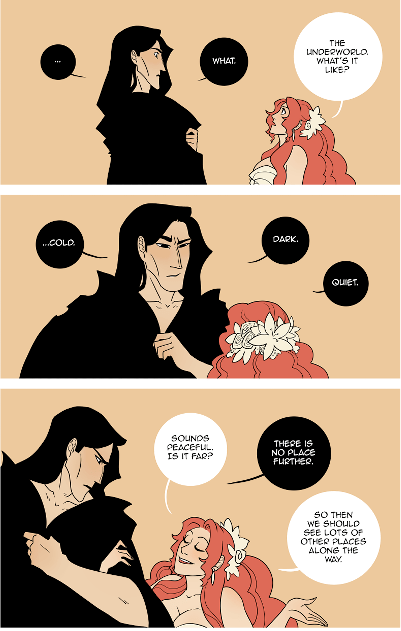
Screen Shot 2019-04-15 at 1.55.09 PM
Source: Hiveworks

I greatly enjoyed what Allison Shaw did with the Hades and Persephone myth. “Persephone” was a sweet and satisfying adaptation of a myth that I have always held dear to my heart.

Rating 8: A sweet and sexy retelling of the Persephone and Hades myth, with a focus on agency, attraction, and choosing one’s own path in life no matter how it may diverge from original expectations.

Reader’s Advisory:

“Persephone” isn’t included on any Goodreads lists, but I think it should be on “Hades and Persephone”.

You can find “Persephone” at Hivemill in both print and eBook form. It isn’t available on WorldCat, but keep an eye out should this change in the future.

Kate’s Review: “Before She Knew Him”

40390756Book: “Before She Knew Him” by Peter Swanson

Publishing Info: William Morrow, March 2019

Where Did I Get This Book: I own it.

Book Description: Catching a killer is dangerous—especially if he lives next door

Hen and her husband Lloyd have settled into a quiet life in a new house outside of Boston, Massachusetts. Hen (short for Henrietta) is an illustrator and works out of a studio nearby, and has found the right meds to control her bipolar disorder. Finally, she’s found some stability and peace.

But when they meet the neighbors next door, that calm begins to erode as she spots a familiar object displayed on the husband’s office shelf. The sports trophy looks exactly like one that went missing from the home of a young man who was killed two years ago. Hen knows because she’s long had a fascination with this unsolved murder—an obsession she doesn’t talk about anymore, but can’t fully shake either.

Could her neighbor, Matthew, be a killer? Or is this the beginning of another psychotic episode like the one she suffered back in college, when she became so consumed with proving a fellow student guilty that she ended up hurting a classmate?

The more Hen observes Matthew, the more she suspects he’s planning something truly terrifying. Yet no one will believe her. Then one night, when she comes face to face with Matthew in a dark parking lot, she realizes that he knows she’s been watching him, that she’s really on to him. And that this is the beginning of a horrifying nightmare she may not live to escape. . .

Review: GodDAMN do I look forward to any and every Peter Swanson book. Unfortunately, I missed the library hold boat on this one, as by the time I realized it was happening both systems I use had long hold lists on them. So what’s a girl to do but go and buy it. I’m usually loathe to buy books given that I work at a library and use its services exhaustively, but with authors I love I’m willing to make exceptions, and so I went out and purchased “Before She Knew Him”.

Also, this review is going to have some spoilers in it, as I feel like it’s the only way that I can truly discuss what I liked about it. SO, that means

giphy-13
If you want to read this book completely ignorant, stop here. (source)

Like other good Peter Swanson books, “Before She Knew Him” sucked me in with it’s fascinating characters, and legitimately surprising twists and turns. Our main two perspectives are that of Hen, an artist who has struggled with bipolar disorder in the past, and Matthew, Hen’s neighbor whom she is convinced is a murderer. And guess what: he totally is. This is made quite clear very early on. Hen’s suspicions are right, and therefore we aren’t going to see the tired ‘is she right or is she just having an episode’ trope that feels so common in stories like this. Matthew is indeed a killer, but he is incredibly compelling in his motivations. He targets men that he sees as predatory, his ethos being that if they hurt women, be it through mental abuse, cheating, sexual assault, what have you, they don’t deserve to live. It stems back to childhood trauma, which still haunts him due to his brother Richard, who seems to be escalating in his own violent tendencies, which disturbs Matthew because he doesn’t want to face his brother. In the same vein, Matthew isn’t exactly a Madonna/Whore savior complex killer either. I don’t even really know how to describe him, and his complex nature is one of the things I greatly liked about this book. Swanson doesn’t make him totally evil, but he certainly isn’t totally good either. Swanson also does a great job with Hen and her characterization. I’m always a little afraid of how thriller writers address mental illness, as more of then than I’d like it’s used as a way to make a character seem unreliable or unstable in a stigmatizing kind of way. With Hen I felt like while her struggles with mental illness do play a large role in the story, she never seemed to be stigmatized by them in the reader’s eyes. If anything when people would throw them back at her, particularly her husband Lloyd, you didn’t question her, you sympathized with her. Perhaps this had to do with the fact that we KNEW Matthew was a killer almost from the jump, but even so I thought it was a welcome change from books where she might have been portrayed as ‘crazy’ to keep the ‘is he or isn’t he?’ going. And when these two are on page together, it’s incredibly satisfying, if only because it’s less cat and mouse and more two people on equal footing trying to figure the other one out.

giphy-14
And yes, I’m back on my bullshit of shipping couples that probably shouldn’t be shipped. Because man, even though it was (rightfully) never really addressed as a possibility, I SHIP IT. (source)

The plot, too was incredibly satisfying, with other mysteries sprinkled in along the way. These I won’t address, because that would be a true crime to spoil things. All that being said, I kind of guessed one of the reveals a bit early on. But I say kind of because it was a fleeting thought I had that soon flitted away, and by the time that reveal happened I was legitimately caught by surprise, even though I HAD thought of it. Swanson slowly lays out the various clues as to what things are going to happen, but you keep reading not necessarily because you want to know about these things, but because you want to know just what is going to happen to both Hen AND Matthew, especially since Hen knows the truth about him. It was a real journey finding out how things all shook out, and I greatly enjoying accompanying these two on said journey.

“Before She Knew Him” was a fun and satisfying read. If you haven’t gotten on the Peter Swanson train yet, do yourself a favor and check him out. This would be a good place to start.

Rating 8: With intriguing characters and some pretty well laid out surprises, “Before She Knew Him” is another fun and twisty thriller from Peter Swanson.

Reader’s Advisory:

“Before She Knew Him” is included on the Goodreads lists “The Girl Who Didn’t See Her Husband’s Wife When She Disappeared Twice from the Train”, and “Mystery and Thriller 2019”.

Find “Before She Knew Him” at your library using WorldCat!

Serena’s Review: “Throne of Jade”

14069Book: “Throne of Jade” by Naomi Novik

Publishing Info: Del Rey Books, April 2006

Where Did I Get this Book: audiobook from the library!

Book Description: When Britain intercepted a French ship and its precious cargo–an unhatched dragon’s egg–Capt. Will Laurence of HMS Reliant unexpectedly became master and commander of the noble dragon he named Temeraire. As new recruits in Britain’s Aerial Corps, man and dragon soon proved their mettle in daring combat against Bonaparte’s invading forces.

Now China has discovered that its rare gift, intended for Napoleon, has fallen into British hands–and an angry Chinese delegation vows to reclaim the remarkable beast. But Laurence refuses to cooperate. Facing the gallows for his defiance, Laurence has no choice but to accompany Temeraire back to the Far East–a long voyage fraught with peril, intrigue, and the untold terrors of the deep. Yet once the pair reaches the court of the Chinese emperor, even more shocking discoveries and darker dangers await.

Previously Reviewed: “His Majesty’s Dragon”

Review: After discovering the absolute joy that was “Hi Majesty’s Dragon,” it was all I could do to wedge in “The Loneliest Girl in the Universe” before going straight to the next on in this series. Already, this series feels like a comfort read, where I know what I’m going to get, to a good extent, and I’m there for it. I can just relax back and enjoy.

At the end of the last book, Temeraire and Laurence discovered that, while they always knew Temeraire was special, he was even more unique than they had thought: a rare Celestial dragon of the sort to only partner with Chinese royalty. His egg had been meant as a gift for Napoleon, but now that they have realized the error, a delegation has been sent to express their insistence that Temeraire be parted from Laurence and returned to China. Refusing to be parted, both dragon and captain must now set off on the long sea voyage across the world. And once arriving at their destination, both are shocked to realize that perhaps there is more to dragon-human relations than they had presumed.

In some ways, I was just as surprised by this book as I had been by the first. In the first, I had expected a lot more military action and was surprised to find such an intense focus on characterization, especially the building relationship between Laurence and Temeraire. But then in the end, we got that great battle scene where Temeraire’s “super power” essentially came to light and I thought “Ok, now we’re going to move into the military action series I had been expecting!” And then I started this book and found…a long sea voyage with political espionage as the main action of the story.

But, as I said, my expectations not being met just turned into yet another delightful surprise once again! I loved the sea voyage. There were a lot of little episodic moments sprinkled throughout that had to deal with Great Britain’s relationship to the slave trade, the relationships between the various military arms (navy vs aerial), cultural distinctions that don’t translate well between countries, and even sea monsters! And many of these domains were made all the more interesting being seen and discussed through the very different eyes of Laurence and Temeraire. Laurence must confront his own assumptions and prejudices, and Temeraire must work through his understanding of humanity, especially as it deals with dragons.

Like Laurence and Temeraire, the reader so far has only been presented with Great Britain’s approach to dragons. While in the previous book Laurence had already challenged a lot of the obvious negatives that popped up, throughout this book, we learn more and more about the true limitations of the Western approach. It was fascinating to explore the cultural differences in how dragons exist in each of these societies.

I also liked the added wrinkle this added to Laurence and Temeraire’s relationship. Temeraire is rightly curious about the country of his origin. And, like I said, he had already been asking questions regarding the limitations and prejudices put upon dragon-kind back in Great Britain, so he is all the more fascinated and intrigued by the freedoms and independence offered in Chinese society. From Laurence’s side of things, however, he also sees a great country in China, but one that has also treated poorly with his beloved Great Britain, and specifically himself and Temeraire. From the comfort and surety of the relationship that was built up in the first book, this one offers challenge upon challenge to both Temeraire and Laurence. Who needs tons of action when you’re on the edge of your seat with worry about how your precious dragon/captain pair are going to make it through this all??

Given the nature of the story and the need to keep some of the mysteries held close until the end of the book, this did read a bit slower than the first. I was fine with it, however, as, like I said, I’m mostly here for the relationship between Temeraire and Laurence. But if you go into this one expecting an uptick in the military action, you’ll probably be disappointed. However, I do feel like there were a healthy number of action scenes that were perfectly sprinkled throughout the story, so I feel like this is only the most nit-picky of nit-picks. If you enjoyed the fist book in this series, I’m sure you’ll love this one too!

Rating 8: An excellent sequel, all the better for once again offering a surprise in the overall direction the series is taking.

Reader’s Advisory:

“Throne of Jade” is included on these Goodreads lists: “Non-Western Speculative Fiction” and “Historical Military Adventure.”

Find “Throne of Jade” at your library using WorldCat!

Kate’s Review: “She Was The Quiet One”

36476218Book: “She Was The Quiet One” by Michele Campbell

Publishing Info: St Martin’s Press, July 2018

Where Did I Get This Book: An eAudiobook from the library!

Book Description: From the author of It’s Always the Husband comes a riveting new suspense audiobook about privilege, power, and what happens when we let ambition take control. 

For Rose Enright, enrolling in a prestigious New England boarding school is the opportunity of a lifetime. But for Rose’s vulnerable twin sister Bel, Odell Academy is a place of temptation and danger. When Bel falls in with a crowd of wild rich kids who pressure her into hazing Rose, the sisters’ relationship is shattered. Rose turns to her dorm mother, Sarah Donovan, for advice. But Bel turns to Sarah’s husband Heath, a charismatic and ambitious teacher. Is Heath trying to help Bel or take advantage of her? In a world of privilege, seduction, and manipulation, only one sister will live to tell the truth.

In an audiobook full of twists, turns, and dark secrets, Michele Campbell once again proves her skill at crafting intricately spun and completely compelling plots.

Review: Michele Campbell was an author who came out of nowhere for me. I saw the book title “It’s Always the Husband” on my twitter feed, and such a bold statement (that, sadly, feels all to true sometimes) as a book title absolutely caught my eye. I requested it on audiobook, and when I was finished with it I was, for the most part, happy with it, and therefore chomping at the bit for whatever story Campbell would come out with next. So when I saw “She Was The Quiet One” pop up on my Goodreads feed, I had to request the audiobook post haste! Not only was it a new book by a promising thriller author, it also took place at a BOARDING SCHOOL! A BOARDING SCHOOL FILLED WITH SCANDAL AND AWFUL PEOPLE!

giphy
Love those rotten rich high school kids! (source)

I had to wait since I opted for an eAudiobook, but when “She Was The Quiet One” finally came in, I started it, expecting to have the same interest as I did to the previous novel. That is, a nice listen while driving from Point A to Point B, or while at the gym. What I didn’t anticipate was not turning my phone off when I was done with those fleeting moments, and continuing to listen while in the walls of my home. That kind of devotion is usually reserved for podcasts, but the likes of “My Favorite Murder” and “Last Podcast on the Left” took backseat to an audiobook. Yes, “She Was The Quiet One” was that addictive.

The structure of this novel is told from a few different perspectives. The first two are of Rose and Bel Enright, the twin sisters whose mother’s death has sent them to live with an estranged grandmother, and then be shipped off to an elite boarding school. These fraternal twins are not only different in appearance, but also personality, as Rose is driven and ambitious and Bel is sullen and rebellious. We know from the jump that one of them is dead, and it’s through their flashbacks that we start to get the story of what happened. The next perspective is that of Sarah, a math teacher at the exclusive boarding school Odell Academy, and the wife of Heath, an English teacher there. They are also the heads of the Moreland dorm, the building where Rose and Bel are housed, and the ‘problem’ dorm because of the most spoiled students living there. The final perspective is that of police interviews in the wake of the death of one of the twins. As these four perspectives come through the pieces of the expansive mystery fall into place at a compelling pace, and they each revealed themselves precisely when needed. More often than not I can see various twists and turns coming from a mile away, but in “She Was The Quiet One” I felt as though I was kept guessing, for the most part. Sure, here or there I was able to guess, but not to the point where I was bored. On the contrary, even if I did guess right I loved the journey of getting to the solution so I didn’t feel short changed.

All of the perspective characters had their distinct voices and personalities, and while none of the perspective characters were ‘likable’ per se, I did find all of them to be realistic, and had empathy for all of them and was invested in their various outcomes. And Campbell did a good job of capturing the various hardships that both Rose and Bel faced, and while they were on completely different ends of the conflict at hand, I understood both of their perspectives and sympathized for both of them. Even when I wanted to shake them. Sarah, too, was a character that I had complete sympathy for, even when she sometimes drove me mad with her decisions and her inability to see stark truths in front of her face. While the twins had a more compelling story, hers was also an important one to the ultimate narrative. The supporting characters felt more two dimensional to me. From the wretched popular girls Bel was hanging out with to the ambiguous (for awhile) Heath, none of them showed much depth beyond the plot points that they needed to fill. What Heath had going for him was that we got to see multiple perceptions of him depending on who the perspective was from, but in the end he has a very specific characterization that falls into familiar tropes of the thriller genre of this ilk.

January LaVoy was the audiobook narrator for “She Was The Quiet One”, and I thought that she did a superb job with the cast of characters and the tone. She had very distinct voices for each person, and her emotions really came through during the highest moments of tension.

And I also need to mention a content warning: there is a scene in this book that depicts a rape. It isn’t very long and it isn’t terribly graphic, but it was uncomfortable and hard to listen to.

“She Was The Quiet One” is another addictive and compelling thriller mystery from an author that thriller fans really ought to be familiar with. If you haven’t picked up Michele Campbell yet, this is the book to read.

Rating 8: An addictive and immersive thriller that hit all of my reading guilty pleasures, “She Was The Quiet One” was a book that I almost couldn’t put down.

Reader’s Advisory:

“She Was The Quiet One” is included on the Goodreads lists “Twin Thrillers”, and “The Best of Prep”.

Find “She Was The Quiet One” at your library using WorldCat!

Kate’s Review: “Wet Hot American Summer”

38749157Book: “Wet Hot American Summer” by Christopher Hastings and Noah Hayes (Ill.)


Publishing Info: BOOM!Studios, November 2018

Where Did I Get This Book: I own it.

Book Description: It’s time to shut up and return to Camp Firewood in the first-ever, all-new original graphic novel for the beloved, cult classic, Wet Hot American Summer. To tell you all about it, here’s Camp Director Beth.
 
“Well guys, we made it through the first week of camp in one piece . . . except for a few campers who now are lepers. Anyway, so I gave the Camp Firewood counselors the night off to head into town to do whatever it is teenagers do and some old coot—excuse me, old sea hag whore face—called the fuzz, which led to a surprise camp inspection! Not only did they find out that we have a kid who doesn’t shower but apparently the entire camp isn’t up to code! Now we have 24 hours to clean up our act or they’re going to shut down Camp Firewood. Luckily, I have the best counselors in the whole wide world…wait, where are those little jackasses…in town still?! We are so screwed…”

There you go! Join Beth, Coop, Katie, Andy, Susie, Gene, Nancy, Victor, Ben, McKinley, J.J., Gary, Gail, and probably some other people in this unforgettably tender story of camp spirit and spreading mud on your ass written by the hilarious, deliciously irreverent Christopher Hastings (Deadpool) and illustrated by artistic dungeon master Noah Hayes (Goldie Vance). What are you waiting for? Go read it.

Review: If you were to ask me what my favorite movie was, I would immediately say “Wet Hot American Summer”. This wacky ensemble camp comedy is a cult classic, and has so many people in it who either were comedic favorites at the time (Janeane Garofalo and David Hyde Pierce) , or became comedic favorites as time went on (Paul Rudd, Amy Poehler, Bradley Cooper, the list goes ON). In 2015 Netflix produced a prequel miniseries called “First Day of Camp” in which almost the entire original cast came back to reprise their roles, and I loved every minute of it. They somehow managed to recapture the charm, irreverence, heart, and humor of the cult classic in spite of the fifteen year gap. Then in 2017 they tried again with a sequel series called “Ten Years Later”… And I wasn’t terribly impressed. At that point it felt forced, and like it was beating a dead horse. So when I heard about a graphic novel story about “Wet Hot American Summer”, with a whole new plot but familiar characters during the same 1981 summer, I was stoked, but hesitant. While I welcome new WHAS content, it wasn’t the original writers. Would it go the way of “First Day of Camp”, or “Ten Years Later”?

I’m happy to report my fears were for nothing. Because “Wet Hot American Summer”, the graphic novel, was mostly a delight.

giphy-7
And there was much rejoicing. (source)

The plot is pretty simple, even if it’s outlandish. Which, as a WHAS story, it needs to be. A night on the town from the teenage counselors leaves a local woman scandalized, which leads to a camp inspection. Camp Firewood has one day to fix all of the problems of the camp will be shut down for good. Is there any suspense about whether or not this will happen? Of course not. Is it fun seeing various characters have a week’s worth of nonsensical misadventures in one day’s time? Hell yes. Christopher Hastings, the writer, does a fantastic job of creating ludicrous situations and tidbits that feel like any of the random non sequiturs that the original creators and writers would have done. From a long forgotten boy’s wash house of spa like proportions to a number of campers who go feral, the antics are at a very outlandish, and therefore WHAS level. And while the stakes in terms of the eventual outcome of the camp’s survival aren’t exactly high, Hastings still built suspense regarding friendships and interactions, which did keep me a little nervous and on edge. My dear sweet sweethearts Ben and McKinley are fighting?! NOOOO!

giphy-8
I am far too invested in these precious, precious cuties. (source)

In terms of the characterizations of the cast, Hastings overall did a pretty good job of writing them the way they are supposed to be. Coop is still a hopeless idealistic, Susie is still a theater obsessed control freak, Andy is still a bad boy doofus, and Gene, well… is Gene. It felt like David Wain and Michael Showalter themselves brought us a whole new story, they were all so spot on. If I did have an issue with this book, it would be that the distribution of character focus was a little unbalanced. While we would get a lot of focus on Andy, or Ben and Susie, or Beth and Gene, we barely saw anything from other characters, and sadly it was mostly women, like Katie and Lindsay and Abby Bernstein. I know that you can only do so much with a huge swath of characters, all of them amazing, and only so many pages, but it was still a little disappointing that it was women who were more likely to fall to the wayside. Especially since Lindsay played such an important role in “First Day of Camp” (whether this followed the canon of “FDOC” isn’t very clear; there are some hints but nothing is said outright in reference to it).

I also should probably mention that if you have no working knowledge of WHAS and what it tries to do, this will probably seem nonsensical and insane. It is definitely written for fans of the movie and various shows, and while it nails it for the fans, if there is no familiarity of it from the reader they will almost assuredly be lost, and perhaps frustrated. There are tiny throwbacks and Easter eggs within the narrative that make it extra fun for people like me, but I can’t imagine that the completely ridiculous plot and exaggerated characters will resonate for those who have never seen the movie. And along with that, if the wackiness of the movie didn’t appeal to you, there is no way that this graphic novel would.

The illustrations, done by Noah Hayes, are the perfect design for the tone of the story. They feel like a mix of YA favorites such as Raina Telgemeier and the over exaggerated emotions of manga or manga inspired narratives that Bryan Lee O’Malley might make.

wethotamericansummer_sc_press_13
Coop continues to be adorable, even in comic form. (source)

“Wet Hot American Summer” was a funny and heart filled revisit to my favorite summer camp. I would love it if Hastings and Hayes teamed up to bring us more stories from Camp Firewood, but even if this was it, I’d be happy with what we have.

giphy-9
Show me the fever, into the fire, taking it hiiigher and hiiiiighter.. (source)

Rating 8: A fun romp of new content for my favorite movie, “Wet Hot American Summer” does a pretty great job of capturing the humor and irreverence of Camp Firewood and its staff!

Reader’s Advisory:

“Wet Hot American Summer” isn’t included on any Goodreads lists, but I think that it would fit in on “Books Set During the Summer”.

Find “Wet Hot American Summer” at your library using WorldCat!

Kate’s Review: “American Kingpin”

31920777Book: “American Kingpin: The Epic Hunt for the Criminal Mastermind Behind the Silk Road” by Nick Bilton
Publishing Info: Portfolio, May 2017

Where Did I Get This Book: I own it.

Book Description: In 2011, a twenty-six-year-old libertarian programmer named Ross Ulbricht launched the ultimate free market: the Silk Road, a clandestine Web site hosted on the Dark Web where anyone could trade anything–drugs, hacking software, forged passports, counterfeit cash, poisons–free of the government’s watchful eye.
It wasn’t long before the media got wind of the new Web site where anyone–not just teenagers and weed dealers but terrorists and black hat hackers–could buy and sell contraband detection-free. Spurred by a public outcry, the federal government launched an epic two-year manhunt for the site’s elusive proprietor, with no leads, no witnesses, and no clear jurisdiction. All the investigators knew was that whoever was running the site called himself the Dread Pirate Roberts.

The Silk Road quickly ballooned into $1.2 billion enterprise, and Ross embraced his new role as kingpin. He enlisted a loyal crew of allies in high and low places, all as addicted to the danger and thrill of running an illegal marketplace as their customers were to the heroin they sold. Through his network he got wind of the target on his back and took drastic steps to protect himself–including ordering a hit on a former employee. As Ross made plans to disappear forever, the Feds raced against the clock to catch a man they weren’t sure even existed, searching for a needle in the haystack of the global Internet.
Drawing on exclusive access to key players and two billion digital words and images Ross left behind, Vanity Fair correspondent and New York Times bestselling author Nick Bilton offers a tale filled with twists and turns, lucky breaks and unbelievable close calls. It’s a story of the boy next door’s ambition gone criminal, spurred on by the clash between the new world of libertarian-leaning, anonymous, decentralized Web advocates and the old world of government control, order, and the rule of law. Filled with unforgettable characters and capped by an astonishing climax, American Kingpin might be dismissed as too outrageous for fiction. But it’s all too real.

Review: There is a misconception about the true crime genre, and that is the thought that there are only books about blood, violence, murder, and serial killers to be had. While those are certainly some of the more popular topics in the scope of the genre, you can find a large number of books about less violent crimes. So for those of you who like the idea of reading up on something salacious and scandalous, but are squeamish when it comes to violence and death, I may have a good true crime fit for you. It involves a whole lot of the scandal and law breaking, and outlandish twists and turns that don’t seem real, but is, for the most part, low on body counts. And you may never look at “The Princess Bride” the same way again after reading it. Let me introduce you to “American Kingpin”.

“American Kingpin” is the story of the rise of The Silk Road, a website that acted as a black market for drugs that was hidden within the Dark Web. It was founded by a man named Ross Ulbricht, who initially saw it as a way for people to have access to illegal drugs, a value that lined up with his Libertarian beliefs. His internet handle was “The Dread Pirate Roberts”, and he remained fairly anonymous for years. As his website and fortune grew, so did his love of power, and his need to hold onto it by any means necessary. Along with his story are the stories of the various law enforcement officers who tracked him, and even got embroiled with him and The Silk Road, in hopes of catching him. And boy, is it a doozy. Nick Bilton does a very good job of keeping all of the complicated character threads straight, and slowly weaves them together to create an all encompassing big picture that reads like a thriller novel. He writes not so much sympathetic, but well laid out backgrounds of the people, and I think that seeing Ulbricht especially in a complex light was important. But it never took away from the fact that this guy was an entitled, privileged, single minded narcissist who thought he was untouchable, and went from drum circle college student to a man who was taking out hits on those who crossed him. While calling himself The Dread Pirate Roberts of all things!

The narrative itself moves at a fast pace, and given that the events are so outlandish that they read like fiction, it has a high entertainment factor. Like the cast of players, I felt like I was reading a thriller novel as opposed to a non fiction account, and it really speaks to how good of a narrative non fiction writer Bilton is. There were multiple moments I shouted out ‘ARE YOU KIDDING ME?!’ Specifically when it was noted that The Silk Road considered dabbling in human organs. HUMAN. ORGANS.

giphy
I had to set the book down and laugh in despondency. (source)

As Ulbricht’s scheming escalated the tension did as well. The book is very well researched, and it’s constructed in a way that gives a pretty evenly distributed amount between the players and the goings on in all of their lives, and how they connected to each other. I had a very hard time putting it down as I was reading, and even though I had a pretty basic working knowledge of the story thanks to the “Casefile” podcast series on it, there was still a lot of information at hand that never got bogged down by the sheer volume of it all. Bilton is also certain to push back against the idea of the Libertarian Utopia of the Silk Road being ‘victimless’ in its drug business, detailing one especially sad story about someone who was an unwitting purveyor of drugs from the site… and then suffered terrible consequences because of it. While Bilton never outright maligns the values that Ulbricht was striving to champion, he definitely makes a very compelling case for debating them. It never feels preachy; just matter of fact.

All in all, “American Kingpin” is a thrilling write up of a truly unbelievable crime. If you’ve been curious about the new true crime interest in our culture, but are wary when it comes to violence and murder, I would absolutely recommend this rollercoaster of a book.

Rating 8: A tense and VERY addictive true crime thriller, “American Kingpin” does a great job chronicling the rise and fall of a black market empire and the man who was behind it all.

Reader’s Advisory:

“American Kingpin” is included on the Goodreads lists “Scary Tech? Big Data, Surveillance, Information Overload, Tech Addiction, Propaganda, Dark Money..”, and “Murderino Reading List!”

Find “American Kingpin” at your library using WorldCat!

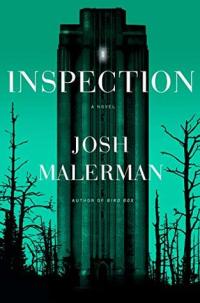
Kate’s Review: “Inspection”

41058632Book: “Inspection” by Josh Malerman

Publishing Info: Del Rey Books, March 2019

Where Did I Get This Book: I received an eARC from NetGalley.

Book Description: Boys are being trained at one school for geniuses, girls at another. And neither knows the other exists–until now. The innovative author of Bird Box invites you into a tantalizing world of secrets and lies.

J is a student at a school deep in a forest far away from the rest of the world.

J is one of only twenty-six students, who think of their enigmatic school’s founder as their father. And his fellow peers are the only family J has ever had. The students are being trained to be prodigies of art, science, and athletics, but their life at the school is all they know–and all they are allowed to know.

But J is beginning to suspect that there is something out there, beyond the pines, that the founder does not want him to see, and he’s beginning to ask questions. What is the real purpose of this place? Why can the students never leave? And what secrets is their father hiding from them?

Meanwhile, on the other side of the forest, in a school very much like J’s, a girl named K is asking the same questions. J has never seen a girl, and K has never seen a boy. As K and J work to investigate the secrets of their two strange schools, they come to discover something even more mysterious: each other.

In Inspection, the masterful author of Bird Box crafts a sinister and evocative gender equality anthem that will have readers guessing until the final page.

Review: Thanks to NetGalley for providing me with an eARC of this novel!

I am going to sound like an insufferable hipster for a moment, so bear with me; I liked “Bird Box” before it was cool. A few years before Netflix dropped their thriller hit, I read the book it was based on, written by Josh Malerman. I know the reception of the film was hit or miss, but I legitimately think that the book is terrifying. It kept me on the edge of my seat, and I could barely put it down even as it stressed me out. So when I saw the new book by Malerman was available for request on NetGalley, it caught my eye. And when I found out it took place at a boarding school with malevolent intentions… Well….

giphy-10
(source)

While evil or mysterious boarding schools have been done before, Malerman leans into the concept and makes it feel wholly original. We first see it from the perspective of an experiment that involves all boys, in which the man heading the experiment, who refers to himself as D.A.D., has taken twenty four boys at birth and raised them isolated from modern society with no knowledge of the female gender. The hypothesis (and trust me, I will absoLUTEly be addressing this later) is that if they are not distracted by women/sexuality/attraction, they can reach their full potential as the next great thinkers and scientists of the world. Malerman covers pretty much all of his bases in this regard, accounting for the need for space, control, and isolation, and did it in ways that felt as realistic as they could be in a story like this. We follow one of the subjects, J, as he and the others start to reach puberty, and we see how he is starting to question his place at this school, and the world that is being presented to them. I liked J quite a bit, and appreciated that Malerman gave him the right amount of rebellious nuance and a believable curiosity, along with a fear and anxiety about his questions, and his fear of being ‘spoiled rotten’ and sent to The Corner, a place where two boys who questions, A and Z, never returned from. I also appreciated that Malerman took into account other aspects of this experiment that I never would have thought of, specifically the role that propaganda would have to play. I thought it was genius to have a specific propagandist on staff, a failed writer named Warren who writes morality tales for the boys that will help keep them in line and under control. It never occurred to me that propaganda would need to play a role in this kind of situation, but this subplot was so, so intriguing, especially as the propagandist starts to question his own culpability.

It’s at the halfway point that “Inspection” really grabbed me. That was when we switched to another boarding school, this one with twenty four girls. This is where Malerman made this story truly all his own. D.A.D.’s wife, who calls herself M.O.M., naturally, is running the same experiment, this time with girls, in hopes of unlocking creative potential. In this part of the story we meet K, the girl who is at the top of the class, but has potentially seen something that she shouldn’t have. Her journey is far less hesitant than J’s, and I loved seeing her creative thinking, as opposed to J’s more rigid thinking, help bring her to conclusions about her situation in a different way. And by the time the two stories converge (though I don’t want to spoil anything here), that is when this story shifts from a vaguely dystopic thriller into a full blown horror novel. While in some ways it felt a little late for the horror elements to arrive, I was so enthralled by the rest of it that I didn’t mind it.

There was one aspect of this story that I couldn’t quite swallow, and that is based within the premise that D.A.D. and M.O.M. have for their awful experiment. They both believe that by isolating the genders, they will be able to unlock the full potential of their subjects, as to them sexuality and attraction are the distractors that keep humans from the highest intellectual levels. This story takes place in a modern-ish time or perhaps a very near future. As two scientists, I don’t understand how they didn’t think about as to whether, within twenty four boys and twenty four girls, there may be the possibility of subjects who were attracted to the same gender. Given the odds, you’d think you’d get at least one, if we’re being conservative in our estimates. I wasn’t sure if Malerman was trying to say that D.A.D. and M.O.M. were so corrupted by their devious and unethical thinking that they would also be biased against LGBTQIA+ people as part of their experiment, or if such a development would immediately call for The Corner, or whether he just didn’t think of it at all. Because it doesn’t come up. And to me, it’s a pretty big question that probably should have been addressed.

That aside, I quite enjoyed “Inspection” in all of it’s creepy and unsettling glory. Malerman continues to surprise and shock me in the best ways, and my hope is that he just keeps getting more attention as time goes on.

Rating 8: A propulsive and then eerie thriller/horror novel, “Inspection” is another triumph from Josh Malerman.

Reader’s Advisory:

“Inspection” is a new book and isn’t on any Goodreads lists yet, but I think that it would fit in on “Evil Schools – Public, Private, and University”.

Find “Inspection” at your library using WorldCat!

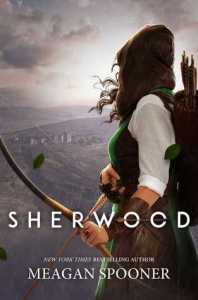
Serena’s Review: “Sherwood”

38734256Book: “Sherwood” by Meagan Spooner

Publishing Info: HarperTeen, March 2019

Where Did I Get this Book: Edelweiss+

Book Description: Robin of Locksley is dead.

Maid Marian doesn’t know how she’ll go on, but the people of Locksley town, persecuted by the Sheriff of Nottingham, need a protector. And the dreadful Guy of Gisborne, the Sheriff’s right hand, wishes to step into Robin’s shoes as Lord of Locksley and Marian’s fiancé.

Who is there to stop them?

Marian never meant to tread in Robin’s footsteps—never intended to stand as a beacon of hope to those awaiting his triumphant return. But with a sweep of his green cloak and the flash of her sword, Marian makes the choice to become her own hero: Robin Hood.

Review: As I mentioned in my brief description of this book in our “Highlights” post for March, I was a big fan of Spooner’s wholly unique take on “Beauty in the Beast” in her YA novel “Hunted.” Now, obviously these two stories aren’t connected, but it is clear by the stylization of the cover art that we’re meant to make associations between the two: both feature a strong, independent female main character and both are reinterpreting a story in which that character had varying levels of agency. I’m definitely not one of those readers who subscribes to the whole “Stockholm syndrome” group fret about Belle/Beauty’s role in her story, but there’s no denying that “Hunted” gave this character a bunch more to do. And here, we have a legitimate side character in Marian being firmly placed in the lead role of the classic Robin Hood tale. It was great to see this book live up to the expectations I had placed on it given my feelings for “Hunted.”

Marian has made the best out of a bad situation: she loves her bow, fighting, and generally running wild and has very little interest or skill in the more “womanly” arts. Luckily for her, her childhood friend Robin has always been her partner in crime in these pursuits, and their engagement seems an obvious route to making the  best of out of an inevitable situation. That is, until he rides off to the Crusades and news reaches her of his death. Devastated by the loss, Marian still sees herself as responsible for the livelihood of the people living on both her own and Robin’s land and when the Sheriff’s taxes rise beyond reason, she finds herself donning not only male garb, but the persona of her deceased fiance, Robin of Locksley. Now, pursued by the Sheriff’s right hand man, a man whose desire to catch “Robin” is only matched in his wish to marry Marian, Marian must lead a double life, and one that can only have a catastrophic end.

I really enjoyed this version of Robin Hood. While I’ve read a fair share of stories that insert a female character as a stand-in for Robin, typically Robin himself is still present in the story, often the love interest. That being the case so much of the time, I truly didn’t trust the book description or the first chapter that laid out the concept that Robin died while at the Crusades. It was probably up until about half way through the book before I really let myself trust that he wasn’t going to just pop up. Not that I have a problem with the Robin character typically, but even by a quarter into the story, Marian herself and the way her story was unfolding was already so intriguing that any addition of the more famous Robin could have only detracted from her. Plus, as I said, in those past versions, even a Robin relegated to a love interest role often rubbed up wrong against what the author was trying to do with the actual main character who was supposedly supposed to be taking on the primary role in the action.

Marian was an excellent lead. Her grief for Robin’s death is real, and I appreciate that this wasn’t glossed over. Instead, we see how his loss affects throughout the entire story, first as a hindrance and further on as a motivation. Over time, she also has to re-assess what she knew about the man she was to marry. We, the readers, get a few extra glimpses into past moments between the two, and it is here, too, that we see small, but very important, differences being laid out between who this Marian and this Robin are compared to what we expect from the typical versions of the story. We also see the foundation for how Marian came to possess the skills necessary to take on the role she does here.

Wisely, Spooner leans in heavily to Marian’s skill with a bow, a talent that, while unusual, wouldn’t fall completely out of the realm of something a lady might have learned. Marian is also described as being exceptionally tall. But that aside, it could still have read as unbelievable for her disguise as a man to be fully bought by those around her had the author not carefully crafted every interaction that “Robin” goes into in a way that plays to hiding Marian’s identity. Indeed, Marian herself is written to understand the limitations of her disguise and to use every advantage she has to work within it, instead of breaking past it in ways that could have read as unbelievable and strange.

I also really enjoyed how many of the secondary characters came into play. Several familiar faces show up throughout the story, and each was given a few extra flares to make them stand out from the usual versions of the characters we’ve seen in other books. But I also really enjoyed the addition of unique characters (or at least vastly expanded upon versions of them). Marian’s father, maid, and horse master all were expanded upon quite a bit and I loved them all.

The most notable new addition, of course, is Guy of Gisbourne who is presented as both the villain and the love interest of the story. Again, because I was expecting Robin to pop back up at any moment, it took me a while to really figure out his role in the story. Thinking back, I tend to attribute this to an intentional decision on the author’s part as well, and not only my own skepticism of how the story was originally presented. Marian herself takes a long time to understand Gisbourne, what motivates him, where his moral compass points, and how he truly feels about her. Her own confusion translates perfectly to the reader. This is both a good and a bad thing. I love slow burn romances, and this is definitely that. But at times I think the book was almost too successful at selling me on Marian’s dislike of Gisbourne and his own coldness as a character. There are a few moments that are meant to show their gradual warming to each other, and they do work, for the most part, but I’m not sure it was ultimately enough. At a certain point, it did feel a bit like some type of authorial-driven light switch was just flicked in Marian’s head because it needed to be, rather than because it was earned.

So, too, her past relationship with Robin was also a bit strained. We only see a few glimpses here and there of their childhood and teenage friendship, but the scenes are all so strongly written and their connection so well established that it almost worked against the burgeoning romance with Gisbourne in a way that I don’t think was intended. I liked the idea of what we’re being told with regards to Robin/Marian/Gisbourne: that people are not always who we initially think they are and that love can present itself in very different ways with different people, and that these ebbs and flows don’t undermine one relationship or the other. But I’m just not sure the reader can actually see this message play out, so much as just be on the receiving end of being told.

Ultimately, I almost think it says even more positive things about the story that the downside I can mention has to do with romance and yet that downside in no way tanks the entire story for me. We all know that if you don’t get the romance right for me, often that can lead to my very much not enjoying a story. And here, it’s not that the romance was wrong, necessarily, just that I felt it was the weakest part of the story. But Marian herself, the reimagining of how the Robin Hood story would play out with her at its heart, the action, and the new characters all provided enough of a counter balance to my questions about the romance to lead me to viewing it with still a very positive light. Fans of Robin Hood re-tellings should definitely check this one out!

Rating 8: A bit muddled in the romance department, but an awesome female Robin Hood saves the day in the end!

Reader’s Advisory:

“Sherwood” is included on these Goodreads lists: “Female Robin Hood” and “YA Modern Retellings.”

Find “Sherwood” at your library using WorldCat!

Book Club Review: “Sky in the Deep”

34726469We are part of a group of librarian friends who have had an ongoing bookclub running for the last several years. Each “season” (we’re nerds) we pick a theme and each of us chooses a book within that theme for us all to read. Our current theme is ‘genre mash-ups’, where we pick two random genres and try to find a book that fits both. 

For this blog, we will post a joint review of each book we read for book club. We’ll also post the next book coming up in book club. So feel free to read along with us or use our book selections and questions in your own book club!

Book: “Sky in the Deep” by Adrienne Young

Publishing Info: Wednesday Books, April 2018

Where Did We Get This Book: Kate got it from the library,

Genre Mash-Up: Fantasy and Romance

Book Description: Raised to be a warrior, seventeen-year-old Eelyn fights alongside her Aska clansmen in an ancient rivalry against the Riki clan. Her life is brutal but simple: fight and survive. Until the day she sees the impossible on the battlefield—her brother, fighting with the enemy—the brother she watched die five years ago.

Faced with her brother’s betrayal, she must survive the winter in the mountains with the Riki, in a village where every neighbor is an enemy, every battle scar possibly one she delivered. But when the Riki village is raided by a ruthless clan thought to be a legend, Eelyn is even more desperate to get back to her beloved family.

She is given no choice but to trust Fiske, her brother’s friend, who sees her as a threat. They must do the impossible: unite the clans to fight together, or risk being slaughtered one by one. Driven by a love for her clan and her growing love for Fiske, Eelyn must confront her own definition of loyalty and family while daring to put her faith in the people she’s spent her life hating.

Kate’s Thoughts

I went into this book with hesitance, if only because it’s described as ‘fantasy’ and you all know how I am about fantasy books. I had remembered that Serena had read it and enjoyed it, and I do have to admit that the idea of Viking based mythology was a tantalizing thought. Still, I was nervous. But it turned out that I had nothing to be nervous about, because “Sky in the Deep” ended up being a really fun read for me!

The greatest appeal of this book was Eelyn, as not only is she a fierce and strong warrior, she is also a complex character who is still a relatable teenage girl. She loves her family and she is very set in her beliefs, and when her belief system is questioned she has to reconcile that life isn’t as black and white and straightforward as she previously thought. But even in the face of these changes to her opinions and realizations of nuance, she still remained true to her self, and it didn’t feel like she strayed from her character in ways that seemed unbelievable. I also really enjoyed seeing how she had to relearn about, and learn to forgive, her brother Iri after his perceived betrayal. I felt that while her relationship and eventual romance with Fiske was an interesting dynamic, I was more invested in whether or not Eelyn would be able to reconcile with Iri.

The world that Young built also kept me interested in the story. I have very little working knowledge of Viking lore and history, so I went into this with little to no expectations. This worked in my favor in two ways: one, I had no idea of anything stood out as ‘inaccurate’ (though as a fantasy that doesn’t necessarily need to enter into it), and it was still exciting enough that it  kept me going. I liked the world building and the explanations of the different cultures and how they were similar and dissimilar, and felt like they were distinct from each other. The action sequences and conflicts were also very well written, and I found myself on the edge of my seat with worry for all the characters I liked. Investment in characters is always a huge plus!

“Sky in the Deep” was a really fun read and a great exception to my usual lukewarm feelings towards fantasy. It makes me feel like people who may not like fantasy will find things to like here!

Serena’s Thoughts

I was excited when I heard that this book was chosen for one of our bookclub picks. Yes, I had already read it, but I had liked it the first go around and was more than happy to revisit it. On a second read-through, my feelings remain pretty much the same. The short and sweet of it: I liked the main character quite a lot, the story could be predictable at times, but the awesome action and subdued romance all hit the right marks for me.

Again, this re-read, the thing that really stood out to me was just how badass Eelyn is. This book is the epitome of showing and not telling as far as warrior skills go. All too often, readers are simply informed that the main character is “such and such incredible fighter” but we either never see it in action, or only get a brief glimpse. This could partly be due to the fact that writing good fight/battle scenes simply isn’t as easy as one would think. But Young rises to the challenge and again and again we see Eelyn’s abilities on display, both in larger battles scenes (like the ones at the beginning of the book) to the smaller skirmishes that Eelyn gets in throughout the story. What’s more, we’re free from having to read through any moral hand-wringing about all of this violence. This is the culture and world that Eelyn has grown up in. It’s brutal and bloody and it simply never occurs to her to question her own role in taking part in this. Through a modern lens, we can have our questions. But through a realistic portrayal of a character living in this world, she wouldn’t have these same thoughts.

Beyond this, one thing that did stand out more for me this re-read was just how beautiful some of the turns of phrase were. Much of the book is action, but there are a few quieter moments throughout the story that are really quite gorgeous, either in the depth of the reflections taking place (especially Eelyn’s struggles to understand her brother and his choices) or simple descriptions of a winter-y scene. The title of the book draws from one of these moments. I think these quieter moments really worked well to balance out what was otherwise a very fast-paced story.

Obviously, re-reading this, I knew what was coming when, so my original criticism of its being a bit predictable is harder to evaluate a second go-around. I do think that that thought remains true, however. Much of this probably has to do with the length of the book. It’s a standalone (yay!), but it also doesn’t have a terribly long page count on its own. Within these restrictions, plot points need to be gotten through fairly efficiently, and the manner in which this is accomplished is, yes, fairly predictable to readers familiar with this type of story.

Overall, however, I still very much enjoyed this book, and it’s definitely one worth checking out if you’re looking for a standalone story that mixes fantasy, history, and romance in an action-packed book.

Kate Rating 8: An action packed adventure with a compelling set of characters and distinct world building, “Sky in the Deep” was a fun surprise!

Serena Rating 8: I’m going to actually up my rating a point after this re-read. I think the strength of the writing as a whole stood out even more this go-around, and it deserves that edge up.

Book Club Questions

  1. This story mixes several different genres all together: fantasy, historical fiction, romance. Did one of these areas standout for you?
  2. Eelyn must grapple with a lot of prejudices and preconceptions in this book. How well do you think her growth in this area was handled?
  3. There are two primary relationships at the heart of this story: Eelyn and her brother, Iri, and Eelyn and Fiske? Were you more invested in one or the other and why?
  4. The book covers a host of dark themes and can be quite violent at times. What did you think about how these aspects of the story were handled?
  5. The story also focuses a lot on found families. Were there any notable elements in this area that stood out for you?

Reader’s Advisory

“Sky in the Deep” is on these Goodreads lists: “YA Vikings” and “YA Fantasy Standalones.”

Find “Sky in the Deep” at your library using WorldCat!

Next Book Club Book: “Girl Squads: 20 Female Friendships That Changed History” by Sam Muggs.

Kate’s Double Review: “The Real Lolita” and “Rust & Stardust”

Books: “The Real Lolita: The Kidnapping of Sally Horner and the Novel that Scandalized The World” by Sarah Weinman; “Rust & Stardust” by T. Greenwood

Publishing Info: Ecco, September 2018; St. Martin’s Press, August 2018

Where Did I Get These Books: The library; I was sent an ARC from the publisher

Book Descriptions: Vladimir Nabokov’s Lolita is one of the most beloved and notorious novels of all time. And yet very few of its readers know that the subject of the novel was inspired by a real-life case: the 1948 abduction of eleven-year-old Sally Horner.

Weaving together suspenseful crime narrative, cultural and social history, and literary investigation, The Real Lolita tells Sally Horner’s full story for the very first time. Drawing upon extensive investigations, legal documents, public records, and interviews with remaining relatives, Sarah Weinman uncovers how much Nabokov knew of the Sally Horner case and the efforts he took to disguise that knowledge during the process of writing and publishing Lolita.

Sally Horner’s story echoes the stories of countless girls and women who never had the chance to speak for themselves. By diving deeper in the publication history of Lolita and restoring Sally to her rightful place in the lore of the novel’s creation, The Real Lolita casts a new light on the dark inspiration for a modern classic.


When 11 year-old Sally Horner steals a notebook from the local Woolworth’s, she has no way of knowing that 52 year-old Frank LaSalle, fresh out of prison, is watching her, preparing to make his move. Accosting her outside the store, Frank convinces Sally that he’s an FBI agent who can have her arrested in a minute—unless she does as he says. 

This chilling novel traces the next two harrowing years as Frank mentally and physically assaults Sally while the two of them travel westward from Camden to San Jose, forever altering not only her life, but the lives of her family, friends, and those she meets along the way.

Review: I want to extend a special thank you to St. Martin’s Press for sending me an ARC of “Rust & Stardust”.

For someone who reads a whole lot for her profession and her pleasure, I have a pretty gaping hole in my literary experience when it comes to ‘the classics’. Between taking not so typical literature classes in high school and majoring in psychology, my exposure to classic books was limited, and while I’ve tried to pick up the pieces here and there I still have many left on the ‘theoretically to read’ list. So no, I have not read “Lolita” by Vladimir Nabokov, though the notoriety of the story means that I am pretty familiar with it as a whole. I’m in no rush to read it, not for any other reason than there are so many other books out there that interest me more. But when I got an ARC of the book “Rust & Stardust” by T. Greenwood, the fact that it was based on the very real story of Sally Horner, the girl who served as inspiration to Dolores Haze in Nabokov’s book, caught my attention. And then I heard that a nonfiction book about Sally Horner, called “The Real Lolita” by Sarah Weinman, was also soon to be available. So I decided to bide my time, and to read the two as a pair so that I could compare and contrast the two, which each tell the same story in very different ways.

And perhaps it’s implied, but just in case, I need to give some serious content warnings for both of these books. They do, after all, involve the kidnapping, rape, and abuse of a little girl.

“The Real Lolita” is a non fiction work that juxtaposes Sally Horner’s kidnapping at the hands of Frank La Salle with Vladimir Nabokov trying to write “Lolita”. Weinman surmises that Nabokov, who had been having stumbling block after literary stumbling block as he tried to write what would become his most famous work, heard the sensationalized news stories surrounding the case and used it in his work. Nabokov denied this again and again, but Weinman lays out the similarities between the two cases, and the timeline that he was working within and how it wa well within the highest media furor surrounding the case. It isn’t really a criticism of Nabokov’s decision to use this story as inspiration so much as it’s an indictment of him lifting a girl’s very real pain to profit from it without giving her any credit. I appreciated that she wasn’t going after the inspiration piece, because it isn’t uncommon for creatives to take inspiration from real life horrors and to make them into a fictional work. The issue is that Nabokov was too proud to admit that he in all probability did find inspiration in this trauma victim, which is deeply problematic in and of itself, and couldn’t be bothered to even acknowledge her pain and how successful of a novel it was. Her evidence is well researched and carefully laid out, and the details that she found regarding the Horner case and what her life was like before, during, and after the ordeal gives voice to a girl whose trauma was appropriated for a novel with the subject of her inspiration twisted and misinterpreted  into a nymph-like seductress (even if that wasn’t Nabokov’s intention). It’s a book that I had a hard time reading because of the awful manipulations and abuses La Salle did to Horner, though I appreciated how frank and ‘just the facts’ Weinman was because of the horrors of the case. I also liked that she wasn’t particularly fiery in her critiques of Nabokov, but that she simply presented the evidence as it was and let it speak for itself. Weinman’s book gives this girl a voice, a voice that wasn’t afforded to her in the moment, and that has been drowned out because of time and a novel that overshadowed it.

“Rust & Stardust” is also the Sally Horner story, but it has been adapted into a work of fiction. T. Greenwood  makes it very clear in a long author’s note that she approached this story through the eyes of a fiction author, but tried to keep a good number of the details, especially in regards to Sally’s experience, realistic and plausible. The prose flows neatly and succinctly, and while it is a longer book than “The Real Lolita” I found that it felt like a quicker read just because Greenwood paced it so well. The story is pretty much what you’d expect; Sally Horner is caught by Frank LaSalle as she’s stealing a notebook from the store, and what follows is the story of Sally’s kidnapping, captivity, and return, as well as the perspectives of those in her life during her absence. While it was definitely hard to read at times, Greenwood never made it feel lurid or exploitative. The emotions were there, but were able to remain untangled from bad taste. Greenwood also gave herself some creative plot leeway (though not in regards to Sally, which was good) so that she could highlight the problematic attitudes of the post-War American culture, specifically when it comes to abuse towards girls and women. Whenever someone would raise doubts about Sally’s relationship to Frank, almost every time they were told to be quiet because the very notion of bad intentions was disgusting and inappropriate. Frank is able to get away with his predation because the people around him and Sally don’t want to face that it’s happening. Which brings me back to the criticisms of “Lolita”, in that some people, be it Nabokov’s intent or not, have romanticized the story of Humbert Humbert and the ‘nymph’ he fixates on. Greenwood doesn’t give any leeway for that because the story is Sally’s, and those who care about her.

Reading “The Real Lolita” and “Rust & Stardust” has given me a larger picture of a tale I thought I knew, and in their own ways they tell the side that has been lost to time and literary critique and accolades. If you like “Lolita”, and even if you don’t like it, these books will give it more context, a context that it has probably always needed.

Ratings 8: Though the backstory to “Lolita” has been glossed over and outright ignored by some (and denied by others), “The Real Lolita” and “Rust & Stardust” strive to give Sally Horner the ability to tell her story.

Reader’s Advisory:

“The Real Lolita” is included on the Goodreads lists “Women’s Lives”, and “Best Crime Books of 2018”.

“Rust & Stardust” is included on the Goodreads lists “#MeToo”.

Find “The Real Lolita” and “Rust & Stardust” at your library using WorldCat!