Serena’s Review: “The Glass Magician”

45046558Book: “The Glass Magician” by Caroline Stevermer
Publishing Info: Tor Books, April 2020

Where Did I Get this Book: NetGalley

Book Description: What if you could turn into the animal of your heart anytime you want?

With such power, you’d enter the cream of New York society, guaranteed a rich life among the Vanderbilts and Astors, movers and shakers who all have the magical talent and own the nation on the cusp of a new century.
You could. If you were a Trader.

Pity you’re not.

Thalia is a Solitaire, one of the masses who don’t have the animalistic magic. But that is not to say that she doesn’t have talent of another kind—she is a rising stage magician who uses her very human skills to dazzle audiences with amazing feats of prestidigitation. Until one night when a trick goes horribly awry…and Thalia makes a discovery that changes her entire world. And sets her on a path that could bring her riches.

Or kill her.

Review: I was intrigued by the original sounding premise of this book. Set in New York, turn-of-the-century time period, and some type of new class system that is based around one’s magical ability to turn into an animal. All sounds like cool concepts and all put together, I really had no idea what to expect from this book. Unfortunately, it didn’t really turn out to be much of anything at all, so no expectations was about right.

After inheriting her father’s magic business, Thalia has been making her living as a stage magician. Not blessed with actual magical abilities that would vault her into the upper class of New York society, she is still managing to make a name for herself by performing wondrous and dangerous tricks in her act. One night, however, a trick goes wrong and Thalia discovers there is more within her than she had ever known. Now with abilities she doesn’t know how to control and a murder added to the mix, Thalia’s life is beginning to change. Will it be for the better or for the worse?

For the pros for this book, I will say that I still liked the uniqueness of the time period during which it was set and the choice to have it take place in New York City. It’s always a breath of fresh air to find a fantasy novel that isn’t set in some generic “medieval times” setting. And even more so to find one that is set in a city that exists today. However, I do think the author left a lot on the table with regards to what all could have been done with these two elements. The other positive worth noting was the writing itself. It didn’t stand out to me in any particular way, but it was of the sort that is strong enough to get the job done without distracting the reader. And, considering that I didn’t love much about this book, I think it’s a real strength of the writing that it was strong enough that I didn’t ever really feel like just putting the book down for good.

Unfortunately, as I mentioned with the time period and the setting, it felt like the author came up with some cool, individual ideas, but didn’t spend any time really building up the world or system around them. Like, people have this magic to turn into animals and society has been built in such a way that possessing this ability puts you into an elite class. But the why or how of this is never really explained. The history of how this system came to be in place is lacking. And there is really not magic system of any kind to explain the rules, limitations, or even, to some extent, the benefits of having these abilities. The entire world that has been created depends on these magical factors, and yet we get next to nothing about what they really are. It felt like the author simply didn’t want to bother with the details of these things, instead wanting to just jump into her heroine’s own story.

But there, too, I had problems. Thalia is an interesting enough character on her own, but the book simply didn’t have enough story for her. The entire book feels made up of either Thalia struggling to learn to control her new abilities or making small bits of progress solving a murder mystery. I was pretty surprised, actually, when the murder mystery aspect of it became apparent since there wasn’t any hint of that in the general description. But I’m all for historical murder mysteries, so this should have been a benefit to the story. Instead, again, it felt like only the most basic aspects of this part of the story were really explored. Things all come way too easily to Thalia, with people often behaving against their own best interest or out of character to help her on her way.

To make up page time for the lack of world-building, magic system, or complications in the murder mystery, we instead spend an incredible amount of time just in Thalia’s mind exploring her feelings. I don’t have a problem with books that center largely around the introspective thoughts of a main character, but there just has to be more to the story itself to support this. I also didn’t love the romance we were given. It felt forced and lacked chemistry.

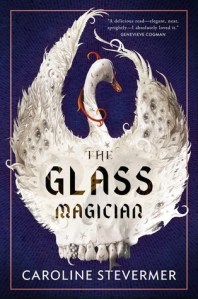
I also have to spend a moment on that cover. Yikes. It’s the kind of thing that immediately attracts the eye (indeed, I clicked on it in NetGalley just because of the swan motif), but the more you look at it, the worse it gets. It’s all kinds of creepy with the teeth and eyes, and I’m not sure it really represents well the book we have. Instead, if I had noticed these details when choosing the book off the shelf, I think I would have most likely put it back just due to how unnerving I find it all.

Overall, I wasn’t impressed with this book. It felt like the author had some really neat ideas at the very core of it, but didn’t spend enough time to fully develop anything. The writing was strong enough, but there wasn’t enough story to go around.

Rating 6: Lack luster and thin, this book didn’t hold up to the promises of its premise.

Reader’s Advisory:

“The Glass Magician” is a newer title and isn’t on any relevant lists. Bizarrely (and inaccurately) it is on “Historical Fiction 2020.”

Find “The Glass Magician” at your library using WorldCat!

Serena’s Review: “The Ranger of Marzanna”

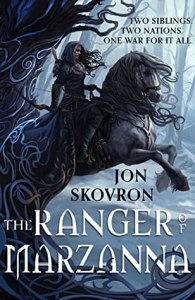
51113661._sx318_sy475_Book: “The Ranger of Marzanna” by Jon Skovron
Publishing Info: Orbit, April 2020

Where Did I Get this Book: ARC from the publisher

Book Description: When their father is murdered by imperial soldiers, two siblings set out on opposite paths—one will destroy the Empire forever and the other will save it—in this thrilling new Russian inspired epic fantasy from Jon Skovron.

Sonya is training to be a Ranger of Marzanna, an ancient sect of warriors who have protected the land for generations. But the old ways are dying, and the rangers have all been forced into hiding or killed off by the invading Empire.

When her father is murdered by imperial soldiers, she decides to finally take action. Using her skills as a ranger she will travel across the bitter cold tundra and gain the allegiance of the only other force strong enough to take down the invaders.

But nothing about her quest will be easy. Because not everyone is on her side. Her brother, Sebastian, is the most powerful sorcerer the world has ever seen. And he’s fighting for the empire.

Review: Between the beautiful cover art and the intriguing book description, this was a no brainer for me to request. I always love stories about warrior women, and the fact that it was based on Russian folklore is just the cream on top. I was definitely getting some “The Bear and the Nightingale” vibes off this, which couldn’t have been more of an inducement since I’m still in mourning that that trilogy ended…like more than a year ago now. Get over it! Sadly, however, this book wasn’t quite that. There were some strengths to it, but not quite what I was looking for, in the end.

Sonya is in training to be a Ranger, a member of an elite fighting force. In pursuit of this goal, she travels around the countryside attempting to help her people against the doings of the invading imperial soldiers. While away, however, her family is attacked and her father killed. Her brother, however, a powerful sorcerer-in-training, survives and begins to make a new life for himself, one that sides with the very people who murdered their father. Now these two siblings find themselves on very different paths, paths that will eventually intersect to devastating effect.

So, to start with a few things I liked. I did like the Russian/Ukranian influences on the culture, location, and folklore of the story. The elemental magic system was also interesting enough. It’s not a super new concept, but I felt like the author put enough new twists into how it all works to keep it from feeling flat. I particularly liked the cult-like religion that followed Marzanna and the sacrifices that were required of those who committed themselves to her path (as we see through Sonya’s story.) But, sadly, I had a really hard time connecting to either of the two main characters, and I felt like the pacing and writing of the story weren’t helping matters out.

First, Sonya. I did end up liking her half of the story better than her brother’s, but again this was mostly due to the intriguing concept of having to give up parts of oneself to become a full follower of Marzanna. However, even in this part of the story, I didn’t feel like the author truly explored this concept completely. In many ways, it mostly just made Sonya less likable. She starts out incredibly bad-ass and so some of her struggles then appear out of character. But at the same time, growth for the character comes out of these moments, but never felt like it was really being applied completely. It’s hard to get at exactly what my problem was. I think maybe it was just that the actual character herself felt too flimsy to hold up the more grand adventure she was supposed to be having. And by the time we got to some of the darker portions of her tale, the part where readers have to begin questioning her actions and motives, it’s too late to really feel invested enough in it all.

As for Sebastian, I didn’t like him from the start, and it didn’t get any better as we went along. In the very first chapter we meet him, his father his killed and he and his mother are shipped back to the capitol city. His entire inner thought process of these events was summed up with an actual line saying that he didn’t really get along with his father that much so that must be why he’s not really grieving. From there, it just got worse as he literally teams up with the very people who killed his father and pretty much goes “meh” about the idea that his powers are now going to be used against his own people. There simply wasn’t enough (or any!) real conflict shown between Sebastian and his father to justify to bewildering turn for his character. Sebastian is either a sociopath who can’t care about others or an outright villain. Neither are likable. It’s especially confusing as he’s presented in a way that makes it clear that the author expects you to sympathize with him and read him as an equal protagonist. I just didn’t get it, and what I did get, I didn’t like.

I also felt like the writing and pacing of story were just a bit off. The characters spoke in a very YA manner, but this didn’t mesh well with the super violent descriptions that came with the action scenes. What’s more, the author had an unfortunate habit of info-dumping in his dialogue making it read as unnatural and stiff. Overall, I was pretty disappointed by this book. I know that the author has a fairly popular series already published, so I’m not sure if this was an aberration or whether this story just didn’t mesh with me specifically. If you are a fan of his other work and want to give this one a shot, don’t forget to enter the giveaway for an ARC copy of this book!

Rating 6: The two unlikable protagonists were too much for me to get past.

Reader’s Advisory: 

“The Ranger of Marzanna” is a newer title, so it isn’t on any Goodreads lists. But it should be on “Warrior Women.”

Find “The Ragner of Marzanna” at your library using WorldCat!

Serena’s Review: “A Murderous Relation”

35530507Book: “A Murderous Relation” by Deanna Raybourn

Publishing Info: Berkley, March 2020

Where Did I Get this Book: Edelweiss+

Book Description: Veronica Speedwell and her natural historian colleague Stoker are asked by Lady Wellingtonia Beauclerk to help with a potential scandal so explosive it threatens to rock the monarchy. Prince Albert Victor is a regular visitor to the most exclusive private club in London, known as the Club de l’Etoile, and the proprietess, Madame Aurore, has received an expensive gift that can be traced back to the prince. Lady Wellie would like Veronica and Stoker to retrieve the jewel from the club before scandal can break.

Worse yet, London is gripped by hysteria in the autumn of 1888, terrorized by what would become the most notorious and elusive serial killer in history, Jack the Ripper–and Lady Wellie suspects the prince may be responsible.

Veronica and Stoker reluctantly agree to go undercover at Madame Aurore’s high class brothel, where another body soon turns up. Many secrets are swirling around Veronica and the royal family–and it’s up to Veronica and Stoker to find the truth, before it’s too late for all of them.

Previously Reviewed: “A Curious Beginning,” “A Perilous Undertaking,” “A Treacherous Curse” and “A Dangerous Collaboration” 

Review: I was even more excited than usual to pick up the latest “Veronica Speedwell” mystery when it came out. Finally, at the end of the last book, it seemed like Veronica and Stoker were finally confirming their romantic interest in one another. But, in a cruel twist of authorial spite, readers were left right at the brink of these two actually acting on their feelings. So here, in the next book, how would this newly forming relationship affect their working relationship and would we finally see them actually together? Well, yes, but not necessarily in the way I would have preferred.

Immediately upon their return to London, Veronica and Stoker once again find themselves caught up in mystery and scandal. This time, rather than solve a mystery, they are tasked with protecting Veronica’s “family,” the monarchy that has not acknowledged her. To do this, they must go under cover into an elaborate private club in hopes of retrieving a rare jewel that can be used to implicate Prince Albert Victor. But things are never as simple as they seem, and soon enough Veronica and Stoker find themselves mixed up with familiar foes and wandering streets that are plagued by a horrific serial killer.

So, this was a bit of a frustrating read for me. It seems that recently the books in this series have been see-sawing a bit as far as my enjoyment goes. The third book I found to be a bit lagging, but I loved the fourth book. Sadly, here, we see a return to some of the dragging bits. Ultimately, I struggled with two aspects of this: first, like in the third book, it felt like the author was not willing to deal with the burgeoning romance she had started and instead created roadblocks and delays that didn’t feel natural to the story; and second, there was a distinct feeling of familiarity and lack of new material to this particular story.

When I said “immediately” in my book description about how quickly the mystery started, I meant immediately. So much so that the entire question of the burgeoning romance between Stoker and Veronica is effectively sidelined right off the bat. From there, the book is quick to establish how tired they both are, how the beginning of a case is not the right time, etc, etc. And then the rest of the book happens with the entire mystery taking place in one full swoop spanning a hectic day and a half or so. Right there, we have a problem. Regardless of how silly and obvious some of the “tiredness” and “not the right time” conversations felt, the mystery itself did not gain anything for having to frantically move fast enough from one element to another in order to prevent addressing the romantic elephant in the room. Emotional moments didn’t ring as true or feel as earned. The build-up, crescendo, and conclusion to the mystery itself felt rushed, making it hard to feel invested in what was happening. It all felt forced and I think hurt the story more than it accomplished…whatever it was trying to accomplish.

My second problem had to do with the actual elements involved in the story. Almost all of it were retreads of themes, characters, and dilemmas that were found in previous books. We’ve already covered much of the emotional groundwork to be had with regards to Veronica and her feelings towards a royal family who doesn’t want to acknowledge her unless she can do them some favor. There has already been an entire book about a salacious secret society, so the escapades at the private club feel all too familiar. Even the villain, for the most part, is a return to a motivation and individual we’ve seen before. And for all of that, the Jack the Ripper portions that are teased in the book description are barely worth mentioning.

The primary strength of the series has always been Veronica and Stoker themselves. But even they, when given tired material that offers no room for new personal growth, can only do so much. Veronica’s voice is still strong and compelling, but that’s probably the best that can be said. Stoker felt largely absent from the story, even when he was right there on the page. And the small bits of emotional groundwork covered between the two of them felt like, again, retreads of conflicts that had already been resolved. There is a payoff for these two at the end, but I found it to be too little too late.

Overall, I was pretty disappointed by this book. It felt like the author had ran out of ideas as far as the mystery went. And then was too scared to confront the changing romance she had started in the last book, so she threw in a bunch unnecessary and ridiculous roadblocks in order to write one more book between these two prior to any romantic commitment. I honestly don’t understand the concern here. I’ve often compared this series to the “Amelia Peabody” books. And in that series there was only one book before our main characters not only paired up, but got married! And then only one more book or so before they had a kid along with them! And that series never lost anything for resolving the “will they/won’t they” aspect early, let alone 5 books in like this one. Frankly, I feel like this shying away from resolving “will they/won’t they” relationships in general, across all media formats, needs to die a quick and final death.

I believe the author has a contract with a publisher to write at least two more books, so of course I’ll be reading them. And, at least given the events of the end of this book, this whole relationship thing should be settled. Hopefully she’ll come out with some more unique themes and elements, too. But if I catch even a whiff of forced drama to the romance of this story again, I’m pretty sure I’m out.

Rating 6: A disappointing follow-up after one of my favorites in the series so far. The author seemed to run out of ideas and resorted to pulling old tricks out of her hat. And then became a deer in the headlights with the romance she had written herself into at the end of the last book.

Reader’s Advisory: 

“A Murderous Relation” is a newer title so it isn’t on many Goodreads lists, but it is on “Historical Mystery 2020.”

Find “A Murderous Relation” at your library using WorldCat!

Kate’s Review: “Under the Moon: A Catwoman Tale”

38452822._sx318_Book: “Under the Moon: A Catwoman Tale” by Lauren Myracle and Isaac Goodhart (Ill.)
Publishing Info: DC Ink, May 2019

Where Did I Get This Book: The library!

Book Description: Selina Kyle is fiercer than she knows. For 15 years, she’s put up with her mother’s string of bad boyfriends, but when Dernell, her mom’s current beau, proves crueler than the others, Selina reevaluates her place in her home. There’s no way Selina and Dernell can live under the same roof, and since Dernell won’t leave, Selina must.

From New York Times bestselling author Lauren Myracle (ttyl) and artist Isaac Goodhart comes a story about learning how to survive the world when you’ve been forced to abandon your home and finding allies in the most unexpected moments.

Review: If I’ve said it once, I’ve said it many a time: I love Catwoman. I have always loved Catwoman. And because of my deep and unabiding love for Catwoman, I am VERY picky about how Catwoman is portrayed. Some portrayals I’ve loved, other’s I’ve despised, but at the end of the day while it’s a gamble, I am always up for giving any version a chance. So when I discovered “Catwoman: Under the Moon” by Lauren Myracle, I absolutely had to take the bet and roll the dice.

giphy-1
It will probably never live up to this, but a good effort can do a lot. (source)

I always find it a little risky to try and give Selina Kyle/Catwoman an origin story, for a couple of reasons. The first is that Selina is such a mysterious character at her heart that learning too much can sometimes take away some of the allure. While I like getting into her head and seeing vulnerability, I think that part of the appeal of her is that she has secrets to hide, and don’t you wish you knew them. The other is that some origins have become so iconic over the years (“Batman Returns” really nailed it), I’m always going to be comparing new origins to well done old ones. I think that, for the most part, Myracle is able to fight back both of these pitfalls, as her backstory for Selina is filled with pathos and empathy while still feeling very believable in a lot of ways (I’ll get to the problems I had with it in a bit). And I also think that it feels different enough from other origins I’ve read and unique enough that I wasn’t constantly being like ‘well that’s not how I see it’. Selina’s story in this balances a good line between too unbelievable tragic, and not dark enough. And given some of the darker themes that Myracle brings in, like domestic abuse, animal cruelty, mental illness, and homelessness, she also has a large list of resources in the back of the book so that any readers that may see themselves in Selina’s story may have a place to turn to. I really liked that. 

But then there were the issues I had with it. The first was that, for whatever reason, Bruce Wayne had to be brought in as a childhood friend of Selina. Look, I love Selina and Bruce, no question, they are definitely a top ship for me in the DC universe. But I had really hoped that Selina could have just stood on her own two feet without him being around. It also just didn’t make sense that he had to tell her that his parents had been murdered and what was why they grew apart, and she seemed to not know that. I mean, I feel like the murders of two of the most powerful people in Gotham would have been news that most people would have heard of. And given that Selina was in a middle school setting with Bruce, that teenage gossip mill would have CERTAINLY clued her in, right?! On top of that, there were a good number of plot ideas and strings that were introduced in this book, but I didn’t feel like many of them were fully explored. The biggest one for me was when Selina started running with other homeless kids, and met a girl named Briar Rose who doesn’t speak and has a tragic backstory. There was a lot of potential in the friendship between Selina and Briar Rose (or Rosie as Selina starts calling her!), especially since Myracle left Selina’s younger sister out of this backstory. But we didn’t really get to see their friendship grow, as there was a time jump with small flashbacks to show that they were now thick as thieves so that the plot could progress as such. I never really care for that kind of storytelling.

“Under the Moon” was an alright backstory for one of my favorite DC ladies, but it had the promise to be so much more. That said, if Myracle continued this story, I’d probably pick it up!

Rating 6: A pretty okay origin story for Selina Kyle/Catwoman, but there were a few too many ideas that didn’t get explored enough.

Reader’s Advisory:

“Under the Moon: A Catwoman Tale” is included on the Goodreads lists “Ladies of DC”, and “DC Comics by Women”.

Find “Under the Moon: A Catwoman Tale” at your library using WorldCat!

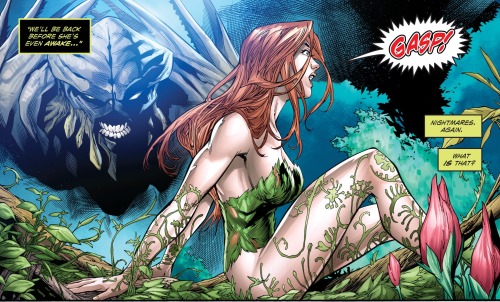
Kate’s Review: “Poison Ivy: Cycle of Life and Death”

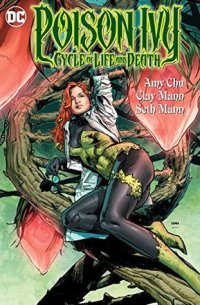
29429567._sy475_Book: “Poison Ivy: Cycle of Life and Death” by Amy Chu, Clay Mann (Ill.), & Seth Mann (Ill.)
Publishing Info: DC Comics, September 2016

Where Did I Get This Book: The library!

Book Description: Poison Ivy blossoms into her first solo adventure! There are animals. There are vegetables. And there is somewhere in between. That’s where Dr. Pamela Isley, a.k.a. Poison Ivy, finds herself. Instead of battling the Dark Knight, she is now a researcher at the Gotham Botanical Gardens, studying the possibility of creating plant-human hybrids. But when her fellow scientists start turning up dead, she’s both the natural leading suspect and the only person (or plant) who can crack the case. To solve the mystery, Poison Ivy must team up or throw down with her oldest friends and closest frenemies, from Harley Quinn to Catwoman to the Swamp Thing. Can she keep things under control, or will she be responsible for a deadly new harvest? Sprouting from the brains of the up-and-coming creative team of writer Amy Chu and artist Clay Mann, it s a mean, green murder mystery starring one of Batman’s greatest rogues!

Review: I will admit that my love for Poison Ivy was late blooming (HAHAHA) in all my years of Batman worship. I don’t know if it was because “Batman and Robin” (though Uma Thurman is a goddess and I now appreciate her characterization in spite of everything), or my disinterest in plants in general, but it took far too long for me to love Dr. Pamela Isley. It didn’t happen until I was looking for a cosplay outfit that wouldn’t require a wig, and I dove heart and soul into making a Poison Ivy costume. And it turned out AWESOME, if I do say so myself.

poisonivy
And to hide my prematurely white hair I dyed my roots green, because ROOTS!

So now that my love for Ivy is here to stay and all encompassing, I was totally tickled when I saw “Poison Ivy: Cycle of Life and Death” during a weeding project at work. I wanted to give this book a stay of execution and wanted to see what author Amy Chu had done with my girl.

There were two, maybe three, really strong aspects to this book. The first is that we get to see Pamela back in her research role, and we get to see how awesome she is at it. While we are used to seeing her as an eco-terrorist or just a general baddie that Batman has to take on, it’s sometimes easy to forget that she is a brilliant scientist, and seeing her passionate and stupendous at her work was heartening as hell. Chu shows that Pamela is in her element, and even throws in some really satisfying moments of fighting back against sexism and misogyny in STEM. True, it’s with violence, but it’s a power fantasy so that’s just fine. The second aspect I enjoyed (a mild spoiler alert here) was the exploration of Poison Ivy as not only a scientific creator, but as a mother as well. She creates human plant hybrids that she raises as her daughters, and I thought that showing motherhood and nurturing sides of Poison Ivy while still letting her maintain her strength and power. Too often these more feminine themes are thrown aside as if they aren’t strengths in superhero stories, so to see it here was great. And the third aspect was seeing some other DC lady favorites like Harley Quinn and Selina Kyle show up and help Ivy when needed, as well as a cameo from another DC character that I’m going to keep under wraps.

Those aspects aside, “Poison Ivy: Cycle of Life and Death” didn’t have the oomph that I wanted from it. While I liked Ivy as a mother figure, her relationship with her three ‘daughters’ Rose, Hazel, and Thorn didn’t get enough deep dive attention. The affection was there, sure, but we didn’t really get to see it build and transform, as a time jump to speed up the plot deprived us of the actual character and relationship development. Another quibble I had was that the relationship between Ivy and Harley Quinn wasn’t nearly sapphic enough. There was something of a hint towards them perhaps being an item if you knew to look for it, but there was a bit more attention towards Ivy’s scientist colleague Darshan and the sexual tension there. To Chu’s credit, while Darshan is a nice addition to the story, his relationship with Ivy doesn’t really go anywhere. But the fact that even the hint of her being with a guy got more attention than the long standing undertones of the Ivy/Harley relationship made me even more frustrated.

And finally, I didn’t really care for the artwork. The reason for this is that while this story really is great in that it puts Ivy at the front and gives her agency and a lot of cool things to do, the character design was definitely still through the male gaze.

tumblr_o8b3y5wt6i1r7hjkqo1_500
What is going on with these proportions?! (source)
pivybnner
And what is the point of this may I ask? (source)

It just doesn’t fit with the tone of the story.

I’m glad that Poison Ivy got her own story where she could show off her strengths, and there were certainly good things about “Poison Ivy: Cycle of Life and Death”. I just wish that we had gotten more. But if you like Poison Ivy, you will find things to like here.

Rating 6: A perfectly fine adventure starring one of my favorite anti-heroines, but I really wanted more from it.

Reader’s Advisory:

“Poison Ivy: Cycle of Life and Death” is included on the Goodreads lists “Biologically Interesting Sci-Fi”, and “Ladies of DC”.

Find “Poison Ivy: Cycle of Life and Death” at your library using WorldCat!

Book Club Review: “It’s Not The End of the World”

504509We are part of a group of librarian friends who have had an ongoing bookclub running for the last several years. Each “season” (we’re nerds) we pick a theme and each of us chooses a book within that theme for us all to read. Our current theme is “American Girl Readalikes”, in which we each pick an American Girl book and a book that can be connected to it, however tenuous as it may be.

For this blog, we will post a joint review of each book we read for book club. We’ll also post the next book coming up in book club. So feel free to read along with us or use our book selections and questions in your own book club!

Book: “It’s Not The End of the World” by Judy Blume

Publishing Info: Macmillan, 1972

Where Did We Get This Book: The library!

American Girl Book: “Meet Julie” by Megan McDonald

Book Description: Can Karen keep her parents from getting a divorce? This classic novel from Judy Blume has a fresh new look.

Karen couldn’t tell Mrs. Singer why she had to take her Viking diorama out of the sixth-grade showcase. She felt like yelling, “To keep my parents from getting divorced!” But she couldn’t say it, and the whole class was looking at her anyway.

Karen’s world was ending. Her father had moved out of the house weeks before; now he was going to Las Vegas to get divorced, and her mother was pleased! She had only a few days to get the two of them together in the same room. Maybe, if she could, they would just forget about the divorce. Then the Newman family could be its old self again—maybe. But Karen knew something she didn’t know last winter: that sometimes people who shouldn’t be apart are impossible together.

Kate’s Thoughts

Okay, literary confession time. Before Book Club picked “It’s Not The End of the World”, I had never read anything by Judy Blume. I don’t really know how I missed that, as I was almost certainly in the target demographic of her books, and I know that various classrooms at my grade school had her books on the shelves. But this was my first experience with Blume, so I was glad that one of our members picked it! I know that Blume is a queen of kid lit, so finally reading one of her books seemed far past due. Unfortunately, I didn’t enjoy “It’s Not The End of the World” as much as I thought I would.

I do want to say that first and foremost, I definitely understand the significance of a book about divorce being written in 1972. Especially a book that shows how toxic and terrible an acrimonious marriage and split can be for a family, without the promise of a happy moment of Mom and Dad reuniting because they do still love each other. As the 1970s brought more lenient social mores and changing ideas of values, divorce became more commonplace, and I think it’s so important that kids going through such a thing had a book like “It’s Not The End of the World” to turn to. It’s important to be able to see yourself in the media you consume, and so kids who had to go through that having this reflection of themselves and a reassurance that it is, in fact, not the end of the world, must have been resonant. On top of that, it was very easy to read and Blume’s skills as a writer are on full display.

But all that said, I think that now that more books have been written about divorce as time has gone on, they would be better options to explore than this book. I thought that a lot of the characters were two dimensional, including Karen who seemed quite a bit younger in her voice than the twelve year old she was supposed to be. On top of that, every single adult in this book was just awful, and while I think it’s probably pretty realistic that parents going through this kind of thing won’t always be on their best behavior, they were almost flat out abusive. And it felt to me like this was almost excused by Blume, or at least written off as typical and what to expect from divorcing parents. I don’t know what the 1970s were like, but this seemed unrealistic and histrionic.

I get and appreciate “It’s Not The End of the World,” but I don’t think it holds up as well as I’m told other Blume stories do.

Serena’s Thoughts

So I’ll try to keep my half of this review from just repeating everything Kate said. But somehow, even though we grew up in completely different states and both loved books obsessively, I, too, missed the Judy Blume train. Part of this I think has to do with the fact that I was pretty solidly a genre reader from the get-go and my forays into contemporary fiction have always been few and far between, even as a kid. The only other Blume book I read was “Forever” and that was just because I was assigned it in library school (Kate and I were in this same class, but she wisely chose a different book option for this assignment.) I didn’t particularly enjoy that book. So it was with some skepticism that I started this book, knowing that I hadn’t been the target audience pretty much ever and didn’t loved my only other experience with her work. And, alas, it held true here.

Like Kate said, this book definitely had its time and place, and there’s no arguing with the general popularity of Blume’s work with many middle graders. Still today libraries circulate many copies of her more popular stories. That said, I think this one shows its age and in ways that make it particularly less approachable to modern kids reading it than others. Books dealing with how kids deal with divorce are still needed today, but this one’s approach is heavily cemented in the idea that Karen is experiencing a socially rare event, one that is distinctive enough from her peers’ experiences that she stands out. Not only are attitudes around divorce markedly different than they were in the 70s, but it is simply common enough that Karen’s situation wouldn’t have likely made her stick out in a crowd.

Beyond this, the adults in Karen’s life are almost uniformly letting her down in massive ways. So much so, that at times both parents read as cartoonish in their villainy. There are also elements in their parenting strategies that would fall under a much harsher lens than they might have at the time this was written. Like Kate said, their actions in today’s views could be seen as borderline abusive. But the parents weren’t the only one-dimensional characters. Sadly, I didn’t connect with Karen at all either. She felt largely like a stock character around whom this “afternoon special: divorce!” topic was being framed.

I see how Blume’s work can be highly readable, as I did manage to get through the book quickly. But between this book and “Forever” (a book where I had a lot of similar complaints, particularly around the flat characterization), her writing is definitely not for me. I’m hesitant to throw a beloved author for many under the bus, but…I ain’t seeing it. With this topic specifically, I think there are better books being written now that I would direct readers to before this.

Kate’s Rating 6: Definitely an important work for it’s time and honest in many ways, but now it feels a bit over the top with histrionic moments and pretty two dimensional characters.

Serena’s Rating 5: More interesting as an artifact representing a very different time period with regards to divorce than as an actual story.

Book Club Questions

  1. This book was one of the first children’s novels that had divorce as a main theme. Do you think that it holds up today?
  2. What did you think of the adults in this novel? Did you find them realistic?
  3. What were your thoughts on Val, Karen’s new friend and supposed divorce expert?
  4. Did Karen’s voice feel authentic?
  5. Do you think that “It’s Not The End of the World” is still a book that you might recommend to kids whose families are going through a divorce? Why or why not?

Reader’s Advisory

“It’s Not The End of the World” is included on the Goodreads lists “Coming of Age Stories”, and “Books for My Eleven Year Old Self”.

Find “It’s Not The End of the World” at your library using WorldCat!

Next Book Club Book: “Almost American Girl” by Robin Ha

Serena’s Review: “Woven in Moonlight”

40877706._sy475_Book: “Woven in Moonlight” by Isabel Ibnez

Publishing Info: Page Street Books, January 2020

Where Did I Get this Book: BookishFirst

Book Description: Ximena is the decoy Condesa, a stand-in for the last remaining Illustrian royal. Her people lost everything when the usurper, Atoc, used an ancient relic to summon ghosts and drive the Illustrians from La Ciudad. Now Ximena’s motivated by her insatiable thirst for revenge, and her rare ability to spin thread from moonlight.

When Atoc demands the real Condesa’s hand in marriage, it’s Ximena’s duty to go in her stead. She relishes the chance, as Illustrian spies have reported that Atoc’s no longer carrying his deadly relic. If Ximena can find it, she can return the true aristócrata to their rightful place.

She hunts for the relic, using her weaving ability to hide messages in tapestries for the resistance. But when a masked vigilante, a warm-hearted princess, and a thoughtful healer challenge Ximena, her mission becomes more complicated. There could be a way to overthrow the usurper without starting another war, but only if Ximena turns her back on revenge—and her Condesa.

Review: This book was a no-brainer for me to request. I mean, look at that gorgeous cover? I’m not sure I can remember a book with a cover like that; it immediately stands out and I’m sure the book will benefit from many a spur-of-the-moment pick-up while on the shelves at stores. The book description itself was also incredibly unique-sounding and dealing with a people, place, and culture that I am only passingly familiar. In many ways, the cover and description reminded me greatly of “Gods of Jade and Shadow” which I read last summer and loved. Unfortunately, this comparison didn’t hold true in the actual reading experience…

Ximena has lived most of her life pretending to be someone else, a queen, the Condesa. But mostly a queen under siege: managing dwindling supplies, sending out scouting parties, and dreaming of one day returning her people to their homeland and the city that is now occupied by the cruel king Atoc. Now, with a demanded-marriage between the two leaders of these divided peoples, Ximena has the greatest of all performances before her. She must marry the usurper and serve as an embedded spy, searching for that crack that can benefit her people and her sister-friend, the true Condesa.

Even typing up that description makes me excited about the story this could have been. Yet, alas, could have been, but wasn’t. This is one of those strange books where I question whether I read the same story others read. Currently, it’s rated over 4 on Goodreads, so many people are loving it. Perhaps I can see elements of what all of these other readers are latching on to, but it all seems like too little, too familiar, and too inexplicable to really earn those 4 stars.

The biggest strength this book has going for it is the unique setting, the unique culture (what little we really get of it), and the descriptions of Ximena’s weavings. There are some truly lovely depictions of these detailed creations, and having a mother who is an avid weaver, I could see the magic in her abilities here, even without the actual magic involved. What descriptions we received of the countryside and the city itself were intriguing, but this is also where the bare minimums began to show. I had just enough to form loose images, but I have to admit that many of these were probably drawing from stereotypical images of South American culture (there isn’t even such a thing, hence the extreme stereotype of my mental images that were just drawing from random images from other books and movies set in South American countries). I wish there had been a more detailed look into the daily life of the people, a clearer image drawn of their lives and the world they lived in. Half of the reason I picked up this book was because of the uniqueness to be had here. Finally not another European fantasy novel! But then it felt like the author only went halfway, and I was left wanting.

From the “too little” we move to the “too familiar.” Most of this plot will read as incredibly predictable to anyone who reads a lot of YA fantasy. I could quickly guess who El Lobo was as well as predict several of the other major plot points of the story. Perhaps for readers who aren’t as well versed in current YA fantasy tropes this would read better. Or even age it down to middle grade readers who simply haven’t had the time to build up these stores of memory that make stories like this feel rote and tired. There’s nothing inherently wrong with it; I’ve just read it too many times before. And when the surprise has been taken out of most of the twists, there’s not a lot of drive behind speeding through the rest of the story.

And lastly, the “too inexplicable.” I really struggled with Ximena herself. The love story was, again, predictable. And she kept referring to said characters as “the boy” which I just found cringe-worthy. I get that typing out “young man” seems kind of silly and obviously “guy” is anachronistic and has its own issues. But given the situation we’re meant to be in (she’s there to marry a king), I think we can just stick with “man” and be done with it. Regardless of age, this is an adult situation, and she’s been an adult for many years, making decisions as a ruler and now serving as a spy meant to marry the enemy. Referring to someone as “a boy” can only be a demeaning comment in these circumstances. But she uses it as a bland, seemingly objective description, and it bothered the heck out of me. If he’s “a boy,” he’s a kid and my mind will neatly file him away in the “non-love-interest” section.

Beyond that small nit-pick that I blew out of proportion with my own annoyance, it was hard to understand Ximena. We’re meant to believe that she’s been training, and acting, as the Condesa for almost all of her grown life. Not only would the real Condesa have to be well-versed in self-control, cool thinking, and precise speaking/acting, someone who grew up to serve as a decoy in this role would have to be all of that twice over. But Ximena routinely and regularly loses all self-control. It’s hard to believe that she wasn’t immediately seen through. Or, if not that, it would seem that all respect would be quickly lost for “the Condesa” as a leader since she can’t stop behaving like a rash, easily provoked youth. Ximena spends way too much time caught up in her own personal angst and far too little behaving as a true Condesa would. Sure, she always comments after the fact on how that was really “un-Condesa-like,” but that doesn’t do away with the fact that had she been trained to do this her entire life, there should be nowhere near as many outbursts as there are in the first place.

A book is always going to be a hard sell for me if I can’t connect with the POV character. I found Ximena unbelievable at best and incredibly annoying at worst. From there, the predictable story just lowered it further. I’m really sad that this wasn’t a great read for me. So many people are enjoying it, and I really wish I had read whatever book they’re loving so much. There are many great elements of this story, particularly with the snippets of the world, culture, and history we get. Unfortunately, there’s not enough of any of those things to counteract the weak main character and tired story. But, like I said, lots of people are liking it, so if you’re looking for an ownvoice, Latinx story, it might still be worth a shot.

I didn’t love this one, but a lot of people do. So I’d like to share it with someone who will appreciate it more than I was able. If this sounds like something you would enjoy, make sure to enter the giveaway for a hardback copy!

Rating 6: A really confusing read where I’m not sure what I’m missing that so many other people are loving.

Reader’s Advisory:

“Woven in Moonlight” is on these Goodreads lists: “Latina Leads in YA and Middle Grade Fiction” and “Upcoming 2020 SFF Books with Female Leads or Co-Leads.”

Find“Woven in Moonlight” in your library using WorldCat!

Kate’s Review: “A Line in the Dark”

28096526Book: “A Line in the Dark” by Malinda Lo

Publishing Info: Dutton Books for Young Readers

Where Did I Get This Book: I own it!

Book Description: The most important thing is that Jess Wong is Angie Redmond’s best friend, even if Angie can’t see how she truly feels. It’s okay that Jess is the girl on the sidelines that nobody notices. That means she’s free to watch everyone else and be at Angie’s side. But when Angie starts falling for Margot, a girl from the nearby boarding school, Jess can already see what’s going to happen. And suddenly her gift for observation is a curse.

As Angie drags Jess further into Margot’s circle, Jess finds more than her friend’s growing crush. Secrets lie just beneath the carefree surface of this world, and when they come out, Jess knows Angie won’t be able to handle the consequences. When the inevitable darkness finally descends, Angie will need her best friend.

Review: A couple years ago Serena and I went to the Twin Cities Book Festival, and given that neither of us have any will power we both left with a few books in tow. One of the books that I brought with me was “A Line in the Dark” by Malinda Lo, which had been on my Highlights list in October 2017. Suffice to say, it languished on my shelf for awhile. Like, two years and a fourth years awhile. Definitely my bad. But since I’m trying to read books that I’ve been putting off as of late, I decided the time had come for “A Line in the Dark”.

It takes a little while to get there, but ultimately “A Line in the Dark” is a mystery. But the bigger themes involve friendship, loyalty, privilege, and jealousy. Jess and Angie are best friends, but the tension that exists between them is almost immediate, and prevalent throughout the narrative. Jess is infatuated with Angie, and her devotion to her best friend is exacerbated even more so because of her attraction for her. So when Angie starts dating the privileged and potentially toxic Margot from the local boarding school, Jess’s jealously starts to fester and stir. It’s hard to know much about Margot, as this book spends a lot of the time in Jess’s head, and her opinion is skewed because of her jealousy. We don’t know if Jess is an unreliable narrator, which adds to the mystery that appears when Margot’s friend Ryan (another mean girl from the boarding school) goes missing after a party that all of the girls attend. Ryan’s disappearance and it’s aftermath is told through Jess’s POV, transcripts of police interviews, and a sudden shift in perspective as the narrative turns to third person. While the first person POV and transcripts worked well together, the sudden shift to third person felt a little forced, especially since it happens later in the book as opposed to being established right away. That said, I did like the mystery and how the clues unfolded, as well as how we eventually got to the solution through these three devices. Even if the third device wasn’t as strong, in my opinion.

That said, I did have a problem with how the characters were presented. There were already some limitations due to the majority of the novel being in the first person, but I do believe that a first person POV doesn’t necessarily hinder an author from character development. I’ve read a number of books in the first person where I still got a really good sense of the surrounding characters, but “A Line in the Dark” didn’t have that. I never really got a good sense for what Angie was like outside of being an object of affection for Jess. We’re told that Jess’s parents think she’s a bad influence, but I never could really figure out why that was. Margot gets a little more to work with, but that isn’t clear until we’re basically done with the story. And even though we have Jess’s first person perspective throughout a lot of the narrative, I felt like the only thing I really knew about her was her love of art and her devotion to Angie. I did like that Lo does comment on classism and racism within this book, as Jess is Chinese American and has to deal with privileged and racist wealthy kids during her art program and when she hangs out with Angie and Margot and Margot’s group. I thought that while it was subtle commentary, it packed a punch.

Not so compelling characters aside, I enjoyed “A Line in the Dark” for it’s mystery. I will definitely be looking into reading more works by Lo, as it’s undeniable that she knows how to craft a tense story.

Rating 6: A solid mystery that keeps the tension taut, “A Line in the Dark” kept me interested, even if the characters weren’t as drawn out as I’d hoped they would be.

Reader’s Advisory:

“A Line in the Dark” is included on the Goodreads lists “Bi and Lesbian Psychological Thrillers”, and “Sapphic Boarding School Books”.

Find “A Line in the Dark” at your library using WorldCat!

Serena’s Review: “Reverie”

46299614Book: “Reverie” by Ryan La Sala

Publishing Info: Sourcebooks Fire, December 2019

Where Did I Get this Book: NetGalley

Book Description: All Kane Montgomery knows for certain is that the police found him half-dead in the river. He can’t remember how he got there, what happened after, and why his life seems so different now. And it’s not just Kane who’s different, the world feels off, reality itself seems different.

As Kane pieces together clues, three almost-strangers claim to be his friends and the only people who can truly tell him what’s going on. But as he and the others are dragged into unimaginable worlds that materialize out of nowhere—the gym warps into a subterranean temple, a historical home nearby blooms into a Victorian romance rife with scandal and sorcery—Kane realizes that nothing in his life is an accident. And when a sinister force threatens to alter reality for good, they will have to do everything they can to stop it before it unravels everything they know.

Review: Another gorgeous cover, another intriguing book description! To be honest, I really had very little to go on when requesting this book. Part of it may have spoken to my withdrawals from “The Starless Sea” with some of the similar-sounding descriptions of mystical worlds each with their own story. December always seems to be a bit thin in the pickings, too, so anything that sparks interest is usually a go around now. Alas, even no expectations were too many for this book.

Kane knows very little about himself or his life. Found half dead on the side of a river, he only feels a sense of…difference. About him?About the world? About the mystery behind what happened to him? So when three others show up claiming to be his friends, he jumps at the opportunity to learn more. But he quickly realizes that this mystery is much greater than a near-drowning. Now, worlds are opening in the middle of the ordinary places in the world, each with their own stories and histories. How does his own experience connect with these mysteries? And is that even the biggest problem Kane faces now?

Ah, too bad. Another story that falls into the too simple and too common box of “missed potential.” These types of books are almost the hardest to review because there is nothing overtly wrong or offensive about the book, and, more often than not, they still have good qualities that hold them together. But by the final page, I’m left with an overwhelming sense of indifference and a fixation on the hours spent reading this book instead of some other book.

Amnesia stories, to start with, are very hard to pull off. The main character of the story is a necessary blank, having no point of reference of history, prior relationships, ongoing emotional struggles to draw upon. This leaves their observations and reactions feeling hollow. It’s hard to feel connected to a character who isn’t connected himself. This is the problem with Kane in a big way. Through the entire book, I just never really cared about him. He was instead mostly just a blank slate around which to build this story and magical world.

The world-building and writing was both a hit and a miss for me as well. On one hand, several of the descriptions of events and places were beautiful and new. But on the other hand, they weren’t the type of descriptions that read easily. I’m not sure how to put my finger on this. But I found myself having to re-read several lines to really put together how a particular metaphor was being used or what was being described. Perhaps having just read “Starless Sea” made this particular misstep hit home a bit harder than it would have at other times. That book, too, used very unique language to describe strange and new imagery. But there, somehow, the words flowed in a way that wasn’t distracting and didn’t throw me out of the story quite as badly as a similar style did here.

I also struggled to fully understand the rules of the world. How exactly do reveries work? What are their boundaries? There was definitely an interesting idea to be found here, but between the blank that was Kane and the distracting writing, I was already too out of this story to be able to turn my brain off and just go with the flow.

All of that being said, I did like Kane’s love interest, and in many ways, he had a lot more character building given to him than Kane himself did. And, while the writing style did kick me out of the flow of things every once in a while, there were also some legitimately lovely pieces of word play. But, in the end, my main takeaway was that this book didn’t accomplish all that it set out to. It was too bad. Others, however, might still enjoy this story. If you’re looking for a unique, LGBT fantasy, this does do well on all of those counts. Just not really my cup of tea, I guess.

Rating 6: Nothing terrible, but amnesia strikes again at taking down its main character and the unique word play hurts the flow of the story more often than it helps.

Reader’s Advisory:

“Reverie” is on these Goodreads lists: “2020 Queer Sci-Fi Fantasy” and “Oooh Shiny! December 2019.”

Find “Reverie” at your library using WorldCat!

Kate’s Review: “The Twisted Ones”

42527596._sy475_Book: “The Twisted Ones” by T. Kingfisher

Publishing Info: Gallery/Saga Press, October 2019

Where Did I Get This Book: The library!

Book Description: When a young woman clears out her deceased grandmother’s home in rural North Carolina, she finds long-hidden secrets about a strange colony of beings in the woods.

When Mouse’s dad asks her to clean out her dead grandmother’s house, she says yes. After all, how bad could it be?

Answer: pretty bad. Grandma was a hoarder, and her house is stuffed with useless rubbish. That would be horrific enough, but there’s more—Mouse stumbles across her step-grandfather’s journal, which at first seems to be filled with nonsensical rants…until Mouse encounters some of the terrifying things he described for herself.

Alone in the woods with her dog, Mouse finds herself face to face with a series of impossible terrors—because sometimes the things that go bump in the night are real, and they’re looking for you. And if she doesn’t face them head on, she might not survive to tell the tale.

From Hugo Award–winning author Ursula Vernon, writing as T. Kingfisher. 

Review: Of all the horror genres, folk horror tends to be one of the few that I have a hard time sinking my teeth into. While I love the movie “The Wicker Man” (and “The Blair Witch Project”, if you can classify it as such? I feel like maybe you could?), I still haven’t seen “Midsommer” and don’t feel a huge draw to do so. I’ve read a few folk horror novels, and none of them really stood out to me as particularly engrossing or engaging. But I am always wanting to give the subgenre a chance. Because of this, I wanted to read “The Twisted Ones” by T. Kingfisher. After all, while it was described as ‘folk horror’ by some reviewers, the idea of monsters in the woods slowly creeping up was too good of a premise to pass by.

rtuq
Have I been burned by this premise before? Yes. Yet I keep the faith that I won’t be frustrated every time I pick up such a book. (source)

“The Twisted Ones” starts out with a lot of promise. A woman named Mouse (our first person narrator) has gone to her grandmother’s house (along with her dog Bongo) to clean it out after she has died. Mouse and her grandmother didn’t get along, as her grandmother was a TERRIBLE human being, but Mouse was close to her stepgrandfather, Cotgrave, and as she’s cleaning memories of her time with him bubble up. At night she has to contend with her grief and guilt regarding Cotgrave, her anger at her grandmother, and strange noises she hears outside that Bongo just won’t leave alone. As one might guess, the noises aren’t just harmless nature sounds, and soon Mouse finds herself being drawn into stories of ‘twisted ones’, and stumbling into landscapes that shouldn’t be there. Throughout all of this, I was definitely enjoying this story and the slow burn that Kingfisher was putting forth. I liked how through Mouse’s narration we are tuned in with her own initial skepticism (and delightful snark), though we have a dread in our gut that the noises and the weird blurs of animals running around in the dark aren’t just run of the mill North Carolina fauna. As it slowly becomes clear that Mouse and Bongo are dealing with something sinister and threatening, the tension is so tightly wound that the reader will potentially look out their own dark window at night and worry about what they will see. The building tension is grand, as are the supporting characters that Mouse meets while she is in the cabin in the woods. From Foxy the eccentric woman down the road to Tomas the helpful handyman, Mouse and the cast of characters feel real and sympathetic, to the point where you care about them and what happens to them.

All that said, once we get to the heart of the horror and find out what these creatures are any why they are here, the fear and scares immediately departed for this reader. I think that when it comes to ‘monsters in the woods stories’, I am only interested until the monster is revealed. The terror and dread is the unknown, the strange noises in the woods, the blurs in the moonlight. When we get to portals and interactions with the actual beings face to face, and the other revelations as to what they may or may not with Mouse, my interest was completely lost. But I think that has more to do with a lot of my own folk horror tastes, which are firmly placed more towards ambiguity and the unknown. I am far more taken in by an unseen Blair Witch who may or may not be stalking a group of filmmakers in the woods, than I am by a reveal of ‘monsters in the woods aren’t real but used to control the town’ two thirds of the way through the narrative. You have me when it’s ambiguous in folk horror. The moment you explain it, my interest wanes.

This is very much an instance of my own personal tastes getting in the way of the story, and that shouldn’t dissuade ride or die folk horror fans from checking it out. “The Twisted Ones” has some tense moments and scary themes regardless of how I felt about the last third of the book. So don’t take my word for it. Give it a go if this sounds like a book that will keep you up at night and out of the woods.

Rating 6: This had some tense moments and a fun and snarky narrator, but the big reveal was a bit of a let down. That said, it could be just me, and not the book itself.

Reader’s Advisory:

“The Twisted Ones” is included on the Goodreads lists “A Walk in the Woods”, and “Best Supernatural Books, No Romance, No Series”.

Find “The Twisted Ones” at your library using WorldCat!