Serena’s Review: “The Providence of Fire”

The Providence of Fire Book: “The Providence of Fire” by Brian Staveley

Publishing Info: Tor, January 2015

Where Did I Get this Book: the library!

Book Description from Goodreads: The conspiracy to destroy the ruling family of the Annurian Empire is far from over.

Having learned the identity of her father’s assassin, Adare flees the Dawn Palace in search of allies to challenge the coup against her family. Few trust her, but when she is believed to be touched by Intarra, patron goddess of the empire, the people rally to help her retake the capital city. As armies prepare to clash, the threat of invasion from barbarian hordes compels the rival forces to unite against their common enemy.

Unknown to Adare, her brother Valyn, renegade member of the empire’s most elite fighting force, has allied with the invading nomads. The terrible choices each of them has made may make war between them inevitable.

Between Valyn and Adare is their brother Kaden, rightful heir to the Unhewn Throne, who has infiltrated the Annurian capital with the help of two strange companions. The knowledge they possess of the secret history that shapes these events could save Annur or destroy it.

Spoilers for the first book “The Emperor’s Blades”

Review: The second book in Staveley’s “Chronicle of the Unhewn Throne” series is like one of those scenes that starts zoomed in a on kid playing, and then zooms back and the kid is in large park, and then zooms back and the park is in a huge city, and so on and so forth. What I’m saying is that the world building goes from complex to wait…what now?? But Staveley’s control of his narrative, world, and characters never stumbles under this added mythology. If anything, the strength of this series only grows with the additional challenges and complications thrown in the mix.

What is the most impressive about this series is Staveley’s ability to handle his three main characters. Kaden, Valyn, and Adare have a more equal balance this time, as far as page time goes. Each is traveling such a distinctive path. Kaden’s is a cerebral journey pealing back the mysteries of the Shin, the portal-like doorways of the kenta, and the history between the Csestriam, the gods they sought to kill, and humanity caught within a struggle between power players completely out of their league. Valyn’s journey continues as the most straight forward. He is a man of action, and action itself becomes his motivation. While Kaden and Adare spend much of their time balancing the intricacies of the pieces on the world-sized board, Valyn sets a goal and moves towards it, even if reaching that goal means aligning with the Urghul, the savage enemies of his own Empire. Adare, the politician, is forced to re-evalutate her own role in this crumbling world. Betrayed by her own general, Adare is driven out of her city in desperate attempt to gain allies and a find new foothold to combat the roving Urghul armies heading her direction.

What is so amazing about this balance is also what is so frustrating. Kaden, Adare, and Valyn all are seeing limited parts of the story and reacting in ways that are consistent to their worldviews and preferred operating methods. But these choices and stories conflict, setting the three up against each other with misunderstanding and suspicion. While reading each chapter, I could completely understand and sympathize with each character’s decisions. But then once I switched to the next chapter it became clear that no, this other character had the right idea about things.

As the story progresses, each character made decisions that made me want to shake them. However, I see this as a strength of the story. Staveley’s characters are flawed and limited by the knowledge they have and their own personalities and tendencies that lead them towards one decision or another. It was perhaps more uncomfortable if only because I think many fantasy readers are accustomed to our heroes and heroines quickly evolving into specific tropes. Kaden should be all-wise, calm, and reasoned. Valyn should be completely heroic, using violence in only the most esteemable ways. And Adare should be clever, easily wrapping her foes around her finger and springing elaborate traps. When they fail to behave as we expect, it’s frustrating, uncomfortable, and frankly, awesome.

This book also made a lot of strides to improve upon the last as far as page time and use of its female characters. Adare is given an equal portion of the story; in fact, hers becomes my favorite of the three siblings. And a new character, Gwenna, a member of Valyn’s group of Kestrel fighters, gets her own sprinkling of chapters. This was particularly welcome. As I said, the three siblings become very caught up in the increasingly complicated web that is the Empire, and it was a relief to read chapters from the very straight-forward thinking Gwenna. She was brash, sympathetic, and highly entertaining. So, too, Triste’s role in the story is greatly increased.

And, as I mentioned, the amazing world building cannot be over emphasized. Most epic fantasy relies on a complex historical past for its world. In this book, it becomes more and more clear that this history is not as understood as it was thought to be. Not only that, but history is still unraveling even in the present. The Csestriam, the old gods, the new gods, the mad, power-hungry leaches of centuries past, the Atmani. They all weave in and out of the story in completely unexpected ways. By the end of the book, I was left questioning everything I thought I had understood from the first book.

All told, “The Providence of Fire” only improved on what was an amazing fantasy epic to begin with. The added complexity of the world and the characters left me constantly guessing and re-evaluating my opinions. While the previous book had slow sections, particularly in the beginning with Kaden’s chapters, this story moves at full throttle from beginning to end. “The Emperor’s Blades” laid out the threads of each storyline, and “The Providence of Fire” tangled them all up into such a mess that I have no idea how Staveley is going to wrap this all up. But I do know that I’m looking forward to finding out!

Rating 9: So good! So worried about what’s coming next!

Reader’s Advisory:

“The Providence of Fire” is included in this Goodreads list: “Must Read Epic Fantasy.”

Find “The Providence of Fire” at your library using WorldCat!

Previous Review of “The Emperor’s Blades”

Serena’s Review: “City of Stairs”

City of Stairs Review: “City of Stairs” by Robert Jackson Bennett

Publishing Info: Broadway Books, September 2014

Where Did I Get this Book: the library!

Book Description from Goodreads: Years ago, the city of Bulikov wielded the powers of the Gods to conquer the world. But after its divine protectors were mysteriously killed, the conqueror has become the conquered; the city’s proud history has been erased and censored, progress has left it behind, and it is just another colonial outpost of the world’s new geopolitical power. Into this musty, backward city steps Shara Thivani. Officially, the quiet woman is just another lowly diplomat sent by Bulikov’s oppressors. Unofficially, Shara is one of her country’s most accomplished spymasters — dispatched to investigate the brutal murder of a seemingly harmless historian. As Shara pursues the mystery through the ever-shifting physical and political geography of the city, she begins to suspect that the beings who once protected Bulikov may not be as dead as they seem — and that her own abilities might be touched by the divine as well.

Review: This book is like a magical combination of everything I love to read.

Ingredients for Serena’s favorite reading experience:

  • a unique, fantasy setting
  • a compelling main character with a diverse and interesting set of companions
  • a mystery that is both challenging but has also been well laid out with clues
  • a good helping of action scenes
  • a dash of philosophy
  • a sprinkle of witty dialogue

Mix well and consume!

Bennett’s “City of Stairs” was a perfect concoction.

Honestly, this book was so good, I don’t even know where to start. Not only that, but the world that Bennett has created, its history, its peoples, its culture, is so elaborate and detailed that almost anything I say will be wildly, misleadingly, simplified. I guess I’ll try to just touch on a few of my favorite aspects.

The characters. I could probably list every single character here and just call it good. Shara was a great leading character. She’s reminiscent of a noir detective, combined with Hermione Granger, with the chops of James Bond. Her “secretary,” Sigrud is essentially a giant Viking with a dark past who’s taking names. Turyin Mulaghesh: grizzled war veteran. She just wants to retire on an island, but her inherent badassery is always going to get in the way. Vohannes, a Continental native whose political savvy and charm make him an indisposable ally or a disastrous foe. Aunt Vinya, the “M” of the Saypurian spy network. I could go on. Essentially, this cast is diverse, complex, and perfectly balanced. There wasn’t an unrealized character or point of view to be found.

But the real strength of this story is the intricate analysis of its world. There are two aspects that I most want to focus on: colonialism and religion. The relationship between the Continent and Saypur is laid out in a way that is so perfectly imperfect. The Continent, once the powerhouse of the world, invaded Saypur and enslaved its people for centuries. After their Gods fell at the hands of a Saypurian general, the Continent sunk into disrepair. Saypur has risen as the new center of culture and economics. Saypur has occupied the Continent and outlawed the Continent’s own history. What makes this balance so striking is the honest portrayal of the failings of countries. The line between the oppressor and the oppressed is constantly tested.

The real success here is the sadness this book evokes. The Continentals did terrible things. But the remnants of their history are laid slowly before you, the ruin of what once were glorious feats of architecture, and you can’t help but feel a sense of loss. This ability to balance the wonder, beauty, and terrible, sudden quenching of culture and people with the true horror that was the Continentals’ reign makes this book special.

The commentary on religion is even stronger. In a world where once Gods walked the earth and directly touched the lives of people, religion and faith have a different meaning. The sense of entitlement that can come with a belief system would inevitably become even more prevalent. The Continentals can see and interact with their Gods. Saypur is literally Godless. How can the Continentals not be blessed and meant to be the center of the world?

Beyond this, each God has his or her own set of beliefs, ways of interacting with their followers, and chosen method of influencing the world. Kolkan reflects a rule-based religion. Judgement and punishment is at its core. Olvos is the Goddess of light. Hers is a faith based in thinking for oneself and living a life of service. Jukov is a God of mischief. He’ll as likely bless you as turn you into a flock of birds. Life should be lived to its fullest and the chaos of the world embraced. Each of these Gods and their specific faith systems carry traces of the familiar. Buried within it all is a deeper discussion of power and where it lies. Does faith and religion carry meaning because of the power of its God or the power of its followers?

It’s hard to discuss much of this book without spoiling the best parts. For a story that takes place in a world where knowledge of its past is forbidden, the slow reveal of history, its lies and truths, is a huge factor in the reader’s enjoyment. I won’t ruin it for you!

Let it just be said, beyond having some really interesting things to say, there are also some truly fun adventures. Shara and Sigrud battle a sea monster. Sigrud battles ninjas. There are portals, there are magic carpets, there are mysterious cults and creepy beasts. Like I said at the beginning, everything I could possibly want!

Rating 10: Practically perfect in every way.

Reader’s Advisory:

“City of Stairs” is included on these Goodreads lists: “Sword and Laser Fantasy List” and “Diversity in Fantasy and Science Fiction.”

Find “City of Stairs” at your library using Worldcat!


Serena’s Review: “Fire Touched”

Fire Touched Book: “Fire Touched” by Patricia Briggs

Publishing Info: Ace, March 2016

Where Did I Get this Book: the library!

Book Description from Goodreads: Tensions between the fae and humans are coming to a head. And when coyote shapeshifter Mercy and her Alpha werewolf mate, Adam, are called upon to stop a rampaging troll, they find themselves with something that could be used to make the fae back down and forestall out-and-out war: a human child stolen long ago by the fae.

Defying the most powerful werewolf in the country, the humans, and the fae, Mercy, Adam, and their pack choose to protect the boy no matter what the cost. But who will protect them from a boy who is fire touched?

Review: Another quality cover for urban fantasy! Seriously though, covers like this explain why people hide their books on ereaders when they’re on the bus. But I will not obsess over this again! “Fire Touched” is the latest addition to Patricia Briggs’s “Mercy Thompson” series. I think I’m going to struggle reviewing this book, however. I mean, things happen, but…not much really happens.

First off, there was an attempt to rectify one of the problems I had highlighted from earlier books: the lack of positive female characters other than Mercy. The tension within the pack with regards to Mercy is faced head on in such a way that I doubt we will see much having to do with that anymore. This leaves the door open for Mercy to form closer relationships with the women pack members, like Honey and Mary Jo. There was also an attempt add a new Fae woman as a friend for Mercy. They had some good girl talk in a car that one time. It’s still not perfect. Adam’s ex-wife was shoed in unnecessarily, albeit briefly, in the beginning. But I feel like we might be moving in a better direction, all said.

Many things I had liked from previous books are still here. Mercy and Adam are still great. And I enjoyed the time that was given to Adam’s daughter Julie. She’s a fun character who I always wish to see more from. Mercy’s old boss (and powerful fae) Zee, and his son Tad, re-entered the story, and they were also favorites from past books. And the two new additions to the cast of characters were interesting.

Aiden is a boy who has spent the last several centuries trapped in the fae homeland of Underhill. While there, he has gained abilities with fire and a unique understanding and relationship with Underhill, a connection that is highly envied by the Fae who have been having a rocky time getting Underhill to cooperate. Of course, Aiden only looks like a child. He hasn’t aged, but centuries of being disconnected from the world and trapped in a land (a personified place/being?) that both loves him and toys with him like a pet has left a mark. His interactions with Julie, who takes it upon herself to update him with the ways of the modern world, are particularly fun. The summary of the book is rather misleading, as his fire abilities had very little impact on the story as a whole. His understanding of the Fae and capricious Underhill was much more interesting.

Baba Yaga also makes up a larger part of this story. She was briefly introduced in a previous book, but she plays a more integral role here. She’s a fun character, but she also highlights some of the problems I’m beginning to see with the series. She’s yet another super powerful character who rather arbitrarily decides to be Mercy’s friend. My biggest problem with this story was the lack of stakes. The team of characters that Mercy has built up around her over the past 9 books really limits the story’s ability to create situations that feel threatening anymore. There were several fights in this book, and yet I found myself largely bored by them. Mercy now has Zee (super powerful Fae), the Walking Stick, (personified powerful Fae artifact that follows her around), Adam (werewolf Alpha), Bran (werewolf Super Alpha), Stephan (powerful vampire), Thomas Hao (super powerful vampire), and on and on. Who’s going to compete against all of that? The answer is no one.

So, too, with all of these characters, the cast is just feeling bloated. There’s not enough time to focus on many of them, and I was having to constantly remind myself who people were and how they fit into the bigger picture. I miss the early days of the book where it was just Adam and Mercy against the world, with a nice sprinkling of fun personalities like Ben, Warren, and Stephen.

Between too many characters, a lack of stakes, and a plot that felt like it was actually moving backwards a bit (undoing previous books’ work at setting up the Fae as an ongoing threat against humanity), I was underwhelmed by this book. Sure, a few new fun characters showed up, but as the large cast is part of the problem, even this isn’t a huge point of favor for the story. I liked it for the carried over pieces from other books, but mostly it just felt bloated and unnecessary.

Rating 6: I still enjoyed it, but I’m concerned about whether the legs are running out on this series.

Reader’s Advisory:

“Fire Touched” is included in these Goodreads lists: “Books with Action Heroines” and “Native American Paranormal.”

Find “Fire Touched” at your library using WorldCat!

Previous Reviews of “Mercy Thompson” series: “Mercy Thompson series review”


Serena’s Review: “The Emperor’s Blades”

The Emperor's Blades

Book: “The Emperor’s Blades” by Brian Staveley

Publishing Info: Tor, January 2014

Where Did I Get this Book: the library!

Book Description from Goodreads: The circle is closing. The stakes are high. And old truths will live again . . .

The Emperor has been murdered, leaving the Annurian Empire in turmoil. Now his progeny must bury their grief and prepare to unmask a conspiracy.

His son Valyn, training for the empire’s deadliest fighting force, hears the news an ocean away. He expected a challenge, but after several ‘accidents’ and a dying soldier’s warning, he realizes his life is also in danger. Yet before Valyn can take action, he must survive the mercenaries’ brutal final initiation.

Meanwhile, the Emperor’s daughter, Minister Adare, hunts her father’s murderer in the capital itself. Court politics can be fatal, but she needs justice. And Kaden, heir to an empire, studies in a remote monastery. Here, the Blank God’s disciples teach their harsh ways – which Kaden must master to unlock their ancient powers. When an imperial delegation arrives, he’s learnt enough to perceive evil intent. But will this keep him alive, as long-hidden powers make their move?

Review: It’s just a fact that a lot of high fantasy novel descriptions start sounding all the same over time. If you’ve read a lot of the genre, you immediately recognize staples in these summaries. Ruler’s death. Fight for the throne. Assassins. Mysterious religious/mystical figures. A forgotten past. And this isn’t a gripe about lack of creativity. If you pick up a horror novel or a science fiction novel, there will be a similar case with each. It’s just the nature of genre storytelling. If a reader loves a specific genre, chances are good that what they really love are these specific features common to that type of story. But there is a balancing act to be found between crafting these typical elements to support new and interesting characters and support creative world building and using them as a crutch. More and more, I am wary of the latter. So when I read the description for this book, I kind of sighed and thought, well, here we go! But not only was I wrong; I was so, so wrong. This is Brian Staveley’s first book, but “The Emperor’s Blades” reads like it is already a fantasy classic.

The narrative is split between the lately deceased Emperor’s three children: the youngest and heir to the throne, Kaden, the oldest child and only daughter, Adare, and the middle son, Valyn. So, from the get go, Staveley sets himself up with a challenge. Three perspectives ranging in age, gender, and life experience is no easy task. Often I find myself strongly gravitating towards one narrative and wishing to flip quickly through the rest. And while I feel like I could rank the three stories in an order of preference, I truly did enjoy them all. If anything, a large part of my complaint has to do with unequal distribution. I wanted more from each character!

Specifically, I wanted more from Adare. Sadly, Adare only has a handful of chapters in this book which I felt did her story a disservice. The author is clearly attempting to set up these three storylines as parallel journeys  with each character taking a unique path and answering different questions in the mystery of what happened to their father, the Emperor, and what political mechanisms are in play in the Empire. And Adare is the politician, the daughter who has grown up in the capital city, learning at her father’s knee from birth. But she is not the heir, and after her father’s death, she discovers he has placed her in a political role not typically held by women. Struggling to find allies and unravel the truth behind her father’s cryptic messages, Adare’s story seems central to the larger tale being started with this book. Not only is her position so clearly important, but her practical, no-nonsense approach and savvy political mind were fascinating to read about. A few chapters weren’t enough!

Kaden’s story, on the other hand, is the slow burn in an otherwise fast-moving story. As customary for the heir in the Empire, he has spent the majority of his life being raised far away from the capital by a holy order of monks. This was a fascinating swap in typical fantasy tropes. Kaden spends a large part of his narrative discussing the peaceful, meditative practices that he has spent the last several years learning. Not only was I (a fantasy reader used to hearing all about a typical princelings learning fighting and politics in the middle of court drama) confused by Kaden’s segregation from his family and kingdom, but Kaden himself struggled to understand the value of his tutelage. This storyline was initially a bit slow for me. Kaden is the most cut off from the mayhem that comes from his father’s death, and as a character, he is drawn as a thoughtful, careful person. But while it might have taken a bit for me to become fully invested in his story, there was a big pay off in the end, and I am excited to see where Kaden goes next.

By far, the character with the most page-time and the most to do was the youngest son, Valyn. Valyn, too, has been growing up disconnected from his family and home. From a young age, he’s been training to be a member of the Empire’s most elite fighting force, a group of warriors whose primary skill set revolves around their ability to fly huge falcons. I mean, right there, you know this guy’s going to be fun. Valyn, also, is the first character to begin fully realizing the extent of the problems going on in the Empire following his father’s death which leads to a lot of exciting action. He also is surrounded by the most interesting tertiary characters. The other trainees provide for a very diverse look at the other people living in the Empire. The female members of his group also did a good job of making me feel slightly less disappointed in the small number of chapters that Adare was relegated. Valyn is probably the most typical character, as far as high fantasy goes. This is not necessarily a bad thing either. Like I said, genre readers like what they like. And by sandwiching his story in between Adare and Kaden, two far less typical high fantasy characters, Valyn’s familiarity works as a good balance point.

“The Emperor’s Blades” is the first in a trilogy, and it definitely reads like one. Major cliffhanger warnings! But luckily, the second book came out a while ago, and the third was just published this month. I’ll be diving into those immediately.

tumblr_njlukoiuk51rfh2uao1_500

Rating 8: Loved it. Wished there was more Adare, but I’ll by jumping right into the sequels, so hopefully I’ll find it there!

Reader’s Advisory: 

Getting on a bit of a soapbox here: I went to look up lists on Goodreads for this book and found not only one, but two lists that were titled something like “Best Fantasy Books for Guys.” There might have been even more, but after the first page included two of these lists, I stopped looking. Here is a pretty generic list that it’s on “Best New Fantasy Novel” and here are two articles worth checking out about gender and reading. Elaine Cunningham briefly discusses epic fantasy and the misconception of them as “boy’s books” here and Caroline Paul writes about how boys should read “girl’s books” here. Both really get to my main point: there is no such thing as “boy’s books” or “girl’s books.” People who like high fantasy will like “The Emperor’s Blades.”

Find “The Emperor’s Blades” at your library using WorldCat!

Serena’s Series Review – “Mercy Thompson” Series

Mercy Thompson series

Books: “Moon Called,” “Blood Bound,” “Iron Kissed,” “Bone Crossed,” “Silver Borne,” “River Marked,” “Frost Burned,”and “Night Broken” by Patricia Briggs

Publishing Info: Ace, 2006, 2007, 2008,  2009, 2010, 2011, 2013, 2014

Where Did I Get this Book: Bought the first few, the rest from the library

Spoiler warning: I will try to avoid large spoilers, but some minor spoilers are inevitable to cover the progression of the story throughout the series. 

Review: The “Mercy Thompson” series holds the perhaps ignoble position of being the first urban fantasy series I picked up. As an avid reader of fantasy and sci-fi, I’m not sure what has held me back from urban fantasy overall, though I can’t say the cover choices are helping anything! I know I’m not supposed to judge a book by its cover, but when I’m browsing the shelves in the library, covers featuring scantily clad women are probably not going to be the first to jump out at me. Which is unfortunate, because overall, these books are pretty darn fun. I am currently reading the most recent (the 9th!) book in the series, and prior to posting my thoughts on that, we’re going to jump into yet another series review!

Mercy Thompson is a coyote shape-shifter who lives in central Washington state and works as a mechanic. (Fun aside: I’m originally from the Pacific Northwest and get unreasonably excited when I’m reading a book that’s set in, believe it or not, Pasco, Washington. Surprising, central Washington is not a go-to setting for most authors!) Mercy was raised by a pack of werewolves after her mother discovered that her baby had turned into a coyote cub in her crib and being understandably perturbed by this decided that werewolves would be the best option as caretakers. Now an adult, Mercy has broken ties with the werewolves and is determined to make her own way through the world. Unfortunately for her, she just happens to share a backyard/field with the Alpha werewolf of the Columbia Basin Pack, Adam Hauptman.

Starting with the worldbuilding: Briggs calls on several of the traditional characters found in fantasy and urban fantasy. The series begins in a world that has just learned that the fae exist about 20 years ago. But the fae have been sneaky and carefully ensured that humans only know of their more “kindly” folk, hiding their power players in fairy reservations that the humans have set up for them. In an interesting take on the history of reservations stifling the people they are meant to protect, the fae make great use of their allocated land, much to the humans’ dismay as the series progresses.

Unbeknownst to humans, however, are the werewolves and vampires. They, understandably, have larger “image issues” when thinking of coming out to people. The vampires, specifically, just aren’t nice guys. Though Mercy does have an awesome vampire friend, Stephan.

The werewolves are the central group of this series, and as the books progresses it was fun watching the evolution of how the werewolves viewed and interacted with the world. Starting from a very isolationist perspective, they must adjust their perspective as they grow to have closer relationships with humans and as the fae begin making power moves against the human world.

Mercy, of course, plays a large role in this. There are no other coyote shape-shifters, so while not human, she is also not a werewolf and quickly becomes a bridge between these many different groups. Mercy is a great narrator for the series as a whole. Perhaps one of the things I appreciate most about her, as compared to other urban fantasy leads, is her acknowledgement of her limitations. Of course, she’s still heroic and always ends up in the middle of situations above her pay scale. But she is honest about her abilities, both the advantages they give her but also the weaknesses that restrict her.

And, per usual, there is the inevitable love interest. Love interests plural, actually. Sadly, the first few books of the series commit one of my larger “book trope sins” by setting up a love triangle between Mercy, Adam, and a werewolf from the pack she grew up with, Samuel. Mild spoilers for this: I didn’t mind the love triangle that much as it seemed very clear to me from the very beginning that Adam and Mercy were the eventual goal, and Samuel was more a stumbling block than a legitimate second option. That said, I feel like I could have lived without this aspect of the story all together. I have yet to find a love triangle that I feel truly adds value to the story. The best I can say is that this one doesn’t derail the story, and I was able to largely ignore it. High praise, as far as I’m concerned.

Briggs’s world is very creative, especially her version of the beings within it. The fae are set up in a way that allows for endless imagination, and Briggs takes full advantage of this. So, too, she expands the mythology of the vampires in her world in a way that also allows for creative new stories. This creativity most fully hit its stride later in the series when Mercy begins exploring her family history and the origins of her shape-shifting ability. Briggs’s unique take on the creatures in this world is what has allowed this series to remain engaging through 8 book.

However, there are also some weaknesses to the series that I must point out. While Mercy has a lot of admirable qualities, she also tends to fall into the trap of blaming herself for everything that happens. At a certain point, I just found myself rolling my eyes at this. There’s a fine line between accepting responsibility for things that happen that are truly a result of your own actions, and adopting a sort of “world revolves around my decisions” perspective that begins to come off as self-centered and denying the fact that other people have their own agency. This is especially a problem towards the last few books in the series, a point at which Mercy is surrounded by friends and family who care for her and make their own decisions to protect her or follow her lead.

Another flaw is the lack of other positive female characters in the series. In the beginning, this flaw isn’t as apparent as the cast of characters is significantly lower. But as the story continues, it becomes more and more apparent and uncomfortable. It’s not that female characters aren’t there. It’s that they are there, but then are set up in a way that makes them a negative contrast to Mercy’s awesomeness. Female members of the werewolf pack continually have issues with her. And then in the last book, Adam’s ex-wife is brought into the story in a way that is doing none of the characters any favors. I don’t appreciate stories that sabotage other women characters as a way to promote the female lead. The last book does make some cursory attempts with other women characters, but the unfortunate, and frankly unnecessary, use of the jealous ex-wife largely wiped out these small steps. This is an area that I will be on high alert for improvement in future books.

One of the books also includes a very violent scene with Mercy that was hard to read. I’m still not convinced that this was necessary to the story overall, which is perhaps the most unfortunate part. I don’t believe these types of scenes should be included lightly. The aftermath was also very challenging to read. I appreciate that Briggs made an honest attempt to deal with the lasting effects of this situation, and in a lot of ways she was very successful. But it’s a difficult situation to write, and there were a few stumbling points that were cringe worthy as well.

Overall, I have enjoyed the “Mercy Thompson” series. As with most long-running stories, some of the books are stronger than others. There have been points that I have enjoyed throughout them all (creative world building, fun characters, snappy dialogue) and also points of annoyance throughout them all (misuse of female friends for Mercy, love triangles, confusing plot points). However, if you like urban fantasy, this series is a staple in the genre and definitely one worth checking out. Stay tuned for my review of the newest “Mercy Thompson” novel: “Fire Touched.”

Rating 6: Reliable urban fantasy series. You know what you’re going to get, with the pros remaining solid, but unfortunately some of the cons are persistent as well.

Reader’s Advisory:  As a series, it’s not on any Goodreads lists as a whole. However, Patricia Briggs has also written a companion series called “Alpha and Omega.” This series features a new protagonist but has several cross-over characters. The main characters from each series never interact directly, but there are references in later “Mercy Thompson” books to the happenings from this series, so it’s worth checking out if you want more of this world.

Find the first book in this series, “Moon Called,” at your library using WorldCat!

Serena’s Review: “The Rithmatist”

"The Rithmatist"Book: “The Rithmatist” by Brandon Sanderson

Publishing Info: Tor Teen, May 2014

Where Did I Get this Book: Audiobook from the library!

Book Description from Goodreads: More than anything, Joel wants to be a Rithmatist. Rithmatists have the power to infuse life into two-dimensional figures known as Chalklings. Rithmatists are humanity’s only defense against the Wild Chalklings. Having nearly overrun the territory of Nebrask, the Wild Chalklings now threaten all of the American Isles.

As the son of a lowly chalkmaker at Armedius Academy, Joel can only watch as Rithmatist students learn the magical art that he would do anything to practice. Then students start disappearing—kidnapped from their rooms at night, leaving trails of blood. Assigned to help the professor who is investigating the crimes, Joel and his friend Melody find themselves on the trail of an unexpected discovery—one that will change Rithmatics—and their world—forever.

A “New York Times” Book Review Notable Children’s Book of 2013.

Review: Full disclosure: Brandon Sanderson is one of my all-time favorite authors. I think I’ve read almost everything he’s ever written, which is actually saying a lot as the man is known as a speedwriter. He published 2 novels just this year! And is writing another series that is made up of 900+ page books at the same time! I think he may have no life? Another fun fact, I got to meet him last year at a book signing here in Minneapolis!

KIMG0126

First and foremost, Sanderson is known for creating elaborate, unique magic systems. No lazy wand waving here! Rithmatics is comprised of a complicated system of chalk diagrams, essentially. As I was listening to the audiobook, each chapter would start with the narrator describing one diagram or another, all based around a system of circles. It was a bit challenging to picture it all: 9-point circles based on inscribed triangles, 2 point ellipses, jagged lines used for attacks, etc. But then, when clicking to hear the next chapter one time, I noticed that on the cover image it included illustrator information. *sigh* So, this was probably not the best book to be listening to as an audiobook. Live and learn! Considering that, I’m even more impressed by the fact that the narrator was mostly successful with these descriptions and that by the end of the book I had a fairly good understanding of the whole thing.

Essentially, Rithmatists are able to “activate” chalk drawings to accomplish different tasks. A circle is for protection, certain jagged lines can be used to break through circles, and you can draw “Chalklings,” little creatures who can be instructed to perform certain tasks, such as protecting a circle or attacking a circle. In school, Rithmatists will hold duels to practice these skills with the end goal of being prepared to guard the United Isles (in this world the United States is made up a series of islands based on state names essentially, like “New Britannia” and the “Floridian Isles”) from Wild Chalklings, vicious creatures that will attack and eat people if not warded off.

The whole concept was a very fun idea. It was even more fun to have our main protagonist, Joel, NOT be a Rithmatist, but instead a regular student who just happened to be obsessed with the whole idea and befriends a Rithmatics professor, Professors Finch, and student, Melody. This was a clever way of introducing the audience to the world, through a narrator who, while knowledgeable, is still an outsider like we are in many ways. Joel was a good protagonist, but a little flat, I felt. He seened a bit like a paper cutout version of a YA hero. Good enough, but his personality didn’t stand out to me in any really interesting ways.

However, Professor Finch and Melody were amazing! Professor Finch is the typical bumbling, wise mentor. Combine Dumbledore with Dobby and you get Finch. Wise, kindly, but not self-confident. And Melody had all of the personality that Joel lacked. An unskilled Rithatmatics student herself, Melody is also an outsider who is taken in by Professor Finch. She’s dramatic, witty, and just the right foil for straight-laced Joel. She also loves to draw unicorn Chalklings, much to Joel’s continuous dismay.

Unicorn
“The unicorn is a noble and majestic creature!”

The mystery itself was good. There were a few moments towards the end where I began to think Sanderson was going to take the easy way out, and I’m glad to say he didn’t. For the most part, the revelations were a surprise.

One criticism I have, however, is that after reading this and the first book in Sanderson’s other YA series, “Steelheart” I’m beginning to think he struggles just slightly with adjusting his tone for YA. While overall I liked this book, Joel is not fully fleshed out, and in some ways this feels like a result of the author’s discomfort with writing teenage characters. The story itself suffers from a similar feeling of slight “offness.” Again, maybe a discomfort with not knowing how to tone down a story for young adult audiences? It’s very hard to put my finger on exactly what it was. But having read his other works, this just felt like slightly…less.

Overall, however, I still enjoyed this book and think it would be a great recommendation for fans of YA fantasy/sci fi.

Rating 6: Strong concept and fun story, but had a few weaknesses

Reader’s Advisory:

“The Rithmatist” is included in these Goodreads lists: “Most Unique, Original, and Interesting Magic Systems” and “The League of Extraordinary Kids.”

Find “The Rithmatist” at your library using WorldCat!

Serena’s Review: “A Court of Thorns and Roses”

A Court of Thorns and Roses Book: “A Court of Thorns and Roses” by Sarah J. Maas


Publishing Info: Bloomsbury’s Childrens, May 2015

Where Did I Get this Book: the library!

Book Description from Goodreads: When nineteen-year-old huntress Feyre kills a wolf in the woods, a beast-like creature arrives to demand retribution for it. Dragged to a treacherous magical land she only knows about from legends, Feyre discovers that her captor is not an animal, but Tamlin—one of the lethal, immortal faeries who once ruled their world.

As she dwells on his estate, her feelings for Tamlin transform from icy hostility into a fiery passion that burns through every lie and warning she’s been told about the beautiful, dangerous world of the Fae. But an ancient, wicked shadow grows over the faerie lands, and Feyre must find a way to stop it… or doom Tamlin—and his world—forever.

Review:  Last year our bookclub read “Throne of Glass” by Sarah J. Maas. The series was wildly popular with young adults, so we were diligent and added it to our list. Long story short, I was not a fan. I’ll refrain from getting on my soapbox for that book, but I make no promises that it won’t get pulled out again later in this review! Either way, when I saw that Maas’s next book was going to be a fairytale retelling, and one of my favorites, I decided to give her another go.

Fairytale snob moment: this book is often referred to as a “Beauty and the Beast” retelling. But actually! It is more accurately retells the fairytale “East of the Sun, West of the Moon” (“Beauty and the Beast” is a more recent retelling of this older story) in which a girl is stolen away by a polar bear king, and after failing to save him from his curse (in the traditional version she actually makes things worse), she must travel to an ogre queen’s castle and perform three impossible tasks to rescue her prince. It’s all quite lovely and romantic. I’ve always been particularly fond of this fairytale, especially the fact that it boils down to the prince being a damsel-in-distress who must be saved by the heroic maiden. Fun times!

So, first off, I really liked that aspect of this story. It does follow the fairytale in many ways while also adding its own creative twists. There were large segments in the middle and sections of the end where I was just breezing along enjoying the heck out of the story. Feyre is a great main character. She is flawed, but courageous. Her prejudices against fairies are given the proper amount of time to recede, and her emotional journey is believable. I particularly enjoyed a moment in the book where she has to completely readjust her opinions of her two sisters. In the beginning of the story, they are presented as the typical evil sisters that we are used to seeing in these kind of stories, and I was very disappointed that the book seemed to be going the “other women characters must be bad to make the heroine even more special” route. But, much to my surprise, this gets turned on its head in a way that is very emotionally satisfying.

The love story had the potential to be insta-love, but it was able to just walk that line enough that I bought it in the end. Your own tolerance level for that kind of thing will largely determine how successful this aspect of the story is. Tamlin is your typical hero, not much to say there, really. I honestly liked his companion Lucien much more.

But, as much as I loved parts of this book, I equally hated other parts. It was a very uncomfortable pendulum swing, honestly. I’m going to try to limit my rants, but man, some of the choices made in this book were so frustrating. First, there were small choices, like referring to women as “females,” that were so jarring that I almost put the book down.

enough-internet-dean-winchester-supernatural

What is this decision? What does it add to the story overall to use this type of terminology that is so inherently dehumanizing? I mean, is it as simple as that? Some weird attempt to not use the word “woman” as a way to differentiate them as fairies rather than humans? If so, it doesn’t succeed. Especially when it is paired with another one of my biggest complaints about the book.

This might be a spoiler, but the section I’m going to talk about now ultimately has no affect on the plot, which is actually a large part of the complaint itself. Towards the middle of the book, Maas sets up this whole fairy festival which essentially boils down to Tamlin being “taken over” by magic until he’s a sex-crazed beast who must choose from a line of fairy females to sleep with that night to replenish the kingdom’s magic. It is so awful! Pair this thought with the overuse of the term “female” throughout the book. Maas has essentially lined up a bunch of fairy women, reduced them to “females” with no characteristics other than their function as a sex objects, and had her hero lose his humanity to beast magic, then select one of these women (she has no choice if she’s selected) to breed with. And Maas go further! Having Lucien explain the ritual to Feyre as unpleasant because Tamlin “won’t be gentle.” Umm…so icky. And at the end of the whole bit, there is zero, I repeat ZERO, impact on the ultimate story by having this scene. Other than, maybe, giving Tamlin an excuse to go all “dominant” and bite Feyre on the neck when she wanders out of her room the same night as this festival. Can you say “not worth it” loud enough? Especially since he goes back to being the sweet, caring love interest the reader is used to the very next day and for the remainder of the book. The whole thing is just gross.

premio-liebster-iv-cuartas-partes-veces-fuero-l-slyx1b

And sadly, this type of weird sexual objectification continues towards the end of the story with Feyre herself. I’ve always loved the ending of the original fairytale with the heroine attempting to complete her three impossible tasks. And, again, when this story is sticking to these origins, it’s very strong. I loved the tasks that were set up and Feyre’s struggles with them. So, why?! Why do we need to introduce what I can only assume is going to be the third character in the seemingly required love triangle, Rhys? A character who, even while helping Feyre through the tasks, in the mean time, has her dressed in lingerie each night, has her entire body painted so that he can tell if anyone else touches her, refers to her as his property, and then drugs her with fairy wine so she loses her senses and seductively dances in front of the entire fairy court and sprawls around on his lap. Again, I say, why?! What does any of this add to the story? Maas has already set up the fact that this court is terrible, and that Feyre is suffering getting through these trials. What does it add to have this element?

And, as these books can never just be stand alones, there is going to be a sequel, which this book sets up to strongly feature Rhys. Ugh. And this is where my main problem with this type of love triangle lies. Love option one: a man you’ve grown to love over months of time spent with him, someone who has proven his love to you through self-sacrifice and respect, and a person who you’ve now literally gone through hell to save. Love option two: a man who has, sure, helped you out a time or two, but in repayment has forced you to become his “love slave” essentially for two weeks every month for all eternity, and has dressed you up, drugged you, and humiliated you in front of hundreds of people. Yeah. Those are equal options. How could she ever choose?! It’s obnoxious. And yes, I see the clever Persephone/Hades thing you’re setting up there, Maas. It’s not cute.

i-dont-even-have-time-nonsense

Ok, that was long. All in all, I was more upset by the fact that at times I was thoroughly enjoying this book. Honestly, if you just took out these bits I’ve mentioned you’d have a kickass fairytale retelling that I’d probably be raving about. But these other parts kept hitting like buckets of cold water being repeatedly dumped on my head throughout the story. Very disappointing.

Rating 4: The bad parts were a 1, but the fact that there was so much potential and parts I truly enjoyed, I bumped it up. Sadly, I couldn’t get past these flaws.

Reader’s Advisory:

“A Court of Thorns and Roses” is included in these Goodreads lists: “Best Retellings of Beauty and the Beast”and “Best Books about Faeries.”

Find “A Court of Thorns and Roses” at your library using WorldCat!

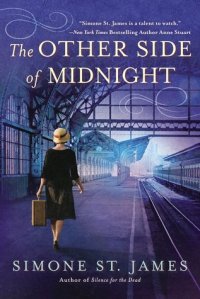
Serena’s Review: “The Other Side of Midnight”

The Other Side of Midnight Book: “The Other Side of Midnight” by Simone St. James

Publishing Info: NAL Trade, April 2015

Where Did I Get this Book: Audio book from the library

Book Description from Goodreads: London, 1925. Glamorous medium Gloria Sutter made her fortune helping the bereaved contact loved ones killed during the Great War. Now she’s been murdered at one of her own séances, after leaving a message requesting the help of her former friend and sole rival, Ellie Winter.

Ellie doesn’t contact the dead—at least, not anymore. She specializes in miraculously finding lost items. Still, she can’t refuse the final request of the only other true psychic she has known. Now Ellie must delve into Gloria’s secrets and plunge back into the world of hucksters, lowlifes, and fakes. Worse, she cannot shake the attentions of handsome James Hawley, a damaged war veteran who has dedicated himself to debunking psychics.

As Ellie and James uncover the sinister mysteries of Gloria’s life and death, Ellie is tormented by nightmarish visions that herald the grisly murders of those in Gloria’s circle. And as Ellie’s uneasy partnership with James turns dangerously intimate, an insidious evil force begins to undermine their quest for clues, a force determined to bury the truth, and whoever seeks to expose it…

Review: This book had many things going for it that fit into my preferences. Mystery: check. Historical time period: check. Dash of romance: check. All in all, right up my alley. And, for what it was, it met these expectations. It didn’t blow me away, but I enjoyed it.

Right off the bat, this book has been marketed as a gothic, ghost story. I’m not sure that’s right. This is a mystery. Yeah, there are some ghosts in it, but if you’re expecting horror, you’re going to be disappointed (also, it’s Kate’s job to read those so I don’t have deal with the nightmares!) But as a mystery novel, it does succeed. Ellie is a unique narrator and detective. She doesn’t start out with the goal of becoming an investigator and falls into the role purely from chance. But it becomes clear that she has a natural inclination, and her decisions are smart and she deals with the challenges thrown her way in a believable manner.

Often, mystery novel investigators fall into the category of “the next Sherlock Holmes.” They make wild leaps of logic, and their deductions are impossible for the reader to follow. We’re meant to just go with it and realize that we couldn’t possibly follow the thought process with our normal brains, which is what makes the author’s main character such a special investigative snowflake.Sometimes this can work. I love me a Sherlock Holmes esque character, believe me.

kc3cuvmstgtce
Preach, Rob Lowe!

But, at other times, it comes off as lazy writing and a way for the author to avoid laying down the clues necessary for the reader to follow the mystery appropriately. This book, however, succeeds very well in this regard and provides just enough to keep the reader guessing without feeling completely lost.

I really enjoyed the psychic angle for the story. While this could fall under the category of “easy outs” like I was just ranting about a second ago, I gave this book an pass for it because of the attention given to this portion of the story. It is as much about how these different women have chosen to handle being given this gift as it is about the murder mystery. Ellie, her mother, and Gloria all handle this power in very different ways. [Insert Spiderman quote: “With great power comes great responsibility.”] The isolation of this gift is fully explored, especially in the context of the time period when operating as a businesswoman alone without a husband would have been isolating on its own, psychic abilities aside. There is a fascinating bit where Gloria discusses her role as a woman in society and what it means that out of everyone, three women were given this amazing ability.

With all of these details, however, the story did feel a bit bogged down in the middle. There are frequent jumps back in time to explore Ellie’s relationship with her mother and Gloria. And while these scenes are necessary to flesh out the story, there comes a point where I just wished we could move on with the real mystery. A killer was lurking in the city! Get a move on!

I also liked the romance included in the story. It felt a bit rushed towards the end, but I was impressed by how fully the author was able to explore James’ PTSD and experiences from the war without the the ease of an omniscient third person narrator. There were moments when James edged into “protecting the little woman” territory, but I appreciated how quickly and effectively Ellie stomped down on this while remaining true to the perspective and realities of a woman living in the 1920s.

As far as the audiobook goes, I enjoyed the narrator quite a lot. They got a British narrator for the story and the inclusion of a variety of London accents helped flesh out the many characters. Full marks for the audiobook version!

Rating 7: Good mystery novel. Not doing anything super new, but the psychic angle and time period made it a very fun read.

Reader’s Advisory:

“The Other Side of Midnight” is included in these Goodreads lists: “Fiction set in the 1920s” and “Historical Mysteries and Thrillers Featuring Women.”

Find “The Other Side of Midnight” at your library using WorldCat!

Serena’s Reviews: “Magic Shifts”

"Magic Shifts"Book: “Magic Shifts” by Ilona Andrews

Publishing Info: Ace, August 2015

Where Did I Get this Book: The library!

Book Description from Goodreads: After breaking from life with the Pack, mercenary Kate Daniels and her mate—former Beast Lord Curran Lennart—are adjusting to a very different pace. While they’re thrilled to escape all the infighting, Curran misses the constant challenges of leading the shapeshifters.

So when the Pack offers him its stake in the Mercenary Guild, Curran seizes the opportunity—too bad the Guild wants nothing to do with him and Kate. Luckily, as a veteran merc, Kate can take over any of the Guild’s unfinished jobs in order to bring in money and build their reputation. But what Kate and Curran don’t realize is that the odd jobs they’ve been working are all connected.

An ancient enemy has arisen, and Kate and Curran are the only ones who can stop it—before it takes their city apart piece by piece…

Review: So, now that we’re all caught up with the “Kate Daniels” series, let’s jump right in to her next challenge! Life in the suburbs! I feel ya, Kate. Shockingly, Kate and Curran are not exactly ideal neighbors now that they’ve chosen to abandon living at the Pack fortress and have bought a home and property in suburbia. Curran’s habit of turning furry and huge and Kate’s late night excursions are most unwelcome.

odok9
Ew. Shapeshifters.

Curran seems to have been helping Kate with her usual tasks of cleaning up the city. Even more of a chore, now that she has “claimed” Atlanta as her own territory in an attempt to save it from her power-mad father, Roland. But, of course, something must go wrong and their friend, werebison Eduardo (I told you every creature that was ever imagined is in this series!) has gone missing and some new big bad is in town with a score to settle.

After having taken a break from this series for about a year and now jumping back in, I kind of forgot what a madhouse this world is! I mean, this book is comprised of not only a werebison, but the family drama of a werebison/werebear relationship, evil unicorns, a pegasus, and, count them, three giants! What is this book?! Fun, that’s what it is.

Kate is her usual snarky, badass self which is always the primary joy for me with this series. It was also fun seeing Curran outside of his role as the Beast Lord. In a lot of ways he was the Robin to Kate’s Batman in this book, which was a fun change from the usual Pack politics drama that he had been tied up within from the last few books. At the same time, it seems like he will now be running the Mercenary Guild, so he might fall back into the same type of position, just with another group. This probably makes sense for a character like this. Too much Robin is no one’s favorite thing. One book of it was probably enough!

Several of my favorite characters were noticeably light in this book, which was too bad. Saimen and Derek barely showed up. But we did get to meet Martha, a werebear who is the alpha of Clan Heavy. She was only there for moments, but I love her already. There was also a delightfully awkward family dinner with Kate, Curran, Julie, and Roland.

Roland’s all: “Family bonding time!”

Kate’s all:

date-wine-dinner-excused-brb-gif-blonde-awkward-gif

As far as the villain goes…meh? It was another new creature, and all in all it was an interesting concept. But at the same time, now that Roland’s on the scene, stories like these feel more and more like filler. And, not only did we not get a real showdown there or much progress beyond an info-dump at Applebee’s (Roland’s restaurant of choice??), Kate didn’t seem to even enhance her abilities in any way that could be read as progress towards that inevitable clash. So that was too bad.

That said, I still enjoyed this book for what it was: a quick foray into a messed up Atlanta that I’m sure as heck pleased NOT to live in. Though, I’d take the pegasus.

Rating 7: On par with my rating of the series over all

Reader’s Advisory: 

“Magic Shifts” is included in these Goodreads lists: “Badass Female Leads” and “It’s All About The Swords!”

Find “Magic Shifts” at your library using WorldCat!

Serena’s Series Review – “Kate Daniels” Series

Kate Daniels SeriesA couple of years ago, I went on an urban fantasy binge. Urban fantasy, as a genre, has been very hit and miss for me. On paper it looks like something I would love. In reality? Most of what I’ve read has been fairly “meh.” There are a couple of series, however, that have caught hold and Ilona Andrews’ “Kate Daniels” series was one of them. Her newest book, “Magic Shifts” was published last August with the next in the series is coming out this September. I’ll be reviewing “Magic Shifts” soon and definitely have her newest on my mental list of books to look forward to this fall. But there are like 7 books in this series before this point! In lieu of an exhausting, and frankly, likely boring, review of each and every one of these books, I’m going to combine them all into a mega series review! We’ll see how this goes!

Books: “Magic Bites,” Magic Burns,” “Magic Strikes,” “Magic Bleeds,” Magic Slays,” “Magic Rises,” and “Magic Breaks” by Ilona Andrews*

Publishing Info: Ace, 2007, 2008,  2009, 2010, 2011, 2013, 2014

Where Did I Get this Book: all from the library!

Review: This series takes place in post-Shift Atlanta sometime in the near future. The Shift, a near apocalyptic event where magic suddenly re-entered the world, occurred years before and humanity is still adjusting to what this means for the world order. Suddenly there are shapeshifters, vampires, ghouls, and who knows what else running around the world wreaking havoc on the ordinary folk. The government has adjusted accordingly and attempted to set up systems to maintain order. One piece of this system is the Mercenary Guild. Its name is self-explanatory. Some creepy critter shows up, people can hire a mercenary to take care of it. Kate Daniels is one of the best, and this series is her story.

Throughout the series, Kate explores the mysteries of her past, while saving the day and forming close relationships with a ragtag group of other mercenaries, shapeshifters, vampire controllers, mages, etc, etc. Basically, she knows everyone in Atlanta. And, per typical urban fantasy requirements, there is a strong romantic element in her growing relationship with the Beast Lord, Curran, who is a werelion and the alpha of the Atlanta shapeshifter pack. Steaminess ensues.

What makes this series stick for me in ways that other urban fantasy series did not is our heroine, Kate. The spunky, snarky, warrior woman in these kinds of books is a well-trodden trope. However, Kate stands out not only in her consistency and general ability to avoid making ridiculous, self-sacrificial, dramatic decisions (per other frustrating heroines in series-that-shall-not-be-named), but also in the genuine evolution of her character throughout the books. While there are weaker books in the series than others, and there are moments where she falls into these stereotypes, overall, Kate learns from her mistakes, accepts who she is, and doesn’t devalue those around her, their feelings, or what they can contribute to her cause.

Curran, also, works well as the romantic lead. There are times, especially in the early books, where he plays a bit too much into the classic “alpha male” role which didn’t rub me the right way. But over the course of the series, he, too, evolves as a character and becomes a strong partner for Kate. And, even at his worst, he still acknowledges Kate’s independence and does not interfere in her adventuring ways.

There does come a point towards the last two thirds of the series where I call relationship shenanigans. Up to this point there had been the usual relationship set-up drama, but at this stage in the story, Kate and Curran were firmly an item and had worked through many of their issues. And then. And then!

Enough, I'm tired of your shenanigans

The wedge that was used to insert drama into their relationship felt very contrived. Both Kate and Curran behaved out-of-character, in my opinion, and it was all highly disappointing for a series that had handled its core relationship so competently up until this point. Luckily, this gaffe only lasted through the one book and things have returned to normal since. During this section in the series, it felt like Andrews was coming up against a sort of wall, having gotten her couple together and fleshed out many of Kate’s familial mysteries. She did recover, however, and I am happy to report that the next few books were on par once again.

When I said earlier that Kate knows everyone in Atlanta? Yeah, I meant everyone. There are so many characters in this series! And most of them are tons of fun. A few of my favorites are Aunt B, a werehyena, Andrea, a sharpshooter merc, Julie, a street kid with magical flare, and Saiman, a….who knows what really? But he snarks at Kate and makes her uncomfortable and is fun all around. And there are many, many more! This is both a plus and a minus. As the series continues, it becomes impossible to spend enough time with all of these great characters in each book. One book will spend extra time with one or two and only have brief appearances from the others, and vice versa. So, depending on which characters you like, and how much page time they get in each book, there can be a dramatic difference in your enjoyment of one book in the series as compared to another. Luckily, if you’re just there mostly for Kate, like I am, you’re good to go the whole time.

Each book also seems to live and die by its villain. Some are stronger than others. There are some genuinely creepy magical beings in these books. But, in general, the creativity of the world and how civilization has adapted to all of the craziness is what makes this series so fun. I burned through the first 3-4 books in this series in a matter of weeks. I’m not sure I would recommend this approach, as aspects of the stories became a bit too familiar from one book to the next. But it can’t say anything too bad that I was invested enough to fall into that trap in the first place. If you like urban fantasy, definitely check out this series, and look out for my upcoming review of “Magic Shifts” where Kate beats up on some giants!

*Can we take a moment to ask why urban fantasy novels have such terrible names and covers? I mean, look at those things! Sigh.

Rating 7: Fun urban fantasy lark. You know what you’re getting, but it’s the good kind.

Reader’s Advisory: Since this is a series, it’s not really on a list, per se. If you liked this series, however, I would recommend the “Mercy Thompson” series by Patricia Briggs and “October Daye” series by Seanan McGuire.

Find the first book in this series, “Magic Bites,” at your library using WorldCat!