Serena’s Review: “Unmade”

18309803Book: “Unmade” by Sarah Rees Brennan

Publishing Info: Random House, September 2015

Where Did I Get this Book: the library!

Book Description: Kami has lost the boy she loves, is tied to a boy she does not, and faces an enemy more powerful than ever before. With Jared missing for months and presumed dead, Kami must rely on her new magical link with Ash for the strength to face the evil spreading through her town.

Rob Lynburn is now the master of Sorry-in-the-Vale, and he demands a death. Kami will use every tool at her disposal to stop him. Together with Rusty, Angela, and Holly, she uncovers a secret that might be the key to saving the town. But with knowledge comes responsibility—and a painful choice. A choice that will risk not only Kami’s life, but also the lives of those she loves most.

Review: I finally got around to picking up the last book in the “Lynburn Legacy” trilogy. And, while I was left a bit cold by the second book in this series, I am happy to report that “Unmade” pulled the series back from the edge and ended on a solid note.

But first, before I go into any details about the book itself, can we take a moment to be aghast together at this cover? For the sake of discussion, here are the three covers in the series:


Obviously there was a huge shift between the first book and the second. My guess is that the first cover was coming across as “middle grade” and the publishers thought to “age it up” by switching cover art. But to this? Generic back-of-girl-walking-into-distance artwork? At least the first was interesting and unique. The second two just look like every other book on the shelf. I’ve never been a fan of the titles of these books, either. They say next to nothing about what the story is (what genre is this? what time period? what’s unique here?). And this problem is only exasperated by these generic covers. And what’s worse, by the time we get to the third one, the generic cover actually makes no sense! There is absolutely zero reference to the ocean or to Sorry-in-the-Vale even being anywhere near the ocean in these books. While the second cover at least draws feelings of mystery and suspense with a creepy woods (there is at least a creepy woods in the story), the third cover looks like something from Spring Break: Hawaii!! It’s truly awful. I have many feelings re: book covers, and usually I’m good at tamping it down, but this time…

aubreyplazano
(source)

But, enough of that, on to the review! Kami and co. start off this book in a pretty low spot. Rob Lynburn has taken control of the town, Jared is missing, presumed dead, and Kami sharing a sorcerer/source bond unwillingly with Ash. It’s all very awkward and uncomfortable. First off, I commend Brennan for “going there” with the darkness in this book. It doesn’t pull any punches with the horror of what the Lynburn legacy of magic and might stands for, and the type of rule that Rob hopes to usher back in. With that, however, comes a challenging hole to be dug out of. I was concerned that some type of magical out was going to appear, but for the most part I was satisfied with the direction this story took in its final third. While I’ve always wished for a bit more explanation into the magic system (it seems like people just “have” powers and can then do anything. Harry Potter has spoiled an entire generation to fantasy reading where we expect to hear about our characters “learning” their magic!), over all I the expanded ideas with regards to connections between sorcerers and sources was entertaining and interesting.

As I’ve said in my previous two reviews, the characters are what drive this story and the reason I kept returning to the series. Kami is such a healthy, balanced teenage girl protagonist. She struggles with not only the fantasy elements of the story, but problems that many teenagers face: shifting relationships with parents, connections with siblings, evolving friendships, and, of course, romance.

The romance is probably the weakest element of this story for me. By the end of the second book, I thought things had been largely resolved in that area and I was looking forward to a story more closely focused on plot than on the romance angst. Unfortunately, it is made a thing again. And really, because it had been seemingly resolved in the second book, it felt like hoops and out-of-character behavior had to be used to create drama in this department, a writing trope that I never appreciate. At this point in the story, especially when there were serious events going on in life, the relationship angst felt contrived and I almost was rooting for Kami to just slam the door in Jared’s whiny, mopey face once and for all. Alas, she did not. Ultimately, this also resolved itself in a surprisingly satisfying manner by the end of the book, but I feel like a lot less page time could have been devoted to the whole plot line to begin with.

There are moments of this story where the dialogue is laugh-out-loud in its witticisms, but I’ll be honest, there were a few parts that were cry-worthy as well. All in all, it was a very satisfying conclusion to a solid trilogy in the YA fantasy genre. If any of these elements are up your alley, I definitely recommend checking out this series!

Rating 7: A satisfying conclusion full of witty and fun characters!

Reader’s Advisory:

“Unmade” is included on these Goodreads lists: “Diversity in Young Adult and Middle Grade” and “What a Wonderful World – A Celebration of Imaginative World-Building.”

Find “Unmade” at your library using Worldcat!

Previous review: “Unspoken” and “Untold”


Serena’s Review: “The Anatomist’s Wife”

13542496Book: “The Anatomist’s Wife” by Anna Lee Huber

Publishing Info: Berkley, January 2012

Where Did I Get this Book: audiobook from the library!

Book Description: Scotland, 1830. Following the death of her husband, Lady Darby has taken refuge at her sister’s estate, finding solace in her passion for painting. But when her hosts throw a house party for the cream of London society, Kiera is unable to hide from the ire of those who believe her to be as unnatural as her husband, an anatomist who used her artistic talents to suit his own macabre purposes.

Kiera wants to put her past aside, but when one of the house guests is murdered, her brother-in-law asks her to utilize her knowledge of human anatomy to aid the insufferable Sebastian Gage–a fellow guest with some experience as an inquiry agent. While Gage is clearly more competent than she first assumed, Kiera isn’t about to let her guard down as accusations and rumors swirl.

When Kiera and Gage’s search leads them to even more gruesome discoveries, a series of disturbing notes urges Lady Darby to give up the inquiry. But Kiera is determined to both protect her family and prove her innocence, even as she risks becoming the next victim…

Review: Well, I guess it was coming. I had been on a historical binge for the last few weeks, mostly to great success, so there was bound to be a come-down heading my way, and sadly that come-down arrived in the form of “The Anatomist’s Wife.” Really, I should have been skeptical at the title alone considering that “The [insert occupation here]’s Wife” has been the working title of every new work wanting to make a name for itself in the historical fiction world for the last 5 years at least. But the cover was so beautiful! And what if it was another great historical woman detective series that I could just dig my teeth into for the next few months! And look at how pretty! Alas, this book suffered from failings in writing, narrative, and characterization, as well as fell into a few tropes that are particular pet peeves of mine.

For the good, on the whole the writing is fairly strong. The author wasn’t pulling any narrative marvels out of her hat, but it was clear and concise, and for the most part, the dialogue was believable and interesting. Unfortunately, there were also a few distractions. The story is set in Scotland, and while it is explained that many of the characters are from London and thus devoid of a Scottish accent, the author chooses to sprinkle bits of the dialect into the story in such a way that is very distracting. Kiera’s brother-in-law, for example, is originally from Scotland but has apparently lost much of his accent due to schooling. Fine, sounds believable. But then at bizarre intervals throughout the story, he suddenly starts speaking in a deep brogue.

The other sticking point I found with the writing was the author’s choice to write from first person. I’ve long held the view that first person narration is much more difficult to write than third person, and there’s a reason many readers don’t prefer it due to these challenges. For example, in this story, Kiera refers to her own hair as “chestnut tresses” at least twice. No one thinks of themselves like that! Or, if they do, they are a thoroughly strange and probably unsavory character. There were also several anachronisms in the way that Kiera thought/behaved. I’m all for the strong, independent woman character in historical mysteries like this, but there were at least 12 too many eye rolls for even my taste.

Which leads into one of my biggest criticisms of the story: Kiera herself. It felt like the author wasn’t sure whether she wanted to write a historical mystery or a romance novel. And this indecision resulted in very inconsistent characterization for Kiera. She would wildly vacillate from one extreme to another. First as a competent, confident, and independent-minded widow who has seen the nasty parts of the world and has chosen to use the skills she has gained from this to solve a horrendous murder. And next as a weepy, weak, irrational, love-stricken lady who literally clings to the men around her. I’m all for fully rounded out characters, as that’s just a true portrayal of people. We all can be competent one minute and irrational the next, but there’s usually a good explanation for the change. Definitely a better one than “she needs to have an emotional breakdown so that when the love interest sweeps in it’s romantic!” which is often what it felt like here.

Further, there were two tropes of romance novels (at this point, I’m pretty convinced that that was what the author should have written and just left off the whole mystery to begin with) that I absolutely can’t stand. First, while most romance novels have a progression of feelings between the heroine and the hero that can often start with some level of dislike, this book took this idea and would speed the process up one minute and rewind it the next. Kiera hates Gage, he’s a rake! Gage pays her a very small compliment and Kiera’s heart is fluttering and she doesn’t know why! Kiera really doesn’t like him, look at all that flirting! But her stomach swoops when he walks in the door! What can that be about? She definitely doesn’t like him. Sigh. It was exhausting and undermined Kiera as a person. She came across as completely unaware of herself and those around her, which is not a good trait in a want-to-be detective.

Second, Kiera was constantly criticizing the women around her for being shallow and silly. Even worse, she was constantly being told by one man or another how unique and special she was because she “wasn’t like other women.” In general, if the only way a book/author can make the main female character worthy of praise is by tearing down all the women around her, maybe the main female character just isn’t that special to begin with? Like I said, I’m all for the strong, independent women character, but you don’t get there by implying that any other type of woman whose interests might align with the more traditional roles women have played is somehow lesser.

The mystery was adequate. I was able to predict the killer fairly early on, which is always disappointing, but there was a good trail of clues to follow and things tied together nicely. The secondary characters were also interesting, especially Kiera’s sister Alanna who had much more spunk and fire than Kiera herself, sadly.

All in all, I was pretty disappointed by this book. If you are more interested in a historical romance novel with a dash of a mystery, I might recommend this. But not the other way around.

i-expected-more-from-you-james-mcavoy
(source)

Rating 4: A very “meh” mystery and an irritating leading lady makes for a not great reading experience.

Reader’s Advisory:

“The Anatomist’s Wife” is included on these Goodreads Lists: “The _______’s Wife,” and “Best Romantic Mystery Series.”

Find “The Anatomist’s Wife” at your library using WorldCat!

Serena’s Review: “A Countess Below Stairs”

714569 Book:“A Countess Below Stairs” by Eva Ibbotson

Publishing Info: Speak, May 1981

Where Did I Get this Book: audiobook from the library!

Book Description: After the Russian revolution turns her world topsy-turvy, Anna, a young Russian Countess, has no choice but to flee to England. Penniless, Anna hides her aristocratic background and takes a job as servant in the household of the esteemed Westerholme family, armed only with an outdated housekeeping manual and sheer determination.

Desperate to keep her past a secret, Anna is nearly overwhelmed by her new duties—not to mention her instant attraction to Rupert, the handsome Earl of Westerholme. To make matters worse, Rupert appears to be falling for her as well. As their attraction grows stronger, Anna finds it more and more difficult to keep her most dearly held secrets from unraveling. And then there’s the small matter of Rupert’s beautiful and nasty fiancée…

Review: I am on a bit of a historical fiction kick currently, it seems. And this story, with its mixture of “Downton Abbey” themes and motifs combined with a main character who survived the Russian revolution, sounded just about perfect right now. While there were definite strengths and weaknesses of this story, I ultimately very much enjoyed it.

Anna, whose family lead an idealic life in the Russian aristocracy before the revolution overcome their country, has now fled to England with the remaining members of her family, and is broke and facing a new life for which she is completely unprepared. Luckily, she finds a place as a housemaid in the household of the Earl of Westerholme. I say “luckily” because, while the book description leads readers to believe that Anna struggles with this transition, she manages to find herself in one of the best households one could imagine. Her co-workers are hardworking and, while initially very skeptical of her clearly inexperienced background (though they only think she is untrained, unaware of her high born status), they are supportive and recognize her hard work and effort. And the family all end up loving her immediately as well, even the family dog!

This speaks to one of my largest criticisms of the book. Reading the book description, I was looking forward to a story about struggle, hope, and the ability to overcome the tough hand life had dealt Anna. But ultimately? She seemed to glide through it all with barely a misstep! Her childhood, before the revolution, is described in rosy hues and she’s pretty much the perfect child, notably never spoiled, always humble and cheerful. And then, thrown into a position as a maid, she seems to adjust instantly and everyone love her! The dog, the eccentric uncle (they bond over classical music), the senile mother of the butler (Anna gives her something to do!), Ollie, the young neighbor girl who struggles with her health (Anna never makes her feel like an outsider!). Anna was bit of a “special snowflake,” I guess is what I’m saying.

While this aspect of her characterization was a bit much, there were also very funny bits. For example, to learn to be a housemaid, Anna reads a 3 volume tome about the do’s and don’ts of service and is eternally quoting it at the other workers, much to their chagrin. She also curtsies elaborately to everyone, like so:

tumblr_m59hugea111qlgcyro1_500
I was pretty much picturing “Anastasia”throughout this whole book…(source)

Ultimately, it was the villain character that made this book so fun. I found myself wanting to rush through the story just to get to the parts where Rupert would realize how completely terrible his fiancee really was. And she’s not villainized in the typical way (I was concerned that this was going to be a bit of a “evil for being popular” trope). Instead, Muriel has a keen interest in eugenics and “perfecting” the human race. So, you can guess where that was going! She was delightfully horrible.

My second criticism of the book was the ending and how it was resolved. Rupert is a rather bland leading man, and I was waiting for him to actually make some choices and stand up for his family and household whom he had exposed to the workings of his cruel fiancee. Instead, things are wrapped up in a way that seemed a bit out of left field, and by periphery characters. I feel that this could have been handled a bit better.

I listened to the audiobook version of this and very much enjoyed the narrator. She had a very “Dowager Countess of Grantham” type style which was lovely. The quality of the recording was a bit lacking, but I generally enjoyed it.

If you want a short, sweet historical story and can tolerate a bit of a “Mary Sue” type leading lady, definitely check this book out! Like I said, the villain is lovely to hate.

Rating 6: Solid story with a unique addition of the Russian revolution, but the leading lady was a bit too perfect and the ending a bit too much of an “easy out.”

Reader’s Advisory:

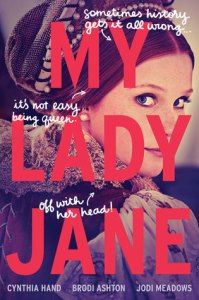
Serena’s Review: “My Lady Jane”

22840421Book: “My Lady Jane” by Cynthia Hand, Brodi Ashton, and Jodi Meadows

Publishing Info: HarperTeen, June 2016

Where Did I Get this Book: the library!

Book description: The comical, fantastical, romantical, (not) entirely true story of Lady Jane Grey. In “My Lady Jane,” coauthors Cynthia Hand, Brodi Ashton, and Jodi Meadows have created a one-of-a-kind fantasy in the tradition of “The Princess Bride,” featuring a reluctant king, an even more reluctant queen, a noble steed, and only a passing resemblance to actual history—because sometimes history needs a little help.

At sixteen, Lady Jane Grey is about to be married off to a stranger and caught up in a conspiracy to rob her cousin, King Edward, of his throne. But those trifling problems aren’t for Jane to worry about. Jane gets to be Queen of England.

Review: I listed this book as one of my picks for June Highlights without any real knowledge of what it would be. A comedy of the definitely-tragic life of Lady Jane Grey? Something about a horse? But the comparison to “The Princess Bride” is what truly sold me on it, and I immediately requested it from the library. And it was a blast!

King Edward is dying. Or so he’s been told. And in a brilliant scheme of his (not) own making, he decides to line up his best friend and cousin Lady Jane Grey to inherit the throne behind him. But to do so, she should really be married so the male heirs can take over eventually, because women are questionable leaders, Edward has to believe. And so enters Lord Gifford, or “G” who has a bit of a “horse” problem. That is, he becomes a horse from dawn to dusk every day. So now, poor Jane must mourn Edward (or does she?), become queen, and deal with a husband who prefers apples. It’s all quite lovely.

I am generally hit-and-miss on the concept of duel protagonists, even more skeptical of three. But this book pulls it off! We have chapters from Edward, G, and, of course, Jane, to tell us their story. Naturally, it would be easy for Edward’s chapters to fall to the wayside in a story that is largely about Jane’s queenship and her burgeoning relationship with G, her husband/horse. But I was surprised to find myself truly enjoying Edwards contributions and his journey to self-awareness. Yes, Edward, maybe women can rule…maybe, your half-sister, even, Ness (also known as Elizabeth…)?

G and Jane, however, were the true heart of the story and I enjoyed them both immensely. Jane loves books, so there was a natural kinship between us there.

giphy5
(source)

At one point, in the early more rocky stages of their relationship, Jane builds a wall of books between herself and G in the carriage because there was not enough room in the trunks. This is my kind of girl. G, too, had a great voice and sense of humor. His perspective from his “horse self” was hilarious.

Really, the humor is what made this book. The dialogue was witty, and the authors fully embraced the ridiculousness of their concept, and it as almost impossible to not feel their own laughter emanating from the pages.

And yes, the comparisons to “The Princess Bride” were on point. The use of a narrator inserting thoughts and opinions throughout the story was used in the same way, and there definite nods to the story itself. In one scene, G refers to a large bear by some long acronym and proclaimed he didn’t believe it existed (ala “ROUSs? I don’t believe they exist!”) However, while I enjoyed these nods and the style in general, there were points where I felt like it was leaning too heavily on elements from that story. A nod here and there, sure, but there were a few too many, especially with the parenthetical narration bits that struck a bit too closely to “The Princess Bride.” It’s one thing to follow a format, it’s another to almost copy an idea. Parts of this made me uncomfortable.

I also really liked the twisting of history. Instead of the actual struggle between Catholics and Protestants that was going on during this time period (and lead to the conflict in rulers with Mary and Elizabeth fighting for different national religions, essentially), this book changes it to a conflict between the Verities (people who stay people and believe this is the RIGHT way to be) and the Ethians (those who can turn into nifty creatures like horses/dogs/etc). It was fun seeing what was actually a very serious conflict be turned into such a creative fantasy adventure.

Which speaks to tone over all. Like I said, this is definitely a comedy story. If you’re looking for anything regarding a serious, historical book, this is not for you. The story/characters/narrator consistently make fun of elements of the time period (see: sexism regarding women rulers), and the dialogue is full of anachronisms. But, if you’re in the mood for a quirky, fun, romantic comedy, this book is definitely for you!

Rating 8: Super fun story, with three great leads. If you liked “The Princess Bride,” you’ll like this. But was also a bit too close to this original, at times.

Reader’s Advisory:

“My Lady Jane” is a very new book, so it’s not on many lists. Obviously, if you liked this and haven’t read “The Princess Bride,” go do that now! And another great comedy fantasy series I love is called the “Hero” series by Moira J. Moore and starts with “Resenting the Hero.”

Find “My Lady Jane” at your library using WorldCat!

Serena’s Review: “The Rose and the Dagger”

23308084Book: “The Rose and the Dagger” by Renee Andieh

Publishing Info: G.P. Putnam’s Sons Books for Young Readers, April 2016

Where Did I Get this Book: the library!

Book Description: In a land on the brink of war, Shahrzad is forced from the arms of her beloved husband, the Caliph of Khorasan. She once thought Khalid a monster—a merciless killer of wives, responsible for immeasurable heartache and pain—but as she unraveled his secrets, she found instead an extraordinary man and a love she could not deny. Still, a curse threatens to keep Shazi and Khalid apart forever.

Now she’s reunited with her family, who have found refuge in the desert, where a deadly force is gathering against Khalid—a force set on destroying his empire and commanded by Shazi’s spurned childhood sweetheart. Trapped between loyalties to those she loves, the only thing Shazi can do is act. Using the burgeoning magic within her as a guide, she strikes out on her own to end both this terrible curse and the brewing war once and for all. But to do it, she must evade enemies of her own to stay alive.

Review: I picked up this book right on the heels of finishing the first, and while I enjoyed the first one for the most part, I was almost more intrigued by this sequel because it wouldn’t be that. The “retelling” of “A Thousand and One Nights” had been thoroughly wrapped up in the first book, so endless opportunities were spread before this one. And the cliffhanger left some good room for growth. For the most part, I think this succeeds, though it does get bogged down by the trappings of the first book.

Originality played highly in this book’s favor. Freed from the original trappings of serving as a retelling, the author had room to take world-building and character growth in her own directions, and for me, this really succeeded. While before the story was trapped largely within the confines of the palace in Rey, here Shazi has been released on the greater world and new and exciting destinations come with it. And alongside these fantastical new settings, adventures followed.

In fact, I would classify this book as an adventure story, first and foremost. Its predecessor was largely a romance, and the hints of a love triangle made me nervous for this book’s direction. Gladly, these worries were unnecessary. The romance served as motivation and fuel to the fire of Shazi’s attempts to end the curse, but it is a matured romance that is steady and sure of itself. No needless wavering or second-guessing.

I also really enjoyed the nods to Aladdin in this book. The scenes with the magic carpet were beautiful and obviously made me want one for myself. And the inclusion of a genie-like character was inspired, most especially given the well-rounded characterization that is applied in the relatively short amount of page time that is devoted to the character.

There were a few downsides, however. While I enjoyed the increased time that was spent from Shazi’s sister’s perspective, there was also a rushed romance here that felt unnecessary. Irsa’s journey was one of self-discovery. As a character who had spent a life time comparing herself unfavorably to her fire-y and strong sister, Irsa’s path to self-acceptance and appreciation for her own unique talents was one that I believe would speak to many readers. No need to add in the distraction of a burgeoning love. It felt like this was inserted purely to compensate for the fact that Shazi and Khalid’s own love story was past the “discovery” phase, and the author worried that more romance was needed. Unfortunately, I feel that this addition was a disservice to both Shazi’s and Irsa’s story. It was refreshing to read a series where the primary romance progressed in a normal manner, from new love to steady love, and the addition of a love interest to Irsa’s own tale distracted from the more interesting story of personal growth.

The other small niggle I had with this book was the inclusion of stories-within-stories. I listed this as part of the reason I enjoyed the first book, and given the fact that its a retelling of “A Thousand and One Nights,” it plays a large and natural role within the narrative. That’s all well and good. Unfortunately, this book isn’t that. The adventure and more action-packed nature of the story doesn’t serve as a natural vehicle for the insertion of shorter tales. While I understand that the author was attempting to highlight the importance of story-telling and reinforce what made Shazi so special to begin with, the addition of a few of these tales were more distracting than anything else. I wish the author had felt more comfortable letting her previous work stand for itself and allowed this book to be its own thing as well.

Overall, however, this book was a solid conclusion to the series. Characterization, over all plot progression, and the new additions to the story all served to fully round out the duology. For fans of retellings, or readers looking for a fantasy story set in a non-European setting, I highly recommend this book and series!

Rating 6: A solid conclusion, if a little undermined by trying to be too similar to the first book.

Reader’s Advisory:


Serena’s Review: “The Wrath and the Dawn”

18798983Book: “The Wrath & the Dawn” by Renee Andieh

Publishing Info: G.P. Putnam’s Sons Books for Young Readers, May 2015

Where Did I Get this Book: the library!

Book Description: One Life to One Dawn.

In a land ruled by a murderous boy-king, each dawn brings heartache to a new family. Khalid, the eighteen-year-old Caliph of Khorasan, is a monster. Each night he takes a new bride only to have a silk cord wrapped around her throat come morning. When sixteen-year-old Shahrzad’s dearest friend falls victim to Khalid, Shahrzad vows vengeance and volunteers to be his next bride. Shahrzad is determined not only to stay alive, but to end the caliph’s reign of terror once and for all.

Night after night, Shahrzad beguiles Khalid, weaving stories that enchant, ensuring her survival, though she knows each dawn could be her last. But something she never expected begins to happen: Khalid is nothing like what she’d imagined him to be. This monster is a boy with a tormented heart. Incredibly, Shahrzad finds herself falling in love. How is this possible? It’s an unforgivable betrayal. Still, Shahrzad has come to understand all is not as it seems in this palace of marble and stone. She resolves to uncover whatever secrets lurk and, despite her love, be ready to take Khalid’s life as retribution for the many lives he’s stolen. Can their love survive this world of stories and secrets?

Review: Fairy tale retellings have been enjoying quite their moment in the sun over the last few years in the young adult publishing industry. And while they are some of my favorite stories to read, I’ve also about reached my saturation point for the number of ways you can try to make the prince character in a version of “Cinderella” actually interesting. So, I was very excited when I ran across this book and discovered it not to be yet another common fairy tale exploiting a craze but instead a story inspired by “A Thousand and One Nights.” I mean, I dressed up as Scheherazade as a kid for Halloween once, so obviously I was going to read this immediately. And, for the most part, it’s a pretty solid entry.

It’s hard to review this while also gauging my reaction based on whether or not I appreciated this book for what it was actually doing or because I was just so thrilled it was doing something different from the many other retellings. A big question with these is whether or not it differs enough from the original story. And this sort of did? The basic premise is still there. King kills wives each morning, woman sets out to avenge her friend who was a victim of this madness, woman staves off the axe via elaborate and strategic story-telling. And Shahrzad embodied many of the traits of the original character: spunk, bravery, and sheer stubbornness to see this mad plan through.

Unfortunately, because it is a novel and not a fairy tale, the book also fell victim to its premise. In the fairy tale, it’s very easy to spin this type of tale and escape relating the details or inconsistencies, especially using common story telling lines like “Another morning dawned. Another day passed. And Scheherazade continued to enchant her king husband.” That’s sweet and poetic and moving forward along those lines, it’s easy enough to set up your happy ending. With this? Not as much. There’s no way, even with the most sympathetic king character to not make Shahrzad’s transition from “revenge driven murderess in the making” to “love stricken girl who thinks maybe, yeah, he’s not that bad” seem less then believable and make her, as a character, highly questionable. All that said? I think the author did the best she could with this set up. I mean, it’s a crazy story to begin with, so going in, there has to be some forgiveness for the madness of the whole set up.

Other than this, the writing and scene-setting was beautiful. Again, maybe it’s because we don’t see a lot of settings like this in YA fantasy books nowadays, but the descriptions of the desert and lifestyle were beautiful and fresh. I also liked the inclusion of the stories that Shahrzad told each night. It would have been easy to just use a cheat, maybe tell one story, and then sweep the remaining nights under the rug. But the tales themselves were interesting and fun. Your mileage with this may vary, however, as the stories can also read as long breaks in the actual narrative of the book itself.

One other big detractor: a love triangle.

tumblr_mtlkdecjws1qkiyi1o1_400
(Source)

Overall, I really enjoyed this story. It’s the first in a duology (praise be, not a trilogy or, heaven forbid, a series…) So, I’m moving directly on to the next and should have a review of that up soon! This story pretty much wrapped up the retelling part from the original, which leaves the next with completely new content. We’ll see how it goes!

Rating 7: Good retelling, but fell into some common pitfalls.

Reader’s Advisory:

Serena’s Review: “The Boy Who Lost Fairyland”

18961361Book: “The Boy Who Lost Fairyland” by Catherynne M. Valente

Publishing Info: Feiwel & Friends, March 2015

Where Did I Get this Book: from the library!

Book Description: When a young troll named Hawthorn is stolen from Fairyland by the Golden Wind, he becomes a changeling – a human boy — in the strange city of Chicago, a place no less bizarre and magical than Fairyland when seen through trollish eyes. Left with a human family, Hawthorn struggles with his troll nature and his changeling fate. But when he turns twelve, he stumbles upon a way back home, to a Fairyland much changed from the one he remembers. Hawthorn finds himself at the center of a changeling revolution–until he comes face to face with a beautiful young Scientiste with very big, very red assistant.

Review:

This book marks a notable shift from the books previous to it in the series. Alas, our beloved September is nowhere in sight! And instead of experience the bizarre transition from “reality” to “fairyland,” the trip has been reversed with poor baby troll, Hawthorn, being selected as a changling and mailed (the postal service exists everywhere it seems!) to the “real world.” Here he faces the challenges of adapting his nonsensical worldview to a very sensible (or so it claims) world. While the story differs, the beautiful writing, philosophical musings, and abundant creativity remains. So following my established reviewing format for this series, here are a few passages that stood out to me.

Growing up has been a theme throughout this entire series, and this book was no different. The mixture of melancholy and joy, confusion and excitement, and the general sense that we don’t have this whole thing figured quite out is wonderfully discussed.

I shall tell you an awful, wonderful, unhappy, joyful secret: It is like that for everyone. One day you wake up and you are grown. And on the inside, you are no older than the last time you thought Wouldn’t it be lovely to be all Grown-Up right this second?

So, too, the coping mechanisms of childhood. I, obviously, identify with this last method.

Some small ones learn to stitch together a Coat of Scowls or a Scarf of Jokes to hide their Hearts. Some hammer up a Fort of Books to protect theirs.

One of my favorite things about this series are the quirky insights into aspects of life that, on the surface, have very little to do with the story of a Changeling troll or a wandering human girl in Fairyland. One of my favorites from this book:

English loves to stay out all night dancing with other languages, all decked out in sparkling prepositions and irregular verbs. It is unruly and will not obey—just when you think you have it in hand, it lets down its hair along with a hundred nonsensical exceptions.

Philosophical views on life are vivid and rich in this book. I’m still surprised by how seamlessly the author works these in. What could so easily become preachy and silly-ly on-the-nose instead reads as a beautiful side note placed directly next to an excellent fairy tale.

A choice is like a jigsaw puzzle, darling troll. Your worries are the corner pieces, and your hopes are the edge pieces, and you, Hawthorn, dearest of boys, are the middle pieces, all funny-shaped and stubborn. But the picture, the picture was there all along, just waiting for you to get on with it.

The other books probably had this as well, but in this story I found myself appreciating the shorter, one sentence thoughts that sprung off the pages. Someone should make a coffee table book out of these stories with some of these quotes.

She’s an old woman possessed of great powers–but aren’t all old women possessed of great powers? Occupational hazard, I think.

Lovely.

It is not so easy to always remember who you are.

True.

Rules are for those who can’t think of a better way.

Correct.

A thing too familiar becomes invisible

Worth an extra thought.

While the beautiful language and creativity remained in this story, I found myself missing our familiar characters. Hawthorn is a lovely protagonist, but I had spent three books coming to know September, and the last books ends with the feeling that she is on the cusp of something important. And, while she does make an appearance towards the end of this story and I see the neat place that this story fill within the larger narrative, I still found myself finishing it and wishing for a bit more.

That said, I still highly enjoyed this book and it is clearly setting the series up for this final book. I’m both excited and so, so nervous! Please let things work out for my lovely September!

Rating 7:  Still quite enjoyable, but slightly less preferred than others in the series

Reader’s Advisory:

“The Boy Who Lost Fairyland” is included on this Goodreads list: “Fairies in Children’s Fiction” and “Changelings.”

Find “The Boy Who Lost Fairyland” at your library using Worldcat!

Previous Reviews: “The Girl Who Circumnavigated Fairyland in a Ship of Her Own Making” and “The Girl Who Fell Beneath Fairyland and Led the Revels There,” and “The Girl Who Soared Over Fairyland and Cut the Moon in Two.”


Serena’s Review: “The Ghost Bride”

16248223Book: “The Ghost Bride” by Yangsze Choo

Publishing Info: William Morrow, August 2013

Where Did I Get this Book: audiobook from the library!

Book Description from Goodreads: Though ruled by British overlords, the Chinese of colonial Malaya still cling to ancient customs. And in the sleepy port town of Malacca, ghosts and superstitions abound.

Li Lan, the daughter of a genteel but bankrupt family, has few prospects. But fate intervenes when she receives an unusual proposal from the wealthy and powerful Lim family. They want her to become a ghost bride for the family’s only son, who recently died under mysterious circumstances. Rarely practiced, a traditional ghost marriage is used to placate a restless spirit. Such a union would guarantee Li Lan a home for the rest of her days, but at a terrible price.

After an ominous visit to the opulent Lim mansion, Li Lan finds herself haunted not only by her ghostly would-be suitor, but also by her desire for the Lim’s handsome new heir, Tian Bai. Night after night, she is drawn into the shadowy parallel world of the Chinese afterlife, with its ghost cities, paper funeral offerings, vengeful spirits and monstrous bureaucracy—including the mysterious Er Lang, a charming but unpredictable guardian spirit. Li Lan must uncover the Lim family’s darkest secrets—and the truth about her own family—before she is trapped in this ghostly world forever.

Review: This book has been hanging around on my TBR list for so long that I have zero idea where it came from, and honestly, had very little idea what it was even about. A historical book about Malaysia in the late 1800s? A ghost story? Fantasy book? Yep. Yep to all three. “The Ghost Bride” came out of left field and was everything I hadn’t known to look forward to.

There are so many things I could talk about with this novel, I’m not even sure where to start. First off, I guess, is the rich detail that Yangsze Choo brings to this story. The language, culture, and vibrancy of Malaya (now Malaysia) was so rich and nuanced throughout. It was like the most beautiful, most interesting history lesson on a part of the world and the merging of several cultures that I had very little understanding of to begin with. It was evident that Choo had meticulously researched her subject, and more impressively, she integrated these facts and details in a way that never felt unnecessary or distracting from what was, largely, a very action-packed story.

The story itself was also surprising. I guess if I had read the book description a bit more thoroughly, this might not have been as shocking. But the unexpected turn from a traditional, period piece story into a underworld fantasy adventure was a jolt to the system. And even throughout these more fantastical portions of the story, the narrative never lost sight of its foundation, even then laying more insight into the time period, culture, and religious beliefs of the people of Malaya. (It is worth noting that while elements of this story were created by the author, she includes detailed author’s notes at the end that explain her decisions and provide even more insight into the background of these elements.) Even the ending was unexpected. About one third of the way through the book, I thought I had a pretty good idea where the story was going. About two thirds of the way through, I had changed this slightly, but it was still pretty much the same. The last 50 pages? Nope, I had it all wrong the whole time and the story was even better for it!

The characters themselves were also well written and thought out. Li Lan is an endearing protagonist, Tian Bai a compelling villain, and side characters such as her loving, yet superstitious nanny, Amah, and Er Lang, a mysterious man who keeps crossing Li Lan’s path, add flavor and spunk to the story.

Additionally, I listed to the audiobook version of this story which was read by the author herself. She had a great voice, and her pronunciation was particularly useful for a book like this where I would have likely butchered half the words in my head had I been reading the book. If you enjoy historical stories with an fantastical element, definitely check out “The Ghost Bride.”

Rating 9: An  unexpected yet very welcome surprise! Just like the ending of the story itself!

Reader’s Advisory:

“The Ghost Bride” is included on these Goodreads lists: “Historical Ghost Fiction” and “Chinese and Japanese Fantasy.”

Find “The Ghost Bride” at your library using Worldcat!

Serena’s Review: “Palace of Stone”

12926132Book: “Palace of Stone” by Shannon Hale

Publishing Info: Bloomsbury, August 2012

Where Did I Get this Book: the library!

Book Description: Coming down from the mountain to a new life in the city is a thrill to Miri. She and her princess academy friends have been brought to Asland to help the future princess Britta prepare for her wedding.There, Miri also has a chance to attend school-at the Queen’s Castle. But as Miri befriends students who seem sophisticated and exciting she also learns that they have some frightening plans. Torn between loyalty to the princess and her new friends’ ideas, between an old love and a new crush, and between her small mountain home and the bustling city, Miri looks to find her own way in this new place.

Review: Continuing my self-education in middle grade novels, after reading and enjoying “Princess Academy” it was a quick jaunt back to the library to scrounge up its sequel. And, while the first book can be read as a stand alone book (a trait I will never not praise), “Palace of Stone” is a worthy successor, expanding the world of Danland and challenging Miri’s own perceptions of right and wrong and her place within this society.

This story picks up shortly after the events of the first book with Miri and her village enjoying the boost to their local economy that came with Miri’s discovery of the true worth of the linder stone that their village mines. However, when Miri and a few familiar characters travel to Asland to join the soon-to-be princess, Britta, Miri discovers how tremulous this newly earned freedom can be. Revolution is rumbling throughout the kingdom of Danland.

One of the themes that I most appreciated from the first book was its emphasis on the joy of learning. Here, this concept is expanded even further with Miri attending university while in Asland and dreaming of her plans to continue and expand the local school she’s been running back home. The cast is also expanded when she gains an unexpected friend in fellow scholar, Timon.

Timon serves a definite purpose in this book, as he is the conduit between Miri and the underground swell of revolutionaries. And this concept of revolution, history, and democracy is at the core of the story. I greatly appreciate the care that Hale uses in laying out this path before Miri, with all of the temptation, confusion, and impossible choices that situations like this cause. And, while this is a middle grade novel and with this comes, perhaps, a few too many convenient solutions, Hale also spends a good portion of the novel fully exploring these themes before wrapping up the story.

Timon also brings with him a love triangle, and here is where I’m not so sure. While I think I understand what Hale was going for, forcing Miri and Peder to challenge the realities of their relationship and feelings in an adult manner (rather than the ease of an early crush), I question whether this was the best route. It also could just be that I’m so sick and tired of love triangles that even ones that are introduced for a good reason and, largely, executed well, are still frustrating to read.

In many ways this book was a step up from the first story. But at the same time, I struggled with it a bit more. Perhaps I just had higher expectations for Miri and wanted to see more growth in her as a character between the last book and this. Of course, she’s still young, and, of course, the point of this story was to challenge her even further, but perhaps when I’m reading about a character who is contemplating marriage, I also wanted to see a bit more perception from her. Her naivety in the first book was charming and believable. She’s still charming here, but there were points where her naivety was a bit much. We’ve been presented with a smart character, some common sense and ability to reason through certain things while still being challenged by others would have been more believable and enjoyable.

For readers who enjoyed “Princess Academy,” this book is a fun follow up. It retains many of the traits that made the first book so enjoyable while also adding complexity to the challenges the main characters face. While there were a few stumbling points, I definitely recommend it as a strong sequel story.

Rating 7: Worth checking out!

Reader’s Advisory:

“Palace of Stone” is included on this Goodreads list: “The Best Fairytales and Retellings” and “Best Heroine in a Fantasy Book.”

Find “Palace of Stone” at your library using Worldcat!

Previous Review: “Princess Academy”


Serena’s Review: “Untold”

15801763Book: “Untold” by Sarah Rees Brennan

Publishing Info: Simon & Schuster, August 2013

Where Did I Get this Book: the library!

Book Description from Goodreads: On the surface, Sorry-in-the-Vale is a sleepy English town. But Kami Glass knows the truth. Sorry-in-the-Vale is full of magic. In the old days, the Lynburn family ruled with fear, terrifying the people into submission in order to kill for blood and power. Now the Lynburns are back, and Rob Lynburn is gathering sorcerers so that the town can return to the old ways.

But Rob and his followers aren’t the only sorcerers in town. A decision must be made: pay the blood sacrifice, or fight. For Kami, this means more than just choosing between good and evil. With her link to Jared Lynburn severed, she’s now free to love anyone she chooses. But who should that be?

Spoilers for “Unspoken!”

Review: “Untold” picks up directly after the events that unfolded in “Unspoken.” The Lynburn family is in the midst of a civil war and the small town of Sorry-in-the-Vale is caught in the middle. Unwilling to simply sit on the sidelines while the fate of her town is decided without her, Kami gathers her friends and begins her own preparations. All while balancing her new, uncomfortable, un-linked relationship with Jared Lynburn. “Unspoken” ended with a bang, and between the now open secret that is the sorceror infestation in the town, and Kami and Jared’s evolving relationship from source/sorceror to…who knows what, there was a lot of material to work with. And sadly, I feel like most of that material was dropped in favor of witty dialogue.

This may be an example of an author’s strengths playing against her. As I mentioned in my review of the first book, this story, too, was peppered with snappy and fun language. However, unlike the first book, the stakes are much higher from the very beginning of this story. There is much less room in the natural evolution of the plot for characters to all stand around chatting like they’re in an episode of “Gilmore Girls.” So to create these situations, the author had to put the brakes on her story and create relationship drama, all to a largely disappointing effect.

Unfortunately, that relationship drama manifests itself not only in the upping of the love triangle potential seen in the first book, but also in creating a tangent storyline for Holly who is dealing with her confusing feelings after being kissed by Angela. The love triangle is doomed from the very beginning. Aside from my feeling that it is impossible to write a realistic love triangle, this one is made all the more silly from bizarre situations like “oops, it was dark and I kissed the wrong boy!” to the classic misunderstandings that are only possible due to incredible amounts of plot acrobatics. And then when they “suddenly” realize things…

p.txt

And as for the drama regarding Holly, I have mixed feelings about this. In some ways, it was a great exploration of burgeoning awareness of a character’s more complicated sexuality, and there were some great moments where this topic was explored from a variety of perspectives. But at other times, it was used as yet another “misunderstanding” plot wedge between Kami and Jared, which just undervalued most of the work that had been done up to this point. Suddenly, Holly’s exploration of herself and her feelings for others was just one more crinkle in the main straight couple’s issues. That frustration aside, I don’t want to end this paragraph on a completely negative point, since I do still really appreciate the diversity that is the cast of characters in this book.

Another of the strengths of the first book was its inclusion of Kami’s family members as active, important people in her life (none of the “invisi-parent” that is so often found in YA). And in this aspect, “Untold” goes even further. Kami’s whole family is affected by this sorcerer war, having been connected to the Lynburn family for years in some mysterious way. Her father and mother struggle to reconcile their reactions to this changing worldview, and her brothers, Tomo and Ten, may be caught up in the struggle as well. Throughout the story, Kami’s thoughts are never far from her family, and it is clear that she loves them deeply and that they are at the forefront of her mind when she plans her resistance against Rob Lynburn. This was a refreshing inclusion.

So, while I did still enjoy “Untold,” I also feel that it succumbed to “second novel syndrome.” The author had to put the brakes on her own story so as to leave material for the third and final installment. And to do that, a lot of relationship nonsense was added. But, while disappointing, I’m still invested enough to want to read the final book, so that will be making its way onto my reading list.

Rating 6: A step down from the first book, but still enjoyable.

Reader’s Advisory:

“Untold” is included on these Goodreads lists: “Diversity in Young Adult and Middle Grade” and “Gothic Romance.”

Find “Untold” at your library using Worldcat!

Previous review: “Unspoken”