Kate’s Review: “Five Midnights”

41555950Book: “Five Midnights” by Ann Dávila Cardinal

Publishing Info: Tor Teen, June 2019

Where Did I Get This Book: The library!

Book Description: Five friends cursed. Five deadly fates. Five nights of retribución.

If Lupe Dávila and Javier Utierre can survive each other’s company, together they can solve a series of grisly murders sweeping though Puerto Rico. But the clues lead them out of the real world and into the realm of myths and legends. And if they want to catch the killer, they’ll have to step into the shadows to see what’s lurking there—murderer, or monster?

Five Midnights is a “wickedly thrilling” (William Alexander) novel based on the el Cuco myth set against the backdrop of modern day Puerto Rico.

Review: The first time I encountered the el Cuco folktale was in Stephen King’s book “The Outsider”. While I really liked what he did with it and REALLY liked “The Outsider”, I did see how it could be a little problematic that a white guy was taking a Latinix/Portuguese mythology and twisting it to his own needs. Because of this, when I heard about “Five Midnights” by Ann Dávila Cardinal, I definitely wanted to give it a whirl, given that she is of Puerto Rican descent and sets her story about el Cuco in modern day Puerto Rico. Luckily my local library system had some copies checked in despite its new status, and it didn’t take long to arrive.

“Five Midnights” has a lot of strong points and a lot of potential for YA horror fans. The story is both unique but also timely. You have an old school ‘boogeyman’ story that blends with social themes that are affecting Puerto Rico of the 21st century, such as poverty, the drug trade, and wealthy (read: white) developers coming in and creating further divides between the haves and have nots. You have two perspectives you are seeing within this story: there is Lupe, a Vermont based teenager whose father is Puerto Rican who is visiting her policeman uncle, and Javier, a local who has fought against poverty and drug addiction and is now in recovery. It is mostly Javier and those in his group that reflect the struggles that his community is facing, as he and his friends have fallen into dangerous behaviors due to desperation and circumstance. It is also Javier’s friend group that has started to end up dead, one by one, the targets of a potential murderer, or perhaps supernatural being based in the folklore they grew up with (el Cuco!). Along with Javier is a girl named Marisol, the sister of one of Javier’s dead friends, whose rage and resentment towards their circumstances is channeled towards Lupe, an outsider from America who is also white passing. I really liked that Cardinal took these social issues and not only put them into the narrative, but was able to show how the story of el Cuco could be tied to them, given that it is said el Cuco targets misbehaving children. And honestly, I really like the el Cuco myth, and since it’s still kind of new to me I liked seeing a new interpretation that is based more on what the original folklore is as opposed to Stephen King’s version of it. It makes me want to go out and learn more about the mythology as a whole.

That said, there were definitely some weaker aspects of this book as well. The mystery itself wasn’t REALLY a mystery, as it’s clear from the get go that this isn’t a serial killer or human antagonist, but el Cuco committing the murders. The reasons are sound, and I liked the reveal of the origins, but I never really got completely invested in whether or not Javier and his friends were going to make it out alive or not. I think this is in part because the characterizations weren’t as strong as I would have liked. Javier was fine, but he wasn’t very fleshed out. And Lupe, while the other protagonist, was a bit harder to like, if only because she never really tried to understand nor was totally called out on her privileges, be it that she is an American citizen or that she is white passing. For me the most interesting character was Marisol, but even she never really got past being a two dimensional quasi-antagonist, especially since her antagonism is based in a very understandable anger about her disenfranchised circumstances. On top of that, she and Lupe could have very easily had an interesting relationship where they could have learned a lot from each other. Instead, it was merely two strong willed girls butting heads, which was disappointing. 

The negatives aside, I definitely appreciated “Five Midnights” and the story that it told from perspectives we don’t see as much in YA literature. It has some well done scary moments, and some relevant themes interwoven with the scares.

Rating 6: A compelling and original horror story with some well done social commentary. While the characters weren’t as fascinating as I had hoped, the el Cuco myth was a true strength of this novel.

Reader’s Advisory:

“Five Midnights” isn’t included on any Goodreads lists as of now, but I think that it would fit in on “Books Set in Puerto Rico”.

Find “Five Midnights” at your library using WorldCat!

Kate’s Review: “Laura Dean Keeps Breaking Up With Me”

29981020._sx318_Book: “Laura Dean Keeps Breaking Up With Me” by Mariko Tamaki and Rosemary Valero-O’Connell.
Publishing Info: First Second Books, May 2019

Where Did I Get This Book: The library!

Book Description: Laura Dean, the most popular girl in high school, was Frederica Riley’s dream girl: charming, confident, and SO cute. There’s just one problem: Laura Dean is maybe not the greatest girlfriend.

Reeling from her latest break up, Freddy’s best friend, Doodle, introduces her to the Seek-Her, a mysterious medium, who leaves Freddy some cryptic parting words: break up with her. But Laura Dean keeps coming back, and as their relationship spirals further out of her control, Freddy has to wonder if it’s really Laura Dean that’s the problem. Maybe it’s Freddy, who is rapidly losing her friends, including Doodle, who needs her now more than ever. Fortunately for Freddy, there are new friends, and the insight of advice columnists like Anna Vice to help her through being a teenager in love.

Mariko Tamaki and Rosemary Valero-O’Connell bring to life a sweet and spirited tale of young love that asks us to consider what happens when we ditch the toxic relationships we crave to embrace the healthy ones we need.

Review: Teenage love is rough. True, I married my high school sweetheart and we haven’t really had any rough patches, then or now, but hey, I had my fair share of awkward pining and heartbreak before all that. While romance isn’t really a go to genre for me, when I do read it I like seeing how the love story aspects of a book portray romance and relationships, especially when a book is Young Adult. This brings me to “Laura Dean Keeps Breaking Up With Me” by Mariko Tamaki and Rosemary Valero-O’Connell, a YA graphic novel about the tumultuousness of a teenage romance. I’ve always found Tamaki to be honest and realistic when it comes to her books, and therefore I was very interested in seeing what she was going to do with the story of Freddy and Laura, two teenage girls who keep falling in and out of a relationship.

Like her other stories, Tamaki really knows how to capture realistic and relatable teenage voices. Just about every character in “Laura Dean Keeps Breaking Up With Me” feels like a real teenager, both in how they act in situations and how they don’t always understand how their actions affect other people. Freddy is our protagonist, the lovelorn girlfriend of the fickle and manipulative Laura. When we meet her Freddy has had her heart broken by Laura once again, and is seeking advice from an online advice columnist. Freddy is absolutely being taken advantage of, but at the same time she is so caught up in her own miserable love life she isn’t able to see what is going on with her other, more loyal friends. She is both someone you can’t help but root for, as well as someone you want to shake for being so self absorbed. As a character she’s very well conceived, and her flaws and moments of unlikability make her an even stronger protagonist than I was expecting. Her relationship with Laura is toxic at its heart, as Laura’s interest is only in Freddy when it’s convenient to herself, and because of this you both feel pity for Freddy, as well as frustration. But that was one of the stand out themes of this book, in that toxic relationships, be it between teens or adults, romantic or platonic, don’t only affect those in said relationships, and how we can blind ourselves to the people we become while inside of them. But even if Freddy makes mistakes and can be hard to like at times, she doesn’t compare to Laura, who is just the worst. We don’t really get to see THAT much of Laura when all is said and done, as she flits in and out of Freddy’s life in fickle and self absorbed ways, but you definitely know the kind of person she is even in these moments. Tamaki is great at portraying how cruel and mean Laura is without going into heavy handed monologues or speeches, as well as how the toll it takes on Freddy ripples across her other relationships. It’s a great example of showing and not telling, something that is sometimes lost in books written for teens.

I also really liked that this book is very sapphic and LGBTQIA+ in it’s themes. Many of the characters, from Freddy and Laura to their friends groups, are LGBTQIA+, and the normalcy of it all is very evident from the get go. While sometimes these themes did fall more into a telling vs showing trap (a couple of kind of shoe horned in bits of dialogue that didn’t quite fit popped up here and there), I really liked that all of these characters were true to themselves and the majority of the conflict had nothing to do with their identities. Along with this, I liked that this exact normalcy made it so that Laura Dean could be a genuinely terrible person, and that it would be next to impossible to say that she is that way because of her sexual orientation, a them that is sometimes still seen in fiction stories, regrettably. This book also tackles other, harder issues that YA books aren’t always comfortable tackling in empathetic ways. I don’t want to spoil too much, but I will say that there is a side storyline involving abortion that did a really good job of not stigmatizing the procedure or the choice of having one. 

Finally, I really really loved the artwork in this book. It has a muted and subtle quality to it, with some manga-esque traits that still felt unique to the artist, Rosemary Valero-O’Connell. I also liked that while it’s mostly in black and white, there are little splashes of a soft pink throughout the story. It really made the images pop.

data47481171-895ddc
(source)

“Laura Dean Keeps Breaking Up With Me” is a bittersweet and hopeful look at the ups and downs of teenage relationships. If you haven’t checked out anything by Mariko Tamaki yet, I would say that this would be a good place to start.

Rating 8: A bittersweet story about the ups and downs of teenage romance, “Laura Dean Keeps Breaking Up With Me” hits you in the feels when it comes to love and toxic relationships.

Reader’s Advisory:

“Laura Dean Keeps Breaking Up With Me” is included on the Goodreads lists “Lesbian Teen Fiction”, and “Sapphic Graphic”.

Find “Laura Dean Keeps Breaking Up With Me” at your library using WorldCat!

Kate’s Review: “Loki: Where Mischief Lies”

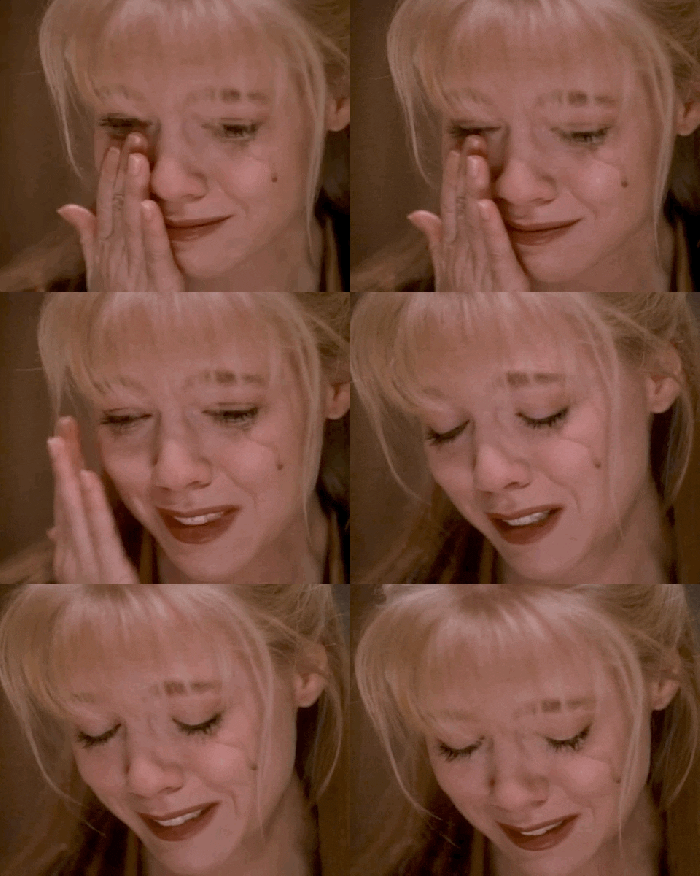
37076222._sx318_Book: “Loki: Where Mischief Lies” by Mackenzi Lee
Publishing Info: Marvel Press, September 2019

Where Did I Get This Book: I received an eARC from NetGalley!

Book Description: Before the days of going toe-to-toe with the Avengers, a younger Loki is desperate to prove himself heroic and capable, while it seems everyone around him suspects him of inevitable villainy and depravity . . . except for Amora. Asgard’s resident sorceress-in-training feels like a kindred spirit-someone who values magic and knowledge, who might even see the best in him.

But when Loki and Amora cause the destruction of one of Asgard’s most prized possessions, Amora is banished to Earth, where her powers will slowly and excruciatingly fade to nothing. Without the only person who ever looked at his magic as a gift instead of a threat, Loki slips further into anguish and the shadow of his universally adored brother, Thor.

When Asgardian magic is detected in relation to a string of mysterious murders on Earth, Odin sends Loki to investigate. As he descends upon nineteenth-century London, Loki embarks on a journey that leads him to more than just a murder suspect, putting him on a path to discover the source of his power-and who he’s meant to be.

Review: Thank you to NetGalley for sending me an eARC of this novel!

Long time readers of this blog might remember that, unlike Serena, I am rather prickly when it comes to the DC and Marvel rivalry. I don’t really go out of my way to read many Marvel things, and when it comes to the MCU I’ve only seen a handful of the films. But the movies within the canon that I have seen multiple times and in a complete arc are the ones that center around Thor. And it probably surprises no one that the biggest factor of this is Loki, the sometimes villain, sometimes anti-hero brother of Thor who is at turns a pain in the neck and other turns a somewhat valuable ally. Because of this, when I saw that Loki was getting his own YA novel that gave him his own adventure and some backstory, I was mildly intrigued. But when I saw that it was being written by Mackenzi Lee, the author of the lighthearted and romantic romp “The Gentleman’s Guide to Vice and Virtue”?

giphy-2
Sign me up post haste! (source)

Lee has always had a real talent for giving voice to snarky, bitchy, and flawed yet likable protagonists, so it’s really no surprise that her version of Loki was spot on. She does a very good job of balancing the complexities of his personality, both the megalomaniac side, and the side that has been emotionally warped by his family life and the ways that his father and brother have failed him. You see him wanting to bring pride and joy to Odin and Thor, but ultimately falling into the easier patterns of being out for himself, in part due to his only friend Amora. Amora is a mysterious character who is the court sorceress’s student, and her magic entices Loki since he, too, is magical. You get the sense that Amora isn’t a great influence on him, but you also completely understand why he would be drawn to her, given that Odin has tried to suppress his magical powers. But while you can definitely understand why Loki lashes out and behaves in the ways that he does, Lee is also very careful not to go to the ‘poor misunderstood baby’ interpretation. Loki’s choices are his own, and while she lets you see why he’d do it, she never lets him off the hook. If anything it makes him all the more tragic, especially when you see him interacting with his family, particularly Thor and their mother Frigga. Given that the reason I can’t totally write of “Thor: The Dark World” is the heartbreaking themes and Frigga and Loki’s relationship, any scenes with these two had me almost in tears. Lee really know how to get to the meat of Loki’s motivations, and that was great to see.

The overall plot was also a delight and a half. While we do spend a large amount of time in Asgard (as well as other realms), a big chunk of the story is spent on Earth in Victorian London. Odin sends Loki to work with a mortal secret society that has found evidence of Asgardian magic being used for bad purposes, and to have the spoiled and vain Loki have to interact with Victorian era humans is QUITE amusing. The secret group, SHARP, consists of a number of societal misfits, much like Loki himself is, and I felt like Lee gave solid backstories to all of them. My favorite of this group was Theo, the earnest and loyal investigator who has to hide his sexuality from the world. Theo acts as a moral compass to Loki, but in ways that don’t come off as condescending or self serving, which tends to be the problem with Thor back in Asgard. This is in contrast to Loki’s other foil, Amora, who tries to pull him more towards his more self serving side, and the two relationships make for high tension and conflicting feelings in Loki. Related to this is that Lee has made Loki the genderfluid and pansexual character that has been long heralded in the fandom, and it really, really works within this narrative. Sweet, sweet romantic agony as you feel like Loki wants to be good enough for Theo, but feels he can only meet Amora’s standards.

giphy-3
All the tears. (source)

Overall, “Loki: Where Mischief Lies” was a super fun interpretation of a beloved Marvel fan favorite. Mackenzi Lee is writing a couple more backstory novels for other Marvel characters, and even if they aren’t my own personal favorites, I may have to give them a go.

Rating 8: A fun backstory for Loki from one of the most fun YA authors of today, “Loki: Where Mischief Lies” gives the morally ambiguous quasi-villain some time to shine and be the (anti)hero of his own story!

Reader’s Advisory:

“Loki: Where Mischief Lies” is included on the Goodreads lists “The Trickster”, and “YA/Middle Grade Comic Book Superhero Novels”.

Find “Loki: Where Mischief Lies” at your library using WorldCat!

Serena’s Review: “Beasts of the Frozen Sun”

42118210Book: “Beasts of the Frozen Sun” by Jill Criswell

Publishing Info: Blackstone, August 2019

Where Did I Get this Book: Edelweiss+

Book Description: Burn brightly. Love fiercely. For all else is dust.

Every child of Glasnith learns the last words of Aillira, the god-gifted mortal whose doomed love affair sparked a war of gods and men, and Lira of clan Stone knows the story better than most. As a descendant of Aillira and god-gifted in her own right, she has the power to read people’s souls, to see someone’s true essence with only a touch of her hand.

When a golden-haired warrior washes up on the shores of her homeland–one of the fearful marauders from the land of the Frozen Sun–Lira helps the wounded man instead of turning him in. After reading his soul, she realizes Reyker is different than his brethren who attack the coasts of Glasnith. He confides in her that he’s been cursed with what his people call battle-madness, forced to fight for the warlord known as the Dragon, a powerful tyrant determined to reignite the ancient war that Aillira started.

As Lira and Reyker form a bond forbidden by both their clans, the wrath of the Dragon falls upon them and all of Glasnith, and Lira finds herself facing the same tragic fate as her ancestor. The battle for Lira’s life, for Reyker’s soul, and for their peoples’ freedom has only just begun.

Review: Our fairly recent re-read of “Sky in the Deep” for bookclub reminded me just how much I enjoyed Vikings stories. Pair that with “The Wolf in the Whale,” another story that I read this year that partially featured Vikings and had a good romance at its heart, and I was ready and raring to go for more of the same. This made it an easy decision to request a copy of “Beasts of the Frozen Sun” for review. But while it did have elements of what I was looking for, it also seemed to be a bit too off the mark at times for me to fully enjoy.

Lira and Reyker had met years before, though one remembers it as a half-believed nightmare, and the other as a strange encounter with a wild young girl who inspired him to break his own codes of warfare. When they meet again, it is under very different, and yet oddly similar circumstances. Now an adult, Lira holds an incredible power to see the truth of person’s being through a mere touch. It is an ability that has garnered her respect, but also makes her a valuable tool for her tribe, offering her limited option for her future. Reyker has continued on the path set before him so long ago, as a member of  Viking marauding crew that has taken down countless villages. Now, Lira’s tribe is the next and the two are thrown together once again, natural enemies, but with a connection that neither can deny.

As I said in my introduction, this book didn’t quite connect for me. But there were a few pros that I want to start out by highlighting. For one, the writing itself was strong. There was one blurb I read before starting it that mentioned a comparison to Juliet Marillier’s work. Given that this story description sounds just like something that author would write herself and the fact that she’s one of my favorite authors, I had high hopes on that front. And there, at least, it didn’t disappoint. The writing it lyrical, smooth, and feels as if it is a fairytale in the making. At the same time, the action, dialogue, and character moments all read as natural and alluring. There were several turns of phrase that popped off the page for me. While I’m not sure I would quite put it at the level of Marillier’s work, I can definitely see where the comparison came from.

The other stand-out was Lira herself. I really liked her voice and the way her character moved throughout the storyline presented her. She rose to the challenges presented to her, but never lost sight of herself or her unique gifts. Early in the book there is a big emphasis placed on Lira’s limited life choices, due to her unique powers, and I enjoyed the way that Lira approached the responsibility of her gift as well as the confines it put on the paths before her. While I do wish that a bit more was done with her gift itself, Lira, as a character, was another point of favor for this story.

Where the book let me down, however, was with the plot itself and the romance. The plot felt meandering and full of too many ideas all at once. A few chapters would focus on one thing. Then a new event would pop up and suddenly take over. It felt almost like a bunch of mini stories all crammed together, losing sight of any connecting tissue that would pull them all together. There was also a lot of repetitive planning, action, escapes, but then failures. The story literally couldn’t escape its own restrictions and it felt like it, like our characters, was simply floundering around in captivity.

I also didn’t love the romance. And this is where the comparison to Marillier hurt the book for me. If there’s anything that Marillier excels at, other than beautiful prose, it’s amazing romances. So I went into this perhaps with my expectations too high. But, on top of that, Reyker and Lira are both strong characters on their own. And the build up to their romance is intriguing, especially given that they don’t share a common language. But then they kiss, and it’s all downhill from there as they immediately fall into all-consuming love for each other. I wish this could have been drawn out a bit more or progressed in a more natural way. Perhaps I would have been less disappointed with it had Lira and Reyker on their own been less compelling. But as it was, they were both strong characters who deserved an equally strong romance.

I think this book had a lot of promise, and the writing and strong characters get it a long way down the road to success. But the plot seemed to circle back on its self a bit too much and the romance was underwhelming. This is the first in a series, however, so these things could be improved in the sequel. Fans of historical fantasy would probably enjoy this; just keep your expectations in check better than I did.

Rating 6: A solid attempt, but it read as a bit too bland for what I was wanting and missed some opportunities a long the way to take advantage of the strengths it had going for it.

Reader’s Advisory:

“Beasts of the Frozen Sun” is included on the Goodreads lists “Viking Era” and “Tristan & Isolde Retellings.”

Find “Beasts of the Frozen Sun” at your library using WorldCat!


Kate’s Review: “Kiss Number 8”

22612920Book: “Kiss Number 8” by Colleen A.F. Venable and Ellen T. Crenshaw (Ill.)
Publishing Info: First Second Books, March 2019

Where Did I Get This Book: The library!

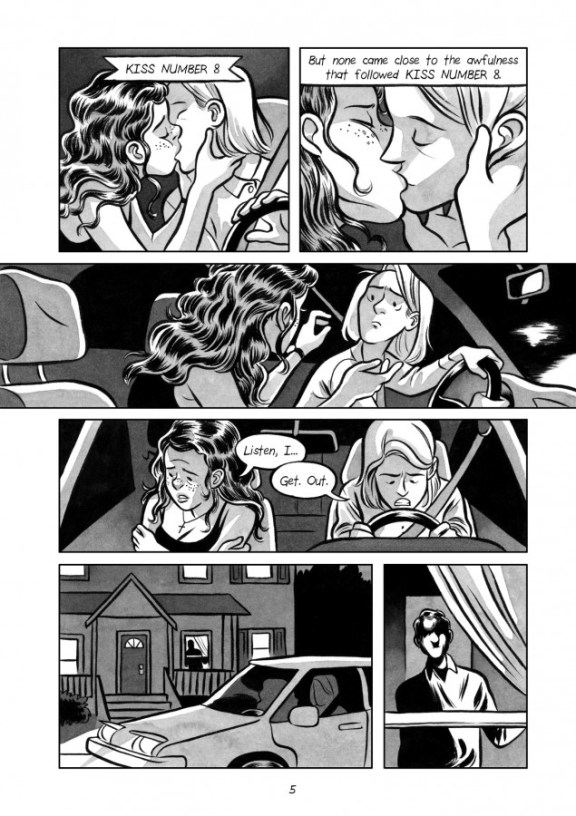
Book Description: Amanda can’t figure out what’s so exciting about kissing. It’s just a lot of teeth clanking, germ swapping, closing of eyes so you can’t see that godzilla-sized zit just inches from your own hormonal monstrosity. All of her seven kisses had been horrible in different ways, but nothing compared to the awfulness that followed Kiss Number Eight. An exploration of sexuality, family, and faith, Kiss Number Eight is a coming-of-age tale filled with humor and hope.

Review: It may seem like I’m doing a LOT of graphic novels lately, but in my defense I neglected this format a lot this summer. This occurred to me when I was requesting books for a teen graphic novel display, and one of the books I stumbled upon was “Kiss Number 8” by Colleen A.F. Venable and Ellen T. Crenshaw. After requesting it for work, I requested it for myself. I hadn’t looked too much into it when I requested it; I knew that it had LGBTQIA+ themes, and I knew that it was about a teen girl figuring out her sexuality. But what I didn’t expect was how emotional “Kiss Number 8” was going to be, and how hard it would be to read at times because of the themes.

And to note, I will have to address some vague spoilers in this review to fully discuss my opinions. I’ll do my best to keep it general.

“Kiss Number 8” takes place in 2004, a time that doesn’t seem to distant to me but is actually fifteen years ago. As I was reading this book, it served as a reminder of how many things have changed in terms of societies views on sexuality, and yet how far we still have to go. Amanda is written as a pretty typical teenage girl of this time and place, and up until this point she can count on a number of things: she has a fantastic relationship with her father, she has a tempestuous relationship with her mother, and her best friends Cat and Laura are always going to be there for her, even if they don’t particularly like each other. You get a great glimpse into Amanda’s life through snippets of scenes, and by the time the main plots start to kick in you already know who she is and what her reality is. Venable does a good job of showing rather than telling when it comes to how Amanda feels about those in her life, especially her growing infatuation with Cat, whose care free and somewhat selfish personality is apparent to everyone BUT Amanda. I also liked the slow unraveling and reveal of the other main plot line: a mysterious phone call to her father, and a mysterious letter that he tries to hide from her. Venable does a really good job of making the reader think it’s going to be one thing, but then piece by piece shows that it’s something completely different, something that connects to Amanda’s present emotional situation with Cat and goes even further back into how people have to hide their identities from others.

I also thought that Venable did a good job of portraying realistic, and at times very flawed, characters. As I mentioned earlier, Amanda is a pretty normal teenage girl, but along with that comes a cruel streak towards those who care about her, especially her mother and Laura. She makes bad decisions in moments of great emotion, and it ends up hurting people, who in turn react poorly and hurt her back. But you never get the sense that she is a bad person when she does these things, rather that she is in a great deal of pain and dealing with confusion about herself and a life she thought she had all sorted out. The fallout from these choices always felt real, and sometimes that meant that it was painful to read. But again, Amanda doesn’t ever come off as a bad person, just a person who is still learning. In fact, most of the characters are given a certain amount of grace when they screw up, and aren’t painted as being one dimensional or cardboard cut outs of tropes…. Even when they don’t necessarily deserve it. Because to me, with how some of the characters did end up reacting to Amanda’s identity, and the identities of others within the story, I didn’t want them to be given a pass, realistic or not. Not when they caused to much pain.

And that is a good segue into difficult moments that I had with “Kiss Number 8”, specifically with how a number of the characters were when it comes to LGBT issues. There is a LOT of homophobia and transphobia in this book, and while it’s all written within the context of the story, and doesn’t feel like it’s excused or glossed over, it could still be triggering for readers who are in those communities. While Amanda was a lived experience of learning about herself and her sexuality, I feel like the ball was dropped a bit more with the trans characters in the narrative. They were more used as lessons for Amanda to learn, and their voices and experiences were put in the context of a cis girl realizing that they too are human beings who deserve respect and dignity. That isn’t to say that I thought Venable was malicious in her portrayal, but it does show that we still have a ways to go when it comes to how trans characters are portrayed within the stories we read. That said, I am a cis straight woman, so if my assessment is off kilter to anyone please do let me know. I, too, am still learning.

I have nothing but good things to say about Crenshaw’s artwork. The characters are cartoony and fun, and their designs remind me of other popular teen graphic works like “Drama” and “This One Summer”, but the style is still unique and feels new and fresh. And even with the more ‘cartoony’ drawings, the emotional weight of the various situations still came through loud and clear.

kiss_8_r15-1-635x900
(source)

Uncomfortable and clunky aspects aside, I enjoyed “Kiss Number 8”. It’s an honest and emotional book that kept me reading, and reminded me that there is still so much progress to be made, even if we’ve come so far.

Rating 8: A bittersweet and emotional story about finding one’s identity, “Kiss Number 8” has complex characters and relevant themes. We’ve come so far with stories like this, but we still have a ways to go.

Reader’s Advisory:

“Kiss Number 8” is included on the Goodreads lists “Lesbian Teen Fiction”, and “Sapphic Graphic”.

Find “Kiss Number 8” at your library using WorldCat!

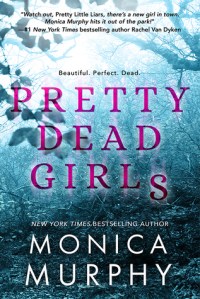
Kate’s Review: “Pretty Dead Girls”

32972117Book: “Pretty Dead Girls” by Monica Murphy

Publishing Info: Entangled: Teen, January 2018

Where Did I Get This Book: I own it.

Book Description: Beautiful. Perfect. Dead.

In the peaceful seaside town of Cape Bonita, wicked secrets and lies are hidden just beneath the surface. But all it takes is one tragedy for them to be exposed.

The most popular girls in school are turning up dead, and Penelope Malone is terrified she’s next. All the victims so far have been linked to Penelope—and to a boy from her physics class. The one she’s never really noticed before, with the rumored dark past and a brooding stare that cuts right through her.

There’s something he isn’t telling her. But there’s something she’s not telling him, either.

Everyone has secrets, and theirs might get them killed.

Review: I strive to go through my Kindle every once in awhile and see what books I’ve purchased that I haven’t read yet. I’ll be honest, I mostly use my Kindle for the eARCs that I receive, but every once in awhile I do get ebooks for it. As I was scrolling through my library I was reminded that about a year back I bought “Pretty Dead Girls” by Monica Murphy. It had shown up on my twitter feed, as a popular YA twitter account was singing its praises. There are so many things that should have worked in this narrative, at least for me. You have a climbing body count. You have popular mean girls who may be the top suspects. You have a local bad boy who may be misunderstood, MY KRYPTONITE! These are the ingredients for a stew that would normally set my tastes aflame. But by the time I had finished “Pretty Dead Girls”, I was left disappointed and wanting a whole lot more.

As I always try to do, I will start with what did work for me, and that is the aforementioned bad boy Cass. This is in all likelihood due to the fact that he seems to have been written to fit each and every trope that I love to see in a misunderstood outsider; there are rumors about him at school, he has a tragic back story, he dresses all in black and freaks people out, but at the end of the day he’s a genuinely good person who shows the protagonist (Penelope) what real love and loyalty is. Is it an overdone trope? For sure. My inevitable reaction to the character when he shows up?

giphy-7
Never fails. (source)

But even this doesn’t quite work in the broader context of the book. Because Cass’s relationships with other characters feel at times forced, and at other times a bit problematic. While I wanted to like him and Penelope and their budding relationship, I didn’t like that his ‘bad boy’ persona/plot device pushed him into almost psychopathic territory. For example, at one point he drives like a maniac that scares the hell out of Penelope, and it’s played off as ‘sexy and daring’, as well as used as a way for Penelope to perhaps question as to whether or not he is the mysterious killer. It feels lumped in and a bit lazy, and while I know that in real life bad boys are probably not going to be good dating choices, this is fiction, dammit! And these things, in the words of the drag queen Valentina, do not make sense with my fantasy! Especially since that wasn’t the overall point that was trying to be made.

On top of that, other characters never really move outside of their tropey boxes. Penelope is likable enough, but she doesn’t experience much growth outside of realizing that her friends are jerks and that Cass isn’t what he seems. Penelope’s main nemesis Courtney is the prototypical mean queen bee who also has some private pain. The other characters are pretty much relegated to being there as potential suspects, or eventual body count padding. I was hoping that we would get more growth from every one, but they basically remained two dimensional and static.

This could have been brushed aside and/or justified by myself as a reader had the plot been able to carry the weight, but as it was I wasn’t really invested in the mystery of ‘who is the killer and who is going to be next?’. The characters who did die (with the exception of one, but I won’t spoil it here) weren’t really characters that held emotional weight when they were killed. And while the identity of the killer was played up, with first person perspectives from the mystery person to boot, by the time it was revealed whodunnit, the solution fell flat due to a lack of real motive building and characterization before they were ‘unmasked’. It just felt like a ‘gotcha!’ that wasn’t earned.

I was disappointed because I had high hopes for “Pretty Dead Girls”. But it just goes to show that sometimes the perfect ingredients aren’t going to combine to make a well done final product. While I think that it would work for other readers, it didn’t work for me.

Rating 4: While the premise had a lot of potential, I was underwhelmed by “Pretty Dead Girls”. Not even a romance between a brooding bad boy and uptight good girl could save it.

Reader’s Advisory:

“Pretty Dead Girls” is included on the Goodreads lists “Teen Screams”, and “YA Suspense/Thriller/Mystery”.

Find “Pretty Dead Girls” at your library using WorldCat!

Kate’s Review: “Clueless: One Last Summer”

38926467Book: “Clueless: One Last Summer” by Amber Benson, Sarah Kuhn, and Siobhan Keenan (Ill.)

Publishing Info: BOOM! Box, December 2018

Where Did I Get This Book: The library!

Book Description: Cher, Dionne, and Tai set off for one last summer of footloose and fancy-free fashion and fun before college starts! 

The class of 1997 has left Bronson Alcott High School for good, and as the weather heats up, Cher and besties Dionne and Tai head off for their last summer vacation adventure together before, ugh, REAL LIFE! 

Picking up after Clueless: Senior Year, head back to the ’90s for summer fun and fashion from superstar writers Sarah Kuhn (Heroine Complex) and Amber Benson (The Witches of Echo Park), and illustrator Siobhan Keenan.

Review: It took a little while for my library to get this book in their catalog, but they did and I got it right in time for summer! As I mentioned in my review of “Clueless: Senior Year” (linked at the bottom of the post), “Clueless” is one of my favorite movies and no matter how many times I watch it I will never get sick of it. I was very excited for the next comic when I heard that it was coming out, and the sort of long wait was absolutely worth it. Just like “Senior Year” before it, “One Last Summer” brings back Cher, Dionne, Tai, and more, and gives them worthy stories of their fabulous characters. On top of that, we got some focus on characters we hadn’t even seen yet (still no Elton though. I get it, but I love that creep so much that I can’t help but be bitter).

Cher, Dionne, and Tai are the primary focuses of the story, as they all have their own conundrums to solve, while trying not to think about how things are going to be changing in their lives. Cher has taken on a summer internship as an assistant to an advice columnist (who is not a very good or honest person, much to Cher’s chagrin), Dionne is in charge of planning a beach party that her parents are helming, and Tai is preparing for her favorite aunt to come to town, and introducing her to Travis. On top of that, all three of them are hoping to solve a mystery for their friend Summer, who has a secret admirer. The stories are kind of simplistic to be sure, but the characters were just so in character and absolutely on point that I highly enjoyed every foray that they went on. I also enjoyed that for some of the characters, especially Dionne, the worries and anxieties about having to go to a new environment and leave people behind make things all the more stressful, even if they don’t totally get why. I found Dionne’s storyline to be especially compelling, as she and Murray are going to different schools across countries from each other. The anxiety and fear of a long distance relationship after high school was captured perfectly, and as someone who knows from experience hers was the story that I most related to. It’s also great seeing the spotlight being shared between these three girls once again, as they all are so endearing and different from each other.

But as mentioned above, “One Last Summer” also brings more attention to other characters that didn’t get as much last time. The biggest one is Summer, a character from the movie who is probably best remembering for her shining moments at the Valley Party, where she initiated a game of Suck and Blow, and snagged a lawn snowman for no discernible reason. I liked seeing her being brought into the main three friend group, and I liked how well she fit in. Benson and Kuhn made her a distinct and fun character who is similar enough to fit in with Cher, Dionne, and Tai, but different enough that she felt like she had her own complexities. And I mean, fine, if we can’t get Elton I was totally happy getting another awesome lady character. Along with Summer we did see a little more focus on other characters, like Josh, Murray, and Travis. And on top of that, they got to play roles that usually are reserved for female characters, which felt like a bit of a subversion and I REALLY liked it. For Josh, we got to see his own insecurities when it comes to his relationship with Cher and his worries that she still may judge him when he’s a bit of a geek. For Murray, it’s his fears about the long distance relationship, and not being sure of how to deal with Dionne when her anxiety turns into anger. And for Travis, HE IS JUST SO SUPPORTIVE AND ADORABLE AND SWEET, just there to love Tai like she’s the goddamn best thing ever. HOW WONDERFUL IS THAT?

tumblr_mbe9rfsrjz1qb9jcko1_500
While Josh and Cher are my favorite couple, THESE TWO MELT MY HEART TOO. (source)

And the art continues to be very bubblegum and perfect for the tone. The characters look enough like their counterparts that it feels like the actors and actresses, but also show off Keenan’s unique style.

clueless_onelastsummer_ogn_interiorart2_promo
Awww. (source)

“Clueless: One Last Summer” was a bittersweet but lovely story for the characters from “Clueless”. I understand that Benson and Kuhn might stop here, but honestly they could keep telling these stories with these characters and I would be filled with joy.

Rating 8: Another fun and nostalgic story featuring some of my favorite movie characters, “Clueless: One Last Summer” brings back some classic characters, brings in new ones, and serves some cute summer stories!

Reader’s Advisory:

“Clueless: One Last Summer” isn’t included on any Goodreads lists as of yet, but I think that it would fit in on “Summer Break Books for YA”, and “Comics & Graphic Novels by Women”.

Find “Clueless: One Last Summer” at your library using WorldCat!

Previously Reviewed: “Clueless: Senior Year”.

Kate’s Review: “Bloom”

29225589._sx318_Book: “Bloom” by Kevin Panetta and Savanna Ganucheau (Ill.)

Publishing Info: First Second, February 2019

Where Did I Get This Book: The library!

Book Description: Now that high school is over, Ari is dying to move to the big city with his ultra-hip band―if he can just persuade his dad to let him quit his job at their struggling family bakery. Though he loved working there as a kid, Ari cannot fathom a life wasting away over rising dough and hot ovens. But while interviewing candidates for his replacement, Ari meets Hector, an easygoing guy who loves baking as much as Ari wants to escape it. As they become closer over batches of bread, love is ready to bloom . . . that is, if Ari doesn’t ruin everything.

Writer Kevin Panetta and artist Savanna Ganucheau concoct a delicious recipe of intricately illustrated baking scenes and blushing young love, in which the choices we make can have terrible consequences, but the people who love us can help us grow.

Review: We’re getting near the end of summer (kind of?), and on the hot days sometimes you just need to have a cute, sweet, comfort read that you can enjoy in the sun… or air conditioning in my case. I saw “Bloom” by Kevin Panetta and Savanna Ganucheau on a display at the library I was working at, and decided to pick it up on a whim. It had been a bit since I’d read a one shot graphic novel, and the look of it and the summer feeling the cover gave me stood out to me. I hadn’t heard of “Bloom” until I picked it up, and after reading it I wish I’d found it sooner. I really, really enjoyed “Bloom”!

The story involves two young adults who are both looking for some self discovery and paths for their future. Ari is determined to move away from his home and his family bakery to become a music star with his friends, while Hector is trying to wrap up his late grandmother’s affairs and move on from a needy relationship. While they are both starkly different, you can’t help but love both of them for what they are. Ari is over emotional and a little bit self centered, but also wrapped up in insecurities about those around him. You understand why he wants to go out and make his own life, but can’t help but feel for his parents, who want him to join the family bakery business. Panetta did a really good job of showing how people can be torn between by their individual dreams, and their familial expectations. Ari is complex and at times very frustrating, but he also is a character I think a lot of people can see themselves in. Hector, too, is a fascinating character, as while he isn’t as conflicted as Ari, he has his own insecurities, but is better at navigating them. That said, I liked the foil that he played, as his kindness and patience has led him to troubles in the past because of his compassion and empathy for people. I loved them both for who they were, and I loved seeing them interact with each other. The side characters were a bit more hit or miss for me. On the one hand you have Ari’s parents, who I really liked. Ari’s father was the strict and singleminded parent you tend to see in stories like this, who could have easily fallen into the box of being the ‘out of touch parent who doesn’t care about what their kid wants’. But instead, Panetta does a fantastic job of showing complexities there, and his worries and fears regarding his business, his livelihood, and his relationship with his son were definitely well defined, and brought tears to my eyes. Ari’s mother was a bit more of the supportive parent of the two parent dynamic, but I also liked that she had moments of stepping out of that box too and being stern and realistic. But while Ari’s parents were great and spot on, I thought that Ari’s and Hector’s friend groups were a little two dimensional. They tended to check off a lot of trope boxes (the aggressively quirky, the jerk, the snarky, etc), and while I didn’t mind seeing them I didn’t really get much interesting from them.

The romance and overall plot of this book was very sweet and rewarding. Ari and Hector get closer because of baking, and Panetta focuses as much on the slow burn of the love story as much as he focuses on the intricacies and art of baking. Passion, be it romantic passion of passions for hobbies, are a huge theme in this book, and you can see the passion of a number of characters, and how it drives them, and sometimes makes them forget about the potential consequences of said passions. You can’t help but root for Ari and Hector as their romance slowly blooms and comes to life. And you can’t help but think about the metaphors of baking and the patience that it takes, the time and care it can require, and how sometimes you have to restart when unanticipated problems arise. I loved every panel and every moment, and savored the story as it unfolded. And as I mentioned above, I definitely cried as I was reading it.

The artwork is understated and lovely. I loved the blue hues and the sketches, and how the art not only brings the people to life, but the food as well. The style sometimes looks like sketches that aren’t quite finished (with arrows denoting movement and bare boned sketches occasionally making appearances), but it only added to the charm of the story. Also, the occasional large splash panel would showcase both the people and their emotions, as well as the food that they were making.

560x0w
(source)

“Bloom” is an adorable and touching summer romance about finding yourself, finding love, and finding your passions. If you want a cute and satisfying love story, look no further than Ari and Hector!

Rating 9: A sweet, emotional, and mouth watering romance that has delightful characters, a lovely romance, and some tasty looking baked goods!

Reader’s Advisory:

“Bloom” is included on the Goodreads lists “Pride Month! The Teen Essentials List”, and “Graphic Novels Centered Around Food”.

Find “Bloom” at your library using WorldCat!

Kate’s Review: “Patron Saints of Nothing”

42166429._sy475_Book: “Patron Saints of Nothing” by Randy Ribay

Publishing Info: Kokila, June 2019

Where Did I Get This Book: The library!

Book Description: A powerful coming-of-age story about grief, guilt, and the risks a Filipino-American teenager takes to uncover the truth about his cousin’s murder. 

Jay Reguero plans to spend the last semester of his senior year playing video games before heading to the University of Michigan in the fall. But when he discovers that his Filipino cousin Jun was murdered as part of President Duterte’s war on drugs, and no one in the family wants to talk about what happened, Jay travels to the Philippines to find out the real story.

Hoping to uncover more about Jun and the events that led to his death, Jay is forced to reckon with the many sides of his cousin before he can face the whole horrible truth — and the part he played in it.

As gripping as it is lyrical, Patron Saints of Nothing is a page-turning portrayal of the struggle to reconcile faith, family, and immigrant identity.

Review: There are some days that I open up my news feed and just feel utter despondency. There are so many horrible things going on in the world right now that they sometimes blur together for me, and then I become peripherally aware of some but not as knowledgeable about others. This is representative of my general awareness/lack of knowledge about Rodrigo Duterte, president of the Philippines, and his human rights record, specifically the fact that his ‘war on drugs’ has led to numerous murders and deaths of drug addicts and dealers all under government approval. Given that I knew a little bit about his policies (and how much they horrify me), my knowledge of Filipino society, culture, and history, both before and during his rule, is scant. So I was very interested in reading “Patron Saints of Nothing”  by Randy Ribay, as it focuses on these themes yet is written for an audience who may be unfamiliar. I buckled up for an emotional ride.

“Patron Saints of Nothing” approaches the controversial Duterte regime and its policies through the eyes of a Filipino-American teenager whose cousin Jun was killed, supposedly because of drugs. Jay is a good way for the audience to connect to the story, as while he himself was raised by a Filipino father, his American experience (and his father’s personal need to assimilate) has superseded his Filipino culture. But guilt and sadness over his cousin’s death is the perfect motivator to send him on this personal journey where he will learn about himself and also the culture that he hasn’t paid much attention to, or has taken for granted. As Jay learns about the society that Jun lived and died in, we are presented with a crash course of information about the modern day Philippines and the policies of the Duterte regime. Jay sees Duterte and his policies through American/Western eyes and values, and while he talks about the violence and the human rights violations that are incredibly disturbing, there is a stark contrast to how many Filipinos feel about said policies. I really liked how Ribay definitely addressed how brutal and corrupt this dictatorship is, and addresses the Marcos dictatorship as well, but also doesn’t pass judgement on those who live there who may not feel the same way. One really good example of this is Jay’s uncle Tito Maning, who is a government official and is incredibly loyal to Duterte, so loyal that he sees his own son’s death as justified. Ribay isn’t hesitant to show what kind of environment this man has fostered within his own family, and is absolutely critical of his blind loyalty and its consequences. But at the same time, Tito Maning isn’t a moustache twirling villain. Ribay makes sure to show how someone like him could still be loyal, in spite of his loyalty costing him is son, and how his choices aren’t as black and white as our own personal experience might perceive them to be.

The mystery about what happened to Jun is also well done and well paced. Jay has to make connections with family members, friends, and activists to figure out just what happened to his cousin, and I greatly enjoyed following him as he tries to find the puzzle pieces. You get the sense that there is more to the story than that which is presented to Jay, and themes of social justice and activism, and the dangers it can put you in within a dictatorship, are added into the drug war at hand. I didn’t feel much suspense when following this story, but I liked that the stakes were high regardless. What added to this is the epistolary aspect of this book, through letters that Jun sent to Jay over the years. It helps you get a sense of who Jun was outside of a victim of violence, and it helps you understand Jay’s own need to understand what happened to him. There is a lot of sadness permeating this story, sadness about what happened to a young person like Jun, sadness over the injustices of the society he was living in, and sadness for Jay and his own residual guilt, be it earned or not. The mystery also helps Jay learn about himself, but it’s done in a way that doesn’t feel forced or in bad taste. As he learns and connects to his heritage, so too does the reader. 

I really enjoyed “Patron Saints of Nothing”. I felt like it told a unique and needed story, and gave context and voice to realities that are easy to ignore when it comes to human rights issues around the world. I am going to keep my eye on Randy Ribay, because I feel like this is the start of a storied and rich writing career.

Rating 8: A powerful and eye opening story about identity, loss, and standing up for what’s right, “Patron Saints of Nothing” casts a spotlight on a less talked about human rights issue and the complexities that surround it.

Reader’s Advisory:

“Patron Saints of Nothing” isn’t included on any Goodreads lists yet, but I think that it would fit in on “Best Asian-American Teen Fiction”.

Find “Patron Saints of Nothing” at your library using WorldCat!

Kate’s Review: “Superman: Dawnbreaker”

29749094Book: “Superman: Dawnbreaker” (DC Icons #4) by Matt de la Peña

Publishing Info: Random House Books for Young Readers, March 2019

Where Did I Get This Book: The library!

Book Description: When the dawn breaks, a hero rises.

His power is beyond imagining.

Clark Kent has always been faster, stronger–better–than everyone around him. But he wasn’t raised to show off, and drawing attention to himself could be dangerous. Plus, it’s not like he’s earned his powers . . . yet.

But power comes with a price.

Lately it’s difficult to hold back and keep his heroics in the shadows. When Clark follows the sound of a girl crying, he comes across Gloria Alvarez and discovers a dark secret lurking in Smallville. Turns out, Clark’s not the only one hiding something. Teaming up with his best friend, Lana Lang, he throws himself into the pursuit of the truth. What evil lies below the surface of his small town? And what will it cost Clark to learn about his past as he steps into the light to become the future Man of Steel? Because before he can save the world, he must save Smallville. 

Review: Though I’ve come to terms with the fact that Batman is always going to be my choice of male DC superheroes (depressive demon nightmare boys are my weakness, as we all know) Superman is a very close second, and it’s probably because he’s the exact opposite of Bruce Wayne and his brooding tendencies. Clark Kent/Superman is an optimist who just wants to do the right thing, and to help people because he can. Sure, he has sadness about his home planet of Krypton blowing up, but overall he’s a cheerful and stand up guy whose motivation to do good is pretty much without strings. So it makes sense that the DC Icons Series, the YA books that have taken on DC’s favorite characters, has saved their Golden Boy for last. Therefore we come to Matt de la Peña’s “Superman: Dawnbreaker”, a new quasi-origin story for Superman set during his teen years in Smallville. 

giphy-6
But without the ‘somebody saaaaave meeee’ intro. (source)

Overall, this was a very satisfying and well done Superman origin story. We’ve seen so many different iterations of this, but de la Peña manages to make it feel fresh and original, if only because he takes it to places that aren’t as obvious as the usual plot points. There are still familiar faces, like Ma and Pa Kent and Lana Lang, but de la Peña tweaks the relationships a tiny bit. In “Dawnbreaker”, Clark knows that he has powers, but he doesn’t know why, and he hasn’t felt comfortable asking his parents for answers. He gets the feeling that something is being hidden, but doesn’t necessarily know if he wants to know what, and wonders if he can be okay with not knowing all facets of his identity if it means living a relatively uncomplicated life. But, given that this is a Superman origin story, one can guess that all will come out soon enough, but even this I felt was handled with nuance and complexity. You see both Clark’s AND The Kents having to come to terms with the fact that Clark isn’t of this world, and what that could mean in both the greater scheme of things, but also their own familial ties. I was also VERY happy to see what de la Peña did with Lana Lang. I’ve always been solidly a Lois girl, and portrayals of Lana that I have seen have made her into an uninteresting love interest that I can’t abide. Partially because she’s competition for Lois (YES I AM THAT PETTY), but mostly because she could be so much more than just the hometown sweetheart. And de la Peña allows her to be more than that! While it could be argued that she’s just kind of been turned into Lois (though to be fair the comics did this too, with her being a TV newscaster on and off), I liked the spunky and intrepid Lana we got on the page. Also, she isn’t relegated to love interest here! She and Clark are best friends, and while they have some romantic tension it feels more like a wink towards their original storyline as opposed to a ‘will they or won’t they’ scenario. It means the Lana can be her own person, and her story isn’t defined by Clark’s affection for her. This is the Lana that Lana deserves to be.

But what struck me the most about this story was the plot and themes that de la Peña was able to bring together in a seamless way. When people think of Smallville they usually think of the humble and down home hometown that Clark grew up in, and the positive Americana that such a place an evoke. de la Peña doesn’t exactly blow this notion out of the water, but he does bring up the notion that small town simplicity and charm generally favors a very specific population, aka white people. In “Dawnbreaker”, Smallville (like many small towns in America’s midwest and heartland) has seen a growing population of Latinx immigrants, and racial tensions are on the rise as some townspeople miss ‘the good old days’. Seeing Clark hope that at the end of the day the people of Smallville will do the right thing is SO very Clark Kent, but it’s also a sad reality that unless checked and questioned and called out, prejudice and racism can easily run amok. And given that the people who are going missing are from the local Latinx population, Clark learns some hard truths about why they aren’t being sought out so much, and why their loved ones are too scared to push the authorities too much. In fact, while the main plot and mystery surrounding strange people in town and a mysterious new corporation moving in was well done, I was more interested in the themes about racism and xenophobia, and how capitalism and capitalist interests can claim they want to help, when they actually want to make a profit. And while it’s true that sometimes de la Peña is more inclined to spoon feed these themes to his reader as opposed to trusting that they can pick up on it, for the most part the execution was fairly well done.

“Superman: Dawnbreaker” was a strong end to the DC Icons series. I’m glad that they saved this one for last, because I think that it was my favorite of the bunch.

Rating 8: A strong end to a fun series, “Superman: Dawnbreaker” gives Clark Kent a timely and fun new origin story, while addressing social issues that remain incredibly relevant in today’s societal climate.

Reader’s Advisory:

“Superman: Dawnbreaker” is included on the Goodreads lists “Super Hero Books (Not Graphic Novels)”, and “YA-Fiction: Super Powered Fiction”.

Find “Superman: Dawnbreaker” at your library using WorldCat!