Kate’s Review: “Clown in a Cornfield”

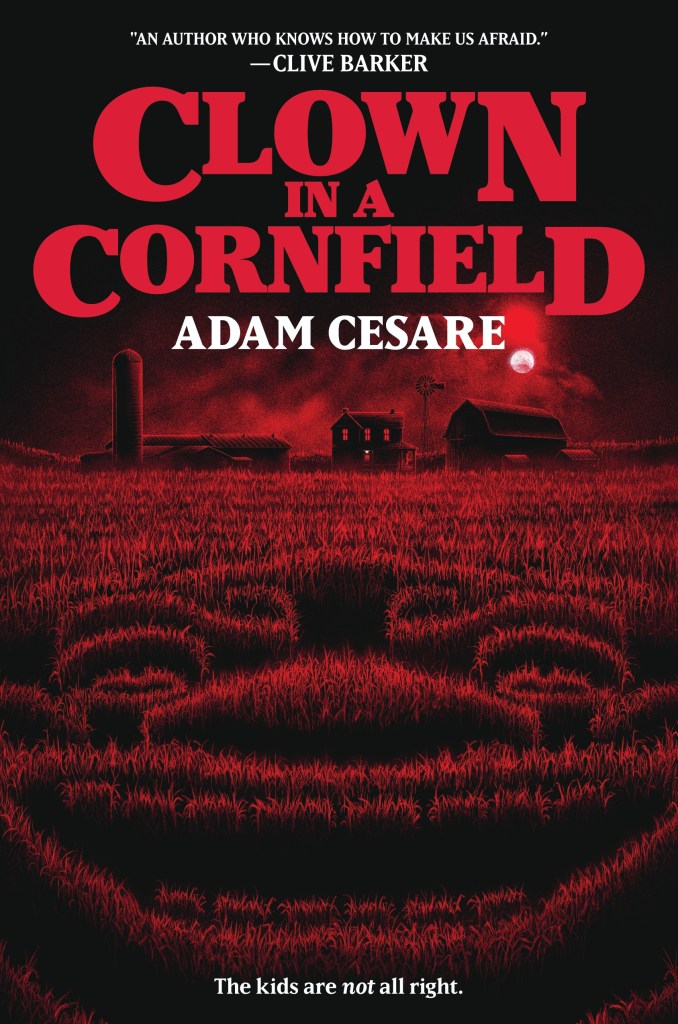
Book: “Clown in a Cornfield” by Adam Cesare

Publishing Info: HarperTeen, August 2020

Where Did I Get This Book: I own it.

Book Description: Quinn Maybrook just wants to make it until graduation. She might not make it to morning.

Quinn and her father moved to tiny, boring Kettle Springs to find a fresh start. But ever since the Baypen Corn Syrup Factory shut down, Kettle Springs has cracked in half. On one side are the adults, who are desperate to make Kettle Springs great again, and on the other are the kids, who want to have fun, make prank videos, and get out of Kettle Springs as quick as they can.

Kettle Springs is caught in a battle between old and new, tradition and progress. It’s a fight that looks like it will destroy the town. Until Frendo, the Baypen mascot, a creepy clown in a pork-pie hat, goes homicidal and decides that the only way for Kettle Springs to grow back is to cull the rotten crop of kids who live there now.

Review: I am not afraid of clowns. I have friends who are, but I myself don’t really have much beef with them outside of sometimes finding them a little pointless. Even the likes of Pennywise of John Wayne Gacy’s Pogo just don’t really make me tap into my inner coulrophobic. But I do like a book that reads like a slasher story, and reading the description of “Clown in a Cornfield” by Adam Cesare felt like exactly that. Throw in some Millennial resentment towards older generations that don’t quite get the road we’ve had to travel, and I was eager to dive in and see what Cesare was going to do with all of it.

“Clown in a Cornfield” is a bit of a slasher story, a bit of small town secrets story, and some ‘okay, Boomer’ memes all mixed together to create a YA horror tale. On a few levels, this works out pretty well and makes for fun reading. The very concept of a bunch of teens being slaughtered by someone wearing a clown mask is great horror fodder, but “Clown in a Cornfield” takes it a few steps further than that and works through some generational angst that is playing out in the real world. The town of Kettle Springs, the setting of this book, is having a bit of a reckoning when it comes to the older people in town versus the teenagers. The older people want Kettle Springs to stay the same, living off of good family values, hard work, and the corn syrup factory that has given the town jobs and prosperity, until recently, that is. The younger generation, specifically the teens, just want to live their lives and then move on. Cesare takes a pretty realistic conflict and pumps it full of blood and guts, and it works pretty well, with those with traditional values blaming inevitable changes in values for all the ills within the town. It could have been heavy handed, but Cesare keeps his tongue planted in cheek firmly enough that it’s a rather effective satire. I also liked a few of our main characters, namely Quinn, the new girl in town who is trying to fit in. Quinn has enough tragic backstory to give her a little bit of pathos, but also stands on her own two feet well enough that she is likable and endearing.

But that said, some of the executions of the plot points didn’t work as well for me. Besides Quinn and a couple other characters, we don’t really get to know enough about a number of the people we’re following so that it doesn’t feel like the stakes are too high when the clown Frendo (“No Country for Old Men” reference?) comes a knocking with weaponry and murderous intent. I don’t really care too much when a slasher film just has a bunch of stereotypes to act as machete fodder for a masked killer, but I think that on the page you have a little more wiggle room to give us some insight into your characters, even if it’s just a little bit. Along with that, the pacing was a little off at times, feeling a bit rushed in some places but kind of draggy in others. I bought the plot overall, as it really is just a slasher story and I know what I’m getting into there. But I think that had there been a little more focus on fleshing out some other characters and less on making super cool kills happen, it probably would have worked a little better. Especially since the satire was pretty well thought out.

Inevitable progress to traditionalists everywhere. (source)

“Clown in a Cornfield” is a pretty fun read. I think that it would have worked better as a gory limited series, but Cesare left room for a sequel, and it was good enough that I would definitely read it. If you don’t like clowns, maybe skip it? But if you’re like me, this could be a fun read for this time of year.

Rating 6: A sly premise and some fun characters keep this story afloat, though the plot is a little hasty at times and the scares feel like they’d work better on screen than on the page.

Reader’s Advisory:

“Clown in a Cornfield” isn’t included on many relevant Goodreads lists, but it would fit in on “Clown Horror”. Obviously.

Find “Clown in a Cornfield” at your library using WorldCat, or a local independent bookstore using IndieBound!

Serena’s Review: “Blood & Honey”

40550366

Book: “Blood & Honey” by Shelby Mahurin

Publishing Info: HarperTeen, September 2020

Where Did I Get this Book: Edelweiss+

Book Description: After narrowly escaping death at the hands of the Dames Blanches, Lou, Reid, Coco, and Ansel are on the run from coven, kingdom, and church—fugitives with nowhere to hide.

To elude the scores of witches and throngs of chasseurs at their heels, Lou and Reid need allies. Strong ones. But protection comes at a price, and the group is forced to embark on separate quests to build their forces. As Lou and Reid try to close the widening rift between them, the dastardly Morgane baits them in a lethal game of cat and mouse that threatens to destroy something worth more than any coven.

Previously Reviewed: “Serpent & Dove”

Review: Well, after enjoying the first book well enough this summer, it was kind of a given that I’d include it in my fall reading schedule. After all, I’d had a lot of success this summer with reading books that had been very popular last year and then were followed up by equally good, if not better, sequels (“The Merciful Crow” and its sequel, for example!). And, while the first book in this duology (ugh trilogy) wasn’t as strong as that one, it still caught my interest, and I had hopes the trend would continue. Alas, no. Not only did the trend decidedly not  continue, but I actively disliked this book and am probably out on this (again, ugh ) dulogy-turned- trilogy.

After the dramatic events at the end of “Serpent & Dove,” Reid, Lou and their friends find themselves on the run and in need of allies. Their search is a long and arduous one, pushing them all to the limits. On top of this all, Reid and Lou are still managing the new waters of their marriage after secrets on both of their sides have now been revealed. Will they all be able to stand strong together and will they be able to outwit the powerful force amassing against them?

So, that’s a pretty junky book summary that I just wrote. And that’s because…this is a pretty junky book? Seems harsh, but I really am having  a hard time coming up with any positive to say about this book. The problems start right away when I can’t write a good summary of this book because nothing happens in it. And it’s over 500 pages long! Instead of any plot to speak of, it’s made up of angst, drama, out of character actions/thoughts, and the worst case of “middle book syndrome” that I’ve ever seen. Part of the blame for this is, of course, because either the publisher or author (I’m guessing this was pushed by the publisher after the success of the first book) decided to stretch what originally envisioned as a duology into an unnecessary trilogy. And it shows. In a bad, bad way.

There is practically no action in this book until the last 40 pages. It’s just Lou, Reid and the others looking for allies, and with not much success. It’s not so much a story plot as a story plot point…a small one, at that. Definitely not one that justifies this book’s extreme length either. I mean, on one hand, it was always going to be a hard sell changing what was meant to be a duology into a trilogy kind of late in the game. But then to make the now-added middle book into a massively long middle book? The plot can’t support it. The character arcs (if there are any to speak of) can’t support it. It’s just not good storytelling.

The other major problem for me was in in the character arena and the romance. As I pointed out, this book was clearly stretched too thin on plot, and it feels the same with the characters. Their arcs no longer felt natural, but instead each character felt, at best, wildly out of character at times, and at worst, like they had been made into totally unlikable, totally different characters altogether. I struggled with Reid’s likablity in the first book. He was downright unpleasant in this one. His overly protective attitude towards Lou was in no way endearing and was often aggressively sexist in its portrayal. When he wasn’t caught up in that, it was internal angst and indecision all the live long day. Lou was a bit better, but still less likable than she was in the first. For her, much of her “arc,” such as it was, was more confusing than anything. She seemed to lose much of the personality she had in the first book and was at times almost unrecognizable.

To top a bad situation off, the book ends on a massive cliffhanger. And at this point, given how bad the rest of the book had been, this did not have the desired affect of cajoling last minute interest out of me, but instead just pissed me off more. It’s almost as if the publisher/author knew the book on its own wasn’t enough to keep most fans around, so they added this final twist as a last ditch effort. Really, the entire book seems to serve an example of publishing greed gone to far. If it had remained as a duology, with this the second and final portion, I’m sure we would have had a lot more actual plot and a lot less unnecessary character drama. The tone of the entire series could have remained consistent, and fans would have been satisfied. Instead, out of a need to squeeze the last drops out of the golden goose that was the first book, the series was stretched to a breaking point that is now losing fans. At least, they’ve lost me.

Rating 4: Supremely disappointing and barely recognizable as having come from the same author as the first book.

Reader’s Advisory:

“Blood & Honey” is on these Goodreads lists: “2020 YA Sequels” and “Can’t Wait Sci-Fi/Fantasy of 2020.”

Find “Blood & Honey” at your library using WorldCat!

Serena’s Review: “The Silvered Serpents”

45044785Book: “The Silvered Serpents”  by Roshani Chokshi

Publishing Info: Wednesday Books, September 2020

Where Did I Get this Book: NetGalley

Book Description: Séverin and his team members might have successfully thwarted the Fallen House, but victory came at a terrible cost — one that still haunts all of them. Desperate to make amends, Séverin pursues a dangerous lead to find a long lost artifact rumored to grant its possessor the power of God.

Their hunt lures them far from Paris, and into the icy heart of Russia where crystalline ice animals stalk forgotten mansions, broken goddesses carry deadly secrets, and a string of unsolved murders makes the crew question whether an ancient myth is a myth after all.

As hidden secrets come to the light and the ghosts of the past catch up to them, the crew will discover new dimensions of themselves. But what they find out may lead them down paths they never imagined.

A tale of love and betrayal as the crew risks their lives for one last job.

Previously Reviewed: “The Gilded Wolves”

Review: I wasn’t blown away by “The Gilded Wolves,” the first in this YA fantasy trilogy. But as I liked it more than Chokshi’s other books I’ve read and the cast of characters was compelling, I decided to keep going with the series. Well, I have, and…I don’t think I liked this one any better? Maybe worse? And yet I still will probably read the third? I’m not sure what this says about me as a reader or about the trilogy itself. Me, probably a completionist. The trilogy, something about it must be intriguing enough to keep me invested.

Things have kind of fallen apart for our crew after the dramatic events at the end of “The Gilded Wolves.” Each on their own, each has been trying to make their own way in the world, feeling cut-off from the rest. But when a lead on “The Divine Lyrics,” the magical book at the heart of Severin’s (and Laila’s) quest, finally comes to light, Severin brings them back together for one last adventure. Into the heart of the north and through mysteries new and astounding, the crew must once again bring each of their unique skill sets to hand in order to pull of this last job. But, of course, nothing goes as planned and a darker price is waiting than any of them could have imagined.

So, a lot of the problems I had with the first book (and with this author in general) were still present here, unfortunately. There’s something about her style of writing that I struggle with. On one hand, there’s the turns of phrase that seem to be written more because they sound beautiful and poetic rather than the fact they convey any actual image. The titles, for example, of both of these books doesn’t seem to really connect directly to much in the story. But they sure sound pretty! Most of the time it didn’t bother me too much, but there were definitely other times when I would re-read a sentence and be like “Sure…sounds nice…but…what?” And that confusion carries over to my second struggle with the writing.

While the author does a good job with characterization for the most part and clearly has a bunch of unique fantasy ideas. She’s not lacking in imagination on either front. But when it comes to the actual description of locations, objects, and how they interact with each other…it’s just not good. There were entire locations (where the book spent a significant amount of time) that I couldn’t describe to you. There was an entire action scene that was a blur of movement, and by the end, again, I couldn’t tell you what exactly had happened. The writing looks pretty on the front of things, but it too often failed at its most basic requirement: conveying ideas clearly.

I also struggled with the plot itself. The mystery was both at times not clear at all (Severin and his cohort would jump through leaps of logic that were either impossible to follow or just totally unbelievable that anyone would connect those dots). And at other times so bizarrely obvious that I couldn’t be less impressed when AHA! the reveal finally came and Severin and his crew were just oh, so clever for putting it together.

And, sadly, on top of all of this, my favorite part of the first book, the characters, was a let-down here as well. They’re all still interesting enough, but man, this was a glum book. Severin was practically unrecognizable, and his decisions were, again, hard to buy at times. As for the rest, they all seemed to become more and more caught up with unnecessary secret keeping that served no other purpose than to stir up more drama. It was just all kind of sad and tiring.

And yet…I’m probably going to finish out the story. For one thing, this book mostly felt like a place hold and necessary vehicle for the author to get from point A to point B. So while this middle portion of the trip was a let down, I can still be hopeful that it was all to the purpose of getting us somewhere more interesting. I’m not really holding out much hope for the writing to clear up and suddenly become my cup of tea, but I do have hopes that the characters themselves will go interesting places and resolve their own story lines in compelling ways. Fans of the first book are sure to like this one. But if you were on the fence there, you’ll probably have similar feelings here. I leave it to you whether it’s worth going through it based on only the hope of a well-executed landing.

Rating 6: Fairly glum and mired in its own “middle-ness” in the trilogy.

Reader’s Advisory:

“The Silvered Serpents” is on these Goodreads lists: “Asian MG/YA 2020” and “2020 YA Sequels.”

Find “The Silvered Serpents” at your library using WorldCat!

Serena’s Review: “A Deadly Education”

50548197._sy475_Book: “A Deadly Education” by Naomi Novik

Publishing Info: Del Rey Books, September 2020

Where Did I Get this Book: Edelweiss+

Book Description: Learning has never been this deadly

“A Deadly Education” is set at Scholomance, a school for the magically gifted where failure means certain death (for real) — until one girl, El, begins to unlock its many secrets. There are no teachers, no holidays, and no friendships, save strategic ones. Survival is more important than any letter grade, for the school won’t allow its students to leave until they graduate… or die! The rules are deceptively simple: Don’t walk the halls alone. And beware of the monsters who lurk everywhere. El is uniquely prepared for the school’s dangers. She may be without allies, but she possesses a dark power strong enough to level mountains and wipe out millions. It would be easy enough for El to defeat the monsters that prowl the school. The problem? Her powerful dark magic might also kill all the other students.

Review: Naomi Novik has quickly become a must-read author for me. After this book, she’s pretty much a must-buy author (I only have maybe 5 of those, so that says something, I think!). But, still, when requesting this book, what I’d read from her had been both of her fairytale retellings and the first several of her Napoleonic wars/dragon historical fantasy series. This didn’t sound remotely like either of those, instead being billed as a modern, more grim, “Harry Potter” style boarding school story. But man, Novik can do anything, and my trust is now fully earned, no matter how strange the book description is!

Scholomance is technically a school. There are no teachers and students are on their own to make classes and finish homework, sure. But that’s only half, and arguably the less important half, of what this school provides. Instead, it offers magical kids the best chance they have of surviving their juvenile years. Sure, their odds are still pretty darn bad in the school, but better than the next to nothing they have outside. El’s chances have been even worse from the start. Yeah, she has the raw power, but she seems to repel people for some reason. And in a place where forming alliances is a necessary survival tactic, that’s not good. But here, in her second to last year at the school, staring down the barrel of a final year full of even more likely death, El begins to uncover secrets about not only the school, but herself, and the boy who has been roaming around annoyingly playing savior to all this entire time.

I adored everything about this book, so it’s kind of hard to think of where to start when reviewing it. It’s also so totally unique, interesting, and complicated that it’s hard to find the middle ground between reviewing important aspects of the story and not spoiling the fun for new readers. There’s just so much good stuff to unpack!

I guess I’ll start with the world-building itself. The book description has a tough job trying to describe what Scholomance really is, and, as you can see, I probably struggled too in my own summary. That’s because it’s so complicated and well-constructed that it’s almost impossible to really give a broad overview. Novik seems to have thought out every intricate detail for this magical place, from how the cafeteria works, to the menacing library, to the simplest of things, like how the school assigns and monitors homework and what happens if students fall behind. And it’s all just so creative! I can’t think of a single other fantasy story that has anything like the place Novik has thought up here. And that’s saying something, I think, in a genre that is becoming more crowded by the day (especially YA that has a tendency to become trope-ridden and bogged down in certain themes every few years).

One of the most impressive aspects of all of this that, being as complicated and detailed as it all is, our narrator is given a heavy load of information to be handing off to readers. There’s a significant portion of the first half of the book that is largely devoted to detailing all of these little aspects. It would have been so easy for it to have felt like info-dumping or to have dragged down the pacing and plot of the story. But, for one thing, the information being provided is just too interesting on its own to feel bored by. And secondly, our narrator had a fantastic voice from the start that is strong enough to carry this type of detail-ridden load.

El is everything I like in a narrator: snarky, consistently characterized, yet vulnerable in ways that we (and she) discover throughout the story. From the book description, I was kind of expecting some type of tired anti-hero story or quasi-villain plot line for her, but it’s really nothing like that. Sure, her powers are destructive and there’s this pesky doomsday-esque prophesy lingering around her, but she’s just as skeptical of all that nonsense as the reader wants to be. El’s story, here, is not only finding acceptance with some key friends around her, but in accepting what she has to offer. On one hand, she can be overly confident, but on the other, we see her realize her own values and where her personal lines are between survival and standing up for some moral greater good.

And to balance her out, of course, we have a “Chosen One.” This friendship was everything! Both El and Orion’s characters play perfectly off each other. She, stand-offish, uninterested, and, again, snarky. He, bumbling, clueless of his affect on people, and obnoxiously heroic. I loved everything about this friendship and the slow build to sort of romance that it comes to towards the end.

It’s also clear, here, where the comparisons to “Harry Potter” are coming from. Orion Lake is definitely a response to Harry Potter and all of the other “chosen” heroes we see in fantasy fiction. Novik has said that “Spinning Silver” was essentially her “yelling” at the “Rumpelstiltskin” fairytale, and that this would be her yelling at “Harry Potter.” Comparisons to “Harry Potter always make me nervous. For one thing, I love Harry Potter so, for me, a book being compared to it is either going to be a massive let-down of trying to copy something that shouldn’t be copied. Or it’s going to be some type of “response” piece that spends more time criticizing another book series than in being its own thing. Luckily, this falls right in the middle and does it perfectly.

You can definitely see where Novik is making a point about the type of “chosen one” story that Harry Potter tells, but, while she does touch on some of the obvious themes, she also deep dives into a lot of aspects of this type of storyline that one doesn’t often think about. There’s a strong focus on inequality and injustice, but it’s approached through angles and perspectives that are unique to this world. The themes, of course, carry over, but it stays true to the fantasy world it is and the types of justice and injustice that would be inherent to it. It’s left to the reader to transcribe these thoughts onto our own world and our own experiences of injustice within society.

This review has already gotten pretty long, and I could go on and on. But, in this case, I almost feel like the less said the better! There’s so much great stuff to discover here that I don’t want to spoil any more of it! Needless to be said, my copy is already pre-ordered, and I highly recommend any and all fantasy fans to get their hands on this book ASAP!

Rating 10:Breaking fantasy walls that I didn’t know even exited! Simply fantastic!

Reader’s Advisory:

“A Deadly Education” is a new title, so it isn’t on many Goodreads lists. But it is on “Non JKR Magic School Novels.”

Find “A Deadly Education” at your library using WorldCat!

Kate’s Review: “A Good Girl’s Guide to Murder”

45874065Book: “A Good Girl’s Guide to Murder” by Holly Jackson

Publishing Info: Delacorte Press, February 2020

Where Did I Get This Book: I own it.

Book Description: Everyone in Fairview knows the story.

Pretty and popular high school senior Andie Bell was murdered by her boyfriend, Sal Singh, who then killed himself. It was all anyone could talk about. And five years later, Pip sees how the tragedy still haunts her town.

But she can’t shake the feeling that there was more to what happened that day. She knew Sal when she was a child, and he was always so kind to her. How could he possibly have been a killer?

Now a senior herself, Pip decides to reexamine the closed case for her final project, at first just to cast doubt on the original investigation. But soon she discovers a trail of dark secrets that might actually prove Sal innocent . . . and the line between past and present begins to blur. Someone in Fairview doesn’t want Pip digging around for answers, and now her own life might be in danger.

This is the story of an investigation turned obsession, full of twists and turns and with an ending you’ll never expect.

Review: Back when we were a COVID-free world and the thought of going shopping in person didn’t give me hives, my Mom and I went to Barnes and Noble on a trip to the Mall of America. I always like to check what the YA display has, because even though I know it will usually be heavy on the fantasy and romance, you can also find some gems of teen thrillers. That was how I initially learned about “A Good Girl’s Guide to Murder” by Holly Jackson. I let it be, but the name stuck in my head enough that when quarantine happened about a month later I had the title of a book I wanted to order. It still took a little time to get to it, but I finally picked it up and gave it a go…. and kicked myself for waiting to start it as long as I did.

“A Good Girl’s Guide to Murder” has all the elements that I want in any kind of thriller, let alone a teen one. The protagonist is interesting and well fleshed out, for one thing. Pippa is the kind of teenage girl I probably wished I was at the time. She’s clever, she’s funny, and her true crime obsession, one true crime in particular, is a fun nod to all true crime enthusiasts everywhere. But on top of all of those things, she is by no means perfect, but not in the obvious ways that some thriller heroines go. She has a well adjusted home life, she has healthy friendships and relationships, and she isn’t drowning in her own dysfunction. You like her almost immediately, and even when she does sometimes do dumb things (like most teenagers probably would on occasion), they are believable. And it isn’t just Pip that is enjoyable as a character. Her friends are all fun with witty and snappy personalities, and her partner in investigating, Ravi, is incredibly likable along with being a little bit tragic. Ravi is the younger brother of Sal, the boy who everyone assumes murdered Andie but who ended up dead before he could be charged (supposedly by his own hand). Not only does Ravi’s involvement make Pip’s endeavor all the more personal and high stakes, it also makes it feel more ‘legitimate’ as opposed to just a random girl not really connected to a tragedy sticking her nose in it because of a quirky true crime obsession. Jackson also makes note of racism within police investigations and media coverage, as Sal, being Indian American, was immediately accepted as the murderer because of racist ideas about his culture and how women fit into it, in spite of a few big inconsistencies. Ravi, too, doesn’t have the same privileges as Pip does as they investigate, and Jackson definitely makes certain to address these things when Pip needs to be educated on them. I thought that was a good theme throughout this novel.

And on top of likable characters, we also get a VERY stellar, complex, but not overwrought mystery at hand. We get to see Pippa approach it through her perspective in a few different ways, be it through the narrative itself, her log entries for her capstone project, or the notes that she has taken about the case. The clues are all there, and while I admit that I kind of figured out one of the big aspects to the case pretty early on, Jackson throws in enough believable red herrings that I did end up doubting myself. It’s a classic whodunnit with a lot of people who would have reason and motive, and then you add in ANOTHER layer with a mystery person starting to threaten Pip as she gets closer and closer to finding out the truth about what happened to Andie. There are well executed moments of legitimate tension, and you do really start to worry about Pip as she starts to unearth long kept secrets and lies. This is the kind of suspense you really want in a thriller, and Jackson is able to maintain it throughout the story, though there are a good number of moments of levity sprinkled in. Just to give the reader a break in the tension here and there. I was hooked, and basically read it in the course of two days, foregoing other forms of entertainment until I was done. Yeah, it’s VERY fun.

And the best part is that a sequel is coming out next Spring here in the States.

giphy-5
Between this and the hope of a potential vaccine, Spring 2021 is looking PRETTY good! (source)

“A Good Girl’s Guide to Murder” is a great read and a hell of a lot of fun! Shame on me for sleeping on it for so long! Thriller fans, do yourself a favor and go read this book!

Rating 9: Incredibly fun, properly twisty, and a very impressive debut novel, “A Good Girl’s Guide to Murder” gave me everything I want in my YA thrillers, and more.

Reader’s Advisory:

“A Good Girl’s Guide to Murder” is included on the Goodreads lists “Young Adult Crime/Murder Mysteries”, and “Can’t Wait Crime, Mystery, and Thrillers 2020”.

Find “A Good Girl’s Guide to Murder” at your library using WorldCat, or a local independent bookstore using IndieBound!

Kate’s Review: “Grown”

49397758Book: “Grown” by Tiffany D. Jackson

Publishing Info: Katherine Tegen Books, September 2020

Where Did I Get This Book: I received an eARC from Edelweiss+.

Book Description: Korey Fields is dead.

When Enchanted Jones wakes with blood on her hands and zero memory of the previous night, no one—the police and Korey’s fans included—has more questions than she does. All she really knows is that this isn’t how things are supposed to be. Korey was Enchanted’s ticket to stardom.

Before there was a dead body, Enchanted was an aspiring singer, struggling with her tight knit family’s recent move to the suburbs while trying to find her place as the lone Black girl in high school. But then legendary R&B artist Korey Fields spots her at an audition. And suddenly her dream of being a professional singer takes flight.

Enchanted is dazzled by Korey’s luxurious life but soon her dream turns into a nightmare. Behind Korey’s charm and star power hides a dark side, one that wants to control her every move, with rage and consequences. Except now he’s dead and the police are at the door. Who killed Korey Fields?

Review: Thank you to Edelweiss+ for providing me with an eARC of this novel!

If I’ve said it once, I’ve said it a hundred times: if you haven’t checked out Tiffany D. Jackson’s books, be you a YA thriller fan or just a thriller fan in general, you absolutely NEED to. Jackson is one of my favorite authors, and when I heard that her newest novel, “Grown”, was taking on the sexual exploitation of Black teenage girls searching for stardom, I knew that it was going to be her toughest, but perhaps most important, novel yet.

First of all, content warnings abound on this book. Jackson herself puts a content warning at the beginning of this book, and it is definitely necessary. “Grown” deals with themes of sexual abuse, grooming, and psychological abuse and trauma.

“Grown” is an unflinching look at the sexual abuse and victimization of teenage girl Enchanted, a Black girl with dreams of becoming a singing sensation. When R&B superstar Korey Fields (who is twenty eight to her seventeen) sees her at an audition, he offers to take her under his wing and help her become a singer, but from the get go you know that something is off. He texts her about her life. He compliments her on how pretty she is. He calls her ‘Bright Eyes’. But once he gets her on tour and away from her parents and her support system, he isolates her, he abuses her, and he makes her completely subservient to him under guise of care and love. There are clear influences from R. Kelly in this story (side note: if you are interested in social justice issues regarding the #MeToo movement but haven’t watched “Surviving R. Kelly” yet, go watch it. Go watch it now.), but Enchanted as a character is wholly original and an incredibly realistic teenage girl. Her insecurities, her dreams, her certain naiveté, everything about her was on point. Jackson paints a clear portrait of a girl who has been manipulated into a dangerous situation, and you never feel any victim blaming towards her. On the contrary, we see how easy it would be for Enchanted to get into that situation because of the manipulations of a predator, and the inaction of those who are willing to prop up a predator based on his fame, wealth, and power. Jackson also points out the very important point that Black girls aren’t as easily seen as victims in our culture due to societal racism that dehumanizes Black people, and sexualizes Black girls from a young age. Misogynoir is a very dangerous thing, and it allows predators to get away with their predation, and you see it over and over again with Enchanted, even in seemingly mundane ways (one moment that struck me was when her swim coach told her to get a bigger suit because she was ‘spilling out’ of the one she was wearing, as if Enchanted’s body is somehow her fault). Seeing all of this play out is devastating, and seeing Enchanted failed by those who should be protecting her (I am leaving her parents out of this indictment, by the way, as while I don’t want to go into TOO many details, they are powerless in their own ways) is so upsetting.

Oh, and there is also a mystery at hand here! Right off the bat, Korey Fields is dead, and Enchanted is covered in ‘beet juice’. The narrative is split into two timelines. The first is before, and the second is during and after, with first person accounts, transcripts, and conversations all sprinkled in to lay out the building blocks of the murder case. I did feel like the mystery took a back seat to the bigger issues at hand, but that is totally okay in this work. In fact, things that made the mystery more complex and threw doubt as to Enchanted’s reliability as a first person narrator almost weakened the narrative, as it didn’t feel necessary to throw in twists and turns to throw the reader off the scent. Regardless, it was a satisfying mystery that was well laid out, and I liked how Jackson used different writing styles and devices to build up a suspenseful story that you are invested in.

“Grown” is once again a triumph by Tiffany D. Jackson. But it’s also perhaps one of the more important reads about #MeToo themes. It also asks many hard questions and makes the reader really think about how society values power and fame over the welfare of others.

Rating 9: An important, suspenseful, and heart wrenching story, “Grown” shines a much needed light on misogyny, sexual violence, and the way that race plays a part to make victims, especially Black women and girls, even more vulnerable.

Reader’s Advisory:

“Grown” is included on the Goodreads lists “YA Books for BLM Movement”, and “YA Contemporary by Black Authors”.

Find “Grown” at your library using WorldCat, or at a local independent bookstore using IndieBound!

Serena’s Review: “The Wendy”

35510314._sx318_Book: “The Wendy” by Erin Michelle Sky and Steven Brown

Publishing Info: Trash Dogs Media, January 2018

Where Did I Get this Book: NetGalley

Book Description: London. 1789. More than anything in the world, Wendy Darling wants to be the captain of a ship, but women aren’t allowed in the Royal Navy. When she learns the Home Office is accepting a handful of women into its ranks, she jumps at the chance, joining the fight against the most formidable threat England has ever faced. Magic.

But the secret service isn’t exactly what she hoped. Accompanied by a reimagined cast of the original Peter Pan, Wendy soon discovers that her dreams are as far away as ever, that choosing sides isn’t as simple as she thought, and that the only man who isn’t blinded by her gender might be the worst friend anyone could ask for.

Anyone, that is, except Wendy Darling.

Review: I’m never one to turn down a re-telling. And while I haven’t had super good luck with “Peter Pan” retellings in the past, this one seemed far enough from the original story to have a better chance of success. For one thing, the focus is on Wendy’s own story, not Peter’s. And for another, she wants to become a ship’s captain?? So some strange mixture of Peter’s, Wendy’s, and, somehow, Hook’s story? Count me in!

Wending Darling does want to grow up. But she wants to grow up to be a very specific thing: a ship’s captain. And, luckily enough, once she is older, it turns out that a limited number of women are being accepted into the service. Seems perfect! But once there, Wendy quickly discovers that being accepted on paper is not the same thing as being accepted by the men around her, especially not in her dreamed-of leadership role as the captain. Struggling to find her own place, Wendy quickly finds herself caught up in new challenges and adventures, surrounded by a familiar sounding cast of characters, including a certain Captain Hook and a man-child named Peter.

This was a really fun read. One of the reasons I think it’s a success compared to other “Peter Pan” retellings I’ve read is the fact that, while it does a familiar cast of characters, it’s not trying to retell the original story really at all. For one thing, this is Wendy’s story through and through. Sure, Peter plays an important role, but she is front and center the entire time. It is her dreams and adventures the story follows, and her challenges the story prioritizes.

Part of this, of course, is a focus on the gender inequality of the time. The fact that she’s allowed to sign on to the secret service at all is a huge departure from history, but the authors don’t make it any easier for her other than that. She’s constantly having to challenge the perceptions and dismissals of those around her. And, when she does find someone who can see past her gender, it’s not necessarily the best advocate one could ask for. There were a few moments where the “messaging,” for lack of a better word, around this theme came across as a little heavy handed. But luckily the story had enough going for it that the action could quickly take over again and right the ship, so to say.

I also really liked the various takes on familiar characters. John and Michael, for example, are transformed from Wendy’s literal brothers to her brothers-in-arms. Michael, however, could be a bit much at times and too often came across in a pretty annoying manner. He improved as the story went a long and was given opportunities to make up for some of his shortcomings, but he was probably, overall, my least favorite character in the story.

Probably my biggest complaint for the story was the overabundance of love interests presented for Wendy. Sigh. Love triangles are not my thing (pretty well established), and I’m even less excited when we move past triangles to squares and pentagons. I want to settle into my romance and see it slowly develop. Not feel tossed here and there wondering what direction the main character go. Beyond that, multiple love interests is really hard to sell, simply on the believability spectrum, and this one wasn’t any different.

This was a pretty fun romp of a book. It’s not blowing away any literary awards or anything, but if you like fairytale retellings and “Peter Pan” especially, it’s definitely one worth checking out. A sequel came out fairly recently, so I’ll probably get around to reading that one, too, sooner or later.

Rating 8: A bit preachy at times and with too many love interests, but other than that, a jolly good time.

Reader’s Advisory: 

“The Wendy” is on these Goodreads lists: “Peter Pan Retellings” and “Retellings of Classic Tales.”

Find “The Wendy” at your library using WorldCat!

Serena’s Review: “The Princess Will Save You”

43603825._sy475_Book: “The Princess Will Save You” by Sarah Henning

Publishing Info: Tor Teen, July 2020

Where Did I Get this Book: NetGalley!

Book Description: When her warrior father, King Sendoa, mysteriously dies, Princess Amarande of Ardenia is given what would hardly be considered a choice: Marry a stranger at sixteen or lose control of her family’s crown.

But Amarande was raised to be a warrior—not a sacrifice.

In an attempt to force her choice, a neighboring kingdom kidnaps her true love, stable boy Luca. With her kingdom on the brink of civil war and no one to trust, she’ll need all her skill to save him, her future, and her kingdom.

Review: I’ll be honest, I first requested this book based purely on how much I love this cover. Even now, looking at it above, I’m swayed to feel more positive about this book just by the lovely depiction of its main characters on the cover. But, when I dug deeper, I realized that it is also being promoted as a gender-swapped retelling of “The Princess Bride,” so, of course, I was even more excited to check it out! While I did enjoy it overall, it sadly didn’t quite live up to the promise of the gorgeous cover or the intrigue of the unique concept.

After the sudden and unexpected death of her father, the king, Princess Amarande quickly discovers how few options she has. Seemingly, no one else is concerned about potential assassination, and instead, her entire council is moving full steam ahead to marry her off to the most politically advantageous match they can find, regardless of Amarande’s own wishes. When her best friend, Luca, is kidnapped by one such potential match in an attempt to force her hand, Amarande takes matters into her own hands. Her quest is simple: save her true love, save her kingdom.

This is a tough one for me to rate and review. On one hand, it was enjoyable enough, and I was able to blaze through it in only a few days. The writing was solid. The characters were interesting. And the world-building did enough to paint a picture that I felt grouned. And yet…it was lacking something.

For one thing, I don’t think it did this book any favors to have it marketed as a gender-swapped “Princess Bride.” Sure, I can see how it follows similar plot points and winks and nods at some of the key phrases used in that book. But, on one hand, if I had not had that put in my head and thus wasn’t looking for these elements specifically, I’m not sure I would have made these connections. And, conversely, when I was looking and did spot them, they often detracted more from the story than they added. For one thing, the first half of the story doesn’t feel like a re-telling at all, whereas the last half really goes all in. It’s an uncomfortable balance.

Beyond that, I think I was also set up to expect more of a humorous fantasy story. Obviously, “The Prinicess Bride” is comedy through and through. Here, not so much. Not only is it clearly not going for the same parody tone that its inspiration had, it also just seemed to lack much humor at all? I think this, truly, is where my main contention point came for the story. It checks all the marks for a good fantasy adventure, but there is something decidedly dry in the tone and its telling. It didn’t have to be back-to-back laughs, but as I was reading through, I realized more and more that there simply were no laughs whatsoever. So, while the characters, romance, and adventure were compelling enough, they also felt strangely two dimensional and flat. It was too bad.

It looks like a sequel is planned, so I’ll most likely check it out. There were some interesting developments towards the end of the story. And perhaps the second will be served better by being more thoroughly detached from the “Princess Bride” read-alike label. Just add some humor to the story, and it could be great!

Rating 7: Sadly a bit flat in its telling, but a fast enough fantasy adventure.

Reader’s Advisory:

“The Princess Will Save You” is on these Goodreads lists: “Damsels in Shining Armor & Dudes in Distress” and “Royalty.”

Find “The Princess Will Save You” at your library using WorldCat!

Kate’s Review: “Wayward Witch”

53038638._sx318_sy475_Book: “Wayward Witch” by Zoraida Córdova

Publishing Info: Sourcebooks Fire, September 2020

Where Did I Get This Book: I received an eARC from NetGalley.

Book Description: Rose Mortiz has always been a fixer, but lately she’s been feeling lost. She has brand-new powers she doesn’t understand, and her family is still trying to figure out how to function in the wake of her amnesiac father’s return home. Then, on the night of her Deathday party, Rose discovers her father’s memory loss has been a lie.
 
As she rushes to his side, the two are ambushed and pulled through a portal to the land of Adas, a fairy realm hidden in the Caribbean Sea. There, Rose is forced to work with a group of others to save Adas. Soon, she begins to discover the scope of her powers, the troubling truth about her father’s past, and the sacrifices he made to save her sisters.
 
But if Rose wants to return home so she can repair her broken family, she must figure out how to heal Adas first.

Review: Thank you to NetGalley for providing me with an eARC of this novel!

It’s been a four year journey with the Mortiz Sisters in the “Brooklyn Brujas” Trilogy by Zoraida Córdova, and what a genre bending, empowering, and unique (to me) journey it’s been. Given that books one (“Labyrinth Lost”) and two (“Bruja Born”) followed the oldest and middle sisters, Alex and Lula, I knew that “Wayward Witch”, the last in the trilogy, was destined to be Rose’s story. Rose has always been the sister that has intrigued me the most, as she has always been quiet, reserved, and a little bit mysterious because of it. I was eager to get into her head for the last story, hoping that Córdova would give her a lot to do and work with, and perhaps explore a new genre like she did with Lula. The fulfillment of those hopes was a mixed bag.

Since I want to focus on the positives, I will get my negatives out of the way, particularly as they are no fault of the book. We have gone back to a fantasy focused story in “Wayward Witch”. I had been hoping that after the genre shift in “Bruja Born” we might be experimenting with a whole other genre again, but that was not the case. As much as I can appreciate the care and detail that Córdova put into the world of Adas, and as much as it definitely was unique and steeped in cultural influence that you don’t see as much in fantasy, it’s still a world building fantasy story. And outside of very specific examples that I love, it’s a genre that doesn’t really click with me. Along with that, I had hoped to see more sister interaction like we had in “Bruja Born”, but given that Rose was on her own for a majority of the story, that didn’t happen.

But, that said, I am so happy that we finally got to Rose’s story, and that she got to have this kind of adventure that is so different from the ones that her sisters had. Rose has been dealing with magical changes in her life, as her power has shifted to being a person who can take on the powers of those around her. You enter that in with the dramatic changes in her family life (her father returning from his long absence, her family having to move to Queens after their home was destroyed, her Deathday celebration), and she is feeling stressed and unheard. Not to mention her relationship with her father is a bit strained, as she has few memories of him before he disappeared. I liked that his reappearance in her life specifically is a bit messier and more complicated. But her journey to Adas with her father allows her to see her powers in a new way, as to the fae there she is a savior and a warrior who is there to stop The Rot that is destroying their world. Seeing her function in this totally different realm could have been similar to Alex’s journey in “Labyrinth Lost”, but Rose is so different from Alex that it feels pretty new and fresh. Her magical powers are also neat to see in focus, as the upsides, and the downsides, of being a ‘magic hacker’ as she likes to refer to it are shown in different ways. Be they amusing, or potentially dangerous. And even though the fantasy themes didn’t really connect with me, I did like the characters that Córdova created in Adas, especially Princess Iris. Iris has a lot to prove to both her father, the King, and to herself as well. It was refreshing to see usual fantasy gender norms being bent between her and her twin brother Arco. While Iris is the more ferocious and determine warrior type, Arco is a bit more sensitive and reserved, and Rose’s interactions with both of them helped round out her character, and perhaps made up for the fact we didn’t see her interacting with Alex and Lula in similar ways.

So while the fantasy elements as a whole weren’t as interesting as the horror elements from the previous books, I thought that “Wayward Witch” gave Rose the attention that she deserved, and wrapped up the series in a mostly satisfying way. I’m so happy that Zoraida Córdova got to tell her story about these bruja sisters, and that YA audiences have been given a great example of how witches don’t have to be white.

Rating 7: A return to otherworldly fantasy means that this conclusion didn’t connect as much as the previous book, but “Wayward Witch” gives Rosie Mortiz a strong tale that shows off her abilities, and wraps up a fun and dreamy fantasy series.

Reader’s Advisory:

“Wayward Witch” is included on the Goodreads lists “Latina Leads in YA and Middle Grade Fiction”, and “2020 YA Books with LGBT Themes”.

Find “Wayward Witch” at your library using WorldCat, or a local independent bookstore using IndieBound!

Previously Reviewed:

Kate’s Review: “Displacement”

39908611._sx318_Book: “Displacement” by Kiku Hughes

Publishing Info: First Second Books, August 2020

Where Did I Get This Book: I received an eARC from NetGalley.

Book Description: A teenager is pulled back in time to witness her grandmother’s experiences in World War II-era Japanese internment camps in Displacement, a historical graphic novel from Kiku Hughes.

Kiku is on vacation in San Francisco when suddenly she finds herself displaced to the 1940s Japanese-American internment camp that her late grandmother, Ernestina, was forcibly relocated to during World War II.

These displacements keep occurring until Kiku finds herself “stuck” back in time. Living alongside her young grandmother and other Japanese-American citizens in internment camps, Kiku gets the education she never received in history class. She witnesses the lives of Japanese-Americans who were denied their civil liberties and suffered greatly, but managed to cultivate community and commit acts of resistance in order to survive.

Kiku Hughes weaves a riveting, bittersweet tale that highlights the intergenerational impact and power of memory.

Review: Thank you to NetGalley for providing me with an eARC of this graphic novel!

I am always going to keep hammering home the point that if we don’t know our own history, we are going to repeat it, especially now when our country seems to be determined to undercut civil liberties of its own citizens. Between police brutality, towards minorities (particularly Black people), a Muslim ban, and children in cages at the border, it feels like we are slipping more towards times in American history where we committed terrible atrocities that we haven’t really faced as of yet. That brings me to “Displacement” by Kiku Hughes, a graphic novel on the Japanese American Internment during World War II. I’ve read my fair share about this horrific practice (and reviewed another graphic novel on the topic, “They Called Us Enemy” by George Takei), and figured that this would be another powerful, but familiar, take on this period in history. And I can safely say that “Displacement” wasn’t really what I was expecting.

“Displacement” is both fiction, and non-fiction. The non-fiction aspect is that Kiku Hughes’s grandmother Ernestina was held prisoner at both Tanforan and Topaz Internment camps, and that Kiku and her mother did a lot of research into it as Ernestina didn’t open up about it while she was alive. But the fictional aspect is a device that works very well, in which Kiku tells a story of herself being transported back in time, or ‘displaced’ to the 1940s, and ending up at the same Internment sites as Ernestina, therein letting the reader see this historical atrocity through the same modern lens that Kiku may. It’s very similar to “Kindred” by Octavia Butler, and Hughes mentions her specifically in her acknowledgements. I thought that it worked really well because it makes the story feel more personal than perhaps a textbook would, and more relatable since Hughes is a young adult who doesn’t know that much about the camps and what life there was like for Ernestina. It’s a perfect read for tweens and teens who might be wanting to learn about this topic, as while it’s ‘fantasy’, it’s also very realistic and provides the same perspective that they may be going in with. I read “Farewell to Manzanar” by Jane Watasuki Houston when I was in seventh grade, and while I did like it and got a lot from it, I think that if I had something like “Displacement” I may have connected more with it just because of the modern lens. Hughes also makes very clear connections to the current political climate we are in today with Trump and his goons in power, and how there are stark, STARK similarities between the prejudices they hold and the policies they are inflicting upon marginalized groups, and the ones inflicted upon the Issei and Nisei in this country during the Internment.

While “Kindred” is the book Hughes mentions specifically as influence, I also see a lot of similarities to Jane Yolen’s “The Devil’s Arithmetic”, in which a modern day (well modern when it came out) Jewish girl named Hannah is transported back to Poland right as the Nazis take over. I kept going back to that story as I saw Kiku pre-displacement, thinking about how Hannah, like Kiku, doesn’t feel that much connection to her heritage. While “Displacement” certainly does a great job of talking about what specifically happened to her grandmother during the Internment, Hughes also makes direct connections as to how the Internment facilitated a loss of identity for Japanese Americans, and played a part in generational trauma that still lingers today. It’s a theme that I haven’t seen as much in other books, be they fiction or non-fiction, about the Internment, and it is a really powerful way to show that there are far reaching consequences that touch later generations when it comes to trauma and violence directed towards a group of people. Kiku recounts (in the true story part of this book) how she and her mother decided to do their own research about Ernestina’s life in the camps, and about the camps themselves, and find out things that neither of them knew because of survivors not wanting to talk about it due to trauma and shame. This was the aspect that stood out to me the most.

And finally, I really liked Hughe’s artwork style. It feels not dissimilar to what you might expect from modern comics, but there are undercurrents of more realistic artwork and imagery that kind of remind the reader that this is based on something real, and terrible.

wtbchhrnj1x3brfhsqpb
(source)

“Displacement” is a book that I really think educators should have in their curriculums when teaching teens about the Japanese American Internment. It’s easy to understand, easy to parse, and has a whole lot to say about identity, racist policy, and trauma that can last beyond a generation.

Rating 8: A powerful graphic novel and the perfect introduction to the subject for tween and teen audiences, “Displacement” takes on a reprehensible part of American history with a magical realism twist.

Reader’s Advisory:

“Displacement” is included on the Goodreads lists “Surviving in the Japanese Relocation Centers of WW2”, and “2020 YA/MG Books With POC Leads”.

Find “Displacement” at your library using WorldCat, or a local independent bookstore using IndieBound!