Kate’s Review: “The Tea Dragon Society”

34895950Book: “The Tea Dragon Society” by Kate O’Neill

Publishing Info: Oni Press, October 2017

Where Did I Get This Book: The library!

Book Description: From the award-winning author of Princess Princess Ever After comes The Tea Dragon Society, a charming all-ages book that follows the story of Greta, a blacksmith apprentice, and the people she meets as she becomes entwined in the enchanting world of tea dragons. 

After discovering a lost tea dragon in the marketplace, Greta learns about the dying art form of tea dragon care-taking from the kind tea shop owners, Hesekiel and Erik. As she befriends them and their shy ward, Minette, Greta sees how the craft enriches their lives—and eventually her own.

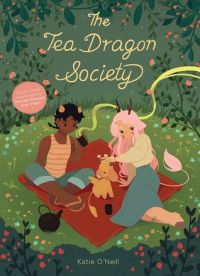
Review: Now see here, I may be the resident horror/thriller/true crime/all things macabre blogger, but I, too, am sometimes in need of a break from those things. While I do love me all the dark, dank, and creepy of the world, every once in awhile I yearn for a serious palate cleanser to take me down from a self made anxiety tower where I find myself perched all too often. So while at the desk at work the other day, my dear friend Tami (who is also the children’s librarian at my library) handed me this book and said “You are going to love this.” Boy oh boy, was she right, and was “The Tea Dragon Society” everything I needed in that moment!!! Hell, the cover alone gave me a vocal and physical reaction the moment I saw it.

giphy11
Specifically this with a loud “AWWWWWW!!!” (source)

“The Tea Dragon Society” is a calming and quiet graphic novel for kids, though I would argue that it’s suitable for all ages of youth AND adult as well. It takes place in an unspecified fantasy world, where there are dragons and goblins and animal creatures, and while none of it is really explained in depth, it really doesn’t have to be. This is just the world the story takes place in and it needs to explanation. We follow Greta, the daughter of a blacksmith who finds that her passion in life may actually be centered on Tea Dragon rearing. Tea dragons are dragons who grow tea leaves on their horns. Different kinds of dragons produce different kinds of tea. From Jasmine Dragons to Rooibos Dragons to Ginger Dragons, these creatures need love and attention to make the best leaves. IS THIS NOT THE CUTEST THING YOU’VE EVER HEARD? Maybe I’m biased, as I love love LOVE dragons, but the creativity and the gentle sweetness of it just hits me right in the feels.

And let’s talk about those who blacksmith and those who raise tea dragons, and what that means for gender roles in this world. Right off the bat we are introduced to Greta’s mother, who is teaching Greta how to blacksmith. Greta’s mother is implied to be one of the best blacksmiths around, and it is Greta’s father who is the artist within the family. It was so refreshing to see a mother teaching her daughter a craft that is often associated with masculinity, and teaching her the family business. While Greta has some reservations about blacksmithing and her personal devotion to it, it’s never because of her gender. Along with that, the people who raise the tea dragons are two men, Hesekiel and Erik (though Heseikiel is some kind of animalesque being, kind of looking like a llama?). Erik used to be an adventurer, but after an accident those days are behind him. However, he is never shown as being weakened or at a disadvantage because he lost this previous life. On the contrary, he’s settled into a new life of dragon rearing and gardening as well as maintaining the home that he and his partner Hesekiel share.

We also get some really good diversity in this book, as Greta and her family are darker skinned, as is Erik. Along with that, Erik is in a wheelchair because of an accident in his past. As mentioned before, Erik and Hesekiel are romantic as well as business partners, and their relationship is so lovely and shows years of devotion and caring. Minette, Erik and Hesekiel’s ward, is also representative of a different ability set, and while I don’t really want to spoil it here, I will say that she also shows that with these inherent disadvantages she can still do what she loves. In the picture of the previous Tea Dragon Society there was also diversity, showing that just about anyone could take on this life and be successful at it. While I do think that explicit discussions of why diversity matters, and being explicit about these differences in these stories are important, I also like seeing normalized diversity such as in this world. Especially since fantasy and sci-fi does have a diversity problem within the stories that are told. This goes to show that it can be done and that it should be done.

And yes, we need to talk about the dragons. Because holy crap are they just the cutest things ever.

almanac_entertainment-1
OMG!!!! (source)
almanac_diet
SCREEEEECH! (source)

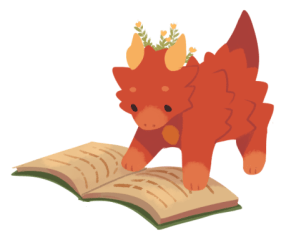
There are so many designs for these different kinds of dragons, and O’Neill made it so that they do kind of represent the various teas that their horns produce. The Chamomile Dragon (the yellow one above) always looks a little relaxed and sleepy. The Rooibos Dragon (the red one above) looks spiky and rambunctious. The Earl Grey Dragon looks dignified and regal. And so on. To make these dragons so varied and yet still similar amongst themselves is such a great design, and it goes to show that dragons don’t always have to be big and daunting and fearsome. Though hey, I’m never going to complain about those kinds of dragons either.

“The Tea Dragon Society” was the right bit of fluff I needed in my life to give me an overdose on cuteness while building a lovely fantasy world. I can’t recommend it enough to not only children and parents, but also to people who like fantasy. Or those like me who really just need a relaxing read once in awhile. While O’Neill says that the story has concluded, I would be so pleased if someday she decides to revisit these characters and the lovely world that they live within.

Rating 9: TOO CUTE FOR WORDS!!!!! Along with that, we have a diverse cast of characters and an interesting examination of gender norms.

Reader’s Advisory

“The Tea Dragon Society” is on the Goodreads lists “Comics & Graphic Novels by Women”, and “2017 YA Books with LGBT Themes” (though this book is definitely appropriate for all ages).

Find “The Tea Dragon Society” at your library using WorldCat!

Here is the website for the original webcomic for “The Tea Dragon Society”.
Serena’s Review: “The Tethered Mage”

34219880Book: “The Tethered Mage” by Melissa Caruso
Publishing Info: Orbit, October 2017

Where Did I Get this Book: ARC from the publisher

Book Description: In the Raverran Empire, magic is scarce and those born with power are strictly controlled — taken as children and conscripted into the Falcon Army.

Zaira has lived her life on the streets to avoid this fate, hiding her mage-mark and thieving to survive. But hers is a rare and dangerous magic, one that threatens the entire empire.

Lady Amalia Cornaro was never meant to be a Falconer. Heiress and scholar, she was born into a treacherous world of political machinations.

But fate has bound the heir and the mage. And as war looms on the horizon, a single spark could turn their city into a pyre.

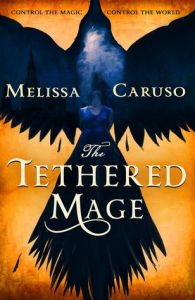
Review: My first props (of many to come) for this book is to whomever designed the cover art. I’ve ranted in the past about cover art tendencies in which publishers try to piggy-back off the designs of other popular books, regardless of whether or not that style or art subject matches the topic of the actual book they are producing. And yes, I know that it’s a business, and I understand the marketing behind it. But that’s the case with every cover art decision ever, and “The Tethered Mage”‘s cover art shows that publishers are perfectly capable of creating unique, pertinent, and striking art for an individual book without needing to reference others to sell. I knew next to nothing about this book, but clicked through to read the description based on this art alone, and largely this was due to its originality. I hadn’t seen a book like this before, therefore I didn’t have expectations going into checking outs its details.

My second props comes for this same originality carrying throughout the book itself. I may not have had many expectations from the art, but reading the descriptions, I had a few guesses (concerns) about the story. Yet another fire mage with a “past.” Likely a duo protagonist situation. Two women protagonists, none the less, creating potential for the ever-dreaded competitive women themes. But almost immediately after reading the first few chapters, I was ecstatic to realize that not only some of these assumptions, but all of them, were completely off base.

While the story does focus on these two women, it is told only from the perspective of Amalia Cornaro, a young woman who is in line to inherit her powerful and canny mother’s position on the Council of Nine, a group of nobles who essentially rule the land. But when she helps a young Captain bring a fire mage under control, she finds herself in a precarious position, the Falconer of the only current fire mage in the realm, and one who had done her best to avoid capture her entire life. Now Amalia must not only win the friendship of this wary and angry young woman, but larger forces are moving within the Empire, threatening its peace and tempting its rulers to now use this suddenly gained powerhouse of a Falcon/Falconer duo, regardless of said Falcon/Falconer’s opinions on the matter of burning down entire cities.

I loved that this story comes from Amalia’s point of view. While I like the magical aspects of fantasy fiction as much as the next person, I have been finding myself growing a bit weary with the fire mage young woman protagonists who litter the genre, currently. No exaggeration, I’ve read three books in the last month that feature a young woman fire mage of some sort.

But while Zaira is a focal point of the story, and gets an intriguing arc of her own, she’s secondary to Amalia, an ordinary young woman who is beginning to understand the burden she will be inheriting as an up-and-coming political leader. She’s also a scholar who, while not magically gifted herself, gets herself and others out of several binds using her knowledge of the intricacies of magical formulas. She’s also a perfect example of a character rising to meet the challenges she’s presented with. Her arc is full of personal growth and courage, and while intimidated by her circumstances at times, she’s blessedly free of unnecessary drama or indecision.

Supporting Amalia, we have her mother, La Contessa, her Falcon, Zaira, and the Captain of the Falcon guards, Marcello. All of these relationships were incredibly drawn, speaking to the unique challenges they each represent to Amalia. I was especially pleased with the portrayal of Amalia’s relationship to her mother, La Contessa. So rarely do we get to see truly loving and supportive mother/daughter relationships in fiction. That’s not to say that Amalia and her mother are without conflict, but they handle their disagreements within the larger understanding and comfort of their love for one another.

Zaira, and her relationship with Amalia, is notably free of the overly typical woman on woman competition and sniping. Given the circumstances of their partnership, their relationship is built on a lot of mistrust and misunderstanding, but these circumstances, never the specifics of the other woman, are what drives their conflict and growth. And through these challenges grows a tentative friendship, free of competition and jealousy. Zaira is also a diverse character, expressing interest in both a powerful lord and one of her fellow Falcons, a young woman.

My third props goes to this story’s portrayal of a complicated society and its approach to its magical members. The system that has been created, wherein children with magical abilities have no choice but to join the Falcon system where there powers are tied to the control of a nonmagical Falconer who can, at will, release or bind the Falcon’s abilities, is one filled with problematic issues. But on the other side we see the legitimate dangers that unbound mages present to the city. Mages are incapable of controlling their powers beyond a certain point, getting lost within these forces. In the very first chapter, Zaira, with her fire ability running out of control, could have burnt down the entire city. And throughout the story we learn of other, more tragic, events that have occurred when mages are left free. I very much enjoyed the careful exploration of the many sides of this complicated system. The story touched on free will, choice, and sacrifices made for the good of the public, delving into the many aspects of these topics, without preaching on a correct answer to this complicated problem.

Lastly, the setting and politics. The story takes place in a world that loosely connects to historical Venice. Raverra is also made up canals and waterways, and it was easy to overlay images of Venice onto this new city. The politics of the region were also key to the plot of this story, with a powerful northern realm making inroads into the treaties that hold together many city states that used to operate independently, but now all fall within the oversight of the Empire. The mystery was compelling, and the action fast-moving.

I was incredibly surprised by how much I enjoyed this story. The characters are nuanced, the plot is complicated, and the book doesn’t shy away from confronting large issues that may not have a clear right answer. This is a must for fantasy lovers everywhere! Now I just have to anxiously wait for the sequel!

Rating 9: A wonderful surprise worth adding to your fantasy TBR shelf!

Reader’s Advisory:

“The Tethered Mage” is included on the Goodreads lists: “Covers With Beautiful Art” and “‘Gender Is No Object’ Second-World Fantasy.”

Find “The Tethered Mage” at your library using WorldCat!


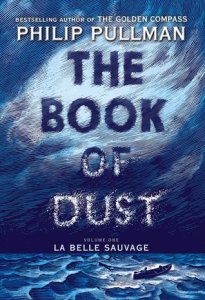
Serena’s Review: “La Belle Sauvage”

34128219Book: “La Belle Sauvage” by Philip Pullman

Publishing Info: Alfred A. Knopf Books for Young Readers, October 2017

Where Did I Get this Book: the library!

Book Description: Eleven-year-old Malcolm Polstead and his dæmon, Asta, live with his parents at the Trout Inn near Oxford. Across the River Thames (which Malcolm navigates often using his beloved canoe, a boat by the name of La Belle Sauvage) is the Godstow Priory where the nuns live. Malcolm learns they have a guest with them, a baby by the name of Lyra Belacqua . . .

Review: This is going to be such a hard review to write! Not only do I have drastically mixed opinions of this book, but there’s just no escaping the fact that there is no way I can be completely objective about this. As I was reading it, my husband looked over and asked about the strange smile on my face and the only way I could explain it (yes, he is one of those rare individuals who hasn’t read the “His Dark Materials” trilogy) was to compare it to reading a new Harry Potter book. It’s something you never thought would happen, so much so that you gave up wishing for it, and yet, one day, it arrives on your step and you’re once again back in this magical world, and more than than, you’re back to when you were a kid reading the series for the first time. The only word to describe the entire experience is “surreal.”

But. I did have qualms, and I think through these I was able to take off the nostalgia glasses long enough to be able to analyze the book as much outside of its connection to this beloved trilogy as I can. Here we go!

Set eleven or so years before the events of “The Golden Compass,” this is the story of Malcolm, an 11 year old boy whose family owns and operates an inn called the “Trout.” Malcolm is everything we expect from young heroic boys: smart, resourceful, and kind. If you look up the actual definition of “boy scout,” I’m pretty sure it would say “See the character of Malcolm from Philip Pullman’s “La Belle Sauvage.”

Other than caring for his beloved canoe (the name of which is where the title of the book comes from), his main duties in life are avoiding the acerbic teenager Alice who works as a dishwasher at the inn, and helping a group of nuns who live in a priory nearby. Until, that is, a mysterious baby girl named Lyra appears in the nuns’ care. Now, devoted to Lyra, Malcolm finds himself caught up in a cold war between two powerful parties both looking to determine Lyra’s future (or whether she should have one at all). Fleeing the disturbed man named Bonneville and his even more disturbing daemon, a three legged hyena, who have their own designs on the baby, Malcolm, Alice and Lyra flee during a massive flood, looking for safety and a future for this small, but important, girl.

First with the simple parts of my review. Obviously, Pullman is still the incredible author we all knew him to be. His writing is clear, concise, and compelling. While the story starts out slowly, this, too, that fans of this author should have been expecting. “The Golden Compass” itself isn’t known to have a bang of a start. And once the flood takes place, the action picks up to almost a frantic pace, changing dramatically into an almost “Odyssey” like tale with Malcolm, Alice, and Lyra drifting from one mystical and dangerous island to another. This aspect of the story was a complete surprise to me, and I very much enjoyed the entire sequence and the various types of magical elements that these scenes added to Lyra’s world.

Further, his main character, Malcolm, is a strong addition to the cast. This was probably the biggest challenge: how do you create a new child hero that will hold his own when compared to Lyra and Will, and notably not be the same as either of those two characters? Malcolm has much of Will’s earnestness and good will, and, if Will’s childhood hadn’t been flooded with the darkness it was, he and Malcolm may have turned into very similar boys. Malcolm is essentially the result of a good childhood and good parents. In some ways he could be read as a bit one dimensional in this goodness, but as the story progress, specifically the last half of the story, his character is tried and tested enough that I think he can avoid this accusation. Malcolm confronts real horrors and real choices, and while he holds true to his “boy scout” mentality, he is also clearly very much changed by the end of the story.

The second biggest hurdle faced by Pullman was how to handle characters we are all familiar with from the first trilogy. It would be all to easy for these known characters to overwhelm a story like this and wash out the new characters being introduced. For the most part, I think he handled this very well. The cameo appearance of many of these character were like bright jewels to run into, but at the same time, I was satisfied enough with the main story not to crave their absence. There were a few moments, like a very brief scene with Mrs. Coulter, that I felt verged a bit too close to fan service for my taste. Was it really necessary to this story that she appear on the page? But these are pretty minor quibbles, and I thought Pullman mostly avoided any pitfalls in this area.

Now, my concerns. There are two that really stand out: Bonneville as a villain and the aspects of the story caught up in him, and Alice’s character and role in this story. We’ll start with Bonneville as I think he leads nicely to my second point.

Bonneville is introduced as a criminal with a pretty nasty past, one specifically dealing with his imprisonment for some type of sexual crime that Mrs. Coulter testified against. So, we can make some assumptions there. Then, throughout this story, we see Bonneville terrorizing and coercing the women around him, notably Alice and a few of the nuns. And towards the end of the story, this culminates in a very horrible way.

Look, Bonneville himself, and his creepy hyena, were scary villains. They served their purpose as a persistent and unpredictable terror following close behind the children. But the fact that his danger is tied up in sexual violence read as strange, especially with regards to the choices made with Alice’s role in the plot, and, more importantly, with all of the work Pullman did in his first trilogy to reclaim the importance of the body and to write strong, complex female characters.

At one point, early in their flight, Alice accuses Malcolm of only bringing her along to change the diapers of Lyra. And, in the end, this is most all she does. She’s clearly a smart and competent character, but she is given very little to do in this story other than care for Lyra and wait while Malcolm saves the day (repeatedly). Which all just makes the sexual violence towards the end all the more disturbing and off putting.

I’m not sure exactly how this trilogy is planned to play out, but I read somewhere that at least one of the next books will deal with Lyra as an adult. If that’s the case, are Malcolm and Alice only the main characters here? And if that’s the case, this last violent scene plays all the worse. I’m not convinced it is necessary, other than to push Malcolm into action (won’t go into that aspect of it, just look up “fridging female characters” and you’ll get my point), and I’m worried that it will be left as is, with no real followup in subsequent stories.

Ultimately, the whole thing was just confusing to me. Why was this choice made? What purpose was it serving? And, from an author like Pullman who gave us such excellent characters as Lyra and Mary Malone, why was Alice written so simplistically and then, even worse, combined with these story choices? I honestly can’t understand it.

As I said at the top, I closed this book with some very mixed feelings. I can’t help but love the fact that there’s a new entry into this world, and I very much enjoyed Malcolm and much of the action of this story. And there’s never an argument to be had about Pullman’s mastery of writing. But some of the choices with the villain and the themes brought up with him were very unsettling. What’s more, the original trilogy simply had more to say. And very little of that philosophical underpinning can be found in this book, leaving us only with a very gruesome and largely unaddressed sexual violence theme. But, obviously, I’ll be back for the next to in the series, and hopefully some of this book’s action will be addressed there. And if not, hopefully Pullman will once again find his footing with the larger questions that made the first trilogy so fascinating.

If you’re fa fan of his first series, I don’t even need to tell you to check this out, because I’m sure you will. If you’re a new reader, I strongly recommend reading the fist trilogy before picking this up; not only is it much better, but it provides much needed context for a lot of what is presented in this book.

Rating 7: A wonderful return to a beloved world with an excellent new character in Malcolm, but one that is marred by some jarring writing decisions.

Reader’s Advisory:

“La Belle Sauvage” is included on these Goodreads lists: “Alternate History in 2017” and “Most Anticipated Speculative Fiction Books of 2017.”

Find “La Belle Sauvage” at your library using Worldcat!

Serena’s Review & Giveaway: “The Girl in the Tower”

34050917Book: “The Girl in the Tower” by Katherine Arden

Publishing Info: Del Ray, December 2017

Where Did I Get this Book: ARC from Bookish First, and an e-ARC from NetGalley

Book Description: Orphaned and cast out as a witch by her village, Vasya’s options are few: resign herself to life in a convent, or allow her older sister to make her a match with a Moscovite prince. Both doom her to life in a tower, cut off from the vast world she longs to explore. So instead she chooses adventure, disguising herself as a boy and riding her horse into the woods. When a battle with some bandits who have been terrorizing the countryside earns her the admiration of the Grand Prince of Moscow, she must carefully guard the secret of her gender to remain in his good graces—even as she realizes his kingdom is under threat from mysterious forces only she will be able to stop.

Previously Reviewed: “The Bear and the Nightingale”

Review: It wasn’t even a year ago when I, on a slight whim, picked up “The Bear and the Nightingale.” It was in the middle of winter, and here in Minnesota, that’s a real thing, so the gorgeous cover with its deep, cool blues centered around a girl, out in the cold, facing inwards towards the cozy warms hues of hearth and home, struck a particular cord. But nothing could have prepared me for the sheer joy that was reading that first debut novel by Katherine Arden. This time, I was prepared. And yet…was I? Once again, I’ve somehow been blown off my feet by the sheer scope of Arden’s abilities and the story she is weaving together in this series.

“The Girl in the Tower” opens with a few chapters from the perspective of Vasya’s siblings. These first glimpses highlight not only that life has gone on outside of the strange and magical happenings in Vasya’s remote home village, but that in this time period, across all of this space, word does not travel fast. And her siblings have their own concerns. Olga, living the life of an aristocratic woman in medieval Russia, constrained to a tower and seclusion, is trying to raise her two children, particularly her willful young daughter, while looking forward to the birth of her third. And Vasya’s brother, Sasha, a wandering warrior monk, brings news of villages being raided and burned, their daughters stolen, to his close friend the Grand Prince.

Within this framework, we return to Vasya, almost immediately after the end of the previous book, still set on her plan to wander the world, accepting neither marriage nor a convent as reasonable choices. Even in the face of Morozko’s, the frost demon and god of death, open skepticism of her plan, she sets off. Only to discover that he is both right and wrong. The world is filled with much more danger than she had expected, but oh so much more beauty, as well. Along the way, she takes on the appearance of a young boy for further safety, and rescues two girls from the same group of bandits that Sasha had discovered. After running into her brother and the Grand Prince hunting these bandits, Vasya finds herself living a lie that is full of freedom but doomed to not last. Olga and Sasha, alone, understand the true, political dangers of what their young sister has gotten them all tangled up within.

As I said, I loved the first book in this series, and while I was hopeful that this book would continue to show that same strength, I never expected it to exceed it. And exceed it did, in almost every way. This book was by far more action-packed. The romance was increased. The danger and horror were there. And the characterization, allowed to build on what came before without the pressure of introducing completely new characters, blossomed. By being exposed to the world and its realities, the beauties and, more importantly, dangers and restrictions that confront women, Vasya’s former naivety is brutally stripped away. And yet she never loses her fierceness or her conviction that, whatever anyone says, this is wrong. Seeing their fiery, brilliant sister’s struggle, Sasha and Olga, not the most conservative individuals themselves, are forced to confront the lives they are leading and the expectations and assumptions they’ve made about themselves and those around them. One of my favorite quotes, from Sasha:

Witch. The word drifted across his mind. We call such women so, because we have no other name.

Further, I continue to love the mixture of historical detail of a time period and location that is rarely explored, with Russian folklore and fairytales, some of them recognizable, some completely, refreshingly, new. The tower from the book’s name, for example. In the author’s note, Arden discusses how locking aristocratic women in remote towers or wings of castles, completely removed from society, was a common practice in this time period. But perhaps most interesting, no one fully understands why this was done. And here, she ties this aspect of Russian history so neatly into a full-fledged fantasy novel that includes frost demons, magical talking horses, and firebirds.

And, like the first book, Arden’s prose is simply beautiful. While this book has more action than the first, this in no way detracts from atmospheric style of writing. Again, the cold of winter, the darkness of the woods, the bustle of the cities. It is all gorgeously drawn landscapes across which her characters romp.

The story also fully succeeds as a middle step in a trilogy. It takes concepts and interest points from the first story (particularly the romantic undertones with Morozko) and expands on them, tells a complete and compelling story of its own (the bandits, and a surprising tie-in to Vasya’s own familial history), but also lays the groundwork for the next and last in the trilogy. Vasya’s place in the world is by no means defined, and where she will go, and what role she will play in the ever-fading mystical world to which she is so closely connected is still yet to be determined.

Lastly, as a horse lover already, Solovey stole the show in this book. He was the primary source of much of the humor of the story, but it is also clear that without him, much of what Vasya accomplishes would have been impossible. As much as I love the bittersweet romance with Morozko, I’m all in for the horse/girl relationship as my primary bread and butter.

Honestly, I can’t recommend this book enough. And like with “The Bear and the Nightingale,” I want to share the love! Enter the giveaway to win an ARC copy of “The Girl in the Tower.” The giveaway is open to U.S. entrants only and ends on November 28, 2017.

Congrats to Kara for winning our giveaway of “The Girl in the Tower!”

Rating 10: Somehow even better than the first!

Reader’s Advisory:

“The Girl in the Tower” is a new title and isn’t on many relevant Goodreads lists except for  “Young Adult & Middle Grade Historical Fiction set in Russia.”

Find “The Girl in the Tower” at your library using WorldCat!

Serena’s Review: “All the Crooked Saints”

30025336Book:  “All the Crooked Saints” by Maggie Stiefvater

Publishing Info: Scholastic Press, October 2017

Where Did I Get this Book: the library!

Book Description: Here is a thing everyone wants: a miracle.
Here is a thing everyone fears: what it takes to get one.

Any visitor to Bicho Raro, Colorado is likely to find a landscape of dark saints, forbidden love, scientific dreams, miracle-mad owls, estranged affections, one or two orphans, and a sky full of watchful desert stars.

At the heart of this place you will find the Soria family, who all have the ability to perform unusual miracles. And at the heart of this family are three cousins longing to change its future: Beatriz, the girl without feelings, who wants only to be free to examine her thoughts; Daniel, the Saint of Bicho Raro, who performs miracles for everyone but himself; and Joaquin, who spends his nights running a renegade radio station under the name Diablo Diablo.

They are all looking for a miracle. But the miracles of Bicho Raro are never quite what you expect.

Review: I have been a fan of Stiefvater for a while now. I have  distinct memory of picking up “Shiver” like ten years ago before she was a big name in the YA community and very much enjoying it. But what makes her special, in opinion, is the way she has grown as an author in the year’s between. Every book I’ve read by her seems to be better than the last: the plotting more meticulous, the characters more fleshed out, and, most importantly, the lyrical, poetic style of her writing more beautiful and heartbreaking than ever before. All of this remains true for her latest novel “All the Crooked Saints.”

When Pete wanders into the Bicho Raro ranch, he’s only there to work off the price of a box truck that he hopes to use to start a moving business. He’s heard something about miracles, owls, and saints on his way, but not until he arrives does he fully understand. Now, surrounded by pilgrims whose miracles were not what they expected, Pete finds himself becoming entranced by the entire Soria family, but particularly the “emotionless” Beatriz.

While I have framed my summary around Pete, there is no one character who serves as a central point for the story, truly. Perhaps the Soria family as a whole? Throughout what is really a very small book, I found myself sinking down deeply into this strange family, their history, and the beautiful imagery and philosophy behind what constitutes a miracle. We learn bits about every one of the Soria family, their hopes, their fears, what has them, like the pilgrims around them, seemingly stuck with their first miracle, unsure how to move forward.

Stiefvater’s creativity is boundless. The entire concept is beautiful and terrifying, terrifyingly beautiful, just like the stark desert in which the story takes place. The miracles that the pilgrims experience are surprising and new: twin sisters caught in a tangle of snakes, a man who is growing moss, a woman covered in butterflies whose own personal cloud dumps rain on her head constantly. What makes this all the more special is that we can see how these miracles (lessons) connect to the darkness each of these characters are walking through, but none of them are too on the nose or expected. It would have been very easy for this idea to slip into the trite.

Beyond this, the characters are all gloriously complicated, damaged, and lovely. It’s a true testament of skill to not only work in a complicated magic system, fill the pages with beautiful prose that speaks to complicated philosophies and theologies, as well as create a large cast of characters that all have their own distinct story and appeal, all within such a short page count.

Pete, hard-working, but feeling betrayed by a heart to weak to allow him to serve his country in the military, like his family before him. Beatriz, too comfortable with her own lack of emotions. Joaguin, with dreams of being bigger than his little life on the ranch, feeling the judgement of a family who may deem him frivolous. And Daniel, the current Saint, whose parents died due to their darkness and by breaking the taboo to help the pilgrims who visit them. And while these are our “main” characters, the generation of Sorias before them, too, get their own snips of chapters and histories, loves and heartbreaks.

Throughout this all Stiefvater delves into the meaning of family, questions what makes up love, and explores the courage and fear that comes with recognizing what is dark within ourselves. And, importantly, how necessary this process is, for everyone.

I feel like this review may have been all over the place, but I truly don’t know how to best portray the beauty that was this story. Thinking back on it, I mostly see images: barren, but vivid landscapes of the desert, owls grouped on a porch, strange beings wandering among scattered out-buildings, and a family, gathered closely together, but somehow apart and drifting alone. If you’ve read any of Stiefvater’s work in the past, this will all make more sense to you, knowing her skill and particular style of writing. And if you haven’t, this is an excellent place to start, as a stand-alone book that perfectly illustrates all the gifts Stiefvater has to offer.

Rating 9: Vivid and gorgeously rendered, but challenging readers to look deeper within themselves and wonder “What would my miracle look like?”

Reader’s Advisory:

“All the Crooked Saints” is fairly new and isn’t on many relevant Goodreads lists, but it is on “2017 YA/MG Books With POC Leads.”

Find “All the Crooked Saints” at your library using WorldCat!


Serena’s Review: “City of Brass”

32718027Book: “City of Brass” by S. A. Chakraborty

Publishing Info: Harper Voyager, November 2017

Where Did I Get this Book: e-ARC from the Edelweiss

Book Description: Nahri has never believed in magic. Certainly, she has power; on the streets of 18th century Cairo, she’s a con woman of unsurpassed talent. But she knows better than anyone that the trade she uses to get by—palm readings, zars, healings—are all tricks, sleights of hand, learned skills; a means to the delightful end of swindling Ottoman nobles.

But when Nahri accidentally summons an equally sly, darkly mysterious djinn warrior to her side during one of her cons, she’s forced to accept that the magical world she thought only existed in childhood stories is real. For the warrior tells her a new tale: across hot, windswept sands teeming with creatures of fire, and rivers where the mythical marid sleep; past ruins of once-magnificent human metropolises, and mountains where the circling hawks are not what they seem, lies Daevabad, the legendary city of brass–a city to which Nahri is irrevocably bound.

In that city, behind gilded brass walls laced with enchantments, behind the six gates of the six djinn tribes, old resentments are simmering. And when Nahri decides to enter this world, she learns that true power is fierce and brutal. That magic cannot shield her from the dangerous web of court politics. That even the cleverest of schemes can have deadly consequences.

After all, there is a reason they say be careful what you wish for . . .

Review: In addition to my e-galley, I nabbed a copy of this while Kate and I were sneaking around early exploring the exhibit hall. I really knew nothing about it beyond the fact that the cover was beautiful, and it had a blurb that referenced ‘The Golem and the Jinni,” which is a historical fantasy novel from a few years ago that I absolutely adored. So I went into this one with practically no expectations, and wow. I mean…wow. S. A. Chakraborty is a new author to sit up and pay attention to!

First off, the description above is a bit misleading. Yes, we do follow the story of Nahri, a street con woman who finds herself to have a mystical heritage and one that is paramount to the future of a vast and complicated fantastical world where djinn, marids, and many, many others roam and war with each other. However, chapters alternate between her adventures and those of Ali, a young, second son of Ghallan, the current ruler of Daevabad. Ali has been trained as a warrior to serve as a general, essentially, for his older brother when he takes over. But Ali is also a deeply religious young man, and when he looks at his family’s dealings with the shafit (half human, half djinn), he sees only oppression and wrong doings.

There is so much to praise about this book. It is atmospheric, bringing to life large swaths of the Middle East. We travel from the streets of ancient Cairo, to the foothills of what is likely Persia, across desserts and great rivers, and finally, into a fully-realized magical realm that seamlessly blends creative magical elements (like bizarre illnesses, strange creatures, and fantastical architecture) alongside traditional, historic middle eastern touches. And Chakraborty has peopled this world with an equally diverse and well-drawn cast of characters. Yes, there are magical beasts, liked winged lions. But there are also various types of humanoid-beings. The djinn are a fire people. There are the rumored Marid, a water people. And, the most powerful of all,  a people of the air. Among these, roam the shafit, whose complicated history with the djinn sits at the heart of this story.

This history is perhaps one of the most impressive parts of the story. Not only is it complicated enough that I was still fitting pieces together towards the end of the book (in this case, this is a compliment, as it was complicated for important reasons, not due to poor writing, which is often the case behind lasting confusion), but the author successfully challenges readers at every step to evaluate and re-evalutate and AGAIN re-evalutate who are the heroes and villains in each version of history we hear. And the best part: this is never made clear. I love this nuanced take on storytelling, as I feel it reads the most honest to true history. The stories are told by the winners, and often the winners have contributed their own atrocities to succeed in the first place. And in this book’s case, we have such a long history presented, that the winners of one historic conflict, are the losers of the next. One side is oppressed at one point, only to oppress the other at the next, while that oppressed group now holds the keys to peace going forward. There are no simple “good guys” and “bad guys” in this story. And by the end, I’m firmly rooting for three different characters who all fall on one extreme, the middle, and the other extreme of a very complicated spectrum.

And this brings me to my last point. All of this history and world-building is supported by an amazingly strong cast of characters. To support this kind of ongoing conflict that is constantly questioning the morality of one group’s choices or the other, you must have sympathetic and interesting characters to make you care. Nahri is the exact type of heroine I love. She’s well-rounded, has a distinct personality, is sassy, but also knows when to bend, and, importantly, she is flawed. Ali, the second protagonist, is also incredibly strong. He had more work to do as he took me by surprise, but I found myself equally enjoying his earnest and often naive view of the world he lives in and the role he is expected to play. And then lastly, we have Dara, a djinn warrior of legend who befriends and protects Nahri. Even by the end of the story, we’re not sure who exactly this character is. But the sweet romance that begins to develop between him and Nahri is the exact sort of slow burn love story that I like, and I’m curious to see what will happen with this particular character and plot line moving forward.

I honestly can’t recommend this book enough. As I said, I picked this up because it sounded like “The Golem and the Jinni.” Turns out, I loved it even more than that one. For those looking for a smart, complicated, fantasy novel set in a unique environment, definitely check out “The City of Brass.” Now I’ll just frantically stare down the calendar while I wait for the sequel!

Rating 10:  The best kind of surprise. I honestly have zero criticisms for this book, and that’s a feat on its own!

Reader’s Advisory:

“City of Brass” is on these Goodreads lists: “Muslims Represented in Literature” and “2017 SFF by Authors of Color.”

Find “City of Brass” at your library using WorldCat!

Serena’s Review & Giveaway: “Girls Made of Snow and Glass”

32768509Book: “Girls Made of Snow and Glass” by Melissa Bashardoust

Publishing Info: Flatiron Books, September 2015

Where Did I Get this Book: ARC from ALA 2017

Book Description: At sixteen, Mina’s mother is dead, her magician father is vicious, and her silent heart has never beat with love for anyone—has never beat at all, in fact, but she’d always thought that fact normal. She never guessed that her father cut out her heart and replaced it with one of glass. When she moves to Whitespring Castle and sees its king for the first time, Mina forms a plan: win the king’s heart with her beauty, become queen, and finally know love. The only catch is that she’ll have to become a stepmother.

Fifteen-year-old Lynet looks just like her late mother, and one day she discovers why: a magician created her out of snow in the dead queen’s image, at her father’s order. But despite being the dead queen made flesh, Lynet would rather be like her fierce and regal stepmother, Mina. She gets her wish when her father makes Lynet queen of the southern territories, displacing Mina. Now Mina is starting to look at Lynet with something like hatred, and Lynet must decide what to do—and who to be—to win back the only mother she’s ever known…or else defeat her once and for all.

Review: “Snow White” fairytale re-tellings have had quite the resurgence it seems over the last few  years. And many of them, like “Girls Made of Snow and Glass,” are attempting to re-imagine this classic tale into something new and different. Not an easy feat. To add to this, this novel was also marketed as somehow connected (based on??) the smash Disney hit “Frozen,” as well. Which in turn was based on yet another fairytale, “The Snow Queen.” In all honesty, I picked this one up with a bit of trepidation, worrying that all the elements listed above, plus the fact that I knew it had LBGT elements, would combine into what could only be described as a hot mess. But I’m not to proud to admit when I’m wrong, and while I would consider this one a home run, it did manage to pull all the elements it committed to.

The story follows to young women: Mina, a young woman without a heart, who never the less seeks out love, hoping to find it in a King with a young daughter. The daughter, Lynet, is our second main character, a young woman created in the image of her own dead mother. Chapters alternate between these two main characters, and while each of their stories plays out in different manners, what’s at the heart of their struggles is the same: the meaning of family, what is love, and how they, as women, must make hard choices in order to navigate the world in which they live.

Honestly, in many ways, this book took the best advantage of the opportunities to respond to a fairytale that is completely based on woman vs. woman competition due to beauty. There is a lot to unpack there, both with the relationships formed between women, as well as the value on beauty above all else that society, and women themselves, place upon young girls.

I was honestly very surprised with the direction that this story went at different points in the book. Obviously, it was refreshing to read a version of the “evil queen” who was sympathetic, who had made tough decisions to protect herself and what she wanted, and knew that it was wrong that she is being punished for it. Lynet, too, was more than the simpering, often one dimensional princess character that is often found in these stories, and hers the romance containing LGBT elements. For all the hype around this aspect of the series, however, I did find this romance to be a bit underfed. Lynet’s story is only half of the book after all, and Mina’s romantic storyline read as more fully developed. This is unfortunate, but I applaud the author’s intentions in this aspect.

My primary criticism of the story was the writing style. Perhaps it simply wasn’t the type of writing I prefer, but at times it read as a bit middle grade and simplistic for a young adult novel. Especially for a young adult novel that was trying to do and say some big things about found families, the wide varieties and intrinsic value of loves to be found in the world, and the challenges that women face when trying to control their own lives without being punished for it. For all of these large and complicated topics, for being based on not one but two action-packed fairytales, at times I just found myself to be bored. A couple of scenes in the middle, specifically, should have jumped off the page, but somehow seemed to wilt, leaving me under enthused.

But, these criticisms aside, “Girls Made of Snow and Glass” did an excellent job of reimaging a fairytale that has almost be “reimagined” to death at this point. Just when you start to think that there isn’t much more that can be done with a story like this, an author comes along and proves you wrong. If you’re a fan of fairytale retellings, and especially if you’re looking for better representation in your fantasy fiction, check out “Girls Made of Snow and Glass” and enter the giveaway below to win a copy for yourself!

Giveaway is for an ARC of “Girls Made of Snow and Glass” and is open to U.S. entrants only. Giveaway ends on Tuesday, November 7.

Congrats to @melissadougher for winning this giveaway!

Rating 7: Fantasy fiction with a lot to say about found families and feminism. Come for the familiar, stay for the new!

Reader’s Advisory:

“Girls Made of Snow and Glass” can be found on these Goodreads lists: “LGBT Retellings of classic Fiction/Fairy Tale/Myth” and “Snow White Retellings.”

Find “Girls Made of Snow and Glass” at your library using WorldCat!

Guest Post: Danica Davidson and The Minecrafters Blog Tour!

adventure-against-the-endermen 600We at the Library Ladies are excited and honored to participate in the Minecrafters Blog Tour along with author Danica Davidson! For those unfamiliar, the Overworld Adventures books take place within the “Minecraft” Universe, and have proven to be a popular series for kids of all ages. Kate can personally attest that she sees a lot of these books being checked out her her library. We are very excited to have a guest post from Danica Davidson, the author of the upcoming “Adventure Against the Endermen”, the first in a whole new series of books! Today she is going to talk about what libraries and literacy mean to her, and we are very thankful for her perspective. Thanks, Danica!

danica3I don’t know what I would do without libraries. I was the kid who went into the library and walked out with a pile (wait, that’s still true). I love the smell, feel and experience of holding a book. I love how books will open up new worlds and new perspectives to me in a way that nothing else does. I love all the options libraries supply, where there are so many books on different subjects, and that they’ve been there for me when there was no money to spare for buying books. When everything else is gone, there’s still the library.

It’s not a big surprise that has someone who had an interest in storytelling from an early age would end up a voracious reader. (According to my mom, when she would tell me bedtime stories and I was three, I would take over the stories and tell her what happened.) I always appreciated that my parents encouraged me to read and let me read what I wanted, and after initially dictating stories to my parents, I started writing down my own stories in early elementary school. I was making picture books for myself in first grade and by sixth grade I was writing short novels. My dream was always to be a professional author. I started working as a journalist in high school and got my first book contract three years ago. None of this would have happened if I hadn’t been a reader and had access to books.

Since then, I’ve written kids’s books and YA books. My book Manga Art for Beginners will soon have a sequel, Manga Art for Intermediates, and my Minecrafter books (middle grade novels for ages 7-12 that take place as if Minecraft is real) have turned into two series. The first series, Escape from the Overworld, Attack on the Overworld, The Rise of Herobrine, Down into the Nether, The Armies of Herobrine and Battle with the Wither, are coming out as a box set November 7, the same day the first book in my spinoff series, Adventure Against the Endermen, comes out. The new series will have the same main characters, but different villains and adventures. I have also written a Barbie graphic novel, where Barbie and her sisters throw a puppy party to get all the local shelter pets adopted, and a Tales from the Crypt comic where a fight in the high school locker room leads to a deadly act. Just as I like reading in all different sorts of genres, I love writing in all different sorts of genres. This is how I experience the world and I want to write more books for different ages, including books for adults.

I believe that literacy is one of the most important issues out there, because so much stems from being able to read and from reading on different topics. I’ve been told by librarians that my books are hard to keep on the shelves, and that’s what I want. I want to write stories that keep the pages turning, that readers up later to see what happens, to have characters that people find involving. I find very few people don’t actually like to read; most of the time when I hear kids say they don’t like to read, it’s because they could use more help in their reading, or because they haven’t been introduced to books that interest them. Often the books I was assigned to read in class didn’t interest me much; I liked the books I could pick out for myself at the library better. If kids know “Yes, there are books about [plug in your interest]” I think that would make a world of difference for some young readers. I believe in encouraging kids to follow their interests when it comes to reading and their own creativity. Oftentimes when kids find books they like and learn that reading can be fun, they’ll expand into reading about other subjects as well and become more well-read on different topics.

Many librarians use Minecraft in their libraries these days, especially for STEM reasons. I hope they can also like their Minecraft-obsessed patrons know there are also books for Minecrafters! In my books, 11-year-old Stevie lives in the Minecraft world, but they he finds a portal to Earth, making Earth friends and paving way for adventures that take place in the Overworld, the Nether, the End . . . and, yes, on Earth as Minecraft infiltrates it! The books also talk about real world things, like friendship, cyberbullying, insecurity, stuff like that. I want to mix the fantastic and the realistic, so kids can read about issues they have . . . while being right there with my characters as they fight zombies and save the worlds from the villainous Herobrine. Hey, anything can happen in books!

For more information about this fun blog tour, please visit  https://littleredreviewer.wordpress.com. Thanks again, Danica! And happy reading, everyone! 

Serena’s Review: “Weaver’s Lament”

31375770Book: “Weaver’s Lament” by Emma Newman

Publishing Info: Tor, October 2017

Where Did I Get this Book: NetGalley

Book Description: Charlotte is learning to control her emerging magical prowess under the secret tutelage of Magus Hopkins. Her first covert mission takes her to a textile mill where the disgruntled workers are apparently in revolt.

But it isn’t the workers causing the trouble. The real culprits are far more extranormal in nature.

And they have a grudge to settle.

Previously Reviewed: “Brother’s Ruin”

Review: The second novella in Newman’s “Industrial Magic” series see Charlotte still learning to control her powers in the hopes of avoiding life in the restrictive, but privileged, Royal Society. Her brother, however, has been recently admitted to the Society, and is beginning to run into problems of his own. There is something going on at the textile mill that he has been tasked to oversee. He recruits Charlotte to work undercover and discover what is going on. But what she finds is more than he expected, or either of them wanted to know. “Weaver’s Lament” raises all the stakes, and I found myself enjoying it even more than I did the first!

Charlotte, as ever, is an excellent protagonist. She’s capable, curious, and still a bit naive about the Royal Society and, especially, the role her brother is now playing by being involved within it. I had a fairly good understanding of her motivations and character from the first book, and this one simply built upon what we already knew. More and more, we understand why she resists joining a society that in many ways would elevate her to a life of riches and success. But her characterization wasn’t one of the stumbling blocks I found in the first story.

After reading the first book, most of my confusion and qualms came from not understanding who I was supposed to be rooting for among the cast of secondary characters. Charlotte’s own confusion here didn’t help. But as this story moves along, I was relieved to see that, while Charlotte may still have the wool pulled over her eyes, we, as readers at least, are beginning to understand the roles these other characters play in her life. Specifically, we begin to see the true colors of her brother Ben and Mage Hopkins, the member of the Royal Society who has been training Charlie over the last several months. At the same time, as we begin to understand the motivations, priorities, and loyalties of these two men, we are still seeing them through Charlotte’s eyes and her perspective is very much colored by her experiences and wishes. She wants her brother to be the same man he was when he left, and even her evaluation of the man he was then is forever seen through the lens of her love for him as a sibling. Mage Hopkins, too, is both the man who is training her as well as her greatest liability for being turned in to the Royal Society should he ever suspect that her training is not enough to keep her from going “wild.”

The primary mystery was also very compelling. Not only did it expose more tidbits of knowledge of how the magic system in this world works, but we saw how the Royal Society uses its magic in industrial work like the textile mill. But the other half of the story is the more human one: Charlie’s shock and horror at the conditions of the mill workers and, at best, the complacency of those in power to the situation. At worst, she finds active participation and collusion.

We also learn more about what it means for an untrained mage to “go wild,” as Charlie struggles to hold herself and her power in check. But even as she discovers the price that comes with remaining free, she, and the reader, begins to question the truth behind any of it. There were a couple surprises wrapped up in this aspect of the story that added new layers to the fantasy aspects of this world. I’m excited to see where Newman is going with all of this.

There’s a lot going on in a very short book, but I thoroughly enjoyed every aspect of it. My only criticisms would come down to a writing style that at times felt stunted, perhaps due to the constraints of the shorter page count. But this by no means hindered my reading experience, and I would highly recommend both this book, and the previous novella, to any fans of historical fantasy fiction or steampunk fantasy.

Rating 8: It’s always thrilling when a second book out performs the first, and here we really see Newman coming into her stride with this series!

Reader’s Advisory:

“Weaver’s Lament” is a newer book and isn’t on any Goodreads lists, but it should be on “Gaslamp Fantasy.”

“Weaver’s Lament” does not yet have a library catalog entry, but request it from your local librarian!

Kate’s Review: “Strange Weather”

34066621Book: “Strange Weather” by Joe Hill

Publishing Info: William Morrow, October 2017

Where Did I Get This Book: An ARC from the publisher at ALA.

Book Description: A collection of four chilling novels, ingeniously wrought gems of terror from the brilliantly imaginative, #1 New York Times bestselling author of The Fireman, Joe Hill

“Snapshot” is the disturbing story of a Silicon Valley adolescent who finds himself threatened by “The Phoenician,” a tattooed thug who possesses a Polaroid Instant Camera that erases memories, snap by snap.

A young man takes to the skies to experience his first parachute jump. . . and winds up a castaway on an impossibly solid cloud, a Prospero’s island of roiling vapor that seems animated by a mind of its own in “Aloft.”

On a seemingly ordinary day in Boulder, Colorado, the clouds open up in a downpour of nails—splinters of bright crystal that shred the skin of anyone not safely under cover. “Rain” explores this escalating apocalyptic event, as the deluge of nails spreads out across the country and around the world.

In “Loaded,” a mall security guard in a coastal Florida town courageously stops a mass shooting and becomes a hero to the modern gun rights movement. But under the glare of the spotlights, his story begins to unravel, taking his sanity with it. When an out-of-control summer blaze approaches the town, he will reach for the gun again and embark on one last day of reckoning.

Review: While we were at ALA, Serena and I were making our way through the throngs of eager librarians at the publisher tables. After all, the vendor’s hall had just opened up, and that meant free books. At one point Serena grabbed my arm and pointed to a stack of books. I immediately saw that they were ARCs of the new novellas collection by Joe Hill, entitled “Strange Weather”. Given that you all know my deep deep love for Joe Hill, it should come as no surprise that I basically went like

giphy11
Slightly more polite. But not much. (source)

I saved it and saved it and SAVED IT for Horrorpalooza, and I can say that it was basically worth the wait. I’m going to talk about all four novellas, split up into four sections. I’ll try to keep it concise, but this may be a ramble, y’all.

“Snapshot”: Okay, so I’ll be honest. I read “Strange Weather” for Horrorpalooza, but I would say that this story was the only one in the set that was a mostly ‘conventional’ horror story. More on the others later. What I liked about “Snapshot” was that it had the nostalgia feel down pat, with our protagonist being a teenage boy named Michael who is fairly normal, if not a little awkward. His neighbor and family friend Shelly Beukes has been succumbing more and more to memory loss and dementia, and Michael keeps an eye on her for her aging husband Larry. She keeps talking about a “Polaroid Man” who is stalking her, but it’s chalked up to her failing memory. Of course, Michael then meets this “Polaroid Man” and his camera that steals memories from people. From the description of this guy to the very concept of someone stalking you to steal your memories, I was sufficiently spooked by this first novel. I thought that Michael also had a very realistic voice, and it just proves that Hill, like his father Stephen King, really knows how to write a book from the perspective of kids and pull it off. There was also a lingering sense of pathos about this story, as it didn’t end after a battle of good and evil, like so many horror stories do. I had to wipe tears away from my eyes as Hill ruminated and explored the ideas of losing oneself to time and old age, and how it affects those who love you. Man does this man know how to make me cry.

“Loaded”: This was probably the ballsiest, and most maddening, book in the collection. Hill doesn’t shy away from his personal politics and opinions in his public persona, and he has a lot to say about gun violence in this country. “Loaded” takes the themes of gun violence, racism, privilege, and, dare I say, the Alt-Right (before it became so prevalent), and turns it into this sucker punch of a story. Basically, a white mall cop with a history of racism and violence is said to have stopped a mass shooting at a mall, in which five people were killed, including the suspect. He becomes a hero to the community. But then his story starts to fall apart as a reporter with her own painful memories involving racist cops and police brutality starts to dig into his ‘heroic act’. This one built up nice and slow, piecing things together bit by bit until I was on the edge of my seat. This was also the story in the collection that made me yell out in anger at the end, and have to walk around my house a bit before I could continue onto the next one. Hill brings up a lot of hot button by ever relevant issues in how we view authority, how we downplay racism in our culture, and how deadly situations that can totally be prevented instead explode because of our obsession with guns and the inability (or refusal) to confront our racist culture and disdain for gun control. DAMN this one pulsated with indictments and anger, and while it was bleak as HELL, I like that he took it on, even if there were a couple of tropes used that feel a bit outdated and not so culturally sensitive (like, why did the father of Aisha’s daughter have to have run off on her?). Overall, this one lights up the page with frustration and misery. Be ready.

“Aloft”: This story might have been my favorite in the book, actually, which I wasn’t expecting because it was the one that was the LEAST horror-oriented. A guy named Aubrey is skydiving with the girl he pines after, as part of a promise they made to a mutual friend who has now passed on. But he manages to land on a solid, cloud-like…. thing. It tries to provide him with everything he needs, as if it has a mind of it’s own and wants him to stay, and Aubrey is tempted to take it up on it’s hospitality. What I liked about this one was that it just kind of felt a little whimsical, as well as bittersweet. We learn about Aubrey and his relationships with his crush, Harriet, and their now deceased bandmate June. You slowly see his strengths and weaknesses, and how his inability to take various plunges in life now applies to not taking ‘the plunge’ off this weird ‘cloud’ that so entices him to stay. I just loved the mechanics and the world building of this ‘cloud’. We don’t really know what it is, we don’t really know how it works, but I was so tickled by the various things that it could do. It’s just such an original concept, even if it wasn’t particularly ‘scary’. It reminded me of some of the more whimsy-based stories in “20th Century Ghosts” that didn’t scare, but entertained through sheer creativity.

“Rain”: Hill is no stranger to the Apocalypse story. You remember how much I LOVED “The Fireman”, so when I realized that “Rain” was an end of the world story but with NAIL RAIN, I was pretty pumped. Our protagonist this time is Honeysuckle, a woman who lives in Boulder and is excited that her girlfriend is finally moving in with her. Unfortunately, the day that Yolanda is going to move in, a storm cloud comes through, and instead of water, the sky rains sharp crystals that look like nails. They shred every living thing below, causing death, damage, and panic. In the acknowledgments Hill said that he was kind of having a bit of fun with the fact he’d already written such an epic end of the world story, but “Rain” isn’t exactly light hearted. It is very despondent, as Honeysuckle travels on foot to Denver to try and find Yolanda’s father, having to deal less with rain than the human wreckage and evils along the way. From a strange cult to homophobic misogynists, Honeysuckle has a long road ahead of her. This one made me cry deeply at one point, because, fair warning for a spoiler here, a person that Honeysuckle comes upon is completely broken over the fact his cat Roswell has been impaled by these crystals. Roswell is still alive, but in agony, and Honeysuckle decides to put the poor animal out of it’s misery. And it was here that all my tears for other things in this collection decided that enough was enough.

giphy12
Actually, the bed/covers setting and the hair isn’t too far off either. (source)

But even though Hill said in the acknowledgments that the Trump election made him make this story far less hopeful that he originally intended, he doesn’t leave it totally hopeless. I appreciate that even in darkest times in his writing, he will usually give us the strength to keep on hoping. Unless it’s “Loaded”. GOD that was a rough one.

All in all, I thought that “Strange Weather” was a very strong collection of stories. Joe Hill continues to amaze me and move me, and if you haven’t already, please do seek him out. This might be a good collection to start with, as it balances so many of the genres that he excels in.

Rating 8: A solid and enjoyable collection of four novellas that made me laugh, cry, shudder, and have to walk around my house in a rage. So you know, everything I want Joe Hill to do.

Reader’s Advisory:

“Strange Weather” is not on any Goodreads lists yet, but I think that it would fit in on “Best Weird Fiction” books (for “Aloft” and “Rain”), “Not the Normal Paranormal” (for “Snapshot”), and “Masters of Misery” (for “Loaded”).

Find “Strange Weather” at your library using WorldCat!