Serena’s Review: “Salt & Broom”

This post may contain affiliate links for books we recommend.  Read the full disclosure here.
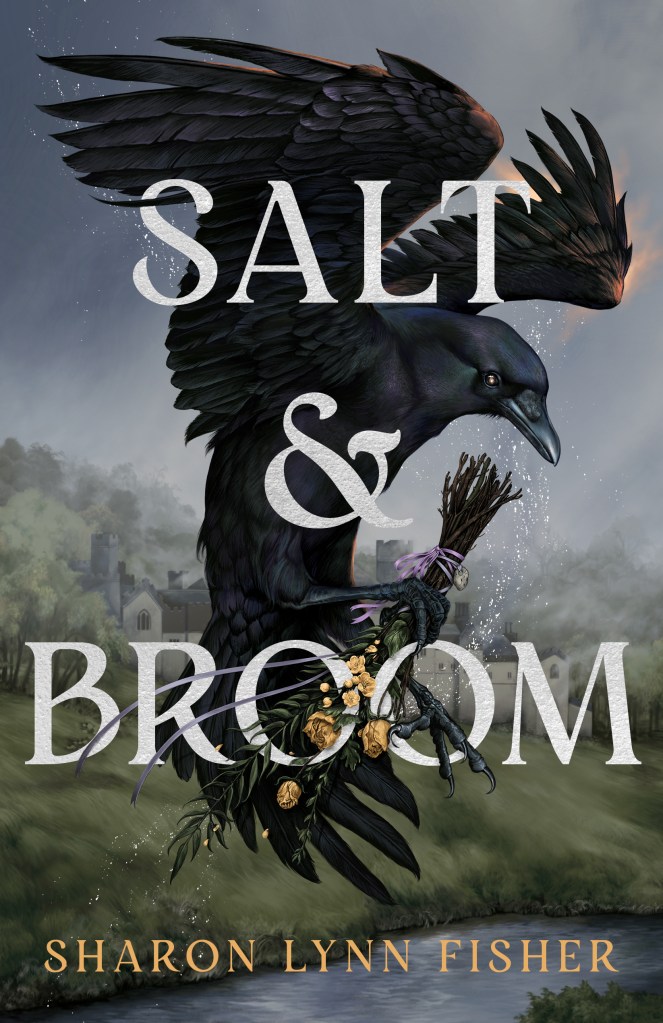
Book: “Salt & Broom” by Sharon Lynn Fisher

Publishing Info: 47North, December 2023

Where Did I Get this Book: Netgalley!

Where Can You Get this Book: WorldCat.org | Amazon | IndieBound

Book Description: A gifted healer unravels the mysteries of a cursed estate—and its enigmatic owner—in a witchy retelling of Jane Eyre .

“Salt and broom, make this room
Safe and tight, against the night.”

Trunks packed with potions and cures, Jane Aire sets out on a crisp, clear morning in October to face the greatest challenge of her sheltered girls’-school existence. A shadow lies over Thornfield Hall and its reclusive master, Edward Rochester. And he’s hired her only as a last resort. Jane stumbles again and again as she tries to establish a rapport with her prickly new employer, but he becomes the least of her worries as a mysterious force seems to work against her. The threats mount around both Jane and Rochester—who’s becoming more intriguing and appealing to her by the day. Jane begins to fear her herb healing and protective charms may not be enough to save the man she’s growing to love from a threat darker and more dangerous than either of them imagined.

Review: No, your memory is not failing you: Kate, not me, was the one to include this book in her Highlights post back in December! But this is a perfect example of the sort of book that has cross-over appeal for Kate and I. For one thing, we both love “Jane Eyre” and thusly any “Jane Eyre” retellings are automatically appealing to us both. From there, I imagine she looked at this one and saw “witchy cozy horror,” and I looked at it and saw “witchy cozy fantasy,” and in truth, it’s a little bit of both. Never fear, however, I didn’t poach this one from her! She confirmed that she didn’t have a full review planned, so I was in the clear!

“Jane Eyre” is a tough nut to crack as far as re-tellings go. I think both Jane and Mr. Rochester are fairly complicated characters in their own right, and their romance is by no means straight forward or easy. But I have to commend Fisher for the version she presents here! This book walks the perfect tight-rope of hitting the main story beats that one expects from a “Jane Eyre” story, while also completely re-imagining large chunks of the story to fit in a fantasy world where witches, ghosts, and fairies exist. It would be very easy for either side of this balance to shift and throw the entire book into disarray, but that’s not a concern here! Instead, the book confidently moves forward in the world its has created, trusting the reader to strike this balance as well. I was also impressed with the overall style and tone of the writing, as capturing the specific “voice” and manner of speaking can be a challenge when adapting older works like this. Again, this ability to capture this tone was all the more impressive since you had to pair this sort of “period piece” voice with all kinds of fantasy terms about witches and magic.

In particular, I really enjoyed the adaptations and liberties the author took with the original story. All of the main plot beats were hit (and even a few minor ones, the sort that will definitely please the fans!), but the author didn’t hold back from truly making this one her own. Several familiar characters are completely re-imagined, while others play roles that are relatively unchanged. Some fairly major plot lines are also changed, but in ways that still hold true to exploring the themes and love story of the original. This include the plot line regarding Mr. Rochester’s wife. Obviously, I don’t want to go into spoilers, but I was very impressed by how this was re-done! And, again, the magical elements tied into all of this in ways that were truly surprising! Going in, I had it in my mind that it would mostly be the same story but with Jane doing a bit of magic here and there. Nope! Major fantasy elements all over the place, but in the best ways!

I also really enjoyed this version of Jane and Rochester. Jane, especially, was a fantastic leading lady. This version captured the same spirit of independence and resolve that we see in the original, but the story also allowed her to explore themes regarding female friendships, motherhood, and family in ways that the original didn’t. Rochester was also excellent, capturing much of the same dark and broody motifs that we expect from this classic romantic hero. That said, I liked some of the updates we got to this version as the original had moments where he came off as a bit, well, jerkish. This Rochester is still reserved and mysterious, but also updated in small ways to appeal to modern romance readers. I especially loved all of the scenes where he and Jane team up to solve the magical mysteries surrounding them.

Overall, I really loved this book! It managed to take a beloved classic story and retain all that makes it great while also adding a fun fantasy spin to the proceedings. I’ll definitely be looking through this author’s back catalog to see what else she’s written and will keep any eye out for anything coming in the future! If you enjoy magical re-imaginings of classic stories, definitely check this one out!

Rating 9: Darkly romantic and mysterious, a perfect book for all “Jane Eyre” fans!

Reader’s Advisory:

“Salt & Broom” is on any relevant Goodreads lists yet, but it should be on Jane Eyre Retellings.

Kate’s Review: “Forgotten Sisters”

This post may contain affiliate links for books we recommend.  Read the full disclosure here.

Book: “Forgotten Sisters: A Novel” by Cynthia Pelayo

Publishing Info: Thomas & Mercer, March 2024

Where Did I Get This Book: I received an eARC from NetGalley.

Where You Can Get This Book: WorldCat.org| Amazon | Indiebound

Book Description: A city’s haunted history and fairy-tale horrors converge for two women in an addictive novel of psychological suspense by a multiple Bram Stoker Award–nominated author.

Sisters Anna and Jennie live in a historic bungalow on the Chicago River. They’re tethered to a disquieting past, and with nowhere else to go, nothing can part them from their family home. Not the maddening creaks and disembodied voices that rattle the old walls. Not the inexplicable drownings in the area, or the increasing number of bodies that float by Anna’s window.

To stave off loneliness, Anna has a podcast, spinning ghostly tales of Chicago’s tragic history. But when Anna captures the attention of an ardent male listener, she awakens to the possibilities of a world outside.

As their relationship grows, so do Jennie’s fears. More and more people are going missing in the river. And then two detectives come calling.

They’re looking for a link between the mysteries of the river and what’s housed on the bank. Even Anna and Jennie don’t understand how dreadful it is—and still can be—when the truth about their unsettled lives begins to surface.

Review: Thank you to NetGalley for providing me with an eARC of this novel!

I’ve been following Cynthia Pelayo on social media for a few years now, and that was where I first caught wind of her newest novel “Forgotten Sisters”. I had hopes that there would perhaps be very early ARCs of it at ALA last year, and while that didn’t come to fruition (hey, a girl can dream and I DID get “Loteria” and “The Shoemaker’s Magician”), I waited patiently for this “Little Mermaid” inspired dark fantasy horror novel. I was pumped when I saw that it was available on NetGalley, and when my request went through I was very eager to start. Pelayo is one of the more unique horror authors out there right now, a multi- Bram Stoker Award winner, and this one was REALLY tantalizing.

While I thought that “Children of Chicago” was more full on malevolent horror, “Forgotten Sisters” leans more into dark fantasy, with references to “The Little Mermaid” being crafted into a melancholy tale about sisters Anna and Jennie. Through Anna’s perspective we learn about the terrible loss that they have endured, the way that they have clung to each other, and the river side house that they have been living in since their childhood, which may be housing a number of ghosts as well as grief and haunting memories. Anna has been running a podcast about the haunted history of Chicago, and while she loves her sister and can’t see herself leaving their troubled home, she does seem to long for more, in spite of Jennie clinging all the more at any hint of Anna pulling away (which becomes all the more complicated when Anna meets a man named Peter through her podcast). When we start we know that Anna isn’t necessarily reliable due to the unknown unresolved trauma she has endured, but Pelayo does a good job of easing into the peeling back of the tragedies that these women have had to live with, and what cost their enmeshment has taken and how that warps Anna’s perceptions. It’s dreamy and weird and uneasy, and it was both mesmerizing and unsettling at once, and while I pieced together bits and pieces just based on hints laid out and a knowledge of the history of Chicago, I thought that it was a well done dark fairy tale at heart. That said, sometimes I got lost in the flowery and dreamlike elements of this part of the story, which could take me out of it once in awhile.

I did like the police procedural parts quite a bit as well. I am a huge sucker for a procedural, and Pelayo succeeds at writing gritty and cynical dialogue and setting up interesting and tense crime beats. In this book we have Detectives Kowalski and Rodriguez, a seasoned long timer and an idealistic rookie, who are investigating the mysterious deaths of young men who are found drowned in the Chicago River under strange circumstances. It has hints of the Happy Face Killer theory, and with the criminal history of Chicago always lurking (after all this is the city of John Wayne Gacy and H.H. Holmes, amongst others) you get a more sinister vibe and a sense of dread as these two detectives try to piece things together. I liked their dynamic, and I liked seeing them slowly circle in on a potential serial killer, and the connection to Anna and Jennie and the River itself. It comes together really well and makes for a satisfying combination of dark fantasy and cop thriller, balancing each other out in ways that caught me by surprise.

One of the things that always strikes me when I read a Pelayo book is that she so clearly loves the city of Chicago, and that love comes through her tales even if they are about the darker histories of this city. As a Midwesterner I’ve been to Chicago multiple times, and it’s always a joy seeing the references to various locations and historical footnotes, as she so effortlessly sprinkles them in as well as making her book just so grounded in the city itself. This really comes through in both the hard boiled cop procedural aspects, as well as through the pieces we see of Anna’s podcast. Pelayo has such a strong knack for writing and developing a sense of time and place, and it makes the city shine, even if it’s the darker sides of the history.

“Forgotten Sisters” is another well done dark fantasy horror tale from Cynthia Pelayo. I’m always intrigued by what she writes, and this haunting story is sure to please her fans.

Rating 8: An eerie and melancholy dark fairy tale meets a gritty no nonsense procedural, “Forgotten Sisters” is another tribute to Chicago from Cynthia Pelayo!

Reader’s Advisory:

“Forgotten Sisters” is included on the Goodreads list “Horror to Look Forward To in 2024”.

Serena’s Review: “A Feather So Black”

This post may contain affiliate links for books we recommend.  Read the full disclosure here.

Book: “A Feather So Black” by Lyra Selene

Publishing Info: Orbit, March 2024

Where Did I Get this Book: ARC from the publisher!

Where Can You Get this Book: WorldCat.org | Amazon | IndieBound

Book Description: In a kingdom where magic has been lost, Fia is a rare changeling, left behind by the wicked Fair Folk when they stole the High Queen’s daughter and retreated behind the locked gates of Tír na nÓg.

Most despise Fia’s fae blood. But the queen raises her as a daughter and trains her to be a spy. Meanwhile, the real princess Eala is bound to Tír na nÓg, cursed to become a swan by day and only returning to her true form at night.

When a hidden gate to the realm is discovered, Fia is tasked by the queen to retrieve the princess and break her curse. But she doesn’t go with her is prince Rogan, Fia’s dearest childhood friend—and Eala’s betrothed.

As they journey through the forests of the Folk, where magic winds through the roots of the trees and beauty can be a deadly illusion, Fia’s mission is complicated by her feelings for the prince…and her unexpected attraction to the dark-hearted fae lord holding Eala captive. Irian might be more monster than man, but he seems to understand Fia in a way no one ever has.

Soon, Fia begins to question the truth of her mission. But time is running out to break her sister’s curse. And unraveling the secrets of the past might destroy everything she has come to love.

Review: While Disney reigns supreme as far as fairytale movies go, for my sister and I, the collection of favorites wasn’t complete without including “Anastasia” and “The Swan Princess.” And, as far as the latter goes, the original fairytale itself has flown under the radar as far as fiction re-tellings go. I’m not sure I can even think of one off the top of my head? I feel like Mercedes Lackey might have done one at one point, but it’s definitely a lesser told story. All of that to say, I was incredibly excited when I discovered this book coming out this spring. Now, did it live up to admittedly high expectations?

Short answer, yes, yes it did! I loved almost everything about this book in fact! From the main character and her fierce, broken story, to the whimsical but dangerous Fae world that she explores, to the manner in which the story unfolds over an entire year, to the exemplary manner in which the author deals with the love triangle (proof that it’s possible!). On top of this all, the writing was confident and sure throughout, nicely balancing the vicious but beautiful nature of fairytales alongside the intricacies of depicting the complicated familial dynamics at play in Fia’s life. Telling a story that takes place over an entire year, with month-long breaks between trips to the Fae world is a complicated technique. It would be easy for the pace to languish between these trips or to feel as if time is not passing in a natural way. Instead, I was very impressed with the way the author balanced her more obviously exciting trips to the other world alongside the much greater period of time that Fia spends waiting back in the “real world.”

But this decision to draw out the story in this way over an entire year worked in more ways than just form. By giving the story this amount of time to breathe, Fia’s slow understanding about the truths regarding the people around her played out in a believable way. It’s always frustrating when main characters have grown up being told certain things their entire lives, trusting close family members or whomever, and then are told some alternate story by a relatively new source and easily throw off everything they knew before and all other feelings of loyalty or love that would be challenged. It’s just not believable. Instead, here, Fia’s journey is one of excruciating realizations about how she has been used by those around her and how her views of herself have been poisoned from the start.

On top of this, the use of this year-long approach to the story also allowed for the love triangle to play out in a believable way. Again, she didn’t just “get over” her feelings for the prince when she met some dark Fae guy in the other world. I feel like I’ve read that story a million times. No, instead a good chunk of the story is devoted to exploring the relationship between Fia and the prince, thoroughly exploring their complicated history, their wishes for the future, and the realities of their situation. On top of that, the reader can always look forward to the incredibly compelling and increasingly romantic scenes in the Fae world with the Fae lord. Here, too, Fia’s trust and understanding of this character grows naturally. No insta-love here! I will say, my one critique comes towards the end where Fia makes a few fairly questionable decisions and put her relationships with those around her at risk. But, while I was partly frustrated by this, it also was believable that Fia, with her complicated history of trust and deception, would be make some of these decisions. And even here, I really enjoyed the way this particular arc was resolved.

I also really liked the overall plot of the story. Yes, there are definite bits from the original “Swan Princess”/”Swan Lake” story. But this is also a wholly unique story. It was appropriately grim and dark, like all good fairytales are, had confusing curses at its heart all driven by a ticking clock by which they needed to be solved, and explored a complicated world and history between the humans and the Fae world. I was also incredibly surprised by some of the turns it took towards the end. I had a few ideas about a certain things that did play out the way I expected, but others were a complete shock! I can’t wait to read the next book in this series (though this one also concludes in a way that feels satisfying). Readers who enjoy fairytale fantasies should definitely check this one out!

Rating 9: A breath of fresh air in a crowded room of Fae fantasy stories! Dark, whimsical, and romantic, this book has it all!

Reader’s Advisory:

“A Feather So Black” isn’t on any relevant Goodreads lists yet, but it should be on Swan Lake Retellings.

Blog Tour and Book Excerpt: “Six Moons Seven Gods”

This post may contain affiliate links for books we recommend.  Read the full disclosure here.

Occasionally we are approached with the opportunity to promote books that may be of interest to our readers. And occasionally in lieu of a full review of the book, we will let it speak for itself by posting an excerpt from it. Enjoy!

Book: “Six Moons Seven Gods” by Robert A. Walker

Publishing Info: Fairytale Publishing, October 2023

Where Can You Get this Book: WorldCat.org | Amazon | IndieBound

Book Description: “One must be careful practicing deception. The easiest to deceive will always be one’s self.” The skilled thieves of the Takers Guild plot to overthrow the kingdoms of Baelon, but when their plans are thwarted by a prescient woman and her brooding daughter, they must turn to the League of Assassins for assistance. Meanwhile, retired royal guard Rolft Aerns returns to the palace of King Axil with an old score to settle. When they all cross paths–and swords–in the dark shadows of Fostead’s south end, nothing is as it seems and the murder count rises quickly. The long fingers of the Guild reach everywhere, and one overly ambitious thief is all it takes to spark a chain of events that will haunt the world of Baelon for many years to come.

Excerpt:

Sibil sat on a bed in a servant’s quarters, her head spinning. Had it not been for previous visits to the palace with Princess Lewen, she would not have known where she was. The steward had escorted her briskly to the room some time ago, leaving her to entertain herself. There seemed no end to the mystery surrounding her mother. Supposed premonitions of death had been unnerving enough, but now… an audience with the king? At his request! It was surreal, and Sibil’s wildest conjectures did not begin to explain it. Her attempt to seize control of her own life seemed waylaid once again. She was imagining herself a bit of flotsam from a shipwreck, at the mercy of the ocean’s currents, when the steward returned, shutting the door angrily behind himself.

“Where is my mother?” she asked as he approached.

“With the king.”

Without warning, the steward sat so close to her their thighs touched.

“I should like to see her.” Sibil started to rise.

“In due time.”

The steward caught her arm and pulled her back to the bed.

“What are you doing?”

“If your mother were more forthcoming, you would not be so inconvenienced.”

“How do you mean?” Sibil’s eyes darted toward the door.

“The woman’s hiding something. Perhaps you’d like to tell me what that is.”

“My mother has nothing to hide from the king!”

“I could be convinced of that, I suppose.” The steward loosened his hold and placed a palm against Sibil’s cheek.

“There are many ways for you to prove your loyalty to the throne.” His hand brushed her breast as he withdrew it. “Are you prepared to do so?”

Before Sibil could respond, he leaned in, his lips seeking hers. Sibil pushed him away, struggling to stand. “How dare you!”

“Need I remind you where you are?”

The steward rose, positioning himself between her and the door.

“Or who you’re talking to?”

“I mean no disrespect, m’lord, but if you—“

“Take off your blouse.”

“What?!”“Like mother, like daughter. Take off your blouse and let us see what you are hiding there.”

“I’ll do no such thing,” said Sibil breathlessly. “And if you lay another hand on me—“

The steward grasped her sleeve. Sibil twisted violently away, her blouse ripping at the shoulder seam. The steward grinned.

“You see? One way or the other!” He started to laugh, sobering quickly at the sight of the dagger Sibil produced. “Put that away before you hurt yourself.”

“Take me to my mother!” Sibil waved the dagger at him.

“Did I not warn you about making demands?”

The steward lashed out, recoiling as Sibil’s blade pricked his arm. He swore loudly as he inspected the spot of crimson staining his white blouse.

“You’ll not soon forget what I’m going to do to you.”

“Touch me and I’ll kill you!” Sibil lurched past the steward and onto the bed, clambering quickly over it, but he intercepted her before she could reach the door. He kicked a stool separating them toward her. Sibil grabbed it and flung it back at him. The stool sailed past the steward’s head and crashed against the door.

“Make all the noise you want,” the steward said. “No one cares!”

Serena’s Review: “Sunbringer”

This post may contain affiliate links for books we recommend.  Read the full disclosure here.

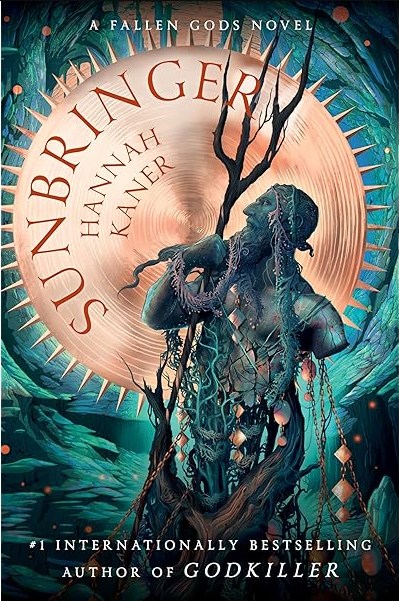
Book: “Sunbringer” by Hannah Kaner

Publishing Info: HarperVoyager, February 2024

Where Did I Get this Book: Edelweiss+

Where Can You Get this Book: WorldCat.org | Amazon | IndieBound

Book Description: Return to the world of Godkiller in this thrilling sequel to the #1 internationally bestselling fantasy debut, where Kissen and her companions must navigate lands of gods and demons to unravel a dark truth at the heart of their world.

Professional godkiller Kissen and her companions—young noble Inara and knight Elogast—return in a winding adventure in a world overflowing with magic, beauty, and danger.

Previously Reviewed: “Godkiller”

Review: This was definitely one of my most highly anticipated reads for the spring 2024 season. “Godkiller” was one of those great books where I went in with very little knowledge or expectation when I started it and then was blown away by just how much I loved it! It also ended not on a cliffhanger, per se, but on a fairly big action sequences with our characters stumbling to find new ways forward after their initial goals and their plans that were, sometimes quite literally, blown out of the water. So how does this one stand up? Let’s dive in!

I’ll say right from the start that I don’t think this book was quite the high that was “Godkiller.” However, I think that would have been a very high bar to reach, and the goals that needed to be met in this story to lead to the ultimate conclusion in the third book (didn’t know there was going to be a third book until very recently!) also necessitated some of these stumbling blocks. There are a lot of moving pieces, most especially the characters themselves who have to quite literally move from one place to another over a large chunk of space. And, of course, there were some important character beats that had to be hit properly to continue them all along their series-long arcs.

As far as the characters go, Inara largely takes center stage in this book (a bit to my disappointment, as Kissen remains by favorite of the three by far). Her story is very interesting in that she’s a child character, and the book doesn’t shy away from presenting her this way. She can be stubborn, irrational, and sometimes thoughtless about the repercussions of her choices. But she’s also endearing and a girl on the verge of womanhood who finds herself in a disrupted world with very few people on whom she can rely. I also appreciated the fact that the book acknowledged the more tenuous relationship between Inara and Elo. Kissen was the glue that held this group together, and without her, we quickly see these two’s bonds begin to stretch when presented with their differing goals.

Elo’s story was fairly straight-forward, and of the three, felt a bit wayward. He has a clear plot line, but even though action is happening on the page, I felt like the reader was left spinning their wheels during much of his page time. Through him, we also spent a lot of time getting to know various other side characters who, frankly, I just didn’t care about. Worse, the book didn’t really give me reason to care about them; their stories were very must restricted to the minor events of this book, only to, by the end, feel fairly meaningless with regards to the greater story of the trilogy as a whole.

Kissen, of course, was wonderful. She’s simply a more charismatic lead character than Elo or Inara, someone who is fun to read about, pure and simple. Again, however, much of her story felt a bit aimless, especially in the first half. It’s not until the last thirty percent of the book that it becomes clear where her storyline is even going. Once it does, I liked the challenges that Kissen faced when having to re-evaluate her worldview and her role in the future conflict.

As you may have pieced together from these three character explanations, my biggest disappointment for this book was the simple fact that our main three characters spend practically no time together. I’m not sure if Kissen even exchanges any words with Elo?? It’s fairly extreme as far as character separations go, especially for a sequel of a book that had such a strong team dynamic at the center of its story.

That said, while many of my quibbles came down to what felt like “second book syndrome,” I still ended the book on an extremely high note. The story took a few switches that I truly didn’t expect, and the grand scale conflict ahead seems turbulent and morally complicated, the best kind! We had a few important reveals, and I enjoyed the important challenges that our three main characters faced with regards to their views of this world and what the future would look like. They all started in one place, but by the end, each has been significantly challenged to broaden their understanding of what is going on and who they are.

Overall, I think this was a solid sequel. I was disappointed by the lack of time the characters spent together, but I also see the important character beats that they all hit through these more separate adventures. There’s also a great conflict set up at the end that promises a very dynamic and exciting conclusion to the trilogy. Fans of the first book will likely enjoy this one, and I think it’s well worth it just to see where it all goes from here!

Rating 8: A bit of a stumble from the near-perfection of the first book, but still a solid sequel that promises great things to come!

Reader’s Advisory:

“Sunbringer” is on this Goodreads list: Can’t Wait Sci-Fi/Fantasy of 2024

Serena’s Review: “A Flame in the North”

This post may contain affiliate links for books we recommend.  Read the full disclosure here.

Book: “A Flame in the North” by Lilith Saintcrow

Publishing Info: Orbit, February 2024

Where Did I Get this Book: ARC from the publisher!

Where Can You Get this Book: WorldCat.org | Amazon | IndieBound

Book Description: An elemental witch and her shieldmaiden journey into a world of ancient myth and unexpected destiny in this sweeping Norse-inspired epic fantasy from New York Times bestselling author Lilith Saintcrow.

The Black Land is spent myth. Centuries have passed since the Great Enemy was slain. Yet old fears linger, and on the longest night of the year, every village still lights a ritual fire to banish the dark.

That is Solveig’s duty. Favored by the gods with powerful magic, Sol calls forth flame to keep her home safe. But when her brother accidentally kills a northern lord’s son, she is sent away as weregild—part hostage, part guest—for a year and a day.

The further north Sol travels, the clearer it becomes the Black Land is no myth. The forests teem with foul beasts. Her travel companions are not what they seem, and their plans for her and her magic are shrouded in secrecy.

With only her loyal shieldmaid and her own wits to reply upon, Sol must master power beyond her imagination to wrest control of her fate. For the Black Land’s army stirs, ready to cover the world in darkness—unless Sol can find the courage to stop it.

They thought the old ways were dead. But now, the Enemy awakens…

Review: This is the second Norse-inspired fantasy I’ve read this month! It’s funny how these trends come and go; even as I go through what I though was a fairly randomly-ordered TBR list, I often find myself reading books with strong similarities to one another. I’ve read a decent amount of fantasy fiction that draws from Norse mythology, and have typically enjoyed them quite a bit, so this was an obvious pick for me. On top of that, I love the idea of taking a typical fantasy duo (the hero and his shield) and switching it to a female heroine/witch and her shieldmaiden. I still enjoy the former as well, of course, but it’s nice to see such variety popping up throughout SFF.

This book is a bit tough to review, simply because some of my struggles with the book came down more to my needing to properly categorize the type of book I was reading. Starting out, it was clear that this book was aiming for a specific sort of high fantasy, the kind that uses dense language, both in the vocabulary chosen and in the longer sentences structures used, and also is playing a long game as far as pacing and plotting go. The story takes its time laying out its world, its characters, and even getting to what seems to be the true action of the story.

As I continued to read, at some point it occurred to me to compare this read to “Lord of the Rings,” and frankly, that kind of saved the experience for me. Both books have a similar dense sort of feeling, the kind that can be overwhelming to begin with, and the sort that then pays off later. Similarly, there were a few world-building aspects that were simply dropped in with very little explanation. For example, at one point they refer to the “All Mother” which, of course, seems like a similar character as Odin the “All Father.” Changes like this are, of course, fine, but then I was left a bit unsure as to where I was supposed to be placing this world. Are we in some sort of alternate world where there is an All Mother instead of an All Father? Or is this our world with magic and this is just changed? Things like this aren’t necessarily a big deal or bad, but it does add to the initial challenge with the point of entry to the story. The reader really has to work for it get dive in.

But this slow pacing did pick up towards the end, and this is where the LOTR comparisons worked even better. If read as the rather slow-paced entry to a grand spectacle, a sprawling series, the dense nature of this book is easier to digest. I also really liked Solveig and her shieldmaiden as characters. The author did a fantastic job with these two, balancing their fierceness with the sort of sly reserve that they would need to employ in the world in which they are living.

This is the kind of book that I would definitely recommend for a specific sort of fantasy reader, those who like epic fantasy and are willing to put in the time with denser language and a slow plot. Readers who want to be immediately drawn in to an action-packed story will likely struggle this one. But, like I’ve said earlier, if you like “Lord of the Rings” and can remember some of the slower parts, especially in “Fellowship,” this book does seem to promise an intriguing series overall!

Rating 7: Tough to get into but well worth it in the end, I think.

Reader’s Advisory:

“A Flame in the North” isn’t on any relevant Goodreads lists currently, but it should be on Vikings and Viking-Inspired Fantasy.

Serena’s Review: “Where the Dark Stands Still”

This post may contain affiliate links for books we recommend.  Read the full disclosure here.

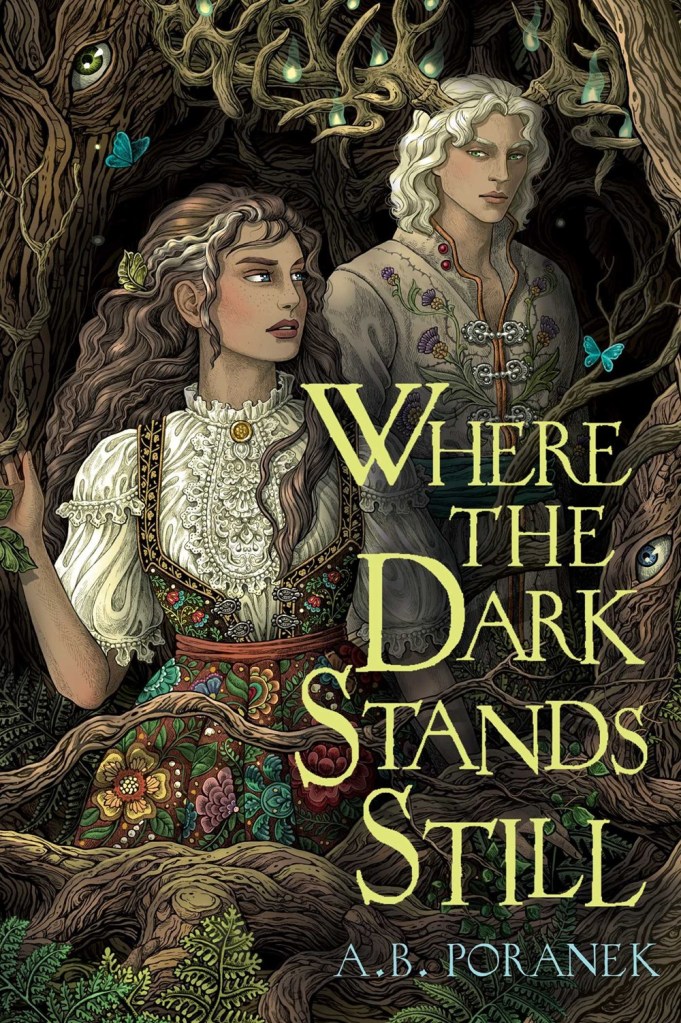
Book: “Where the Dark Stands Still” by A. B. Poranek

Publishing Info: McElderry Books, February 2024

Where Did I Get this Book: ARC from the publisher

Where Can You Get this Book: WorldCat.org | Amazon | IndieBound

Book Description: Raised in a small village near the spirit-wood, Liska Radost knows that Magic is monstrous, and its practitioners, monsters. After Liska unleashes her own powers with devastating consequences, she is caught by the demon warden of the wood – the Leszy – who offers her a bargain: one year of servitude in exchange for a wish.

Whisked away to his crumbling manor, Liska soon discovers the sinister roots of their bargain. And if she wants to survive the year and return home, she must unravel her host’s spool of secrets and face the ghosts of his past.

Those who enter the wood do not always return…

Review: Have I mentioned recently my love of dark woods/dark fairytale fantasy books? No? Well, I love them. And this cover is definitely pointing towards that sort of story. Then you look at the book description, and yep, my kind of book! I also enjoy stories where the heroine/hero has a limited amount of time to uncover some sort of mystery or unravel a curse, so this book quickly racked up points of interest for me. And I’m pleased to say that it followed through on almost all of them!

Right away I knew this story was going to work for me (unless something went terrible wrong, like some sort of character assassination midway through the book). The style of writing immediately drew me in, seamlessly merging fast-paced action and lyrical, descriptive passages that set the tone for the world and story itself. Everything felt equally beautiful and dreadful, leaving the reader on tenterhooks, wanting to know more, but feeling Liska’s own sense of increasing wariness and fear as she realizes how little she knows about the myths of her own world. Alongside the writing, the world-building felt complete and immersive. The enchanted castle, woods, and guardian all felt familiar, but the author also put her own twists and turns on everything that it all felt fresh and new.

I also really enjoyed Liska as a central character. Her motivations are clear, and her perseverance and bravery in the face of her ever-changing circumstances made her incredibly sympathetic. Her circumstances and history slowly unfurled as the story continued, hinting at dark secrets in her own past. She also had great chemistry not only with the Lezky but also with a few side characters that showed up a bit further into this book. This latter point, especially, was a bit of a surprise. I wasn’t expecting additional characters so late into the story and am often a bit concerned with this choice, as late characters often have an uphill battle as far as getting good character work in with the limited page count remaining. Luckily, here, we see how it can be done well, with these characters adding important new dimensions to the world and to Liska’s own character arc.

As for the Lezky, I really enjoyed this character. Most especially, I enjoyed the slow-burn nature of his relationship with Liska and the reveals regarding his own complicated history. Their character moments covered all of the bases, from wariness to humor to, eventually, love and caring. I will say, however, that I think this book would have been better served as an adult fantasy novel. Not because there is any explicit, story-wise. More because the Lezkey is a centuries-old being, but because the book is YA, the narrative was struggling to present him as a “boy” for much of the book, which simply rubbed wrong against the character’s own situation and history. I feel like this book is the exact example I’d point to when I talk about the unfortunate habit publishers seem to have where they dub anything that is at all romantic, at all fairytale-like as YA, as if adults are not equally interested in these sorts of stories.

I also feel like the overall tone and execution of the book perhaps might sit better with an adult audience. Not that YA readers can’t appreciate bittersweet and darker tales, but I do worry that this book might not quite find its footing because of this mismatch between reader expectations and reality based on it being marketed as YA. For me, even though this book took a sharper turn into the bittersweet than I typically look for, the overall story and writing as a whole were so strong that I couldn’t help but come away loving it. If you enjoy fairytale fantasy stories and slow-burn romances, definitely give this one a shot! Right now, I feel like it’s flying under the radar, and I really

Rating 8: Whenever you wander into a deep, dark forest, you never know how you might be changed. Reading this book is much the same; you’ll find yourself enchanted, bewitched, and ultimately caught in a spell from which you won’t want to free yourself.

Reader’s Advisory:

“Where the Dark Stands Still” can be found on these Goodreads lists: The Most Beautiful Covers of 2024 and Fantasy Standalone.

Serena’s Review: “To Cage a God”

This post may contain affiliate links for books we recommend.  Read the full disclosure here.

Book: “To Cage a God” by Elizabeth May

Publishing Info: DAW, February 2024

Where Did I Get this Book: ARC from the publisher!

Where Can You Get this Book: WorldCat.org | Amazon | IndieBound

Book Description: To cage a god is divine. To be divine is to rule. To rule is to destroy.

Using ancient secrets, Galina and Sera’s mother grafted gods into their bones. Bound to brutal deities and granted forbidden power no commoner has held in a millennia, the sisters have grown up to become living weapons. Raised to overthrow an empire―no matter the cost.

With their mother gone and their country on the brink of war, it falls to the sisters to take the helm of the rebellion and end the cruel reign of a royal family possessed by destructive gods. Because when the ruling alurea invade, they conquer with fire and blood. And when they clash, common folk burn.

While Sera reunites with her estranged lover turned violent rebel leader, Galina infiltrates the palace. In this world of deception and danger, her only refuge is an isolated princess, whose whip-smart tongue and sharp gaze threaten to uncover Galina’s secret. Torn between desire and duty, Galina must make a choice: work together to expose the lies of the empire―or bring it all down.

Review: Let’s just say, I’m glad this is the cover for the U.S. version of the book. Check out the U.K. one if you don’t believe me! I mean, it’s definitely a statement…but it’s also not the type of cover I’d necessarily want starting out at me from my shelves! However, what truly caught my interest was the promise of a Russian-inspired fantasy world in which two sisters head up a rebel cause. I mean, that checks a pretty decent number of my personal preferences right there. Add in a dash of romance, and yep, I was excited to check this one out!

This book was a very hot and cold affair as far as my changing enjoyment levels throughout the story. It started off great, I will say. I was immediately drawn in to both Sera and Galina’s narration and their different styles. Here, finally, was a case where the two POVs felt distinct but each was enjoyable. I even felt fairly confident that the prickly but powerful Galina was going to be my favorite of the two. However, this strong start didn’t last. Much to my dismay, as the book progressed, we were introduced to a whopping three OTHER POV characters. And five…five is just too many.

And in this case, it was incredibly apparent that at least two of them had no business having POVs at all. We had a fair number of chapters from one of the Queen’s handmaidens, and yet every single chapter we heard from her, she literally went through the same exact story beats: the Queen killed her sister when her sister was a handmaiden, the Queen is violent and may kill her at any moment, she hates the Queen. Rinse and repeat and get ready to hear the same story about six more times, all to conclude in…yeah, nothing really. From there, we also got a handful (maybe three or four? not enough to amount to anything, that’s for sure) of chapters from Sera’s love interest, Vitaly. Again, this character had no arc or story of his own. The entire purpose of his chapters, apparently, was to give readers a glimpse into his mind as he repeated over and over that he was a bad guy, but he’d do anything for Sera. Which…we’d already heard him say aloud several times to Sera herself, thus completely negating any reason to hear directly from this character himself.

Lastly, we also had chapters from the Princess Vasilisa’s perspective. These, at least, were more worthwhile in that Vasilisa has the remnants of an arc to be found, in that she has had a troubled upbringing with her mother, the Queen, and must face the reality of her mother’s violent and unchanging nature. I’ll also say that this character having POV chapters was fairly necessary for this romance. Not for the reasons you’re thinking though! But because if she didn’t, we’d have had about a grand total of three interactions between her and Galina to build up a romance. As it stands, I really struggled with this romance either way. It’s classic instalove, and if you actually add up the time Galina and Vasilisa spend together, it rounds out to a few hours! Total! Before they’re professing love and Galina is insisting to Sera that Vasilisa will turn on her mother and side with the rebels. And she’s right, a few hours was all it did take! It’s all pretty crazy, and the focus on this romance was one of the reasons my interest in Galina’s storyline dropped quickly from my favorite to one I barely cared about.

Sera, instead, became my favorite character and actually took up the bulk of the action of the book. She’s the only one who is truly doing anything much of the time, and almost all of the action scenes come through her storyline. And if we had taken out Vitaly’s unnecessary chapters which I think managed to actually hurt the romance, I would have enjoyed this second chance love story as well.

Honestly, this book was a bit of a hot mess. The world-building and fantasy elements (the idea of gods being caged within people who can then harness their powers) all had a lot of potential. But the story fell apart due to failures of craft. There were moments when the writing was incredibly strong, but others when it felt all over the place. And then, worst of all, the decision to include so many POV characters, especially when so many of them had no real arcs of their own, really hurt the overall book. If things had been kept to just Sera and Galina’s stories, I think the story would have been massively more successful. As it stands, the bones of a good book can be seen in this one, but the author got into her own way too many times for it really come together. If you enjoy large casts of characters, however, you may still want to give this a shot. Sera’s story is still enjoyable, if you go in focusing on that.

Rating 7: I enjoyed one of the main characters a lot; unfortunately, she was one of five POVs, which drastically reduced my overall experience.

Reader’s Advisory:

“To Cage a God” can be found on this Goodreads list: Russian motifs in fantasy

Kate’s Review: “Earthdivers (Vol.2): Ice Age”

This post may contain affiliate links for books we recommend.  Read the full disclosure here.

Book: “Earthdivers (Vol. 2): Ice Age” by Stephen Graham Jones, Ricardo Burchielli (Ill.), Patricio Delpeche (Ill.), & Emily Schnall (Ill.).

Publishing Info: IDW Publishing, February 2024

Where Did I Get This Book: I received an eARC from NetGalley.

Where You Can Get This Book: WorldCat.org | Amazon | Indiebound

Book Description: Guest artists Riccardo Burchielli ( DMZ ), Patricio Delpeche, and Emily Scnall join Stephen Graham Jones— New York Times best-selling author of The Only Good Indians and My Heart Is a Chainsaw —for a mission to the Ice Age exploring America’s pre-Columbian past!

When Martin and Tawny’s children disappeared, the couple barreled into the desert to track them down at any cost. Instead, they ran afoul of another group of rovers who claimed to be saving the world by traveling through a cave portal to the year 1492 to prevent the creation of America—an idea that defied belief until the grieving parents were lured into the cave and vanished in time and space.

Now alone, Tawny must adapt to the wild marshlands of prehistoric Florida, circa 20,000 BC, and the breathtaking and bloodthirsty megafauna are the least of her problems when she’s caught in a war between a community of native Paleo-Indians and an occupying Solutrean force. Tawny’s odds of survival are in free fall, but she’s a mother on a mission…and she’s holding on to hope that the cave brought her here for a family reunion.

In the tradition of Saga , the next chapter of the critically acclaimed sci-fi epic is here in Earthdivers Vol. 2 . Collects Earthdivers #7-11.

Review: Thank you to NetGalley for providing me with an eARC of this graphic novel!

When I first started Stephen Graham Jones’s fantasy/Sci-Fi time travel series “Earthdivers”, for whatever reason I thought that it was only going to be focused on what the first volume covered: the time travel assassination of Christopher Columbus. Why I thought it was only going to be that is beyond me, but when that arc came to an end at the start of “Kill Columbus”, I wondered where we were going next, with no clue or idea as to what the path was going to be. Who were we going to follow now? Was it still going to be historical fiction time travel-y? Our protagonist’s storyline pretty much definitively ended, what is going to happen now? And then I saw the cover for “Earthdivers (Vol. 2): Ice Age”, and I was blown away. BACK IN TIME TO THE ICE AGE?! HELL YES! And when I saw that we were following another time traveller, this time Tawney, a mother who was searching for her children, I was all the more excited. And shocking absolutely no one, “Earthdivers: Ice Age” is suspenseful, intriguing, and enthralling.

I really love that we are starting to explore stories of other characters in the book who have fallen afoul the mysterious cave. In “Ice Age” our focus is on Tawney, a grieving mother who had been looking for her missing twins when she and her friends were lured into the cave by Emily as an act of self defense. When Tawney wakes up, she is no longer in the 22nd century, but all the way back to the Ice Age and the Paleolithic era of humans. This is such a great choice, narrative wise, as it not only opens up a slew of possibilities as to what stories are going to potentially be told next (after all, there were multiple people who ended up in the cave around the time that Tawney did….), but it also gives us lots of different character possibilities. Tawney was a good first choice, because her motivation is based on her love for her kids, and it drives not only her want to survive in this wholly new setting, but also the choices that she makes while there. I really loved Tawney as a main character for this volume, and I loved the idea of the Ice Age as a setting and having her have to figure out how to survive in this totally new environment. Whether it’s dealing with smilodonts, having to adapt to the cold, or trying to find ways to communicate with the people she meets and connects with, it makes for a gripping story of a stranger in a strange land.

And in true Jones fashion, “Ice Age” also taps into societal injustices that feel very true today and places them even in the Ice Age. I wasn’t sure what to expect with this volume, as I thought that the Ice Age would have different hardships, but Jones keeps with the fighting against colonialism theme, using the clashes between Indigenous people and Solutreans (a controversial theory that Europeans settled in the Americas during the Ice Age by traveling over the frozen waters, HERE is a pretty good write up as to why it’s unlikely and also racist). It’s genius because it’s laying not only another kind of invading force story, but also tapping into Tawney’s inner turmoil about how to proceed when she finds herself protecting and becoming attached to a Solutrean child, as she sees her own children in him. These led to some really emotional beats, as Tawney, unlike Yellow Kid in “Kill Columbus”, draws lines when it comes to children as victims, no matter how much it could seem like a ‘greater good’. I also love how Jones has taken this fringe theory of Solutrean discovery and torn it apart by having Tawney basically fight back against the invading forces with her know how from her own time period. It’s very creative and makes for a really interesting volume! Throw in some more backstory for the Earthdivers and their motivations, as well as world building for the ravaged planet they are trying to reset, and the story arc continues to build on its complexity in very rewarding ways.

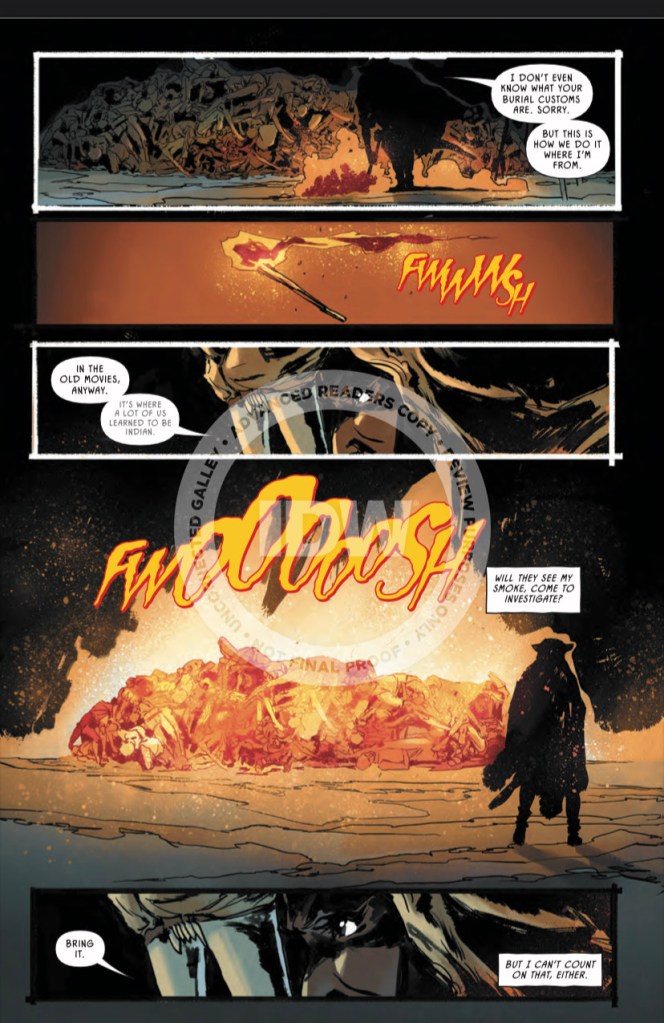
And finally, the artwork. We have some new artists in this volume, Ricardo Burchielli, Patricio Delpeche, and Emily Schnall. I liked the new styles that they brought, as while they still fit in with the previous Volume, they did bring their own aesthetics and signatures to the work.

(source: IDW)

I’m still really digging “Earthdivers” and how outside the box Stephen Graham Jones is taking it. I can’t wait to see who we follow through the cave next, and what time period it’s going to be.

Rating 8: Another creative and intense time travel story from Stephen Graham Jones! I’m loving the world building at the creative time and place.

Reader’s Advisory:

“Earthdivers (Vol. 2): Ice Age” isn’t included on any Goodreads lists as of yet, but would fit in on “Graphic Novels & Comics By The Aboriginal, Indigenous, and Native Peoples of the World”, and “Time Travel”.

Serena’s Review: “Fathomfolk”

This post may contain affiliate links for books we recommend.  Read the full disclosure here.

Book: “Fathomfolk” by Eliza Chan

Publishing Info: Orbit, February 2024

Where Did I Get this Book: ARC from the publisher!

Where Can You Get this Book: WorldCat.org | Amazon | IndieBound

Book: Welcome to Tiankawi – shining pearl of human civilization and a safe haven for those fleeing civil unrest. Or at least, that’s how it first appears.
 
But in the semi-flooded city, humans are, quite literally, on peering down from skyscrapers and aerial walkways on the fathomfolk — sirens, seawitches, kelpies and kappas—who live in the polluted waters below.
 
For half-siren Mira, promotion to captain of the border guard means an opportunity to reform. At last, she has the ear of the city council and a chance to lift the repressive laws that restrict fathomfolk at every turn. But if earning the trust and respect of her human colleagues wasn’t hard enough, everything Mira has worked towards is put in jeopardy when a water dragon is exiled to the city.
 
New arrival Nami is an aristocratic water dragon with an opinion on everything. Frustrated by the lack of progress from Mira’s softly-softly approach in gaining equality, Nami throws her lot in with an anti-human extremist group, leaving Mira to find the headstrong youth before she makes everything worse.
 
And pulling strings behind everything is Cordelia, a second-generation sea-witch determined to do what she must to survive and see her family flourish, even if it means climbing over the bodies of her competitors. Her political game-playing and underground connections could disrupt everything Nami and Mira are fighting for.
 
When the extremists sabotage the annual boat race, violence erupts, as does the clampdown on fathomfolk rights. Even Nami realises her new friends are not what they seem. Both she and Mira must decide if the cost of change is worth it, or if Tiankawi should be left to drown.

Review: This has definitely been a highly anticipated read for me when I was looking forward through my TBR pile for the spring. The book summary lays out a pretty complicated, rich-sounding world that I was excited to dive into, and the cover art seem to paint a picture of the exact sort of romantic, fairytale-like tone that I look for in much of my fantasy. Plus, it was being marketed as an adult fantasy novel, which on its face doesn’t seem like much. But while there are a bunch of adult fantasy novels published all of the time, there aren’t necessarily many that sound like this.

I’ll just get it out of the way now: I didn’t really enjoy this book and probably would have DNF’d it if I hadn’t received an ARC from the publisher. But before we dive into my struggles with the story, let’s start with a few positives. As the book summary hints towards, there is a lot of creativity and detail to the worldbuilding in this book. I don’t know tons about all of the cultures that were drawn upon to create this world, but it was clear the author was pulling from a number of them and blending them into a unique world. I also really enjoyed some of the details that went into the little things, like the descriptions of the street vendors and the foods they would sell. There was definitely an experience, especially early in the book, of wanting to simply walk down these streets to see it all.

That said, as beautiful as the cover art was for the story, it did mislead me a bit about the time period and setting of this book. It clearly is using elements of historical building styles, implying a less modern setting than what we have here. I was surprised to find cable cars and trams and the like as I read further. There’s obviously nothing wrong with this sort of setting, but it did feel like a bit of a bait and switch as far as my expectations went. (To be fair to the book, I didn’t catch some of the book summary clues; so that’s on me for focusing too much on the cover). I’ll also add that while I enjoyed a lot of the details that went into the world-building, as the book continued, the thing as a whole began to a bit disjointed, with everything and the kitchen sink seemingly thrown in the book. As more and more was added, I felt more and more disconnected from what I was truly supposed to be focused on.

None of this was helped by the fact that I didn’t enjoy any of our three main characters. At times annoying, at others incredibly naïve, and at others clearly biased themselves, each character in their own way was fairly unlikable. Again, writing characters who learn and grow can serve as an interesting arc, but between the three, I simply couldn’t find anything to grab onto at any point. I felt like I was just bouncing from one to another in a fairly robotic manner, caring little for who I was reading currently or who I was going to read next. None of them felt truly consistent in their worldviews or even their goals; for a book about sea creatures, I felt out to sea myself as a reader, lost in the flotsam of a plot that didn’t seem to be going anywhere fast.

I also found the pacing to be incredibly slow (often the case for a book that has to establish several POV characters while also building up a complicated world). However, as the story progressed, the pacing never really increased alongside it. It was one of those books that simply felt bland much of the time. There was nothing terrible about the writing, but it also wasn’t engaging and there were some form questions at play with the way scenes would end abruptly or other descriptive elements wouldn’t quite fit.

Overall, I was very disappointed by this book. Most of the time it felt like a chore to read, and I never really found anything that struck my interest or compelled me to want to continue reading. I won’t be continuing with the series, and I can’t strongly recommend this one. If you have a strong interest in Asian folklore, perhaps this is worth checking out, but even then, I think there are stronger examples of books like this out there.

Rating 6: An interesting premise fell apart in the face of a lackluster plot and unlikable lead characters.

Reader’s Advisory:

“Fathomfolk” can be found on this Goodreads list: Asian Mythology Inspired Books