Serena’s Review: “To Gaze Upon Wicked Gods”

This post may contain affiliate links for books we recommend.  Read the full disclosure here.
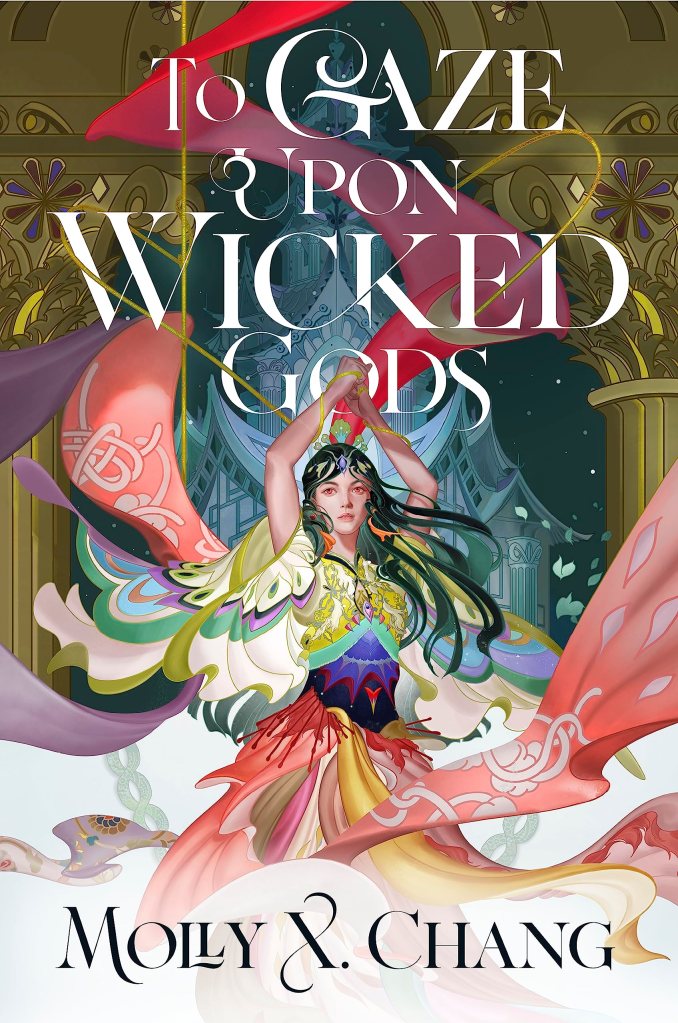
Book: “To Gaze Upon Wicked Gods” by Molly X. Chang

Publishing Info: Del Rey, April 2024

Where Did I Get this Book: NetGalley!

Where Can You Get this Book: WorldCat.org | Amazon | IndieBound

Book Description: She has power over death. He has power over her. When two enemies strike a dangerous bargain, will they end a war . . . or ignite one?

Heroes die, cowards live. Daughter of a conquered world, Ruying hates the invaders who descended from the heavens long before she was born and defeated the magic of her people with technologies unlike anything her world had ever seen.

Blessed by Death, born with the ability to pull the life right out of mortal bodies, Ruying shouldn’t have to fear these foreign invaders, but she does. Especially because she wants to keep herself and her family safe.

When Ruying’s Gift is discovered by an enemy prince, he offers her an impossible deal: If she becomes his private assassin and eliminates his political rivals—whose deaths he swears would be for the good of both their worlds and would protect her people from further brutalization—her family will never starve or suffer harm again. But to accept this bargain, she must use the powers she has always feared, powers that will shave years off her own existence.

Can Ruying trust this prince, whose promises of a better world make her heart ache and whose smiles make her pulse beat faster? Are the evils of this agreement really in the service of a much greater good? Or will she betray her entire nation by protecting those she loves the most?

Review: I’m going to review this one in a rather unconventional manner, but when thinking about this read and trying to organize my thoughts into my typical review style, I simply found it all to be too jumbled and all over the place. Moreover, many of my thoughts and feelings have to do with very specific aspects of the books and less to do with overall structure and form of the book.

I’ll give a quick overview here, however: I did not like this book. I thought the writing was incredibly choppy and stilted with broken up sentences galore, the characters largely unlikable and melodramatic to the extreme, and the plotting muddled, leaving readers unsure of what was going on in basic aspects of the world and how they were meant to interpret the actions and feelings of its characters. It simply failed to be a good read for me in almost every way. That said, as always, there are plenty of readers who may enjoy this more! Specifically, readers who focus less on world-building will likely not be as hung up as I was with much of this story. And those who really enjoy Asian fantasy (as I typically do!) might also want to read this. Now, for the rest of this, I’m simply going to label each section with the struggle point I’m going to focus on. First up:

The Author’s Note/Historical Inspiration

This author’s note was included at the beginning of the book, so it’s clear that the author and publisher intended for it to be read before the story itself. In it, the author writes beautifully of listening to her grandfather recount his memories of Unit 731, a unit of the Japanese Army in late 1930s, early 1940s, that committed horrific war crime experiments on the Manchurian people. Now, I always appreciate when author’s include information like this when they are writing a book inspired by true events, but in this case, it only raised more questions with regards to the decision by the author to name the colonizing force “Rome.” To draw attention to the atrocities of the past by creating a fictional version of the tale for modern audiences is a tried and true practice, and like renaming Manchuria “Pangu,” the Japanese forces could have similarly been given a fictional name. And with the inclusion of this author’s note, it would have been clear to everyone what was being discussed.

But to instead take a specific historical event like this that was enacted by one nationality and then write a book and attribute those actions to a completely different real-world country/people is pretty icky. I can’t imagine this choice going over well if something similar had been done with different historical events/groups. For example, writing a book about a colonizing group giving indigenous people blankets covered in disease but then naming that colonizing group, say, Brazil. Nope! Not great! It was also such an easy fix, since Manchuria/ancient China had already been given the fictional name of “Pangu.” Simply do the same and come up with some other fictional name! Not only would this have avoided the “ick” factor we have here, but it also would have made the reading experience more pleasant as a whole. The name “Rome” invokes a very specific picture in most readers’ minds, so to then write a book in which the Romans are zipping around on helicopters and whipping out guns all the time reads as strange. It’s distracting, at best. This lead’s me to my next point, which also starts in the author’s note but than moves into the narrative itself:

“Magic Vs. Science”

There were also some bizarre claims in the author’s note about “science” that really had me raising my eye brows. At one point, the author is reflecting on the past, about how Manchuria/China fought its Western invaders’ bullets with bows and arrows. Now…I’m honestly just confused by this. The note started off talking about Unit 731, so obviously references to bows and arrows make no sense in this context, not even getting to the fact that I don’t believe we’d call the Japanese forces “Western.” But if at this point in the note she’s instead been talking about an earlier point of history (there is no indication that this is the case, however, because the very next sentence is again referencing her grandfather), I’m not sure it’s much better! China was significantly more advanced in science and technology than the West for pretty much all of history. I really don’t know how to interpret what the author was trying to say. Maybe I’m missing something, and if so, I’m happy to be corrected, but as it stands this was bizarre to the extreme.

Unfortunately, this continued into the story itself. Ruying, in her overly melodramatic style, goes on and on throughout this book of the impossible power of Rome’s “science” and how Pangu has struggled against it for decades. Aside from the fact that just referring to this over and over again as “science” (“they came at us with science”) makes for a clunky reading experience, it’s also a strange choice. Don’t you mean technology? Saying that Pangu had no sense of “science” is like saying they have no understanding of gravity or of how the stars move through the sky. It makes Pangu and its people sound incredibly stupid, and I know that’s not what the author was trying to say! Beyond this, again, to write a fictional world that is based off ancient China and frame it in a way that makes the Chinese stand-ins repeatedly said to have no understanding of “science” is to downgrade China’s own history of actually being incredibly scientifically advanced.

Beyond this, from a fictional stand-point, we are told that the Romans invaded several decades ago. Again, unless we are to seriously devalue the people of Pangu, it belies belief that they would not be able to begin adapting and replicating some of the technology that the invaders brought with them. It’s simply hard to buy from a story front, and I was repeatedly thrown out of the story whenever this discussion of the “Romans and their science” came up.

The Romance

I don’t typically read many reviews of a book before writing down my own thoughts, but I did here because of all of the confusion re: “Rome” and “science” that I discussed above. And when I was going through the Goodreads reviews, I began to notice something strange. This book was continually being referenced as a “colonizer romance” with many readers enraged about the love story between Ruying and her Roman love interest, Antony. What makes this most interesting to me, however, is the fact that here is a real-time example of how either the times have changed or something else went wrong in the marketing of the book.

Readers of this blog will know that long ago I had a very bad “break up” with the “Shadow and Bone” trilogy, and this largely had to do with my dislike of the massive fangirling over the Darkling as a love interest. I was bewildered and put off by how so many fans of that series seemed to think that the Darkling, a literal psychopath and mass murderer, was a legitimate option as a love interest, to be held up right along side the heroic best friend, Mal. Well, low and behold, I think we have the exact same set up in this book, but for whatever reason (changing of the times, the type of fantasy novel this is with the focus on colonization), the pendulum has swung completely the other direction, with fans up in arms that this pretty terrible guy, Antony, is given so much time as a love interest at all! What is missing from many of these reviews is that this book, too, includes a very “Mal-like” character, the best-friend that, by the end of the book, seems to be fully brought forward as the true love interest. Frankly, I felt like the story was fairly clear about all of this. But if you just read the reviews, you won’t see this. For some reason, poor (not really) Antony didn’t see any of the Darkling love that a pretty similar character received in another YA fantasy story just like it!

Now, to be fair to many reviewers, I think there is a major disconnect from the story this book is actually telling and the type of book it is being marketed as. We’ve seen a heavy push by the publisher to label this as an “enemies to lovers” style romance. This would obviously set the reader up to expect Ruying’s primary romance to be with Antony, and indeed, much of the actual “romance,” such that it is, is focused between these two characters. But by the end, we see Ruying forced to grapple with the reality of Antony’s choices and who he is, much like we see Alina become horrified by the Darkling in book one and turn to Mal. I don’t think the marketers or publishers did this one any favors with the way they presented it to readers, and the confused Goodreads reviews prove my point.

All of that said, leaving the confused reviews aside, I did not enjoy this love story. Ruying was incredibly annoying through much of it, melodramatically info-dumping her way through what could have been compelling scenes. For a girl with the power of “Death,” we see practically no assassinations. And from a character that we’ve been warned by the author (again in the bewildering author’s note) to not judge the character harshly for her actions, all we see is a girl who judges others, doesn’t really kill anyone on page, and then the one time she does she breaks down about it. This is not the “morally grey” character I was promised. Instead, that morally grey character seems to be the best friend love interest who, low and behold, Ruying herself spends much of her time “judging for his actions.”

This has gotten incredibly long, so thank you for everyone who stuck with me through this messy, rambling rant of a review! I obviously had a lot of thoughts and feelings on this one, but unfortunately, none of it was positive. I don’t recommend you read this book, however, it’s also one of the more highly anticipated titles for the spring, so if you want to get in on the action, I guess give it a shot!

Rating 3: As a story it fails with poor writing, weak characterization, and a muddled plot. But on top of this, we had some really strange choices about how to re-imagine historical events in a fantasy novel that I think not only landed badly, but crashed and burned.

Reader’s Advisory:

“To Gaze Upon Wicked Gods” can be found on these Goodreads lists: Around The World 2024 – Asia Continent and The Most Beautiful Covers of 2024.
Serena’s Review: “Draw Down the Moon”

This post may contain affiliate links for books we recommend.  Read the full disclosure here.

Book: “Draw Down the Moon” by P. C. Cast & Kristin Cast

Publishing Info: Wednesday Books, April 2024

Where Did I Get this Book: NetGalley!

Where Can You Get this Book: WorldCat.org | Amazon | IndieBound

Book Description: Wren Nightingale isn’t supposed to have any powers. Born of magickal parents but not under a moon sign, she was destined for life as a Mundane—right up until she starts glowing on her eighteenth birthday. In a heartbeat, Wren’s life is turned upside down, and she’s suddenly leaving her home for the mystical Academia de la Luna—a secret magickal school on a hidden island off the Seattle coast.

Lee Young has always known about his future at the Academia. He has one goal: pass the trials, impress the Moon Council, and uphold his family’s reputation. But he wasn’t expecting to be attending alongside the girl he’s been secretly in love with for as long as he can remember.

As Wren and Lee are thrown into the Academie’s gruelling trials, they quickly learn there’s something different–and dangerous–about the school this year. Wren will have to navigate a web of secrets, prophecies–and murder. And Lee will have to decide who to protect–his family’s legacy, or the girl he loves.

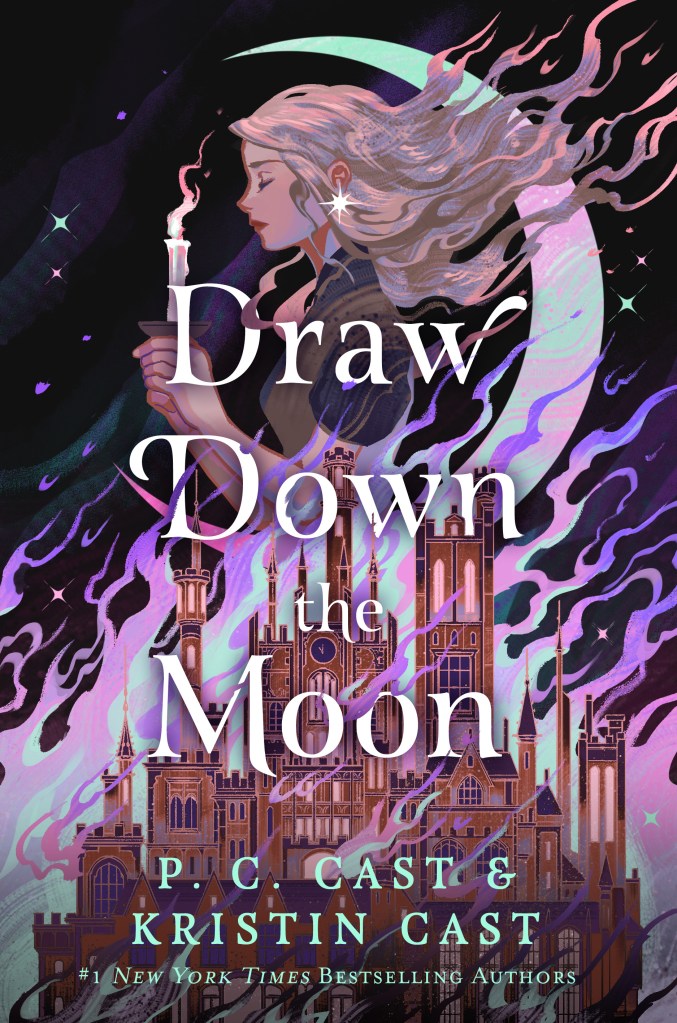
Review: I’ll be honest, I was drawn into this one mostly because of its whimsical cover! And then I read the description which focuses on a magical school and academia, and I knew this was one I’d like to check out. I haven’t read anything by either of these authors before either, so I went in with very few expectations. Unfortunately, this one didn’t quite work for me.

But let’s start with some of the pros first, as always. I really enjoyed the magical school and the fantasy components of this world. The idea of characters gaining certain powers based on the lunar cycle is very intriguing and not something I’d come across before. I also liked that the concept, while new feeling, wasn’t overly complicated, but felt approachable, especially for younger readers. And this is where part of my problems come in, I believe. When stepping back from my reading experience, I would say much of the reason I didn’t enjoy this one was because it seems to be the type of book best suited towards one fairly specific audience: middle school to young teen readers who are fairly unfamiliar to the fantasy genre and its conventions. For these readers, much of what is being done here may hold more interest, but for older readers, or those who read a lot of fantasy, much of it feels standard to the point of banality.

Further, this book is a perfect example of the YA “genre” being a bit to broad, or perhaps the marketers/publishers getting it wrong when promoting this book. The characters are meant to be 18, but throughout the entire story they read much, much younger. This shows itself in the dialogue, but even more so in the rather simplistic approaches to life that they incorporate, as well as some of the more ridiculous decisions they make. I believe even older teenagers would struggle to really connect to these characters without growing quickly frustrated by their storylines, let alone the many adult readers of YA fantasy fiction.

As far as fantasy concepts go, the story also follows a fairly tried and true “chosen one” plot line, very rarely veering into any territory that truly feels original. And, again, while I think the simplicity of the magic system can also be a pro, it can work against the story as well, coming across as overly basic at times, with very little room for growth, depth, or context. The romance, too, struggles in much the same way. There is nothing overtly wrong with this aspect of the story, but it never felt like it was ever taking any risks or swerving in any way that might surprise readers.

Ultimately, this book could be a success for younger readers looking for an entry point into fantasy fiction. But older readers, even just older teens, and those well-versed in fantasy stories will likely find themselves bored for much of this read and would do better to look elsewhere. For these readers, I’d likely rate this a 6, but I’ll bump it up since so much of this rating comes down to this disconnect between reader and book, more so than any distinct failures on the book’s part.

Rating 7: Perhaps a story that will work for middle grade readers looking to first dip their toes into fantasy fiction, but there’s not enough in this book to truly appeal to general fantasy readers.

Reader’s Advisory:

“Draw Down the Moon” can be found on this Goodreads list: Cover Illustrated by Afterblossom (Kelly Chong)

Serena’s Review: “Dragonfruit”

This post may contain affiliate links for books we recommend.  Read the full disclosure here.

Book: “Dragonfruit” by Makiia Lucier

Publishing Info: Clarion Books, April 2024

Where Did I Get this Book: from the publisher!

Where Can You Get this Book: WorldCat.org | Amazon | IndieBound

Book Description: In the old tales, it is written that the egg of a seadragon, dragonfruit, holds within it the power to undo a person’s greatest sorrow. An unwanted marriage, a painful illness, and unpaid debt … gone. But as with all things that promise the moon and the stars and offer hope when hope has gone, the tale comes with a warning.

Every wish demands a price.

Hanalei of Tamarind is the cherished daughter of an old island family. But when her father steals a seadragon egg meant for an ailing princess, she is forced into a life of exile. In the years that follow, Hanalei finds solace in studying the majestic seadragons that roam the Nominomi Sea. Until, one day, an encounter with a female dragon offers her what she desires most. A chance to return home, and to right a terrible wrong.

Samahtitamahenele, Sam, is the last remaining prince of Tamarind. But he can never inherit the throne, for Tamarind is a matriarchal society. With his mother ill and his grandmother nearing the end of her reign. Sam is left with two to marry, or to find a cure for the sickness that has plagued his mother for ten long years. When a childhood companion returns from exile, she brings with her something he has not felt in a very long time – hope.

But Hanalei and Sam are not the only ones searching for the dragonfruit. And as they battle enemies both near and far, there is another danger they cannot escape…that of the dragonfruit itself.  

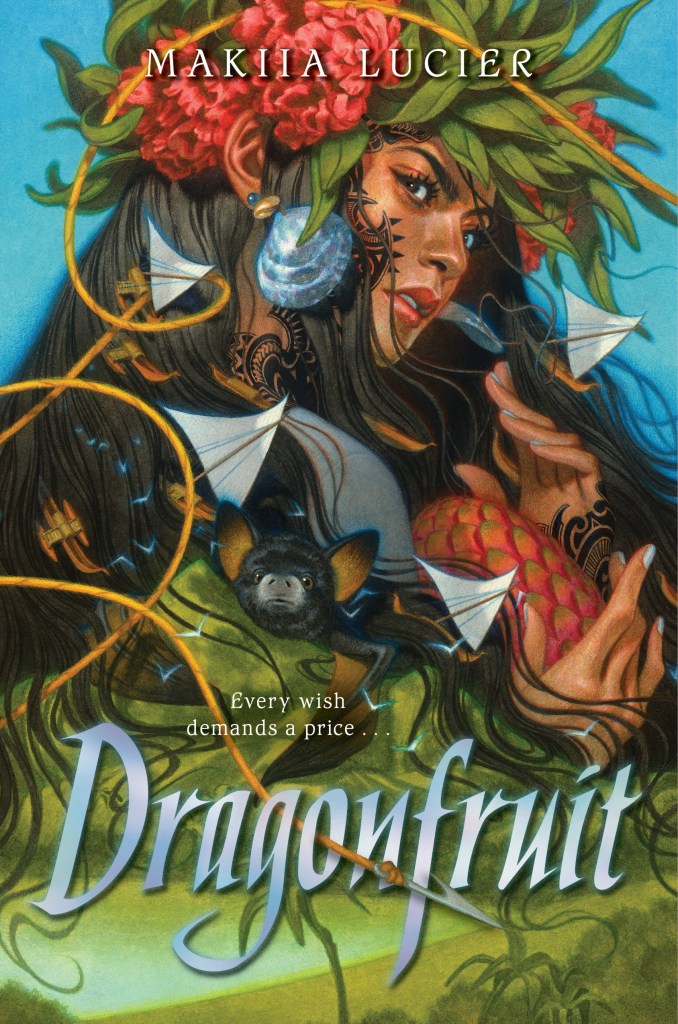
Review: I always am interested in a book about dragons! But while I’ve read a million and one (still love them though) stories about European-style dragons, I’ve read fewer based on Eastern cultures. And I was particularly intrigued that this story was drawing from Pacific Island mythology, of which I know very little. Plus, the colorful, vibrant cover is very distinct from the other YA fantasy stories out there! I always appreciate it when publishers buck trends in cover art and produced unique covers that actually fit the specific story within!

I really enjoyed this book! Right from the start, the story begins with a bang and never really slows down for the entirety of the story. The world-building, with its history of dragon hunters, dragons, and the magical and rare dragonfruit they produce is all neatly divvied out whenever there’s a break in the action. We quickly learn about our main character Hanalei and the way in which dragonfruit has shaped her life to this point. She was both saved by it, but also estranged from her home country and branded a traitor, losing family, friends, and home all in one swoop. However, as the story continues, we see that Hanalei’s past is not viewed the same by those around her, and when she finally makes her way back home, these old ties come back in surprising ways. I enjoyed the general arch of her character, especially the contradictory feelings she has towards dragons and dragonfruit. More than most others, she understands not only the magic of the dragonfruit, but also the costly price. Even more importantly, she sees what many do not, that this cost is not only born by the humans touched by a curse, but by the dragons themselves, hunted for their young.

This in particular stood out to me, the way in which the dragons were handled. They were very much presented as majestic, wild animals, with that coming all of the beauty and horror of nature. They are wonderous, yes, but they also hunt people, and the book doesn’t shy away from the human cost that exists in a world with natural predators as mighty as these dragons. There is also a strange balance of tone that this brings to the story. As far as as Hanalei and Sam’s story goes, this book can read as a very cozy YA fantasy, with their romance coming across as very sweet and innocent. But on the other hand, there is so much tragedy with the dragons. If you’re bothered by violence towards animals, this one might be a struggle. I do think it was important that the book put to the page some of these scenes, to properly highlight the challenging choices faced by our characters, but there’s also just a lot of it. I definitely shed tears more than once.

I will say that by the end I was left wanting a bit more, especially with regards to the morality of dragonfruit. I appreciated that the author simply laid out these scenes before the reader and trusted that they could come to the correct judgement about the horror of using dragonfruit for wishes, but I wish there had been a bit more acknowledgement of this situation spoken about on the page between the characters. By the end, the reader has a good understanding of things, and you feel that the characters do, too, but there still seemed to be at least one or two important conversations needed to make it feel well-rounded.

On the same note, some of the cozy vibes of this story (which I very much appreciated on the whole!) seemed to coincide with a few almost cartoonish depictions of the books’ villains. There were a few characters, especially in the beginning, who were of the sort where you simply love to hate them. And that is all well and good, but, again, by the end of the story, I was left wanting a bit more depth to all of these characters. I will say that one of these did end up having an interesting arc, though I also felt this was fairly predictable past a certain point.

Overall, however, I very much enjoyed this book! It was a fast read, and I completed it in two sittings. The main characters, especially, were incredibly relatable and I loved their heart-warming romance. I also really loved the dragons of this world, they were an integral part to the story and they did not let me down! If you’re looking for a breath of fresh air in the YA dragon books arena, definitely give this one a shot! Just have some tissues on hand!

Rating 8: Full of heart and tragedy, this is a YA dragon book for all those looking for a fresh entry into a tried-and-true subgenre!

Reader’s Advisory:

“Dragonfruit” can be found on these Goodreads lists: Obscure Books Worth Considering and YA Novels of 2024.

Serena’s Review: “The Hemlock Queen”

This post may contain affiliate links for books we recommend.  Read the full disclosure here.

Book: “The Hemlock Queen” by Hannah Whitten

Publishing Info: Orbit, April 2024

Where Did I Get this Book: ARC from the publisher

Where Can You Get this Book: WorldCat.org | Amazon | IndieBound

Book Description: The corrupt king August is dead. Prince Bastian has seized the throne and raised Lore—a necromancer and former smuggler—to his right hand side. Together they plan to cut out the rot from the heart of the sainted court and help the people of Dellaire. But not everyone is happy with the changes. The nobles are sowing dissent, the Kyrithean Empire is beating down their door, and Lore’s old allies are pulling away. Even Prince Bastian’s changed. No longer the hopeful, rakish, charismatic man Lore knows and loves, instead he’s reckless, domineering and cold. 

And something’s been whispering in her ear. A voice, dark and haunting, that’s telling her there’s more to the story than she knows and more to her power than she can even imagine. A truth buried deep that could change everything. 

With Bastian’s coronation fast approaching and enemies whispering on all sides, Lore must figure out how to protect herself, her prince, and her country before they all come crumbling down and whatever dark power has been creeping through the catacombs is unleashed.

Previously Reviewed: “The Foxglove King”

Review: While “The Foxglove King” wasn’t a perfect read for me, it did solidly set up the series in all of the ways that mattered. The world seemed interesting. The characters drew me in. The ending set up a bigger conflict to come. And, best of all, I wasn’t completely turned off by the love triangle being set up (truly a rare thing). On top of that, Whitten has yet to truly let me down with any of her books, even if I’ve liked some more than others. So it was with great eagerness that I finally got to this book when going through my TBR pile!

This was an incredibly interesting second book in this series. On one hand, I do think it’s the kind of sequel that asks its readers to put a lot of trust in the author and the over-arching plot of the trilogy as a whole. Its’ definitely a middle book, setting up a lot of moving pieces that will not see a conclusion in this story. As well, in the first third to even half of the book, several of the characters read very differently from how they appeared in the first book. Lore, our feisty survivor, spends much of the beginning of this story in a very passive, reactive role. So much so, that we see her willfully sticking her head in the sand about what is going on around her and becoming distrusted to reliably act by those close to her. But, as the story progresses, I really enjoyed the character reflection that this brought about. In the first book, we see a Lore who will fight to survive. But much of survival is also endurance and remaining out of the way in dangerous situations, and in this book we see a Lore who knows how to adapt quickly to whatever circumstances she finds herself in, prioritizing her day-to-day existence over radically challenging anything around her. This is a much less sexy side of survival, but I think there’s a case to be made that this trait is even more important than “fighting.”

I also enjoyed the nice parallels between Lore’s awakening to the reality of her own situation alongside the stirrings of the old gods themselves. We get so much great information and backstory for these gods and the story twisted and turned in many exciting ways. There were tons of reveals, but by the end, I still felt like I had barely scratched the surface of what is currently going on with the gods and what had happened between them in the past.

Returning to the “trusting the author” theme, Bastian, too, was a character who read very different at times in this book than he had in the first. Here, I feel like the explanation/understanding of what was going on was fairly easy to predict early on, thus assuaging any fears of fans. But I have still seen several disappointing Goodreads reviews where readers essentially DNF’d this early saying that Bastian had gotten the “Tamlin treatment” from ACOTAR. This book just goes to show how readers need to give stories a chance to develop before jumping to conclusions and potentially missing out on an excellent story.

As for the third member of our group, we see a lot less of Gabe in this book than in the first, which was my biggest disappointment. I did like the scenes we had with him, but he very much felt like a background character for much of the story. This makes sense as far as the story goes, especially with Lore’s own character arc of slowly accepting the truth about their situation, but it does leave him with a much-reduced plot from what we saw in the first.

As far as the romance goes, I feel like the author has to be setting up more of a throuple situation at this point than a true love triangle. If anything, I found Lore’s repetitive thoughts about “why can’t I have both” to be a bit too on the nose, especially given how often she reflected on this point. Now, I don’t love throuple stories personally, but I will say, this is by far the best variation on this type of romance that I’ve read. While it’s not my preference, Whitten has laid down excellent groundwork building up strong relationships between all three characters. There’s also the very real possibility that this will all end in tears. Who knows!

Overall, I thought this was an incredibly successful sequel. The story is slow to start and asks the readers to trust that the characters will work through their challenges, but once it gets going, boy does it move! There is a ton of world-building included in this one, and I also enjoyed the greater scope of the political situation, with other countries now nipping at the heels of a seemingly weakened new King. The story also ends on a fairly massive cliffhanger, so readers beware as far as that goes! But, if you enjoyed the first book this series, definitely check this one out!

Rating 8: A sense of dread slowly simmers to build to a climatic crescendo that will leave readers aching for the next book in the series!

Reader’s Advisory:

“The Hemlock Queen” can be found on these Goodreads lists: Most Anticipated Adult Romances of 2024 and Epic High Fantasy/Romance/Mythology in 2024

Serena’s Review: “The Familiar”

This post may contain affiliate links for books we recommend.  Read the full disclosure here.

Book: “The Familiar” by Leigh Bardugo

Publishing Info: Flatiron Books, April 2024

Where Did I Get this Book: Edelweiss+

Where Can You Get this Book: WorldCat.org | Amazon | IndieBound

Book Description: In a shabby house, on a shabby street, in the new capital of Madrid, Luzia Cotado uses scraps of magic to get through her days of endless toil as a scullion. But when her scheming mistress discovers the lump of a servant cowering in the kitchen is actually hiding a talent for little miracles, she demands Luzia use those gifts to better the family’s social position.

What begins as simple amusement for the bored nobility takes a perilous turn when Luzia garners the notice of Antonio Pérez, the disgraced secretary to Spain’s king. Still reeling from the defeat of his armada, the king is desperate for any advantage in the war against England’s heretic queen—and Pérez will stop at nothing to regain the king’s favor.

Determined to seize this one chance to better her fortunes, Luzia plunges into a world of seers and alchemists, holy men and hucksters, where the line between magic, science, and fraud is never certain. But as her notoriety grows, so does the danger that her Jewish blood will doom her to the Inquisition’s wrath. She will have to use every bit of her wit and will to survive—even if that means enlisting the help of Guillén Santangel, an embittered immortal familiar whose own secrets could prove deadly for them both.

Review: I’ve had a mixed past reading Leigh Bardugo’s books. I started out really enjoying the first book in her original Grisha trilogy, “Shadow and Bone.” But then I disliked the way the love triangle was handled so much that I was pretty much hate-reading the series by the time I got to the final book. Sure, I liked the ending, but I was pretty put off by the entire experience. Then, however, I picked up the “Six of Crows” duology and absolutely loved it! On top of that, while I haven’t read “Ninth House,” Kate gave it a 10 in her review a few years ago. Sooo, when I saw this book coming out, I thought now was the time to revisit her work. It helps that this book is disconnected from the Grishaverse entirely and was set in a place and time period that I’ve rarely seen tackled in fantasy fiction. And now that I’m finished…well, consider me converted! If this is what Bardugo is producing currently, I’m all in!

There is so much to love about this book that I barely know where to start! But let’s start with something I’m always on the look out for when reading books like this: how well does it blend genres? Here, Bardugo is not only writing a fantasy story, but she’s attempting to blend it into a real time and place in our own world. With that comes a lot of challenges, but when done right, like here, it can be the best of both world. And while Luzia’s magic and the magical competition she finds herself entrenched within drive much of the plot of the story, I think it’s truly the historical setting that breathes life into this book.

This story is rich with all of the intricate details that one looks for from a historical fiction book: the lush descriptions of fashion and architecture, the political maneuvering driving a country’s leaders, the cultural norms and restrictions placed on its people. And central to it all, Luzia’s precarious place in a culture that demonizes “unholy” magic as well as her own Jewish heritage. All of this and more is woven in so neatly alongside fantastical events that it truly begins to feel believable that this was simply a lost element of the historical record. In this way, it very much reminded me of reads like “The Golem and the Jinni” where the historical setting and commentary felt as if they played a more primary role to its fantasy elements.

I also really enjoyed the characters, but especially Luzia herself. She’s a fully formed, complicated character with all of the joys and struggles that come alongside that. Early in the story, numerous characters warn her about the dangers of her own ambitions, and I was truly impressed by the delicate manner in which this was handled. Restricted to a life as a scullery maid, Luzia’s dreams of basic comforts, safety, and the recognition and appreciation of her power are all understandable, especially to the modern reader. She’s never demonized for wanting more. That said, the book never loses sight of the time period and place during which it is taken place. There are no easy solutions to the realities of the world around her; no magical wand-waving that can re-form the world into one where Luzia’s dreams of her future can be easily made true. This is not a story of revolution or grand sweeting changes to a real-world historical time line. Instead, it is a careful exploration of the very real lives that people, especially women, lead. That said, it’s not all doom and gloom.

Woven throughout the story was one of my favorite slow-burn romances that I’ve read in quite some time. Like Luzia, Santangel is a complicated, imperfect being. His story is slowly revealed over the course of the book, and we learn of the backstory that lead him to be who he is now and understand the choices he makes. For much of the book, I was truly concerned about how this love story was going to be resolved, given the restrictions on his character. But, like everything else, this all fell neatly in line by the end of the book, leaving us with a bittersweet, but satisfying ending. And for those concerned, I’d say it veers closer to the “sweet” than the “bitter.” Take from that what you will.

The fantasy elements were also fantastic. It starts off slowly, but the story eventually builds to full-scale, action-packed magical scenes. Honestly, I was kind of surprised by just how far into the fantasy aspect the book leaned at certain points. There were some truly suspenseful scenes, and I enjoyed the way Luzia’s magic was used. There were enough restrictions on what she could do that there was sufficient tension and conflict building throughout the story, but there was also a sense of whimsy, that anything could be possible if it could be dreamed.

Truly, I can’t say enough good things about this book. The writing was incredibly sharp, the character work was deep and complicated, and there was an excellent balance between the increasing danger and stakes of Luzia’s situation and the sweet, slow-burn romance building between her and Santangel. Fans of Bardugo’s work are sure to love this one, and I would also highly recommend it to any fantasy readers, especially those who enjoy historical fiction, as well.

Rating 10: A masterpiece of historical fantasy fiction, with “The Familiar” Bardugo has proven once again why she’s one of the most exciting authors writing in the genre today.

Reader’s Advisory:

“The Familiar” can be found on these Goodreads lists: Jewish Fantasy Genre and Historical Fiction With a Dash of Magic.

Kate’s Review: “The Monstrous Misses Mai”

This post may contain affiliate links for books we recommend.  Read the full disclosure here

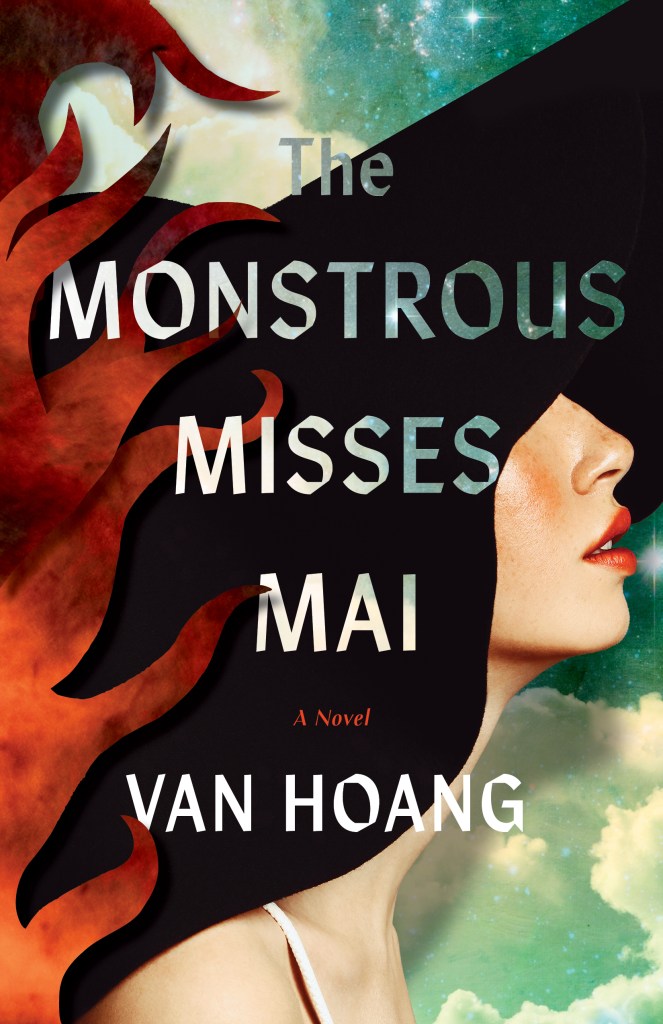
Book: “The Monstrous Misses Mai” by Van Hoang

Publishing Info: 47North, April 2024

Where Did I Get This Book: I received an ARC from the publisher.

Where You Can Get This Book: WorldCat.org | Amazon | Indiebound

Book Description: A determined young woman in 1950s Los Angeles walks a darker city than she ever imagined in a spellbinding novel about the power to make dreams come true―whatever the sacrifice.

Los Angeles brims with opportunity in 1959―though not for aspiring fashion designer Cordelia Mai Yin, the first-generation child of Vietnamese immigrants, who finds the city unkind to outsiders and as dispirited as her own family. When Cordi rents a cheap loft in an old apartment building, she quickly warms to kindred souls Tessa, Audrey, and Silly. They also want better things and have pasts they’d rather forget. That they all share the same middle name makes their friendship seem like destiny.

As supportive as they are of each other, it’s a struggle just to eke out a living, let alone hope to see their wishes for success come true. Until an ever-present and uncannily charming acquaintance of the landlord’s offers a solution to their problems. He promises to fulfill their every dream. All it takes is a little magic. And a small sacrifice.

As one surprisingly effective spell leads to another, their wishes get bigger. But so does the price they must pay. Amid the damaged seams of her life so far, Cordi must realize her own power in order to rip free, without losing everything she’s worked so hard to achieve.

Review: Thank you to 47North for sending me an ARC of this novel!

I love it when I am surprised by book mail in any form, but love it even more when I am surprised by book mail that I already had my eye on. This happened to me with “The Monstrous Misses Mai” by Van Hoang, as I had seen it on my various social media feeds as well as NetGalley, but hadn’t yet taken the plunge to try and get my hands on it. So when it arrived in my mailbox unprompted, I was pretty excited to see it! Between the cover and the idea of women making a magical bargain that they perhaps won’t be able to cash, the entire concept really intrigued me.

The strongest point of this book was our protagonist Cordi Mai Yin, a young Vietnamese American woman who has found herself on her own and estranged from her strict family in 1959 Los Angeles. She moves into an apartment with three other Asian American women, Tessa, Audrey, and Silly, who all also have the middle name of Mai, which feels like fate. As they all struggle due to their class, race, and gender, they meet a mysterious man who claims he can help them make their wishes come true with magic and a sacrifice. We see the story and trajectory of this decision through Cordi’s eyes, who is so desperate to succeed away from her family and as a fashion designer, and whose meek nature is bolstered through the success after the ritual. I liked Cordi a lot, as I found her complexity believable and sympathetic, and she was explored and fleshed out enough that I was invested in what happened to her as well as totally convinced of her choices and storyline beats. Her anxiety about making it on her own after being so dependent on a less than supportive family, mixed with the constant racism and misogyny she has to face in her day to day life, are also laid out in a convincing and realistic way.

The magical system in this book, known as lura, is a well thought out idea that was vague enough to be flexible but felt unique in enough ways that it didn’t feel run of the mill. I felt like there was a lot of “The Craft” in it, with four powerless women coming together to find their power, only to realize that it may have more consequences than they can actually fathom. While this is probably a solidly dark fantasy story, there are also some pretty nasty body horror elements that come from the lura spells taking their toll, with fingernails falling out, or hair shedding in clumps, or even just some gross transformational stuff that made the story have some definite horror elements. I also quite enjoyed the metaphors at hand with various luraists who have accrued power through indirect means, but still feel entitled to the lavish (if not hard to keep up) lifestyles that they have in front of them, and how that doesn’t necessarily apply to four Asian American women who have societal roadblocks due to racism and misogyny.

Overall, I enjoyed “The Monstrous Misses Mai”! It scratched all my dark fantasy and historical fiction itches, and I will certainly be seeing what Van Hoang brings next!

Rating 8: An engrossing dark fantasy with elements of body horror, “The Monstrous Misses Mai” has a bite, both in mythos and in metaphor.

Reader’s Advisory:

“The Monstrous Misses Mai” isn’t on any Goodreads lists as of now, but it would fit in on “Coven Book Club”.

Serena’s Review: “Dark Water Daughter”

This post may contain affiliate links for books we recommend.  Read the full disclosure here.

Book: “Dark Water Daughter” by H.M. Long

Publishing Info: Titan Books, July 2023

Where Did I Get this Book: Netgalley!

Where Can You Get this Book: WorldCat.org | Amazon | IndieBound

Book Description: Mary Firth is a Stormsinger: a woman whose voice can still hurricanes and shatter armadas. Faced with servitude to pirate lord Silvanus Lirr, Mary offers her skills to his arch-rival in exchange for protection – and, more importantly, his help sending Lirr to a watery grave. But her new ally has a vendetta of his own, and Mary’s dreams are dark and full of ghistings, spectral creatures who inhabit the ancient forests of her homeland and the figureheads of ships.

Samuel Rosser is a disgraced naval officer serving aboard The Hart, an infamous privateer commissioned to bring Lirr to justice. He will stop at nothing to capture Lirr, restore his good name and reclaim the only thing that stands between himself and madness: a talisman stolen by Mary.

Finally, driven into the eternal ice at the limits of their world, Mary and Samuel must choose their loyalties and battle forces older and more powerful than the pirates who would make them slaves.

Review: I’ve been wanting to get back to H.M. Long’s books for a while now, and even had this mentally slotted as one to review last summer when it came out. Obviously, that didn’t happen. But better late than never! And as the sequel is scheduled to drop this coming July, I can even say I’m getting this review out of the way several months in advance! We’ll see if I can be timely about getting to that one! Though, given how much I enjoyed this book, I think think the chances are high!

I feel like there was a very brief blip where pirate fantasy stories were trending, around when Adrienne Young wrote her “Fable” duology. But it didn’t quite take off in the same way we’ve seen with other incredibly popular trends (the vampire one currently is a good example, where every third book you see will be a vampire book in some way or another). It’s too bad though, as I think that pirate stories or even just sea-fairing adventure stories are a perfect match for a lot of classic fantasy fiction. They both often involve quests of some sort that move from location to location; there are often larger parties of characters who all have their own motivations and loyalties; and, of course, lots of fight scenes! Long was able to hone in on all of these elements perfectly in this book.

For the fantasy elements, I really liked the world we have here. Not only is Mary’s weather singing ability super interesting on its own, but I enjoyed the way this kind of ability was worked into the organization of this society and the history behind how Stormsingers have historically been treated. Especially for a very nautical group of countries, we can easily see how Stormsingers would be in the sort of demand they are, as well as how their abilities could be exploited by those around them. Beyond the Stormsinging, however, there were a lot of other excellent fantasy elements. I feel like we only scratched the surface of Samuel’s own abilities, with some big swings coming towards the end of the book (I’m especially excited to see where his story goes in the next book). And on top of all of this, we have the ghistlings. These beings felt like a bit of an after thought in both the book summary and in the beginning of the story, but man, that was a bait and switch! There were some truly shocking twists and turns in this arena throughout the book.

I also really enjoyed Mary and Samuel as characters. Each had a rich and compelling back story that was slowly revealed, and I particularly enjoyed the extreme slow burn of their growing relationship. We’re talking slooooowww. After reading a bunch of romantasy books recently, I very much appreciated the return to fantasy where there is a romance, but it is definitely a subplot to not only the greater plot but also to the individual character arcs. As an aside, I had a moment reading this book where I realized I may have been reading a bit too much romantasy recently when the villain was first introduced and I found myself wondering if he was being introduced as a second spoke in a developing love triangle (there is a bare whiff of a love triangle, to be fair, but not with this character.) Sometimes villains are just villains, Serena! Once I re-oriented myself to the real world of most fantasy fiction, I appreciated just how villainous this character really was, and how clearly everyone around him saw this fact.

I also really enjoyed the many various side characters we met. There were several different ships with their own crews and captains that wove in and out of this story, and I enjoyed how all of these moving parts worked together to build to the ultimate show-down. There were some great twists and turns with these side characters as well, with swapping loyalties and a shifting scope of who were the good guys and bad guys at any given moment. It all felt very “Pirates of the Caribbean” in the best way.

I loved this book! It managed to balance so many things all at once without dropping a single plate. There was action, there was danger, there was loyalty and betrayal, love and friendship, and, of course, a large dose of magic in a creative secondary world. After reading this book, I can fairly confidently move Long into my “must read” category for fantasy authors currently writing. If you enjoy fantasy adventures, and especially pirate stories, definitely check this one out!

Rating 9: A perfect combination of a high stakes pirate adventure and a fantasy-fueled quest of discovery. I couldn’t put it down!

Reader’s Advisory:

“Dark Water Daughter” can be found on these Goodreads lists: Nautical Fantasy and Gunpowder Fantasy.

Serena’s Review: “Mountains Made of Glass”

This post may contain affiliate links for books we recommend.  Read the full disclosure here.

Book: “Mountain Made of Glass” by Scarlett St. Clair

Publishing Info: Sourcebooks Bloom Books, March 2023

Where Did I Get this Book: from the publisher!

Where Can You Get this Book: WorldCat.org | Amazon | IndieBound

Book Description: All Gesela’s life, her home village of Elk has been cursed. And it isn’t a single curse—it is one after another, each to be broken by a villager, each with devastating consequences. When Elk’s well goes dry, it is Gesela’s turn to save her town by killing the toad that lives at the bottom. Except… the toad is not a toad at all. He is an Elven prince under a curse of his own, and upon his death, his brothers come for Gesela, seeking retribution.

As punishment, the princes banish Gesela to live with their seventh brother, the one they call the beast. Gesela expects to be the prisoner of a hideous monster, but the beast turns out to be exquisitely beautiful, and rather than lock her in a cell, he offers Gesela a deal. If she can guess his true name in seven days, she can go free.

Gesela agrees, but there is a hidden catch—she must speak his name with love in order to free him, too.

But can either of them learn to love in time?

Review: Scarlett St. Clair is a powerhouse of a romantasy writer. She’s prolific and beloved, and I hadn’t read anything by her up to this point. So I was excited to check this book out when I was approached by the publisher for a potential review. I won’t lie, I was especially excited to check out a novella and one that is pulling from various fairytales. I best know St. Clair through references to her “Hades and Persephone” series, and that’s a tough one to get right, so I felt more confident with a fairytale re-telling as an initial entry point to this author’s work.

After now reading this book, I feel like I’m just as unclear on whether or not St. Clair’s books are for me or not. That said, I can now easily understand the appeal for many romantasy fans. Let’s start with that part. Right away, the style of writing appealed to me. There was a nice balance between quick pacing and descriptive prose. The author had clearly read a bunch of fairytales and had no problem capturing the correct tone, writing a story that felt both whimsical and beautiful at times, and violent and disturbing at others. I especially liked just how many fairytale sources were all drawn upon to craft this story. The author even included a note with more details on all of the points of inspiration she pulled upon when writing this book, which I found fascinating.

I also really enjoyed the dialogue and much of the inner monologues we saw from both the hero and the heroine. And while I enjoyed Gesela, Casamir’s chapters turned out to be the most fun. There were a bunch of side characters with whom he interacted, and I loved the ridiculousness of their scenes attempting to point out to their great Fae lord just how inept his attempts at wooing Gesala really were. There was also a captured fairytale prince whose own story veered off into some truly surprising directions.

However, almost from the very start, I struggled with the balance being struck here between plot and spicy scenes. In that…there really was no balance and it was predominantly the latter. No judgement, of course, to readers who are happy with books that lean more in this direction, but for me, I still have fairly high expectations as far as plot goes for my romantasy books. I still want a story, you see. And while yes, there was one here, it was sometimes hard to keep sight of it through all of the insta-lust we had going on.

I was especially put off when, during the very first scene between Gesala and Casamir, we have Gesala completely losing her wits and falling into immediate lust over this complete stranger. And not just “oh, he’s good looking” lust, we’re talking “let’s jump in bed now!” lust. From there, I felt like there were numerous moments where any of the tension or build to the actual love story were undercut by these moments of straight spice. And at a certain point, it became so comical how often Gesala was ending up in contrived situations where she was naked that I started counting. Which really isn’t what I want from a story: to be so distracted by some sort of silliness that I start counting.

I’m not quite sure where to go from here. Reading between all of the spicy scenes, there was a lot to like about this book. I thought the characterization was great, the dialogue was witty and often hilarious, and the fairytale inspiration was spot on. I just didn’t like how much the spicy scenes seemed to overshadow any actual story that was being drawn. The author’s note said she plans on writing stories for all of the other Fae brothers, so maybe I’ll check out the next one of those and go from there. That said, if you enjoy romantasy books with insta-lust/lots of spice, this may be for you. But if you’re looking for more story or plotting to hold things together, this one is on the weaker side.

Rating 7: A bit of a hit or miss reading experience, I really enjoyed the story we had here, but unfortunately the plot often fell to the wayside in lieu of romance scenes.

Reader’s Advisory:

“Mountains Made of Glass” can be found on these Goodreads lists: Romantasy for Adults and Epic High Fantasy/Romance/Mythology in 2023

Serena’s Review: “The Last Bloodcarver”

This post may contain affiliate links for books we recommend.  Read the full disclosure here.

Book: “The Last Bloodcarver” by Vanessa Le

Publishing Info: Roaring Brook Press, March 2024

Where Did I Get this Book: NetGalley

Where Can You Get this Book: WorldCat.org | Amazon | IndieBound

Book Description: Nhika is a bloodcarver. A cold-hearted, ruthless being who can alter human biology with just a touch. In the industrial city of Theumas, she is seen not as a healer, but a monster that kills for pleasure.

When Nhika is caught using her bloodcarving abilities during a sham medical appointment, she’s captured by underground thugs and sold to an aristocratic family to heal the last witness of their father’s murder.

But as Nhika delves deeper into their investigation amidst the glitz of Theumas’ wealthiest district, she begins to notice parallels between this job and her own dark past. And when she meets an alluring yet entitled physician’s aide, Ven Kochin, she’s forced to question the true intent behind this murder. In a society that outcasts her, Kochin seems drawn to her…though he takes every chance he gets to push her out of his opulent world.

When Nhika discovers that Kochin is not who he claims to be, and that there is an evil dwelling in Theumas that runs much deeper than the murder of one man, she must decide where her heart, and her allegiance, truly lie. And – if she’s willing to become the dreaded bloodcarver Theumas fears to save herself and the ones she’s vowed to protect.

Review: I feel like there’s been a lot of exciting new Asian fantasy stories coming out this spring, and this one was definitely high on my TBR list, as I’m even less familiar with Vietnamese mythology than Chinese, Japanes, or Korean. The cover art is also very unique and intriguing, and I thought the main character’s magical trait of manipulating human biology had a lot of promise. I also love murder mysteries, so I was excited to see how well these two genres would be blended together. And, well, it was all pretty good!

What first stood out to me was the lush and descriptive style of writing the author employed. The story starts out fairly quickly as far as plot and pacing go, but I was still able to picture the details of this world and character. This felt like a fully realized, fully peopled fantasy world, complete with a culture that felt distinctive and elaborate. Of course, central to the story were Nhika’s bloodcarving abilities, and this detailed style of writing helped to truly flesh out how this power worked. Many fantasy stories devolve to fairly simplistic explanations of their magical elements, but here I felt like we were given a true insiders-look into Nhika’s magic. This felt important as it helped the reader understand why an ability that could be so useful to humanity could also be seen as something to fear and hate.

I also really liked Nhika’s character and the arc she has in this book. Through her eyes, we see the experiences of a diaspora character, a young woman who finds herself in a world that no longer feels like her own. Even more interesting, her experiences as an outsider who does not fit within this world were mirrored in the other main character Kochin who experiences a similar disconnect. But while this disconnection and “out-of-place-ness” might be similar between them, their experiences and views of how they fit (or don’t fit) within this world are very different.

That said, this is one of those rare circumstances where I feel like the story might have been better without any romance at all. I liked both of these characters, but frankly, by the time the romance really started to amp up, I’d forgotten that was even the direction it was heading. These two were very definitely enemies for much of the time, so the change of tone when it came, did feel a bit strange. It was also rather sudden, not feeling nearly as developed as many of the other aspects of the story.

Overall, this was a great debut novel! I had some quibbles here and there with the way the romance was developed, but the writing and world-building were strong and promise of great things to come from this author in the future!

Rating 8: Rich and vivid worldbuilding combined with a compelling vision of the diaspora experience created a fantastic debut all around!

Reader’s Advisory:

“The Last Bloodcarver” can be found on these Goodreads lists: Around The World 2024 – Asia Continent and Asian SSF.

Serena’s Review: “The Encanto’s Daughter”

This post may contain affiliate links for books we recommend.  Read the full disclosure here.

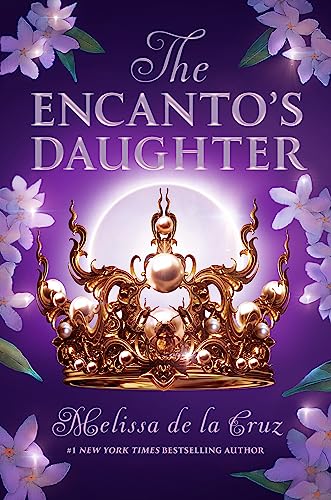
Book: “The Encanto’s Daughter” by Melissa de la Cruz

Publishing Info: G.P. Putnam’s Sons Books for Young Readers, March 2024

Where Did I Get this Book: NetGalley

Where Can You Get this Book: WorldCat.org | Amazon | IndieBound

Book Description: A young woman claims the throne of a realm inspired by Filipino mythology in this YA romantic fantasy, the first in an enchanting new duet by #1 New York Times bestselling author Melissa de la Cruz.

MJ Rodriguez has spent her life hiding in the human world, keeping a heavy secret. She’s half-encanto. As the only child of King Vivencio of the Sirena Court, she’s also next in line for the throne. And now, upon her estranged father’s sudden death, MJ must claim her place as rightful heir.

In wondrous Biringan, the road to the throne is paved with thorns. Without a reigning monarch, the realm has spiraled into disarray. MJ has to win over a backstabbing council that objects to a half-human ruler. And when it looks like her father’s passing wasn’t natural but possibly inflicted by a curse, she must hunt down the sorceress behind this merciless magic.

In a bind, MJ forges an unlikely alliance with the striking Sir Lucas of the feared Sigbin Court, and soon, she loses her heart to the mysterious knight. But with peril looming over Biringan, the princess must decide if she can both open herself to love and carry the weight of the crown.

Review: So, I’m going to just say this up front: I mistook this author for another “Melissa” author when I initially requested this book on NetGalley. I’ve only read one other book by de la Cruz, and to say it wasn’t a favorite is probably an over-statement. I think it might be one of my lowest rated books on the blog, actually. That said, even after I realized, I still wanted to give this one a shot. Over the last year or so, I can think of a few examples where I’ve really loved books by authors who didn’t work for me the first time around. So, who knows? This could have been another situation where, with a new project, my mind could be changed.

All of that nice intro just to find out…nope, turns out everything that I disliked about the first de la Cruz book was more a feature of her writing than a bug. Ah, well, worth the shot I guess! But, as always, let’s talk a bit at first about the things that did work for me. Really, not much did. But I can see more where things would work for other readers whose tastes differ from mine. I did like the elements that were drawn from Filipino mythology (I especially appreciated the author’s note about this), and I wish there had been even more of these elements included on the whole. By the end, I still felt like we’d only scratched the surface of what could have been a rich fantasy tapestry. I also think that many of the choices made with regards to characterization and plot will appeal more to younger YA readers, so they may find more to like in this book than I did.

But for me, this was really a disaster of a read. Both the characters and the plot felt like cardboard cut outs of the most stereotypical elements of storytelling that on could cobble together. From the ridiculousness of the “magical royal school” setting, to the plot quickly devolving from MJ taking seriously her task to learn to take the throne in only a month’s time to instead partaking in juvenile bickering and drama. And to people these scenes, we have all of the stereotypes you can imagine: quirky best friend? Check. Mysterious romantic interest? Check. Hot girl that the main girl must hate? Check. This last one was most disappointing to see. I vaguely remember having problems with this in the other book by de la Cruz I read, this propensity to making the main female character seem special by degrading the other women around her. It was distasteful then, and it’s pretty depressing to still see it popping up here in YA fiction years later.

Beyond this, it felt like the book didn’t know what it wanted to be. You have, of course, the boarding school aspect. But the story also has elements of a fantasy thriller and then a murder mystery is introduced. And yet, even with all of these elements, I found myself so, so bored while reading this. Not being able to connect to any of the characters is always an uphill battle as far as engagement with a book goes, but it also felt like the pacing of this one was simply very slow. It felt like nothing was really happening for large chunks of the story. And as it went, it was easy to guess exactly where every plot line was going which sucked any tension out of the experience. And then we get to the end and what do we get? A cliffhanger!

I really disliked this book. The writing felt limited, the plotting was questionable, and the characterization could be reduced to stereotypes. All of that said, I know this author is popular with a lot of readers, so if you’re a fan of her previous books, take all of this with a massive grain of salt. Also, if you’re very dedicated to checking out a book that draws from Filipino mythology this might be worth a shot, though, I have to say, I feel like there have to be better examples out there than this. Overall, while I’m glad I gave this author another shot in the service of not having fixed opinions of an author based on one reading experience, after finishing this one, I’ll think I’ll call it quits.

Rating 5: At best it doesn’t stand out from the pack of other YA fantasy stories, and at worst, it’s a muddled mess of stereotypes and predictable plot lines.

Reader’s Advisory:

“The Encanto’s Daughter” can be found on this Goodreads list: Asian YA/NA Books 2024: