Book Club Review: “Northanger Abbey”

50398We are part of a group of librarian friends who have had an ongoing bookclub running for the last several years. Each “season” (we’re nerds) we pick a theme and each of us chooses a book within that theme for us all to read. Our current theme is ‘Books On Our To Read Shelf’, where we pick books that we’ve been meaning to read but haven’t gotten to.

For this blog, we will post a joint review of each book we read for book club. We’ll also post the next book coming up in book club. So feel free to read along with us or use our book selections and questions in your own book club!

Book: “Northanger Abbey” by Jane Austen

Publishing Info: John Murray, 1818

Where Did We Get This Book: eAudiobook from the library,

Book Description: Jane Austen’s first novel—published posthumously in 1818—tells the story of Catherine Morland and her dangerously sweet nature, innocence, and sometime self-delusion. Though Austen’s fallible heroine is repeatedly drawn into scrapes while vacationing at Bath and during her subsequent visit to Northanger Abbey, Catherine eventually triumphs, blossoming into a discerning woman who learns truths about love, life, and the heady power of literature. The satirical novel pokes fun at the gothic novel while earnestly emphasizing caution to the female sex.

Kate’s Thoughts

Unlike Serena, I am not as well versed in Jane Austen stories. I’ve read “Emma” and “Sense and Sensibility”, and I’ve read “Pride and Prejudice and Zombies”, which admittedly probably doesn’t count. So when book club picked “Northanger Abbey”, I was both a bit excited but also a little apprehensive. I’m always looking to expand my ‘classics’ experience, as that’s admittedly a huge gap in my reading, but one of my biggest hangups with Austen is her writing style. But I got the audiobook from the library, and jumped in.

While I did have problems with the writing, overall I enjoyed “Northanger Abbey”! Given that I quite like Gothic novels (“Jane Eyre”, anyone?), it was kind of fun seeing a gentle satire/ribbing of the genre with Catherine Morland’s imagination running away with her. Given that Gothic novels are incredibly melodramatic it was quite amusing seeing Catherine look for the melodrama in her life, even when there really wasn’t much to be had, at least not in the ways she expected. Catherine herself is a pretty enjoyable protagonist, as she is sometimes flighty and naive, but always has a good heart in place and ultimately is good to other people. I can’t say that I was super invested in her relationship with Henry Tilney, but I did like their witty banter. I was far more invested in Catherine’s friendship with his sister Eleanor, and her frenemy relationship with the vapid and self centered Isabella (side note: Isabella and her dumbshit brother John are fun to hate as villains, and because of that I GREATLY enjoyed them and their nasty scheming). Catherine’s maneuvering through romantic and platonic relationships composed the true heart of this story, and I was definitely rooting for her.

I was also really tickled to see so much of this story took place in Bath, if only because I really enjoyed Bath when I went there. It was also neat to see that some of the tourist-y things to be done in Bath today, like visiting the pump room, were part of the tourist appeal back when this book was written! It’s funny to see how things can endure over time, whether it be a tourist attraction or the appeal of a novel.

But like I mentioned above, I did have a hard time with the writing style. I usually try to read ‘classics’ by listening to them on audiobook, as for some reason listening to the writing is easier for me to process that way. With “Northanger Abbey” this mostly worked, but I still found my mind wandering as I listened. Given that I’ve had success with this when reading other ‘classics’, I do think that had the plot been more to my liking, I may not have had as large of a problem keeping interested. This, however, is probably more a comment on my own personal hangups than the book itself.

“Northanger Abbey” hasn’t necessarily made me want to run out and read all the rest that Jane Austen has to offer, but as I slowly chip away at her work I can see why she has endured.

Serena’s Thoughts

I’ve read all of Jane Auten’s works, most of them twice. “Northnager Abbey,” however, is one of the few I’ve only read the one time, so I was also super excited when this was selected as a bookclub pick. Most of Austen’s other titles serve as comfort reads of some sort or another, depending on the mood I’m in and the type of romantic hero I’m craving. But for some reason I haven’t had this one in my rotation, though I do re-watch the BBC movie of it fairly regularly.

In many ways, this book is very different from Austen’s other works. It is one of her earliest writings (though it was published later, after her death), and you can see the building blocks in development with this work. Her villains are a bit more obviously “villain-y”: the Colonel with his strict meal times, Isabella with her contradictions and manipulations. The comedic characters play almost only for that, like Mrs. Allen’s obsession with clothes. And Tilney & Eleanore are simply good people all around. They all play their parts perfectly, but when compared to Austen’s other characters of the same type, one can see that these first attempts are a bit more bland and one-note. In “Pride and Prejudice,” for example, Mrs. Bennett is both a comedic character but also one that is pitiable for the situation she finds herself in, one that she is completely unable to handle (a questionable future and five daughters whose options are limited).  So, too, Mr. Darcy is both a romantic hero but also flawed man.

Catherine, as the heroine, is given the most fully fleshed out character. One of the lasting appeals of Austen’s work, I believe, is the way she captured the core of people, traits that carry on throughout the ages, regardless of many cultural or societal changes. Catherine, for instance, reads as a very believable seventeen year old girl. She’s a good person, but is prone to flights of dramatics, wishing to make her life more like the ones she reads about, seeing intrigue and mystery where there is none. She is also easily attracted to those she perceives as having more confidence than herself, like Isabella. And while never lead completely astray from the solid foundation of principles that make up her person, we see her fall under the sway of a “popular girl” who is going about life in a very different way than Catherine even understands.

As Kate mentioned, the most unique aspect of this book is the fact that it is a straight satire of the popular Gothic novels of the time. Every character choice and plot point holds in direct contrast to the dramatic events taking place in those books. Tilney is simply a good person (a very good person, given how gently he handles Catherine after she lets her imagination take her a bit too far at one point), with not flights of brooding or penchant to unnecessary dueling. Northanger Abbey itself is simply a home, most notable for being cozy and done up to the latest styles. Catherine’s family are all alive, most notably her mother, a character that even in Austen’s time was often killed off early in the story (Disney and many other YA stories still lean heavily on this trope). There are also several lines where Austen directly references other books and statements from authors that, for the curious reader, are fun rabbit holes to go down on one’s own time.

I very much enjoyed re-reading this book. The piercing take-downs of the tropes often found in Gothic fiction are on point, the story itself is sweet, and Tilney and Catherine are heroes you can’t help but root for. While the story and character portrayals are a bit more simplistic than what we see in Austen’s later work, you can clearly see the foundation that is being built in this first work.

Kate’s Rating 7: I liked the protagonist and the fun satire of Gothic novels, but the writing of the time period has never been my cup of tea.

Serena’s Rating 8: The most straight-forward of Austen’s books, this is a fun read though not as fully engaging as her other novels.

Book Club Questions

  1. This book pokes fun at common themes found in Gothic novels. Have you read any Gothic novels yourself and which of these satirical jabs did you appreciate the most?
  2. This is Austen’s first novel. If you have read her other stories, in what ways do you see her writing and characterization change between this story and her others?
  3. There is a careful balance struck between poking fun at Gothic novels but also defending novel-reading as a whole. How well do you think this balance was portrayed and what do you think Austen was ultimately trying to say?
  4. The romance between Henry and Catherine is very different from the ones in Gothic novels and even Austen’s own other works, especially with the admission later in the book that Henry’s initial interest was largely struck purely based on Catherine’s own obvious admiration. What do you think of the romance between these two? How does Henry compare to Austen’s other heroes?
  5. There is a large cast of characters who fall within the “villains” and “fools” categories. Which of them stood out to you and were they believable characters in and of themselves? Why or why not?

Reader’s Advisory

“Northanger Abbey” is included on the Goodreads lists “Best Books For Girls Who Belong to Another Era”, and “Fictional Crushes”.

Find “Northanger Abbey” at your library using WorldCat!

Next Book Club Book: “Incognegro: A Graphic Mystery”.
Serena’s Review: “An Illusion of Thieves”

39662738Book: “An Illusion of Thieves” by Cate Glass

Publication Info: Tor Books, May 2019

Where Did I Get this Book: NetGalley

Book Description: In Cantagna, being a sorcerer is a death sentence.

Romy escapes her hardscrabble upbringing when she becomes courtesan to the Shadow Lord, a revolutionary noble who brings laws and comforts once reserved for the wealthy to all. When her brother, Neri, is caught thieving with the aid of magic, Romy’s aristocratic influence is the only thing that can spare his life—and the price is her banishment.

Now back in Beggar’s Ring, she has just her wits and her own long-hidden sorcery to help her and Neri survive. But when a plot to overthrow the Shadow Lord and incite civil war is uncovered, only Romy knows how to stop it. To do so, she’ll have to rely on newfound allies—a swordmaster, a silversmith, and her own thieving brother. And they’ll need the very thing that could condemn them all: magic.

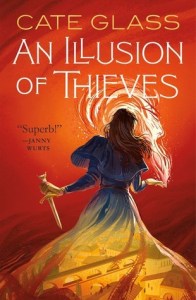
Review: Cover lust! I love everything about that illustration, the vibrant colors, the style, it’s all very eye-catching and definitely served its purpose as it instantly drew me in when I was browsing through NetGalley. The description helped quite a lot as well, as I can never resist a good heist story, especially if there’s a fantasy element involved! And while my hopes were not fully met, I still enjoyed this book quite a lot in the end.

For the most part, I very much enjoyed this story. Particularly, I enjoyed the detailed take on the political and economical environment in which the story took place. I’ve read a bunch of stories where magic being illegal is a central theme, but when combined with the other world-building elements twisted into the story, it still came off as a unique take. Pacing-wise, the story could read as a big slower with many of the little details getting more attention than some readers may prefer. Likewise, the main plot often takes a backseat to smaller, character-driven moments. I can enjoy both types of fantasy stories, but those looking for a grand epic might find themselves frustrated with the lower stakes of this story.

It was also an interesting read knowing that the author plans to write the series in an episodic manner. Most fantasy series typically follow a grand arc that takes place over several books, and while smaller offshoots exist here and there, the main conflict builds and resolves through all the books, linking them closely together. I can see the stage being set for a different type of read with this book, and I’m intrigued by what Glass has in mind with this type of tale.

As for the characters, I really enjoyed Romy. She was a fun narrator and it was exciting to see her so competently put her skills to work when she finds herself back on the streets, poverty-stricken and desperate. I was also surprised to find that the story is also largely Neri’s as well. I’m not quite sure how I feel about this character. His character type, that of the young, arrogant, swagger-ridden boy-o, has some natural flaws simply built in. But those same flaws are the points around which his characterization builds, so they have to be there to see any growth.

I was also surprised to find the story lacked a romantic plot line, instead focusing on the sibling relationship between Romy and Neri a its emotional crux. I confess that I typically prefer some romance in my stories, and second best is a sister-sister relationship, but I was also drawn in by the tense relationship between Romy and Neri as they learned to get along throughout the book.

Overall, this book was an entertaining read. I felt that the plot was a bit light for me and at times the author seemed to almost lose focus on her main story, caught up in the details of her world. But the interesting characters and the slowly built up trust and respect between Romy and Neri was a point in its favor. And, again, I’ll never say no to magical heist stories!

Rating 7: A fun, lighter read with a compelling brother/sister relationship at its heart.

Reader’s Advisory: 

“An Illusion of Thieves” isn’t on any relevant Goodreads lists, but it should be on “Popular Fantasy Heist Books.”

Find “An Illusion of Thieves” at your library using WorldCat!


Serena’s Review: “Kingsbane”

40523458Book: “Kingsbane” by Claire Legrand

Publishing Info: Sourcebooks Fire, May 2019

Where Did I Get this Book: ARC from the publisher

Book Description: Rielle Dardenne has been anointed Sun Queen, but her trials are far from over. The Gate keeping the angels at bay is falling. To repair it, Rielle must collect the seven hidden castings of the saints. Meanwhile, to help her prince and love Audric protect Celdaria, Rielle must spy on the angel Corien—but his promises of freedom and power may prove too tempting to resist.

Centuries later, Eliana Ferracora grapples with her new reality: She is the Sun Queen, humanity’s long-awaited savior. But fear of corruption—fear of becoming another Rielle—keeps Eliana’s power dangerous and unpredictable. Hunted by all, racing against time to save her dying friend Navi, Eliana must decide how to wear a crown she never wanted—by embracing her mother’s power, or rejecting it forever.

Previously Reviewed: “Furyborn”

Review: As my review above indicates, I had some problems with the first book in this trilogy. But, as the book was so well-received, to a certain extent I know these were a lot of personal preferences, mainly having to do with the decision to include a prologue that, I felt, gave away a bit too much of the story, if read carefully. So, with that in mind, when I received an ARC in the mail from the publisher, I decided to give it a go. And, while I still struggled with aspects of the story, I also enjoyed it more than the first.

Rielle and Eliana both are thought to be the Sun Queen, though Eliana does have the dark history of her mother, Rielle’s, decent into darkness to back up her claim. But so far these titles and prophesies have brought nothing but danger and challenges, one after another. Eliana must bear the heavy load of her mother’s legacy, worrying constantly that she will follow in her footsteps, fearing her own powers. And Rielle, centuries earlier, must walk a tight line between protecting her kingdom and spying on the angels who threaten them, all while becoming increasingly intrigued by one of them, the mysterious Corien.

Having the world and writing set-up (alternating POVs from the past and the future) already established definitely helped me enjoy this book more than the first. If I worked very hard, I could even try and put the initial prologue out of my head and enjoy the story as it is. I’m particularly intrigued by the ongoing mystery of which Queen is really the Sun Queen and which is the one who turns to evil. While it feels fairly established as Rielle, I’m still on the look-out for a trick up this author’s sleeve in the eleventh hour.

As far as characters go, I still have enjoyed Eliana’s story more than Rielle’s. Part of this might have something to do with the timing of my read of this book. Frankly, I’m a bit exhausted by the “power hungry queens” in fantasy stories right now (I think the reason why is probably pretty obvious). This is definitely not the book’s fault. But timing aside, I do think that Rielle’s decision making and thirst for power made her a bit less appealing for me. At my heart, I always will prefer to the straight-forward hero character over an anti-hero. I also wasn’t a fan of the strange love triangle that was being built up between Rielle, Corien and Audric. I didn’t feel like there was enough established to really justify Rielle’s interest in Corien.

I do very much enjoy the general writing style and world-building of these books. The story feels expansive and epic, and the writing effortlessly flows between witting dialogue and engrossing descriptions of action and setting. If only the characters who populated it all were a bit better. The book is pretty long, however, and I do think some editing could have been in order to tidying it all up.

I also had some questions about the marketing of this book as YA. There are some pretty intense scenes in this book, particularly in the romance plot line between Corien and Rielle. This is by no means coming from a “the children aren’t ready for this!!” place, but more a general question about fantasy fiction and current marketing practices. It almost feels like a lot of good fantasy works are being relegated to YA regardless of that being the appropriate place for them simply because YA fantasy is booming. And look, I love that so many fantasy titles are coming out in YA. But I’m also starting to feel like there is an equal and growing lack of fantasy coming out in adult fiction for the very same reason.

I would place good money on the fact that several titles are pitched to publishers as adult fantasy fiction and then are sent back with the note “Great! But let’s make the protagonists teenagers so we can market it to YA, since that’s where this stuff sells!” It’s too bad, because a lot of adults want to read good fantasy fiction (again, look at the recent epic fantasy TV show that just concluded. Clearly, there is an adult interest in these types of stories). And books like this read as if they could just as easily, and perhaps more appropriately, be marketed as adult fantasy. Teenagers can pick up an adult fantasy novel just as easily as an adult can pick up a YA fantasy title. So maybe we can try giving each their due based on the story itself, and not marketing tactics. A girl can dream.

Having the characters and world set up in the first book, overall I felt as if I could sink more fully into this read and enjoy it. I still had some struggles, but some of that can be laid at the feet of the timing of my read more than any real flaw on the book’s part. Fans of the first book are sure to love this one, and those who may have had middling feelings might want to check it out as well, as I do think everything was strengthened, if not perfected, in this sequel.

Rating  7: An overall improvement on the first book!

Reader’s Advisory:

“Kingsbane” is a newer title, so it isn’t on many Goodreads lists, but it is on: “Books Marketed as Young adult that might be New Adult, Adult Fiction.”

Find “Furyborn” at your library using WorldCat!

Book Club Review: “Girl Squads: 20 Female Friendships That Changed History”

We are part of a group of librarian friends who have had an ongoing bookclub running for the last several years. Each “season” (we’re nerds) we pick a theme and each of us chooses a book within that theme for us all to read. Our current theme is ‘genre mash-ups’, where we pick two random genres and try to find a book that fits both. 

For this blog, we will post a joint review of each book we read for book club. We’ll also post the next book coming up in book club. So feel free to read along with us or use our book selections and questions in your own book club!

39873981Book: “Girl Squads: 20 Female Friendships that Changed History” by Sam Maggs

Publishing Info: Quirk Books, October 2018

Where Did We Get This Book: from the library!

Genre Mash-Up: Non-fiction and short stories

Book Description: A modern girl is nothing without her squad of besties. But don’t let all the hashtags fool you: the #girlsquad goes back a long, long time. In this hilarious and heartfelt book, geek girl Sam Maggs takes you on a tour of some of history’s most famous female BFFs, including:

• Anne Bonny and Mary Read, the infamous lady pirates who sailed the seven seas and plundered with the best of the men
• Jeanne Manon Roland and Sophie Grandchamp, Parisian socialites who landed front-row seats (from prison) to the French Revolution
• Sharon and Shirley Firth, the First Nations twin sisters who would go on to become Olympic skiers and break barriers in the sport
• The Edinburgh Seven, the band of pals who fought to become the first women admitted to medical school in the United Kingdom
• The Zohra Orchestra, the ensemble from Afghanistan who defied laws, danger, and threats to become the nation’s first all-female musical group

And many more! Spanning art, science, politics, activism, and even sports, these girl squads show just how essential female friendship has been throughout history and throughout the world. Sam Maggs brings her signature wit and warmth as she pays tribute to the enduring power of the girl squad. Fun, feisty, and delightful to read—with empowering illustrations by artist Jenn Woodall—it’s the perfect gift for your BFF. 

Serena’s Thoughts

This was my bookclub pick. I drew “nonfiction” and “short stories,” which on first glance was a pretty terrifying and unintuitive draw for me. I read very little nonfiction and only a handful of short story collection, all of which were decidedly NOT nonfiction and definitely were lots of fantasy/magic/aliens action that in no way could be pass off as “true to life.” But after thinking about it a bit more, short biographies seemed like the obvious choice and when I stumbled on this title when browsing around, it was an obvious pick.

Overall, I really enjoyed this story. Collections like this about women of history who have largely gone unnoticed have had a bit of a spotlight recently and our bookclub, when asked, could rattle off three or four similar titles off the top of their heads. But the interesting quirk that made this one stand out was its focus on female friendships and partnerships. All too often we hear stories about the one woman who stood out as unique (and often forgotten) among all of the men who surrounded her, so it was a breath of fresh air to read this book that focused on the fact that it wasn’t just one in a million women who was doing interesting things and chances were good that she surrounded herself by other like-minded women who are worth noting, not just a bunch of dudes.

Many of the stories were unfamiliar to me and I really liked that about the story. There were a few familiar ones as well, but even those felt as if they were providing new insights into the lives of these women. Overall, I enjoyed most of the choices provided. However, the book is broken up into section that have an over-arching theme with the women included in each, like “sports,” “science,” and “warriors.” I get the reasoning for this, but I do feel it might have worked against the book, as readers who are less interested in certain areas, like sports, perhaps, might go into a segment of stories prepared to be bored. And then, because they have similar focuses, the way each story plays out could begin to feel a bit predictable and repetitive. Had the stories been presented in a more random manner, this might have helped this aspect.

My only other complaint comes with annoyances with the writing style. At times, it can read as very dry and a bit pedantic. And then, in an obvious effort to counterbalance this very thing, the author would throw in some quirky, conversational-style line to try and “spice things up.” I found these one-liners very distracting and fairly eye-roll-worthy most of the time. Other than that, though, I really enjoyed this book and was glad that my bookclub pairings lead me to it!

Kate’s Thoughts

I, for one, am always going to be happy to see women’s history showcased, especially if they are stories that haven’t really been brought to the public’s attention on a large scale level in the past. So when Serena picked “Girl Squads” for her book club pick, I was definitely excited to learn some new things about some awesome ladies.

And new things did I find! While there are some familiar stories in this book, like the stories of the three present Women Supreme Court Justices or the ‘Hidden Figures’ of NASA, a lot of the tales of lady friendships and partnerships were new to me. I enjoyed the variety and range of the stories told, from sports and athletics, to warriors and battles, to innovators and creatives and more. It was both really empowering to read all these different tales, and also frustrating that so many of these tales have gone unnoticed or under-told for as long as they have, at least in terms of what I’ve been exposed to. My favorites included the Haenyo Divers on Jeju Island, South Korea, and the Japanese Women’s Olympic Volleyball team.

I also really liked that Maggs made a concerted effort to tell a variety of stories from all over the world, so as not to focus mostly on white, European narratives. Given that our educational system in this country is so Euro-centric, seeing stories from all over the world and many different experiences was really enlightening. Given that academia, like many other communities, has problems with diversity, I was happy to see that Maggs intended to write an intersectional book.

But like Serena I had similar problems with the structure of the book and the conversational tone it attempted to implement. By the time I reached the final fourth of the book, I found myself skimming and missing various sections of the chapters due to zoning out. It just got to be a little long, and, as Serena mentioned, the structure made it feel repetitive and lagging. And when it comes to the conversational commentaries that Maggs tried to drop in every once in awhile, I had very little patience for it. I think that this kind of creative choice CAN be done, as I’ve read a few books that manage to nail the fun quirky tone with the more ‘serious’ subject matter, but Maggs’s attempts felt more ‘how do you do, fellow kids?’, as opposed to natural or organic.

Those things aside, overall I enjoyed “Girl Squads” because of the stories that it told.

Serena Rating 7: Never quite felt like it found the writing style or organization that best fit it, but the stories were interesting and enlightening, none the less.

Kate Rating 7: With similar complaints about the writing style and structure, this book tended to take me out of the moment more often than not. That said, I liked learning new things about women I wasn’t familiar with.

Book Club Questions

  1. Which story was your favorite and why?
  2. Were there any stories that you want more information on or think could have been improved? Which one would you read a full-length biography on?
  3. Are there any women you would have like to see highlighted who weren’t included and what notable aspects of their life would you draw upon?
  4. How did you feel about the writing style and organization of the collection?
  5. Are there any other “themes” (like “girl squads”) that you would like to see be used to create a collection of short biographies? Who would you include in a collection like that?

Reader’s Advisory:

“Girl Squads: 20 Female Friendships that Changed History” is on these Goodreads lists: “Biographies of Women, by Women” and “Great Books For Young Girls.”

Find “Girl Squads: 20 Female Friendships that Changed History” at your library using WorldCat!

Next Book Club Book: “Northhanger Abbey” by Jane Austen.

Kate’s Review: “Assignment”

42956158Book: “Assignment” by Angela Howes

Publishing Info: Fine Tuned Editing, December 2018

Where Did I Get This Book: The author provided me with a PDF copy.

Book Description: In a city divided between the workers who keep the economy going and the families who bolster the population, eighteen-year-old graduate Phoebe Ray is assigned to a solitary life as a newspaper delivery girl, forbidden from marrying, seeing her family more than twice a year, or ever having children.

But when childhood flame Noah and charming neighbor Sky enter the picture, Phoebe must decide whether a chance at love is worth risking imprisonment, banishment from society, and ultimately, death. And when a city-wide strike breaks out leaving everyone vulnerable, Phoebe has an even greater decision to make.

Should she turn her back on the fight to save her friends and family, or is it finally time to make a stand?

Review: First I want to extend a special thank you to Angela Howes for reaching out and sending me a copy of this book!

For better or for worse, my extensive list of not-so-guilty-reading-pleasures includes dystopic YA fiction. While I admittedly haven’t read the entire gamut, I’m always looking out for new titles. So when Angela Howes approached us and asked if we would be interesting in reading and featuring her book “Assignment” on the blog, I jumped at the chance.

The premise of “Assignment” is a fairly familiar one. A teenage girl named Phoebe lives in a society where people can be assigned to two facets of the community: you can be a One, who works and creates and keeps society and the economy going, or a Two, who doesn’t work but marries and reproduces to bolster the population. But what I liked about “Assignment” was that while the set up is familiar, I enjoyed the path that was taken for most of the narrative. Phoebe, who didn’t expect/ want to end up as a One, has to learn to adjust to a life she never saw coming. While you get the sense that things aren’t right in Cerenia, with the hints of corruption and strict, oppressive rules, most of this book is watching Phoebe start to find self-actualization, and how that eventually puts her in a place where she starts asking questions. I liked seeing her work her way up in her career, seeing her learn to take care of herself, and liked seeing her have to interact with people she wouldn’t necessarily interact with. Watching her character change and grow was a real fun treat, and I really liked how her path took her and where she ended up. Seeing the world she was in grow around her as the story went on was also enjoyable. The focus right now in the books is building the world, and I felt like we got a really good sense of why Cerenia has become the society that it is, and in turn how conflicts are handled within the society because of its core ethos. This is seen in a couple of ways. The first is the ‘strike’ that the Ones partake in, and how Phoebe and her fellow Ones become targets of violence, intimidation, and raids. This was a creative plot device, and it not only made the suspense fly high, it also laid out the stakes. But the second is far more personal to Phoebe, as her brother Milo became a One before she did, and now she’s having a hard time getting a hold of him. The question of where her brother is, and what it means that he’s seemingly disappeared, is every present and effective.

That said, there is one big trap that “Assignment” falls into, and this is perhaps based more in personal preference than anything else. We have The Love Triangle, a trope that I cannot stand. Our two players are pretty typical in their roles. There’s Noah, the boy that Phoebe has known since childhood and whom she has loved for a long time. They assumed they would both be Twos and get married and have a family. But since Ones and Twos cannot fraternize, their love in a star crossed one. The other is Sky, a One that Phoebe meets at the assignment ceremony and ends up being her neighbor. Noah is sweet and loyal, whereas Sky is cocky with a heart of gold. I’m just going to put out there I am Team Sky, because Noah not only has a lady friend named Darya he’s been matched up with who is super sweet and understanding, but he is a complete coward who wants to have his cake and eat it too. In this case, that means shacking up with Darya and fulfilling his responsibility with her, but sneaking around with Phoebe when she drops off his newspaper every day. PHOEBE, YOU CAN DO BETTER. I liked Sky because while he did checkbox a number of familiar bad boy tropes, I DID appreciate that he respected Phoebe’s wants and needs, so when she just wanted to be friends, he was satisfied with that. It’s a healthier love triangle moment to be sure. But it’s still going strong by the end of the book. On top of that, we get a very HUGE cliffhanger right at the end. I can handle a cliffhanger ending if it ends with ambiguity, but when it’s a smash cut in the middle of a scene or conversation, that’s a choice I don’t particularly care for.

Those qualms aside, I enjoyed “Assignment”! I will definitely be looking out for the next book in the series, because Phoebe has me fully invested at this point. Fans of dystopia romance should give it a whirl!

Rating 7: While love triangles aren’t my cup of tea and cliffhangers rankle me, “Assignment” was an addictive dystopia with some sound and well done world building, and likable characters!

Reader’s Advisory:

“Assignment” isn’t included on any Goodreads lists, but if you like books like “Divergent”, “Matched”, or “The Testing” you will probably find this one fun as well!

“Assignment” isn’t in very many libraries as of now, but you can find it in WorldCat, and on Amazon.

Kate’s Review: “Aquicorn Cove”

36482829Book: “Aquicorn Cove” by Katie O’Neill
Publishing Info: Oni Press, October 2018

Where Did I Get This Book: The library!

Book Description: When Lana and her father return to their seaside hometown to help clear the debris of a storm, the last thing she expects is to discover a colony of Aquicorns—magical seahorse-like residents of the coral reef. As she explores the damaged town and the fabled undersea palace, Lana learns that while she cannot always count on adults to be the guardians she needs, she herself is capable of finding the strength to protect both the ocean, and her own happiness.

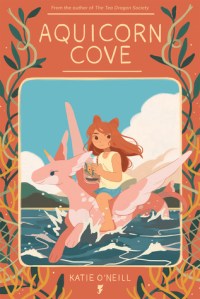
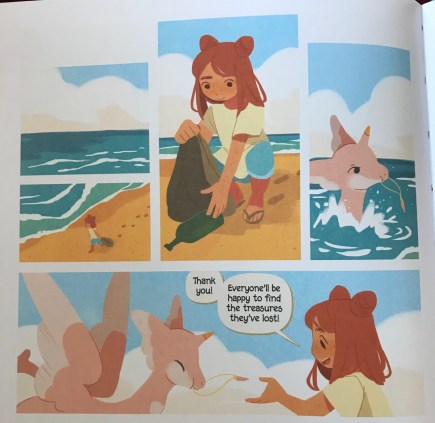
Review: When I saw that Katie O’Neill had another graphic novel coming out, I knew, I KNEW, that I had to read it. I loved “The Tea Dragon Society” so very much, and gentle and vibrant cuteness was something that I was needing after a stressful couple of weeks. While aquatic mythical creatures may not catch my attention as much as dragons do (unless it’s a sea serpent, as those are basically water dragons if we’re being honest), the cover alone had me screeching with joy. A girl riding some kind of weird water unicorn Pegasus thing?!

giphy-3
The contrast of this with the horror graphics on my stack was striking. (source)

But the thing that I noticed about “Aquicorn Cove” from the get go is that there is a far more bittersweet undercurrent running through this story than there was with “The Tea Dragon Society”. While the imagery is just as cute and serene as the imagery in that book, the premise here is a bit darker. Lana is a girl whose mother was killed during a violent ocean storm, and that is why she and her father left their hometown in the first place. They are coming back to visit her maternal Aunt Mae as well as clean up the wreckage after another bad storm. Lana has a genuine connection to the ocean like Mae and her mother did, even though being back is painful for her and her father. When she finds an injured baby aquicorn she wants to nurse back to health, her love of the ocean has a tangible element it can attach to. Mae, too, has a connection to the sea, given that she is a fisherwoman and she makes her living because of it, but there is always going to be the painful reminder that the thing she loves took her sister away. They are both coping with the trauma of the loss, but they cope in different ways.

The Aquicorn society that Mae and Lana interact with has it’s own issues that it brings to the story. Aure, the head of the community, has struck up a long time friendship with Mae, as they have helped each other in various ways. Mae has taken objects and products from Aquicorn Cove and has helped her own community thrive. But the give and take relationship has started to crumble, as Aure thinks that the cost for her community has started to become far too great. O’Neill has found a relatable and easy way to show kids the importance of giving back to the environment, and while you understand Mae’s need and want to keep her community alive, you see the cost it has to Aure’s and the reef. There was one panel that is especially relevant where, when pushed back on by Aure, Mae says that her community shouldn’t have to change it’s ways because ‘this is how it’s always been’, and THAT struck a chord. Mae is never presented as a bad person, per se, just someone who is unable to see the consequences that her actions have for others.

The other big theme in this story is the importance of ocean conservation, and how it can be a matter of life and death not only for sea creatures, but for the human communities that live on the seashore. Aquicorn Cove’s reef is sick and starting to die, and without the protection of the reef that can help buffer the strength of ocean storms, the severity on land is becoming more and more devastating. Climate change scientists postulate that storms will become worse and worse as time goes on, and with more of these natural buffers dying off or disappearing the costs and the losses will be higher. At the end of the book O’Neill listed a number of ocean conservation resources, as well as information for the readers on what they can do to help restore the tenuous ecosystems. What I liked about this section was that it was easy to understand for kids, and while O’Neill did simplify it she never made it seem like she was talking down to her readers. She really hits home that we may feel like in our smallness we can’t make a difference, but how we can connect to our community, which can connect to other communities, and how that can help amplify our voices for change. The message was loud and clear, and I really liked it.

And yes, let’s look at how sweet the drawings are.

IMG_2816
EEEEE!!! (Source: Oni Press)
IMG_2817
It’s just so charming. (source: Oni Press)

The gentle design and all around charming style made the art pop and had me smiling from ear to ear.

“Aquicorn Cove” is another lovely graphic novel by Katie O’Neill, and with it’s important messages and themes it stands out from the crowd.

Rating 7: A cute graphic novel with a resonant message, “Aquicorn Cove” is a sweet story that brings out cute sea creatures and talks about the importance of our oceans.

Reader’s Advisory:

“Aquicorn Cove” is included on the Goodreads lists “Tween Graphic Novels”, and “Comics and Graphic Novels by Women”.

Find “Aquicorn Cove” at your library using WorldCat!

Kate’s Review: “Internment”

38167114Book: “Internment” by Samira Ahmed

Publishing Info: Little, Brown. March 2019

Where Did I Get This Book: I received an eARC from NetGalley.

Book Description: Rebellions are built on hope.

Set in a horrifying near-future United States, seventeen-year-old Layla Amin and her parents are forced into an internment camp for Muslim American citizens.

With the help of newly made friends also trapped within the internment camp, her boyfriend on the outside, and an unexpected alliance, Layla begins a journey to fight for freedom, leading a revolution against the internment camp’s Director and his guards.

Heart-racing and emotional, Internment challenges readers to fight complicit silence that exists in our society today.

Review: I want to extend a thanks to NetGalley for sending me an eARC of this book!

One of the vivid horrible memories I have in the wake of the Trump election (and there are many, believe me) is that one of Trump’s PAC supporters, Carl Higbie, said that Trump’s idea to create a registry for immigrants from Muslim countries had a ‘precedent’ because of Japanese American citizen registries during WWII. Given that those registries led to the unconstitutional and horrific internment of American Citizens, this statement was quite frightening (and given the detention of families at the border and how horrific that practice is, in some ways internment is already present on our soil). Fast forward to a couple years later, when a controversy surrounded the upcoming release of a novel called “American Heart”. The author, Laura Moriarty, had wanted to write a ‘what if’ book that was about Muslim Internment camps in America during a Trump-esque executive administration. But it was from the perspective of a white teenage girl who basically has to be taught why it’s wrong to imprison people for their beliefs and culture, and to be shown the humanity and worth of their lives. It’s a story structure that is pretty problematic in that it dehumanizes a marginalized group so that a non-marginalized group an learn a lesson. And that is where “Internment” by Samira Ahmed comes in. The premise is similar: it is a what if scenario in which Muslim Americans have been put on lists and had laws passed to limit their rights in the wake of a far right administration taking power. But this one is from the perspective of a teenage Muslim American girl named Layla, whose life is uprooted when she and her family are taken to an internment camp.

The power and resonance within “Internment” is the timeliness of it all. From the Muslim Travel Ban in this country to the rise in hate crimes against Muslims, the future that Ahmed is painting doesn’t necessarily feel farfetched. While Ahmed doesn’t use specific names, it is very clear that this takes place a couple years after the 2016 election, and she paints a picture of how these policies could easily turn into the policies that we seen within this story. The escalation that is set up, both before Mobius Camp itself comes into play and during the time spent there, is chilling and real, and Ahmed does a good job of drawing comparisons to different internment policies of the past. Not only is the escalation seem based in a probable truth, the power structure of the camp itself also feels very true to life. The camp director abuses his power and uses power plays to harass, intimidate, and commit violence against the inmates. There are Muslim families who have been appointed as leaders of blocks, whose compliance wtih the policy gives them benefits at the expense of other prisoners. And the actions and conditions of the camp has been suppressed from the outside world, so the public doesn’t know just what is going on inside the walls. This all felt VERY real and familiar.

Layla herself is a bit of a mixed bag. For the most part I really liked her as our main character. She feels like a very typical teenage girl in a lot of ways; she is trying to assert her independence from her parents, she is very committed to her Jewish boyfriend David, and is interested in geek culture. Her rebelliousness feels very true to her character, and I completely believe her as a young person who wants to fight back against her oppression while her parents are more investing in using silence and compliance in hopes of keeping her safe. My frustrations of her more had to do with her motivations sometimes feeling like they shifted depending on what they needed to be for the plot at the moment. She would rail against her parents for their complacency one moment, then seem to understand their point of view another moment, only to rail against them again. Her tentative trust of one of the guards, Jake, felt like it grew too quickly for her character as we’d seen her up until that point. To me her motivations were muddled. It very well could be that this is trying to show how a traumatic period can affect a person’s psyche and the way they think, so I can’t completely tear Layla down for seeming inconsistent within her characterization.

And as we sometimes tend to see in YA fiction that hopes to make pertinent points within a broader social and political context, sometimes the messages felt a little too spoon fed to the audience. Be it a speech awkwardly plunked down in a conversational setting, or an offhand remark that doesn’t quite fit the greater conversation at hand but has a point to make, we occasionally see these moments within the narrative. I realize that this book is for a young adult audience, and that sometimes people tend to think that teens need to have things spelled out for them. But I wish that authors would trust their audiences more, in that they are able to read between the lines and parse out the lessons in more ‘show rather than tell’ fashions. Trust teens to get nuance!

All in all, I thought “Internment” was an effective and charged read. It paints a grim picture of where our current political climate could possibly lead, and what could happen if we don’t speak out and rise up against it.

Rating 7: With relevant and pertinent themes but a sometimes clunky execution, “Internment” is a frightening read that asks ‘what if’ when it comes to our current political climate.

Reader’s Advisory:

“Internment” is included on the Goodreads lists “Lady Lit-Female Authors”, and “2019 Books by Authors of Color”.

Find “Internment” at your library using WorldCat!

Serena’s Review: “The Bird King”

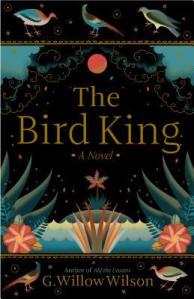
40642333Book: “The Bird King” by G. Willow Wilson
Publishing Info: Grove Press, March 2019

Where Did I Get this Book: Bookish First!

Book Description: Set in 1491 during the reign of the last sultanate in the Iberian peninsula, The Bird King is the story of Fatima, the only remaining Circassian concubine to the sultan, and her dearest friend Hassan, the palace mapmaker.

Hassan has a secret–he can draw maps of places he’s never seen and bend the shape of reality. When representatives of the newly formed Spanish monarchy arrive to negotiate the sultan’s surrender, Fatima befriends one of the women, not realizing that she will see Hassan’s gift as sorcery and a threat to Christian Spanish rule. With their freedoms at stake, what will Fatima risk to save Hassan and escape the palace walls?

Review: I read an excerpt of this on Bookish First and found myself immediately connecting to the beautiful writing that was popping on the page. I placed my request was thrilled when I received a copy. While it was a slower read, ultimately, than I had been expecting, that same strength in writing and the unexpected depth of thought given to the historical events, religious interactions, and cultures of the time period ultimately drew me in.

Fatima and her friend Hassan have built a quiet life for themselves in the circumstances they have found themselves in: she a concubine to the sultan and he a mapmaker. But Hassan is much more than your ordinary mapmaker and possess the incredible gift of not only drawing up intricate maps of the places he’s never been, but also, through these maps, interrupting the weave of reality itself. But when Hassan suddenly falls under the eyes of those who would see his gift as more of a threat than a blessing, he and Fatima must go on the run, seeking out a mystical island as their one port of harbor for a safe life going forward.

I haven’t read too many books set in this time period or within these combinations of cultures. The book is tackling a lot: the persecution under the Spanish Inquisition, the clashes between religious forces taking place in that time, plus a healthy dose of magic realism to differentiate it from a purely historical fiction work. But I think it is this last portion, the interweaving of the fantastical elements that really made this book sing for me. There are a lot of big ideas being tossed around throughout the story, but many of these are explored from a bit of an angle, with the author approaching them almost from the side, using fairytale-like elements to draw readers into a deceptively complicated, real-world issue. Metaphor and stylized writing are also used to great effect to, again, almost backwards-walk readers into topics that can get pretty dicey pretty quickly. Of course, I’m always going to love anything that reads like a fairytale, but I appreciate it all the more when an author is able to use this writing style to get at deeper topics that can often be challenging to get across.

I also very much liked the two main characters in Fatima and Hassan. At first, I wasn’t quite sure how I was going to feel about Fatima, but as the story progressed, I found myself becoming more and more invested in their platonic friendship and love. It’s a rare read to find a story that focuses on this type of strong relationship, one that isn’t based on romantic love (Hassan is gay, another factor that leads to his persecution), but that still highlights the extent to which each party will go for the other. The fact that they aren’t romantically involved never feels like it detracts from what they would do for each other, and, instead, in some ways it feels that their bond is even stronger by being freed from that element. It’s a unique relationship to see explored so thoroughly in this type of book.

I will say, however, that the story is pretty slow going. It takes quite a bit for them to even get started on their journey, and then once they do, it doesn’t speed up much. There’s a lot of travel, camping, small moments of action, and then more travel and camping. The writing was still captivating, which was enough to get me through these slower elements, but I can see how this could be off-putting to many readers, especially ones who may not be as interested in the greater themes being explored at the heart of the story. I do think more could have been done to tighten up this middle portion of the book, as the fact that it ultimately worked for me seems to speak more to my own preference than to the general quality of the story structure.

Overall, “The Bird King” was a surprisingly deep and satisfying read for me. There were, however, some stumbling blocks with the pacing and writing speed, which is what knocks it back a few points for me. It’s a lengthy story, and while it is trying to cover a lot of different things, I do think it could have been tightened up to increase its general appeal. If you like historical fiction blended with magical realism, especially dealing with a unique set of characters and a time period that isn’t often explored in this way, definitely give “The Bird King” a try. Just know that you might need to push through in the beginning before really getting to the good stuff.

Rating 7: A beautifully written story that covers a complicated time with two wonderful characters at its heart. Only lowered by being a bit too slow for my taste.

Reader’s Advisory:

“The Bird King” is included on these Goodreads lists: “Historical Fiction – Spain / Portugal” and “Muslim/Islamic Fiction.”

Find “The Bird King” at your library using WorldCat!

Kate’s Review: “Cross Her Heart”

37486235Book: “Cross Her Heart” by Sarah Pinborough

Publishing Info: William Morrow, September 2018

Where Did I Get This Book: The library!

Book Description: Lisa lives for her daughter Ava, her job, and her best friend Marilyn, but when a handsome client shows an interest in her, Lisa starts daydreaming about sharing her life with him too. Maybe she’s ready now. Maybe she can trust again. Maybe it’s time to let her terrifying secret past go. Then her daughter rescues a boy from drowning and their pictures are all over the news for everyone to see. Lisa’s world explodes, and she finds everything she has built threatened. Not knowing whom she can trust, it’s up to her to face her past to save what she holds dear.

Review: After being burned so badly by “Behind Her Eyes”, I will admit that I was shocked to find myself picking up the newest Sarah Pinborough novel “Cross Her Heart”. But I so enjoyed “13 Minutes” I wanted to give her books another chance, in case “Behind Her Eyes” was a fluke. So it’s good news, bad news time. The bad news is that “Cross Her Heart” didn’t live up to “13 Minutes”. But the good news is that it blew “Behind Her Eyes” out of the freaking water!

giphy-1
I knew my instincts about Pinborough were right! (source)

The story is laid out in a couple of different view points over a couple of different time frames. Pinborough keeps the ultimate plot pretty close to the vest until we get about half way through, and since that’s part of the mystery I’m going to do my very best to review without giving anything away. If I DO have to give a spoiler, though, I will make it very clear. Our main perspectives are Lisa, a nervous single mother who does her best to blend in as she hides from a traumatic past; Ava, Lisa’s teenage daughter who is corresponding with a mysterious older man online; and Marilyn, Lisa’s colleague and close friend who has some secrets of her own. While Ava and Marilyn’s issues are pretty clear cut from the get go, it’s Lisa’s who brings in the most intrigue. Pinborough slowly lays out the pieces of a mystery with a very well constructed conclusion, and she did it in such a way that she kept this reader guessing up until the first big reveal. Going back and looking at the set up confirmed that Pinborough knows how to set up a magic trick of a reveal, with deceptions and distractions. I was pretty well invested in how it all turned out by the time we got to that moment, wanting to see what was going to happen next. The characters themselves are pretty standard fare for this kind of book, and the story itself doesn’t really reinvent any wheels or break any either. It was just a fun and solid mystery overall that kept me guessing.

All that said, it did find itself close to derailing a couple of times. While the initial twist and some of the curve balls that come after felt pretty well executed, there were some things within the narrative henceforth that I didn’t quite buy. So here is where a big ol SPOILER alert is going to come in, even if I keep it vague. There is a moment where a character is revealed to have been masquerading as two different people, who are two very different ages. While I normally am willing to suspend my disbelief about these kinds of things, I do find it kind of laughable that we are to believe that a person could simultaneously be middle aged, and yet pass for someone who is a teenager, especially if they are interacting on more than a superficial basis with their peers. It was a moment where Pinborough didn’t quite convince me, and because of that i was taken out of the story and just snorted out a ‘yeah SURE’ before going on. Plus, there was one final twist that I saw coming about ten miles away. I am not certain if it was meant to be a big surprise once our characters are made privy to it, or if we were supposed to have figured it out before they did, but with the emphasis on the shocked reactions I’m thinking it’s the former. And it just wasn’t that surprising.

But when comparing it to “Behind Her Eyes”, I enjoyed “Cross Her Heart” far, far more. I don’t know if it’s merely by comparison, but even if it is, it was an altogether enjoyable read. If you were disappointed with Pinborough’s last runaway hit, don’t necessarily pass “Cross Her Heart” by! You may be surprised!

Rating 7: A quick and fast paced read that was quite the improvement over her previous work, “Cross Her Heart” is a standard mystery without too many surprises (and one ridiculous twist). Nonetheless, it’s enjoyable.

Reader’s Advisory:

“Cross Her Heart” is included on the Goodreads list “Mystery & Thriller 2018”.

Find “Cross Her Heart” at your library using WorldCat!

Kate’s Review: “Freefall”

39855088Book: “Freefall” by Jessica  Barry

Publishing Info: Harper, January 2019

Where Did I Get This Book: The publisher sent me an ARC.

Book Description: A propulsive debut novel with the intensity of Luckiest Girl Alive and Before the Fall, about a young woman determined to survive and a mother determined to find her.
When your life is a lie, the truth can kill you

When her fiancé’s private plane crashes in the Colorado Rockies, Allison Carpenter miraculously survives. But the fight for her life is just beginning. For years, Allison has been living with a terrible secret, a shocking truth that powerful men will kill to keep buried. If they know she’s alive, they will come for her. She must make it home.

In the small community of Owl Creek, Maine, Maggie Carpenter learns that her only child is presumed dead. But authorities have not recovered her body—giving Maggie a shred of hope. She, too, harbors a shameful secret: she hasn’t communicated with her daughter in two years, since a family tragedy drove Allison away. Maggie doesn’t know anything about her daughter’s life now—not even that she was engaged to wealthy pharmaceutical CEO Ben Gardner, or why she was on a private plane.

As Allison struggles across the treacherous mountain wilderness, Maggie embarks on a desperate search for answers. Immersing herself in Allison’s life, she discovers a sleek socialite hiding dark secrets. What was Allison running from—and can Maggie uncover the truth in time to save her?

Told from the perspectives of a mother and daughter separated by distance but united by an unbreakable bond, Freefall is a riveting debut novel about two tenacious women overcoming unimaginable obstacles to protect themselves and those they love.

Review: Thank you to Harper for sending me an ARC of this book!

I’ve mentioned a number of times on this blog that I greatly enjoy wilderness survival fiction, so when “Freefall” by Jessica Barry was sent to us I was pretty interested in the premise. I’ve also had some luck with emotional dramas involving mother/daughter relationships in the past few months, and when I realized that the most prevalent theme in “Freefall was going to be the broken relationship of a mother and daughter I was all the more on board.

“Freefall” is told in two different perspectives between an estranged relationship of a mother and daughter. Allison has left her mother Maggie behind after feeling betrayed by her, and reinvented herself in the lap of luxury thanks to her engagement to a pharmaceutical CEO. Maggie is living alone in small town Maine, still mourning her husband’s death and missing her daughter. Allison’s perspective is more action and suspense driven, as the private plane she was in has crashed in the mountains, leaving her the only survivor in a vast wilderness. Barry slowly reveals that Allison isn’t only in danger because of her current situation, but because of something she discovered long before she got on the plane. As that all starts to unfold, mostly through flashbacks, we see a greater danger to her, and her mother, than we anticipated. I liked the slow burn of the conspiracy, and while I wasn’t as invested in Allison’s angst and how she got to where she was when we met her, I enjoyed seeing all of those pieces come together.

The other narrative is that of Maggie, Allison’s mother who has been told her daughter died in the plane crash. Maggie’s narrative goes at a slower pace than Allison’s, though through her research into her daughter’s life we are given more pieces to the puzzle. The estrangement between the two women makes it so we can follow Maggie as she goes through her discoveries in an organic and realistic way, and as the over arching conspiracy unfolds because of her research and Allison’s flashbacks, I was happy to see a complex and interesting conflict at the center of everything. I don’t really want to spoil it here, but just know that it harkens to old school conspiracies where whistleblowers find out something damning and then they end up with targets on their backs. The other part of these sections that laid some compelling groundwork is the complicated relationship between a mother and daughter, and how past hurts can throw familial links off.

But I will admit that as I was reading, it felt slow at times. Even though I liked a number of aspects of the plot, I think that the pacing was a little off just because of the time jumps in Allison’s chapters, and the mother/daughter angst in Maggie’s. I found myself skimming more than once, just wanting to get back to the action at the heart of the novel. Because of this, “Freefall” didn’t ever graduate from ‘pretty good’ thriller to ‘great’ thriller. I will be interested to see what Barry comes out with next, though, which shows that there was enough in “Freefall” to make me think her future writings have promise.

“Freefall” is a fun conspiracy thriller with a healthy dose of familial drama, and it may be a good read for those who are looking for those themes in their reading adventures.

Rating 7: Though I liked the conspiracy angle and the wilderness survival aspects, “Freefall” moved a little too slowly for me to become completely hooked by its two storylines.

Reader’s Advisory: 

“Freefall” is still pretty new and isn’t on many Goodreads lists. But I think that it would fit in on “Conspiracy Fiction”, and “Mother-Daughter Novels”.

Find “Freefall” at your library using WorldCat!