Kate’s Review: “Containment”

41xlqrp7yslBook: “Containment” (The Cerenia Chronicles Book 2) by Angela Howes

Publishing Info: Fine Tuned Editing, January 2020

Where Did I Get This Book: The author provided me with a PDF copy.

Book Description: She made her choice. Now, she must live with the consequences. As Phoebe’s family and friends fight for their lives, she finds herself drawn further into the enigmatic world of the Council, caught in a struggle between lying low and inciting war. But as more allies emerge from the shadows, Phoebe must decide whether she has what it takes to lead a rebellion … especially when it could mean losing everything and everyone that matters to her.

Review: First I want to extend a special thank you to Angela Howes for reaching out and sending me a copy of this book!

YA dystopia seems to be mostly out of style, at least in the circles of YA enthusiasts that I associate with or follow. But given that I haven’t lost my interest in it, I was pretty excited when Angela Howes reached out to me with news that her second book in the Cerenia Chronicles, “Containment”, was coming out! Given that I enjoyed the first in the series, “Assignment”, I was eager to see where things were going to go for our protagonist Phoebe, her two suitors Sky and Noah, and the rest of the mild dictatorship of Cerenia. Especially since we left it on such a cliffhanger.

When we left off, Phoebe, Sky, and Noah had all achieved freedom by making it to The Jungle, where defectors and former prisoners of Cerenia have been building a rebellion. Phoebe decided to infiltrate the Cerenia Council in hopes of overthrowing the corruption. Unfortunately, Noah and Sky have ended up in captivity because of this, with Noah in prison and Sky in a Box, an almost guaranteed death sentence. The book flip flops between these three perspectives, with Phoebe hoping to outwit and influence the Council members, Sky hoping to escape his death sentence (and I mean, of course he does, mild spoiler alert but it happens pretty quick), and Noah hoping to get out of jail. Of all three perspectives, Phoebe’s was by far the most interesting. I liked watching her have to play 3D chess and having to make really difficult decisions, sometimes decisions that would be life or death, all to try and fit in in hopes of taking down corruption from the inside. I thought that her inner struggles and her ruthlessness meshed well together, and thought that it was a huge benefit to her characterization. Sometimes her calculations were cold and unnerving, and yet I believed that she would be making them. I also liked getting into Sky’s head as he has to rally the rebellion on the outside, all without knowing if he would ever see Phoebe, the love of his life again. Team Sky, all the way. His voice is fun and snarky, but he has enough sprinkles of vulnerability and self doubt that he doesn’t come off as an obnoxious trope.

But that leaves Noah’s narrative, which to me felt a bit superfluous if only because we don’t really have a reason to care about Noah. Or at least, I don’t have a reason to care about him. I mentioned before that I don’t like love triangles, but this particular point on this love triangle really doesn’t work for me, especially now. At this point, Phoebe has made her choice, and that choice is Sky. It’s also hard for me to let go of the fact that Noah was such a goddamn chickenshit in the first book that he was perfectly happy stringing along the girl he’d been matched with Darya, while having an affair with Phoebe, which put not only himself but Darya in danger. To me it feels like the love triangle has been resolved, and his backstory and characterization hasn’t been developed or built up enough for him to be a character we need to care about. Unless we’re going to get another love triangle plot in the third book, and boy oh boy am I hoping that isn’t the case.

There is indeed going to be a third book, as “Containment” ended on a cliffhanger. But with the way things ended this time, I’m even more interested to see where this goes this time around than I was last time around. I think we’re building to something that could be really unique, and I can’t wait to see what that may be.

Rating 7: The political intrigue and maneuvering is upped and the stakes continue to rise. “Containment” continues a solid dystopian narrative and explores the difficult decisions a person has to make for the greater good.

Reader’s Advisory:

“Containment” isn’t on any Goodreads lists as of yet, but if you like books like “Divergent”“Matched”, or “The Testing” you will probably find this one fun as well!

“Containment” isn’t in very many libraries as of now, but you can find it on Amazon.

Previously reviewed: “Assignment”


Kate’s Review: “Jane Anonymous”

37650881._sy475_Book: “Jane Anonymous” by Laurie Faria Stolarz
Publishing Info: Wednesday Books, January 2020

Where Did I Get This Book: I was sent an eARC by the publisher via NetGalley

Book Description: Bestselling author Laurie Faria Stolarz returns with Jane Anonymous, a gripping tale of a seventeen-year-old girl’s kidnapping and her struggle to fit back into her life after she escapes.

Then, “Jane” was just your typical 17-year-old in a typical New England suburb getting ready to start her senior year. She had a part-time job she enjoyed, an awesome best friend, overbearing but loving parents, and a crush on a boy who was taking her to see her favorite band. She never would’ve imagined that in her town where nothing ever happens, a series of small coincidences would lead to a devastating turn of events that would forever change her life.

Now, it’s been three months since “Jane” escaped captivity and returned home. Three months of being that girl who was kidnapped, the girl who was held by a “monster.” Three months of writing down everything she remembered from those seven months locked up in that stark white room. But, what if everything you thought you knew―everything you thought you experienced―turned out to be a lie?

Review: Thanks to Wednesday Books and NetGalley for providing me with an eARC of this novel!

In so many books the involve missing people or missing women, if the missing person is found alive and is able to return home that is usually the end of the book. The investigator is a hero, the victim gets to return to their life, and the story is considered to be happy, or at least positive. But the truth of the matter is that in real life, anyone who survives a harrowing and violent experience such as that has a lot more story to live and tell after they are rescued or recovered. And “Jane Anonymous” ventures to examine that concept, that the ‘happy ending’ isn’t necessarily guaranteed, and that the fallout of the trauma isn’t easily reconciled with the joy of returning to one’s life. Is it a rough book because of it? Hell yes. But it’s a theme that I haven’t encountered as much as I have the ‘happily ever after’ conclusion in stories like these.

“Jane Anonymous” is told through two timelines. The first is Jane’s time directly before and during captivity. The second is Jane’s life in the weeks and months after she escapes, and how she is coping after her trauma. Both of them create an entire story labeled as ‘Then” and “Now”, and it’s told as though Jane is writing down her experiences as a way to try to make sense of everything. Stolarz is vague about the details of setting, as Jane not only refers to herself as Jane Anonymous, but she also says that she’s living in ‘New England Town’ so the reader can feel like this could be a number of places. We juxtapose what happened to her in captivity along with how she is functioning back in her life with the trauma of it, and it’s honest and raw and very tense. Stolarz does a very effective and believable job of conveying just how the trauma would effect a person who was held in a small room all alone for seven months, and how coming back to her old life is going to be incredibly difficult. I thought that coping mechanisms and panic attacks and PTSD symptoms were portrayed convincingly, and also thought that the strain on not only Jane’s experiences but also the experiences of those that love her was also very well done. The ‘Now’ sections were almost harder to read because the idea of being ‘home’ is so dismantled and examined, and Jane and her family are still in such turmoil. It reminded me of the book “Room”, but tackled more head on since it wasn’t through the eyes of a little kid who can’t comprehend what happened. Jane comprehends. And therefore we are forced to.

The ‘Then’ sections read more like a traditional thriller, and while it was indeed suspenseful there were parts of it that were predictable. While it’s a foregone conclusion that Jane is going to escape, Stolarz does attempt to create a tension about how she is going to do it. The thing that sustains her is Mason, the voice in the vents who says he’s also been captured by the same lunatic. As Jane and Mason cling to each other and their relationship is all that can sustain her, you see how having one person there gives Jane the strength that she needs, and seeing he determination to survive is definitely a compelling part of these sections. That said, there are a couple of twists that I called pretty early on, and I’m not sure if that’s because they weren’t hidden particularly well, or because I have just read so many books like this that I know what to look for, trope wise. That said, it wasn’t like that ruined anything for me when it came to the story. It may have been the weaker of the two time frames, but it was still highly enjoyable.

“Jane Anonymous” doesn’t pull any punches when it comes to showing the fallout of trauma. It’s honest and upsetting, but also pulls at the heartstrings as you see a girl try to begin to heal, as hard as it may be.

Rating 7: An emotional and at times a little predictable thriller about having to rebuild your life after a horrible trauma, “Jane Anonymous” was both suspenseful and moving.

Reader’s Advisory:

“Jane Anonymous” is new and not on many relevant Goodreads lists, but I think it would fit in on “Kidnapped!”.

Find “Jane Anonymous” at your library using WorldCat!

Kate’s Review: “The Rust Maidens”

40874196Book: “The Rust Maidens” by Gwendolyn Kiste
Publishing Info: Trepidatio Publishing, November 2018

Where Did I Get This Book: The library!

Book Description: Something’s happening to the girls on Denton Street.

It’s the summer of 1980 in Cleveland, Ohio, and Phoebe Shaw and her best friend Jacqueline have just graduated high school, only to confront an ugly, uncertain future. Across the city, abandoned factories populate the skyline; meanwhile at the shore, one strong spark, and the Cuyahoga River might catch fire. But none of that compares to what’s happening in their own west side neighborhood. The girls Phoebe and Jacqueline have grown up with are changing. It starts with footprints of dark water on the sidewalk. Then, one by one, the girls’ bodies wither away, their fingernails turning to broken glass, and their bones exposed like corroded metal beneath their flesh.

As rumors spread about the grotesque transformations, soon everyone from nosy tourists to clinic doctors and government men start arriving on Denton Street, eager to catch sight of “the Rust Maidens” in metamorphosis. But even with all the onlookers, nobody can explain what’s happening or why—except perhaps the Rust Maidens themselves. Whispering in secret, they know more than they’re telling, and Phoebe realizes her former friends are quietly preparing for something that will tear their neighborhood apart.

Alternating between past and present, Phoebe struggles to unravel the mystery of the Rust Maidens—and her own unwitting role in the transformations—before she loses everything she’s held dear: her home, her best friend, and even perhaps her own body.

Review: I honestly couldn’t tell you where I heard about “The Rust Maidens” if you asked me. I THINK that it was on a Goodreads list at one point, but I can’t tell you what the theme of said list would be. Probably horror, but still. All I know is that it came in for me at the library, and when I picked it up I thought to myself ‘oh yeah….’ The reason I say that I only think that it was probably on a horror list but am not certain is because “The Rust Maidens” is one of the most unique horror stories I’ve read in the past year or two, based on the themes that it decides to take on along with some good old fashioned body horror you might see in an early Cronenberg film.

“The Rust Maidens” is a tale of decay, both the decay of the human body and the decay of a once prosperous part of Americana. In Cleveland, Ohio in 1980 Phoebe is a working class teenager living in a working class neighborhood. The community has put on a face of togetherness and wholesome American values, while the livelihood of a number of the men, the mill, has been experiencing more and more uncertainty. Phoebe’s story is told during the summer of 1980, and also almost thirty years later when she has to return to the neighborhood after years of grief and guilt. Spunky and rabble rouser Phoebe of 1980 is a stark contrast to the jaded and affected Phoebe of later life, and the changes over the years, which seemed to catalyze with the Rust Maidens, are now very apparent in her old neighborhood. The fact of the matter is that “The Rust Maidens” is a story of degeneration, not just of the afflicted girls, but of the community around them, and the decay of the American Working Class once the 1980s hit. While the Rust Maidens are slowly wasting away, Denton Street and the blue collar workers who live there are facing yet another potential strike at the mill. Phoebe’s family and neighbors believe that the promise of that job will always be there for them, even as the union gets continuously beaten down and the specter of the upcoming Reagan years lingers. Decay takes on many meanings in this book, and Kiste isn’t afraid to point out that when people are scared, scapegoats are sought out. And the Rust Maidens are the perfect scapegoats. It’s fully intentional that Kiste made the neighborhood turn on a bunch of scared and ‘sick’ teenage girls, given that they had already turned on Phoebe before for daring to not conform. The aggression comes from all sides, from deadbeat boyfriends to angry old men to women who think that girls should be and act a certain way. The metaphors are real, and the feminism in this horror story is angry and apparent.

And on top of the themes, the body horror is VERY real. The descriptions of the Rust Maidens as their bodies start to change and wither away/transform is unsettling at best, and revolting at it’s worst. But on top of that, it’s also very upsetting on an emotional level to see these girls be maligned and feared, and to see how some of them react to the revulsion towards them. Being extra sensitive to such things right now, one of the Rust Maidens is a new mother, and her child whisked away from her because of her condition. She is constantly drawn to the baby, who is placed with the father and his family even though he’s a complete lout. The descriptions of the mother’s pain, even when she was starting to become something else, had me crying pretty handily, so thanks for that, Gwendolyn Kiste!

“The Rust Maidens” is a unique and fascinating horror novel. Those who like their body horror with a little bit of metaphor should check it out post haste!

Rating 7: A bleak and angry examination of decay and the expectations of teenage girls, “The Rust Maidens” serves body horror and feminism in heaping, scathing doses.

Reader’s Advisory:

“The Rust Maidens” is included on the Goodreads Lists “Best First Novels: Bram Stoker Award Winners”, and “2018 Indie Horror Book Releases”.

Find “The Rust Maidens” at your library using WorldCat!

Kate’s Review: “Good Girls Lie”

42771599Book: “Good Girls Lie” by J.T. Ellison

Publishing Info: Mira Books, December 2019

Where Did I Get This Book: I received an eARC from NetGalley

Book Description: Perched atop a hill in the tiny town of Marchburg, Virginia, The Goode School is a prestigious prep school known as a Silent Ivy. The boarding school of choice for daughters of the rich and influential, it accepts only the best and the brightest. Its elite status, long-held traditions and honor code are ideal for preparing exceptional young women for brilliant futures at Ivy League universities and beyond. But a stranger has come to Goode, and this ivy has turned poisonous.

In a world where appearances are everything, as long as students pretend to follow the rules, no one questions the cruelties of the secret societies or the dubious behavior of the privileged young women who expect to get away with murder. But when a popular student is found dead, the truth cannot be ignored. Rumors suggest she was struggling with a secret that drove her to suicide.

But look closely…because there are truths and there are lies, and then there is everything that really happened.

J.T. Ellison’s pulse-pounding new novel examines the tenuous bonds of friendship, the power of lies and the desperate lengths people will go to to protect their secrets.

Review: Thank you to NetGalley for providing me with an eARC of this novel!

The end of 2019 is upon us and on this New Years Eve we are going to close out the 2019 blog year with one of my favorite guilty pleasure genres: the soapy catty boarding school thriller! Oh how I love the juicy and scandalous tales of kids at boarding school behaving badly, and if you have an interesting mystery to boot it’s just icing on the cake. So how lucky for me that I was approved to check out “Good Girls Lie” by J.T. Ellison. Boarding school drama, secret societies, and murder are just a few of the juicy tidbits you’ll find in this novel.

Our main character is Ash, an English orphan who has been accepted to the prestigious Goode school, an all girls academy that is said to produce women who go on to the Ivy League and then find themselves in powerful jobs and totally set lives. Ash isn’t interested in making friends, as she just wants to finish school and move on with her life. It’s told from the first person perspective, and I have to say that Ellison is really good at still maintaining a sense of mystery in spite of the fact we are in Ash’s head for most of the novel (there are some other perspectives, but more on that later). We know that something went down while she was back in England, and that Ash is hiding something. Pretty standard stuff, but that doesn’t mean that it’s not entertaining. If anything, the fact that it hit a lot of familiar notes and had a number of red herrings and twists made it feel like a comfortable sweater that fit in every way I wanted it to. Ash as a main character was also a positive of this story, as I thought that she had enough mystery and relatability that I was invested in how things turned out for her, as well as worried about what she may or may not be capable of. I was genuinely questioning if I was dealing with an unreliable narrator or not, and I couldn’t wait to see how it all shook out. I also enjoyed the complicated relationship Ash had with another student at the school, Becca. Becca is a couple years older than Ash and one of the most envied, and perhaps feared, girls at Goode, and her interest in Ash is something that makes other girls jealous and curious. Their friendship is filled with a fair amount of sexual tension, and question as to whether either of them can be trusted makes the tension all the more amped, and therefore satisfying.

There was one aspect of this book that didn’t totally work for me, and that is that along with Ash’s perspective, we also occasionally get some third person perspectives from Dean Ford, the headmistress at Goode. While I think that multiple perspectives can be done well, and that you can construct more ‘ah ha!’ moments if you have the ability to see outside the first person narration, a lot of the moments that we had with Ford were more about showing her weaknesses and personal problems. I like the concept of exploring a woman who has to live up to the reputations of the many other head mistresses that the school has had (in particular, her mother, who was the previous head mistress), and how she may fixate on a new, and potentially damaged student, but the way that it was executed felt like it was fat that could have been trimmed.

“Good Girls Lie” was a boarding school thriller that hit the familiar points. Like I’ve said before, that isn’t necessarily a bad thing! If you want a read that you can just enjoy for what it is, and you like boarding school thrillers, this will be a good fit. I hope that you all have a very happy and safe New Year’s Eve, and I’ll see you in 2020!!

Rating 7: A soapy mystery with catty drama, “Good Girls Lie” was a worthy contribution to the ‘thriller at a boarding school’ genre.

Reader’s Advisory:

“Good Girls Lie” isn’t on many Goodreads lists yet, but I think it would fit in on “Sapphic Boarding School Books”.

Find “Good Girls Lie” at your school using WorldCat!

Serena’s Review: “Dangerous Alliance: An Austentacious Romance”

44244324Book: “Dangerous Alliance: An Austentacious Romance” by Jennieke Cohen

Publishing Info: HarperTeen, December 2019

Where Did I Get this Book: Edelweiss+

Book Description: Lady Victoria Aston has everything she could want: an older sister happily wed, the future of her family estate secure, and ample opportunity to while her time away in the fields around her home.

But now Vicky must marry—or find herself and her family destitute. Armed only with the wisdom she has gained from her beloved novels by Jane Austen, she enters society’s treacherous season.

Sadly, Miss Austen has little to say about Vicky’s exact circumstances: whether the roguish Mr. Carmichael is indeed a scoundrel, if her former best friend, Tom Sherborne, is out for her dowry or for her heart, or even how to fend off the attentions of the foppish Mr. Silby, he of the unfortunate fashion sensibility.

Most unfortunately of all, Vicky’s books are silent on the topic of the mysterious accidents cropping up around her…ones that could prevent her from surviving until her wedding day.

Review: “…An Austentacious Romance.” Need I say more? I’ve been debating doing a re-read of all of Jane Austen’s novels for the blog, so as a middle ground in the mean time, this was an obvious book to request. I often don’t enjoy straight re-tellings of Austen’s stories (often they are made into contemporary romances, and I just don’t care for those myself), but this one seemed to have struck on something new: a historical piece that both pulls from the themes found in Austen’s books and straight up references those books as reading material that the heroine herself is fond of. Part of this equation work, however, on the whole, this was less than I had wanted it to be.

Lady Victoria Aston has always tried to model her life around her favorite heroines, those found in Jane Austen’s works. So, when difficulties suddenly strike her family and she finds herself suddenly needing to marry well to secure their futures, she looks to these wise and witty ladies once again for guidance. But be it rogues who are much more dangerous than those found in the pages of a book or a childhood friend who has secrets of his own, Lady Vicky quickly finds that life is much more complicated than she had thought. And it’s not only the typical challenges of the marriage market that plague her, but somehow dangerous accidents seem to be cropping up everywhere as well. Is it all connected and, more importantly, what would Jane Austen do in this situation?

Obviously, for me, this is a fantastic premise for a book. Austen re-tellings are found all over the place, some successful, others…less so. But what a fun idea, to pull from common aspects found within Austen’s novels all while referencing those very books in the story itself with a main character whose story takes place in our own world and the time of Austen’s publications. It’s a fun idea, but unfortunately, it ends up being a bit too much.

The elements of the story that are not direct references to Austen’s work do end up coming across better. We have characters who definitely fall into familiar categories from Austen’s works: the rogues, the fools, the loving sisters. There are also familiar plot points, especially with regards to the romantic confusions and the family relationships. For herself, Vicky is a capable heroine. And, given the necessity of this book being read by modern readers, she’s much more proactive and involved in the action of the plot than some of Austen’s own leading ladies. If this does lend a bit of a anachronistic feeling to the story, it’s at least a familiar flaw for books in the historical romance genre.

That said, while some of the humor and romance do line up well with Austen’s own books, these lighter topics sit awkwardly next to some much darker themes. This is where the first of my complaints really came to play. I’m not saying that books in this genre can’t touch on darker themes, but handling them is a delicate thing. The book is tripping along happily and then BANG! A super dark scene is thrown at the reader. It was jarring and unexpected in a bad way. For a book that has the words “Austentacious romance” in the title,  there are some expectations laid down from the start. And while many of those were fulfilled, some of these darker bits did not lay comfortably with the rest. And after the second such instance, I was thrown out of the book enough to continue reading only warily, which resulted in my inability to fully immerse myself again in the fluffy fun of it all.

My second problem came with the Jane Austen references themselves, bizarrely enough. I’m not quite sure if ultimately I was just less enthralled with this concept as a whole once I actually started reading it, or whether this book just over-played its hand. There were simply too many of them! Almost every situation had Vicky comparing herself to one or another of Austen’s heroines.

And many of these references weren’t to well-known aspects of Austen’s works. This part, to some extent, I did enjoy as it proved that the author wasn’t just cherry picking the popular, well-known, and commonly referenced bits of Austen’s work. No, readers actually need to be familiar with many of Austen’s lesser read books, specifically “Mansfield Park” which received a lot of attention here and whose heroine, Fanny Price, often falls last on many people’s lists of favorites. But, all of that said, this does leave the book in the awkward position of only being truly appreciated by hard and fast Austen lovers, the very people who are likely to be the most critical of other books, such as this one, that are trying to emulate those beloved titles.

All told, however, there were just too many of these references for my taste. There were several moments where the comparisons did nothing to further enlighten the scene or character being contrasted in this book and only served to break up the action and distract the reader. I can’t say for certain that it would have been better without the references at all, but thinking back on it, I’m not sure it would be any worse for losing them either.

Overall, this was kind of a disappointing book for me. Don’t get me wrong, I think for the most part it delivers on what it promises. But I think the story does throw in some darker scenes that don’t mesh well with the light-hearted nature of the rest of the book and the Austen references ended up being more a distraction than anything. Reader who enjoy historical romance will still likely enjoy this book. But know that you’ll need to be familiar with more than just “Pride and Prejudice” and “Emma” to fully appreciate this story!

Rating 7: A neat little book that didn’t feel quite settled with itself: tonal inconsistency and an imbalance between original work and Austen references made up most of my complaints.

Reader’s Advisory:

“Dangerous Alliance: An Austentacious Romance” is on these Goodreads lists: Young Adult Regency and Jane Austen variations published in 2019.

Find “Dangerous Alliance: An Austentacious Romance” at your library using WorldCat!

Kate’s Review: “Whisper Network”

41555931._sy475_Book: “Whisper Network” by Chandler Baker
Publishing Info: Flatiron Books, July 2019

Where Did I Get This Book: The library!

Book Description: Four women learn their boss (a man who’s always been surrounded by rumors about how he treats women) is next in line to be CEO—what will happen when they decide enough is enough?

Sloane, Ardie, Grace, and Rosalita are four women who have worked at Truviv, Inc., for years. The sudden death of Truviv’s CEO means their boss, Ames, will likely take over the entire company. Ames is a complicated man, a man they’ve all known for a long time, a man who’s always been surrounded by…whispers. Whispers that have always been ignored by those in charge. But the world has changed, and the women are watching Ames’s latest promotion differently. This time, they’ve decided enough is enough.

Sloane and her colleagues set in motion a catastrophic shift within every floor and department of the Truviv offices. All four women’s lives—as women, colleagues, mothers, wives, friends, even adversaries—will change dramatically as a result.

“If only you had listened to us,” they tell us on page one, “none of this would have happened.”

Review: When my husband and I first brought our daughter home, we had to adjust to spending more time at the house and finding ways to spend the evenings when we weren’t directly caring for the kiddo. One of those ways was to watch “Mad Men” on Netflix, a show that neither of us watched when it was on originally but had been on our lists. I think that both of us were struck and angered by the casual misogyny that a number of the women characters experienced during the course of the show, both at home and at work. Around this time I also got the book “Whisper Network” by Chandler Baker, a Reese’s Book Club pick that had a pretty long hold list at the library. As I read “Whisper Network” I kept thinking about “Mad Men” and how the women at the ad agency had to deal with terrible, abusive men. It wasn’t lost on me that the similarities were incredibly high, even though fifty some years had passed between the timelines in which the characters from both stories were living. Goes to show that while in a number of ways we’ve progressed in terms of women in the work force, some things stay the same, and boy does that rile me up.

giphy
A phrase I’ve related to so many times in the past few years. (source)

“Whisper Network” has been described as a #MeToo story, though the themes have been present long before the movement. Our protagonists, Sloane, Ardie, and Grace all work in the legal department at a high powered corporation, and all of them have had run ins of varying degrees with the soon to be new CEO Ames Garrett. Ames is a well liked member of the company’s corporate boys club, and while he seems to be a shoe in for the position his abusive and harassing tendencies have been swept under the rug. Sloane, Ardie, and Grace are all competent and capable women, and as of now have kept their mouths shut when it comes to their experiences with Ames because they don’t necessarily think that tangling with him directly would be worth it. It’s when a new employee, the young and seemingly naive Katherine, enters the mix that they think perhaps they need to speak up, lest Ames set his predatory sights on her. What comes next involves lies, deception, back stabbing, and an untimely death that Sloane, Ardie, and Grace are blamed for because they decided to speak up. Baker does a really good job of addressing how sometimes victims of harassment, especially if the accused is seen as ‘likable’, can be demonized and vilified for speaking of their experiences. Some of the most effective moments of this were told through ‘witness’ interviews after the main incident, where coworkers, male and female alike, are questioning the veracity of the accusations, and also questioning the stability or motivations of those who have spoken out. It’s angering to read in its realism.

The mystery of “Whisper Network” is pretty straightforward (what really happened to the victim we see at the beginning), though I didn’t really find myself too invested in the solution to it. I was more invested in what was going to happen to those who were left behind as the fallout comes crashing down. I was also more invested in Sloane, Grace, and Ardie getting justice for what had happened to them at the hands of an abusive boss, and at the hands of those who don’t believe them and try to drag their names through the mud. None of the characters really stood out for me, but were all likable enough and relatable enough that I did care about them and how things worked out once the book was done. The character that I liked the most, however, was Rosalita, a night cleaning lady at the company who doesn’t have the same privileges as our main three, and who has her own story to tell, or not tell as the case may be. I liked how Baker brought in a bit of intersectionality when it comes to this #MeToo story, as unlike other characters Rosalita doesn’t have the class privilege they do, and as a woman of color she has more reasons to stay quiet against a powerful white man. I think that Baker could have done more with this, as to me it was the most interesting component to the story.

“Whisper Network” will probably anger you as you read it, but it’s a story that has resonance as the spotlight of #MeToo continues to highlight misogyny and sexual harassment in our culture. The mystery comes second to the social commentary, but it’s still an entertaining page turner.

Rating 7: A #MeToo story with a slow burn mystery, “Whisper Network” is a relevant and upsetting tale of work place harassment and how victims can be unfairly punished for speaking out against powerful harassers.

Reader’s Advisory:

“Whisper Network” is included on the Goodreads lists “MeToo”, and “ATY 2020 – Books Related to News Stories”.

Find “Whisper Network” at your library using WorldCat!

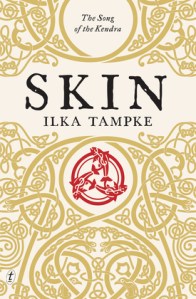
Serena’s Review: “Skin”

24721903Book: “Skin” by Ilka Tampke

Publishing Info: Consortium Book Sales & Distribution, October 2019

Where Did I Get this Book: Edelweiss+

Book Description: Southwest Britain, AD 43.

For the people of Caer Cad, ‘skin’ is their totem, their greeting, their ancestors, their land.

Ailia does not have skin. Abandoned at birth, she serves the Tribequeen of her township. Ailia is not permitted to marry, excluded from tribal ceremonies and, most devastatingly, forbidden to learn. But the Mothers, the tribal ancestors, have chosen her for another path.

Lured by the beautiful and enigmatic Taliesin, Ailia embarks on an unsanctioned journey to attain the knowledge that will protect her people from the most terrifying invaders they have ever faced.

Review: I believe this book was self-published a few years ago (or published from a smaller, independent publisher?), so I wasn’t aware of it until I saw it and its sequel, due out in January, pop up on Edelweiss. Always in the mood for historical fiction and intrigued by the unique time period in which this was set, I was quick to request it! And while it was darker than I had expected, the beautiful writing and gripping story swept me along in a quick read-through.

Ailia has grown up living a half-life. Her mysterious origins left her without a skin, an identifier by which tribes connect to each other and their land. Without this marker, she exists outside of the normal structure of life, unable to fully participate and with a large question mark looming over her future. But when their quiet life is interrupted by the threat of war, Ailia journeys far and wide to not only find her own place, but to save her people.

This book was a bit hit and miss for me. But if I’m honest about it, the “misses” are likely just personal preferences at the moment and maybe not being in the correct headspace for some of the darker elements of this story. To start with the good stuff, however! The first thing that really stood out to me immediately was the beautiful style of writing. This book was very reminiscent of Juliet Mariller’s writing, and I really couldn’t give out a better compliment than that! It is lyrical and heart-wrenching, perfectly painting the picture of life in this early part of history in Britain. It’s the kind of thing that is hard to pin down; somehow the style of writing itself lends a sense of atmosphere to the story.

I also really liked the setting and time period of this book. It’s set in early AD Britain where Roman influence and invasion has been ebbing and flowing for a while. I don’t know much about this time period, so I can’t speak to the historical accuracy of the story. The author does include a good note at the end which does detail some of the historical influences behind the work. But beyond that, again perhaps due to the strength of the writing, it was easy to sink into the time and place being presented, even when elements of this life felt completely foreign.

I also like Ailia as the main character. The book is written in first person from her point of view, so it is quick and easy to fall into line with her character. While the general outline of her story isn’t the most original (outsider comes into her own power as a central figure in a growing conflict), I was still invested in her arc throughout the story. The idea of “skins” was also very intriguing, especially in connection with how Ailia sees herself and how other see her.

Now for the downsides. This book is dark. Very, very dark. Right from the start the reader is thrown into a pretty violent scene. And given the nature of the story, the lifestyle, and the growing conflict, this violence does continue to pop up throughout the story. Typically I’m not overly squeamish about violence, and it never felt gratuitous or glorified here. In fact, I would even say that this violence was part of what made the book feel so grounded in the time period and events that it was trying to depict. So, again, I think it was largely that I was just surprised by it and wasn’t in a good emotional place to read about some of these topics. Perhaps re-reading it later I wouldn’t struggle as I did here. And other readers may not have the same qualms I did.

My one other struggle with the book has to do with the ending, so this is obviously a hugely subjective problem. For me, the ending was of the sort that left me more focused on the grim nature of the story than on the beauty of the writing. It felt incredibly realistic, but it was the kind of reality that I didn’t necessarily want to be left with at the end of a story. I guess I needed a bit more light to counterbalance all of the brutality, and for me, the book just ended on yet another grim note.

It’s hard to rate and review books when you struggle with how they end. Obviously, that’s the last experience I had of the book, and it wasn’t an overly positive one. I’m definitely curious to see where the sequel goes from here. There is a chance that, depending on how that book goes, the ending of this one might be retroactively improved for me. And all of this to say, my qualms with this one were very much based on my own preferences. Overall, the writing, story, and characters are all strong. It was just too much darkness for me. Readers who aren’t put off by that and enjoy atmospheric historical fiction (with a dash of fantasy, of course!) will likely enjoy this.

Rating 7: A reader’s case of “it’s not you; it’s me.”

Reader’s Advisory:

“Skin” is on these Goodreads lists: “Coming of Age Stories” and “Books for the INFJ.”

Find “Skin” at your library using Worldcat!

Kate’s Review: “Anything For You”

43263434Book: “Anything for You (Valerie Hart #3)” by Saul Black

Publishing Info: St Martin’s Press, November 2019

Where Did I Get This Book: I received an eARC from NetGalley!

Book Description: Critically acclaimed author Saul Black returns with a heart-racing thriller in which a brutal murder forces one woman to reckon with her own past–and her future.

On a hot summer night, a watchful neighbor locks eyes with an intruder and unwittingly alerts the police to a vicious crime scene next door: a lavish master bedroom where a man lies dead. His wife is bleeding out onto the hardwood floor, clinging to life.

The victim, Adam Grant, was a well-known San Francisco prosecutor–a man whose connection to Homicide detective Valerie Hart brings her face-to-face with a life she’s long since left behind. Adam’s career made him an easy target, and forensic evidence points towards an ex-con he put behind bars years ago. But while Adam’s wife and daughter grapple with their tragic loss, Valerie uncovers devastating clues that point in a more ominous direction. Lurking in the shadows of the Grants’ pristine life is a mysterious blonde who holds the key to a dangerous past.

As Valerie struggles to forge a new path for herself, the investigation forces her to confront the question: can we ever really leave our pasts behind?

Sophisticated and stunning, Anything for You is an unforgettable thriller that will grip readers long after turning the last page.

Review: Thank you to NetGalley for sending me an eARC of this novel!

We had to wait a little while, but finally, FINALLY the gritty and complex detective Valerie Hart is back for another mystery! Saul Black continues the adventures of the San Francisco sleuth in “Anything For You”, and I was lucky enough to get an advanced copy. I don’t have many mystery series I follow, but when a new one comes out I’m game to dig in. I had some mostly positive, but also a bit mixed, feelings about the previous Valerie Hart books after revisiting them (as seen in my previous review), but had high hopes that I’d come out of “Anything For You” still feeling good. And I did. Mostly.

I’ll talk about the mystery first, as that really in the central plot point and Hart is just living in it. A well known lawyer is found murdered in his home, leaving behind a wife and daughter. Hart is on the case, though she should probably step aside given that she almost slept with the man a few years ago (because of course she did). It initially looks open and shut, but as Hart continues to investigate we get to see the slow reveal of a more complex (and sinister) plan and past that the victim might have been hiding. Along with Hart’s investigation and her slow clue building, we also get the perspective of a mysterious woman whose connection isn’t apparent at first, but slowly becomes more and more clear. To me this was the most interesting aspect of this story, and possibly the most interesting slow reveal of all of Black’s Valerie Hart books. I was actually more interested in seeing what this mysterious woman’s story was going to bring next than I was in the official investigation, and then once the tethers did intersect and wrap everything together I was all the more satisfied with how Black build up a cohesive and complex mystery.

As for Hart, I still really like Valerie and I like seeing how she progresses in each book. When we see her in this one, she is now married to her lover Nick, and they are considering starting a family. The questions of parenthood and whether she’s cut out for her are obviously weighing on her mind, and it means that, once again, she starts to drift towards her usual self destructive tendencies. And as much as I love Valerie and I like that it’s being acknowledged that family planning can be filled with complex emotions, I do feel like Valerie’s constant slip up potential is a little old at this point. I’m not saying that there wasn’t any growth whatsoever with her character, as she certainly isn’t static in her behavior or personality. But I do think that it’s an easy out to revert to questions of ‘will she or won’t she’ make bad decisions just for the sake of inner conflict and turmoil. I’m also becoming more and more sensitive to the ‘men write women’ pattern that can be seen sometimes, especially when it comes to ‘strong female characters’. When it comes to Hart, she sometimes falls into all too common tropes about what that means, like sacrificing any aspect of femininity, pointing out the flaws of other women to make her look better, or simply putting more ‘masculine’ traits (that is traits commonly associated with masculinity in our culture) into her bag of tricks to show how tough she is. That isn’t to say that all men or all women exist in a monolith when it comes to behavior and emotional coping skills, as that would also be a foolish thing to insist upon. The problem with Valerie is that more and more she falls into the ‘not like other girls’ box, and it’s one that I have less and less patience for. And honestly, every time that Valerie referred to her genitalia as ‘her c*nt’, I cringed. And I know that Black is British and the associations with that word are very different there, but still. It just felt like another ‘not like other girls’ moment, and it was laid on pretty thick.

giphy-4
(source)

Overall there was a lot for me to like about “Anything for You”, and I am still interested in seeing what lies in store for Valerie Hart and any future endeavors she may undertake. But I’m hoping that her character gets to grow a little more in the future.

Rating 7: Valerie Hart is still a compelling protagonist and the mystery was good, but I’m starting to worry that we’re edging into all too common ‘tough but messed up girl’ tropes.

Reader’s Advisory:

“Anything For You” is new and not included on many Goodreads lists, but I think that it would fit in on “Women Who Solve Crimes”.

Find “Anything For You” at your library using WorldCat!

Previously Reviewed: “The Killing Lessons” and “Lovemurder”


Kate’s Rev Up Series Review: The Valerie Hart Series


Books: “The Killing Lessons” and “Lovemurder” by Saul Black

Publishing Info: St. Martin’s Press, September 2015; Orion, November 2016

Where Did I Get These Books: The library!

Book Descriptions: When the two strangers turn up at Rowena Cooper’s isolated Colorado farmhouse, she knows instantly that it’s the end of everything. For the two haunted and driven men, on the other hand, it’s just another stop on a long and bloody journey. And they still have many miles to go, and victims to sacrifice, before their work is done.

For San Francisco homicide detective Valerie Hart, their trail of victims–women abducted, tortured and left with a seemingly random series of objects inside them–has brought her from obsession to the edge of physical and psychological destruction. And she’s losing hope of making a breakthrough before that happens.

But the murders at the Cooper farmhouse didn’t quite go according to plan. There was a survivor, Rowena’s ten-year-old daughter Nell, who now holds the key to the killings. Injured, half-frozen, terrified, Nell has only one place to go. And that place could be even more dangerous than what she’s running from.

In this extraordinary, pulse-pounding debut, Saul Black takes us deep into the mind of a psychopath, and into the troubled heart of the woman determined to stop him.


The second spine-chilling serial-killer thriller featuring homicide detective Valerie Hart from the author of the critically-acclaimed THE KILLING LESSONS.

Troubled San Francisco homicide detective Valerie Hart is planning a rare weekend away from the job when she gets the call. A body has been found. A woman, brutally murdered. And the cryptic note left by the body is addressed to Valerie.

The victim is unknown to her, but as Valerie analyses the scene, the clues begin to point in a deeply disturbing direction: to a maximum security prison where a woman called Katherine Glass is awaiting execution for a series of gruesome killings. And Valerie was the cop who put her there.

The last thing Valerie wants to do is re-enter Katherine’s twisted world, but when a second body is discovered, with another puzzling clue, she realises she has no choice. Katherine Glass holds the key to the killings, and Valerie needs to find out what she knows before the murders come even closer to home.

Even if it means playing a deadly game where once again, the psychopathic killer holds all the cards.

Review: A few years ago, I took a chance on a book called “The Killing Lessons” by Saul Black. I went in more interested in the overall story and plot, expecting it to be a one off with horrific travelling murderers and a run of the mill hard boiled detective on their tail. But what I found instead was Valerie Hart, a damaged, complex, and fascinating protagonist whose demons and past eclipsed the already compelling and disturbing main plotline. A year later, “Lovemurder” came out, and I was thrilled to see that Valerie Hart was, once again, the hero of the tale. And now, a few years after that, the third in the Valerie Hart series “Anything For You” is about to come out. In anticipation of this new novel, I decided to go back and revisit “The Killing Lessons” and “Lovemurder”, and get myself super hyped for the return of Valerie. So before I review that book, let’s look at the books that came before it, as they are very different stories, and yet are connected by a protagonist that I’ve come to really enjoy.

When we first meet Valerie in “The Killing Lessons”, she is a detective in San Francisco who is haunted by a couple of different things. The first is that she has had a couple of unsolved cases that she can’t shake, cases that have rocked her to her core and have become a dark obsession. The other is a failed relationship with another detective named Nick Blaskovich. She and Nick had a real shot at happily ever after, but after her frustrations about her unsolved cases made her spiral, she pushed him away in the most destructive ways possible. Little does she know that out east in Colorado, the men she has been trying to find are about to strike again, and this time they mess up and leave a witness alive, a little girl named Nell who ran when her mother and brother were brutally murdered. Black seamlessly connects the stories of Valerie, Nell, and the two murderers, and shows them on a collision course. Black gives a lot of attention to all of the players, the chapters trading off between what Xander and Paulie, the murderers, are up to, what Nell is doing as she hides from them, and how Valerie is slowly but surely piecing their tracks together and closing in on them. The story treads more towards the literary than what you may expect from a detective story, and the brutality is striking, and at times a little much to handle. When I read it initially it didn’t seem to bother me, but during my revisit the violence, which is mostly directed towards women, was very difficult to swallow. I think that had Valerie not been given as much attention, depth, and complexity, I would have been more critical. But as it was, Valerie’s storyline shows not only the tenacity and spunk of a truly gifted detective, but also what being a good detective can sometimes do to your psychological state. 

In “Lovemurder”, we turn from overblown sadistic violence, and gravitate more towards a psychological cat and mouse game. In this story, Valerie has to confront Katherine Glass, a serial killer that she put away years ago, but whose mystery partner has started killing again, and claims they won’t stop unless Glass is set free. Like Hart, Glass is a hyper-intelligent woman who knows how to read people, and when she and Valerie start to face off again, the mind games start up again between the two women. Glass claims that she wants to help Valerie since her partner, whom she never knew the identity of, left her high and dry to rot in jail, but Valerie isn’t certain that she can fully trust this woman, insights aside. In this story, there is still a case that is haunting her, but Valerie has grown from the complete mess that she is in “The Killing Lessons”, and exudes a new strength and confidence that really suits her. I like seeing her character grow between novels, as had she just remained static between the two it would have been exhausting. I also liked that Black didn’t feel a need to up the ante on the violence, and that while there is STILL violence in this book, it doesn’t feel nearly as exploitative or misogynistic as it did in “The Killing Lessons”. On top of that, Katherine Glass is another fascinating, complex character, and I really liked seeing her and Valerie go head to head in a battle of the wits. Another aspect I liked is that Valerie’s personal life with Nick is still there, but it doesn’t take the forefront, nor does Black put Valerie in any situation where she is the ‘bad guy’ because she takes her job so seriously and will put it over romance when she deems it fit to do so. 

That isn’t to say that there aren’t pitfalls with Hart and her characterization. I do think that from time to time Black does fall into the ‘men writing women’ trap. Every once in awhile Valerie may do something that would make me pause and say ‘okay, that reads more like a guy’s idea of what a woman would do as opposed to how a woman author would write and read the same situation’. And it’s hard to deny that, as mentioned above, there are definitely misogynistic undertones towards some of the women characters, be it as victims, or just other characters that aren’t Valerie (this is especially evident with a character named Carla in “The Killing Lessons”; her hatred for Valerie is petty and comes back to a man). Plus, there were some strange moments, especially in “The Killing Lessons”, where objectification and violence ruled, and sexuality popped up in places it probably shouldn’t. While it makes some sense when it’s from Xander and Paulie’s point of view (they are sexual sadists after all), there was one moment involving Nell, a prepubescent girl, and the odd note that she hasn’t hit puberty yet as denoted by a, shall we say, lack of certain secondary sexual characteristics. Why did THAT need to be noted? What did it add to the plot as a whole, ESPECIALLY when the observation is coming from a character who is supposed to be benevolent and someone she is safe with? 

But that said, as a whole I am always interested in finding out more about Valerie, and to see where she goes next. So go on I shall, problematic aspects aside (but also kept track of, in case it becomes too much). Suffice to say, when I saw that Black had a new book about her, I was THRILLED and requested it from NetGalley almost immediately. Valerie herself is such a compelling character, as of now I am eager to come back for more. On Thursday, I’ll review her newest adventure, “Anything For You”.

Rating 7 and 8: Black has brutal, dark, and propulsive thrillers, but the true strength is the protagonist Valerie Hart. These books aren’t for the faint of heart and sometimes come off as sexist in some ways, but overall Hart is a complex and interesting character to follow.

Reader’s Advisory:

The Valerie Hart Series is included on the Goodreads lists “Best Female Lead Characters”, and “Best Modern Thrillers”.

Find “The Killing Lessons” and “Lovemurder” at your library using WorldCat!

Serena’s Review: “Newt’s Emerald”

24737347Book: “Newt’s Emerald” by Garth Nix

Publishing Info: Katherine Tegen Books, October 2015

Where Did I Get this Book: audiobook from the library!

Book Description: On her eighteenth birthday, Lady Truthful, nicknamed “Newt,” will inherit her family’s treasure: the Newington Emerald. A dazzling heart-shaped gem, the Emerald also bestows its wearer with magical powers.

When the Emerald disappears one stormy night, Newt sets off to recover it. Her plan entails dressing up as a man, mustache included, as no well-bred young lady should be seen out and about on her own. While in disguise, Newt encounters the handsome but shrewd Major Harnett, who volunteers to help find the missing Emerald under the assumption that she is a man. Once she and her unsuspecting ally are caught up in a dangerous adventure that includes an evil sorceress, Newt realizes that something else is afoot: the beating of her heart.

Review: After reading “Angel Mage,” I found myself on a bit of a Garth Nix kick, as I had been clearly reminded just how much I enjoyed his writing. Not wanting to bite off the large task of re-immersing myself in the “Sabriel” world and series, I was happy to come across this short-and-sweet, standalone fantasy!

Lady Truthful, or “Newt,” is due a large inheritance, but more important than the money is a priceless, magical heirloom, an emerald with unknown but great powers. When the emerald is stolen from beneath her nose, Newt sets out on an adventure to recover it. Disguised as a man, she finds herself wandering dark alleyways at night and aboard ships raging through storms. And as a woman, she is caught up in an even more dangerous endeavor: a young woman debuting for her first season in London! By her side she finds the mysterious Major Harnett who also might be hiding his own secrets.

This was a strange little book. And really, I think that’s where many of its strengths and weaknesses lie, with how little it is. From my research, it seems that this was originally written as a novella and then expanded out into a full-length, albeit still short, book. Reading it, it is easy to see these backbones through what we are presented here. Everything that is given is excellent: a solid main character, a firm touch on both the genres its straddling (fantasy and historical romance), and a succinct, but clear, storyline. And I enjoyed it all. However, I do wish there had been a bit…more of everything.

In some ways, it feels that this was a novel born from a writing exercise on Nix’s part. That he went into the story wanting to dabble in historical romance, but, being a fantasy author, wanted to include his own trademark worldbuilding and fantastical elements to the standard elements. Perhaps readers not familiar with his other works would be less surprised by this book, but for those of us who have read those, this book feels remarkably light on the fantasy. There is the titular emerald, of course, and it seems that characters in this world are prone to having some level of magical abilities themselves. The ins and outs of these abilities, their range, scope, or power, is never really explored and the few times we see people use them, there isn’t much there other than a flash and bang. From an author that I know is capable of writing complex and thorough magic systems, it ended up reading a bit bland.

The characters themselves fared better, though even here it seemed we were getting only modestly adjusted variations on the stock historical romance characters one often sees. Newt’s time spend dressed as a man is a saving grace for her character, raising her above the tropes that often befall historical romance heroines. I particularly enjoyed the time spent between her and the love interest when she was still thought to be a man and their friendship began to develop.  Once the secret was outed, the story fell quickly back into the more expected beats of a romance.

There was a strange moment, however, when the reader is allowed to see behind the curtain on the Major’s side of things. I’m not quite sure what the goal of this inclusion was, but from my perspective it took the bite out of a few of the mysteries at the heart of the story. Newt has her own secrets, but so does the Major. Being privy to the truth before our main character quickly defangs many of the conflicts and makes Newt’s own agonizing and confusion read as more of a bore, knowing the truth and likely outcomes ourselves already.

Again, this isn’t meant to be all critical. I did enjoy the romance, it was sweet and funny. The action and adventure was probably the strongest portion of the story, with several good chase scenes and fights. And the writing was perfectly matched to the Recency romance style that Nix was clearly attempting to reference, most especially noticeable in the dialogue, which was witty and fun. Most of this seems due to the length of the story; it’s simply too short to fully flesh out all of its characters or expand on the magical system and world to the extent that I might have wished. It was a quick read, however, and a fun story. Readers who are looking for a light, beach-read-like story will likely enjoy this. Just don’t go into it expecting to see the full power of Nix’s abilities on display.

Rating 7: Reads a bit more like a primer of Nix’s work than as a fully completed work of its own.

Reader’s Advisory: 

“Newt’s Emerald” is on these Goodreads lists: “Fantasy of Manners” and “Girls Disguised as Boys.”

Find “Newt’s Emerald” at your library using Worldcat!