Book: “There’s Someone Inside Your House” by Stephanie Perkins
Publishing Info: Dutton Books for Young Readers, September 2017
Where Did I Get This Book: I received an ARC of it from the publisher at ALA.
Book Description:Scream meets YA in this hotly-anticipated new novel from the bestselling author of Anna and the French Kiss.
One-by-one, the students of Osborne High are dying in a series of gruesome murders, each with increasing and grotesque flair. As the terror grows closer and the hunt intensifies for the killer, the dark secrets among them must finally be confronted.
International bestselling author Stephanie Perkins returns with a fresh take on the classic teen slasher story that’s fun, quick-witted, and completely impossible to put down.
Review: We’re nearing the end of September, guys, which means that October is just around the corner! For me, that means HORRORPALOOZA is on the way, in which my reading tastes gravitate towards all horror, all the time. I had to get a little taste of that before the calendar turned over, though, as I just couldn’t wait to pick up “There’s Someone Inside Your House” any longer. So I don’t know if it was the waiting and the hype that I built up in my head for it, but I’m wondering if waiting was a mistake. because while there were definitely things I enjoyed about this book, it was something of a let down.
I’ll start with what I did like, though. “There’s Someone Inside Your House” has had comparisons to “Scream”, one of my favorite slasher movies of all time because of how it cheekily deconstructs the tropes and tricks of the slasher genre. While I was reading this book, I one hundred percent could see it in my mind’s eye as a film. It has the right amount of characters, it has the right dynamic for the group that we follow, and it has so many visual moments in it that would translate very well to a movie screen. I also enjoyed Makani, our protagonist and surmised ‘final girl’, as of course this book would need one to play to genre type. She is a fish out of water, but not in the ways we may be used to seeing. Not only has she moved to small town Nebraska from freakin’ Hawai’i (I can totally get her bitterness), she is also a biracial girl living in a town with a majority of white people. Being half black and half native Hawaiian means she gets a lot of ‘but where are you from really?’ questions, and this book deals with that openly and frankly, which is very important. She does, of course, have a dark secret in her past that she fears getting out, and while I was rolling my eyes at this cliche when it was revealed what had happened, I was actually at peace with it, as it wasn’t too melodramatic, yet she also did have legitimate things to be sorry for while having reason to be hurting and traumatized. From characters who are POC to LGBTQIA to socioeconomically different, I feel like Perkins was committed to exploring diversity for this story when other authors may have not bothered.
The slasher killer plot line (so, the main plot line) had some issues that I couldn’t quite wrap my head around. I give props in that while Perkins starts out making us wonder who the killer is (mainly is it Ollie, Makani’s brooding but sensitive love interest), once it is revealed who they are, there are no more questions or twists, or suppositions of coming twists. It was who it was, and that was that. But once it was revealed WHY the killer was doing what they were doing, this book kind of lost me. It’s one thing if you are doing it because you’re a supernatural being that is taking revenge for your deserved but untimely murder (“Nightmare on Elm Street”), or because camp counselors weren’t paying attention and you drowned (“Friday the 13th), or because you’re just one big metaphor for Evil (“Halloween”). Even in “Scream” the trauma of parental abandonment mixed with the need to be famous/notorious worked out as a solid motive. But in this one it’s just so…. not that, and without more background to the killer I couldn’t and wouldn’t swallow it so easily. On top of that, each teenager killed by this person has something cut off and taken away, and it seemed like it was going to build up to one big gross reveal of just what was happening with these absconded body parts…… But then nah, the pomp and dramatics were all for naught, it was maybe just because reasons (note, I will admit that perhaps I’m wrong on this, as when I start getting near the end of a tense book I sometimes inadvertently skim in my anxiety).
While there were a few hang ups I had with “There’s Someone Inside Your House”, I do think that it’s a quick, simple, and totally appropriate book for the upcoming Halloween season. Teens that are craving horror but maybe aren’t feeling something a but denser and darker will probably find a lot to like here, and anything that nurtures kids and teens loves of horror gets props from me.
Rating 6: The characters were fine and I liked the diversity. While the identity of the killer wasn’t drawn out or too twisty turny, the motivation and MO felt flimsy at best.
Book Description:In the early 20th Century, the United States government concocted a plan to import hippopotamuses into the marshlands of Louisiana to be bred and slaughtered as an alternative meat source. This is true.
Other true things about hippos: they are savage, they are fast, and their jaws can snap a man in two.
This was a terrible plan.
Contained within this volume is an 1890s America that might have been: a bayou overrun by feral hippos and mercenary hippo wranglers from around the globe. It is the story of Winslow Houndstooth and his crew. It is the story of their fortunes. It is the story of his revenge.
Review: The fact that this novella is based on a true consideration undertaken by the U.S government, importing hippos to the U.S. to be used alongside cows in meat production, was all it took to land it on my TBR list. The fact that the cover features several characters riding hippos moved it quickly to the top.
And if the finished result wasn’t all I had hoped it could be, there’s still no denying the pure fun that is delivered with such a unique concept as hippo-riding outlaws!
First for the parts I did enjoy. As I said, the pure genius of this concept is spot on. I mean, who knew about the late, great hippo plan? If anything, this proves that the U.S. government was just as capable of thinking up ridiculous plans back in our earlier days as country as it seems to be now! But Gailey doesn’t just rest the historical wackiness of this plan, she brilliantly conceptulizes what this plan would have looked like if implemented.
The Louisiana territory is largely converted to extensive marshland, as hippos can only travel so far out of water. Various breeds of hippos have emerged, beyond the ones simply raised for meat. Some are faster than others, some larger, some more capable of managing longer distances on dry land. They are imagined to be a combination of a horse and a cow: close traveling companion in some cases, purely a form of meat production in another.
But, let’s not forget, hippos are very much NOT cows. They are strong, faster than they look, and fully capable of enacting their tempers on poor, unaware people who may get in their way. And, like all good plans, the great hippo importation quickly got out of control in this case, leaving wide range of the Mississippi river chocked up by an out-of-control feral hippo population, one that the notorious riverboat crime lord, Mr. Travers, has fully made use of to create his own scary, little kingdom.
Enter our heroes, tasked with a government funded mission to clear out the feral hippo population, once again opening up the river to commercial traffic. Unsurprisingly, Mr. Travers is not on board with this plan.
As I’ve said, the setting and creative use of the hippos was spot on in this story. So, too, the pacing is strong, reading like a charming classic Western adventure story, but with hippos. It’s easy to see these influences play out in many scenes, and in many ways the writing reads like a screenplay for what would surely be a super cool TV mini series.
But this strength is also a weakness. It almost reads too much like a screen play with a few beats hitting just slightly off target. There are moments when the dialogue veers a tad too close to the cheesy, and the descriptions could also seem pedestrian at times, lacking the detail and cohesion.
Which leaves us with our cast of characters. And there are many. We have the leader of our little troop, a man with a dark past tied up with Mr. Travers. A con woman. An assassin. A poisoner/munitions expert. And a man who knows the Mississippi region like the back of his hand. This is a lot of characters, all with big personalities, to be jammed into a short novella that also has a lot of story to tell. Characters would come and go so quickly that the fates that awaited them never really struck any chord. See you later, I barely knew you, I guess?
Further, Bailey attempts to right in a romantic story line, as well. And while I applaud her for her representation of this couple, their romance feels rushed to the point of unbelievability. And, in many ways, this relationship is used as a driving force for the decision-making of several of our characters, which just plays all the weaker for being given so little time to develop.
So, while I loved the conceptualization and adventure of this story, I was left wanting in a few areas. The writing style seemed to slip at points, and the numerous characters often overwhelmed any attachment I could develop for any single one, leaving some of the more important story beats to land flat. However, being a novell, this is a low stakes read, time-wise, so if you’re looking for a fun, quick adventure story unlike any other you’ve probably come across, I’d still recommend checking out “River of Teeth.”
Rating 6: An overwhelmingly large cast and some writing slips prevented me from fully committing to the Western adventure romp.
Reader’s Advisory:
“River of Teeth” is still relatively new and is on only one relevant Goodreads list “Alternate History in 2017.”
Book Description:New York Times bestselling author of THE GOOD GIRL, Mary Kubica is back with another exhilarating thriller as a widow’s pursuit of the truth leads her to the darkest corners of the psyche.
“The bad man, Daddy. The bad man is after us.”
Clara Solberg’s world shatters when her husband and their four-year-old daughter are in a car crash, killing Nick while Maisie is remarkably unharmed. The crash is ruled an accident…until the coming days, when Maisie starts having night terrors that make Clara question what really happened on that fateful afternoon.
Tormented by grief and her obsession that Nick’s death was far more than just an accident, Clara is plunged into a desperate hunt for the truth. Who would have wanted Nick dead? And, more important, why? Clara will stop at nothing to find out—and the truth is only the beginning of this twisted tale of secrets and deceit.
Told in the alternating perspectives of Clara’s investigation and Nick’s last months leading up to the crash, master of suspense Mary Kubica weaves her most chilling thriller to date—one that explores the dark recesses of a mind plagued by grief and shows that some secrets might be better left buried.
Review: I have many anxieties in my life, some that are realistic, others that are unrealistic. Or at the very least not worth worrying about. One of those anxieties is becoming unexpectedly widowed. I’m the person who can’t sleep too well at night if her husband isn’t home, especially if I’m expecting him home and he is late to return. Because OBVIOUSLY it isn’t that he’s just running late or finding that time has run away from him. Obviously he’s dead.
So reading “Every Last Lie” kind of made me confront my anxieties on that at least a little bit, so it has that going for it. Mary Kubica is one of those authors that I really, really want to like, mainly because I really enjoyed her book “Pretty Baby” and the subversion of expectations that we were given. I wasn’t as thrilled by “Don’t You Cry” (if you remember) just because it was less a subversion of expectations and more a tangle of unnecessary twists and turns. But I was willing to give “Every Last Lie” a chance because overall, I like the author. Unfortunately, this was less of a “Pretty Baby” experience and more of a “Don’t You Cry” experience.
Note: I am going to try avoiding spoilers here, but I can’t really critique it without saying at least a little bit of how scenarios kind of play out. So even though I’m avoiding specifics, you may want to skip this review if you want to read it.
“Every Little Lie” is told through alternating perspectives. The first is Clara’s perspective as she’s trying to piece together what happened to Nick, finding potential clues to suggest that maybe her husband didn’t die by accident and that perhaps he was murdered. The other is Nick’s perspective in the weeks leading up to that fateful car ride that sets the plot in motion. I will give this book credit where it is due, I really enjoyed this structure. It allowed for the reader to be able to see the clues that were presented in ways that Nick and Clara couldn’t see them, and I liked picking up on truths that one or the other weren’t privy to. It’s good when these books find fun and interesting ways to reveal the solution to the reader, and I definitely felt like Kubica did a bang up job in terms of pacing and reveal. It also made it for a fast read, and a pretty entertaining one in the moment.
But plotting aside, I didn’t really care for either Clara or Nick. I didn’t feel like I knew that much about Clara as a person outside of the trauma that she was experiencing and what it was doing to her mental state. Sure, that makes sense that we are only going to see that side of her in her chapters, but even in the chapters that Nick had before the car accident we only got a partial view, and it wasn’t a very telling one. Nick was a bit more interesting, seeing Clara’s views of him alongside the truths about him was a very good way to get to know him as a character. But ultimately, he wasn’t terribly interesting, and just fell into pretty familiar tropes of a desperate man with a lot of secrets. And then you add into that a lot of really odd red herrings that never felt satisfying, as they never led anywhere. I know that red herrings usually don’t, but there were so many things in this book that I wanted to have SOME sort of resolution, only to find that there is no resolution in sight for a good deal of them as we turn the last page. And some of them, I felt, really needed resolution for me to be satisfied with the story. I was left saying “Well what about ______?” too much to be happy or at least okay with how things ended up.
I still fully intend to keep giving Mary Kubica a shot, because there is a lot of potential there. And “Pretty Baby” was proof that I do like stuff that she has done, and can like it again. It’s just too bad that this one fell flat. I keep hope alive that the next will be better.
Rating 6: A quick and entertaining enough read, but none of the characters really grabbed me and I wasn’t terribly invested in how it all turned out. Especially when many problems were left unresolved.
Where Did I Get This Book: An ARC from the publisher at ALA.
Book Description:The story of a young woman whose diabolical smarts are her ticket into a charmed life. But how many times can someone reinvent themselves? You be the judge.
Imogen is a runaway heiress, an orphan, a cook, and a cheat. Jule is a fighter, a social chameleon, and an athlete. An intense friendship. A disappearance. A murder, or maybe two. A bad romance, or maybe three. Blunt objects, disguises, blood, and chocolate. The American dream, superheroes, spies, and villains. A girl who refuses to give people what they want from her. A girl who refuses to be the person she once was.
Review: I mentioned a book on this blog this summer called “The Talented Mr. Ripley”. It’s a deeply unsettling thriller about a man named Tom Ripley who befriends a wealthy playboy, only to kill him and take on his identity. It’s super messed up and a very fun read, and I think that many of the more recent psychopaths as protagonists characters owe a lot to Patricia Highsmith, who created the character. So when I started to read “Genuine Fraud” by E. Lockhart, it didn’t take long for me to pick up on the fact that this book is a genderbent version of that story. Throw in a little bit of timeline tweaking that starts at the end for good measure, and you have the newest novel from the author of “We Were Liars”, with more coastal scenes and protagonists that you aren’t sure that you can really trust.
I do like it when YA authors experiment with structure and plotting, so to see that it started at the end was a great way to start this book. We start with Jule, who has taken on the identity of her best friend Imogen, a flighty heiress who was as aimless as she was charming. We don’t know what happened to Imogen, only that she is dead, and Jule is pretending to be her. Just as it seems she’s about to be arrested for some sort of crime (fraud? something worse?), we go backwards in time. And then we go further backwards. As we go back more and more, the pieces start to come into place, not only about who Jule is, who Imogen was, how they found each other, and how everything went wrong… plus the collateral damage along the way. We kind of get a sense for Jule and who she is, but she is definitely the definition of unreliable. Things that are said about her may not be the truth, and certainly things she tells other people probably aren’t. The backwards structure was a really neat way to get some of the facts, foreshadowing to events that happened before the moment that you are reading about. You forge thoughts and attitudes towards characters, but then as you shift backwards through the story your attitude changes and you see them in completely new ways. The more I see this device, the more I come to appreciate it, to be sure. It also made it so that I had a hard time putting this book down, needing to take any down time to keep going to find out what happened. It was such a fast and engrossing read that I consumed most of it in one sitting, and then stayed up probably far too late, battling sleep, just to see how it all turned out. There is no denying that the pacing and the little smattering of clues throughout the pages made this a very fun read.
But the problem that I had with it is that it is most certainly borrowing a lot from “The Talented Mr. Ripley”. I’m sure that it’s meant to be an homage to this classic story of obsessive friendship, identity theft, and murder, but there were a number of parallels that felt more like lifting plot points instead of honoring them. The close friend who has always been suspicious of the interloper. The lover who is being played like a harp. The parent who reaches out because their child has ditched responsibility in favor of carelessness. An incident in a boat with an OAR (my God, this basically played out the same way in “Ripley” as it did here). The list goes on. For the target audience, that isn’t going to really make much of a difference. For them Imogen won’t be Dickie Greenleaf and Jule won’t be Tom Ripley, but in my mind I couldn’t separate the characters in this book from the ones that they appear to be modeled after. I think that perhaps if it had been made a bit more clear that this was, in fact, a genderbent retelling with a different structure I would have been more thrilled by it, but instead it was frustrating because I would always be thinking ‘well that was just what Highsmith did’.
All that said, it’s undeniable that “Genuine Fraud” was an entertaining read. Definitely the kind of book that will keep you guessing and keep you completely obsessed with it. I would be curious to see if Lockhart will be following it up with other stories about Jule. After all, since this is an homage to Tom Ripley, it’s important to note that he had a whole series dedicated to him and his exploits. I’d probably read more about Jule, just as I’ve always meant to with regards to Tom Ripley.
Rating 6: An addictive thriller that I ate up quickly. However, it feels less like an homage to “The Talented Mr. Ripley” and more like a copy in some ways.
Book: “Monstress (Vol.1): Awakening” by Marjorie M. Liu, Sana Takeda (Ill.)
Publishing Info: Image Comics, July 2016
Where Did I Get This Book: The library!
Book Description:Set in an alternate matriarchal 1900’s Asia, in a richly imagined world of art deco-inflected steam punk, MONSTRESS tells the story of a teenage girl who is struggling to survive the trauma of war, and who shares a mysterious psychic link with a monster of tremendous power, a connection that will transform them both and make them the target of both human and otherworldly powers.
Review: When I first heard of “Monstress” by Marjorie Liu, I was pretty compelled by the description. Hell, I even put it on one of our Highlights lists last year around the time it came out. The premise definitely sounds like it would be right up my alley: a girl is part of a group of creatures called Arcanics that are oppressed and hunted down after a war, and she is possessed by an ancient monster. And while it was fantasy, a genre that I am very picky about and have very specific preferences in for it to appeal to me, I thought that it sounded enough like ‘dark fantasy’ that it would suit my tastes. Monsters, wars, dark magic and lots and lots of violence, all of these things piqued my interests, and I can say that “Monstress: Awakening” delivers all that and much much more.
Maika Halfwolf is our protagonist, and we meet her just as she is being sold off for experimentation. As a member of the Arcanics, but as someone who can pass for human, she is a hot commodity for her buyer, a woman who is a Cumea. Cumea are sorceresses who absorb the life energy from Arcanics to keep their own power levels up. So right away we are shown the brutal world that Maika and others like her live in, and how it is to be in a society where they are constantly beaten down and treated as less than, so far as to be slaughtered so that others may gain from it. Intricate themes to be certain, and some that I was very pleased to see in this story. It was also really neat to see a group of female protagonists, and very nuanced and complex women at that. Maika, of course, has a lot of sides to herself. She’s violent and driven by a need to avenge her dead mother, Moriko Halfwolf, but she also has moments of compassion and empathy, as well as glimpses into a time period where she wasn’t as jaded and cynical about the world she lives in. We also get to see the power of female friendships in a time of trauma and war, as she forges bonds with a couple of female characters, some part of her new life, others part of her old one. But inside of her is a monster that is hinted at being one of the greatest evils in the history of the world that she lives in. However, it isn’t quite clear just what this being wants yet.
We also get a compelling group of villains within this world that Liu has created. I like the idea of female sorceresses being seen as nun-like, their entire lives devoted to their powers. The hierarchy of power was cool to see, and I liked the very intimidating Inquisitrixes, those sent out to find Maika and her group after she escapes. You also get a sense of the corruption that the Cumea have inside their system. Nothing says feminism to me like having fascinating female villains, and the Cumea are definitely a well rounded set of villains. But the most charming group in this are the cats. Yes, there are cats in this series that have many roles, from sidekicks to warriors to professors, and I really, really enjoyed that.
The art in this book is absolutely gorgeous. It has influences from manga, steampunk, and art deco styles, and they all meld together to make a sumptuous feast for the eyes of the reader. I was blown away multiple times by the details that went into it, and how there were so many intricate things inside of the art, from the details on the clothing to the etchings of the backgrounds.
But, sadly, at the end of the day, I can only give this six stars. And that is because this is definitely a bit too high fantasy for me. But I want to really emphasize that the rating I am giving it is one that I have for it, personally, just because this isn’t really my kind of story. That said, people who really like high fantasy and intrigue to go with their monsters and mayhem would probably like this a lot. In fact, looking at how a few of my friends have rated it, I can safely say that my rating is my own, and that it should NOT deter anyone from reading this if you think that all of these things sound great. Hell, I’m probably even going to keep on going in the series, because I like Maika so much and want to see what is going on with this monster inside of her. And the themes, too, are going to bring me back for more, since feminism, racism, and colonialism can be found in their own ways in this world and are explored very well. Again, fantasy fans, take note of this one. It’s dark and it’s violent, but it’s also gorgeous and will probably completely suck you in.
Rating 6: A little high fantasy for my tastes, but the characters are great and the art is beautiful. The themes that Liu explore are dark and complex, and I think that they really give this story a little more than other series like it may.
Where Did I Get this Book: ARC giveaway from Goodreads & ARC NetGalley e-book
Book Description:Lady Elanna Valtai is fiercely devoted to the King who raised her like a daughter. But when he dies under mysterious circumstances, Elanna is accused of his murder and must flee for her life.
Returning to the homeland of magical legends she has forsaken, Elanna is forced to reckon with her despised, estranged father, branded a traitor long ago. Feeling a strange, deep connection to the natural world, she also must face the truth about the forces she has always denied or disdained as superstition powers that suddenly stir within her.
But an all-too-human threat is drawing near, determined to exact vengeance. Now Elanna has no choice but to lead a rebellion against the kingdom to which she once gave her allegiance. Trapped between divided loyalties, she must summon the courage to confront a destiny that could tear her apart.
Review: First off, thank you to the publisher and Goodreads for providing me this book through a give away! I also read a portion of it through an e-book ARC provided by NetGalley. You know, cuz I need to be able to read the book at ANY GIVEN MOMENT and thus need copies available in every format.
Anywho! On to the review! Beyond the beautiful cover (yes, I do judge a book by its cover when it suits me, thank you very much), I was instantly intrigued after reading the story synopsis. It sounded like an appealing mix of political intrigue, manners and etiquette, and, of course, magic. And while it was all of those things, there were a few stumbling blocks along the way.
First off, the political intrigue. It became very clear early in the book that the author was drawing inspiration from the Jacobite rebellion between Scotland and England to create the history and heart of the conflict in her story. There are two countries occupying an island nation, one has been overthrown in recent history, but still hopes to put their own choice leader on the thrown and regain independence for their portion of the country. Obviously, there’s much more to it than this, but at its core, it’s fairly straightforward. I was very pleased with this portion of the story. It was interesting finding similar threads to real history sprinkled within this fantasy novel, especially when those threads diverged from the path with which we are familiar.
Bates clearly had a lot of world building she was trying to pack in this novel. Beyond these tie-ins to the Jacobite rebellion, there’s a complicated history that goes back centuries before it, involving not only these two nations, but another powerful nation who had conquered the entire region at one point and then retreated again. Detailed histories likes this make a story interesting, but they also present a challenge to authors. All too often books end up with large info-dumps presenting all of these details, which no one loves. But here, we saw the opposite side of the coin. I was a good 150 pages into this story and was still trying to work out the timeline of who conquered who when and why. At a certain point, it was so frustrating that I simply gave up trying to understand. I hesitate to recommend more info dumping, but in circumstances like this, it’s probably the better option than sprinkling in details throughout a long-ish book where much of the plot revolves around the political implications of this history and readers end up just confused.
I did love the magical set up that was brought into the story. Sure there was the cool magic that Elanna was able to create, but the more interesting part was, again, the detailed framework and history behind her power. Not only are her powers needed for the rebellion, but the symbol that she represents as a corner of the tri-part governing force that traditionally ruled the land is highly motivating to the people.
I had mixed feelings with regards to Elanna herself. Her history (the stolen child of a failed rebel leader being held to keep the other side in check) is one that sets her up to have many conflicting feelings and views of those around her. Things like family, friendship, and even national loyalty are all tied together in knots. She feels abandoned by one family, guilty for developing attachments to her captors, questions everyone’s motives around her, questions her own loyalties. Much of this was very interesting and created a rich character arc for her to travel. Unfortunately, all too often she would perform complete 180s on a dime with very little explanation for why she changed her mind. She hates her father! She’ll join her father in this rebellion! Also, while the stress and frustration that would arise from her situation is understandable, at times she read as very unlikable and immature. I never could quite decide how I felt about her. Ultimately, I think I was more invested in the story that she was living than in her as a character on her own.
So there are my thoughts! To be summed up, I was very conflicted with this book. It had true moments of brilliance with a unique and complicated history, both political and magical, and the main character also had flashes of greatness. But I was also all too often confused by the same history and frustrated with Elanna herself. I would still likely recommend this book to readers who enjoy historical “fantasy of manners” type books based on its strengths. Want to judge for yourself? Enter our giveaway to receive an ARC of this book!
Book: “The Secret Diary of Laura Palmer” by Jennifer Lynch
Publishing Info: Pocket, January 1990
Where Did I Get This Book: ILL from the library!
Book Description:Laura Palmer was introduced to television audiences in the opening scenes of “Twin Peaks”–as a beautiful dead girl, wrapped in plastic. Now available in print for the first time in many years (and in e-book for the very first time!), THE SECRET DIARY OF LAURA PALMER chronicles Laura’s life from age 12 to her death at 17, and is filled with secrets, character references, and even clues to the identity of her eventual killer. Fans of the show will love seeing their favorite characters again, and Laura’s diary makes compelling reading as she turns from a naive freshman having her first kiss to a “bad girl” experimenting with drugs, sex and the occult.
“As seen by” Jennifer Lynch, creator David Lynch’s daughter, THE SECRET DIARY OF LAURA PALMER is authentic, creepy, and a perfect book for anyone who loves supernatural suspense.
Review: In case it hasn’t become abundantly clear at this point, I am a HUGE HUGE HUGE “Twin Peaks” fan. It was a show that burned too bright and went out too fast, but went on to change television as we know it. When I finally got to start watching the recent revival, I felt a need to actually get my hands on one of the tie ins to the show that I had heard of, but never actually experienced. That is, of course, the notorious “The Secret Life of Laura Palmer”, a book that is supposed to be the journal of the doomed and tragic Laura Palmer, the victim whose murder kicks off the series. It’s notorious because, similar to books like “Flowers in the Attic” and “Go Ask Alice”, it has a reputation for being salacious and scandalous.
There is definitely something that should be said right away about this book: if you are not familiar with the show “Twin Peaks” and it’s mythos, this book is probably not going to make much sense to you. Jennifer Lynch, daughter of the show’s creator (and amateur meteorologist) David Lynch, writes these diary entries and expects that the reader is going to understand who these characters are and what the significance is to the various situations that Laura describes. So while I knew why it was absolutely upsetting when on page 4 Laura write ‘p.s., I hope BOB doesn’t come tonight’, those who are going in blind would not. My advice would be that if you haven’t seen the show this book should probably be avoided until you have, not only because of confusion but also major spoilers to the plot. All that said, I found it to be a fun(?) read because of the hidden references and the first person perspective from the girl who was dead in episode one. I also have to admit that I smiled pretty broadly every time there was mention of one of my favorite characters from the show, like Bobby Briggs or Audrey Horne. This book also does a good job of expanding upon characters that we only saw through the show’s perspective, and showing sides that perhaps they couldn’t or wouldn’t show after Laura’s murder. This mostly applies to my bae Bobby Briggs. On the show we mostly see an angry teenage boy who makes dumb decisions and generally acts like a brooding whiner. But I loved that in this book we saw the sweet side that was long extinguished by the time we get to know him.
When you are both vindicated and hurting in your love for Bobby Briggs. (source)
But, all that said, as fun as the references and new perspectives were, this book doesn’t really tell me anything that I don’t know about Laura Palmer and how awful and sad her life was. If anything, it merely puts the awful abuse, torture, and sadness that she endured on full display. I need to give Jennifer Lynch the utmost credit for writing the voice of a pre-teen to teenage girl so well. As I was reading this book there were so many moments that I thought to myself ‘yep, my diary entries at this age totally sounded like this’ (to an extent), and I think that it was a genius move to let not only a woman, but the daughter of the series creator as well write it. But the authenticity just made all the stories of sexual abuse, drug use, sex work, and violence feel all the more awful. I know that some of the appeal of books like this one and “Flowers in the Attic” is the taboo-ness of reading them, but when you are reading about a teenage girl recounting all the awful things she has been made to do and the reckless and dangerous coping mechanisms she finds herself in, I was less ‘wow this is fun’ and more ‘ugh, this makes me want to take a shower’. It’s not that I found it exploitative, exactly, as I think that Lynch is very good and making it uncomfortable and decidedly NOT sexy. But I did find it upsetting. Which, at it’s heart, Laura Palmer’s story is supposed to be. By seeing this side of her, it shows her as more than just that smiling picture that everyone thinks of when they think of the show.
“The Secret Diary of Laura Palmer” isn’t necessarily a ‘must read’ for fans of the show, and it certainly isn’t a way for people to get an introduction to the show’s universe. But I appreciate that it gives Laura Palmer a more personal voice than the show did (and I can’t speak for the movie “Twin Peaks: Fire Walk With Me” as I have not seen it). Maybe I would have had more fun if it was the secret diary of Audrey Horne.
Rating 6: While it’s enjoyable for a “Twin Peaks” fan like me, it doesn’t really add much new to the canon beyond a personal perspective. But that personal perspective is super sad and tragic.
Book Description: A single mother turns up dead at the bottom of the river that runs through town. Earlier in the summer, a vulnerable teenage girl met the same fate. They are not the first women lost to these dark waters, but their deaths disturb the river and its history, dredging up secrets long submerged.
Left behind is a lonely fifteen-year-old girl. Parentless and friendless, she now finds herself in the care of her mother’s sister, a fearful stranger who has been dragged back to the place she deliberately ran from—a place to which she vowed she’d never return.
With the same propulsive writing and acute understanding of human instincts that captivated millions of readers around the world in her explosive debut thriller, The Girl on the Train, Paula Hawkins delivers an urgent, twisting, deeply satisfying read that hinges on the deceptiveness of emotion and memory, as well as the devastating ways that the past can reach a long arm into the present.
Beware a calm surface—you never know what lies beneath.
Review: A couple years ago I got the book “The Girl on the Train” from my library, a spoil of war known as the ‘New Items Wall’. I had been waiting for it to be up for the allotted amount of time employees have to wait before it’s up for grabs, and as soon as that time was up I grabbed it and claimed it as my own. It didn’t take me long to read it. I found it pretty okay. I was entertained, even if I guessed the big twist long before the reveal was meant to happen. Though it’s gotten a bit of backlash as of late, I knew that anything else that Paula Hawkins wrote would get a lot of attention, and that I would be interested in reading it. So enter “Into the Water”, the newest book by Paula Hawkins. Like “The Girl on the Train”, I had to wait for this one to pass the time limit. And then I grabbed it for myself.
When “Into the Water” took me in, it took me in pretty hard. The book is told through multiple perspectives, each of them slowly giving tiny pieces of the overall puzzle as to what exactly happened to the two dead ladies who drowned in the local pond. The first is Katie, a teenage girl who jumped to her death from the cliff above the drowning pool. The second is Nel, a single mother whose daughter, Lena, was best friends with Katie. No one knows what happened to Nel. She was writing a book about the large number of women who died in the drowning pool over the years, either by suicide, witch craft trial, or straight up murder. Various perspectives include the eyes of Jules, Nel’s sister, Lena, Nel’s daughter, Sean, a detective and a man with his own connection to the pool, and Erin, Sean’s partner on the force. These four voices were the strongest of the bunch, as others either felt overdramatic (the mother of Katie was especially grating, even though I did feel sympathy for her), superfluous (a local psychic who has her own beef with Sean’s family), or just downright yucky (Mark, a teacher who may have had an improper relationship with one of his students). While they all added their own important pieces, it was hard to keep track of all of them at times at first. You add in chapters from Nel’s book about the other women who died in the drowning pool and you get a lot of information to process as you are paging through quickly because it’s so enthralling.
I had a few theories about what was going on this book, and unlike “The Girl on the Train” I wasn’t totally convinced about what had happened very early one. While I liked that it kept me guessing pretty well, I did take issue with the fact that this book is the kind of story that likes to keep yanking the rug out from under you. I am okay with twists and turns, but I get really sore when a solution is presented, a conclusion is presumed, and then in the last paragraph, NAY, the last SENTENCE, the solution is completely thrown out the window and a new reality is set in place. That’s not clever to me, that’s not inventive or an ‘ah ha!’ moment. That’s a cop out, and I am not impressed with cop outs.
I think that I need to just start to accept the fact that while I am definitely going to keep up with Paula Hawkins books in the future, I’m going to have to accept that for me it’s going to be less about the solution and more about the journey getting there. I would definitely say that “Into the Water” kept me entertained and captivated well until the final pages were turned, but on the other side of the coin the ending was a huge let down. What I will say is that Hawkins knows how to construct a mystery and a thriller, and just because the endings have disappointed me it doesn’t mean that I will completely overlook the experience as a whole.
Rating 6: Incredibly engrossing and addictive, but with a dud of an ending, “Into the Water” kept me going but left me frustrated.
We are part of a group of librarian friends who have had an ongoing bookclub running for the last several years. Each “season” (we’re nerds) we pick a theme and each of us chooses a book within that theme for us all to read. Our current theme is a “Book Challenge!” theme. This book comes from a “Pick A One Word Title” challenge.
For this blog, we will post a joint review of each book we read for bookclub. We’ll also post the next book coming up in bookclub. So feel free to read along with us or use our book selections and questions in your own bookclub!
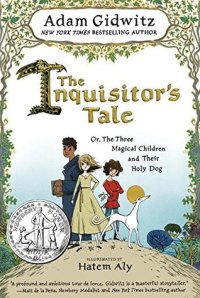
Book: “The Inquisitor’s Tale: Or, The Three Magical Children and Their Holy Dog” by Adam Gidwitz, Hatem Aly (Ill.)
Publishing Info: Dutton Books for Young Readers, September 2016
Where Did We Get This Book: The library!
Book Description:1242. On a dark night, travelers from across France cross paths at an inn and begin to tell stories of three children. Their adventures take them on a chase through France: they are taken captive by knights, sit alongside a king, and save the land from a farting dragon. On the run to escape prejudice and persecution and save precious and holy texts from being burned, their quest drives them forward to a final showdown at Mont Saint-Michel, where all will come to question if these children can perform the miracles of saints.
Join William, an oblate on a mission from his monastery; Jacob, a Jewish boy who has fled his burning village; and Jeanne, a peasant girl who hides her prophetic visions. They are accompanied by Jeanne’s loyal greyhound, Gwenforte . . . recently brought back from the dead. Told in multiple voices, in a style reminiscent of The Canterbury Tales, our narrator collects their stories and the saga of these three unlikely allies begins to come together.
Beloved bestselling author Adam Gidwitz makes his long awaited return with his first new world since his hilarious and critically acclaimed Grimm series. Featuring manuscript illuminations throughout by illustrator Hatem Aly and filled with Adam’s trademark style and humor, The Inquisitor’s Tale is bold storytelling that’s richly researched and adventure-packed.
Beautifully illustrated throughout! Includes a detailed historical note and bibliography.
Kate’s Thoughts
Guess who has never read “The Canterbury Tales”? Me! Guess who isn’t really into Medieval Fiction? Also me! And guess who knows little to nothing about religion and the philosophy of it beyond the most basic tenants of Judaism and United Church of Christ Christianity? This girl! So I feel like all of these factors combine (as well as some spates of bathroom humor, one of the few types of humor that doesn’t especially appeal to me) to make “The Inquisitor’s Tale” a book that isn’t written for me. So yes, while I understand the praise for this book and the appeal of it, and understand why it works so well as a children’s book and does so much more than other children’s books, I never really got into it myself.
That isn’t to say that there wasn’t anything I liked about it. I liked that it asked some pretty deep philosophical questions that you usually don’t see in children’s literature. I feel like Gidwitz doesn’t patronize to his audience, and that he knows that these are hard questions to wrap minds around regardless of what age you are. What makes a Saint? How can some people say that they hold certain values and beliefs, and not realize that they are perpetuating cruelty towards others, especially those that they claim to care about? What are ways that stories can be told and passed on, and how can these stories be changed based on the storyteller? I also liked that Gidwitz had three very different protagonists to show different walks of life and different experiences that would have been common during this time period. You have Jeanne, the peasant girl who can see parts of the future, who has to function in a society where women and peasants hold no value. You have William, a boy raised to be a monk who is both of African and Muslim descent, and stands out among those around him. And there’s Jacob, a Jewish boy in a France where King Louis persecutes the Jews as heretics. Seeing all these kids come together (along with Jeanne’s resurrected dog Gwenforte) and try to understand each other is a great message.
I also had a very hard time reading about the anti-Semitism in this book, be it villages being burnt to the ground, Jews being humiliated and threatened with violence, and Talmuds being burnt. I know that it was the reality of the time period, but for whatever reason I really struggled with it and had to set the book down a number of times and calm down before I could continue reading. I appreciate that Gidwitz was being honest about this time period, of course, and I really liked the extensive historical notes that he put in the back of the book, and yet I wasn’t really on board for the ‘Louis was a complex person who thought he was doing what was right, no matter how wrong it was’ stuff. Because at the end of the day, no matter how noble Louis thought he was being, it WAS wrong. And I have less and less time for those kinds of explanations these days.
My personal issues with this book shouldn’t necessarily reflect this book. It just wasn’t for me, but I definitely see how it would be an appealing read for other people.
Serena’s Thoughts
From the other side of the spectrum, I have read “The Canterbury Tales!” I am into Medieval fiction (at least as far as the fact that much fantasy is set in some type of medieval-like world)! And I was raised Lutheran, so at least the Christian theological philosophy was fairly familiar to me! So I think Kate is right, there are some factors going in that if you have as a reader you’re perhaps more likely to immediately engage with the book. However, massive caveat in this whole theory is that this is a middle school children’s book and let’s be real, how many kids have read “Canterbury Tales” or have a strong understanding of religious philosophy??
So, while I did enjoy the story more than Kate did, I do have to agree with her on a few of the downsides of the book. Most notably the potty humor and, for me, the suspension of disbelief in a few parts.
But first the pros! Since by an large I did very much enjoy this book. I won’t repeat what Kate said about the great diversity of the cast, except for one extra note. I really appreciated the close up look at exclusion/inclusion that the narrator took with these three children. Yes, they are all in this together. And yes, they are all friends. But at various points throughout the book, even with the friendships that have formed from their shared experiences, they each have to confront the sense of “otherness” that comes from their own unique walk of life. For William, he’s a black boy with two white children. For Jeanne, she’s a girl with two boys. For Jacob, he’s a Jewish boy with two Christian children. I loved the various triangles that were made up and the constant shift that was in play from situation to situation with each of their “ins” or “outs” becoming a strength or something that made them stand out as different. I felt that this was a really important message for a book like this: privilege comes in all shapes and forms and at any given moment any single person can be on the in or the out, so we must all be aware and kind.
I’ll also throw in a few good words for the illustrations! I loved the metacommentary of the way the book was illustrated, mimicking the images that monks would draw into the margins of their transcribing work. Some would align with the action of the story while others were intentionally obtuse (a fact that is noted in the beginning of the story, that the illustrator would draw what came to him, with some images existing without connection to the story or explanation).
The ties to “The Canterbury Tales” were also fun, with the story being told by various narrators. I loved the way this element of the book came to life towards the last third, drawing these outside forces into the story itself. There were a few very clever twists with this that I don’t want to spoil! That said, as I mentioned above, I doubt any kid reading this will have read “The Canterbury Tales” and I don’t think there is anything missing for it. It’s more just a fun plug for those English nerds out there who have plowed through that thing and all of its incomprehensible Old English.
But I also agree with a few of the down points that Kate mentioned, notably the potty humor. This is purely a personal preference thing, as I know many kids (and adults!) love this type of humor. But there was one side plot that really lost me as it focused almost entirely on these types of jokes. Secondly, there were a few points in the story where my suspension of disbelief was called into question. We’re dealing with magical children, so for the most part I was ready to just go with this. But there were a few scenes, notably a fight scene where William beats up a bunch of bandits with a donkey leg, that pushed me out of the story a bit wondering how much of the “real world” this story was supposed to be set in.
Those issues aside, I really enjoyed this book. It is a tough read in parts like Kate mentioned. Serious issues are tackled and the persecution and tragedy of the time period weren’t glossed over. I appreciated this fact, but it does make for some sad happenings. But ultimately I would recommend this book to middle schoolers and adults. It’s one of those rare children’s books that can equally appeal to adults.
Serena’s Rating 8: A strong middle school story set in a unique time period with a lot to say about history, religion, and inclusiveness.
Kate’s Rating 6: I see the value and I understand the praise, but I had a harder time with this book than I would have liked.
Book Club Questions
This book is told from multiple perspectives when a group of people gather in a pub to recall the story of the three kids. Did you have a favorite perspective voice?
The illustrations in this book are similar to that of illuminated texts that are seen throughout history in religious works. Have you ever encountered this kind of illustration before? What did you think of the illustrations?
King Louis IX was an actual person in history, as was his mother Blanche, as were other people mentioned in this book. What did you think of using real people in this fictional story?
Each of the main characters comes from a different walk of life, has their own set of challenges to overcome, and their own magical powers. Did one of these characters stand out more to you? Why?
This story tackles a lot of big questions about religion and diversity. Did any of these points stand out to you as particularly strong? Could any have been improved upon or weren’t fully realized?
Book Description:Fallon is the daughter of a proud Celtic king, the sister of the legendary warrior Sorcha, and the sworn enemy of Julius Caesar.
When Fallon was a child, Caesar’s armies invaded her homeland, and her beloved sister was killed in battle.
Now, on the eve of her seventeenth birthday, Fallon is eager to follow in her sister’s footsteps and earn her place in the fearsome Cantii war band. She never gets the chance.
Fallon is captured and sold to an elite training school for female gladiators—owned by none other than Julius Caesar. In a cruel twist of fate, the man who destroyed Fallon’s family might be her only hope of survival.
Now Fallon must overcome vicious rivalries and deadly fights—in and out of the arena. And perhaps the most dangerous threat of all: her forbidden yet irresistible feelings for Cai, a young Roman soldier.
Review: If you read the above description and thought to yourself “that sounds a lot like the movie ‘Gladiator’ but with a teenage girl instead of Russel Crowe,” well….you wouldn’t be wrong. Your mileage for whether or not that is a good or bad thing will depend on your opinion of that movie. I thought it was quite enjoyable, but I love overly dramatic action movies myself. So with that in mind, and firmly stifling any inner thoughts about historical accuracy, I was excited when this book arrived on the hold shelf at my library last week and jumped right in. And…it was kind of what I expected, there were things I enjoyed, but ultimately I wasn’t blown over by the book as a whole.
First to the pros! This book is non stop action, almost from the very first page where we meet Fallon attempting to execute a dangerous, yet flashy, spear throw from a precarious balance point on a racing chariot. The scene is set. Fallon is a no-holds-barred warrior princess, and I am happy to report that she sticks to these guns throughout the book. We are not simply told that she is an excellent fighter, we see it proven to us time and again.
With break neck speed, the novel rushes through our introductions to Fallon, her father, who is still devastated by the loss of his eldest daughter, Sorcha (who was a brilliant fighter in her own right and essentially raised Fallon and taught her everything she knows), and setting the stage that was Fallon’s life so far. And with equal swiftness, that rug is swept out from Fallon’s, and our, feet, and she’s off to Rome, a captured slave destined for the gladiatorial arenas. Lots of training, fighting, and political drama thus ensues.
And for the most part, I very much enjoyed this fast paced style. The book never sets out to present an in-depth character study of Fallon or historical analysis of her homeland (Britain) and its relationship with the conquering Rome. The book is meant to be full of fight scenes, and full of fight scenes it is. Character development does fall to the wayside with this approach, though Fallon remains true to her original characterization throughout, which was a relief.
I particularly enjoyed the introduction of Elka, a fellow slave-turned-gladiatrix (yes, that is what the female gladiators are called and I cringed every time it came up). Elka is badassery defined. And she also turns into a true and steady friend for Fallon. About halfway through the book, she sadly begins to fade into the background, but whenever she reappeared, I was reminded of how much color she added to the story. Fallon herself was a steady character, but her steadiness also read as a bit one-note at times. Elka’s more electric presence helped reinforce Fallon herself.
Most of my qualms came in the form of the romance. *sigh* All too often that is the case for me, and I was sorry to see it happen here as well. There’s nothing inherently wrong with the romance. But it is never built up. Cai, a Roman soldier, is given no unique traits and seems to, out of nowhere, fall in love with Fallon. And she with him. The amount of time they know each other is minuscule. The natural biases they would have against each other would seemingly be insurmountable, both based on the strife between their countries and the fact that he is a soldier who has probably been trained from birth to look down on slaves and she is a warrior whose father’s spirit was broken by Roman soldiers. It just seems like it should have been more difficult, or at least taken longer and be given more attention for a true-feeling relationship to develop. I simply didn’t care about Cai or this relationship. Elka’s and Fallon’s relationship is much better developed. And frankly, I would have been more than happy to have a book that is already largely focused on the sisterly bonds that can be formed between women and the power this can give them to have based its primary relationships on these only with no need to add romance into the mix at all.
There were also a few “surprises” that weren’t surprises at all if you are familiar with the genre. I was able to quite easily predict the most major twist, and also understand the character motivations that were later revealed, thus making Fallon’s shock and struggle to understand these same points a bit tiresome to plow through.
So, while I did enjoy the action, and Fallon was a decent lead character (if made better by supporting characters like Elka), the story was a bit too predictable and the romance way too tepid for me to completely fall in love with this book. I’ll mark the second one as a “to read” but I don’t feel any anxiety in the wait for its release. However, if you want a strong YA female warrior book and don’t mind a few stale aspects, this might be worth checking out!
Rating 6: Strong action and a likeable heroine weren’t enough to make this book completely engrossing, but it accomplishes its main goal and was a quick read.

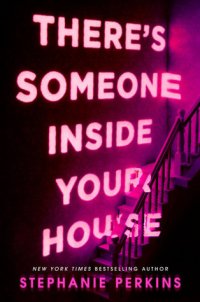 Book: “There’s Someone Inside Your House” by Stephanie Perkins
 Book: “River of Teeth” by Sarah Gailey
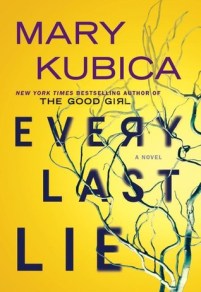 Book: “Every Last Lie” by Mary Kubica
 Book: “Genuine Fraud” by E. Lockhart
 Book: “Monstress (Vol.1): Awakening” by Marjorie M. Liu, Sana Takeda (Ill.)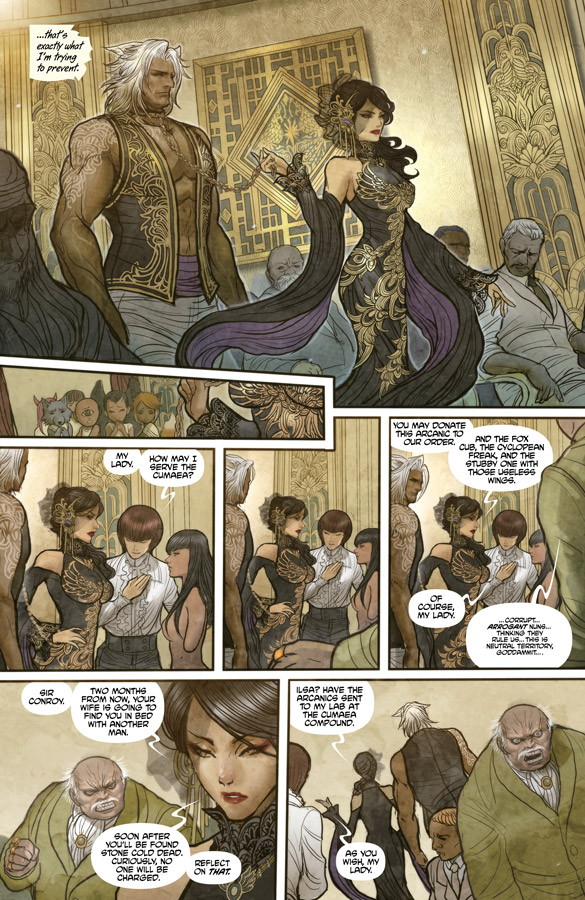
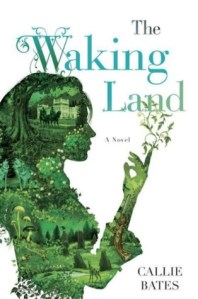 Book: “The Waking Land” by Callie Bates
 Book: “The Secret Diary of Laura Palmer” by Jennifer Lynch
 Book: “Into the Water” by Paula Hawkins
 We are part of a group of librarian friends who have had an ongoing bookclub running for the last several years. Each “season” (we’re nerds) we pick a theme and each of us chooses a book within that theme for us all to read. Our current theme is a “Book Challenge!” theme. This book comes from a “Pick A One Word Title” challenge.
 Book: “The Valiant” by Lesley Livingston
 The Library Ladies