Kate’s Review: “American Heiress”

28007903Book: “American Heiress: The Wild Saga of the Kidnapping, Crimes, and Trial of Patty Hearst” by Jeffrey Toobin

Publishing Info: Doubleday, August 2016

Where Did I Get This Book: The library!

Book Description: From New Yorker staff writer and bestselling author Jeffrey Toobin, the definitive account of the kidnapping and trial that defined an insane era in American history

On February 4, 1974, Patty Hearst, a senior in college and heiress to the Hearst family fortune, was kidnapped by a ragtag group of self-styled revolutionaries calling itself the Symbionese Liberation Army. The already sensational story took the first of many incredible twists on April 3, when the group released a tape of Patty saying she had joined the SLA and had adopted the nom de guerre “Tania.”

The weird turns of the tale are truly astonishing — the Hearst family trying to secure Patty’s release by feeding all the people of Oakland and San Francisco for free; the photographs capturing “Tania” wielding a machine gun during a bank robbery; a cast of characters including everyone from Bill Walton to the Black Panthers to Ronald Reagan to F. Lee Bailey; the largest police shoot-out in American history; the first breaking news event to be broadcast live on television stations across the country; Patty’s year on the lam, running from authorities; and her circuslike trial, filled with theatrical courtroom confrontations and a dramatic last-minute reversal, after which the phrase “Stockholm syndrome” entered the lexicon.

The saga of Patty Hearst highlighted a decade in which America seemed to be suffering a collective nervous breakdown. Based on more than a hundred interviews and thousands of previously secret documents, American Heiress thrillingly recounts the craziness of the times (there were an average of 1500 terrorist bombings a year in the early 1970s). Toobin portrays the lunacy of the half-baked radicals of the SLA and the toxic mix of sex, politics, and violence that swept up Patty Hearst; and recreates her melodramatic trial. American Heiress examines the life of a young woman who suffered an unimaginable trauma and then made the stunning decision to join her captors’ crusade. Or did she?

Review: I grew up in an upper middle class neighborhood in St. Paul, Minnesota, and my usual stomping grounds were also in upper middle class areas. One of those neighborhoods was one that I could bike to, to hit the local Barnes and Noble, get a Starbucks mocha, and maybe go see a movie. This neighborhood also happened to be the same neighborhood that Sara Jane Olson, aka Kathy Soliah of the Symbionese Liberation Army, was found in after decades on the lam. My parents, both former anti-war protestors and pinko liberals of the 1960s and 70s, were pretty stunned, and when they explained who Soliah and the SLA were, I was stunned too. It was around this time that I was first introduced to the story of Patty Hearst, the heiress to the Hearst Fortune who was kidnapped by the SLA, only to join up with them. Sure, Hearst has kind of entered the pop cultural zeitgeist after all these years, that famous ‘Tania Picture’ pretty recognizable to even those who don’t necessarily know the significance of it. Hell, I had this picture on my bedroom door in high school (in vague protest of local gun legislation, but I digress). But outside of knowing the very basics of the case, I knew very little about Patty Hearst outside of this photograph. So when “American Heiress” ended up at my library, I decided it was time to learn more.

Toobin, a writer for the New Yorker, tells a comprehensive and detailed story not only about Patty and her kidnapping, but the crimes that the SLA committed before, during, and after, the trials and scrutiny that Patty faced, and the social and political climate of the United States in the 1970s. Gone were the idealistic days of the 1960s, and the 1970s was a time of much anger and frustration, as well as uncertainty. Nixon had recently been exposed for his corruption with the Watergate Scandal, gas prices were astronomical, and tensions were high. The Symbionese Liberation Army fancied itself a revolutionary group, but was less akin to peaceful protest and discourse, and more interested in bombs and murder (including the assassination of school superintendent Marcus Foster). Toobin does a great job of profiling our main players in the SLA, and his profiles are expansive and in depth. He also does a very good job of profiling Patty and her life pre-kidnapping. She was a student at Berkeley, engaged to an older man, and already feeling a little bit unappreciated and approaching a stagnancy. His descriptions of all these factors, as well as explanations of various societal events and views, all mix together to bring the reader right into this setting. I could almost feel the tension in the air.

What I also liked was that Toobin was pretty good at presenting a lot of this neutrally and seemingly without a conclusion he wanted the reader to draw. That may be in part to the fact that Patty Hearst didn’t have anything to do with this book, and declined to work with him on it. Because of that, Toobin has to work with other sources. He still managed to present a well thought out analysis of many factors within this crime. One of the biggest turns of the crime was the fact that Patty ‘joined’ her captors and began to commit crimes with them, releasing propaganda images and films denouncing her former life. She was eventually tried and convicted, in spite of the defense’s arguments that she was suffering from Stolkholm Syndrome. Eventually she was pardoned by President Carter. Toobin has really set out just to tell the story as it was, and how the SLA could have influenced her choices to cooperate. While the SLA didn’t have the competence to actually systematically brainwash her, it was, in a way, their short sightedness in their plan that may have led to her cooperation. They kidnapped her with no plan, and were constantly threatening her life and waffling with what to do with her. Because of this, through a need to survive and adapt, it could be argued that Hearst decided that to save herself, be it consciously or not, she needed to become one of them. But not once does Toobin go so far as to suggest that there is no responsibility there. After all, he also points out that she was angry with her parents for how they seemingly handled her kidnapping, and felt that they had turned their back on her. And by the end, I don’t really know where I fall in the argument. I jumped between ‘If she wasn’t a Hearst, or a white woman, or rich, she would have been in prison for far longer than eighteen months’, and ‘this poor girl was a complete victim and was completely railroaded!’. I still don’t really know where I stand, but I appreciate that. It shows that Toobin knows that it’s almost too complex for any solid answers to come out of it, especially after all this time. Honestly, it’s a combination of all those things. She was certainly a victim. But many victims don’t get the luxury of being seen as one.

The book is a little dense, so I hard a slower time getting through it, but in it’s density we get a whole lot of really interesting facts. I had no idea that so many familiar names were involved in this case. This runs the gamut from perhaps obvious people, like Ronald Reagan who was the Governor of California of the time (who said some pretty wretched things about poor minorities in relation to this case, surprise surprise), to the less obvious like Desi Arnaz (who was a family friend of Patty’s parents and whisked them away on a vacation to help them take their mind off of things). While sometimes this book could get a little off track with these things, I found it all pretty engrossing.

I think that true crime fans would like this book, but so would history buffs, and possibly even people interested in psychology and sociology. Patty Hearst is still around, making public appearances here and there, be it at the Westminster Dog Show or on TV. I don’t think anyone can really know everything about her outside of her, and she isn’t going to address it anytime soon. Nor should she have to. That said, Jeffrey Toobin does a great job of postulating and assessing various factors in her kidnapping fairly and in an insightful way. “American Heiress” was a good read, and I’m happy I know more about the poor girl whose chilling photo was on my bedroom door.

Rating 8: An in depth and interesting book about a notorious crime that never goes for sensation or salaciousness, “American Heiress” looks at the Patty Hearst Kidnapping through many lenses.

Reader’s Advisory:

“American Heiress” has not been out long, and isn’t on many relevant Goodreads lists. It can be found on “Fresh Air 2016”, but I think it would also fit in on “California True Crime”.

Find “American Heiress” at your library using WorldCat!

Kate’s Review: “When We Go Missing”

33382556Book: “When We Go Missing” by Kristen Twardowski
Publishing Info: CreateSpace Independent Publishing Platform, December 2016

Where Did I Get This Book: An ARC was provided by the author in exchange for an honest review.

Book Description: Once, Alex Gardinier was a successful physical therapist and a happy wife. Now she is trapped in a crumbling hospital room. Seven years ago Alex’s ex-husband, Nathan, was convicted of murdering five girls, and he has been rotting in prison ever since. Except the doctors say that Nathan isn’t in prison. In fact, they don’t believe that he is a criminal at all. According to them, Nathan is a devoted husband who visits her every week. But Alex can’t recall ever seeing him at the hospital, and the last time they met he was holding her hostage on a boat.

Maybe the doctors are right – maybe these memories of his crimes are her own personal delusions – but if they are wrong, then Nathan somehow escaped from prison. If they are wrong, he has trapped Alex in a psychiatric ward.

If they are wrong, he is hunting her sister.

Review: During my time studying psychology in my high school and college careers, there were a number of case studies that freaked me out. Be it because of ethical problems (The Milgram Experiment), animal cruelty (Harlow Monkey Experiment), or just flat out human terribleness (The Stanford Prison Experiment), many studies have told us a lot, but have ridiculous messed up connotations. But one that seems perfect for a horror story is the Rosenhan Experiment, where non-mentally ill people faked symptoms to get inside mental institutions… and then found it pretty near impossible to get out, even when they stopped reporting symptoms. So when “When We Go Missing” ended up in the blog email box, and seemed to touch on exactly that, I thought “Oh yes. This could work.” And on top of that, it was written by fellow book and literature blogger Kristen Twardowski! So of course I gotta give a shout out of solidarity to her!

giphy2
(source)

And there may be mild spoilers here, but I promise that I won’t give too much away, nor will I give away anything that I don’t think isn’t established pretty early on, and therefore fair game.

Though the description makes it sound like it’s going to be mostly from Alex’s point of view, “When We Go Missing” actually follows the experiences and points of view of a number of women, all of whom are connected to Alex in one way or another. All of them have their own unique perspectives and experiences, and I appreciated the pieces of the larger, overarching puzzle that they provided. I do think that the description may be a little misleading in some ways, as I feel that through these multiple perspectives we find out quite early that Alex is not necessarily crazy, and that Nathan has somehow gotten away with sticking her into a Portuguese mental institution after he escaped from prison. But this still works, because now the mystery is how did he do this, how is Alex going to escape when she has been diagnosed as insane, and is Nathan going to get away with it. I am far more interested in figuring this out as opposed to ‘is Alex an unreliable narrator?’, a trope that I am pretty much well and over at this point.

Besides Alex’s story, be it before her time in the asylum or during it, we get the stories of Carolyn, Sandra, and Lucia. Carolyn is Alex’s sister, a woman who has never felt comfortable or trusting around Nathan, but doesn’t know how to say so. I really appreciated how her character progressed, and I totally believed her choices when it came to her sister and her sister’s marriage. While some may wonder how Carolyn couldn’t tell Alex her reservations, I found it to be pretty realistic that she may not feel it her place, or that she doesn’t have a leg to stand on. I’m someone who isn’t terribly close to her sister, and while the girl has a great head on her shoulders and has yet to make a terrible decision in regards to her personal life, I wonder if I’d have the courage to say if she had. So that resonated with me. Another character, Sandra, is actually the character I was most intrigued by, and found to be the most tragic. Sandra’s daughter disappeared, and she is trying to make sense of what happened to her. This journey takes her to the realization that a lot of women, many whom society may not miss, have gone missing, and that they may be connected. Her story was the one that I most looked forward to in terms of plotting, as it was definitely the saddest and the one that made me feel the most of all of the threads. And finally there was Lucia, a nurse at the asylum that Alex was being held in. She was another very interesting device for the story, acting as detective for the reader as we followed the hospital storyline through her eyes as well as Alex’s. I liked seeing Lucia try to figure out if the woman being detained in room 203 is insane, or if there is a larger conspiracy going on around her, and just how high up it goes. Because really, while the Rosenhan Experiment was upsetting in how it exposed the ineptitude of psychiatric hospitals diagnostic practices, wouldn’t it have been so much worse if it had all been one big conspiracy to keep the ‘patients’ in? And THAT is the thing about this book that freaked me out the most.

giphy1
No drinking fountains in sight to throw through a window either. (source)

There was a fair amount of jumping around in this book, timeline wise, which was a little confusing at first. Once I got the hang out it, however, it went a lot smoother, and I didn’t feel as lost as when I started. I think that it’s just a matter of getting used to the pacing and the jumping, which took a little bit of patience from me, a girl with ADD and a need for instant gratification.

“When We Go Missing” was an entertaining read that kept me guessing in a number of ways up through the last pages. It definitely hits a number of original themes and plot points, and I think that it would appeal to those of us who want something fresh from our psychological thrillers.

And be sure to come back here on Monday, January 23rd! Because the author of this book, Kristen Twardowski, is publishing a guest post here about writing, inspiration, and the creative process!

Rating 8: An entertaining and suspenseful book with a lot of well fleshed out characters, “When We Go Missing” was a very unsettling and tense novel with twist, turns, and a solid mystery!

Reader’s Advisory:

“When We Go Missing” can be found on the following Goodreads lists: “Fancy a Debut Psychological Thriller Author?”, and “Female Psychological Thrillers/Suspense”.

“When We Go Missing” is not available on WorldCat yet, but it can be found in paperback and ebook form at amazon.com.

Kate’s Review: “Moonshot (Vol.1): The Indigenous Comics Collection”

25823323Book: “Moonshot (Vol.1): The Indigenous Comics Collection” by Hope Nicholson (Editor)
Publishing Info: Alternate History Comics, 2015

Where Did I Get This Book: The library!

Book Description: Produced by AH Comics Inc. (Titan: An Alternate History, Delta, Hobson’s Gate, Jewish Comix Anthology) and edited by Hope Nicholson (Brok Windsor, Lost Heroes, Nelvana of the Northern Lights), MOONSHOT brings together dozens of creators from across North America to contribute comic book stories showcasing the rich heritage and identity of indigenous storytelling.

From traditional stories to exciting new visions of the future, this collection presents some of the finest comic book and graphic novel work in North America. The traditional stories presented in the book are with the permission from the elders in their respective communities, making this a truly genuine, never-before-seen publication. MOONSHOT is an incredible collection that is sure to amaze, intrigue and entertain!

Review: I had another impulsive moment at work recently, where I went to our New Books Wall and took a look at what there was to offer. Since these books don’t go to the usual request list, sometimes you can get really lucky and find something that’s in demand or brand new. I was immediately taken in by the gorgeous cover on a new graphic novel collection. I mean, DAMN, look at the cover for “Moonshot (Vol.1)”! Is it not staggering and beautiful!?

giphy
Absolutely blown away, no lie (source)

I gave it some time on the wall, because I had a big stack at home and wanted to give the patrons a chance to snatch it up. But after waiting awhile I just had to have it. And I am so glad that I was entranced by the cover, because “Moonshot” as a whole was an entrancing collection!

The first thing to know about “Moonshot” is that it is a collection of one shot stories that are written by people from Indigenous Nations across North America, as are the artists. The second thing to know is that it is a collection filled with stunning variety because of all of these differing perspectives. I wasn’t sure of what to expect from this collection, but whatever my expectations may have been they were blown out of the water by what I found. While there are a number of stories in this book, a few of them really stood out to me, so I will focus my attention on them. That isn’t to say that the others aren’t as good, however. These are the ones that left the biggest impression because of story or artwork.

“The Qallupiluk: Forgiven” by Sean and Rachel Qitsualik-Tinsley, and menton3 (Ill.).

This story is from the Arctic regions, and concerns themes of death and forgiveness. This was also the one story in the collection that had minimal artwork, as it was mostly text with a few large pieces that stood out for the most important parts of the story. I liked a couple of things about this story. The first was that it was creepy as all get out, as the Qallupiluk is a creature that hides beneath the ice and takes unsuspecting victims under the water and kill them. This story is about a Qallupiluk that takes on the form of one of it’s victims in hopes of stealing away a child, until a dog calls it out. I liked the personal journey that the Qallupiluk took, as odd as that sounds, and has to confront the concept of forgiveness. The art, as I said, was scattered, but the images that were there were absolutely breathtaking and visceral. As someone who loves creepy imagery, this one was a true treat.

“Siku” by Tony Romito, and Jeremy D. Mohler (Ill.)

Another story from the Arctic region, and another one that involves malevolent forces and scary imagery. This one is about a hunter who witnesses a conflict between two otherworldly beings, one of which is a demon. Boy do I love the demon stories. This book definitely was more set up like a comic, with panels, bubbles, the works. It felt like an old school horror comic, and like something that I would pick up at the comic book shop when looking for something twisted. And the end, WAHH, so unsettling. The art didn’t stand out as much in this one, but that didn’t matter because the story really kept me interested. I don’t want to spoil anything, so I won’t go into much detail, but it kind of cut to the quick in that it definitely touched on one of my bigger freak out factors in horror.

“Coyote and the Pebbles” by Dayton Edmonds, and Micah Farritor (Ill.)

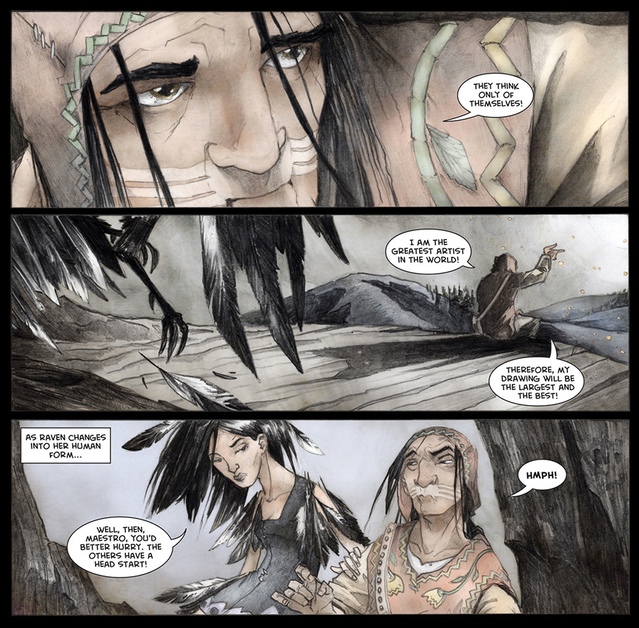
I’ve grown up hearing many iterations of the Coyote myth, as Coyote is a very prominent character in many Indigenous narratives and mythologies. This one sounded familiar, but Edwards really made it his own. I’ve always liked Coyote, be he a troublemaker or sympathetic, and in this story I really liked how he was portrayed as somewhere in the middle (but being me, I still felt for him). It concerns the nocturnal animals of the world hoping to see more at night when the sun is down, and thinking that they should draw portraits of themselves to light the way. And Coyote thinks that he is the best artist of them all. This story is a straight up ‘how this came to be’ myth, but I really liked it. This was also my favorite art style in the collection, with animals shifting between animal form and human form, but even in human form still evoking their animal identity. Farritor has a real skill for pulling animal characteristics from his drawings, be they animals or not.

e5a2865273415b875ddf4ff9d3c53e4a_original
Coyote and Raven discuss his artistic prowess (source).

This story was lovely and melancholy, and I really, really enjoyed it.

“Moonshot (Vol.1)” is a collection that was so fun, and breathtaking in a lot of ways, and I seriously cannot wait for Volume 2 to come out (YES, there is going to be a Volume 2, isn’t that great?!). I think that it’s also a very important work, especially since Indigenous representation is one of the lowest in Children’s and YA Literature. I cannot recommend this book enough to comics enthusiasts, and I think that everyone should consider picking it up. If the cover alone doesn’t get you, the stories inside certainly will.

Rating 8: With gorgeous and varied artwork and sweeping stories, “Moonshot (Vol.1)” is an important collection with talented writers and artists at the helm.

Reader’s Advisory:

“Moonshot (Vol.1)” can be found on the following Goodreads lists: “Graphic Novels & Comics by the Aboriginal, Indigenous, and Native People’s of the World”,  and “Canadian Graphic Novels & Comic Books”.

Find “Moonshot (Vol.1)” at your library using WorldCat!

Kate’s Review: “The Trap”

32813330Book: “The Trap” by Melanie Raabe (Imogen Taylor Translation)

Publishing Info: Grand Central Publishing, 2016 (Translation)

Where Did I Get This Book: The library!

Book Description: The renowned author Linda Conrads is famous for more than just her bestselling novels. For over eleven years, she has mystified fans by never setting foot outside her home. Far-fetched, sometimes sinister rumors surround the shut-in writer, but they pale in comparison to the chilling truth: Linda is haunted by the unsolved murder of her younger sister, whom she discovered in a pool of blood twelve years ago, and by the face of the man she saw fleeing the scene.

Now plagued by panic attacks, Linda copes with debilitating anxiety by secluding herself in her house, her last safe haven. But the sanctity of this refuge is shattered when her sister’s murderer appears again–this time on her television screen. Empowered with sudden knowledge but hobbled by years of isolation, Linda resolves to use her only means of communication with the outside world–the plot of her next novel–to lay an irresistible trap for the man.

But as the plan is set in motion and the past comes rushing back, Linda’s memories of that traumatic night–and her very sanity–are called into question. Is this man really a heartless killer or merely a helpless victim?

Review: At work one night my friend Paul (and fellow librarian) was subbing with me at the desk. He told me about a book he’d read, and that he thought that I should give it a whirl. It was a German book, recently translated into English, called “The Trap”. I requested it pretty much immediately, because Paul knows my reading tastes pretty well (and movie tastes; we proceeded to have a long conversation about “The Conjuring 2”). I think that I was expecting more horror by his description, and instead found myself with another Messed Up Lady Narrator book. But hey, I was okay with it, because I had yet to read a German Messed Up Lady Narrator book!

Side note: I’VE BEEN MISUSING THE PHRASE GRIT LIT THIS ENTIRE TIME!!! I could have sworn that Grit Lit was the phrase for these female psychological thrillers, but I guess it’s more the hip new slang for Southern Gothic. Huh.

giphy7
So ignore that from before. (source)

I have some good news right off the bat. This was a Messed Up Lady Narrator Book (I need to find a good snappy phrase for this genre) that I mostly, basically, enjoyed. While it perhaps doesn’t reach the high highs of “In A Dark, Dark Wood”, it was a gripping read with a tense plot. I did get a little nervous as the book progressed, because you all know how frustrated I get with psychological thriller heroines and their issues. Linda isn’t really any exception, as she is suffering from agoraphobia and PTSD after walking in on her sister Anna’s murder scene. While the trope of ‘damaged heroine’ is firmly in place with Linda, while it is realistically and necessarily dramatic, it never really feels overdramatic. Linda is very up front with her problems, she recognizes that she is, indeed, very messed up, and she isn’t the usual absolute WORST to everyone that you sometimes see in these books. Plus, I feel like she has actually earned her messed up personality, while sometimes the trope can feel forced and cliche. I mean, a mentally ill character usually means that there are going to be moments of ‘is all of this actually happening the way I think it is?’, especially in a book like this. It happened in “The Girl on the Train”, it happened in “The Couple Next Door”, and it definitely happened in this. I don’t want to spoil anything here, because I do think that this is a good read and definitely worth your time, but I think that it would have worked better and been a bit more revelatory if Linda wasn’t so sure about everything from the get go, if maybe we hadn’t jumped in with her mid-revenge plot. Surprises ended up not being too surprising, and while I was ultimately okay with it, the stakes never felt terribly, terribly high, and I didn’t feel like I was really solving anything along with her. I like taking the journey of detection and gumshoe-ing. This book didn’t really have that element to it, or at least not enough for me.

Linda’s relationships were also something that I want to address. I had a problem with a kind of out of nowhere forced romance sub plot that arrived a bit too late for my liking. There were hints about Linda’s simmering relationship with Julian, the detective of her sister’s case, but he didn’t really show up until the last third of the book. And I think that if I was really going to buy it, I needed him to really show up and make an impression well before that, not just as an analog character in the book that she has written (yes, we do get to see excerpts from the book. They were fine. They didn’t really add or detract). But I still liked Linda’s relationship with him as a whole, just as I liked her relationships with those around her, be it her assistant or her publisher. As I said, I think that there is a stereotype in pop culture and literature that people who are mentally ill are going to be completely difficult to deal with at all times and that they are going to put people off because of it. What I liked about Linda is that she has her problems, she has this uphill battle that she is fighting, but she still has relationships and isn’t portrayed as toxic or a pariah. She has friends and people who care about her. That meant a lot to me.

And then there’s the villain character, or whom Linda is convinced is a villain, Lenzen. Linda thinks that Lenzen, an established and well respected journalist, is the man who killed her sister a decade earlier. And since we, of course, know that there is going to be some doubt about him based on the plot description alone, I was very curious as to how Raabe was going to approach him. I liked that she did do a pretty good job of making it hard to tell what his deal was. Many of the things he did in the interactions he had with Linda could be chalked up to calculated sociopathy… Or they could have just as easily been something a regular, innocent man would do. Tricky. Very tricky. I liked that I was constantly questioning him, which shows to me that Raabe made effective use of the device that she set up. And believe me, sometimes a writer can make a real mess of it.

So while it ultimately did end up feeling suspenseful throughout the book, I wasn’t really surprised by much of anything that happened. True, I had my questioning moments, but I never had a “WOW!” moment. But honestly, I prefer a well written if simple plot to one that just has twist after twist after twist. “The Trap” was a fast paced and enjoyable read, and I hope that it takes off here in the U.S. as much as it did in Germany.

Rating 7: While it didn’t necessarily enthrall me and stagger me, “The Trap” was a fun and tense read that I found entertaining and not as overwrought as other books in the genre.

Reader’s Advisory:

“The Trap” is new and isn’t on any Goodreads lists. But it would be at home on “Female Psychological Thrillers/Suspense”, and “Psychological Chillers by Women Authors”.

Find “The Trap” at your library using WorldCat!


Kate’s Review: “The Call”

30292413Book: “The Call” by Peadar Ó Guilín
Publishing Info: Scholastic Inc, August 2016

Where Did I Get This Book: The library!

Book Description: The Hunger Games meets horror in this unforgettable thriller where only one thing is certain . . . you will be Called.

Thousands of years ago, humans banished the Sidhe fairy race to another dimension. The beautiful, terrible Sidhe have stewed in a land of horrors ever since, plotting their revenge . . . and now their day has come.

Fourteen-year-old Nessa lives in a world where every teen will be “Called.” It could come in the middle of the day, it could come deep in the night. But one instant she will be here, and the next she will wake up naked and alone in the Sidhe land. She will be spotted, hunted down, and brutally murdered. And she will be sent back in pieces by the Sidhe to the human world . . . unless she joins the rare few who survive for twenty-four hours and escape unscathed.

Nessa trains with her friends at an academy designed to maximize her chances at survival. But as the days tick by and her classmates go one by one, the threat of her Call lurks ever closer . . . and with it the threat of an even more insidious danger closer to home.

Review: I think that a lot of people have started associating YA science fiction with the idea of the dystopian society, and that the plot is a group of teenagers who have decided to fight back against it. With books like “The Hunger Games”, “Divergent”, “The Testing”, and “Matched” all being hits in their own rights, I think that if a plot has any smatterings of their themes, it will automatically be lumped in with them. I know that I almost made the mistake of doing this with “The Call” by Peadar Ó Guilín. After all, it takes place at a school where teenagers are being trained for the fight of their life, a test that will in all likelihood leave them dead and mangled. “Oh how ‘Hunger Games'” I thought to myself. But man, was I wrong. And I’m ashamed that I was willing to be even slightly dismissive of it.

On paper, sure, it sounds like a familiar trope. But “The Call” is one of the most original YA novels I’ve read in a long time, for a number of reasons. The first is that our main character, Nessa, is a polio survivor, and has to walk with the aid of crutches as one of her legs has been permanently damaged by it. Diversity in YA literature is important, and that includes people with disabilities. From what I know about Polio (having read about it and knowing someone who is a Polio survivor), Ó Guilín did a really good job of portraying Nessa and her strengths and limitations, and while he never used her disability in a ‘let’s all feel sorry for her’ kind of way, he also was honest with how hard it would be, especially in a situation where you have to be able to run and fight. Nessa is a very well rounded character beyond that as well, as she is headstrong and stubborn, but has insecurities that could apply to not just her and her situation, but many teenage girls from lots of backgrounds. She has her problems with her friends, she has her problems with love and relationships, and she has her problems with her family (though they are pretty removed from this story in general). She is a seriously great female protagonist for a YA fantasy novel, always rooted in realism and never treading towards some superhuman and unrealistic ideal. I especially loved her friendship with her best friend Megan, a sarcastic and snide girl who is the perfect foil to her, but very clearly and fiercely has her back. And huzzah and hurray, there is no love triangle to be found here, as Nessa only has eyes for one guy, the pacifist and quiet Anto. Anto as a character isn’t as interesting as Nessa or even Megan, but the arc that he does go on is a pretty good one, and luckily he isn’t there just to be the ‘boy who sees her for what she’s worth isn’t it sweet’ kind of gig. Given that this is supposedly the start of a series, I would be very curious to see where Anto goes, both for himself and with Nessa.

The world itself is also very, very original. While I can understand that the militarized training for teens smacks of “Hunger Games” and “Divergent”, this world is far more creative than that. For one, this isn’t a totalitarian regime that is oppressing these kids by using violence and isolation to control them. This is another outside force, in this case the Sidhé, or fairies. And these fairies are not the kind of fairies we think of in sanitized fairy tales. These fairies were banished from Ireland to another world, and they are taking their revenge by sucking up Ireland’s teenagers and trying to kill them. And succeeding most of the time. These are the kinds of violent fairies that original folklore spoke of, the kind that would put a death curse on a baby just because they weren’t invited to said baby’s Christening.

source
And I mean the REAL Maleficent, not that Angelina Jolie bullshit. (source)

I think that modern fantasy needs more evil and menacing fairies, and “The Call” really delivered on that. Not only are the Sidhé mysterious and vengeful, they are very, VERY violent. Like, to the point where I was getting pretty disturbed by the kind of stuff that they would inflict upon the teens who were taken by The Call. From skinning them, to mutilating them, to transforming them into hideous creatures out of Giger-esque nightmares, these Sidhé were not screwing around, and it made the stakes feel very, very high. Which in turn made me terrified to see what happened next, but also unable to put the book down whenever a poor, hapless teen was taken by The Call.  I also appreciated how Ó Guilín has changed Ireland in subtle ways to reflect how this situation would affect society, with the people knowing English, Old Irish, and Sidhé out of tradition, pride, and necessity, just as I liked how he made it clear that the Sidhé are not the only villains in this story, and in some ways are understandably upset. The best example of this is that by far the scariest villain is not the evil fairies, but a human teenager named Conor. His misogyny and violent obsession with Nessa was just as off putting as the sadistic fairies that chase down teenagers, and the fact that Conor is a very realistic villain in his sociopathy and entitlement made him the most skin crawling of all the antagonists in this book.

I really, really enjoyed “The Call” and I am actually pretty pumped that it sounds like Ó Guilín is going to write more stories in it’s world. Definitely give this a try if you like books like “The Hunger Games”, but know that it stands quite well on it’s own.

Rating 9: A very intense and original fantasy, “The Call” is a refreshing new take on YA survival thrillers, with a fabulous protagonist and deliciously evil fairies.

Reader’s Advisory

“The Call” is not on any Goodreads lists at the moment, but I think that fans of “The Hunger Games” would find a lot to like, and I would put it on “Best YA Fairy Books”.

Find “The Call” at your library using WorldCat!

Kate’s Review: “Transmetropolitan (Vol.3): Year of the Bastard”

22418

Book: “Transmetropolitan (Vol.3): Year of the Bastard” by Warren Ellis, Darick Robertson (Ill.), and Rodney Ramos (Ill.)

Publishing Info: Vertigo, September 1999

Where Did I Get This Book: I own it.

Book Description: Investigative reporter Spider Jerusalem attacks the injustices of the 23rd Century surroundings while working for the newspaper The Word in this critically-acclaimed graphic novel series written by comics superstar Warren Ellis, the co-creator of PLANETARY and THE AUTHORITY.

In this third volume, Spider Jerusalem begins to crumble under the pressure of sudden and unwanted fame. Having had enough of the warped 23rd century Babylon that he lives in, Spider escapes into a world of bitterness and pills. As he stumbles through this haze of depression and drugs, he must find a way to cover the biggest story of the year, the presidential election. Armed with only his demented mind and dark sense of humor, Spider embarks on an adventure of political cynicism, horrific sex, and unwelcome celebrity which culminates in a shocking and ruinous ending.

Review: When we left of in “Transmetropolitan”, things got a bit existential and a bit off track of the main plot. That isn’t to say that I didn’t appreciate the stories that we got in “Transmetropolitan: Lust for Life”. I actually really did enjoy them for what they were and what purpose they served. I liked learning more about the world that this series takes place in, and the limits and limitlessness that society lives with. But I’ll be honest, I was stoked to see that we were getting back into the down and dirty nitty gritty with “Transmetropolitan: Year of the Bastard”. Spider’s assistant Channon has left him in the lurch, and he’s turned to drugs and angst. But then he is approached by Vita Severn, the campaign manager of the candidate who is going to rival The Beast. This man is known as The Smiler, as he perpetually smiles and tries to show off a chipper demeanor to counteract The Beast.

Spider, of course, is NOT fooled by any of this bullshit.

giphy5
(source)

As much as maybe in this moment I needed someone to rail against The Beast in any way, shape, and form, it was very nice to see that Spider Jerusalem stayed true to form and showed a blatant mistrust for any and all politicians, even ones that could possibly take down the monster in charge. The whole point of this series is that corruption is rampant and a simple answer isn’t readily available because of it. But along with that, we get to see that sometimes in an imperfect situation, there are symbols of hope. And I am, of course, referring to the lovely, strong, and badass Vita Severn, the one friggin’ symbol of true hope that The Smiler’s campaign truly has.

1058329-vita
Here she is with a literal Princess Leia ‘do. That’s deliberate. (source)

I had completely forgotten about Vita. I know why I did (no spoilers), but this time around she left such a positive impression on me she has skyrocketed up to my top five favorite characters in this series. I love that Ellis writes women so well and in such varied ways. You have Channon, a volatile and snarky, but ultimately supportive and caring, ex stripper who will protect Spider at all costs. You have Vita, a brilliant political mind who knows that her choice in candidate is not perfect, but truly feels that it’s the only way to take down an even worse threat. And then, there’s the introduction of Yelena, Spider’s new assistant. Yelena is so different from Channon, in that she has no interest in hanging out with Spider, and deeply resents that she is being made to (she’s Spider’s boss’s niece). And if you thought that Channon didn’t take crap from Spider, Yelena is the absolute master of not taking crap from him. On my first read through of this series I wasn’t as into Yelena, but this time around, I am really enjoying her thus far. Even if she’s a bit 2 Edgy 4 Me at times.

As far as the plot progression goes, as I mentioned before, we get back on track with the main plot in this collection. Spider gets fully pulled into covering the Election, pressured to speak out in favor of the Smiler in spite of the fact that he finds the Smiler pretty corrupt in his own ways. I liked the issues that this raises, bringing up the questions of supporting someone who is flawed and bad in different ways in the name of dethroning and taking down someone who is the evil you already know. I can see arguments for both sides, and I think that Ellis does a good job of showing why both positions have their pros and cons. Along with this, we get to see how flawed Spider himself is. Sure, in the first two collections he’s definitely brash, violent, bitter, and rageful. But in this one we see that he’s also spiraling now that Channon is gone, and that his addiction to drugs is back in full swing. Spider is certainly based in part on Hunter S. Thompson, and it’s in storylines like these that we are reminded that Thompson himself was incredibly screwed up, no matter how brilliant he was. I love Spider, but I applaud that Ellis isn’t making him free of critique or problems that could really do damage to him and to those around him.

Plus, the ending of this collection…… It just gutted me. I had forgotten about it, and I gasped out loud when the big climax happened, because damn was it unexpected, and DAMN did it hurt.

giphy6
So much pain. SO MUCH PAIN. (source)

This series continues to be great, and I can’t wait to see what I rediscover next. Even if I know I’m going to get emotionally ravaged again and again. Thanks, Spider. Thanks a lot.

Rating 9: We are back on the main storyline and it goes as dark and darkly funny as you’d expect from this series. It was great seeing Yelena finally show up, and Spider continues to be both the best and the worst.

Reader’s Advisory:

“Transmetropolitan (Vol.3): The Year of the Bastard” is included on these Goodreads lists: “Great Non-Superhero Graphic Novels”, and “Bibles for the Revolution”.

Find “Transmetropolitan (Vol. 3): The Year of the Bastard” at your library using WorldCat!

Previously Reviewed:“Transmetropolitan (Vol.1): Back on the Street”, “Transmetropolitan (Vol.2): Lust for Life”.

Kate’s Favorite Reads 2016: Picks 5-1

The end of the year is upon us, and we are about to embark into 2017. Given that we both did a lot of reading this past year, and had a lot of opinions about what we read, we thought that we would reveal our top picks of the year this entire week! Today I’m finishing my countdown with my top 5 favorite books of the year!

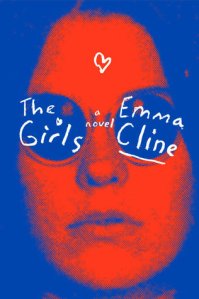
26893819Pick Number 5: “The Girls” by Emma Cline

“The Girls” Review

This book was so not what I was expecting, but that ended up being perfectly okay. The Manson Family Murders are notorious, but when we think about them we think about Manson and the girls who went to prison. We don’t really think about the girls who were left behind in the aftermath. Emma Cline decided to take this question and fictionalize it, and brought us a very sad, tense story about how we view girls in American society, and how they react to how we view them. This book raised some important questions, and it was written in a strange and beautiful way. I felt so badly for Evie, our lonely and lost protagonist, and I also felt for Suzanne, the doomed and violent friend who was on a deadly path. This book was hard to read, but so, so good.

25533076Pick Number 4: “Hex” by Thomas Olde Heuvelt

“Hex” Review

This was a year where I read a fair amount of books about witches, and “Hex” was one of them. And damn was it good and scary. I love a good story about witches that takes the puritanical terror of it all, and “Hex” does that perfectly, and in a modern setting! The town of Black Spring has been haunted by the Black Rock Witch for hundreds of years, and they have it pretty well under control, keeping it secret from the world. So of course some dumb teenagers are resentful of having to remain silent, and decide to post about her on youtube. With horrific results. This book scared the crap out of me, keeping me up and night, yet fearing that if I stayed awake I’d see a terrible shadow in the corner. Horror fans, this book is AMAZING and you need to check it out.

23308488Pick Number 3: “The Chilling Adventures of Sabrina: The Crucible” by Roberto Aguirre-Sacasa

“The Chilling Adventures of Sabrina: The Crucible” Review

Speaking of stories about witches, Roberto Aguirre-Sacasa took the classic heroine of Sabrina the Teenage Witch and turned her and her aunts into some scary as hell puritanical nightmares! I had no clue that this was going to happen when I picked this comic up, and when it became incredibly clear incredibly fast that this wasn’t going to be like any other “Archie” comic I’d ever read, I was on board one hundred percent! The artwork is beautiful and eerie, and the story puts Sabrina in the sights of an evil succubus named Madame Satan. Oh, and her aunts are cannibalistic brides of Satan. OH, and Betty and Veronica are also witches. This series is genius, and I need more of it. Now. YESTERDAY.

25816688Pick Number 2: “The Fireman” by Joe Hill
“The Fireman” Review

Joe Hill is my favorite author, and I waited in abject anticipation for “The Fireman”. When it finally dropped this past spring, I was not disappointed, devouring this brick of a tome in a couple days time. Hill takes the apocalypse story and tells it from the perspective of the infected, humanizing them and also showing how scary they can be from those who sympathize towards them. His creation of the disease Dragonscale is harrowing, scary, and beautiful, and his protagonist Harper is a wonderfully well rounded heroine. And finally, his tragic character of John Rookwood, the Fireman himself, was one of my favorites of the year as well. His love for Harper was beautiful, their relationship sweet and strong. This book was just so emotionally charged, and meeting Joe Hill was the icing on the cake involving this book. Read it. It’s so good.

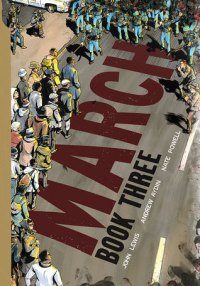
29436571Pick Number 1: The “March” Trilogy by John Lewis

“March” Review

This personal and powerful graphic memoir is my personal favorite book of 2016. Yes, fine, it’s technically three books, but we’re going to take them as a whole. John Lewis chronicles his time in the Civil Rights Movement in these stories, and they are all so incredibly moving, resonant, and powerful that I found myself floored many times while reading. He tells not just his story, but also parts of the stories of those who were there, stories that may not be told all that often in American History. The art is also lovely, subtle and simple but still able to jump off the page and really kick you in the gut. In times like these, this story is more important than ever, and I truly and sincerely hope that educators will use this story to teach about human rights, civil rights movements, racism in America, and the power of resistance for years to come.

A very fulfilling year of reading. What were some of your favorites this year? Let us know in the comments!


Kate’s Favorite Reads of 2016: Picks 10 Through 6

The end of the year is upon us, and we are about to embark into 2017. Given that we both did a lot of reading this past year, and had a lot of opinions about what we read, we thought that we would reveal our top picks of the year this entire week*! So today I’m going to countdown from ten until six. There will probably be some familiar titles on here, but maybe a few I haven’t even talked about yet…

18692431Pick Number 10: “Everything, Everything” by Nicola Yoon

The first book on this list that I haven’t reviewed on this blog! This realistic YA book is about a girl named Madeline who has a rare disease that means she needs to stay in a very clean, sterilized environment, lest she fall incredibly sick. But when she meets the new boy in the neighborhood, she starts to wonder if she could have more. This book is poignant, sweet, and incredibly romantic as well. Though a little predictable, Madeline is so well written and the situation so unique to YA fiction it has to be noted and recognized. Yoon is a great writer, who will hopefully be gracing us with her books and words for a long time.

27064358

Pick Number 9: “Disappearance at Devil’s Rock” by Paul Tremblay.

“Disappearance at Devil’s Rock” Review

Paul Tremblay’s newest horror novel, this one concerning the disappearance of a teenage boy, took some time to build up, but once it reached the breaking point it turned into a very disturbing, upsetting, and tragic read. Tremblay is masterful at mounting his suspense, and along with that he knows how to portray some very real and complex people in a heartwreching situation. I had this book in my mind long after I finished it, especially the concept of Shadow Doppelgangers, and “The Third Man” phenomenon personified. And plus, outside of the disturbing, his take on grief is so raw and haunting that thinking about it still aches.

25982692

Pick Number 8: “DC Comics Bombshells: Enlisted” by Marguerite Bennett

“DC Comics Bombshells: Enlisted” Review

This was a comic that warmed my DC Girl heart! I loved seeing all my favorite female superheroes from the DC Universe put in an alternate history WWII storyline, and I especially loved that so many of them were incredibly well thought out and strongly portrayed. It was fun seeing Wonder Woman, Batwoman, Supergirl, and many others settling into fun roles that reflect the time period, but also let them show off their unique strengths. And plus, DC Heroines fighting Nazis??? Boy howdy, am I there!! Comics fans looking for a gracefully executed feminist story should pick this up post haste!

23492288

Pick Number 7: “Hidden Bodies” by Caroline Kepnes

“Hidden Bodies” by Caroline Kepnes Review

I also read the first book in this series, “You”, but I enjoyed “Hidden Bodies” a bit more than that one. I think the reason for this is because Kepnes was fully comfortable with her sociopathic main character Joe Goldberg in this story. We know he’s a creep now, and we are allowed to revel in his reprehensibility and let ourselves enjoy it in a schadenfreude kind of way. I liked this one so much I actually listened to it on audiobook a few months after reading it, and I still laughed out loud and cringed at the seriously icky parts. I still hold out hope that this isn’t the last we’ve seen of Joe Goldberg.

18339901

Pick Number 5: “Afterlife with Archie: Escape from Riverdale” by Robert Aguirre-Sacasa

“Afterlife with Archie: Escape from Riverdale” Review

I’m still dumbfounded that Archie Comics is the publisher that is putting out the best horror comics in the game right now. But “Afterlife with Archie: Escape from Riverdale” is a solid and scary zombie story. Aguirre-Sacasa does a great job of taking these familiar characters and turning them into zombie killers while keeping them true to their characters. Along with that, he makes a few of them far more interesting, and sometimes twisted, than their original iterations. Specifically the Blossom Twins, Cheryl and Jason. I’m still totally gagged by their relationship in this, in both meanings of the word. A great horror comic to be sure.

So that’s ten through six. Next time I will give a countdown of my top five. What have been some of your favorite reads of 2016?

*Note: I won’t be including re-reads on this list. I love you, “Transmetropolitan”, but this is for new titles!

Kate’s Review: “The Most Dangerous Place on Earth”

28561926Book: “The Most Dangerous Place on Earth” by Lindsey Lee Johnson

Publishing Info: Random House, January 2017 (upcoming)

Where Did I Get This Book: An ARC through Random House (won on LibraryThing), for which I will give an honest review. Thank you, Random House and LibraryThing!

Book Description: In an idyllic community of wealthy California families, new teacher Molly Nicoll becomes intrigued by the hidden lives of her privileged students. Unknown to Molly, a middle school tragedy in which they were all complicit continues to reverberate for her kids: Nick, the brilliant scam artist; Emma, the gifted dancer and party girl; Dave, the B student who strives to meet his parents expectations; Calista, the hippie outcast who hides her intelligence for reasons of her own. Theirs is a world in which every action may become public postable, shareable, indelible. With the rare talent that transforms teenage dramas into compelling and urgent fiction, Lindsey Lee Johnson makes vivid a modern adolescence lived in the gleam of the virtual, but rich with the sorrow, passion, and beauty of life in any time, and at any age.

Review: I can hear it now. When “The Most Dangerous Place on Earth” is officially published, I’m going to bet that there are going to be people who grouse that it’s either unrealistic, or an unfair portrayal of teenagers. But let me tell you. I knew these kids in high school. I basically went to this high school, though mine was in the Midwest and not on the West Coast. I knew kids who were vicious and mean to those who were different to the point that it became sadistic. I knew kids who were under incredible pressure to get into good schools because it was expected of them, and that it nearly broke them. I knew kids with serious drug problems who were shielded by their wealthy parents and faced few repercussions, while kids from less advantaged backgrounds were facing expulsion for not having good enough grades. It wasn’t wealthy enough for “Cruel Intentions’… but it was a Minnesota version of ‘Cruel Intentions’.

giphy4
All Kathryn needs is a winter parka and a toque. (source)

Suffice to say, this book was kind of like a walk down memory lane, the only difference being that in MY day there was no social media to make things that much worse. Thank God. So yes. While it may not reflect the experiences of all teenagers, it sure reflects the experiences of some.

What struck me hardest about “The Most Dangerous Place on Earth” was that, while it was kind of a soapy thriller grit lit novel in some ways, it really read more like a character study of a number of privileged kids, and who they turn into after one terrible, avoidable tragedy. I liked that we were given a framework, a moment that has changed the lives of a number of kids (some tragic, some sympathetic, many horrible), and we get to see how this moment has predetermined how they are going to end up, in a way. This character study is seen through the eyes of a new, young, teacher named Miss Nichols. I think that it was a good idea to have her be the thread throughout this novel, a Greek Chorus to tie all of these other stories together, to show how they connect to each other and how they affect each other. But at the same time, much of my frustration was aimed at Miss Nichols, whose decision making skills and naïveté were a bit hard to fathom at times. It was as if her desire to understand and sympathize with these kids was being punished, which felt pretty cynical. But at the same time, it was kind of refreshing that this wasn’t just another ‘how do I reach these kids?!’ kind of moment, and that these kids can’t be reached because they don’t want to be reached, and the world has convinced them that they don’t have to be. That said, GOSH I wanted to smack Miss Nichols upside the head a few times.

I was far more interested in the perspectives of the kids, because we did get to see how their various lives were being shaped and destroyed by parental coddling/expectations, their wealth, and their seeming ability to be completely untouchable. For me the two most interesting characters we examined were Abigail and Elisabeth, both struggling with their own problems of teenage girlhood. Abigail is an honors student striving for good grades so she can go to a good school, but she has also found herself tangled up in an illicit romance with a teacher, Mr. Ellison. But Abigail was also one of the main instigators of a horrendous bullying episode in eighth grade, whose participation and needling led to the overarching tragedy of the story, and the end of her most important friendship. It was pretty fascinating to get to see all these different angles of Abigail, and while I definitely felt terrible for her in some ways (she is, after all, being manipulated by a sexual predator), she is also absolutely terrible in other ways in how she treats others. Her multifaceted personality was realistic, and a bit more in depth than some of the other awful kids she surrounded herself with. Elisabeth, however, was a surprising character altogether. So much of what we saw of her at first was from the perspective of those around her, from a moment of compassion towards a bullied classmate (with a sad face emoji in the group chat he was being harassed on), to others, including adults, thinking of her as a beautiful girl who is a sex object to all the men and boys around her. But then we find out that her aloofness is hiding her painfully shy personality, and a troubled home life that has pushed her to dark places. Her perspective chapter was the one that hurt the most to read, but in turn she was also the student that I was rooting for the most. It was just so interesting that I as the reader went in with certain expectations about her based on what other characters said, only to find someone completely different, but only when I actually had to listen to/ read about her from her perspective. It was very well played.

So in all, this is an upsetting book, but I do think that there is quite a bit of truth to it. While it shows the dark and disturbing places that high schools, especially those with unlimited access to money and little consequences to their actions, it also shows that things do go on, and that life will keep going after it for those who just hang in there, and learn from their mistakes. And again, as someone who went to a school like this, I found it to be one of the most relatable books about teenagers that I’ve read this year.

Rating 8: An entertaining and addictive look into the dangers of privilege and how bad teenagers can be to each other, and how they can blindly hurt themselves as well.

Reader’s Advisory:

“The Most Dangerous Place on Earth” is not on any lists on Goodreads yet, but I think that it would be a good fit on “The Best of Prep” and “High School Experiences”.

“The Most Dangerous Place on Earth” is not out yet and not available on WorldCat. It is expected to be published on January 10th, 2017. Thanks again to Random House and LibraryThing for providing this ARC!

Kate’s Review: “Altamont”

28435534Book: “Altamont: The Rolling Stones, The Hells Angels, and Rock’s Darkest Day” by Joel Selvin

Publishing Info: Dey Street Books, August 2016

Where Did I Get This Book: The library!

Book Description: In this breathtaking cultural history filled with exclusive, never-before-revealed details, celebrated rock journalist Joel Selvin tells the definitive story of the Rolling Stones’ infamous Altamont concert in San Francisco, the disastrous historic event that marked the end of the idealistic 1960s.

In the annals of rock history, the Altamont Speedway Free Festival on December 6, 1969, has long been seen as the distorted twin of Woodstock—the day that shattered the Sixties’ promise of peace and love when a concertgoer was killed by a member of the Hells Angels, the notorious biker club acting as security. While most people know of the events from the film Gimme Shelter, the whole story has remained buried in varied accounts, rumor, and myth—until now.

Altamont explores rock’s darkest day, a fiasco that began well before the climactic death of Meredith Hunter and continued beyond that infamous December night. Joel Selvin probes every aspect of the show—from the Stones’ hastily planned tour preceding the concert to the bad acid that swept through the audience to other deaths that also occurred that evening—to capture the full scope of the tragedy and its aftermath. He also provides an in-depth look at the Grateful Dead’s role in the events leading to Altamont, examining the band’s behind-the-scenes presence in both arranging the show and hiring the Hells Angels as security.

The product of twenty years of exhaustive research and dozens of interviews with many key players, including medical staff, Hells Angels members, the stage crew, and the musicians who were there, and featuring sixteen pages of color photos, Altamont is the ultimate account of the final event in rock’s formative and most turbulent decade.

Review: I’m going to take on a new responsibility here, guys! I’ve decided that I’m going to start reviewing the occasional non-fiction book as well as the other genres that I’m tackling. I don’t read non-fiction as much as fiction, but I have been reading enough pretty good stuff that I want to share it with you guys! So I’m starting this off with “Altamont: The Rolling Stones, The Hells Angels, and Rock’s Darkest Day” by Joel Selvin. I went through a phase in high school where I listened to a lot of rock and roll from the mid to late 1960s, and went so far as to try and dress up like a hippie when I went to school (though admittedly I probably was more akin to an anti-war protester, as my Mom was my inspiration and I went off old photos of her as my template). Hell, my first ever concert was CSNY in 9th grade (also because of my folks). I had heard of the Altamont Concert in passing by my parents and the cultural impression it left, but didn’t know much beyond the Hells Angels stabbing Meredith Hunter to death while the Rolling Stones played. But that’s where Selvin comes in. Because he taught me quite a bit.

What I liked about this book is that it didn’t just cover the concert: it covered events that influenced the decision to have the concert, and the days leading up to it. I had not realized that by the time Altamont rolled around, The Rolling Stones were practically broke. I’ve never lived in a world where The Stones weren’t legends, so to think that at one point they were having monetary problems was mind blowing. They were still kind of living off the image of being a tour that packed in teenage girls, even though they had started to experiment with harder and edgier sounds like ‘Sympathy for the Devil’. They hadn’t toured in awhile, and the tour that Altamont was part of was going to be a quick effort to make some cash. I also hadn’t realized that Altamont was basically thrown together in a short period of time, and moved locations in even shorter time. The information that was provided in this book really opened my eyes to how the poor planning happened, and why everything was so haphazard.

Selvin also did a lot of good research about the people who attended this concert, from Meredith Hunter (the victim of the stabbing), to his girlfriend, to other people in the audience who were injured or killed during or right after Altamont. Everyone hears about Hunter’s death, but I had no idea that some drugged out people jumped into ravines, off bridges, and had terrible car accidents. Not only that, a member of Jefferson Airplane was knocked out by an Angel, and poor Stephen Stills was repeatedly gouged with a bike spoke by another one WHILE HE WAS ON STAGE SINGING.  It all seems like such a contrast to Woodstock, which has gone down in legend as a peace, love, rock and roll fest…when in reality, it sounds like it really just got lucky that it didn’t have the same awful stuff that Altamont had. Though admittedly, the Hells Angels played a part in that. But even the Angels Selvin really looked into. While it would certainly be easy to chalk it all up to these guys being violent thugs (and hey, they were), he also makes sure to point out that they too got pretty screwed over in a way here. They were not prepared to work security for such a huge show, and their own biker culture was in direct conflict with the druggie hippie culture, with neither side trying to understand the other (I too would be pissed if I had a motorcycle that a bunch of drugged out kids kept touching and knocking over).

My one qualm that I had with this book is that Selvin, while trying to ease blame off of the usual suspects and showing it as a perfect storm of nonsense, kind of throws the Stones under the bus a little bit. Do I think that the Stones were idiots to agree to this entire thing given how shoddily planned it was? Totally. Do I think that Jagger was disingenuous in his dealings with the press when asked about pricing for their tickets? Yes indeed. But Jagger was twenty six. Richards was twenty five. Grown men, yes, but young, and they had been surrounded by yes men for a few years whose jobs were to shield them from this stuff. It’s not fair to humanize the Hells Angels, who were stabbing, beating, and roughing up concertgoers, and then imply that the Stones were to blame for all the violence. I call bullshit on that. And I also wonder how witnessing this traumatic event, liability in question or not, affected the members of the band. After all, shortly thereafter at least Richards starting doing heavier drugs than he usually experimented with. It may not be connected but it did raise some questions.

Overall, this was an engrossing book that intrigued and disturbed me. I appreciated learning more about this notorious rock concert, and looking into how things can, and will, go wrong, to the point where there’s no turning back.

Rating 8: A very well researched book about a shitshow of a rock concert that has become notorious. Selvin gave more info than I expected, and told me many new things about Altamont, all messed up and disturbing.

Reader’s Advisory:

“Altamont” is not on many lists yet, as it’s a fairly new book. But I think it would fit in on “Best Books on Rock and Roll”, and “The Rolling Stones”

Find “Altamont” at your library using WorldCat!.