
This post may contain affiliate links for books we recommend. Read the full disclosure here.
It’s been eighteen years since Suzanne Collins wrote “The Hunger Games”, the smash hit literary sensation that continues to feel relevant and capture the attention of readers. This ongoing series will be a review series of both the Suzanne Collins books, as well as the film adaptations of the novels. I will post my review on the last Thursday of the month as we revisit the totalitarian world of Panem and the hope of the Mockingjay.
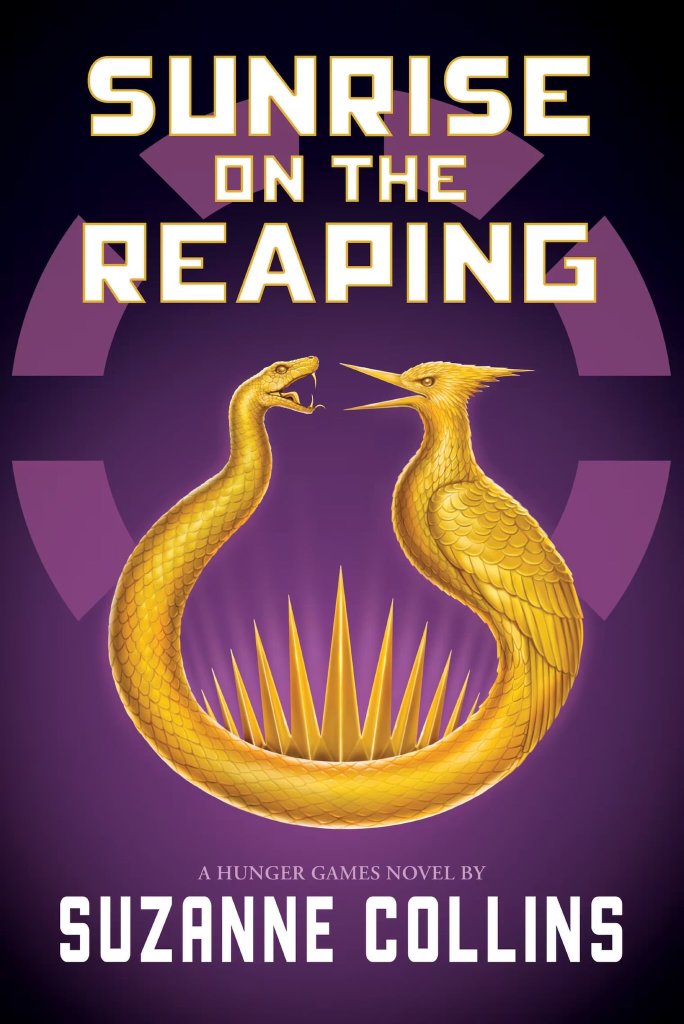
Book: “Sunrise on the Reaping” by Suzanne Collins
Publishing Info: Scholastic Press, March 2025
Where Did I Get This Book: I own it
Where You Can Get This Book: WorldCat.org | Amazon | Indiebound
Book Description: When you’ve been set up to lose everything you love, what is there left to fight for?
As the day dawns on the fiftieth annual Hunger Games, fear grips the districts of Panem. This year, in honor of the Quarter Quell, twice as many tributes will be taken from their homes.
Back in District 12, Haymitch Abernathy is trying not to think too hard about his chances. All he cares about is making it through the day and being with the girl he loves.
When Haymitch’s name is called, he can feel all his dreams break. He’s torn from his family and his love, shuttled to the Capitol with the three other District 12 tributes: a young friend who’s nearly a sister to him, a compulsive oddsmaker, and the most stuck-up girl in town. As the Games begin, Haymitch understands he’s been set up to fail. But there’s something in him that wants to fight . . . and have that fight reverberate far beyond the deadly arena.
Review: We are now at the last book in the “Hunger Games” universe, and I remember being wholly stoked when “Sunrise on the Reaping” was announced. We were finally going to get Haymitch’s Games! I have loved Haymitch since I first read the books, and on this read through I only appreciated his character more. When we meet Haymitch he is the lone surviving victor of District 12 (and only the second victor overall), and he is a drunken PTSD ridden mess who has to mentor Katniss and Peeta, and he turns into a emotional support for them as well as an important part of the rebellion. We all know that he was going to have a rough backstory, but the idea of meeting him when he was young and a tribute was so exciting! I know that some people thought that it was going to be fan service. Well, I can tell you that Suzanne Collins basically said ‘yeah, fuck you and your fan service, you are going to only get FAN DEVASTATION’ (outside of a cameo by THE Effie Trinket), because “Sunrise on the Reaping” is quite possibly the most depressing “Hunger Games” story yet.

I am sure that that was in part due to the fact that Collins didn’t want the fandom to get comfortable and to lose sight of the overall message of these stories. But it is also because Haymitch Abernathy, while a side character seen through the eyes of Katniss in the original trilogy, has an incredibly sad backstory that has to shape who he is by the time we get to Katniss and Peeta’s games. And shape “Sunrise on the Reaping” does.
So we go to the 50th Hunger Games, which is also the Second Quarter Quell, where the ‘special twist’ is that each district sends four tributes. We had some info about this thanks to snippets in the original trilogy, like we knew that Haymitch had a fellow tribute named Maysilee Donner (whose twin Merilee was the mother of Katniss’s friend Madge). But Collins gives us a far larger picture about how Haymitch got to where he was, as well as a look at propaganda in Panem and how entrenched it is.
The propaganda is REALLY apparent this time around, as we see more blatant examples of it in this book that the regular viewers of The Games would completely miss. Whether it’s sudden replacements of tributes after horrific tragedy that is scrubbed from view (like Haymitch not being the original tribute, or the whole Louella/Lou Lou thing, my GOD), or the way that we see Plutarch Heavensbee’s original role as a cinematographer of sorts (more on him in a bit) to promote the games, we see how Snow has taken his lessons from “Ballad of Songbirds and Snakes” and really started to implement them to make the Games full on garish entertainment and a tool of control through fear. And not just the general population, but also the former victors, as we see some fan favorites in this book making appearances like Beetee and Mags and Wiress, but whose circumstances of being involved range from depressing (Mags and Wiress being mentors and seeing them BEFORE they are where they are in the original series, mental health wise), to outright devastating (Beetee’s own child has been reaped, and it’s implied that it is in retaliation).
But the other huge theme in this book which REALLY worked for me and feels SUPER RELEVANT (not that government propaganda doesn’t) is the way that Collins approaches and expands upon the idea of a revolution. When we read the initial trilogy, it seems like Katniss as the Mockingjay is the spark that lit the flame to revolution in Panem, as so many things came together to make her a symbol and people like Plutarch, Haymitch, and Alma Coin took advantage of her popularity to pull off the uprising. But we find out in “Sunrise on the Reaping” that Plutarch has been working on a revolution alllll the way back to Haymitch’s games, and Haymitch was his first tribute recruit. Obviously, it doesn’t go well, and while Haymitch does win and while Plutarch goes undetected, Haymitch loses basically everything after he goes outside of Snow’s approval of how he handles the Games. The revolution this time is a failure, and it takes YEARS to actually achieve, and it needs a lot of lucky timing and non-controllable circumstances to actually come to fruition. This is what hit me the hardest as I read this book, because I think that for a lot of people the idea of a ‘revolution’ is something that just happens, it works, and everything is better. But in reality, it can take a lot of time, it usually involves a lot of deaths, and it also tends to have to have people behind the scenes, like Plutarch Heavensbee, bless is incredibly morally gray character, who are willing to do REALLY dodgy things to achieve their goals, with others, usually more vulnerable groups, bearing the brunt of it like poor Haymitch who lives in the poorest area of one of the poorest districts.
And finally, I also want to touch on the portrayal of District 12 in this book, as we’re kind of in the middle of the timeline between “Songbirds” and the original trilogy. The Covey are still around at this point, with Haymitch being in love with a Covey girl named Lenore Dove. It’s an interesting point in the timeline because the Covey are becoming more sparse, though there is still a clear divide between the Covey, the more merchant class, and the working class in the Seam. We also know that by the time we go twenty five years into the future, the Covey are basically gone, at least culture wise (as Katniss’s father is Covey on his mother’s side), and we see a cultural extermination in process over the series’s timeline. It’s sad and deeply interesting, and with the way Lenore Dove’s fate settles out and how Lucy Gray disappeared in the previous novel, it stings all the more knowing their community will be gone in the coming years.
“Sunrise on the Reaping” is another impactful and powerful “Hunger Games” story that avoids the pitfalls that could have come with it. If Collins is done with these stories and this world, it has ended on a strong note. Up next we start our movie reviews, and we start with “The Hunger Games”! Back to the beginning folks!
Rating 9: There is no fan service to be found here. Instead we get a despairing look at how Haymitch Abernathy became who he was in the original trilogy, as well as an examination of the power of propaganda as manipulation to get a population to believe whatever those in power want them to, and how sometimes revolutions take decades to achieve.
Reader’s Advisory:
“Sunrise on the Reaping” is included on the Goodreads lists “Best Dystopian and Post-Apocalyptic Fiction”, and “[ATY 2026] Character in More Than One Book”.

