
Serena’s Review: “Into the Crooked Place”

INTO_THE_CROOKED_PLACE6Book: “Into the Crooked Place” by Alexandra Christo

Publishing Info: Feiwel and Friends, October 2019

Where Did I Get this Book: Edelweiss+

Book Description: The streets of Creije are for the deadly and the dreamers, and four crooks in particular know just how much magic they need up their sleeve to survive.

Tavia, a busker ready to pack up her dark-magic wares and turn her back on Creije for good. She’ll do anything to put her crimes behind her.

Wesley, the closest thing Creije has to a gangster. After growing up on streets hungry enough to swallow the weak whole, he won’t stop until he has brought the entire realm to kneel before him.

Karam, a warrior who spends her days watching over the city’s worst criminals and her nights in the fighting rings, making a deadly name for herself.

And Saxony, a resistance fighter hiding from the very people who destroyed her family, and willing to do whatever it takes to get her revenge.

Everything in their lives is going to plan, until Tavia makes a crucial mistake: she delivers a vial of dark magic—a weapon she didn’t know she had—to someone she cares about, sparking the greatest conflict in decades. Now these four magical outsiders must come together to save their home and the world, before it’s too late. But with enemies at all sides, they can trust nobody. Least of all each other.

Review: I never got around to reading Christo’s “To Kill a Kingdom,” but I heard a lot of good things about it. So when I saw she had another book coming out this fall, I was eager to jump in and see what the fuss was about. I’ll admit, I was a bit wary when reading the book description, because I think these ensemble/gang/YA fantasy stories ala “Six of Crows” have become the number one genre to regularly burn me recently. But I thought I’d still give it a go based on the recommendations for the author herself. Unfortunately, my wariness was deserved, and this book wasn’t the hit I was hoping for.

Creije is both a wondrous and dangerous place. But whether if is dangerous or wondrous depends largely on one’s own abilities. And four different individuals know that with the right combination of magic, wits, and guts, the streets are where you make a life for yourself. Each with their own role to play and their own proficiency, a simple misunderstanding will quickly draw them together in an adventure where no one can be trusted.

Confession: I read this book back in the fall closer to when it was actually published. But I had also just reviewed (rather negatively) several other books that were very similar to this (ensemble, YA fantasy novels that centered around gangs/heists) and was, frankly, too tired out to want to right up yet another review. But as I did receive this book from a publisher, I thought better late than never. Alas, all of that leads to the obvious point: this book was not my jam and was way too familiar to a million other books that I’ve read just like it.

Look, I loved “Six of Crows.” But in retrospect I’m starting to hold a serious grudge against the deluge of similar YA titles that have now flooded the market. I swear, there was a point where I read about five of these in a row and was beginning to confuse them all (there’s at least two others that I’ve read and *sigh* will get around to reviewing at some point). I mean, the genre has always had trends that come and go, but for some reason this one seems worse than others. I think its because, other than “Six of Crows,” I’ve yet to come across a version of this trope/subgenre that I’ve actually liked.

I hate love triangles (a previous trope found all too often), but I can name at least two books I’ve read in the last year that had this trope and were still good! Because the authors still managed to make it their own and add new and interesting twists to the concept. But for some reason, with these ensemble, YA gang stories…they’re all almost literally exact copies of each other. To the point that some of the staple characters could be interchanged between books with a simple name change and not much would alter. Their personalities are the same. Their relationships are the same. The general mood/banter in the group as a whole is the same. It’s just…exhausting. I don’t know if there’s just not enough to plum with this this particular subgenre or whether “Six of Crows” just set too high of a bar. But something has gone wrong here, and it needs to stop.

And look, I’ve written two entire paragraphs without even talking about this book itself. And that’s because it’s just the same as all of the others. The characters feel like bland re-imaginings of characters we’ve seen before. The dialogue was tired and familiar. The relationships were…ok, I liked that they added the relationship between the two women, but the other was super familiar and predictable. The plot did pick up about half way through the book, but it never felt like it was really coming into anything of its own. Instead, it feels like the author just cobbled together a bunch of things that have been popular in other stories and whipped this one out there as fast as she could. There’s really not much to say in reviewing this book that I haven’t said before about similar books in the past that have tried and failed at this plot.

Eventually, I guess, I’ll have to get around to reviewing the other two books like this I’ve read. One I won’t be continuing and the other I already have the sequel to (though this more a case of “not as bad as the others” than anything else). But I have to space them out so my poor readers don’t have to just re-read the same review from me over and over again. I’m sorry! I just seem to keep reading the same book over and over again, and this is the result!

Rating 5: Adds nothing to a tired and needs to be put to bed subgenre of YA fantasy.

Reader’s Advisory:

“Into the Crooked Place” isn’t on any relevant lists (other than ones having to do with the year of its publication), which I think is telling. But it probably should be on “Villain Protagonists.”

Find “Into the Crooked Place” at your library using WorldCat!
Serena’s Review: “The Glass Magician”

45046558Book: “The Glass Magician” by Caroline Stevermer

Publishing Info: Tor Books, April 2020

Where Did I Get this Book: NetGalley

Book Description: What if you could turn into the animal of your heart anytime you want?

With such power, you’d enter the cream of New York society, guaranteed a rich life among the Vanderbilts and Astors, movers and shakers who all have the magical talent and own the nation on the cusp of a new century.
You could. If you were a Trader.

Pity you’re not.

Thalia is a Solitaire, one of the masses who don’t have the animalistic magic. But that is not to say that she doesn’t have talent of another kind—she is a rising stage magician who uses her very human skills to dazzle audiences with amazing feats of prestidigitation. Until one night when a trick goes horribly awry…and Thalia makes a discovery that changes her entire world. And sets her on a path that could bring her riches.

Or kill her.

Review: I was intrigued by the original sounding premise of this book. Set in New York, turn-of-the-century time period, and some type of new class system that is based around one’s magical ability to turn into an animal. All sounds like cool concepts and all put together, I really had no idea what to expect from this book. Unfortunately, it didn’t really turn out to be much of anything at all, so no expectations was about right.

After inheriting her father’s magic business, Thalia has been making her living as a stage magician. Not blessed with actual magical abilities that would vault her into the upper class of New York society, she is still managing to make a name for herself by performing wondrous and dangerous tricks in her act. One night, however, a trick goes wrong and Thalia discovers there is more within her than she had ever known. Now with abilities she doesn’t know how to control and a murder added to the mix, Thalia’s life is beginning to change. Will it be for the better or for the worse?

For the pros for this book, I will say that I still liked the uniqueness of the time period during which it was set and the choice to have it take place in New York City. It’s always a breath of fresh air to find a fantasy novel that isn’t set in some generic “medieval times” setting. And even more so to find one that is set in a city that exists today. However, I do think the author left a lot on the table with regards to what all could have been done with these two elements. The other positive worth noting was the writing itself. It didn’t stand out to me in any particular way, but it was of the sort that is strong enough to get the job done without distracting the reader. And, considering that I didn’t love much about this book, I think it’s a real strength of the writing that it was strong enough that I didn’t ever really feel like just putting the book down for good.

Unfortunately, as I mentioned with the time period and the setting, it felt like the author came up with some cool, individual ideas, but didn’t spend any time really building up the world or system around them. Like, people have this magic to turn into animals and society has been built in such a way that possessing this ability puts you into an elite class. But the why or how of this is never really explained. The history of how this system came to be in place is lacking. And there is really not magic system of any kind to explain the rules, limitations, or even, to some extent, the benefits of having these abilities. The entire world that has been created depends on these magical factors, and yet we get next to nothing about what they really are. It felt like the author simply didn’t want to bother with the details of these things, instead wanting to just jump into her heroine’s own story.

But there, too, I had problems. Thalia is an interesting enough character on her own, but the book simply didn’t have enough story for her. The entire book feels made up of either Thalia struggling to learn to control her new abilities or making small bits of progress solving a murder mystery. I was pretty surprised, actually, when the murder mystery aspect of it became apparent since there wasn’t any hint of that in the general description. But I’m all for historical murder mysteries, so this should have been a benefit to the story. Instead, again, it felt like only the most basic aspects of this part of the story were really explored. Things all come way too easily to Thalia, with people often behaving against their own best interest or out of character to help her on her way.

To make up page time for the lack of world-building, magic system, or complications in the murder mystery, we instead spend an incredible amount of time just in Thalia’s mind exploring her feelings. I don’t have a problem with books that center largely around the introspective thoughts of a main character, but there just has to be more to the story itself to support this. I also didn’t love the romance we were given. It felt forced and lacked chemistry.

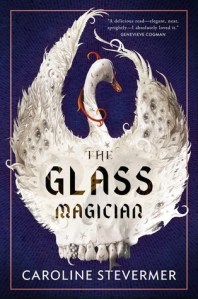
I also have to spend a moment on that cover. Yikes. It’s the kind of thing that immediately attracts the eye (indeed, I clicked on it in NetGalley just because of the swan motif), but the more you look at it, the worse it gets. It’s all kinds of creepy with the teeth and eyes, and I’m not sure it really represents well the book we have. Instead, if I had noticed these details when choosing the book off the shelf, I think I would have most likely put it back just due to how unnerving I find it all.

Overall, I wasn’t impressed with this book. It felt like the author had some really neat ideas at the very core of it, but didn’t spend enough time to fully develop anything. The writing was strong enough, but there wasn’t enough story to go around.

Rating 6: Lack luster and thin, this book didn’t hold up to the promises of its premise.

Reader’s Advisory:

“The Glass Magician” is a newer title and isn’t on any relevant lists. Bizarrely (and inaccurately) it is on “Historical Fiction 2020.”

Find “The Glass Magician” at your library using WorldCat!

Serena’s Review: “Storm from the East”

45043929Book: “Storm from the East” by Joanna Hathaway

Publishing Info: Tor Teen, February 2020

Where Did I Get this Book: NetGalley

Book Description: Battles, revolution, and romance collide in Joanna Hathaway’s stunning, World Wars-inspired sequel to Dark of the West

Part war drama, part romance, Storm from the East is the second novel in Joanna Hathaway’s immersive, upmarket YA fantasy series that will appeal to readers of Sabaa Tahir, Marie Rutkoski, and Evelyn Skye.

War has begun, and the days of Athan’s and Aurelia’s secret, summer romance feel a world away. Led by Athan’s father, the revolutionary Safire have launched a secret assault upon the last royal kingdom in the South, hoping to depose the king and seize a powerful foothold on the continent. Athan proves a star pilot among their ranks, struggling to justify the violence his family has unleashed as he fights his way to the capital—where, unbeknownst to him, Aurelia has lived since the war’s onset. Determined to save the kingdom Athan has been ordered to destroy, she partners with a local journalist to inflame anti-Safire sentiment, all while learning this conflict might be far darker and more complex than she ever imagined.

When the two reunite at last, Athan longing to shake the nightmare of combat and Aurelia reeling from the discovery of a long-buried family truth come to light, they’ll find the shadow of war stretches well beyond the battlefield. Each of them longs to rekindle the love they once shared . . . but each has a secret they’re desperate to hide.

Previously Reviewed: “Dark of the West”

Review: I really enjoyed “Dark of the West” when I read it last spring. It wasn’t a book that had been on my radar much, but I was instantly drawn in by the complicated world-building and the even more complicated deep dive into themes regarding revolution, warfare, and a world shifting between monarchy, democracy, and everything that lies in between. The sweet romance between our two teenage main characters who represent vastly different positions was also a big draw. So, when I saw the sequel was coming out, I placed a request immediately. I did struggle with this one a bit more than the first, but it still comes out solidly in the “win” category.

Athan and Aurelia are separated by much more than distance, as Athan, unknown to Aurelia, is the son of the war-mongering leader of the Safire nation. They now find themselves involved on opposite ends of a war to determine the future of the last kingdom of the South with a monarchy at its heart. Aurelia finds herself in this capital in an attempt to use her family connections through her mother (born a Southerner herself) to stave off a growing war. But while there, Safire makes its move, and with it Athan, leading the aerial forces, they draw ever neared to the city where Aurelia is staying. But as they each move unknowingly closer together, they discover new truths about their parents, about themselves, and about the people and causes they’re fighting for.

This is a complicated book, and that’s both a good and bad thing. One way in which this complication is a good thing is the very honest approach it takes to themes that are very complicated and all to often are written about in black and white terms, with good guys and bad guys seeming to pop straight from the earth fully formed in their one-sided moralities. But this book lives in shades of grey. At one point or another, the reader finds themselves sympathizing with every angle involved in this quickly changing world. And I say angle, and not side, because that’s another good thing the book does: there aren’t just two sides to the conflicts here. Sure, it’s a war with one country invading another. But we also see the complicated relationships that allies have with both the invaders and those being invaded. There are other forces involved as well. Some would call them terrorists, others would call them freedom fighters. These names are completely dependent on who is doing the telling and who is listening, and even that can change with just the slightest readjustment of context, history, and priorities. But this same nuanced look at the fact that there are no “good guys” in war also leaves the reader in a precarious state, emotionally.

At the beginning of the story, it is all too easy to dismiss Aurelia’s viewpoints and plans as foolishly optimistic. And they are. Of the two main characters, she has the more limited view of  the world. Growing up in a privileged and traditionally monarch-ruled country has left her with a very simplistic idea of how the world work. Like many young people, she thinks that only she sees the full picture and if others would simply listen to an argument from her, they’d all see that their feuds are pointless and agree to a peaceful resolution. It was both heart-breaking and a relief to see her have to confront the folly of these views.

But it was also just a very depressing story arc, overall. By the end, between Athan’s struggles in the midst of some truly terrible acts of warfare and Aurelia’s slow sink into the grim realities of the world, it was hard not to feel a bit hopeless. We see all the shades of grey. We see all the wrongs committed by every group, each playing victim and aggressor in different points of history and with regards to various groups. It’s very realistic and believable, but also a tough story to feel happy reading.

I also wish there was a prequel series to this story. We learn much more about both Athan and Aurelia’s parents in this book, and it’s all pretty fascinating. One part really stood out, a moment when Aurelia discovers a secret about her mother and realizes, in a very honest and true-to-life moment, that her mother was a person with a life before Aurelia was born. It was the kind of moment that is hardly ever felt in YA books. Aurelia comments that she has fallen into the trap of feeling like these conflicts and histories all started in her own life. But this moment reminds her that people had lives, had fights, had secrets, had allegiances and enemies, all long before her. That she was plopped down in the middle of it all. Just like her parents were plopped down in the middle of it all. And back. I loved this thought. Like I said, most YA books do nothing to discourage this way of thinking in its protagonists, that the world starts and ends with them. And yes, they are the main character of their story and thus their’s is the one we care about, but it’s a nice reminder that there is more to it than all of that. I mean, most YA books either kill off the parents or conveniently forget to mention them for much of the story. They definitely rarely presented as fully fledged people with histories of their own (outside of some direct connection to the main character). But this series is really excelling at creating a story that is clearly about Athan and Aurelia but still puts them down in the middle of an already complicated world, not making them the whole world in and of themselves.

But yes, it’s all very complicated. Having a year-long break between these two books was frankly very challenging. It took me a long time to re-orient myself to the world and the players in it. I’ve been reading e-ARC versions which don’t have maps, and I’m not sure if the finished books do either? If not, they could really benefit from one. It took me quite a while in the first book to picture this world, and almost just as long here in the second to re-create it in my mind. And all the weavings in and out of secret relationships and allegiances were hard to keep up with. I’d have to constantly remind myself who knew what, who had betrayed whom, and which of our main characters knew which pieces of the greater puzzle. It was a lot.

The pacing was also pretty slow in the beginning, so between these two factors, it took a bit to really get into this story. Having liked the first book, I was wiling to do the work, but for anyone feeling more middling about the series, this could be a challenge. But one definitely worth facing if you’re looking for a complicated political series! And ultimately, fans of the first book should be happy with this second outing, and, like me, anxious to see where it all ends up in the third book. We still have that prologue from the first book looming over us. How, oh how, do our main characters get to that awful place? And, more importantly, how do they get out of it??

Rating 8: A beautiful, horrible world of greys where I just want my two precious main characters to be happy.

Reader’s Advisory:

“Storm from the East” is a newer title so it isn’t on many relevant Goodreads lists yet, but it should be on “Original Stories . . . a Breath of Fresh Air.”

Find “Storm from the East” at your library using WorldCat!

Kate’s Review: “Under the Moon: A Catwoman Tale”

38452822._sx318_Book: “Under the Moon: A Catwoman Tale” by Lauren Myracle and Isaac Goodhart (Ill.)
Publishing Info: DC Ink, May 2019

Where Did I Get This Book: The library!

Book Description: Selina Kyle is fiercer than she knows. For 15 years, she’s put up with her mother’s string of bad boyfriends, but when Dernell, her mom’s current beau, proves crueler than the others, Selina reevaluates her place in her home. There’s no way Selina and Dernell can live under the same roof, and since Dernell won’t leave, Selina must.

From New York Times bestselling author Lauren Myracle (ttyl) and artist Isaac Goodhart comes a story about learning how to survive the world when you’ve been forced to abandon your home and finding allies in the most unexpected moments.

Review: If I’ve said it once, I’ve said it many a time: I love Catwoman. I have always loved Catwoman. And because of my deep and unabiding love for Catwoman, I am VERY picky about how Catwoman is portrayed. Some portrayals I’ve loved, other’s I’ve despised, but at the end of the day while it’s a gamble, I am always up for giving any version a chance. So when I discovered “Catwoman: Under the Moon” by Lauren Myracle, I absolutely had to take the bet and roll the dice.

giphy-1
It will probably never live up to this, but a good effort can do a lot. (source)

I always find it a little risky to try and give Selina Kyle/Catwoman an origin story, for a couple of reasons. The first is that Selina is such a mysterious character at her heart that learning too much can sometimes take away some of the allure. While I like getting into her head and seeing vulnerability, I think that part of the appeal of her is that she has secrets to hide, and don’t you wish you knew them. The other is that some origins have become so iconic over the years (“Batman Returns” really nailed it), I’m always going to be comparing new origins to well done old ones. I think that, for the most part, Myracle is able to fight back both of these pitfalls, as her backstory for Selina is filled with pathos and empathy while still feeling very believable in a lot of ways (I’ll get to the problems I had with it in a bit). And I also think that it feels different enough from other origins I’ve read and unique enough that I wasn’t constantly being like ‘well that’s not how I see it’. Selina’s story in this balances a good line between too unbelievable tragic, and not dark enough. And given some of the darker themes that Myracle brings in, like domestic abuse, animal cruelty, mental illness, and homelessness, she also has a large list of resources in the back of the book so that any readers that may see themselves in Selina’s story may have a place to turn to. I really liked that. 

But then there were the issues I had with it. The first was that, for whatever reason, Bruce Wayne had to be brought in as a childhood friend of Selina. Look, I love Selina and Bruce, no question, they are definitely a top ship for me in the DC universe. But I had really hoped that Selina could have just stood on her own two feet without him being around. It also just didn’t make sense that he had to tell her that his parents had been murdered and what was why they grew apart, and she seemed to not know that. I mean, I feel like the murders of two of the most powerful people in Gotham would have been news that most people would have heard of. And given that Selina was in a middle school setting with Bruce, that teenage gossip mill would have CERTAINLY clued her in, right?! On top of that, there were a good number of plot ideas and strings that were introduced in this book, but I didn’t feel like many of them were fully explored. The biggest one for me was when Selina started running with other homeless kids, and met a girl named Briar Rose who doesn’t speak and has a tragic backstory. There was a lot of potential in the friendship between Selina and Briar Rose (or Rosie as Selina starts calling her!), especially since Myracle left Selina’s younger sister out of this backstory. But we didn’t really get to see their friendship grow, as there was a time jump with small flashbacks to show that they were now thick as thieves so that the plot could progress as such. I never really care for that kind of storytelling.

“Under the Moon” was an alright backstory for one of my favorite DC ladies, but it had the promise to be so much more. That said, if Myracle continued this story, I’d probably pick it up!

Rating 6: A pretty okay origin story for Selina Kyle/Catwoman, but there were a few too many ideas that didn’t get explored enough.

Reader’s Advisory:

“Under the Moon: A Catwoman Tale” is included on the Goodreads lists “Ladies of DC”, and “DC Comics by Women”.

Find “Under the Moon: A Catwoman Tale” at your library using WorldCat!

Serena’s Review: “The Queen’s Assassin”

39334176._sy475_Book: “The Queen’s Assassin” by Melissa de la Cruz
Publishing Info: G. P. Putnam’s Sons, February 2020

Where Did I Get this Book: Edelweiss+

Book Description: Caledon Holt is the Kingdom of Renovia’s deadliest weapon. No one alive can best him in brawn or brains, which is why he’s the Guild’s most dangerous member and the Queen’s one and only assassin. He’s also bound to the Queen by an impossible vow–to find the missing Deian Scrolls, the fount of all magical history and knowledge, stolen years ago by a nefarious sect called the Aphrasians.

Shadow has been training all her life to follow in the footsteps of her mother and aunts–to become skilled enough to join the ranks of the Guild. Though magic has been forbidden since the Aphrasian uprising, Shadow has been learning to control her powers in secret, hoping that one day she’ll become an assassin as feared and revered as Caledon Holt.

When a surprise attack brings Shadow and Cal together, they’re forced to team up as assassin and apprentice to hunt down a new sinister threat to Renovia. But as Cal and Shadow grow closer, they’ll uncover a shocking web of lies and secrets that may destroy everything they hold dear. With war on the horizon and true love at risk, they’ll stop at nothing to protect each other and their kingdom in this stunning first novel in the Queen’s Secret series.

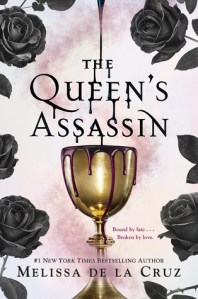
Review: Something, something, quippy and non-spoilery intro. *Sigh* But frankly, this book didn’t make any effort to be good or original, so why should I! Yes, holding myself to the standard of books that I hated is the writing goal I want to set for myself and this blog! This was a whim book request for me, even though the synopsis didn’t seem particularly inspiring. I’ve had some great results from reading random books I haven’t heard a bunch about before (see “The Bones Houses”), but it does seem that it really goes one of two ways: I’m either blown away, the surprise only adding to the fun, or I absolutely hate the book and wonder why I ever risk it. Obviously, this was the latter.

I’m not going to even bother re-summarzing this book. The book blurb does a decent enough job and as the story is so predictable, there’s nothing new I could add to my summary of the story that isn’t an out-right spoiler. So let’s jump right into it! Usually I would start with the things I liked, but I have to be honest, there was really nothing I liked about this book. Often, if I don’t like the story itself, the writing is still good. If the writing is bad, there’s a character I can enjoy. Not so, here. The best I can say was that perhaps this book missed a publishing window where it wouldn’t have been quite so bad. I still wouldn’t have enjoyed it, but perhaps some of its most trope-y plot points wouldn’t have felt quite so egregious had this been released five years ago. It sure does read like a book that has completely missed the fact that everything it is doing has been beaten into the ground already over the last several years of YA fantasy publishing. So, good points: maybe passable if existed in an alternate reality where it came out in 2015.

The plot is incredibly predictable. Read the summary again. Make a few predictions. Spoiler alert! They’re all right. The book takes itself way too seriously with these supposed surprises as well. When I wasn’t simply exhausted by the pretense of it all, I was flabbergasted that anyone, anywhere, would ever think that these “reveals” could be read in a serious light. Shadow’s (there you go, another thing to hate! That name…) entire history is obvious to any one who has even a passing familiarity with these stories. The one aspect of her tale that could even be a surprise didn’t work in the book’s favor as it then retroactively undermined much of Shadow’s own narration throughout the book. Her story is told in first person. There are certain rules to first person narration, and this “surprise” threw all those rules in a dumpster fire in pursuit of “surprises.”

Speaking of first person narration, the writing was fairly bad in this book. Mostly this was due to the choice to alternate POVs between Shadow and Caledon and, inexplicably, to switch between first and third person narration for these two characters. This type of switch is always jarring and rarely justifiable. The only books I can think of that pulled off something similar were N. K. Jemisin’s “Broken Earth” trilogy titles, and those books were award winners, so you know they’re already a rarity. The choice here is not only bizarre but exists for no clear reason. If the author can’t differentiate between these two characters’ voices without switching writing tenses, that speaks to a whole new problem. If it was meant to represent some greater distinction between these two, I couldn’t spot it. And in the end, all it did was interrupt any flow or rhythm that the story was trying to establish.

Even without this, the pace of this story was all over the place. In the first few chapters, a million things seemed to happen one after another, leaving the reader confused and unable to connect to anything of these events. Worst of all, Shadow’s motivations behind these actions were never clear or explained. She just did things, so that things would happen, so that she could react to those things. And then the story took a jarring halt for a good chunk, and then again with the manic pacing. This, finally, was unpredictable but in the worst way.

The romance was also cringe-worthy and full of unnecessary angst and drama. At one point, the two go undercover…as siblings. Why? Because now there can be all of this increased awkwardness when others discover them being romantic! Angst! Drama! The author’s fingerprints were all over this, and each smudgy, forced moment just made me, again, cringe. To offset this, for a book with the name “assassin” in the title, there are next to no actual assassinations. It’s just yet another example of playing to the supposed YA fantasy crowd. People like books with the word “queen” in the title. And they like assassins…so.

Like I said before, the best I can say for this book is that some of the surprises, had they come in a book published five to ten years ago, could  have maybe worked. But the poor writing with the swaps in tenses and fast/slow pacing would remain. The poor characterization would remain. The romance, such as it is, would remain. And you’d still have to take a character named “Shadow” (get it? cuz she wants to be an assassin?) seriously for an entire book. I really can’t recommend this book to anyone. The author has several other books, so perhaps her die-hard fans will enjoy this. But for everyone else, there are better things out there. My usual recommendation for those looking for a good assassination book is “Skullsworn” so check that out instead.

Rating 2: I didn’t like anything about this book. The characters and plot were tired re-hashes of things we’ve seen a million times before in YA fantasy fiction. And the writing was poor, to really put the last nail in the coffin (a coffin that was not necessary to the plot as, again, no assassinations.)

Reader’s Advisory:

This book isn’t good. You shouldn’t look for ones like it. But here’s a generic Goodreads list that it’s on: “Queen in Title.”

Find“The Queen’s Assassin” at your library using Worldcat! If you must…

Serena’s Review: “The Shrike & the Shadows”

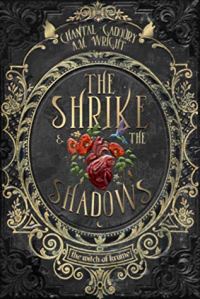
51012361._sx318_sy475_Book: “The Shrike & the Shadows” by Chantal Gadoury and A.M. Wright
Publishing Info: The Parliament House Press, March 2020

Where Did I Get this Book: NetGalley

Book Description: Men have gone missing before.

The village of Krume is plagued by a haunted wood and a hungry witch. It’s been that way for as long as Hans and Greta can remember, though they have never seen the witch themselves; no one has.

When men start to disappear once again in the cover of night – their bloody hearts turning up on doorsteps – the village falls into frenzied madness.

Hans and Greta, two outcast orphans, find themselves facing accusations of witchcraft and are met with an ultimatum: burn at the stake, or leave the village forever.

With nowhere else to go, they abandon their only home.

As they venture into the strange forest, their path is fraught with horrific creatures, wild and vivid hallucinations, and a mysterious man tied to the witch’s past.

The Shrike is watching, just beyond the deep darkness of the woods.

Review: A lot of fairytales have been retold a million different times in a million different ways. And I, being the sucker I am for fairytale retellings, am more than happy to read the millionth and one version of many of these popular tales. That said, it’s always particularly exciting when I see a new book coming out that it tackling one of the less popular story. I’m sure I’ve read a “Hansel and Gretel” story in the past, but I couldn’t think of one off the top of my head, so I immediately placed a request for this book. Unfortunately, this was not only a disappointment as far as new fairytale retellings go, but also, in my opinion, just not a very good book overall.

The village where Hans and Greta have grown up has long been haunted by an evil that claims the lives of its men, leaving their hearts on the doorsteps of the grieving families. It is under this constant threat that Greta and Hans have tried to make a life for themselves, praying each night that Hans won’t be next. But when they are driven out of the only home they’ve ever know, the two siblings find themselves alone in the very same forest in which lurks this evil force. Will they make it through this woods? And what waits on the other end?

I was really bummed to find that this book was such a miss for me. I seem to have had a recent run of either books I’ve really enjoyed or ones that have really, really not worked for me. I’m hesitant to make this comparison, but what first came to mind was that this book read like a bad fanfiction story. I say this having read and enjoyed a good amount of fanfiction, some of which with writing as good or better than many published novels I’ve read. So this is in no way a ding against fanfiction as a whole. That said, this book exemplifies several of the pitfalls that poor works of fanfiction have been known to fall into: lackluster world-building, washed out characters, and, unfortunately, over use of sex scenes and trauma, seemingly to make up for a lack of real story at its heart.

The world-building is lacking and transitions from scene to scene are awkward at best and nonexistent at worst. I’d have a hard time describing much of anything about the world in which this book takes place. In the beginning of the story we have a scene with Greta frantically searching for her brother. She runs around quite a bit, but I was completely unable to track her movements. She’s at one point in her cabin, then outside, then, I think, in a field. Shortly after that, she and Hans are in the village itself. This action takes place in the first few pages, but it is a perfect example of the lack of attention that went into setting the scenes for this story. There is no foundation upon which any of this happens, and the writing makes no effort to draw a picture in the reader’s mind.

The writing didn’t serve the story any better as far as the plot goes either. Early in the book there’s a scene depicting an attempted assault (this comes out of nowhere, by the way, and was jarring in and of itself). It’s a serious topic, but the way it is depicted is cartoonish in its villainy. The assaulter’s lines of dialogue were cringe-worthy, and the villain himself was made up of only the broadest strokes of stereotypes without any effort to delve into the seriousness of the real-life history behind the power imbalance that was being described. Again, this was only an early example, but this writing problem continued throughout.

Hans and Greta were also difficult to care about. While the writing seemed a bit better equipped to handle these two main characters, they still often felt flat at times. Hans, in particular, was very hard to sympathize with. Greta had the stronger moments of the two, but as the story was split between them, this wasn’t enough on its own to balance out Hans.

And then there’s the sex scenes. As I mentioned, there’s an attempted assault that comes out of nowhere within a few pages of the start of the book. There’s very little build up to this, and, overall, it doesn’t feel handled particularly well. I’m not in the camp that says every book that has scenes like this should have an overt trigger warning on the cover. Mostly this is because strong writing will build to an event of this nature in a way that allows readers time to decide whether to read the event or not. But with weaker writing, these scenes are a bit trickier. And from there, once our characters are in the woods, there are still numerous sex scenes. I enjoy romances here and there and am not a prude about scenes like this in my books. But the sheer volume of them was off-putting, not to mention the jarring juxtaposition of these scenes against the story’s effort to build up the horror and threat of their travels through the woods. Like I said, kind of like bad fanfiction.

I didn’t enjoy this book. I’m not familiar with either of these authors, so I’m not sure if this is indicative of either of their other works. But on its own, this wasn’t a strong story. I had a hard time connecting to the characters, and the world-building was so superficial that I couldn’t describe much of the book if you asked.

Rating 4: Very disappointing, “Hansel and Gretel” deserve better.

Reader’s Advisory: 

“The Shrike and the Shadows” is on this Goodreads list: “Parliament House Novels.”


Kate’s Review: “Deathless Divide”

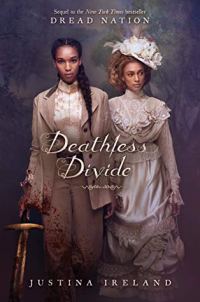
38124119._sy475_Book: “Deathless Divide” by Justina Ireland
Publishing Info: Balzer + Bray, February 2020

Where Did I Get This Book: The library!

Book Description: The sequel to Dread Nation is a journey of revenge and salvation across a divided America.

After the fall of Summerland, Jane McKeene hoped her life would get simpler: Get out of town, stay alive, and head west to California to find her mother.

But nothing is easy when you’re a girl trained in putting down the restless dead, and a devastating loss on the road to a protected village called Nicodermus has Jane questioning everything she thought she knew about surviving in 1880’s America.

What’s more, this safe haven is not what it appears – as Jane discovers when she sees familiar faces from Summerland amid this new society. Caught between mysteries and lies, the undead, and her own inner demons, Jane soon finds herself on a dark path of blood and violence that threatens to consume her.

But she won’t be in it alone.

Katherine Deveraux never expected to be allied with Jane McKeene. But after the hell she has endured, she knows friends are hard to come by – and that Jane needs her, too, whether Jane wants to admit it or not.

Watching Jane’s back, however, is more than she bargained for, and when they both reach a breaking point, it’s up to Katherine to keep hope alive – even as she begins to fear that there is no happily-ever-after for girls like her.

Review: A couple years ago, Justina Ireland wrote the YA horror/historical fiction book “Dread Nation”, a novel about the zombie uprising during Reconstruction in the U.S. Her main character, Jane, was a black teenage girl being trained to be a personal bodyguard for upper class white people, as after the zombies came Black and Indigenous people were recruited to protect the white people of society. It ended with an overrun town and Jane, her frenemy and fellow attendant Katherine, her old flame Jackson, and a group of refugees deciding to head West to California, as Jane was hoping to find her mother. When I heard about “Deathless Divide”, the sequel to “Dread Nation”, I was anticipating another zombie horror novel with the usual apocalypse themes. What I got was something completely different. This time, we get a horror historical fiction novel with distinct themes of a Western, and the lonesome redemptive attempts that come with that genre.

giphy-4
Spoiler Alert: It does. (source)

“Deathless Divide” picks up right after the end of “Dread Nation”, and almost immediately it gets turned on it’s head as to what I had expected from the narrative. For one thing, we are not only getting Jane’s POV, we also get the POV of Katherine, the high strung, prim, and incredibly talented classmate and sometimes friend of Jane. I wanted to know more about Katherine in “Dread Nation”, so when we got to get inside her head in “Deathless Divide” I was overjoyed. Katherine always intrigued me the most from the first book because I loved that she is unabashedly feminine, and is still an incredible fighter, perhaps the best in the book. Too often we see women characters who are made ‘strong’ at the expense of having their femininity stripped away. This is fine, of course, as there are lots of ways to write female characters, but women can fight and kick butt in a corset if they want to, dammit! I also liked getting a deeper exploration of Katherine and the issues that she has to contend with as a very attractive woman who is constantly underestimated, and who, as a woman who passes for white, doesn’t always feel like she has her identity all figured out. Getting to see more of Katherine was delightful. 

The other unexpected shift in the narrative was, as I mentioned before, the fact that it has a distinctly Western theme about it. Usually as a rule I am not a fan of Westerns, as the themes usually don’t grab me AND so many of the Westerns that I think of feel imperialistic. But in “Deathless Divide” Ireland does a really good job of taking the theme of the lone gunslinger and applying it to Jane as her journey progresses, especially since the usual trope of that is a white man. I loved the role for Jane, as she has endured so much trauma and loss and violence because of her race and the fact that Black and Native people have been used as protectors and bodies to protect the White people in a zombie ravaged society. It’s no wonder she would become morally ambiguous as she travels the west looking for revenge. It makes the idea incredibly tragic. And it’s just another of many ways that Ireland once again explores themes and issues of race and racism in America, and like in “Dread Nation” it works very well. From POC being used as guinea pigs to further scientific research to race and class relations in urban settings and capitalism to colorism, “Deathless Divide” shows that some times don’t really change much, and that we still have a long way to go. 

As for the zombies, not much has changed from the first book, and they aren’t as centered this time around. But that said, we do get to delve into the ideas of potential cures, and how different science experiments can bring different outcomes when it comes to the zombies and how they interact with their potential prey. I don’t want to spoil anything here, but just know that Ireland still manages to make the zombies feel fresh and interesting even when they aren’t at the forefront. After all, like in all good zombie stories, it’s the humans that are the bigger threat.

(note: As I mentioned in my review for “Dread Nation”, there had been criticism of the Native characters in that book. I’ve not seen anything in that regard about this book, and I don’t think that I as a white woman can say if Ireland has been more responsible this time around. We do get a more complex and deeper dive into the character of Daniel Redfern, however. If anything changes on this front I will update this post.)

“Deathless Divide” is the end of the road for this world and characters (at least for now; Ireland has said that it COULD happen that more gets written, maybe), and I think that it’s a great follow up and completion. I’ll miss Jane and Katherine.

Rating 8: A satisfying ending with a bold new genre take, “Deathless Divide” wraps up a world of zombies, racism, and empowerment for Black women.

Reader’s Advisory:

“Deathless Divide” is included on the Goodreads Lists “Black Heroines 2020”, and “LGBT SciFi and Fantasy 2015-2020”.

Find “Deathless Divide” at your library using WorldCat!


Serena’s Review: “Night Spinner”

45046766Book: “Night Spinner” by Addie Thorley

Publication Info: Page Street Kids, February 2020

Where Did I Get this Book: Edelweiss+

Book Description: Before the massacre at Nariin, Enebish was one of the greatest warriors in the Sky King’s Imperial Army: a rare and dangerous Night Spinner, blessed with the ability to control the threads of darkness. Now, she is known as Enebish the Destroyer―a monster and murderer, banished to a monastery for losing control of her power and annihilating a merchant caravan.

Guilt stricken and scarred, Enebish tries to be grateful for her sanctuary, until her adoptive sister, Imperial Army commander Ghoa, returns from the war front with a tantalizing offer. If Enebish can capture the notorious criminal, Temujin, whose band of rebels has been seizing army supply wagons, not only will her crimes be pardoned, she will be reinstated as a warrior.

Enebish eagerly accepts. But as she hunts Temujin across the tundra, she discovers the tides of war have shifted, and the supplies he’s stealing are the only thing keeping thousands of shepherds from starving. Torn between duty and conscience, Enebish must decide whether to put her trust in the charismatic rebel or her beloved sister. No matter who she chooses, an even greater enemy is advancing, ready to bring the empire to its knees.

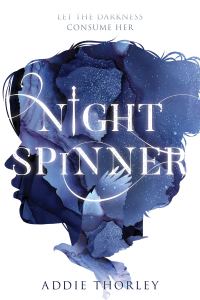
Review: Another beautiful cover! It seems like I’m a broken record recently in my praise of the cover art of my books, but it’s also just true that many of them have been extraordinary! It’s nice to see original cover art that properly reflects the book itself rather than trying to brazenly mimic other successful titles in an attempt to trick readers into picking books up. I mean, I get it, publishing is a business and all of that. But a beautiful cover will do the job just as well, as many readers, myself included, will pick up titles like this because the cover is lovely and unique. The book was also marketed at a retelling of “The Hunchback of Notre Dame.” And because I can’t even really picture what that looks like, this was an immediate request for me!

Enebish’s life is now one of seclusion and repression, a far fall from a few years ago when she had been on the cusp of becoming a great warrior and great leader for her people. But when a horrific accident occurs, killing many and crippling Enebish, her life takes a drastic turn, leaving her hated and feared by those who used to respect her. But, after years of hiding from her own powers and ignoring the temptations of the night, she is finally given a path forward to redeem herself. As she chases down a notorious criminal, however, she learns that there are many secrets in the night, not least of all her own.

While this book wasn’t the home run I’d been hoping for, there was still a lot I ended up liking about it. For one thing (and in my book, most importantly), Enebish was an excellent character. While some of her secrets and the reveals she discovers throughout the book were easy to guess, her own process of exploring these new insights was always sympathetic and relatable. As the story progresses, we see more and more clearly that her physical injuries are not nearly as crippling as her fear. Fear of her past, fear of the judgement of others, and, of course, fear of herself.

I was also a fan of the writing style and world-building. It was the kind of book that I was able to immediately sink into. Writing is always one of the hardest aspects of a book to review because what makes one author’s style work and another’s struggle can be both very subjective to the reader as well as almost impossible to pinpoint with specifics. I can usually tell within the first few chapters of a book whether the writing is going to click for me, and right off the bat, this one did. The world-building was also interesting, and I was able to easily picture the various locations that Enebish travels to.

The romance is definitely on the slow-burn side and there were hints of a love triangle at points. Luckily, the story didn’t commit fully to said triangle and the romance itself was very sweet, what little we had of it.

My struggles had to do with the length/pacing of the story, as well as the comparison to ” The Hunchback of Notre Dame.” To the latter point, I found this expectation more distracting than anything. I can see the base elements for why this was referenced in the blurb, but frankly, in the first half of the book I spent way too much time comparing characters and events to that story and not enough appreciating the book before me. I think, as a whole, the comparison is too weak to add anything to the story and is likely to prove more distracting to readers. I recommend trying to put that thought out of your head immediately to better enjoy the book. The middle of the story also lagged a bit, and, overall, I think the book was a bit longer than what was necessary. As the writing and characters were strong, these were minor concerns, but still worth noting.

Overall, I thought this was a really interesting read. I’m not biting at the bit to get to the second one, but it laid down a decent foundation for the plot going forward, and I’m fairly invested in Enebish herself. If you’re looking for an original fantasy novel this spring, this might be one worth checking out!

Rating 7: A bit longer than was necessary, but a compelling lead character and interesting magic system pulled this one into the “win” column.

Reader’s Advisory:

“Night Spinner” is a new book, so it isn’t on many relevant Goodreads lists. But it is on “Profiles in Silhouette.”

Find “Night Spinner” at your library using WorldCat!


Serena’s Review: “Woven in Moonlight”

40877706._sy475_Book: “Woven in Moonlight” by Isabel Ibnez
Publishing Info: Page Street Books, January 2020

Where Did I Get this Book: BookishFirst

Book Description: Ximena is the decoy Condesa, a stand-in for the last remaining Illustrian royal. Her people lost everything when the usurper, Atoc, used an ancient relic to summon ghosts and drive the Illustrians from La Ciudad. Now Ximena’s motivated by her insatiable thirst for revenge, and her rare ability to spin thread from moonlight.

When Atoc demands the real Condesa’s hand in marriage, it’s Ximena’s duty to go in her stead. She relishes the chance, as Illustrian spies have reported that Atoc’s no longer carrying his deadly relic. If Ximena can find it, she can return the true aristócrata to their rightful place.

She hunts for the relic, using her weaving ability to hide messages in tapestries for the resistance. But when a masked vigilante, a warm-hearted princess, and a thoughtful healer challenge Ximena, her mission becomes more complicated. There could be a way to overthrow the usurper without starting another war, but only if Ximena turns her back on revenge—and her Condesa.

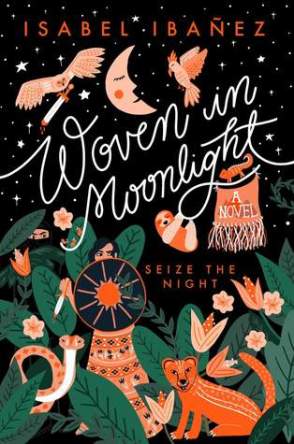
Review: This book was a no-brainer for me to request. I mean, look at that gorgeous cover? I’m not sure I can remember a book with a cover like that; it immediately stands out and I’m sure the book will benefit from many a spur-of-the-moment pick-up while on the shelves at stores. The book description itself was also incredibly unique-sounding and dealing with a people, place, and culture that I am only passingly familiar. In many ways, the cover and description reminded me greatly of “Gods of Jade and Shadow” which I read last summer and loved. Unfortunately, this comparison didn’t hold true in the actual reading experience…

Ximena has lived most of her life pretending to be someone else, a queen, the Condesa. But mostly a queen under siege: managing dwindling supplies, sending out scouting parties, and dreaming of one day returning her people to their homeland and the city that is now occupied by the cruel king Atoc. Now, with a demanded-marriage between the two leaders of these divided peoples, Ximena has the greatest of all performances before her. She must marry the usurper and serve as an embedded spy, searching for that crack that can benefit her people and her sister-friend, the true Condesa.

Even typing up that description makes me excited about the story this could have been. Yet, alas, could have been, but wasn’t. This is one of those strange books where I question whether I read the same story others read. Currently, it’s rated over 4 on Goodreads, so many people are loving it. Perhaps I can see elements of what all of these other readers are latching on to, but it all seems like too little, too familiar, and too inexplicable to really earn those 4 stars.

The biggest strength this book has going for it is the unique setting, the unique culture (what little we really get of it), and the descriptions of Ximena’s weavings. There are some truly lovely depictions of these detailed creations, and having a mother who is an avid weaver, I could see the magic in her abilities here, even without the actual magic involved. What descriptions we received of the countryside and the city itself were intriguing, but this is also where the bare minimums began to show. I had just enough to form loose images, but I have to admit that many of these were probably drawing from stereotypical images of South American culture (there isn’t even such a thing, hence the extreme stereotype of my mental images that were just drawing from random images from other books and movies set in South American countries). I wish there had been a more detailed look into the daily life of the people, a clearer image drawn of their lives and the world they lived in. Half of the reason I picked up this book was because of the uniqueness to be had here. Finally not another European fantasy novel! But then it felt like the author only went halfway, and I was left wanting.

From the “too little” we move to the “too familiar.” Most of this plot will read as incredibly predictable to anyone who reads a lot of YA fantasy. I could quickly guess who El Lobo was as well as predict several of the other major plot points of the story. Perhaps for readers who aren’t as well versed in current YA fantasy tropes this would read better. Or even age it down to middle grade readers who simply haven’t had the time to build up these stores of memory that make stories like this feel rote and tired. There’s nothing inherently wrong with it; I’ve just read it too many times before. And when the surprise has been taken out of most of the twists, there’s not a lot of drive behind speeding through the rest of the story.

And lastly, the “too inexplicable.” I really struggled with Ximena herself. The love story was, again, predictable. And she kept referring to said characters as “the boy” which I just found cringe-worthy. I get that typing out “young man” seems kind of silly and obviously “guy” is anachronistic and has its own issues. But given the situation we’re meant to be in (she’s there to marry a king), I think we can just stick with “man” and be done with it. Regardless of age, this is an adult situation, and she’s been an adult for many years, making decisions as a ruler and now serving as a spy meant to marry the enemy. Referring to someone as “a boy” can only be a demeaning comment in these circumstances. But she uses it as a bland, seemingly objective description, and it bothered the heck out of me. If he’s “a boy,” he’s a kid and my mind will neatly file him away in the “non-love-interest” section.

Beyond that small nit-pick that I blew out of proportion with my own annoyance, it was hard to understand Ximena. We’re meant to believe that she’s been training, and acting, as the Condesa for almost all of her grown life. Not only would the real Condesa have to be well-versed in self-control, cool thinking, and precise speaking/acting, someone who grew up to serve as a decoy in this role would have to be all of that twice over. But Ximena routinely and regularly loses all self-control. It’s hard to believe that she wasn’t immediately seen through. Or, if not that, it would seem that all respect would be quickly lost for “the Condesa” as a leader since she can’t stop behaving like a rash, easily provoked youth. Ximena spends way too much time caught up in her own personal angst and far too little behaving as a true Condesa would. Sure, she always comments after the fact on how that was really “un-Condesa-like,” but that doesn’t do away with the fact that had she been trained to do this her entire life, there should be nowhere near as many outbursts as there are in the first place.

A book is always going to be a hard sell for me if I can’t connect with the POV character. I found Ximena unbelievable at best and incredibly annoying at worst. From there, the predictable story just lowered it further. I’m really sad that this wasn’t a great read for me. So many people are enjoying it, and I really wish I had read whatever book they’re loving so much. There are many great elements of this story, particularly with the snippets of the world, culture, and history we get. Unfortunately, there’s not enough of any of those things to counteract the weak main character and tired story. But, like I said, lots of people are liking it, so if you’re looking for an ownvoice, Latinx story, it might still be worth a shot.

I didn’t love this one, but a lot of people do. So I’d like to share it with someone who will appreciate it more than I was able. If this sounds like something you would enjoy, make sure to enter the giveaway for a hardback copy!

Rating 6: A really confusing read where I’m not sure what I’m missing that so many other people are loving.

Reader’s Advisory:

“Woven in Moonlight” is on these Goodreads lists: “Latina Leads in YA and Middle Grade Fiction” and “Upcoming 2020 SFF Books with Female Leads or Co-Leads.”

Find“Woven in Moonlight” in your library using WorldCat!

Giveaway: “Woven in Moonlight”

40877706._sy475_Book: “Woven in Moonlight” by Isabel Ibnez

Publishing Info: Page Street Books, January 2020

Where Did I Get this Book: BookishFirst

Book Description: Ximena is the decoy Condesa, a stand-in for the last remaining Illustrian royal. Her people lost everything when the usurper, Atoc, used an ancient relic to summon ghosts and drive the Illustrians from La Ciudad. Now Ximena’s motivated by her insatiable thirst for revenge, and her rare ability to spin thread from moonlight.

When Atoc demands the real Condesa’s hand in marriage, it’s Ximena’s duty to go in her stead. She relishes the chance, as Illustrian spies have reported that Atoc’s no longer carrying his deadly relic. If Ximena can find it, she can return the true aristócrata to their rightful place.

She hunts for the relic, using her weaving ability to hide messages in tapestries for the resistance. But when a masked vigilante, a warm-hearted princess, and a thoughtful healer challenge Ximena, her mission becomes more complicated. There could be a way to overthrow the usurper without starting another war, but only if Ximena turns her back on revenge—and her Condesa.

Giveaway Details: Though it did take me until February to get around to it, I was excited enough about this book to include it as one of the three titles I was most looking forward to in January. And now the time has come! My full review comes up on Friday, so I won’t go into any spoilers as to my opinions here.

I will say that the concept is an intriguing one, intertwining a unique magic system with the political upheaval and history of Bolivia. It’s an ownvoices work, so the author brings much vibrancy to her story and world. And here, the cover artist really upped the ante creating a cover image that perfectly communicates the heart of the story and is sure to draw readers in. I know it worked well on me!

It’s always great to see young adult fantasy escape from the often overwhelming European-centered stories that are everywhere. And this one presents an area of the world and history that I’m sure many readers are only passably familiar with. For myself, I knew very little and, while this book is still clearly fictional and, you know, magic, it did inspire me to do some research of my own into the country’s history.

So, for those of you who still haven’t gotten around to this book, or for those of you who have already read it and loved it (according to Goodreads, there are many of you!), here’s your chance to get your hands on a hardback copy! The giveaway is open to U.S. residents only and closes on February 12.

Enter now!