Where Did I Get this Book: audiobook from the library!
Book Description from Goodreads:Snowman, known as Jimmy before mankind was overwhelmed by a plague, is struggling to survive in a world where he may be the last human, and mourning the loss of his best friend, Crake, and the beautiful and elusive Oryx whom they both loved. In search of answers, Snowman embarks on a journey–with the help of the green-eyed Children of Crake–through the lush wilderness that was so recently a great city, until powerful corporations took mankind on an uncontrolled genetic engineering ride.
Review: Margaret Atwood is a master of dystopian fiction. And that is why I read her books rarely. Want to sink deeply into existential malaise? Wallow in the realization that many of these “dystonian” constructs seem frighteningly close to the truth? Oh boy, get ready! And while this is a glum start to a review, the fact that she is able to tap so directly into these dark themes is simply an example of her expertise in action.
“Oryx and Crake” drops readers off right in the middle of the action…er…inaction. A man who calls himself “Snowman” is seemingly the last human alive on a very clearly climate-impacted earth. Surrounded by bizarre hybrids species such as Rachunks (raccoon/skunks) and Wolvogs (wolf/dogs), he spends his days sleeping in a tree, scrounging for food, and acting as a sort of prophet to the “Children of Crake” a humanoid species that he shares his beach with.
A beginning like this is definitely challenging. Atwood starts her story in the middle and leaves readers to trust that the answer to an overwhelming number of initial questions will come. The story does become clear slowly throughout the book using extended flashback as Snowman thinks of his life before when he was known as Jimmy and had a brilliant friend named Crake and a mysterious lover named Oryx. Through these flashbacks and what seems like the slow decay of Snowman’s sanity given his isolation, important facts and connections can be gleaned and fit together forming a complex puzzle that is incredible once you reach the end. However, while I loved this tactic, some readers may be frustrated with the amount of trust and patience that is required early on in the story.
The main focus of the story is the life of Jimmy/Snowman. Knowing the end result, it is fascinating reading about his life unfolding and spotting the signs that things would not end well. And right here is what I’m talking about! The mad science of this society that comes across as horrific to an omniscient reader who knows the outcome can also be easily seen as a natural progression of a society gone wild with its own power of creation. What’s more, in the moment, lacking this foreknowledge, these advancements would seem as nothing more than the logical next step in society. And it’s terrifying, the ease with which one can imagine these things as all too plausible in the near future! Atwood pulls no punches in her critiques of society, science, and the pitfalls of humanity’s relationship with nature, science, and, perhaps most importantly, with itself.
As a character, Jimmy is the everyman of the story. As the son of two scientists, Jimmy’s life is one of privilege given the state of society. He grows up in a “compound,” one of the elaborate campuses that private companies create to house their most prized goods: the brilliant scientists they hire. Outside these communities lie the “Pleblands” where the average members of society make their living. I wish we had heard more about this outside world. As I said, Jimmy starts life in a very privileged position and this start is enough to successfully carry him through a life inside the more cozy world of these compounds, even though he doesn’t possess the brilliance of his parents or genius best friend, Crake. That being the case, we see very little of this outside world. It seems to still run like current society, with a hierarchy of wealth within its boundaries as well, though more plagued by crime, disease, and, obviously, poverty, than the compounds.
The second member of the three main characters is Oryx, the love interest for Jimmy and Crake, though this is a very small part of the story, as far as I could tell. The book description plays it up in a way that I don’t think rings true at all. Of the three characters, her life story is the most tragic and she is the most ambiguous. It is clear that Jimmy never fully understands her, so we as readers glimpsing her only through Jimmy’s own perceptions never see a clear picture either. While I enjoyed hearing her story and seeing different aspects of society through her life, as a character she was probably the weakest. Her storyline did not seem as integral to the plot overall.
And Crake. Jimmy has a better understanding of him, but an understanding that is constantly distorted through rose colored glasses of childhood friendship. Again, knowing the outcome and in combination with Snowman’s more cynical thought process in the present, the story of Crake is one of simmering horror.
“Oryx and Crake” is the first in a trilogy, however, it reads well as a stand alone novel. I will most likely continue the series (again, once I’ve given myself a rest from the dread that Atwood so effortlessly dredges up), but I am satisfied with the story as it stands now, as well. Her writing is strong, the characters intricate, and, as always, this book definitely reads as a cautionary tale for humanity.
Last week, the two of us had gotten together at Serena’s house to continue our long and drawn out re-watch of a show that both of us enjoyed in childhood. That show is “Lois and Clark: The New Adventures of Superman,” and it was a formative part in both our childhoods when it came to portrayals of Superman in popular culture. With the new trends of the DC Universe leaning more towards gritty and ‘real’ interpretations of their characters, it’s been very fun going back and watching a more light-hearted version of Clark Kent/Superman, and his best gal-pal Lois Lane. Even though there are a lot of things about this show that are painfully 1990s (see below for one of many fashion statements), the storylines, characters, and themes really hold up for 21st century sensibilities.
So we thought that it would be fun if we took a fond look back on this show and the ways that it brought Lois Lane, Clark Kent, and all the important characters of Metropolis to life!
History of the Show
“Lois and Clark: The New Adventures of Superman” premiered on Sunday nights on ABC in September of 1993. Teri Hatcher was cast to play Lois Lane with Dean Cain as Clark Kent/Superman.
Before “Lois and Clark,” Hatcher was probably best known for recurring roles on “The Love Boat” and “MacGyver,” though one of her first jobs was as a cheerleader for the 49ers. These days people will probably know her best from the show “Desperate Housewives,” but to us she will always be known as the best damn Lois Lane there’s been. For the part of Clark Kent, the NFL was consulted once again, as they cast Dean Cain, a former player for the Buffalo Bills who remained benched for the entirety of his career due to an injury. He did commercials and guest roles before winning the role of Clark Kent.
The series creator, Deborah Joy Levine, was the show-runner for the first season. Unfortunately, the show’s time slot left it in direct competition with “Murder, She Wrote,” so top performance was not in the cards straight out of the gate. (Angela Lansbury was, and still is, a formidable foe.) But a solid second was the goal, and Levine and her writers knew they had to approach their characters in a way that would be family friendly, but entertaining for adults as well. In a departure from most previous Superman storylines and depictions, “Lois and Clark” refocused its story on the relationship between Lois Lane and Clark Kent rather than the exploits of Superman, with Supes’ dazzling feats of heroics often playing an exciting, but decidedly second, fiddle.
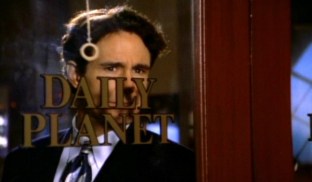
Between season 1 and 2 a number of changes were made. The show completely dropped the character of Cat Grant, the saucy and bawdy gossip columnist at the Daily Planet (played perfectly by cult TV show staple Tracy Scoggins), and replaced their Original Jimmy Olson, Michael Landes, with Justin Whalin to make Jimmy 2.0.
FUN FACT: In the commentary of the pilot episode on the DVD release, it was revealed that this recasting was due to a concern that Landes, also dark haired and eyed, too closely resembled Cain’s Clark Kent.
This also marked the departure of Lex Luthor as the main over-arching antagonist (as John Shea apparently had a falling out with production), whose presence as a corporate villain set the focus for Season 1. Sadly, Deborah Joy Levine also departed the show after Season 1, along with the original writing staff. The network wanted a bit more focus on action and romance, and there is a noticeable tonal shift to a more over-the-top feel starting in Season 2. Instead of focusing on more realistic villains and undercover crime reporting, villains started becoming far more magical, supernatural, and fantastical. At times, this shift also resulted in an increased, and one has to imagine, unintentional, comedic factor with regards to the show’s villains. One remembers (fondly, I might add), re-imaginings of classic Superman villains, such as the Toyman, into gushing fountains of cheesy 90s goodness (this version creates toy rats that spray a goo into people’s faces, reducing them to a greedy, child-like state. This affect even works on Superman. He steals Lois’s candy, and it’s great.)
Season 3 was the most successful of the seasons ratings-wise, though much of the show became about a wedding between Lois and Clark that just couldn’t quite get off the ground. But by Season 4 ratings started to drop, the show got tossed around different time slots, and even though the titular characters did finally get married “Lois and Clark” was eventually not renewed for a fifth season (though apparently they had been told that they probably would be).
FUN FACT: The wedding episode was timed to air with the release of the comic book “Superman: The Wedding Album” which featured the same marriage for the first time in 60 years; the first “for realsies” marriage that is, as there were several dream sequence type “fake outs” over the many decades previous.
The show ended with Lois and Clark, after being told that they wouldn’t be able to have any biological children together, finding an abandoned baby on their doorstep wrapped in a blanket featuring the Superman symbol. So ultimately, what was meant to be a cliffhanger, oddly helped wrap the show up in a suitably ‘happily ever after’ kind of way. The final episode aired on June 14th, 1997.
Lois/Clark/Superman Character Analysis
The show took a couple of interesting characterization stances when it came to telling the stories of Lois Lane and Clark Kent/Superman. The first was that it was made clear early on that Clark Kent does not have the usual life balance that Superman had in other comic and movie portrayals. In the show Clark lives in an apartment, acts like Clark when no one is looking, and doesn’t become Superman as we know him until the pilot episode. He is even unaware of his Kryptonian background until several episodes into the first season. In this way, it is firmly established that Clark Kent IS his identity; Superman is his alter ego.
FUN FACT: To further emphasize this shift in dominant personalities, Clark Kent and Superman’s hair styles are swapped with Superman sporting the slicked back and stylized hair, while Clark Kent features the more natural and laid back floppy style.
Clark’s humanity is further highlighted with the many romantic blunders that he commits throughout the show’s running. We spend much of our re-watches throwing our hands up in frustration and saying “No, Clark! Not again! Lois…you can do better.” “No, she can’t, it’s Clark.” “You’re right, and I’m sorry for saying it, but really…?” Cain plays the role with a sincere but goofy take, always pulling back at the right moment to prevent the character from taking himself too seriously.
Cain’s strengths definitely lie in his portrayal of Clark Kent. Due to the show’s focus on Clark as the character and Superman as the role, when Superman is on screen he is often saddled with the cheesier aspects of the show, a fact that isn’t helped by what are now very dated special effects. The character is further weakened by his isolation from the rest of the cast, often working against the aforementioned over-the-top villains for the most part with only dashes of interactions with a Lois who (especially in the first two seasons when she doesn’t know his true identity) is often at her most lovesick and ridiculous. While Cain is still effective in this role, the added layer of playing the character of Clark who is then playing the character of Superman adds a certain strain to his acting that can seem a bit forced at times.
In the end, it is Hatcher who carries the show with the stronger performance. While Lois plays the usual ‘damsel in distress’ role, she is also written as a very competent and well respected reporter. From the beginning through to the show’s end, Lois is clearly the superior reporter and takes the lead in their professional life. And, let’s be real, their personal life too, once she gets the whole super identity thing figured out. Hatcher wraps up a character who could verge into the realm of overbearing and ridiculous within layers of sweetness, insecurity, and vulnerability that makes Lois completely relatable and endearing.
And ultimately, it is the undeniable chemistry between Cain and Hatcher that carries the show. The progression of their relationship, from strained co-workers, to friends, to dating, to married life, is always peppered with the perfect amount of humor, respect, friendship, and finally love, and is joy to watch.
Other regular characters included Jimmy Olson, Perry White, and, in another notable difference from many Superman stories, the routine appearance of Jonathan (thankfully living!) and Martha Kent.
Villains
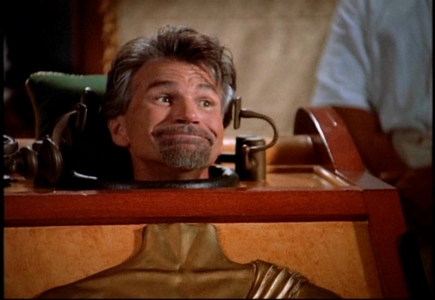
The villains on “Lois and Clark: The New Adventures of Superman” ranged from fairly realistic corporate and crime moguls, to strange and out there time travelers, ghosts, or in the case of Spencer Spencer, a head on a deformed torso that he hides in a box.
Played by a guy who looks like a Swayze Brother but isn’t a Swayze Brother. (source)
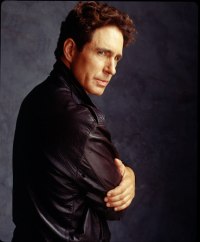
The show’s most recognizable villain, however, is Lex Luthor, played by John Shea.
This interpretation of Luthor follows the John Byrne version of the character, who isn’t so much a mad scientist as he is a corporate villain with lots of money at his disposal. This version is the one that many people think of for Luthor these days, and Shea fits the part to a t. Shea’s Luthor is charismatic and charming, a villain that is pretty fun to hate. Or not hate, in Kate’s case. Shea has good chemistry with Cain in their antagonistic moments, but his chemistry with Hatcher crackles. The viewer can hate him for not only wanting to take down Superman, but also because he effortlessly and, one could argue, realistically romances Lois away from Clark. While it would have been an obvious choice to make him a bad boyfriend, Hatcher’s strong, confident Lane would never have tolerated that. So this Luthor is formidable in all ways, and the ultimate villain for the show.
And then the character was killed off at the end of Season 1.
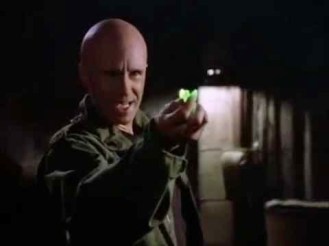
This gave other villains time to shine. While a few of the comic book villains did show up (perhaps most notably Mr. Mxyzptlk, played by Howie Mandell), quite a large number were original.
FUN FACT: Aside from Lex Luthor, General Zod is likely one of the best known Superman villains. However, the show could not get rights to the character. Instead, they created a nearly identical character named Lord Nor who, alongside a group of Kryptonians, attempts to take over Earth in season 4.
Many times these villains would be B-lister guest stars, or people who made their name in other sci-fi/fantasy television shows or movies. You had Bruce Campbell playing Bill Church Jr., the leader of the nefarious organization Intergang. You had “Star Trek: Next Gen” alums Denise Crosby and Jonathan Frakes playing Lex Luthor’s ex-wife and a wealthy megalomaniac, respectively. Even people who had shows on ABC at the time would make tongue in cheek guest appearances, as was the case with Drew Carey from “The Drew Carey Show” when he played a realtor who accidentally summoned the ghost of a murder victim. Kathy Kinney, who played Drew’s nemesis Mimi on “The Drew Carey Show,” was the ghost, naturally. The villain-of-the-week became the name of the game format of the show, and the more scenery they could chew, the better.
Luthor did return a handful of times for a couple of small arcs (reanimation for the win!) But even he wasn’t unaffected by the new “the bigger the better” bottom line for how villains were portrayed. He went from a suave and chill super-villain with a bank account to a crazed science experiment gone mad with dreams of revenge and reconnecting with his lost love, Lois Lane.
Shea played both versions well, but it’s safe to say that he was more fun when he was tangling with Superman with an ice cold demeanor, unphased by most things that the Man of Steel could throw at him.
The upside to this carousel approach to villains is that the show really is, at its heart, about Lois Lane and Clark Kent figuring out their relationship, and Clark figuring out how to function both as himself and as Superman. So ultimately, it’s just as well that the villains, Luthor aside, never stuck around too long. The prolonged angst of dark and demented nemeses wouldn’t fit the tone of the show at all. The villains serve their purpose, but at the end of the episodes they are, usually, vanquished, and the status quo is returned for Lois and Clark.
Favorite Episodes
Kate:
Look how thrilled she is to be working with him.
You probably won’t be surprised to hear that my favorite episodes come from the first season, as that was the season that was more grounded in subtleties. I love “Pilot,” as I feel that it perfectly establishes every single one of the characters as the show is writing them. Clark Kent comes to the Daily Planet looking for a job and looking for a normal life, but by the end of the episode he’s taken on the Superman role in hopes of helping others. Lois has the perfect introduction in this, just coming off an undercover case that she has totally nailed. She is ambitious and snide, but clearly has a very good heart along with a good head on her shoulders. Her disdain for boy-scout Clark Kent as her new partner (a partner she does not want nor think she needs) is hilarious. Plus Dean Cain just embodies the persona of Clark Kent with his ‘aw shucks’ demeanor. And an MVP award has to go to Lane Smith, who is the best damn Perry White ever with his blustery attitude and ‘God I hate/love my staff so much’ demeanor. He takes a chance on Clark, but doesn’t let him off easy either. That’s the Perry I know and love.
Lex wishing he’d just gone to the opera without Lois. (source)
I also have to give a shout out to the episode “Fly Hard,” the nineteenth episode of Season 1. In this one Clark, Perry, Lois, Jimmy, and Lex Luthor are being held hostage at the Planet by a group that is trying to find a large amount of money hidden in the building. This one I really like because it has a good amount of suspense, a very funny scene involving Cat being completely oblivious about her co-workers being held hostage, and one of the best pick up lines that Lex Luthor has given in the history of Lex Luthor pick up lines (“[Money] can’t buy brown eyes.” I’m sorry, I’m kind of a Lois/Lex shipper on this show because of how good Shea is when he’s on screen with Teri Hatcher). “Fly Hard” sticks out in my mind very prominently.
Serena:
I definitely agree with Kate’s picks and would have listed them as well! For my picks, I’m going to highlight an episode from Season 2 and Season 3.
For Season 2, one of my favorite episodes has always been number 7 “That Old Gang of Mine.” It also perfectly illustrates the more nonsensical villains that were introduced in this season by featuring a mad scientist who, after discovering that he knows how to raise people from the dead, decides that the best way to impress people with this power is to bring back famous criminals such as John Dillinger and Al Capone. What is this plan?!? Anyways, Lois and Clark investigate, but while undercover, Clark gets shot. Of course, Clark, not being Superman, must “die.” This episode was a real turning point for Lois’s character with the realization of how deeply she depends on Clark’s friendship. Clark, too, also realizes how important his life in Metropolis is (Clark’s history before the timeline of the show involved him globe-trotting and never laying down roots due to his lack of a secret identity and inability to not help when he sees something going wrong). Their reunion is also very cute!
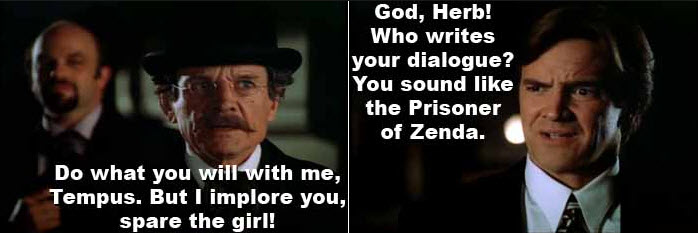
The second episode that I always love rewatching is in season 3 episode 13 “Tempus, Anyone?” Aside from Lex Luthor, Tempus is the second most-used villain in the show, appearing in 3 out of the 4 seasons. A time traveler from the future, Tempus for some reason doesn’t like good things and wants to prevent the utopian future that was created due to the actions of Lois/Clark/Superman, so whenever he shows up, time tomfoolery is sure to happen! His appearance in season 3 is his second attempt at disruption when he whisks Lois away to a parallel universe where things are very different. In that universe, Lois died years before meeting Clark. More so than almost any other episode, this is a “Lois episode,” not only featuring her as the well and true heroine of the story, but also highlighting how crucial her presence is to those around her, most importantly, to Clark.
Also, Tempus has some of the funniest lines in the whole show! (source)
So, there you go! A very long winded “brief” history of our love for the 90s classic “Lois and Clark: The New Adventures of Superman.” Are there any older tv shows that you consider lost gems? Let us know in the comments below!
(Many sources of information in this post come from the Wikipedia page on “Lois and Clark: The New Adventures of Superman” and the references that can be found at the bottom of it.)
Book: “This Shattered World” by Amie Kaufman and Meagan Spooner
Publishing Info: Disney-Hyperion, December 2014
Where Did I Get this Book: audio book from the library!
Book Description from Goodreads:Jubilee Chase and Flynn Cormac should never have met.
Lee is captain of the forces sent to Avon to crush the terraformed planet’s rebellious colonists, but she has her own reasons for hating the insurgents.
Rebellion is in Flynn’s blood. Terraforming corporations make their fortune by recruiting colonists to make the inhospitable planets livable, with the promise of a better life for their children. But they never fulfilled their promise on Avon, and decades later, Flynn is leading the rebellion.
Desperate for any advantage in a bloody and unrelentingly war, Flynn does the only thing that makes sense when he and Lee cross paths: he returns to base with her as prisoner. But as his fellow rebels prepare to execute this tough-talking girl with nerves of steel, Flynn makes another choice that will change him forever. He and Lee escape the rebel base together, caught between two sides of a senseless war.
Review: After reading and liking “These Broken Stars,” the first book in the “Starbound” trilogy, I was excited to jump right into the sequel. As I said in that review, I was even more intrigued by this book (and this series) by the fact that it was being written as companion novels, each featuring new characters, while spinning out a larger mystery that connects them all. When most YA series have recently followed a very predictable path, this was a creative take and a way to “have your cake and eat it, too” as an author. Sustainable series that will build and maintain a reading followership? Check. Get to write exciting, new characters and storylines? Check. Garner new readers with each book by not requiring knowledge of a previous story to engage with the current one? Check. So, in theory, “This Shattered World” was a brilliant concept. In reality, it was a swing and a miss for me.
Starting with the things I liked. Strengths from the previous novel were still present here: strong grounding in science fiction, not shying away from the realities and horror of the story’s premises, and the ability to draw characters who are both flawed and sympathetic and whose journey to mutual understanding is believable and compelling. These are no easy marks to meet, and I can’t emphasize enough how impressed I have been by the authors’ ability to balance alternating character chapters in a way that makes each perspective relatable and interesting in both of these stories. I personally found Jubilee’s voice more compelling, but this is likely due to my own personal preference for her character type as opposed to the more quiet and introspective Flynn.
Further, I was impressed with the way that the previous book’s main characters were tied into this story. The larger conflict dealing with Lilac’s father, his company, LaRoux Industries, and the experiments they have been undertaking on a mysterious alien life form were neatly woven in to this book. The unique conflict and peril of the story, the growing rebellion between the military and rebel leaders, were balanced nicely with this larger plot point. And while Lilac and Tarver are not present for much of the story, when they do make an appearance, it doesn’t feel forced or contrived. This story neatly builds upon the first one and does a good job laying down more groundwork and pushing the narrative towards the inevitable confrontation that will take place in the final book in the trilogy.
Now, sadly, for the negatives. First off, the writing in this book, overall, felt weaker than the last. The limited vocabulary was noticeable to a point of distraction. At one point, the word “shattered” was used 4 times within 2 pages. Hearts shattering. Sound shattering. Thoughts shattering. And it was only later that day when I remembered that that word was also in the title! I wouldn’t necessarily say that this is a marked difference from the first book, but instances like this did happen often enough to make me notice it in this story. Whether that comes down to the fact that there was an actual drop in writing quality in this book, or instead an indicator that I was not as thoroughly invested in this story enough that I was noticing things like this, I don’t know. Honestly, neither explanation is very good.
For some reason, beyond the alternating character chapters, the authors chose to include dream sequences from Jubilee’s perspective between each chapter. In a book as long as this is and with chapters as short as they were, that’s a lot, A LOT, of dream sequences. Way too many to be of any actual use to the story. A few of them may have contributed some background knowledge into Jubilee’s past, but I’m not convinced that this method was the best way to go about this. We learned Flynn’s past fine without resorting to 20+ dream sequences spread out through the entire book. And by the time the story gets to the final act, these dream sequences were not only failing to add to the story, but actively distracting from it and inserting a jarring tonal change between action-packed sequences. Further, there were more writing quality issues with the decision to refer to Jubilee as “the girl” throughout each dream sequence. “The girl hid under the table. But the girl could not see anything.” This writing technique is only rarely successful, from my experience, and there needs to be a good reason to choose to do it. That wasn’t the case here.
This also ties in neatly to my last critique. Typically I don’t have a lot to say about the audiobook version of a book I’ve read. Maybe I’ve just been lucky so far and had good experiences. This, however, was decidedly not. The writing challenges were only further highlighted, I feel, when listening to the story. And some of the creative decisions were very poor. For instance, they decided to have three narrators, one for Jubilee, one for Flynn, and another for the dream sequences portion.
The direction for the dream sequences was absolutely atrocious, and I don’t say that lightly. For some reason, they decided to include this whispery murmuring and wind sound affect in the background for each bit. And the voice actor read the entire thing in a very dreamy, whispered voice. It was almost impossible to take it seriously. The combination of these affects, and the dramatic reading voice, alongside the very simplistic writing style and the whole “the girl” narrative style, was severely off putting. It was taking itself way too seriously and ultimately made a joke of the whole thing. This is very unfortunate. I feel like I would have disliked the dream sequences even if I had simply read the book for the reasons I highlighted earlier, but the audio book version almost made them unbearable.
And sadly, the voice actor who read for Flynn was also not a favorite of mine. His tonal inflection was very bland and he didn’t vary his voice at all between characters which made several portions of the story very difficult to follow. The woman who narrated Jubilee, however, did a very good job. It is just too bad that having only one successful voice actor out of three makes a serious impact on the audio book’s success overall.
I would have rated the story alone as a 6. The strengths from the previous book were still present, however this book suffered from slightly weaker characters, a slightly weaker plot, and even perhaps slightly weaker writing. However, when the audio book is as bad as this one, I have to detract another point. It just goes to show how important it is to properly cast and direct an audio book. It has a huge effect on a story, making small flaws that much more noticeable and potentially adding points of distraction and distaste to an otherwise adequate story.
Rating 5: The story was ok, but the audio book was not.
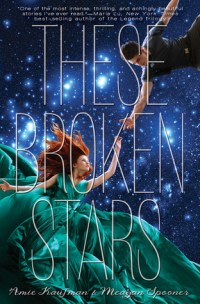
Book: “These Broken Stars” by Aime Kaufman and Meagan Spooner
Publishing Info: Disney Hyperion, December 2013
Where Did I Get this Book: from the library!
Book Description from Goodreads:Luxury spaceliner Icarus suddenly plummets from hyperspace into the nearest planet. Lilac LaRoux and Tarver Merendsen survive – alone. Lilac is the daughter of the richest man in the universe. Tarver comes from nothing, a cynical war hero. Both journey across the eerie deserted terrain for help. Everything changes when they uncover the truth.
Review: For all the proliferation of young adult fantasy novels, there is a distinct lack of young adult science fiction. I’m not quite sure why this is the case as the two genres are so often combined into one “fantasy/sci-fi” due to the vast number of similarities. Further, if there was ever a saturation point for readers, I have to think we’re reaching it with the number YA fantasy series out there right now. In this way, “These Broken Stars” stands out. Not only is it distinctly science fiction, but it is also a book that can be read as a stand alone! Both of these aspects were a refreshing change, and while there were some weak points in the story, for the most part “These Broken Stars” left me very satisfied.
Heiress and socialite Lilac LaRoux and war hero Tarver Merendsen have a typical meet-cute: plummeting towards a planet aboard a malfunctioning escape pod from an exploding spaceship. But really, the ship was called the “Icarus,” what did they expect? Why would anyone, ever, get on a ship named the “Icarus”?? There’s your first mistake. After crash landing, the two discover they are the only survivors of the wreck and must trek across an unknown planet in the hopes of discovering some means of sending a distress signal and escaping alive.
This is a solid plot. I appreciated the fact that Kaufman and Spooner didn’t pull any punches with the realities of a disaster of this magnitude. Not only do Tarver and Lilac have to deal with the challenges of their maroonment, but gruesome details of the crash and its aftermath are not shied away from. There are no easy outs. Injuries, starvation, dehydration, the confusion of a new environment, the grief and fear of a situation so fully out of one’s control: these are all painted with deft strokes. At one point, Tarver and Lilac reach the main wreck of the ship and the practicalities and horror of the situation is fully explored. Often, young adult novels can have a tendency to go easy on the realities of the story in favor of focusing on character drama. It can be very disappointing and also distracting. (Why is that character fretting between her love interests when an army is invading her kingdom?!?!) Not so, here.
And that’s not to say the characters in this do not experience their own drama. It’s only that their drama seems more grounded in the situation they find themselves in and their own biases and preconceived notions of the individual they have been forced to experience this trial alongside. The love story feels earned with its two characters going through misunderstanding, frustration, and anger, before building mutual understanding, respect, and care.
There were a few points where Tarver and Lilac fell a bit too closely into stereotypical characterizations. Or, more like, their “shocking reveal” anti-stereotypical characterizations. Of course Lilac isn’t just a socialite, but also a wiz at mechanics! However, each time I was about to roll my eyes at some overdone character moment, the authors would surprise me with a bit of realism that was enough to draw me back in. Lilac may be a wiz at mechanics, but she still struggles with her situation. So, too, Tarver, who could easily be written as the character more fully in the know and the right with his judgements of his companion, is also given flaws that make him more relatable and believable. Their physical and emotional journey is surprisingly balanced.
The mystery was also surprising. I enjoyed the reveal, and the final challenge in the third act of the story came completely out of left field. Also, while loose ends remained, the story also wrapped itself up in a way that was satisfying. Again, in young adult fiction where trilogies, cliff hangers, and dangling romantic plot lines that are drawn out through at least three books are the norm, I can’t emphasize enough how much I appreciated this respite.
There are two more books in this “series.” However, they each seem to focus on a new pair of individuals. This is a unique framing technique for what I’m guessing will be the larger conflict that was begun in this story. I’m curious to see how it will all pan out!
Rating 7: A solid outing for a young adult science fiction novel!
Book: “Paper Girls, 1” by Brian Vaughan, Cliff Chiang (Ill.), Matthew Wilson (Ill.)
Publishing Info: Image Comics, April 2016
Where Did I Get This Book: The library!
Book Description from Goodreads:In the early hours after Halloween of 1988, four 12-year-old newspaper delivery girls uncover the most important story of all time. Suburban drama and otherworldly mysteries collide in this smash-hit series about nostalgia, first jobs, and the last days of childhood.
Review: Though my book club, and other people in my life like my sister, swear by the series “Saga” by Brian K. Vaughan, I haven’t picked it up and am not really in much of a hurry to do so either. I know that Serena is probably side eying this review right now. Sorry, girl. That said, I have read Vaughan’s other really huge series, “Y the Last Man”, and that one I really enjoyed. I think that the difference is that “Saga” is big Space Opera sci-fi, while “Y the Last Man” is post apocalyptic, and of the sci-fi subgroups I much prefer the latter. So I don’t really know why I was surprised when I picked up “Paper Girls, 1” and it was another science fiction story. But “Paper Girls” fell in the middle of those two subgroups, and at it’s heart is more a coming of age, bildungsroman-esque story.
To give a bit more of a summary: The morning after Halloween in 1988, Erin the paper girl begins her route, joining up with other neighborhood paper girls Mac, KJ, and Tiffany in hopes of steering clear from the local bullies. But when their walkie-talkie is stolen by some mysterious guys in robes, they stumble upon a strange craft in the basement of a local house. Then people start disappearing, and more strange creatures appear. So the Paper Girls get pulled into a strange, end of world-like situation. While it may sound kind of simple, the way that Vaughan tells it is very real and very engrossing. Though I felt that KJ and Tiff wren’t given much to do thus far, Erin and Mac really shine, being portrayed as very three dimensional girls with complex, and in Mac’s case, difficult, backgrounds. Mac, the cigarette smoking tough girl, is pretty much Bender from “The Breakfast Club”, and Vaughan isn’t afraid to make her at times very unlikable (I was rather shocked by her entrance, as she calls one of the neighborhood bullies a ‘faggot’ and ‘AIDS-patient’. I realize that in 1988 it was Reagan’s America and there was a lot of scorn directed at the GLBT community, but realistic or not, it set my teeth on edge right out he gate). Erin is far gentler than Mac is, but that doesn’t make her any less fascinating or fascinating. She’s by far had the most exploration of their situation, and given the cliffhanger that we were left on in this volume it’s pretty clear that this is, ultimately, her story. And I’m one hundred percent okay with that. Hopefully Tiff and KJ will be given more to do as the series goes on, though the little snippets we got of them were fine and enjoyable.
I suppose that I should say that I was sort of disappointed that this is as sci-fi as it is. I guess when I read the descriptions I found online I was thinking it would be more “Blue Velvet” or “Twin Peaks”, but it is what it is and I did like the sci-fi elements for what they were. I highly enjoy the alien beings (if that is indeed what they are) and their kind of tenuous grasp on the English language. I also liked how there were symbols for dialogue for a few of the characters when they were conversing amongst themselves, and that the read has to figure out what is going on based on the visual cues that are being presented. This sort of device works VERY well in graphic novel form, as one can imagine, and given the prevalence both in and out of story, I want to learn more about these glyphs.
I also want to give a shout out to the gorgeous artwork in this comic. Cliff Chiang has done some other artwork for DC over the years, his most well known probably being some “Wonder Woman” for the New 52, which was incidentally one of the only things I LIKED about the new Wonder Woman arc. It looks simple at first glance, but the more you look at it, the more details you see. I think that he’s really making the characters and the story pop, and it’s a good match for the writing and story that Vaughan has given us. The cover alone just looks like an 80’s electric color bubblegum dream.
“Paper Girls, 1” has me hooked, and I’m sorry that I can’t just binge my way through it like I did “Y: The Last Man”. Fans of Vaughan’s work need to check this newest series out.
Rating 8: A fun sci-fi comic with some good characterizations. Some of the paper girls need to be explored more, but they are off to a good start. Plus the art is very funky and leaps off the page.
Where Did I Get this Book: audiobook from the library!
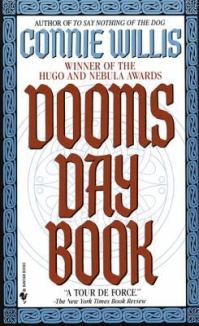
Book Description from Goodreads:For Kivrin, preparing an on-site study of one of the deadliest eras in humanity’s history was as simple as receiving inoculations against the diseases of the fourteenth century and inventing an alibi for a woman traveling alone. For her instructors in the twenty-first century, it meant painstaking calculations and careful monitoring of the rendezvous location where Kivrin would be received.
But a crisis strangely linking past and future strands Kivrin in a bygone age as her fellows try desperately to rescue her. In a time of superstition and fear, Kivrin–barely of age herself–finds she has become an unlikely angel of hope during one of history’s darkest hours.
Review: This book has been on my list for a long time. Connie Willis is regularly mentioned as one of the top women authors for science fiction, and “Doomsday Book” shows up on lots of “must-read” lists. So, when I spotted it as available when browsing my way through the library’s audiobooks a couple of weeks ago, it was as if the stars had aligned and it was finally, finally time for me to get to this one. And for the most part, it was ok? Sadly, it didn’t quite live up to all of my expectations.
For one, the story is told with alternating perspectives between Kivrin in the Middle Ages and her mentor, Dunworthy, in Oxford in 2054. My usual problem with this storytelling method was highlighted again here. One story almost inevitably is much stronger and more interesting than the other. While Dunworthy learns very quickly that something (he doesn’t know what) has gone wrong with Kivrin’s trip to the past and works to find answers while also handling a sudden mysterious disease crippling the city, there’s just no way for him to compete with Kivrin’s story, stranded in the past, with her carefully laid plans crumbling around her.
So, too, there were aspects of Dunworthy’s story that were incredibly frustrating as a reader. It’s hard to know whether, as a longtime reader of sci-fi/fantasy, I’m more familiar with the trail of clues laid out in these types of stories and can anticipate the final destination from long practice, or whether these clues have simply become more standard in the genre all together in the 20 plus years since this book was initially published. Either way, Dunworthy’s progress learning what had happened to Kivrin was so drawn out. At certain points in the story, the character would outright ask another character a basic question and then, bizarrely, the other character would change the subject or, what, pretend not to have heard him? It started to feel really contrived, and by about two thirds of the way through the book when he was still struggling to get basic answers to simple questions, I started doubting my ability to finish all together.
Only, it was an audiobook, so there was no flipping, just sad, sad listening.
Unfortunately, this forced confusion carried over to Kivrin’s narrative as well. While the a large part of the story revolves around the incompetence of the current director who even allowed Kivrin’s trip to the Middle Ages (an era of time that had previously been rated a “10” on the “too dangerous to travel to” scale), Kivrin herself would at times come across as equally incompetent. I have to imagine that this was not intended.
Things go wrong for Kivrin from the beginning, and it becomes clear why time travel to this era was going to be a bad idea for a young woman traveling alone. Beyond the obvious factors, things that Dunworthy pointed out from the beginning in his effort to stop her from going, the fact that a woman in this time period has almost zero agency seems to be an obvious reason to avoid this. If everything had gone right, how was Kivrin, a young, unmarried woman, supposed escape the household she was in? Women didn’t go anywhere by themselves, let alone walk miles into the wilderness along strange roads! Kivrin’s struggles in this area seemed easy to anticipate. The book even discussed two-person drops in time, and I never felt like there was an adequate explanation for why things moved forward as they did. Like I said, a lot revolves around the new director being an idiot. But for something as important as time travel, it was a bit hard to swallow that a disaster like this could so easily happen due to one man’s ego and ignorance.
Here too, Kivrin’s confusion and inability to catch on to simple clues didn’t feel right for a character who was presented as supremely thorough in her preparation for this trip. She seems genuinely confused at one point to discover that a 13 -year-old girl is engaged to a much older man, after many, many clues to this have already been lain out. This kind of bizarre storytelling was very distracting. I feel like Willis was trying to build tension in these choices, but all it did was make me question the sanity of her characters and wish things would just start happening already.
That said, Kivrin’s story was still a very interesting read. I would recommend this book for fans of history, however, rather than sci-fi fans. Time travel aside, the majority of the story is an intricate look at life in the Middle Ages. This is where Willis shines. Not only did the characters feel exactly right, highlighting the various challenges of people’s different roles, but the small details of the challenges of every day things were touched upon in a way that felt incredibly natural. What could have come across as a history lesson, instead felt like catching a glimpse into a beautiful painting of a small slice of time. But this glimpse is entirely honest, and with that honesty comes a lot of tragedy. This book was very hard to read towards the end, but I appreciate that Willis didn’t shy away from the realities of the world she brought Kivrin into.
All in all, there were parts of “Doomsday Book” that I really enjoyed, however, I also felt like the story could have used a heavy dosage of editing. It was’t a short story to begin with, and the continued delay of basic facts that readers could guess on their own, only made it feel longer. It was not a light read, but if you enjoy history and a richly detailed story, I would recommend “Doomsday Book.”
Rating 6: I enjoyed the historical aspects, but I also wanted to knock the characters’ heads together a few too many times to fully get behind it.
Book Description from Goodreads: Darrow would have lived in peace, but his enemies brought him war. The Gold overlords demanded his obedience, hanged his wife, and enslaved his people. But Darrow is determined to fight back. Risking everything to transform himself and breach Gold society, Darrow has battled to survive the cutthroat rivalries that breed Society’s mightiest warriors, climbed the ranks, and waited patiently to unleash the revolution that will tear the hierarchy apart from within.
Finally, the time has come.
But devotion to honor and hunger for vengeance run deep on both sides. Darrow and his comrades-in-arms face powerful enemies without scruple or mercy. Among them are some Darrow once considered friends. To win, Darrow will need to inspire those shackled in darkness to break their chains, unmake the world their cruel masters have built, and claim a destiny too long denied – and too glorious to surrender.
Unavoidable spoilers for “Red Rising” and “Golden Son.”
Review: This is it! The final book in Pierce Brown’s “Red Rising” trilogy. For me, from past experience with YA trilogies, the last book is what makes or breaks the series. And sadly, more often than not, they fall in the category of “breaks.” I’m looking at you “Allegiant” and “Mockingjay.” But not so with “Morning Star.” It’s good, guys, it’s really good!
Yes! Nailed it!
“Morning Star” picks up pretty much where “Golden Son” left off. Darrow has been betrayed and captured by his enemies. Cue pain and suffering. It goes without saying that eventually he is rescued, otherwise there would be no book here, so I don’t think I’m spoiling much by acknowledging that yes, he does eventually escape. But only after his confidence has been shaken. This book is the culmination of Darrow’s journey towards leadership. One of my complaints from “Golden Son” was Darrow’s tendency towards over-confidence and arrogance. In this book he has to re-make himself and discover what it is that he really has to contribute to the uprising. It’s no longer as simple as “Darrow: magical leader fighting guy.” His journey through this book is so incredibly satisfying.
All the right character beats are hit exactly. And moreover, not only do we get more time and character expansion for favorite characters from past books (Sevro, Victra, Mustang) but yes, even more awesome characters are added, like the Queen of the Obsidians. I can’t write this review without dedicating at least a few sentences to my girl, Mustang. This series has come so far from its roots where I was skeptical as to the treatment of the few female characters. In this, Mustang comes into her own as equally important to the success of the revolution as Darrow. They’re the definition of a power couple.
Believe it or not, the world building expands even further in this final book. It’s incredibly impressive how creative, well-thought out, and organized this massive world is. We get to spend time in a variety of new settings and, specifically, the politics of the Obsidians and Moon Lords are more fully explored.
The most impressive part of this story, for me, is the fact that Brown doesn’t shy away from the harsh realities of a revolution of this nature. Darrow is forced to make heartbreaking compromises and, in the end, his “rising” looks much different than the one he imagined as the idealistic sleeper spy from book one.
My few criticisms of the book: I mentioned in my review for “Golden Son” the odd balance Brown strikes between writing shocking revelations and dealing with the boundaries of a first person narrative. There was some improvement in this area, but ultimately, I still found some of these reveals a bit awkward in the context of how the reader is viewing the story. I’m starting to think that Brown could also make it as a screenwriter given this tendency. There are also several grand speeches (ala “Independence Day” style) throughout the book which are easy to picture going over well in a summer blockbuster. Perhaps a few too many, honestly. However, it is ultimately saved by a couple of self-aware jabs at Darrow’s tendency to speechify which play well for humor’s sake.
Ultimately, I think that Brown nailed the landing on this one. While the end was slightly predictable, Brown’s complex world, engaging characters, and talent for writing fast-paced, exciting action scenes make this book (and series) a must for sci-fi lovers.
Rating 8: Highly enjoyable. Am waiting for the movie announcement to come any day! How could it not?
In anticipation of my up-coming review of the recently released “Morning Star,” the final book in Pierce Brown’s “Red Rising” trilogy, I thought I would go ahead and post reviews for the two previous books in the series. Just so we’re all caught up and ready for what promises to be an action-packed conclusion! Here’s my review of the second book in the trilogy.
Book: “Golden Son” by Pierce Brown
Publishing Info: Del Rey, January 2015
Where Did I Get this Book: Bought
Book Description from Goodreads: With shades of “The Hunger Games,” “Ender’s Game,” and “Game of Thrones,” debut author Pierce Brown’s genre-defying epic Red Rising hit the ground running and wasted no time becoming a sensation.
“Golden Son” continues the stunning saga of Darrow, a rebel forged by tragedy, battling to lead his oppressed people to freedom from the overlords of a brutal elitist future built on lies. Now fully embedded among the Gold ruling class, Darrow continues his work to bring down Society from within.
A life-or-death tale of vengeance with an unforgettable hero at its heart.
Inevitable spoilers for “Red Rising.”
Review: Oh, look! Publishers have now added “Game of Thrones” to the list of books this series resembles! Except for space. And a color-based hierarchy. And set in the future of our current world. And a single, first person narrator. Wait…
“Golden Son” starts with a significant jump in time. This was very unexpected. As the series was initially marketed as young adult, it is usually customary for the story to pick up immediately where the previous book left off. However, for this series, I think it really works. “Red Rising” ends with Darrow being fully accepted into the Gold society, triumphant after his overthrow of the battle school system, and moving on to the next level of his training under the tutelage of his nemesis, Nero au Augustus. I suspect that Brown may have caught on to the lessons learned by “Catching Fire:” readers don’t necessarily appreciate “Sequel: Battle School 2.0.” So the decision to skip the majority of Darrow’s time going through this process is not only unexpected but appreciated. We are introduced to a recognizable, but extremely more confident and assertive Darrow who has fully come into his own without needing to experience every growing pain along the way.
The downside of this decision is that readers are immediately plopped into the middle of a very complex story. There are new characters everywhere (this isn’t helped by the use of difficult, Roman-inspired names like “Victra” and “Pliny” who are hard to keep track of). The story is also much more firmly set within a science fiction landscape. While “Red Rising” was considered a science fiction work, the majority of the plot took place on the planet and in an environment that resembled Earth in many ways, advanced technology aside. This story takes place in space with a capital “S.” There are battles between space ships, scenes set on different planets and moons, and space jumps similar to the kind seen in the 2009 remake “Star Trek.” If you were hoping for more sci-fi, Brown delivers.
Darrow remains an interesting protagonist. There are a few times in this book, however, where he makes decisions and acts in a way that, as a reader, you’re just shouting “Darrow, noooo!” It’s like when you’re watching a horror movie and you just know that that character shouldn’t go down into the basement. Why won’t they just listen to good sense? And Mustang? Mustang is the good sense Darrow doesn’t listen to. My concerns from the previous book regarding the use of female characters are addressed here. Mustang continues to be my favorite character, and there are several other female characters introduced who play vital roles to the story. Victra, especially, is a great addition as a scathing, broken Gold who, clearly against her will, befriends Darrow.
One other odd bit: the book is written in such a way that it seems like it would be an effortless translation from page to screen. However, the types of revelations that come naturally to film play oddly within the structure of the book. There is a moment later in the book when a shocking plot point is introduced in a way that feels a bit unnatural. It should, and does, come out of left field for those around Darrow. But we’ve been living in his head for the past 200 pages with no reference to this information, even though facts that tie into it have been mentioned often. So it reads like a great movie reveal. But it’s weird when you’re reading a first person narrative where information should be as known to the reader as it is to the narrator (unless the author is writing an unreliable narrator, but that’s not the case here). The plot point is fun, it’s just the way it’s introduced that feels strange.
“Golden Son” expands Brown’s world in every way. The reader’s understanding of how this society operates and spans a solar system is grown and the political mechanisms at work to sustain such a web are fully explored. A final downside? Cliffhanger alert. But, luckily, “Morning Star” was published early this year, so that’s a relief.
Rating 7: Very good, slightly lower than “Red Rising” due to a challenging balancing act between so many new components and character motivations
In anticipation of my up-coming review of the recently released “Morning Star,” the final book in Pierce Brown’s “Red Rising” trilogy, I thought I would go ahead and post reviews for the two previous books in the series. Just so we’re all caught up and ready for what promises to be an action-packed conclusion! Here’s my review of the first book in the trilogy.
Book: “Red Rising”
Publishing Info: Del Rey, January 2014
Where Did I Get this Book: Splurge! I bought it.
Book Description from Goodreads: Darrow is a Red, a member of the lowest caste in the color-coded society of the future. Like his fellow Reds, he works all day, believing that he and his people are making the surface of Mars livable for future generations.
But Darrow and his kind have been betrayed. Soon he discovers that humanity already reached the surface generations ago. Vast cities and sprawling parks spread across the planet. Darrow—and Reds like him—are nothing more than slaves to a decadent ruling class.
Inspired by a longing for justice, and driven by the memory of lost love, Darrow sacrifices everything to infiltrate the legendary Institute, a proving ground for the dominant Gold caste, where the next generation of humanity’s overlords struggle for power. He will be forced to compete for his life and the very future of civilization against the best and most brutal of Society’s ruling class. There, he will stop at nothing to bring down his enemies… even if it means he has to become one of them to do so.
Review: This book was marketed as a cross between “The Hunger Games” and “Ender’s Game.” I liked “The Hunger Games” and loved “Ender’s Game,” so I was pretty sold. (Of course, this book also came out during a time when all YA books published that had even a whiff of dystopian influences were marketed as “THE NEXT HUNGER GAMES OMG.” So I was understandably skeptical of this claim.) However, for once, this marketing ploy wasn’t far off and actually followed through with its promise!
This book is fast paced. You meet Darrow, an unambitious family man (yes, he’s also a teenager, but hey, dystopia world!) who is content to live his life as a Helldiver, a risky role where he operates a clawDrill that bores into Mars’ core in an effort to terraform the planet for human life on the surface. Two seconds later, tragedy has struck, he’s been recruited to a rebel organization, and is a sleeper spy caught up in political intrigue within a tyrannical society that spans the solar system. A society that uses an elaborate death school to identify the leaders in its elite youth. Hence: “Hunger Games in Space!”
The world building is impressive. The combination of a complex hierarchical system based on colors (Blues work in the medical field, Green are tech, etc. with Gold ruling over the lot), plus a sci-fi backdrop on Mars, with many creative uses of technology, leaves the reader constantly wondering what will come next and how these pieces will all fit together. Brown is clearly having a blast with this world, and his appreciation of staple works in the sci fi/fantasy genre is expressed with a fun smattering of Easter eggs for fans to fish out.
Darrow is also a fantastic protagonist. At one point as I was reading, I started to become concerned that he was going to turn into the typical, hero-journey character that neatly ticks the boxes in his predictable path to becoming the savior of the people. But, luckily, his flaws are highlighted and there are enough wrenches thrown into the plot to defy expectation and keep things interesting.
And his companion, Mustang, is amazing. I want a companion series all about her. My one concern, however, is that in this book she seems to operate as the token “strong woman” character with several other female characters sliding into obscurity. And worse, at one point there comes a bit that strikes too closely to using violence against women purely for shock value. My biggest hope for this series is that it improves in this area.
All in all, I highly enjoyed “Red Rising.” The book is obviously setting up a trilogy but is also enjoyable on its own. Stay tuned for my review of “Golden Son” coming soon.

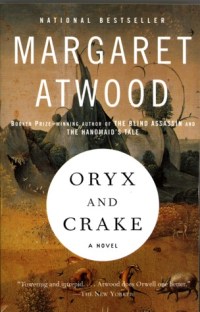 Book: “Oryx and Crake” by Margaret Atwood




 Book: “This Shattered World” by Amie Kaufman and Meagan Spooner
 Book: “These Broken Stars” by Aime Kaufman and Meagan Spooner
 Book: “Paper Girls, 1” by Brian Vaughan, Cliff Chiang (Ill.), Matthew Wilson (Ill.)
 Book: “Doomsday Book” by Connie Willis
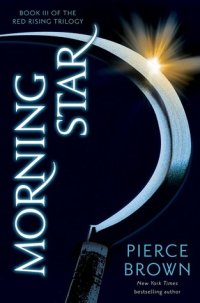 Book: “Morning Star” by Pierce Brown
 In anticipation of my up-coming review of the recently released “Morning Star,” the final book in Pierce Brown’s “Red Rising” trilogy, I thought I would go ahead and post reviews for the two previous books in the series. Just so we’re all caught up and ready for what promises to be an action-packed conclusion! Here’s my review of the second book in the trilogy.
 In anticipation of my up-coming review of the recently released “Morning Star,” the final book in Pierce Brown’s “Red Rising” trilogy, I thought I would go ahead and post reviews for the two previous books in the series. Just so we’re all caught up and ready for what promises to be an action-packed conclusion! Here’s my review of the first book in the trilogy.
 The Library Ladies