Joint Review: “Mexican Gothic”

53152636._sx318_sy475_Book: “Mexican Gothic” by Silvia Moreno-Garcia

Publishing Info: Del Rey, June 2020

Where Did We Get This Book: NetGalley; Edelweiss

Book Description: An isolated mansion. A chillingly charismatic artistocrat. And a brave socialite drawn to expose their treacherous secrets. . . .

From the author of Gods of Jade and Shadow comes “a terrifying twist on classic gothic horror” (Kirkus Reviews) set in glamorous 1950s Mexico—“fans of classic novels like Jane Eyre and Rebecca are in for a suspenseful treat” (PopSugar).

After receiving a frantic letter from her newly-wed cousin begging for someone to save her from a mysterious doom, Noemí Taboada heads to High Place, a distant house in the Mexican countryside. She’s not sure what she will find—her cousin’s husband, a handsome Englishman, is a stranger, and Noemí knows little about the region.

Noemí is also an unlikely rescuer: She’s a glamorous debutante, and her chic gowns and perfect red lipstick are more suited for cocktail parties than amateur sleuthing. But she’s also tough and smart, with an indomitable will, and she is not afraid: Not of her cousin’s new husband, who is both menacing and alluring; not of his father, the ancient patriarch who seems to be fascinated by Noemí; and not even of the house itself, which begins to invade Noemi’s dreams with visions of blood and doom.

Her only ally in this inhospitable abode is the family’s youngest son. Shy and gentle, he seems to want to help Noemí, but might also be hiding dark knowledge of his family’s past. For there are many secrets behind the walls of High Place. The family’s once colossal wealth and faded mining empire kept them from prying eyes, but as Noemí digs deeper she unearths stories of violence and madness.

And Noemí, mesmerized by the terrifying yet seductive world of High Place, may soon find it impossible to ever leave this enigmatic house behind.

Serena’s Thoughts

I love Silvia Moreno-Garcia. She’s such a unique talent.  I’ve now read three or four books by her, and they all spanned different time periods, genres, and themes. It’s truly incredible to find an author who can succeed in so many different lanes. We’ve got fairytale fantasy; we’ve got historical regency romance with a dash of fantasy; and now she comes with a new story mixing fantasy (of course) with gothic horror. And while horror isn’t typically my thing, I do like the creepy novel now and then, and this one seemed like just the thing for me.

The story definitely has some “Yellow Wallpaper” vibes, and I loved every bit of it. When Noemi arrives at the mysterious mansion, High Place, everything is just enough off to feel strange and eerie, but not too strange as to immediately raise alarm. Instead, it’s just the type of creepy dread that makes Noemi, and the reader, begin to question just where the line is drawn between reality and superimposed horror. Are their true mysteries here or is the setting, people, and house, all in their equal strangeness, just enough to spark a wild imagination?

Throughout the story, I found myself routinely falling into the classic horror-bystander role where you scream “just get out of there” at your heroes as they creep into a dark basement or linger in a mysterious place. But the author does a great job creating a situation where the threats are of the sort that if I had been in Noemi’s place, I, too, may have questioned my own reactions. This ties nicely into some fairly well-covered themes about women and how they are almost trained to question their perception of things and doubt their own observations. The question of whether one will be believed or not, or simply dismissed as hysterical, is very real today as it was in the past. And, of course, in the past and the time period during which this is set, women’s choices were that much more limited, especially when married.

I did find elements of the fantastical elements involved in the story to be a bit confusing and hard to track. A long history begins to unfold, and I wasn’t quite sure how exactly it all tied together. But most of the time, this didn’t matter as I was so caught up in the tension that it was enough to accept that it just was. I really loved the Gothic vibes that were brought into the story, and they were blended seamlessly into a location and culture where you don’t typically find this type of story. Overall, I really enjoyed this book, creepiness and all!

Kate’s Thoughts

I love the horror genre as a whole, but it’s hard to deny that a lot of the powerhouses and more popular works are very white dominated. That isn’t to say that progress isn’t being made; on the contrary, as pushes for diversity ramp up in publishing we are seeing more horror tales written by BIPOC. But we still have a long way to go. When I heard about “Mexican Gothic”, I was thrilled to see that we had a take on the Gothic genre from a perspective that wasn’t a white woman, as is the usual suspect within this kind of tale. I will admit that I was a little nervous going in, as Silvia Moreno-Garcia’s other work I’m familiar with is fantasy. Would she be able to make such a huge switch in genre tone? Turns out I was a dope to worry about it, because she nailed the scare factor and creepiness in “Mexican Gothic”.

Noemí is the perfect Gothic protagonist, as she comes from a gregarious and effervescent lifestyle in Mexico City and being thrust into the isolation of the Mexican countryside. It is the exact kind of scenario you see in the genre, and her personality of wanting to figure out what is going on, and then questioning if she is just overreacting when those around her dismiss her, feels so right for the Gothic vibes. But Moreno-Garcia takes it a couple steps further, not only taking on the themes of sexism and misogyny that are prevalent in Gothic lit, but also that of racism and prejudice. Noemí and her cousin are two Latina women who are now living in an English family’s estate, and their history of colonization in the area is what built up their wealth… and also may have something to do with the secrets they are hiding. For Noemí and Catalina, not only are they vulnerable because they are women, but also because they are brown women, and that fact is a really great way to make this story feel all the more fresh and relevant.

And the horror elements were definitely unsettling and outright scary. Not only the fantastical and supernatural ones, but also the real life horrors that Noemí discovers during her time at High Place. As Serena mentioned above, there are the questions as to whether or not Noemí is slowly losing her grip on reality, or if the things she’s experiencing, unsettling imagery and sounds and feelings, are actually happening. There were some really well described moments that made me squirm, which is exactly what I want from a Gothic horror novel.

“Mexican Gothic” is a great spooky read, and Silvia Moreno-Garcia continues to delight and show off her talents! Fans of Gothic novels absolutely need to check it out.

Serena’s Rating 9: Tension-filled and scary, this book makes it easy to feel as if you, too, are being sucked into the mysteries of High Place.

Kate’s Rating 9: A creepy and refreshing take on the genre, “Mexican Gothic” will fill all you may need from a good Gothic tale!

Reader’s Advisory

“Mexican Gothic” is included on the Goodreads lists “2020 Gothic”, and “Paper Lantern Writers: Best Own Voices Historical Fiction”.

Find “Mexican Gothic” at your library using WorldCat, or a local independent bookstore using IndieBound!

Kate’s Review: “Something Is Killing the Children (Vol. 1)”

52757827._sx318_sy475_Book: “Something Is Killing the Children (Vol.1)” by James Tynion IV and Werther Dell’Edera (Ill.).
Publishing Info: BOOM!Studios, May 2020

Where Did I Get This Book: I received an eARC from NetGalley.

Book Description: When children begin to go missing in the town of Archer’s Peak, all hope seems lost until a mysterious woman arrives to reveal that terrifying creatures are behind the chaos – and that she alone will destroy them, no matter the cost.

IT’S THE MONSTERS WHO SHOULD BE AFRAID.

When the children of Archer’s Peak—a sleepy town in the heart of America—begin to go missing, everything seems hopeless. Most children never return, but the ones that do have terrible stories—impossible details of terrifying creatures that live in the shadows. Their only hope of finding and eliminating the threat is the arrival of a mysterious stranger, one who believes the children and claims to be the only one who sees what they can see. 

Her name is Erica Slaughter. She kills monsters. That is all she does, and she bears the cost because it must be done.

GLAAD Award-winning writer James Tynion IV (The Woods, Batman: Detective Comics) teams with artist Werther Dell’Edera (Briggs Land) for an all-new story about staring into the abyss.

Collects Something is Killing the Children #1-5.

Review: Thank you to NetGalley for sending me an eARC of this book!

It’s been awhile since I tackled a straight up horror comic, so when I saw “Something Is Killing the Children (Vol.1)” I was immediately interested in reading it. I am vaguely familiar with James Tynion IV, as we read one of his comics for our book club a few years ago, but I hadn’t sought him out otherwise. I went into “Something Is Killing the Children” with my expectations of what I remembered from his other comic, but those expectations were tossed out the window almost immediately. “Something Is Killing the Children” doesn’t hold back, and it jumps almost immediately into the darkness that surrounds it.

And I should probably throw content warnings out there, because this comic doesn’t shy away from a lot of gore, gore involving children.

The plot is straightforward enough, with terrible things happening in a small town and a mysterious stranger coming to fight the evil that’s hiding in the shadows. Standard stuff, but I was still immersed because I’m a sucker for small towns with dark undertones. We mostly follow our monster hunter Erica Slaughter, but we also get to see the perspective of James, one of the teens who was attacked but spared, and therefore under suspicion from the other people in town. Throw in a couple others, like the brother of a missing girl, and the police officer on the case, though theirs are not as interesting as Erica’s and James’s. That said, we do get to have a number of sides of the plot through all these strings, and we slowly learn about the monsters that are plaguing the town, and also about the town and its inhabitants. A world and a mythos is being built slowly, and this volume was very much setting up dominoes that are undoubtedly going to fall as the story goes on. I like seeing these moments of building blocks being set in place, and I liked learning what we did about the mythology of the monsters, and those who hunt them. And they are genuinely scary. And super disturbing. That content warning I gave is no joke.

Plot aside, I also am very much intrigued by our protagonist, the mysterious Erica Slaughter. We know that she’s a monster hunter, and we know that she is part of some kind of group that goes out to take care of these things, but outside of that she is a mystery. She’s jaded, she’s determined, and she’s cold as ice, even though we see glimmers of empathy for James and his situation. She isn’t afraid to use violence if she needs to, but it’s also hinted at that this life is starting to make her weary. As someone who was a huge “Buffy” fan back in the day, she reminds me a LOT of Faith Lehane, but without the sarcasm, and just the potential damage and baggage she’s carrying. So I, of course, am so in love with her that it hurts, and I want to know EVERYTHING about her. But Tynion is keeping that close to the vest for now, which just makes me want to dive into the next arc even more, because we need more female characters that remind me of Faith Lehane.

382f3a5b4ffc061eb2108eee7663cd52
Queen. (source)

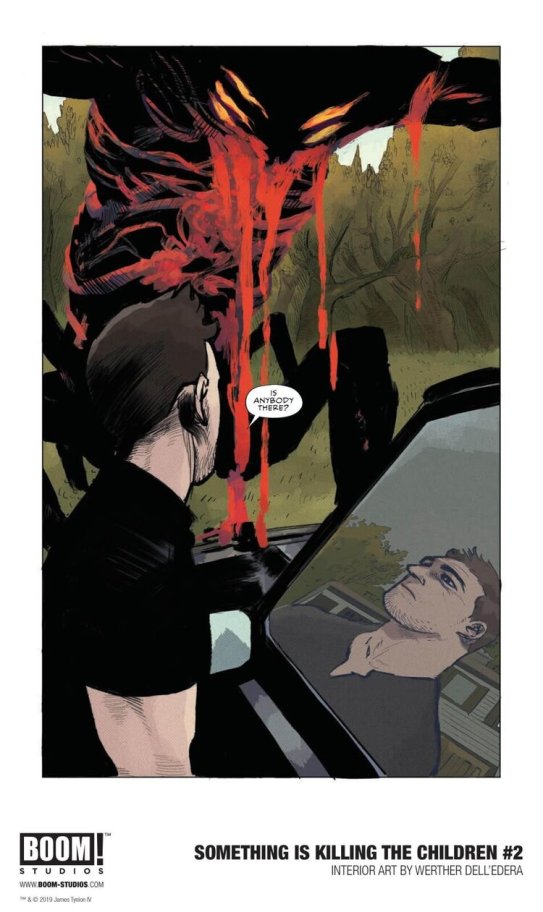
I really liked the artwork too, as it’s visceral and intense, which matches the story very well. I’m unfamiliar with Werther Dell’Edera, but his style works very well with the plot at hand. The reds are VERY red, and while other colors are muted a bit it serves for a powerful contrast that makes the violence all the more horrific.

something2
(source)

My one complaint is less to do with the story itself, and more to do with the formatting. The way that this book downloaded through NetGalley only would load one page at a time, so reading it on my screen was difficult when more creative styles layered one panel over multiple pages. I’m sure that this could be tweaked and adjusted on other eReaders and in other platforms, but it goes to show that sometimes designs with one format in mind don’t translate as well to others.

Overall, I was completely taken with “Something Is Killing the Children (Vol.1)”. I will absolutely be on the lookout for the next in the trade collection, and I can’t say that I will be terribly patient as I wait.

Rating 8: A scary horror comic with a lot of interesting potential, “Something Is Killing The Children (Vol.1)” has set up a creepy and intriguing world of monsters and monster hunters.

Reader’s Advisory:

“Something Is Killing the Children (Vol.1)” is included on the Goodreads list “North American Supernatural Realism”.

Find “Something Is Killing the Children (Vol.1)” at your library using WorldCat, or at a local independent bookstore using IndieBound!

Kate’s Review: “If It Bleeds”

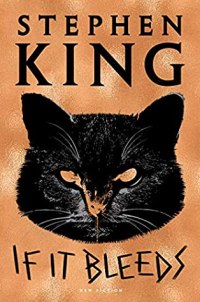
46015758._sy475_Book: “If It Bleeds” by Stephen King

Publishing Info: Scribner, April 2020

Where Did I Get This Book: I own it.

Book Description: A collection of four uniquely wonderful long stories, including a stand-alone sequel to the No. 1 bestseller The Outsider.

News people have a saying: ‘If it bleeds, it leads’. And a bomb at Albert Macready Middle School is guaranteed to lead any bulletin.

Holly Gibney of the Finders Keepers detective agency is working on the case of a missing dog – and on her own need to be more assertive – when she sees the footage on TV. But when she tunes in again, to the late-night report, she realizes there is something not quite right about the correspondent who was first on the scene. So begins ‘If It Bleeds’ , a stand-alone sequel to the No. 1 bestselling The Outsider featuring the incomparable Holly on her first solo case – and also the riveting title story in Stephen King’s brilliant new collection.

Dancing alongside are three more wonderful long stories from this ‘formidably versatile author’ (The Sunday Times) – ‘Mr Harrigan’s Phone’, ‘The Life of Chuck’ and ‘Rat’ . All four display the richness of King’s storytelling with grace, humor, horror and breathtaking suspense. A fascinating Author’s Note gives us a wonderful insight into the origin of each story and the writer’s unparalleled imagination.

The novella is a form King has returned to over and over again in the course of his amazing career, and many have been made into iconic films, If It Bleeds is a uniquely satisfying collection of longer short fiction by an incomparably gifted writer.

Review: Quarantine has been hard, but books have been helping me get through. And I’m very thankful that Stephen King happened to have his new book “If It Bleeds” arrive right when I was most needing a helping of my favorite author. True, short stories collections are things that I tend to be wary of, but King hasn’t failed me yet, so I jumped into this collection of four novellas without much trepidation. For me, King’s works and adaptations are like pancakes. Even when they aren’t as good, they’re still pretty enjoyable.

giphy-2
Me during this Stephen King New Golden Age of Content. (source)

“If It Bleeds” is a collection of thriller and horror tales, the tried and true genres that King does best. I’m going to talk about all four, and then try to pull it all back together at the end. Bear with me, as this may get long.

“Mr. Harrigan’s Phone”: We start off with an age old story about being careful what you wish for, as well as the wholesome bond between a young man and an elder in the community. Mr. Harrigan is an isolated rich man living in a small town, and he asks a boy named Craig to come read to him every week. Their friendship builds, and eventually Craig gets Mr. Harrigan connected to the Internet world with an iPhone. After Mr. Harrigan dies, Craig will call his phone to hear his voice again, and leave a message when he’s feeling down. But then Craig starts to wonder if he’s getting through to Mr. Harrigan beyond the grave… and what the consequences of that may be. This felt the most like an old school and straight forward Stephen King tale, with ambiguity, a bit of humor, and a coming of age tale laced with a bit of malice. It wasn’t really reinventing the wheel, and it also felt a lot like King’s story “Obits”, but it was a fun enough read.

“The Life of Chuck”: I had to go back and reread this one, as it’s definitely the most experimental of the stories within this collection. It’s not horror, and it’s not thriller. It’s more of a meditation on life, death, and the unknown impacts that our lives, and deaths, have. It was also a difficult one to read during the COVID-19 pandemic, as one of the big themes was about the end of the world. People are dealing with the end of the world, as a man named Chuck is dying in a hospital. We see Chuck’s life in reverse, starting with his death, and ending near the beginning. After reading it a second time I fully grasped what King was doing, and this story was neither scary, nor was it a thriller. It was a very quiet, meditative tale, one that added a more tender edge to this collection.

“If It Bleeds”: This was the story I was most looking forward to, as it brings us back to Holly Gibney, Jerome Robinson, and the world of the “Mr. Mercedes” Trilogy and “The Outsider”. Holly has been a top tier King character of mine ever since her debut in “Mr. Mercedes”, and seeing how she has grown and flourished through other tales has really been rewarding. So it’s probably no surprise that I greatly enjoyed “If It Bleeds”. After a middle school is bombed in a supposed terrorist attack, Holly starts to fixate on a good samaritan on the scene. This leans more towards “The Outsider” than the Bill Hodges Trilogy in terms of genre, but it still reads like a thriller at the heart of it, even Holly is once again after something supernatural. I was admittedly a little nervous that Holly may have a harder time carrying a story on her shoulders, since she does sometimes edge a bit towards King’s idea of a quirky savant. But Holly really has grown and edged out since her first adventure, and seeing her on her own tracking down something malevolent was suspenseful, poignant, and fun. And along with that, both Jerome and Barbara Robinson are back and are given some good things to do. King could keep coming back to all of these characters and I don’t think I’d ever get tired of them.

“Rat”: This felt the most like an old school Stephen King short story, as it has everything I’ve come to expect of that. A troubled writer, a secluded cabin, danger, and a potentially talking rat that can grant a wish at a great cost. Drew is an author who think that he is on the brink of another great novel, and since it’s been awhile since his last hit, he’s desperate to make something of it. He isolates himself in a remote cabin, and begins his work. But when a storm comes through and Drew is felled by illness and isolation, he turns to a talking rat who says that it can guarantee his book will be a hit… if he makes a sacrifice. It’s your usual Faustian deal, but it’s what led up to it that was the most interesting. As a storm rages and illness messes with Drew’s perceptions of reality, you get the suspense and questions as to how sound his mind is in that moment, and if he’s going to ultimately sacrifice everything for his craft. I also liked how King brought in how a marriage can suffer when one person is more dedicated to their own dream and ego than they are to those that care about them.

Overall, “If It Bleeds” was a solid collection from King. None of the stories blew me out of the water, but they all connected with me on one level or another. And right now, I just liked having the familiarity of my favorite author to help me get through.

Rating 8: A well done and comfortable collection of thriller stories, and a new story for a favorite character.

Reader’s Advisory:

“If It Bleeds” is included on the Goodreads list “Crime, Mystery, and Thrillers 2020”, and would fit in on “Great Dark Short Stories”.

Find “If It Bleeds” at your library using WorldCat, or at your local independent bookstore using IndieBound!

Kate’s Review: “The Southern Book Club’s Guide to Slaying Vampires”

44077284Book: “The Southern Book Club’s Guide to Slaying Vampires” by Grady Hendrix
Publishing Info: Quirk Books, April 2020

Where Did I Get This Book: I received an eARC from NetGalley.

Book Description: Fried Green Tomatoes and Steel Magnolias meet Dracula in this Southern-flavored supernatural thriller set in the ’90s about a women’s book club that must protect its suburban community from a mysterious and handsome stranger who turns out to be a blood-sucking fiend.

Patricia Campbell had always planned for a big life, but after giving up her career as a nurse to marry an ambitious doctor and become a mother, Patricia’s life has never felt smaller. The days are long, her kids are ungrateful, her husband is distant, and her to-do list is never really done. The one thing she has to look forward to is her book club, a group of Charleston mothers united only by their love for true-crime and suspenseful fiction. In these meetings, they’re more likely to discuss the FBI’s recent siege of Waco as much as the ups and downs of marriage and motherhood.

But when an artistic and sensitive stranger moves into the neighborhood, the book club’s meetings turn into speculation about the newcomer. Patricia is initially attracted to him, but when some local children go missing, she starts to suspect the newcomer is involved. She begins her own investigation, assuming that he’s a Jeffrey Dahmer or Ted Bundy. What she uncovers is far more terrifying, and soon she–and her book club–are the only people standing between the monster they’ve invited into their homes and their unsuspecting community.

Review: Thank you to NetGalley for sending me an eARC of this novel!

While it’s certainly not up there with my favorite vampire movies, I really do have a soft spot for “Fright Night”. The original, not the new one. There’s just something about it that is so cheesy and 80s, but also feels very sinister and menacing. That’s probably because Chris Sarandon’s Jerry Dandrige is so outwardly charming when he’s a literal monster next door. It’s a great example of suburban horror, as suburbs were created so affluent white people could flee the dangerous city to feel safe, when danger is everywhere. Even in the handsome bachelor next door. If you took “Fright Night” and mixed it with “Steel Magnolias”, you would get Grady Hendrix new horror novel, “The Southern Book Club’s Guide to Slaying Vampires”. It’s no surprise that Hendrix would be the one to make that combination into one of his quirky horror novels, as his offbeat and campy scary stories have true elements of terror. “The Southern Book Club’s Guide to Slaying Vampires” almost dethroned “My Best Friend’s Exorcism” as my favorite of his works. And you guys know how much I love “My Best Friend’s Exorcism”.

giphy
Remember when Marcy Darcy and Prince Humperdink basically boned during an awkward dance sequence? Gosh I love “Fright Night”. (source)

The quirkiness and humor is a bit of a given with Hendrix’s stories, and “The Southern Book Club’s Guide to Slaying Vampires” is no exception. It’s very funny at times, and has it’s tongue planted in cheek, though it does take itself seriously enough to create some legitimate scary moments. Our main character Patricia is an awkward and goodhearted book worm who loves to read tales of the macabre, as her husband is patronizing and her kids take her for granted. So she and her Southern Belle lady friends focus their book club on books about serial killers, murder, and other creepy things. I found Patricia relatable in some ways, mostly her general anxiety and her love of creepy books, and I liked how she is easy to root for, but also has flaws that are deeply human. Her initial encounter with James, the new neighbor, is right out of a horror movie, as she catches him in a trance of some sorts and his reaction is basically to scare her to death. But Patricia’s been raised in a culture (Southern, white, 1990s) in which she is more inclined to doubt herself and her own perceptions of James when he comes by later and just seems so nice, and so gregarious, and takes interest in her and her interests when her family does not. In fact, in contention for biggest SOBs up against James the vampire (more on him in a bit) were the husbands of the book club members, as they ranged from patronizing and gaslighting asshats like Patricia’s husband Carter to actual spousal abusers. And once Patricia starts to question if James is more dangerous than he seems, the men in the story are more inclined to believe the new man in town over their wives and any suspicions that they may have. It’s a tale as old as time, and it added an entire layer of suspense to this book that made my blood boil and had me concerned for Patricia. 

The vampire mythos that Hendrix has created for this story is centered around James, the deadly but enticing neighbor. Hendrix has created an original set of vampire rules for James, some of which are rooted in various folklores and some that feel totally original. Like Chris Sarandon in “Fright Night”, he’s the perfect villain because he just seems so wonderful, when he’s actually a vampire that is killing children in an impoverished part of town that is mostly black people. While some of the ways that Hendrix took on this part of the story felt a little clunky when it came to the racial issues at hand, I did appreciate that he wanted to talk about the fact that, indeed, in a situation like this the greater community of Charleston probably wouldn’t notice or care too much if these were the people being victimized. And he doesn’t spare Patricia and her book club friends from criticism in this way, as they are taken to task for their places of privilege in relation to the people that James uses as initial victims. 

I did have one big hang up with this book, however, and this is what knocked it down from a serious contender for top Hendrix novel. This is a mild spoiler, just to get that out there. There is a moment in this book that involves the implied rape of one of the characters, and the fallout thereafter. This moment was used as a way to up the stakes within the story, and I am so very sick of authors using rape in that way. There were plenty of other ways that Hendrix could have really reiterated how dangerous the situation had become, so to be like ‘ah, I’ll just use rape for that’ is something I am completely sick of. We can do better.

Overall, I thought that “The Southern Book Club’s Guide to Slaying Vampires” was a very fun and entertaining read. Grady Hendrix has once again written a scary and funny horror novel, and I am happy he continues his streak of cheeky horror triumphs.

Rating 8: An original, eerie, and deeply funny vampire story from the master of quirky and cheeky horror, “The Southern Book Club’s Guide to Vampire Slaying” is both scary and amusing!

Reader’s Advisory:

“The Southern Book Club’s Guide to Vampire Slaying” is included on the Goodreads list “2020 Horror to Scream For”.

Find “The Southern Book Club’s Guide to Vampire Slaying” at your library using WorldCat!

Kate’s Review: “The Return”

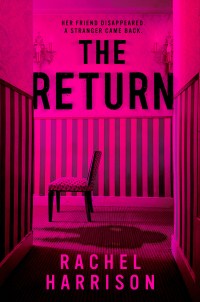
46354144Book: “The Return” by Rachel Harrison

Publishing Info: Berkley, March 2020

Where Did I Get This Book: I received an eARC from the publisher through NetGalley.

Book Description: A group of friends reunite after one of them has returned from a mysterious two-year disappearance in this edgy and haunting debut.

Julie is missing, and the missing don’t often return. But Elise knows Julie better than anyone, and she feels in her bones that her best friend is out there, and that one day she’ll come back. She’s right. Two years to the day that Julie went missing, she reappears with no memory of where she’s been or what happened to her.

Along with Molly and Mae, their two close friends from college, the women decide to reunite at a remote inn. But the second Elise sees Julie, she knows something is wrong—she’s emaciated, with sallow skin and odd appetites. And as the weekend unfurls, it becomes impossible to deny that the Julie who vanished two years ago is not the same Julie who came back. But then who—or what—is she?

Review: Thank you very much to Berkley and NetGalley for providing me with an eARC of this novel!

I cannot tell you how excited I was when Berkley emailed me a link to the eARC of “The Return” by Rachel Harrison. I had been waiting and searching NetGalley to see if a request for this book would go up, eager to read a book that was being called a mash up of “The Shining” and “Girls”.

giphy-5
So… like this???? (source)

In my mind this meant super disturbing horror AND soapy catty girl fights (though a serious lack of Adam Driver, the only redeeming feature of that dreadful show in my mind). It took a fair amount of willpower to save it for a later date, and honestly I dove in a lot earlier than I normally do with eARCs that I get. I clearly had high hopes. And they were met. And HOW.

From the get go “The Return” sucks you in and lets you know the kind of story and people you’re going to be dealing with.  Julie has disappeared, and her best friend Elise doesn’t want to believe that this is anything more than a histrionic call for attention. Julie has a history of this, after all, so when mutual friends Molly and Mae are concerned Elise refuses to be. Until Julie doesn’t come back and is declared dead, with a funeral and everything. So when she returns two years later claiming no memory, the reader knows that something is amiss, both in Julie’s story AND the relationship she has with her best friend. Therefore, isolating the four friends in a strange hotel and letting them slowly realize that Julie isn’t ‘the same’ is the perfect slow burn horror that especially resonates with anyone who has had a friendship that has potentially run its course. The horror elements are on point, from the descriptions of Julie’s emaciated look to the quirks and strange changes at the hotel that may or may not be Elise’s imagination to the imagery of dark beings in the corners of vision. There were numerous moments where I found myself incredibly unsettled, or had to set the book down for a bit and regroup. There is one especially suspenseful scene near the end the effectively lets the scene build up from everything being okay, to minor unease, to outright terror, so the reader experiences everything that the character is going through within the moment as you read it. I loved it, even if it deeply upset me and really put me off going exploring in our nation’s national parks by myself… And some of the descriptions of Julie’s physical transformation were absolutely disgusting, really amping the body horror aspect up to sit alongside the Gothic themes of an isolated location, as bad weather rolls in and people start disappearing…

But the other theme that struck me about this book is how well it captures the last dying gasps of a friendship on the skids. Elise, Julie, Molly, and Mae were all close back in the day, but now have drifted apart geographically and emotionally. With the four of them scattered across the country, some of them settling down, others making poor romantic choices, and others are stagnating and refusing the see it. Seeing the four of them try to force a reunion in the wake of Julie’s remarkable reappearance is something you could see in a tawdry drama, and the story would work even if you pulled the horror elements out. You especially see the tumultuous friendship between Elise and Julie, told through references to the past and seen in interactions in the present, as Julie has come back very much not herself. But then, I couldn’t help but think that it’s all a very well done metaphor for when you don’t know a person anymore, even without the strange body horror aspects, or the rotting teeth, or the fact that bodies may be piling up. Elise and Julie are codependent on each other’s friendship, no matter how damaging it could be for both of them.

“The Return” blends an effective Gothic and body horror tale with the deterioration of a long standing friendship. It’s a horror story that was worth the wait and the anticipation, and one that may be more relatable than you would think.

Rating 9: A sudsy and creepy horror story that not only brings the scares, but examines tough realities about friendships that start to fade away.

Reader’s Advisory:

“The Return” is included on the Goodreads list “2020 Horror to Scream For”.

Find “The Return” at your library using WorldCat!


Kate’s Review: “The Deep”

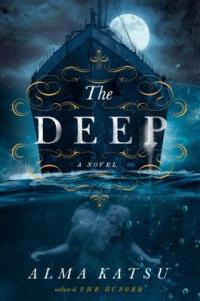
46371247Book: “The Deep” by Alma Katsu

Publishing Info: G.P. Putnam’s Sons, March 2020

Where Did I Get This Book: I received an eARC from NetGalley

Book Description: From the acclaimed and award-winning author of The Hunger comes an eerie, psychological twist on one of the world’s most renowned tragedies, the sinking of the Titanic and the ill-fated sail of its sister ship, the Britannic.

Someone, or something, is haunting the ship. That is the only way to explain the series of misfortunes that have plagued the passengers of the Titanic from the moment they set sail. The Titanic’s passengers expected to enjoy an experience befitting the much-heralded ship’s maiden voyage, but instead, amid mysterious disappearances and sudden deaths, find themselves in an eerie, unsettling twilight zone. While some of the guests and crew shrug off strange occurrences, several–including maid Annie Hebbley, guest Mark Fletcher, and millionaires Madeleine Astor and Benjamin Guggenheim–are convinced there’s something more sinister going on. And then disaster strikes.

Years later, Annie, having survived that fateful night, has attempted to put her life back together by going to work as a nurse on the sixth sailing of the Britannic, newly refitted as a hospital ship to support British forces fighting World War I. When she happens across an unconscious Mark, now a soldier, she is at first thrilled and relieved to learn that he too survived the tragic night four years earlier. But soon his presence awakens deep-buried feelings and secrets, forcing her to reckon with the demons of her past–as they both discover that the terror may not yet be over.

Featuring an ensemble cast of characters and effortlessly combining the supernatural with the height of historical disaster, The Deep is an exploration of love and destiny, desire and innocence, and, above all, a quest to understand how our choices can lead us inexorably toward our doom.

Review: Thank you to NetGalley for providing me with an eARC of this novel!

It’s been ten years since I was working at our local Science Museum and had shifts in the Special Exhibit about the Titanic, and while I am intrigued by the story still, I’m also a tiny bit burnt out on it. This doesn’t necessarily discourage me from reading stories that are related to or based upon the maritime disaster, however, because if I love the author or the premise sounds promising I’ll happily give it a whirl. Because of this, when I heard that Alma Katsu’s newest horror novel, “The Deep”, took place on the Titanic (and also on the similarly doomed sister liner The Britannic), I immediately requested an eARC from NetGalley. Lucky for me, I was given access. Given how much I LOVED Katsu’s take on the Donner Party in “The Hunger” (as reviewed HERE), I was all in for what she could do with the Titanic.

giphy-2
And I hoped it would leave out a hokey romance. (source)

Katsu has once again brought beautiful prose and an eerie supernatural twist to a well known tragedy, and I think that I liked “The Deep” even more than I did “The Hunger”. She utilizes both actual historical figures such as Madeleine Astor, Lady Duff Gordon, and W.T. Stead, as well as original characters to give an all encompassing view of what happened during the ill fated voyage, and what roles everyone played in each other’s experiences both before and after the iceberg. It is the characterizations of all these characters that “The Deep” found it’s greatest strength, and given how much I loved the other parts that says something. Katsu mostly uses the real life characters to examine the social roles that they all played at the time, to great effect. My favorite to follow was Madeleine Astor, the VERY young, pregnant wife of mogul J.J. Astor. Her age is definitely alluded to through her immaturity compared to other characters, but we also get to see how the position she was in couldn’t have been easy. She was always seen as a trophy wife and her legitimacy was questioned by Astor’s family after his death, and Katsu gets into her head and really explores the insecurities that a young wife at this time in her situation almost certainly would have had. I really looked forward to her chapters, because they always left me with such bittersweet feelings. Our original characters mostly focus on stewardess Annie, whose story is told in flashbacks on the Titanic and in the present on the Britannic, where she has become a nurse thanks to her friend Violet Jessup (an actual woman who survived BOTH sinkings). We slowly find out that something strange is afoot on the Titanic, a ghostly presence of some sort, and see through the flashbacks and the present just how it has affected Annie, and how she has affected others. Annie is clearly traumatized by the time she gets on the Britannic, but there are hints that even before she was on the Titanic that something is afoot with her. Along with her we get Mark and Caroline, a young married couple with a small child in tow. Annie is drawn to Mark, and her interest begins to feel like downright obsession over him and his daughter. There, too, is the mystery, as it seems like Mark reciprocates, but then perhaps he doesn’t. The unreliable narration that comes from multiple characters really helped the mystery at hand. I was kept guessing pretty much the entire time as to what kind of supernatural hijinks were afoot, and how it connected to our cast of characters.

And speaking of the supernatural, like in “The Hunger” Katsu perfectly balances the eerie and unsettling along with more subtle and underlying horrors of the real world. It isn’t completely clear from the get go just what we are dealing with in terms of supernatural themes, but as it’s slowly revealed we get to explore the ideas of spiritualism that were popular at the time, as well as lesser known mythologies that line up with some of our characters backgrounds and culture. This easily could have gone in a predictable fashion, as a ghostly presence on a ship like this is no doubt filled with possibilities, no matter how obvious. But instead we got a suspenseful story that combines things that go bump in the night with the horrors of gender, class, and obsession. I really, really loved how she tied it all together and how well she pulled it off.

“The Deep” is another triumph from Alma Katsu. She brings historical fiction horror to new heights, and if The Donner Party was a little too gruesome, The Titanic will be a good way to experience what she can do with the genre.

Rating 9: Haunting and chilling, “The Deep” brings new spooky life to the Titanic story, and paints a supernatural picture that is effortlessly as emotional as it is suspenseful.

Reader’s Advisory:

“The Deep” is new and not yet on many Goodreads lists, but I think that it would fit in on “Fiction Books About The Titanic”.

Find “The Deep” at your library using WorldCat!

Kate’s Review: “Deathless Divide”

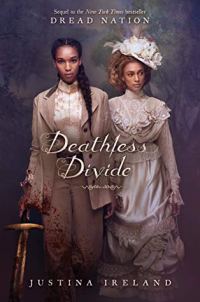
38124119._sy475_Book: “Deathless Divide” by Justina Ireland

Publishing Info: Balzer + Bray, February 2020

Where Did I Get This Book: The library!

Book Description: The sequel to Dread Nation is a journey of revenge and salvation across a divided America.

After the fall of Summerland, Jane McKeene hoped her life would get simpler: Get out of town, stay alive, and head west to California to find her mother.

But nothing is easy when you’re a girl trained in putting down the restless dead, and a devastating loss on the road to a protected village called Nicodermus has Jane questioning everything she thought she knew about surviving in 1880’s America.

What’s more, this safe haven is not what it appears – as Jane discovers when she sees familiar faces from Summerland amid this new society. Caught between mysteries and lies, the undead, and her own inner demons, Jane soon finds herself on a dark path of blood and violence that threatens to consume her.

But she won’t be in it alone.

Katherine Deveraux never expected to be allied with Jane McKeene. But after the hell she has endured, she knows friends are hard to come by – and that Jane needs her, too, whether Jane wants to admit it or not.

Watching Jane’s back, however, is more than she bargained for, and when they both reach a breaking point, it’s up to Katherine to keep hope alive – even as she begins to fear that there is no happily-ever-after for girls like her.

Review: A couple years ago, Justina Ireland wrote the YA horror/historical fiction book “Dread Nation”, a novel about the zombie uprising during Reconstruction in the U.S. Her main character, Jane, was a black teenage girl being trained to be a personal bodyguard for upper class white people, as after the zombies came Black and Indigenous people were recruited to protect the white people of society. It ended with an overrun town and Jane, her frenemy and fellow attendant Katherine, her old flame Jackson, and a group of refugees deciding to head West to California, as Jane was hoping to find her mother. When I heard about “Deathless Divide”, the sequel to “Dread Nation”, I was anticipating another zombie horror novel with the usual apocalypse themes. What I got was something completely different. This time, we get a horror historical fiction novel with distinct themes of a Western, and the lonesome redemptive attempts that come with that genre.

giphy-4
Spoiler Alert: It does. (source)

“Deathless Divide” picks up right after the end of “Dread Nation”, and almost immediately it gets turned on it’s head as to what I had expected from the narrative. For one thing, we are not only getting Jane’s POV, we also get the POV of Katherine, the high strung, prim, and incredibly talented classmate and sometimes friend of Jane. I wanted to know more about Katherine in “Dread Nation”, so when we got to get inside her head in “Deathless Divide” I was overjoyed. Katherine always intrigued me the most from the first book because I loved that she is unabashedly feminine, and is still an incredible fighter, perhaps the best in the book. Too often we see women characters who are made ‘strong’ at the expense of having their femininity stripped away. This is fine, of course, as there are lots of ways to write female characters, but women can fight and kick butt in a corset if they want to, dammit! I also liked getting a deeper exploration of Katherine and the issues that she has to contend with as a very attractive woman who is constantly underestimated, and who, as a woman who passes for white, doesn’t always feel like she has her identity all figured out. Getting to see more of Katherine was delightful. 

The other unexpected shift in the narrative was, as I mentioned before, the fact that it has a distinctly Western theme about it. Usually as a rule I am not a fan of Westerns, as the themes usually don’t grab me AND so many of the Westerns that I think of feel imperialistic. But in “Deathless Divide” Ireland does a really good job of taking the theme of the lone gunslinger and applying it to Jane as her journey progresses, especially since the usual trope of that is a white man. I loved the role for Jane, as she has endured so much trauma and loss and violence because of her race and the fact that Black and Native people have been used as protectors and bodies to protect the White people in a zombie ravaged society. It’s no wonder she would become morally ambiguous as she travels the west looking for revenge. It makes the idea incredibly tragic. And it’s just another of many ways that Ireland once again explores themes and issues of race and racism in America, and like in “Dread Nation” it works very well. From POC being used as guinea pigs to further scientific research to race and class relations in urban settings and capitalism to colorism, “Deathless Divide” shows that some times don’t really change much, and that we still have a long way to go. 

As for the zombies, not much has changed from the first book, and they aren’t as centered this time around. But that said, we do get to delve into the ideas of potential cures, and how different science experiments can bring different outcomes when it comes to the zombies and how they interact with their potential prey. I don’t want to spoil anything here, but just know that Ireland still manages to make the zombies feel fresh and interesting even when they aren’t at the forefront. After all, like in all good zombie stories, it’s the humans that are the bigger threat.

(note: As I mentioned in my review for “Dread Nation”, there had been criticism of the Native characters in that book. I’ve not seen anything in that regard about this book, and I don’t think that I as a white woman can say if Ireland has been more responsible this time around. We do get a more complex and deeper dive into the character of Daniel Redfern, however. If anything changes on this front I will update this post.)

“Deathless Divide” is the end of the road for this world and characters (at least for now; Ireland has said that it COULD happen that more gets written, maybe), and I think that it’s a great follow up and completion. I’ll miss Jane and Katherine.

Rating 8: A satisfying ending with a bold new genre take, “Deathless Divide” wraps up a world of zombies, racism, and empowerment for Black women.

Reader’s Advisory:

“Deathless Divide” is included on the Goodreads Lists “Black Heroines 2020”, and “LGBT SciFi and Fantasy 2015-2020”.

Find “Deathless Divide” at your library using WorldCat!


Kate’s Review: “Cirque Berserk”

04 Cirque Beserk CoverBook: “Cirque Berserk” by Jessica Guess
Publishing Info: Unnerving, February 2020

Where Did I Get This Book: I was sent an eARC by the author.

Book Description: The summer of 1989 brought terror to the town of Shadows Creek, Florida in the form of a massacre at the local carnival, Cirque Berserk. One fateful night, a group of teens killed a dozen people then disappeared into thin air. No one knows why they did it, where they went, or even how many of them there were, but legend has it they still roam the abandoned carnival, looking for blood to spill.

Thirty years later, best friends, Sam and Rochelle, are in the midst of a boring senior trip when they learn about the infamous Cirque Berserk. Seeking one last adventure, they and their friends journey to the nearby Shadows Creek to see if the urban legends about Cirque Berserk are true. But waiting for them beyond the carnival gates is a night of brutality, bloodshed, and betrayal.

Will they make they make it out alive, or will the carnival’s past demons extinguish their futures?

Review: Thanks to Jessica Guess for sending me an eARC of this novella!

If there are two things you should know about me and my pop culture affinities, I love slasher movies, and I love the 1980s (in terms of the art and music scene, NOT the political one). And if you give me slasher movies from the 1980s, I’m golden. When Jessica Guess contacted me asking if I would be willing to read her new novella “Cirque Berserk”, the description alone sucked me in. A haunted/evil carnival? Urban legends? A mention of the 1980s? And then, the cover had ROLLER SKATES?! I was IN!! If anything I figured it would be campy and entertaining, but “Cirque Berserk” was more than that. It achieved something I’ve seen a few horror novels fail: it felt like I was reading a slasher movie.

Guess creates a fun urban legend, some visceral gore and violence moments, and wicked characters that are easy to root for even when they are committing horrendous acts of violence. You assume that you’re going to be reading a novella that hits the usual slasher tropes and check boxes: the supernatural or unstoppable/ faceless killer, the final girl, the innocent but expendable teenagers, and on and on. But Guess takes those tropes and manages to subvert them in various ways that kept catching me by surprise. I thought I knew where certain characters or scenes were going, and then the rug would be yanked out from under me and I’d be genuinely surprised. I really don’t want to spoil anything about the plot’s big reveals, and I found them to be fun and effective, but I WILL say that Guess created not only a good mythology for Cirque Berserk and the horrifying things that go on there, she also gives the baddies some real motivation, motivation that the reader can, in some ways, relate to. She also gives the killers identities and backgrounds that aren’t generally seen as much in slasher stories, at least in the sense of how they are fully explored and given some actually tangible and relatable reasons for why they do what they do, at least at first. The focus is less on the expendable teenagers who’ve wandered into the fairgrounds, and more on the baddies, and how they got to where they are when we meet them.

And honestly? This novella is, pardon the bad pub, a scream to read. It opens with a classic slasher movie situation, and goes balls to the wall in terms of visceral horror violence as well as showing the stakes that we are dealing with. We get flashbacks to the fateful and dreadful night when Cirque Berserk went bad, we get some really gnarly kills right out of the Tom Savini playbook, and we get some pretty creepy moments and concepts AND a cameo from my favorite Biblical demon Lilith. On top of all that, it becomes quite clear, quite quickly that this candy coated fever dream of a slasher story is going to be accompanied by a bitchin’ 80s sound track, including tracks by Whitney Huston, Bonnie Tyler, and A-ha.

giphy-3
(source)

Honestly, if you like old school slasher movies that are dropping in day glo 80s nostalgia, “Cirque Berserk” is a novella that you should absolutely check out. It’s fun, it’s a quick read, and it has some great curveballs.

Rating 8: A hell of a fun ride that reads like a slasher movie on the page, “Cirque Berserk” was an entertaining read that I greatly enjoyed.

Reader’s Advisory:

“Cirque Berserk” isn’t on any Goodreads lists as of now, but for a similar read I would steer you towards “My Best Friend’s Exorcism”.

“Cirque Berserk” isn’t in WorldCat yet, but you can find it HERE at Unnerving Magazine.


Kate’s Review: “The Sun Down Motel”

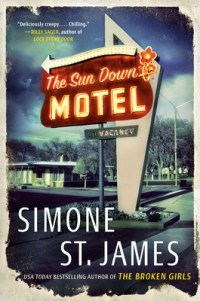
45885644Book: “The Sun Down Motel” by Simone St. James
Publishing Info: Berkley, February 2020

Where Did I Get This Book: I received an eARC from the publisher via NetGalley

Book Description: The secrets lurking in a rundown roadside motel ensnare a young woman, just as they did her aunt thirty-five years before, in this new atmospheric suspense novel from the national bestselling and award-winning author of The Broken Girls.

Upstate NY, 1982. Every small town like Fell, New York, has a place like the Sun Down Motel. Some customers are from out of town, passing through on their way to someplace better. Some are locals, trying to hide their secrets. Viv Delaney works as the night clerk to pay for her move to New York City. But something isn’t right at the Sun Down, and before long she’s determined to uncover all of the secrets hidden…

Review: Thanks to Berkley and NetGalley for providing me with an eARC of this book!

I have memories of spending childhood road trips, be it out to Lake Superior or just visiting family down in Iowa, staying in motels. Eventually my mother had it and we were upgraded to hotels, but there was always something kinda fun about the rooms leading out to the parking lot, at least in my mind. It’s been a long while since having that kind of experience, but I thought about it a lot as I read “The Sun Down Motel” by Simone St. James. I greatly enjoyed her book “The Broken Girls”, and when this ended up in my inbox I was happy to see that she had a new book. And not just any old new book, but a new book involving a missing woman, a true crime obsessed amateur sleuth, AND a haunted motel!

giphy-4
It’s like this book was written with me in mind!! (source)

Our two stories/mysteries take place in two different timelines and POVs. The first is that of Viv, who left home in 1982 in hopes of going to New York City, but finds herself in Fell, a strange small town in upstate New York that has a lot of weird and violent baggage. Stranded and broke, she decides to take a job as the night clerk at the Sun Down Motel, a run down motel that’s seedy at best. She disappears without a trace. Then in 2017, her niece Carly, wanting to figure out what happened to her aunt, arrives in Fell, and takes the same job Viv had. Viv’s perspective is in the third person, and Carly’s is in the first, and both POV styles worked well for their parts of the story, and worked together to weave a complex and rich set of mysteries. The first mystery is what happened to Viv, and the second is the question of why the Sun Down Motel is so damn haunted, and I was fully invested in both. St. James was masterful at building upon both mysteries from each others foundations, and I was kept guessing for pretty much all of the book.

And then there are the haunting and ghost elements of this story. These too were incredibly well done and right up my alley. From strange noises, to the feeling of a presence near you even if you can’t see anyone, to lights going out one by one and doors opening on their own, St. James has taken a number of the best tropes from the haunted house genre and applied them effortlessly to a run down motel. The history of The Sun Down has the tragedy and scandal that is comparable to The Overlook in “The Shining”, and like King St. James has created a whole character for a place made of brick, mortar, and ectoplasm. The various ghosts range from the tragic to the intimidating, and all of them had sufficiently creepy moments. Both Viv and Carly have their run ins, and the first one we see was genuinely heart pounding and knocked my socks off. St. James makes it clear that she has not come to play, nor has she come to be ambiguous. There are ghosts at the Sun Down, and one of them is especially PISSED OFF.

But the thing that struck the most resonant chord with me as a reader was the undercurrent of the toxicities of misogyny within our culture, both in the 1980s and in modern times. Girls go missing or are murdered in Fell, and while it causes sensation and gossip, the women are completely forgotten soon thereafter, or objectified in the moment. A mother goes missing and ends up murdered, and the town mourns and turns her into a martyr. A girl with a bad reputation is murdered, and there are underpinnings of victim blaming. A warning is sent out about a strange man who is seemingly fixated and following a girl, and no one cares enough to investigate further. And a ghost who was the victim of misogynistic rage has a wrath and fury that was never afforded to her in life, and has turned her into an unsolved and salacious mystery in death. St. James both makes true crime aficionados plucky and useful in their quest for the truth, but also points out that their interest and arguably ‘hobby’ is based in actual people’s pain, and can cause damage in and of itself. I really, really liked how these themes were sprinkled throughout the story.

I highly recommend “The Sun Down Motel” for fans of thrillers and horror alike! And if you can, read it in a roadside motel, and don’t pay too much attention to the strange sounds you may hear outside. It’s probably nothing.

Rating 9: Eerie and suspenseful, and simmering with justifiable anger, “The Sun Down Motel” is a wonderful mystery with fantastic characters.

Reader’s Advisory:

“The Sun Down Motel” is included on the Goodreads lists “2020 Gothic”, and “Haunted House Books”.

Find “The Sun Down Motel” at your library using WorldCat!

Kate’s Review: “The Rust Maidens”

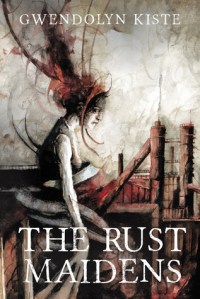
40874196Book: “The Rust Maidens” by Gwendolyn Kiste

Publishing Info: Trepidatio Publishing, November 2018

Where Did I Get This Book: The library!

Book Description: Something’s happening to the girls on Denton Street.

It’s the summer of 1980 in Cleveland, Ohio, and Phoebe Shaw and her best friend Jacqueline have just graduated high school, only to confront an ugly, uncertain future. Across the city, abandoned factories populate the skyline; meanwhile at the shore, one strong spark, and the Cuyahoga River might catch fire. But none of that compares to what’s happening in their own west side neighborhood. The girls Phoebe and Jacqueline have grown up with are changing. It starts with footprints of dark water on the sidewalk. Then, one by one, the girls’ bodies wither away, their fingernails turning to broken glass, and their bones exposed like corroded metal beneath their flesh.

As rumors spread about the grotesque transformations, soon everyone from nosy tourists to clinic doctors and government men start arriving on Denton Street, eager to catch sight of “the Rust Maidens” in metamorphosis. But even with all the onlookers, nobody can explain what’s happening or why—except perhaps the Rust Maidens themselves. Whispering in secret, they know more than they’re telling, and Phoebe realizes her former friends are quietly preparing for something that will tear their neighborhood apart.

Alternating between past and present, Phoebe struggles to unravel the mystery of the Rust Maidens—and her own unwitting role in the transformations—before she loses everything she’s held dear: her home, her best friend, and even perhaps her own body.

Review: I honestly couldn’t tell you where I heard about “The Rust Maidens” if you asked me. I THINK that it was on a Goodreads list at one point, but I can’t tell you what the theme of said list would be. Probably horror, but still. All I know is that it came in for me at the library, and when I picked it up I thought to myself ‘oh yeah….’ The reason I say that I only think that it was probably on a horror list but am not certain is because “The Rust Maidens” is one of the most unique horror stories I’ve read in the past year or two, based on the themes that it decides to take on along with some good old fashioned body horror you might see in an early Cronenberg film.

“The Rust Maidens” is a tale of decay, both the decay of the human body and the decay of a once prosperous part of Americana. In Cleveland, Ohio in 1980 Phoebe is a working class teenager living in a working class neighborhood. The community has put on a face of togetherness and wholesome American values, while the livelihood of a number of the men, the mill, has been experiencing more and more uncertainty. Phoebe’s story is told during the summer of 1980, and also almost thirty years later when she has to return to the neighborhood after years of grief and guilt. Spunky and rabble rouser Phoebe of 1980 is a stark contrast to the jaded and affected Phoebe of later life, and the changes over the years, which seemed to catalyze with the Rust Maidens, are now very apparent in her old neighborhood. The fact of the matter is that “The Rust Maidens” is a story of degeneration, not just of the afflicted girls, but of the community around them, and the decay of the American Working Class once the 1980s hit. While the Rust Maidens are slowly wasting away, Denton Street and the blue collar workers who live there are facing yet another potential strike at the mill. Phoebe’s family and neighbors believe that the promise of that job will always be there for them, even as the union gets continuously beaten down and the specter of the upcoming Reagan years lingers. Decay takes on many meanings in this book, and Kiste isn’t afraid to point out that when people are scared, scapegoats are sought out. And the Rust Maidens are the perfect scapegoats. It’s fully intentional that Kiste made the neighborhood turn on a bunch of scared and ‘sick’ teenage girls, given that they had already turned on Phoebe before for daring to not conform. The aggression comes from all sides, from deadbeat boyfriends to angry old men to women who think that girls should be and act a certain way. The metaphors are real, and the feminism in this horror story is angry and apparent.

And on top of the themes, the body horror is VERY real. The descriptions of the Rust Maidens as their bodies start to change and wither away/transform is unsettling at best, and revolting at it’s worst. But on top of that, it’s also very upsetting on an emotional level to see these girls be maligned and feared, and to see how some of them react to the revulsion towards them. Being extra sensitive to such things right now, one of the Rust Maidens is a new mother, and her child whisked away from her because of her condition. She is constantly drawn to the baby, who is placed with the father and his family even though he’s a complete lout. The descriptions of the mother’s pain, even when she was starting to become something else, had me crying pretty handily, so thanks for that, Gwendolyn Kiste!

“The Rust Maidens” is a unique and fascinating horror novel. Those who like their body horror with a little bit of metaphor should check it out post haste!

Rating 7: A bleak and angry examination of decay and the expectations of teenage girls, “The Rust Maidens” serves body horror and feminism in heaping, scathing doses.

Reader’s Advisory:

“The Rust Maidens” is included on the Goodreads Lists “Best First Novels: Bram Stoker Award Winners”, and “2018 Indie Horror Book Releases”.

Find “The Rust Maidens” at your library using WorldCat!