Serena’s Review: “Newt’s Emerald”

24737347Book: “Newt’s Emerald” by Garth Nix

Publishing Info: Katherine Tegen Books, October 2015

Where Did I Get this Book: audiobook from the library!

Book Description: On her eighteenth birthday, Lady Truthful, nicknamed “Newt,” will inherit her family’s treasure: the Newington Emerald. A dazzling heart-shaped gem, the Emerald also bestows its wearer with magical powers.

When the Emerald disappears one stormy night, Newt sets off to recover it. Her plan entails dressing up as a man, mustache included, as no well-bred young lady should be seen out and about on her own. While in disguise, Newt encounters the handsome but shrewd Major Harnett, who volunteers to help find the missing Emerald under the assumption that she is a man. Once she and her unsuspecting ally are caught up in a dangerous adventure that includes an evil sorceress, Newt realizes that something else is afoot: the beating of her heart.

Review: After reading “Angel Mage,” I found myself on a bit of a Garth Nix kick, as I had been clearly reminded just how much I enjoyed his writing. Not wanting to bite off the large task of re-immersing myself in the “Sabriel” world and series, I was happy to come across this short-and-sweet, standalone fantasy!

Lady Truthful, or “Newt,” is due a large inheritance, but more important than the money is a priceless, magical heirloom, an emerald with unknown but great powers. When the emerald is stolen from beneath her nose, Newt sets out on an adventure to recover it. Disguised as a man, she finds herself wandering dark alleyways at night and aboard ships raging through storms. And as a woman, she is caught up in an even more dangerous endeavor: a young woman debuting for her first season in London! By her side she finds the mysterious Major Harnett who also might be hiding his own secrets.

This was a strange little book. And really, I think that’s where many of its strengths and weaknesses lie, with how little it is. From my research, it seems that this was originally written as a novella and then expanded out into a full-length, albeit still short, book. Reading it, it is easy to see these backbones through what we are presented here. Everything that is given is excellent: a solid main character, a firm touch on both the genres its straddling (fantasy and historical romance), and a succinct, but clear, storyline. And I enjoyed it all. However, I do wish there had been a bit…more of everything.

In some ways, it feels that this was a novel born from a writing exercise on Nix’s part. That he went into the story wanting to dabble in historical romance, but, being a fantasy author, wanted to include his own trademark worldbuilding and fantastical elements to the standard elements. Perhaps readers not familiar with his other works would be less surprised by this book, but for those of us who have read those, this book feels remarkably light on the fantasy. There is the titular emerald, of course, and it seems that characters in this world are prone to having some level of magical abilities themselves. The ins and outs of these abilities, their range, scope, or power, is never really explored and the few times we see people use them, there isn’t much there other than a flash and bang. From an author that I know is capable of writing complex and thorough magic systems, it ended up reading a bit bland.

The characters themselves fared better, though even here it seemed we were getting only modestly adjusted variations on the stock historical romance characters one often sees. Newt’s time spend dressed as a man is a saving grace for her character, raising her above the tropes that often befall historical romance heroines. I particularly enjoyed the time spent between her and the love interest when she was still thought to be a man and their friendship began to develop.  Once the secret was outed, the story fell quickly back into the more expected beats of a romance.

There was a strange moment, however, when the reader is allowed to see behind the curtain on the Major’s side of things. I’m not quite sure what the goal of this inclusion was, but from my perspective it took the bite out of a few of the mysteries at the heart of the story. Newt has her own secrets, but so does the Major. Being privy to the truth before our main character quickly defangs many of the conflicts and makes Newt’s own agonizing and confusion read as more of a bore, knowing the truth and likely outcomes ourselves already.

Again, this isn’t meant to be all critical. I did enjoy the romance, it was sweet and funny. The action and adventure was probably the strongest portion of the story, with several good chase scenes and fights. And the writing was perfectly matched to the Recency romance style that Nix was clearly attempting to reference, most especially noticeable in the dialogue, which was witty and fun. Most of this seems due to the length of the story; it’s simply too short to fully flesh out all of its characters or expand on the magical system and world to the extent that I might have wished. It was a quick read, however, and a fun story. Readers who are looking for a light, beach-read-like story will likely enjoy this. Just don’t go into it expecting to see the full power of Nix’s abilities on display.

Rating 7: Reads a bit more like a primer of Nix’s work than as a fully completed work of its own.

Reader’s Advisory: 

“Newt’s Emerald” is on these Goodreads lists: “Fantasy of Manners” and “Girls Disguised as Boys.”

Find “Newt’s Emerald” at your library using Worldcat!
Serena’s Review: “The Art of Theft”

36510437Book: “The Art of Theft” by Sherry Thomas”

Publication Info: Berkley, October 2019

Where Did I Get this Book: Edelweiss+

Book Description: As “Sherlock Holmes, consulting detective,” Charlotte Holmes has solved murders and found missing individuals. But she has never stolen a priceless artwork—or rather, made away with the secrets hidden behind a much-coveted canvas.

But Mrs. Watson is desperate to help her old friend recover those secrets and Charlotte finds herself involved in a fever-paced scheme to infiltrate a glamorous Yuletide ball where the painting is one handshake away from being sold and the secrets a bare breath from exposure.

Her dear friend Lord Ingram, her sister Livia, Livia’s admirer Stephen Marbleton—everyone pitches in to help and everyone has a grand time. But nothing about this adventure is what it seems and disaster is biding time on the grounds of a glittering French chateau, waiting only for Charlotte to make a single mistake…

Previously Reviewed: “A Study in Scarlet Women” and “A Conspiracy in Belgravia” and “The Hollow of Fear”

Review:  Continuing my week of Sherry Thomas reviews! While “The Magnolia Sword” took me by surprise (I didn’t realize it was coming out until late in the game, and still later figured out the author was Sherry Thomas), I’ve been impatiently waiting for the release of the latest “Lady Sherlock” story. Thanks to Edelweiss+, I had early access to it on my Kindle, and due to a complete lack of willpower, I ended up reading this book a few months ago but still wanted to review it closer to its publication date, so here we are. And while this wasn’t my favorite book in the series, I’m still enjoying the heck out of these stories and, again, am anxiously awaiting the next.

After helping Lord Ingram escape a false murder charge in the last book, Charlotte Holmes once again finds herself at the service of one of her close friends. This time it’s Mrs. Watson who has been contacted by a friend from the past who is now caught up in a mysterious blackmail/art theft situation. But this time, Charlotte and co. must do more than simply unravel the various players in this charade, but now find themselves playing an active role within the events themselves. Now she must not only discover who is at the heart of this conflict, but find a way to walk the narrow line between solving the case and not becoming a criminal herself!

Many of the strengths of the original books are still present here. Charlotte, as always, is a perfectly realized character, now comfortably familiar in both her quirks (her sense of fashion and preference for sweet treats), her strengths (obviously), as well as her weaknesses (challenges with navigating complicated relationships). One of the pleasing things about a long(ish) running series is this solid comfort with a character who is understood and beloved, but it also come with challenges. Here, while Charlotte is still at the heart of untangling the mystery, it feels like she is not the main character in her own book. That is, there is very little ongoing character development or a unique arc that is devoted to her. Much of this character work is picked up by the others in the book, but for a series that is called the “Lady Sherlock” series, this book was the first that did begin to show some signs of not quite knowing where to go from here with its titular character.

Luckily, the series has already set up a good number of side characters in the first several books so a shift of focus to them, while not preferred, also still feels earned. And I was already invested enough to feel that their conflicts were enough to carry much of this story. Mrs. Watson, of course, is at the heart of this story, and I loved learning more about her past and those who played a role in it. We see, again, both the strengths and weaknesses that lead her to where she is today. She also serves as a good mentor for Livia who ends up taking on a much more active role in this story.

Throughout the series, Livia has always played a bit of a strange role. A decent amount of page time is devoted to her, but she’s typically no where near the action and her development has moved at a fairly glacial pace. Here, Livia finally gets to come out of the shadow and play with the big kids. I loved seeing her come out of her shell, even if it was an uncomfortable process for her. Through her, the story also spends a bit exploring, again, the limitations on women in this time period. And, while Livia’s life has by no means been a happy one, she comes to realize the privileges that she has taken for granted.

I did enjoy the mystery itself as well. After the more active role that Charlotte took on in the previous book, it was nice to see that approach used once again here with Charlotte and co. essentially staging a heist. The story has definite “‘Ocean’s 11’ but in Victorian times” vibes, which I thought was a clever change of pace from the other, more typical mysteries of the first books. There were some surprises sprinkled throughout, as well, and, overall, I found the conclusion and explanation satisfying.

However, for all the answers we do get, there were a few too many loose ends left hanging. This was clearly done on purpose, but there were just one or two too many for me not to begin to feel slightly frustrated and anxious. For one thing, these mysteries are complicated. It always takes a bit of thinking on my part to fully put things together and still I’d have a hard time explaining it all later. But to add more unsolved clues on top of all that, clues I can only assume will come into play in a later book and that I will need to recall…it’s a bit too much. For me, I was left feeling a bit worried that I was not only missing things in this book, but will now likely miss even more in some future story.

The book also ends on a bit of a cliffhanger, which I’m not sure was necessary. It’s not the type that gnaws away at you, but more just introduces the topic of the next book. But it seemed liked a strange choice for an established series. It’s the kind of thing you do in book one or two, just to keep readers interested. But here, it was more like an unneeded “coming next week” preview for a well-watched and established TV show. Just leave it out and let the book end on a note relevant to this book’s story. The next book can take care of itself without page time given to it here.

Those quibbles aside, this was another solid entry in the “Lady Sherlock” series. I’m definitely excited for the next book as it seems like it will focus on a character who wasn’t much seen in this story. And I hope that Charlotte’s more active role continues. However, I also hope that she gets a bit more character development and a more defined emotional arc in future stories. I enjoy the side characters, for sure, but I’m mostly here for Charlotte. All of this to say, if you’ve enjoyed this series so far, you’re good to go on this one as well. And never fear, there will be another; it’s all set up right there at the end of this one.

Rating 8: While Charlotte fades a bit into the background and there are a few too many dangling clues, I enjoyed the addition of a heist plot onto another solid mystery.

Reader’s Advisory:

“The Art of Theft” is a newer title, so it isn’t on many Goodreads’ lists, but it is on “Historical Mystery 2019.”

Find “The Art of Theft” at your library using WorldCat!

Serena’s Review: “The Magnolia Sword: A Ballad of Mulan”

44059557._sy475_-1Book: “The Magnolia Sword: A Ballad of Mulan” by Sherry Thomas

Publishing Info: Tu Books, September 2019

Where Did I Get this Book: Edelweiss+

Book Description: CHINA, 484 A.D.

A Warrior in Disguise

All her life, Mulan has trained for one purpose: to win the duel that every generation in her family must fight. If she prevails, she can reunite a pair of priceless heirloom swords separated decades earlier, and avenge her father, who was paralyzed in his own duel.

Then a messenger from the Emperor arrives, demanding that all families send one soldier to fight the Rouran invaders in the north. Mulan’s father cannot go. Her brother is just a child. So she ties up her hair, takes up her sword, and joins the army as a man.

A War for a Dynasty

Thanks to her martial arts skills, Mulan is chosen for an elite team under the command of the princeling–the royal duke’s son, who is also the handsomest man she’s ever seen. But the princeling has secrets of his own, which explode into Mulan’s life and shake up everything she knows. As they cross the Great Wall to face the enemy beyond, Mulan and the princeling must find a way to unwind their past, unmask a traitor, and uncover the plans for the Rouran invasion . . . before it’s too late.

Review: There are certain stories out there that I always think about wistfully. They are the ones that have so much potential and yet, while tried, have still not (to my mind at least) come out with a definitive version (like “Beauty” by Robin McKinely is for me for “Beauty and the Beast). Even worse, sometimes, are those that have so much potential and have been attempted only to muck it up badly. “Mulan” is one of those tales. It has all the right ingredients to make a great story and to be (seemingly) easily adapted into a story that is sure to appeal to many readers right now. And yet…for me, it definitely falls in the latter category of disappointment: attempts have been made but not only are they not the definitive version (again, my own opinion of it at least), but I had varying levels of frustration with these attempts. From boredom to out-right anger. cough”Flame in the Mist”cough. But…but…finally!

Mulan has spent much of her life disguised as a boy and training to compete in an age-long duel between her family and another over the possession of two incredible swords. Her days are filled with swordplay, catching flying arrows while blindfolded, and other incredible feats. She has defined her life around this role, though secretly mourns the loss of her own identity as her father’s only daughter. But when war strikes, thoughts of the duel are set aside and duty rises to the forefront. Now, marching to battle, Mulan finds herself in the company of a handsome prince who seems somehow familiar. And all too soon her fighting skills are put to the test, not in an organized duel, but out in the wild with death on the line.

I was incredibly hopeful for this version of “Mulan” when I saw that Sherry Thomas would be the author writing it. Not only is Thomas a Chinese American who was born and lived in China during her childhood, but she’s successfully tackled retelling other well-known historical stories, like her “Lady Sherlock” series (guess what review you’ll be reading from me next??). Like that series, here Thomas not only masterfully recreates the character of Mulan but deftly draws a version of early China that not only feels authentic but is very informative of a time and culture that many Western readers may not be familiar with.

The central conflict, for example, doesn’t center  around the ubiquitous, largely undefined Huns as many past versions have done. Instead, it dives into the various political maneuverings of North and South China, their differing cultures, and the challenges of bringing together a nation as large and diverse as that. It also speaks to the seeming randomness of borders and how being on one side or another can define much about a person and have lasting effects on the way one group is perceived over time.

But don’t get me wrong, the story isn’t just an exploration of cultural definitions in China; Mulan and her fellows are going to war. I very much enjoyed the action of this story. From the beginning, we see the differences between how Mulan has been raised to fight, seeing it as something bound in duty and a form of art, and what fighting looks like on a battlefield when your life depends on your choices. Here we see Mulan struggle not because she is a woman and has to somehow overcome more due to this “deficiency” (no, she is largely acknowledged as one of the most skilled fighters from the beginning), but because she is human, and being human makes fear and courage very real things that must also be learned and mastered. Here, we have not only the exploration of these themes through Mulan’s experiences, but some really great examples seen in the princeling himself.

I think of them all, much as I love Mulan herself, the princeling struck me as the most interesting character. Thomas goes some surprising routes with this character and deftly sidesteps the pitfalls that other versions have fallen into where his “manliness” is used to bluntly contrast Mulan’s own femininity. Much as I love Disney’s “I’ll Make a Man Out of You” song, this version provides a much more layered character and one who contrasts Mulan, but not in the ways one would expect.

I’m not terribly familiar with the original tale of Mulan, but this one feels right. The added layer of the ancient sword duel and the use of this aspect of the story to delve into family, honor, and trust fleshed the story out beyond the confines of a war story where a girl disguises herself as a man. Mulan’s conflicts are not only battles and war tactics, but the challenge of understanding one’s parents and the choices of those who came before us. Through this understanding, she is better able to find peace with her own walk of life.

I absolutely loved this story. It’s everything I could have wanted for a “Mulan” retelling. If I had to ding it, HAD to, I would say I could have used a tad bit more of the romance. But this is such a niggling thing that it barely is worth mentioning. Overall, I found the romantic plotline, like everything else, to be very satisfying. This story not only retells the known tale (at least what most readers know of it, probably, again, based on Disney), but it adds new layers to the main characters and the conflict itself. If you, like me, were waiting for the version, your wait is over! Check out this book immediately!

Rating 9: Absolutely brilliant. Thomas has done for “Mulan” what she did for Sherlock: taken a challenging-to-get-right story and blown it away!

Reader’s Advisory: 

“The Magnolia Sword: A Ballad of Mulan” can be found on these Goodreads lists: “Retellings of Mulan” and “YA East Asian Fantasy.”

Find “The Magnolia Sword: A Ballad of Mulan” at your library using WorldCat!

Serena’s Review: “The Gameshouse”

41716946Book: “The Gameshouse” by Claire North

Publishing Info: Orbit, May 2019

Where Did I Get this Book: from the publisher!

Book Description: Everyone has heard of the Gameshouse. But few know all its secrets…

It is the place where fortunes can be made and lost through chess, backgammon – every game under the sun.
But those whom fortune favors may be invited to compete in the higher league… a league where the games played are of politics and empires, of economics and kings. It is a league where Capture the Castle involves real castles, where hide and seek takes place on the scale of a continent.

Among those worthy of competing in the higher league, three unusually talented contestants play for the highest stakes of all…

Review: This book sounded like something altogether different. So different in fact that I wasn’t quite sure what I was getting! Was this a fantasy story? Some type of sci-fi dystopian future ala “The Hunger Games?” Would the said three contestants be fighting against each other? The sheer mystery of all, plus the appropriately creepy cover, was enough for me!

Throughout history disasters have struck, luck has failed one and served another, the slightest change can have lasting effects. It all seems so random. But what if behind many of these grand events lay a sinister and beguiling underworld where grand players used the entire earth as their playing board and kings and countries as their pawns? Who would join such a game? And more importantly, who would win?

Other than the intriguing general description, I didn’t know a whole lot about this book before picking up. Most importantly, I didn’t know that it had previously been released as three separate novellas. Once I realized this, it didn’t hugely change my take on the book, it is a fact worth noting going in, that this isn’t your typical, singe protagonist, linear story that one typically expects to find in novels. But, given the stories it does tell, I think the three separate novellas do fit very well together as a larger collection like this. It would have been interesting reading them individually, but together, you can see a greater progression, especially in the scale of the “games,” as each story unfolds.

That said, while the scale does get grander from the first to the last, I do think I enjoyed the first story the most. The smaller, more intimate setting and stakes somehow made it all feel a bit more personal and lead me to be more invested in the protagonist of that story and its outcome. As the three stories unfold, the fantasy elements begin to take over more completely. The first one felt more grounded as an alternate history with only a smidge of fantasy thrown in.

While the fantasy increased, story by story, I really liked the alternate history and blend of historical ficiton and fantasy that was woven across all three. These stories are definitely global and I liked that we got to deep dive into a few locations and times that aren’t often seen. The second book in particular, with its lush descriptions of early 20th century Thailand, was very interesting. While Venice (the setting of the first book) is always fun, it’s definitely a more common setting for a story. And the third one takes place in modern days and across the entire world. Each of these three had their own strengths, but, setting-wise, I did like the second one best.

The writing was also strong and quirky, living up to all the absurdity of its concept without becoming a mockery of it. There were some clever bit of commentary on identity, order, and chaos that were also slipped in there between the high stakes and increasing fantasy fare. I haven’t read anything else by this author, but this one was pretty darn fun and fans of hers are sure to be pleased. New readers might just find a new author to check out as well!

Rating 8: Three unique stories that seamlessly blend alternative history, fantasy and thrilling adventure!

Reader’s Advisory:

“The Gameshouse” isn’t on any Goodreads lists, but it should be on “Let the (deadly) games begin!”

Find “The Gameshouse” at your library using WorldCat!

Serena’s Review: “The Lady Rogue”

43822758Book: “The Lady Rogue” by Jenn Bennett

Publication Info: Simon Pulse, September 2019

Where Did I Get this Book: Edelweiss+

Book Description: Traveling with her treasure-hunting father has always been a dream for Theodora. She’s read every book in his library, has an impressive knowledge of the world’s most sought-after relics, and has all the ambition in the world. What she doesn’t have is her father’s permission. That honor goes to her father’s nineteen-year-old protégé—and once-upon-a-time love of Theodora’s life—Huck Gallagher, while Theodora is left to sit alone in her hotel in Istanbul.

Until Huck arrives from an expedition without her father and enlists Theodora’s help in rescuing him. Armed with her father’s travel journal, the reluctant duo learns that her father had been digging up information on a legendary and magical ring that once belonged to Vlad the Impaler—more widely known as Dracula—and that it just might be the key to finding him.

Journeying into Romania, Theodora and Huck embark on a captivating adventure through Gothic villages and dark castles in the misty Carpathian Mountains to recover the notorious ring. But they aren’t the only ones who are searching for it. A secretive and dangerous occult society with a powerful link to Vlad the Impaler himself is hunting for it, too. And they will go to any lengths—including murder—to possess it.

Review: I’m always up for a good Vlad the Impaler story. Pair that with what sounds like a romping adventure and an Amelia-Peabody-like heroine, but a teenager, and this book seemed right up my alley. I know the author is a favorite romance author for many people, but I hadn’t read any of her stories previously, so I was excited to see what this one had in store!

For all of her father’s overprotective ways, Theodora finds herself suddenly alone in Eastern Europe and now, he’s the one in trouble and she’s the one tracking his trail. Good thing she’s been preparing for this moment for her entire life. Less good thing that her father’s protege, the irresistible and annoying Huck, is on the trail as well. Together, they discover that her father has gotten himself caught up in matter way above any of their pay grade and those responsible for his disappearance may now be after Theodora and Huck as well.

While this book wasn’t an absolute hit for me, it was still a quite fun read. The author has definitely mastered a witty, style of writing and the dialogue was definitely her strength. From the very first page, I was laughing at Theodora’s descriptions of the troubles she gets herself in. And once Huck shows up, their verbal sparring was on point. You can definitely see the author’s romance writing roots in this, as I’ve always found that the best romance books depend most on the the strong dialogue that pulls together the hero and heroine. Anyone can writing a steamy scene, but the heart of romance writing is the characters themselves since there isn’t a lot of plot, often. Thus, they have to have an amazing inner voice and repartee.

I also enjoyed the adventure and action of this book. The story takes off running and never really lets up on the gas. Mysterious strangers hunt them across multiple countries and even aboard the Orient Express. As the mystery about her father’s disappearance and his connection with the infamous Vlad the Impaler comes to light, I enjoyed seeing Theodora put her own unique skills to the test to rescue him.

Huck, on the other hand, never really landed for me. As I said, the dialogue and witty banter between him and Theodora was engaging from the beginning, but for his own part, he was kind of bland. It was hard to completely buy the connection between him and Theodora since it often came across as having come about simply due to proximity growing up, rather than any particularly unique bond between the two. He also had a habit of tipping a bit too far over the arrogant line from “charming” to “kind of rude.”

Really, the romance was my problem with this book. Maybe if I hadn’t known the author was a romance novelist, my expectations would have been adjusted. But I really just found myself wishing, as I went along, that this had just been a regular, old adult novel. Age up the characters by a few years, increase the romance, and boom! Fun book! As it was, it felt like the author was continuously pulling her punches and the story was wobbling along, crippled by the need to be YA.

I had a fun enough time reading this book. But by the end of it, I mostly remembered it for some witty banter and a few fun action pieces. Nothing wrong with that, but it didn’t capture me the way I wanted and it’s unfortunately the kind of story I enjoyed once but will probably easily forget I ever read. I am interested in checking out the author’s adult romances, however! Fans of the author will probably enjoy this and if you’re looking for a good beach read, this is the book for you!

Rating 7: A fun, but forgettable, ride.

Reader’s Advisory:

“The Lady Rogue” is a new title so it isn’t on many relevant Goodreads books, but it should be on “Best Books Featuring Dracula.” 

Find “The Lady Rogue” at your library using WorldCat!

Book Club Review: “The Joy Luck Club”

7763._sy475_We are part of a group of librarian friends who have had an ongoing bookclub running for the last several years. Each “season” (we’re nerds) we pick a theme and each of us chooses a book within that theme for us all to read. Our current theme is ‘Books On Our To Read Shelf’, where we pick books that we’ve been meaning to read but haven’t gotten to.

For this blog, we will post a joint review of each book we read for book club. We’ll also post the next book coming up in book club. So feel free to read along with us or use our book selections and questions in your own book club!

Book: “The Joy Luck Club” by Amy Tan

Publishing Info: G.P. Putnam’s Sons, 1989

Where Did We Get This Book: Borrowed it from family; the library!

Book Description: Four mothers, four daughters, four families, whose histories shift with the four winds depending on who’s telling the stories. In 1949, four Chinese women, recent immigrants to San Francisco, meet weekly to play mahjong and tell stories of what they left behind in China. United in loss and new hope for their daughters’ futures, they call themselves the Joy Luck Club. Their daughters, who have never heard these stories, think their mothers’ advice is irrelevant to their modern American lives – until their own inner crises reveal how much they’ve unknowingly inherited of their mothers’ pasts. 

With wit and sensitivity, Amy Tan examines the sometimes painful, often tender, and always deep connection between mothers and daughters. As each woman reveals her secrets, trying to unravel the truth about her life, the strings become more tangled, more entwined. Mothers boast or despair over daughters, and daughters roll their eyes even as they feel the inextricable tightening of their matriarchal ties. Tan is an astute storyteller, enticing readers to immerse themselves into these lives of complexity and mystery.

Kate’s Thoughts

I first read “The Joy Luck Club” right after college, when I found it on my sister’s book shelf and decided to give it a go. It was around this time that I really started to devote my life to reading again, and I remember really enjoying the book in my early twenties. So when it was chosen for book club, I was interested to see if my thoughts and feelings would have changed as time passed. I found my Mom’s old school copy in their basement, and dove right back in.

Time and reading experience has definitely changed my perceptions, but not in a bad way, necessarily. I still liked how Tan portrayed the complicated relationships between mothers and daughters, sometimes because of the complex relationship between parents and children, and other times because of a culture clash between immigrants who grew up in one place and culture, and their children who grew up in a different place and different culture. We see their lives and personalities through various vignettes and experiences, and see how the hardships that the mothers had made them approach how they raised their daughters, and in turn how the daughters may or may not understand those approaches. Sometimes the relationships were touching and loving, and other times there would be conflicts that were hard to read. For me, the most effective vignettes mostly involved Suyuan Woo (the founder of the Joy Luck Club) and her daughter Jing Mei. Suyuan was living in China during the Japanese Invasion and the lead up to World War Two, and endured the tragedy of not only losing her husband, but having to abandon her twin daughters on the side of the road because she was too sick to carry them. Jing Mei always felt like she wasn’t good enough in her mother’s eyes, and when she finds out that the rest of the Joy Luck Club found out that her half sisters are alive, she has to decide if she’s going to pursue them. Her complicated relationship with her mother is filled with a lot of painful subtext and context, and while through my Western experience I had a hard time wrapping my mind around how Suyuan (and many of the other mothers) treated their daughters I did think that the stories of Suyuan and Jing-Mei had the most emotional oomph, and definitely made me tear up multiple times. Tan does a good job of not necessarily excusing some of the manipulative or cruel behaviors of her characters, but showing why they may be acting that way. Her writing is also gorgeous, as it flows well and brings out a lot of imagery in vibrant ways.

I can see how there are criticisms from some Chinese American authors and scholars when it comes to “The Joy Luck Club”, as for so long this seemed like the go-to book for Westerners when it comes to what Asian American stories are consumed. Hell, I am pretty sure that when I picked it up a decade or so ago it was one of the first books I’d read written by an Asian-American author about Asian and Asian-American characters. As time has gone on it’s important that more Asian and Asian-American authors have been able to tell stories of all kinds, and to show all kinds of experiences that don’t necessary reflect stereotypes that “The Joy Luck Club” may have contributed to, inadvertently or otherwise. But on the other side, this story definitely seems to be a very personal one for Tan, and therefore it’s hard to completely write it off or to say that it should be left behind completely. It’s a complex issue, and I don’t know what the right answer is when it comes to where “The Joy Luck Club” should be in the literary canon.

Reading “The Joy Luck Club” a second time was an interesting experience, and with older and wiser eyes I think that I got more from it. I’m glad that book club gave me the chance to read it again.

Serena’s Thoughts

This was a book that I only knew through vague familiarity with the title and the fact that it had been made into a movie in the early 90s that I may have caught bits and pieces of, here and there. So other than knowing that this type of literary fiction is typically my jam, I didn’t have many preconceived notions of the book going in.

Overall, I was right in my initial assessment that this wouldn’t be my type of book, but there were things that I did appreciate about it. I don’t know a lot of about China during the Japanese invasion and many of mother’s tales were an interesting (if tragic!) look into that time period and how these women came emigrate to America. I do wish there had been a bit more variation between the tales. While they were each distinctive enough, towards the end of the book, I kept waiting for the next mother’s tale to be the starkly contrasting tale to balance out the others. Instead, most of them were fairly similar at their heart, which leads to one of my main criticism.

I had a hard time keeping track of who was who and how each was related to the one who did what. Part of this comes down to the similarity between some of the stories. But there was also similarity between characters. Many of the daughters ended up married to varying levels of scumbag husbands who all also tended to blend together in my mind. The story was also broken up into chapters for the mothers and chapters for the daughters, but they are all scattered throughout the book in a way that forced me to always flip back to the chart in the front of the book and to previous chapters to try to figure out just who we were talking about how and how their story related to others’.

I think the way the book was laid out in this way had a detrimental effect even on one of the main messages the author was trying to get across, about how the mother’s lives effected how they interacted and raised their daughters, and vice versa. Every once in a while I’d be able to form a clear connection from one of the mother’s stories to how she interacted with her daughter. But I think there was also a lot I missed simply because I couldn’t keep track of who’s story was who’s. The book was originally written as a collection of short stories, and I almost think it would have been more successful had it been left as that. The attempt to draw it together as a novel is just enough to technically earn that description, but left me, the reader, more confused than I would have been had I just read the short stories seperately.

We had a really good book club discussion about identity, mother/daughter relationships, and whether or not immigration and 1st, 2nd, generation immigrants may have different experiences now, coming out of differing political climates in their home countries and into a different USA, too. So there’s still clearly a lot of good stuff to be found in this book. As a point of discussion, I really liked it. But as a read, it wasn’t really my thing.

Kate’s Rating 7: An emotional book with complex themes and issues, “The Joy Luck Club” was interesting to revisit, and for the most part still held up for me.

Serena’s Rating 7: An interesting point of entrance into a larger discussion about immigration, family, and culture, but still a bit hard to read for me.

Book Club Questions

  1. The story is broken into several different stories about the mothers and the daughters. Is there one that stands out to you and why?
  2. The story is focused largely on the challenging relationship between the mothers and daughters. What makes this relationship so challenging but also fulfilling? What about these depictions strikes you?
  3. Immigration is challenging issue right now. How does this book fit into the current narrative about immigrants and their experiences leaving their homes and coming to live in a new country?
  4. When Jing-Mei is talking with the other women of the Joy Luck Club about her mother, she says that she doesn’t feel like she knew who her mother was or anything about her. How much do you think we know about our own mothers? Do you think that Jing-Mei’s perceived lack of knowledge (And Suyuan’s privacy) could be generational? Cultural?
  5. The book is broken into several stories and jumps around from one to another. How did this structure affect your read?
  6. There are rumors of a sequel to this book (in film form). If there was to be a sequel to this story set in the modern day, what do you think it would cover? What relationships, what countries, what cultures?

Reader’s Advisory

“The Joy Luck Club” is included on the Goodreads lists “Immigrant Experience Literature”, and “Jezebel’s Books All Women Should Read”.

Find “The Joy Luck Club” at your library using WorldCat!

Next Book Club Book: “Gone” by Michael Grant.


Serena’s Review: “Turning Darkness Into Light”


41555968Book: “Turning Darkness Into Light” by Marie Brennan

Publishing Info: Tor Books, August 2019

Where Did I Get this Book: Edelweiss+

Book Description: As the renowned granddaughter of Isabella Camherst (Lady Trent, of the riveting and daring Draconic adventure memoirs) Audrey Camherst has always known she, too, would want to make her scholarly mark upon a chosen field of study.

When Lord Gleinheigh recruits Audrey to decipher a series of ancient tablets holding the secrets of the ancient Draconean civilization, she has no idea that her research will plunge her into an intricate conspiracy, one meant to incite rebellion and invoke war. Alongside dearest childhood friend and fellow archeologist Kudshayn, must find proof of the conspiracy before it’s too late.

Review: The “Lady Trent” series has been on my TBR pile for quite a while. But as I’ve heard good things about the audiobook, I’ve been stubbornly waiting to catch it when its available at the library in this format. So far, no success. But not to be put off by little things like reading the first series first, I still decided to go ahead and request an early copy of the new standalone novel set a generation after the first series. And, while there were probably a lot of references and aspects to the story that would have meant more had I read things in order, I still ended up loving this book!

Audrey has quite a distinguished family name to uphold. And she believes that she may finally found her opportunity to stake her own place in history when a collector comes across a rare set of tablets that could possess the secret history and great fabled story of the Draconian people. Translating a tale like this would not only put quite the feather in the cap of the historian who completed it, but the story itself could have greater ramifications on the future of the Draconian people. What this future may be is of great interest to several parties, all who have their own designs on the tablets and what they may say. Soon enough, Audrey finds herself at the heart of several conspiracies and must work to find the way out of this maze of history, language, and story.

Like I said, I really enjoyed this story. Obviously, I feel like I probably missed a lot of the backstory and world building that preceded this standalone in the main series, but even without that prior knowledge, I felt like the world and history were approachable. And what a clever, unique world it is! The Draconian people were incredibly intriguing and I’m sure what I got here was only a small taste of what you see of them in the first book. It’s not often that you come across what feels like an entirely new fantasy being, and the Draconians definitely are that, being a strange mixture of humanoid and dragon.

I really liked the exploration of the concept of history and story that is at the heart of this book. They are both one and the same and very different, each only partially understandable by a “modern” reader or historian approaching something that is thousands of years old. But not only do we the challenges of understanding histories and stories that are far removed from the times and people they describe, but we see how powerful they can still be to a modern people The Draconians are still looking for a place in this world, having just come out of hiding after being away undiscovered for centuries. There is a lot of discussion over how having a defining story is at the heart of being recognized as an individual and respected people. And what values are shown at the heart of that story are paramount for a how a people define themselves and how others regard them as well. It can aid or hurt, depending on interpretation and how it connects with established (or only theorized) history.

I also really liked Audrey as a character. You can see her struggling under the weight of expectation, coming from such a famous family. But she’s brave, independent, and willing to take on the challenges before her to make her own way. She’s also young, impulsive, and sometimes lets her bravery carry her into situations she had better have avoided. I also really enjoyed how the traces of a romance are weaved into this. It’s not at all what I’m used to finding, and, technically, it’s probably better to approach this story with no expectation of romance, given what it is, in the end.

The story is also presented in a unique, multi-media fashion. It plays out through a series of diary entries, letters, and news reports. It’s a tough medium to work with in the most ordinary of stories, but it’s even more impressive in a fantasy world where there is a lot of world building that would be common to the writers of these letters and thus would read as strange for them to be spelling out in these types of media formats. But while there are one or two weird, info-dumpy passages, for the most part, I think it was really successful.

I really have very few complaints about this book. Any confusion of world building is probably on me for reading it in the wrong order. And while the multi-media format had a few sticky bits, overall I think it worked really well. I was definitely left wishing there were more books telling Audrey’s story going for. But at the very least, I now know that I should get a move on with reading the original series! Fans of that original are sure to like this. And for the brave (or those who are lazy with their TBR pile like me), this is still a fun read, even with out that background knowledge.

Rating 9: A creative, new book that highlights just how intertwined and important history and storytelling are.

Reader’s Advisory:

“Turning Darkness Into Light” is a new title so it isn’t on many Goodreads lists, but it should be “Stand Alone Dragon Books.”

Find “Turning Darkness Into Light” at your library using WorldCat!

Kate’s Review: “Kiss Number 8”

22612920Book: “Kiss Number 8” by Colleen A.F. Venable and Ellen T. Crenshaw (Ill.)
Publishing Info: First Second Books, March 2019

Where Did I Get This Book: The library!

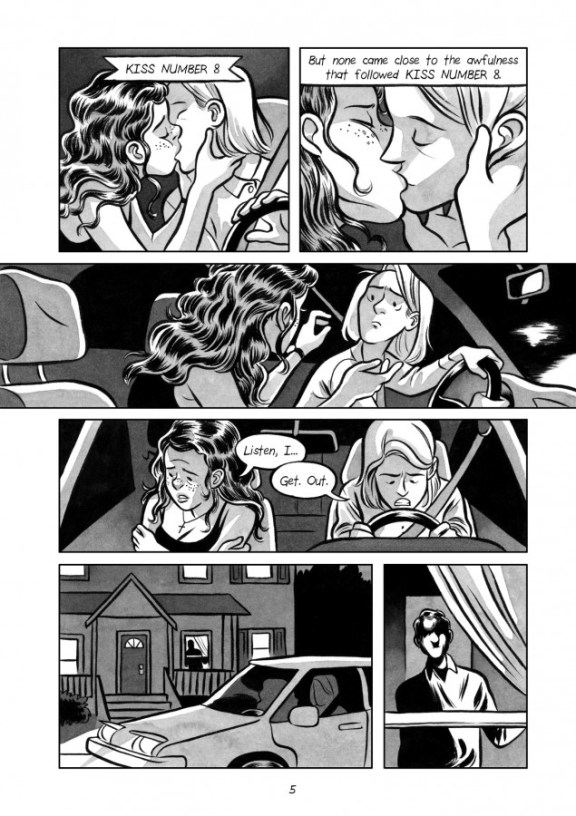
Book Description: Amanda can’t figure out what’s so exciting about kissing. It’s just a lot of teeth clanking, germ swapping, closing of eyes so you can’t see that godzilla-sized zit just inches from your own hormonal monstrosity. All of her seven kisses had been horrible in different ways, but nothing compared to the awfulness that followed Kiss Number Eight. An exploration of sexuality, family, and faith, Kiss Number Eight is a coming-of-age tale filled with humor and hope.

Review: It may seem like I’m doing a LOT of graphic novels lately, but in my defense I neglected this format a lot this summer. This occurred to me when I was requesting books for a teen graphic novel display, and one of the books I stumbled upon was “Kiss Number 8” by Colleen A.F. Venable and Ellen T. Crenshaw. After requesting it for work, I requested it for myself. I hadn’t looked too much into it when I requested it; I knew that it had LGBTQIA+ themes, and I knew that it was about a teen girl figuring out her sexuality. But what I didn’t expect was how emotional “Kiss Number 8” was going to be, and how hard it would be to read at times because of the themes.

And to note, I will have to address some vague spoilers in this review to fully discuss my opinions. I’ll do my best to keep it general.

“Kiss Number 8” takes place in 2004, a time that doesn’t seem to distant to me but is actually fifteen years ago. As I was reading this book, it served as a reminder of how many things have changed in terms of societies views on sexuality, and yet how far we still have to go. Amanda is written as a pretty typical teenage girl of this time and place, and up until this point she can count on a number of things: she has a fantastic relationship with her father, she has a tempestuous relationship with her mother, and her best friends Cat and Laura are always going to be there for her, even if they don’t particularly like each other. You get a great glimpse into Amanda’s life through snippets of scenes, and by the time the main plots start to kick in you already know who she is and what her reality is. Venable does a good job of showing rather than telling when it comes to how Amanda feels about those in her life, especially her growing infatuation with Cat, whose care free and somewhat selfish personality is apparent to everyone BUT Amanda. I also liked the slow unraveling and reveal of the other main plot line: a mysterious phone call to her father, and a mysterious letter that he tries to hide from her. Venable does a really good job of making the reader think it’s going to be one thing, but then piece by piece shows that it’s something completely different, something that connects to Amanda’s present emotional situation with Cat and goes even further back into how people have to hide their identities from others.

I also thought that Venable did a good job of portraying realistic, and at times very flawed, characters. As I mentioned earlier, Amanda is a pretty normal teenage girl, but along with that comes a cruel streak towards those who care about her, especially her mother and Laura. She makes bad decisions in moments of great emotion, and it ends up hurting people, who in turn react poorly and hurt her back. But you never get the sense that she is a bad person when she does these things, rather that she is in a great deal of pain and dealing with confusion about herself and a life she thought she had all sorted out. The fallout from these choices always felt real, and sometimes that meant that it was painful to read. But again, Amanda doesn’t ever come off as a bad person, just a person who is still learning. In fact, most of the characters are given a certain amount of grace when they screw up, and aren’t painted as being one dimensional or cardboard cut outs of tropes…. Even when they don’t necessarily deserve it. Because to me, with how some of the characters did end up reacting to Amanda’s identity, and the identities of others within the story, I didn’t want them to be given a pass, realistic or not. Not when they caused to much pain.

And that is a good segue into difficult moments that I had with “Kiss Number 8”, specifically with how a number of the characters were when it comes to LGBT issues. There is a LOT of homophobia and transphobia in this book, and while it’s all written within the context of the story, and doesn’t feel like it’s excused or glossed over, it could still be triggering for readers who are in those communities. While Amanda was a lived experience of learning about herself and her sexuality, I feel like the ball was dropped a bit more with the trans characters in the narrative. They were more used as lessons for Amanda to learn, and their voices and experiences were put in the context of a cis girl realizing that they too are human beings who deserve respect and dignity. That isn’t to say that I thought Venable was malicious in her portrayal, but it does show that we still have a ways to go when it comes to how trans characters are portrayed within the stories we read. That said, I am a cis straight woman, so if my assessment is off kilter to anyone please do let me know. I, too, am still learning.

I have nothing but good things to say about Crenshaw’s artwork. The characters are cartoony and fun, and their designs remind me of other popular teen graphic works like “Drama” and “This One Summer”, but the style is still unique and feels new and fresh. And even with the more ‘cartoony’ drawings, the emotional weight of the various situations still came through loud and clear.

kiss_8_r15-1-635x900
(source)

Uncomfortable and clunky aspects aside, I enjoyed “Kiss Number 8”. It’s an honest and emotional book that kept me reading, and reminded me that there is still so much progress to be made, even if we’ve come so far.

Rating 8: A bittersweet and emotional story about finding one’s identity, “Kiss Number 8” has complex characters and relevant themes. We’ve come so far with stories like this, but we still have a ways to go.

Reader’s Advisory:

“Kiss Number 8” is included on the Goodreads lists “Lesbian Teen Fiction”, and “Sapphic Graphic”.

Find “Kiss Number 8” at your library using WorldCat!

Serena’s Review: “Tidelands”

43260625Book: “Tidelands” by Philippa Gregory

Publication Info: Simon & Schuster, August 2019

Where Did I Get this Book: e-ARC from the publisher

Book Description: England 1648. A dangerous time for a woman to be different . . .

Midsummer’s Eve, 1648, and England is in the grip of civil war between renegade King and rebellious Parliament. The struggle reaches every corner of the kingdom, even to the remote Tidelands – the marshy landscape of the south coast. 

Alinor, a descendant of wise women, crushed by poverty and superstition, waits in the graveyard under the full moon for a ghost who will declare her free from her abusive husband. Instead she meets James, a young man on the run, and shows him the secret ways across the treacherous marsh, not knowing that she is leading disaster into the heart of her life.

Suspected of possessing dark secrets in superstitious times, Alinor’s ambition and determination mark her out from her neighbours. This is the time of witch-mania, and Alinor, a woman without a husband, skilled with herbs, suddenly enriched, arouses envy in her rivals and fear among the villagers, who are ready to take lethal action into their own hands.

Review: Philippa Gregory was probably one of the authors I associate most strongly with my first experiences reading historical fiction as a teenager. With a few exceptions, up to that point I read fantasy/sci-fi and really that was it. But I whizzed through “The Other Boleyn Girl” and was hooked on a new genre from there on out. I read a good number of Gregory’s works over the years, and enjoyed many them. However, after a bit, I was ready to move on from her tried and true political, royal scheming stories that were starting to feel a bit stale to me. So I was excited when I heard about “Tidelands” and saw that we would be getting something outside of that wheelhouse with a story about a poor widow who comes under suspicion as a witch.

Alinor is a woman between worlds. Her husband is missing, so she is not a widow. So she’s still a wife but one without a provider, left to live independently with all of the challenges that come with it, but none of the securities that come with being a widow (mostly having to do with a woman’s honor and all of that fun stuff). But her and her children’s lives change when she runs across a priest attempting to find safety out on the ever-changing and dangerous tidelands. New opportunities are now opening before her, but with these changes come new dangers, and the watchful and suspicious eyes of neighbors are always watching.

It was nice to return to a historical fiction novel that wasn’t also a mystery. Looking back over what I’ve read the last year or so, almost all of my historical reading has been a combination of the two genres. Gregory has always impressed with her detailed descriptions of life in the time period in which her stories take place and the historical accuracy of the political and cultural experiences of those living then. This book in particular delved into the brewing tensions between the new church and the old, the new king and the old. I didn’t know a whole lot about the parties and beliefs at play here, but I enjoyed learning more about it throughout this novel. I especially enjoyed the way that Gregory approached it through Alinor’s eyes, as a common woman who has lived an isolated life away from much of the drama that is gripping the nation.

But with these details also comes a fairly slowly moving plot. The story takes a long time to get going and, thinking back on it, I’m not sure it ever even did, other than a very brief section near the end. Much of it revolves around Alinor’s romantic plot line, and even that moved at a fairly glacial speed. Once I accepted that that was what the story would be, I was better able to settle in, being now less focused on desperately trying to locate a plot. But even then, the story felt out of balance. It’s one thing to not have a strong plot in favor of focusing on characters and their relationships, but I was also never strongly attached to any of those either.

I also had hoped for a bit more from the fantastical elements teased in the description. I wasn’t expecting a fantasy, of course, but I had hoped for more on the witch front. Again, it took a long time to get there, and then it felt pretty rushed. The ending itself seemed to come out of nowhere and just kind of…end. It wrapped up in only a few pages, leaving several subplots unexplained and with an abrupt shift in characters’ lives, with little build up or exploration provided. This is the first in a series, so there’s room to expand on these things from here. But even with a series, each book should feel self-contained and have a natural beginning, middle, and end. Here, the end felt slapped on because the book needed to end, nothing more.

Overall, this was a bit of a lackluster read for me. While I liked many of Gregory’s early books, this one reminded me why I had stopped keeping up with her works. There is nothing technically wrong with it, but the story never grabbed me, the characters were not especially likable, and I felt like the historical details, while accurate and reflective of Gregory’s strong research, overwhelmed what little story there was left. Fans of her later work may very well enjoy this book, but it wasn’t really for me, sadly.

Rating 6: A bit too slow, a bit too detailed, and a bit off the mark at the end.

Reader’s Advisory:

“Tidelands” is a new book so it isn’t on any relevant Goodreads lists, but it should be on “Witch Hunts in Historical Fiction.”

Find “Tidelands” at your library using WorldCat!

Book Club Review: “Kindred”

60931We are part of a group of librarian friends who have had an ongoing bookclub running for the last several years. Each “season” (we’re nerds) we pick a theme and each of us chooses a book within that theme for us all to read. Our current theme is ‘Books On Our To Read Shelf’, where we pick books that we’ve been meaning to read but haven’t gotten to.

For this blog, we will post a joint review of each book we read for book club. We’ll also post the next book coming up in book club. So feel free to read along with us or use our book selections and questions in your own book club!

Book: “Kindred” by Octavia Butler

Publishing Info: Doubleday, June 1979

Where Did I Get This Book: I borrowed it from my Mom!

Book Description: The first science fiction written by a black woman, Kindred has become a cornerstone of black American literature. This combination of slave memoir, fantasy, and historical fiction is a novel of rich literary complexity. Having just celebrated her 26th birthday in 1976 California, Dana, an African-American woman, is suddenly and inexplicably wrenched through time into antebellum Maryland. After saving a drowning white boy there, she finds herself staring into the barrel of a shotgun and is transported back to the present just in time to save her life. During numerous such time-defying episodes with the same young man, she realizes the challenge she’s been given: to protect this young slaveholder until he can father her own great-grandmother.

Kate’s Thoughts

Usually when only one of us can read the book, we will forego our book club review. But even though Serena was otherwise indisposed for our book club meeting, I really, REALLY wanted to make a post about “Kindred” by Octavia Butler. One reason is that it has been on my personal reading list for awhile now, even though it was fellow book club member Alicia’s pick for this session. But the second, and more pressing, reason is that “Kindred” blew me away and I want to talk about it. Why did I wait so long to read this book? Why? It is still as powerful and relevant today as it was in the 1970s when it was first published.

While it may have similar conventions to what we’ve come to expect of time travel stories, “Kindred” pushes the bounds of what the reader thinks they are going to read. Our protagonist Dana is a 20th Century Black woman who keeps getting sent back to the Antebellum South to save her white ancestor, slave owner Rufus Weilan, from danger, as he needs to live to father her great great grandmother. Butler doesn’t explain why this is happening, nor does she go into the details of various time paradoxes, but honestly, that didn’t bother me at all when usually it really, really does. The more pressing and immediate danger for her, however, is not the existential crisis of her very existence, but whether or not her trips back will ultimately leave her broken, hurt, or killed because of the fact she’s a Black woman in a slave state, and a culture that treats her like chatel and property. She learns to care for Rufus, as her initial meetings with him are when he is a vulnerable child, but as he grows older and more entrenched in the violent white supremacy of his time period their friendship becomes more strained, toxic, and abusive. Dana has every reason to try and keep him alive, but doing so becomes more and more dangerous for her and for the slaves on his family plantation. Butler tackles this complexity with a lot of nuance, but doesn’t shy away from the horrors of chattel slavery in the American South, and the monstrous actions of many white people during this time period. From Rufus to his mother and father to patrollers, the psychological and physical abuse that many white people in this book throw towards the slaves is historically accurate, and therein very upsetting. She doesn’t hold back on the violence and cruelty, and there are many moments in this book that are hard to read, but also necessary to confront. “Kindred” has more gumption on tackling these issues than a number of stories about slavery that have been published after it, and it really says something to me that a book written forty years ago feels braver than more recently published books about slavery. 

On top of the compelling and powerful social commentary, the time travel story had a well developed and interesting system that I could fully buy into. When Dana goes back in time and lives out the timeline then, weeks for her could be minutes for the modern day. This is demonstrated by her relationship with her husband Kevin, who tells her that after her first encounter that she was gone for only a moment, while to her it felt like quite a bit longer. This plays out in more dire, and somewhat tragic, ways later, as a time separation extends for years for one of them, and days for the other. As mentioned earlier, we don’t know how this time travel happens, or what the origin of it is, but it’s well established and believable enough that you don’t find yourself questioning it. You know how she gets there, how she gets back, and that is all you really need to know. The rest doesn’t really matter. This is a significant piece of science fiction, and Butler completely owns and deserves the status of a Sci-Fi heavyweight.

I am so, so happy that I’ve finally read “Kindred”. I now absolutely have to take on other works by Butler, as while Sci-Fi isn’t really my jam, I have a feeling that anything she does in the genre is going to work for me. If you’re a science fiction fan and haven’t read this, you absolutely must do so. 

Rating 9: A stellar, gripping, complex, and compelling piece of speculative and historical fiction, “Kindred” remains one of the best science fiction books that seamlessly combines the all too real with the fantastical.

Book Club Questions

  1. “Kindred” was written in the late 1970s, but still has a lot of resonance today. If it was written today, what, if any, differences do you think there would be in the narrative? Do you think that the social commentary would be the same? Different?
  2. What did you think of the science fiction aspect of the story? Do you want more details? Did it hold up within the narrative?
  3. Dana’s husband Kevin is both a supportive, caring, and sensitive husband, but he also has moments of ignorance and naïveté when it comes to her experiences as Black woman. What did you think of him and Dana as a couple?
  4. Do you think that Dana ever had the ability to change Rufus? If you think she could, what do you think she’d need to have done?
  5. Slavery is a large theme within this novel. How does to content of “Kindred” compare to other slave narratives you’ve read?
  6. What did you think of the ending of the book?

Reader’s Advisory

“Kindred” is included on the Goodreads lists “Speculative Fiction by Authors of Color”, and “Best Time Travel Fiction”.

Find “Kindred” at your library using WorldCat!

Next Book Club Book: “The Joy Luck Club” by Amy Tan