Kate’s Review: “American Vampire (Vol. 1)”

This post may contain affiliate links for books we recommend.  Read the full disclosure here.

Book: “American Vampire (Vol. 1)” by Scott Snyder, Stephen King, & Rafael Albuquerque (Ill.)

Publishing Info: Vertigo, 2010

Where Did I Get This Book: I own it.

Where You Can Get This Book: WorldCat | Amazon | Indiebound

Book Description: From writers Scott Snyder and Stephen King, American Vampire introduces a new strain of vampire – a more vicious species – and traces the creatures’ bloodline through decades of American history.

Snyder’s tale follows Pearl, a young woman living in 1920s Los Angeles, who is brutally turned into a vampire and sets out on a path of righteous revenge against the European monsters who tortured and abused her. And in King’s story set in the days of America’s Wild West, readers learn the origin of Skinner Sweet, the original American vampire – a stronger, faster creature than any vampire ever seen before.

Don’t miss out as Snyder and King set fire to the horror genre with this visionary, all-original take on one of the most popular monster stories! This beautiful collection features a new introduction by Stephen King and bonus art including character sketches, variant covers and more!

Review: Here we are again, about to embark on a re-read of a graphic novel series that I loved in the past and want to revisit in the present. Well, sort of. You see, I read the majority of “American Vampire”, Scott Snyder’s horror comic that follows American vampires through the decades as America changes and evolves. I own almost the entire series. But then for some reason I just kind of stopped reading it, and I honestly don’t really remember why (I have theories, but to address them here would be spoiler-y). So I decided that for my next re-read (potentially final…) of a series I would go back to a horror series I greatly enjoyed. And as a bonus, guess who wrote part of the first volume? Good ol’ Uncle Steve. If Stephen King is involved, I’m always game, and always have been.

We have to differing storylines that do merge together in a way in Volume 1. The first is of Pearl, a 1920s movie extra who loves being in the silent films, as she and her roommate Hattie try to make it big in Hollywood. But when Pearl is invited to a Hollywood executive’s party, what she thinks is a big break turns out to be a trap; the high powered executives are vampires, and they attack her and leave her for dead in the desert. She is rushed to a hospital, but dies.. Until a mysterious man brings her back to life, and she vows revenge on those who killed her. The other story (and the one King wrote) is about said mysterious man, Skinner Sweet, a ruthless desperado from the 1800s, who is turned into a vampire, and realizes that somehow he’s a new breed, one that has distinct advantages over the European ilk, and he goes on a massacre while a man named Book hopes to hunt him down and stop him once and for all. Both stories have a distinctly American feel to them, be it the glowing lights of Hollywood and it’s broken promises, or the dangerous and lawless expansion out West, and Snyder and King find ways to not only have some great arcs that set up an entire series, but ones that can stand on their own as well (especially King, as this is his only contribution to the series, and it’s SO him in characterization and storytelling). It’s the interesting Western theme and the femme fatale theme that are so compelling to the story, and they easily fit together as Pearl beings her journey, and Sweet continues his. I also really appreciated the idea of the ‘American’ vampire type being more violent and opportunistic and guns-a-blazing than the European type. If that isn’t an apt metaphor I don’t know what is.

I definitely prefer the Pearl storyline, as Pearl is such a great character from the jump. She is ambitious but not cutthroat, tough but fair, and the fantastic metaphor of a predatory movie studio being turned into vampire nest works on every level. Once Pearl realizes her new state and new powers, she isn’t hesitant to seek revenge on those who killed her, but at the same time she is struggling with her new condition, especially because of those she loves, specifically her roommate and best friend Hattie, and her would be lover Henry. The relationship with Henry is especially compelling, as Henry is a supportive and caring man who just worships the ground Pearl walks on. Snyder writes him in a way that makes him so likable, never making his love and devotion to her in doubt, nor making it some kind of weakness. Pearl can absolutely stand on her own, especially after she becomes a vampire, but it’s also completely okay for her to want companionship and support and it never feels like it’s holding her back. I loved Pearl the first time, and I loved her again this time.

Skinner is another story, however. It’s interesting, because I thought that perhaps going back into it ten years later with an evolved reading taste would change my thoughts, but nope, I still find Skinner to be the worst, and not really in a fun way. King doesn’t really write him as anything but a disgusting villain, which is good, as the focus of the hero arc is more on his enemy James Book, who was hunting him down in life and now hunts him down post vampirism. There are lots of “Dracula”-esque moments as a group of humans uses their wits and knowledge to track down a vampire, and once again I was more rooting for them to take out Skinner (even though we know it doesn’t work, given Skinner’s connection to Pearl). I do like how King sets up an entire line and arc for how Skinner is going to be functioning and hounded in the years to come, as generations have reason to go after him (Book’s partner has a daughter named Abi who has her own reasons to want Skinner dead as time goes on. I will say that the relationship between her and Book is weird and a little gross, but it has to happen for something ELSE to happen, so…. whatever). Long story short, the Skinner Sweet storylines we see are only as interesting as his foils, and my guess is that King intended for that to be case.

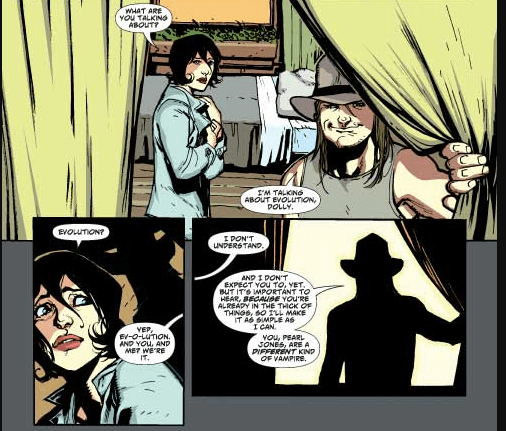
And finally, the artwork is still some of my favorite artwork in comics to date. Rafael Albuquerque can do both really charming kind of down to Earth designs, while also tapping into some really horrific imagery.
Source: Vertigo

I’m really excited about this re-read of “American Vampire”, as I’m already having a blast. Join me, won’t you, as we follow Pearl and Skinner through the years of this very young and very flawed nation. What will these two very different vampires get up to?

Rating 8: A great start to a vampire story that feels incredibly American, for better and for worse.

Reader’s Advisory:

“American Vampire (Vol. 1)” is included on the Goodreads lists “Comics + Graphic Novels To Read For Halloween”, and “Best Adult Vampire Books”.

Kate’s Review: “The Last Comic Book on the Left (Vol.1)”

This post may contain affiliate links for books we recommend.  Read the full disclosure here.

Book: “The Last Comic Book on the Left (Vol. 1)” by Ben Kissel, Marcus Parks, & Henry Zebrowski (Eds.)

Publishing Info: Z2 Comics, June 2022

Where Did I Get This Book: I own it.

Where You Can Get This Book: WorldCat | Amazon | Indiebound

Book Description: RISE FROM YOUR GRAVES
Not a joke, not a gag like a necromancer The Last Podcast on The Left is reviving the tradition of the humor comic magazine except this time as a series of graphic novels. Inside you will see stories edited and curated by your Last Podcast Hosts made to entrance the eyes and titillate the senses. SEE: Detective Popcorn solve the meaning of LIFE! WITNESS: The descendent of Albert Fish! GET AROUSED BY: Very Sexy Mothman! A mix of Comedy and Horror created by some of the best comic writers ,artists, warlocks in this dimension
.

Once read The Last Comic on The Left will change your life maybe for the better.

DISCLAIMER: The Last Comic on The Left has not been funded by an underground satanic cult. All Cryptid portrayals have come with the explicit permission of The Mothman, Sasquatch and Jersey Devil estates. By buying, reading or even looking at this book you are consigning your soul, spirit or any eternal animating entity to the creators of this book which again is not funded by a satanic cult

Review: It’s been a few years, but I am still wholeheartedly into the podcast “The Last Podcast on the Left”. While other podcasts have fallen to the wayside, partially due to not driving as much, partially due to other factors, this one is still a must listen for me, and I will support Ben Kissel, Marcus Parks, and Henry Zebrowski in as many creative endeavors as I can. So of course I was going to pick up “The Last Comic Book on the Left”, the new graphic novel horror anthology inspired by the show, and designed by a number of writers and artists working in today’s comics industry. I preordered it and it took awhile after some delays, but when it did arrive, I dove in.

This is a collection that has a lot of entries, from short stories to ongoing tales to odd artwork that sends up pin ups and ads from old comic anthologies from back in the day. You can tell that all of the contributors have a clear vision that they are putting forth, and it’s a mish mash of varying successes. I actually enjoyed it quite a bit, haphazard as it was. There were a few stand outs for me. My favorite things were the pin up artworks of various cryptids, from the Jersey Devil to Mothman to Sasquatch, designed in ways that make them out to be Playboy centerfolds with sexy designs and insights into their favorite things (the Mothman one was particularly hilarious, as it’s just otherworldly gibberish with the occasional unsettling bits of English). There is also a really interesting story by Noah Van Sciver that starts out as a seemingly graphic history of the Fundamentalist Latter Day Saints, the offshoot Mormon cult that is known for egregious abuses and fanaticism, but instead turns into a meditation on how we tell these stories (this was probably my favorite in the collection; I have been deeply fascinated by the FLDS and I really liked how Van Sciver turned the whole concept of comic histories on its head). There is also a creepy comic that is based on the Sandown Clown Incident, which was just unsettling and tense because of not only the source material, but also the framing of the tale itself with two small children encountering a creepy clown-like figure, the tension building and building into high strangeness discomfort.

But here is the thing. While I think that fans of the podcast (like myself) will find a lot to love in this collection, I’m not sure that there will be a lot of crossover appeal to broader audiences. With the previous LPOTL book being the fantastic “The Last Book on the Left” there was so much great content and context beyond the podcast lore that I felt any fan of true crime could pick it up and enjoy it. “The Last Comic Book on the Left” is definitely a love letter for the fans who have been with the show for awhile, with references to such characters as Detective Popcorn and Scungilli Man that a layman just isn’t going to get. I think it’s super fun, and I think that there will probably be some people who like the weirdness of a lot of it. And a lot of the stories have outside accessibility to be sure. But it does feel niche. I’m okay with niche, however. This comic is written for me as a fan of the show. It’s chaotic and wild. But it’s absolutely a matter of ‘your mileage may vary’ in terms of other readers.

That said, let’s just look at one of my favorite bits of artwork. BEHOLD: SEXY JERSEY DEVIL by artist Sean Van Gorman!

The caption at the bottom sent me into hysterical laughter. (source: Z2 Comics)

It’s out there, it’s nutty, it’s funny and strange. I had a fun time with “The Last Comic Book on the Left”. It fuses the humor of my favorite podcast with some creative graphic novel designs and storytelling.

Rating 7: It’s going to be very niche, I feel, geared towards fans of the podcast, but I enjoyed the chaotic energy this collection was serving.

Reader’s Advisory:

“The Last Comic Book on the Left” isn’t included on any Goodreads lists as of now, but I think it would fit in on “Horror Comics Anthologies”.

Kate’s Review: “Measuring Up”

This post may contain affiliate links for books we recommend.  Read the full disclosure here.

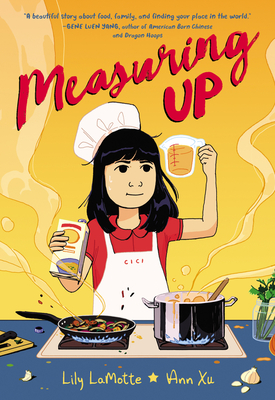
Book: “Measuring Up” by Lily LaMotte & Anne Xu (Ill.)

Publishing Info: HarperAlley, October 2020

Where Did I Get This Book: The library!

Where You Can Get This Book: WorldCat | Amazon | Indiebound

Book Description: Twelve-year-old Cici has just moved from Taiwan to Seattle, and the only thing she wants more than to fit in at her new school is to celebrate her grandmother, A-má’s, seventieth birthday together.

Since she can’t go to A-má, Cici cooks up a plan to bring A-má to her by winning the grand prize in a kids’ cooking contest to pay for A-má’s plane ticket! There’s just one problem: Cici only knows how to cook Taiwanese food.

And after her pickled cucumber debacle at lunch, she’s determined to channel her inner Julia Child. Can Cici find a winning recipe to reunite with A-má, a way to fit in with her new friends, and somehow find herself too?

Review: We have once again come upon a whim book, as I was wanting to read more graphic novels on the day that I requested “Measuring Up” by Lily MaMotte and Anne Xu. One of the other graphic novels I read recently was food based, and given how I enjoyed that one I thought I would give this one a try! Especially since it sounded like it had some other themes that it was going to tackle, along with the food.

The coming of age story at the heart of “Measuring Up” is very sweet and gentle. Cici is a preteen girl who finds herself in a new country and culture, and who is nervous about what that means for herself and for her place in the world around her. Her desperation to see her A-má again, who stayed behind in Taiwan, motivates her to sign up for a junior cooking contest, as cooking with her grandmother was a true joy and she is pretty good at it. The story is fairly simple, which makes sense for the middle grade audience, and I thought that Cici’s initial struggles with making friends and her conflicts with her parents regarding her priorities (cooking contest vs studying) were well conveyed in a middle grade narrative. At times it may have felt perhaps a little too simplistic for me, but I’m absolutely not the audience for this story so that doesn’t reflect the story as a whole. As Cici works through the cooking contest and starts to feel more at home, she is also repressing her identity because of how Taiwanese food and culture is viewed in a Western culinary world (more on that aspects in a bit), which drives her to experiment with more Western foods. This is also because of her cooking partner Miranda, whose Italian restaurant owning father has basically told her to focus on Italian food. The contrast between Miranda and Cici could be pretty start, but LaMotte finds ways to show that they may have more in common than they initially realize. Again, simplistic, but ultimately sweet.

Along with the coming of age story we get a tale about a girl who is adjusting to a new culture, while trying to keep her identity as well as finding a new one. As Cici starts to acclimate to her new home, she feels a need to keep her Taiwanese identity close to the vest, partially because of micro aggressions or flat out racism, but also because of her insecurities about herself as a tween girl. LaMotte touches upon preconceived notions of Asian food, from classmates telling Cici her lunch is ‘stinky’ to adults writing it off as low brow or cheap. I thought that LaMotte did a good job of balancing the broader themes within the story itself, and I liked that Cici had moments of pushing back, as well as moments of Cici being pleasantly surprised beyond her expectations. The important moments of Cici having to deal with micro aggressions are explained in a way that will resonate with the target audience, and I liked how Cici not only got to push back against it, but also got to pursue her own identity that may not line up with the one that her parents have laid out for her. It just felt like it all handled some complex issues in an accessible way.

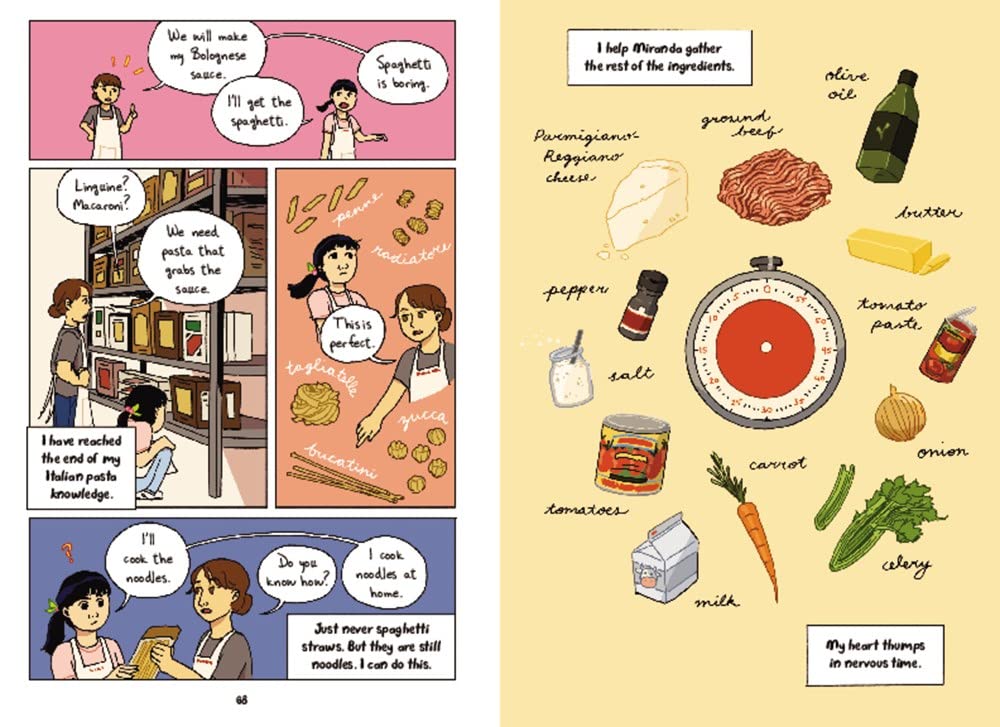
And the drawing style is cute and fits the tone. I liked the way that Anne Xu could bring out emotional moments and feelings even in the simplistic art style that will probably resonate with the target audience. And it also just made me so hungry for basically all of the foods that we were seeing on the page.

(source)

“Measuring Up” was cute and a good fit for middle grade audiences! I know exactly who I would recommend this to, and it will make the reader ready to take on some culinary adventures of their own!

Rating 7: A cute story about cooking, friendship, culture, and finding oneself.

Reader’s Advisory:

“Measuring Up” is included on the Goodreads lists “Comics About Food”, and “Culinary Fiction – Middle Grade”.

ALSO

If you are as disgusted as I am about the striking down of Roe, I’m going to post some links here that will give you information and resources to donate to.

National Network of Abortion Funds

Rewire News Group

National Abortion Federation

Plan C

Kate’s Review: “Run: Book 1”

This post may contain affiliate links for books we recommend.  Read the full disclosure here.

Book: “Run: Book One” by John Lewis, Andrew Aydin, Nate Powell (Ill.), & L. Fury (Ill.)

Publishing Info: Abrams ComicsArts, August 2021

Where Did I Get This Book: The library!

Where You Can Get This Book: WorldCat | Amazon | Indiebound

Book Description: First you march, then you run. From the #1 bestselling, award–winning team behind March comes the first book in their new, groundbreaking graphic novel series, Run: Book One

“In sharing my story, it is my hope that a new generation will be inspired by Run to actively participate in the democratic process and help build a more perfect Union here in America.” –Congressman John Lewis

The sequel to the #1 New York Times bestselling graphic novel series March—the continuation of the life story of John Lewis and the struggles seen across the United States after the Selma voting rights campaign.

To John Lewis, the civil rights movement came to an end with the signing of the Voting Rights Act in 1965. But that was after more than five years as one of the preeminent figures of the movement, leading sit–in protests and fighting segregation on interstate busways as an original Freedom Rider. It was after becoming chairman of SNCC (the Student Nonviolent Coordinating Committee) and being the youngest speaker at the March on Washington. It was after helping organize the Mississippi Freedom Summer and the ensuing delegate challenge at the 1964 Democratic National Convention. And after coleading the march from Selma to Montgomery on what became known as “Bloody Sunday.” All too often, the depiction of history ends with a great victory. But John Lewis knew that victories are just the beginning. In Run: Book One, John Lewis and longtime collaborator Andrew Aydin reteam with Nate Powell—the award–winning illustrator of the March trilogy—and are joined by L. Fury—making an astonishing graphic novel debut—to tell this often overlooked chapter of civil rights history.

Review: In 2020, we lost John Lewis, who passed away that summer after a fight with cancer. I remember being so saddened by this, as he was such an amazing man who helped change our country for the better. It wasn’t until the next year that I found out that before his death he had continued his graphic novel endeavors after “March”. “Run: Book One” is the continuation of Lewis’s work as a social justice advocate, as well as a history lesson on what happened directly after the Civil Rights Act was put in place, both in terms of the backlash from white people who were against it, as well as people within the movement who thought it didn’t go far enough.

“Run: Book One” picks up shortly after the passing of the Civil Rights Act that ended the “March” Trilogy. While in American history class it’s tempting to end the story there, with a great success and a fantastic development in social justice and civil liberties, things didn’t just magically get better. Lewis lays out some of the events that happened right after, such as Black people still being assaulted and murdered by police and white people, the race riots in Watts, and the mass anger on behalf of white supremacy that saw a doubling down on racist leaders and hate groups. It’s framed in such a way that one can’t help but draw comparisons to some of the similar events that have happened in the past couple of years, let alone half a century ago, and it feels deliberate on the part of Lewis. He also dives more into the systemic issues that were stoking a lot of the injustices towards Black people at the time, specifically the Vietnam War and how so many Black men were being sent to fight in an unjust war and were dying for a cause that was rooted in Imperialism. He looks at how he and other Civil Rights leaders agreed or disagreed on how to approach the war and the draft, and how foreign policy was directly connected to the Civil Rights Movement that was still going on even after the Civil Rights Act. There is also the matter of the mass voter suppression of Black people in the wake of the Civil Rights Act being passed, which is just a reminder that the more things change, the more they stay the same, and that’s disgraceful. The direct mirroring of that moment then and the moment we are finding ourselves in right now is stark.

But what was even more interesting to me (and something I admittedly knew very little about) was how John Lewis addresses the strife and splintering of people within the Movement itself, and how that changed his role within. Again, I feel like in history class we are told about SNCC in the context of the sit ins and other nonviolent actions, as well as John Lewis’s role. Because of that, I had NO idea that he was effectively forced out of power by Stokely Carmichael and other members who were beginning to feel that SNCC wasn’t doing enough to combat injustice. Lewis talks about this in a way that never really comes off as bitter or angry, but more saddened as to how everything turned out. I definitely don’t think that I can comment too much upon different approaches to achieving social justice goals by these two ideologies, and Lewis comes off as very careful not to denigrate those who cast him out. He also begins to set up his eventual successful stint as a Congressman, devoting arcs to Julian Bond and Marion Barry, who broke ground as Black government officials right in the thick of the backlash.

And when it comes to the art, L. Fury is now a part of the team, as Nate Powell takes a bit of a back seat but does give input (at least that’s what some research told me). Fury’s style blends enough with the style of the original style of “March” that it feels like a good successor, with black and white aesthetics and similar designs.

(source)

I’m not sure if there will be more “Run” books, as Lewis passed in 2020. There is a note at the beginning of this saying that the script was finished before his death, but I don’t know if that means the entire script, or just for “Book One”. Regardless, “Run” is a fantastic follow up that is an important reminder that with great strides and success comes resistance to change, and that you just have to keep going and doing what you believe in. Add this to the collection with “March”, for sure.

Rating 9: A powerful new memoir from John Lewis that reminds us that stories don’t always end with triumphs, “Run” is a must read continuation of the fight for civil rights and against white supremacy in America.

Reader’s Advisory:

“Run: Book One” is included on the Goodreads lists “Graphic Novels About Black Lives”, and “Teaching African American History After Obama”.

Kate’s Review: “Locke & Key: The Golden Age”

This post may contain affiliate links for books we recommend.  Read the full disclosure here.

Book: “Locke & Key: The Golden Age” by Joe Hill & Gabriel Rodríguez (Ill.)

Publishing Info: IDW, April 2022

Where Did I Get This Book: I received an eARC from the publisher.

Where You Can Get This Book: WorldCat | Amazon | IndieBound

Book Description: Unlock moments from Keyhouse’s long history, expanding the saga of the Locke family in this collection of stories, which includes the epic crossover with DC’s The Sandman Universe!

For two hundred years, the Locke family has watched over Keyhouse, a New England mansion where reality has come unhinged and shadows are known to walk on their own. Here they have guarded a collection of impossible keys, instruments capable of unlocking both unparalleled wonder and unimaginable evil. Take a glimpse into the lives of Chamberlin Locke and his family in the early 20th century as they use the keys to fight battles big and small. From the killing fields of Europe during WWI and the depths of Hell, the Lockes are in a constant struggle to keep the dark forces of their world at bay.

Collects three standalone tales, “Small World,” the Eisner-nominated “Open the Moon,” and the never-before-seen “Face the Music,” along with the 3-part …In Pale Battalions Go… and the epic 80-page crossover with The Sandman Universe, Hell & Gone all from the co-creators of Locke & Key, Joe Hill and Gabriel Rodriguez!

Review: Thank you to IDW for sending me an eARC of this graphic novel!

It wasn’t so long ago that I wrapped up my “Locke & Key” re-read, and just as it was finished I was delighted to receive an invitation to read “Locke & Key: The Golden Age”. As someone who had never really gone back to read the expanded Locke Family stories that serve as stand alone prequels of sorts, this was a great opportunity to finally do so, especially since the original story was so fresh in my mind. But what made this all the more tantalizing? “Locke & Key: The Golden Age” not only has the supplemental expansions on this universe, but it also has the “The Sandman” crossover that has been tempting me ever since I heard about it.

IT’S HAPPENING! (source)

I will admit that I read this in the exact wrong order (as the collection was sent to me in their individualized sections), mostly because I was so damn eager to get to “Sandman” that I started there, which was like starting at the end. So I’m going to save that for last and start with the Locke stories that lead up to it, but also stand on their own two feet. We meet the Locke family that is living in Keyhouse at the beginning of the 20th Century. We have patriarch Chamberlain, his wife Fiona, his brother Harland, and his children John, Mary, Ian, and Jean. I liked getting to know this new Locke Family through the stories in this collection, which include “Small World”, where Chamberlain gives his kids the Small World Dollhouse key, which can bring anything into their actual house in scale sized form. Problem is, a black widow spider gets into the house when young Jean isn’t paying attention. This is a nice introductory tale that plays with a generally innocuous key, though clearly it has other issues. The other standalone story I want to mention was the most emotional of the bunch for me, called “Open the Moon”. In this story Chamberlain realizes that son Ian, who has a brain tumor and is getting sicker and sicker, is not long for this world. So he and Harland decide to construct a new kind of key to give him peace, taking him on a hot air balloon journey around the world with a magical conclusion. Hill made this short tale so bittersweet and moving, it had me weeping by the end, while still being full of whimsy and joy. These standalones were a good way to introduce a new Locke Family and to make you understand them with limited pages. Which is essential for the next two sections.

The next tale (and, of course, the one I read last because again, out of order!) was the collection called “In Pale Battalions Go”, which bridges the whimsical stand alone Locke stories with the “Sandman” crossover. I will have to spoil a bit in the next section, as the way this one plays out sets the scene for the “Sandman” story. World War I is raging, and even though Chamberlain has the keys and all the powers that they hold, he refuses to use them to turn the tides of war, as he feels they are too dangerous to wield in such ways. His son John, and idealistic early teenager, thinks that the keys should be used to help defeat the Germans, and uses the Age Key to age himself up, takes the keys, and goes to enlist. So we have a World War I tale, with some good ‘horrors of war’ and ‘great power comes great responsibility’ themes. As one can imagine, it does not go well. I liked this story for the most part, as it’s bleak as hell and it does a great job of showing the dangers of hubris and unintended consequences (something that is seen in other “Locke and Key” arcs). I also liked getting to follow John, even if I didn’t particularly care for him as a character because of his jingoistic zeal and terrible decisions. But at the same time, I think that Hill made him a fully realized and realistic character, being an impatient teenage boy during a World War that was unleashing unspeakable horrors.

And now the big event: “Hell and Gone”, the crossover story with “The Sandman”. Taking place a decade after “Battalions”, John’s twin sister Mary has a mission. Chamberlain is on his deathbed, haunted by the fact John killed himself at the end of “Battalions”. Using the Wellhouse portal, Chamberlain knows that John is in Hell because of his suicide, and Mary is determined to go and find him and bring him peace so that her father can die at peace as well. She hears of rumors that in England there is an otherworldly being that could be the key to getting her answers, and when she arrives to meets a boy with a strange helmet and amulet… You can see where this is going. I went into this thinking that there would be a fair amount of opportunity for Morpheus, but then when I realized the time period was during his capture, I wasn’t certain WHAT this story was going to do. But fear not, because this “Sandman” crossover instead utilizes other well loved “Sandman” characters, as Mary teams up with Lucien and Fiddler’s Green to confront Lucifer in Hell over John’s soul. I actually loved this even more because Fiddler’s Green is such a joy of a character, with his mild anxiety and caring heart. I also really loved Mary, as this is very much her story to shine in and SHINE SHE DOES. Her loyalty to her family and love for her twin means the stakes are VERY high for her, and it makes perfect sense that she would be down for tangling with Lucifer himself. And I believed every bit of it. And look for cameos from other “Sandman” characters, like the Corinthian, and yes, even Morpheus himself. And it’s done in a way that works for the timeline of his story combined with this one. Hill did a great job with the “Sandman” characters and mythos, it all felt like it combined perfectly and that he had true reverence for that comic and its characters.

And yes, Gabriel Rodríguez comes back to illustrate these stories and I still love his style. And he is a great artist to add to the great artists who worked on “Sandman” tales over the years.

Isn’t Mary just great? She’s great. (source: IDW)

Overall, this is a fantastic collection that both “Locke & Key” and “The Sandman” fans really need to check out if they haven’t already. I’m so happy to return to both Keyhouse and The Dreaming in this way. “Locke & Key: The Golden Age” met all my high expectations.

Rating 9: Fantastic backstory, fantastic fantasy, and a fantastic crossover with “The Sandman” Universe.

Reader’s Advisory:

“Locke & Key: The Golden Age” isn’t included on any Goodreads lists yet in this format, but it would fit in on “Best Horror Comics/Graphic Novels”, and “WWI: Speculative Fiction”.

Kate’s Review: “Himawari House”


This post may contain affiliate links for books we recommend.  
Read the full disclosure here.

Book: “Himawari House” by Harmony Becker

Publishing Info: First Second, November 2021

Where Did I Get This Book: The library!

Where You Can Get This Book: WorldCat | Amazon | Indiebound

Book Description: Living in a new country is no walk in the park.

When Nao returns to Tokyo to reconnect with her Japanese heritage, she books a yearlong stay at the Himawari sharehouse. There she meets Hyejung and Tina, two other girls who came to Japan to freely forge their own paths. The trio live together, share meals, and even attend the same Japanese-language school, which results in them becoming fast friends. But will they be able to hold one another up as life tests them with new loves, old heartbreaks, and the everyday challenges of being fish out of water?

Review: One of my big regrets from my youth is that I never did a study abroad program through school. My anxiety was too big of a hurdle to overcome, as was my mild separation anxiety from my loved ones when we’re apart for extended periods of time. So I like to read stories about people who take the leap, even if it makes me feel a certain sense of melancholy. So reading “Himawari House” by Harmony Becker was one of those books where I enjoyed seeing others do what I never did, even if their reasons and experiences would have been wholly different from my own had I taken the leap.

“Himawari House” follows three young women who are living in a house share in Japan. Nao is a Japanese born American who has come back to try to reconnect to her roots. Tina is from Singapore and was looking for a change. And Hyejung is from Korea and was looking for a new start. All of them end up at Himawari House as they do their schooling, and a strong friendship forms. We get to know each of them, as well as their growing pains, their motivations, their struggles, and their triumphs. While most of the focus is on Nao, Becker is sure to give a lot of page time to both Tina and Hyejung, and to explore how self discovery can span across cultures for young people. I loved seeing all of them get to know each other, and come to terms with the things that have happened in the past, and how they support each other through and through. There is a little bit of romance in this story for the three of them, but it never feels forced or unnecessary, nor does it feel like it takes focus off of their other threads.

I also liked some of the issues that Becker touched upon, specifically that of Nao who has been living in America for most of her life but was born in Japan. We see that because of her race and country of origin she never felt like she fit in in the U.S., as those around her saw her Japanese heritage first and foremost. But when she arrives in Japan, she is seen as an American first and foremost, and therefore she doesn’t feel like she really fits in anywhere when it comes to her greater cultural experiences. This made her found family in Himawari House all the more touching, and following her year with her new friends and loved ones is joyful, as well as bittersweet in some ways as the story moves forward. I also liked Hyejung’s backstory exploration, as being from Korea her experience was different from Nou’s, but had similar themes as well. For Hyejung her decision to go to Japan has put a rift between her and her parents, and seeing her struggle with missing them but also knowing that she may not be welcomed by them due to her decision is just heart-wrenching.

And I really loved the artwork. I’ve seen Becker’s artistry before, as she did the illustrations for George Takei’s graphic memoir “They Called Us Enemy”, and the style once again paired perfectly with the content, as different as it was from that previous work. I loved the influence of manga styles into the story during various moments of emotion, along with the more traditional and realistic artwork. I also REALLY liked how Becker did the speech bubbles, having both the language that the character is speaking in as well as the English translation in moments where that was what was going on.

(source: First Second)

I found “Himawari House” funny, relatable, joyful, and sweet. This tale of friendship and self discovery is a must read for graphic novel fans.

Rating 8: A charming and sweet coming of age tale about finding yourself as a stranger in a strange land.

Reader’s Advisory:

“Himawari House” isn’t included on many Goodreads lists, but I think it would fit in on “Let’s Japan!”.

Kate’s Review: “Chef’s Kiss”

This post may contain affiliate links for books we recommend.  Read the full disclosure here.

Book: “Chef’s Kiss” by Jarrett Melendez and Danica Brine (Ill.)

Publishing Info: Oni Press, March 2022

Where Did I Get This Book: I received an eARC from NetGalley.

Where Can You Get this Book: WorldCat | Amazon | IndieBound

Book Description: Watch things start to really heat up in the kitchen in this sweet, queer, new adult graphic novel! 

Now that college is over, English graduate Ben Cook is on the job hunt looking for something…anything…related to his passion for reading and writing. But interview after interview, hiring committee after hiring committee, Ben soon learns getting the dream job won’t be as easy as he thought. Proofreading? Journalism? Copywriting? Not enough experience. It turns out he doesn’t even have enough experience to be a garbage collector! But when Ben stumbles upon a “Now Hiring—No Experience Necessary” sign outside a restaurant, he jumps at the chance to land his first job. Plus, he can keep looking for a writing job in the meantime. He’s actually not so bad in the kitchen, but he will have to pass a series of cooking tests to prove he’s got the culinary skills to stay on full-time. But it’s only temporary…right? 

When Ben begins developing a crush on Liam, one of the other super dreamy chefs at the restaurant, and when he starts ditching his old college friends and his old writing job plans, his career path starts to become much less clear.

Review: Thank you to NetGalley for providing me with an eARC of this graphic novel!

I’m someone who likes to bake and cook but doesn’t have a real talent for it. I mean, I can follow a recipe and I have a few dishes I’m a pro at, but when it comes to being able to do things on the go or creatively I did NOT inherit that skillset from my Dad (who is an excellent on the fly cook). So stories about people who are creative with food always fascinate me, and “Chef’s Kiss” by Jarrett Melendez caught my eye because of this. And also because it is in graphic novel form! I’ve read a couple graphics that center around food (specifically the first few volumes of “Oishinbo”), but that’s about it. Plus, everything I read about “Chef’s Kiss” sounded not only sweet, but also had the added benefit of the author being a food writer as well. It was an interesting combination to say the least, so I had to give it a try.

“Chef’s Kiss” is both a love letter to food as well as a story about finding oneself, all with the added sweetness of a cute, queer love story to fall head over heels for. Our main character Ben has just graduated from college with aspirations to be a writer, but when he can’t get past the interview phase of job hunting (due to a lack of experience; I remember those days. HOW CAN I GET EXPERIENCE IF NO ONE WILL HIRE ME WITHOUT EXPERIENCE?), he applies for a kitchen position at a local trendy restaurant as it is the only place that doesn’t seem to require experience for consideration. It’s pretty clear from the get go that this job is going to end up being more than just a desperation gig, but that’s okay because while it’s a familiar storyline, Melendez knows how to elevate the best parts of it and turn it into a cute and comfortable coming of age tale. Ben is a relatable and likable main character, and watching him start to suss out his life is a nice journey as he has self doubt, anxiety, and a burning passion for cooking and food awakened inside of him. The conflict is pretty standard: his friends worry that he’s changing in ways that aren’t positive, he hides this from his overbearing parents for fear they will be angry, and Chef Davis, head chef and owner, is INTENSE and INTIMIDATING. But even so, there is a comforting undercurrent that everything is going to be just fine in the end, no matter what happens. I liked Ben a lot, and while his friends were a little two dimensional I liked them too. I also liked the crush that Ben has on fellow chef Liam, and seeing the two of them have their moments is very cute.

And man oh man, the food. Melendez is clearly a food writer because he knows exactly how to make the food and the restaurant culture come to life on the page. There is very much an affection for the culinary arts, and also the hectic and stressful culture that can come with them. I imagine that in “Chef’s Kiss” this is a very romanticized and tame scenario, as I’ve heard MANY things about the chef’s life and hustle, but for the purposes of this story it’s all very romantic and cozy. I just believed everything (well most everything, more on that in a bit) that was presented, from the neurotic head chef to the friendships made with other cooks to the way that food can bring out creativity and passion and self expression.

I’m now going to dedicate this next chunk of this review to Watson the pig. Yes, this book has a pig character, and yes, I absolutely loved this pig character. Ben is told that he doesn’t have to impress Chef with his food creations during his probation, but he does have to impress the restaurant’s pig, and this part of the story is so farfetched but so damn cute that I absolutely loved it. Watson’s opinions on the various offerings range from the expected to the utterly cartoonish (imagine a pig sitting in a lotus pose achieving enlightenment. It’s that level), and while it is not in any way shape or form realistic when the rest of the story is, it is charming as hell and I couldn’t wait to see what Watson was going to do next.

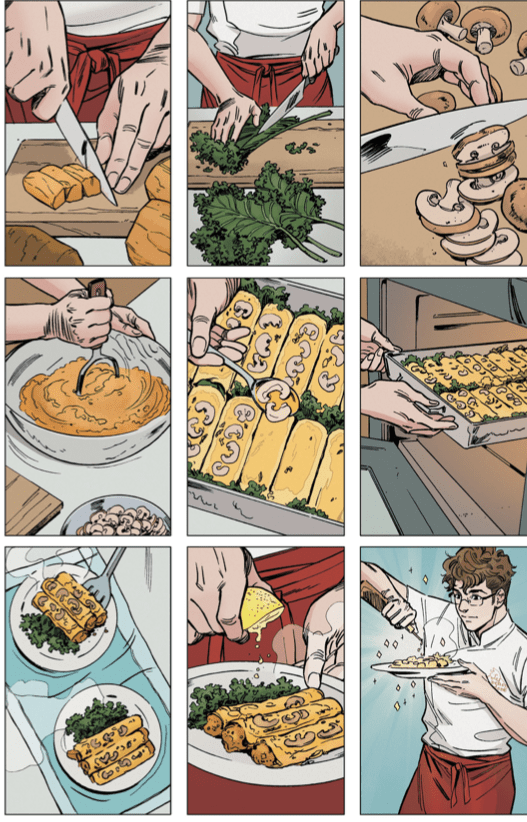
And finally, the artwork is pretty cute. While the lion’s share of it is pretty standard design, the way that it emphasizes the food offerings and food prep itself made my mouth water. It really conveys the complexity and the uniqueness of different kinds of food, and I thought that having the visual really added to the reading experience.

(source: Oni Press)

“Chef’s Kiss” is a super cute and chill contemporary romance. Maybe don’t read it on an empty stomach. But be sure to read it if this kind of tale warms your heart.

Rating 8: A cute and fun coming of age story with a gregarious pig, “Chef’s Kiss” is a sweet romance that will make you hungry.

Reader’s Advisory:

“Chef’s Kiss” is included on the Goodreads list “Graphic Novels Featuring LGBTQ+ Themes”.

Kate’s Review: “Locke & Key (Vol. 6): Alpha & Omega”

This post may contain affiliate links for books we recommend.  Read the full disclosure here.

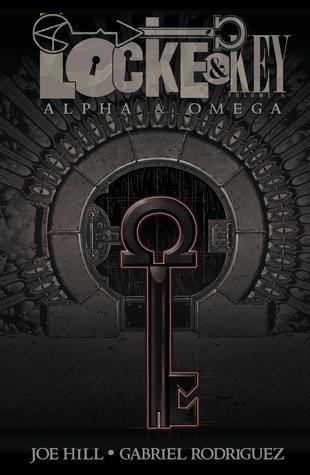
Book: “Locke & Key (Vol. 6): Alpha & Omega” by Joe Hill and Gabriel Rodríguez (Ill.)

Publishing Info: IDW Publishing, January 2014

Where Did I Get This Book: I own it.

Where Can You Get this Book: Amazon | IndieBound | WorldCat

Book Description: The shadows have never been darker and the end has never been closer. Turn the key and open the last door; it’s time to say goodbye.

The final arc of New York Times bestselling Locke & Key comes to a thunderous and compelling conclusion.

Review: I feel like my re-read of “Locke & Key” went by in a flash. It could be because my re-read of “Sandman” was a few volumes longer, but I think that it’s also the fact that Joe Hill has created something that has depth, complexity, and some great horror and fantasy moments that is well packaged and easily digestible. I found myself kind of dreading the end, as I knew that it was going to pack an emotional wallop, but once I picked up “Alpha and Omega”, I basically devoured it in a sitting, taking breaks only to weep into my hands because of said wallop.

I don’t even know where to begin as I review the end of this series. Hill has built up to this moment, and you know that there are going to be a lot of casualties and a lot of collateral damage as Dodge makes his final moves into trying to open the Black Door, but when it centers around graduation night and a high school party in the caves, the stakes are raised to the highest point that the series has seen. It’s up to Tyler and Kinsey to try and stop Dodge, though they have no idea that Dodge has inhabited Bode’s body. So when Dodge does start wreaking havoc, all through the body of a child, it’s just heart-rendering to see. Especially since all the chaos that unfolds involves teenagers, and therefore other children. No one ever said that Hill was sunshine and rainbows, but I had forgotten just how goddamn bleak this last arc is as the horrors unleash and demons do their best to overtake Lovecraft, and perhaps the world at large. It’s a great reveal, it all comes together and makes sense in terms of what we’ve seen so far, and it is a fantastic climactic story arc for this series with awesome horror moments and full fledged mythology. And a whole lot of death, a lot of it coming for characters we have come to care for.

But there are also a lot of wonderful bits of hope throughout this tale. We’ve followed the Locke children (as well as their mother and uncle to lesser degrees), and now we get to see them come to the end of their journey and to live up to the potential of who they are meant to be, as Lockes and as people in general. Tyler and Kinsey have come so far as characters, and through the highs and lows of both I came to just fall in love with them both all over again, just like I did the first time I read it. They are teenagers with a lot of pain in their hearts, and they are messy and damaged, but they are also, ultimately, great people who love their family, even as the family has gone through something terrible and hasn’t figured out how to come through the other side just yet. Hill writes them both as incredibly human, and as such sometimes they just made me want to throttle them, and other times I want to hug them and never let them go. By the time we got to the end of their journeys, Tyler’s in particular, I was a weepy mess.

There are a couple things that don’t work. One is how Hill writes Jordan’s, Tyler’s girlfriend’s, final storyline. I feel like we never really got to fully explore Jordan as a character, as she was relegated to ‘bad girl with a heart of gold who pushes those who care for her away’. We’ve seen it before. She’s more there to give Tyler the ability to learn and grow, and I felt like she deserved more than that. There is also one big moment (no spoilers here) that didn’t really get the explanation I think that it needed, but ultimately these things are minor within the grand scheme of what does end up working. Because so much works.

And one more shout out to Gabriel Rodríguez. His artwork is so fantastic, and there are a lot of moments in this book that have emotional beats that fully rely on the visuals as opposed to what is being said.

Though full disclosure, these days any emotional content with mothers and daughters is going to set me off. (source: IDW Publishing)

“Locke & Key: Alpha and Omega” is a near perfect ending to a fantastic series. I am so glad that I decided to revisit it, as I feel like I got even more out of it this time than I did on my initial read. I imagine I will revisit the Locke Family in the future, as they and the story they have is a wondrous dark fantasy horror creation with so much heart.

And given that there is a crossover story with “Sandman”….. we may be seeing both worlds from some comic re-reads in the near future…

Rating 9: A practically perfect ending that made me weep, “Locke & Key (Vol. 6): Alpha & Omega” brings it all to the finish with emotion, horror, and hope.

Reader’s Advisory:

“Locke & Key (Vol. 6): Alpha & Omega” is included on the Goodreads lists “Best Coming of Age Horror Novels”, and “Graphic Novels That Are Quality”.

Previously Reviewed:

Kate’s Review: “Locke & Key (Vol. 5): Clockworks”

Book: “Locke & Key (Vol. 5): Clockworks” by Joe Hill and Gabriel Rodríguez (Ill.)

Publishing Info: IDW Publishing, 2013

Where Did I Get This Book: I own it.

Book Description: Tyler and Kinsey Locke have no idea that their now-deceased nemesis, Lucas “Dodge” Caravaggio, has taken over the body of their younger brother, Bode. With unrestricted access to Keyhouse, Dodge’s ruthless quest to find the Omega Key and open the Black Door is almost complete. But Tyler and Kinsey have a dangerous key of their own — one that can unlock all the secrets of Keyhouse by opening a gateway to the past. The time has come for the Lockes to face their own legacy and the darkness behind the Black Door. Because if they don’t learn from their family history, they may be doomed to repeat it, and time is running out!

Colonel Adam Crais’s minutemen are literally trapped between a rock and a hard place; in the first days of the Revolutionary War, they find themselves hiding beneath 120 feet of New England stone, with a full regiment of redcoats waiting for them in the daylight… and a door into hell in the cavern below. The black door is open, and it’s up to a 16-year-old smith named Ben Locke to find a way to close it. The biggest mysteries of the Locke & Key series are resolved as Clockworks opens, not with a bang, but with the thunderous crash of English cannons.

Review: As we know I’ve really been enjoying this re-read of Joe Hill’s dark fantasy horror series “Locke and Key”, though I’ve been saying the whole time ‘I don’t remember when and how a lot of this is all going to come together’. The exposition has been building and building and it’s been getting close to the end of the series and there are still a lot of questions to be answered. I remembered really loving the series overall, but I think that the first time I read this I was like ‘okay, I have two books left and few answers, is this going to pay off?’. Because it has to pay off.

And my God, does it pay off. Everything comes together so perfectly and with such thoughtfulness and intricacy that I was just blown away, even though it is my second time reading this book. Joe Hill’s storytelling prowess is at its best in this volume.

There are two major reveals in this story right when things have started to get dire for the Lockes (even if they don’t realize how dire). Given that Kinsey killed Dodge, and Dodge (or whatever it is) moved its consciousness into Bode’s body without them knowing it, the race is on for the Lockes to discover the truth before Bode/Dodge can find the Omega Key. The first reveal that we see we jump into right away, which is the origin of the keys, Keyhouse, the demon, and how the Lockes are connected to it. And we go all the way back to the Revolutionary War, in which we meet a young locksmith named Ben Locke, who discovers that hidden Minutemen have opened a door deep in a cave that has let an evil out that they are trying to put back and contain. The first time I read this I remember thinking that it went on a little long, but this time I thought that this origin story of the Black Door and the keys was pitch perfect. I loved the setting, I loved the connection to the Locke Family (and the backstory for the Lockes, who were victims of Red Coat tyranny), and I loved how Hill sprang this all on us but still managed to make it feel in depth and well explored. He lays his magical system out bare, and it falls into place with ease.

Our second big reveal is we finally, FINALLY, get to see how Rendell Locke and his friends ran afoul Dodge, as well as explanations as to how back in the day Dodge Caravaggio became the Dodge that we know now, how Ellie Whedon became so broken, and how Erin Voss lost her memories and her consciousness, and how ALL of it relates to the keys. And it’s done in a way that doesn’t feel super exposition-y, as we get another key reveal that allows for Tyler and Kinsey to go back in time to see everything happen, and to get a new perspective on their late father. While I do think that we didn’t get enough exploration of all of Rendell’s friends (specifically his girlfriend Kim; I appreciated that Hill tried to make her complicated, but she just came off as cruel and privileged more than anything else), the backstory itself is so fantastic, so heart wrenching, and so SCARY as a bunch of kids who have been bestowed a monumental responsibility of guarding keys get too complacent… and all hell breaks loose. Good God is this an emotional story arc, as we know how things turned out for a few of our characters, but we didn’t know how they got to that point. Hill makes it so complex, satisfying, and devastating, and it adds compounded grief as two kids who lost their father in a terrible act of violence have to see his biggest mistake that ruined lives as it unfolds. Goddammit, it hurts, and it’s beautiful.

And the artwork continues to be great. I can’t praise Gabriel Rodríguez enough, and he has this way of creating the most grotesque and disturbing images as well as the most tender and joyous.

This image specifically took my breath away. (source)

This penultimate volume is fantastic. We will finish up this re-read with the next and last volume, “Omega”. I’m not sure I’m ready to be emotionally destroyed by it, but it’s time regardless.

Rating 9: Fantastic pay off for all the build up before it, “Locke & Key: Clockworks” is the strongest in the series so far.

Reader’s Advisory:

“Locke & Key (Vol. 5): Clockworks” is included on the Goodreads lists “Best Horror Comics/Graphic Novels!”, and “Best Coming-of-Age Horror Novels”!

Find “Locke & Key (Vol. 5): Clockworks” at your library using WorldCat, or at a local independent bookstore using IndieBound!

Previously Reviewed:

Diving Into Sub-Genres: Graphic Memoirs


We each have our own preferred genres of choice. Kate loves horrors and thrillers, really anything that will keep her up at night! And Serena enjoys escaping through hidden doors into realms of magic and adventure. We also read mysteries, historical fiction, graphic novels, etc. etc. And that’s not even counting the multitude of sub-genres contained within each greater genre. In this series, one of us with present a list of our favorites from within a given sub-genre of one of our greater preferred genres.

I really love a good memoir, and while I don’t really review many of them on here (if any?), I usually read a couple a year. What I like about memoirs as opposed to autobiographies is that there is usually a central theme to a memoir as opposed to an all encompassing life story. And one way that an author can make a memoir stand out is to do it in graphic form, therein creating a graphic memoir. As someone who also loves graphic novels, this is obviously a format and genre match made in heaven as far as I’m concerned.

What I love most about graphic memoirs is that with the images and visuals that graphic formats bring, there are other layers and storytelling techniques to bring personal stories to life. With the right image design and the right story you can make something very powerful and unique, and I’m always looking for new ones to read. Here is a list of some of my favorite graphic memoirs, that cover a range of topics and experiences, and have graphics that make the stories all the more fantastic.

Book: “Persepolis” by Marjane Satrapi

We have talked about this book multiple times on this blog, so I won’t dwell too much on the story itself (if you want to see our thoughts, here is our Book Club Review, and here is my separate Review). But it has to be on this list because it is one of the most referenced graphic memoirs, and one of my very favorites. It follows Satrapi’s life story of growing up in Iran during and after the Cultural Revolution, her education in Europe to escape the conflict, and her return home. It not only contextualizes a fraught time in her home country’s history, it also tells a relatable story of coming of age while contextualizing the history and culture without being overly critical, nor glossing over the details. The artwork is unique and striking, and while it isn’t really ‘realistic’, it conveys all of the emotions that Satrapi wants for her life story. I love this book. Read it if you haven’t.

Book: The “March” Trilogy by John Lewis, Andrew Aydin, and Nate Powell (Ill.)

Another series that I reviewed on this blog, and another powerful history lesson along with the life of one of the most important civil rights figures in American history. This book is written by and about John Lewis, congressman and Civil Rights leader who helped organize and implement the 1960s Civil Rights Movement for the rights of Black Americans, starting with his childhood and going up through and beyond the March on Selma. I love this series as it is deeply personal and has a lot of insight from Lewis, while also creating a very accessible history to the Civil Rights Movement. At times it’s heart wrenching and devastating, at other times it’s inspirational and hopeful, and it is always powerful. The artwork by Nate Powell is gorgeous and conveys all the emotional beats of the story as Lewis tells it, and it just fits with the narrative. This graphic memoir is a must for people who want to learn an important moment from one of the most important players. God I miss John Lewis.

Book: “El Deafo” by Cece Bell and David Lasky (Ill.)

This cute graphic memoir is more in the middle grade range, but I really enjoyed it when book club read it a number of years ago. It follows Bell’s childhood experience of being a hearing impaired child who transfers from a school for the Deaf to a public school, and getting used to her new Phonic Ear which will help her hear her teacher. Bell one day can hear her teacher (who has a microphone for the Phonic Ear) even when she is out of the room, and starts to believe that she has superpowers. She takes on the superhero alter ego of El Deafo, a Listener for All. But being a Superhero is just another way of being Othered. I love this sweet, cute, and funny graphic memoir, as it feels very real and relatable, has moments of humor and poignancy, and tells a coming of age story that has some great representation while also being very easy for kids to see themselves in. And the pictures are so cute, with Bell and everyone else being represented by a bunny!

Book: “Fun Home: A Family Tragicomic” by Alison Bechdel

I have a distinct memory of my sister retrieving this book from her room and tossing it into my hands, saying that I needed to read it. And boy was she right! Bechdel, potentially most known for The Bechdel Test, is a comic writer and author who was coming to terms with her sexuality while having a fraught and tense relationship with her father when he died suddenly. She had also discovered that he, himself, was a closeted gay man, and his death meant that he took many secrets and revelations to the grave before she got any answers. “Fun Home” is her examination of this time in her life and before, as she becomes more comfortable in her own skin and reconciles the man she saw her father as (a creative and brilliant man who saw his kids as constraints) and who he never could be (a gay man who could be himself). Bittersweet and funny, “Fun Home” has become a hit Broadway show and spawned another graphic memoir. I think it’s lovely, and the graphic aspect lets Bechdel find and reveal answers about herself through text AND imagery.

Book: “They Called Us Enemy” by George Takei, Justin Eisinger, Steven Scott, and Harmony Becker (Ill.)

George Takei became famous when he played Sulu on “Star Trek” back in the 1960s, his role in that show being revolutionary as a Japanese American man playing a front and center role in a TV show in the 1960s. As a child, he and his family were imprisoned at Rohwer Internment Camp during WWII because of their Japanese ancestry. “They Called Us Enemy” is his story of being a child at this internment camp, and what that experience was like for him and his family, and how it affected him the rest of his life. This is another good history lesson memoir that looks at a VERY dark time in American history, and Takei’s story is powerful and deeply upsetting. His reflections of not only his memories, but his memories of how it affected his parents, especially his father, bring another layer to this memoir, and the artwork is both evocative but also tender and gentle when the content calls for it.

Book: “Hey Kiddo” by Jarrett J. Krosoczka

Jarrett J. Krosoczka was just a little boy when it became clear that his family structure was quite different from his classmates. His mother was out of the picture due to her struggles with addiction, and his father was never in the picture to begin with, so he was raised by his grandparents, who hadn’t planned to raise their grandson. This memoir is about Krosoczka’s childhood with his grandparents, as well as what it was like to be a family grappling with addiction, and while he is at the center of this story (it IS a memoir, after all), he also does a really good job of showing the far reaching pain and fallout of how devastating addiction can be for everyone involved. It is introspective and empathetic, as well as incredibly raw, and he intersperses his artwork (as well as his connection to art and how it helped get him through difficult times) with actual letters from his mother, and it will almost assuredly leave you in tears as you read it.

What graphic memoirs have you enjoyed? Let us know in the comments!