Serena’s Review: “A Deadly Education”

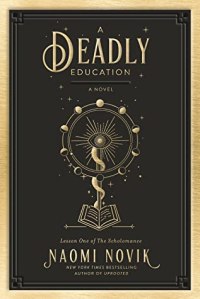
50548197._sy475_Book: “A Deadly Education” by Naomi Novik

Publishing Info: Del Rey Books, September 2020

Where Did I Get this Book: Edelweiss+

Book Description: Learning has never been this deadly

“A Deadly Education” is set at Scholomance, a school for the magically gifted where failure means certain death (for real) — until one girl, El, begins to unlock its many secrets. There are no teachers, no holidays, and no friendships, save strategic ones. Survival is more important than any letter grade, for the school won’t allow its students to leave until they graduate… or die! The rules are deceptively simple: Don’t walk the halls alone. And beware of the monsters who lurk everywhere. El is uniquely prepared for the school’s dangers. She may be without allies, but she possesses a dark power strong enough to level mountains and wipe out millions. It would be easy enough for El to defeat the monsters that prowl the school. The problem? Her powerful dark magic might also kill all the other students.

Review: Naomi Novik has quickly become a must-read author for me. After this book, she’s pretty much a must-buy author (I only have maybe 5 of those, so that says something, I think!). But, still, when requesting this book, what I’d read from her had been both of her fairytale retellings and the first several of her Napoleonic wars/dragon historical fantasy series. This didn’t sound remotely like either of those, instead being billed as a modern, more grim, “Harry Potter” style boarding school story. But man, Novik can do anything, and my trust is now fully earned, no matter how strange the book description is!

Scholomance is technically a school. There are no teachers and students are on their own to make classes and finish homework, sure. But that’s only half, and arguably the less important half, of what this school provides. Instead, it offers magical kids the best chance they have of surviving their juvenile years. Sure, their odds are still pretty darn bad in the school, but better than the next to nothing they have outside. El’s chances have been even worse from the start. Yeah, she has the raw power, but she seems to repel people for some reason. And in a place where forming alliances is a necessary survival tactic, that’s not good. But here, in her second to last year at the school, staring down the barrel of a final year full of even more likely death, El begins to uncover secrets about not only the school, but herself, and the boy who has been roaming around annoyingly playing savior to all this entire time.

I adored everything about this book, so it’s kind of hard to think of where to start when reviewing it. It’s also so totally unique, interesting, and complicated that it’s hard to find the middle ground between reviewing important aspects of the story and not spoiling the fun for new readers. There’s just so much good stuff to unpack!

I guess I’ll start with the world-building itself. The book description has a tough job trying to describe what Scholomance really is, and, as you can see, I probably struggled too in my own summary. That’s because it’s so complicated and well-constructed that it’s almost impossible to really give a broad overview. Novik seems to have thought out every intricate detail for this magical place, from how the cafeteria works, to the menacing library, to the simplest of things, like how the school assigns and monitors homework and what happens if students fall behind. And it’s all just so creative! I can’t think of a single other fantasy story that has anything like the place Novik has thought up here. And that’s saying something, I think, in a genre that is becoming more crowded by the day (especially YA that has a tendency to become trope-ridden and bogged down in certain themes every few years).

One of the most impressive aspects of all of this that, being as complicated and detailed as it all is, our narrator is given a heavy load of information to be handing off to readers. There’s a significant portion of the first half of the book that is largely devoted to detailing all of these little aspects. It would have been so easy for it to have felt like info-dumping or to have dragged down the pacing and plot of the story. But, for one thing, the information being provided is just too interesting on its own to feel bored by. And secondly, our narrator had a fantastic voice from the start that is strong enough to carry this type of detail-ridden load.

El is everything I like in a narrator: snarky, consistently characterized, yet vulnerable in ways that we (and she) discover throughout the story. From the book description, I was kind of expecting some type of tired anti-hero story or quasi-villain plot line for her, but it’s really nothing like that. Sure, her powers are destructive and there’s this pesky doomsday-esque prophesy lingering around her, but she’s just as skeptical of all that nonsense as the reader wants to be. El’s story, here, is not only finding acceptance with some key friends around her, but in accepting what she has to offer. On one hand, she can be overly confident, but on the other, we see her realize her own values and where her personal lines are between survival and standing up for some moral greater good.

And to balance her out, of course, we have a “Chosen One.” This friendship was everything! Both El and Orion’s characters play perfectly off each other. She, stand-offish, uninterested, and, again, snarky. He, bumbling, clueless of his affect on people, and obnoxiously heroic. I loved everything about this friendship and the slow build to sort of romance that it comes to towards the end.

It’s also clear, here, where the comparisons to “Harry Potter” are coming from. Orion Lake is definitely a response to Harry Potter and all of the other “chosen” heroes we see in fantasy fiction. Novik has said that “Spinning Silver” was essentially her “yelling” at the “Rumpelstiltskin” fairytale, and that this would be her yelling at “Harry Potter.” Comparisons to “Harry Potter always make me nervous. For one thing, I love Harry Potter so, for me, a book being compared to it is either going to be a massive let-down of trying to copy something that shouldn’t be copied. Or it’s going to be some type of “response” piece that spends more time criticizing another book series than in being its own thing. Luckily, this falls right in the middle and does it perfectly.

You can definitely see where Novik is making a point about the type of “chosen one” story that Harry Potter tells, but, while she does touch on some of the obvious themes, she also deep dives into a lot of aspects of this type of storyline that one doesn’t often think about. There’s a strong focus on inequality and injustice, but it’s approached through angles and perspectives that are unique to this world. The themes, of course, carry over, but it stays true to the fantasy world it is and the types of justice and injustice that would be inherent to it. It’s left to the reader to transcribe these thoughts onto our own world and our own experiences of injustice within society.

This review has already gotten pretty long, and I could go on and on. But, in this case, I almost feel like the less said the better! There’s so much great stuff to discover here that I don’t want to spoil any more of it! Needless to be said, my copy is already pre-ordered, and I highly recommend any and all fantasy fans to get their hands on this book ASAP!

Rating 10:Breaking fantasy walls that I didn’t know even exited! Simply fantastic!

Reader’s Advisory:

“A Deadly Education” is a new title, so it isn’t on many Goodreads lists. But it is on “Non JKR Magic School Novels.”

Find “A Deadly Education” at your library using WorldCat!
Serena’s Review: “The Ikessar Falcon”

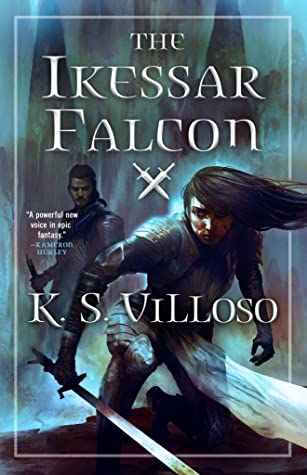
35661274._sy475_Book: “The Ikessar Falkcon” by by K. S. Villoso
Publishing Info: Orbit, September 2020

Where Did I Get this Book: ARC from the publisher

Book Description: Abandoned by her people, Queen Talyien’s quest takes a turn for the worse as she stumbles upon a plot deeper and more sinister than she could have ever imagined, one that will displace her king and see her son dead. The road home beckons, strewn with a tangled web of deceit and unimaginable horrors – creatures from the dark, mad dragons and men with hearts hungry for power.

To save her land, Talyien must confront the myth others have built around her: Warlord Yeshin’s daughter, symbol of peace, warrior and queen and everything she could never be.

The price for failure is steep. Her friends are few. And a nation carved by a murderer can only be destined for war.

Previously Reviewed: “The Wolf of Oren-Yaro”

Review: I requested an ARC of the first book in this series kind of on a whim. To be frank, I was actually kind of put off by the series being titled “Chronicles of the Bitch Queen.” I mean, I get it…she-wolves, bitch, yep. And I’m sure it’s also `tied in with the fact that Talyien is not a beloved queen. But still, it’s kind of an abrasive series title, and I wasn’t sure what exactly I was getting into. Turned out, what I was getting into was an intriguing new fantasy world headed-up by a no-nonsense but still deeply flawed heroine. So after finishing that first book, it was really exciting to see that the second was coming out only 6 months later. And here we are!

Talyien’s situation hadn’t started out well when she set off from her homeland in the hopes of reconciling with the husband that had abandoned her and her son years earlier. It had only gotten worse since with repeated assassination attempts, betrayal, said husband heading back to her home, potentially to kill their son, leaving Talyien stranded in a foreign country with very few friends. But she is nothing if not persistent, especially when the life of her son is at stake. As she makes her way back to him, however, Talyien covers an even deeper web of lies, one that exists not only in the present but extends back to the past.

I think I liked this book even more than the first! For one thing, I’m still really enjoying the first person narration but told from the POV of an adult woman. All too often, the only place I really see first person narration is in YA novels with teenage protagonists. And this, in turn, leads to a certain immaturity in their focus (don’t get me wrong, I still love me a good YA fantasy, but the narrators can sometimes be a bit silly). But here, we have an adult who has a full history behind her, one that she is capable of looking back on and recognizing her own and others’ mistakes. It also makes all of her interactions with those around her particularly interesting. In some ways, she’s an unreliable narrator as her perceptions of others and their motivations are always colored by what she knows (or guesses) about them. But we also have an inside look into how their actions and words influence her.

This book also seemed to expand on almost all aspects. We see more of the world-building as Talyien and her crew travel around trying to make their way back to her son. I really enjoyed out fully fleshed out this world feels. We hear about the different foods, languages, and cultural behaviors from place to place. And it’s all presented in a very natural-feeling way, no info dumping. There was also more of magic to found in this second book and more action in general.

I also really liked how much more we learned about Talyien’s father and his actions. There’s also a pretty deep-dive into the lasting influence that her father has had on Talyien. From the very start of the book, it’s clear that his perceptions of her, his lessons, his strengths and failures as a parent are a continual influence on Talyien’s own perception of herself and of the choices she can make. She, of course, is also unreliable in her memories of him, as we, the reader, can see some of his flaws in a more clear way than she can.

Overall, I really enjoyed this book. It felt like it took what the first book laid down as a foundation and started really building up from there. Everything just felt more fully fleshed out, and the story was even more exciting. Of course, it’s no surprise that Talyien’s story doesn’t end here with rainbows and butterflies, so I’m excited to see what happens in the third book. Don’t forget to enter to win an ARC copy of this book as well!

Rating 8: Even bigger and better than the first!

Reader’s Advisory:

“The Ikessar Falcon” is a new title, so it isn’t on any Goodreads lists yet, but it should be on: “Asian-Authored Books in 2020.”

Find “The Ikessar Falcon” at your library using WorldCat!

Giveaway: “The Ikessar Falcon”

35661274._sy475_Book: “The Ikessar Falkcon” by by K. S. Villoso
Publishing Info: Orbit, September 2020

Where Did I Get this Book: ARC from the publisher

Book Description: Abandoned by her people, Queen Talyien’s quest takes a turn for the worse as she stumbles upon a plot deeper and more sinister than she could have ever imagined, one that will displace her king and see her son dead. The road home beckons, strewn with a tangled web of deceit and unimaginable horrors – creatures from the dark, mad dragons and men with hearts hungry for power.

To save her land, Talyien must confront the myth others have built around her: Warlord Yeshin’s daughter, symbol of peace, warrior and queen and everything she could never be.

The price for failure is steep. Her friends are few. And a nation carved by a murderer can only be destined for war.

Giveaway Details: I really enjoyed the first book in this series, “The Wolf of Oren-Yaro” when I read it earlier this spring. So I was super excited to see that the second one would be coming out this fall, so soon after.

The first story introduces us to Queen Talyien, a young queen who is anything but beloved by her people. Abandoned by her husband and left with a young son and a country that is barely holding itself together, Talyien strives to hold the fraying bits of her life together. When she attempts to reconcile with her husband several years after the fact, everything seems to go wrong and Talyien begins to discover that her problems may be even bigger than she had thought.

There were a bunch of things I really liked about the first book. The writing was strong and confident. The world-building was unique but not to caught up in itself. But most of all, I really liked Talyien. Talyien was that type of heroine that defies all of the stereotypes one typically finds when looking up examples of “strong female protagonists.” Yes, she’s smart, a good fighter, and independent. But she’s also flawed, self-aware, and has made choices that aren’t also good, and realizes it! Beyond this, it’s always nice to have an adult woman as the heroine. Too often fantasy stories focus on very young female characters. Not that I have a problem with those characters and the often very lovely romances they bring with them, but it’s also nice to have a change. Talyien is a grown woman who’s seen the ups and downs or romances and marriage and has a small child of her own. Her problems and outlooks on life are very different than the young woman just setting out in the world.

The end of the first book left Talyien in a situation all the more dire than the one she started in, so I’m excited to see what she gets up to in this one! I’m not really expecting rainbows and butterflies, but man, can’t something go right for this woman? My full review will be up this Friday. In the meantime, we’re giving away a copy of this book. The giveaway is open to U.S. residents only and ends on September 23.

Enter to win!

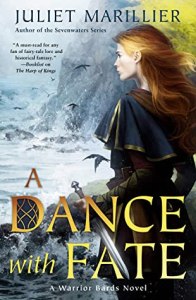
Serena’s Review: “A Dance with Fate”

36253130._sy475_Book: “A Dance with Fate” by Juliet Marillier
Publishing Info: Ace Books, September 2020

Where Did I Get this Book: Edelweiss+

Book Description: The young warrior and bard Liobhan has lost her brother to the Otherworld. Even more determined to gain a place as an elite fighter, she returns to Swan Island to continue her training. But Liobhan is devastated when her comrade Dau is injured and loses his sight in their final display bout. Blamed by Dau’s family for the accident, she agrees to go to Dau’s home as a bond servant for the span of one year.

There, she soon learns that Oakhill is a place of dark secrets. The vicious Crow Folk still threaten both worlds. And Dau, battling the demon of despair, is not an easy man to help.

When Liobhan and Dau start to expose the rot at the center of Oakhill, they place themselves in deadly danger. For their enemy wields great power and will stop at nothing to get his way. It will take all the skills of a Swan Island warrior and a touch of the uncanny to give them a hope of survival. . . .

Previously Reviewed: “The Harp of Kings”

Review: As always, I’m excited whenever I see a new Juliet Marillier book coming out. The first book in this trilogy (?), “The Harp of Kings” definitely set the stage for this second book, leaving a few threads dangling and a mysterious enemy in the form of the Crow People. While it wasn’t my favorite of Marillier’s work, I thought it was a good start to a new series and introduced a compelling set of new characters. This second one was…odd. I still enjoyed it, but not as much as I had hoped, even though, on the surface, it seemed to have most of what I look for in these types of books.

Liobhan and Dau are on the cusp of achieving that which they both have worked so hard and so long to accomplish: to become full members of the Swan Island crew. But, in an unfortunate accident while the two spar, Dau suffers a debilitating injury that costs him his sight, perhaps forever. With his family now demanding justice, Liobhan finds herself alongside Dau back where neither wish to be and a place that caused only harm and suffering to Dau during his childhood. There, they must both confront the evils at the heart of Dau’s family, and maybe some mysteries, too.

My description of the book, following the example of the published one, fails to mention that Brocc, too, is a part of this story. After his decision to marry a half-Fae queen and join her in her realm at the end of the last book, I wasn’t sure what we would see from him here on out. But low and behold, he ends up with a decent number of chapters and his own arc in this story. It’s also made clear by the end of this book that there will be more to hear from him in the third. Not sure why the publisher failed to include the fact that he is still a main character, but I suspect it’s because they realize that most readers are probably here for Liobhan and Dau. I know I was.

Brocc’s not a bad character, but it’s hard to be as compelling as two leads that each have quite a number of chapters devoted to their POVs making them both more compelling together and apart. Brocc’s own story here was…strange. It’s clear that he is still struggling to find his own role in the Fae world. And, due to the fact that he grew up in the human world, it’s also clear that he has very different views and ideas about the threat the Crow People pose to the Fae. He ends up with his own mini quest, which I found compelling enough. But I really struggled with the romance between Brocc and his wife. I’m not sure if we’re supposed to like her or not? By the end, I really didn’t like her at all, but was still unsure whether the author had been meaning for a few late reveals to materially change the negative impression that had been built up. For me, the reveal was definitely not enough to change my mind and, by its nature, kind of made me more mad to think that we might have been supposed to forgive her decisions and treatment of Brocc due to it. I don’t want to spoil it, but if you read this book, you’ll see what I mean. Maybe other readers will have a different impression. But all of this together left me really struggling to enjoy Brocc’s section of the story.

As for Dau and Liobhan, I enjoyed their story more. I think partly they are simply more compelling characters on their own, but they also had more to do in this book in particular. That said, they still didn’t seem to have enough to do. The mystery at the heart of their story is pretty obvious from the get-to, so it’s more a journey of reaching the obvious endpoint than in unraveling any real clues. Dau’s recovery and his attempts to come to grips with his new situation are interesting enough, but, again, there wasn’t any real tension here as it seemed like the conclusion of his arc was also well-telegraphed. And, again, the romance left something wanting.

This is a particularly frustrating thing to find in a Marillier book, as I’ve always thought that one of her best strengths is her ability to write compelling, swoon-worthy romances. But here, it just felt off. There really was no obvious progression of Dau and Liobhan’s feelings. Instead, we were simply told that they each began to have feelings for the other. It was incredibly disappointing  and said, especially knowing what the author is capable of. There could have been a really great romance here, but for some reason, it just felt deflated and underdeveloped from the start. There’s another book coming and some challenges still ahead of these two, so I’ll hold out hope that this ship can be righted.

I still love Marillier’s writing style and the overall tone of her take on fantasy stories. There are some good pieces in these books, but for some reason they just don’t seem to be coming together the same way several of her other stories have in the past. Obviously, I’ll still be here for the next one, but I’m a bit more nervous about it than I remember ever being in the past for one of this author’s books.

Rating 7: A surprisingly lackluster romance on two counts left this book feeling a bit limp at times.

Reader’s Advisory:

“A Dance with Fate” isn’t on any Goodreads lists yet, but it should be on “Strong Fighter Heroines.”

Find “A Dance with Fate” at your library using WorldCat!

Serena’s Review: “The Wendy”

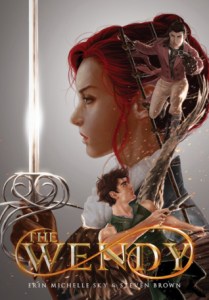
35510314._sx318_Book: “The Wendy” by Erin Michelle Sky and Steven Brown

Publishing Info: Trash Dogs Media, January 2018

Where Did I Get this Book: NetGalley

Book Description: London. 1789. More than anything in the world, Wendy Darling wants to be the captain of a ship, but women aren’t allowed in the Royal Navy. When she learns the Home Office is accepting a handful of women into its ranks, she jumps at the chance, joining the fight against the most formidable threat England has ever faced. Magic.

But the secret service isn’t exactly what she hoped. Accompanied by a reimagined cast of the original Peter Pan, Wendy soon discovers that her dreams are as far away as ever, that choosing sides isn’t as simple as she thought, and that the only man who isn’t blinded by her gender might be the worst friend anyone could ask for.

Anyone, that is, except Wendy Darling.

Review: I’m never one to turn down a re-telling. And while I haven’t had super good luck with “Peter Pan” retellings in the past, this one seemed far enough from the original story to have a better chance of success. For one thing, the focus is on Wendy’s own story, not Peter’s. And for another, she wants to become a ship’s captain?? So some strange mixture of Peter’s, Wendy’s, and, somehow, Hook’s story? Count me in!

Wending Darling does want to grow up. But she wants to grow up to be a very specific thing: a ship’s captain. And, luckily enough, once she is older, it turns out that a limited number of women are being accepted into the service. Seems perfect! But once there, Wendy quickly discovers that being accepted on paper is not the same thing as being accepted by the men around her, especially not in her dreamed-of leadership role as the captain. Struggling to find her own place, Wendy quickly finds herself caught up in new challenges and adventures, surrounded by a familiar sounding cast of characters, including a certain Captain Hook and a man-child named Peter.

This was a really fun read. One of the reasons I think it’s a success compared to other “Peter Pan” retellings I’ve read is the fact that, while it does a familiar cast of characters, it’s not trying to retell the original story really at all. For one thing, this is Wendy’s story through and through. Sure, Peter plays an important role, but she is front and center the entire time. It is her dreams and adventures the story follows, and her challenges the story prioritizes.

Part of this, of course, is a focus on the gender inequality of the time. The fact that she’s allowed to sign on to the secret service at all is a huge departure from history, but the authors don’t make it any easier for her other than that. She’s constantly having to challenge the perceptions and dismissals of those around her. And, when she does find someone who can see past her gender, it’s not necessarily the best advocate one could ask for. There were a few moments where the “messaging,” for lack of a better word, around this theme came across as a little heavy handed. But luckily the story had enough going for it that the action could quickly take over again and right the ship, so to say.

I also really liked the various takes on familiar characters. John and Michael, for example, are transformed from Wendy’s literal brothers to her brothers-in-arms. Michael, however, could be a bit much at times and too often came across in a pretty annoying manner. He improved as the story went a long and was given opportunities to make up for some of his shortcomings, but he was probably, overall, my least favorite character in the story.

Probably my biggest complaint for the story was the overabundance of love interests presented for Wendy. Sigh. Love triangles are not my thing (pretty well established), and I’m even less excited when we move past triangles to squares and pentagons. I want to settle into my romance and see it slowly develop. Not feel tossed here and there wondering what direction the main character go. Beyond that, multiple love interests is really hard to sell, simply on the believability spectrum, and this one wasn’t any different.

This was a pretty fun romp of a book. It’s not blowing away any literary awards or anything, but if you like fairytale retellings and “Peter Pan” especially, it’s definitely one worth checking out. A sequel came out fairly recently, so I’ll probably get around to reading that one, too, sooner or later.

Rating 8: A bit preachy at times and with too many love interests, but other than that, a jolly good time.

Reader’s Advisory: 

“The Wendy” is on these Goodreads lists: “Peter Pan Retellings” and “Retellings of Classic Tales.”

Find “The Wendy” at your library using WorldCat!

Serena’s Review: “The Princess Will Save You”

43603825._sy475_Book: “The Princess Will Save You” by Sarah Henning
Publishing Info: Tor Teen, July 2020

Where Did I Get this Book: NetGalley!

Book Description: When her warrior father, King Sendoa, mysteriously dies, Princess Amarande of Ardenia is given what would hardly be considered a choice: Marry a stranger at sixteen or lose control of her family’s crown.

But Amarande was raised to be a warrior—not a sacrifice.

In an attempt to force her choice, a neighboring kingdom kidnaps her true love, stable boy Luca. With her kingdom on the brink of civil war and no one to trust, she’ll need all her skill to save him, her future, and her kingdom.

Review: I’ll be honest, I first requested this book based purely on how much I love this cover. Even now, looking at it above, I’m swayed to feel more positive about this book just by the lovely depiction of its main characters on the cover. But, when I dug deeper, I realized that it is also being promoted as a gender-swapped retelling of “The Princess Bride,” so, of course, I was even more excited to check it out! While I did enjoy it overall, it sadly didn’t quite live up to the promise of the gorgeous cover or the intrigue of the unique concept.

After the sudden and unexpected death of her father, the king, Princess Amarande quickly discovers how few options she has. Seemingly, no one else is concerned about potential assassination, and instead, her entire council is moving full steam ahead to marry her off to the most politically advantageous match they can find, regardless of Amarande’s own wishes. When her best friend, Luca, is kidnapped by one such potential match in an attempt to force her hand, Amarande takes matters into her own hands. Her quest is simple: save her true love, save her kingdom.

This is a tough one for me to rate and review. On one hand, it was enjoyable enough, and I was able to blaze through it in only a few days. The writing was solid. The characters were interesting. And the world-building did enough to paint a picture that I felt grouned. And yet…it was lacking something.

For one thing, I don’t think it did this book any favors to have it marketed as a gender-swapped “Princess Bride.” Sure, I can see how it follows similar plot points and winks and nods at some of the key phrases used in that book. But, on one hand, if I had not had that put in my head and thus wasn’t looking for these elements specifically, I’m not sure I would have made these connections. And, conversely, when I was looking and did spot them, they often detracted more from the story than they added. For one thing, the first half of the story doesn’t feel like a re-telling at all, whereas the last half really goes all in. It’s an uncomfortable balance.

Beyond that, I think I was also set up to expect more of a humorous fantasy story. Obviously, “The Prinicess Bride” is comedy through and through. Here, not so much. Not only is it clearly not going for the same parody tone that its inspiration had, it also just seemed to lack much humor at all? I think this, truly, is where my main contention point came for the story. It checks all the marks for a good fantasy adventure, but there is something decidedly dry in the tone and its telling. It didn’t have to be back-to-back laughs, but as I was reading through, I realized more and more that there simply were no laughs whatsoever. So, while the characters, romance, and adventure were compelling enough, they also felt strangely two dimensional and flat. It was too bad.

It looks like a sequel is planned, so I’ll most likely check it out. There were some interesting developments towards the end of the story. And perhaps the second will be served better by being more thoroughly detached from the “Princess Bride” read-alike label. Just add some humor to the story, and it could be great!

Rating 7: Sadly a bit flat in its telling, but a fast enough fantasy adventure.

Reader’s Advisory:

“The Princess Will Save You” is on these Goodreads lists: “Damsels in Shining Armor & Dudes in Distress” and “Royalty.”

Find “The Princess Will Save You” at your library using WorldCat!

Kate’s Review: “Wayward Witch”

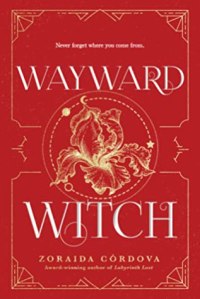
53038638._sx318_sy475_Book: “Wayward Witch” by Zoraida Córdova

Publishing Info: Sourcebooks Fire, September 2020

Where Did I Get This Book: I received an eARC from NetGalley.

Book Description: Rose Mortiz has always been a fixer, but lately she’s been feeling lost. She has brand-new powers she doesn’t understand, and her family is still trying to figure out how to function in the wake of her amnesiac father’s return home. Then, on the night of her Deathday party, Rose discovers her father’s memory loss has been a lie.
 
As she rushes to his side, the two are ambushed and pulled through a portal to the land of Adas, a fairy realm hidden in the Caribbean Sea. There, Rose is forced to work with a group of others to save Adas. Soon, she begins to discover the scope of her powers, the troubling truth about her father’s past, and the sacrifices he made to save her sisters.
 
But if Rose wants to return home so she can repair her broken family, she must figure out how to heal Adas first.

Review: Thank you to NetGalley for providing me with an eARC of this novel!

It’s been a four year journey with the Mortiz Sisters in the “Brooklyn Brujas” Trilogy by Zoraida Córdova, and what a genre bending, empowering, and unique (to me) journey it’s been. Given that books one (“Labyrinth Lost”) and two (“Bruja Born”) followed the oldest and middle sisters, Alex and Lula, I knew that “Wayward Witch”, the last in the trilogy, was destined to be Rose’s story. Rose has always been the sister that has intrigued me the most, as she has always been quiet, reserved, and a little bit mysterious because of it. I was eager to get into her head for the last story, hoping that Córdova would give her a lot to do and work with, and perhaps explore a new genre like she did with Lula. The fulfillment of those hopes was a mixed bag.

Since I want to focus on the positives, I will get my negatives out of the way, particularly as they are no fault of the book. We have gone back to a fantasy focused story in “Wayward Witch”. I had been hoping that after the genre shift in “Bruja Born” we might be experimenting with a whole other genre again, but that was not the case. As much as I can appreciate the care and detail that Córdova put into the world of Adas, and as much as it definitely was unique and steeped in cultural influence that you don’t see as much in fantasy, it’s still a world building fantasy story. And outside of very specific examples that I love, it’s a genre that doesn’t really click with me. Along with that, I had hoped to see more sister interaction like we had in “Bruja Born”, but given that Rose was on her own for a majority of the story, that didn’t happen.

But, that said, I am so happy that we finally got to Rose’s story, and that she got to have this kind of adventure that is so different from the ones that her sisters had. Rose has been dealing with magical changes in her life, as her power has shifted to being a person who can take on the powers of those around her. You enter that in with the dramatic changes in her family life (her father returning from his long absence, her family having to move to Queens after their home was destroyed, her Deathday celebration), and she is feeling stressed and unheard. Not to mention her relationship with her father is a bit strained, as she has few memories of him before he disappeared. I liked that his reappearance in her life specifically is a bit messier and more complicated. But her journey to Adas with her father allows her to see her powers in a new way, as to the fae there she is a savior and a warrior who is there to stop The Rot that is destroying their world. Seeing her function in this totally different realm could have been similar to Alex’s journey in “Labyrinth Lost”, but Rose is so different from Alex that it feels pretty new and fresh. Her magical powers are also neat to see in focus, as the upsides, and the downsides, of being a ‘magic hacker’ as she likes to refer to it are shown in different ways. Be they amusing, or potentially dangerous. And even though the fantasy themes didn’t really connect with me, I did like the characters that Córdova created in Adas, especially Princess Iris. Iris has a lot to prove to both her father, the King, and to herself as well. It was refreshing to see usual fantasy gender norms being bent between her and her twin brother Arco. While Iris is the more ferocious and determine warrior type, Arco is a bit more sensitive and reserved, and Rose’s interactions with both of them helped round out her character, and perhaps made up for the fact we didn’t see her interacting with Alex and Lula in similar ways.

So while the fantasy elements as a whole weren’t as interesting as the horror elements from the previous books, I thought that “Wayward Witch” gave Rose the attention that she deserved, and wrapped up the series in a mostly satisfying way. I’m so happy that Zoraida Córdova got to tell her story about these bruja sisters, and that YA audiences have been given a great example of how witches don’t have to be white.

Rating 7: A return to otherworldly fantasy means that this conclusion didn’t connect as much as the previous book, but “Wayward Witch” gives Rosie Mortiz a strong tale that shows off her abilities, and wraps up a fun and dreamy fantasy series.

Reader’s Advisory:

“Wayward Witch” is included on the Goodreads lists “Latina Leads in YA and Middle Grade Fiction”, and “2020 YA Books with LGBT Themes”.

Find “Wayward Witch” at your library using WorldCat, or a local independent bookstore using IndieBound!

Previously Reviewed:

Kate’s Review: “Displacement”

39908611._sx318_Book: “Displacement” by Kiku Hughes

Publishing Info: First Second Books, August 2020

Where Did I Get This Book: I received an eARC from NetGalley.

Book Description: A teenager is pulled back in time to witness her grandmother’s experiences in World War II-era Japanese internment camps in Displacement, a historical graphic novel from Kiku Hughes.

Kiku is on vacation in San Francisco when suddenly she finds herself displaced to the 1940s Japanese-American internment camp that her late grandmother, Ernestina, was forcibly relocated to during World War II.

These displacements keep occurring until Kiku finds herself “stuck” back in time. Living alongside her young grandmother and other Japanese-American citizens in internment camps, Kiku gets the education she never received in history class. She witnesses the lives of Japanese-Americans who were denied their civil liberties and suffered greatly, but managed to cultivate community and commit acts of resistance in order to survive.

Kiku Hughes weaves a riveting, bittersweet tale that highlights the intergenerational impact and power of memory.

Review: Thank you to NetGalley for providing me with an eARC of this graphic novel!

I am always going to keep hammering home the point that if we don’t know our own history, we are going to repeat it, especially now when our country seems to be determined to undercut civil liberties of its own citizens. Between police brutality, towards minorities (particularly Black people), a Muslim ban, and children in cages at the border, it feels like we are slipping more towards times in American history where we committed terrible atrocities that we haven’t really faced as of yet. That brings me to “Displacement” by Kiku Hughes, a graphic novel on the Japanese American Internment during World War II. I’ve read my fair share about this horrific practice (and reviewed another graphic novel on the topic, “They Called Us Enemy” by George Takei), and figured that this would be another powerful, but familiar, take on this period in history. And I can safely say that “Displacement” wasn’t really what I was expecting.

“Displacement” is both fiction, and non-fiction. The non-fiction aspect is that Kiku Hughes’s grandmother Ernestina was held prisoner at both Tanforan and Topaz Internment camps, and that Kiku and her mother did a lot of research into it as Ernestina didn’t open up about it while she was alive. But the fictional aspect is a device that works very well, in which Kiku tells a story of herself being transported back in time, or ‘displaced’ to the 1940s, and ending up at the same Internment sites as Ernestina, therein letting the reader see this historical atrocity through the same modern lens that Kiku may. It’s very similar to “Kindred” by Octavia Butler, and Hughes mentions her specifically in her acknowledgements. I thought that it worked really well because it makes the story feel more personal than perhaps a textbook would, and more relatable since Hughes is a young adult who doesn’t know that much about the camps and what life there was like for Ernestina. It’s a perfect read for tweens and teens who might be wanting to learn about this topic, as while it’s ‘fantasy’, it’s also very realistic and provides the same perspective that they may be going in with. I read “Farewell to Manzanar” by Jane Watasuki Houston when I was in seventh grade, and while I did like it and got a lot from it, I think that if I had something like “Displacement” I may have connected more with it just because of the modern lens. Hughes also makes very clear connections to the current political climate we are in today with Trump and his goons in power, and how there are stark, STARK similarities between the prejudices they hold and the policies they are inflicting upon marginalized groups, and the ones inflicted upon the Issei and Nisei in this country during the Internment.

While “Kindred” is the book Hughes mentions specifically as influence, I also see a lot of similarities to Jane Yolen’s “The Devil’s Arithmetic”, in which a modern day (well modern when it came out) Jewish girl named Hannah is transported back to Poland right as the Nazis take over. I kept going back to that story as I saw Kiku pre-displacement, thinking about how Hannah, like Kiku, doesn’t feel that much connection to her heritage. While “Displacement” certainly does a great job of talking about what specifically happened to her grandmother during the Internment, Hughes also makes direct connections as to how the Internment facilitated a loss of identity for Japanese Americans, and played a part in generational trauma that still lingers today. It’s a theme that I haven’t seen as much in other books, be they fiction or non-fiction, about the Internment, and it is a really powerful way to show that there are far reaching consequences that touch later generations when it comes to trauma and violence directed towards a group of people. Kiku recounts (in the true story part of this book) how she and her mother decided to do their own research about Ernestina’s life in the camps, and about the camps themselves, and find out things that neither of them knew because of survivors not wanting to talk about it due to trauma and shame. This was the aspect that stood out to me the most.

And finally, I really liked Hughe’s artwork style. It feels not dissimilar to what you might expect from modern comics, but there are undercurrents of more realistic artwork and imagery that kind of remind the reader that this is based on something real, and terrible.

wtbchhrnj1x3brfhsqpb
(source)

“Displacement” is a book that I really think educators should have in their curriculums when teaching teens about the Japanese American Internment. It’s easy to understand, easy to parse, and has a whole lot to say about identity, racist policy, and trauma that can last beyond a generation.

Rating 8: A powerful graphic novel and the perfect introduction to the subject for tween and teen audiences, “Displacement” takes on a reprehensible part of American history with a magical realism twist.

Reader’s Advisory:

“Displacement” is included on the Goodreads lists “Surviving in the Japanese Relocation Centers of WW2”, and “2020 YA/MG Books With POC Leads”.

Find “Displacement” at your library using WorldCat, or a local independent bookstore using IndieBound!

Serena’s Review: “The Faithless Hawk”

41022295._sy475_Book: “The Faithless Hawk” by Margaret Owen
Publishing Info: Henry Holt and Co., August 2020

Where Did I Get this Book: Edelweiss+

Book Description: As the new chieftain of the Crows, Fie knows better than to expect a royal to keep his word. Still she’s hopeful that Prince Jasimir will fulfill his oath to protect her fellow Crows. But then black smoke fills the sky, signaling the death of King Surimir and the beginning of Queen Rhusana’s merciless bid for the throne.

With the witch queen using the deadly plague to unite the nation of Sabor against Crows—and add numbers to her monstrous army—Fie and her band are forced to go into hiding, leaving the country to be ravaged by the plague. However, they’re all running out of time before the Crows starve in exile and Sabor is lost forever.

A desperate Fie calls on old allies to help take Rhusana down from within her own walls. But inside the royal palace, the only difference between a conqueror and a thief is an army. To survive, Fie must unravel not only Rhusana’s plot, but ancient secrets of the Crows—secrets that could save her people, or set the world ablaze.

Previously Reviewed: “The Merciful Crow”

Review: I listened to the first book in this duology as an audiobook. And in my review I credited the narrator with really pulling her weight to imbibe this story with an extra level of emotion and sense of character that helped push the book forward past what, at times, was rather slow-paced storytelling. With that in mind, I was a bit nervous when I picked up this book as a standard e-ARC through Edelweiss. Would it hold up without the narrator’s perfect voice for Fie? Yes, yes it did and not only that, but it was better than the first in all ways.

With Prince Jasimir delivered to relative safety and with an army at his back, Fie’s hope for the future, a future where Crows are protected from the vicious groups that hunt them, seems within grasp. As a Chief now herself, Fie feels this sense of responsibility to her people more strongly then ever. But one things goes wrong after another, one devastating loss after another, until Fie wakes up one morning with her people in hiding and a choice of either a future of starvation and being hunted down, or of leaving her people and going into the heart of her enemy, the castle itself, to do what needs to be done. But even there, Fie must rely on half-lost Crow magic and unravel an erased history to truly find a path forward for not only her own people, but everyone in Sabor.

As I mentioned in my intro, while I did enjoy the first book this duology overall, I did finish it with some lingering questions about the book’s pacing and ability to carry a more plot-driven storyline. So I was incredibly pleased to see both of those issues fully addressed in this second book. Not only does this book have a more action-packed plot than the first, but the pacing was sustained throughout the book without any of portions that seemed to lag (something that happened for a fairly substantial portion in the middle of the first book.)

I also really liked how much this book expanded on the magic-system and history of Sabor. I thought the hierarchy system and the unique abilities assigned to each group was interesting in the first book, so I was really excited to see this book dive much more deeply into not only how it all worked, but in the history of the system itself. I hadn’t even realized until this book started answering them how many lingering questions I had had from the first book, particularly about the Crows and Fie’s own magic. And all of this information seemed to unfold in a very organic, natural way, without any infodumps or unbelievable revelations.

I also really liked Fie’s own part in the story. She takes on a very active role in this book and faces completely different challenges than the ones she dealt with the first go-around. We see not only how she is better prepared for these greater ordeals this time, but also how the increased feeling of responsibility and the new closeness to others affects her own abilities to trust and make decisions on a grand scale vs. personal feelings. Jasimer also featured more heavily in this book than I expected, and, as I didn’t love his character so much in the first book, I was extremely pleased with what we had from the character here. We got to see a lot of the growth he experienced in the first book pay off, and, overall, he was incredibly likable this go-around. Something about being a “cat wrangler” didn’t hurt my impression of him either!

I was also pleased with the romance in this story. Things definitely didn’t go the route I expected. But some of the “twists” here were also easy enough to see through that for those of us who were worried, you can rest fairly assured that all turns out well, though perhaps not how you expected.

Overall, I was really pleased with this book, both in and of itself and as a conclusion to the duology as a whole. There were some legitimate surprises and twists that I didn’t see coming, and those that I did were so purely satisfying that I didn’t care that I could predict them in advance. I think the author had a better handle on the pacing in this book and really came into her own with the strength of writing. For those who enjoyed “The Merciful Crow,” definitely don’t miss out on this one!

Rating 9: A completely satisfying conclusion in pretty much every way!

Reader’s Advisory:

“The Faithless Hawk” is a new title, so it isn’t on many relevant Goodreads lists, but it is on “2020 YA Sequels.”

Find “The Faithless Hawk” at your library using WorldCat!


Kate’s Review: “The Sandman (Vol.3): Dream Country”

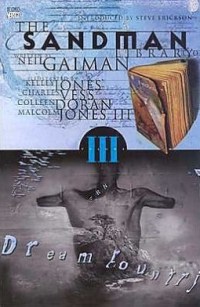
25100Book: “The Sandman (Vol.3): Dream Country” by Neil Gaiman, Kelley Jones (Ill.), Charles Vell (Ill.), Colleen Doran (Ill.), and Malcolm Jones (Ill.)
Publishing Info: Vertigo, 1991

Where Did I Get This Book: I own it.

Book Description: The third volume of the Sandman collection is a series of four short comic book stories. In each of these otherwise unrelated stories, Morpheus serves only as a minor character. Here we meet the mother of Morpheus’s son, find out what cats dream about, and discover the true origin behind Shakespeare’s A Midsummer’s Night Dream. The latter won a World Fantasy Award for best short story, the first time a comic book was given that honor. collecting The Sandman #17–20.

Review: One of the things that I need to get used to when going back and re-reading “Sandman” is that Gaiman sometimes like to meander and experiment with stories in their tone and mythologies. So while “Sandman” does have an overarching plot line, on occasion you will find tales that don’t fit in. Sometimes I really love this, as in both of our previous collections I’ve highlighted these standalone stories. So theoretically I should have been totally game with “The Sandman (Vol.3): Dream Country”, as it has four stand alone tales that don’t really focus on Dream and his journey. I’m all for experimentation, just like on my first read through, “Dream Country” didn’t live up to the books before.

Our first standalone story, “Calliope”, is one of the ones that most fascinates me, but also has some really problematic elements to it. In concerns the Muse Calliope, Morpheus’s former lover and mother of their late son Orpheus, who has been imprisoned by an author so that her influence will make him write amazing works. While in captivity Calliope is isolated and raped repeatedly, and she calls upon Morpheus for help in escaping. I greatly enjoy the concept of a person using the means of a Muse for ill will, and I liked the harkening back to the Greek Mythology that Morpheus has some part in, but I really had a hard time with the way that Calliope is abused by one man, and is basically damsel in distressed until another man saves her. The concept was my favorite of the four, but the execution was very upsetting and felt a bit tone deaf by today’s standards.

The second is “A Dream of a Thousand Cats”, a fun and kind of sad story about house cats and how they went from ruling the wild to being subjugated by human kind. Given my love for cats, the idea of cats wanting to rise up and free themselves from their human ‘captors’ is very fun, if only because it has been said that if house cats were much larger they would absolutely try to kill their owners. Morpheus is here (in the form of a cat, no less!), but it really could have been anyone waylaying this information to our feline protagonists. This probably could have worked as a short story out of the “Sandman” universe, and I wonder if Gaiman had the idea for this kind of story outside of this narrative, as it felt a bit forced into the box of the Sandman world.

The third story is “A Midsummer Night’s Dream”, a World Fantasy Award winning tale (the first comic to win this award even!) in which Morpheus brings people of the faerie realm to come watch Shakespeare’s traveling troupe put on “A Midsummer Night’s Dream”. Basically Morpheus and Shakespeare cut a deal and this is the first of two plays that Shakespeare has written for him. We get a lighthearted version of “A Midsummer Night’s Dream”, and get to see their ‘real world’ counter parts react to the way that they are portrayed within the play. Cute to be sure. I think that were I a bigger fan of the play itself I’d have enjoyed this more, but “A Midsummer Night’s Dream” isn’t a fave of mine, Shakespeare wise.

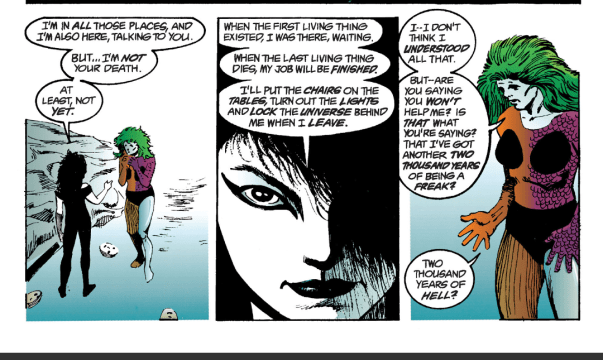
It’s the fourth story that I really, really liked, and kind of saved this whole collection for me. “Facade” is the saddest tale within this collection, and it doesn’t even have Morpheus in it! Instead we get to see my girl Death shine, though she, too, plays a smaller role in lieu of a new original character. Raine is a woman who, when on an archaeological dig in Egypt, was cursed with immortality. Though she is going to live possibly forever, her body is slowly deteriorating, rendering her isolated and scared and desperate to die. She puts on fake faces to go into public, but it’s by no means a long term solution, and after a particularly bad day Death hears her begging, and decides to talk to her. Looking at the consequences of what immortality would actually be is always sobering, and Raine is such a sad character that you ache for as the story goes on. And while it was kind of surprising to see that Morpheus wasn’t in this one, I think that Death was really the character to use given her empathetic nature (unlike Dream, who is prickly at best), and it was really nice seeing her getting a little more spotlight. She is such an intriguing character on her own, after all. I also really liked the artwork for this one. It’s a lovely design for Death.

k5ucirmlsrq31
(source)

“The Sandman (Vol.3): Dream Country” is a fine detour from the main storyline, but I’m eager to get back to see what Morpheus is up to. I definitely encourage you to read these if you are taking on the series, but if you have to go to Volume 4 before this one, that’s probably going to be fine.

Rating 7: These standalone stories are enjoyable for the most part, but they don’t really progress the plot, and feel a bit dated in some of their themes.

Reader’s Advisory:

“The Sandman (Vol.3): Dream Country” is included on the Goodreads lists “Books About Faery”, and “Mythic Fiction Comics”.

Find “The Sandman (Vol.3): Dream Country” at your library using WorldCat, or a local independent bookstore using IndieBound!

Previously Reviewed: