Serena’s Review: “Fireheart Tiger”

Book: “Fireheart Tiger” by Aliette De Bodard

Publishing Info: Tor.com, February 2021

Where Did I get this Book: Edelweiss+

Book Description: Quiet, thoughtful princess Thanh was sent away as a hostage to the powerful faraway country of Ephteria as a child. Now she’s returned to her mother’s imperial court, haunted not only by memories of her first romance, but by worrying magical echoes of a fire that devastated Ephteria’s royal palace.

Thanh’s new role as a diplomat places her once again in the path of her first love, the powerful and magnetic Eldris of Ephteria, who knows exactly what she wants: romance from Thanh and much more from Thanh’s home. Eldris won’t take no for an answer, on either front. But the fire that burned down one palace is tempting Thanh with the possibility of making her own dangerous decisions.

Can Thanh find the freedom to shape her country’s fate—and her own?

Review: I’ll admit that this was another book that pulled me in on the strength of the cover art alone. I mean, that’s just a gorgeous cover, and there’s no second opinion about it! The description comparing it to “Howl’s Moving Castle” and “The Goblin Emperor” couldn’t help but add more intrigue. Plus, it’s a novella, which I haven’t read one of for quite a while. Unfortunately, it didn’t quite live up to all of those expectations!

Life as a political hostage is not easy, but then no one ever expects it to be. More surprising for Thanh, a princess returning home at long last, is that her homecoming proves to have its own set of challenges. Haunted by a first love now thrown back in her path who sees her own path forward, Thanh begins to understand that she will need to evolve. As a passive hostage, her life had been simple. But as princess, wielding great power and responsibility, she has choices, some of which could impact the future of her entire country.

While I can think of several good examples of novellas that I’ve read in the past (Seanan McGuire’s entire “Wayward Children” series, for example), unfortunately, this book highlights much of how to do them wrong. With the strict word count limit imposed on writing a shorter story, the author has to be incredibly efficient with world-building and character development. And even then, you can’t spend too much time on it, necessitating that both the world, story, and character are fairly interesting and compelling on their own from the very start. And in these key areas, this book fails the test.

Particularly, Thanh herself is a fairly paper-thin character. She doesn’t stand out in any bad ways, but she’s also not very interesting and lacks the charisma needed to drive a short story like this. Her lack of a strong voice makes the necessary info-dumping portions of the story stand out more than they should. Beyond that, I found the character to be a bit unlikable, seeming to wallow in self-pity more often than not and easily distracted by her own personal dramas over the larger state of affairs going on around her.

I also was very uninvested in the love interest and romance of this story. We simply aren’t given enough here to care. Ephteria’s attraction is almost entirely contained in the author’s telling rather than showing style. She has blue eyes…that’s about all we get. But Thanh spends pages upon pages obsessing over her, and the readers are stuck there with her, just not understanding why. The thin depiction of this relationship is mirrored in Thanh’s other relationships as well, with her mother, and with another young girl she befriends.

Beyond this, the writing didn’t work for me. I found it often to be jarring and uninspired, pulling out cliches when you’d most expect them and not helping to build any tension as the story worked its way through its plot points. The dialogue was at times particularly egregious, with some of the villains just one mustache-twirl away from being comical.

There may have been a good story here somewhere if the author had had more word-count to work on. But I’m also not convinced that the characters, world, or overall plot could have supported an increased page count. It’s kind of a chicken or the egg thing: did the page count limit the creativity of the characters and flow of the writing, or were these aspects weak on their own and would have just struggled more in a full-length novel?

Rating 6: Pretty disappointing overall. Though the cover is still one of the best I’ve seen in a while.

Reader’s Advisory:

“Fireheart Tiger” is a new title so it isn’t on too many Goodreads list, but it is on Upcoming 2021 SFF Books With Female Leads or Co-Leads.

Find “Fireheart Tiger” at your library using WorldCat!

Serena’s Review: “The Dragon Republic”

Book: “The Dragon Republic” by R. F. Kuang

Publishing Info: Harper Voyager, August 2019

Where Did I Get this Book: from the library!

Book Description: Three times throughout its history, Nikan has fought for its survival in the bloody Poppy Wars. Though the third battle has just ended, shaman and warrior Rin cannot forget the atrocity she committed to save her people. Now she is on the run from her guilt, the opium addiction that holds her like a vice, and the murderous commands of the fiery Phoenix—the vengeful god who has blessed Rin with her fearsome power.

Though she does not want to live, she refuses to die until she avenges the traitorous Empress who betrayed Rin’s homeland to its enemies. Her only hope is to join forces with the powerful Dragon Warlord, who plots to conquer Nikan, unseat the Empress, and create a new republic.

But neither the Empress nor the Dragon Warlord are what they seem. The more Rin witnesses, the more she fears her love for Nikan will force her to use the Phoenix’s deadly power once more.

Because there is nothing Rin won’t sacrifice to save her country . . . and exact her vengeance.

Previously Reviewed: “The Poppy War”

Review: I read “The Poppy War” over the summer. And while I really enjoyed it (it even made it onto my Top 10 list for the year!), it was also a super hard read. Kuang doesn’t back away from the awful realities of war, and how often the innocents are the ones to suffer the worst. That being the case, while I knew I wanted to continue with the series, I had to give myself a break before getting to the next one. So, about six months later, now is the time! Plus, the third book just came out a month or so ago, so I want to get to that one in a somewhat timely way.

The Poppy War has ended due to the extreme measures taken by Rin at the end of the last book. But the Empress remains and Rin’s vengeance has not been completed. However, even a powerful fire shaman such as herself cannot take on the Empress alone. Not to mention the opium she has been using to control the Phoenix’ voice in her head has consumed more and more of her life. When she’s approached by the Dragon warlord to join a new cause, a new war, Rin sees her only path forward. And is a soldier without a war, anyways? Rin’s not sure she wants to find out.

I enjoyed this second book even more than the first. In “The Poppy War,” there was a bit of a jarring tonal shift from the first half which read like a boarding school/coming-of-age story and the second half that was pure war and pure devastation around every corner. It got darker and darker and ended pretty much in the darkest place yet. This second book not only had to move Rin’s story forward from a seemingly impossible personal low, but it also must set up Rin’s path forward in her path for vengeance against an almost all-powerful foe. And while it fully explores the challenges of both of these things in very satisfying ways, that’s all covered in about the first third of the book! And instead, the author takes us into an even more complicated brewing conflict where Rin’s abilities could be the crux of everything.

The story once again dives into the complicated nature of warfare, loyalty to one’s country, and making the tough decisions when weighing the balance of the greater good. For one thing, it explores whether “the greater good” is even a thing in these types of decisions. Alongside these themes, however, this book also explores concepts of religion and cultural power with the introduction of the Hesperians, a sophisticated society that has largely stayed out of previous wars but are beginning to makes moves in this book. Rin is a great character to explore these themes alongside. While she has shamanic powers, she’s by no means devote. She can see both the appeal and the danger in these others with their monotheistic faith.

There were also a bunch of twists and turns in this story. At this point, I’ve come to assume that almost every person in power is terrible, only telling part of the truth, and looking to exploit Rin somehow. But I never can quite pin down the intricate motives and histories that behind the decisions everyone is making. What’s more, we had some pretty big reveals about side characters in this book that I definitely didn’t see coming at all! Rin’s own story took a few pretty massive shifts that I didn’t expect, and I loved it all.

I also appreciated that, while this book is still dark, it wasn’t quite as tough to get through as the first one. This could also be simply because I was more prepared for what I was getting into, and Rin herself was more hardened to what she was seeing and doing. Fans of the first book are sure to love this second one. And I can guarantee that the wait time between this second book and the third will be much shorter than my wait between the first and second!

Rating 9: Excellent and somehow even stronger than the first!

Reader’s Advisory:

Strangely, “The Dragon Republic” isn’t on any Goodreads lists, but it should be on Asian Speculative Fiction by Asian Authors — #ownvoices.

Find “The Dragon Republic” at your library using WorldCat!
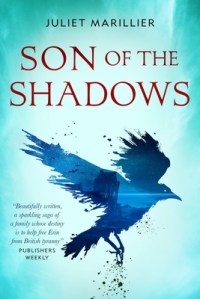
Monthly Marillier: “Son of the Shadows”

“Monthly Marillier” is a review series that is, essentially, an excuse for me to go back and re-read one of my favorite author’s back catalog. Ever since I first discovered her work over fifteen years ago, Juliet Marillier has been one of my favorite authors. Her stories are the perfect mixture of so many things I love: strong heroines, beautiful romances, fairytale-like magic, and whimsical writing. Even better, Marillier is a prolific author and has regularly put out new books almost once a year since I began following her. I own almost all of them, and most of those I’ve read several times. Tor began re-releasing her original Sevenwaters trilogy, so that’s all the excuse I needed to begin a new series in which I indulge myself in a massive re-read of her books.

Book: “Son of the Shadows” by Juliet Marillier

Publishing Info: Tor, June 2002

Where Did I Get this Book: own it

Book Description: After years of comparative peace, darkness has fallen upon Ulster. Trouble is brewing and even those in the heart of the forest are not safe. Niamh, elder daughter of Sorcha, is required to make a strategic marriage, while her sister Liadan, who has the gift of Sight and her mother’s talent for healing, finds herself drawn into the shadowy world of the Painted Man and his warrior band. There Liadan begins a journey that is to transform her life.

Review: The second book in Marillier’s trilogy is really where the author gets to stretch her wings. The first story, while definitely fleshed out and expanded upon, is still essentially a fairy-tale retelling of the “Sevan Swans” so much of the bones were already in place. Without that framework, “Son of the Shadows” is really the book that lays the foundation for the rest of the series. It’s also probably one of my favorite books of Marillier’s.

The next generation is coming into their own. Niamh, the beautiful and wild-hearted eldest. Sean, the chieftain-in-training son. And Liadan, the unexpected second daughter, a young woman very similar to her mother, Sorcha, but who operates outside the Fair Folks’ plans. When their quiet life at Sevenwaters is interrupted by a series of misfortunes, Liadan begins to see hints of a darker force working around them. But while all fingers are pointed at a dangerous mercenary, the Painted Man, and his band of skilled fighters, Liadan suspects otherwise after spending time in their company and forming an unexpected bon with their leader.

In some ways, in this second book Marilliar simply switches the roles of her hero and heroine. Where Sorcha was the damaged character and Red the patient, steady force who drew her in, Liadan and Bran play opposite roles. By the nature of her curse, Sorcha was by necessity a quiet character. Here, Liadan is much more of a force. She has a similar quiet strength, but she’s also snappy, stubborn, and powerful in ways that make her a fascinating character to follow. Bran, of course, has his own strengths, but the mystery of his past, a wrong that makes him slow to trust and suspicious of women, affects him deeply. Much of their relationship is defined by Liadan’s sheer force of will to love Bran despite his best efforts. It’s a very different romance than the sweet, steady love story that played out in the first book. Here there are a lot more sparks, both of the good and bad variety.

I also really liked the secondary characters we get here. Red and Sorcha, of course, play a role, but Marillier does a good job keeping their page time limited so that they don’t overpower the new story she is trying to tell. We also see some familiar faces in Connor and Liam, but there, too, their roles are smaller. Sean, Liadan’s twin brother, plays an important role as the future leader of Sevenwaters, and we begin to see how he will differ from the generation that came before him. We also meet Eamonn, the son of the leader who betrayed Sevenwaters in the previous book. He plays an unexpected role here, adding a sense of building tension throughout the story.

I will give the book one ding here, with these secondary characters. Marillier falls prey to the writing trap where her characters could clear up much by simply communicating. There’s a lot of unnecessary secrecy and no good explanation is ever given. And the secrecy isn’t just a tiny side plot, it has big, important impacts on the story itself, which ultimately undermines those plot points.

The writing and world-building is a beautiful and complex as ever. Again, given the nature of Sorcha’s curse, much of the first book is dependent on the author’s ability to flesh out the world and characters without a talkative leading lady. Here, since Liadan not only can speak but is an opinionated character, we see a new strength of Marillier’s writing in the compelling dialogue. But it’s in the book’s quieter, sadder moments that her writing really shines, and there are several instances (some of them pretty unexpected!) that always make me cry.

One last, small criticim of the story has to be some of the smaller tales woven throughout. Storytelling is often featured in Marillier’s work and there is often a particular tale within the story itself that holds particular importance to a character’s arc. We have that here, too. But there were also several other stories, and while they also connected to characters and actions, they sometimes felt too long and that they were throwing off the balance of the actual story being told. I think a few of them could have been cut or reduced to help with the overall pacing of the book.

But, while I did rate this book one point down from the first, it’s still one of my favorites and maybe even preferred to that one. I really like Liadan as a leading character, and her romance with Bran is very swoon-worthy. It’s a solid sequel to the first and does a lot of the heavy-lifting for paving the way for future books.

Rating 9: Freed of the trappings of a fairytale retelling, we begin to see what Marillier is really capable of.

Reader’s Advisory:

“Son of the Shadows” is on these Goodreads lists: Best Heroine in a Fantasy Book and Fantasy Romance.

Find “Son of the Shadows” at your library using WorldCat!
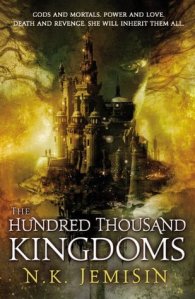
Serena’s Review: “The Hundred Thousand Kingdoms”

Book: “The Hundred Thousand Kingdoms” by N.K. Jemisin

Publishing Info: Orbit, February 2010

Where Did I Get this Book: audiobook from the library

Book Description: Yeine Darr is an outcast from the barbarian north. But when her mother dies under mysterious circumstances, she is summoned to the majestic city of Sky. There, to her shock, Yeine is named an heiress to the king. But the throne of the Hundred Thousand Kingdoms is not easily won, and Yeine is thrust into a vicious power struggle.

Review: Technically, this was a re-read for me. I picked it up originally right when it came out, so about ten years ago now. I really enjoyed it then, but for some reason didn’t continue on with the series. Well, I decided that now was a good time to revisit Jemisin’s first trilogy, so I picked up the second book from the library and started out. Whelp, turns out I remembered basically nothing from this first book and was super confused right out of the gate, so a re-read was definitely in order before continuing on. And I’m very glad I did! I had a few vague ideas about what this book was about, but I really had forgotten just how detailed and rich this story is.

Yeine Darr had only recently come into her role as the leader of her small sub-nation. Challenging as this new role is, it is nothing to the sudden upheavel to her life when she is summoned to the grand city of Sky and finds herself thrust into the middle of a political battle. From small provincial leader, she’s now one of three potential heirs to the ruler of the entire land. But there is much more going on than a simple political struggle: Gods are involved. As Yeine works to uncover the mysteries of her own past, she begins to unravel a complicated history of her own world that has been hidden for centuries. But what can a country nobody such as herself do in this grand opera of gods and magic?

What I remembered about this book could mostly be summed up as “girl goes to palace and falls in love with some sort of dark, magical being.” Which…is somewhat accurate but also so, so much less than what this book is really about! For one thing, I forgot just how skilled Jemisin’s writing and world-building was in this book. Having now read more of her work, this isn’t as surprising, I guess, but when I first read it, it’s a wonder I didn’t just immediately continue on!

In the midst of an action-packed story centered around a complicated mystery, Jemisin still somehow manages to introduce a large cast of characters, build up an intricate world full of an entire pantheon of gods and various nationalities, and create a magic system within which it all operates. And on top of all that, the story never falls into any “info dump” traps. Instead, our narrator casually introduces various aspects of this world and drops hints here and there that slowly begin to paint an intricate picture in the reader’s mind. Indeed, the image is almost fully complete before you even realize that one was being built in the first place!

I’ve also talked before about the challenges of writing first person narratives and how rare it is to find this style of writing in adult fiction. As challenging as it is to build a new fantasy world and magic system on its own without resorting to long, info-dumping paragraphs, it’s even harder to do it in a natural-seeming way coming directly from the mouth of a character who would already be familiar with all of these things and have no natural reason to be speaking it out loud. To tackle this challenge, Jemisin relies on a nice little trick where her narrator is recounting her own story to some unknown audience. While Yeine’s story largely plays out chronologically, it’s clear that the narrator herself is speaking after the fact in the recounting of this story. In this way, little tidbits of information and sneak peaks into events coming up are dropped throughout the narrative, building suspense in the story itself and building curiosity as to how the past Yeine whom we are following along with comes to be the one who is narrating and clearly has a different perspective on her entire world. It’s a really clever technique, and one that we see Jemisin utilize to great effect in many of her works.

I also really liked the cast of character Jemisin builds up around Yeine. The gods themselves are all very complicated, neatly balancing extreme charisma and appeal alongside an ever-present, trigger-haired sense of impending violence. And the humans aren’t much better. Indeed, in many ways, this book emphasizes just how much worse the humans are than the gods who are thought to not possess any sense of humanity themselves. Alongside the perils of power and the quest to retain it, the story explores the darker themes of love and the choices it will lead the unwary towards.

I really enjoyed revisiting this story. I really had forgotten most of it, and it was a joy to rediscover some of Jemisin’s earlier work. This is a fantasy novel that is fully reveling in being a fantasy novel. It checks all the boxes I look for in this sort of story. If you’re a fan of Jemisin’s work and haven’t gotten around to reading some of her earlier stuff, I definitely recommend checking this out!

Rating 9: Complicated and rich, Jemisin proves why she was a force to be reckoned with right from the very start!

Reader’s Advisory:

“The Hundred Thousand Kingdoms” is on these Goodreads lists: Best “Strong Female” Fantasy Novels and Diversity in Fantasy and Science Fiction.

Find “The Hundred Thousand Kingdoms” at your library using WorldCat!

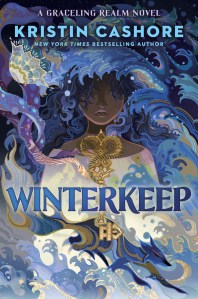
Serena’s Review: “Winterkeep”

Book: “Winterkeep” by Kristin Cashore

Publishing Info: Dial Books For Young Readers, January 2021

Where Did I Get this Book: Edelweiss+

Book Description: Four years after “Bitterblue” left off, a new land has been discovered to the east: Torla; and the closest nation to Monsea is Winterkeep. Winterkeep is a land of miracles, a democratic republic run by people who like each other, where people speak to telepathic sea creatures, adopt telepathic foxes as pets, and fly across the sky in ships attached to balloons.

But when Bitterblue’s envoys to Winterkeep drown under suspicious circumstances, she and Giddon and her half sister, Hava, set off to discover the truth–putting both Bitterblue’s life and Giddon’s heart to the test when Bitterbue is kidnapped. Giddon believes she has drowned, leaving him and Hava to solve the mystery of what’s wrong in Winterkeep.

Lovisa Cavenda is the teenage daughter of a powerful Scholar and Industrialist (the opposing governing parties) with a fire inside her that is always hungry, always just nearly about to make something happen. She is the key to everything, but only if she can figure out what’s going on before anyone else, and only if she’s willing to transcend the person she’s been all her life.

Review: Well, we’ve finally arrived at the long-awaited (really, was anyone actually waiting on this? I think it took most fans by surprise!) fourth book in the “Gracely Realm” series. I’ve enjoyed my re-read so far, though the high of the first two has definitely been dampened by what I felt was a lackluster showing in “Bitterblue”. But given that it has been almost a decade since that book was published, I was curious to see which version of the author’s writing we’d get here: the fast-action, heartstring- pulling story that we saw in the first two, or the more slow, somewhat bloated story that was last one?

It’s been four years since the events of “Bitterblue” and the world has once again expanded. Winterkeep is a distant land whose society is largely focused on politics and industry. With fantastical airships and the knowledge of powerful resources, Winterkeep’s society is at an impasse over the progression of its industry over the environmental effects of some of the resources needed to power those advancements. When two of her envoys die under mysterious circumstances, Bitterblue takes it upon herself to visit this distant land. Things quickly go wrong, and she and her party are left to unravel the mystery at the heart of Winterkeep alongside a local teenage girl, Lovisa, whose parents are somehow connected to it all.

So, I’ll just get it out of the way early: this, sadly, fell much more into the “Bitterblue” school of book than the “Graceling” type which in turn means it was a bit of a disappointment for me. But I’ll start with what I did like. In many ways, I feel like the writing was stronger in this book than in “Bitterblue.” That book was almost oppressively gloomy and serious, whereas here, while the story still tackled serious topics and had darker moments, there were also several funny lines and observations throw in. Bitterblue herself was a much more likable character for having some of these funnier lines/thoughts early in the book which immediately endeared her to me.

I also liked Giddon’s chapters. He was a strong point in “Bitterblue,” so it was great to see Cashore recognize his potential and make him a POV character here. His relationship with Bitterblue was also much more interesting in that book than her romance with Saf, so I was happy to see their friendship/romance take precedence. We also get chapters from a telepathic fox, a special type of animal that is common in Winterkeep and bonds with humans, as well as chapters from a mysterious ocean monster.

But I struggled to connect to Lovisa, and that proved to be a fairly large failing for my enjoyment of the story. As the only native human character we have for Winterkeep, much of the world-building and deeper insight into this world comes through this character. I think there are a few problems here. For one thing, Lovisa simply didn’t have a strong inner voice or particularly compelling character. Those funny lines I mentioned with Bitterblue? None to be found with Lovisa. I’m not asking for a joke a minute, but her voice simply didn’t have any particular aspect to it that made it stand out, which leads to my second problem.

Much of Lovisa’s chapters and inner thoughts are devoted to long reflections on Winterkeep’s political situation and the challenges of balancing industry and environmentalism. Fairly early in the book, I read one of her chapters that devoted almost half of her page count to long paragraphs on these topics. And there simply wasn’t much there! The entire “debate” about environmentalism is a very thinly veiled depiction of our own struggles in this world. And the politics involved are just the same, a very watered down version of the U.S. two party system with entrenched viewpoints on both sides. There are plenty of good ways of using a fantasy novel to get out modern debates, but these were so washed out and thin that they didn’t actually get at any new ideas or add anything of value to the overall conversation. Plus it’s a fantasy novel which usually gives authors a lot of creative leeway to present these ideas in unique and interesting ways. Not so here, unfortunately. The two parties are called the Scholars and Industrialists, for heaven’s sake! And poor Lovisa’s chapters are just full of this stuff, going on and on.

Which gets to my final complaint: this book is way too long. Just like “Bitterblue,” the story begins to feel like a slog fairly early into the first third of the book. The action dies down, the mystery drags on and on, and then finally we get to the resolution, only to find that there’s a significant page count left to get through. In which, again, nothing much happens and the whole thing could have been wrapped up in half the time. This book seriously needed the firm hand of an editor who wasn’t afraid to make great big slashes through some of this.

By this point, it’s clear that Cashore is the type of author who likes to write about issues. Unfortunately, I feel like the books in which she focuses on this the most are her weakest. “Graceling” and “Fire” both touched on some pretty important topics about self-acceptance and the responsibility and dangers of great power. But when the stories delved into more broad topics like they did in “Bitterbue” and here, these issues seemed to consume the book, its characters, and any attempts to build up tension. Fans who enjoyed “Bitterblue” will probably be more pleased with this entry than those who struggled with that book.

Rating 6: Overall, pretty disappointing and bogged down by uninteresting takes on social and political statement pieces.

Reader’s Advisory:

“Winterkeep” is a newer book so it isn’t on many Goodreads lists, but it is on YA Novels of 2021.

Find “Winterkeep” at your library using WorldCat!

Serena’s Rev-Up Review: “Bitterblue”

Book: “Bitterblue” by Kristin Cashore

Publishing Info: Dial, May 2012

Where Did I Get this Book: own it!

Book Description: Eight years have passed since the young Princess Bitterblue, and her country, were saved from the vicious King Leck. Now Bitterblue is the queen of Monsea, and her land is at peace.

But the influence of her father, a violent psychopath with mind-altering abilities, lives on. Her advisers, who have run the country on her behalf since Leck’s death, believe in a forward-thinking plan: to pardon all of those who committed terrible acts during Leck’s reign; and to forget every dark event that ever happened. Monsea’s past has become shrouded in mystery, and it’s only when Bitterblue begins sneaking out of her castle – curious, disguised and alone – to walk the streets of her own city, that she begins to realise the truth. Her kingdom has been under the thirty-five-year long spell of a madman, and now their only chance to move forward is to revisit the past.

Whatever that past holds.

Two thieves, who have sworn only to steal what has already been stolen, change her life forever. They hold a key to the truth of Leck’s reign. And one of them, who possesses an unidentified Grace, may also hold a key to her heart . . .

Previously Reviewed: “Graceling” and “Fire”

Review: So this re-read has been one of discoveries so far. I discovered first that “Graceling” held up really well in the ten plus years since it was first published, even given the boom of similar YA fantasies novels that have come out since. I discovered that while I still prefer “Graceling” overall, I actually liked the romance in “Fire” better. And with “Bitterblue” I discovered…I actually hadn’t read this one before?? I own a copy, and I think I must have skimmed through it at some point, but a full, cover-to-cover read? Nope! Given my takeaway at the end of this read, I suspect I may have skimmed some Goodreads reviews when this came out and put it on the back-burner, being a bit wary. Because, yes, for me, this was quite the step down from the highs of “Graceling” and “Fire.”

Bitterblue has been queen of Monsea since she was ten and her sociopathic father was killed at the hands of Bitterblue’s strongest protector, Katsa. In the years since, Bitterblue has struggled to put her broken country back together. But with endless paperwork and little contact with her actual people, Bitterblue begins to suspect that her efforts aren’t accomplishing much. She takes matters into her own hands and sneaks out to wander the streets of her city and see the state of things for herself. What she discovers opens the floodgates and she is suddenly overwhelmed with all of the mysteries and secrets that have lurked from the time of her cruel father’s reign.

So, overall, I really didn’t love this book. It was so surprising and disappointing to have a reaction like this after just loving both books that came before! But, unfortunately, I think there were several things that worked against it. Not least of which is the fact that I think that even its strengths ultimately work against it when compared to the books that came before. Namely that Cashore’s strengths for creating interesting new worlds and great fantastical elements weren’t allowed any room to grow here. We’ve already been introduced to Monsea, and while the story does show us around the city itself and has some new things to add here, the world itself is largely familiar. The magic, too, is familiar. We may meet a few new Gracelings, but their abilities and their place in the world are already understood. So, too, we already know about the Seven Realms and, largely, how they differ from one another and interact with each other. All of this works to undercut much of what made the first two books so great: Cashore’s deeply imaginative new worlds and magic systems.

And while both of the first two books were slower reads overall, this one really seemed to drag on. It’s much longer than the first two, and nothing in the story really justifies this length. Bitterblue is constantly beset with new mysteries and new roadblocks on any progress she’s making on the ones that came before. More than once she simply gives up and returns to her paperwork in her tower. This is just as boring and anti-climatic for the reader as it’s said to be for her. What’s more, many of the mysteries are built around the seemingly crazy actions of many of the characters around her. But they are so random and so off-the-wall that with the lack of understanding around them comes also the lack of caring. Unlike the books before where it felt like clues were being laid down that reader’s could begin to piece together for themselves (part of what kept the pacing better in those books), here, it all feels too disconnected to any logic or overall plan to really engage the reader.

I also really, really disliked the romance in this book. This was truly shocking as the other books in this series had two of my favorite romances ever. But here, nothing really works about it. Saf is a terrible romantic hero. When he’s not annoyingly immature (it’s never a good sign when you’re heroine herself calls the hero this and she’s completely right!), he’s outright rude and mean to Bitterblue. And all of this is when he’s even on the page at all, for there are large chunks of the story where he’s nowhere to be seen. From a personal reading perspective, his absence isn’t missed as when he was around I was mostly frustrated by him. But from the perspective of trying to build a compelling romance, it’s hard to do when you’re romantic hero is nowhere to be found for the last half of the book. And the end was only satisfying because it was ultimately unsatisfying, essentially!

I did like Bitterblue as a character, but I think the romance and the plodding storyline both did her a massive disserve. It was also confusing trying to understand why Bitterblue was suddenly noticing all of these things around her. Presumably she’s been acting as queen for the last 8 years, and while she was too young initially to take notice, it’s hard to understand what was distracting her from it all for the last few years. There’s no obvious impetus for any of it, really. “Winterkeep” will also feature Bitterblue, so I’m excited to see how the character fares when put in a different (hopefully better!) story. We’ll find out next week when we finally get to “Winterkeep” itself!

Rating 6: Very disappointing. It has some serious weaknesses on its own, but it’s definitely not helped by the fact that the two before it were such hits for me.

Reader’s Advisory:

“Bitterblue” is on these Goodreads lists: YA Second World Fantasy and Best Kick-Ass Female Characters From YA and Children’s Fantasy and Science Fiction.

Find “Bitterblue” at your library using WorldCat!

Kate’s Review: “The Sandman (Vol.6): Fables and Reflections”

Book: “The Sandman (Vol.6): Fables and Reflections” by Neil Gaiman, Bryan Talbot (Ill.), Stan Woch (Ill.), P. Craig Russell (Ill.), Shawn McManus (Ill.), John Watkiss (Ill.), Jill Thompson (Ill.), Duncan Eagleson (Ill.), & Kent Williams (Ill.)

Publishing Info: Vertigo, 1993

Where Did I Get This Book: I own it.

Book Description: FABLES & REFLECTIONS follows the Lord of Dreams through nine remarkable tales as he touches lives from the mists of the past to the nightmares of the present. In these episodes, kings and spies, emperors and actors, ravens and werewolves all share their stories and their dreams–dreams of life and love, and of power and darkness.

Review: When I picked up “The Sandman (Vol.6): Fables and Reflections”, I sighed in disappointment. We were once again going to be focusing on stories that exist within the universe and within Morpheus’s world and realities (or unrealities). While I do appreciate how expansive Gaiman is when it comes to his various mythologies, I admit that coming on the heels of “Game of You” I really just wanted to jump back in with Dream, Death, and the like. But as I started getting back into “Fables and Reflections”, I realized that even though we are still off the main storyline track, there are a lot of really excellent moments in these side stories.

The main thematics of “Fables and Reflections” is various dreamers and leaders throughout history, and how dreams and their dreaming natures affected their lives for better or for worse (worse probably being the story “Thermidor”, which focuses on Robsepierre during the Reign of Terror, the time that no one likes to think about when it comes to revolution fantasies). I had a couple of stories that I especially liked, the first being “Three Septembers and a January”. In this tale, we focus on the obscure but real story of Emperor Norton, a man who just kind of declared himself the Emperor of the United States back in the 1800s. Yes, he was real, and a bit of a local celebrity in San Francisco. In this tale, we get to see snippets of his life as the Endless siblings engage in a wager as to which will claim him before Death does so permanently (with Dream being the least nefarious in his intentions, though Delirium can’t know what she’s doing, she’s Delirium dammit!). We get to see Norton live his life under the delusion of his ‘power’, but also see that while he may be ‘mad’, he’s also just a harmless and pretty good guy. There is a lovely moment between him and Death at the end, which emphasizes the overarching point of the “Emperor” in this collection who had the least amount of power is the one who was the best and kindest ‘ruler’ (see Robespierre above, though Augustus also shows up in this collection). It’s a sweet story that really resonated with me.

The other story that stood out has the most connection to Dream and the Endless, and that is “The Song of Orpheus”. As mentioned in earlier collections, in this universe Orpheus is the son of Calliope and Morpheus, and this is basically a retelling of the Orpheus and Euridyce myth with that twist. It’s a story of fathers and sons, lost love, fate, and how parents can fail their children. It is a gut punch seeing Dream have to reconcile with the fact that Orpheus went against his warnings, and in turn refuses to put Orpheus out of his misery after his dismemberment by the Maenads, dooming his son to live eternity as a disembodied head, all because Orpheus didn’t listen to him about saving Eurydice (well, and because of a ‘rule’ The Endless have about killing family, but that feels second to his own wounded ego). It really emphasizes that while Dream is a great character in a lot of ways, he is horrifically pig headed when it comes to those that he loves, to the point where he treads away from morally grey and into villain territory. But, all the more complexity and depth that will no doubt be explored later!

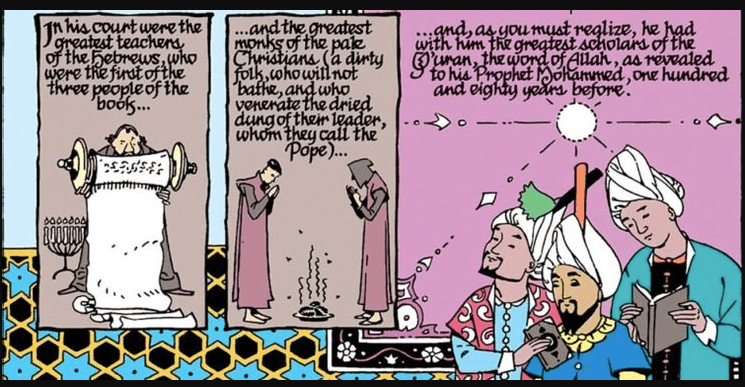
The artwork shifts between the stories (did you SEE the list of artists at the top?!), and the strongest style for me was in “Ramadan”, a story of Harun al-Rashid ruling in historical Baghdad (I will also say that this story has a lovely grace to it, as it was written during the first Gulf War and Gaiman isn’t afraid to make comment of that). P. Craig Russell is the main artist for this story, and WOW. The style appears to be influenced by art from the time and place, as well as illuminated religious texts, and my goodness it’s just beautiful and vibrant.

(source: Vertigo)

All in all, I ended up enjoying “The Sandman: Fables and Reflections” more than I thought I would on this re-read. It’s wistful and dreamy, and it adds a lot of depth to this amazing world.

Rating 8: A ponderous collection of stories about power, empires, love, and death, “The Sandman: Fables and Reflections” doesn’t really advance the plot, but adds flourish to the universe it exists within.

Reader’s Advisory:

“The Sandman (Vol.6): Fables and Reflections” is included on the Goodreads lists “Mythic Fiction Comics”, and “Graphic Novels With The Best Artwork”.

Find “The Sandman (Vol.6): Fables and Reflections” at your library using WorldCat, or a local independent bookstore using IndieBound!

Previously Reviewed:

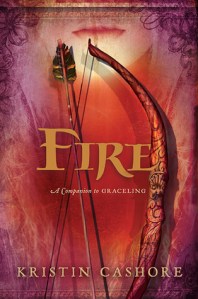
Serena’s Rev-Up Review: “Fire”

Book: “Fire” by Kristin Cashore

Publish: Dial Books, 2009

Where Did I Get this Book: own it!

Book Description: It is not a peaceful time in the Dells. The young King Nash clings to his throne while rebel lords in the north and south build armies to unseat him. The mountains and forests are filled with spies and thieves and lawless men.

This is where Fire lives. With a wild, irresistible appearance and hair the color of flame, Fire is the last remaining human monster. Equally hated and adored, she had the unique ability to control minds, but she guards her power, unwilling to steal the secrets of innocent people. Especially when she has so many of her own.

Then Prince Brigan comes to bring her to King City. The royal family needs her help to uncover the plot against the king. Far away from home, Fire begins to realize there’s more to her power than she ever dreamed. Her power could save the kingdom.

If only she weren’t afraid of becoming the monster her father was.

Previously Reviewed: “Graceling”

Review: Unlike “Graceling,” I never got around to re-reading “Fire” closer to when I read it the first time. Not that I didn’t really enjoy it then, just that, like I said, the TBR list was just starting to get out of control around this time. So going into this re-read, I remembered even less about this book than that. That made it lots of fun to read now as it almost felt like an entirely new book, but one that I already knew I’d enjoy! Win win!

The Dells is a colorful land, marked by the bright, over-powering beauty of its monsters: blue horses, purple raptors, pink mice. But Fire is the only human monster after the death of her cruel father several years prior. Her extreme beauty inspires both wonder and hatred from those around her, so Fire’s life world has been small to stay safe. She also greatly fears the mind control abilities that come alongside her beauty. But when a prince arrives on her doorstep requesting her aide to save the king, Fire is obligated to venture out and put her abilities to the test.

While this is technically a prequel to “Graceling,” it most ways it stands a lone. We have one character (albeit an important one!) who crosses over, but their page time is limited so even there we’re left with mostly new material. I really loved the world-building that went into the Dells and the creativity around the native monsters and how their powers worked. The animals themselves are quite terrifying, especially the monster raptors that seem to constantly lurk in the sky. Though this was also the one point where I was confused. Are these regular raptors, like hawks and falcons that aren’t that big? Or are these some type of unique bird of prey that is bigger? They seemed to be discussed and treated as pretty severe threats to people which was confusing if we’re talking about smaller birds of prey. Not really a big deal, but it was something I kept getting caught up on throughout the story.

Fire herself is an incredible creation. It makes complete sense that extreme beauty would inspire both love and hatred, and seeing how this plays out in Fire’s every day existence was really intriguing. She has some strong abilities, but we also see how very vulnerable her monster looks are to her. She attracts monster animals who want to eat her, and humans aren’t much better, either becoming obsessed with her (often in the grabby, forceful kissing manner) or essentially go mad and want to kill her. Her life seems very challenging, full of fear and tension. This makes it all the more touching to see her begin to form real relationships with the other characters in this book, because we’ve been prepped to understand just how many challenges there are in this for Fire.

I really liked the romance in this book, perhaps even more than I did the one in “Graceling.” Everyone loves a good “enemies to lovers” romantic plot line, and as much as I liked Po, Brigan checked off more on my romantic hero wish list, like steady and a bit solemn. While Katsa and Po were all about the fiery drama, Fire and Brigan have a slow build that is beautiful to watch unfold.

This book was a bit slower than “Graceling,” and the villain(s) were also a bit underwhelming. We see the return of one evil character, and they’re good for the small amount of page time we get from them. But what accounts for the main antagonist and challenge was a bit to removed from the story to feel too invested in it. By the nature of her being, Fire’s work is mostly done from the safety of the castle and is largely passive with most of the action taking place off-page.

I really enjoyed re-reading this book. I really remembered very little of it, and I was pleased to find the romance, in particular, even better than I had remembered. Next up is “Bitterblue!”

Rating 9: A quieter, more introspective book than “Graceling,” but also a bit more heart-breaking (in a good way!) overall.

Reader’s Advisory:

“Fire” is on these Goodreads lists: Original Stories . . . a Breath of Fresh Air and Princes, Other Worlds and Future Lands.

Find “Fire” at your library using WorldCat!

Serena’s Rev-Up Review: “Graceling”

Book: “Graceling” by Kristin Cashore

Publishing Info: Harcourt, October 2008

Where Did I Get this Book: own it!

Book Description: Katsa has been able to kill a man with her bare hands since she was eight—she’s a Graceling, one of the rare people in her land born with an extreme skill. As niece of the king, she should be able to live a life of privilege, but Graced as she is with killing, she is forced to work as the king’s thug.

She never expects to fall in love with beautiful Prince Po.

She never expects to learn the truth behind her Grace—or the terrible secret that lies hidden far away . . . a secret that could destroy all seven kingdoms with words alone.

Review: I read this book right around when it came out and instantly loved it. I went on to re-read it a few times in the next couple of years. But as my list of re-read favorites grew and grew, after those first few years, I never got back around to this one. So now it’s probably been about ten years since I last read it. Then when I saw that Cashore was returning to her “Graceling” world after so many years with the release of “Winterkeep” later this month, I knew that now was the time and this was the perfect excuse! So in anticipation of this new book, I will be re-reading all three of the “Graceling” books that came before, starting out with this, the first and my favorite.

In a world dotted with individuals with extraodinary powers, marked by their duel colored eyes, Katsa’s unparalleled ability to fight and kill just about anything is frightening to the extreme. Not the least of all to her. Under the thumb of her cruel uncle the king, for years, Katsa has served as his unwilling enforcer. To protect her own sanity and the safety of those she can, Katsa’s also built up an underground life of small rebellions and resistence. During one of these missions she meets Prince Po, another Graceling and one who finally opens her eyes to the opportunities before her. When the two begin to uncover a lurking darkness in the far reaches of the kingdom, they set out to unravel an increasingly malicious tangle. And while they do, they begin to discover there is more to Katsa’s Grace than just killing after all.

There’s a lot to love about this book. I but I think most people can agree that one of its biggest selling points is its main character herself. I can think of a number of books that have attempted an all-powerful, badass female character like this before and bungled it up so badly that the book becomes practically unreadable. So it’s a testament to Cashore’s ability that her main character not only avoids pulling the book down with her but actually turns out to be one of its biggest selling points.

Katsa’s biggest strengths, her seemingly endless ability to excel at practically anything, is just what makes her such a challenging character to write. She arrives on page one seemingly capable of easily handling anything that the story throws out her. So where’s the plot to go? What type of development can you give a character like this? Well, instead of physical limitations, Cashore dives deep into the psychological damage and challenges that a character with these abilities would face. Katsa’s fear of her own strength hinders her ability to trust and form friendships, probably the low hanging fruit as far as personal struggles for this type of character goes.

But Cashore goes even deeper. Because Katsa operates alone so much of the time and has a deep-seated fear, verging on hatred, for herself, her interactions with those around her can be quite toxic at times. She’s rash and prone to striking out. She also struggles to recognize the limitations of others and will push people (and horses!) past their breakingpoint. From this starting point, Cashore weaves together a beautiful character arc that focuses on themes like trust, self-acceptance, and self-control. And throughout this all, Katsa’s very brashness and inability to pick up on the most basic of social cues makes her an incredibly endearing lead character.

Beyond Katsa, the story excels in several areas. While it takes a bit to get started, once it does, there are bunch of fantastic action set-pieces and challenges that are posed to our seemingly unstoppable heroine. And the story quickly moves past the more straightforward aspect of her Grace that would just be one fight scene after another. I also really like the romance in this story. Unlike a lot of other YA books, here the romance establishes itself about halfway through the book. Of course, as any romance novel author will tell you, getting your characters together is only half of the story, and I really appreciate that Cashore left room to dive into the later stages of a romantic storyline. Things like facing losses together, going through fights, figuring out how to be a couple while also maintaining your sense of individuality, making decisions about your future.

I also really like the villain we have here. The build up to the reveal successfully creates a lot of tension that is only compounded upon once the reader discovers what is really going on. The villain is also a great foil for Katsa, being appropriately powered but not in a way that feels like their abilities were created specifically with her in mind (a failing of many archvillains, in my opinion.) My only complaint is that there isn’t more page time with this individual. But, then again, given the nature of the villain, there’s not really a very good way to include more scenes with them that doesn’t hurt the story overall.

So, given my ravings above, it’s pretty obvious that I found this book just as enjoyable ten years later as I did the first time I read it. I’m excited to read the next two books as well since, unlike this one, I never re-read either of those and remember very little about them.

Rating 10: Definitely deserves its place in the YA fantasy ranks as one of the bests.

Reader’s Advisory:

“Graceling” is on these Goodreads lists: Best “Strong Female” Fantasy Novels and Magic, Adventure, Romance.

Find “Graceling” at your library using Worldcat!

Book Club Review: “Sailor Moon Eternal Edition (Vols 1 and 2)”

We are part of a group of librarian friends who have had an ongoing bookclub running for the last several years. Each “season” (we’re nerds) we pick a theme and each of us chooses a book within that theme for us all to read. Our current theme is “Outside the Genre Box”, in which we each picked a book from a genre or format that we don’t usually read.

For this blog, we will post a joint review of each book we read for book club. We’ll also post the next book coming up in book club. So feel free to read along with us or use our book selections and questions in your own book club!

Book: “Sailor Moon Eternal Edition (Vols 1 & 2)” by Naoko Takeuchi

Publishing Info: Kodansha Comics, September 2018/November 2018

Where Did I Get These Books: I own them.

Genre/Format: Manga

Book Description: The guardians in sailor suits return in this definitive edition of the greatest magical girl manga of all time! Featuring an extra-large size, premium paper, and an all-new translation and cover illustrations by creator Naoko Takeuchi!

Teenager Usagi is not the best athlete, she’s never gotten good grades, and, well, she’s a bit of a crybaby. But when she meets a talking cat, she begins a journey that will teach her she has a well of great strength just beneath the surface and the heart to inspire and stand up for her friends as Sailor Moon! Experience the Sailor Moon manga as never before in these extra-long editions.

Kate’s Thoughts

Though I have read some manga here and there and have watched a fair number of anime series (I actually just started watching “Death Note” for the first time, and I’m DIGGING it!), I never go into “Sailor Moon”. I had friends in high school who liked it, but by the time I did get into anime and ‘Magical girl’ stories, I pretty much just went with “Princess Tutu” and left it at that. So when our new Book Club session started up and one of our members wanted to read the first two books in “Sailor Moon”, I figured that now was as good a time as any to read one of the most influential Magical Girl mangas.

I think that had I been in a very specific time frame when reading “Sailor Moon” for the first time (perhaps after grade school but before I entered my ‘I’m not like other girls and too cool for girly shit’ punk and Goth phase in high school) I would have probably appreciated it more than reading it now. That isn’t to say that I don’t get why “Sailor Moon” is such a phenomenon. I liked the mythology of the Sailor Scouts, and I liked how we slowly got to meet each one and the different things that they all bring to the table. I also can tell that there is a LOT of mythology we haven’t even gotten to yet, and that as Usagi and her friends/teammates go forward there will be a lot more to learn regarding their identities, how Tuxedo Mask (the mysterious love interest) fits into it all, and how Usagi will balance this with her normal life as a teenage girl. In the first volume there is a lot of this kind of set up, while the second volume there is more solid adventuring and conflict that escalates. It was also pretty neat to see that things weren’t afraid to get dark as the plot arcs went on in Volume 2, and there were some pretty high stakes involved for Usagi and the others, as well as some legitimate peril to wrangle with. But at the end of the day Usagi herself was hard to connect with because there is a lot of effort to make her super imperfect to contrast with the amazing Sailor Moon alter ego that she has inside of her. But at the end of the day, these stories are not written for me as the intended audience, and because of that this is definitely a ‘your mileage may vary’ situation, as I DEFINITELY get the appeal in theory. Just not in my own practice.

I now feel like I have a better understanding of a story that has a very firm and well earned place in pop culture. It may not be for me, but I love that it is a story for teenage, fantasy loving girls who want their own kind of power fantasy. My hat does off to that and to them.

Serena’s Thoughts

Unlike Kate, I did read a lot of magical girl fantasy right around when this was coming out. But, unlike Kate in general, I’ve never really gotten into reading Manga or graphic novels much at all. As an adult, I’ve discovered more graphic novels that I enjoy, but it’s still not a go-to type of reading for me, even within my preferred genres. And as a middle school girl, I think I just associated any/all graphic novels with comic books and filed them away under “boring boy stuff.” I went on to have a complicated relationship with “Sailor Moon” in high school due to my on again off again boyfriend’s love of the series and my suspicion that he only wanted to date me initially based on my name being the same as the Americanized version of the main character’s. I was pleased to find that on reading the series now the main character’s name has been reverted back to the original, thus reducing my flashbacks to teenage years and highschool love letters between Serena and “Tuxedo Mask” (yes, he would sign off like that!)

With that little jaunt down memory lane out of the way, I had a lot of similar impressions to Kate. I can definitely see the appeal of this story and understand how it came to have such a far-reaching fanbase. The characters are all intriguing, the magic is fun, and the story is willing to engage with some darker themes. It also has much of the drama and awkwardness that teenagers enjoy, with Sailor Moon’s teenage identity providing a stark contrast to her magical girl persona.

Like Kate said, the second volume had more to work with after the first one spent much of its time laying down the foundation for the series. But even in the second one, it was clear that the story was just scratching the surface of all the stories it wanted to tell with these characters. I was pleased to see it go a bit deeper than the first volume did.

Overall, this also wasn’t really my thing. But I think that’s probably mostly due to my age and my generally picky approach to graphic novels and Manga. I picked up a “Pride and Prejudice” Manga at ALA a few years ago, and even that wasn’t really my jam. So this one had a steep hill to climb. But I definitely see the appeal for fans of the format and fantasy lovers in general, especially teenagers.

Kate’s Rating 6: Definitely ground breaking and assuredly appealing to magical girl fantasy fans, but not really my cup of tea at the end of the day.

Serena’s Rating 6: Approachable and fun for those who fit its audience type; unfortunately that wasn’t me.

Book Club Questions

  1. Have you read any manga before this? If so, what manga have you read and how does it compare to “Sailor Moon”? If not, what did you think of this first foray into the format?
  2. What did you think of the structure of the story as a stream of consciousness path that Usagi is taking? Did you like learning things as she did, or do you wish there had been a more organic way to explore the mythology?
  3. Did any of the Sailor Scouts appeal to you more than the others? If so, who, and why do you think that is?
  4. What did you think of the relationship between Sailor Moon/Usagi and Tuxedo Mask?
  5. Which elements, if any, of the ‘magical girl’ genre did you find most appealing?

Reader’s Advisory

“Sailor Moon Eternal Edition” Vols 1 and 2 (in other formats) are included on the Goodreads lists “Magical Girl Manga”, and “Fandom Origins”.

Find “Sailor Moon Eternal Edition” Vols 1 and 2 at your library using WorldCat, or a local independent bookstore using IndieBound!

Next Book Club Book: “The Widows of Malabar Hill”