Kate’s Review: “The Sandman (Vol.8): Worlds’ End”

Book: “The Sandman (Vol. 8): Worlds’ End” by Neil Gaiman, Mike Allred (Ill.), Gary Amaro (Ill.), Mark Buckingham (Ill.), David Giordano (Ill.), Tony Harris (Ill.), Steve Leialoha (Ill.), Vince Locke (Ill.), Shea Anton Pensa (Ill.), Alec Stevens (Ill.), Bryan Talbot (Ill.), John Watkiss (Ill.), & Michael Zulli (Ill.)

Publishing Info: Vertigo, 1993

Where Did I Get This Book: I own it.

Book Description: Caught in the vortex of a reality storm, wayfarers from throughout time, myth and the imagination converge on a mysterious inn at WORLD’S END. In the tradition of Chaucer’s The Canterbury Tales, as the travelers all wait out the tempest that rages around them, they share stories of the places they’ve been, the things they’ve seen… and those that they’ve dreamed.

Review: We’ve entered the last fourth of my “The Sandman” re-read, and after the strong note that we ended on at the end of “Brief Lives” I was, admittedly, disappointed to see the number of illustrators coming into “The Sandman (Vol.8): Worlds’ End”. That many illustrators can only mean one thing: we’re getting a number of stand alone short stories. This has been something we’ve seen Gaiman tinker with as the series has gone on, but given that I haven’t remembered many of them as I’ve gone through this re-read, it kind of goes to show that for me these moments of pushing boundaries of storytelling aren’t as effective as the main plot of Morpheus and his siblings. I figured that the same would be said for “Worlds’ End”, and for the most part I was right. Except for one significant moment near the end. But I’m getting ahead of myself.

“Worlds’ End” is an homage to “The Canterbury Tales”, as a number of travelers have found themselves at a mysterious tavern that seems to meet at the nexus of dimensions. There are humans, creatures, entities, and spirits, and all have wound up at the Worlds’ End Tavern due to a strange ‘reality storm’ that has thrown all of them out of their home planes. We arrive with Brant Tucker and his travel companion Charlene, after he crashes her car in the middle of a snowstorm that happens to be occurring in June. Clearly something is up, and as he and Charlene take shelter, the other travelers engage each other with stories to pass the time. As someone who hasn’t read “The Canterbury Tales”, I wasn’t lost, per se, but I was wondering if I was missing something because of my ignorance. The stories range from fantasy to surrealist to creepy. Two really stood out for me in the stand alone stories list. The first is “Hob’s Leviathan”. For one, it brings back fan favorite and Morpheus friend Hob Gadling, but it doesn’t center him at the heart. Instead it focuses on “Jim”, a girl who has disguised herself as a boy to travel on sailing ships. As Jim and Hob travel, their ship encounters a humungous sea serpent. Jim wants to tell the world; Hob knows that the world won’t listen. I liked this one for two main reasons. The first is the reintroduction of Hob. I love Hob! He’s a fun character and it was fun seeing him through the eyes of someone else. The other is Jim, as any tale that has a woman trying to extend past societies expectations is a-okay in my book.

The other story I really liked was “The Golden Boy”. At one point during DC Comics’s Bronze Age there was a character named Prez Rickard, who was a teenage president of the United States. In “The Golden Boy”, Gaiman expands and adds complexity to this concept, following Prez as he maneuvers as President through multiple crises of 20th Century America, which is very clearly a country that has burned brightly but on the verge of starting to burn out. While Prez is never swayed by corrupting influences (specifically an otherworldly entity called Boss Smiley, who looks like the Smiley Face Icon from the 1970s), the ills of the world beat him down and he fades slowly out. It’s a strange and bittersweet but also hopeful story, and one that was VERY weird to read in the America that we’re living in right now.

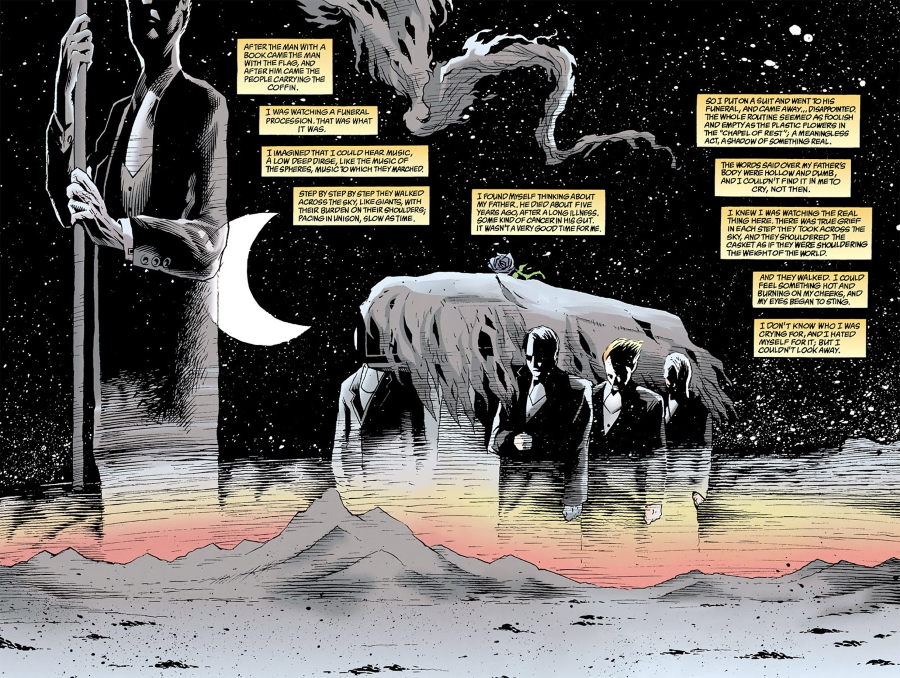
The other original stories in this collection didn’t really connect with me. But there is one final story that is by far my favorite in its power, its emotion, and what it shows is on the way. The last tale is that of the travelers at Worlds’ End who are still waiting out the storm, and wondering what has caused this strange event, as it certainly must be something significant and ghastly to do such damage to reality. And then, across the sky, they see a funeral procession. They don’t know what they are seeing. We as readers don’t really know what we are seeing. But we do see various Endless in the procession, with Delirium and Death trailing behind at the end. Brant describes the entire thing in a sorrowful and yet dreamy way, and once we get to the end and see Death and the look on her face…. Guys, I wept. I think that in part it’s because I know what’s coming. But it’s also such a beautiful moment filled with poignancy and loss. This story was my favorite, and if shifted my perception.

The artwork in this collection is, as you may imagine, incredibly varied (LOOK AT ALL THE NAMES AT THE TOP OF THIS POST). Gaiman says in an afterword in my edition that he wanted to showcase all these different artists talents, and he does. But my favorite was definitely Gary Amaro, who created the funeral procession with such celestial grace and dejection that it just cuts me to the bone.
“The Sandman (Vol.8): Worlds’ End” is the last of the standalone story collections in the series. I’m glad to move on to the rest of the main storyline and characters, but I will say that the end of this one is probably the most powerful moment in the series for me. I’m glad to have been reminded of it.

Rating 7: Another collection of unrelated stories shows off Gaiman’s creativity and the illustrators’s talents. But after a strong previous story arc I was a little underwhelmed, outside of a powerful moment of foreshadowing…

Reader’s Advisory:

“The Sandman (Vol.8): Worlds’ End” is included on the Goodreads lists “Best of Vertigo Comics”, and “Books for the INFJ”.

Find “The Sandman (Vol.8) Worlds’ End” at your library using WorldCat, or at a local independent bookstore using IndieBound!

Previously Reviewed:
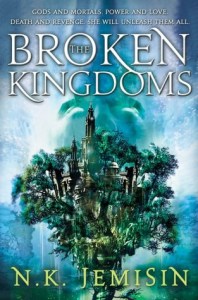
Serena’s Review: “The Broken Kingdoms”

Book: “The Broken Kingdoms” by N.K. Jemisin

Publishing Info: Orbit, November 2010

Where Did I Get this Book: audiobook from the library!

Book Description: In the city of Shadow, beneath the World Tree, alleyways shimmer with magic and godlings live hidden among mortal kind. Oree Shoth, a blind artist, takes in a homeless man who glows like a living sun to her strange sight. This act of kindness engulfs Oree in a nightmarish conspiracy. Someone, somehow, is murdering godlings, leaving their desecrated bodies all over the city.

Oree’s peculiar guest is at the heart of it, his presence putting her in mortal danger — but is it him the killers want, or Oree? And is the earthly power of the Arameri king their ultimate goal, or have they set their sights on the Lord of Night himself?

Previously Reviewed: “The Hundred Thousand Kingdoms”

Review: Having re-familiarized myself with Jemisin’s first novel and after discovering the joy that is the audiobook version, it was a quick hop and skip over to the library website to check out the next book in the series. I wasn’t quite sure what to expect, as I didn’t read a book description beforehand and it had seemed as if the first book wrapped up fairly neatly. But I’m pleased to report that while telling a wholly unique story focused on a new cast of characters, this sequel is just as wonderful as the first book.

Set several years after the events of the first book, Oree’s world looks very different than the one that existed before. Godlings walk among humans, a gigantic tree grows at the heart of what once was the most powerful city in the land, and dark new forces grow with the rumors that a new god, a new lady, has joined the pantheon. But for Oree, life is made up of small moments as she tries to lead a peaceful life selling her artwork. For, even without eyesight, able only to see magic and its users, Oree creates wonderous works that draw the eyes of many. But this simple life is interrupted when she finds herself drawn into a dark mystery: godlings are being murdered and Oree and her strange house guest, a man who shines bright as the sun, but only at dawn, are suspected as being behind it all.

“The Broken Kingdoms” is both a quieter novel and a more complex one. In many ways, it feels like Jemisin came more into her own in this second outing. While the first one was lovely and I might have preferred it as an overall reading experience, I think this was the stronger book. All of the little glimpses into this fantastical world that were laid down in the first story seemed to blossom and weave themselves into an interlocking tapestry here in the second. The history of the gods and godlings, the politics and cultures that have warred and formed alliances throughout history, and the smaller lives of those just trying to get by while cosmic battles wage around them. Oree’s story is very much that, the story of a young woman who quickly finds herself caught up in something stronger than she is…or so she believes.

As a character, Oree has the quiet strength and inner will of iron that I find so appealing in a leading lady. She has no grand desires and spends much of the book fighting against her own involvement in the mystery surrounding the godlings and her strange houseguest whom she has dubbed “Shiny.” Readers of the first book will be quick to identify this character, and I was pleased to see that Jemisin didn’t draw out the suspense too long for Oree, as well. As fun as it is to be in the know against the main character in a book, it’s a short-lived joy and one that can also end up working against itself very quickly if drawn out too long. The main character can often be left looking unnecessarily foolish or slow to pick up on clues that seem obvious to the better-informed reader. But here, Oree learns the truth in a timely manner, and, what’s more, her reaction to this discovery adds a new layer of interest to the story and the friendship building between these two.

I was also pleased with how Jemisin used this character. From the first book, it was easy to have strong opinions of him from the start. And Jemisin doesn’t undermine those, but she also develops layers beneath this surface version that draw a picture of a complicated, flawed individual who is none the less a worthy companion for our Oree.

I also really enjoyed the expanded world building and exploration of magic and the godlings. The world has certainly changed since the events of the first book, and it is interesting to see the many small and large effects that those events have inspired. The villains, in particular, were very interesting and appropriately threatening. What makes them all the more scary is how understandable some of their motivations are. The world has changed drastically and quickly, and everyone’s reactions to that sort of upheaval would be very different.

My only ding against the book was perhaps the ending. But this is a largely personal evaluation, and I think, narratively, it works quite well. I had my own hopes for how things would go, and the ending took me by surprise, both in a good way and, a bit, in a disappointing one as well. I’m curious to see if any of these events are revisited in the third and final book!

Rating 9: While I had more fun with the first book, this might be the stronger work of the two.

Reader’s Advisory:

“The Broken Kingdoms” is on these Goodreads lists: Speculative Fiction by Authors of Color and Non-Caucasian Protagonists in Science Fiction, Fantasy, Horror, and Paranormal Romance.

Find “The Broken Kingdoms” at your library using WorldCat!

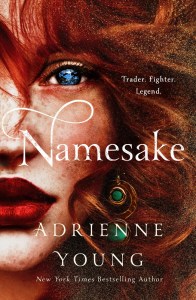
Serena’s Review: “Namesake”

Book: “Namesake” by Adrienne Young

Publishing Info: Wednesday Books, March 2021

Where Did I Get this Book: Edelweiss+

Book Description: Trader. Fighter. Survivor.

With the Marigold ship free of her father, Fable and its crew were set to start over. That freedom is short-lived when she becomes a pawn in a notorious thug’s scheme. In order to get to her intended destination she must help him to secure a partnership with Holland, a powerful gem trader who is more than she seems.

As Fable descends deeper into a world of betrayal and deception she learns that her mother was keeping secrets, and those secrets are now putting the people Fable cares about in danger. If Fable is going to save them then she must risk everything, including the boy she loves and the home she has finally found.

Previously Reviewed: “Fable”

Review: I’ve really liked some books from Adrienne Young in the past, but I think “Fable” might have been my favorite in a while. For one thing, I always enjoy a good pirate/sea-faring story, and they’re fairly hard to come by, making the stand-out ones all the better when you find them. While the first book wasn’t perfect, it was definitely a solid start to the duology and the cruel cliff-hanger did its work: I picked up this one as soon as possible when it became available!

Shortly after thinking she’d finally found a place and family of her own in the Marigold and its crew, Fable is abducted and finds herself caught up in the scheming of several powerful players. Unbeknownst to her, Fable might be the clue to unlocking one of the rarest finds in the sea. And soon, Fable must risk it all to make a future for herself and her crew. But to do so, she must delve into the secrets of her family, especially her mother, a woman Fable had thought she knew up until now.

I wasn’t quite sure where this book was going to be headed when I got to the cliffhanger at the end of the first book. In many ways, most of Fable’s arcs had already been completed. She’d confronted the father who abandoned her. Found a crew. Made her fortune in a risky treasure hunt. And found love with the captain of the Marigold. And then she was abducted, with very little fanfare or clues as to why. This could have gone two ways, of course. It could have felt like a last-minute addition by an author/publisher who insisted they’d wring a sequel out of this thing come hell or highwater. Or it could be a thoughtful addition to Fable’s story that felt organic and natural in its own right. I’m glad to report that it is the second.

While much of the first book dealt with Fable’s complicated relationship with a father who refused to acknowledge her as his daughter publicly, this book dives into Fable’s relationship and understanding of her mother and her mother’s family. From the first book, Isolde is made out to be the prototypical perfect mother figure. She was everything Fable wanted to be and looked up to, while also a comforting, loving mother to Fable as a child. But this book tackles the idea that we never really know our parents, as much as we may love them and want to emulate them. Isolde, like the sea she loved, had depths and currents to her that very few understood, and it was exciting watching Fable navigate the twists and turns uncovered in her own family history through Isolde’s lingering relatives.

There were several points in this story, particularly with regards to the Isolde storyline, that could have felt very predictable. I had a number of suspicions regarding the direction the story seemed to be headed. Luckily, only one of those really played out (though that one in particular still frustrates me to no end, as I felt like at least part of it should have been more obvious to Fable and her crew). Instead, we see new layers to many characters. Villains come and go. Motivations wax and wane. It’s always a bit unclear as to who is doing what and why.

And at the heart of it, Fable is a steady, sympathetic character. The revelations about her family that rock her own understanding of herself and history, while shocking, don’t dislodge her core purpose and understanding of her place in the world. Her values, her love for her family, both found and blood, remain true even when tested by power, suspicion, and deception.

I also liked that we got to see a bit more backstory for a few of the other crew members. In the first book, many of them felt like token characters with only one or two traits to really distinguish them from each other. Here, we get a bit more history for a few of them that grounds their stories in ways that make you care about more than just Fable herself.

I still found the romance to be a bit dull. But in this different circumstance, the second book versus the first, I was almost glad for that dullness. More than anything, I hate it when authors add drama to their established romances as if that’s the only way to maintain the reader’s interest in it. If your romance can’t hold up to its characters being together, it wasn’t great to start with. I’ve said it before and I’ll keep saying probably forever.

Overall, I was very pleased with this sequel. It explored new areas of the duology’s central theme, that of family, while also staying true to the main character and foundations of the story that were laid down in the first book. Fans of “Fable” are sure to enjoy this second high-seas adventure!

Rating 8: Exciting but poignant, “Namesake” continues to build on the excellent foundation laid down in the first book.

Reader’s Advisory:

“Namesake” is on these Goodreads lists: OE Fiction, Fantasies & Epics Book Club and Ginger woman: Redheaded Heroine in Romance.

Find “Namesake” at your library using WorldCat!

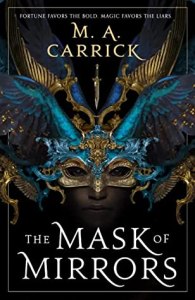
Serena’s Review: “The Mask of Mirrors”

Book: “The Mask of Mirrors” by M. A. Carrick

Publishing Info: Orbit, January 2021

Where Did I Get this Book: copy from the author!

Book Description: Renata Viraudax is a con artist who has come to the sparkling city of Nadezra — the city of dreams — with one goal: to trick her way into a noble house and secure her fortune and her sister’s future.

But as she’s drawn into the elite world of House Traementis, she realizes her masquerade is just one of many surrounding her. And as corrupt magic begins to weave its way through Nadezra, the poisonous feuds of its aristocrats and the shadowy dangers of its impoverished underbelly become tangled — with Ren at their heart.

Review: M. A. Carrick is the pen name for two authors, Marie Brennan and Alyc Helms. I’m not familiar with any of Helms’ work, but I’ve enjoyed the books by Brennan that I’ve read. Both are anthropologists as well, which I think often adds an extra layer of detail and attention to the world-building in original fantasy novels. Like so many before it, this book has been hyped with comparisons to “Six of Crows,” and based on the description alone, I can see where that would come from: any fantasy novel that features cons and has multiple POVs MUST be compared to “Six of Crows!” We all know what my record has been with those so far…

Renata is not who she claims to be, the lost cousin of a down-and-out noble family who nonetheless hold power at their finger tips. No, Renata is truly Ren, a former street urchin who has always had an eye for a con. But the plan that she and her sister conjured up, for Ren to ingratiate herself with a noble family as a long lost cousin and hence secure a future for them both, quickly goes sideways and Ren soon finds herself caught up in events that are greater than she had prepared for. What’s worse, she’s beginning to feel a bit too much like Renata, caring about and for things and people she shouldn’t.

Not only do the comparisons to “Six of Crows” feel accurate in this case, this book escapes the curse of being a massive let-down that has struck so many “wanna-be ‘Six of Crows'” imitations in the past. In a lot of ways, it’s like the adult version of that. It definitely goes to some darker places than the YA novel is allowed to, and its character more fully exist in the shades of grey between good and bad. Good people doing bad things for good reasons. Bad people doing good things for horrible reasons. It’s all deliciously complicated and prickly, making you both love and despise characters at various times and question how you, yourself, would handle certain situations.

I also liked many of the characters introduced, especially Ren. It’s always important to like the main character, and it can be especially hard to write a realistic character such as this without having her become a caricature con artist, constantly quipping and not founded in any deeper human emotion beneath it all. Not here. Through Ren’s perspective, we see the challenges she faces, trying to become part of a group of society that she also despises. And slowly grows to appreciate. And then equally begins to struggle with her own feelings towards these people and the balance between her original goals and the individual connections she’s made.

There were also a lot of twists and turns throughout the story. For much of it, the identity of the mysterious Robin Hood-like character is unknown, and it was a constant challenge trying to figure out the identity of this enigmatic force to be reckoned with. The end of the book also really kicked things up and left the story in a very primed state for the sequel.

My one ding is in regards to the length and pacing of this book. It’s over 600 pages long, which is just a lot to ask of readers taking on a new fantasy world such as this. The story did fairly well supporting this page length, but the pacing did stutter at times, and I think the entire thing would have been more approachable if it had been edited down a bit. But, in the end, I think most fantasy fans will enjoy this book, and I’m definitely curious about the sequel!

Rating 8: A complex new fantasy world bites off a bit more than it can chew in length, but makes up for it with strong characters and compelling mysteries.

Reader’s Advisory:

“The Mask of Mirrors” is on, funnily enough, this Goodreads lists: The Best Random Genre List Of Books…Ever.

Find “The Mask of Mirrors” at the library using WorldCat!

Serena’s Review: “As the Shadow Rises”

Book: “As the Shadow Rises” by Katy Rose Pool

Publishing Info: Henry Holt Books for Young Readers, September 2020

Where Did I Get this Book: Edelweiss+

Book Description: The Last Prophet has been found, yet he sees destruction ahead.

In this sequel to the critically-acclaimed “There Will Come a Darkness,” kingdoms have begun to fall to a doomsday cult, the magical Graced are being persecuted, and an ancient power threatens to break free. But with the world hurtling toward its prophesized end, Anton’s haunting vision reveals the dangerous beginnings of a plan to stop the Age of Darkness.

As Jude, Keeper of the Order of the Last Light, returns home in disgrace, his quest to aid the Prophet is complicated by his growing feelings for Anton. Meanwhile, the assassin known as the Pale Hand will stop at nothing to find her undead sister before she dies for good, even if it means letting the world burn. And in Nazirah, Hassan, the kingdom-less Prince, forms a risky pact to try to regain his throne. When the forces of light and darkness collide in the City of Mercy, old wounds are reopened, new alliances are tested, and the end of the world begins.

Previously Reviewed: “There Will Come a Darkness”

Review: I wasn’t a huge fan of the first book in this series, as my review above with testify to. But it’s hard to resist returning to a series when the sequel is so highly praised (but then again, so was the first one, and we saw how that turned out). But this book currently has a 4.25 star rating on Goodreads, which is definitely not something to turn your nose up at. So I requested it and tried to be open to what others are seeing in this series that I didn’t. Sadly, I still don’t see it.

Our main characters are spread far and wide. And while the Last Prophet has been identified, the world still seems to be burning around them. Hassan has lost his country to his scheming Aunt. Jude returns in disgrace having let his feelings get ahead of his mission time and again. And our favorite assassin wanders the land looking for her self-destructive, undead sister. Not to mention the doomsday cult that only seems to have gotten started. As their paths weave in and out of each other’s stories, the way forward begins to look more and more complicated and challenging. If there even is a way forward.

Well, I will say that I liked this one better than the first. With so many POV characters, the first one had to devote a huge chunk of its page time introducing each of its characters and attempting to instill equal importance and interest in them all. For me, this last part wasn’t successful, but there was no avoiding the first part. One could make an argument for this being why multiple POV books should probably be much more rare than they seem to be at the moment. But for all of those reasons, the first book didn’t have much of a plot until the last quarter of the story where it did, finally, kick into gear. Here, the story was able to take off much more quickly for all that work already being done. Our threats have been better identified, the world-building better established, and it all results in a book that has much better pacing and action than the first.

I also liked the fact that the story is leaning into the darker, twisty aspects of the story. The first one I thought was pretty predictable and what were meant to land as big shocks were easily seen chapters ahead of time. Here, I was pleased that I was only able to predict a few of the twists and turns with more of them taking me genuinely by surprise. So if you enjoyed that aspect of the first book, this one is sure to satisfy.

Unfortunately, for me, most books live and die on their characters. And that was my biggest problem with the first, and that feeling only intensified with this one. There’s a combination of problems here, really. With so many POVs, there will always be favorites. This happens even with books/authors who can handle a large ensemble cast well. But here there are really only one or two characters whose stories I’m really invested in. For the others, there’s a combination of boredom by some and then dislike of others. Both of these feelings, I’m sure, are unintentional. Boring, for sure. And the dislike? I’m not quite so sure, but I think that we’re still meant to like most of these people. And it’s not even the morally ambiguous ones (assassins always are!) that are always the unlikeable ones here! I didn’t like Hassan much in the first, and he really doesn’t improve here. And while Jude has an interesting story, I’m still cringing over his complete failure to live up to what we’re meant to believe is rigorous training he went through his entire life. He has similar struggles here.

I did like the moments when the characters crossed paths with one another. That was a favorite part of the first book, too. It’s nice to see a story that doesn’t just get all of the characters together and then leave them that way. Here, like there, we see people come and go from each other’s stories, making the fact that they are all individuals with very different goals and objectives stay at the forefront of the mind. While they have different connections and interests in one another, they are not a team like we often see in other ensemble books.

Overall, I think this was an improvement on the first book. I liked that the story took me more by surprise. And the fact that so much of the introduction leg work had already been gotten out of the way really helped the pacing and action of the plot. Unfortunately, my problems with many of the characters only intensified and at times it felt like a real chore reading some of their chapters. However, if you were a fan of the first book, I’m sure you’ll like this one. And if your problems with the first one had to do more with its introductory nature more than anything else, this might be an improvement for you as well! Just expect more of the same, character-wise.

Rating 7: An improvement on the first, but I still found myself skimming through certain characters’ chapters.

Reader’s Advisory:

“As the Shadow Rises” isn’t on many Goodreads lists, weirdly, but it is on Books with Red Covers.

Find “As the Shadow Rises” at your library using WorldCat!

Diving into Sub-Genres: Literary Fantasy

We each have our own preferred genres of choice. Kate loves horrors and thrillers, really anything that will keep her up at night! And Serena enjoys escaping through hidden doors into realms of magic and adventure. We also read mysteries, historical fiction, graphic novels, etc. etc. And that’s not even counting the multitude of sub-genres contained within each greater genre. In this series, one of us with present a list of our favorites from within a given sub-genre of one of our greater preferred genres.

Literary fantasy is a hard sub-genre to even wrap your head around. Many of the other sub-genres of fantasy (portal fantasy, epic fantasy, steampunk, urban) have very distinct elements that are easily recognizable even from a short blurb about the book. Literary fantasy…not so much. It’s tempting to say that literary fantasy is simply contemporary fantasy where the story is simply light on fantasy altogether. But this writes off historical works which would also fit this category. So perhaps it is simply the light fantastical elements? But even that I don’t think is correct (you’ll see that a couple of books I’ve included here have fairly extensive magical elements).

Instead, I think it’s largely contained in a certain style of writing that is often found in these books. Literary fantasy is often just as focused on a beautiful turn of phrase as it is on describing a magical spell’s effects. There’s often an elegance to the writing, a compulsion to appreciate the words themselves rather than fully immerse oneself in the book to the point that the reader forgets they’re reading. Indeed, knowing that one is reading is half of the joy of these types of books, with more focus given to descriptions and omniscient narrator musings than action-packed set pieces. In many ways, I’m essentially describing “literary fiction” but with some fantastical element involved. However, I think that “literary fiction” typically includes other notable elements that don’t necessarily rely on a style of writing as strongly as literary fantasy does (often tragic, more experimentation with word-play and style of writing).

So with that in mind, here are a few examples of favorite books of mine that I would file under literary fantasy.

“The Invisible Life of Addie LaRue”

This was actually the book that inspired this entire review series, after one of our readers commented on my labeling it as “literary fantasy” and asked about other titles that would fit in that sub-genre. So here we are! This story, that of a young woman who strikes a deal to live forever but to never be remembered by anyone she meets, fits the criteria in a few ways. It definitely has fantasy elements, what with the main character living forever and all, but the themes of the book are much more focused on identity, one’s own history, and what it means to exist in a world made up of so many other people living out their own journeys. There’s also a big focus on art and how it expresses the lives of both the artist and the subject of art. Between these themes, much of the story taking place in a standard contemporary/historical setting with very little magic involved, and the beautiful style of writing, it definitely meets the criteria for literary fantasy.

“The Starless Sea” by Erin Morgenstern

If “The Invisible Lie of Addi LaRue” was the inspiration for this post, “The Starless Sea” was my immediate answer to the question posed by our blog reader for another example of literary fantasy. I could also include Morgenstern’s first novel, “The Night Circus,” under this category, but as this is the one I’ve read and loved most recently, I’ll include it here. It’s also an example of a book I would classify as literary fantasy but one that includes many, many fantasy elements. If anything, it walks right up to the line of what I would classify as fairytale fantasy or portal fantasy. The story is a winding affair of exploration and mystery throughout time and space, all held together by a mysterious library that exists right through a doorway, if one is only brave enough to open it. There’s much reflection on love and passion, but half of the magic is the sheer whimsy of the entire thing. Behind every door is a new wonder, and the writing seems to wrap you up in a warm blanket of delight and you’re left wondering if you perhaps travelled to this magical world after all, simply through the process of reading this book. It is this lovely style of writing and the effortless feel of the magical elements involved that classifies it as literary fantasy.

“Deathless” by Catherynne M. Valente

This book walks even closer to the line of fairytale fantasy than the last, in that it’s largely inspired by Russian myth and the Russian folklore character, Kuschei the Deathless. But again, it’s all in the style of writing. I debated including one of Valente’s “Fairyland” stories, which I think skirt this sub-genre fairly well themselves. But I think “Deathless” hits the mark a bit better with its supposition of fantastical creatures and myths over almost all of the important events of the 20th century in Russia. Of course, knowing even a little of Russia’s history during that time period, it’s a safe guess that the story, while beautiful, has its fair share of tragic moments, as well. Valente expertly wields her magical elements in such a way as to shine new light and new insights into some of the better (and lesser) known parts of the country’s history. Anyone who has read a book by her before can also testify to the unique and beautiful style of her writing. She’s definitely an author whose stylized sentences and combinations of thoughts often makes the reader stop and re-read certain sections just to revel in her use of words.

“The Golem and the Jinni” by Helene Wecker

This is another literary fantasy novel that is at least as much concerned with delving into its real-life, historical themes as it is in exploring the two magical creatures who are the story’s main characters. Yes, our two leads are the titular golem and jinni, but their story is much more than that. Instead, in many ways, the book is more concerned at looking at the experience of immigrants in the early 1900s and life in New York City during this time period, in general. Not only are both of our characters origins not of the United States, but each, of course, is even more “other” in that they aren’t human. But at the same time, each has such core human traits that define them, that their experiences and struggles feel almost amplified for it. This is a long book, and one that definitely takes its time carefully depicting the details of the place and time as much as it does the history of the golem and jinni. It’s the kind of book that could fairly easily be recommended to straight-up historical fiction fans as well as fantasy readers.

“Tigana” by Guy Gavriel Kay

Guy Gavriel Kay is another author who’s entire catalog of books would likely fit in this sub-genre. My favorite books by him, “The Fionavar Tapestry” quartet, definitely meet the criteria for style of writing, but they fall closer to portal fantasy, in my opinion. But I could have easily put “The Lions of Al-Rassan” or “Children of Earth and Sky” or many others on this list. I selected “Tigana,” however, because it’s probably, universally, one of his most beloved and well-regarded novels. Gavriel Kay’s books are also unique to this category in the fact that they are entirely set in alternative worlds. The settings and events are often inspired by real-life countries and events, but the worlds are still entirely fantasy-based, ultimately. This story touches on themes of war, love, and the tangle that politics makes of it all. It is expansive and marvelous, and, too many, set a higher bar for what readers can expect from fantasy fiction and specifically literary fantasy.

“The Bear and the Nightingale” by Katherine Arden

Lastly, I wanted to include the first book in a trilogy of books that would all fit well in this category. Like some of the others, “The Bear and the Nightingale” has a definite fairytale vibe to the story. But the slow build of the story, the attention spent on developing atmosphere, and the beautiful, lyrical style of writing all fit perfectly for literary fantasy. The sharply beautiful description of the Russian winter landscape are particularly poignant, and the themes regarding religion, magic, and one young woman’s journey to carve out a place for herself in a world that doesn’t have a place for women who don’t fit a certain type of mold. What starts out on a fairly small scale expands across the three books until Vasilisa’s story starts to encompass the entirety of Russia itself. I loved this entire tirlogy and would recommend all three (though they can’t be read separately, other than the first one, perhaps) to fans of literary fantasy.

What fantasy books would you categorize as literary fantasy? What are some of your favorites? Share in the comments below!

Monthly Marillier: “Child of the Prophecy”

“Monthly Marillier” is a review series that is, essentially, an excuse for me to go back and re-read one of my favorite author’s back catalog. Ever since I first discovered her work over fifteen years ago, Juliet Marillier has been one of my favorite authors. Her stories are the perfect mixture of so many things I love: strong heroines, beautiful romances, fairytale-like magic, and whimsical writing. Even better, Marillier is a prolific author and has regularly put out new books almost once a year since I began following her. I own almost all of them, and most of those I’ve read several times. Tor began re-releasing her original Sevenwaters trilogy, so that’s all the excuse I needed to begin a new series in which I indulge myself in a massive re-read of her books. I’ll be posting a new entry in this series on the first Friday of every month.

Book: “Child of the Prophecy” by Juliet Marillier

Publishing Info: Tor, June 2003

Where Did I Get this Book: own it!

Book Description: Magic is fading… and the ways of Man are driving the Old Ones to the West, beyond the ken of humankind. The ancient groves are being destroyed, and if nothing is done, Ireland will lose its essential mystic core.

The prophecies of long ago have foretold a way to prevent this horror, and it is the Sevenwaters clan that the Spirits of Eire look to for salvation. They are a family bound into the lifeblood of the land, and their promise to preserve the magic has been the cause of great joy to them… as well as great sorrow.

It is up to Fainne, daughter of Niamh, the lost sister of Sevenwaters, to solve the riddles of power. She is the shy child of a reclusive sorcerer, and her way is hard, for her father is the son of the wicked sorceress Oonagh, who has emerged from the shadows and seeks to destroy all that Sevenwaters has striven for. Oonagh will use her granddaughter Fainne most cruelly to accomplish her ends, and stops at nothing to see her will done.

Will Fainne be strong enough to battle this evil and save those she has come to love?

Review: Several years after the events in “Son of the Shadows,” we meet Fainne, the daughter of Niamh, Liadan’s lost sister. Growing up in practical isolation, and with the loss of her mother early in life and a reclusive father, Faine’s life has been one of quiet and seclusion. In many ways, Faine feels that she and her father aren’t simply hiding from his cruel, sorceress mother, Oonagh, but they are hiding from their own dark potential. But when the currents shift and Faine is forced out into the world and finds herself in her mother’s ancestral home of Sevenwaters, Faine must begin to make choices about her own future. Will she follow in her grandmother’s footsteps? Or will she choose a new way like her aunt and maternal grandmother before her?

By the time I got to this book, I’d actually read a few of Marillier’s other works. This was probably for the best as this is one of my less favorite of her books. It’s kind of surprising, because overall, I think her Sevenwaters series has been one of her biggest draws to her fantasy readership. But for me, something felt off about this book almost from the start. However, let’s talk about the things I liked, first off.

Marillier’s writing is almost freakish in its consistency. If you read a lot of her books, you’ll soon be able to immediately recognize her unique style of lyrical prose and straightforward storytelling. There’s a sense of wonder and comfort in much of her work, even as she touches on some dark topics. Every word feels delicate and intentional. There’s no denying the craftmanship of her work, and that was all on display here, especially when working with a character like Faine who is very different than the leading ladies who came before her.

I also liked seeing some familiar faces again. I, of course, really enjoyed Liadan and Bran’s story, so it was great seeing them again. It was also interesting to see side characters who had grown into roles they had just begun in “Son of the Shadows.” Sean, for example, has now been leader of Sevenwaters for over a decade. We also see Aisling, his wife, in her role as the lady of Sevenwaters. And, most jarring but also best of all, we get to see a grown Johnny balancing his role as heir to Sevenwaters and presumed fulfiller of the much-debated prophesy that has sat at the heart of the story from the start.

The problem with all of this, however, is that these side characters, both the very familiar, like Liadan and Bran, and the less so, like Johnny, are more intriguing than Faine. Much of Marillier’s work lives and dies on the strength of her characters. Most of her books are slow on the action and heavy on the introspection. So that main character has a lot of heavy lifting to do. And unfortunately, Faine just isn’t up to it. To some extent, I appreciate the challenges that Faine represents. Liadan and Sorcha were almost perfect women, so it’s refreshing to see Marillier tackling a heroine who faces challenges both physical and emotional. Faine walks with a limp, and due to her reclusive lifestyle, she struggles to form connections and maintain relationships. These parts of her character I thought were very well-drawn, and it was interesting watching her learn to piece together human interactions with people who are family in name only to her.

Unfortunately, her naivety turns into almost willful stupidity at points. Her concern of the darkness within her drives her actions past the point of reason. It’s hard to be sympathetic at points when events around her and those who would seek to use her are less than subtle. She does some pretty bad stuff for some pretty weak reasons. And much of her motivation seems weak and more told to the reader than shown in any way that would make it truly threatening feeling.

I also really disliked the romance. It’s not that it was bad, and the hero had his charming, appealing moments. But in comparison to the deep, well-drawn relationships that came in the books before, this one just feels shallow and uninteresting in comparison. I never felt any real chemistry between these characters, and there was very little tension in the proceedings. Some dramatic events happen towards the end, but even then, what should have been heavy hits felt fairly removed for me. I just didn’t care that much.

Of the original trilogy, this book is the weakest by far. It had a really interesting premise, featuring a character who has grown up more on the fringes of Sevenwaters and its stretching legacy, but several aspects of the book just felt a bit off. Faine wasn’t nearly as compelling as Sorcha and Liadan. And the romance felt stilted and thin. It’s still worth reading, however, if you’re a fan of the series as some pretty significant events occur and many of the mysteries laid down in the first two books are resolved. Events that occur here will also be referred to loosely in the second trilogy in the series.

Rating 6: Underwhelming after the flashes of mastery that were the first two books in the trilogy.

Reader’s Advisory:

“Child of the Prophecy” is on these Goodreads lists: Great Celtic Fiction and Myth and Folktale Retellings.

Find “Child of the Prophecy” at your library using WorldCat!

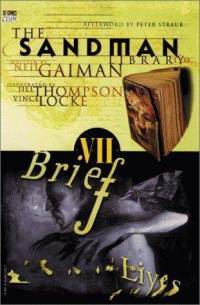
Kate’s Review: “The Sandman (Vol.7): Brief Lives”

Book: “The Sandman (Vol.7): Brief Lives” by Neil Gaiman, Jill Thompson (Ill.), & Vince Locke (Ill.).

Publishing Info: Vertigo, 1993

Where Did I Get This Book: I own it.

Book Description: Dream’s youngest sister, the loopy Delirium, convinces him to go on a quest for their missing brother, Destruction. But Dream may learn that the cost of finding his prodigal sibling is more than he can bear.

Review: This was the storyline in “Sandman” that I was most looking forward to revisiting. My love for Morpheus’s younger sister Delirium knows no bounds, and I remembered that the story that has so much to do with her was the one that touched me the most on my first read through of this series. Her childlike innocence and whimsy, which is also steeped in the darkness of her past, has always been so utterly charming and lovely, and “Brief Lives” puts her at the forefront as she gets in her mind the idea of finding the long lost Endless Sibling, Destruction. When both Desire and Despair say no, she turns to Dream, who is mourning the end of a romantic relationship and decides to go. What comes next is a story that sets the wheels in motion for where this series eventually ends. As well as a road trip tale between the unlikeliest of companions, Delirium and Dream. And I LOVE a good road trip.

Someday we will road trip again! (source)

I, of course, loved “Brief Lives” thanks mostly to Delirium, whose character and design is just a joy as well as a little sad. She is very clearly not in her right mind, gravitating towards those who are in the same boat, so seeing her and the stoic and matter of fact Dream is both quite amusing and bittersweet. It is interesting, however, that she is the Endless that is so determined to find Destruction, who left the family and disappeared three hundred years previously. We see flashbacks of Destruction interacting with some of his siblings, as well as the moment that he decided to go, foreseeing that the Age of Enlightenment and a move towards reason across humanity would bring forth things that would almost make him a bit pointless. Delirium is the perfect sibling to want to find him, as one must only seek Destruction if they were in a similar place as she is. I hesitate to say ‘crazy’. It’s far more complex than that. We get some great moments of humor with her and Dream on this trip, as her driving a car or interacting with nonplussed humans is really great fun.

We also get to see that she didn’t start as Delirium, but as Delight, and that the change she went through was in part thanks to Destruction. This change or multi faceted characterization is a HUGE theme in this tale, especially for the dysfunctional siblings; Destruction talks about how the Endless are two sided coins and aren’t just one thing, but also the inversion of that thing. Delirium is insane, but also one of the most clear headed of her siblings. Death brings, well, Death, but is also the kindest. Desire is both filled with want, but also incredibly vicious. And so forth. I loved seeing these concepts explored as Dream and Delirium go on their journey, inadvertently causing destruction on their quest to find Destruction. This is probably the arc in which we get to see the intricate relationships between The Endless, who are both otherworldly beings with scope and metaphysical attributes that tie into humanity, but also a dysfunctional family group with shifting alliances, petty grievances, and old hurts that siblings know far too well.

And finally, we do get a final visit to the relationship between Morpheus and his son Orpheus, who, cursed with immortality, is just a head being cared for by a family on an island off of Greece. As we saw in “Fables and Reflections”, Orpheus begged his father to kill him, as he is really the only one that can grant him that wish, and Dream turned his back on his son. Now Morpheus has to confront that decision, and to face the child that he abandoned for reasons that Orpheus does not understand. I don’t really want to spoil how this all plays out, but it’s significant and sets the course for what is going to happen next in the series. Also, it made me weep.

And finally, once again, the artwork is lovely. I haven’t gushed enough about Delirium’s design, which is excellent and cheerful and creepy at once. But there was one particular panel that really stuck out to me near the end that just sums up the vast, ever-changing realities of The Endless and their worlds.

Source: Vertigo

“Brief Lives” is a significant story arc and is still my favorite thus far. It really captures the philosophy, the humor, the pathos, and the wonder of the entire series.

Rating 10: A lovely story arc about family, grief, and change, “The Sandman: Brief Lives” is my favorite tale in the series.

Reader’s Advisory:

“The Sandman (Vol.7): Brief Lives” is included on the Goodreads lists “Mythic Fiction Comics”, and “Death Gods and Reaper Protagonists”.

Find “The Sandman (Vol.7): Brief Lives” at your library using WorldCat, or at a local independent bookstore using IndieBound!

Previously Reviewed:
Serena’s Review: “The Bone Maker”

Book: “The Bone Maker” by Sarah Beth Durst

Publication Info: Harper Voyager, March 2021

Where Did I Get this Book: Edelweiss+

Book Description: Twenty-five years ago, five heroes risked their lives to defeat the bone maker Eklor—a corrupt magician who created an inhuman army using animal bones. But victory came at a tragic price. Only four of the heroes survived. 

Since then, Kreya, the group’s leader, has exiled herself to a remote tower and devoted herself to one purpose: resurrecting her dead husband. But such a task requires both a cache of human bones and a sacrifice—for each day he lives, she will live one less.

She’d rather live one year with her husband than a hundred without him, but using human bones for magic is illegal in Vos. The dead are burned—as are any bone workers who violate the law. Yet Kreya knows where she can find the bones she needs: the battlefield where her husband and countless others lost their lives. But defying the laws of the land exposes a terrible possibility. Maybe the dead don’t rest in peace after all.  

Five warriors—one broken, one gone soft, one pursuing a simple life, one stuck in the past, and one who should be dead. Their story should have been finished. But evil doesn’t stop just because someone once said, “the end.”

Review: Sarah Beth Durst has always been a bit of a hit or miss author for me. When she’s on her game, I really love her books. But there are others of her titles that have really not worked for me. So I never quite know which one I’m going to get when I pick up a new book by her. But this one, with its interesting premise and its focus on an older woman as its heroine, sounded like something that would be right up my alley!

What was a day of triumph to the nation was a day of horror to Kreya. While she and her four companions were successful in the heroic mission they set out upon, to take down the viscous bone maker Eklor, Kreya lost her husband in the process. Now, years later, Kreya is living as a recluse, desperately working forbidden magic to buy just one more day with her lost love. When she seeks out a method to work this magic on a more long-term basis, she discovers horrors that she thought were long ago settled. Now she and the others must grapple with the reality that their story may not actually be finished, and they’re not sure they can win this time.

This book checked two boxes of interest for me. Recently, I’ve really been enjoying stories that look at the “after” of heroic tales. Veronica Roth’s “Chosen” was one of my favorite reads last year and dealt with this very topic. While both that book and this one essentially present the same story, that the first “ending” wasn’t really the end at all but simply a pause on everything, they each tackle the topic of what life is like for these heroes in what they think is the end. While this book is mostly Kreysa’s story, Durst also offeres insights into the other heroes who fought alongside her. Through them all, we see the various methods each is using to handle an entire lifetime after such a momentous start. You save the world in your twenties…then what? Not only is the resulting PTSD and trauma something that must be carried afterwards, but the sense that one’s biggest moment in life is already behind one has to play with the mind. I really like the variety we see between the heroes and how they are all coping, nor not coping, with these challenges.

The second point of interest is its focus on an adult heroine. The book never specifies Kreya’s or her friends’ age, but we know their fight happened 25 years ago and that Kreya was married at the time. It’s like that she’s in her late forties or older. It’s always refreshing to read a book that focuses on older characters. By necessity, their lives look very different than the young adult heroes and heroines we so often see. Instead of new love, it’s often an established relationship or a second love. Instead of the challenges of coming into one’s power for the first time, it’s managing a life that has already contained a multitude of defining moments. Kreya and her friends have lived a quarter of a century’s worth of life since their grand adventure. During that time they’ve built lives and come to terms with the events of their youth. They also have to face these new challenges as the people they are now, not the people they were when they first fought their foe. There are both new strengths and challenges that come with taking up the mantle of heroism again later in life.

I specifically enjoyed the established romance between Kreya and her husband. We see all the strengths that have been built into it over the years of loving the same person. But there are also some unique challenges that come along with this. Specifically, of course, the fact that one member of the marriage has been dead on and off for the last 25 years…but it also speaks to the way that relationships grow and change alongside the individuals in them.

The only ding I have against the book is that the world-building and magic system are kind of simplistic and lack detail and depth. There are some cool monsters that live in a particular forest, some magically-operated cable cars, and a few other things. But none of them are described very fully or really made to feel like they are part of a fully-realized world. However, it was also clear that the focus of the book was meant to be largely about its characters, so while the world wasn’t very complex, I wasn’t necessarily feeling that it was lacking while I was reading. Fans of Durst’s work are sure to enjoy this, and fantasy lovers who prefer a more mature hero and stories focused on the “after” of the heroic journey should definitely check it out!

Rating 9: A very enjoyable, fast read that highlights the fact that no hero’s journey is every really over.

Reader’s Advisory:

“The Bone Maker” isn’t on many Goodreads lists, but it is on Can’t Wait Sci-Fi/Fantasy of 2021.

Find “The Bone Maker” at your library using WorldCat!

Serena’s Review: “We are the Fire”

Book: “We are the Fire” by Sam Taylor

Publishing Info: Swoon Reads, February 2021

Where Did I Get this Book: Edelweiss+

Book Description: In the cold, treacherous land of Vesimaa, children are stolen from their families by a cruel emperor, forced to undergo a horrific transformative procedure, and serve in the army as magical fire-wielding soldiers. Pran and Oksana―both taken from their homeland at a young age―only have each other to hold onto in this heartless place.

Pran dreams of one day rebelling against their oppressors and destroying the empire; Oksana only dreams of returning home and creating a peaceful life for them both.

When they discover the emperor has a new, more terrible mission than ever for their kind, Pran and Oksana vow to escape his tyranny once and for all. But their methods and ideals differ drastically, driving a wedge between them. Worse still, they both soon find that the only way to defeat the monsters that subjugated them may be to become monsters themselves.

Review: Two books in a row that I requested based on intriguing covers! Plus a bunch of other things of course: fire magic, a central romance, and whatever those antlers are that they’re wearing in the cover art! This is the first book for this author, so it’s also always nice to support a new voice to the genre. While I did have some criticisms of the story in the end, overall, this was a fun, fast read.

Pran and Oksana share the same tragic story as most of their fellow soldiers: forcibly stolen from their families at a young age and then experimented on and trained to be fire warriors. Not only are the experiments that give them their abilities painful and cruel, there’s no guarantee they’ll even survive their training, all for the privilege of fighting for a nation that has invaded their own lands. But Pran and Oksana aren’t content to simply survive; they want to do away with the entire system. The struggle that follows will test their individual abilities and strengths as well as the heart of their relationship itself.

To start off, this book was very readable. A weird bit of praise for a book that is mean to be, you know, read, but it’s something that more than enough books still fail at anyways. The writing was perhaps simple, but it moved at a quick pace and I found myself blowing through the story in only a day or two. The story of two soldiers forced into battle and working against a tyrannical system and ruler is compelling and the action is tense. The story also doesn’t shy away from the brutality of the world it has built. I originally started questioning whether the book was actually going to demonstrate how bad things were (our hero and heroine escape horrible situations a few times too many to be entirely plausible), but the author really goes there about half way through with a pretty dark scene. It’s a weird thing to say, but I think this book might have benefited from leaning even more into this darker aspect of the story.

Like I alluded to earlier, Pran and Oksana, as interesting as they are as characters, did seem to have pretty obvious plot armor throughout the story. All main characters have this to some extent, but it depends on an author’s ability how well this fact can be masked. Here, it was less so. But simply as characters, Pran and Oksana do well enough. We see how the way they were forced into service has impacted all of their decisions going forward, for better and for worse. Their various relationships with the idea of family and the homes that they left behind drive them each to imagine a better life but direct them down very different paths to accomplish it.

I also liked the fact that the romance is already established at the beginning of the book. Yes, drama is added to give an arc to this relationship, but a story built around the challenges found in a previously strong romance is definitely unique among so many others that focus only on the beginnings. I could have used a bit more fleshing out, here, however. The story refers back to a few scenes that build up how these two came together, but perhaps a extending these into actual flashbacks might have helped make the romance feel more fully fleshed out as a whole.

My main criticism of the story is a bit hard to put my finger on. I think what it comes down to was that everything was a bit too simply described. There are the broad strokes of a world. The broad strokes of a magic system. The broad strokes of characters and their motivations. But I never felt like I was getting any details. I couldn’t describe the fort in which they lived. I couldn’t tell you what any characters looked like other than Pran and Oksana (and even there all I really knew for sure was that Oksana had red hair and what we see on the cover). I didn’t have a good sense of scope of the nations they each came from. It felt a bit like the author was writing a “just the fun bits” type of novel. I have read and liked a good number of fan fiction pieces, so I don’t say this as a heavy ding, but it kind of felt like those stories can: a bit simplistic with an over emphasis on the main characters’ inner thoughts and feelings at the detriment of fleshing out the world and story itself.

But like I said, this was a fun, fast read, if not fully realized. Fans of romantic fantasy who don’t require much deep world-building or intricacy to their magic systems will likely enjoy this book. Also, fans of the show “The 100″…the cover art looks bizarrely like Bellamy and Clarke, I think. A ship that I followed until it crashed and burned, so this was a bit like fan fiction in that sense too: wish fulfillment.

Right?! You see it too!

Rating 7: A sweet romance if a bit unsupported in other aspects of the story.

Reader’s Advisory:

“We are the Fire” is on these Goodreads lists: Monsters and Magic Society and YA Fantasy Standalone Books.

Find “We are the Fire” at your library using WorldCat!