Serena’s Review: “The Bloodsworn”

28439795Book: “The Bloodsworn” by Erin Lindsey

Publication Info: Ace, September 2016

Where Did I Get this Book: audiobook from the library!

Book Description: Unbeknownst to most of Alden, King Erik, in thrall to a cruel bloodbinder, is locked away in his own palace, plotting revenge. To save her king, Lady Alix must journey behind enemy lines to destroy the bloodbinder. But her quest will demand sacrifices that may be more than she can bear.

Meanwhile, as the Warlord of Oridia tightens his grip on Alden, the men Alix loves face equally deadly tasks: her husband, Liam, must run a country at war while her brother, Rig, fights a losing battle on the front lines. If any one of them fails, Alden could be lost—and, even if they succeed, their efforts may be too late to save everyone Alix holds dear…

Review: The final book in the “Bloodbound” trilogy starts out with our heroes in what appears to be an unwinnable situation. King Erik is being controlled by a bloodbinder making him erratic and prone to paranoia (the extreme kind that leads to executions of close friends and family for “treason”). Rig’s battle at the front line has pretty much reached its limit with invasion imminent. Alix must venture deep into enemy territory to attempt to kill the bloodbinder who is controlling the King. And Liam is left to manage a country that is on the brink of destruction, all while hiding the fact that he has the King locked up in a room in the castle. A fact that would surely lead to his immediate death if it were to be discovered. The stakes are high.

At this point, it’s almost hard to remember that this series started out more as a romantic romp with some military/fantasy aspects thrown in than anything else. Sure, there was a large battle at the end and some political maneuvering here and there. But there were a lot of quieter moments where Alix’s personal life was the primary focus. Then the second book came along and everything changed. That entire book was just one massive failure after another for our heroes. And here, in the third, everything just seems kind of hopeless. All of the odds are stacked against them, and even their best case scenarios look grim. I mean, sure, if Alix saves the King, great! But they still have to deal with the fact that they have no allies (having blown their ambassadorial trips in the second book) and an enemy with an army that doubles their own.

I was happy to see that Alix once again played a major part in this story. While I still very much enjoyed the second book, her reduced presence was my biggest complaint. Instead, understandably, given his brain-washed state, Erik takes a back seat to the other characters here. I also liked the fact that Alix’s story line once again took us into the neighboring realms, this time their occupied neighbor whose resistance fighters had helped Rig win significant battles in the second book. Vel, also, played a more important role in this book, joining up with Alix on her quest to find the bloodbinder. I still struggled to like Vel as a character, though she had some good moments in this book. While it made sense to pair up these two women both for the plot and due to the dynamics that come from their relationships with Rig, I think that it also had the unintended result of negatively contrasting Vel to Alix. But this is a pretty subjective viewpoint of my own, more than anything.

Due to the high stakes nature of most of the action in this book, the story definitely kept me on the edge of my seat. There were parts of it where I seriously struggled with the fact that because I was listening to an audiobook and wasn’t able to skim forward and relieve any of the tension. The author did a great job balancing her parallel viewpoints and story lines in a way that just ratcheted up the stress levels on all fronts. And, while the series as a whole is obviously set up to be a generally “feel good” read, the grim realities of war are never glossed over and there were a few tough moments. Alix, in particularly, had a rough road to travel.

And, importantly, the personal relationships between our main characters were not shunted to the side even in the midst of all of this narrative upheaval. Alix and Liam’s marriage is still new and being tested by their own insecurities. Liam and Erik are still learning what it means to be brothers, especially given the effects of Erik’s brainwashing and his lingering pain due to the death of his other brother in the first book. Rig and Vel…yeah, I cared less about this. But it was fine, too.

Ultimately, this series was a very satisfying and consistent read. All three books were strong and the characters and plotlines built steadily over the course of the series with very few stumbling blocks. I would recommend this series for fans of political/military fiction with a strong female lead more than for fantasy lovers. While the fantasy element is important to the story, it is definitely less of a focal point than the rest. This is a lesser known series, but one that I hope begins to get the recognition it deserves!

Rating 8:  A solid ending to the trilogy!

Reader’s Advisory:

“The Bloodsworn” is a newer book and isn’t on many Goodreads lists, but it should be on “Military Fantasy.”

Find “The Bloodsworn” at your library using WorldCat!


Emily’s Corner: “Miss Buncle’s Book”

20170202_140222Emily and I (Serena) have been friends since the first week of freshman year of college. Other than a lost purse (I did the losing, Emily did the calming), take a wild guess as to what we bonded over? Yes, that is correct: books. And the fact that we both had plans to be English majors and would go on to coordinate our schedules to have as many similar classes as possible! All that said, Emily has agreed to be a semi-regular contributor to our blog, so keep your eyes open for posts from her in “Emily’s Corner” on random Mondays going forward!

15725379Book: “Miss Buncle’s Book” by D. E. Stevenson

Publishing Info: First published in 1934, republished in 2008 by Persephone books

Where Did I Get this Book: Barnes and Nobles! My husband gave me a generous book budget for my Christmas present so I promptly stocked up on all of D. E. Stevenson’s re-published novels.

Book Description: Barbara Buncle is in a bind. Times are harsh, and Barbara’s bank account has seen better days. Maybe she could sell a novel … if she knew any stories. Stumped for ideas, Barbara draws inspiration from her fellow residents of Silverstream, the little English village she knows inside and out.

To her surprise, the novel is a smash. It’s a good thing she wrote under a pseudonym, because the folks of Silverstream are in an uproar. But what really turns Miss Buncle’s world around is this: what happens to the characters in her book starts happening to their real-life counterparts. Does life really imitate art?

Review: This was my most recent pick for book club. I had seen the Miss Buncle series several times at my local Barnes and Nobles (praise be that a real life book store still exists driving distance from my house!) and couldn’t wait to read it.

I’ll be honest, the first several chapters were slow going. I was a bit worried that I’d picked a sleeper, especially after last month’s emotional selection, “My Name is Asher Lev.” But thankfully it picked up after a few short chapters.

Miss Buncle is yet another adorable old maid (you know my soft spot for them, see my The Blue Castle” review.) She is a spinster in her sleepy village, whose pre-war dividends have reduced her monthly budget to minuscule proportions. Eager to lift herself out of poverty, she attempts to write a book and produces a best-seller on her first try. The first half of her novel are thinly veiled accounts of her neighbor’s comings and goings, and in the second half she re-writes their lives doling out both poetic justice and happy endings with glee.

The result is a book that is quickly picked up by a publisher who is convinced that this is a work of satire, an opinion seized upon by the public which launches Miss Buncle into conveniently anonymous stardom. The trials of keeping her identity a secret from her alternately furious and delighted neighbors are hilarious, and involve a scheming gold-digger, the town’s charming new parson living a year of self-imposed poverty, a surprise elopement, and the kidnapping of twins!

One of my favorite characters is Miss Buncle’s publisher, a man who is delighted with both the book and its’ beguiling author, once he comes around to the idea that the satirical “John Smith” is in fact a mousy spinster who is honest to a fault and in desperate need of money. The following quote says all you need to know about him.

“What fools the public were! They were exactly like sheep…thought Mr. Abbott sleepily…following each other’s lead, neglecting one book and buying another just because other people were buying it, although, for the life of you, you couldn’t see what the one lacked and the other possessed.” 

In essence, this is a book about a book, full of thoughtful commentary on what it means to be a reader and the very thin line that exists between fact and fiction. This is exactly the kind of book you want on a sick day at home, under the covers with tea and chocolate toast.

One last observation. I was struck by the similarity in writing style to L. M. Montgomery, so I was delighted to discover the D. E. Stevenson was in fact a contemporary of Montgomery’s! If you like “Anne of Green Gables,” I can almost guarantee that you’ll adore the Miss Buncle trilogy. I have yet to read “Miss Buncle Married” or “The Two Mrs. Abbotts,” but they are next on my list!

Rating 8: Get yourself through the yawn-inducing first chapters, and you’ll be rewarded with a delightful little tale set in just the kind of English village you’ve always wanted to retire to.

Reader’s Advisory:

Funnily enough, “Miss Buncle’s Book” is included on only one Goodreads list and it is “Potential Book Club Choices.”

Find “Miss Buncle’s Book” at your library using Worldcat!

Serena’s Review: “Long May She Reign”

30320053Book: “Long May She Reign” by Rhiannon Thomas

Publication Info: HarperTeen, February 2017

Where Did I Get this Book: from the library!

Book Description: Freya was never meant be queen. Twenty third in line to the throne, she never dreamed of a life in the palace, and would much rather research in her laboratory than participate in the intrigues of court. However, when an extravagant banquet turns deadly and the king and those closest to him are poisoned, Freya suddenly finds herself on the throne.

Freya may have escaped the massacre, but she is far from safe. The nobles don’t respect her, her councilors want to control her, and with the mystery of who killed the king still unsolved, Freya knows that a single mistake could cost her the kingdom – and her life.

Freya is determined to survive, and that means uncovering the murderers herself. Until then, she can’t trust anyone. Not her advisors. Not the king’s dashing and enigmatic illegitimate son. Not even her own father, who always wanted the best for her, but also wanted more power for himself.

As Freya’s enemies close in and her loyalties are tested, she must decide if she is ready to rule and, if so, how far she is willing to go to keep the crown.

Review:  Everything about this book description sounded like something that would be right up my alley. And other than a bit of confusion about the genre (fantasy?), I was not disappointed!

Freya is 20-something in line to the throne, but after a mass poisoning, somehow queenship still manages to fall on her shoulders. Now, not only does she, a natural introvert who only wants to work on her science experiments, have to figure out how to rule a country, but she needs to unravel the mystery behind the poisoning before she’s next. No killer would set out to put her on the throne, after all!

This was such a simple story, and I loved it for this very reason! Within the framework of a political drama, Freya herself is allowed to shine as the unique heroine she is. Often we’re presented with this archetypal character arc: shy wallflower through plot devices learns she’s super special and beautiful and ends the book as the bad-ass she was truly meant to be, thus shedding all of her original shyness. I’ve never liked or bought this story arc for a character. As an introvert myself, that’s just not how it works, and I’m kind of offended whenever having a quieter disposition is presented as something that must be “overcome” to become the bad-ass warrior in the end. And it has been well-documented on this blog that I love me some bad-ass women characters! But that doesn’t mean that every character should become this!

Freya’s journey is not to become a better person by the end, but to truly  appreciate that the changes she brings to the country as a different ruler with different strengths, manners, and priorities is ultimately  just what it might need. Mental health is a subject that is brought up a few times in this book, both for Freya who suffers from anxiety attacks and for another noble lady whom Freya quickly befriends who suffers from some form of depression. While neither of these subjects were tackled in any depth, neither character was demonized for the way that they chose to deal with their own mental health and the fact that they each needed to make its management a priority in their own way. For Freya, this meant the comfort of straightforward and logical scientific research.

Given this connection to Freya’s anxiety,  I appreciated that her research wasn’t simply set up in the beginning as “oh, here’s a special thing about her to make her stand apart from all the other fantasy YA heroines but doesn’t actually play any part in the story” but as an aspect of Freya’s character that is continually reinforced throughout the story. Not only does she use her knowledge and abilities to solve the mystery, but we see how she will continue to make room for this important aspect of herself as a ruler going forward. Science is her retreat and her method for calming her mind, and I loved that this was so fully embraced. Further, the characters who are important to her embrace this as well. Not only appreciating that Freya is always going to make scientific research a priority in her life and one that they will have to live aside, but actually joining her and learning from her.

These side characters were also key to my enjoyment of the novel. The cast is a manageable size, both small enough that I felt like I was able to get to know many of them well, but also large enough to hold up the mystery itself with several viable suspects. Many of them were also delightfully written in shades of grey. There are few obviously “good” characters, like Freya’s best friend from the beginning (Yay for female friendships! There were several in this book, and I loved that ultimately these relationships were given more attention than the romantic story line, which is fairly minimal, all told) and, obviously, her cat whom she adores (she risks her life to save the cat at one point which I completely understand!) But several characters on her much-reduced council are presented with their own compelling reasons for either wanting to support her rule or work quietly against it. Freya’s own father is set up as a bit of a grey character. He clearly loves his daughter, but his ambition is what lead to his rise in court from a lowly merchant, and Freya questions where this ambition could ultimately lead. With all of this, I was truly surprised by who the culprit ultimately turned out to be.

I typically try to avoid reading many other reviews for books before I write my own, but with this one I did want to see what other reviewers were doing when slotting this book in a genre. It is presented as a fantasy novel, but for the life of me I can’t really understand why. Sure, it’s set in an imaginary kingdom…but that’s it. There is no magic that is referenced, no creatures that don’t exist in our world, nothing really. And I feel like this was a bit of a failing in its marketing. This book is more a political/historical YA novel, and by setting it up as a YA fantasy (a genre that is booming beyond belief right now), I feel like a lot of readers came out of it disappointed. As I love these genres as well, I wasn’t perturbed by it. But both the description and cover make it seem like this is somehow a fantasy novel, and for readers who are mostly there for the magic and romance that is usually found in YA fantasy…you’re kind of setting the book up to fail by not targeting the correct audience. Sure, publishers want the extra bang for their buck that comes from jumping on a popular genre bandwagon, but is it worth the backlash when readers discover the truth? I never like this type of marketing tomfoolery, as I feel like this is a strong novel for what it is and that’s now being undercut due to these silly tactics.

But if you are a reader who enjoys YA political/historical novels that focus in on science rather than magic, definitely check this one out!

Rating 8: A great, character-focused political romp!

Reader’s Advisory:

“Long May She Reign” is a new book so isn’t on many Goodreads lists yet, but it should be on “YA Royalty” and “Unconventional Princesses (and Princes).”

Find “Long May She Reign” at your library using WorldCat!

Kate’s Review: “Batgirl (Vol.1): The Batgirl of Burnside”

23164970Book: “Batgirl (Vol.1): The Batgirl of Burnside” by Cameron Stewart, Babs Tarr (Ill.)

Publishing Info: DC Comics, May 2015

Where Did I Get This Book: The library!

Book Description: Barbara Gordon is no stranger to dusting herself off when disaster strikes, so when a fire destroys everything she owns, she spots the opportunity for a new lease on life – and seizes it! Following the rest of Gotham City’s young adults to the hip border district of Burnside, Barbara sets about building an all-new Batgirl…and discovers new threats preying on her peers! As the new hero of Burnside, Batgirl gets started by facing twin sister assassins on motorcycles!

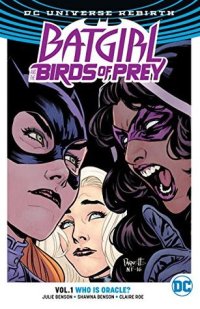
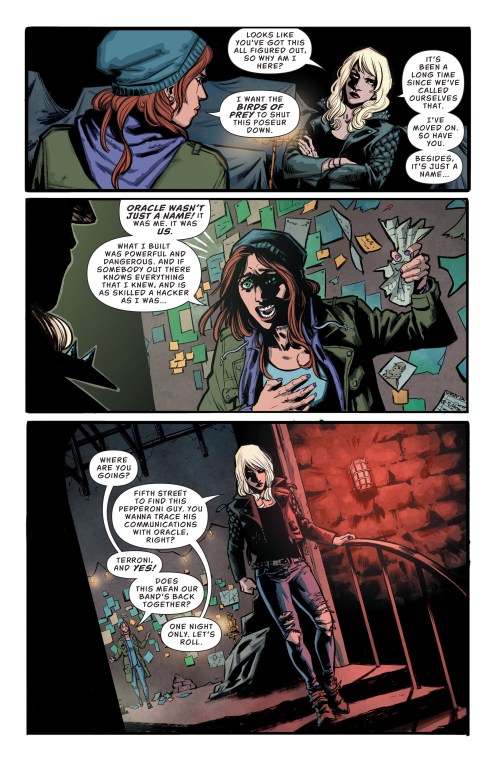
Review: As the world of comics tries to keep up with the changing times and tries to keep rebooting itself, it can, admittedly, get a little confusing. I think that a really good example of this is that of DC’s Batgirl. When DC launched their “New 52” reboot series, giving many of their characters brand new origin stories, one of the new iterations was Batgirl. Gail Simone took the helm, and while there was criticism about erasing Batgirl’s disability (she’s no longer wheelchair bound, and therefore no longer Oracle), it’s pretty agreed that she did justice to Barbara Gordon. Her time with Batgirl ended, showing Barbara’s future years and years down the line. It was pretty dark stuff (no spoilers here though). But then….. Batgirl was rebooted again, even if DC claims that it wasn’t really a reboot. Now the “Batgirl” title is DC’s answer to Marvel’s “Ms. Marvel”: a bit more aimed towards teen girls, with a quirky and flawed, but endearing protagonist who has very real life problems along with the Superhero ones. I mean, just look at the cover of this book: Batgirl is taking a selfie in a hipster club bathroom.

Admittedly, when I first saw this I was like

giphy2
(source)

BUT, I decided to give it a chance because I love Barbara Gordon, and I do recognize that comics appeal to a wide array of audiences now. And I’m glad that I did decide to give it a try, because while I find “Ms. Marvel” fine and important but a but a tad precious, I think that this new Batgirl is just the right balance of aware and action-y.

Barbara has been updated to fit the modern sensibilities of a brainy girl who likes to code and do STEM things. While I’m still a bit bitter that she hasn’t quite taken on the librarian mantle (though I think she eventually does go to get her MLIS!), I love seeing her tackle computer science and code writing, and I LOVE seeing it treated as just something that she does because why wouldn’t she? Not only is Barbara a badass lady coder, so is her roommate Frankie. I really liked the introduction of Frankie (though I wish that Alysia Yeoh could have been another roommate, because I love her to death), as she added a new voice of reason along with adding some much needed diversity to the DC Universe. In fact, a lot of the new faces in “Batgirl” add quite a bit of diversity, not unlike that which you WOULD see in Brooklyn these says (as Burnside is the Brooklyn to Gotham’s Manhattan). So not only do we have an empowered and positive role model of a young woman who is adept at science, she surrounds herself with people from all different backgrounds and experiences. Every character feels real and grounded and not just thrown in for the sake of having a token Muslim, or trans woman, or African American, or etcetera.

Even the villains and the danger scenarios feel like they fit a modern aesthetic without seeming overwrought. One of the first people Batgirl goes up against is an Internet wizard who has been giving out his digital blackmail services to people, willing to ruin lives for a price and a profit. Given how revenge porn is certainly a problem that society hasn’t quite figured out how to wrap it’s head around in many ways, this felt like a pretty relevant threat. Sure, Babs may not be fighting crazed supervillains like the Joker, but villains based in real life awfulness are a-okay with me. And it’s done in such a way that it never feels like it’s being spoon fed to the reader. You don’t need a known and super big bad guy like Joker or Penguin to be behind these realistic maladies, because that just doesn’t feel genuine. Along with the villains, one of the biggest obstacles Barbara has to face is the trauma she is still feeling from when Joker attacked her. You see flashbacks of when she was in recovery, and how dark and damaged her mind went, focused on the past and revenge instead of healing and the future. While I am a staunch defender of the original story of her becoming wheelchair bound, as Oracle became arguably the MOST powerful member within the Bat Family and her wheelchair provided representation to a group that is overlooked, I think that this series has done a good job of addressing the long term mental affects of it all. It’s a shame that they’ve erased that side of Barbara, but now they are tackling the story of a woman who is living with PTSD. I won’t say tit for tat, but I will say that it’s not nothing.

And there are familiar faces as well! My girl Dinah Lance is involved in this first arc, there to provide a needed level of snark, but also to remind Batgirl of her duties and not to let things get out of her control. I am pretty sure this was the predecessor to the “Black Canary” comic that I liked so much (note to self…. get your hands on the next one), and her angst and rough edges are on display in their full glory. She is also there to make sure that Babs, while the selfie and social media culture is fine and part of our lives now, doesn’t lose her endgame all because she loves the likes and tweets. The old school mentality of comics and superheroes in the context of Batgirl still has relevancy, and her reboot is blending well with her origins.

And the art is really fun in this one. It’s very colorful, not as dark and dour as the Gail Simone story that preceded it.

batgirl_38
(source)

I am very pleased with the new life that Batgirl has been given with “Batgirl (Vol.1): The Batgirl of Burnside”. Barbara has been given a new lease on life and I am very happy with where she’s going with it!

Rating 8: A fun reboot of the Batgirl series, with a strong and varied cast of characters and a good hold on how to write Barbara Gordon for today’s world.

Reader’s Advisory:

“Batgirl (Vol.1): The Batgirl of Burnside” is included on the Goodreads lists “Ladies of DC”, and “Ladies in Capes”.

Find “Batgirl (Vol.1): The Batgirl of Burnside” at your library using WorldCat!

Kate’s Review: “Final Girls”

32994321Book: “Final Girls” by Mira Grant

Publishing Info: Subterranean Press, April 2017

Where Did I Get This Book: I received an ARC from NetGalley in exchange for an honest review.

Book Description: What if you could fix the worst parts of yourself by confronting your worst fears?

Dr. Jennifer Webb has invented proprietary virtual reality technology that purports to heal psychological wounds by running clients through scenarios straight out of horror movies and nightmares. In a carefully controlled environment, with a medical cocktail running through their veins, sisters might develop a bond they’ve been missing their whole lives—while running from the bogeyman through a simulated forest. But…can real change come so easily?

Esther Hoffman doubts it. Esther has spent her entire journalism career debunking pseudoscience, after phony regression therapy ruined her father’s life. She’s determined to unearth the truth about Dr. Webb’s budding company. Dr. Webb’s willing to let her, of course, for reasons of her own. What better advertisement could she get than that of a convinced skeptic? But Esther’s not the only one curious about how this technology works. Enter real-world threats just as frightening as those created in the lab. Dr. Webb and Esther are at odds, but they may also be each other’s only hope of survival.

Review: First and foremost, I want to extend a thank you to NetGalley for giving me an ARC of this in exchange for an honest review!

I quite enjoy the “Newsflesh” Trilogy by Mira Grant. For one, it has zombies, which is almost always going to be something of a plus for me when it comes to my horror novels. But it’s also a pretty unique and tech based take of life after the zombie plague. So when Serena sent me some information about a new short story of Grant’s, called “Final Girls”, I was immediately intrigued. Grant likes to take common tropes and give them a tech-y spin. While sometimes I’m a little skeptical of short stories, just because so much has to be crammed into them in a smaller amount of pages to really pull them off, I had faith that Grant could do it. And she didn’t disappoint.

Even though this is a shorter piece, Grant did a really good job of describing the place and time without any of it feeling rushed. The time frame is kind of vague, but we do know that technology allows us to fall into a holodeck-like virtual reality where we can work through various emotional hang ups or relationships. The science is kept nondescript enough not to be bogged down by the science that may or may not ever come to fruition in this world, but it is detailed enough that it seems like it could feasibly happen in the nearish future. She also did a good job of establishing the main characters and their motivations, so I was never questioning why they did the things that they did. I could understand why Dr. Webb is so invested in her invention, and why she would have her whole faith in it and never question how it could go wrong. She is both brilliant and arrogant, cold yet empathetic. Esther, too, is someone whose motivations we can understand, even if her background is presented quickly and never hammered at over and over again. I think that the weakest characterization was that of the mysterious ‘assassin’ character, who drives the conflict of the story with her dangerous meddling. I understand why she would be doing the things she’s doing, but I think that had we explored more about the people who hired her, maybe I would have been more fully invested in her. As she was, she was just kind of the cold badass character. It works well in this story, though, so I can’t really complain about it too much.

I also liked the moral and ethical implications and questions this book raised. There are so many grey areas within the scientific world, and how far we can push experiments without treading on the rights of human and animal subjects. Even if there wasn’t a psychopathic assassin messing up a program and making it super dangerous (due to the stress levels and possibility to be scared to death), how ethical is it to put people in a terribly stressful situation in the name of therapy and relationship healing?

Also…. Zombies.

giphy9
My reaction to a well done zombie story. (source)

While sure, it may seem a bit old hat to bring zombies into this story given the “Newsflesh” series and everything, Grant is just so good at it that I don’t really mind. I’m not sick of zombies yet, so when this was the simulation I just grinned and leaned back, ready to enjoy it.

It’s a bit more than the usual zombie story, and “Final Girls” was a quick and engaging story that built up the suspense and delivered on the chills. But it also goes beyond the usual fare, and brings up good points about the responsibilities of science. It was a fun little read and I recommend it to zombie fans to be certain!

Rating 8: A quick paced and creepy little horror novella that raises questions about ethics and professional responsibility.

Reader’s Advisory:

“Final Girls” is a fairly new novella and isn’t on many lists yet. But I think that it would fit in on “Awesome Technothrillers and Sci-Fi”, and “Zombies Plus: Unconventional Zombie Novels”.

Find “Final Girls” at your library using WorldCat!

Book Club Review: “Flying Lessons and Other Stories”

We are part of a group of librarian friends who have had an ongoing bookclub running for the last several years. Each “season” (we’re nerds) we pick a theme and each of us chooses a book within that theme for us all to read. Our current theme is a “Book Challenge!” theme. This book comes from a “Pick a Short Story Collection” challenge.

For this blog, we will post a joint review of each book we read for bookclub. We’ll also post the next book coming up in bookclub. So feel free to read along with us or use our book selections and questions in your own bookclub! 

24561496Book: “Flying Lessons and Other Stories” by Ellen Oh (Editor)

Publishing Info: Crown Books for Young Readers, January 2017

Where Did We Get This Book: the library!

Book Description: Whether it is basketball dreams, family fiascos, first crushes, or new neighborhoods, this bold anthology—written by the best children’s authors—celebrates the uniqueness and universality in all of us.

In a partnership with We Need Diverse Books, industry giants Kwame Alexander, Soman Chainani, Matt de la Peña, Tim Federle, Grace Lin, Meg Medina, Walter Dean Myers, Tim Tingle, and Jacqueline Woodson join newcomer Kelly J. Baptist in a story collection that is as humorous as it is heartfelt. This impressive group of authors has earned among them every major award in children’s publishing and popularity as New York Times bestsellers.

From these distinguished authors come ten distinct and vibrant stories.

Kate’s Thoughts

The “We Need Diverse Books” movement is one that I have been following for a bit now. Basically, it’s goal is to promote, publish, and highlight books by diverse authors, and tell stories of many different viewpoints and experiences, especially in children’s and young adult literature. When our dear friend and fellow librarian Alicia picked the short stories collection “Flying Lessons” for our book club, I threw it on my request list and got it almost immediately. I also happened to read it during the first attempt this administration made on implementing a travel ban into this country. So yeah, this felt like a very pertinent read, especially since the hope is that diverse books will build empathy to other experiences.

Like most short stories collection, it had some highs and lows. But luckily, it was mostly highs! I really liked the varied authors that contributed to this, and how they all offered so many different kinds of stories without feeling like a box was getting checked off. I expected no less from Ellen Oh, one of the instrumental members of We Need Diverse Books. I will focus on my two favorites.

“Sol Painting, Inc” by Meg Medina: I love the other books by Medina that I’ve read (“Yaqui Delgado Wants to Kick Your Ass”; “Burn, Baby, Burn”), and I was very excited to see that she had a story in this collection. She does a great job of showing one snippet of a day in the life of Merci, Roli, and Mr. Sol, who are Latinx and have a family painting business. While Mr. Sol and and younger sister Merci really love this business, so much so that Merci wants to open her own home improvement empire someday, the elder brother, Roli, is starting to feel embarrassed by it, and would prefer to focus on science things. Medina does a great job of showing the discomfort that Roli has surrounded by his very white peers in a very white space when they go to paint the high school gym, in exchange for tuition for Merci. This story also feels very real in Merci’s voice, as she is the narrator. She doesn’t understand her brother’s self loathing or her father’s self sacrificing. This is probably the saddest story in the bunch, but it was my favorite.

“The Difficult Path” by Grace Lin: Lin takes us back in time to long ago China. It follows the story of Lingsi, a servant girl who is also educated, as it was her mother’s dying wish and her mistress, fearful of being cursed with bad luck, agreed. Lingsi and her house are traveling to try and find a wife for the only son of the family, a cruel and idiotic lout. But as they are traveling, they are attacked by pirates, and Lingsi finds herself in a very surprising situation. I loved Lin’s story telling in this one, as I could totally see everything and hear everything with perfect clarity. It was also neat seeing a surprising feminist twist within this story. No spoilers here. But let’s just say that there is a history of female pirates during this time period. This story was fun and definitely satisfying.

I really liked “Flying Lessons”, and I think that it’s a great collection of short stories that all kids will love.

Serena’s Thoughts

I’m always a bit hesitant about short story collections for a few reasons. First is the same reason that Kate laid out earlier and is true to a certain extent with this one: there can be a variety in quality from one story to another which can be an off-putting reading experience. Secondly, writing a short story is a completely different beast than writing a novel, a fact that I think many authors tend to forget and that then leads to questionable short story collections. Publishers simply paste all the big author names together on one title and think it’s a clear win, with no understanding that many of the skills and traits that make an author successful as a novelist may not carry over to a short story collection.

So, with all of this in mind, I was hesitant about this book, especially as it was often marketed and sold on the fame of the authors’ works it included. But, while there were a few misses, I was happy with the collection as a hole and there were a few stories that particularly stuck out. Kate already discussed two of my favorites, but I’ll throw in a third.

“The Beans and Rice Chronicles of Isaiah Dunn” by Kelly J. Baptist: This story follows Isaiah Dunn, a young boy coping with the death of his father and with his mother’s subsequent fall into alcoholism. Just with that short description, you know going in that this was one of the heavier titles in the book. But this story was so incredibly powerful for it! Grief itself is a huge subject, but the story also touches on so many other factors that all get swirled together in a the life-changing impact that comes with the loss of a parent. The trying economic situation of the family, the mother’s coping method, and the hope that can be found amidst it all is beautifully illustrated in this tale. I particularly appreciated the rather meta use of the power of stories that is brought to being in this story after Isaiah finds a old book of his father’s stories. Isaiah’s voice is also particularly strong, effectively portraying the innocence of childhood but never short-changing his ability to deeply understand the world around him.

As Kate said, there were a few weaker stories included, but even these would likely be well-received by the middle grade target audience of this book. All in all, I greatly enjoyed this collection and its ability to tell important stories without falling under the weight of too much “agenda.”

Kate’s Rating 8: A fun, touching, and varied collection of stories from some of the best children’s and YA authors out there.

Serena’s Rating 8: What else should we have expected from this strong collection of children’s/YA authors? Its strength lies largely in the variety of stories included, both in tone and subject matter.

Book Club Questions:

1.) What was your favorite story in the collection? Why?

2.) Were there any stories that didn’t work for you as well?

3.) This book sets out to present a very diverse collection of stories. Are there any perspectives that you felt were missing?

4.) Were you familiar with any of these authors before? Did any of them have particular writing strengths that appealed to you?

5.) A lot of thought goes into the order in which stories are arrange din a short story collection. Were there any changes you would make to this line up and why?

Reader’s Advisory:

“Flying Lessons and Other Stories” is included on the Goodreads lists “2017 YA/MG Books With POC Leads”, and “YA Short Stories and Collections”.

Find “Flying Lessons and Other Stories” at your library using WorldCat!

Emily’s Corner: “The Wind-Up Bird Chronicle”

20170202_140222Emily and I (Serena) have been friends since the first week of freshman year of college. Other than a lost purse (I did the losing, Emily did the calming), take a wild guess as to what we bonded over? Yes, that is correct: books. And the fact that we both had plans to be English majors and would go on to coordinate our schedules to have as many similar classes as possible! All that said, Emily has agreed to be a semi-regular contributor to our blog, so keep your eyes open for posts from her in “Emily’s Corner” on random Mondays going forward!
284066Book: “The Wind-Up Bird Chronicle” by Haruki Murakami

Publishing Info: Originally published in three parts between 1994 and 1995, the English translation was published in 1997

Where Did I Get this Book: A gift from a friend in book club

Book Description: In a Tokyo suburb a young man named Toru Okada searches for his wife’s missing cat.  Soon he finds himself looking for his wife as well in a netherworld that lies beneath the placid surface of Tokyo.  As these searches intersect, Okada encounters a bizarre group of allies and antagonists: a psychic prostitute; a malevolent yet mediagenic politician; a cheerfully morbid sixteen-year-old-girl; and an aging war veteran who has been permanently changed by the hideous things he witnessed during Japan’s forgotten campaign in Manchuria. Gripping, prophetic, suffused with comedy and menace, The Wind-Up Bird Chronicle is a tour de force equal in scope to the masterpieces of Mishima and Pynchon.

Review: My book club did something a little different for our January read. Instead of reading the same book, we each picked out our favorite novel and did a book swap. (My pick was The Blue Castle, of course.)

The book I received was “The Wind-Up Bird Chronicle,” by Haruki Murakami. Our book club had read his earliest work “Wind/Pinball” together, so I was delighted to receive a more recent publication. Murakami is one of those maddening geniuses who knocked it out of the park on his first try writing a novel. I had high expectations for “Wind-Up Bird Chronicle” and it did not disappoint.

A word on Murakami’s writing style; he takes the most mundane, ordinary situations and makes them riveting. Case in point, I started the book during Christmas break while visiting my parents. My dad asked what I was reading and I said something along the lines of “it’s about a guy and his wife, and the wife has a cat, and it goes missing, and she’s upset with the husband for not caring, so he goes to look for it, and it’s all about this tension in their marriage . . .”

Dad cut me off. “That sounds boring.”

Boring this is not! Murakami takes this story and twists it, wrenches it, in fact. It turns into this surrealist, cerebral adventure that takes on an otherworldly quality without losing its grasp on reality. It was exhausting trying to keep up and yet I couldn’t put it down.

The story twists and turns from the perspectives of the man and his search for his wife who mysteriously vanishes along with the cat, a precocious teenager so fascinated by death that she almost commits murder, bloody flashbacks to the power struggles and mind games of war-torn Manchuria, eerie sisters whose magical talents are the hub of the story, a villain who controls his victims by mentally raping and trapping them in an otherworld, and a wealthy but strange mother-son duo named after baking spices.

I get it. This sounds like an acid trip. This is not a story that you can explain by saying “and then such-and-such happened.” And for sure it is a far cry from the “man looks for lost cat” opening.

That is what is magical about Murakami; he takes you on such a slow and winding journey, where everything makes sense until it doesn’t. You look back to see how far you have come, almost unable to believe that a story about a lost cat could turn into the most violent, most beautiful, most moving thing you’ve read in years.

This book isn’t so much about the story, though it is truly a riveting story. It’s about Murakami’s way with words. He is unlike any author I’ve encountered, writing about daily activities like boiling pasta and ironing shirt collars in such a way that they become intensely beautiful rituals. Something as simple as climbing down a dry well becomes an out-of-body experience, for both the protagonist and the reader. I was gasping by the end of that chapter.

There is a horrifying torture scene, and while I normally have a very low tolerance for this sort of thing, I couldn’t help but be entranced by how Murakami achieved a level of grace and beauty in it. I was trapped between being appalled and being fascinated.

For me, Murakami’s work is about experiencing his way with words just as much as it is about getting caught up in a good story.

Rating 8: While this is one of the most incredible books I’ve read in a while, my squeamishness over the aforementioned torture scene and some terribly awkward phone sex kept this from getting a higher score. Still, this is a must-read for anyone who appreciates the cerebral/magical realism genre.

Reader’s Advisory:

“The Wind-Up Bird Chronicle” is included on these Goodreads lists: “Magical Realism” and “Mind Twist.”

Find “The Wind-Up Bird Chronicle” at your library using Worldcat!

Serena’s Review: “The Burning World”

16148435Book: “The Burning World” by Isaac Marion

Publication Info: February 2017, Atria/Emily Bestler Books

Where Did I Get this Book: the library!

Book Description: R is recovering from death.

He’s learning how to breathe, how to speak, how to be human, one clumsy step at a time. He doesn’t remember his old life and he doesn’t want to. He’s building a new one with Julie.

But his old life remembers him. The plague has another host far more dangerous than the Dead. It’s coming to return the world to the good old days of stability and control and the strong eating the weak, and stopping it will require a frightening journey into the surreal wastelands of America—and the shadowy basement of R’s mind.

Review: This book came into the publishing world like a new Beyonce album: no word, and then suddenly it appears! I highlighted this book as one that I was looking forward to reading, but also with a bit of trepidation. “Warm Bodies” was such a beautiful, funny little book that opened and closed so neatly that the thought of a sequel had honestly never even crossed my mind. So, while I was excited to re-visit this world, especially in the aftermath of Julie and R’s discovery of re-animating (?) zombies back to humans, I was a bit concerned that it was going to succumb to sequel-itis and bring nothing new to the table while negatively impacting the brilliance of the original. And while there were a few rough patches, particularly in the beginning, I am pleased to report that Marion’s expansion to his world and series is well fleshed (ha!) out!.

635729580302245934-1568177425_bad20joke
You can’t stop this laugh train! (source)

“The Burning World” picks up a few months after the events of “Warm Bodies,” and things aren’t going as smoothly as Julie and R had hoped re: reintroducing the zombies into society. I mean, in the movie version of the first book, the zombies and humans are literally playing baseball together and sharing umbrellas in the end. This book quickly does away with any of these happy fantasies. Turns out people aren’t quite as easy to convince that beings that used to kill and eat their brains are really just uber repressed people who need to reconnect with their feelings if only they’d give them all a chance! Even R himself, the protege of this whole zombie-transformation-movement is struggling with the reality of this transition. When he was cured, mobility, language, and most especially, memory didn’t suddenly just reappear. They’ve all had to be tediously re-learned, and when the story begins, it is clear that he’s hit a bit of a wall.

When I made my admittedly very bad pun about fleshing out the world, that is probably the most notable aspect of this book. Marion takes his rather simplistic little zombie world and really goes crazy with it. Half the appeal of “Warm Bodies” was the complete lack of importance that was given to the history of the world. Something went wrong, zombies appeared, and this is the hell everyone is now living in. No explanation necessary. Doing away with this charm was a risky move, but a challenge that Marion proves to be up to meeting. Not only do we get details into R’s own history, but through his patchy and slowly returning memories (present in flashbacks interspersed throughout the story) we see how broken the world really was. If anything, the world of “Warm  Bodies” was a step in the right direction from what had come before! Fractions and zealots fought for power, religion and business warred to control the minds of the people, and zombies were almost an after thought to the craziness.

One particularly, albeit smaller, detail that was brought to the table was the reality of what transforming from a zombie that can’t be killed by anything less than a shot to the head into a person entails. Nora’s story comes to the forefront as a nurse attempting to treat these re-emerging injuries. If you’re shot as a zombie, you don’t heal. Becoming human again doesn’t magically do away with life-ending injuries. This brought a level of seriousness to the procedure that I hadn’t expected, and one that is tied into a major plot line for Julie later in the book.

Most of the plot involves an airplane roadtrip across America. Julie’s home is invaded by a shadowy group with whom R is having strange kindlings of memories, forcing them to go on the run. Mixed in with the expanded world (which cities fell, which cities burned, which came up with their own rule of law), our heroes are faced with the constant question of what future they are running towards: one in which they fight or one in which they flee. I loved how these questions are never approached with an obvious answer. The characters on either side make valid arguments, and though as a reader I knew what the ultimate decision would be, I appreciated the fact that other survival techniques were not poo-pooed away.

So, I really did love much of the book. The expanded world, the added characters, R’s complicated history. However, there were a few setbacks. In the beginning especially, I felt as if the writing was a bit stilted and trying too hard as far as philosophical musings go. “Warm Bodies” hit just the right balance in this regard, and I felt like “The Burning World” suffered from the weight of expectations. Once the story really gets going, there’s enough of a structure to hang these existential musings upon, but in the beginning it just felt tedious and a bit forced.

Secondly, there was a strange “We” character that would show up between chapters. Even by the end of the book, I’m not sure what I was supposed to be getting from these chapters. And it’s not like there were only a few! There were pages of this stuff, and much of the same tedious philosophical ramblings would be crammed into this section with no character or story to really focus on. About midways through we meeting a zombie boy who becomes something of a character in these bits, but the whole thing still feels very strange and disconnected from the story. Presumably it’s building towards some sort of reveal in the final third book in this series, but in this one it felt like a distraction and an unwarranted break in the main plotline’s action.

And on that note, there is a bit of a cliffhanger at the end of this book. Nothing intolerable, in my opinion, but it does end in a manner that requires a follow up read to really reach any type of resolution to both the story and character arcs. But, luckily, this was a strong enough sequel that I’m all in for the next and last book!

Rating 8: A solid, surprise follow up to a story that, previously to this, I had been happy enough seeing as complete!

Reader’s Advisory:

“The Burning World” is newly released and thus not on many Goodreads lists, but it is on  “Zombies!” and should be on “Apocalypses and Dystopias.”

Find “The Burning World” at your library using Worldcat!

Serena’s Review: “Ghostly Echoes”

28110857Book: “Ghostly Echoes” by William Ritter

Publishing Info: Algonquin Young Readers, August 2016

Where Did I Get this Book: audiobook from the library!

Book Description: Jenny Cavanaugh, the ghostly lady of 926 Augur Lane, has enlisted the investigative services of her fellow residents to solve a decade-old murder—her own. Abigail Rook and her eccentric employer, Detective R. F. Jackaby, dive into the cold case, starting with a search for Jenny’s fiancé, who went missing the night she died. But when a new, gruesome murder closely mirrors the events of ten years prior, Abigail and Jackaby realize that Jenny’s case isn’t so cold after all, and her killer may be far more dangerous than they suspected.

Fantasy and folklore mix with mad science as Abigail’s race to unravel the mystery leads her across the cold cobblestones of nineteenth-century New England, down to the mythical underworld, and deep into her colleagues’ grim histories to battle the most deadly foe she has ever faced.

Review: Trekking right along with my read through of the Jackaby series, “Ghostly Echoes” starts off basically right where “Beastly Bones” leaves off. Jenny, the local friendly ghost whose murder has went unsolved for a decade, has finally decided to take things into her own hands. Literally. She actually learns how to pick up things. But this is an important step, and one that coincides with the return of murders that seem to match the M.O. of her own assailant many years ago.

This book represents an interesting turning point in the series so far. Up to this point, the books have been largely stand-alone novels. Sure, a few things will be referenced here and there, but very few plot lines carry through directly from one book to the other. However, in the last book, Ritter laid the groundwork for a “big bad” to best all “big bads.” And one who had been operating in the background all along. Here, we find this is very true, with the plot lines from not only its direct prequel, “Beastly Bones,” but also from the first book in the series, “Jackaby,” being tied together to a larger mystery.

However, this book was very hit and miss for me, tonally. Ritter was essentially wanting to have his cake and eat it too with this one. The larger plot line and mystery were intriguing. Both Jenny’s burgeoning abilities to operate in the real world, the murders that seem so similar to her own, and the clues that begin to point to a strange organization that is operating with its own nefarious agenda were interesting. There was a lot to get through just with this main story line.

But Ritter had also to pay off the set-up he had built with the previous two books where readers expect to find wit, strange beasts, and madcap adventures. All of these bits, while good, seemed to fit in strangely with the more serious tone of this book. I found myself getting pulled one way and the other when the book would veer back and forth between the main story and the smaller interactions that, while important to the overall plot, felt more light and oddly out of line with the rest of the story.

As I mentioned in my last review of the series, the story is at its best when the character of Jackaby is used sparingly. He did have more page time in this story than the last, but this book also did a lot of work building up his past and making him into a more three dimensional character with deeper inner struggles than the simple “wacky Doctor-like” character he has been presented as for the last two books. I was happy to see him becoming more of a character than a plot point.

Towards the end, Ritter did seem to find his footing a bit better, sending Abigail off on an adventure of her own. However, Abigail probably was the least served character by this change of pace to the series. As I mentioned above, Jackaby’s past and character are fleshed out more fully. Jenny becomes an actual character in her own right beyond simply being a friendly ghost and friend to Abigail. But Abby herself? Largely it just feels like she was there to narrate the story to us. And while she does get her own action, it is only that: action. There didn’t feel like there was a lot of character development for her in this book, which I sadly missed. Also Charlie! He was barely there!

So, in conclusion, this book was a bit of a mixed bag. I very much liked the added depth that was given to the greater story line that now pulls through all the books in the series. And Jackaby himself is a more intriguing character now that it has been revealed that he is more than just a quirky, gimmick. But my favorite character, and the main character of the series, was left dangling a bit. And tonally, the book was a bit all over the place, teetering between a more serious larger plot line, and the expected wackiness established in the first two books.

The next and final book comes out this summer, however, and I am still excited to see how Ritter wraps up this all up!

Rating 7: Some imbalanced highs and lows make for a mixed bag read, but still a strong series overall!

Reader’s Advisory:

“Ghostly Echoes” is included on these Goodreads lists: “YA & Middle Grade Historical Mysteries”and should be on this list “YA Mythology Challenge.”

Find “Ghostly Echoes” at your library using Worldcat!

Previously Reviewed: “Jackaby” and “Beastly Bones”

Serena’s Review: “Silver on the Road”

20748097Book: “Silver on the Road” by Laura Anne Gilman

Publishing Info: Saga Press, October 2015

Where Did I Get this Book: the library!

Book Description: On her sixteenth birthday, Isobel makes the choice to work for the devil in his territory west of the Mississippi. But this is not the devil you know. This is a being who deals fairly with immense—but not unlimited—power, who offers opportunities to people who want to make a deal, and makes sure they always get what they deserve. But his land is a wild west that needs a human touch, and that’s where Izzy comes in. Inadvertently trained by him to see the clues in and manipulations of human desire, Izzy is raised to be his left hand and travel the circuitous road through the territory. As we all know, where there is magic there is power and chaos…and death.

Review: You know you read a lot of a specific genre when you begin to recognize cover art artists! So, while I would like to say that I first looked at this book based on its amazing premise, the truth is that the cover artist has also done covers for some of my other favorite fantasy reads, so those books just immediately leap out at me whenever I’m browsing through lists. But, books are not their covers and all of that, so the unique premise was ultimately what landed this one for me as worth checking out. And, while there were a few frustrations here and there, all told, I very much enjoyed this book as a refreshing change of pace for fantasy fiction.

Honestly, with so much of urban fantasy and historical fantasy starting to feel tired and weighed down by too many tropes, it’s shocking that the concept of alternative Western fantasy hasn’t struck home more fully. What an untapped setting and part of history! And this alternative American Wild West was really the major strength of the book.

In this version of history, the West (essentially anything that would have been gained in the Louisiana Purchase in true history) is literally wild, kept in check only by the mysterious and half-fabled Devil who rules the Territory. The true essence and character of the Devil is never fully explored, whether he is the actual Devil from a Biblical sense, or whether this is a name he has acquired from magic-fearing folk who don’t know what else to call him. At a certain point, I simply began associating him with the type of Devil character you hear/read about in folk tales (like the  Devil in the song “The Devil Went Down to Georgia.”)

But this is a good example of the type of “go with it” mentality that is necessary for this book. There are many questions raised and very few answers given. This could be frustrating at times, particularly when I got to the end and realized some of them would be left unanswered completely. But with the world-building itself, it was easier to simply stop trying to over-analyze and simply enjoy immersing oneself in it instead.

Izzy, a young woman who has worked at a tavern alongside the Devil her whole life, is recruited by him to travel the Territory as his Left Hand. Here, too, there was not a lot of clarification. Izzy is simply set out into the world alongside Gabriel, a travel-worn companion who knows the hidden paths and pitfalls of the Territory and who has stuck his own mysterious bargain with the Devil (more unanswered questions!). What she can do, how she can do it, and even when she should do it are all unknowns to her and us.

I very much enjoyed these two characters and their expedition, however. This is a very slow burn novel, and much of the page time is spent with these two on the road, basically wandering from one place to another. Only towards the very end of the book do the small plot points that have been stumbled upon really begin to come together to form any type of unified conflict and arc. For those looking for a more tight story with a more natural progression of learned information, this book may be a struggle. I was able to attach myself strongly enough to the character development of Izzy and Gabriel that most of this was ok by me. I also, personally, very much enjoy hiking and discovering new parts of the world around bends in roads. So, for me, the meandering approach to storytelling that was largely just a roadtrip on a horse was appealing.

I very much enjoyed this book. However, for some it may read as slow and the unanswered questions could be frustrating. I had a fairly laid back approach to this, knowing there was a sequel that was just published, but even I found myself frustrated at times. Izzy’s powers are so undefined, even at the end, that while I know that progress was made in this book (a conflict was resolved and all), it still felt like Izzy herself had very far to go. And Gabriel’s past is still very much a large question mark. But I’m on board enough to want to read the next one where hopefully some of this will be answered!

Rating 8: What could be a slow, frustrating read, was saved by a truly unique setting in a fantastical, alternative American West.

Reader’s Advisory:

“Silver on the Road” is included on these Goodreads lists: “Best Fantastic American West” and “Dead Man’s Hand.”

Find “Silver on the Road” at your library using Worldcat!