Book: “Velvet Was the Night” by Silvia Moreno-Garcia
Publishing Info: Del Rey, August 2021
Where Did We Get This Book: Received an eARC from NetGalley, received an eARC from Edelweiss+.
Book Description:From the New York Times bestselling author of Mexican Gothic comes a “delicious, twisted treat for lovers of noir” about a daydreaming secretary, a lonesome enforcer, and the mystery of a missing woman they’re both desperate to find.
1970s, Mexico City. Maite is a secretary who lives for one thing: the latest issue of Secret Romance. While student protests and political unrest consume the city, Maite escapes into stories of passion and danger.
Her next-door neighbor, Leonora, a beautiful art student, seems to live a life of intrigue and romance that Maite envies. When Leonora disappears under suspicious circumstances, Maite finds herself searching for the missing woman—and journeying deeper into Leonora’s secret life of student radicals and dissidents.
Meanwhile, someone else is also looking for Leonora at the behest of his boss, a shadowy figure who commands goon squads dedicated to squashing political activists. Elvis is an eccentric criminal who longs to escape his own life: He loathes violence and loves old movies and rock ’n’ roll. But as Elvis searches for the missing woman, he comes to observe Maite from a distance—and grows more and more obsessed with this woman who shares his love of music and the unspoken loneliness of his heart.
Now as Maite and Elvis come closer to discovering the truth behind Leonora’s disappearance, they can no longer escape the danger that threatens to consume their lives, with hitmen, government agents, and Russian spies all aiming to protect Leonora’s secrets—at gunpoint.
Velvet Was the Night is an edgy, simmering historical novel for lovers of smoky noirs and anti-heroes.
Serena’s Thoughts
I remember noting in one of my early Moreno-Garcia reads that she’s a unique author in that she seems to jump from genre to genre with ease. It’s truly something rare, I believe, as most authors have a defined genre within they operate comfortably. Sherry Thomas is another favorite author of mine who comes to mind with this shared ability. But Moreno-Garcia takes it to a new level. I’ve read a Gothic horror, a Regency romance, a Mexican folktale fantasy, and now here I am reviewing a noir! At the very least, she’s single-handedly expanding my horizons in my genre reading!
One thing that does remain consistent between her books is her love of featuring duel/multiple POVs in her books. Here we experience the story from both an inside and outside perspective. On one hand, we have Maite, an introverted young woman who leads a quiet life reading her beloved romance novels before getting drawn into the mysterious disappearance of her neighbor Leonora. And on the other, we have Elvis, a gang member who works with the Hawks, an organization that works to quell political dissenters. He is interested in Leonora’s disappearance for very different reasons.
There was much to love about this book, from its exploration of the deep loneliness found in two characters leading very different lives, to the vivid painting of life in Mexico during this period of history. I knew only a little about what was going on during this time, so I was particularly interested in seeing Moreno-Garcia’s take on that situation. Elvis’s storyline, in particular, presented a unique take on these events, coming from the inside of the Hawk organization itself.
But her strengths have always been her characters and the strong, atmospheric worlds she sets them loose in. Here, both Maite and Elvis, while very, very different characters, were equally compelling. Their stories weave together slowly and with attention given to the inner workings of each character and the arcs they are covering. I don’t read a lot of noirs, but I believe this slower-paced storytelling is a specific aspect of the genre, and it blends perfectly with Moreno-Garcia’s love of careful character building.
Overall, I really enjoyed this book. I think I ultimately still prefer her other books that had supernatural/fantasy elements involved, but that’s also just very inline with my own reading tendencies. Fans of noirs and historical fiction, I’m sure, will gobble this up, but I recommend it to readers of all genres,
Kate’s Thoughts
Boy oh boy, I am consistently blown away by how good Silvia Moreno-Garcia is at seamlessly slipping into a new genre with every book I read, and while I always hope that she will come back for more horror and thriller elements as time goes on, I do like a good mystery. I’m not as in tune with the Noir subgenre as I am other mystery subgenres, but I do enjoy a good Noir film every now and again. Because of this, I was eager to read her new Noir novel, “Velvet Was the Night”
Serena touches on a lot of the same things I liked about this book in her review, so I’ll try not to repeat her too much. I also enjoyed both of our protagonists Maite and Elvis, and their very different backgrounds and motivations for finding Leonora. Maite gets pulled into it because 1) she was watching the woman’s cat, and 2) the mystery is exciting, and her life is decidedly not. Elvis, on the other hand, works for a secret group that crushes political dissenters, and Leonora is involved in student activism. The elements of an intricate mystery are there as they both go on the search and find out a lot about her life and how it fits into the landscape of 1970s Mexico City. I liked both Maite for her somewhat naïveté laced personality and the dark and dangerous journey she takes, and I liked Elvis and how, even though he works for a group of suppressive fascists, he has his own bits of rebellion as he, too, goes on a journey on self discovery. They both feel confined to their existences, and start to realize that there could be more.
And it’s really the time and place that worked the best for me in this story. I have no little knowledge of Mexican history, so a lot of this felt like I was learning a bit about an area I knew little about as we went on the journey. I found myself looking up information about Luis Echeverría Álvarez and El Halconazo as I was reading the book just to educate myself some more, and it made the political dissent angle all the more interesting to me. I love how Moreno-Garcia pulled a Noir story out of a setting that you don’t see within the subgenre all that often, at least in my experience. Some of the details and allusions to that theme were very unsettling, and wove in an entire lower level of dread that the Hawks were going to catch up with Maite, Rubén, and Leonora and then all hell would break loose.
“Velvet Was the Night” is a well done new Noir mystery that is sure to entertain mystery fans. Hats off to Moreno-Garcia for once again doing a great job with a new genre!
Serena’s Rating:
Kate’s Rating 8: A taut mystery, fun characters, and a unique setting made “Velvet Was the Night” a fun noir mystery that I enjoyed quite a bit.
Animorphs Graphix #1: “The Invasion” by K.A. Applegate & Michael Grant, Adapted by Chris Grine
Publishing Info: Graphix, October 2020
Where Did I Get this Book: own it!
Book Description: Sometimes weird things happen to people. Ask Jake. He could tell you about the night he and his friends saw a strange light in the sky that seemed to be heading right for them. That was the night five normal kids learned that humanity is under a silent attack — and were given the power to fight back.Now Jake, Rachel, Cassie, Tobias, and Marco can transform into some of the most dangerous creatures on Earth. And they must use that power to outsmart an evil greater than anything the world has ever seen. . . .
I’m know I’m super late at getting around to reading this, but as the second graphic novel is coming out here shortly in October, I knew I had to get on top of things now. I read graphics novels only on and off, so I had mixed feelings about this series being released in this format. On one hand, any new version of the series is amazing (how incredible is it that a cult favorite kids’ series from the 90s’ is getting re-worked in 2021??). But on the other hand, I had seen some previewed pages of the artwork and didn’t really like it. However, my unwavering love of the series won out and here we are!
Said no one ever reading these books. But hey, I’ll take it.
Best Change: I really liked the use of color-coded dialogue bubbles for thought speak. That was always going to be one of the big struggles of adapting this series. This style also allows the thought bubbles to float anywhere in the pane, not needing to be drawn directly next to the character speaking. This gives the artist a lot more flexibility with action scenes and such. I also liked that the colors were largely coordinated to their main morphs, Jake has orange, Marco has black, Visser Three has red. I found the pink for Rachel to be the the worst though. Not only is that not connected to her grey elephant or brown grizzly later, but the pink color itself often clashed with the other color schemes of the panel in a way that the more earthy tones didn’t. I also don’t like the general, tired, “pretty girls like pink” motif that it was playing towards.
Worst Change: I’m more curious to see how this will play out in future books than it being any sort of real “worst,” but this book had some strange pacing with regards to it being “Jake’s” book. The first half of the book is so entirely told through dialogue bubbles, that I was honestly thrown for a loop when Jake began an internal narration when he morphed the lizard (somewhere around page 120). It was jarring to suddenly be in his head in that way given the way the rest of the story had played out. I wish the book had stuck more closely to a consistent internal narration running from Jake throughout, clearing marking him as the character at the heart of this particular installment. I’m really curious to see what happens with Rachel’s story in the next book. That story does involve her alone in her cat morph more often (unlike Jake who was with the group through most of this book), so there’s a better opportunity there to have the pacing be more consistent with her internal narration.
Pretty, Pretty Pictures: Like I said, one of the reasons I held out on initially reading this was my immediate dislike of the general style. I get that the characters are kids and that the story is also for a younger audience. But it’s also gruesome and tackles some serious issues, ideal for teenage readers, as well. As it is, the style reads very “kiddy” to the point that I think teenagers might be reluctant to read it (not only is this a good age group for this story, but YA is a market behemoth in the publishing industry, making tons of money for most publishers, so it’s foolish to cut off chances at cornering that reading group). As with any comic/graphic novel, the art changes slightly over time, so perhaps the style can try and lean a bit more closely to the realistic version used for the animals and aliens. On another point there, I think the mixture of very cartoon-y human kids vs the more realistic, sharp-edged drawings of the animals and aliens was a bit distracting.
I also did not at all like the red noses. I’m not sure what the point of that even was. It just reads as very old-fashioned and weird. There are a few panels where the characters almost look like “Rudolph the Red-Nosed Reindeer” from that super old stop-motion animation. It definitely isn’t adding anything to the book, and I hope it changes.
With some more variation to noses, the art would also be helped in making the characters more distinguishable from each other. Rachel and Tobias are the obvious problem characters. Tobias will be a hawk for the majority, so that gets around it. But it’s never good when two of your characters look so similar in the very beginning of the story as you’re trying to set the stage. It also does nothing for the “Rachel is amazingly beautiful” idea if she’s nearly identical to a teenage boy character. Adjusting all of the faces slightly would also give them more room to express more complicated emotions.
Tobias? Rachel? Who knows?!
Our Fearless Leader: Overall, I liked the version of Jake we saw here. I think his character looked very “boy next door” but also like the kind of kid that would be the one looked to as a leader, could be popular but is kind of just doing his own thing most of the time. As it’s “his book,” we had a number of panels that spoke to his inner thoughts without the use of dialogue, and I think they worked very well. Most of them had to do with Tom and Jake’s slow understanding that something’s wrong with Tom. We see his look of hurt when he finds out that not only does Tom not care that Jake didn’t make the basketball team, but Tom himself has quit and couldn’t care less. And, perhaps most movingly, we see the horror and sadness when Jake sees Tom break through the Yeerk’s control for a brief moment and Jake must finally admit that Tom is a Controller.
I think, overall, these moments worked very well and the art was able to convey a good deal of emotion without resorting to dialogue, either out loud or inner thought. I’ll be most curious to see how this moves forward in other books, as I feel like it was only used sparingly here and is perhaps one of the areas that could grow the most as the artist becomes more comfortable drawing these characters.
Xena, Warrior Princess: There wasn’t a whole lot of characterization given for Rachel. They never mentioned her being Jake’s cousin, so that was strange. And the contrast between her looks and ferocious fighting style wasn’t really highlighted at all. She’s lucky to have the second book as it will hopefully flesh her out more. I really hope they include the cousin bit; that’s so fundamental in the growing tension between Jake and Rachel in the back half of the series.
A Hawk’s Life: There were a few things to like about Tobias’s character here. First, his connection to Elfangor is really highlighted, as well as his immediate connection to the mission as important and something that he will pursue with or without the others.
I also like the way his eventual end, stuck in hawk form, is built up over the story. Once he acquires that morph, we rarely see him in human form, even when he’s not yet stuck. There were also a good number of lines, both from him and the others, that hinted at why he had such a connection to this form. The freedom, the escape from a world that has largely ignored, neglected and rejected him. And, of course, the back panel featuring him as a hawk is one of the more beautiful pieces of art in the entire book.
Peace, Love, and Animals: Overall, I liked what we go from Cassie here. We got to see both the barn and The Gardens, and how her connections to animals are crucial to the Animorphs’ success going forward. But, like Rachel, I felt that she, too, had very little actual characterization. Compared to all three boy characters who I think had solid defining traits early on (Jake’s reluctant leadership, Marco’s cynicism and smarts, and Tobias’s heart and discomfort with his place in humanity), both girls felt pretty weak and undefined. There’s plenty of time to change that, but it was a bit disappointing from a series that really stood out for how balanced it was in its characters.
I was also disappointed not to see any reference to Cassie’s particular skill with morphing. There was one line thrown out there about Cassie being good at it, but we didn’t get to actually see much of it. Though I guess she morphs mostly off page or behind the other characters at the farm, so there wasn’t a lot of opportunity. Hopefully we’ll see it in the second book when she demorphs and has the angel wings that Rachel specifically points out.
The Comic Relief: I really liked Marco here. I think he was actually perhaps the most well done (close tie with Tobias, perhaps). Grine nailed the combination of smarts and reluctance that was so integral to Marco’s early characterization. There’s also plenty of room given to explaining early on why he’s so reluctant. But we also see him clearly step forward when needed by his friends. And the important role he plays in balancing out Jake’s more impulsive, less thought-out moments. It’s really cool to see that, especially. Particularly how he was the most unwilling to think/talk about what had happened in the construction site, but then immediately picks up on the weirdness of Tom, proving that his mind is always working with the reality of this information, even more so than the others who, on the surface, seem to have accepted it more.
E.T./Ax Phone Home: Obviously, not featured. The artwork for the Andalites though is interesting. It’s not exactly how I pictured it. There were a lot of references to the Andalites being similar in shape to deer, very slim and light on their feet. Their bodies, especially their hands, were also often referenced as being rather thin and weak. All of this was used to draw attention to the true strength of their tail blades and how important that feature was to them, thus its use in so much of their culture (shape of their ships, religious rituals, etc.) The Andalites here look much more hefty, more workhorse-like than anything. I mean, it’s fine, but still a bit weird. I wonder if Grine will slim them down a bit for Ax to demonstrate that he’s still young?
Best (?) Body Horror Moment: One of the things that really sold me on this adaptation was the fact that Grine didn’t hesitate to go there with the story. The artwork itself can make the story look very juvenile and kiddy (obviously it’s about kids and marketed to kids, but the story is much more dark than I think most would expect for what is considered a kids’ book). Right off the bat, obviously, you see what happens to Elfangor. But the real punch came with the disaster that was the Yeerk pool run, particularly their chaotic escape while being chased by Visser Three’s fire monster. There are several, several, panels that show people burning alive from his flames. It’s tough stuff, but fully necessary to really set the tone for what this story is and where it’s headed. People die. A lot.
Couples Watch!: I’m not sure if it was on purpose or what, but there’s next to no reference to Jake’s crush on Cassie. She makes her usual line early on about appreciating the boys’ walking her and Rachel home, but that’s about it. However, bless his heart, Grine definitely left in the Rachel/Tobias connection. There are several moments here and there throughout, most notably Rachel commenting that she’d care if something were to happen to Tobias when he claims his aunt and uncle wouldn’t even notice if he disappeared.
If Only Visser Three had Mustache to Twirl: I do think the more stocky body type worked for Visser Three’s Andalite form. Kind of wish they had made Elfangor more slim the way he was described in the book and left Visser Three as the only Andalite built in this more combative mode. I really liked the way both the alien morphs were depicted. They were appropriately huge and terrifying, really highlighting, through sheer size alone, what these young kids are up against. It was a great way of using the visual format of this version to highlight the challenges ahead.
I also want to highlight this panel:
Giving me big time “Balrog in Moria” vibes, what with the fire demon alien thing and the narrow bridges breaking and crumbling.
NO YEERKS SHALL PASS!!!
Adult Ugly Crying at a Middle Grade Book: Right off the bat, with Elfangor’s death. It always got me in the book, too, of course, but there’s something incredibly hard about actually seeing it happen. The fact that he’s not just killed but actually eaten alive by Visser Three. All the worse when you already know the history between these two from “The Andalite Chronicles.” What kind of messed up being must Visser Three be to actually choose to eat (instead of killing/executing in a more normal, not psychotic way) an enemy like Elfangor was to him??
What a Terrible Plan, Guys!: Little moments that kind of go by unnoticed in the book really popped in this version. In this instance, I think of the sheer idiocy of the “just stand in front of her guys!” moment when Cassie is almost caught demorphing from a horse by the Controller!police officer. I really liked this interpretation of a moment that exemplifies how many near misses the Animorphs get away with through sheer dumb luck. The group standing there with arms around each other: “This is how we like to stand!” Great stuff.
Favorite Page/Panel:
I had a really hard time with this pick because there are so many iconic images that were so neat to see come to life on the page. A close runner up was a three-panel page of elephant!Rachel, gorilla!Marco, and tiger!Jake fighting Hork Bajir in the Yeerk Pool. It was just such a perfect image of these three in battle form for the first time (though Rachel’s grizzly is her much more iconic battle morph later on).
But I finally settled on this one:
This was the moment that started it all. It’s both powerful and incredibly sad, as it’s clear that Elfangor is near his end in the picture. The use of the bright lights coming from the box and the dark shadows surrounding them all in the construction site is a lovely metaphor for the Animorphs ongoing battle against the oppressive Yeerk regime trying to creep across the world and universe. “Do not be afraid.”
I also have to throw this one in here as it seems like a nod and a wink to die-hard fans who know the Marco/trash can relationship is something special:
“Do you hate trash cans? Is that your problem? Do you just HATE TRASH CANS?!!”
Final Thoughts: I liked this book way more than I was expecting. I guess I really shouldn’t be surprised given how much I loved the original series, but I also figured that the fact that I loved the original so much was the very reason I’d struggle here. The fact that it was so faithful to the original story is probably what really did it for me.
I think there’s definite room for improvement with some of the art choices, but I also think that Grine set up the story and characters very well (with some exceptions for Cassie and Rachel, but even they were ok, all things considered). There were some really smart decisions with the colored bubbles for thought speak and the choice not to shy away from the more gruesome, dark aspects of the story.
My biggest concern is what is going to happen going forward. While I loved that the first book was given an entire graphic novel all to itself, that’s not a sustainable pace to get through all 50+ books, not to mention Chronicles and Megamorphs. This was a long book, as far as graphic novels go. And obviously one book a year would leave this series being published continuously for half a century. A more likely route would be to combine books into one graphic novel or skip unessential stories (there are a number, especially towards the second third.)
From the preview of the next one, it seems like we’re diving straight into an adaptation of just the second book, which is worrying as far as this all goes. Maybe the idea is to get through the first 5-6 and then start combining? Either way, one book a year is a hard sell for such a slow-moving series as this is. On their own, each adventure does very little to move the bigger plot forward. That works when they’re coming out once a month, but once a year? Seems like it might be hard to keep a loyal fan base invested at that pace. I guess we’ll see what the plans are going forward after the second one releases.
Note: I’m not going to rate these books since I can’t be objective at all!
Where Did I Get This Book: I received an eARC from NetGalley.
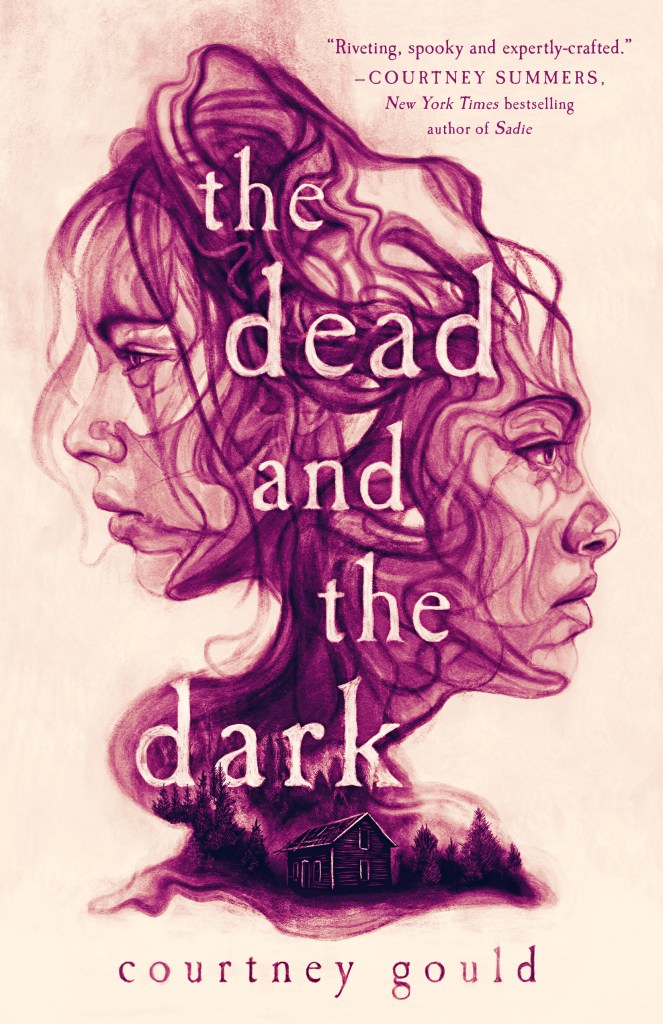
Book Description: Courtney Gould’s thrilling debut The Dead and the Dark is about the things that lurk in dark corners, the parts of you that can’t remain hidden, and about finding home in places―and people―you didn’t expect
The Dark has been waiting for far too long, and it won’t stay hidden any longer.
Something is wrong in Snakebite, Oregon. Teenagers are disappearing, some turning up dead, the weather isn’t normal, and all fingers seem to point to TV’s most popular ghost hunters who have just returned to town. Logan Ortiz-Woodley, daughter of TV’s ParaSpectors, has never been to Snakebite before, but the moment she and her dads arrive, she starts to get the feeling that there’s more secrets buried here than they originally let on.
Ashley Barton’s boyfriend was the first teen to go missing, and she’s felt his presence ever since. But now that the Ortiz-Woodleys are in town, his ghost is following her and the only person Ashley can trust is the mysterious Logan. When Ashley and Logan team up to figure out who—or what—is haunting Snakebite, their investigation reveals truths about the town, their families, and themselves that neither of them are ready for. As the danger intensifies, they realize that their growing feelings for each other could be a light in the darkness.
Review: Thank you to NetGalley for sending me an eARC of this novel!
Given that I am a HUGE sucker for the ‘small town with terrible secrets’ trope, I am always on the lookout for books and stories that showcase it, and showcase it well. In the past few years there have been books that have hit the mark and missed the mark, and when I requested “The Dead and the Dark” by Courtney Gould I didn’t really know what to expect. All I knew was that it was a YA horror novel that not only had that highly enjoyable theme, but it also had a sapphic romance to go with the scares. Since I was a bit let down by a previously hyped book with these themes, I was hoping that this one would give me what I wanted, and for the most part it did!
“The Dead and the Dark” is told through two third person perspectives. The first is that of Logan, a teenage daughter of Brandon and Alejo, the hosts of the ghost hunting show “Paraspectors”. Her Dads were raised in Snakebite but never fit in, and Logan has a strained relationship with Brandon that she hasn’t been able to really figure out. Ashley, on the other hand, is a local teenager who is basically a member of Snakebite royalty, but ever since her boyfriend Tristan disappeared she’s felt like something is off. When Logan’s dads are suddenly suspects in Tristan’s disappearance, Logan and Ashley have to work together to try and figure out what happened, and what secrets the town is hiding. Both characters were well explored and given depth, and I found myself eager to get to each perspective as the book went on. They are both good characters on their own, but Gould is sure to make their interactions as they become allies, then friends, then maybe something more, enjoyable. But Gould doesn’t stop there, as the supporting characters are also interesting and do more than just furthering the plot that Logan and Ashley work within. I liked getting to know Brandon and Alejo, as well as the other teens in the town who range from helpful to downright hostile. Snakebite as a town is also well explored, as the small town with a secret theme has layers of small town angst and pain for outsiders that come to the surface.
As for the plot and the horror elements, “The Dead and the Dark” did some new things that I really liked. I don’t want to give too much away, as there are definitely things here that I want readers to discover without the potential for being spoiled. But, like many good horror stories, there is thought and purpose behind the dark fantasy and horror elements. As Logan and Ashley start to find clues to the evil that is hurting local teens, they also start seeing the every day rot, be it due to sexism, or homophobia, or just plain resentment of anything different from what is known. This ties into the big reveal as to what is going on, and then another reveal within that reveal that legitimately caught me off guard. And it was done in a way that built it up, made it believable, AND socked me right in the feels. So much so that I found myself crying a bit, and I’m not really used to crying while reading YA horror novels.
I had a really good time reading “The Dead and the Dark”. The horror elements were creepy, the sapphic elements were very satisfying, and I will definitely be checking out what Courtney Gould has to offer the genre in the future!
Rating 8: A creepy and suspenseful YA horror story with enjoyable characters and a small town with secrets setting, “The Dead and the Dark” is a fun read with a nice romance to boot.
Publishing Info: G.P. Putnam’s Sons Books for Young Readers, July 2021
Where Did I Get this Book: NetGalley
Book Description: Merit Cravan refused to fulfill her obligation to marry a prince, leading to a fairy godling’s curse. She will be forced to live as a beast forever, unless she agrees to marry a man of her mother’s choosing before her eighteenth birthday.
Tevin Dumont has always been a pawn in his family’s cons. The prettiest boy in a big family, his job is to tempt naïve rich girls to abandon their engagements, unless their parents agree to pay him off. But after his mother runs afoul of the beast, she decides to trade Tevin for her own freedom.
Now, Tevin and Merit have agreed that he can pay off his mother’s debt by using his con-artist skills to help Merit find the best match . . . but what if the best match is Tevin himself?
Review: A cover can go a long way. More often than not, I get sucked into reading books that have summaries that don’t really speak to me but have covers that I can’t resist. But sometimes it cuts the other way. This isn’t an awful cover, but it also looks a bit cheap and like something that was quickly drawn up on Photoshop without much great thought. I almost passed the book up based purely on this, judging the entire book to be of a similar lack-luster quality. Luckily, my obsession with “Beauty and the Beast” forced my hand, because the cover in no way represents the absolute blast of a time I had reading this story!
Fairy gifts and curses can look much alike, often to the detriment of the poor human on whom its cast. But Merit’s experience is very much that of a curse, stuck in the form of a beast except for the few hours that a rare medicine can grant her. And, unless she marries for love or marries a strategic gentleman selected by her mother, this form will become a permanent state. Luckily, Tevin, a con man with his own agenda, is on the case. Together, they hope to break Merit’s curse by finding her a truly perfect match. Soon enough, however, each begins to find their own feelings getting in the way of this task. Will it be enough to break the curse in time?
This was such a fun and funny story. It’s definitely a light-hearted fairytale retelling, but it’s not shallow, like so many stories tend to be when they go for a lighter tone. There were several moments that had me laughing out loud, with witty dialogue and clever, insightful takes sprinkled within the text. On the more serious side, there are a bunch of mothers in this book whose failures as a parent range from general obtuseness to outright neglect and maliciousness. Most of it is still played for comedic affect, but there are some interesting nuggets buried in there regarding the complicated nature of parent/child relationships. How, even if a parent is abusive, there can be a desire to please and impress them on the child’s part, even a grown child.
I really enjoyed both Merit and Tavin as characters. Tavin, perhaps, in particular, was an interesting take on a gender-swapped “Beauty.” His looks are an established part of his way of operating in the world, for better and worse. There’s also a mixture of magic, with his ability to charm those around him. I like that the author didn’t simply say “oh, he’s handsome” and leave it at that as far as the Beauty adaptation worked.
Merit’s beastly nature is also interesting. Unlike many other versions of the story, she’s not left brooding in some dark castle. Instead, while she may prefer to linger in the countryside, her mother likes to keep her in town and participating in society. Merit can go in her human form at times, but also goes out and about in public in her beastly form as well. In a land that is blessed/stricken with people affected by fairy magic, while Merit’s form is unique, she’s not the only person with such an affliction. There were a couple of other characters with interesting curses/blessing, especially the nods at other fairytale characters, a few of whom are on the lesser known side of things.
There’s was also an interesting commentary on the freedom that Merit finds in her beastly form. Not only is she physically more capable, but at times she is seen to appreciate some of the other animalistic characteristics of that form, such as having her emotions closer to the surface and the freedom to express them as such. It was also refreshing to have all of the horror/fear of the beast essentially not even play a part in the story. By not having this aspect, it allowed for the story to develop the romance in a different way and for the story to explore different challenges and aspects of the curse itself.
The world-building and magic all fell heavily in the “light and fluffy” category. There wasn’t tons of detail given into how any of it works or any nuanced history of the world. Instead, readers are left to simply enjoy the ride, with discussions about flying badgers and pompous boys being casually turned into ostriches. The side characters were also all fantastic and added a lot of flair and amusement to the story.
I definitely recommend this one to fans of fairytale re-tellings. Had we not already done our “Beach Reads” lists for the summer, this is exactly the sort of book I’d throw up in my fantasy category. Who knows? Perhaps next summer it will make an appearance!
Rating 8: Perfectly fun in every way, with a well-balanced mixture of romance and humor sure to appeal to any romantic comedy fan.
Publishing Info: St. Martin’s Griffin, August 2020
Where Did I Get this Book: NetGalley!
Book Description: Six weeks after the fall of the Mantle, centuries-old enemies Elsira and Lagrimar struggle to unite. The will of the goddess is that the two nations become one, but while the war may be over, peace is still elusive. As desperate Lagrimari flee their barren land for a chance at a better life in Elsira, a dangerous faction opposed to the unification rises.
When a shadowy group with ties to the Elsiran government takes responsibility for the attack and promises more, an unlikely crew is assembled to investigate. Among them are Lizvette Nirall, a disgraced socialite seeking redemption for past mistakes, and Tai Summerhawk, a foreign smuggler determined to keep a promise he made to a dead man. Powerful Earthsinger Darvyn ol-Tahlyro is sent with a secret assignment, one that Queen Jasminda can’t know about. And in a prison far away, Kyara ul-Lagrimar searches for a way to escape her captors and save a family long thought dead.
It’s a race against time in this world of deadly magic, secret agendas and court intrigue to discover those responsible for the bombing before the next attack. And in another land a new enemy awakens—one that will strike terror into the hearts of gods and men.
Review: While it may have taken me quite a while to get to “Whispers of Shadow and Flame” after reading “Song of Blood and Stone” over a year earlier, I was much more prompt in my continuance of the series this time. It took reading the second story to really remind me how fantastic this series really is! The fact that each book centers around a new set of characters while continuing the overall plot of two countries needing to come together in a new world just adds to the appeal. And not for nothing, but I also really like the cover on this one. Let’s dive in!
After so long kept separate by the magical barrier known as the Mantle, it’s no wonder that the countries of Elsira and Lagrimar have struggled to come together. Thing only get worse when there’s an attack on an Elsiran holy site. The King and Queen, desperate to hold their country together and with a shared vision of the prosperous land that could be these two countries united, bring together a small group of individuals to seek out the culprits. Darvyn, still working to find Kyara, his love who has been captured, joins a smuggler and an ex-socialite. For her part, Kyara works to begin to understand and control her powerful magical abilities.
This series seems to just get better and better! Like I mentioned already, one of the things I’ve liked so far has been that each book has introduced a new set of characters/romantic pairing. But as the series continues, this also becomes a more challenging task to undertake as the previous, now four, other characters still exist in the story, some with active storylines playing out. Darvyn and Kyara, for example, from the previous book, ended their story on somewhat of a cliffhanger. They were separated, and Kyara was still learning how to manage her magic. So I was thrilled to see them given the time and page count needed to continue their stories in a satisfying way.
At the same time, these characters can’t outshine the new characters introduced. I really like both of the new character we got here. They each had distinct voices and backgrounds that set them apart from the characters we’ve seen before. I also really liked the romance that developed between them (I’ve really liked all the romances in these books, another feat!). I was perhaps a bit, a bit, less interested than in others just because I was still very distracted by Darvyn and Kyara’s drama that was still unfolding. But that is barely a complaint at all.
I also really liked the continue exploration into the magic of this world and the various powerful players working behind the scenes. The history of the land also continues to unfold in new and surprising ways, keeping you constantly guessing at who was in the wrong or the right. I really like this type of nebulous story-telling that reflects history so well: it’s often told by the winners and so much is lost to time. My only real criticism here is that the villains in all of the books, including this one, have felt rather one dimensional with unclear motivations.
Fans of the series should definitely check this one out. Each book can technically be read as a stand-alone, but I think this one, even more than the second, would suffer as a first entry for new readers. There’s too much of Darvyns and Kyara’s story that would be lost. I’m excited to see where the story will go from here.
Rating 8: Another great entry with a new set of compelling characters and a sweet romance.
Where Did I Get This Book: I received an eARC from NetGalley.
Book Description:A family returns to their hometown—and to the dark past that haunts them still—in this masterpiece of literary horror by the New York Times bestselling author of Wanderers.
Long ago, Nathan lived in a house in the country with his abusive father—and has never told his family what happened there.
Long ago, Maddie was a little girl making dolls in her bedroom when she saw something she shouldn’t have—and is trying to remember that lost trauma by making haunting sculptures.
Long ago, something sinister, something hungry, walked in the tunnels and the mountains and the coal mines of their hometown in rural Pennsylvania.
Now, Nate and Maddie Graves are married, and they have moved back to their hometown with their son, Oliver. And now what happened long ago is happening again . . . and it is happening to Oliver. He meets a strange boy who becomes his best friend, a boy with secrets of his own and a taste for dark magic. This dark magic puts them at the heart of a battle of good versus evil and a fight for the soul of the family—and perhaps for all of the world. But the Graves family has a secret weapon in this battle: their love for one another.
Review: Thank you to NetGalley for providing me with an eARC of this novel!
After reading Chuck Wendig’s post-apocalyptic tome “Wanderers” back in 2019, I told myself that I wanted to give him another go, even if there were bits of that book that didn’t work for me so well. After all, while I had my issues with the book, I ultimately liked the writing style that Wendig has, as well as a few of the characters that he created. So when I found out that his next novel, “The Book of Accidents”, was being touted as straight horror with a creepy house on the cover, I was absolutely game to hop right back into one of his stories. Sure, I was a little nervous about having issues with the story overall again, but definitely was willing to take the risk. And hey, as it turns out, that risk mostly reaped rewards this time around!
“The Book of Accidents” is touted as a horror novel by a lot of people, and while it definitely has horror elements, I would say that it’s also a bit of a dark fantasy. These genres can happily coexist, and Wendig combines them into something pretty unique. While there are elements of a haunted house story to be sure, we also have magic, inter-dimensional timelines, and a little bit of cosmic horror to top it all off. It’s a lot to cover, thematically, and you can see that in the length of the novel. It’s a bit of a double edged sword, because while I do think that Wendig did a good job of balancing all of it, it also made the read to be a little long at times. But a slight case of bloat aside, I found “The Book of Accidents” to be rewarding in all of the marks that it hits, and it still felt like a fast read overall when I got past some of the laggy parts. Wendig has a good sense for intricate plotting and build up, and he lays out clues that come to fruition and make sense when joined together. He also knows how to create a creepy scene, be it because you know that someone has ulterior, dangerous motives, or because he is putting you in the shoes of someone who has experienced something that is unsettling, or simply unexplainable, even if it isn’t immediately horrifying. It was moments like these that hit hardest as I was reading, and I found them to be pretty darn effective.
But what I liked most about “The Book of Accidents” is the family at the heart of it, Nate, Maddie, and Oliver. I felt that Wendig really developed all of these characters with care and meticulousness, and I found myself adoring all of them in similar amounts, something that doesn’t happen too often for me in books with multiple perspectives. Sure, I could like all of them, but there would be one stand out, and yet Nate, Oliver, and Maddie all had sections and moments that I was always chomping at the bit to get to. Wendig makes you care for all of them, and while he makes sure that they all have their flaws or bits that are rough around the edges, it’s easy to relate to all three. It’s easy to invest in this family, so when they find themselves in grave danger, the stakes for all of them are high and you need to know what happens to them. There were supporting characters who also stood out (I’m thinking mostly of Fig, Nate’s partner in the Fish and Wildlife Department, who is no nonsense and really enjoyable), but the heart is definitely the Graves family. The villainous characters are a little less drawn out (I found Oliver’s friend/foe Jake in particular to be a little cartoony), but in the case of this book I wasn’t too put off by that if only because so many of the others were well done.
“The Book of Accidents” is enjoyable and creepy! It’s a great choice if you are looking for horror with some kind of unique elements to the genre. Chuck Wendig has officially landed on my ‘gotta read what he comes out with next’ list with this one.
Rating 8: An entertaining horror/dark fantasy novel with enjoyable characters, “The Book of Accidents” is a quick read with some great unsettling scares.
Book: “She Who Became the Sun” by Shelley Parker-Chan
Publishing Info: Tor Books, July 2021
Where Did I Get this Book: NetGalley
Book Description: “I refuse to be nothing…”
In a famine-stricken village on a dusty yellow plain, two children are given two fates. A boy, greatness. A girl, nothingness…
In 1345, China lies under harsh Mongol rule. For the starving peasants of the Central Plains, greatness is something found only in stories. When the Zhu family’s eighth-born son, Zhu Chongba, is given a fate of greatness, everyone is mystified as to how it will come to pass. The fate of nothingness received by the family’s clever and capable second daughter, on the other hand, is only as expected.
When a bandit attack orphans the two children, though, it is Zhu Chongba who succumbs to despair and dies. Desperate to escape her own fated death, the girl uses her brother’s identity to enter a monastery as a young male novice. There, propelled by her burning desire to survive, Zhu learns she is capable of doing whatever it takes, no matter how callous, to stay hidden from her fate.
After her sanctuary is destroyed for supporting the rebellion against Mongol rule, Zhu takes the chance to claim another future altogether: her brother’s abandoned greatness.
Review: This book has been extremely hyped since news of it began circulating a few months ago. Comparisons to “Mulan” and “Song of Achilles” only helped a plot that sounded dark, tragic, and full of explorations into the themes such as personhood and the tragedies of war. I don’t have a ton of knowledge of about the real historical period of time and place being referenced (1300s China), but that was just another appeal of the book. And for once, the hype seems pretty well-founded!
Zhu’s fate is one of nothing. Neither tragic nor heroic, her life is predicted to fade from thought almost as soon as it arrives. Perhaps, for an impoverished family, this fate is not so extraordinary. However, her brother’s destiny of greatness very much is. After tragedy strikes, Zhu’s own prediction comes true as she sheds her identity, leaving it behind like so much nothing, and takes up the mantle of her deceased brother. Is this truly what fate had in mind? Can she rise to the greatness that had been assigned to another identity? Or has she simply become who she was always meant to be.
I really enjoyed this book. I’m always in for books that are compared to “Mulan” and, while I haven’t read “Song of Achilles” I know that it’s well-regarded. However, now having read this book, I’d say that a better marketing campaign would have directed readers to “The Poppy War” as the best comparison. Many of the themes are similar, and the dark, grim tone of a war-focused novel is very much the same in each of these books. Like “The Poppy War,” “She Who Became the Sun” doesn’t shy away from the bleak and challenging aspects of war. Many “Mulan” stories are so focused on the heroism of the main character, that war itself fades into the background, almost only a stagnant tool used to elevate the hero into her role. Not so here. Instead, greatness is shown to be perhaps its own burden, not any easier to carry than the nothingness that Zhu left behind.
The writing was incredibly strong, and I particularly enjoyed the well-blended mix of historical China with the fantastical elements. The story also managed to not get lost under its action-packed plot, instead giving ample time to exploring its themes of identity. Zhu’ own journey of self-exploration and acceptance is very powerful. The story doesn’t simply whip out the well-trodden lines, but instead dives into a very nuanced discussion, subtly exploring the many angles involved.
It wasn’t a perfect read, however. The book starts out with only Zhu’s POV and is very much a coming-of-age story. I really enjoyed this portion of the book, which perhaps is why I found it hard to readjust halfway through when the story suddenly expands outwards and adds in other POV characters. It was definitely a gutsy call on the author’s part, as it must has been suspected that readers would be fairly invested in Zhu by that point in the story and might struggle becoming attached to others later in the game. Luckily, the writing is strong enough to largely pull it off. But I did find myself thrown out of the book for a bit and needed some extra time to re-establish myself. This, then, threw off the pacing of the story as well, overall.
I really liked this book. The writing was confident and lyrical, truly impressive from a debut author. The themes were also well-explored and Zhu was a fantastic main character. I was a bit put-off by the sudden switch from one POV to two, but I think it ultimately did help create a more nuanced look at the overall conflict.
Rating 8: While “Mulan” is an adequate comparison, I think this is a better read-alike for fans of “The Poppy War” who are looking for a darker war-focused story.
Book: “The Final Girl Support Group” by Grady Hendrix
Publishing Info: Berkley Books, July 2021
Where Did I Get This Book: I received an eARC from NetGalley.
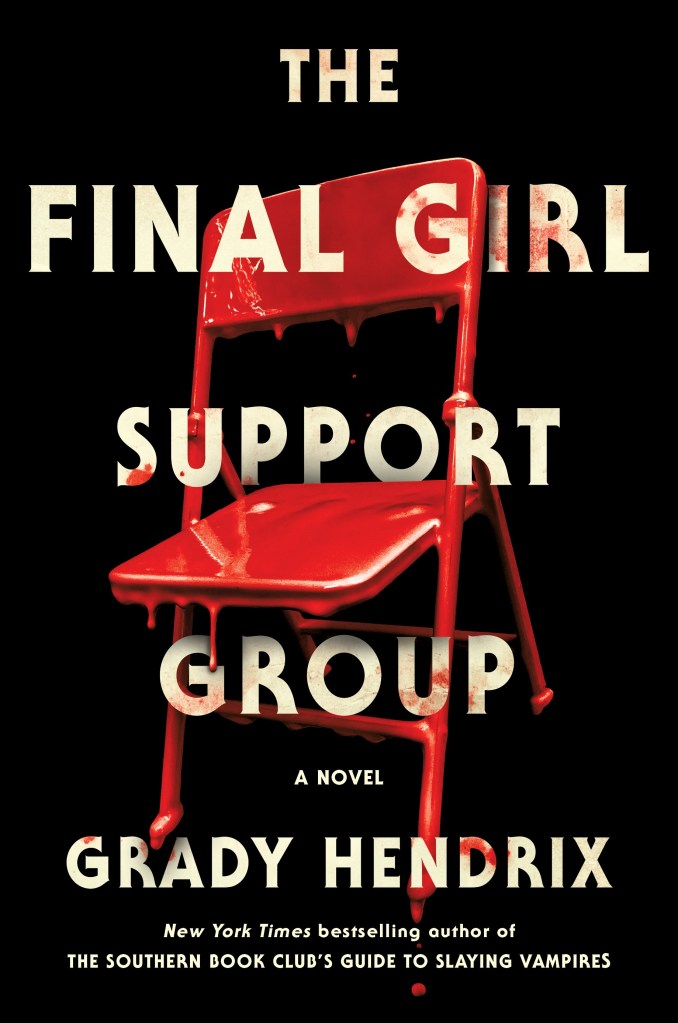
Book Description: A fast-paced, thrilling horror novel that follows a group of heroines to die for, from the brilliant New York Times bestselling author of The Southern Book Club’s Guide to Slaying Vampires.
In horror movies, the final girl is the one who’s left standing when the credits roll. The one who fought back, defeated the killer, and avenged her friends. The one who emerges bloodied but victorious. But after the sirens fade and the audience moves on, what happens to her?
Lynnette Tarkington is a real-life final girl who survived a massacre twenty-two years ago, and it has defined every day of her life since. And she’s not alone. For more than a decade she’s been meeting with five other actual final girls and their therapist in a support group for those who survived the unthinkable, putting their lives back together, piece by piece. That is until one of the women misses a meeting and Lynnette’s worst fears are realized–someone knows about the group and is determined to take their lives apart again, piece by piece.
But the thing about these final girls is that they have each other now, and no matter how bad the odds, how dark the night, how sharp the knife, they will never, ever give up.
Review: Thank you to NetGalley for providing me with an eARC of this novel!
I’ve mentioned it many a time before, but I really enjoy slasher movies. They’ve been my jam since I was a middle schooler who was way into the likes of “Scream”, “Friday the 13th”, and “Halloween”, and as time has gone on I’ve explored many a franchise, many a slasher killer, and many a Final Girl. It’s a trope that’s a bit rooted in sexism and misogyny, as the virginal ‘good’ girl is usually the one to live to the end, though that’s been subverted a number of times in the past couple decades (“Scream” was probably the first to really do it right). Problematic or not, I do love a good Final Girl. A few books in the past few years have decided to explore what life would be like for a character like this after the monster movie has ended, and the newest foray into such exploration is Grady Hendrix’s “The Final Girl Support Group”. Because no one can deny that any Final Girl who survives a slasher killer, sometimes over multiple movies, would undoubtedly need therapy.
“The Final Girl Support Group” has a number of members, all of whom are middle aged women who have survived horrific, traumatic attempted murders that were then turned into film franchises. While the characters are technically original characters by Hendrix, all of them are clear analogs for some of the most popular Final Girls ever seen on screen (and their first names are usually the same as the actresses that portrayed these characters, with a couple subversions. It’s super, super fun). Marilyn (the “Texas Chainsaw Massacre” analog) has married rich and dove into charity work; Dani (the “Halloween” analog, though a reference to Danielle Harris in later movies as ‘Jamie’ would probably be too on the nose) has become a gun hoarding hermit whose only companion is her wife, Michelle; Heather (“Nightmare on Elm Street”) has dived deep into conspiracy theories and addiction, as no one believes that her monster is, indeed, supernatural; Julie (“Scream”- another name change but her last name is Campbell) is wheelchair bound and now an activist; and Adrienne (“Friday the 13th”) has turned the summer camp of her trauma into a mental health wellness organization for women who have been affected by violence. But our first person protagonist is Lynette, who survived an attempted murder by a man whose dark obsession with Santa Claus drove him to kill people while wearing a Santa Suit (a la “Silent Night, Deadly Night”), and she is the one who probably needs the group more than the other members. When the other group members are wanting to disband, Lynette clings to the group, and when Adrienne is murdered she immediately believes that they are all in danger. It was an interesting choice to have our protagonist be Linnea Quigley’s character from “Silent Night, Deadly Night”, as technically, she isn’t a final girl- in the movie, she doesn’t survive, much less fight back against her would be killer. So in this, as a ‘real world’ version, Lynette has been kind of thrown to the wayside since she was too incapacitated to earn her Final Girl stripes. But it opens up a wealth of possibilities, and it makes Lynette somehow more vulnerable than the others in her insecurities and need to belong since she isn’t seen as a ‘fighter’. And in turn, that makes the story and the desperate choices she makes as they all try to survive once again compelling and frustrating, as well as very, very sad in some ways. While I think that Hendrix could have done more with her, and perhaps it would have been more interesting to follow another of the Final Girls (honestly, I want an entire book about Marilyn. I LOVED her), it felt correct that Lynette was the one we got, because she’s almost the one we could trust the least (outside of Heather. DAMN, poor Heather).
In terms of the plot as Lynette tries to figure out how to keep herself and her group mates alive, and to figure out who is targeting them, I was able to predict a few things here and there. I wasn’t as invested in that aspect of the story, as it’s pretty run of the mill. What makes this book work is that Hendrix has penned both a love letter to slasher movies, and found a way to deconstruct them and take them down a few notches without being smug about it. The slasher genre absolutely has problems with sexism and exploitation, and Hendrix makes us confront that by seeing just how incredibly messed up and traumatized these women are. Final Girls are seen as heroic in the movies because of their resilience and ‘goodness’, but in this book all of these women were basically brutalized by men, and then their lives were ruined because of it. However, that point doesn’t make it any less fun to see him play with these characters, and leave in all the fun easter eggs and treasures for readers who love the movies that their characterizations come from. I was grinning ear to ear throughout a lot of this book. And Hendrix, while making our Final Girls a little tragic and traumatized, also makes a few of them VERY funny. Marilyn had me in stitches half the time, and Heather has some hilarious snipes and sarcastic moments. Hendrix is still having fun, and the reader knows that you are allowed to have fun as well as confronting what the actual fallout of this kind of character would have be face.
“The Final Girl Support Group” was a really fun read for this slasher movie fan! It’s horror with heart and humor, and fans of the genre really need to check it out.
Rating 8: A fun love letter to one of my favorite horror movie genres, “The Final Girl Support Group” will be a blast for fans of slasher movies everywhere!
We are part of a group of librarian friends who have had an ongoing bookclub running for the last several years. Each “season” (we’re nerds) we pick a theme and each of us chooses a book within that theme for us all to read. Our current theme is “Award Winners”, in which we each picked a book that has won an award of some kind.
For this blog, we will post a joint review of each book we read for book club. We’ll also post the next book coming up in book club. So feel free to read along with us or use our book selections and questions in your own book club!
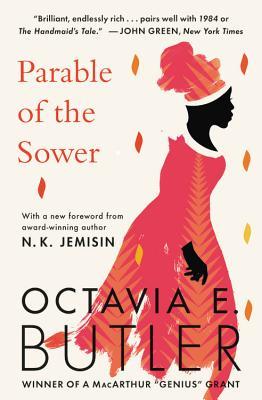
Book: “Parable of the Sower” by Octavia E. Butler
Publishing Info: Four Walls Eight Windows, 1993
Where Did I Get This Book: The library!
Award: New York Times Notable Book of the Year
Book Description: When global climate change and economic crises lead to social chaos in the early 2020s, California becomes full of dangers, from pervasive water shortage to masses of vagabonds who will do anything to live to see another day.
Fifteen-year-old Lauren Olamina lives inside a gated community with her preacher father, family, and neighbors, sheltered from the surrounding anarchy. In a society where any vulnerability is a risk, she suffers from hyperempathy, a debilitating sensitivity to others’ pain.
Precocious and clear-eyed, Lauren must make her voice heard in order to protect her loved ones from the imminent disasters her small community stubbornly ignores. But what begins as a fight for survival soon leads to something much more: the birth of a new faith…and a startling vision of human destiny.
This highly acclaimed post-apocalyptic novel of hope and terror from award-winning author Octavia E. Butler “pairs well with 1984 or The Handmaid’s Tale” (John Green, New York Times)—now with a new foreword by N. K. Jemisin.
Kate’s Thoughts
Back when Trump was elected, I started hearing whispers from my friends and acquaintances about a book called “Parable of the Sower” by Octavia E. Butler. Many of them were saying that “Parable of the Sower” predicted the society in which a person like Trump could be elected, along with the existential crises that come with it. When we were deep in the shit of the Trump Administration, I couldn’t bring myself to read that book, as even though it sounded supremely fascinating, it also sounded too real. A story written in the early nineties that seemed to predict the shitshow of climate change, social inequity, and an incompetent and narcissistic president? On the nose! And therefore too stressful to read. So when someone in book club chose it for our first Award Winners read, I was happy that I finally had a push to read it…. And then I read it, and was sent into an anxiety spiral.
Basically my face during my entire reading experience.
“Parable of the Sower” is a bleak and terrifying dystopia where climate change, vast social and financial disparities, and corporate corruption has created a society where people are either gated in, hoping that they will not fall victim to rampaging violent nomads, or trying their best to survive in a violent and dangerous wasteland. We follow Lauren, a teenager who lives in a gated community who has dreams of a better future for herself, and who starts to develop and discover a new religion/life she calls Earthseed due to her faith and a condition in which she has hyper empathy to those around her. Butler creates a terrifying world where mass violence is always a threat, and it’s only a matter of time until a person faces the bleak and staggering reality of having to survive. I found it to be incredibly well written as well as horrific. It’s told in mostly epistolary devices, with Lauren recording what is going on each day, and I thought that the slow crumbling of her life and then rebuilding in a chaotic and unpredictable landscape to be compelling and very suspenseful. There were so many moments that not only set me on edge, but felt like they could potentially happen if we don’t get a hold on many existential crises that plague our world at the moment. Engaging to be sure, but it also made it hard for me to sleep at night.
I think that if I were a more religious person (in that I’m not at all) I may have connected a little bit more with the aspects of Lauren’s journey that involved ‘discovering’ Earthseed, and her self assurance that everything was going to work out because she was discovering and bringing forth a new religion that would save society. From the Biblical references to some of the blind faith aspects of this book, I didn’t connect as much to the moments where Lauren was creating a whole new belief system. That isn’t to say that it wasn’t intriguing; I definitely found myself enjoying the mythos that Butler was creating in this story, and liked seeing Lauren connect to it. I’m not sure that I have the emotional wherewithal to continue in the series (especially given that it’s incomplete; Butler passed away before she could complete it), but what I saw in this book really hit home how incredibly gifted Butler was for creating complex and horrifying alternate realities while also giving us a little bit of hope to cling to.
“Parable of the Sower” is a rough read, but I definitely think it’s worthwhile. Butler was a true talent, and this showcases the world building, and premonition, that she had as an author.
Serena’s Thoughts:
For being a long-time fan of the science fiction and fantasy genre, it’s kind of crazy that I hadn’t read any of Octavia Butler’s books before this. And I can’t really tell you why! Perhaps, like Kate mentioned above, when her books began coming up more and more in the public consciousness recently, I wasn’t really in a good mental place to dive into this type of story. Margeret Atwood is a similar author for me: I can recognize the supreme talent she is and appreciate her books, but I can only manage to read one every five years or so and inevitably spend those five years half terrified of the “too real”-ness of her stories. But, also like Kate said, I was glad to have the push to read this.
I agree with everything Kate wrote. I, however, come from a more religious family so in that way, I did connect more to the aspects of the story that were focused on the development of a belief system and the role that would play in Lauren’s management of the challenges of this society. Blind faith is a particularly challenging topic, even for those have a religious life. Most who are honest with themselves, I think, would say that faith itself is a constant challenge. It can provide some assurance in the midst of strife and unknown, but it, too, can cause its own form of strife, in that faith, at its core, is not necessarily a comfortable thing. I liked the way that Butler dug into this topic and her use of Biblical references went beyond the usual uses we’ve all seen a million times over.
I do think I’ll eventually read the next book, but like I said above, it will probably follow a pattern similar to my reading of Atwood’s stories. It’s a credit to just how powerful a writer Butler was that her presentation of a future world feels too read to inhabit for overly long without it causing real-world anxiety! If you haven’t checked this one out yet, I definitely recommend it.
Kate’s Rating 8: Terrifying and bleak, but well written and sprinkled with some hope, “Parable of the Sower” is a glimpse into a could be futurescape.
Serena’s Rating 8: Hope wars with terror in a version of the future that feels all-too real at times.
Book Club Questions
The future that Butler paints in this book has a lot of mirrors to a reality that we seem to be nearly living in. Do you think that what happens to society in this book could happen in a similar fashion in real life? Why or why not?
Even though Lauren is living in an unstable society and there is lots of violence and despair, she still seems to want to have kids some day. Why do you think that is?
Does Lauren’s religion or belief system of Earthseed connect to you? Do you see it as a new religion? A cult? Something else?
At one point Lauren says that she isn’t inventing Earthseed, but discovering it. What do you make of that statement?
At one point Lauren and her group pass by the settlement of Hollister, which seems to be pretty stable and safe. What did you think of them continuing on their journey instead of stopping and settling?
What did you think of the concept of hyper-empathy?
What did you think that Butler was saying about religion in this book?
Book Description: The Annurian Empire is disintegrating. The advantages it used for millennia have fallen to ruin. The ranks of the Kettral have been decimated from within, and the kenta gates, granting instantaneous travel across the vast lands of the empire, can no longer be used.
In order to save the empire, one of the surviving Kettral must voyage beyond the edge of the known world through a land that warps and poisons all living things to find the nesting ground of the giant war hawks. Meanwhile, a monk turned con-artist may hold the secret to the kenta gates.
But time is running out. Deep within the southern reaches of the empire and ancient god-like race has begun to stir.
What they discover will change them and the Annurian Empire forever. If they can survive.
Review: I was so excited when I saw an ARC of this pop up on Edelweiss several months ago. I really enjoyed both the original “Unhewn Throne” trilogy by Brian Staveley as well as his companion/prequel stand-alone, “Skullsworn.” I knew he had another book in the works, but I hadn’t been paying overly much attention to when it was slated for release. Call me jaded, but epic fantasy isn’t the most reliable of genres for timely releases! But it arrived at last, and I wasted no time before diving right in.
Five years after the events of the first trilogy, the Annurian empire is scrambling to hold itself together. Adare, unable to use the kenta gates, the magical doorways that allow the sitting empire to quickly travel throughout the land, is desperate to hold her world together. To do so, she recruits a thief-turned-monk who promises he can teach her how to use the magical passages. But the empire is weak in more than one way. With the Kettral depleted, Gwenna is sent on a perilous mission to travel south into a land riddled with madness and monsters in search of Kettral eggs to bring back in the hope of rebuilding the powerful fighting force. And on the edge of the Empire, revolution has struck and two priests discover that their may be more Gods in the world than they had thought. And a new one has arrived with plans of conquest.
The story is split between three characters (sadly, Adare is not one of them). While the book is approachable to new readers, long-time fans of the series will be most rewarded. Gwenna, the Kettral warrior, had POV chapters in the last two books in the original trilogy. And Ruc, a priest of the Goddess of love who resides in the swamp-surrounded city of Dombang, was a character readers met in “Skullsworn.” The third character is a priest who grew up alongside Kaden whom readers briefly met in the first book. Gwenna is the most familiar of the three, but this prior knowledge of their stories does add depth to their arcs here, and fans of the previous books will be rewarded with little tidbits and references throughout the story.
This book is definitely the first in a series (duology? trilogy?). In that way, much of the story is set-up for the larger conflicts to come. We see that in the carefully laid groundwork that plays out in our three main story lines. Each drops several small pieces here and there to the larger plot, but none of the characters have a full view of the greater picture. Indeed, their plot lines barely even brush each others, all three living out very different experiences in far-spread parts of the world. Due to this, the story definitely progresses in a slow, careful manner. There are some tense action scenes, probably the best coming in Gwenna’s chapters, but the overall plot is mostly concerned with setting the stage.
However, the writing is as strong and compelling as ever. So while the book wasn’t a fast read or full to the brim with a moving plot, I was still completely engrossed. As we see some pieces fall into place at the end, it’s also gratifying to know that these disparate plot lines will come together in a satisfying way eventually. Given Staveley’s last trilogy, I felt satisfied with this book as a solid introduction to where he is heading eventually.
The characters themselves also largely go through “beginning of the book” syndrome. In that, each of them spends the majority of the book having their understanding of themselves and how they exist in their world broken down piece by piece. This is, of course, necessary for many character arcs as it allows the story to then focus on the rebirth of a character into a new form. But unlike the traditional arcs we see play out in single works, like the plot, this book treats its character arcs as ones that span the entire serie. So a first book sees only the first steps in this process.
At times, it can feel like a bit much. It’s definitely not a fun read to see favorite characters go through existential crisis after existential crisis, regardless of how necessary it is for their ultimate growth. Gwenna, in particular, has a roller coaster of a ride, with some true highs alongside some very dark, lonely lows. However, again, towards the end of the book, we begin to see the direction these characters are headed in, and I have faith that their continued stories will retroactively justify some of the lows we experience with our characters here.
I really enjoyed this book. It was so exciting to be back in this world. The familiar characters and scenes were a joy to return to, and the expanded world and mythology felt like it perfectly slotted in with what we already new of this universe. The book is long and, at times, slow moving, but fans of the series will likely be so thrilled by a new entry that this slower pace just seems like an excuse to revel in the story. Fans of epic fantasy are sure to enjoy this, though, while it’s not necessary, I recommend reading Staveley’s other books first, particularly the first trilogy.
Rating 8: An excellent return to the world of the “Unhewn Throne,” though the book is definitely focused more on setting up the bigger story than in creating a self-contained plot.
Reader’s Advisory:
“The Empire’s Ruin” is a new book, so it isn’t on many Goodreads lists, but it is on Adult Sci-Fi/Fantasy of 2021.








 The Library Ladies