Serena’s Review: “Seafire”

378225341Book: “Seafire” by Natalie C. Parker

Publication Info: Razorbill, August 2018

Where Did I Get this Book: Edelweiss

Book Description: After her family is killed by corrupt warlord Aric Athair and his bloodthirsty army of Bullets, Caledonia Styx is left to chart her own course on the dangerous and deadly seas. She captains her ship, the Mors Navis, with a crew of girls and women just like her, whose lives have been turned upside down by Aric and his men. The crew has one misson: stay alive, and take down Aric’s armed and armored fleet.

But when Caledonia’s best friend and second-in-command just barely survives an attack thanks to help from a Bullet looking to defect, Caledonia finds herself questioning whether or not to let him join their crew. Is this boy the key to taking down Aric Athair once and for all…or will he threaten everything the women of the Mors Navis have worked for?

Review: There’s no doubt about it, this summer has been the summer of the pirates as far as my reading list as gone. It’s as if all of the authors and publisher all got together and decided that now, now was the time, just long enough for memories of the more recent “Pirates of the Caribbean” to fade away and soon enough that there is still nostalgia lingering from the very beginning. My feelings on the last several pirate-themed books have been very hit and miss, and the last was quite the miss indeed. But where “These Rebel Waves” failed, “Seafire” was there to redeem this budding genre!

Caledonia and her best friend trusted a Bullet once. And from that trust game death and destruction upon both of their families. Since then, the two women have gone on to gather together a crew of other women and a ship of their own. Together, they fight back against the Bullet’s reign of terror, and Caledonia is still looking for revenge on the boy who betrayed her. But when a Bullet ends up on their ship after saving Caledonia’s first mate, Cal is given a chance to trust again. Should she take it for the chance at new and potentially live-changing information?

So first off, thank god! A pirate story that actually has pirates and takes place on the sea! “Seafire” is just what it claims to be, as far as its action and world-building go. There are ships, a sea battles, and pirates, and all of the best type of action that one looks for in action adventure stories like these. It’s all fairly standard, but in this case, that’s a compliment.

What makes this book stand out from the rest is the cast of characters made up of the found family crew of women. The story delves into great themes such as loyalty, friendship, and of course, the love a family, be it your born family or chosen. It also explicitly deals with the challenges that family present to each other and the ways that they can let each other down, and that this applies to both born and chosen families. Each come with their own struggles, and navigating these relationships can be perilous.

Beyond these broader topics, I genuinely cared about a pretty large group of characters introduced in this book. I typically find myself only invested in the 1-2 main characters in most books, but here I found myself rooting and worrying for a much larger group. There is also good representation in this group with a solid f/f relationship between two secondary characters. But all of this investment also came with a price, since the book doesn’t shy away from the tragedies that can befall characters who regularly engage in sea battles.

As for the main characters, I mostly liked our main character, Cal. The fact that I only “mostly” liked her is also probably a point in the book’s favor, highlighting the attention given to creating a flawed, real teenage girl. Cal is by no means perfect. She is brave and determined, but all too often she makes choices based on her own personal need for revenge. She is slow to give up prejudices, but is also completely devoted to the group of women she has taken under her wing. Towards the end, I did begin to struggle more and more with her character and some of her decision-making, but I was on board enough with the rest of the story to not let myself get too bogged down in that.

There is a minor subplot of romance in the story, but I was fine with this part not taking up more time. The true relationships in this book are those built on sisterhood and friendship. As for the pacing, the book does have a slower start, but picked up quite a lot towards the end, so some patience is required when getting going. But, other than that, “Seafire” was a solid book full of badass women doing badass pirate-y things!

Rating 7: Delivers on its concept with an exciting pirate story full of strong women. The main character was at times not the most likable and it started slow, but was worth it in the end!

Reader’s Advisory:

“Seafire” is on these Goodreads lists: “YA Female Ensemble Casts” and “Lady Pirates.”

Find “Seafire” at your library using WorldCat.
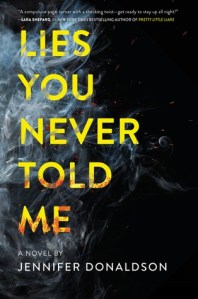


Serena’s Review: “Lies You Never Told Me”

36547961Book: “Lies You Never Told Me” by Jennifer Donaldson

Publishing Info: Razorbill, May 2018

Where Did I Get this Book: BookishFirst

Book Description: Gabe and Elyse have never met. But they both have something to hide.

Quiet, shy Elyse can’t believe it when she’s cast as the lead in her Portland high school’s production of Romeo and Juliet. Her best friend, Brynn, is usually the star, and Elyse isn’t sure she’s up to the task. But when someone at rehearsals starts to catch her eye–someone she knows she absolutely shouldn’t be with–she can’t help but be pulled into the spotlight.

Austin native Gabe is contemplating the unthinkable–breaking up with Sasha, his headstrong, popular girlfriend. She’s not going to let him slip through her fingers, though, and when rumors start to circulate around school, he knows she has the power to change his life forever.

Gabe and Elyse both make the mistake of falling for the wrong person, and falling hard. Told in parallel narratives, this twisty, shocking story shows how one bad choice can lead to a spiral of unforeseen consequences that not everyone will survive.

Review: Whaaaat? A thriller review by Serena and not Kate?! That’s right, people! Buckle up and get ready for a good look at what it’s like for a fantasy reader to read a YA thriller! Spoiler alert: probably not that different, though much more naive as far as predicting twists. I’m sure Kate would have figured this one out, but oh well!

The story is told in dueling, first-person narratives. In one, we follow the story of Gabe, a teenage boy who, after being involved in a car accident and rescued by a mysterious girl, finds himself struggling to escape the clutches of his mean-girl girlfriend, Sasha, to pursue this new savior girl. The other narrative follows Elyse who on a whim auditions for a role in “Romeo and Juliet” and quickly finds herself entangled in a complicated web revolving around a person she knows she should avoid.

Both stories were engaging, however I did find myself more pulled into Elyse’s plot. Her struggles and circumstances were a bit more relatable to the average reader, while Gabe’s story could verge a bit into the unbelievable, particularly where his ex-girlfriend Sasha was involved. It was a bit hard to believe that she had so little oversight in her life that she could pull off some of the very unbalanced stunts she did.

The story is told in first-person, which I thought worked fairly well for the story. At times it did make the writing feel a bit too simple, and I found myself wanting a little more depth in the descriptions of scenes. This is a typical limitation of this writing tense, however, so it wasn’t overly distracting, just not my preferred type. And I do think that keeping it in first-person allowed readers to more fully identify with the mental and emotional struggles that Elyse and Gabe go through.

I also very much liked the diversity of the cast. Gabe is Mexican American and his sister has Down Syndrome. I especially loved the relationship between Gabe and his sister, and it was great to see a relationship like that portrayed on the page. The story also tackled several other topics such as poverty, addiction, and, of course, abusive romantic relationships.

As I’ve said, I haven’t read too many thrillers. So, while I know that there will some twist coming, I wasn’t able to spot this one. Maybe fans more familiar with the genre would have had an easier time of it, but I was genuinely surprised. Specifically, I was left wondering throughout most of the book how Elyse’s and Gabe’s storylines were tied together, and it was exciting to finally find out in the end. However, as surprising as it was, it also had an affect on how I viewed the rest of the story in the end, and I’m not sure it was a change for the better.

Ultimately, I very much enjoyed “Lies You Never Told Me” even though it falls outside of my usual genre preferences. I’m sure it will be a hit for regular thriller fans as well!

Rating 7: While thrillers are probably never going to be my favorite, I found this book a compulsive read and a fun reminder of what this genre has to offer!

Reader’s Advisory:

“Lies You Never Told Me” is on these Goodreads lists: “Secrets and Lies” and “2018 YA Mysteries.”

Find “Lies You Never Told Me” at your library using WorldCat.

Kate’s Review: “Vox”

37796866Book: “Vox” by Christina Dalcher

Publishing Info: Berkley, August 2018

Where Did I Get This Book: I was sent an eARC from the publisher via NetGalley.

Book Description: Set in an America where half the population has been silenced, VOX is the harrowing, unforgettable story of what one woman will do to protect herself and her daughter.

On the day the government decrees that women are no longer allowed more than 100 words daily, Dr. Jean McClellan is in denial–this can’t happen here. Not in America. Not to her.

This is just the beginning.

Soon women can no longer hold jobs. Girls are no longer taught to read or write. Females no longer have a voice. Before, the average person spoke sixteen thousand words a day, but now women only have one hundred to make themselves heard.

But this is not the end. 

For herself, her daughter, and every woman silenced, Jean will reclaim her voice.

Review: A special thanks to Berkley Publishing and NetGalley for sending me an eARC of this book!

People keep asking me if I have watched “The Handmaid’s Tale” yet, and as of now I still haven’t. I know that it’s supposed to be super super good, and I know that a number of my friends really love it, but I haven’t been able to bring myself to watch it because it really just feels ‘too real’ right now. So I will admit that when I was sent the book “Vox” by Christina Dalcher from Bentley, I also had that moment of cringe, not because I doubted that it was good, but because I felt that it would touch on a raw nerve. Perhaps a few years ago I would have said that the idea of the American Government stripping women of all rights, and limiting their daily speech to 100 words total, as preposterous. Now? I’m not as certain about it. But I did eventually decide that it was time to buckle down and read it, and once I did, as terrifying as the themes were, I had a hard time putting it down.

The first big win of this book is that Dalcher creates a fairly realistic pathway for how American Society can change it’s societal values and ideals in such a drastic way in such a comparatively short amount of time. Our protagonist, Jean, is in her early forties, and she can trace the origins of this super right wing group, The Pure Movement, within her lifetime dating back towards her college years. Through flashbacks involving Jean and other people in her life, mostly her old friend and feminist advocate Jackie, we can see how a woman who became a renowned expert in neuroscience eventually ended up as a housewife with no rights and a counter on her hand to track her words. Dalcher presents a slow take over of right wing politics and ideals, and the apathy of ‘that will never happen here’ that does nothing until it is far too late. Dalcher also presents a fairly realistic progression of how Jean’s family is affected by the law, and how the men in her life betray her in different ways even though they also ‘love’ her (I hate putting that in quotations, but I feel like I have to). Be it her husband Patrick, who is a flunky to the government who doesn’t REALLY believe in the law, but does nothing to stop it, or her son Steven, who at seventeen is drinking the Kool Aid of The Pure Movement and becoming a traitor to his mother and general decency.

d8b2afb044495e7f49faddae3a8580b5-sound-of-music-movie-soldiers
I was consistently picturing THIS motherfucker whenever Steven was on page. (source)

Because of these things the plot was gripping and engrossing. I was horrified by the things that the Pure Movement does in this book (be it to women, LGBTQIA people, or other marginalized groups), but Jean was so compelling and so easy to root for that I kept reading, needing to know if she was going to overcome the persecution, if not completely overthrow it.

There were a couple of things that didn’t quite work for me. I did feel that the pacing was a bit off by the end, as I felt that I suddenly wrapped up very quickly. There were a couple of inconsistencies within the ending that felt like they went against a few of the characters and their personalities, and while I do believe that some people can change their minds about certain things (I’m trying so hard to be vague), to go from one side of opinion to an opinion on the other VERY extreme side felt uncharacteristic and hard to swallow. I can’t really divulge much more without spoiling anything vital, but just trust me when I say it was a leap. That and I feel that some characters who did nasty things got too easy of a pass. I’m kind of over giving people who do crappy and disturbing and oppressive things the benefit of the doubt, so while I like me a redemption arc to a point, I’m not sure that I can stomach one that gives something of a pass to bigots, even if they were slowly brainwashed. 

Still and all, “Vox” is an entertaining read that give enough darkness to feel allegorical, but enough hope that you don’t want to just crawl into a hole and never come back out. I think that this could be a hot read come Fall, and think that anyone frustrated or scared may be able to work out some feelings by trying it out!

Rating 7: A gripping and addicting thriller that feels all too real at the moment, “Vox” was a disturbing, and somewhat cathartic, read about women being silenced by their own government and those who fight back.

Reader’s Advisory:

“Vox” is included on the Goodreads lists “Patriarchal Dystopias”, and “Best Books To Read When You Need A Reminder of Why Feminism Is Important”.

Find “Vox” at your library using WorldCat!

Serena’s Review: “The Phantom Tree”

32618152Book: “The Phantom Tree” by Nicola Cornick

Publishing Info: Graydon House, August 2018

Where Did I Get this Book: NetGalley

Book Description: Browsing antiques shops in Wiltshire, Alison Bannister stumbles across a delicate old portrait – supposedly of Anne Boleyn. Except Alison knows better… The woman is Mary Seymour, the daughter of Katherine Parr who was taken to Wolf Hall in 1557 as an unwanted orphan and presumed dead after going missing as a child.

The painting is more than just a beautiful object from Alison’s past – it holds the key to her future, unlocking the mystery surrounding Mary’s disappearance, and the enigma of Alison’s son.

But Alison’s quest soon takes a dark and foreboding turn, as a meeting place called the Phantom Tree harbours secrets in its shadows…

Review: This is probably one of the first historical fiction novels that is NOT a mystery that I’ve read in quite a while! As such, I was quite excited to return to the genre, especially when comparisons to Phillipa Gregory’s books were being routinely listed (though I’ve had a fairly hit and miss experience with Gregory, I will always love “The Other Boleyn Girl.”) The book had a bit of a slow start and didn’t grab me as much as some of Gregory’s better books, but over all, I still enjoyed “The Phantom Tree,” especially its take on a lesser known and minor character in Tudor history.

Allison is a woman out of her own time, and while she’s managed to scramble a life together for herself, calling upon her vast stores of sheer determination and stubbornness, she still longs to return to her original time back in the 16th century where she was forced to leave behind her infant son. Her only clues are connections to Mary Seymour, a fellow orphan left to be raised at Wolf Hall, and a young woman with a mysterious ability of her own. But Mary has been lost to time, with many scholars believing she died in infancy. When Allison discovers a painting of an adult Mary, she finally is able to begin picking up the clues that may finally lead her home.

This story is pieced together through the perspectives of both Allison and Mary. Allison’s portions consist of her life in the present and her search to return to the past. And through Mary’s eyes, we see the events that lead to Allison’s journey to the future and the events that have unfolded after she’s gone missing, and which Allison herself is now piecing back together centuries later.

Both Allison and Mary were compelling characters, however the nature of the story and the way their stories unfolded did lead to the book feeling as if it had a slow start. Further, both of them were initially a bit unlikeable, with Allison coming off as a bit of a ignorant brat (mostly her past self) and Mary as too wilting and unwilling to take action in her own life. However, from these weaker beginnings, both characters ultimately grew into women I found myself greatly rooting for.

I didn’t know much about Mary Seymour before going into this book, so I did end up doing a bit of background reading to try and figure out how much if this story is based on history. Mary disappeared from history when she was around 2 years old and is presumed to have died in young childhood. That leaves the majority of this story as operating in a fictional setting. However, what made it stand out was the creative way the author managed to tell Mary’s story in a way that made it believable that she may have lived longer but still been absent from history. The fantastical elements come in early, especially with regards to Mary, so there’s never any real question about the authenticity of the tale, but it still added a nice layer that the book never strayed too far into the unbelievable as far as her actual life.

Allison is, of course, a completely fictional character. What I most appreciated about her story was the build-up for her character back in the 16th century that helped establish her as a person capable of adapting to a completely different life in modern times. Think about it: that’s a huge ask of a character and the book explores a few other characters who also time traveled and were less successful with it. The same brashness and stubborn refusal to bend that made her rather dislikable as a teenager in the past were also the traits that let her survive on her own in a completely new world.

The time travel and fantastical elements did end up playing a larger role in the story than I initially anticipated, and there were a few twists and turns towards the end that were especially surprising. At the same time, I never felt like these aspects of the book overran the historical setting of the past sequences or the modern version of the story that focused on Allison’s search for family, her discovery of self and what she wants from her life, and the burgeoning romance with a historical researcher.

By the end of the story, I was actively rooting for both of these main characters, made all the more tense by the knowledge that something dark had to be looming to explain Mary’s sudden disappearance in history. This particular element of the book did wrap up rather suddenly, and while it helped build the believablity of the mystery, it was also a bit traumatic to experience with one of your main characters.

I very much enjoyed “The Phantom Tree.” It was a strange mix of fantasy/time travel, historical fiction, and even modern romance. Both Mary and Allison were compelling heroines, though I never quite escaped a certain sense of distance from the story which prevented me from becoming fully enthralled. For fans of time travel stories, however, and especially those interested in the Tudors, I would definitely recommend this book!

Rating 7: A solid new entry into the subgenre of historical/time travel fiction, though I didn’t connect with it as fully as I may have wished.

Reader’s Advisory:

“The Phantom Tree” is a new book so it isn’t on many Goodreads lists, but it should be on “Historical Fiction/Time Travel.”

Find “The Phantom Tree” at your library using WorldCat.


Serena’s Review & Giveaway: “Spinning Silk”

39810065Book: “Spinning Silk” by T. Cook

Publishing Info: Amazon Publishing, May 2018

Where Did I Get this Book: provided for review

Book Description: A weaver’s genius ignites the jealousy of her peers, the possessiveness of her mill’s proprietress and the hopes of an unborn nation.

Furi knows she was born to create, but the fabric of her life otherwise weaves mysteries. These things are more than they appear:

Shin, the gardener, with his unlikely power over life and death;
A mysterious illness with a selective death route;
Kitsuke artist Madame Sato, who would fashion Furi into a reincarnation of her own dead daughter;
The princess of a puppet emperor, who has strange loyalties to a humble gardener; and
The vaporous rumor of a war with no apparent aggressor.

“Spinning Silk” is inspired by Japanese folklore including the love story of Orihime and Hikoboshi as well as a radical reimagining of the terrible tsuchigumo (spider spirits) and jorogumo demons.

Review: I was sent an excerpt of this book several months ago, and while reviewing it the strength of the author’s writing and the intriguing plot nabbed my attention. After receiving my copy, I blew through this story quickly. While it’s not without faults, “Spinning Silk” was a unique story, almost a fairytale-retelling but inspired by Japanese folklore instead of the Western-based fairytales that are all too common.

Furi is an orphan who has been raised as a slave. However, she has an incredible talent for weaving, a talent so great that it draws the eyes of some very important people. Her path soon crosses with several other unique characters, most importantly, perhaps, a gardener who has power of his own. Her journey is one filled with death and darkness, a mysterious illness that strikes in an unknowable way. But Furi persists through it all, discovering her own strengths within.

We all know how I feel about fairytale-retellings. That said, is is more and more difficulty to find truly intriguing stories. The basic fairytales have been told over and over in almost every way. So I’m always incredibly excited when I see a story like this that is not only drawing from folktales that I am not familiar with, but that is set in a place and culture that is A.) not my own and B.) one that is rarely called upon as a setting and foundation for a story such as this. All cultures have stories at their heart, and yet we’re only familiar with a very few.

I know very little about Japanese culture and folklore. I was not familiar at all with the story that serves as the basis for this book. But what made it so excellent was that this didn’t matter! While I can’t speak to the authenticity of these things (again, given my lack of prior knowledge of the subject), I will say that coming from a fairly ignorant standpoint, I felt that the world that Cook drew and the tale itself felt truly authentic. She avoided several of the pitfalls common to stories set in places/cultures that are not one’s own. Notably, her use of Japanese language. The book does has a helpful list of terms in the back for those of us who are not familiar, but the story itself is blessedly free of any in-text explanation for terms and words. Because, of course, why Furi explain words that are common to her?

I also liked the way the story wove together the fantastical elements and the historical parts. While I do wish there there had been a bit more lead up to the fantasy aspects (they come into play much more strongly towards the end), the historical portions of the story were spot on. I felt immediately immersed in this setting and became quickly invested in Furi’s story. The writing is excellent (again, this was one of the things that immediately drew me to the book), and while the story does unfold slowly, I felt that it was worth the payoff in the end.

However, this book definitely falls into the “dark” category, as far as fantasy fiction goes. The tone is often somber and bad things happen to good people. I like dark fantasies as a whole, so I was mostly fine with this. I did struggle a bit with the end, but I understood the point the author was making and, while a valid one, it simply isn’t my preferred reading experience. But that should in no way take away from the reading experience of others. This is just a very subjective preference of mine.

I also very much like Furi herself. The story is told from her perspective, but even being in her mind, all is not revealed. Not only do readers need to piece together the motivations and histories of other characters, but Furi herself doesn’t come out and tell you everything about herself. This also contributed to the slow-moving factor of the book, but I didn’t mind it. Instead, I felt like I was slowly learning who Furi truly was and this increased knowledge built alongside the stakes of the story as a whole.

Overall, I very much enjoyed this book. And I don’t think enough people have read it! To help with that, I’m offering a giveaway of my copy of “Spinning Silk.” The giveaway is open to US entrants only and runs  until August 16.

Click here to enter!

Rating 7: An exciting new fantasy fairytale set in a culture that is often not seen in these types of stories. A bit on the darker side, but worth the slower reading experience in the end.

Reader’s Advisory:

“Spinning Silk” isn’t on many Goodreads lists, but it should be on “Re-tellings of Little Known Fairy Tales.”

Find “Spinning Silk” on Amazon!

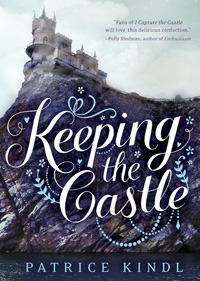
Serena’s Review: “Keeping the Castle”

12871232Book: “Keeping the Castle” by Patrice Kindl
Publishing Info: Viking Childrens Books, 2012

Where Did I Get this Book: the library!

Book Description: Seventeen-year-old Althea is the sole support of her entire family, and she must marry well. But there are few wealthy suitors–or suitors of any kind–in their small Yorkshire town of Lesser Hoo. Then, the young and attractive (and very rich) Lord Boring arrives, and Althea sets her plans in motion. There’s only one problem; his friend and business manager Mr. Fredericks keeps getting in the way. And, as it turns out, Fredericks has his own set of plans . . .

Review: This book has been hanging around on my Goodreads TBR pile for quite a while. Like, years. Between all the new releases and series that I’ve been reading so far, it’s never made its way to the top. Until last month when I was heading out on vacation and realized I had nothing on my Kindle that was particularly calling to me. Not to mention, I’ve been reading a heavy dose of fantasy/sci fi books recently, it was about time I got back to good, old historical fiction. So without further ado, I checked it out and raced through it.

The castle that Althea, her mother, her brother and her two snobby (but rich!) step-sisters live in is falling apart around them. Literally. Pieces of the ceiling pose a danger at any moment and the family must carefully arrange chairs when they have guests over to limit the risk of said chairs caving in from sheer age and decrepitude. Althea knows her duty: to save the castle by marrying well. Luckily, while fortune is not on her side, she does have a good amount of looks. Armed with this and a healthy dose of determination, Althea sets her eyes on their new neighbor, Lord Boring. But can she even get at him when the ever present, ever annoying Mr. Fredericks is always by his side?

From that description alone, you can probably guess the majority of the story. That, or having read/been exposed to any Jane Austen in your lifetime. I’m not leading with this as a criticism of the book (though it did have its downsides, which I’ll get into later), but as a general description of what this book sets itself up to be from the very beginning. There are no illusions of creating a completely distinct work. Instead, the story walks a line between parodying other classic works while also trying to work in a few surprises of its own. Some pieces of this were more successful than others.

Many of the characters had similarities to other stereotypical characters one usually finds in historical romance. Althea was an entertaining blend of Emma from “Emma” and Elizabeth from “Pride and Prejudice.” At her core, she’s a good-willed, smart woman. But she also has a healthy dose of foolishness that leads to all of the some-what expected shenanigans one could hope for from a light-hearted story like this. The two step-sisters were, of course, terrible, each exhibiting comical combinations of idiocy, selfishness, and petty cruelty.

The characters I was a bit more surprised with were Althea’s mother and the two gentlemen who are introduced. The mother was neither foolish nor absent! That alone is kind of shocker for stories like this. Instead, Althea’s mother is a very compassionate character and had her own mini arc throughout the book. As for the men, it’s not a spoiler to reveal that OF COURSE Althea has it all wrong about both of them. But their backgrounds and motivations where different than one might expect. This played to varying success. I liked the evaluation of Lord Boring and the choices he makes, revealing that in some ways, men and women in this time are not all that different.

But, while I liked Mr. Fredericks for the most part, I still struggled a bit with his “change” and the romance between him and Althea. Her frustrations with him are, largely, completely valid. And while he does make up for some his errors, I wasn’t quite convinced that I saw a discernible change in their relationship as the book progressed. Althea just kind of suddenly realizes that she has feelings. But it several of the better traits about Mr. Fredericks haven’t even been revealed! It isn’t a huge complaint, as I still enjoyed their scenes and dialogue together. But I also never really felt the chemistry between them either, which is a problem for a book like this where the romance is key.

As for the plot, like I said earlier, there are a lot of references to plot points from Jane Austen novels and the like in this book. While I enjoyed these for the most part, there were also moments when the book simply felt predictable because of how closely it was following the storyboard of those types of books. There were very few real surprises in here.

But, again, this is a book that one reads for the light, fluffy romance and for the writing style itself. There, the author very much succeeded. She did manage to neatly grasp the way of talking and writing that is common to stories set in this time period, and there were several turns of phrase that had me laughing out loud and highlighting bits.

All in all, it was a very pleasing book. It didn’t push any boundaries or surprise me, but it was just what it claimed to be: a light historical romance with some witty banter.

Rating 7: A fun, easy read, but don’t expect to be surprised or challenged in any way.

Reader’s Advisory:

“Keeping the Castle” is on these Goodreads lists: “Teen novels related to Jane Austen” and “Clean Regency (or around then) Romance Novels.”

Find “Keeping the Castle” at your library using WorldCat!


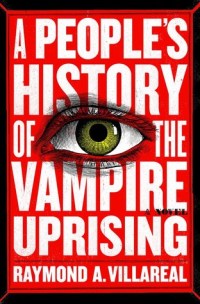
Kate’s Review & Giveaway: “A People’s History of the Vampire Uprising”

36341674Book: “A People’s History of the Vampire Uprising” by Raymond A. Villareal

Publishing Info: Mulholland Books, June 2018

Where Did I Get This Book: I received an ARC from the publisher.

Book Description: A virus that turns people into something somehow more than human quickly sweeps the world, upending society as we know it.

This panoramic thriller begins with one small mystery. The body of a young woman found in an Arizona border town, presumed to be an illegal immigrant, walks out of the town morgue. To the young CDC investigator called in to consult the local police, it’s a bizarre medical mystery.

More bodies, dead of a mysterious disease that solidifies their blood, are brought to the morgue, and disappear. In a futile game of catch-up, the CDC, the FBI, and the US government must come to terms with what they’re too late to stop: an epidemic of vampirism that will sweep first the United States, and then the world.

Impossibly strong, smart, poised, beautiful, and commanding, these vampires reject the term as derogatory, preferring the euphemistic “gloamings.” They quickly rise to prominence in all aspects of modern society: sports, entertainment, and business. Soon people are begging to be ‘re-created,’ willing to accept the risk of death if their bodies can’t handle the transformation. The stakes change yet again when a charismatic and wealthy businessman, recently turned, decides to do what none of his kind has done before: run for political office.

This sweeping yet deeply intimate fictional oral history–told from the perspectives of several players on all sides of the titular vampire uprising–is a genre-bending, shocking, immersive and subversive debut that is as addictive as the power it describes.

Review: I want to extend a special thanks to Mulholland Books for sending me an ARC of this novel.

It’s been awhile since I’ve read vampire fiction. I don’t know if it’s because the pop culture fascination with vampires has waned again and not much has come out, or if I have just been oblivious to what new offerings are out there. But when I saw that “A People’s History of the Vampire Uprising” was about to come out, I was immediately interested by the premise. I liked the book “World War Z” by Max Brooks, which is a similar premise, but with zombies, and was curious to see how such a thing would be done with vampires.

“A People’s History of the Vampire Uprising” feels like an amalgamation of “World War Z”, “The Strain”, and Charlaine Harris’s “Sooki Stackhouse” series, a brew that comes together to make a fairly unique new vampire mythos. We follow a few different perspectives and plot points as the rise of the NOBI Virus is laid out on the page. Once a person is infected with NOBI, they have a fifty fifty chance of transforming into a ‘gloaming’, a being that has gained a longer lifespan and other supernatural abilities, but cannot survive in the sunlight and must feed off of blood. This story postulates less of an immediate vampire apocalypse, and more of a slow shift as they appear to try to integrate into modern society. It’s a more in depth analysis than the “Sookie Stackhouse” books gave, and a bit more cynical as well. Villareal is far more interested in how this kind of shift would affect the laws and civil liberties of modern societies, and he has a number of characters who fall on either side of the gloaming ‘issue’. These characters include CDC Investigator Dr. Lauren Scott, the woman who was on the scene when Patient Zero, Liza Sole, is found along the U.S.-Mexican Border, only to escape into the night. Another is Father John Reilly, a Catholic Priest who is going through his own journey regarding the rise of ‘gloamings’ and how it’s changing society. We also follow Joseph Barrera, a political wunderkid and spin doctor who is approached to run the gubnatorial campaign for Nick Claremont, a gloaming who wants to become Governor of New Mexico, and Hugo Zumthor, and FBI Agent whose field is mostly gloaming issues. Along with various perspective sections with these characters we get newspaper articles, message board posts, transcripts, and interviews that slowly show how NOBI rises and changes society over the course of a few years. My favorite parts were definitely the ones that involved Lauren, as the description of the NOBI virus was fascinating and reminded me of “The Strain” series in the virology of this kind of vampirism.

I also enjoyed the various ethical and philosophical debates that Villareal brings up in this book that have been glossed over in other similar stories. The debates of gloamings being able to have similar rights as humans, and the question of tolerance and equity and how to accommodate for this new population, are addressed and waxed poetic in this book, and the legal and cultural perspectives were in depth and well laid out. I enjoyed that Villareal made it a complex and grey issue, with various likable characters having deep prejudices, but also having fair questions and reservations about gloamings and what their ultimate motivations are. Especially as they start coming into positions of power, and what that power does and what it means for the shared space between humans and gloamings alike. Villareal dives a bit deeper into the legal and policy aspects of this quandary than “World War Z” did in its ‘history’, and while it was mostly fascinating sometimes it felt a little bloated, as did some of the medical aspects that come with the description of the NOBI virus. Because of this, at times I was thinking that it was a bit tedious to get through, though overall it was neat that Villareal went the extra steps into the philosophy behind it all.

Overall I enjoyed reading “A People’s History of the Vampire Uprising”, and it’s a notable contribution to modern vampire lore. You will need to go in expecting a deeper dive than what you usually find in the genre, but ultimately it’s worth taking a look if you are a fan of vampires and vampire mythos.

And good news! I’m giving away an ARC edition of this book! Given that it’s on a number of ‘Hot Summer Book’ lists, this book is bound to be the talk of the town this season!

Enter The Giveaway Here!

Rating 7: A solid tale in the tradition of “World War Z”, “A People’s History of the Vampire Uprising” is a creative new take on the vampire mythology.

Reader’s Advisory:

“A People’s History of the Vampire Uprising” is fairly new and not on many Goodreads lists yet, but it is included on “June Buzz Books”, and I think that it would fit in on “Not The ‘Normal’ Paranormal”.

Find “A People’s History of the Vampire Uprising” at your library using WorldCat!

Kate’s Review: “The Dry”

28220971Book: “The Dry” by Jane Harper

Publishing Info: Flatiron Books, January 2017

Where Did I Get This Book: The library!

Book Description: A small town hides big secrets in this atmospheric, page-turning debut mystery by an award-winning new author.

After getting a note demanding his presence, Federal Agent Aaron Falk arrives in his hometown for the first time in decades to attend the funeral of his best friend, Luke. Twenty years ago when Falk was accused of murder, Luke was his alibi. Falk and his father fled under a cloud of suspicion, saved from prosecution only because of Luke’s steadfast claim that the boys had been together at the time of the crime. But now more than one person knows they didn’t tell the truth back then, and Luke is dead.

Amid the worst drought in a century, Falk and the local detective question what really happened to Luke. As Falk reluctantly investigates to see if there’s more to Luke’s death than there seems to be, long-buried mysteries resurface, as do the lies that have haunted them. And Falk will find that small towns have always hidden big secrets.

Review: I don’t know how I missed “The Dry” by Jane Harper when it first came out. Actually, okay, that’s a lie; I missed it because the title and cover didn’t compel me. Sure, the hype and praise that surrounded it was on my radar, as well as the fact that copies at the library were always on request and being requested by patrons who came to see me at the desk. But I stubbornly and steadfastly stayed away, until I read the plot description of its sequel “Force of Nature”. Given that the plot of that sounds awesome (suspicious misadventures in nature!), and that it was part of series, I was finally convinced to go back and read “The Dry”, so as to fully experience Aaron Falk and his storyline. But given that I am always looking for new mystery series to follow with interesting detective protagonists, I am happy that I finally gave in and decided to give it a chance, stubbornness aside.

tenor1
(source)

While a lot of the mystery series settings I follow are set in America or England, “The Dry” set itself apart immediately by taking place in Australia. Given that I am still desperately missing New Zealand (not that I think they’re interchangeable, mind you, please don’t hurt me, Australia and New Zealand), I was happy to have a story set in Oceania. Australia’s sprawling divide between metropolis vs small town plays a huge part in the story, and set up for a well done ‘small town with secrets’ kind of plot line. Aaron Falk was a fine protagonist to explore this, given that this involves a homecoming to a place that thinks that he’s a murderer. It’s an interesting tweak to the big town detective trying to maneuver in small town politics and society, as Falk knows how it works, and knows that he’s going to be doubly scrutinized with his background. When his old friend Luke’s apparent family annihilation/suicide brings Aaron back for the funeral, the murder of their mutual friend Ellie still lingers, as does the fact that Aaron and Luke were each other’s alibis. So this story has two mysteries: did Luke actually kill his wife, son, and himself, and who actually killed Ellie? The narrative shifts between the present timeline with a third person perspective through Falk’s eyes, and past perspectives through a vaguer third person narration. If that makes sense. It’s not something I’ve seen very often in fiction, and it was interesting getting more information than Falk was getting and seeing how he interpreted the information as it’s fed to him. It makes for a questionable reliability in the storytelling, and I liked being kept on my toes. But while I was kept on my toes, I wasn’t terribly invested in either mystery that was presented. The problem with Ellie’s was that given some of the sad realities of statistics and violence towards women and girls, I didn’t have a hard time guessing the ultimate solution to her fate, and therefore didn’t feel connected to it. And with Luke’s storyline, I wasn’t invested enough in Luke to want to see his name cleared, so while that one did keep me guessing, I didn’t really care too much one way or the other.

Falk himself was just fine as a protagonist, but I think that for me the difference between this series and, say, the Tempe Brennan Series (working as my go to for a series with a re-occurring detective type)  is that Falk hasn’t really established himself as a unique main character I’m interested in just yet. Tempe Brennan is complex and effervescent and snarky, whereas Falk hasn’t been much outside of a falsely accused outsider looking to redeem a friend (and in some ways himself), and brooding accordingly. I do realize that Tempe has had nineteen books to solidify her personality, and that Falk is really just beginning, so I am not holding any of this as-of-now simplicity against him. There are definitely glimmers of promise within him and where he could go, and I want to see how he’s going to grow in future books now that, theoretically, it won’t be as personal for him going forward. I was happy with the supporting cast that Falk got to play off of. I liked his old friend Gretchen, and her loyalty to him even when others thought that he didn’t deserve it. I liked Raco, a local detective who joins up with Falk on an official investigation against the town’s judgmental gaze. But I’m not sure as of now that they are going to remain large parts of the series, as they are still back in the town that Falk is visiting temporarily. Again, comparing it to Tempe Brennan there are familiar faces that work as foils and give Tempe’s life and character uniqueness and interesting interactions. If it’s just Falk going forward with a revolving door of characters,, it could be a missed opportunity for a strong cast of supporting and familiar faces. We’ll just have to see. “Force of Nature” will give me a better idea of what to expect in this way. And lord knows it’s going to be awhile before my number comes up on the request list.

giphy8
Me waiting for “Force of Nature” to end up on the holds shelf…. (source)

So all in all while “The Dry” didn’t blow me away in the fashion that it did to many others, there is a lot of promise going forward. Aaron Falk may not be Temperance Brennan yet, but I have a feeling that he has the potential to join her as a detective in a unique series that I will follow as it moves forward.

Rating 7: A solid mystery with a protagonist that has some potential, “The Dry” didn’t take me in as much as it did others, but it has me interested enough to go onto the next one.

Reader’s Advisory: 

“The Dry” is included on the Goodreads lists “Best Small Mysteries”, and “Australian Bush”.

Find “The Dry” at your library using WorldCat!

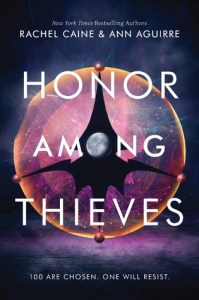
Serena’s Review: “Honor Among Thieves”

30129657Book: “Honor Among Thieves” by Rachel Caine & Ann Aguirre

Publishing Info: Katherine Tegen Books, February 2018

Where Did I Get this Book: bought it

Book Description: Petty criminal Zara Cole has a painful past that’s made her stronger than most, which is why she chose life in New Detroit instead of moving with her family to Mars. In her eyes, living inside a dome isn’t much better than a prison cell.

Still, when Zara commits a crime that has her running scared, jail might be exactly where she’s headed. Instead Zara is recruited into the Honors, an elite team of humans selected by the Leviathan—a race of sentient alien ships—to explore the outer reaches of the universe as their passengers.

Zara seizes the chance to flee Earth’s dangers, but when she meets Nadim, the alien ship she’s assigned, Zara starts to feel at home for the first time. But nothing could have prepared her for the dark, ominous truths that lurk behind the alluring glitter of starlight.

Review: It’s been way too long since I’ve reviewed a sci fi novel on this blog. While I love the fact that YA fantasy fiction is booming, it does make me sad that sci fi fiction seems to have been left on the sidelines for the most part. I mean, you can have just as much fun in space as you can riding around on a horse with a sword! Arguably, more. I’ve also read a few of Rachel Caine’s books in the past, and the book description for this one, of a teenage girl forming a connection with a sentient ship/alien, sounded right up my alley!

So this book was a bit of a roller coaster for me. There were things that I really enjoyed. Things that I wasn’t expecting at all that I quite liked. And other things that kind of knocked me out of the story with too many questions about plausibility and the pacing of the plot.

To start with the things I really liked: the characters. Zara is a great leading lady and the authors walk the line fairly well in keeping with the hardness that has made up her life on the street, the trauma that still exists from her childhood, while also making her sympathetic, and more importantly, believable. Her harshness is well-grounded in past events, and as the story progresses and she forms a connection with Nadim and her fellow shipmate Beatriz, we see her not only begin to open up to those around her but begin to question her own understanding of friendship and loyalty and how damaged some of her past relationships really were.

Nadim was everything I could have wanted from a sentient ship/alien. He was sufficiently “other,” with his own biological quirks and distance from human concepts of gender and other social norms. As the story unfolds, we begin to unravel the mysteries of his species and see in what ways Nadim stands out from the other Leviathan. While his relationship with Zara and Beatriz are at the core of the story, we also see glimpses into the role he plays among his own people and social hierarchies that exist there. I particularly enjoyed the parallels between the Leviathan and whales, especially their unique relationship to sound and music.

Beatriz took me completely by surprise. As you can see in the book description, there is no indication that this isn’t just a Zara/Nadim story. Instead, the Honors program is set up to send two cadets into space with their own Leviathan, and Beatriz is Zara’s crew mate. We all know how much I love sisterhood/girl friendship stories, so I was thrilled when I realized that’s what was being set up here. What’s more, Beatriz is an excellent contrast to Zara. Originally, she struggles much more with the vastness of space and the otherness of Nadim. But she also brings unique strengths to the crew with her abilities as a pilot and masterful singing voice. What made this all the more interesting was the idea that while Zara and Nadim have a special connection, it is by no means the only connection that matters. Beatriz, too, is just as much a needed and valued member of this team. It really is more of a three-way relationship than a traditional romance, with each pairing having their own specific connections to each other.

My struggles with this book had a lot to do with the first third of the story. The pacing seemed off for much of the beginning, with Zara rushing through several different set pieces and action scenes before finally landing herself with Nadim. We have her on the streets! Then she’s caught! Now she’s in a facility! Now she’s famous! Finally out to space! It all zips by in only a few chapters. I get that the authors wanted to get to the good stuff, but the story might have been served better had these things been told in flash backs. As it stands, I felt off balance for the entire first third and had a hard time really connecting to the characters and the story because it was too busy jumping from one thing to another.

My other criticism also comes from this first bit and it’s a straight out plausibility issue. Again, I get that the authors wanted to get Zara to the ship as fast as possible and for her to go through most of her character growth through her experiences there. However, the way it is set up, we’re supposed to believe that all training and preparation for the Honors takes place over a single week. And that somehow, after that, they’re ready to go out on a year-long mission and manage complicated scientific and mathematical equations during their work. The way the Honors are chosen makes this even worse. It’s not like they’re coming from a pool of candidates who have all had rigorous training up to this point and could theoretically be made ready with a short turn around. No, this is just a random draw from the entire population and Zara herself has been living on the streets for years, with no education to speak of.

I would always have a problem with this set up, and it’s just made worse by the story its serving. I LIKED the science and action in this book. It’s a true science fiction story with discussions of the equations needed to pilot in space, the knowledge of natural science needed to explore new planets, and the machinery skills necessary to maintain a ship. But with each moment when these skills were necessary for their survival or the completion of a task, I was reminded of how impossible it would be for Zara and Beatriz to have learned any of this in only one week. So each time it came up, I was thrown out of the book. Again, maybe flashbacks to a longer training time period would have helped this. All I really needed was something saying that, say, even 6 months went by with blah blah boring training blah. Great! Now I can buy it! But as it stands, I had a real problem with it.

But those things aside, I still very much enjoyed this book. It reminded me of how awesome books in space can be, and it fully capitalized on the concept of a living spaceship forming a connection to its pilots. The action was suspenseful and varied, and the mysteries about the Leviathan that were answered and that still remain are enough to keep me reading. Plus, one can hope that now that we’re through the first book, in a second outing, I’d have less problems with their skill sets since maybe they just picked things up what with their time on the ship. If you like science fiction and are able to turn your brain off a bit, this is definitely one worth checking out!

Rating 7: Plausibility issues aside, I thoroughly enjoyed this story of teenagers in space with a living ship!

Reader’s Advisory:

“Honor Among Thieves” is a newer title, so isn’t on many relevant Goodrads lists, but it is on  “Teenagers . . . IN SPACE!”

Find “Honor Among Thieves” at your library using WorldCat!

Serena’s Review: “Song of Blood and Stone”

36347830Book: “Song of Blood and Stone” by L. Penelope

Publishing Info: St. Martin’s Press, May 2018

Where Did I Get this Book: ARC from the publisher

Book Description: Orphaned and alone, Jasminda lives in a land where cold whispers of invasion and war linger on the wind. Jasminda herself is an outcast in her homeland of Elsira, where her gift of Earthsong is feared. When ruthless soldiers seek refuge in her isolated cabin, they bring with them a captive–an injured spy who threatens to steal her heart.

Jack’s mission behind enemy lines to prove that the Mantle between Elsira and Lagamiri is about to fall nearly cost him his life, but he is saved by the healing Song of a mysterious young woman. Now he must do whatever it takes to save Elsira and it’s people from the True Father and he needs Jasminda’s Earthsong to do it. They escape their ruthless captors and together they embark on a perilous journey to save Elsira and to uncover the secrets of The Queen Who Sleeps.

Thrust into a hostile society, Jasminda and Jack must rely on one another even as secrets jeopardize their bond. As an ancient evil gains power, Jasminda races to unlock a mystery that promises salvation.

The fates of two nations hang in the balance as Jasminda and Jack must choose between love and duty to fulfill their destinies and end the war.

Review: I was super excited when I received this in the mail. For one, look at that gorgeous cover? I’m not usually a fan of covers with models, but I’ll make an exception for this one. Beyond that, I was intrigued by the premise and am always stoked when I can find fantasy fiction featuring a diverse cast of characters. And while there were some slower moments, overall, I really enjoyed this read!

The world is literally split in two by an impenetrable magic force field that has kept two warring civilizations separate for as long as anyone can remember, with only brief breaks of warfare every few centuries when the field falters. On one side, Elsira, a technologically advanced civilization has risen, longing for the day when their sleeping Queen will again awaken. On the other side, Lagamiri, a nation full of magic wielders who can control the elements, but who are ruled by a tyrannical and vicious God King. The prejudices are strong on each side. Jasminda, a daughter of both races, has grown up in a country where her skin marks her as the enemy, as an Earthsinger. She’s kept to herself these long years, finding isolation to be her best bet for a quiet life. That is until she meets Jack, an Elsiran soldier with his own secrets, but who also shows her that there are those out there who see her as more than just an “other.”

I loved the world-building in this story. The idea of magic users vs. technology isn’t anything new, but what really added to this take on it was combining it with other prejudices, on both sides, and the fear and ignorance that can come from these sorts of long-standing built up generalizations about people. Throughout the story, we are also given glimpses into the ancient history of this world, and this is really what solidified the concept for me. Through these, we see that the world wasn’t always this way, and in fact many things had been turned on their heads. The origin story was compelling and each chapter was intro’d with little parables from this almost forgotten time. I particularly enjoyed how each parable loosely connected to the happenings of each chapter.

Through this history and the current situation, Jasminda and Jack both portray different roles and experiences of segregation and prejudice. Jasminda has lived a life of not belonging. She’s grown up in a country that judges her for her skin color and her power, but it is her home. I enjoyed how much this fact was hit home. Just because she looked like those on the other side of the wall, didn’t mean she would be any more welcome there or that that should in any way be her place, based on only one part of her being. Jack, as an advocate and an example of a more tolerant and enlightened individual, still must learn to understand the true battles that those like Jasminda face. His idealism is often based in naivety. But through him, Jasminda, too, learns that not everyone is as they seem, and that there may be a way forward for both peoples together.

The story also had a strong through line on the experiences of refugees, and the terrible choices they face. Here, many Lagamiri secretly cross the border, hoping to escape the terror that is their homeland. This choice isn’t only leaving behind all they have known, but is to willing walk into a country knowing they will face a different kind of persecution there. They live in camps and face many injustices at the hands of a struggling nation looking for someone to blame. And yet, this is still a better choice than the horrors that wait back home.

For all of these positives, I did struggle with a few things. While the story took on some big concepts, giving detailed focus and attention to these challenges, I never quite felt connected to the story. Jasminda and Jack, while interesting protagonists, were each a little too perfect to feel real. They were just kind of…fine. I wasn’t hugely invested in their individual struggles, but happy to go along for the ride.

The story also isn’t helped out by a few strange choices with pacing and explanations for the magic system. The plot would zip through a few key moments, with very little clarity on what was actually taking place, and then suddenly move very slowly through other, more character-driven scenes. I think this is likely a show of where the author’s true interests and talents as a writer lie, but it makes for a rather bumpy reading experience.

Also, at different times, it felt like distances on the map changed drastically, or didn’t match with the expanse of the world that we’re told exists. It seemed, at times, that the entire country could be traveled in only a few hours, which doesn’t make sense given the references to geographical elements and the population that is hinted at. Further, while the magic system was interesting, I struggled to understand how it actually worked. For example, it was referenced several times that Earthsingers couldn’t kill with their magic, but could use the elements in every other way. But what does that actually look like? If they sent fire at someone, wouldn’t that still be killing with their magic? Or does it do nothing, and if that’s the case, then what power does that actually give them? I found it confusing, especially given the fact that this restriction was referenced more than once.

The romance, kind of like the two main characters, was also a bit too perfect. For all of theirs struggles, Jasminda and Jack’s love is never really the complicated or tragic “Romeo and Juliet” story that we’re promised. I enjoyed the romance, don’t get me wrong, but I think the misleading description played against it, in the end.

All in all, I very much enjoyed “Song of Blood and Stone.” It’s a great example of fantasy fiction tackling bigger topics like diversity, prejudice, and the challenges faced by refugees. However, there is a large focus on romance, so readers who don’t enjoy those elements might want to avoid this one, and the characters are also a bit flat.

Rating 7: Even with some missteps, would still recommend it based on the strengths of the challenges it addresses, especially set against an interesting fantasy backdrop.

Reader’s Advisory

“Song of Blood and Stone” can be found on these Goodreads lists: “Non-Caucasian Protagonists in Science Fiction, Fantasy, Horror, and Paranormal Romance” and “Fantasy Romance.”

Find “Song of Blood and Stone” at your library using WorldCat!