Book Club Review: “My Invented Country”

16528We are part of a group of librarian friends who have had an ongoing bookclub running for the last several years. Each “season” (we’re nerds) we pick a theme and each of us chooses a book within that theme for us all to read. Our current theme is “Around the World”, in which we each picked a continent and had to match a book that takes place there and/or is written by an author from that continent.

For this blog, we will post a joint review of each book we read for book club. We’ll also post the next book coming up in book club. So feel free to read along with us or use our book selections and questions in your own book club!

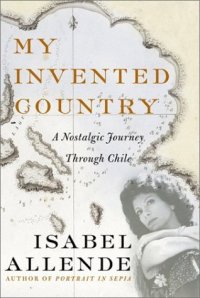
Book: “My Invented Country: A Nostalgic Journey Through Chile” by Isabel Allende

Publishing Info: Harper, May 2003

Where Did We Get This Book: Kate owns it;

Continent: South America

Book Description: Isabel Allende’s first memory of Chile is of a house she never knew. The “large old house” on the Calle Cueto, where her mother was born and which her grandfather evoked so frequently that Isabel felt as if she had lived there, became the protagonist of her first novel, The House of the Spirits. It appears again at the beginning of Allende’s playful, seductively compelling memoir My Invented Country, and leads us into this gifted writer’s world.

Here are the almost mythic figures of a Chilean family — grandparents and great-grandparents, aunts, uncles, and friends — with whom readers of Allende’s fiction will feel immediately at home. And here, too, is an unforgettable portrait of a charming, idiosyncratic Chilean people with a violent history and an indomitable spirit. Although she claims to have been an outsider in her native land — “I never fit in anywhere, not into my family, my social class, or the religion fate bestowed on me” — Isabel Allende carries with her even today the mark of the politics, myth, and magic of her homeland. In My Invented County, she explores the role of memory and nostalgia in shaping her life, her books, and that most intimate connection to her place of origin.

Two life-altering events inflect the peripatetic narration of this book: The military coup and violent death of her uncle, Salvador Allende Gossens, on September 11, 1973, sent her into exile and transformed her into a writer. The terrorist attack of September 11, 2001, on her newly adopted homeland, the United States, brought forth from Allende an overdue acknowledgment that she had indeed left home. My Invented Country, whose structure mimics the workings of memory itself, ranges back and forth across that distance accrued between the author’s past and present lives. It speaks compellingly to immigrants, and to all of us, who try to retain a coherent inner life in a world full of contradictions.

Kate’s Thoughts

I am sorry to say that while Isabel Allende has been on my reading list for a long time, I haven’t actually picked up any of her novels. So “My Invented Country” was my first interaction with her as an author. In terms of the history of Chile, I did have a small familiarity with the Pinochet government/dictatorship, as in high school we learned about him. But all of my experience reading about him was through an American lens, which is problematic enough on its own without even adding in the fact that the CIA was the one to help put him into power in the first place. So I went into this wanting to get familiar with Allende, and to see a perspective on Pinochet through a Chilean’s eyes.

“My Invented Country” is a collection of recollections of Allende’s childhood in Chile, and what her life was like when she had to flee after Pinochet came to power. She also makes a lot of connections to how her childhood influenced her books, with a lot of references to “The House of the Spirits”. Given that I haven’t read her other books, I didn’t feel like I was getting as much from this book as one who had read them might have. Along with that, it took a long while to actually get to the information about Pinochet and what that dictatorship did to the country. By the time we did get to that, however, I really liked seeing her insights and how complicated it was in society, and even within her own family. And it’s undeniable that Allende’s writing is gorgeous. The way she described the people in her life, the people in Chile, the landscapes and settings, I felt like I was there and getting a full view.

So while I probably didn’t get as much from “My Invented Country” as I might have, it has encouraged me to actually pick up some of Allende’s books in the near future.

Serena’s Thoughts

I have to echo a lot of what Kate already said. I had heard of Allende before, but of all the subgenres of fantasy, “magic realism” is probably my least preferred. So while her books have been on my radar for a while, I’ve never actually gotten around to reading any of them. And, like Kate said, that might have helped my reading experience with this.

In many ways it was clear that Allende was directing this book almost exclusively to her fans. There were a lot of references to her previous books, and this type of insider knowledge is just the sort of information I would gobble up if one of my favorite fantasy authors wrote a biography of this sort. It was also clear in the overall tone of the book. The writing was often light and witty, obviously tailored to be appealing to even the most strident “only fiction” readers out there who may be new or less used to memoirs. I think she was very successful in this regard, as I would fall in that category of readers who rarely picks up memoirs, and I found her writing to be very engaging.

On the other side of that coin, however…I also know very little about Chilean history, and I had been looking forward to learning more. Like Kate said, it takes quite a while to really get into the more informative aspects of the story, and here the writing style worked a bit against what I was looking for. She had some very good insights here and there, but all too often the actual deeper analysis of the time, people, and political upheaval was only briefly skimmed over. She would often continue to throw in the light, airy commentary amidst all of this. And while still entertaining, I was left wanting more.

Overall, while this may have not been the best introduction to Allende’s work, it did confirm that I enjoy her writing style itself. Her books will remain on my reading list, and I hope to get to one of them soon!

Kate’s Rating 7: Her writing is gorgeous and I really liked the information about the rise of Pinochet, but having not read other books by Allende I feel like I didn’t connect as much as I could have.

Serena’s Rating 7: Struck an awkward balance between a great writing style but one that seemed to, at times, work against the more informative take on the country and times that I was looking for.

Book Club Questions

  1. Had you read anything by Isabel Allende before reading this book? Did you see the connections that she made between her life and her other writings?
  2. How familiar were you with the history of Chile before reading this book? Did you feel like you got a sense of the history and the people who live there? Why or why not?
  3. What kinds of parallels can you draw between Allende’s childhood and your own childhood?
  4. Did this book make you want to visit Chile someday? Why or why not?
  5. Allende talks about moving from one place to another, and how having two homes an sometimes make you feel like you don’t quite fit in perfectly in either. Have you ever experienced anything similar?
  6. If you haven’t read anything else by Allende, did this book make you want to explore her bibliography more?

Reader’s Advisory

“My Invented Country” is included on the Goodreads lists “Chilean Literature”, and “South America: History and Culture”.

Find “My Invented Country” at your library using WorldCat, or a local independent bookstore using IndieBound!

Next Book Club Book: “Picnic at Hanging Rock” by Joan Lindsay

Kate’s Review: “The Silence of Bones”

44280973Book: “The Silence of Bones” by June Hur
Publishing Info: Feiwel & Friends, April 2020

Where Did I Get This Book: I own it.

Book Description: I have a mouth, but I mustn’t speak;
Ears, but I mustn’t hear;
Eyes, but I mustn’t see.

1800, Joseon (Korea). Homesick and orphaned sixteen-year-old Seol is living out the ancient curse: “May you live in interesting times.” Indentured to the police bureau, she’s been tasked with assisting a well-respected young inspector with the investigation into the politically charged murder of a noblewoman.

As they delve deeper into the dead woman’s secrets, Seol forms an unlikely bond of friendship with the inspector. But her loyalty is tested when he becomes the prime suspect, and Seol may be the only one capable of discovering what truly happened on the night of the murder.

But in a land where silence and obedience are valued above all else, curiosity can be deadly.

June Hur’s elegant and haunting debut The Silence of Bones is a bloody tale perfect for fans of Kerri Maniscalco and Renée Ahdieh.

Review: Book buying is my version of retail therapy, so you can imagine that lately I’ve been doing a lot of it. While I mostly decide to get print books I can hold from local booksellers, on occasion I will snag something for my Kindle, to save space on my physical shelf and to get some instant gratification as well. “The Silence of Bones” was that kind of scenario, as I had heard of it on and off various book circles online and was interested to check it out and just have it at the ready. I finally dove in over the weekend as chaos and unrest overtook the Twin Cities, needing moments of escape to a completely different place. 19th Century Korea seemed like the perfect place to visit, so “The Silence of Bones” by June Hur was the right book to pick up.

What struck me most is the time and place of this YA mystery thriller. While you can find oodles of historical mysteries that take place in the U.S., or Europe, or other Western cultures, I’m not as aware of the genre branching out to other parts of the world that often. That very well just may be my own levels of exposure to such things, but because of this “The Silence of Bones” felt incredibly unique to me. I know so little about Korean history that I felt like I was learning a lot as I was following Seol as she tried to solve a series of murders as she works as an indentured servant for the police. The descriptions of the urban settings and rural settings alike were vibrant and detailed, and I felt like I could picture the places in my mind and got a good sense for how the society was structured. June Hur clearly did her research, and it really paid off. I especially liked the way that geopolitics of the time entered into it, with hints and whispers of Western Influences starting to move in no matter how local Governments try to stamp them out, sometimes in extreme and violent ways. The sense of impending threat from Catholicism, and the actions taken towards Catholics and other Western traditions, was a very fascinating angle to throw into this story, as knowing what we know about Imperialism in that part of the world now (and other parts not addressed in this book) there was a lot of nuance to parse through.

I also just really liked Seol as a protagonist and the mystery at hand. Seol definitely felt like a sixteen year old girl, even though she was living in incredibly difficult and different circumstances than one sees for sixteen girls in YA today. Her story addresses indentured servitude, the oppression of lower classes, misogyny, and trauma, and her perseverance (and at times stubbornness) was really satisfying to read. Being taken from her home and losing everything to go serve as an indentured servant is quite the backstory, and I really liked it. She sometimes makes mistakes and jumps to conclusions, which makes her all the more real and complex, but overall you can’t help but really want her to figure out what is going on, especially when she begins to find herself in danger. The mystery of who killed a local noblewoman is very well crafted, and Hur throws in a lot of twists and turns that keep the reader wondering and on their toes. There is also the mystery of what is up with Seol’s boss, Inspector Han, who Seol is drawn to and forms a friendship with before he becomes a suspect in the mystery. Han feels like he is steeped in a lot of greys, and I was genuinely on the edge of my seat wondering if Seol’s faith in him is unfounded. By the time everything comes together, you can trace how it does so and it is done seamlessly.

“The Silence of Bones” is a unique and thrilling mystery, and if you like historical mysteries I cannot recommend it enough!

Rating 7: A unique and fascinating historical mystery in a not as seen setting, “The Silence of Bones” has a lot to offer to fans of YA mysteries!

Reader’s Advisory:

“The Silence of Bones” is included on the Goodreads lists “Historical Fiction: Korea”, and “2020 YA/MG Books with POC Leads”.

Find “The Silence of Bones” at your library using WorldCat, or a local independent bookstore using IndieBound!

Serena’s Review: “The Will and the Wilds”

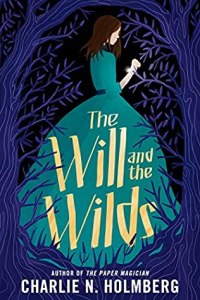
44646004._sy475_Book: “The Will and the Wilds” by Charlie N. Holmberg
Publication Info: 47North, January 2020

Where Did I Get this Book: NetGalley

Book Description: Enna knows to fear the mystings that roam the wildwood near her home. When one tries to kill her to obtain an enchanted stone, Enna takes a huge risk: fighting back with a mysting of her own.

Maekallus’s help isn’t free. His price? A kiss. One with the power to steal her soul. But their deal leaves Maekallus bound to the mortal realm, which begins eating him alive. Only Enna’s kiss, given willingly, can save him from immediate destruction. It’s a temporary salvation for Maekallus and a lingering doom for Enna. Part of her soul now burns bright inside Maekallus, making him feel for the first time.

Enna shares Maekallus’s suffering, but her small sacrifice won’t last long. If she and Maekallus can’t break the spell binding him to the mortal realm, Maekallus will be consumed completely—and Enna’s soul with him.

Review: I read “The Paper Magician” by this author a few years back. It was a simple, straight-forward, enjoyable little fantasy story that I quite enjoyed (though I haven’t gotten around to reading any of the other books in the series). But when I came across this title by the same author, I was excited to see what looked like a new fairytale story. It’s always refreshing to find something that isn’t a retelling and the element involving the exchange of souls between the main characters was intriguing.

Enna has always yearned to study mystings that roam the wildwood near her home. But they are as dangerous as they are mysterious, so much of her time is spent instead on warding her home against them in an attempt to protect her and her father from the viscous death her mother suffered when Enna was just a baby. Soon enough, however, she finds herself tangled up with a mysting named Maekallus, a powerful being who steals the soul with a kiss. Now, entwined in a deal that is dooming them both, Enna and Maekallus must unravel the secrets of an enchanted stone Enna’s father stole from the mystings long ago and that may be more powerful than Enna ever imagined.

Like “The Paper Magician,” this was another sweet, little story. There wasn’t anything particularly challenging or unique about the story itself. The world-building was pretty straight-forward. And the characters were all likable. Putting it all together it sounds like I’m criticizing the book for being bland, but I think that a story such as this has just a much a place on most readers’ shelves as even the most complex and deep stories do. While I may not have found myself blown away by any aspect of it, the entire experience of the story was like sinking into a nice warm bath with some low level candles flickering. It was comfortable and safe, something that is even easier to appreciate in times such as this when frankly all I want to do is re-read comfort books all day long.

The most intriguing part of this story was around the idea of the soul and what it provides to those who possess it. Enna, a human girl, naturally goes about life never questioning the role her soul plays in her existence. But when she meets Maekallus and enters into a sort of transactional agreement with him that sees her slowly losing pieces of her soul, we begin to see what it costs her. And, conversely, what Maekallus lacked before gaining pieces bit by bit. The romance between the two is accordingly a slow burn love story.

I will say that there were points in the middle of the book where the plot began to feel a bit repetitive and meandering. There isn’t a whole lot of fast-paced action in this story, and some of the conflicts, such as they are, feel relatively low stakes and don’t add much tension to the proceedings. The main plot line, of course, has some action to it. But as that takes part mostly in the beginning and end of the book, there are some side quests in the middle that don’t seem to add a lot. I also felt like the main confrontation at the end of the  book was fairly anticlimactic, all things considered.

But, like I said, the love story was sweet and our two main characters were interesting enough. If one is looking for a quick fairytale fantasy, this is a good go-to. But if you’re looking for anything of the more “epic” or grand variety, this isn’t going to do the trick. It’s definitely a “right mood” kind of book, and I think I was in it when I read it. Objectively, I think it was probably a bit slower and less developed than it could be, though.

Rating 7: A nice little story, but not one that is pushing any sort of boundaries.

Reader’s Advisory:

“The Will and the Wilds” isn’t on many relevant Goodreads lists, but it is on  “slow-burn romance.”

Find “The Will and the Wilds” at your library using WorldCat!

Serena’s Review: “The City We Became”

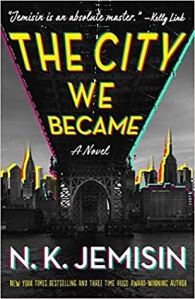
42074525._sy475_Book: “The City We Became” by N.K. Jemisin
Publishing Info: Orbit, March 2020

Where Did I Get this Book: Edelweiss+

Book Description: Every city has a soul. Some are as ancient as myths, and others are as new and destructive as children. New York City? She’s got five.

But every city also has a dark side. A roiling, ancient evil stirs beneath the earth, threatening to destroy the city and her five protectors unless they can come together and stop it once and for all.

Review: I’ve been a fan of Jemisin’s since years ago when I first read “The Hundred Thousand Kingdoms.” But my love for her didn’t really set in until after I read the “Broken Earth” trilogy. Those books blew me away with the sheer scope of imagination and dexterity of language that were required to pull off such a feat. With those in mind, I went into this book knowing that if anyone could handle the strange set-up that was offered in the book description, it would be Jemisin. And she definitely does! Sadly, this book didn’t hit quite the same mark as the others of hers that I’ve read, but I suspect much of that is just down to my own reading preferences.

Birth is a painful, messy business. It can be as frightening as it is beautiful. A city’s birth is no different, especially for one such as New York City, a behemoth whose very soul can’t be contained in one vessel. Instead, when things begin to go wrong as NYC strives towards its own new life, five individuals are selected to represent the myriad of faces and lives that make up this one spirit. Together they must become the protectors the city needs and fight off a great evil that threatens this new life.

Even though this book wasn’t the huge hit for me that I was hoping for, there is still a lot to praise it for. As always, Jemisin’s creativity is without bounds. The idea of great cities developing souls is just fantastic, and the book takes that theme and runs with it into some crazy and unexpected places. The strength of writing needed to make some of these completely foreign fantasy elements make sense is mind boggling, and it’s here that Jemisin has always shined. There were a bunch of lines that not only jumped off the page, but more so slammed into my unprepared mind with all the beauty and shock of a firework. It was truly impressive.

Part of my struggle, however, also had to do with the writing. Not so much maybe the writing, but the way that it was so clearly an homage to New York City and the many cultures made up within that huge city. I’ve only visited NYC on one frantic, 24 hour period visit. So I know very little about the actual city itself. And for a book so focused on the heart of this city and the pieces that make it unique and tick, I was often left feeling like I was an outsider looking in. Many of the stronger pieces of writing I could see objectively as great, but I couldn’t connect to personally as it was so clearly talking about a specific place and people that I personally don’t know much about. And, unlike most second world fantasy where all readers are “newbies” learning about a world they don’t understand, this was clearly written to some extent with the idea that readers would know and connect to some of these elements, without the book itself needing to do that extra legwork. So, in this way, some of the mileage of this book might depend on the reader’s own familiarity, and to a lesser extent, interest, in New York City itself.

I also had a hard time feeling truly connected to many of the POV characters. The story starts off quite quickly and doesn’t spend much time laying out many details for readers. In some regards, this is a staple trick of Jemisin’s and one can have faith that the answers will come eventually. They do here as well. But this trick then depends on the reader connecting to and investing in the main characters themselves early on to carry one through until plot details begin to clarify. I’m not sure quite what the problem was here for me. Perhaps there were just too many characters, and combining that with the slow moving pieces of putting the plot together, was just too much.

Jemisin is also well-known for putting diverse characters first and foremost in her books, often strong women of color. And here, too, the cast is diverse across all kinds of lines. But there were also moments where I felt like the message (for lack of a better word) was a bit more hamfisted here than the incredibly powerful observations and mirrors that were held up in her previous works.  Really, it felt in some ways like this entire book was a bigger statement (particularly in response to the Lovecraft stuff that has pervaded SFF for so long) that the author needed to get out into the world.  And that’s a good thing! But it also, again, left it a bit harder for me to fully sink into this book as a reading experience.

Overall, I think this book is incredibly powerful and highlights again the strength of Jemisin’s skill as an author, both in her masterful world-building as well as just the strength of her writing. That this one didn’t really hit home for me could, in part, simply be due to my own lack of knowledge of (or real interest in) NYC itself. But for those with a stronger connection to that city, I’m sure some of these elements in particular will strike a much stronger chord. Fans of Jemisin’s work should definitely still try this out and those looking for an urban fantasy novel that breaks the mold for what urban fantasy typically offers are sure to be intrigued!

Rating 7: Incredibly unique with a widely diverse cast, but it was a bit harder to become invested in than other works by this author.

Reader’s Advisory:

“The City We Became” is on these Goodreads lists: “Adult Sci-Fi/Fantasy Releases of 2020” and “SFF Set in Global Cities (No YA).”

Find “The City We Became” at your library using WorldCat!


Serena’s Review: “The Cerulean Queen”

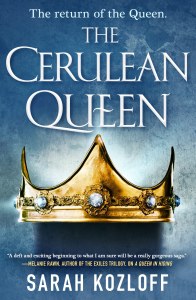
45046550Book: “A Cerulean Queen” by Sarah Kozloff

Publishing Info: Tor Books, April 2020

Where Did I Get this Book: from the publisher!

Book Description: The true queen of Weirandale has returned.

Cerulia has done the impossible and regained the throne. However, she’s inherited a council of traitors, a realm in chaos, and a war with Oromondo.

Now a master of her Gift, to return order to her kingdom she will use all she has learned—humility, leadership, compassion, selflessness, and the necessity of ruthlessness.

Previously Reviewed: “A Queen in Hiding” and “The Queen of Raiders” and “A Broken Queen”

Review: Well, we’re finally here. “Finally” being the debatable word. Yes, it’s been a full four months of reading to get to this point, but also no, because we’re getting the last book in an epic fantasy series within, again, only four months since the first book came out! I get that not many authors write in a way that would make this type of publication style an option, but I do love me some binging in pretty much any media format! This final book successfully ties up a lot of loose strings while also going into details that I hadn’t expected. Overall, it’s a satisfying conclusion to this series.

After years and years, Cerulia has finally returned home and reclaimed the throne that was hers. But what should be a celebration soon turns into one conflict after another. Fighting her own doubts about the role of monarchy in her country, Cerulia must also contend with a council whose loyalties remain unclear, a war, and the general upheaval of a country that has quickly experienced big changes. With the future before her, now is the time for Cerulia to step up and establish what type of ruler she wants to be.

Overall, I was satisfied with this conclusion to the story. At this point, after three fairly long books, I’m pretty invested in Cerulia’s story. I’ve also highlighted that the villains have often been complex and well-realized and that carries over here in the end. Between Cerulia herself and these interesting antagonists, I remained interested in the story even when it took a few turns I wasn’t expect. For example, Cerulia gets her throne back very fast. Like, super fast. The majority of this story is then spent with her figuring out how to rule, weeding out the traitors from around her, and dealing with the tremulous state of a realm that isn’t quite sure how it feels about aristocrats anymore. To be fair, the book description itself hints at these points being a big part of the story, but for some reason my brain was still expecting more on the front end of things with her actual struggle to regain the throne. I’m not saying it went a bad route with how this was dealt with, just an unexpected one.

For the most part, I did very much enjoy the turn towards the ins and outs of what ruling would really be like for a newly established queen who’s living in a court full of people who may or may not have supported the previous ruler. I enjoy political fantasy often, so I found this aspect of the story to be interesting, especially when paralleled with the general state of uncertainty that the entire kingdom now faces with regards to its monarchy. Cerulia’s challenges operate on the micro and macro levels. The author also wisely paces the story between action scenes and emotional moments to ensure that the story never lags.

There were times, perhaps, when it became a bit predictable with Cerulia’s decisions always turning into the correct ones. But I’m not sure what else could really be done at this point; it is a last book in a series, and a series that has devoted quite a lot of time to the development of Cerulia’s decision-making. She should be doing well by this point and, while a long wrap up, a wrap up this book is. We don’t want added mysteries and conflicts at this point.

I did have a few quibbles with the end of the book, as, strangely, it was here that I felt the pacing did seem to stutter a bit. For a series that had such a strong opening chapter, I wanted a bit more from the final pages of this book. But, in the end, I was very satisfied with this conclusion to the series! And don’t forget to check out our giveaway for this book!

Rating 7: A satisfying end to a wild ride over the last four months!

Reader’s Advisory: 

“The Cerulean Queen” is a newer title so isn’t on any Goodreads lists other than “Upcoming 2020 SFF with female leads or co-leads.”

Find “The Cerulean Queen”at your library using WorldCat!

Kate’s Review: “The Book of Koli”

51285749Book: “The Book of Koli” by M.R. Carey

Publishing Info: Orbit, April 2020

Where Did I Get This Book: I was sent a copy by the publisher.

Book Description: Beyond the walls of the small village of Mythen Rood lies an unrecognizable world. A world where overgrown forests are filled with choker trees and deadly vines and seeds that will kill you where you stand. And if they don’t get you, one of the dangerous shunned men will.

Koli has lived in Mythen Rood his entire life. He knows the first rule of survival is that you don’t venture beyond the walls.

What he doesn’t know is – what happens when you aren’t given a choice?

The first in a gripping new trilogy, The Book of Koli charts the journey of one unforgettable young boy struggling to find his place in a chilling post-apocalyptic world. Perfect for readers of Station Eleven and Annihilation.

Review: Thanks to Orbit for sending me a copy of this novel!

I requested to read “The Book of Koli” in early March. The plot of a post-apocalyptic ravaged world overrun by killer plants sounded both wholly unique and super intriguing, Given that, in general, post-apocalyptic wasteland dystopias are my jam, I was excited to get a book not only about that very subject, but by M.R. Carey, whose works I have mostly enjoyed.

And then the COVID-19 shit hit the fan and it started to feel like we were living in an actual precursor to a post-apocalyptic world.

giphy-1
The timing…. wasn’t great. (source)

I honestly cannot get on board the ‘let’s read all the apocalyptic fiction!’ train that I’ve seen as of late. My husband joked about starting to read our baby “The Stand” and I pretty much yelled at him that he wasn’t and has never been funny. So yeah, the idea of reading this book had me a bit wound up. Anxieties off the charts, I knew that I needed to read this book so I jumped in trying not to think of the doom and gloom of the real world. And what happened next was not at all “The Book of Koli”‘s fault. Extenuating circumstances like whoa made it so I didn’t enjoy this book as much as I thought I would.

But there is a lot that this book has going for it, and I’m going to really focus on that. Because the fact this book didn’t connect as much with me at this moment in time probably has very little to do with the actual content. The first thing that struck me was how Carey was toying with the idea of language, and how the language in this world (a future set England) has changed and evolved over time. It’s not as slang driven as “A Clockwork Orange” does with it’s dystopia, but it tweaks things enough that it’s slightly off, but you know what the characters are trying to say. There is also a bit of toying with the idea of technology and what can happen when it is lost to us, which is implied to have happened with the plants (genetically altered and then out of control) overtook civilization and drove humanity into heavily protected clusters (and allowed some to consolidate power). The first half of this book is the heavy world building to create this world, and to let us as readers get to know Koli as a character and who he is as a character. After he snags some tech from the Ramparts (aka those in charge of the tech) in the town he lives in, he meets Monono Aware, the AI within the tech he takes. Monono and Koli have a fun banter, and through him meeting her he discovers that tech can be wielded by anyone… which would be bad for the Ramparts if that secret got out. Sometimes this section dragged, but overall Carey used his time very well to show us what kind of society/dystopia we are dealing with. And I liked Monono a lot, even if she sometimes felt a little twee.

The second half of the book is after Koli has been banished into the wilderness, in danger of being killed by either killer plants, or roving bands of ‘shunned men’. This is where the book really started to build upon the action and the tension, and this was the part that I enjoyed most even if it was the part that stressed me out the most as well. Carey is no stranger to post-apocalyptic scenarios, and this one feels like he’s thinking outside of the box. He creates enough here that I can definitely see how he’s going to be able to pull enough material from this world and its characters to make a complex and well paced trilogy. I especially liked Ursala, a doctor who Koli meets while he’s still at Mythen Rood. She is the key to Koli starting to learn the truth of things, and her place in the story becomes even more apparent once Koli is out in the wilderness.

As I mentioned above, I had a hard time dealing with a post-apocalyptic story when it feels like we are at the start of our own. I think that it’s really just a matter of timing, as were we not in the middle of COVID-19 I truly believe that I would have been able to get into this story more. So while “The Book of Koli” didn’t connect with me as much as I thought I would, I really do think that that’s on me and not on Carey at all. So if you are one of those people who has been reading “The Stand” or watching “Contagion” in these trying times, and you also like dystopian fiction, “The Book of Koli” will fit the bill SO well. Once all of this is over, I will probably go on to the next book in the series, as I recognize that any of my apprehensions are solely on me during a literal global traumatic event.

Rating 7: While I had a hard time enjoying it as much as I could have in the moment of global pandemic, “The Book of Koli” is fresh and deep dystopic fiction.

Reader’s Advisory:

“The Book of Koli” is included on the Goodreads lists “Sword and Laser Sci-Fi List”, and “Can’t Wait Sci-Fi/Fantasy of 2020”.

Find “The Book of Koli” at your library using WorldCat!

Serena’s Review: “The House in the Cerulean Sea”

45047384._sy475_Book: “The House in the Cerulean Sea” by TJ Klune

Publishing Info: Tor Books, March 2020

Where Did I Get this Book: NetGalley

Book Description: A magical island. A dangerous task. A burning secret.

Linus Baker leads a quiet, solitary life. At forty, he lives in a tiny house with a devious cat and his old records. As a Case Worker at the Department in Charge Of Magical Youth, he spends his days overseeing the well-being of children in government-sanctioned orphanages.

When Linus is unexpectedly summoned by Extremely Upper Management he’s given a curious and highly classified assignment: travel to Marsyas Island Orphanage, where six dangerous children reside: a gnome, a sprite, a wyvern, an unidentifiable green blob, a were-Pomeranian, and the Antichrist. Linus must set aside his fears and determine whether or not they’re likely to bring about the end of days.

But the children aren’t the only secret the island keeps. Their caretaker is the charming and enigmatic Arthur Parnassus, who will do anything to keep his wards safe. As Arthur and Linus grow closer, long-held secrets are exposed, and Linus must make a choice: destroy a home or watch the world burn.

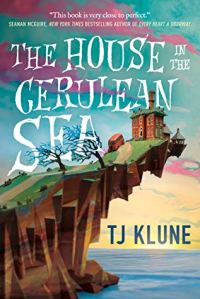
Review: Cover art alert! Cover art alert! Yes, again, I selected a book almost completely based on the cover art itself. I’ve never read any of TJ Klune’s work before, though I believe he was largely a self-published author before the break-out into big publishers with this title. I did see a few references to “The Umbrella Academy” thrown around, so that was the last bit of justification I needed for placing a request for a book just because I thought the cover was pretty! But it is! Look at all of those colors! For some reason, the cover art put me in mind of the covers for “A Series of Unfortunate Events.” Not a bad thing at all, as I enjoyed that series for the most part. In the end, I did enjoy this book quite a bit.

While not ecstatic about life, Linus Baker is quite content with the solitary existence he’s created for himself. A stable job, a small, cozy house, and, of course his beloved cat and records. But this quiet life is suddenly interrupted when Linus finds himself given a peculiar assignment: to travel to a remote orphanage and evaluate the state of things. Once there, Linus discovers six wondrous, but dangerous, children and their charming caretaker Arthur. As Linus learns more about these wards and Arthur himself, he finds himself more and more drawn to this small family, danger and all.

I’m not typically a fan of contemporary fantasy (though I will concede that that’s a pretty catch-all subgenre so my preferences therein aren’t particularly well-defined), but this book was a great opportunity for me push my comfort levels a bit. And it was a bit of a stretch, as the fantasy elements were fairly low, other than our magical children. But they were delightful enough that the parts of me that was missing world-building and magic systems was satisfied enough.

The comparisons to “The Umbrella Academy” (only watched the Netflix show) is very apt, and, similar to story, this one lives and dies on its characters. The collection of bizarre orphans are where Klune’s work really shines. They were all perfect blends of heart-wrenching and heart-warming, misfits and fitting perfectly together, witty but hiding deep emotions behind their words. The dialogue for these character in particular was quite good, and I found myself really speeding through the book once Linus met up with them.

Linus himself was a solid main character and his slowly built relationship with Arthur and the kids was lovely to explore. There was a lot of exploration around themes of found families, trust, and how we judge those around us. The romance was definitely more on the sweet side, and I would say that the book overall would appeal to a varied range of ages from middle grade to adults (a very good thing, as the cover definitely speaks to a younger audience, I think).

There were a few moments where the story did strike me as trying a bit too hard, just a bit too bizarre for its own good. But readers will have different experiences with this, depending on their preferences for fantasy writing and modes of humor. The book was also a tad longer than I would have liked. Most of it read very quickly, but I felt that there were times when Klune was simply having fun with his characters and the book got away from him a bit. I mean, the characters are a blast, so I can easily understand getting carried away with all of these moments, but it did end up with the book having a bit of a bloated feel. Overall, I really enjoyed this book, and fans of contemporary fantasy, found family stories, and ensemble casts of characters are sure to have a blast!

Rating 7: A bit long, a bit silly at times, but its characters were so heart-warming that they carry it through.

Reader’s Advisory:

“The House on the Cerulean Sea” is a newer book so it isn’t on many Goodreads lists, but it is on “Books released in 2020 I’m curious about.”

Find “The House on the Cerulean Sea” at your library using WorldCat!


Kate’s Review: “Saint X”

43782399Book: “Saint X” by Alexis Schaitkin

Publishing Info: Celadon Books, February 2020

Where Did I Get This Book: The library!

Book Description: Claire is only seven years old when her college-age sister, Alison, disappears on the last night of their family vacation at a resort on the Caribbean island of Saint X. Several days later, Alison’s body is found in a remote spot on a nearby cay, and two local men – employees at the resort – are arrested. But the evidence is slim, the timeline against it, and the men are soon released. The story turns into national tabloid news, a lurid mystery that will go unsolved. For Claire and her parents, there is only the return home to broken lives.

Years later, Claire is living and working in New York City when a brief but fateful encounter brings her together with Clive Richardson, one of the men originally suspected of murdering her sister. It is a moment that sets Claire on an obsessive pursuit of the truth – not only to find out what happened the night of Alison’s death but also to answer the elusive question: Who exactly was her sister? At seven, Claire had been barely old enough to know her: a beautiful, changeable, provocative girl of eighteen at a turbulent moment of identity formation.

As Claire doggedly shadows Clive, hoping to gain his trust, waiting for the slip that will reveal the truth, an unlikely attachment develops between them, two people whose lives were forever marked by the same tragedy.

Review: Whenever I hear the phrase ‘missing white woman syndrome’ I immediately think of Natalee Holloway. Holloway was an eighteen year old on a school sponsored trip to Aruba when she went missing. Her disappearance was all over the news, her face practically everywhere even as little new information came up. While her case is technically still unsolved, the general consensus is that she was murdered by a local whose father was a judge, and therefore had a lot of protection (it just so happens the same guy was eventually convicted of murdering another woman in Peru). A very sad and mysterious case all around, and it was all I was thinking of when I read the description for “Saint X” by Alexis Schaitkin. But instead of a run of the mill thriller that takes inspiration from real tragedy for lurid entertainment (I know that I’m one of the people who perpetuates that problematic issue by reading books like that), I instead found a literary thriller that had a lot of deep thoughts and haunting themes.

“Saint X” is less about Alison’s disappearance, and more about the fallout and consequences for those involved with the case, specifically her sister Claire and one of the accused but cleared suspects, Clive. Both Claire and Clive have had their lives completely upended by what happened to Alison. For Claire, it’s the grief and trauma of loss that her family never recovered from, and her obsession of wanting to find out what happened. This is sparked when she sees Clive in New York City. For Clive, being suspected and never officially cleared made his life back on Saint X one of suspicion, and he felt the need to start over and leave it all behind, which meant leaving everything he ever knew and loved. They are both damaged people with one commonality, and Schaitkin really brings out the pain that both of them have been dealing with. Along with these two and their trauma, we also get snippets of other people’s associations with Alison’s death. These bits are left to the end of chapters, and not only shed light into how Alison’s death sent shockwaves through many lives, but how she was as a person before her ill fated trip and during it as well.

Alison herself is a bit more of a mystery, but I thought that that was deliberate and I enjoyed that. We see her through Claire’s eyes, and Clive’s eyes, and the eyes of others. But those eyes can’t really know who Alison was as a person. Even the audio diary entries that Claire finds and listens to don’t quite capture who Alison was, because Alison was still trying to figure all that out. It’s a really interesting way to call out this obsession people get with missing and murdered (usually white and attractive) women, and how we project our own ideas of who they are upon their memory, even if those ideas are totally of the mark. I also liked that what we DO know about Alison is that she is very human, in that she isn’t perfect. Alison is at that tenuous age where she is trying to find herself, and yet still trying to be seen in a certain way by others. She is privileged and naive, and sees the colonizer issue of a resort in the Caribbean, but doesn’t see that her presence, as judgemental of the system as she is, is still perpetuating the problem.

And that was another thing that I liked about this book: Schaitkin definitely takes shots at the resort society on Saint X. It’s an industry that drives the economy, but relies upon a population group that is underprivileged and taken advantage of. Clive is doing his best to support himself and his loved ones, and has to kowtow to wealthy white tourists who see his home as an escape, but doesn’t see the inequities outside of the resort walls. This theme wasn’t at the very front of the story, but it was simmering underneath.

I wasn’t expecting what I got from “Saint X”, in that I was ready for a tense and addictive thriller. What I got instead was a little more ruminative. That isn’t a bad thing, but I will admit that had I known it was more literary I would have probably enjoyed it more. I did enjoy it, but it didn’t grab me as much as I think it would have had I had the expectations it called for. That said, I think that “Saint X” is a worthwhile read. Just go in expecting something more nuanced.

Rating 7: A haunting and evocative literary mystery. It wasn’t what I was expecting. But it’s definitely worth the read.

Reader’s Advisory:

“Saint X” is included on the Goodreads list “Psychological Suspense for 2020 (U.S. Publications January-July).

Find “Saint X” at your local library using WorldCat!

Serena’s Review: “A Broken Queen”

45046564Book: “A Broken Queen” by Sarah Kozloff

Publishing Info: Tor Books, March 2020

Where Did I Get this Book: from the publisher!

Book Description: Barely surviving her ordeal in Oromondo and scarred by its Fire Spirit, Cerulia is taken to a recovery house in Wyeland to heal from the trauma. In a ward with others who are all bound to serve each other, she discovers that not all scars are visible, and dying can be done with grace and acceptance.

While she would like to stay in this place of healing, will she ever be able to leave the peace she has found to re-take the throne?

Previously Reviewed: “A Queen in Hiding” and “The Queen of Raiders”

Review: And we’re back with the third book already! Man, I’m really loving being able to read an entire series like this. In the “My Year with Jane Austen” series I’m writing, I’m getting near to reviewing the 1995 mini series version of “Pride and Prejudice.” It’s excellent for many reasons, but I’ll be honest, a large part of my love for it is simply that it’s nearly six hours long, meaning I can sink into one world with one set of characters for an extended period of time all once. It’s been a similar experience with this series.

Cerulia is badly injured, both physically by the scars left on her body by the flames, but also internally, unsure of her own role as a leader and queen going forward. In the quiet and peace of the healing ward where she is recovering, she is badly tempted to give up her quest of regaining her throne. The path has been harder than she ever thought, but she comes to see her responsibility to her people is greater than her own insecurities and fears. But without an army and with her sister poised to marry the son of her great enemy, Cerulia must work hard to remain free and in a position to challenge Matwyck for her throne.

I actually ended up liking this third book a bit more even than the first two, especially portions in the first half of the book while Cerulia is struggling to find her way again. For an individual who has been in exile for so long, jumping from one place to another, one entire identity to another, it’s no wonder that questions would arise about whether it is worth it and who she really is beneath all of the disguises. Through these reflections, she’s forced to confront her own insecurities and fears. She also come across the tried and true “with great responsibility” way of thinking, recognizing that her own struggles are ultimately not about what she has lost as a princess/queen forced from her home, but in the service of a greater duty to the country that’s been left behind. All of the people who don’t have the option to flee and re-create lives for themselves with the help of magical abilities and a grand heritage.

After this period of reflection, the action picks up again with Cerulia returning home, reuniting with her foster family, and facing the stark reality of the challenges ahead of her on her journey to the throne. There are also some interesting discussions regarding the necessity of a queen at all. It was fun seeing Cerulia go full circle and finally return to her home and her foster family, and it’s a great set-up for the final conflict to come in the last book.

But, with the increased interest I had in Cerulia’s story, I found myself feeling more disconnected from the other characters’ portions of the story. While there have been some moments where these other characters’ perspectives have added strength and context to the story, at this point, as we near the end of the series, their portions felt like more of a distraction than anything. I was always eager to return to Cerulia’s story and found myself more and more impatient with any breaks in the momentum of her plot line.

Lastly, I want to throw out a brief kudos to the cover art for this series! I always like covers that don’t include models, so that was a great start. But mostly I think the understated changes to the crown and how it reflects the action of each story was very clever. The first cover had a crown that was literally hidden behind vines. In the second, we see a crown being consumed by flames, a direct nod to Cerulia’s own perilous experience with fire. And here we have the broken remains of that ordeal, cracked but not destroyed. The final cover, of course, finally brings the crown to it’s completed state: regal and whole, free of damage or concealment. It’s a very simple little theme, but I think it works perfectly for this story.

Only one more month to go until we wrap this all up! In the meantime, make sure to enter the giveaway for a finished copy of “A Broken Queen.”

Rating 8: Poignant reflections on the responsibility of privilege and the definitions of self set a solid foundation for the final book to come.

Reader’s Advisory:

“A Broken Queen” is a newer title so it isn’t on many Goodreads lists, but it is on “Upcoming 2020 SFF with female leads or co-leads.”

Find “A Broken Queen” at your library using WorldCat!

Kate’s Review: “My Dark Vanessa”

44890081Book: “My Dark Vanessa” by Kate Elizabeth Russell

Publishing Info: William Morrow, March 2020

Where Did I Get This Book: I received a print ARC from the publisher.

Book Description: Exploring the psychological dynamics of the relationship between a precocious yet naïve teenage girl and her magnetic and manipulative teacher, a brilliant, all-consuming read that marks the explosive debut of an extraordinary new writer.

2000. Bright, ambitious, and yearning for adulthood, fifteen-year-old Vanessa Wye becomes entangled in an affair with Jacob Strane, her magnetic and guileful forty-two-year-old English teacher.

2017. Amid the rising wave of allegations against powerful men, a reckoning is coming due. Strane has been accused of sexual abuse by a former student, who reaches out to Vanessa, and now Vanessa suddenly finds herself facing an impossible choice: remain silent, firm in the belief that her teenage self willingly engaged in this relationship, or redefine herself and the events of her past. But how can Vanessa reject her first love, the man who fundamentally transformed her and has been a persistent presence in her life? Is it possible that the man she loved as a teenager—and who professed to worship only her—may be far different from what she has always believed?

Alternating between Vanessa’s present and her past, My Dark Vanessa juxtaposes memory and trauma with the breathless excitement of a teenage girl discovering the power her own body can wield. Thought-provoking and impossible to put down, this is a masterful portrayal of troubled adolescence and its repercussions that raises vital questions about agency, consent, complicity, and victimhood. Written with the haunting intimacy of The Girls and the creeping intensity of Room, My Dark Vanessa is an era-defining novel that brilliantly captures and reflects the shifting cultural mores transforming our relationships and society itself.

Review: Thank you to William Morrow for sending me a print ARC of this novel!

I will admit that when Serena handed me the print ARC of “My Dark Vanessa” by Kate Elizabeth Russell and said it arrived for the blog and that it sounded more in my genres, at first glance I agreed. I mean, Stephen King’s blurb was on the cover, so clearly it had to be, right? But then when I read the description of the book, I was suddenly nervous. For one, it sounded more literary than horror or thriller. But hey, I can go outside my usual genres if a book really interests me, right? The bigger issue was what the plot sounded like: a woman has to contend with the fact that her illicit affair with her English teacher when she was fifteen was, in fact, abusive. Heavy stuff to be sure. But I was still very interested, especially as time went on and more buzz began to build around the novel. So I steeled myself, and finally dove in. It’s definitely not a book I’d say is within my usual genres. But I’m still glad that I read it.

“My Dark Vanessa” is a complex and very uncomfortable and upsetting novel about abuse, grooming, rape culture, and coming of age in very hard ways. It’s told through two timelines, both from the perspective of a woman named Vanessa. In 2017 she’s a woman who works at a hotel in hospitality, and is seeing her former teacher, Strane, being swept up in accusations of sexual misconduct with his female students. Vanessa, who was in an illicit relationship (I hate using that term here but am at a loss as to how else to describe it) with him that started at age fifteen, has to contend with the fallout of his downfall, and how that trauma of their ‘relationship’ has affected her after all these years. The other timeline is seeing Vanessa during the time that Strane began grooming her, and seeing how their relationship progressed. Russell is frank and unflinching in how she shows the realities of the sexual abuse that Vanessa experienced at the hands of her teacher, but is also very honest about how Vanessa herself cannot seem to view it as abuse as time goes on, even as other women are coming forward with their experiences with him. I greatly appreciated that Russell was also inclined to explore the very complex feelings that a survivor like Vanessa could feel, being groomed and manipulated for so long and therein not comfortable with seeing herself as a victim, and not wanting to expose herself in such a way. A subplot within the story is that a journalist starts pressuring Vanessa to tell her her story so that it can be put in an article, and heavily implies that Vanessa has an obligation to do so for victims everywhere. I think that it’s VERY important to make that point that victims of sexual abuse have NO obligation to open up about their experiences, and they are allowed to unpack and deal with said experiences in the way that they are most comfortable with.

(This kind of segues into some of the controversy that surrounded “My Dark Vanessa” for a hot minute before its release. HERE is a good article that sums it up. My two cents: I think that there are absolutely important questions to be asked about the publishing industry, and what stories get huge cash advances while other ones get left aside and not as promoted. But I think that it’s really gross that the discourse rose to the point where a survivor felt that the only way to move forward was to out herself as a victim of sexual abuse when she really didn’t want to. And unfortunately, abuse like this is probably more prevalent than we think, and the MOs of the abusers are probably pretty similar. Can we say that it must be plagiarism if it’s an experience that is, unfortunately, more commonplace than we’re comfortable admitting? I really don’t think so.)

I did find this book a little bit bogged down by the narrative as it went on, however, and more just in the sense that it felt longer than it probably needed to be and had some repetitive moments that could have been shaved, or at least tightened. I read it in a timely manner, but it did lag a bit at times, and I would put it down less because of the really hard content but more because of how it kind of felt like it was dragging.

And finally, content warnings abound for this book. There are scenes of rape, scenes of grooming and sexual harassment, and some really heavy and hard themes. This is not a book I would say that I ‘enjoyed’, as it’s greatly upsetting and unsettling, but I do think that Russell has crafted a story that is well done and filled with things that we should be thinking about as a society that has issues with misogyny and rape culture.

“My Dark Vanessa” was a hard read. But it’s one that I think has a lot of important points to make.

Rating 7: A deeply unsettling but engrossing novel, “My Dark Vanessa” tackles some seriously difficult themes but sometimes gets a bit bogged down within the narrative.

Reader’s Advisory:

“My Dark Vanessa” isn’t on any Goodreads lists that I feel really do it justice (“Hot For Teacher”? Seriously?), but I think that it would fit in on “#MeToo”, and “Sexual Assault Awareness Month”.

Find “My Dark Vanessa” at your library using WorldCat!