Book: “The Queen of Attolia” by Megan Whalen Turner
Publishing Info: Greenwillow Books, April 2000
Where Did I Get this Book: the library!
Book Description:Revenge When Eugenides, the Thief of Eddis, stole Hamiathes’s Gift, the Queen of Attolia lost more than a mythical relic. She lost face. Everyone knew that Eugenides had outwitted and escaped her. To restore her reputation and reassert her power, the Queen of Attolia will go to any length and accept any help that is offered…she will risk her country to execute the perfect revenge.
…but Eugenides can steal anything. And he taunts the Queen of Attolia, moving through her strongholds seemingly at will. So Attolia waits, secure in the knowledge that the Thief will slip, that he will haunt her palace one too many times.
…at what price? When Eugenides finds his small mountain country at war with Attolia, he must steal a man, he must steal a queen, he must steal peace. But his greatest triumph, and his greatest loss, comes in capturing something that the Queen of Attolia thought she had sacrificed long ago…
Review: Well, as predicted, I’m well on my to zipping through this entire series well before the publication of the newest book (expected sometime next spring). But I just can’t help myself!
Coming off the strength of the last book, I was very excited picking up this book to discover what new adventures Gen would get himself into next! So I was a bit dismayed when I soon realized that the format of this book has changed from the first. “The Thief” was told from Gen’s first person perspective. This book is not only told from a third person perspective, it also has widened the cast to include chapters from other characters. But I should have had faith! This book was even better than the last, and this change in format is largely responsible for the improvements.
The first person perspective often seems like the more intimate style of storytelling. You’re living fully in a character’s head, so of course readers feel more closely connected to a character written this way. However, as I’ve discussed before, there are also limitations to this type of storytelling. Here we see the strengths of the third person approach. In many ways, it better suits the type of story that Whalen Turn is trying to tell. After pulling the rug out from under readers the way she did at the end of the first book, the author couldn’t use the same trick twice. We all know how clever Gen is and won’t be fooled again! Or will we…
A third person perspective and the increased use of other characters allowed the plot to become that much more intricate, especially given the shift in tone that this story takes. The first was largely an adventure/heist story. This is political intrigue, and very smart political intrigue at that. Often in YA, political intrigue seems to be dumbed down to such an extent that you can barely call it “intrigue.” Not so here. And the added character perspectives, most notably, those of the Queen of Attolia, add so much to this broadened take on the relationships between our main characters and the countries they rule.
I can’t say enough how impressed I am with the tale that was built for the Queen of Attolia (the character, not to be confused with the title of the book itself!). After the first book, I had her comfortably slotted into the “evil queen” character type and nothing more. Low and behold, Whalen Turner had miles more of character development in store for her.
And, of course, I can’t end this review without specifically talking about Gen. While we get less of him, I feel that by the end of this book, I understood this complex, flawed, but brilliant character that much more. The author makes a very brave choice with regards to Gen early in this book, and I was thrilled that she didn’t take any easy outs with how she dealt with the fallout of this choice. Honestly, like I said earlier, I thought that after being fooled once I would be enough on the look out to spot plot developments in this book. But not so. I was shocked when it happened, and even more shocked with the brilliant way that Whalen Turner faced her building narrative straight on, all while cleverly pulling the wool over readers’ eyes.
I can’t rave enough about this series. There is a lot more political maneuvering in this book than in the first (and than is often found in YA fantasy). But these days, with “Game of Thrones” at the the height of its power, I feel that this series is primed for a resurgence.
Rating 10: Brilliant plotting, complex characters, gutsy risk taking that pays off!
Book: “Chilling Adventures of Sabrina (Vol.1): The Crucible” by Roberto Aguirre-Sacasa, and Robert Hack (Ill.).
Publishing Info: Archie Comics, August 2016
Where Did I Get This Book?: The library!
Book Description:On the eve of her sixteenth birthday, the young sorceress Sabrina Spellman finds herself at a crossroads, having to choose between an unearthly destiny and her mortal boyfriend, Harvey. But a foe from her family’s past has arrived in Greendale, Madame Satan, and she has her own deadly agenda. Archie Comics’ latest horror sensation starts here! For TEEN+ readers.
Compiles the first six issues of the ongoing comic book series Chilling Adventures of Sabrina.
Review: Okay readers, listen up! It is my first post in the month of October, and I have a certain thing I do every year during my favorite month: It’s called Horrorpalooza and I will be reading all horror, all the time. Well, at least things that have to do with horror, be it the genre itself or stories about ghosts, ghouls, witches, zombies, and other things that go bump in the night. So we are starting this horror festival off right with “Chilling Adventures of Sabrina (Vol.1): The Crucible”. I had a couple of associations for Archie Comics’ magical heroine Sabrina “The Teenage Witch” Spellman from my youth. When I was in elementary school it was the plucky spin off character from Archie Comics. When I was a tween and early teen it was Melissa Joan Hart’s TV character who showed up on my TV every Friday night (until she went to college and the cast went through a huge overhaul. Forget that!). So when I heard about the newest version from Archie comics, and heard that it was supposed to be scary and horror based, I didn’t have big expectations. I figured it would be marginally creepy, maybe like “Scream Queens” level creepy, and that it would be kind of fun.
Oh my God. I was so, so very wrong. Because in the very first scene, Diana Spellman is running through the woods with her baby daughter Sabrina, hoping to save her from the family of witches she had unwittingly married into…. Only to have Edward, her husband, stick her in a mental institution after wiping her sanity from her.
Friends, in this story arc, Sabrina is a teenage witch living in the 1960s and her aunts are brides of Satan. As she is approaching her sixteenth birthday she has to choose between devoting her life to Satan and witchcraft, or to pick a mortal life to live with her high school sweetheart Harvey Kinkle. But there is also the threat of Madam Satan, a powerful witch from the Spellman family’s past who is hell bent on revenge. This is some Anne Rice “Witching Hour” stuff here, guys, and let me tell you, it is done VERY well. It also caught me completely off guard, as I did not expect this dark, twisted story to come from ARCHIE COMICS of all places! Between Aunts Hilda and Zelda partaking in cannibalism and Sabrina herself casting spells that take away people’s free will, and Madam FREAKING Satan peeling people’s faces off (off page, thankfully) to place across her own mutilated face, I felt like I was reading an old school folk tale about witches in all their evil, nasty glory, and I was LIVING FOR EVERY MOMENT OF IT. Because “Chilling Adventures of Sabrina” is a damn good horror comic, and I would even go so far as to say that it’s the best horror comic out there right now.
The twisting of the old Sabrina story is incredible, really. I love the new fun and funky witch stories that have cropped up in the 20th and 21st centuries, like “Bewitched” and the original “Sabrina” stories, but there is something to be said for some of the scary portrayals like “The Blair Witch Project” (and its recent sequel) and “The Witch.” By taking Sabrina Spellman, one of the tamest of witch stories, and making it into a Puritanical nightmare, Aguirre-Sacasa has made a new horror narrative that also, somehow, has its tongue planted firmly in cheek. There is something both upsetting and hilarious about seeing Sabrina Spellman ride a big black goat through the air as part of her “christening,” just as it’s unsettling seeing Betty and Veronica in Riverdale trying to raise a succubus to finally settle their feud over Archie once and for all. I was laughing and also freaking out about how royally screwed up this all was. We are following incredibly wicked characters, characters who commit heinous acts and commit themselves to what we are to believe is the worst kind of evil in this world, and yet they are so familiar and kind of devilishly fun in how they’ve gotten so twisted up. The only two characters that seem to have their original, fairly benign and caring hearts, are Sabrina herself, and her dutiful cat Salem. And my God was it just nostagia-filled loveliness to see that Salem is still there for his witch.
The artwork, too, is a sight to see. It was what really tipped me off right as I opened it that this was going to be something far greater than I anticipated. It looks like watercolor sketches, which gives the book an eerie and dreamy feel. Robert Hack has also been known for his other comic work, such as “Afterlife with Archie” and a few runs at “Doctor Who”, and his style really adds to the aesthetic of the story.
I love the faded quality to it, with the splashes of realism when it comes to a book that Sabrina may be reading, or a very important moment or character. I find it gorgeous and I hope that Hack stays with the series in its entirety. I can’t imagine it with any other style.
So if you are looking for some serious hardcore witch stories this lovely October, “Chilling Adventures of Sabrina (Vol.1): The Crucible” needs to be put on your list. The tribute to old time witch mythos combined with a familiar, if not very inverted, cast of characters is an act of genius. Sabrina Spellman, I am so happy that this is what you’ve become.
Rating 10: A fun and incredibly disturbing horror comic for fans of old school witch and witchcraft mythology. The best horror comic being written right now, hands down.
Book: “The Complete Persepolis” by Marjane Satrapi
Publication Info: Pantheon, October 2007 (originally published 2003)
Where Did I Get This Book: The library!
Book Description:Here, in one volume: Marjane Satrapi’s best-selling, internationally acclaimed memoir-in-comic-strips.
Persepolis is the story of Satrapi’s unforgettable childhood and coming of age within a large and loving family in Tehran during the Islamic Revolution; of the contradictions between private life and public life in a country plagued by political upheaval; of her high school years in Vienna facing the trials of adolescence far from her family; of her homecoming–both sweet and terrible; and, finally, of her self-imposed exile from her beloved homeland. It is the chronicle of a girlhood and adolescence at once outrageous and familiar, a young life entwined with the history of her country yet filled with the universal trials and joys of growing up.
Edgy, searingly observant, and candid, often heartbreaking but threaded throughout with raw humor and hard-earned wisdom–Persepolis is a stunning work from one of the most highly regarded, singularly talented graphic artists at work today.
Review: Every year during Banned Books Week I try to read a book or books that have been banned or challenged. Because damn the man and all that. This time around I thought that it may be the right time to revisit “Persepolis” by Marjane Satrapi, a graphic memoir that has been praised for it’s genius and reviled for it’s content by some people, more recently by a college student in 2015 who wanted it (and other graphic novels) removed from the school curriculum. I first read “Persepolis” in 2009, when a co-worker at my then job let me borrow her copies of Parts 1 and 2, and I really, really liked it (as well as the film that was made based on the books), but had been meaning to re-read the story for a while now. So what better time?
“Persepolis” is a memoir that not only tells a very relatable coming of age story, it also charts a very turbulent time in Iranian history. Satrapi’s parents were militantly anti-Shah, the dictator whose policies oppressed and exploited many Iranians during his reign (a reign that the United States supported because of the profits to be made as a result), so when revolution came, Satrapi’s family had high hopes… But then, those hopes were dashed when fundamentalists took the country over, and war broke out between Iran and Iraq. Satrapi’s story is very straight forward and never delves into over the top dramatics, but through this simple telling also shows the horrors of the unrest during this time period. But along with that we also get the story of a girl who is sent to Austria to spend her teenage years, as her mother didn’t think she would be safe in Tehran anymore given Satrapi’s love of rebellion. So Satrapi tells a story of not fitting in in her home country because of her family’s ideals clashing with the new religious fundamentalism, but also the story of an Iranian girl in the 80s trying to fit in a predominantly Western society that doesn’t quite understand. Satrapi’s self awareness and honesty really drives this book, and so does her penchant for humor and tenderness.
Satrapi does a great job of showing the experiences of all people in Tehran, and while she never excuses the actions of the crueler and more violent people, you also can understand how Iran got to where it did. She also gives some history lessons in this book about the history of her home country and the Western interference that in part led to the Shah, which in turn led to the Revolution that, to her family, set the country back decades in terms of politics and civil liberties. I have some working knowledge of the history of Iran and the Iranian Revolution thanks to some books that I’ve read about it, but Satrapi does a very good job of contextualizing that through her own personal story, both in the midst of the struggles at home and then her own personal struggles in Austria, a place that was meant to be a safe haven but ended up being incredibly oppressive in different ways.
Satrapi is also very forthcoming about her own flaws and bumps in her life, always portraying herself as a human who isn’t perfect, and is trying to find herself. There were a few actions that she took in her youth that definitely made me wince as I re-read this book, as sometimes she did do things that were cruel or selfish. She makes no excuses for these actions, but the reader can’t help but feel sympathy for her because of the various experiences she had that led to these points. If anything it made her all the more relatable, because I’m sure many of us have done things that we are not proud of. She just has the courage to put these things out in the open.
And finally the artwork in this book continues to charm me the second time around. I love the simplicity of it all, a style that can portray a wide range of emotions and motivations, from humor and love, to abject fear and sorrow. The images juxtapose a time of war and ruin with a girl’s coming of age, and it is incredibly effective.
The story itself is broken up into separate parts that all represent a key moment in Satrapi’s life, and I love how they all fit together as a whole while standing on their own as well. It’s such an interesting way to tell such a complex story, and I think that it works very well.
It’s really no secret why people want this book to be banned. From portrayal of Muslims as just normal people, to Satrapi’s frank expressions of her sexuality, to the negative lights that are shed upon Wester Cultures during the critiques of them, “Persepolis” has ruffled many feathers and will probably continue to do so. But it’s such an important and wonderful graphic novel that those who pass it over or openly condemn it are really, really missing out. It remains one of my favorite graphic novels, and I think that it should be required reading for both comics fans and history buffs alike. It was great revisiting “Persepolis” for Banned Books Week.
Rating 10: An astounding, personal, and fabulous graphic novel about coming of age in societal upheaval. Marjane Satrapi’s graphic memoir is insightful, tender, funny, and in some ways haunting. A must read.
Book: “Crocodile on the Sandbank” by Elizabeth Peters
Publishing Info: Mead Dodd, 1975
Where Did I Get this Book: the library!
Book Description:Set in 1884. At thirty-two, strong-willed Amelia Peabody, a self-proclaimed spinster, decides to use her ample inheritance to indulge her passion, Egyptology. On her way to Egypt, Amelia encounters a young woman named Evelyn Barton-Forbes. The two become fast friends and travel on together, encountering mysteries, missing mummies, and Radcliffe Emerson, a dashing and opinionated archaeologist who doesn’t need a woman’s help — or so he thinks.
Review: I am on a constant search for new historical mystery series! There are so many of them, and yet, as my last foray into “The Anatomist’s Wife” proved, there is also a lot of variety in whats out there when balancing the mystery itself alongside any adventure/historical/romance genre elements. The “Amelia Peabody” series is one that I have heard a lot about, but have never gotten around to. I freely admit that the covers have always put me off, as well as the title of this first book which didn’t exactly spark my fancy. But, after my latest failures in this genre, I was ready to finally give it a go! Wow. Talk about cover snobbery leading me wrong! I absolutely adored this book!
Before I start raving about the characters in this book, most notably, of course, Amelia herself, I will try and get through the standard parts of a review. For one, this book started out on a strong foot simply be being set in Egypt and featuring archaeology at the heart of its mystery. I greatly enjoyed the setting itself, and specifically Amelia’s no-nonsense, practical approach to most everything, never flustered by such things as sandy dunes and donkeys. No suitable housing situation? Why, she’ll make her abode in an emptied out tomb, nothing to worry about there!
The mystery itself was fun, if fairly ridiculous at times. But don’t take this as a negative, I laughed out lout many, many times in this book, and the romp, adventure, and questionably supernatural elements only added to what could have been a stuffy Victorian novel. But Amelia Peabody can never be stuffy, and so the mystery is not!
Amelia herself is everything I love in a narrator, witty, sarcastic, straight-forward, and, you have to imagine, slightly unreliable. She always knows best; she will take care of everything; if you don’t step in line, then you aren’t needed. All this wrapped up in a character who is, at her heart, a very caring individual, though she would never admit it! She takes in poor Evelyn under her wing, much to Evelyn’s own gratitude and, perhaps, dismay! Evelyn, herself, wasn’t a particularly interesting character, but I did enjoy the different parts of Amelia’s character that Evelyn brought out. And I always appreciate a strong female friendship in novels like these.
The romance was also lovely, being a very slow-burn, lightly emphasized affair. Emerson and Amelia are exasperated with the other right up to the point where…they’re not. But one has to imagine that with two such strong personalities, flare ups will always be inevitable.
As I mentioned earlier, I laughed more in this book than I have in quite a long time. I am so excited to pick up the next and see what adventures and villains lie in wait for Amelia next! I almost feel sorry for them, not seeing her coming!
Rating 10: I’m so excited to have found a new favorite mystery series! Amelia is amazing and I will follow her anywhere!
Book: “I Know What You Did Last Summer” by Lois Duncan
Publishing Info: Laurel Leaf, April 1999 (first published October 1973 by Little Brown)
Where Did I Get This Book: The library!
Book Description:It was only an accident — but it would change their lives forever. Last summer, four terrified friends made a desperate pact to conceal a shocking secret. But some secrets don’t stay buried, and someone has learned the truth. Someone bent on revenge. This summer, the horror is only beginning….
Review: Last month, the literary world lost a great YA thriller legend. Lois Duncan passed away at age 82, and I felt a deep, serious sadness. I’m sure I wasn’t the only one. Duncan was considered the queen of YA horror and thriller stories, and won numerous awards for the books that she wrote, including the Margaret A. Edwards Award, which honors an author who has contributed significantly to YA literature. While she has written numerous books, perhaps her most famous is “I Know What You Did Last Summer”. Most people probably think of the movie version that came out in 1997. After the success of “Scream”, Kevin Williamson wrote a new teen slasher flick based on Duncan’s book, which proved to be another hit with audiences. Hey, I will fully admit that the only reason I read this book for the first time in seventh grade was because my parents wouldn’t let me see the movie. But here’s the thing: Duncan hated the movie and what it did with her source material. Fact is, Duncan’s daughter was murdered when she was eighteen, so taking her book about personal responsibility and morality and turning it into a flick where teens are brutally killed by a guy with a hook? Didn’t sit too well. And while the film version is okay (if not a bit disrespectful), it’s a true shame because the book is phenomenal.
For the unfamiliar, “I Know What You Did Last Summer” follows four teens: Julie, Ray, Barry, and Helen. The summer after Barry and Ray’s senior year, the four went on a picnic in the mountains to celebrate the boys graduation. But on the way back, they accidentally hit a young boy on his bike. Barry, the driver, sped away from the scene, and after a vote of 3-1 (Julie being the dissenting vote) they decided not to go back, but to leave an anonymous tip on a pay phone. When they found out that the boy died en route to the hospital, Julie cut herself off from all of them…. Until the next summer, when she gets a strange anonymous note. All it says is ‘I know what you did last summer’. So she seeks out Helen (a local tv celebrity now somehow. It was the 70s.), Barry (a big man on campus and still a douche), and Ray (back from California and pining for her) so they can try and solve who is stalking them. There are no hooks. There are no twists about the man they hit actually surviving and having previously murdered someone. These are four kids who killed a child, and ran from the responsibility of it all.
Pretty heavy stuff for teens to read, and pretty dark for 1973 as well! But that is one of the many reasons that this book is far more compelling then the movie that was made of it. Our four protagonists (with the exception of Barry, I would argue) are all young adults that are, at the heart of them, okay people who made a terrible mistake, and Duncan writes them as such. The book is less focused on them being stalked, and more on the horrible thing that they did. True, there are some pretty creepy things that their stalker is doing in this book, and the big reveal is one of the best twists that I have ever seen in YA literature (and really can only work in book form). But at it’s heart, “I Know What You Did Last Summer” is less about chills and thrills, and more about doing the right thing, no matter how hard and scary that it is. Unlike in the movie, where the characters are arguably pretty much objects that have terrible things happen to them, Duncan has written some very complex characters that you do fear for and care about. I think that Helen is probably the greatest accomplishment in characterization. Even though she is constantly praised for her beauty, and even though she is a local celebrity because of her TV status at the news station, her self esteem is crippled because of her past body issues and being treated like crap by Barry. She starts out as someone who is easily manipulated by him and wounded by his cruelty, but as the book goes on and she finds herself the victim of someone who is potentially worse than he is, she realizes that she deserves better and is a much better person than Barry makes her out to be. I love Helen. I love that Helen figures out that she is strong, strong enough to move on from him, and strong enough to face the consequences of her past actions. Duncan knew how to write well rounded female characters, even in 1973.
The one sad thing about recent editions of this book, and other Duncan books, is that she updated them to be in present day. I don’t know if that was her own decision, or the publishing company’s decision, but it just feeds into that so untrue myth that teens can only empathize and relate to characters who are just like them and the society they live in. It’s really unfortunate, as Duncan’s books, while a tiny bit dated, ultimately stand the test of time without the unnecessary time and technology changes. I just regret that I lost my copy of “I Know What You Did Last Summer” from my middle school years, and now you can only really find the new, updated versions. And this saddens me.
I am going to miss Lois Duncan and everything she brought to the YA literature world. If you haven’t read “I Know What You Did Last Summer”, you should definitely do so. While it’s not necessary to find an old copy, I strongly suggest that you do over the new editions. But regardless, just read it.
Rating 10: One of my favorite teen thrillers that many teen thrillers owe a serious debt to.
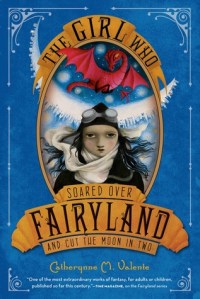
Book: “The Girl Who Soared Over Fairyland and Cut the Moon in Two” by Catherynne M. Valente
Publishing Info: Feiwel & Friends, October 2013
Where Did I Get this Book: audiobook from the library!
Book Description from Goodreads:September misses Fairyland and her friends Ell, the Wyverary, and the boy Saturday. She longs to leave the routines of home, and embark on a new adventure. Little does she know that this time, she will be spirited away to the moon, reunited with her friends, and find herself faced with saving Fairyland from a moon-Yeti with great and mysterious powers.
Review: Can my whole review just be this gif?:
No? Ok, fine, but I have to say, with this, the third installment in Valente’s “Fairyland” series, my love of these books has only continued to grow and my coherence for a reviewing them continues to deteriorate. But onwards we go in my now usual fashion for this series: blatant and unapologetic quoting!
September is growing up. We spend the longest portion yet in this series with September home in the “real world” waiting, wondering, and, now as an older girl, preparing for her trip to Fairyland. And with this growing up comes feelings, so many feelings! Fear, sadness, worry, and, suddenly, the thought that one must hide all of these feelings away. September has been practicing her “stern” face.
“It is such hard work to keep your heart hidden! And worse, by the time you find it easy, it will be harder still to show it. It is a terrible magic in this world to ask for exactly the thing you want. Not least because to know exactly the thing you want and look it in the eye is a long, long labor.”
But finally her traveling companion and escort to Fairyland arrives in the form of a very grumpy Blue Wind and she’s away! In the previous story, with September’s adventures in Fairyland Below, we spent a lot of time with the shadow versions of her companions, the wyverary A-Through-L, and the madrid Saturday, who were not quite the same as the true versions of themselves. So, as a reader, I could sympathize with September’s reflections on missing friends and loved ones and the complex feelings that arise from being reunited with those we care about after years of grieving their absence (though I am a spoiled reader who only had to wait until the next book to find my beloved characters again).
“September laughed a little. She tried to make it sound light and happy, as though it were all over now and how funny it was, when you think about it, that simply not having another person by you could hurt so. But it did not come out quite right; there was a heaviness in her laughing like ice at the bottom of a glass. She still missed Saturday, yet he was standing right beside her! Missing him had become a part of her, like a hard, dark bone, and she needed so much more than a few words to let it go. In all this while, she had spent more time missing Saturday than seeing him.”
The breadcrumbs that had been laid out in past books regarding the slow build relationship between September and Saturday come to a head in this story. Fully ensconced in “teenagedom,” September and Saturday struggle with the everyday challenges of first love while also dealing with the very-not-everyday-challenges of dating a madrid whose experiences with time as a river that can be traveled up and down with ease puts uncomfortable truths in the forefront. September had a glance of what could be her and Saturday’s daughter in the very first book, and a few run-ins with an adult Saturday in this story just further highlights her discomfort with fate, love, and choosing.
“But the trouble is, I do want to be surprised. I want to choose. I broke the heart of my fate so that I could choose. I never chose; I only saw a little girl who looked like me standing on a gear at the end of the world and laughing, and that’s not choosing, not really. Wouldn’t you rather I chose you? Wouldn’t you rather I picked our future out of all the others anyone could have?”
And per what is typical of these books, September’s adventures through bizarre and magical lands, meeting nonsensical and wonderful creatures, is all peppered with philosophical ponderings that speak to deeper truths. A few of my favorites include:
“Marriage is a wrestling match where you hold on tight while your mate changes into a hundred different things. The trick is that you’re changing into a hundred other things, but you can’t let go. You can only try to match up and never turn into a wolf while he’s a rabbit, or a mouse while he’s still busy being an owl, a brawny black bull while he’s a little blue crab scuttling for shelter. It’s harder than it sounds.”
and
“It’s Latin, which is an excellent language for mischief-making, which is why governments are so fond of it.”
and, of course,
“All Librarians are Secret Masters of Severe Magic. Goes with the territory.
I don’t think I have mentioned it in past reviews, but these books come with beautiful illustrations by Ana Juan. I listened to this book on audiobook (read by the author herself, and she was very good), so I missed the illustrations here. I nabbed a copy of the printed version to peruse them and they are beautiful, as they were in the previous books. Yet another plus to the series as a whole!
by Ana Juan
Rating 10: The perfect balance of beautiful and poignant.
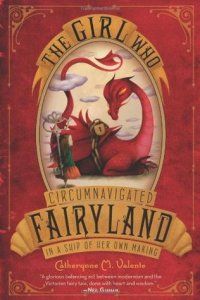
Book: “The Girl Who Circumnavigated Fairyland in a Ship of Her Own Making” by Catherynne M. Valente
Publishing Info: Feiwel & Friends, May 2011
Where Did I Get this Book: from the library!
Book Description from Goodreads:Twelve-year-old September lives in Omaha, and used to have an ordinary life, until her father went to war and her mother went to work. One day, September is met at her kitchen window by a Green Wind (taking the form of a gentleman in a green jacket), who invites her on an adventure, implying that her help is needed in Fairyland. The new Marquess is unpredictable and fickle, and also not much older than September. Only September can retrieve a talisman the Marquess wants from the enchanted woods, and if she doesn’t . . . then the Marquess will make life impossible for the inhabitants of Fairyland. September is already making new friends, including a book-loving Wyvern and a mysterious boy named Saturday.
Book: It’s going to be so hard to talk about this book without gushing. Or crying. Or gushing. Or crying/gushing. (Gushily crying?)
But remember how I listed the “Oz” books as one of the formative series of my childhood? Along side a similar love for the “Narnia” series and a brief stint as Alice in a children’s theater production of “Alice in Wonderland,” I have a special fondness in my heart for books about children traveling to fantastic and nonsensical worlds. But the true joy of this book was its heart, the deeper meanings, feelings, and yes, tragedies, that could be seen sparkling through the ridiculous trappings of a crazy Fairyland world. And I loved every minute of it.
Beyond the gushing, it’s also going to be hard to write about this book given what it is. While there is a plot, and there are great characters, its all wrapped up in the trappings of madness. And the language itself is what makes the story great. How do I really capture that in a review? So, I might try something different here, and pull out some of my favorite quotes and use those to frame my thoughts.
“Stories have a way of changing faces. They are unruly things, undisciplined, given to delinquency and the throwing of erasers. This is why we must close them up into thick, solid books, so they cannot get out and cause trouble.”
September, our 12 year old heroine, is ready for an adventure. As a child who loves to read, she is well accustomed to what it would take to be a great traveler and is only waiting for her invitation.
“One ought not to judge her: all children are Heartless. They have not grown a heart yet, which is why they can climb high trees and say shocking things and leap so very high grown-up hearts flutter in terror. Hearts weigh quite a lot. That is why it takes so long to grow one. But, as in their reading and arithmetic and drawing, different children proceed at different speeds. (It is well known that reading quickens the growth of a heart like nothing else.) Some small ones are terrible and fey, Utterly Heartless. Some are dear and sweet and Hardly Heartless At All. September stood very generally in the middle on the day the Green Wind took her, Somewhat Heartless, and Somewhat Grown.”
And one day it comes in the form of a Green Wind riding a leopard ready to whisk her away to Fairyland where she will get in an awful lot of trouble, meet some great friends like a Wyverary (a wyvern/library definitely NOT dragon) and a mysterious boy names Saturday, and be called upon to de-throne a monarch.
“Such lonely, lost things you find on your way. It would be easier, if you were the only one lost. But lost children always find each other, in the dark, in the cold. It is as though they are magnetized and can only attract their like. How I would like to lead you to brave, stalwart friends who would protect you and play games with dice and teach you delightful songs that have no sad endings. If you would only leave cages locked and turn away from unloved Wyverns, you could stay Heartless.”
The beautiful language in this book can not be praised enough. It is difficult enough to write a nice, straight forward story. But to write nonsense, and nonsense that hides deep, dark truths while also just being simply beautiful to read and repeat aloud, that is a unique and rare talent.
“… but as has been said, September read often, and liked it best when words did not pretend to be simple, but put on their full armor and rode out with colors flying.”
Valente also employs another tricky technique, that of inserting her own authorial voice into the story. I’ve seen this ploy used all too often to super-cheesy effect. But here, like with everything else, Valente captures the perfect balance of whimsy and wit, so instead of being read as intrusive or tonally jarring, these insertions only add depth and further insight to the story.
“It is true that novelists are shameless and obey no decent law, and they are not to be trusted on any account, but some Mysteries even they must honor.”
So, I have successfully reviewed this book while mostly relying on the author’s own work to speak for itself and done very little myself. But, that too, is a praise of the book and of the author herself. I am proceeding straight to the next book and, if it is as amazing as this one, will likely be equally incoherent in my next review.
“All stories must end so, with the next tale winking out of the corners of the last pages, promising more, promising moonlight and dancing and revels, if only you will come back when spring comes again.”
Rating 10: Could have gotten this rating for this quote alone, but the book also completely earned it.
“She sounds like someone who spends a lot of time in libraries, which are the best sorts of people.”
Reader’s Advisory:
“The Girl Who Circumnavigated Fairyland in a Ship of Her Own Making” is included on these Goodreads lists: “Books that Love Words” and “Girls with Dragons” (but A-Through-L is NOT a dragon!!)
Book Description from Goodreads:From the award-winning, New York Times bestselling author ofNOS4A2 and Heart-Shaped Box comes a chilling novel about a worldwide pandemic of spontaneous combustion that threatens to reduce civilization to ashes and a band of improbable heroes who battle to save it, led by one powerful and enigmatic man known as the Fireman.
The fireman is coming. Stay cool.
No one knows exactly when it began or where it originated. A terrifying new plague is spreading like wildfire across the country, striking cities one by one: Boston, Detroit, Seattle. The doctors call it Draco Incendia Trychophyton. To everyone else it’s Dragonscale, a highly contagious, deadly spore that marks its hosts with beautiful black and gold marks across their bodies—before causing them to burst into flames. Millions are infected; blazes erupt everywhere. There is no antidote. No one is safe.
Harper Grayson, a compassionate, dedicated nurse as pragmatic as Mary Poppins, treated hundreds of infected patients before her hospital burned to the ground. Now she’s discovered the telltale gold-flecked marks on her skin. When the outbreak first began, she and her husband, Jakob, had made a pact: they would take matters into their own hands if they became infected. To Jakob’s dismay, Harper wants to live—at least until the fetus she is carrying comes to term. At the hospital, she witnessed infected mothers give birth to healthy babies and believes hers will be fine too. . . if she can live long enough to deliver the child.
Convinced that his do-gooding wife has made him sick, Jakob becomes unhinged, and eventually abandons her as their placid New England community collapses in terror. The chaos gives rise to ruthless Cremation Squads—armed, self-appointed posses roaming the streets and woods to exterminate those who they believe carry the spore. But Harper isn’t as alone as she fears: a mysterious and compelling stranger she briefly met at the hospital, a man in a dirty yellow fire fighter’s jacket, carrying a hooked iron bar, straddles the abyss between insanity and death. Known as The Fireman, he strolls the ruins of New Hampshire, a madman afflicted with Dragonscale who has learned to control the fire within himself, using it as a shield to protect the hunted . . . and as a weapon to avenge the wronged.
In the desperate season to come, as the world burns out of control, Harper must learn the Fireman’s secrets before her life—and that of her unborn child—goes up in smoke.
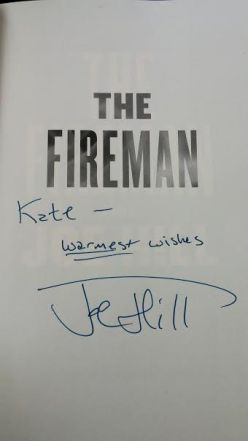
Review: Joe Hill is easily my favorite writer out there at the moment. I haven’t read a piece of work of his that I haven’t really enjoyed. His comic “Locke and Key” is one of my all time favorites, and his novel “NOS4A2” was my favorite book I read in 2014. When he first announced his most recent novel, “The Fireman”, I had to wait a long while before it was actually published. I waited not that patiently, and then put it on pre-order so I could get it and start it the day that it came out. And then a few days later (aka this past Saturday), I had the opportunity to see him in Minneapolis reading from this book. My friends and I were treated to a lovely evening of Joe Hill reading an excerpt, a sing along, and a great Q and A session.
I was also chosen to play the kazoo during the singalong. Watch for my kazoo album, coming never!
It took me four days to read this 700-some page book, and let me tell you, I had a very hard time putting it down. While “NOS4A2” remains my favorite of Joe Hill’s novels, “The Fireman” is a very close second. There are many reasons for this, which I could probably write a dissertation on, but I will try and keep the fan-girling to a minimum.
To. A. Minimum.
Hill has always been praised for his amazing character development, and “The Fireman” has an entire slew of characters that reinforce this praise. While the book is named after John Rookwood, the avenger who dresses like a fireman and can manipulate his Dragonscale to control the fire inside, this book is solidly about Harper Willowes, the pregnant nurse who just wants to survive so her can have her baby. When we first meet Harper, she is a sunny and optimistic school nurse who is very good at keeping things positive for those around her. But when a man stumbles upon the playground and bursts into flames, Harper’s world starts to crumble, so her resolve in this regard is tested. While Harper does, of course, have to adapt to her new surroundings, her strength is always apparent and she does not have to sacrifice her core personality to this bleak landscape. I LOVED that. It would be so easy to turn her into a cynical, bitter shell of her former self, but Hill instead keeps her character very Mary Poppins, therein reinforcing that women can be strong in many, many ways and don’t have to fit a certain mold to survive. By the end of this book I was worshiping at the altar of Harper Willowes, and put her up there with my other favorite Hill female characters. The holy trinity for those interested are Georgia from “Heart Shaped Box”, Vic from “NOS4A2”, and now Harper. I loved how she interacted with all of the other characters, especially her slow progression from damsel, to ally, to equal when paired up with Rookwood. She knows that he’s messed up, cares for him all the same, but does not put up with any of his nonsense.
Harper is also very loving and maternal not just to her unborn child, but to other children at Camp Wyndham, the sanctuary she finds herself at. Her relationships with Allie and Nick, the children of Rookwood’s dead girlfriend Sarah. Allie is angry and very, very flawed, while Nick is sweet and introverted. Harper approaches them in ways that are never patronizing. She doesn’t put up with Allie’s crap when she is at her worst, but always lets her know that she is, ultimately, loved. And Harper goes out of her way to learn sign language so she can communicate with Nick, who is deaf and therefore always feels very much like The Other at the camp. Harper treats them both with respect and kindness, and never patronizes them.
John Rookwood in turn was always at his best when he was interacting with Harper. As he is so inclined to not be the optimist, they played off each other and helped each other see other sides of things, and never really belittled each other for their opposing outlooks. I was afraid that he was going to merely be there to say ‘I told you so’ when things went wrong, but it never felt that way. He served as a contrast, because if Harper is caring, he is vengeful, and they helped each other find those parts in each other when it was necessary. Plus, his powers are just cool. I mean, he can throw fire and make giant fire birds. It was also very cool to see him in contrast to Harper’s husband, Jakob. While Jakob started out as this kind of mellow, caring, intelligent guy, the moment that Harper got sick he showed his true colors and revealed himself to be a despicable, terrifying antagonist. Rookwood sort of had the opposite transformation, as he, while never terrible, did start out as coarse and a bit harsh. But Dragonscale, and Harper too, empowered him and made him a better person who was more inclined to become part of something bigger than just himself and his grief for Sarah. It was very interesting seeing these two very different men react to their surroundings and situations, and see how they are changed by the illness that is destroying civilization.
And it can’t be a pandemic story without human beings totally falling apart, so while it was no surprise that Camp Wyndham became a freaky violent cult, it was still very upsetting to watch. While other pandemic stories usually jump right to the cult once it’s already been established as such, “The Fireman” lets the reader see how Camp Wyndham went from a loving sanctuary with many loving characters, to a horrific example of group think run amok. When Harper meets them, she finds a group of people who have Dragonscale who have learned to control it, and harness the goodness of it. Calling this The Bright, they’ve discovered that singing all together can make them all glow, and give the community a sense of euphoria and belonging. It really does start out as a safe haven for people who are being hunted down and killed by Cremation Squads, led by a bigoted radio shock jock calling himself The Marlboro Man. And because we got to see the characters at their best before, and understand why they are afraid, seeing them at their worst was especially heartbreaking. While it would be very easy to have them be dangerous cultists from the get go, Hill has no interest in letting the reader take the easy way out when it comes to this group. And boy, does that hurt.
I do think that this book went on a little longer than I wanted it to, but that’s really the only qualm that I have with it. With a sudden shift in setting after a situation that would have made a perfectly great climax, it started to drag a little bit, but I totally get why the choice was made. The ultimate ending, however, was absolutely beautiful, and I was openly weeping as I read through to the VERY last page of the book. And I mean the very last page. That’s a hint, from me to you.
I absolutely adored this book. Joe Hill continues to be my favorite author writing today, and “The Fireman” shows off his talents in all of their red hot burning glory. Also, see him speak if you have the opportunity. He’s a joy.
TO A MINIMUM!
Rating 10: Another fabulous dark fantasy/horror story from Joe Hill. I loved every bit of this book, from the characters, the themes, and the writing.
Reader’s Advisory:
“The Fireman” is a brand new book and not on many lists yet. But the themes are similar to the books found on “Popular Pandemic Books”, and Harper would be right at home on “Girls Who Kick Ass”.
Review: “City of Stairs” by Robert Jackson Bennett
Publishing Info: Broadway Books, September 2014
Where Did I Get this Book: the library!
Book Description from Goodreads:Years ago, the city of Bulikov wielded the powers of the Gods to conquer the world. But after its divine protectors were mysteriously killed, the conqueror has become the conquered; the city’s proud history has been erased and censored, progress has left it behind, and it is just another colonial outpost of the world’s new geopolitical power. Into this musty, backward city steps Shara Thivani. Officially, the quiet woman is just another lowly diplomat sent by Bulikov’s oppressors. Unofficially, Shara is one of her country’s most accomplished spymasters — dispatched to investigate the brutal murder of a seemingly harmless historian. As Shara pursues the mystery through the ever-shifting physical and political geography of the city, she begins to suspect that the beings who once protected Bulikov may not be as dead as they seem — and that her own abilities might be touched by the divine as well.
Review: This book is like a magical combination of everything I love to read.
Ingredients for Serena’s favorite reading experience:
a unique, fantasy setting
a compelling main character with a diverse and interesting set of companions
a mystery that is both challenging but has also been well laid out with clues
a good helping of action scenes
a dash of philosophy
a sprinkle of witty dialogue
Mix well and consume!
Bennett’s “City of Stairs” was a perfect concoction.
Honestly, this book was so good, I don’t even know where to start. Not only that, but the world that Bennett has created, its history, its peoples, its culture, is so elaborate and detailed that almost anything I say will be wildly, misleadingly, simplified. I guess I’ll try to just touch on a few of my favorite aspects.
The characters. I could probably list every single character here and just call it good. Shara was a great leading character. She’s reminiscent of a noir detective, combined with Hermione Granger, with the chops of James Bond. Her “secretary,” Sigrud is essentially a giant Viking with a dark past who’s taking names. Turyin Mulaghesh: grizzled war veteran. She just wants to retire on an island, but her inherent badassery is always going to get in the way. Vohannes, a Continental native whose political savvy and charm make him an indisposable ally or a disastrous foe. Aunt Vinya, the “M” of the Saypurian spy network. I could go on. Essentially, this cast is diverse, complex, and perfectly balanced. There wasn’t an unrealized character or point of view to be found.
But the real strength of this story is the intricate analysis of its world. There are two aspects that I most want to focus on: colonialism and religion. The relationship between the Continent and Saypur is laid out in a way that is so perfectly imperfect. The Continent, once the powerhouse of the world, invaded Saypur and enslaved its people for centuries. After their Gods fell at the hands of a Saypurian general, the Continent sunk into disrepair. Saypur has risen as the new center of culture and economics. Saypur has occupied the Continent and outlawed the Continent’s own history. What makes this balance so striking is the honest portrayal of the failings of countries. The line between the oppressor and the oppressed is constantly tested.
The real success here is the sadness this book evokes. The Continentals did terrible things. But the remnants of their history are laid slowly before you, the ruin of what once were glorious feats of architecture, and you can’t help but feel a sense of loss. This ability to balance the wonder, beauty, and terrible, sudden quenching of culture and people with the true horror that was the Continentals’ reign makes this book special.
The commentary on religion is even stronger. In a world where once Gods walked the earth and directly touched the lives of people, religion and faith have a different meaning. The sense of entitlement that can come with a belief system would inevitably become even more prevalent. The Continentals can see and interact with their Gods. Saypur is literally Godless. How can the Continentals not be blessed and meant to be the center of the world?
Beyond this, each God has his or her own set of beliefs, ways of interacting with their followers, and chosen method of influencing the world. Kolkan reflects a rule-based religion. Judgement and punishment is at its core. Olvos is the Goddess of light. Hers is a faith based in thinking for oneself and living a life of service. Jukov is a God of mischief. He’ll as likely bless you as turn you into a flock of birds. Life should be lived to its fullest and the chaos of the world embraced. Each of these Gods and their specific faith systems carry traces of the familiar. Buried within it all is a deeper discussion of power and where it lies. Does faith and religion carry meaning because of the power of its God or the power of its followers?
It’s hard to discuss much of this book without spoiling the best parts. For a story that takes place in a world where knowledge of its past is forbidden, the slow reveal of history, its lies and truths, is a huge factor in the reader’s enjoyment. I won’t ruin it for you!
Let it just be said, beyond having some really interesting things to say, there are also some truly fun adventures. Shara and Sigrud battle a sea monster. Sigrud battles ninjas. There are portals, there are magic carpets, there are mysterious cults and creepy beasts. Like I said at the beginning, everything I could possibly want!
Book Description from Goodreads: In these stories from issues #1-6 of the hit series, learn the story behind this alternate reality where the Second World War is fought by superpowered women on the front lines and behind the scenes! It all begins with the stories of Batwoman, Wonder Woman and Supergirl.
Review: Last year our friend Anita and I went to the local Wizard World Comic Con Convention. When we were walking around the merchandise area, we saw these really cute posters of DC superheroines drawn like retro WWII-era Pin Ups. I had no clue what the story was with them, but had to get the Black Canary one for my house.
How could I not hang this up in the kitchen?
So when I got to work one day, I went to check out the new materials wall. And what did I see? “DC Comics: Bombshells (Vol.1): Enlisted”. Needless to say I ran over to the book and grabbed it for myself.
The Goodreads summary doesn’t really do this justice, so here is mine. Set in an alternate universe, “Bombshells” is a WWII era historical fiction arc starring a whole lot of DC’s superheroines and supervillainesses. Various governments and groups start recruiting these women so they can fight for their countries, or the group’s motivations. You have Batwoman, an All American Girl’s Baseball League player who is recruited to be an American Spy. You have Wonder Woman, a Amazonian princess who meets WWII flier Steve Trevor when he crashes near her home, and she and her bestie Mera decide to bring him home, but get the attention of American forces. Supergirl and Stargirl are living in Soviet Russia, who are discovered to have serious powers that can be used as Soviet Propaganda. Zatanna is being pressured into working with the Joker’s Daughter in Berlin, standing aside helplessly as Joker’s Daughter gives the Nazis magical, zombie making powers. And then there’s Harley Quinn, who has forsaken her medical prowess in London and flies into France in search of her boyfriend, only to find Pamela Isley, a possible French Resistance Fighter.
There are many things to like about this comic. First and foremost, the concept is super creative. The idea kind of sounds like an alternate universe fan fiction idea, but Marguerite Bennett’s writing makes it work so well. She takes a lot of things from WWII history, like the All American Girl’s Professional Baseball League, or the Soviet Night Witches, and gives them a very cool platform to bring them to the forefront while producing some really intriguing storylines. While I loved all of them, I think that the one of my favorites was definitely that of Supergirl and Stargirl, as the story not only talked about the Night Witches, it also showed the brutal regime that the Soviets had in spite of the fact they were our allies. The part that punched me in the gut the hardest was when Supergirl and Stargirl realize that they are supposed to be attacking a camp that, while disguised as a Nazi Camp, is actually a Soviet Prison camp, with political prisoners of all ages being held there. It was super ballsy to address that and to give these girls a serious moral dilemma. And I also liked the Harley Quinn and Poison Ivy storyline, because if it does go the way of the French Resistance, that would be super cool. The Resistance is getting more play in literature lately, between “Code Name Verity” and “All the Light We Cannot See”, so if it gets a fun story in this comic I will be very happy. The banter is also quite zippy and fun to read, and the dialogue feels natural and not stilted. I found it very feminist and woman centric without being heavy handed or on the nose.
Another aspect I liked is that through this story, DC is giving a lot of great fun and great opportunities to their lady characters. While I love DC guys a whole lot too, the fact that there was no sign of Batman, or Superman, or any of the other heavy hitters, was very refreshing. You see a couple guys, namely Lex Luthor and John Constantine. But Luthor is a fellow spy who is teamed up with Batwoman and Catwoman, and Constantine is more of a sidekick to Zatanna.
Like I said, I like the men of DC. But honestly, if they start to come in and play a bigger part I will feel a little miffed. This is the time and the series to let the ladies shine.
And the story is just fun. I was screeching in glee as I read this volume, and actually had to put it down and run off to tell my husband about a certain cameo that appears late in the game. No spoiling it. But it was a hoot to see this character, even if it was for just a moment.
“Bombshells” is a fabulous series and I need Volume 2 yesterday. It isn’t coming out until September, so I am just going to have to wait, I guess. Probably not at all patiently.
Rating 10: This comic is everything. I had so much fun while reading it and I cannot wait for the next one. Fans of comics, WWII fiction, and kick ass ladies need to pick this one up!

 Book: “The Queen of Attolia” by Megan Whalen Turner
 Book: “Chilling Adventures of Sabrina (Vol.1): The Crucible” by Roberto Aguirre-Sacasa, and Robert Hack (Ill.).

 Book: “The Complete Persepolis” by Marjane Satrapi
 Book: “Crocodile on the Sandbank” by Elizabeth Peters
 Book: “I Know What You Did Last Summer” by Lois Duncan
 Book: “The Girl Who Soared Over Fairyland and Cut the Moon in Two” by Catherynne M. Valente

 Book: “The Girl Who Circumnavigated Fairyland in a Ship of Her Own Making” by Catherynne M. Valente
 Book: “The Fireman” by Joe Hill

 Review: “City of Stairs” by Robert Jackson Bennett
 Book: “DC Comics: Bombshells (Vol.1): Enlisted” by Marguerite Bennett, Marguerite Sauvage (Ill.)


 The Library Ladies