Serena’s Series Review – “Mercy Thompson” Series

Mercy Thompson series

Books: “Moon Called,” “Blood Bound,” “Iron Kissed,” “Bone Crossed,” “Silver Borne,” “River Marked,” “Frost Burned,”and “Night Broken” by Patricia Briggs

Publishing Info: Ace, 2006, 2007, 2008,  2009, 2010, 2011, 2013, 2014

Where Did I Get this Book: Bought the first few, the rest from the library

Spoiler warning: I will try to avoid large spoilers, but some minor spoilers are inevitable to cover the progression of the story throughout the series. 

Review: The “Mercy Thompson” series holds the perhaps ignoble position of being the first urban fantasy series I picked up. As an avid reader of fantasy and sci-fi, I’m not sure what has held me back from urban fantasy overall, though I can’t say the cover choices are helping anything! I know I’m not supposed to judge a book by its cover, but when I’m browsing the shelves in the library, covers featuring scantily clad women are probably not going to be the first to jump out at me. Which is unfortunate, because overall, these books are pretty darn fun. I am currently reading the most recent (the 9th!) book in the series, and prior to posting my thoughts on that, we’re going to jump into yet another series review!

Mercy Thompson is a coyote shape-shifter who lives in central Washington state and works as a mechanic. (Fun aside: I’m originally from the Pacific Northwest and get unreasonably excited when I’m reading a book that’s set in, believe it or not, Pasco, Washington. Surprising, central Washington is not a go-to setting for most authors!) Mercy was raised by a pack of werewolves after her mother discovered that her baby had turned into a coyote cub in her crib and being understandably perturbed by this decided that werewolves would be the best option as caretakers. Now an adult, Mercy has broken ties with the werewolves and is determined to make her own way through the world. Unfortunately for her, she just happens to share a backyard/field with the Alpha werewolf of the Columbia Basin Pack, Adam Hauptman.

Starting with the worldbuilding: Briggs calls on several of the traditional characters found in fantasy and urban fantasy. The series begins in a world that has just learned that the fae exist about 20 years ago. But the fae have been sneaky and carefully ensured that humans only know of their more “kindly” folk, hiding their power players in fairy reservations that the humans have set up for them. In an interesting take on the history of reservations stifling the people they are meant to protect, the fae make great use of their allocated land, much to the humans’ dismay as the series progresses.

Unbeknownst to humans, however, are the werewolves and vampires. They, understandably, have larger “image issues” when thinking of coming out to people. The vampires, specifically, just aren’t nice guys. Though Mercy does have an awesome vampire friend, Stephan.

The werewolves are the central group of this series, and as the books progresses it was fun watching the evolution of how the werewolves viewed and interacted with the world. Starting from a very isolationist perspective, they must adjust their perspective as they grow to have closer relationships with humans and as the fae begin making power moves against the human world.

Mercy, of course, plays a large role in this. There are no other coyote shape-shifters, so while not human, she is also not a werewolf and quickly becomes a bridge between these many different groups. Mercy is a great narrator for the series as a whole. Perhaps one of the things I appreciate most about her, as compared to other urban fantasy leads, is her acknowledgement of her limitations. Of course, she’s still heroic and always ends up in the middle of situations above her pay scale. But she is honest about her abilities, both the advantages they give her but also the weaknesses that restrict her.

And, per usual, there is the inevitable love interest. Love interests plural, actually. Sadly, the first few books of the series commit one of my larger “book trope sins” by setting up a love triangle between Mercy, Adam, and a werewolf from the pack she grew up with, Samuel. Mild spoilers for this: I didn’t mind the love triangle that much as it seemed very clear to me from the very beginning that Adam and Mercy were the eventual goal, and Samuel was more a stumbling block than a legitimate second option. That said, I feel like I could have lived without this aspect of the story all together. I have yet to find a love triangle that I feel truly adds value to the story. The best I can say is that this one doesn’t derail the story, and I was able to largely ignore it. High praise, as far as I’m concerned.

Briggs’s world is very creative, especially her version of the beings within it. The fae are set up in a way that allows for endless imagination, and Briggs takes full advantage of this. So, too, she expands the mythology of the vampires in her world in a way that also allows for creative new stories. This creativity most fully hit its stride later in the series when Mercy begins exploring her family history and the origins of her shape-shifting ability. Briggs’s unique take on the creatures in this world is what has allowed this series to remain engaging through 8 book.

However, there are also some weaknesses to the series that I must point out. While Mercy has a lot of admirable qualities, she also tends to fall into the trap of blaming herself for everything that happens. At a certain point, I just found myself rolling my eyes at this. There’s a fine line between accepting responsibility for things that happen that are truly a result of your own actions, and adopting a sort of “world revolves around my decisions” perspective that begins to come off as self-centered and denying the fact that other people have their own agency. This is especially a problem towards the last few books in the series, a point at which Mercy is surrounded by friends and family who care for her and make their own decisions to protect her or follow her lead.

Another flaw is the lack of other positive female characters in the series. In the beginning, this flaw isn’t as apparent as the cast of characters is significantly lower. But as the story continues, it becomes more and more apparent and uncomfortable. It’s not that female characters aren’t there. It’s that they are there, but then are set up in a way that makes them a negative contrast to Mercy’s awesomeness. Female members of the werewolf pack continually have issues with her. And then in the last book, Adam’s ex-wife is brought into the story in a way that is doing none of the characters any favors. I don’t appreciate stories that sabotage other women characters as a way to promote the female lead. The last book does make some cursory attempts with other women characters, but the unfortunate, and frankly unnecessary, use of the jealous ex-wife largely wiped out these small steps. This is an area that I will be on high alert for improvement in future books.

One of the books also includes a very violent scene with Mercy that was hard to read. I’m still not convinced that this was necessary to the story overall, which is perhaps the most unfortunate part. I don’t believe these types of scenes should be included lightly. The aftermath was also very challenging to read. I appreciate that Briggs made an honest attempt to deal with the lasting effects of this situation, and in a lot of ways she was very successful. But it’s a difficult situation to write, and there were a few stumbling points that were cringe worthy as well.

Overall, I have enjoyed the “Mercy Thompson” series. As with most long-running stories, some of the books are stronger than others. There have been points that I have enjoyed throughout them all (creative world building, fun characters, snappy dialogue) and also points of annoyance throughout them all (misuse of female friends for Mercy, love triangles, confusing plot points). However, if you like urban fantasy, this series is a staple in the genre and definitely one worth checking out. Stay tuned for my review of the newest “Mercy Thompson” novel: “Fire Touched.”

Rating 6: Reliable urban fantasy series. You know what you’re going to get, with the pros remaining solid, but unfortunately some of the cons are persistent as well.

Reader’s Advisory:  As a series, it’s not on any Goodreads lists as a whole. However, Patricia Briggs has also written a companion series called “Alpha and Omega.” This series features a new protagonist but has several cross-over characters. The main characters from each series never interact directly, but there are references in later “Mercy Thompson” books to the happenings from this series, so it’s worth checking out if you want more of this world.

Find the first book in this series, “Moon Called,” at your library using WorldCat!
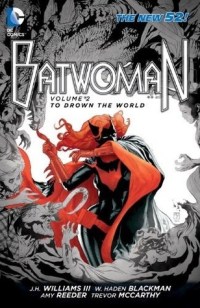
Kate’s Review: “Batwoman (Vol.2): To Drown The World”

15757284

Book: “Batwoman (Vol.2): To Drown the World” by J.H. Williams III, W. Haden Blackman, Trevor McCarthy (Ill.), Rob Hunter (Ill.), Pere Pérez (Ill.), Richard Friend (Ill.), and Guy Major (Ill.)

Publishing Info: DC Comics, January 2013

Where Did I Get this Book: The library!

Book Description from Goodreads: Six lives, inextricably linked in the past and present, each on a collision course with the others: Batwoman, fighting for duty and vengeance against a threat of arcane power. Detective Maggie Sawyer, investigating a case that could end her career. DEO Agent Cameron Chase, commanding a vigilante she despises. Colonel Jacob Kane, clutching at a life that’s slipping away. Maro, a new villain corrupting Gotham City. And Kate Kane, wrestling with decisions that will test her loyalties.

J.H. Williams III and W Haden Blackman continue their stellar BATWOMAN run, joined by senational artists Amy Reeder and Trevor McCarthy! Collects BATWOMAN #6-11!

Review: We’re going back to Gotham, folks, and we are still ignoring the obvious Caped Crusader in favor of his female, lesbian counterpart. I am, of course, talking about Kate Kane, also known as Batwoman. We’d left her off at something of a crossroads, as she had joined a group  called the D.E.O., whose goal is to take down another secretive group called Medusa. Medusa has been kidnapping children in Gotham, and Batwoman hopes to find them and return them home…. And then there’s Maggie Sawyer, Kate’s lover who is a detective for the Gotham police department… And then there’s Jacob, Kate’s father, who is keeping vigil by his niece Bette, who is in a coma after her stint as Firebird went awry… AND THEN there’s Maro, an agent working for Medusa, who is doing a lot of the kidnapping dirty work….

What I’m getting at here is that there are a lot of perspectives. Specifically, six. With jumping timeframes and scenarios that told the story out of order, or deviated from the story completely to keep tabs on other past stories! And that was a bit much to follow, if I am being quite honest. Just as I would be getting into one perspective, we’d suddenly jump to another one, which made it very hard for me to get invested in any of the storylines that were being presented. Not to mention that I would find myself having to go back and remind myself what the linear progressions were so that the stories would make sense in the end. It felt like most of my time was spent turning pages back to remind myself just where I was in the plot, and then have to skip back AGAIN to remind myself of how we got to THAT point in the first place.

giphy
I hear ya, Boone. (source)

And the biggest problem with this was that it took a lot of the focus off of Batwoman herself. I am reading this because I want to know what is going on with Kate Kane. Sure, it’s nice getting some background on what Medusa’s endgame is, or what the D.E.O is thinking in regards to the whole situation, but not nice enough to keep on hammering it into the plot line like a puzzle piece that just doesn’t quite fit, no matter how hard you try to make it fit.

There are positives though. I really enjoyed the use of Urban Legends in the origins of the Medusa plans. As a huge fan of stories like The Man with the Hook and Bloody Mary, it was super neat to see them thrown into this story and given a neat and creepy little twist. Plus, the art continues to be absolutely gorgeous, with vibrant and bright colors and stark, dour shades of grey and black. This matches the tone to this series quite well, as it’s mostly very dark and edgy, with moments of sweetness and light, specifically between Kate and Maggie. Normally I am the first to complain about the darker tones and grittier stories that some of the DC Universe has applied to it’s stories. But I feel that it works really well for Batwoman, if only because it’s a deliberate contrast to what she was when she was first created in the 1960s. To go from a glamorous and somewhat incompetent love interest to a tough and complicated crime fighter in her own right, the darkness and edge suits Kate Kane very well, and I’m glad that she has the chance to explore it.

I’m going to hope that things go a bit better in the next volume, and that the perspectives die down a bit. Just get back to Kate.

Rating 5: The origins of the villains was very original and the art is still gorgeous, but the story gets muddled with too many perspectives.

Reader’s Advisory: 

“Batwoman (Vol.2): To Drown the World” is included in these Goodreads lists: “The New 52” and “Fantasy and Sci-Fi Featuring Lesbian Characters”

Find “Batwoman (Vol.2): To Drown the World” at your library using WorldCat!

Previous Reviews of “Batwoman”: “Hydrology”

Movie Review: “The Jungle Book” (2016)

As much as we like books, sometimes we like to check out the movie world as well. Today we reviewed “The Jungle Book.” We discuss the history of the stories, the changes this movie made, why we need more Kaa in our lives, and what Serena thinks of CGI talking animals. We also name drop almost every voice actor in the movie but failed to remember the actor’s name for the boy who plays Mowgli. For the record, it’s Neel Sethi, and he was amazing. Stay tuned at the end for our book recommendations if you liked this movie. (Titles also posted below).

Serena’s Recommendations:

Tarzan

“Tarzan of the Apes” and “The Return of Tarzan” by Edgar Rice Burroughs


Jane

“Jane” by Robin Maxwell


Kate’s Recommendations:

Julie of the Wolves

“Julie of the Wolves” by Jean Craighead George


Life of Pi

“Life of Pi” by Yann Martel

Serena’s Review: “The Rithmatist”

"The Rithmatist"Book: “The Rithmatist” by Brandon Sanderson
Publishing Info: Tor Teen, May 2014

Where Did I Get this Book: Audiobook from the library!

Book Description from Goodreads: More than anything, Joel wants to be a Rithmatist. Rithmatists have the power to infuse life into two-dimensional figures known as Chalklings. Rithmatists are humanity’s only defense against the Wild Chalklings. Having nearly overrun the territory of Nebrask, the Wild Chalklings now threaten all of the American Isles.

As the son of a lowly chalkmaker at Armedius Academy, Joel can only watch as Rithmatist students learn the magical art that he would do anything to practice. Then students start disappearing—kidnapped from their rooms at night, leaving trails of blood. Assigned to help the professor who is investigating the crimes, Joel and his friend Melody find themselves on the trail of an unexpected discovery—one that will change Rithmatics—and their world—forever.

A “New York Times” Book Review Notable Children’s Book of 2013.

Review: Full disclosure: Brandon Sanderson is one of my all-time favorite authors. I think I’ve read almost everything he’s ever written, which is actually saying a lot as the man is known as a speedwriter. He published 2 novels just this year! And is writing another series that is made up of 900+ page books at the same time! I think he may have no life? Another fun fact, I got to meet him last year at a book signing here in Minneapolis!

KIMG0126

First and foremost, Sanderson is known for creating elaborate, unique magic systems. No lazy wand waving here! Rithmatics is comprised of a complicated system of chalk diagrams, essentially. As I was listening to the audiobook, each chapter would start with the narrator describing one diagram or another, all based around a system of circles. It was a bit challenging to picture it all: 9-point circles based on inscribed triangles, 2 point ellipses, jagged lines used for attacks, etc. But then, when clicking to hear the next chapter one time, I noticed that on the cover image it included illustrator information. *sigh* So, this was probably not the best book to be listening to as an audiobook. Live and learn! Considering that, I’m even more impressed by the fact that the narrator was mostly successful with these descriptions and that by the end of the book I had a fairly good understanding of the whole thing.

Essentially, Rithmatists are able to “activate” chalk drawings to accomplish different tasks. A circle is for protection, certain jagged lines can be used to break through circles, and you can draw “Chalklings,” little creatures who can be instructed to perform certain tasks, such as protecting a circle or attacking a circle. In school, Rithmatists will hold duels to practice these skills with the end goal of being prepared to guard the United Isles (in this world the United States is made up a series of islands based on state names essentially, like “New Britannia” and the “Floridian Isles”) from Wild Chalklings, vicious creatures that will attack and eat people if not warded off.

The whole concept was a very fun idea. It was even more fun to have our main protagonist, Joel, NOT be a Rithmatist, but instead a regular student who just happened to be obsessed with the whole idea and befriends a Rithmatics professor, Professors Finch, and student, Melody. This was a clever way of introducing the audience to the world, through a narrator who, while knowledgeable, is still an outsider like we are in many ways. Joel was a good protagonist, but a little flat, I felt. He seened a bit like a paper cutout version of a YA hero. Good enough, but his personality didn’t stand out to me in any really interesting ways.

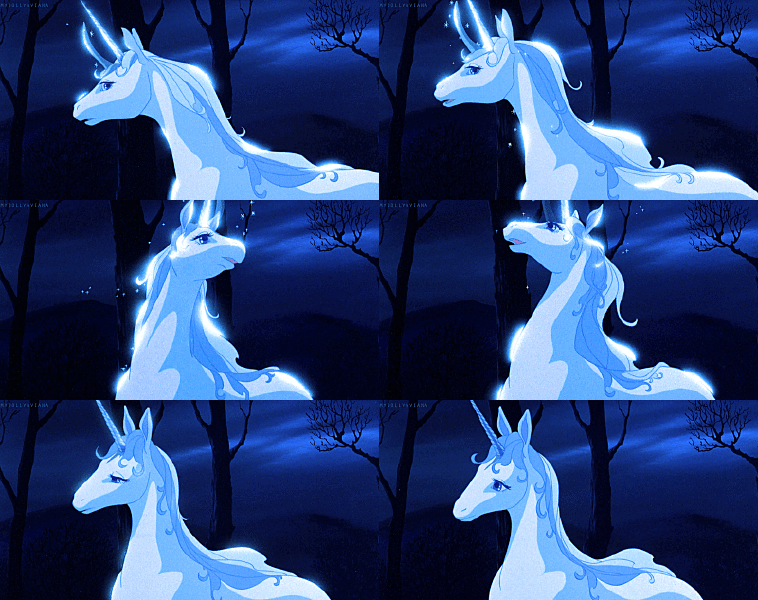
However, Professor Finch and Melody were amazing! Professor Finch is the typical bumbling, wise mentor. Combine Dumbledore with Dobby and you get Finch. Wise, kindly, but not self-confident. And Melody had all of the personality that Joel lacked. An unskilled Rithatmatics student herself, Melody is also an outsider who is taken in by Professor Finch. She’s dramatic, witty, and just the right foil for straight-laced Joel. She also loves to draw unicorn Chalklings, much to Joel’s continuous dismay.

Unicorn
“The unicorn is a noble and majestic creature!”

The mystery itself was good. There were a few moments towards the end where I began to think Sanderson was going to take the easy way out, and I’m glad to say he didn’t. For the most part, the revelations were a surprise.

One criticism I have, however, is that after reading this and the first book in Sanderson’s other YA series, “Steelheart” I’m beginning to think he struggles just slightly with adjusting his tone for YA. While overall I liked this book, Joel is not fully fleshed out, and in some ways this feels like a result of the author’s discomfort with writing teenage characters. The story itself suffers from a similar feeling of slight “offness.” Again, maybe a discomfort with not knowing how to tone down a story for young adult audiences? It’s very hard to put my finger on exactly what it was. But having read his other works, this just felt like slightly…less.

Overall, however, I still enjoyed this book and think it would be a great recommendation for fans of YA fantasy/sci fi.

Rating 6: Strong concept and fun story, but had a few weaknesses

Reader’s Advisory:

“The Rithmatist” is included in these Goodreads lists: “Most Unique, Original, and Interesting Magic Systems” and “The League of Extraordinary Kids.”

Find “The Rithmatist” at your library using WorldCat!

Kate’s Review: “The Fifth House of the Heart”

23705513

Book: “The Fifth House of the Heart” by Ben Tripp

Publishing Info: Gallery Books, July 2015

Where Did I Get This Book: The Library!

Book Description from Goodreads: Filled with characters as menacing as they are memorable, this chilling twist on vampire fiction packs a punch in the bestselling tradition of ’Salem’s Lot by Stephen King.

Asmodeus “Sax” Saxon-Tang, a vainglorious and well-established antiques dealer, has made a fortune over many years by globetrotting for the finest lost objects in the world. Only Sax knows the true secret to his success: at certain points of his life, he’s killed vampires for their priceless hoards of treasure.

But now Sax’s past actions are quite literally coming back to haunt him, and the lives of those he holds most dear are in mortal danger. To counter this unnatural threat, and with the blessing of the Holy Roman Church, a cowardly but cunning Sax must travel across Europe in pursuit of incalculable evil—and immeasurable wealth—with a ragtag team of mercenaries and vampire killers to hunt a terrifying, ageless monster…one who is hunting Sax in turn.

From author Ben Tripp, whose first horror novel Rise Again “raises the stakes so high that the book becomes nearly impossible to put down” (Cory Doctorow, author of Little Brother), The Fifth House of the Heart is a powerful story that will haunt you long after its final pages.

Review: If there is one thing that you need to know about me when it comes to my love of horror, it’s that I am supremely picky about my vampire fiction. I love vampire lore, and have always enjoyed a vampire tale if it is done right. What do I personally define as ‘right’ when it comes to vampires in my pop culture? Oh, let me tell you.

  1. The Lost Boys
  2. Buffy the Vampire Slayer
  3. A Girl Walks Home Alone At Night
  4. Martin
  5. Dracula
  6. The Hunger
  7. Lestat as a whole

And of course….

8. What We Do In The Shadows

What don’t I define as right?

edward-cullen-3-edward-cullens-future-wives-35821954-544-480
I will beat this dead horse forever. (source)

I am happy to report that “The Fifth House of the Heart” is going to be able to be used as one of my personal good examples of what I look for in vampire fiction. I will admit that I had to sort of have a jump start as I was reading, because I found myself skimming more than I wanted to and not appreciating the writing. So I jumped back about a hundred pages, and really delved deep into the narrative.

The vampire world and mythology that Tripp has created is a familiar one, but he puts his own spin on his vampires and his vampire hunters. While vampires have generally the usual characteristics and tropes that has become a part of the collective narrative, Tripp adds things and twists things to make them unique to his world. For example, in this world, vampires take on the form of their prey over time, so there are encounters with vampires that look like giant spiders and malicious frogs. He also gives a lot of time to theories on metallurgy and chemistry in relation to vampire weaknesses, giving garlic some potency through means of scientific explanation and silver weapons enhanced by blacksmithing. I really enjoyed that Tripp gave such deep thought to his story that he made stalwart themes completely new and creative. I also really enjoyed our rag-tag group of vampire hunters, as they felt like they were coming right out of an “Ocean’s Eleven”-esque heist movie. Sax is a very fun protagonist, because he’s by no means a brave man. Hell, he kills vampires because he wants their antiques for his collection, and doesn’t get his hands dirty unless he absolutely has to. And even then he really doesn’t want to out of sheer cowardice. But in spite of that you can’t help but really like him and root for him. His team consists of a paramilitary badass, a sociopathic assassin who has a tragic link to vampires in her past, an obnoxious burglar type, and a blacksmith and metal specialist who is far more interested in banging women than hunting vampires. Not to mention the Bollywood actress who is suffering from a vampire bite. It is seriously charming!

Tripp’s writing is also something that gels with me completely, as I found it laugh out loud funny, but also really scary at times. There were many scenes that had me on the edge of my seat, and his descriptions are vivid and evocative. I could picture everything so easily, and the change of place never felt awkward or choppy. There are a few flashbacks in telling Sax’s story, but they were always clear cut and put in at just the right times. And the shifts from really funny scenes to scenes that had me on the edge of my seat were never jarring, as the comedic elements were just a part of the characters and always felt like they were in place, no matter how tense the situation was. And his descriptions of gore and vampire things of that nature were just the right amount of brutal without making me squeamish. Granted, my threshold for that stuff is pretty high, but it never felt supremely exploitative or graphic to me.

Vampire fans really need to try out “The Fifth House of the Heart”. It was a true joy to read it, and I think that it should take it’s rightful place of honor in modern vampire fiction.

Rating 8: A solid vampire mythology with some really fun characters. The mix of humor and horror really gives in a bite and the creatures Tripp has created are fabulous.

Reader’s Advisory:

“The Fifth House of the Heart” is included in these Goodreads lists: “Best Picks: Fantasy, Science Fiction, and Horror Novels of 2015”, and “Hugo 2016 Eligible Works”.

Find “The Fifth House of the Heart” at your library using WorldCat!

Serena’s Review: “A Court of Thorns and Roses”

A Court of Thorns and Roses Book: “A Court of Thorns and Roses” by Sarah J. Maas
Publishing Info: Bloomsbury’s Childrens, May 2015

Where Did I Get this Book: the library!

Book Description from Goodreads: When nineteen-year-old huntress Feyre kills a wolf in the woods, a beast-like creature arrives to demand retribution for it. Dragged to a treacherous magical land she only knows about from legends, Feyre discovers that her captor is not an animal, but Tamlin—one of the lethal, immortal faeries who once ruled their world.

As she dwells on his estate, her feelings for Tamlin transform from icy hostility into a fiery passion that burns through every lie and warning she’s been told about the beautiful, dangerous world of the Fae. But an ancient, wicked shadow grows over the faerie lands, and Feyre must find a way to stop it… or doom Tamlin—and his world—forever.

Review:  Last year our bookclub read “Throne of Glass” by Sarah J. Maas. The series was wildly popular with young adults, so we were diligent and added it to our list. Long story short, I was not a fan. I’ll refrain from getting on my soapbox for that book, but I make no promises that it won’t get pulled out again later in this review! Either way, when I saw that Maas’s next book was going to be a fairytale retelling, and one of my favorites, I decided to give her another go.

Fairytale snob moment: this book is often referred to as a “Beauty and the Beast” retelling. But actually! It is more accurately retells the fairytale “East of the Sun, West of the Moon” (“Beauty and the Beast” is a more recent retelling of this older story) in which a girl is stolen away by a polar bear king, and after failing to save him from his curse (in the traditional version she actually makes things worse), she must travel to an ogre queen’s castle and perform three impossible tasks to rescue her prince. It’s all quite lovely and romantic. I’ve always been particularly fond of this fairytale, especially the fact that it boils down to the prince being a damsel-in-distress who must be saved by the heroic maiden. Fun times!

So, first off, I really liked that aspect of this story. It does follow the fairytale in many ways while also adding its own creative twists. There were large segments in the middle and sections of the end where I was just breezing along enjoying the heck out of the story. Feyre is a great main character. She is flawed, but courageous. Her prejudices against fairies are given the proper amount of time to recede, and her emotional journey is believable. I particularly enjoyed a moment in the book where she has to completely readjust her opinions of her two sisters. In the beginning of the story, they are presented as the typical evil sisters that we are used to seeing in these kind of stories, and I was very disappointed that the book seemed to be going the “other women characters must be bad to make the heroine even more special” route. But, much to my surprise, this gets turned on its head in a way that is very emotionally satisfying.

The love story had the potential to be insta-love, but it was able to just walk that line enough that I bought it in the end. Your own tolerance level for that kind of thing will largely determine how successful this aspect of the story is. Tamlin is your typical hero, not much to say there, really. I honestly liked his companion Lucien much more.

But, as much as I loved parts of this book, I equally hated other parts. It was a very uncomfortable pendulum swing, honestly. I’m going to try to limit my rants, but man, some of the choices made in this book were so frustrating. First, there were small choices, like referring to women as “females,” that were so jarring that I almost put the book down.

enough-internet-dean-winchester-supernatural

What is this decision? What does it add to the story overall to use this type of terminology that is so inherently dehumanizing? I mean, is it as simple as that? Some weird attempt to not use the word “woman” as a way to differentiate them as fairies rather than humans? If so, it doesn’t succeed. Especially when it is paired with another one of my biggest complaints about the book.

This might be a spoiler, but the section I’m going to talk about now ultimately has no affect on the plot, which is actually a large part of the complaint itself. Towards the middle of the book, Maas sets up this whole fairy festival which essentially boils down to Tamlin being “taken over” by magic until he’s a sex-crazed beast who must choose from a line of fairy females to sleep with that night to replenish the kingdom’s magic. It is so awful! Pair this thought with the overuse of the term “female” throughout the book. Maas has essentially lined up a bunch of fairy women, reduced them to “females” with no characteristics other than their function as a sex objects, and had her hero lose his humanity to beast magic, then select one of these women (she has no choice if she’s selected) to breed with. And Maas go further! Having Lucien explain the ritual to Feyre as unpleasant because Tamlin “won’t be gentle.” Umm…so icky. And at the end of the whole bit, there is zero, I repeat ZERO, impact on the ultimate story by having this scene. Other than, maybe, giving Tamlin an excuse to go all “dominant” and bite Feyre on the neck when she wanders out of her room the same night as this festival. Can you say “not worth it” loud enough? Especially since he goes back to being the sweet, caring love interest the reader is used to the very next day and for the remainder of the book. The whole thing is just gross.

premio-liebster-iv-cuartas-partes-veces-fuero-l-slyx1b

And sadly, this type of weird sexual objectification continues towards the end of the story with Feyre herself. I’ve always loved the ending of the original fairytale with the heroine attempting to complete her three impossible tasks. And, again, when this story is sticking to these origins, it’s very strong. I loved the tasks that were set up and Feyre’s struggles with them. So, why?! Why do we need to introduce what I can only assume is going to be the third character in the seemingly required love triangle, Rhys? A character who, even while helping Feyre through the tasks, in the mean time, has her dressed in lingerie each night, has her entire body painted so that he can tell if anyone else touches her, refers to her as his property, and then drugs her with fairy wine so she loses her senses and seductively dances in front of the entire fairy court and sprawls around on his lap. Again, I say, why?! What does any of this add to the story? Maas has already set up the fact that this court is terrible, and that Feyre is suffering getting through these trials. What does it add to have this element?

And, as these books can never just be stand alones, there is going to be a sequel, which this book sets up to strongly feature Rhys. Ugh. And this is where my main problem with this type of love triangle lies. Love option one: a man you’ve grown to love over months of time spent with him, someone who has proven his love to you through self-sacrifice and respect, and a person who you’ve now literally gone through hell to save. Love option two: a man who has, sure, helped you out a time or two, but in repayment has forced you to become his “love slave” essentially for two weeks every month for all eternity, and has dressed you up, drugged you, and humiliated you in front of hundreds of people. Yeah. Those are equal options. How could she ever choose?! It’s obnoxious. And yes, I see the clever Persephone/Hades thing you’re setting up there, Maas. It’s not cute.

i-dont-even-have-time-nonsense

Ok, that was long. All in all, I was more upset by the fact that at times I was thoroughly enjoying this book. Honestly, if you just took out these bits I’ve mentioned you’d have a kickass fairytale retelling that I’d probably be raving about. But these other parts kept hitting like buckets of cold water being repeatedly dumped on my head throughout the story. Very disappointing.

Rating 4: The bad parts were a 1, but the fact that there was so much potential and parts I truly enjoyed, I bumped it up. Sadly, I couldn’t get past these flaws.

Reader’s Advisory:

“A Court of Thorns and Roses” is included in these Goodreads lists: “Best Retellings of Beauty and the Beast”and “Best Books about Faeries.”

Find “A Court of Thorns and Roses” at your library using WorldCat!

Kate’s Review: “Shadoweyes (Vol.1)”

8515574

Book: “Shadoweyes” by Sophie Campbell

Publishing Info: SLG Publishing, August 2010

Where Did I Get This Book: The library!

Book Description from Goodreads: In the futuristic, dystopian city of Dranac, moody teenager Scout Montana is an aspiring vigilante, but her first attempt to beat up a mugger is halted when she’s hit in the head with a brick and knocked unconscious. When she awakens, she discovers that she’s able to transform into a strange, blue, clawed, superhuman creature! In this new body she becomes the vigilante Shadoweyes… but, she’s unable to return to her human form, and is lured into a homeless superheroic life on the streets by her inhuman appearance – forced outside of society yet still bound to it. Scout’s new life as Shadoweyes is just getting started!

Review: When we started this blog, I knew that one of the things I really wanted to do was to try and find books that had diversity in them. I think that it’s important as librarians that we find books for all people from all backgrounds, and to promote them and show them off. I asked my friend Tami for some recommendations, and one of the first ideas she came up with was “Shadoweyes”. I had never heard of this series, and am glad that it was brought to my attention. So thanks, Tami! Scout/Shadoweyes is a character that stands apart from a number of other superheroes, if only because her personality is both very chill and subdued, while also having a very strong sense of what’s morally right, even if sometimes what’s right can be murky. I liked that she wasn’t necessarily a quirky teen girl, nor was she really an outcast. She has her best friend Kyisha, she has a supportive and loving mother, but she also has a frustration with the society she lives in that pushes her to try and make the world at least a little safer. She doesn’t have lofty goals; lofty goals are thrust upon her when she starts shape shifting into Shadoweyes, a strange reptilian humanoid creature.

I really like Scout/Shadoweyes, as she felt very real as a teenage girl in a very violent and dangerous world. I also liked her circle of friends/acquaintances, namely Kyisha and Sparkle. Kyisha is a very fun and cynical character, while Sparkle is over the top in her optimism and naïveté (and her love for a card game that is very reminiscent of “My Little Ponies”), so having them both provide companionship to Shadoweyes and her story was a nice balance. As for world building, Dranac is a place that we don’t know much about, setting wise. The concept of a dystopic future world is one that we’ve seen before, but what I liked about “Shadoweyes” and the setting of Dranac is that the dystopic world is not really the focus of the story, it’s just the setting. True, Dranac isn’t a good place to live, hence the reason Scout/Shadoweyes is so interested in being a vigilante, but as of right now Dranac’s setting is environmental only. Given that so much dystopic fiction for teens usually ends up with an overthrowing of the system, I’d be curious if “Shadoweyes” is going to go that route. It may not have to, and set itself apart that way.

I also really like how diverse this world is, and how that diversity is not treated as a strange anomaly. Not only is Scout/Shadoweyes an African American teenage girl, her friend Kyisha is a POC and trans, and Sparkle is representing another demographic that I don’t really want to give away because of a spoiler that really needs to be saved for reading it, just in relation to emotional impact. Campbell also draws all of these characters with differing looks, body types, and personalities, so they all feel very representative of different kinds of people who don’t usually get a lot of focus in a graphic novel setting. Campbell herself is a writer that I’m happy has a voice in the comics world, as she is a trans woman. There was one instance where the moral of tolerance and understanding felt a little bit on the nose, with characters starting to lecture a bit, but it was very quickly pulled in and never trotted into unbelievable territory. On the whole, all of the diversity and representation was very organic and believable, which was so refreshing and good to see. As someone who knows she still has a lot to learn when it comes to a lot of these things, I don’t know if I can say that it was a be all end all place for diverse representation, but I do think that at the very least it’s a good start.

And then there’s the villain, the unnamed-as-of-yet zombie/mummy/whatever girl. She is just super unsettling, and I am very curious as to what her deal is because she gave me a serious case of the willies. I don’t know why she was holding onto Sparkle, I don’t know why she was buried, and I don’t know where she is going in terms of plot. But I am really, really intrigued to find out, because her presence is easily one of my favorite things about this comic. While the city itself has a lot of injustice that Scout/Shadoweyes is trying to sort out, I really hope we go back to this girl and the mysteries that surround her.

After doing a bit of digging, it looks like the original run of “Shadoweyes” only went for two graphic novels. But as of now, it looks as though it’s being rereleased as a web comic that you can find online, starting HERE. Online it’s in full color, and I found a kickstarter that Campbell set up that, I think, is re-releasing “Shadoweyes” in full color. So maybe we’re going to get some new adventures of “Shadoweyes” beyond what has been in black and white print form already. I, personally, am very excited about that, and hope that it comes to fruition.

Rating 8: A fun comic that has it all: action, solid friendship, representation, humor, and heart.

Reader’s Advisory:

“Shadoweyes” is included in these Goodreads Lists: “Booklist for Trans Teens” and “Supernatural (Not Superhero) Comics”

Find “Shadoweyes” at your library using WorldCat!

Book Club Review: “Cold Comfort Farm” by Stella Gibbons

578463

We are part of a group of librarian friends who have had an ongoing bookclub running for the last year and a half. Each “season” (we’re nerds) we pick a theme and each of us chooses a book within that theme for us all to read. Our current theme is “Books with Movie Adaptations.” 

For this blog, we will post a joint review of each book we read for bookclub. We’ll also post the next book coming up in bookclub. So feel free to read along with us or use our book selections and questions in your own bookclub!

Book: “Cold Comfort Farm” by Stella Gibbons

Publishing Info: Penguin Classics, October 2006 (First Published in September 1932)

Where Did We Get this Book: The library!

Book Description from Goodreads: ‘I saw something nasty in the woodshed’

When sensible, sophisticated Flora Poste is orphaned at nineteen, she decides her only choice is to descend upon relatives in deepest Sussex. At the aptly named Cold Comfort Farm, she meets the doomed Starkadders: cousin Judith, heaving with remorse for unspoken wickedness; Amos, preaching fire and damnation; their sons, lustful Seth and despairing Reuben; child of nature Elfine; and crazed old Aunt Ada Doom, who has kept to her bedroom for the last twenty years. But Flora loves nothing better than to organise other people. Armed with common sense and a strong will, she resolves to take each of the family in hand. A hilarious and merciless parody of rural melodramas, Cold Comfort Farm (1932) is one of the best-loved comic novels of all time.

Kate’s Thoughts:

Something I have come to learn as I’ve been reading more outside of my comfort zone is what kinds of books work for me, and what kinds of books just don’t. I really do have to thank our book club for picking books that I wouldn’t otherwise try out, as I do think that that makes me a stronger reader. Of course, this means that sometimes I just don’t connect to a book, and that is what happened with “Cold Comfort Farm”. And it isn’t the books fault. “Cold Comfort Farm” is just one of those books (specifically the ‘eccentric people living in the country being charming and strange as parody’ books) that I have no interest in. The same thing happened with “I Capture The Castle”. That isn’t to say that there weren’t things about the books that I did like. I really liked Flora as the protagonist. I liked that she was very smart and very determined, but I also liked that Gibbons was having a little fun with her and how clueless she was when it came to her privilege. Classism in Britain is so evident and prevalent in a lot of the literature and pop culture that comes from there, and when authors give a nudge-nudge wink-wink to it I find it a bit easier to swallow. Flora certainly means well and isn’t cruel by any stretch, but she is definitely cringe-worthy at times when she’s interacting with the people at the farm and looking through her very urban rose colored glasses.

I also have a feeling that a lot about this book was pretty transgressive when it came out. You not only have a woman coming in and taking over an estate, competently and kindly to boot, but you also have the same women bringing modern ideals and ideas, some of which are still controversial today. I was blown away when there was a scene in which Flora was encouraging Meriam, a farm hand who had just had her fourth unplanned baby, to look into using birth control when she and Seth Starkadder are hoping to give in to their urges. At first I wasn’t certain that that could have been what I was reading, and was very pleased when I confirmed that it was. But then of course for every progressive moment there were moments that betrayed the time period in their sexism and, yes, classism. There was another scene regarding Meriam, who became the object of affection of a bachelor named Urk who had previously been obsessed (And I mean creepily obsessed) with Flora’s cousin Elfine. There was a throw away line about Urk possibly dragging Meriam off and drowning her, but no one really knew, and who would care if he had? Given that Meriam has FOUR CHILDREN I feel like THEY would care. That didn’t sit with me well at all. Perhaps it was meant to be a part of the parody, but it didn’t feel that way.

This book wasn’t for me, but I do see it’s merits to be sure. If you like tongue in cheek books about country eccentrics, definitely check out “Cold Comfort Farm” because it seems to be a classic of the genre.

Serena’s Thoughts:

I agree with a lot that Kate said. Bookclub has been a great learning opportunity that has helped me refine my thoughts on what I do and do not enjoy reading. Before bookclub, I would have said that I enjoy almost all historical fiction, especially the kind about eccentrics living out in the British countryside. However, like Kate, I couldn’t get completely behind “I Capture the Caste” and had similar problems with “Cold Comfort Farm.” Perhaps celebrating Jane Austen’s complete collection doesn’t necessarily translate to loving all British, comedic novels.

For me, it was the same aspect of the book that both made and broke the story for me. I went into it knowing that it was written as a parody of similar romantic, pastoral novels that were popular at the time. And while I enjoyed the elbow-nudging humor this book used to critique the tropes of these stories, I was also unable to become truly attached to any of its characters for the same reason. They served their purpose in highlighting the more ridiculous aspects of the stories Gibbons set out to mock, but they were also distracting.

There are also aspects of the humor that I think are lost on modern audiences who do not have a strong knowledge of rural dialects in 1930s Britain. Apparently, Gibbons took the Shakespeare-route and dropped in several made up words. Words such as “mollocking” and “clettering.” This is a fun idea, especially since Gibbons apparently included this aspect of parody in her novel as an expression of frustration at other authors’ attempts to use phonics in their writing to capture local accents. Which is something I abhor as well. I’ll immediately put down any book that, say, is set in Scotland, and insists on having characters sprinkle in “didnae” or “woudnae” in their speech. Especially when the rest of their dialogue is unchanged. Maddening.

All in all, I struggled with this story, but I can see why it would have been very popular when it was published and can continue to be appreciated today. I actually enjoyed the book much more on a line-by-line basis. Maybe I could get a coffee table book version of it with some of the best witty lines? That I would really like. But as far as a story, I found it wanting.

Kate’s Rating 5: I definitely get why this book is beloved and a classic, but it wasn’t for me. Flora was enjoyable, but the story didn’t connect with me.

Serena’s Rating 5: Samsies. I think I had more fun reading about the book and Gibbons methods of mockery than I did reading the story itself, sadly.

Book Club Notes and Questions: 

The theme continues to be watching the movie adaptation of the book. The selection for “Cold Comfort Farm” (as there have been a few adaptations) was the 1995 version starring Kate Beckinsale, Ian McKellan, and Joanna Lumley. Unfortunately, the copy that Kate had didn’t play, so she watched clips on youtube. The acting was good, the tone seemed true to the book, and Ian McKellan can really do no wrong as far as we’re concerned.

1. “Cold Comfort Farm” was written in the early 1930s. How do you think some of the themes (feminism, birth control, emotion vs reason) were received back when the book was published? Do they still feel as powerful in 2016?

2. Ada Doom is always saying “I saw something nasty in the woodshed” throughout the novel, though we never find out just what that nasty thing was. Do you think it should have been revealed? Were you happy it wasn’t revealed?

3. This book is a parody of British pastoral stories and melodramas. Do you think that it works as an effective parody of this genre?

4. Have you read other books in the genre that this book sets out to parody? Were you able to spot similarities to other stories like this, and if so, which books and how so?

5. What did you think of the ending? Were you satisfied with how everything got resolved?

Reader’s Advisory:

“Cold Comfort Farm” is included in these Goodreads lists: “All Kinds Of Classics That Should Be Read At Least Once” and “Strong Female Characters Written By Female Authors”

Find “Cold Comfort Farm” at your library using WorldCat!

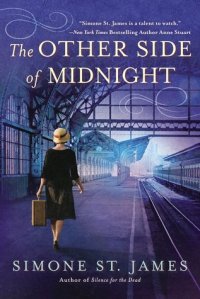
Serena’s Review: “The Other Side of Midnight”

The Other Side of Midnight Book: “The Other Side of Midnight” by Simone St. James

Publishing Info: NAL Trade, April 2015

Where Did I Get this Book: Audio book from the library

Book Description from Goodreads: London, 1925. Glamorous medium Gloria Sutter made her fortune helping the bereaved contact loved ones killed during the Great War. Now she’s been murdered at one of her own séances, after leaving a message requesting the help of her former friend and sole rival, Ellie Winter.

Ellie doesn’t contact the dead—at least, not anymore. She specializes in miraculously finding lost items. Still, she can’t refuse the final request of the only other true psychic she has known. Now Ellie must delve into Gloria’s secrets and plunge back into the world of hucksters, lowlifes, and fakes. Worse, she cannot shake the attentions of handsome James Hawley, a damaged war veteran who has dedicated himself to debunking psychics.

As Ellie and James uncover the sinister mysteries of Gloria’s life and death, Ellie is tormented by nightmarish visions that herald the grisly murders of those in Gloria’s circle. And as Ellie’s uneasy partnership with James turns dangerously intimate, an insidious evil force begins to undermine their quest for clues, a force determined to bury the truth, and whoever seeks to expose it…

Review: This book had many things going for it that fit into my preferences. Mystery: check. Historical time period: check. Dash of romance: check. All in all, right up my alley. And, for what it was, it met these expectations. It didn’t blow me away, but I enjoyed it.

Right off the bat, this book has been marketed as a gothic, ghost story. I’m not sure that’s right. This is a mystery. Yeah, there are some ghosts in it, but if you’re expecting horror, you’re going to be disappointed (also, it’s Kate’s job to read those so I don’t have deal with the nightmares!) But as a mystery novel, it does succeed. Ellie is a unique narrator and detective. She doesn’t start out with the goal of becoming an investigator and falls into the role purely from chance. But it becomes clear that she has a natural inclination, and her decisions are smart and she deals with the challenges thrown her way in a believable manner.

Often, mystery novel investigators fall into the category of “the next Sherlock Holmes.” They make wild leaps of logic, and their deductions are impossible for the reader to follow. We’re meant to just go with it and realize that we couldn’t possibly follow the thought process with our normal brains, which is what makes the author’s main character such a special investigative snowflake.Sometimes this can work. I love me a Sherlock Holmes esque character, believe me.

kc3cuvmstgtce
Preach, Rob Lowe!

But, at other times, it comes off as lazy writing and a way for the author to avoid laying down the clues necessary for the reader to follow the mystery appropriately. This book, however, succeeds very well in this regard and provides just enough to keep the reader guessing without feeling completely lost.

I really enjoyed the psychic angle for the story. While this could fall under the category of “easy outs” like I was just ranting about a second ago, I gave this book an pass for it because of the attention given to this portion of the story. It is as much about how these different women have chosen to handle being given this gift as it is about the murder mystery. Ellie, her mother, and Gloria all handle this power in very different ways. [Insert Spiderman quote: “With great power comes great responsibility.”] The isolation of this gift is fully explored, especially in the context of the time period when operating as a businesswoman alone without a husband would have been isolating on its own, psychic abilities aside. There is a fascinating bit where Gloria discusses her role as a woman in society and what it means that out of everyone, three women were given this amazing ability.

With all of these details, however, the story did feel a bit bogged down in the middle. There are frequent jumps back in time to explore Ellie’s relationship with her mother and Gloria. And while these scenes are necessary to flesh out the story, there comes a point where I just wished we could move on with the real mystery. A killer was lurking in the city! Get a move on!

I also liked the romance included in the story. It felt a bit rushed towards the end, but I was impressed by how fully the author was able to explore James’ PTSD and experiences from the war without the the ease of an omniscient third person narrator. There were moments when James edged into “protecting the little woman” territory, but I appreciated how quickly and effectively Ellie stomped down on this while remaining true to the perspective and realities of a woman living in the 1920s.

As far as the audiobook goes, I enjoyed the narrator quite a lot. They got a British narrator for the story and the inclusion of a variety of London accents helped flesh out the many characters. Full marks for the audiobook version!

Rating 7: Good mystery novel. Not doing anything super new, but the psychic angle and time period made it a very fun read.

Reader’s Advisory:

“The Other Side of Midnight” is included in these Goodreads lists: “Fiction set in the 1920s” and “Historical Mysteries and Thrillers Featuring Women.”

Find “The Other Side of Midnight” at your library using WorldCat!

Kate’s Review: “Secret Six: Villains United”

22338431

Book: “Secret Six: Villains United” by Gail Simone, Dale Eaglesham (Ill.), and Brad Walker (Ill.)

Publishing Info: DC Comics, February 2015

Where Did I Get this Book: The library!

Book Description from Goodreads: Collecting the series that led into INFINITE CRISIS! Six of justice’s deadliest enemies band together to start a revolution. Together, they want to take a stand to stop the super-heroic community from tampering with their minds and to prove how deadly they can be! But not everyone agrees to this agenda. Six rogues are recruited by the enigmatic Mockingbird, charged with opposing the Society and given assignments to thwart their rivals and even help their enemies. Who is Mockingbird? Could it be one of the six? The status quo is rocked by the Society’s formation and the revelations along the way make certain that when the Secret Six are done, nothing in the DCU will ever be the same!

Review: Remember how I screwed up when I started reading the Secret Six trades? Remember how I jumped into “Unhinged” and felt like I’d missed something, and came to understand that I had missed the entire backstory comic miniseries “Villains United”? Well guess what! I went back and read not only the prequel series, but two other prequel arcs that were included inside the collection “Secret Six: Villains United”. Let me tell you, so many things make so much more sense now. And being reintroduced to these characters in their original introductions was a bit surreal, though very helpful.

Like the summary says, the Secret Six was originally formed in opposition to Lex Luthor’s group the Secret Society of Supervillains. The recruits included Scandal Savage, Deadshot, Ragdoll, Parademon, and Cheshire. Catman joined after Luthor had his pride of lions killed. The group isn’t exactly doing this of their own volition, as Mockingbird is using blackmail as a weapon against them. Secret Six has to help their enemies as ordered by Mockingbird, and has to contend with the fact that they may all betray each other. As far as a set up series goes, I liked “Villains United” for what it was. Sometimes it felt muddled when it came to motivations, and the plot got a little bloated for a six issue arc. But the fact of the matter is that this story was far more about the characters and less about the mess that surrounded them. Finding out why each of these villains joined made me love many of them even more. I was probably biased going in, given that the team has switched up between this story and “Unhinged”. I unapologetically love the current line up, and when the line up didn’t involve them, I stubbornly refused to be on board (mainly because I just love Jeanette, and Cheshire didn’t do anything for me outside of irritate me. Yes, I know that Jeanette didn’t even get introduced until “Unhinged”, but I never said I was rational).

But I really liked Catman again. Seeing his pretty tragic backstory and seeing why he would be so resentful for his current situation shed some serious light on his character. I like that he’s a villain, but is also very conflicted about being one. I doubt that he will become a hero by any means, but he’s a breath of fresh air in how sarcastic and crabby he is, while having a good heart that he resents. I also liked seeing Scandal’s own back story, from her love story with Knockout to her broken relationship with her assassin father who is ashamed that his daughter is a lesbian, and wants her to produce an heir to their line. Deadshot is still just a snark machine who makes questionable decisions, and Ragdoll is definitely the quirky weirdo that I loved in “Unhinged”, but this time he has an adorable friendship with Parademon, who is convinced that he’s a clown that must be protected AT ALL COSTS. Their friendship even got my misty-eyed at one point, a sign of Simone’s writing skills. She does such a good job of humanizing these villains while still making them, ultimately, villains. I just wish that it hadn’t been so convoluted at times.

Just to note as well, Doomsday showed up, and I’m still not totally over “Batman vs Superman: Dawn of Justice”, so I was both happy to see him and also suffering teary flashbacks.

Now that I’m all caught up in Secret Six I’m going to charge on through the series. Simone has a great group of characters, and a lot of heart and humor with edgy stories.

Rating 7: A good origin story with fun characters, but sometimes felt a little bloated and muddled.

Reader’s Advisory:

“Secret Six: Villains United” is included in these Goodreads lists: “Current DC Titles”. Yep, that’s it. You can find more on my initial “Secret Six” post here.

Find “Secret Six: Villains United” at your library using WorldCat!