Serena’s Review: “An Unexpected Peril”

Book: “An Unexpected Peril” by Deanna Raybourn

Publishing Info: Berkley, March 2021

Where Did I Get this Book: Edelweiss+

Book Description: January 1889. As the newest member of the Curiosity Club—an elite society of brilliant, intrepid women—Veronica Speedwell is excited to put her many skills to good use. As she assembles a memorial exhibition for pioneering mountain climber Alice Baker-Greene, Veronica discovers evidence that the recent death was not a tragic climbing accident but murder. Veronica and her natural historian beau, Stoker, tell the patron of the exhibit, Princess Gisela of Alpenwald, of their findings. With Europe on the verge of war, Gisela’s chancellor, Count von Rechstein, does not want to make waves—and before Veronica and Stoker can figure out their next move, the princess disappears.

Having noted Veronica’s resemblance to the princess, von Rechstein begs her to pose as Gisela for the sake of the peace treaty that brought the princess to England. Veronica reluctantly agrees to the scheme. She and Stoker must work together to keep the treaty intact while navigating unwelcome advances, assassination attempts, and Veronica’s own family—the royalty who has never claimed her.

Previously Reviewed: “A Curious Beginning,” “A Perilous Undertaking,” , “A Treacherous Curse” , “A Dangerous Collaboration” , and “A Murderous Relation”

Review: I think I’ve started my reviews for the last several books in this series the same way: my enjoyment of these stories has been very hit and miss. The first several were all very enjoyable, but as the series progressed, it felt like the author was stalling on the romance and losing some creativity with the mysteries themselves. The book directly previous to this one, for example, very much felt like a recycled version of plot elements from several of the books before it. However, optimistic as ever, I’ve continued on. And, while this wasn’t my favorite book in the series, it did again bounce back from the previous low point.

Surprising no one but perhaps Stoker (his optimism for an end to his and Veronica’s dangerous mysteries is perhaps more endearing than it is realistic), murder and mystery has once again found Veronica Speedwell. The death of a fellow female explore, Alice Baker-Greene, a famous mountaineer, raises suspicion from Veronica, especially in light of the cagey response by the Princess of the country in which Alice died. When the Princess herself next disappears, Veronica finds herself thrust into royal company posing as a doppleganger and hoping to suss out more clues as to Alice’s fate. But are Veronica and Stoker once again straying too close to danger?

I was pleased to see that this new entry into Veronica and Stoker’s story was taking us into uncharted territory for the most part. I really enjoyed the backstory we are given for Alice, a woman of Veronica’s own ilk but whose talents were directed towards mountain climbing rather than butterflies. I was able to guess a few of the mysteries tied up in her story, but I was also flummoxed by a few others. The added twist of the Princess’s disappearance adds an interesting extra layer to the proceedings.

Veronica and Stoker are still interesting characters, but I do feel that each is beginning to run a bit dry on character development. Once again, Stoker is so far in the background of this story that I often felt like he was barely present. Over the last two books, there has been practically no growth or arch for this character and it’s definitely starting to show. And for her part, Veronica is growing only marginally. We see her here struggle with the prospect of her future and the changes that her burgeoning relationship with Stoker may have upon that. This was an interesting concept, but I don’t feel like the author really gave it enough room to grow and resolve.

Instead, we find Veronica again getting caught up into the tired story line regarding her connections to the Royal family. Seriously, knock it off with this. It was a great reveal for the first book and coming up here and there is fine. But every single book now seems to include this aspect of Veronica’s life, but without having anything new to say or any new conclusion to reach. It’s dull and starting to feel really lazy. I complained about this same thing in my last review, and I’m disappointed to be repeating myself again here.

Overall, however, I was pleased with the mystery itself. When the story started out, I had hopes that Veronica and Stoker would travel to Alpenwald to conduct their investigation. I’m starting to think that a change of location would help the series a lot. One of my favorite entries, “A Dangerous Collaboration,” took place elsewhere, and I think it helped the story get out of a few of the ruts it gets stuck in when remaining in London. If there’s a next entry in the series, hopefully a relocation like this will help breathe some new life into this series. I’ll probably still continue on, but at this point I would probably only recommend it to those who are fairly devoted. The last few entries have just been too shallow and dull to amount to a stronger recommendation to a new reader.

Rating 7: An improvement on the last book, but still stuck in some tired tropes of its own making.

Reader’s Advisory:

“A Unexpected Peril” is on these Goodreads lists: Historical Mystery 2021 and Historical Mysteries and Thrillers Featuring Women.

Find “An Unexpected Peril” at your library using WorldCat!
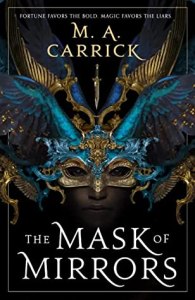
Serena’s Review: “The Mask of Mirrors”

Book: “The Mask of Mirrors” by M. A. Carrick

Publishing Info: Orbit, January 2021

Where Did I Get this Book: copy from the author!

Book Description: Renata Viraudax is a con artist who has come to the sparkling city of Nadezra — the city of dreams — with one goal: to trick her way into a noble house and secure her fortune and her sister’s future.

But as she’s drawn into the elite world of House Traementis, she realizes her masquerade is just one of many surrounding her. And as corrupt magic begins to weave its way through Nadezra, the poisonous feuds of its aristocrats and the shadowy dangers of its impoverished underbelly become tangled — with Ren at their heart.

Review: M. A. Carrick is the pen name for two authors, Marie Brennan and Alyc Helms. I’m not familiar with any of Helms’ work, but I’ve enjoyed the books by Brennan that I’ve read. Both are anthropologists as well, which I think often adds an extra layer of detail and attention to the world-building in original fantasy novels. Like so many before it, this book has been hyped with comparisons to “Six of Crows,” and based on the description alone, I can see where that would come from: any fantasy novel that features cons and has multiple POVs MUST be compared to “Six of Crows!” We all know what my record has been with those so far…

Renata is not who she claims to be, the lost cousin of a down-and-out noble family who nonetheless hold power at their finger tips. No, Renata is truly Ren, a former street urchin who has always had an eye for a con. But the plan that she and her sister conjured up, for Ren to ingratiate herself with a noble family as a long lost cousin and hence secure a future for them both, quickly goes sideways and Ren soon finds herself caught up in events that are greater than she had prepared for. What’s worse, she’s beginning to feel a bit too much like Renata, caring about and for things and people she shouldn’t.

Not only do the comparisons to “Six of Crows” feel accurate in this case, this book escapes the curse of being a massive let-down that has struck so many “wanna-be ‘Six of Crows'” imitations in the past. In a lot of ways, it’s like the adult version of that. It definitely goes to some darker places than the YA novel is allowed to, and its character more fully exist in the shades of grey between good and bad. Good people doing bad things for good reasons. Bad people doing good things for horrible reasons. It’s all deliciously complicated and prickly, making you both love and despise characters at various times and question how you, yourself, would handle certain situations.

I also liked many of the characters introduced, especially Ren. It’s always important to like the main character, and it can be especially hard to write a realistic character such as this without having her become a caricature con artist, constantly quipping and not founded in any deeper human emotion beneath it all. Not here. Through Ren’s perspective, we see the challenges she faces, trying to become part of a group of society that she also despises. And slowly grows to appreciate. And then equally begins to struggle with her own feelings towards these people and the balance between her original goals and the individual connections she’s made.

There were also a lot of twists and turns throughout the story. For much of it, the identity of the mysterious Robin Hood-like character is unknown, and it was a constant challenge trying to figure out the identity of this enigmatic force to be reckoned with. The end of the book also really kicked things up and left the story in a very primed state for the sequel.

My one ding is in regards to the length and pacing of this book. It’s over 600 pages long, which is just a lot to ask of readers taking on a new fantasy world such as this. The story did fairly well supporting this page length, but the pacing did stutter at times, and I think the entire thing would have been more approachable if it had been edited down a bit. But, in the end, I think most fantasy fans will enjoy this book, and I’m definitely curious about the sequel!

Rating 8: A complex new fantasy world bites off a bit more than it can chew in length, but makes up for it with strong characters and compelling mysteries.

Reader’s Advisory:

“The Mask of Mirrors” is on, funnily enough, this Goodreads lists: The Best Random Genre List Of Books…Ever.

Find “The Mask of Mirrors” at the library using WorldCat!

Serena’s Review: “As the Shadow Rises”

Book: “As the Shadow Rises” by Katy Rose Pool

Publishing Info: Henry Holt Books for Young Readers, September 2020

Where Did I Get this Book: Edelweiss+

Book Description: The Last Prophet has been found, yet he sees destruction ahead.

In this sequel to the critically-acclaimed “There Will Come a Darkness,” kingdoms have begun to fall to a doomsday cult, the magical Graced are being persecuted, and an ancient power threatens to break free. But with the world hurtling toward its prophesized end, Anton’s haunting vision reveals the dangerous beginnings of a plan to stop the Age of Darkness.

As Jude, Keeper of the Order of the Last Light, returns home in disgrace, his quest to aid the Prophet is complicated by his growing feelings for Anton. Meanwhile, the assassin known as the Pale Hand will stop at nothing to find her undead sister before she dies for good, even if it means letting the world burn. And in Nazirah, Hassan, the kingdom-less Prince, forms a risky pact to try to regain his throne. When the forces of light and darkness collide in the City of Mercy, old wounds are reopened, new alliances are tested, and the end of the world begins.

Previously Reviewed: “There Will Come a Darkness”

Review: I wasn’t a huge fan of the first book in this series, as my review above with testify to. But it’s hard to resist returning to a series when the sequel is so highly praised (but then again, so was the first one, and we saw how that turned out). But this book currently has a 4.25 star rating on Goodreads, which is definitely not something to turn your nose up at. So I requested it and tried to be open to what others are seeing in this series that I didn’t. Sadly, I still don’t see it.

Our main characters are spread far and wide. And while the Last Prophet has been identified, the world still seems to be burning around them. Hassan has lost his country to his scheming Aunt. Jude returns in disgrace having let his feelings get ahead of his mission time and again. And our favorite assassin wanders the land looking for her self-destructive, undead sister. Not to mention the doomsday cult that only seems to have gotten started. As their paths weave in and out of each other’s stories, the way forward begins to look more and more complicated and challenging. If there even is a way forward.

Well, I will say that I liked this one better than the first. With so many POV characters, the first one had to devote a huge chunk of its page time introducing each of its characters and attempting to instill equal importance and interest in them all. For me, this last part wasn’t successful, but there was no avoiding the first part. One could make an argument for this being why multiple POV books should probably be much more rare than they seem to be at the moment. But for all of those reasons, the first book didn’t have much of a plot until the last quarter of the story where it did, finally, kick into gear. Here, the story was able to take off much more quickly for all that work already being done. Our threats have been better identified, the world-building better established, and it all results in a book that has much better pacing and action than the first.

I also liked the fact that the story is leaning into the darker, twisty aspects of the story. The first one I thought was pretty predictable and what were meant to land as big shocks were easily seen chapters ahead of time. Here, I was pleased that I was only able to predict a few of the twists and turns with more of them taking me genuinely by surprise. So if you enjoyed that aspect of the first book, this one is sure to satisfy.

Unfortunately, for me, most books live and die on their characters. And that was my biggest problem with the first, and that feeling only intensified with this one. There’s a combination of problems here, really. With so many POVs, there will always be favorites. This happens even with books/authors who can handle a large ensemble cast well. But here there are really only one or two characters whose stories I’m really invested in. For the others, there’s a combination of boredom by some and then dislike of others. Both of these feelings, I’m sure, are unintentional. Boring, for sure. And the dislike? I’m not quite so sure, but I think that we’re still meant to like most of these people. And it’s not even the morally ambiguous ones (assassins always are!) that are always the unlikeable ones here! I didn’t like Hassan much in the first, and he really doesn’t improve here. And while Jude has an interesting story, I’m still cringing over his complete failure to live up to what we’re meant to believe is rigorous training he went through his entire life. He has similar struggles here.

I did like the moments when the characters crossed paths with one another. That was a favorite part of the first book, too. It’s nice to see a story that doesn’t just get all of the characters together and then leave them that way. Here, like there, we see people come and go from each other’s stories, making the fact that they are all individuals with very different goals and objectives stay at the forefront of the mind. While they have different connections and interests in one another, they are not a team like we often see in other ensemble books.

Overall, I think this was an improvement on the first book. I liked that the story took me more by surprise. And the fact that so much of the introduction leg work had already been gotten out of the way really helped the pacing and action of the plot. Unfortunately, my problems with many of the characters only intensified and at times it felt like a real chore reading some of their chapters. However, if you were a fan of the first book, I’m sure you’ll like this one. And if your problems with the first one had to do more with its introductory nature more than anything else, this might be an improvement for you as well! Just expect more of the same, character-wise.

Rating 7: An improvement on the first, but I still found myself skimming through certain characters’ chapters.

Reader’s Advisory:

“As the Shadow Rises” isn’t on many Goodreads lists, weirdly, but it is on Books with Red Covers.

Find “As the Shadow Rises” at your library using WorldCat!

Diving into Sub-Genres: Literary Fantasy

We each have our own preferred genres of choice. Kate loves horrors and thrillers, really anything that will keep her up at night! And Serena enjoys escaping through hidden doors into realms of magic and adventure. We also read mysteries, historical fiction, graphic novels, etc. etc. And that’s not even counting the multitude of sub-genres contained within each greater genre. In this series, one of us with present a list of our favorites from within a given sub-genre of one of our greater preferred genres.

Literary fantasy is a hard sub-genre to even wrap your head around. Many of the other sub-genres of fantasy (portal fantasy, epic fantasy, steampunk, urban) have very distinct elements that are easily recognizable even from a short blurb about the book. Literary fantasy…not so much. It’s tempting to say that literary fantasy is simply contemporary fantasy where the story is simply light on fantasy altogether. But this writes off historical works which would also fit this category. So perhaps it is simply the light fantastical elements? But even that I don’t think is correct (you’ll see that a couple of books I’ve included here have fairly extensive magical elements).

Instead, I think it’s largely contained in a certain style of writing that is often found in these books. Literary fantasy is often just as focused on a beautiful turn of phrase as it is on describing a magical spell’s effects. There’s often an elegance to the writing, a compulsion to appreciate the words themselves rather than fully immerse oneself in the book to the point that the reader forgets they’re reading. Indeed, knowing that one is reading is half of the joy of these types of books, with more focus given to descriptions and omniscient narrator musings than action-packed set pieces. In many ways, I’m essentially describing “literary fiction” but with some fantastical element involved. However, I think that “literary fiction” typically includes other notable elements that don’t necessarily rely on a style of writing as strongly as literary fantasy does (often tragic, more experimentation with word-play and style of writing).

So with that in mind, here are a few examples of favorite books of mine that I would file under literary fantasy.

“The Invisible Life of Addie LaRue”

This was actually the book that inspired this entire review series, after one of our readers commented on my labeling it as “literary fantasy” and asked about other titles that would fit in that sub-genre. So here we are! This story, that of a young woman who strikes a deal to live forever but to never be remembered by anyone she meets, fits the criteria in a few ways. It definitely has fantasy elements, what with the main character living forever and all, but the themes of the book are much more focused on identity, one’s own history, and what it means to exist in a world made up of so many other people living out their own journeys. There’s also a big focus on art and how it expresses the lives of both the artist and the subject of art. Between these themes, much of the story taking place in a standard contemporary/historical setting with very little magic involved, and the beautiful style of writing, it definitely meets the criteria for literary fantasy.

“The Starless Sea” by Erin Morgenstern

If “The Invisible Lie of Addi LaRue” was the inspiration for this post, “The Starless Sea” was my immediate answer to the question posed by our blog reader for another example of literary fantasy. I could also include Morgenstern’s first novel, “The Night Circus,” under this category, but as this is the one I’ve read and loved most recently, I’ll include it here. It’s also an example of a book I would classify as literary fantasy but one that includes many, many fantasy elements. If anything, it walks right up to the line of what I would classify as fairytale fantasy or portal fantasy. The story is a winding affair of exploration and mystery throughout time and space, all held together by a mysterious library that exists right through a doorway, if one is only brave enough to open it. There’s much reflection on love and passion, but half of the magic is the sheer whimsy of the entire thing. Behind every door is a new wonder, and the writing seems to wrap you up in a warm blanket of delight and you’re left wondering if you perhaps travelled to this magical world after all, simply through the process of reading this book. It is this lovely style of writing and the effortless feel of the magical elements involved that classifies it as literary fantasy.

“Deathless” by Catherynne M. Valente

This book walks even closer to the line of fairytale fantasy than the last, in that it’s largely inspired by Russian myth and the Russian folklore character, Kuschei the Deathless. But again, it’s all in the style of writing. I debated including one of Valente’s “Fairyland” stories, which I think skirt this sub-genre fairly well themselves. But I think “Deathless” hits the mark a bit better with its supposition of fantastical creatures and myths over almost all of the important events of the 20th century in Russia. Of course, knowing even a little of Russia’s history during that time period, it’s a safe guess that the story, while beautiful, has its fair share of tragic moments, as well. Valente expertly wields her magical elements in such a way as to shine new light and new insights into some of the better (and lesser) known parts of the country’s history. Anyone who has read a book by her before can also testify to the unique and beautiful style of her writing. She’s definitely an author whose stylized sentences and combinations of thoughts often makes the reader stop and re-read certain sections just to revel in her use of words.

“The Golem and the Jinni” by Helene Wecker

This is another literary fantasy novel that is at least as much concerned with delving into its real-life, historical themes as it is in exploring the two magical creatures who are the story’s main characters. Yes, our two leads are the titular golem and jinni, but their story is much more than that. Instead, in many ways, the book is more concerned at looking at the experience of immigrants in the early 1900s and life in New York City during this time period, in general. Not only are both of our characters origins not of the United States, but each, of course, is even more “other” in that they aren’t human. But at the same time, each has such core human traits that define them, that their experiences and struggles feel almost amplified for it. This is a long book, and one that definitely takes its time carefully depicting the details of the place and time as much as it does the history of the golem and jinni. It’s the kind of book that could fairly easily be recommended to straight-up historical fiction fans as well as fantasy readers.

“Tigana” by Guy Gavriel Kay

Guy Gavriel Kay is another author who’s entire catalog of books would likely fit in this sub-genre. My favorite books by him, “The Fionavar Tapestry” quartet, definitely meet the criteria for style of writing, but they fall closer to portal fantasy, in my opinion. But I could have easily put “The Lions of Al-Rassan” or “Children of Earth and Sky” or many others on this list. I selected “Tigana,” however, because it’s probably, universally, one of his most beloved and well-regarded novels. Gavriel Kay’s books are also unique to this category in the fact that they are entirely set in alternative worlds. The settings and events are often inspired by real-life countries and events, but the worlds are still entirely fantasy-based, ultimately. This story touches on themes of war, love, and the tangle that politics makes of it all. It is expansive and marvelous, and, too many, set a higher bar for what readers can expect from fantasy fiction and specifically literary fantasy.

“The Bear and the Nightingale” by Katherine Arden

Lastly, I wanted to include the first book in a trilogy of books that would all fit well in this category. Like some of the others, “The Bear and the Nightingale” has a definite fairytale vibe to the story. But the slow build of the story, the attention spent on developing atmosphere, and the beautiful, lyrical style of writing all fit perfectly for literary fantasy. The sharply beautiful description of the Russian winter landscape are particularly poignant, and the themes regarding religion, magic, and one young woman’s journey to carve out a place for herself in a world that doesn’t have a place for women who don’t fit a certain type of mold. What starts out on a fairly small scale expands across the three books until Vasilisa’s story starts to encompass the entirety of Russia itself. I loved this entire tirlogy and would recommend all three (though they can’t be read separately, other than the first one, perhaps) to fans of literary fantasy.

What fantasy books would you categorize as literary fantasy? What are some of your favorites? Share in the comments below!

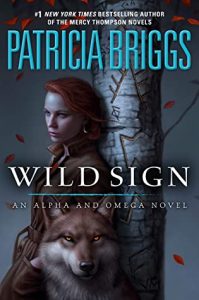
Serena’s Review: “Wild Sign”

Book: “Wild Sign” by Patricia Briggs

Publishing Info: Ace Books, March 2021

Where Did I Get this Book: NetGalley

Book Description: In the wilds of the Northern California mountains, all the inhabitants of a small town have gone missing. It’s as if the people picked up and left everything they owned behind. Fearing something supernatural might be going on, the FBI taps a source they’ve consulted in the past: the werewolves Charles Cornick and Anna Latham. But Charles and Anna soon find a deserted town is the least of the mysteries they face.

Death sings in the forest, and when it calls, Charles and Anna must answer. Something has awakened in the heart of the California mountains, something old and dangerous — and it has met werewolves before.

Previously Reviewed: “Burn Bright”

Review: If you go back and read my review of the previous book in the “Alpha and Omega” series, you’ll see that I was…less than thrilled with that entry. My concerns from that book spanned both this series as well as the “Mercy Thompson” books. But as my review earlier this week demonstrated, that series managed to sidestep the implications of the events in “Burn Bright.” But I was always a bit more concerned with how the next book in this series would do, given that Bran is more of a main character here. And, well, Briggs tries to walk it back a bit, I guess. But unfortunately the distraction offered in the main plot just introduces another frustration of mine.

Old things live in the dark wilds of the forest. And if you stay on the path, maybe you’ll miss the dangers lurking there. But when an entire town’s worth of people go missing, what lurks in the shades of the trees leaves a mark to big to ignore. Anna and Charles are called into action to track down the mystery. Where do you start, though, when all of the victims seem to have vanished into the air leaving behind no trace? Clues exist however in rumors of a powerful force that once lived there centuries before and may have faced werewolves before.

So, I did like this book overall. It’s hard, however, to write a review without taking up tons of wordcount on how this book deals with the fallout of the previous one. Or getting sucked into a long commentary piece on my frustrations with one particular aspect of it that I’m beginnig to struggle with more and more. So…I’ll try to write a fairly general bit before getting into any of that.

Overall, I liked the villain at the heart of this story. Its powers and backstory were very unique and interesting and left me guessing for much of the story. I was able to piece a few bits together early on, but there were a number of genuine surprises throughout that really helped build towards the final conflict. The action and threat-level felt high when it needed too, and there was a underlying sense of doom that pervaded the book in a really nice, creepy way.

I also liked what we got from Charles and Anna. Brother Wolf, the personified version of Charles’s wolf half was given more to say/do here and it was almost like having an entire third character. Might be a bit unfortunate, though, when your wolf character is more interesting than the two humans. Not that Charles and Anna are bad characters, but they still seem a bit dull and one-note, especially in comparison to the characters in the Mercy Thompson series.

The book also introduces a few chapters from Leah’s perspective. On the surface, this is a good thing. The story largely has to do with events in her history, and it’s great seeing inside the head of a character who has been at the heart of so much conflict earlier in the series and even in the “Mercy Thompson” series. It seems clear that by doing this Briggs is attempting to respond to the criticism of the previous book. Her history is such that Bran’s actions in her life are highly criticized by both Charles and Anna. Briggs also seems to try to build up a more true relationship between Leah and Bran with Bran needing to deal with his own past actions and open up to Leah more. It’s all well and good, I guess, but, really, it just makes the previous book’s “reveal” about Bran’s feelings for Mercy feel more about of place. This book not only doesn’t address that but seems to want to just paint over that with some alternative history in which Bran does care for Leah and that whole Mercy thing…never happened.

But when diving into Leah’s history, Briggs steps right into another big problem that I have. I’ve already struggled with the fact that both of Briggs’ leading ladies has a history of being a rape victim. Several SFF authors have written about how pervasive this particular trauma is within the genre and how unfortunate that fact is. Here are two of my favorite pieces, one by Seanan McGuire and one by Sarah Gailey. Each tackles the topic much more thoroughly and eloquently than I can.

Unfortunately, this book not only includes another rape attempt on our main character, but gives the only other POV female character we have a history of rape as well. Now all three POV female characters we’ve had in both series have experienced this particular trauma. Beyond that, the topic is placed firmly at the center of the conflict in this book. I wouldn’t have a problem with that fact on its own if it wasn’t for this established history of using it for our two other main characters. It not only begins to feel a bit much, but Briggs is falling into the exact trap that McGuire and Gailey discuss in their pieces: that somehow rape and sexual assault are almost necessary traumas that female heroes must go through in the ever-chased goal of “character development” and “added depth.” And in Leah’s case, particularly, it almost seems to be used as a way to excuse her abusive treatment of Mercy in the past. The entire thing reads as lazy and uninventive at best and as exploitative at worst.

So, there you go. Another book in this series that’s hard to evaluate based only on the merits of the story itself, but instead gets stuck in challenging topics that outweigh much of the rest. At this point, I’m sure I’ll still continue to read this series if there are more to come. But I’m on high alert now with this author and if these topics continue to come up in this manner, it might be time to throw in the towel.

Rating 6: A solid story is marred by the unfortunate, recurring use of sexual assault as a character-building tactic.

Reader’s Advisory:

“Wild Sign” isn’t on many relevant Goodreads lists, but it is on this funny-titled one: My Vampire Book Obsession Book Boyfriends

Find “Wild Sign” at your library using WorldCat!

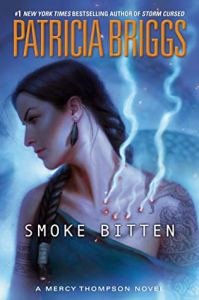
Serena’s Review: “Smoke Bitten”

Book: “Smoke Bitten” by Patricia Briggs

Publishing Info: Ace, March 2020

Where Did I Get this Book: from the library!

Book Description: I am Mercedes Athena Thompson Hauptman. My only “superpowers” are that I turn into a thirty-five pound coyote and fix Volkswagens. But I have friends in odd places and a pack of werewolves at my back. It looks like I’m going to need them.

Centuries ago, the fae dwelt in Underhill–until she locked her doors against them. They left behind their great castles and troves of magical artifacts. They abandoned their prisoners and their pets. Without the fae to mind them, those creatures who remained behind roamed freely through Underhill wreaking havoc. Only the deadliest survived.

Now one of those prisoners has escaped. It can look like anyone, any creature it chooses. But if it bites you, it controls you. It lives for chaos and destruction. It can make you do anything–even kill the person you love the most. Now it is here, in the Tri-Cities. In my territory.

It won’t, can’t, remain.

Not if I have anything to say about it.

Previously Reviewed:“Moon Called,” “Blood Bound,” “Iron Kissed,” “Bone Crossed,” “Silver Borne,” “River Marked,” “Frost Burned,”and “Night Broken” and “Fire Touched” and“Silence Fallen” and “Storm Cursed”

Review: This series has probably been the longest-running Urban Fantasy series I’ve read. With a series that has run for so long and includes so many books, it’s assumed that there will be highs and lows. There was a period a few books back that had me worried, with several underwhelming entries in a row. But the last one was super dark and very good, so it was with a refreshed interest in the series that I picked up this latest book. And while it wasn’t my favorite, it at least didn’t backslide into the low points that had come before.

All is not well for Mercy Thompson. Her husband, Adam, has been withdrawing from her for the last few months, clamming up when asked and shutting down the magical bond between them. On top of this, another werewolf pack is attempting to move in on their territory and the magical creator Underhill has created a doorway to her realm in Mercy’s backyard. And a door goes both ways, letting thins in…and out. Not a powerful magical creature is on the loose, taking over people and making them murder to fuel its terrible power. But so is the life of one Mercy Thompson: full of madness and danger. Will she, Adam, and their pack be able to tackle this most recent threat?

This book was kind of hit and miss. There were several things I really liked about it, and then some that I didn’t care for as much. For the positives, I like that we’re back to the trend of having Mercy as our one and only narrator. Some of the weaker installments were the ones that deviated from her and included POV chapters from Adam. He’s great as a romantic interest, hero type. But it was pretty boring being in his head. Mercy’s voice remains strong and compelling, lending needed animation to even the less exciting mysteries and villains.

I also really liked the action in this book. The fight scenes were fast and thrilling, and the aspects of the fight that existed on a more magical element were also interesting. I liked the increased exploration of how the pack’s bonds and Mercy and Adam’s bond work and affect each other. Mercy’s own background and heritage adds an extra level of interest into how she deals with magical threats and powers. There was also the return of a fairly beloved element of her magic, which was fun to see.

I also liked the story regarding Adam and the reasons behind why he was pulling away from Mercy. At first I was concerned that it was going to be some sort of silly melodrama, especially with the return of his ex-wife’s meddling early in the book. But luckily it went a different route and even tied back to some of the challenges that we know Adam has faced throughout his long life. There was also an unexpected sense of real danger to this particular problem. If anything, it was almost the bigger threat than the actual villain of the story.

And that I didn’t love as much: the main villain and the threat he/she/it presents. For one thing, I was able to very quickly guess who/what they were dealing with, which just made the delay for the final reveal to read as boring at best and frustrating at worst. It’s implied that Mercy figures it out around the time that I did, so at least it doesn’t dumb her down in the process. But I still felt like the build-up itself didn’t work and the story would have done better without it. A few more jokes and references would have been way more fun than the false tension.

There were also a few story elements and subplots that I didn’t think were needed. The book wasn’t super long, so maybe these were used just to pad out the wordcount. But I think that speaks to problems with the main plot that needed to be tweaked anyways. Not only did these subplots not add anything to the overall story, but they drained out some of the tension when they popped up again here and there throughout the story.

That said, I still enjoyed this book overall. It could be a bit slower than I’d prefer at times, but I still found the characters compelling, especially the evolving relationship between Adam and Mercy. Fans of the series will likely be pleased with this installment.

Rating 8: Not as good as the one that came before it, but still much better than the low-points of the series.

Reader’s Advisory:

“Smoke Bitten” isn’t on too many Goodreads lists, but it is on I checked it out of the library!

Find “Smoke Bitten” at your library using WorldCat!
Monthly Marillier: “Child of the Prophecy”

“Monthly Marillier” is a review series that is, essentially, an excuse for me to go back and re-read one of my favorite author’s back catalog. Ever since I first discovered her work over fifteen years ago, Juliet Marillier has been one of my favorite authors. Her stories are the perfect mixture of so many things I love: strong heroines, beautiful romances, fairytale-like magic, and whimsical writing. Even better, Marillier is a prolific author and has regularly put out new books almost once a year since I began following her. I own almost all of them, and most of those I’ve read several times. Tor began re-releasing her original Sevenwaters trilogy, so that’s all the excuse I needed to begin a new series in which I indulge myself in a massive re-read of her books. I’ll be posting a new entry in this series on the first Friday of every month.

Book: “Child of the Prophecy” by Juliet Marillier

Publishing Info: Tor, June 2003

Where Did I Get this Book: own it!

Book Description: Magic is fading… and the ways of Man are driving the Old Ones to the West, beyond the ken of humankind. The ancient groves are being destroyed, and if nothing is done, Ireland will lose its essential mystic core.

The prophecies of long ago have foretold a way to prevent this horror, and it is the Sevenwaters clan that the Spirits of Eire look to for salvation. They are a family bound into the lifeblood of the land, and their promise to preserve the magic has been the cause of great joy to them… as well as great sorrow.

It is up to Fainne, daughter of Niamh, the lost sister of Sevenwaters, to solve the riddles of power. She is the shy child of a reclusive sorcerer, and her way is hard, for her father is the son of the wicked sorceress Oonagh, who has emerged from the shadows and seeks to destroy all that Sevenwaters has striven for. Oonagh will use her granddaughter Fainne most cruelly to accomplish her ends, and stops at nothing to see her will done.

Will Fainne be strong enough to battle this evil and save those she has come to love?

Review: Several years after the events in “Son of the Shadows,” we meet Fainne, the daughter of Niamh, Liadan’s lost sister. Growing up in practical isolation, and with the loss of her mother early in life and a reclusive father, Faine’s life has been one of quiet and seclusion. In many ways, Faine feels that she and her father aren’t simply hiding from his cruel, sorceress mother, Oonagh, but they are hiding from their own dark potential. But when the currents shift and Faine is forced out into the world and finds herself in her mother’s ancestral home of Sevenwaters, Faine must begin to make choices about her own future. Will she follow in her grandmother’s footsteps? Or will she choose a new way like her aunt and maternal grandmother before her?

By the time I got to this book, I’d actually read a few of Marillier’s other works. This was probably for the best as this is one of my less favorite of her books. It’s kind of surprising, because overall, I think her Sevenwaters series has been one of her biggest draws to her fantasy readership. But for me, something felt off about this book almost from the start. However, let’s talk about the things I liked, first off.

Marillier’s writing is almost freakish in its consistency. If you read a lot of her books, you’ll soon be able to immediately recognize her unique style of lyrical prose and straightforward storytelling. There’s a sense of wonder and comfort in much of her work, even as she touches on some dark topics. Every word feels delicate and intentional. There’s no denying the craftmanship of her work, and that was all on display here, especially when working with a character like Faine who is very different than the leading ladies who came before her.

I also liked seeing some familiar faces again. I, of course, really enjoyed Liadan and Bran’s story, so it was great seeing them again. It was also interesting to see side characters who had grown into roles they had just begun in “Son of the Shadows.” Sean, for example, has now been leader of Sevenwaters for over a decade. We also see Aisling, his wife, in her role as the lady of Sevenwaters. And, most jarring but also best of all, we get to see a grown Johnny balancing his role as heir to Sevenwaters and presumed fulfiller of the much-debated prophesy that has sat at the heart of the story from the start.

The problem with all of this, however, is that these side characters, both the very familiar, like Liadan and Bran, and the less so, like Johnny, are more intriguing than Faine. Much of Marillier’s work lives and dies on the strength of her characters. Most of her books are slow on the action and heavy on the introspection. So that main character has a lot of heavy lifting to do. And unfortunately, Faine just isn’t up to it. To some extent, I appreciate the challenges that Faine represents. Liadan and Sorcha were almost perfect women, so it’s refreshing to see Marillier tackling a heroine who faces challenges both physical and emotional. Faine walks with a limp, and due to her reclusive lifestyle, she struggles to form connections and maintain relationships. These parts of her character I thought were very well-drawn, and it was interesting watching her learn to piece together human interactions with people who are family in name only to her.

Unfortunately, her naivety turns into almost willful stupidity at points. Her concern of the darkness within her drives her actions past the point of reason. It’s hard to be sympathetic at points when events around her and those who would seek to use her are less than subtle. She does some pretty bad stuff for some pretty weak reasons. And much of her motivation seems weak and more told to the reader than shown in any way that would make it truly threatening feeling.

I also really disliked the romance. It’s not that it was bad, and the hero had his charming, appealing moments. But in comparison to the deep, well-drawn relationships that came in the books before, this one just feels shallow and uninteresting in comparison. I never felt any real chemistry between these characters, and there was very little tension in the proceedings. Some dramatic events happen towards the end, but even then, what should have been heavy hits felt fairly removed for me. I just didn’t care that much.

Of the original trilogy, this book is the weakest by far. It had a really interesting premise, featuring a character who has grown up more on the fringes of Sevenwaters and its stretching legacy, but several aspects of the book just felt a bit off. Faine wasn’t nearly as compelling as Sorcha and Liadan. And the romance felt stilted and thin. It’s still worth reading, however, if you’re a fan of the series as some pretty significant events occur and many of the mysteries laid down in the first two books are resolved. Events that occur here will also be referred to loosely in the second trilogy in the series.

Rating 6: Underwhelming after the flashes of mastery that were the first two books in the trilogy.

Reader’s Advisory:

“Child of the Prophecy” is on these Goodreads lists: Great Celtic Fiction and Myth and Folktale Retellings.

Find “Child of the Prophecy” at your library using WorldCat!
Serena’s Review: “The Bone Maker”

Book: “The Bone Maker” by Sarah Beth Durst

Publication Info: Harper Voyager, March 2021

Where Did I Get this Book: Edelweiss+

Book Description: Twenty-five years ago, five heroes risked their lives to defeat the bone maker Eklor—a corrupt magician who created an inhuman army using animal bones. But victory came at a tragic price. Only four of the heroes survived. 

Since then, Kreya, the group’s leader, has exiled herself to a remote tower and devoted herself to one purpose: resurrecting her dead husband. But such a task requires both a cache of human bones and a sacrifice—for each day he lives, she will live one less.

She’d rather live one year with her husband than a hundred without him, but using human bones for magic is illegal in Vos. The dead are burned—as are any bone workers who violate the law. Yet Kreya knows where she can find the bones she needs: the battlefield where her husband and countless others lost their lives. But defying the laws of the land exposes a terrible possibility. Maybe the dead don’t rest in peace after all.  

Five warriors—one broken, one gone soft, one pursuing a simple life, one stuck in the past, and one who should be dead. Their story should have been finished. But evil doesn’t stop just because someone once said, “the end.”

Review: Sarah Beth Durst has always been a bit of a hit or miss author for me. When she’s on her game, I really love her books. But there are others of her titles that have really not worked for me. So I never quite know which one I’m going to get when I pick up a new book by her. But this one, with its interesting premise and its focus on an older woman as its heroine, sounded like something that would be right up my alley!

What was a day of triumph to the nation was a day of horror to Kreya. While she and her four companions were successful in the heroic mission they set out upon, to take down the viscous bone maker Eklor, Kreya lost her husband in the process. Now, years later, Kreya is living as a recluse, desperately working forbidden magic to buy just one more day with her lost love. When she seeks out a method to work this magic on a more long-term basis, she discovers horrors that she thought were long ago settled. Now she and the others must grapple with the reality that their story may not actually be finished, and they’re not sure they can win this time.

This book checked two boxes of interest for me. Recently, I’ve really been enjoying stories that look at the “after” of heroic tales. Veronica Roth’s “Chosen” was one of my favorite reads last year and dealt with this very topic. While both that book and this one essentially present the same story, that the first “ending” wasn’t really the end at all but simply a pause on everything, they each tackle the topic of what life is like for these heroes in what they think is the end. While this book is mostly Kreysa’s story, Durst also offeres insights into the other heroes who fought alongside her. Through them all, we see the various methods each is using to handle an entire lifetime after such a momentous start. You save the world in your twenties…then what? Not only is the resulting PTSD and trauma something that must be carried afterwards, but the sense that one’s biggest moment in life is already behind one has to play with the mind. I really like the variety we see between the heroes and how they are all coping, nor not coping, with these challenges.

The second point of interest is its focus on an adult heroine. The book never specifies Kreya’s or her friends’ age, but we know their fight happened 25 years ago and that Kreya was married at the time. It’s like that she’s in her late forties or older. It’s always refreshing to read a book that focuses on older characters. By necessity, their lives look very different than the young adult heroes and heroines we so often see. Instead of new love, it’s often an established relationship or a second love. Instead of the challenges of coming into one’s power for the first time, it’s managing a life that has already contained a multitude of defining moments. Kreya and her friends have lived a quarter of a century’s worth of life since their grand adventure. During that time they’ve built lives and come to terms with the events of their youth. They also have to face these new challenges as the people they are now, not the people they were when they first fought their foe. There are both new strengths and challenges that come with taking up the mantle of heroism again later in life.

I specifically enjoyed the established romance between Kreya and her husband. We see all the strengths that have been built into it over the years of loving the same person. But there are also some unique challenges that come along with this. Specifically, of course, the fact that one member of the marriage has been dead on and off for the last 25 years…but it also speaks to the way that relationships grow and change alongside the individuals in them.

The only ding I have against the book is that the world-building and magic system are kind of simplistic and lack detail and depth. There are some cool monsters that live in a particular forest, some magically-operated cable cars, and a few other things. But none of them are described very fully or really made to feel like they are part of a fully-realized world. However, it was also clear that the focus of the book was meant to be largely about its characters, so while the world wasn’t very complex, I wasn’t necessarily feeling that it was lacking while I was reading. Fans of Durst’s work are sure to enjoy this, and fantasy lovers who prefer a more mature hero and stories focused on the “after” of the heroic journey should definitely check it out!

Rating 9: A very enjoyable, fast read that highlights the fact that no hero’s journey is every really over.

Reader’s Advisory:

“The Bone Maker” isn’t on many Goodreads lists, but it is on Can’t Wait Sci-Fi/Fantasy of 2021.

Find “The Bone Maker” at your library using WorldCat!

Serena’s Review: “Monsters of Men”

Book: “Monsters of Men” by Patrick Ness

Publishing Info: Candlewick, May 2010

Where Did I Get this Book: own it!

Book Description: As a world-ending war surges to life around them, Todd and Viola face monstrous decisions. The indigenous Spackle, thinking and acting as one, have mobilized to avenge their murdered people. Ruthless human leaders prepare to defend their factions at all costs, even as a convoy of new settlers approaches. And as the ceaseless Noise lays all thoughts bare, the projected will of the few threatens to overwhelm the desperate desire of the many. The consequences of each action, each word, are unspeakably vast: To follow a tyrant or a terrorist? To save the life of the one you love most or thousands of strangers? To believe in redemption or assume it is lost? Becoming adults amid the turmoil, Todd and Viola question all they have known, racing through horror and outrage toward a shocking finale.

Previously Reviewed: “The Knife of Never Letting Go” and “The Ask and the Answer”

Review: So remember how I was all whiny about the cliffhanger ending in the first book? Yeaaaah, Ness definitely leaned into that inclination with the end of “The Ask and the Answer” with both the arrival of another ship from Viola’s fleet and an army of Spackle marching in on New Prentisstown full of righteous vengeance. Betwen all of that, you’ll understand why my reviews for these books came on after another. I simply never put down the series and blew through all there in a matter of days!

Todd and Viola have finally managed to reunite only to be immediately set off on separate missions. For Todd, his victory over the Mayor is fleeting as the Spackle army marches down upon the town and the Mayor’s army still recognizes only one leader. For Viola, two more of her people have finally arrived only to find themselves in the midst of an ongoing war with terrible choices all around. To engage in a war against a wronged native people? To side with a terrorist group? To side with the maniacal Mayor whose cruelty sparked much of the violence? With no good choices, once again, both Todd and Viola must face just how far they will go to save one another. And at what cost to the greater good?

Following the path set in the first two books, Ness expands even further on the questions he presents his characters (and the readers) regarding violence, justice, and priorities. The first book was a very insular look at one boy’s, Todd’s, struggles to cope with one-on-one violence in his efforts to protect himself and those around him. In second book, we see Viola confronted with a terrorist organization that is working against a truly evil man but which is operating within its own questionable morality. And in the third book, we see the righteous fury of the native Spackle as they finally bring the Mayor’s great war to fruition. And we experience the horror of Viola, Todd, and, importantly, the two new comers as they are forced to pick sides in a volatile situation that seems to have no good outcomes.

The book jumps right into things with the first battle playing out between the Spackle, equipped with new powerful weaponry, and the Mayor’s army. There is no glory or exciting action here. Ness, through Todd’s eyes, is committed to presenting the horrors of war. Even from the Spackle whose mistreatment at the hands of the humans would justify much. It is all death, pain, and misery, as brought to home most poignantly in Todd’s eyes as he witness the death of a random man in the army whose Noise is projecting fear and longing for his wife and small son right up until the end. There’s no escaping the sheer nightmare of war as described in this battle scene. It’s powerful and painful and an excellent precursor to much of the rest of the book.

In the second book, we were given an extra POV through Viola’s eyes. Here, we get a third and begin to learn more about the Spackle themselves. I can’t talk to much about this without some fairly big spoilers. But I can’t emphasize how pleased I was with this addition. The first two books show a people who have been forcibly silenced by colonizers. All that is known of them is what the humans around them have projected upon them, with the original war and memories of what the Spackle were like before their enslavement all but gone in people’s memories. There were so many intriguing aspects of this portion of the story. I particularly liked the way Ness handled Noise and how, for the Spackle who are natives of this world, it is seen in a completely different light than it is by the humans who have torn themselves apart because of it.

Todd and Viola, for their part, are still excellent characters. We see each of them struggle with the choices before them, making missteps that are driven by what seems like the right choice at the time but that has lasting implications for everyone around them. Each has grown so much from the first book, but we almost get that much character growth all again in this single, last book. As a whole, their journeys are each spectacular and even more wonderful as a pair.

This entire trilogy is so very, very good. It challenges readers at every turn to evaluate the price of every action or reaction, regardless of how righteous the cause. Ness is smart enough to leave many of the conclusions left unsaid but obvious enough. It’s always nice to see an author trust his readers like that. The ending was rough, but so was the entire series. Sad, but hopeful. I think that’s how I’d sum up the the trilogy anyways. If you’ve enjoyed the first two books, I think it’s a given that you’re already planning on reading this given (yet again!) the massive cliffhanger at the end of that book. But I will reassure you all that Ness stick the landing perfectly.

Rating 10: Heartbreaking in the best way possible.

Reader’s Advisory:

“Monsters of Men” is on these Goodreads lists: Most Interesting World and Best War Novels.

Find “Monsters of Men” at your library using WorldCat!

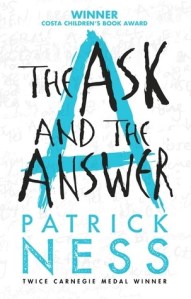
Serena’s Review: “The Ask and the Answer”

Book: “The Ask and the Answer” by Patrick Ness

Publishing Info: Candlewick, May 2009

Where Did I Get this Book: own it!

Book Description: We were in the square, in the square where I’d run, holding her, carrying her, telling her to stay alive, stay alive till we got safe, till we got to Haven so I could save her – But there weren’t no safety, no safety at all, there was just him and his men…

Fleeing before a relentless army, Todd has carried a desperately wounded Viola right into the hands of their worst enemy, Mayor Prentiss. Immediately separated from Viola and imprisoned, Todd is forced to learn the ways of the Mayor’s new order. But what secrets are hiding just outside of town? And where is Viola? Is she even still alive? And who are the mysterious Answer? And then, one day, the bombs begin to explode…

Previously Reviewed: “The Knife of Never Letting Go”

Review: Keeping on my read of Patrick Ness’s “Chaos Walking” trilogy, I was eager to pick up this next book after the massive cliffhanger we were left with in the first book! Warning, there will be spoilers for the first book in this review as it’s almost impossible to talk about this book without revealing some of the reveals we had there.

After desperately fleeing the Mayor and his growing army, Todd and a grievously injured Viola finally reach Haven to discover it is really nothing of the sort. Without even putting up a fight, the people of Haven have already surrendered to the Mayor, and it is he who now controls the town and Todd and Viola’s fate. The division between men and women, with men’s Noise and women’s lack of Noise at the heart of it, grows daily. Like all of the other men and women, Todd and Viola are separated and life is very different under the control of the Mayor (now the President.) But a resistance quickly emerges calling itself the Answer and waging a terrifying guerilla war against the Mayor and his men. No one knows when the next bomb will go off or how the Answer is even doing what its doing. Todd and Viola separately with the cruel decisions put before them, desperately trying to find their way back to one another at the same time.

I feel like this series is systematically expanding a central thought at its core: is violence ever justified? In the first book, we see Todd’s struggles with what he has been told makes a man, the ability to kill. Again and again he fails to kill even when it would spare his life. But then in a fit of anger and fear, he kills a Spackle violently and suddenly. And then we see this decision haunt him throughout the remainder of the book. By the end, Todd has come to his own decisions about what does and does not make a man and cold-blooded murder decidedly does not.

Here, however, the question of violence is expanded outwards. On one hand, we have the Mayor who insists that his army and tactics are necessary for dealing with the rising threat of the Spackle and to create a unified force for when Viola’s people arrive in their ships. The Answer, on the other hand, violently opposes the Mayor’s brutal tactics and cruel treatment of women and Spackle. For them, the “answer” is to fight back with everything they have, waging a terrorist bombing campaign against the town itself. They try to avoid casualties, but any accidental hits are simply put down to necessary losses in the grander scheme. And from a third perspective, Viola, who spends much of the first half of the book in a House of Healing, meets a healer woman who’s firm line that saving a life must always come first demonstrates just how hard this approach is, watching cruelty unfold but not responding other than to treat those who are injured, both friend and foe alike.

There is no clear “right” choice in any of it, other than the Mayor himself who is pretty clearly bad. Viola and Todd each have to tackle incredibly challenging situations that really make the reader stop and think about what they would do if presented these options in the circumstances. I was never really sure, other than to be glad I was reading about it and not experiencing it myself. But I find this type of story that really challenges its readers to be the best kind. It’s definitely not an easy book. There’s darkness throughout and some really terrible things happen, but it’s also one that shows the resilience of the spirit to go on through even the most impossible feeling events.

For his part, the Mayor is an excellent villain. Ness doesn’t overplay his hand here with any mustache-twirling or silly excess. Instead, the Mayor’s oozing manipulation is all to easy to understand. We see how even Todd can be influenced by it, a young many who has tackled more than many of the other men who fall under the Mayor’s sway. I also really liked that we got to see more from Davy, the Mayor’s son. His character is really rounded out here and shines a different light on the Mayor as well.

The narrative is also now split between chapters from Todd’s perspective and Viola’s. This is, of course, necessary to tell each of their stories as they spend so much of the book apart. But it’s also great to finally see into Viola’s head. In the first book, it was clear that even though Todd has grown up on this planet, he still had very little understanding of his own people’s history. But Viola is coming from a completely different life experience. She grew up on a colony ship with this planet as its destination. And then to be suddenly thrust into this situation after her parents die in the crash…It’s inevitable that she would see the decisions before her and the events around her through a very different lens than Todd.

I really enjoyed this book. Like I said, it’s not a light, fluffy read, but it’s darkness and challenge is what makes it stand-out. Ness doesn’t pull any punches when pushing his reader to tackle these tough topics. If you enjoyed the first book, I’m sure this is already on your radar (again, that ending!) So rest assured that while the pedal might have felt like it was to the metal in the first book, this is where it really gets started!

Rating 9: Tackling some really tough questions about violence and the rights and wrongs therein, this book is kept from being too dark by its incredibly compelling two main leads.

Reader’s Advisory:

“The Ask and the Answer” is on these Goodreads lists: Fast-paced books with Redeeming social value to read in one-sitting and Deep Underrated YA.

Find “The Ask and the Answer” at your library using WorldCat!