Book Description: Navigate through monsters, mysteries, and the will of the gods with two young extraordinary adventurers in fifteenth-century Mesoamerica as they search for a missing father.
Donají is a fearless Zapotec girl who, even though she’s only fifteen, is heralded as a hero by her village. In Codex Black, Donají sets out on an adventure–accompanied by the god that lives inside of her poncho–to find her missing father. Along the way, she meets an 18-year-old winged Mexica warrior named Itzcacalotl, and over time their temporary partnership blooms into an incredible friendship.
The search brings the young pair closer to danger and deeper into mystery than either could have predicted. What exactly was Donají’s father involved with? And how did a simple search for a missing relative lead Donají and Itzcacalotl into a fight with a terrifying bat monster to defend an entire village?!
Review: Thank you to IDW Comics for sending me an eARC of this graphic novel!
I told myself that I was going to try and do more graphic novels this year, as I felt like 2022 was a bit more sparse than it should have been. And with that goal I’ve found some pretty fun reads, some of which have been suggested to me or offered up, and were therein probably not been on my radar without the outside help. And that’s really worked out in my favor! The most recent of these is “Codex Black (Book 1): A Fire Among Clouds”, a young adult fantasy graphic novel that takes place in a pre-Columbian Mesoamerica, and involves two teenagers who have found themselves with magical abilities and powers. The premise alone sounded awesome, and when I saw the artwork I was even more eager to dive in!
“Codex Black: A Fire Among Clouds” is a really enjoyable first volume in the series. It has a lot it has to do in terms of setting up time and place, as well as a cast of characters, AS WELL as building a fantasy world within a historical context. We meet our two protagonists and see where they fit into the story, and Lozano does a great job of not only introducing them and making them connect, we also get a great sense for who they are. The first is Donají, a Zapotec teenage girl from a mountain village, is determined to find her father, a man who left their village and never returned, but did leave behind a poncho that houses the God Chicahualizteotl, who is there to assist her on her journey. The second is Itzcacalotl, a teenage Mexica boy who, while on a caravan with warriors, falls into a cavern and is gifted with crow wings. These two teens eventually come together and begin a journey of fantastical proportions, as Donají looks for her missing father and Itzcacalotl comes along for the ride and stumble upon thieves, monsters, and historical figures. I really loved both Donají and Itzcacalotl and their characterizations, and how Lozano slowly peels back and explores their personalities, strengths, and flaws. Dojaní is feisty and strong willed, while Itzcacalotl is a bit more reserved but also very determined to prove himself, and together they make an endearing team. I loved seeing them start to realize the powers that they both are wielding, be it the protectiveness of Donají’s poncho or Itzcacalotl’s wings, and how they interacted with friends, foes, historical figures (like Cosijoeza, one of the last coquitaos of the Zapotec people), and monsters from Mesoamerican lore and myth.
But what stood out to me most in this graphic novel was the VERY well presented historical context and information that was provided at the back of the book. As a woman who went to an American high school at the turn of the 21st century, I have VERY little working knowledge about Mesoamerican/Pre-Columbian civilizations and cultures (outside of a grade school unit on the Mayans). I’ve learned bits here and there through other books I’ve read, but it’s not extensive. So I LOVE that Lozano has such a great, accessible, and thorough historical notes section at the end of the book. It talks about the various myths of these different groups of people, and also gives historical notes and context to the events that were going on in Mexico during the time of this book before European imperialism started to take over. Given that I had been opening multiple tabs on my browser to look up some of this context, finding a good deal of it at the end of the PDF was really refreshing.
And finally, the artwork. I like Lozano’s style, with clear influence by manga and anime, with all the intricate details that harken to the cultures and styles of the people that the story is about. It’s varied and unique and I really liked it.
(Source: IDW Comics)
I will definitely be going forward in the “Codex Black” series. It’s so unique and filled with so much heart, I really can’t wait to see where it goes next.
Rating 8: Filled to the brim with fantastical mythology, engaging and well presented history, enjoyable characters, and lots of heart to spare, “Codex Black: A Fire Among Clouds” is a great introduction to a fun fantasy adventure!
Book Description: Clara’s magic has always been wild. But it’s never been dangerous. Then a simple touch causes poisonous flowers to bloom in her father’s chest.
The only way to heal him is to cast an extremely difficult spell that requires perfect control. And the only person willing to help is her former best friend, Xavier, who’s grown from a sweet, shy child into a mysterious and distant young man.
Xavier names a terrible price in return, knowing Clara will give anything to save her father. As she struggles to reconcile the new Xavier with the boy she once loved, she discovers their bargain is only one of the heavy secrets he’s hiding. And as she hunts for the truth, she instead finds the root of a terrible darkness that’s taken hold in the queendom—a darkness only Clara’s magic is powerful enough to stop.
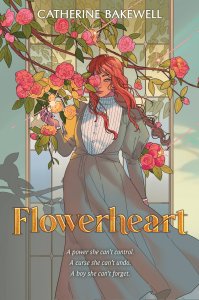
Review: This is definitely one of those books that I first looked at because of the cover. It immediately stood out when I was scrolling through Edelweiss+ planning out my spring reading schedule. Tons of books with daggers and swords on the covers, lots of duo characters drawn in that cartoonish style that is so popular right now (not that I dislike this style per se, just there’s a lot of it). This cover’s unique art immediately stood out and had me clicking through to the description. So well done there!
Clara has always struggled to control her magic, so much so that the local leaders have presented her with a terrible ultimatum to prevent her from injuring others. But before she can go through with it, the worst happens and an innocent touch causes her magic to sprout poisonous plants in her father’s chest, dooming him to a painful and slow death. When an old friend offers to help her tame her magic in an attempt to save her father’s life, she doesn’t even hesitate in the face of the steep price he requests. But when it becomes clear that Xavier is caught up in much darker forces than she had previously known, Clara begins to wonder with just whom did she strike her perilous bargain?
One thing that I found interesting when I was looking into this book was that it was marketed as a “cottage core” fantasy novel. What does that even mean? As far as I’m aware “cottage core” is a style of interior decoration. I’m not sure how that translates to a genre of book? Digging deeper, I discovered that there seems to be a recent trend of labeling some books “cozy fantasy,” which I imagine is just a spin-off from the more popular “cozy mystery” subcategory. Based on the latter, I’d guess that a cozy fantasy novel would be a story that avoids darker themes or graphic descriptions. Like cozy mysteries, they would focus on lighter topics and have happy endings, essentially. All of this to say, while I could see how cozy fantasy would apply to this story, I still have no clue about “cottage core.” And honestly, I’m not a fan of that description; interior decoration styles and genres of books are just not the same thing. Sorry, not sorry.
Anyways, that rant aside, I can definitely see how this book could fall into the “cozy” category. Overall, it does stay on the lighter side of things and the plot wraps up with a nice bow at the end. But this book also highlights why a lot of cozy mysteries don’t work for me either. Look, I don’t need tragedy around every corner and tons of graphic violence, but if you paint in only bright colors, without any shades of grey, the entire thing starts to just lose focus and interest. Clara is fine. Xavier is fine. This world and magic are fine. But I didn’t care about any of them.
I also found the magic system and world to be barely fleshed out at all. Towards the second third of the book, we begin to learn about a magical illness that is going around that leaves its victims comatose. This was the first thing to trigger my interest, but even that quickly sank into the quagmire of dullness that I found this read. Nothing was objectively bad, but it all was just so flat feeling that even small points of interest quickly faded away.
There was also an attempt by the author to deal with mental illness, particularly depression and anxiety. And while I applaud the effort, I don’t think it quite hit the mark. At points, it felt incredibly over-simplified and the metaphors heavy-handed. And then Clara has this weird relationship to her own magic where she speaks to it as a living, thinking being using this strange internal dialogue, which I wasn’t a fan of. It turns out that this particular choice plays a larger role later in the story, but that was still too late to save my reading experience through which I had been perpetually annoyed by this.
Overall, this book wasn’t for me. I do think that readers looking for something in the cozy category may enjoy this one more, but I’ve started coming to the conclusion that “cozy” any genre is just not my cup of tea.
Rating 6: Perhaps other readers looking for just a quick, cozy read will enjoy this, but I found everything from the world-building to characterization to be a bit too watered down to enjoy.
Book Description: London, 1885. Gabriel Utterson, a 17-year-old law clerk, has returned to London for the first time since his life— and that of his dearest friend, Henry Jekyll—was derailed by a scandal that led to his and Henry’s expulsion from the London Medical School. Whispers about the true nature of Gabriel and Henry’s relationship have followed the boys for two years, and now Gabriel has a chance to start again.
But Gabriel doesn’t want to move on, not without Henry. His friend has become distant and cold since the disastrous events of the prior spring, and now his letters have stopped altogether. Desperate to discover what’s become of him, Gabriel takes to watching the Jekyll house.
In doing so, Gabriel meets Hyde, a a strangely familiar young man with white hair and a magnetic charisma. He claims to be friends with Henry, and Gabriel can’t help but begin to grow jealous at their apparent closeness, especially as Henry continues to act like Gabriel means nothing to him.
But the secret behind Henry’s apathy is only the first part of a deeper mystery that has begun to coalesce. Monsters of all kinds prowl within the London fog—and not all of them are out for blood…
Review: Thank you to NetGalley for providing me with an eARC of this novel!
I first read “Strange Case of Dr. Jekyll and Mr. Hyde” in college in my favorite class of all time: “Monsters, Robots, and Cyborgs”. Thank goodness for an unofficial Cultural Studies and Comparative Literature minor! We looked at horror, fantasy, and science fiction stories of the past and present and what they said about cultural and societal anxieties, so of course “Jekyll and Hyde” is ripe for the picking. Think about it: a somewhat obsessive scientist creates a potion that can change him from mild mannered academic to a brutish, cruel, uninhibited psychopath, talk about a great way to talk about the complexities of humankind while creating a suspenseful mystery to explore that. So when I saw that one of the “Remixed Classics” books was going to take on this story, I was VERY excited to see how it was going to be reimagined with newer themes and a more diverse perspective for modern young adult audiences. Suffice to say, “My Dear Henry” by Kalynn Bayron was an anticipated read. And in a lot of ways it lived up to my anticipation.
Bayron reimagines the classic tale of a personified split identity and the calamities that follow, by making our protagonists Henry Jekyll and narrator Gabriel Utterson young adults, Black, and queer, and setting them in a Victorian London that will hold those identities against them. This was immediately resonant and very incisive, and it works so well for the themes of the source material while expanding upon them to make them even more complex. It’s especially clever because there are, indeed, questions as to Robert Louis Stevenson’s sexuality and whether these themes were also hidden in his original “Jekyll and Hyde” idea. To expand upon that and to make Hyde less of a symbol for the uninhibited ‘evil’ of man and instead to make it a symbol of uninhibited ability to be oneself is poignant as hell. As Gabriel and Henry are drawn to each other and fall for each other, the cultural mores at the time makes it so that they have to hide their feelings from others, and when they ARE found out it leads to the path of Jekyll to Hyde, and leads to lots of poignancy and pathos. It makes the “Jekyll and Hyde” story all the more tragic, as this Hyde isn’t a violent madman, he’s a manifestation of love that was criminalized and feared. And to make it even more complex, our main characters are Black, and having Black characters set in Victorian England is a great choice for a few reasons. The first is that it makes the marginalization of Gabriel and Henry even deeper, as the racism in English society has already made them vulnerable, just as it has made their fathers, especially Jekyll Sr. (as he is the one we see more of), all the more intent on stifling their sons because of their already targeted identities. The other is that it is so common to see Black narratives in this time and place ignored or questioned, as if Black people didn’t exist in England during this time period, so to counteract this erasure within this story was really, really enjoyable.
And since it is a remix of an old tale, I do want to talk about how effective of a retelling it was. And I thought that in a lot of ways it succeeded, and in a couple ways it didn’t quite capture it. In terms of successes, it does have the characters and the plot points of the original story, either tweaked, reimagined, or adapted to suit the newer narrative and thematic ideas, and it does this really well. You are definitely reading the Jekyll and Hyde story at the heart of the book, when I’ve seen adaptations that just slap on the idea of a reimagining without actually doing the work to make the new ideas coexist with the old. But I do think that one thing that did let me down about this book was that while it is definitely Jekyll and Hyde, it does give it a whole new flavor that kind of takes the suspense and thrills of the original out of it. It’s very possible that because this story is SO old hat that maybe there aren’t really ways to be held in suspense by it anymore, but I wonder if there could have been a way to make it feel like a thriller and to mine a new kind of suspense? I’m unsure.
Overall, I did enjoy “My Dear Henry” and I liked the directions that Bayron took this classic horror story of identity and repression. It’s an effective reimagining and brings out new ideas from a timeless tale.
Rating 8: A clever remix of “The Curious Case of Dr. Jekyll and Mr. Hyde” that takes on the dualities of identity in a society that doesn’t accept certain people for who they are, though it doesn’t capture the suspense that the original had.
Animorphs Graphix #2: “The Visitor” by K.A. Applegate & Michael Grant, Adapted by Chris Grine
Publishing Info: Graphix, October 2021
Where Did I Get this Book: own it!
Book Description: Rachel is still reeling from the news that Earth is secretly under attack by parasitic aliens, the Yeerks. Now she and her friends are the planet’s only defense — kids who, purely by chance, stumbled onto a downed spacecraft and were given the power to morph into any animals they touch.
The team’s best lead is their assistant principal, Mr. Chapman, who is the human host to a high-ranking Yeerk official. It’s not much, but Rachel’s always been a daredevil, and she volunteers to infiltrate Chapman’s home.
Rachel is tough. She’s fearless. But what she finds inside may be more than even she can handle.
I’m baaaaaaack! Yes, yes, it’s been forever. So long in fact that not only is the second Animorphs graphic novel out, but the third was released last fall as well! What’s my excuse?
Anyways, I was very excited to jump back into the world of the Animorphs and check out what these graphic novels have in mind for the long run. I remember really liking the first one, but having some concerns about the longevity of the series. I was also curious to see how this particular story was handled. “The Invasion” has tons of material to work with, not only in the chock-full plot but also with a lot of important character work introducing all of the teens. But “The Visitor” is a much slower, simpler story. In fact, I’d say it’s probably the weakest story in the introductory first five books. I mean, I still love it, because I love Rachel and Applegate is at the helm in these early books and that’s clear in the general quality of a more “filler” story as compared to the same sorts of stories that we see later in the series that don’t land as well. All of that to say, I was curious to see what the graphic novel had in store for us.
Best Change: I really liked the way the Chapmans were portrayed in this version of the story. There’s a really cool couple of pages that are drawn when Rachel first enters the house. We see Mrs. Chapman in the kitchen, staring straight ahead and chopping up vegetables. We then shift to the living room and see Mr. Chapman sitting on the couch staring at a television set that’s turned off. Creepy enough on its own. But then when Rachel comes back in the second go around, we see the exact same thing: Mrs. Chapman in the kitchen, chopping; Mr. Chapman in the living room, staring. It really hits home how absolutely off and cold this house is and what a horrible hell Melissa is living through. Beyond that, I liked how the way Chapman’s face is drawn changes from scene to scene as his power dynamic shifts. When he’s driving Rachel home, he’s shadowy and threatening. But when he’s talking with Visser Three, he’s depicted as small and cowering. And then, lastly, we see the human side of him when the real Chapman gets control briefly to plead his case to Visser Three. It was all very effective, and I think it does a good job of setting up just how witnessing this horrible home situation would influence and motivate Rachel.
Worst Change: I’m not sure I really have a worst change for this book. Other than a few things here and there which I’ll get to later, this is a pretty faithful adaptation of the original book. I’ll go on (and on and onnnn) about my feelings about the art throughout the book, but I think that’s probably not going to be a specific-to-this-book thing so not really a “change” at all. Speaking of art…
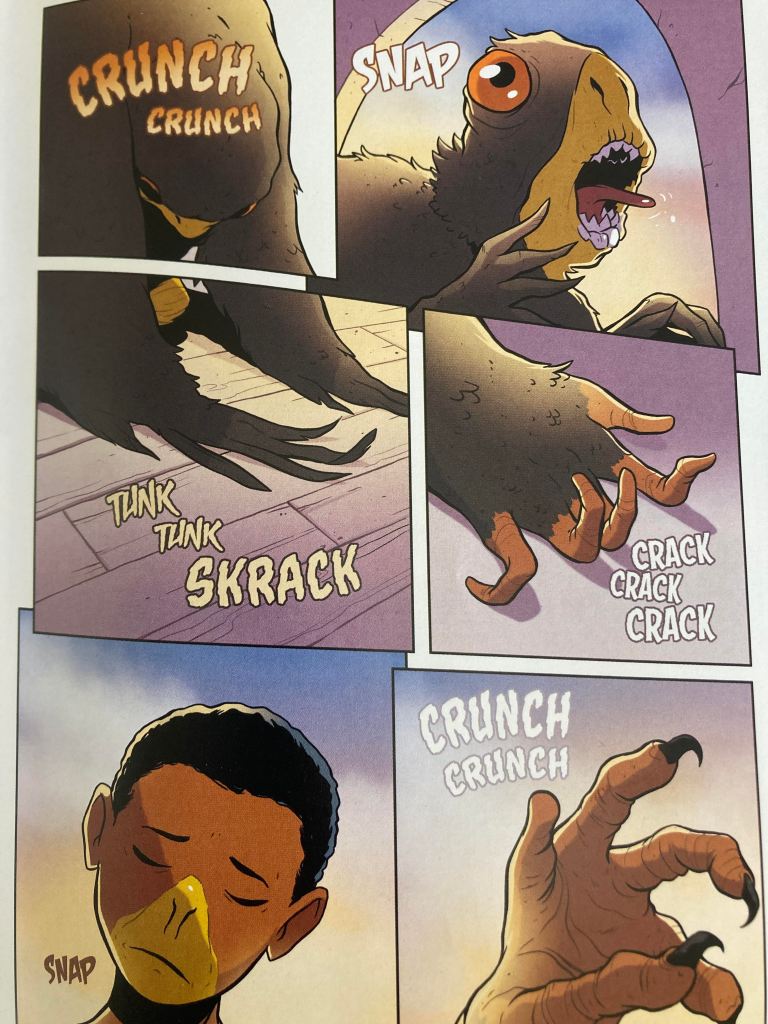
Pretty, Pretty Pictures: I have to say, I’m not coming around on the art style of these books. It’s not a complete loss, but I think there’s a stark difference in quality between the two styles. On one hand, I think the graphics are excellent when done in the more realistic style used for the animals. I also think the larger spreads across two pages and the horror aspects are well done. The descriptions of morphing in the books were always horrific, but when you see it depicted on the page…man, it really captures how truly disgusting this stuff looks. I mean, look at this!
But, I have to say, I’m really not loving the cartoon images of the kids themselves. I wanted to give it more of chance than just the first book, where I didn’t love the fact that Tobias and Rachel looked so similar or the strange choice with the red noses. But this book just confirmed some of my worst fears. If you look at these characters, they all just look exactly the same in the most generic of senses. You wouldn’t even be able to tell who is a boy or who is a girl based on images of just their faces in some of the panels (a picture of Cassie really highlights this at one point where I honestly had to do a double take to remind myself that there wasn’t a random Black boy in this story). This fact is really highlighted early in the story when we first meet Melissa. Here’s the first panel we see her in:
Without the speech bubble, which of these characters is which?? Ultimately, Melissa is given the silly freckles purely to identify and differentiate her later in the book. And that just seems to me to be a failure of the art itself. I mean, I’m still glad these graphic novels are being made so I have a hard time being this critical, but it honestly feels as if the artist either can’t be bothered to draw interesting and unique characters or simply isn’t capable of it while using this cartoonish style. Given the quality of the realistic stuff, I know he’s talented. So it feels like it must be a choice. But it’s the kind of choice that feels as if it’s talking down to its readers: hey, these are just kids and kids are the target audience, why bother making them look like anything other than bobble head cartoons? I don’t know. I’m not a fan.
Our Fearless Leader: Jake is one of the few characters that I think is drawn with a distinct face. His chin is a bit more pointed than the rest, and that difference stood out more and more as I became increasingly frustrated by the other characters. As for the story, there was a nice section in the middle devoted to a conversation between Rachel and Jake about their experiences (nightmares) after morphing frantic-minded prey animals. I like that this much page time was devoted to what can be seen as a pretty small character moment. There’s also an interesting line where Rachel gets a bit defensive saying that Jake is talking down to her because she’s his younger cousin. I can’t remember whether or not we knew that she was the younger of the two from the books? If so, I had forgotten and found it to be an interesting little tidbit here that she’s only a few weeks younger than Jake.
Xena, Warrior Princess: This book is pretty faithful to the original, so there isn’t a lot of new stuff to discuss with regards to Rachel’s experiences in the story. I will say, I really liked seeing Rachel’s mom and sister portrayed on the page. These were nice little moments to get to see one version of what these characters could look like. We get a lot of descriptions of what the main characters looked like in the original text, but we really have basically nothing to go on for any/all side characters. It was also nice to see these moments between Rachel and her mom and Rachel and Jordon to highlight the difference between her own warm, caring family and the cold, prison-like existence that Melissa is suffering through. I really like these sorts of subtle contrasts that the graphic novel can deploy. The book doesn’t come right out and say it, but it’s there all the same.
One thing I didn’t really like was the way the scene was drawn when Rachel is running away from the thugs to morph an elephant in the alley. Granted, again, it’s now been a few years from when I read this book for the original re-read series, but I guess I had it in my mind that Rachel was more annoyed from the very start and never frightened. Whereas here she’s drawn as being legitimately afraid at first, which I think is totally out of character. Rachel wants to take the fight to Visser Three himself, no way is she going to be wincing away from two jerks on the street.
A Hawk’s Life: Not a lot from Tobias. I did like all of the bird action in the very first scene and the way that was all drawn out. Rachel’s outrage about the guys shooting at a bald eagle “a national symbol!!!” is excellent. There were also some lovely images later on of Tobias flying, especially one when he flies away with shrew!Rachel to help give her time to get control of her morph. The way the sky and the silhouettes were drawn was striking.
Peace, Love, and Animals: Given how horrifying the images of the morphing is, I was glad we got to see a panel of Cassie with her raptor wings and Marco’s comment that they all look like freak show contestants while Cassie gets to look like an angel. It was a really nice juxtaposition and a moment that really worked well with the graphic elements. Other than that, Cassie has a pretty subdued go of it. We get some good animal facts from her about the prey mindset and the abilities of cats (there’s a good joke from Marco when Cassie comments that a cat’s eyesight is 8 times better than a humans), but that’s about it.
The Comic Relief: Marco is pretty much the same here as he is in the book. We get more groundwork laid about his home life and why he’s reluctant to fight. His dialogue is by far the funniest and best, per the book’s standard as well. There was one throwaway bit that I thought was odd, however. At one point, a character, I think it was Cassie, compliments Marco on his haircut. From the books, we know this does happen and is commented on but it doesn’t happen until Marco’s second go around as a narrator, all the way through to book number 10. But then the really strange thing is that Marco was depicted with short hair in the first graphic novel, too. Which, honestly, given my comments already about the cartoon style proving challenging to differentiate between male or female characters, I can see the choice to not have him with long hair from the very start. But looking back at the art from the first book, it’s clear that the styling for his hair is slightly different, but if anything, it’s drawn as longer and more shaggy here in the second book, not cut shorter at all. It’s very strange. I don’t think this small of a change really warranted any dialogue at all, but then to write it in as a notable haircut rather than a style change, which is the most that can be said, is strangely incongruent.
E.T./Ax Phone Home: No Ax yet, but boy am I excited to get to him!
Best (?) Body Horror Moment: Beyond what I said above about the disgustingly graphic images of morphing, there was a full page spread devoted to Rachel’s nightmare about being a shrew. Again, this is where the artist’s talents are really on display. I’ve only included half of the spread, but the other side is also covered in maggots swarming in and over an animal skull. I mean, the depiction of the nightmare is going to cause nightmares itself.
Couples Watch!: Sadly, I feel like we got even less from Tobias and Rachel here than we do in the books. We do get the line from Tobias that he doesn’t want anything to happen to her, so there are hints here and there, but for whatever reason, this relationship in particular just felt off. This probably is just due to the nature of the graphic novel format. Since the story relies only on dialogue and images, it’s pretty hard to depict true feelings between a girl and a hawk!boy when you can’t draw them interacting. On the other hand, to highlight this point, we do get this sweet panel coming fairly early in the book for Cassie and Jake:
If Only Visser Three had Mustache to Twirl: Again, since the horror aspects of the art are what work so well, the depictions of Visser Three and the terror he inspires are truly great. Even his Andalite form, which shouldn’t be terrifying in and of itself, is depicted in such a way as to be clearly intimidating. And then the panels showing him morphing the Vanarx and sucking out the Yeerk from a Controller are incredibly creepy and effective. I mean, Visser Three is essentially a cannibal at this point, and that is made pretty clear. And of course, the final battle with Visser Three morphing yet another big bad and chasing after the Animorphs is very well done. More on that below.
Adult Ugly Crying at a Middle Grade Book: Man, the Melissa stuff isn’t any easier when drawn out on the page rather than just described in a book. Plus, now I’m reading these books as a parent myself and boy, rough stuff. Especially the part where she follows Chapman out when he’s carrying cat!Rachel away in the crate. “Oh, I didn’t see you there.” “But daddy…I was crying.” Oooof! Not to sound like a broken record or anything, but again, AGAIN, I think the cartoon style let some of these heart-breaking moments down a bit. The reason this scene hits hard, and the same with the one where Melissa is crying in her bed, is because the writing and dialogue are so strong. The way the characters are drawn, there’s just so little that can be done to express these deep emotions, so it all falls to the writing. I’m having a hard time picturing some of the truly devastating moments that are coming up landing the way they should as shown on the faces of characters with red bubble noses.
What a Terrible Plan, Guys!: I’d say the terrible plan is still the obvious one: where Rachel decides to morph a shrew to lure a tomcat out of a tree. Like Cassie points out, while cats often play with their food, sometimes they just go straight for the kill, too, and there’s really no way of predicting it one way or another. But also, specific to this version of the story, I’ll say that the use of the machinery in the construction site didn’t quite translate here. I can’t remember exactly how it was described in the books, but I felt like there I had a better sense of just how these machines were disrupting Visser Three’s plans. Here, we only see a few small shots of a solitary bulldozer, and it kind of fails to land as to why this would pose any sort of threat or disruption to what the Yeerks are doing.
Favorite Page/Panel:
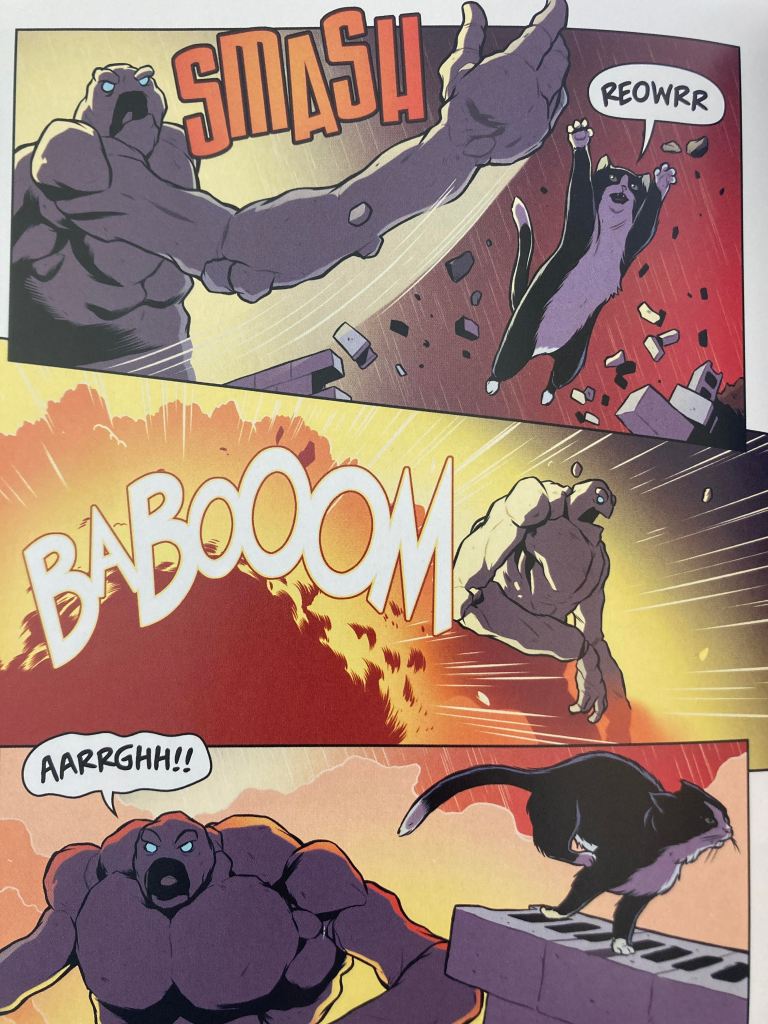
I really liked all of the pages that made up the final conflict between the Animorphs and Visser Three in his alien morph. But this one stood out for the sheer joy of the absurdity of it all. I mean, take that picture out of context. Just look at it. The crazy rock monster. The speech bubbles of the cat growling and alien roaring. The cat’s crazy Superman jump featured prominently in the top right corner. It’s all so whacky and fun, and I think it’s a perfect visual representation of the sheer joy that these books are to read, especially to younger audiences. In no other series of books are you going to get anything remotely like what Animophs has to offer.
Final Thoughts: Overall, I’m still continuing to enjoy reading these graphic novels. I won’t repeat myself about the art, but like I said, too, for all my complaining about that, I’d rather have the graphic novels as they are now than nothing at all. I do hope they continue to make them, but I think there’s room to combine some things going forward. These first six or so books are important enough to have their own adaptations independently, but I think this book specifically also highlights how some future stories could be combined or skipped. Mostly, I just want some adaptation, ANY ADAPTATION, to get to the David trilogy.
Note: I’m not going to rate these books since I can’t be objective at all!
Book Description: A house with a terrifying appetite haunts a broken family in this atmospheric horror, perfect for fans of Mexican Gothic.
When Jade Nguyen arrives in Vietnam for a visit with her estranged father, she has one goal: survive five weeks pretending to be a happy family in the French colonial house Ba is restoring. She’s always lied to fit in, so if she’s straight enough, Vietnamese enough, American enough, she can get out with the college money he promised.
But the house has other plans. Night after night, Jade wakes up paralyzed. The walls exude a thrumming sound, while bugs leave their legs and feelers in places they don’t belong. She finds curious traces of her ancestors in the gardens they once tended. And at night Jade can’t ignore the ghost of the beautiful bride who leaves her cryptic warnings: Don’t eat.
Neither Ba nor her sweet sister Lily believe that there is anything strange happening. With help from a delinquent girl, Jade will prove this house—the home her family has always wanted—will not rest until it destroys them. Maybe, this time, she can keep her family together. As she roots out the house’s rot, she must also face the truth of who she is and who she must become to save them all.
Review: Thank you to Bloomsbury YA for sending me a finished copy of this novel!
Gothic horror is a sub genre that I really enjoy, and a lot of the time the haunted house tale can fall into that definition. But I think that a lot of people fall into the trap of expecting a Gothic haunted house tale to be very Western in style and theme, probably thanks to images of tormented white women lost in the moors as they are haunted by ghosts, ennui, and possibly mental instability. Because of that I’m always eager to read non-Western takes on Gothic haunted house stories, and “She Is a Haunting” by Trang Thanh Tran really caught my eye when a promo of it ended up in my inbox. Given that my knowledge of Vietnamese history is pretty limited, the idea of a haunted French Colonial home in Vietnam REALLY clinched it for me. I was really excited to read this book, and it didn’t disappoint.
The horror elements are on point basically right out the gate. As Lily settles in at the isolated, French Colonial house her Ba has taken on for refurbishing in Đà Lạt, Vietnam, it’s almost immediately off. Lily already doesn’t want to be there, as she harbors a resentment for her father for leaving her family in the States when he returned to Vietnam, as well as his coldness to her when he discovered that she is attracted to girls. So she is already in a suffocating mindset, but then Nhà Hoa, or Flower House, is hot and humid, seems to be infested with dying bugs, and just feels unsettled. Tran gets the unease off on the right foot, and as Jade starts experiencing sleep paralysis and having visions of a ghostly woman inside the house, the tension builds and the horror imagery pops. There were a number of moments and bits in this book that just made me shiver, or even gag a little bit because of the nasty descriptions involving bugs, or food, or a little of both. Jade as a character is a little caustic at times, but she’s well explored enough that I worried about her as things get more and more spooky and disgusting during her investigation of the house and its history.
But it’s the themes of colonialism, racism, and generational trauma that really made this one stand out for me. These kinds of themes make metaphors ripe for the picking, and Tran really emphasizes the terrible ways that French colonialism disrupted and destroyed the lives of Vietnamese people. Nhà Hoa has a dark history that is being romanticized to make for a charming historical bed and breakfast, propping up the French style and story of the family that lived there, but left behind is the story of Jade’s Ba’s family, that worked in the house under terrible conditions, and the mysterious ghost bride whose connection to the house is lost to history. The French family that build the home is remembered fondly, so much so that the investors that Ba has on board for the B and B fawn over the history of the couple that lived there, while the couple was using and discarding the Ba’s ancestors, and because of the exploitation that reverberated through the generations he now feels like he has to keep up a connection to this house and to prop up this history, much to Jade’s horror as she finds the dark history and abuses that occurred in the house. It may not be super unique for a horror story about colonialism to have metaphors regarding an unrelenting haunting and a house that seems to have a constant hunger and need to consume, but Tran’s talent is that they can bring these metaphors to life with the aforementioned well executed horror moments, making the supernatural and real life horrors leap off the page in the most disturbing ways. It’s really well done.
“She Is a Haunting” is scary, uncompromising, and deeply unsettling. Fans of haunted house tales, take note. This is one you are going to want to check out.
Rating 8: Disturbing horror and a searing critique of colonialism, “She Is a Haunting” is scary and unrelenting.
Book Description: It is 1912, and for the last seventy years magic has all but disappeared from the world. Yet magic is all Biddy has ever known.
Orphaned in a shipwreck as a baby, Biddy grew up on Hy-Brasil, a legendary island off the coast of Ireland hidden by magic and glimpsed by rare travelers who return with stories of wild black rabbits and a lone magician in a castle. To Biddy, the island is her home, a place of ancient trees and sea-salt air and mysteries, and the magician, Rowan, is her guardian. She loves both, but as her seventeenth birthday approaches, she is stifled by her solitude and frustrated by Rowan’s refusal to let her leave. He himself leaves almost every night, transforming into a raven and flying to the mainland, and never tells her where or why he goes.
One night, Rowan fails to come home from his mysterious travels. When Biddy ventures into his nightmares to rescue him, she learns not only where he goes every night, but the terrible things that happened in the last days of magic that caused Rowan to flee to Hy-Brasil. Rowan has powerful enemies who threaten the safety of the island. Biddy’s determination to protect her home and her guardian takes her away from the safety of Hy-Brasil, to the poorhouses of Whitechapel, a secret castle beneath London streets, the ruins of an ancient civilization, and finally to a desperate chance to restore lost magic. But the closer she comes to answers, the more she comes to question everything she has ever believed about Rowan, her origins, and the cost of bringing magic back into the world.
Review: First things first, I absolutely love this book’s cover! It’s so unique and eye-catching. I’m on the record as disliking books using cover-models, and I’m even starting to burn out a little on the cartoonish characters (though there are still versions of this theme I can get behind.) But I think this cover does exactly what a good cover is meant to do: it communicates exactly what kind of book you’re going to get. And here, that would be a book taking place in a historical setting and featuring a fairytale-like tone of fantasy. So, well done cover artist! Let’s get to the book itself, though.
While Biddy understands that a world exists beyond the boundaries of the smile island that she shares with her magician guardian, Rowan, and his rabbit familiar, but all that she knows of it comes from books. Not only has she never seen a city, but while she knows that magic disappeared from the larger world decades ago, for her, growing up, she has been surrounded by it. But soon she sees that there are darker shadows growing in Rowans eyes every time he returns from the mysterious ventures to the outer world he goes on each night. As she finally begins to demand answers to her growing questions, she learns that there is much more going on in the world outside her home than she had ever suspected. And soon she may be needed to play a much larger role in shaping the future than she ever could have imagined.
I absolutely adored this book, as I knew I would almost from the first page of the novel. Of course, things could have always taken a turn for the dire, but the tone and style of the writing was exactly the sort that always appeals to me. The author was direct, and yet whimsical, deftly exploring the world and characters she had created while never falling into the trap of exposition or strange, narrated infodumps. On top of this, the dialogue was witty and had me laughing right from the start, particularly the interactions between Rowan and his familiar, Hutchingson.
But a book cannot live on funny dialogue alone. Indeed, for me, it really comes down to the characters themselves, and as Biddy is the protagonist with whom we travel this story alongside, the book lived and died based on her characterization. She, too, was exactly the sort of leading teenage character I enjoy. It’s a coming of age story where the character is doing exactly that…coming of age. She doesn’t start out as some “best assassin/thief/princess/etc.” and, indeed, the stories she paints about herself are challenged throughout the book. As she comes to understand the world and her own place in it, she must grow into understand the complexities of all the moving pieces and people in it. Rarely is anyone a true hero or true villain. Biddy must come to understand the adults in her life and the stories they, too, have built up around themselves and how they behave in the world and the choices they make. There were strong themes of family, choice, and the duties we have to those around us, both those with whom we are familiar and care for and those stranger who we will never meet but who we understand as humans too who deserve care and kindness as much as the next person.
I also really liked the way that the magic system was used to explore these themes. For what starts as a simple fantasy premise, that magic is leaving/has left the world, the author leverages this topic into deeper conversations about how society responds to emergencies. From what can be well-intentioned decisions going wrong to how those who seek power can take advantage to consolidate wealth into their own pockets at the expense of the many. It was really well done, and the story definitely took some twists and turns towards the last half that really surprised me and left me on the edge of my seat.
Indeed, I really have nothing to criticize about this book! I think it perfectly accomplished everything it set out to do, and it will surely appeal to all fantasy fans who are looking for a great fairytale-esque stand-alone fantasy. I can’t wait to see what the author does next! I’ll definitely be first in line to find out.
Rating 10: Heart-wrenching in all the right ways, this fairytale fantasy deftly explores important themes of individual choice and the responsibilities we have towards the least of those in society.
We are part of a group of librarian friends who have had an ongoing book club running for the last several years. Each “season” (we’re nerds) we pick a theme and each of us chooses a book within that theme for us all to read. Our current theme is retellings and reimagings.For this blog, we will post a joint review of each book we read for book club. We’ll also post the next book coming up in book club. So feel free to read along with us or use our book selections and questions in your own book club!
Book Description: Briseis has a gift: she can grow plants from tiny seeds to rich blooms with a single touch.
When Briseis’s aunt dies and wills her a dilapidated estate in rural New York, Bri and her parents decide to leave Brooklyn behind for the summer. Hopefully there, surrounded by plants and flowers, Bri will finally learn to control her gift. But their new home is sinister in ways they could never have imagined–it comes with a specific set of instructions, an old-school apothecary, and a walled garden filled with the deadliest botanicals in the world that can only be entered by those who share Bri’s unique family lineage.
When strangers begin to arrive on their doorstep, asking for tinctures and elixirs, Bri learns she has a surprising talent for creating them. One of the visitors is Marie, a mysterious young woman who Bri befriends, only to find that Marie is keeping dark secrets about the history of the estate and its surrounding community. There is more to Bri’s sudden inheritance than she could have imagined, and she is determined to uncover it . . . until a nefarious group comes after her in search of a rare and dangerous immortality elixir. Up against a centuries-old curse and the deadliest plant on earth, Bri must harness her gift to protect herself and her family.
From the bestselling author of Cinderella Is Dead comes another inspiring and deeply compelling story about a young woman with the power to conquer the dark forces descending around her.
Kate’s Thoughts
When we decided on reimaginings/retellings for our Book Club theme for this new cycle, I jumped into a number of lists trying to figure out what I was going to choose. I wanted to avoid titles that people may have already read, and I wanted to try and find one that would be a more modern take on a classic that was steeped in Western literature. So when I stumbled upon “This Poison Heart” by Kalynn Bayron and that it involved a Black teenage girl with Poison Ivy-esque powers that was based on “The Secret Garden” I was very intrigued. I hadn’t read the book in its entirety, but I was obsessed with the early 90s movie and thought that this was a fun choice. And while it absolutely has some good moments and fun aspects to it, I think that I was let down a bit by this retelling.
First I will talk about the good! I love the concept of a teenage girl who has magical powers that make plants drawn to her, and make her immune to poisonous plants while she can make plants thrive. I really enjoyed the ways that Briseis has to grapple with these powers, and how this kind of magical reality could cause serious problems (what with trees uprooting around you trying to get closer to her and how these issues could affect relationships). I also enjoyed that, when Greek mythology connections start to come through, that Bayron wants to re-examine the character of Medea, the villainous witch that killed her children to get back at her husband Jason. I really love it when there are new takes on old myths like that, especially ones that deconstruct evil women and give them more depth, complexity, and tragedy in their own right. But that kind of leads up to my big issue with this book being called a “Secret Garden” retelling. It doesn’t really feel like that, outside of a mysterious garden on a newly inherited estate. The other themes didn’t feel present, and it did shift a bit more towards Greek Mythology as the story went on. I just think that it takes more than a mysterious garden to be a retelling of the story (that said, I LOVE poison gardens so that was pretty cool).
So while I did like certain parts of “This Poison Heart”, as a retelling it wasn’t as successful as I would have liked it to be. As a fantasy YA novel without that connection it works just fine.
Serena’s Thoughts
I second all of Kate’s thoughts! I, too, really loved the 90s version of “The Secret Garden” and very much enjoyed the book, as well. So I definitely went in to this re-telling with a lot expectations, not only about the themes that would be covered (loneliness, found family, etc.) but also which characters would show up and how they would be reinterpreted. I’ve got to say, by the time I realized there was no Colin equivalent, I was getting pretty bummed.
As Kate said, about halfway through the book the story takes a massive swerve into Greek mythology. I’m on the record as loving “Circe,” so I definitely don’t have anything against this theme. It was more the fact that I had been sold on one story (one I really hadn’t seen before, a retelling of “The Secret Garden”) and ended up reading a very different one (a Greek mythology story, which, frankly, is getting a bit played out recently.)
The characters were also a mixed bag for me. I really liked Briseis herself, and I thought the ways that her plant powers affected her life were interesting and creative. I also really liked that her moms played very active roles in the story, rather than just mysteriously disappearing as is so often the case in YA fiction. But other than that, I struggled. For one thing, I didn’t like the love interest. The romance ticked off two of my pet peeves: one for instalove and two for semi-creepy age discrepancies. Look, we can’t sit here on a high horse and give Edward Cullen all of this flack for being so much older than Bella and then let this romance off the hook just because is f/f. At least, I can’t.
Overall, I didn’t love this book. The first half of it I thought was pretty intriguing and was setting up an interesting story. But halfway through it takes a massive swerve, and I spent the rest of the book dreaming of what could have been.
Kate’s Rating 6: I liked Briseis’s powers and I liked the reinterpretation of a Greek mythology villainess, but this didn’t really feel like a “Secret Garden” retelling.
Serena’s Rating 6: While it had a few redeeming qualities, especially in the first half, I could never get beyond the fact that I’d been sold one thing and was reading something completely different.
Book Club Questions:
How familiar are you with “The Secret Garden”? Did you feel like this was a successful reimagining?
What were your thoughts on the Greek Mythology elements of the story?
Did you like the magical aspects of the story? Did you feel like the magical systems were well thought out?
What did you think of Rhinebeck as a small town setting?
Did any characters stand out to you in particular?
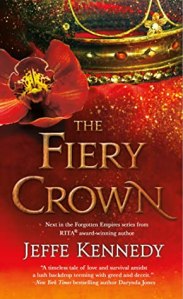
Book Description: Conri and Lia’s marriage of convenience has turned into an uneasy alliance. If only the two leaders could agree on something. Driven by revenge, Conri wants to attack Emperor Anure before the tyrant gets to them first. But Lia needs to keep Calanthe safe, and refuses to sacrifice her kingdom. Their ongoing battle for control has built up tension they’re both more than happy to release in bed, the only place where they find common ground. But Conri and Lia are developing deeper feelings for each other that are complicating matters. In the second book in the Forgotten Empires trilogy, Conri and Lia find their loyalties torn, and with Emperor Anure’s threat growing, will they be able to risk everything with each other before it’s too late?
Review: While I was late getting around to it, I really enjoyed “The Orchid Throne.” But I’ll be honest, one of the reasons I finally picked it up was because of the growing guilt from my NetGalley shelf glaring at me with this book, the sequel, continuously sitting there as a request I placed waaaaaay back in 2020 that I still hadn’t read or reviewed. Lucky for me, the first book was good enough that it was quite easy to jump back into this world with only a small reading break between novels.
While Conri has technically “claimed the hand that wears the Orchid Ring” by marrying the queen of Calanthe, Lia, he doesn’t feel any closer to his goal of killing the cruel emperor Anure. Instead, he feels bogged down and trapped on a beautiful island where no one seems to be taking the threat of war seriously. Little does he know that no one takes the threat of war more seriously than Calanthe’s queen, Lia. Calanthe holds secrets, and as Conri begins to learn more about the land he now co-rules and the woman he’s now married to, he begins to see that his own view of the world and its priorities may, in fact, be what was misordered all along.
This story picks up immediately where “The Orchid Throne” leaves off. Meaning, Lia and Conri are still only about a week into their new marriage, and as such, are still very much struggling to understand each other and the shifting dynamics that make up their relationship. I really liked everything we got from these two and this marriage of convenience. For one thing, I appreciated the conversation that was had about the fact that attraction and chemistry, while great, do not on their own make a match made in heaven. Indeed, while Conri and Lia both appreciate the sparks in the bedroom, this compatibility makes it all the more bemusing when they butt heads again and again in other arenas. Particularly, I enjoyed the continued look at how both Conri and Lia approach leadership and their conflicting priorities. We also see how easy it is to misunderstand another person’s motives and motivations, especially when we switch perspectives between the two and see one scene interpreted very differently between them both.
I also liked their individual stories. For Lia, she must grapple with the balance between strength and vulnerability, private and public, and how to navigate ruling a land and planning a way with a man she only halfway trusts. For Conri, we see his ongoing struggles to continue a mission that he had created his entire self of sense around while at the same time grappling with the idea that his approach, to care about nothing but the mission, may not be the strength he thought it was, but instead, a weakness.
I was also surprised by the second act of this book. While the first half is concerned with a lot of this character work that I’ve been describing, the second one really gets going on the action front. The first book was pretty light on this stuff, and I had gone into this one not expecting much conflict until the third and final book in the trilogy. Boy, oh, boy was I wrong! We have battles, we have blood, we have, yes, even death. It was pretty non-stop there at the end, and I enjoyed it all.
I really have very few qualms about this story. I don’t know if it’s doing anything particularly masterful, but then again, why should it? It’s a thoroughly enjoyable fantasy story with two very sympathetic leading characters. This book also set up a lot of pretty big world events that will need to be dealt with in the third book, and I’m very excited to see how this all gets wrapped up. If you enjoyed the first book in this trilogy, this is definitely a solid sequel that’s sure to please.
Rating 8: An intriguing look into the intricacies of a new marriage, where the person you love most can also be the person you least understand.
Book Description: Into every generation, a slayer is born. One girl in all the world . . . maybe.
Frankie Rosenberg is the world’s first slayer-witch, but she doesn’t have that slay-life balance figured out just yet. After all, being the newest slayer means that another slayer had to die. Frankie and the Scooby gang are still reeling from the deadly explosion that rocked the annual slayer retreat―and grappling with new evidence that some slayers may have made it out alive. And even though they defeated bloodthirsty vampire the Countess, it doesn’t mean Sunnydale is free from the forces of evil.
Something has reawakened the Hellmouth―and is calling old friends home. Someone is performing demon magic in the shadows, opening portals between dimensions. Everyone has demons to contend with―of the metaphorical and the very real (occasionally very hot) variety. And an oracle warns of a new evil on its way: the Darkness.
Could this be what attacked the slayers? And is it coming for Frankie?
Review: Thank you to Disney Hyperion for sending me an eARC of this book via NetGalley!
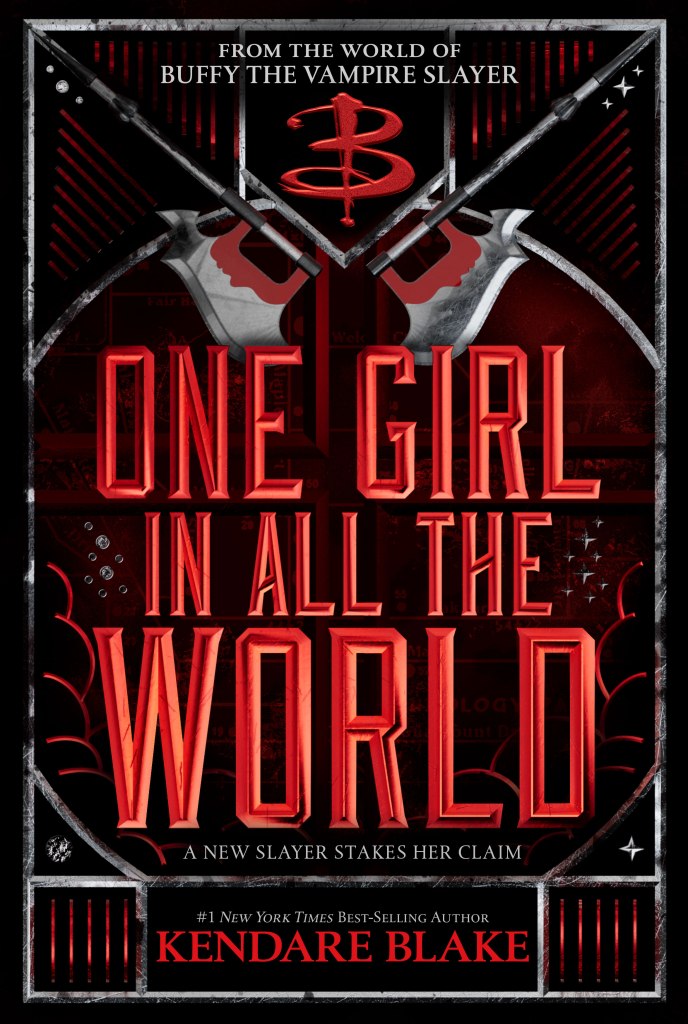
Well after that awesome opportunity we had last week with our blog’s Q & A with Kendare Blake, I am now going to talk about the newest book in her “Buffy the Vampire Slayer” Universe set YA Series, “One Girl In All The World”. It took some willpower to not dive immediately into this one once I had finished “In Every Generation”, as the first book that focuses on Frankie Rosenberg, Slayer-Witch, and her 2nd Generation Scoobies was such a hit for me. But I found the right moment with “One Girl In All The World”, telling myself I wouldn’t take it too fast and would just enjoy my time with Frankie, Hailey, Willow, Spike, and everyone else….. Yeah, then I pretty much read three fourths of it in one sitting. Late into the night. So much for self control.
This could be footage of me sitting up in disbelief after looking at the hotel room clock. (source)
When we left off, Frankie and friends Jake, Hailey, and Sigmund had basically formed Scooby Gang 2.0, with Frankie as the Slayer and her pals as her rag tag gang of fighters and supporters. With Buffy and a number of other Slayers still missing and possibly trapped in another dimension, Frankie is just about it for fighting the forces of darkness, and it is clear that the burden is starting to wear on not only her and her friends, but also on her mother Willow and her Watcher Spike. It doesn’t help that someone has seemingly set a beacon to lure any and all demons back to the Hellmouth, so they are all working overtime and are all VERY stressed. I thought that it was a good idea for Blake to show just how hard this would be for these teenagers to have to deal with, magical powers or not, and I liked that there were some very realistic problems with a supernatural twist (like Frankie’s attraction to Hunter of Thrace Grimlock, a morally grey demon that serves as a broody Angel-esque love interest; teenage romance is so messy even if you’re a Slayer-Witch). And even without super powers at play there are still relatable issues, like Hailey feeling torn between her new friends and her Slayer sister Vi, who has returned and is acting a little cagey, or Jake and his newfound feelings for a fellow athlete named Sam, or Sigmund feeling parental pressure to live up to a role he may not be cut out for. And since I really like all of these kids, the suspense isn’t just about whether or not this so called “darkness” is going to put them in danger, but if they are going to crumble because of this huge responsibility that is just exacerbating built in teenage struggles.
But it’s not just Frankie and her friends who are dealing with the weight of all of this. The first and most obvious old favorite is Willow, who has not only lost her best friend, but is also having to deal with her child being put in constant peril by the very nature of her being a Slayer. Willow remembers what it was like for Buffy when the weight of the world was on her shoulders. Now her daughter is carrying that burden. On top of all of that, Willow knows that her magic is a way that she can help Frankie and also Buffy, but there is the pesky fact that she was once consumed by her magic and almost destroyed the world. Blake really nails this stressful line that Willow has to walk, and the fear of not only losing her child, but also of losing herself. And it’s not just Willow who gets in on the angst. Because oh God how Spike is just ACHING for Buffy in this book. My old shipper heart was breaking over and over again. I am someone who can see Spike with Buffy, or Angel, or Faith (haaa I’ve written fan fiction with ALL of those combinations), but when you have an author like Blake who really gets the complex and undefinable but super intimate relationship that Buffy and Spike had by the end of Season 7, I just die. She just GETS it. She gets Spike, she gets Willow, she gets it all.
And Blake continues to give plenty of fan service to old seasoned “Buffy” fans like myself, and for anyone who has watched the series in full and enjoyed it. For one, there are so many references to old episodes and enemies, be it the return of the Sunnydale Swim Team that turned into aquatic monsters, or a reference to the episode where Giles was turned into a demon by a nemesis (oh my God, this moment had me howling with laughter because Spike, natch, was at the heart of it and it was PERFECT, PERFECT I SAY). Blake obviously loves the show and the canon and the characters, and you can really tell she is having a blast while she writes these new stories as she references the source material. But she also weave it into the story at hand so effortlessly that it doesn’t feel out of place or too twee due to fan service. All of these bits fit in with the various scenarios that Frankie et al are dealing with within this new story, and it’s a true joy to watch it all come together.
I’m still loving this series. I don’t know what I’m going to do while I wait for the conclusion. Frankie Rosenberg, you have earned your place as a kickass Slayer.
Rating 9: “One Girl In All The World” continues to reimagine “Buffy” for a new generation, with great, great success. The characters, old and new alike, are still highly enjoyable, and it feels like I’m a teenager watching my favorite show all over again.
Book Description: After a mission gone awry two years ago, Remy Castell has been desperately searching across worlds to find the friend she failed to save—the friend who changed her life by helping her overcome the brainwashing she was subjected to as a genetically engineered corporate agent.
Since then, she’s been chasing the only lead she has: fellow genopath Kiran Lore, the same secretive ex-squadmate who left her for dead when she compromised that mission. She nearly caught up to him on Tundar before joining the infamous sled race alongside outcast Sena and her wolf companion Iska. Now, all three of them have tracked Kiran back to Maraas, the jungle planet where Remy lost everything. But nothing on Maraas is how it was two years ago. Syndicates and scavvers alike are now trying to overthrow a megalomaniac corpo director, which Remy wants nothing to do with; fighting against corpos is as useless as trying to stay dry in the middle of the giant hellstorm that encircles the planet. But the storm—and the rebellion—are growing stronger by the minute.
When Remy finds Kiran, he doesn’t run away like she expects. Instead, he offers her a deal: help with the revolution and he’ll reunite her with her friend. But can she really trust the boy who betrayed her once before? With the entire planet on the edge of all-out war, Remy will have to decide just how far she’s willing to go to save one girl before the impending storm drowns them all.
Review: I really liked “Cold the Night, Fast the Wolves” when I read it last January. Not only is January the perfect time to hole up inside next to a fire and read about someone else suffering the elements, but who can say no to a book that has a central relationship between a girl and her half-feral wolf? No one, that’s who. That book also introduced us to Remy, a side character who we learn is on the run from the corporation that made her. So I was thrilled when I saw that the author was releasing a companion novel that would focus on Remy’s story.
Remy has been on the run for two years after her ex-squadmate betrayed her and cost her everything she held dear. While running from the corporation that created her, she’s traced her away across the universe to hunt down the man who destroyed the fragile sense of self she had been building. Now, with her friend Sena and Sena’s wolf companion Iska alongside, Remy returns to the planet where it all began. But what she finds is a world transformed from the one she left behind. Still, in the midst of ongoing political and social strife, Remy is hopeful she can finally put her past to rest.
I won’t beat around the bush: I didn’t enjoy this book nearly as much as the first. Which was really too bad. But I can still see the bones of a good book and the strength of the writing that drew me to the first novel. The author is clearly skilled at creating interesting, alternative world environments, complete with their own weather systems, creatures, and societies. This one was just as interesting as the first. Whereas before we explored a brutal tundra world, here we dive into the sticky, hot, humidity of a jungle planet. Even more interesting, the planet is plagued by a massive storm system that circumnavigates the entire world every two weeks or so. This creates a very interesting culture and society where everything in the city is under a constant state of destruction and repair. We also see how this mindset influences who lives where (more protected areas vs less) and what materials they have access to for their construction, affecting how durable the buildings are in any certain community. This was all super interesting, and I really enjoyed everything we got with regards to the world building.
Further, I liked the politics and mystery at the heart of the story with regards to these dynamics. When we get to the motivations of the bad actors, it was all very believable and relatable, touching on some important themes and commentary about class and the environment in our own world. And, while I don’t think it is absolutely necessary to read “Cold the Night, Fast the Wolves” before you read this one, having read that one, I appreciated how the author further fleshed out the role of local syndicates and the interesting balance they strike between their own world’s population and the power of the corporations that essentially rule the universe.
But it all broke down for me with the main character and the love interest. I don’t really think it’s a spoiler to say that said ex-squadmate who “betrayed” her probably has more going on. But if you don’t want more details, suffice it to say that I found Remy’s understanding of this character to be so poor as to be almost laughable. For more details, continue reading!
Basically, this just comes down to a case of telling and not showing. From the beginning, Remy goes on repeated internal rants about her ex-squadmate who was controlling, always putting himself forward and making her look bad on their missions. The problem comes when we are shown flashbacks that make it painfully obvious what is going. Again and again, all we see is a man who clearly loves Remy and is protecting her in every way he can. In one case, he directly takes the blame for something Remy does and ends up in a torture session over it. And somehow…Remy not only doesn’t pick up on these super obvious clues, but spends large chunks of the book telling the reader how bad of a guy Kiran is. And that’s just not a recipe for success. I get having an unreliable narrator. But you have to have a reason for why they’re misleading the reader. And if that reason turns out to be “the protagonist is kind of a dunderhead and oblivious to the point of disbelief” that’s not good look for the protagonist or is incredibly frustrating for the reader.
Unfortunately, some of this obliviousness on Remy’s part showed up in many different ways. Not only is she repeatedly unable to understand how her actions impact others, but she also misreads many other characters’ motivations. It was tough to read, as I thought that Remy’s portrayal in the first book was so solid and interesting. But here, she immediately started to fall into some predictable YA female protagonist stereotypes. And this wasn’t helped by having Sena hanging around through a lot of it, reminding readers of just how likable a main character she was in her book.
Overall, this was kind of a mixed bag for me. My experience of this book really lived and died by my reaction to Remy as a main character. The world-building, writing, and themes were still incredibly strong. I just was too frustrated by Remy through much of it to truly enjoy my read. If you were a fan of the first book, however, I still might recommend a read through here. Your tastes may vary for a main character, and the author still had a lot of good story and commentary to offer with this book.
Rating 7: Excellent world-building and important themes regarding environmentalism and class were undermined by a rather frustrating main character.










 The Library Ladies