Serena’s Review: “Landline”

18081809Book: “Landline” by Rainbow Rowell

Publishing Info: St. Martin’s Press, July 2014

Where Did I Get this Book: audiobook from the library!

Book Description: Georgie McCool knows her marriage is in trouble; it has been in trouble for a long time. She still loves her husband, Neal, and Neal still loves her, deeply — but that almost seems beside the point now.

Maybe that was always beside the point.

Two days before they’re supposed to visit Neal’s family in Omaha for Christmas, Georgie tells Neal that she can’t go. She’s a TV writer, and something’s come up on her show; she has to stay in Los Angeles. She knows that Neal will be upset with her — Neal is always a little upset with Georgie — but she doesn’t expect him to pack up the kids and go home without her.

When her husband and the kids leave for the airport, Georgie wonders if she’s finally done it. If she’s ruined everything.

That night, Georgie discovers a way to communicate with Neal in the past. It’s not time travel, not exactly, but she feels like she’s been given an opportunity to fix her marriage before it starts…

Is that what she’s supposed to do?

Or would Georgie and Neal be better off if their marriage never happened?

Review: I had read two of Rowell’s young adult novels, “Fangirl” and “Eleanor and Park” and really liked them before coming to this book. I had heard that she had an adult novel floating around, and had it casually on my mental “to read” list, but had never made a real effort to pick it up as it falls out of my usual favorite genres. Last week, however, it happened to pop up as an available audiobook at the library, and that was my sign that now was the time!

I went into this story not knowing much about it. In fact, I had even less than the book description given above, since I was really only checking it out on the strength of Rowell’s other books and the general knowledge that this was about a married couple. That’s about it. So, it was quite a shock when I got to the magical, time-travel phone about 1/4 of the way into the story! A good surprise though.

Georgie is a television writer with her longtime friend and partner, Seth, who has been married for the past 17 years to her college sweetheart, Neal, and has two small girls to complete her family. From the outside, they look like the poster family for a working mom/stay-at-home father lifestyle, with Georgie financing the family, and Neal caring for the two daughters. However, after years of struggles balancing her work/home life, Neal and Georgie’s marriage is coming to a crisis state. Enter time travel, magical phone. A connection for Georgie back to the Neal she knew in college when they were going through a similar rough patch in their relationship.

So, just from that description, this book was quite a step out from my typical reading habits. Magical phones aside (which largely, it really is, as it functions as a plot device and not a lot more),  this book was mostly about the relationship between Georgie and Neal, how they got to where they are now and discovering whether they have a future. It’s a romantic, non-romance book, I guess, featuring two lead characters who are anything but typical romantic leads.

I really enjoyed this book. It perfectly balanced the emotional challenges of a long term relationship without vilifying either of the main characters. I’ve read a few other reviews where Georgie came under strong fire as a narrator, but I felt that her struggles, her realization of poor choices and her own failings was the whole point of the story. She is not written to be an unlikable character, just an honest, flawed human being. Being frustrated with her for these traits misses the journey of the story itself. Neal, too, is not written as a perfect partner, and while Georgie is our primary focal point, one can see the role he plays in their relationship fairly clearly.

I also really enjoyed the role that Georgie’s best friend and writing partner, Seth, plays in the story. I had quite a few concerns when he showed up initially, wondering whether we were heading into love triangle territory, but I should have had faith! If there is one thing that Rowell has proven with her previous books, it’s that she knows how to write honest relationships. And, at their core, I don’t believe love triangles can reflect any honesty about human relationships. It’s just not the way people truly form relationships and attachments. Seth’s role in Georgie’s life is refreshing and integral. He has played a role in the weakening bonds between Georgie and Neal, but not due to any romantic entanglements.

I also really enjoyed Georgie’s interactions with the rest of her family, both her young daughters as well as with her mother, step father, and much-younger sister. I’m going to repeat the word “refreshing” here for how much I appreciated this focus on the other people and relationships that make up Georgie’s life. She is not only defined by the primary romantic relationship in her life, but it is clear that the influence and love that she relies on from these other members is paramount in her life. I always enjoy reading about sisters, especially, and Georgie’s mother was a great character, too.

I sped through this audiobook! Usually I just listen to my audiobooks during my commute and call it good, but I found myself listening to this one as I cleaned my house and even before bed. The reader was very good, and I felt the story itself was very engaging. If you enjoy contemporary novels, with a good dash of humor and an honest look at the challenges and joys of married life, I highly recommend “Landline.”

Rating 8: Very good, especially the deeper look into all the many relationships that make up the central character’s life.

Reader’s Advisory: 

“Landline” is included in these Goodreads lists: “Chick Lit for the Beach” and “Married Couples – NA/Contemporary Romance.”

Find “Landline” at your library using WorldCat!
 

Kate’s Review: “Forsaken”

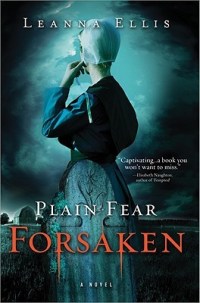
9775490Book: “Forsaken” by Leanna Ellis

Publishing Info: Sourcebooks Landmark, August 2011

Where Did I Get This Book: The library!

Book Description: “Hannah cannot move on.”

She pines for Jacob, the boy who saved her life when she drowned, bringing her back from the brink of death by breathing life into her.

“But Jacob is gone now, buried.”

Levi’s love for Hannah burns just as strong. But he knows how much Hannah loved his brother Jacob. He also knows the troubling event that took Jacob out of their lives. And he lives with that lie every day.

So when a stranger named Akiva comes to their community, he carries with him two secrets that will change their lives forever: he is in fact Jacob, whom Hannah had lost. And he is now a vampire.

When passions stir and secrets are revealed, Hannah must choose between light and dark, between the one she has always loved and the new possibility of love. But it’s more than a choice of passion; it’s a decision that will determine the fate of her soul.

Review: Did you know that there is not only Amish Romance, but apparently there is also AMISH VAMPIRE ROMANCE???

DID YOU!?!?!?

Because I didn’t, and the moment that I found this out I was like

giphy1
WHY IS THIS A THING?! (source)

So what did I do? I requested it as soon as I could because OH MY GOD HOW BIZARRE. I don’t know what I expected. I mean, it’s laid out pretty plainly just what this book is going to be. We have a pious and pure Amish woman who is tempted by a vampire because he’s her long lost love, so of course it’s going to be filled with over the top moments, dialogue, and nonsense. And I know that this book is SO not written for me. But….. Let’s be real, Amish Romance is a special niche of Christian fiction that lets people enjoy wholesome romantic scenes without having to worry about smutty moments. So to me, adding a vampire isn’t going to end up in any way outside of good conquering evil and goodness triumphing over the unholy. But this book gives it the ol’ college try of making the story unpredictable. As if we didn’t know that ultimately Hannah was going to choose the side of the light. Which, hey, more power to Hannah and more power to that kind of story, as some people like that kind of thing. But there sure were a lot of things about this book that rubbed me the wrong way outside of my own predilection for walking on the wild side, fiction wise.

And okay look, you’re going to get some spoilers here, so buckle up.

First of all, I was a bit taken aback by the implications that Jacob (or Akiva, as is his vampire name), the Amish boy who was so taken with travel, art, poetry, and a potential life outside of the Amish community, was effectively punished for his wanderlust by being turned into a vampire. And beyond that, he was portrayed as selfish for being intrigued by a life outside of his community, as if even deigning to imagine a life outside of it is an act punishable by vampirism. Though it seems not to happen terribly often from my limited research, Rumspringa does sometimes lead to people leaving the Amish community. So what is that saying about those who legitimately don’t fit in within the community they were born into and do want to leave it? As it was it kind of came off as judgmental and kind of shame-y, as if you were going to be corrupted for the rest of your days by choosing a different path. Or in Jacob’s case, even thinking about it, as he did, in fact, return home to be baptized! He was just turned into a vampire before he could be. So even thinking of it is so bad you’re punished in such a way? Jacob was this whole concept personified, especially since we had the contrast of his brother Levi (who is the other point in the love triangle with Hannah and Jacob/Akiva). Levi is not only a true and devout Amish man, but also the TRUE hero of the story here in more ways than one. The part that had me absolutely incensed was that when Hannah, our heroine, was younger she almost drowned, and as she remembers it Jacob pulled her out of the water she was caught up in and saved her by breathing air back into her lungs. It was actually a kind of nice backstory to their romance, in my opinion, as it displayed bravery on Jacob’s part and also affection, as well as showing why Hannah may have had a deeper connection to him outside of being essentially betrothed to him. But then, at DEFCON ONE of the climax, it is revealed that it was actually Levi the whole time that had saved her! And JACOB was panicky and scared and did nothing when she was unconscious! So Jacob, who is a freaking vampire and couldn’t even have ultimately won Hannah’s hand in this kind of gross and weird love triangle in the first place, doesn’t even get to have that act of heroism going for him, and is in fact a total coward!! Was that necessary? I don’t think so. I don’t understand why Jacob couldn’t have been more well rounded and multi-faceted, but oh well, apparently you can only be purely good (the steadfast and dependable Levi) or purely evil (the flitty-dreamer-coward-turned-vampire Jacob/Akiva). Heaven forbid there be complexity to these characters. Jacob could have been brave once in his life is all I’m saying.

I also took serious umbrage with poor Hannah’s portrayal. At one point I thought that we were getting a kind of self assured and headstrong female lead who could handle herself, as at one point she told Levi that she didn’t need him to protect her and that she could take care of herself. I’d hoped that that was going to be a theme for her throughout the book, but then it became abundantly clear that no, she couldn’t actually take care of herself and she quite obviously did need Levi’s protection and guidance. After all, Jacob encourages her to dance, drive in a car, and drink alcohol, and this is portrayed in a negative way as if he’s leading her astray IN SPITE OF THE FACT that Hannah never did participate in Rumspringa! So this could feasibly be seen as her doing what most Amish kids are encouraged to do!!! Not once is Hannah portrayed as her own person. She either belongs to Jacob, Levi, or a higher power. Never herself.

And again, I know that this is a different value system than mine, and that this book is not for me but more for them, but the moment you bring vampires into a story, it’s fair game for me. So let’s talk about the vampires. I liked that they are portrayed as more animalistic and less romantic. I liked the mythology that Ellis gave them, as limited as it felt at times. But I also felt like there wasn’t much research done into the history of vampires and how they are portrayed in literature. There was a scene with a character named Roc, a cop from New Orleans with his own personal vendetta against vampires (and a character that I actually thought was pretty okay, when all was said and done. Of course I like the hot mess abrasive cop who drinks too much). In this scene he’s talking with a childhood friend who is now a priest, and he asks if sunlight is indeed something that can hurt vampires. His friend says no. I was pretty excited, because yeah, in older vampire lore sunlight didn’t play into it, that’s a comparatively new part of the mythology. But then the priest said something along the lines of falsehoods being perpetuated by vampires and vampire sympathizers to keep their actual weaknesses hidden, to which Roc asked if that meant that Bram Stoker was a vampire or vampire sympathizer, to which he got a veiled yes.

Guys, in the book “Dracula”, Count Dracula WALKS AROUND IN THE DAYLIGHT. And by this books logic, that confirms that vampires can walk around in daylight! So how would being totally truthful make Stoker a vampire or vampire sympathizer?! I’m okay with promoting fun ideas of vampire myths being propaganda that can be twisted to what suits them, but if you’re going to do that, know which myths apply to which stories!

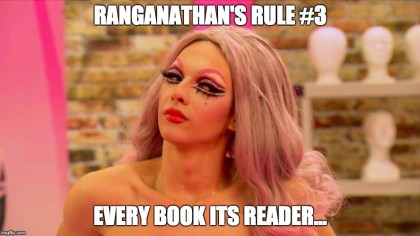
So yeah. This book wasn’t for me. I couldn’t even really enjoy it in a guilty pleasure ‘so bad it’s good’ kind of way. But, that said, I know that a lot of people probably would like this book, both legitimately and ironically. And so it’s with this book, “Forsaken”, that I finally get to pull out Ranganathan’s Rule Number 3 as I side eye the HELL out of it.

violetchachkirangnathan

Amish Vampire Fiction is not for me, but it may be for you. “Forsaken” is certainly unique, and while I didn’t enjoy it, that doesn’t mean that others won’t. Every book its reader. Just gotta keep repeating that.

Rating 2: I had high hopes for silly fun, but ultimately really didn’t enjoy this one. Some of the vampire stuff was pretty okay, but overall it didn’t do it for me.

Reader’s Advisory:

“Forsaken” is included on these Goodreads lists: “Amish Mysteries”, and “Magic, Adventure, Romance”.

Find “Forsaken” at your library using WorldCat!

Joint Review: “Jane Steele”

25938397Though we do tend to read different genres, there is sometimes overlap in the books that we pick up and devour. When this happens, we decide to do a joint review, giving our thoughts through our own personal lenses of what we look for in reading material. 

Book: “Jane Steele” by Lyndsay Faye

Publishing Info: G.P. Putman’s Sons, March 2016

Where Did We Get This Book: The library!;

Book Description: “Reader, I murdered him.”

A sensitive orphan, Jane Steele suffers first at the hands of her spiteful aunt and predatory cousin, then at a grim school where she fights for her very life until escaping to London, leaving the corpses of her tormentors behind her. After years of hiding from the law while penning macabre “last confessions” of the recently hanged, Jane thrills at discovering an advertisement.  Her aunt has died and her childhood home has a new master: Mr. Charles Thornfield, who seeks a governess.
 
Burning to know whether she is in fact the rightful heir, Jane takes the position incognito, and learns that Highgate House is full of marvelously strange new residents—the fascinating but caustic Mr. Thornfield, an army doctor returned from the Sikh Wars, and the gracious Sikh butler Mr. Sardar Singh, whose history with Mr. Thornfield appears far deeper and darker than they pretend. As Jane catches ominous glimpses of the pair’s violent history and falls in love with the gruffly tragic Mr. Thornfield, she faces a terrible dilemma: can she possess him—body, soul, and secrets—without revealing her own murderous past?
 
A satirical romance about identity, guilt, goodness, and the nature of lies, by a writer who Matthew Pearl calls “superstar-caliber” and whose previous works Gillian Flynn declared “spectacular,” Jane Steele is a brilliant and deeply absorbing book inspired by Charlotte Brontë’s classic Jane Eyre.

Kate’s Thoughts:

I didn’t discover “Jane Eyre” until a couple years ago, but when I did I immediately fell in love with it. I loved Jane, I loved Rochester, I loved the broody star-crossed romance between them, and I loved how brassy and spitfire Jane was. It has now become one of my very favorite “classic” novels, and I am always on the look out for a good interpretation of it, or a good retelling. I can say, safely, that this search hasn’t always borne the best kind of fruit. One that stands out in particular was the book “Jane Eyre Laid Bare” by Eve Sinclair, and boy was THAT a huge miss for me. Essentially it was “Jane Eyre” but with erotic sex scenes sprinkled throughout, and that doesn’t really offend me on paper. What offends me is that it ends after she leaves Thornfield Hall the first time, and it made Rochester into a submissive slave for his dominatrix crazy wife in the attic, who wants Jane as her new sub.

giphy2
I want my Jane and Rochester romance brooding, but not creepy. (source)

Luckily, “Jane Steele” is a much better interpretation of the source material. It isn’t so much a retelling of “Jane Eyre,” as much as it is an homage to the themes of it. Jane Steele is certainly an orphan girl with a cruel aunt, who goes to a boarding school, and ends up as governess to a girl in a sweeping mansion on the moors… But she’s also a fan of “Jane Eyre” the novel. Oh, and she’s a serial killer, though I would argue that in most cases she is completely justified in what she is doing, so to try and paint it as such seems a bit dishonest. In fact, I think that was my biggest frustration with the book, in that I thought it was going to be about a crazy version of Jane who kills mercilessly. But it wasn’t. But ultimately, that was okay.

I liked Jane Steele as a narrator and protagonist quite a bit. True, I sometimes found the winking at the reader airs about her to be a bit much, but overall I found her to be well rounded and I found her to be a good proxy for the original Jane. Her hardships at home and at school always felt very real, talking about the way that women during the time period were mistreated and abused in a very realistic way. In fact, up until we got to the stuff at Highgate House, where Charles Thornfield (the Rochester Proxy) lived, which also happened to be her childhood home, I was totally on board with this book. Regretfully, it was when she started the part I was most anticipating that it started to lose a bit of its luster for me. Charles was fine. I really liked his butler/friend Sardar, who is Sikh. Charles and Sardar fought together during the Sikh Wars, and I really liked that Faye didn’t just ignore the British imperialism that was going on at the time and the consequences it had for those that it was conquering. Unfortunately, Sardar and his deep and complex friendships with Charles and Jane aside, Jane and Charles didn’t have the oomph and chemistry that Jane Eyre and Rochester Proxies NEED TO HAVE. They need to smolder, and Jane and Charles didn’t do that for me.

The murder scenes are rightfully gruesome though! I liked seeing Jane Steele going out there and perpetrating various crimes of revenge. I think that had some of these cases addressed been a bit more shades of grey it would have given the story more literary clout.  On the other hand, there is nothing wrong with a power fantasy of women getting revenge on those who have abused them or abused other women. Sometimes that can be satisfying, too. The villains in this book are almost always White Men with Too Much Power, and given that British imperialism during the time period that “Jane Eyre” was written in was very much the name of the game, it was very nice to see that turned on it’s head.

Overall, I greatly enjoyed “Jane Steele.” As far as homages to “Jane Eyre” go, this one is a true winner.

Serena’s Thoughts:

I remember growing up and hearing over and over again that “Jane Eyre” was my mother’s favorite book. It was a yearly read for her. Around middle school, I discovered Jane Austen, another favorite of my mother’s and an author who was often mentioned in conjunction with her raves of “Jane Eyre.” So, after finishing all of Austen’s works, it was a natural jump to this. Unfortunately, this jump might have been my first mistake. Having come off the witty, light, and comedic notes that Jane Austen is known for, “Jane Eyre”‘s much darker, angsty tone didn’t sit quite right for me. I found the tone of the book glum, and while I like Jane Eyre as a character, I thought that Rochester was generally a jerk towards her and that she could do better. I thought this even before getting to the “hidden crazy wife in the attic” part. Now, as an adult, I have re-read it and appreciated it more. But, while I can completely see how this book became a favorite for Kate (whose love of brooding men knows no limit!), it still never hits quite the right notes for me, especially in the romance department. All that said, I still enjoyed it and was very intrigued by the concept of this book. Bizarrely, I assumed that making Jane Eyre a serial killer might actually lighted up the original tale, and in some ways, I think this was right. I mean, what a crazy idea! But it works!

Overall, I greatly enjoyed this novel. The language was seamless and appropriate to the time. I think this is often one of the greatest challenges of retellings of classic novels. Authors attempt to mimic speech patterns and language choices and either wildly miss the mark or come across as trying too hard. So, too, it is too easy to superimpose modern sensibilities on historical time periods, thus completely undermining aspects of society and worldviews that are imperative to the original story. In both of these ways, “Jane Steele” was a success. The challenges Jane faced were realistic and appropriate to the time. And while reacting with murder was certainly not the common approach, her motivations and methods were believable.

As Kate mentioned, one problem with this concept was the way the book was advertised: “Jane Eyre as a serial killer!” as well as the way Jane Steele refers to herself as a murderer throughout the book. Perhaps this has to do, again, with modern perspectives looking in on these situations, but I, like Kate, found myself becoming increasingly frustrated with Jane’s inability to accurately assess the context behind many of her supposed murders. Unfortunately, for me, this problem also undermined an important moment in the conclusion of the novel. The build up and resolution didn’t seem to fit. But, on the other hand, this could just be a case of an unreliable narrator, and in many ways it’s understandable. Just slightly frustrating for the reader.

I actually really enjoyed Jane’s time at Highgate House. Perhaps because I wasn’t fully on board with Jane/Rochester in the original, the changes to the type of relationship and interactions between Jane and Charles didn’t bother me as much. If anything, for me it was still too similar. I don’t know, brooders aren’t my type!

I definitely agree with Kate, however, that a strength of the book was its secondary characters and the backstory for Charles and Sardar with the Sikh Wars. Their history was complicated and interesting, and their child ward was much more engaging than Adele was in the original.

I enjoyed the call backs to “Jane Eyre,” particularly when Jane Steele called the character out on choices that I, too, found questionable in that book. However, I also agree with Kate here that some of these winking nods could also interrupt the novel and be slightly jarring in tone. I like where the author was going with it, but at certain points, it felt like she was trapped by her own idea a bit.

All in all, I very much enjoyed “Jane Steele.” As a fan of historical novels, this book landed well. As I first mentioned, the biggest challenges (the language and the adherence to the structures of society in that time period) were handled aptly. And while I did have a few criticisms, I would highly recommend this book to fans of “Jane Eyre.” You don’t have to have read the original, but I guarantee a basic knowledge of that book will improve your reading enjoyment of this.

Kate’s Rating 8: A tense and fun read, with lots of “Jane Eyre” love to go around. I just wish the romance was stronger.

Serena’s Rating 8: A strong retelling that doesn’t fall into the common traps for historical retellings. The unreliable narrator was both a plus and a negative, however.

Reader’s Advisory

“Jane Steele” can be found on these Goodreads lists: “Derivatives of Jane Eyre”, and “Female Anti-Heroines”.

Fine “Jane Steele” at your library using WorldCat!