Book Club Review: “The Bletchley Riddle”

This post may contain affiliate links for books we recommend.  Read the full disclosure here
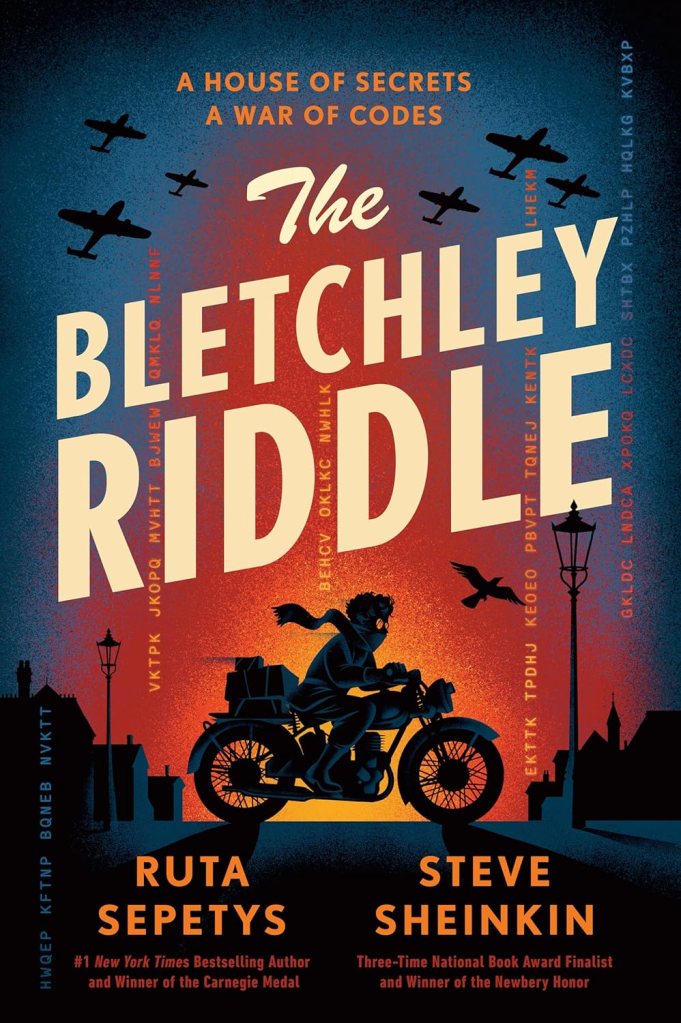
Book: “The Bletchley Riddle” by Ruta Sepetys & Steve Sheinkin

Publishing Info: Viking Books for Young Readers, October 2024

Where Did We Get This Book: The Library!

Where You Can Get This Book: WorldCat.org | Amazon | Indiebound

Book Description: Remember, you are bound by the Official Secrets Act…

Summer, 1940. Nineteen-year-old Jakob Novis and his quirky younger sister Lizzie share a love of riddles and puzzles. And now they’re living inside of one. The quarrelsome siblings find themselves amidst one of the greatest secrets of World War II—Britain’s eccentric codebreaking factory at Bletchley Park. As Jakob joins Bletchley’s top minds to crack the Nazi’s Enigma cipher, fourteen-year-old Lizzie embarks on a mission to solve the mysterious disappearance of their mother.

The Battle of Britain rages and Hitler’s invasion creeps closer. And at the same time, baffling messages and codes arrive on their doorstep while a menacing inspector lurks outside the gates of the Bletchley mansion. Are the messages truly for them, or are they a trap? Could the riddles of Enigma and their mother’s disappearance be somehow connected? Jakob and Lizzie must find a way to work together as they race to decipher clues which unravel a shocking puzzle that presents the ultimate challenge: How long must a secret be kept?

Serena’s Thoughts

Other than the fact that this is a middle grade novel (I don’t tend to love reading this genre as an adult, which honestly makes me a bit sad!), this book was right up my alley! I enjoy both historical fiction as well as mysteries, and both are done so well in this story. I was also a big fan of the code-breaking and puzzle aspects. I enjoyed trying to put things together myself, but also was happy to simply follow along with the characters as they pieced it all together and then explained it to me later.

I have a long record on this blog of complaining about poorly executed alternating POVs, but this was a good example of how to do this right. One of my biggest complaints is that authors often have a hard time writing multiple characters in ways that make them feel distinct. This story was well suited for this, however, focusing on a pair of siblings, an older teenage brother and his younger middle grade sister. Between the age and gender differences, they both felt very distinct. It was also great following their different experiences with Bletchley Park and the roles they took on there.

I also thought many of the side characters were very good, and I appreciated the way the authors managed to weave in real-world historical figures throughout the text. It would have been nearly impossible to not include these figures, but there’s always the danger, when writing fiction, that any real-life characters won’t blend well with their fictional counterparts. Not the case here! I think both authors well understood the truth in the saying “a little goes a long way” in this area.

Overall, this was a great middle grade read! Not being a middle grade reader myself, I may not have enjoyed it as much as the target audience, but this would be an easy book to recommend to large swaths of younger readers!

Kate’s Thoughts

I too am not much of a middle grade reader unless the topic is VERY interesting to me, but I have loved basically every book I’ve read by Ruth Sepetys so I had pretty high hopes for this one. Middle grade or not. And I also find books about World War II’s ally home fronts interesting in general, especially for places like Britain that were dealing with the constant fear of invasion. And finally, I had some vague knowledge about Bletchley Park thanks to stories about Alan Turing, as well as the miniseries “The Bletchley Circle”. All of that combined to make this a potentially good match for me, and overall it was.

Now I’m not super good at codes and puzzles, but I really enjoyed the way that the authors not only explained the importance of Bletchley Park and the goals that it had, it also gives really accessible examples of codes and ciphers to contextualize what kind of work they were doing (and how daunting the Enigma Machine was even for the most skilled of code breakers). Similarly to how she writes historical fiction books for teens, Supetys really has a skill for bringing out the most interesting and sometimes complex topics and parsing out that information for her audience, this one being middle grade. I also liked how she not only touched on the British code breakers through Jakob’s work (and the important work of messengers like Lizzie, who could be young teens!), but also the code work that more in the thick of it countries were doing, like Poland.

I also generally enjoyed the sibling relationship between Jakob and Lizzie, who butt heads sometimes but always have each other’s backs even in the most stressful of times. We have not only the stress of being at Bletchley, the stress of being in a place that could be bombed at any time, AND the question of where their espionage adjacent mother is, who disappeared in Poland and who Lizzie is convinced in still alive (while British intelligence is convinced she is a traitor). Watching them not only try to figure out how they can help in any way they can at Bletchley but ALSO try and hold on without knowing where their mother is was at times emotional, and both Sepetys and Sheinkin bring their talents together to create an informative and gripping family story.

I found “The Bletchley Riddle” to be a well done World War II read that history buffs of ANY age may like!

Serena’s Rating 8: A great balance of historical facts and exciting adventure, perfect for any middle grade or young adult readers who are interested in learning more about the lesser-known parts of WWII.

Kate’s Rating 8: An accessible and entertaining historical fiction for kids about code breaking, World War II, and siblings fighting against Nazis and surviving a war in more ways than one.

Book Club Questions

  1. How familiar were you with the history of Bletchley Park before reading this book?
  2. Did the setting of World War II London ring true for you?
  3. We follow the Novis siblings, Lizzie and Jacob, with their voices alternating between chapters. Did you find these two characters voices different enough as you read the book? Did you like one perspective more than another?
  4. What did you think about the friendships in this book?
  5. How did you like the inclusion of real life figures like Alan Turing? Did it feel like it fit, or did it feel distracting?
  6. What were your thoughts on the mystery Willa Novis and her disappearance? What about the code mysteries?

Reader’s Advisory

“The Bletchley Riddle” is included on the Goodreads lists “World War Two England”, and “Books Set in Bletchley Park”.

Next Book Club Pick: “The Hacienda” by Isabel Cañas
Book Club Review: “Matilda”

This post may contain affiliate links for books we recommend.  Read the full disclosure here.

We are part of a group of librarian friends who have had an ongoing book club running for the last several years. Each “season” (we’re nerds) we pick a theme and each of us chooses a book within that theme for us all to read. Re-visiting some of our past themes, we’re once again reading books that have had film/TV adaptations and then comparing the two mediums. For this blog, we will post a joint review of each book we read for book club. We’ll also post the next book coming up in book club. So feel free to read along with us or use our book selections and questions in your own book club!

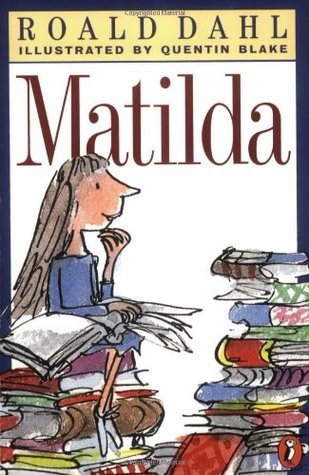
Book: “Matilida” by Roald Dahl

Publishing Info: Viking, October 1988

Where Did I Get This Book: The library!

Where You Can Get This Book: WorldCat.org | Amazon | Indiebound

What We Watched: “Matilda” (1996) & “Matilda: The Musical” (2022)

Book Description: Matilda is a little girl who is far too good to be true. At age five-and-a-half she’s knocking off double-digit multiplication problems and blitz-reading Dickens. Even more remarkably, her classmates love her even though she’s a super-nerd and the teacher’s pet. But everything is not perfect in Matilda’s world…

For starters she has two of the most idiotic, self-centered parents who ever lived. Then there’s the large, busty nightmare of a school principal, Miss (“The”) Trunchbull, a former hammer-throwing champion who flings children at will, and is approximately as sympathetic as a bulldozer. Fortunately for Matilda, she has the inner resources to deal with such annoyances: astonishing intelligence, saintly patience, and an innate predilection for revenge.

Kate’s Thoughts

“Matilda” was my hands down favorite Roald Dahl book when I was a kid. As much as I enjoyed other books of his, there was just something Matilda Wormwood that really connected with me (could it be that she was a strange and lonely little girl who liked to read? Possibly!). But I hadn’t revisited it until it was selected for our book club as our last adaptation read, and oh my goodness am I so glad that we picked this one. Because “Matilda” is still so, so utterly whimsical and a true delight.

Dahl really had a knack for writing such funny books that are funny for kids (eating a giant chocolate cake! A hat stuck on a Dad’s head!) while also being funny for adults (so much dry humor and English witticisms!). I highly enjoyed the over the topness of the experiences that Matilda was dealing with, be it her horrible parents, the INSANE Miss Trunchbull, or even the quirky and strange and oh so amusing classmates at her school. I also enjoyed revisiting the artwork of Quentin Blake, and I had forgotten that there are so many fun illustrations throughout the book, which really just added to my positive experience of revisiting this classic from my youth.

And I actually ended up watching the 2022 film adaptation of the musical, starring Alisha Weir as Matilda, Lashana Lynch as Miss Honey, and Emma Thompson as The Trunchbull. I absolutely adored it. I thought that it was a little truer to the spirit of the book than the 1990s film (though that one is still very charming and fun!), and I really love the music and basically all the performances from everyone in it. I also liked the way that it highlights the ways that Matilda was doing small things, or ‘a little bit naughty’ things, to fight back against the oppressive people in her life when feeling like she has no control (things I try to keep in mind these days). And I can definitely say that it’s kid approved, because my daughter watched it obsessively in the days after she watched it with me.

“Matilda” is still absolutely charming and sweet. So witty, so magical, so utterly enjoyable.

Serena’s Thoughts

I mean, can I just say “delightful” and then be done with my review? Sometimes you re-read books from your childhood and are shocked to find that perhaps the rose-tinted glasses have worn off. But then there are others that really just prove they are classics for a reason, and such was the case here! There is just so much to love about this story! The characters, the magic, the “British-ness” of it all! (That last one I may have appreciated more re-reading it now as an adult.)

It’s also the kind of story that is sure to connect with readers of all ages today as well! Though there’s also no denying that this is the sort of story that librarians are especially primed to love. Who can so say no to a story about a love for reading and how it can lead to only good things?? It’s also the sort of story that will likely speak to many kids who may feel out of place or lonely and who turn to books as a source of escape and comfort.

I also re-watched the 90s version of the movie. I watched it once as a kid, but hadn’t seen it since. It, too, was as delightful as ever! One of our bookclub friends mentioned that the movie “Americanized” the story, in that everything was bigger than ever, including the magic, and I think this is spot on. It’s still an excellent adaption, however, and I’m sure my kids will love to watch it whenever I get around to showing it to them.

Kate’s Rating 9 : Matilda Wormwood, icon that you are, you are still a fantastic children’s lit character and I’m so pleased that I was able to revisit your world again!

Serena’s Rating 9: Just as delightful as I remember it being!

Book Club Questions

  1. Did you read “Matilida” growing up? Did you experience it differently as an adult?
  2. Did you watch the movie or the musical? How did they compare to the original?
  3. In the book, the magical elements are a bit more in the background than they are in many of the adaptations. Do you think that one approach worked better than another?
  4. There is a good cast of secondary characters. Did any stand out to you in particular and why?
  5. How do you think Matilda will use her magic going forward after the events at the end of the book?

Reader’s Advisory

“Matilda” is included on the Goodreads lists: Favorite books from my childhood and Children’s Books I’ll Re-Read No Matter How Old I Am

Next Book Club Pick: “A Master of Djinn” by P. Djeli Clark

Book Club Review: “Are You There, God? It’s Me, Margaret”

This post may contain affiliate links for books we recommend.  Read the full disclosure here.

We are part of a group of librarian friends who have had an ongoing book club running for the last several years. Each “season” (we’re nerds) we pick a theme and each of us chooses a book within that theme for us all to read. Re-visiting some of our past themes, we’re once again reading books that have had film/TV adaptations and then comparing the two mediums. For this blog, we will post a joint review of each book we read for book club. We’ll also post the next book coming up in book club. So feel free to read along with us or use our book selections and questions in your own book club!

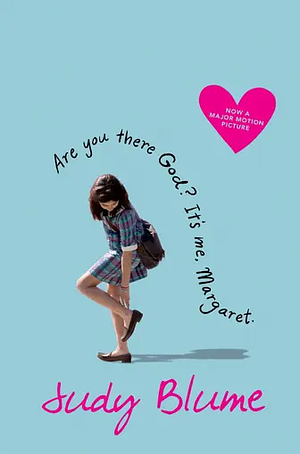
Book: “Are You There, God? It’s Me, Margaret” by Judy Blume

Publishing Info: Bradbury Press, 1970

Where Did I Get This Book: The library!

Where You Can Get This Book: WorldCat.org | Amazon | Indiebound

What We Watched: “Are You There, God? It’s Me, Margaret” (2023)

Book Description: Margaret Simon, almost twelve, likes long hair, tuna fish, the smell of rain, and things that are pink. She’s just moved from New York City to Farbrook, New Jersey, and is anxious to fit in with her new friends—Nancy, Gretchen, and Janie. When they form a secret club to talk about private subjects like boys, bras, and getting their first periods, Margaret is happy to belong.

But none of them can believe Margaret doesn’t have religion, and that she isn’t going to the Y or the Jewish Community Center. What they don’t know is Margaret has her own very special relationship with God. She can talk to God about everything—family, friends, even Moose Freed, her secret crush.

Margaret is funny and real, and her thoughts and feelings are oh-so-relatable—you’ll feel like she’s talking right to you, sharing her secrets with a friend.

Kate’s Thoughts

I missed out on so much classic children’s literature when I was little, because I basically jumped from the likes of “Goosebumps”, “The Babysitter’s Club”, and “Fear Street” to full on adult novels, without really touching any contemporary books that are long enduring classics. So I never actually read “Are You There, God? It’s Me, Margaret” by Judy Blume when I was a prepubescent girl, which was probably the best time to read it. But thanks to book club, I had the opportunity to read it, now at forty years old! Better late than never?

And I really enjoyed this book! I actually kind of wish that I HAD read it as a pre-teen because there were so many things that I absolutely would have been able to relate to when it comes to Margaret. I was a girl who was worried about making friends and fitting in, and I was a girl who was raised without any kind of religion, really, outside of major Christian holidays celebrated in the most secular sense (we did go to Church for a month when my Mom convinced herself that we needed that community factor in our lives and then remembered pretty quickly that oh yeah, Church was NOT something ANY of us wanted to do, least of all her). And even though the book was written decades ago, I thought that it still has a lot of pertinent and timeless themes like friendship, peer pressure, burgeoning sexuality, and the way that families can be complicated, even if we don’t fully see the big picture as children. Margaret is very realistic in her anxieties, whether it’s fitting in, her crush on a boy who may not be seen as ‘cute’ by her friend group, her worries about not getting her period yet, or her existential crisis when it comes to her family’s approach to faith.

And I have to say, the film adaptation was actually better than the book! I think that is due, in part, to the way that not only do we see Margaret’s point of view, but we also see the POVs of her mother (played by a delightful Rachel McAdams) and her grandmother (played by the ICONIC Kathy Bates). It made the story all the more emotional seeing three generations of women trying to figure it out through crazy changes in their lives. It also wrapped up a few things that I felt were left a bit hanging in the book (I was far more satisfied with how the Laura storyline ended in the movie). I really, really loved it.

I am so glad that I finally read “Are You There, God? It’s Me, Margaret”! What a charming and delightful book that still speaks to the anxieties of adolescence.

Kate’s Rating 9: A charming, incredibly relatable, and at times emotional coming of age story. I really enjoyed this one!

Book Club Questions

  1. Have you read “Are You There, God? It’s Me, Margaret” before? If so, how does it compare reading it now? If not, what books were you reading as a pre-teen?
  2. Religion is a huge theme in this book. Why do you think religion and choosing one was suddenly so important to Margaret after not really thinking about it for so many years in New York City?
  3. When it comes to the adults in the book and in the movie, how did you feel that they were portrayed between the two mediums? Did you prefer one portrayal over the other?
  4. What were your thoughts on Margaret’s friend group in her new home?
  5. Do you think that this story could be updated to take place in the 2020s as opposed to the 1970s? Why or why not?

Reader’s Advisory

“Are You There, God? It’s Me, Margaret” is included on the Goodreads lists “Best Coming of Age Stories”, and “Friendship Between Girls”.

Next Book Club Pick: “Matilda” by Roald Dahl

Book Club Review: “The Witch of Blackbird Pond”

This post may contain affiliate links for books we recommend.  Read the full disclosure here.

We are part of a group of librarian friends who have had an ongoing book club running for the last several years. Each “season” (we’re nerds) we pick a theme and each of us chooses a book within that theme for us all to read. Our current theme is Centuries, where we were given a random century and had to pick a book based during that time period.  For this blog, we will post a joint review of each book we read for book club. We’ll also post the next book coming up in book club. So feel free to read along with us or use our book selections and questions in your own book club!

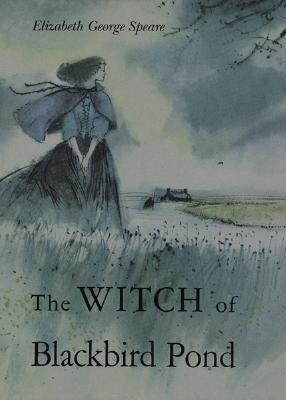
Book: “The Witch of Blackbird Pond” by Elizabeth George Speare

Publishing Info: Houghton Mifflin, 1958

Where Did We Get This Book: The library!

Where You Can Get This Book: WorldCat.org | Amazon | Indiebound

Century: 17th

Book Description: Orphaned Kit Tyler knows, as she gazes for the first time at the cold, bleak shores of Connecticut Colony, that her new home will never be like the shimmering Caribbean island she left behind. In her relatives’ stern Puritan community, she feels like a tropical bird that has flown to the wrong part of the world, a bird that is now caged and lonely. The only place where Kit feels completely free is in the meadows, where she enjoys the company of the old Quaker woman known as the Witch of Blackbird Pond, and on occasion, her young sailor friend Nat. But when Kit’s friendship with the “witch” is discovered, Kit is faced with suspicion, fear, and anger. She herself is accused of witchcraft!

Kate’s Thoughts

I read “The Witch of Blackbird Pond” in grade school, but I hadn’t ever revisited it and I can’t even tell you why, because I remember that I enjoyed it. I think that it was always in the back of my mind when it comes to children’s literature, but as time went on it just kind of fell further and further back. So when it was the choice for the 17th Century for our book club theme, I was eager to go back and re-read a book that I read as a ten year old through the eyes of an almost forty year old. And I’m happy to report that it holds up pretty well! But then, that’s probably because some things haven’t really changed, either from the McCarthy Era, when the book was written, or the times of witchcraft panic, when the book takes place.

I think that Speare did a really good job of laying out some pretty heavy topics, like prejudice, Othering, religious panic, and misogyny, in a way that is easily digestible for a middle grade audience. I found Kit to be an interesting heroine that is easy for a young reader to relate to, and her story of befriending a Quaker in a Puritan community who is rumored to be a witch (because OH NO SHE’S A QUAKER) is engaging, and at times quite suspenseful, given that the town starts to think that both Kit and Hannah (the so called witch) are up to no good and devilry, all because they are different and therein seen as untrustworthy outsiders. As mentioned above, this was initially written as a metaphor for McCarthyism and the Red Scare, where people were turning on and accusing others of being Communists and blacklisting them. But it’s so typical that we see this over and over in American history, and are seeing a form of it play out again right now with LGBTQIA+ people, and immigrants, and other marginalized groups. Some things never change, and hate towards the Other is one of those things. But that just makes the book relevant still, and it’s written with a keen eye that makes it all the stronger.

“The Witch of Blackbird Pond” is another classic children’s lit book that is still timely and interesting, and I am happy that book club gave me the push to give it another go!

Serena’s Thoughts

Like Kate, I read this one as a upper grade schooler/middle schooler. But I’ve also read it several times since. I believe I read it again during high school at some point. And then in my mid-twenties when I was building up my book collection, I stumbled upon a copy of this book on the “free” shelf at my local library, so I grabbed it and, of course, read it again right away! So, while it’s probably been a decade since my last re-read, I’m fairly familiar with the overall story. And given that I’ve somehow managed to read it across every decade of my life so far, I think it’s safe to say that both A.) I like it, and B.) it’s the kind of book that has a lot of cross-over appeal, no matter the age of the reader!

A few things stood out to me in this re-read. Like Kate mentioned, there’s a universal appeal to this story. Not only is Kit the sort of protagonist who will always speak to teens and younger readers (her combination of spunk as well as frustration with the rules around her), but the story talks on perennial struggles of humanity and society. Kate already talked about the Other-ing of those who are different, and the ways in which groups of people can spiral out of control into fear and desperation quite quickly and completely irrationally. But one aspect that I had focused less on in the past were the book’s secondary themes of capital “A” acceptance. In that, while the story is very much focused on the “witches” and the typical sorts of “others” that we know have been feared and hated throughout history (and whose counterparts are easy to spot today as well), it also subtly draws attentions to the sorts of judgements that we make at everyday moments, judgements that often reduce people to their worst characteristics without touching on the rest of their being, their context, or their priorities in life.

First of all, we see this in Kit herself, the heroine and “good guy” of our story, but also a character who grew up with slaves and very much has not thought about the realities of this horror until it is bluntly pointed out to her. This is, of course, very much of the time. And while the story doesn’t excuse Kit, it also presents this flaw of hers alongside all of the elements that still make her the heroine. She learns, and to learn, it requires others to see her flaws and, instead of shunning and shaming, to help her grow.

Further, we also see this in Kit’s uncle, a character who can be incredibly unlikable for much of the story. But as the plot progresses, we see Kit’s estimation of him slowly adjust as she’s exposed to more and more of his core personality, seeing what he cares about most and how that shapes his views. By the end, she recognizes him as the flawed individual he is, but also someone who loves his family and is doing what he thinks is best, even if there are choices that Kit doesn’t agree with or understand. So, while I think the core theme around witches and Other-ing is just as important as ever, in this re-read, I appreciated the time and care the book took to look as these lesser versions of similar judgements and how important it is to humanize those we don’t understand.

Kate’s Rating 8: A classic in children’s literature that feels as timely as ever, “The Witch of Blackbird Pond” is a powerful book about being Othered and ostracized by those who fear things that are different.

Serena’s Rating 8: For a short-ish, young adult book, this story still packs a powerful punch regarding themes of acceptance, Other-ing, and the ways in which people can let fear drive their life.

Book Club Questions

  1. There are several different women characters in this book. If you were living in this time period, which of these characters would you like to trade places with if only for a moment?
  2. What are your thoughts on Puritan Society as portrayed in this book?
  3. There are a few mentions of the slave trade and slavery in this book, as Kit comes from a plantation on Barbados. What were your thoughts on how it was addressed? Do you think it reflects the time that it was written?
  4. There were multiple romantic relationships in this story. Did you have a favorite couple?
  5. Are there any more modern books with similar settings or themes to this book that you have enjoyed? What were they? What made them different from this one? How are they similar?
  6. What did you think about the conclusion of the story? Did it feel realistic to you?

Reader’s Advisory

“The Witch of Blackbird Pond” is included on the Goodreads lists “Teen Historical Fiction”, and “Wise Women, Witches, Midwives, Healers, and Strong Girls!”.

Next Book Club Pick: “What The Wind Knows” by Amy Harmon

Book Club Review: “Snapdragon”

This post may contain affiliate links for books we recommend.  Read the full disclosure here.

We are part of a group of librarian friends who have had an ongoing book club running for the last several years. Each “season” (we’re nerds) we pick a theme and each of us chooses a book within that theme for us all to read. Our current theme is song inspirations, where we were given a random song from a random genre and had to pick a book based on the song.  For this blog, we will post a joint review of each book we read for book club. We’ll also post the next book coming up in book club. So feel free to read along with us or use our book selections and questions in your own book club!

Book: “Snapdragon” by Kat Leyh

Publishing Info: First Second, February 2020

Where Did We Get This Book: The library!

Where You Can Get This Book: WorldCat.org | Amazon | Indiebound

Song Inspiration: “Blasphemous Rumors” by Depeche Mode

Book Description: Kat Leyh’s Snapdragon is a magical realist graphic novel about a young girl who befriends her town’s witch and discovers the strange magic within herself.

Snap’s town had a witch. At least, that’s how the rumor goes. But in reality, Jacks is just a Crocs-wearing, internet-savvy old lady who sells roadkill skeletons online. It’s creepy, sure, but Snap thinks it’s kind of cool, too.

Snap needs a favor from this old woman, though, so she begins helping Jacks with her strange work. Snap gets to know her and realizes that Jacks may in fact have real magic—and an unlikely connection to Snap’s family’s past.

Kate’s Thoughts

Sometimes people can forget that the Halloween season doesn’t have to be all about the scares! There are plenty of non-scary stories that still feel like they fit in in the season, and “Snapdragon” is one of those stories. Why yes there is a witch and why yes there are bones and skeletons, but this middle grade graphic novel about a girl befriending a rumored witch is a very cozy and charming story about friendship and found family, all with a magical twist.

I thought this was a super cute read, with our intrepid protagonist Snap meeting Jacks, a rumored witch who teaches her about taxidermy and also a little bit of magic. I loved the friendship between Snap and Jacks, as Snap is a LOT and Jacks is very patient. I loved getting to know both of them individually but also through them getting to know each other. I really liked the mentor-mentee relationship, and I liked seeing Snap get to know Jacks and, therein, also getting to know herself AND to learn some things about her family’s past through her friendship with this supposed and friendly witch. The themes of friendship and found family were well presented for the audience, as well as themes of general family love and acceptance and love, whether it’s single mothers doing the best they can, or trans kids finding acceptance from their loved ones as well as their friend circles. You have all these things along with humor and some witchy magic and you have a recipe for a very sweet middle grade fantasy tale!

If you are looking for some adorable witchy fun for your middle grader reader, or even yourself, “Snapdragon” is a breezy and not so spooky choice!

Serena’s Thoughts

Overall, I enjoyed this read. Middle grade fiction was never a real favorite of mine, even when I was a middle grader, but I can definitely see the appeal of this book. In many ways, while it covers important and sometimes heavy topics, this is very much a cozy, feel-good fantasy novel. Snap is a fantastic lead character and probably my favorite part of the book. She was simply a fun person to follow through the story!

I also really liked the inclusion of intergenerational relationships. The story focuses on the relationships between many different characters, but this one stood out to me the most as one that we rarely see on the page, let alone in middle grade fiction that is often focused on peer relationships and maybe parents.

That said, I did struggle a bit with this particular art style. I found it rather clunky and difficult to parse facial expressions and other important aspects of the scenes. As a fantasy reader, I also found myself wish there had been a bit more with regards to just how the magic works in this world. I’m all for just going with the flow, but for me, this could have used a bit more fleshing out.

Overall, I think this book would appeal to many middle grade readers. However, if middle grade fiction or graphic novels aren’t your natural wheelhouse, you might feel a bit more disconnected from this one, like I did.

Kate’s Rating 7: A sweet and charming story about being yourself and found family, “Snapdragon” is a nice middle grade novel that could be fun for Halloween reading!

Serena’s Rating 7: A lovely little story that explores themes important to the middle graders while presenting a world of wonder and whimsy.

Book Club Questions

  1. The prompt for this book was “Blasphemous Rumors”, as Jacks has a lot of rumors surrounding her. Can you think of another book or story that has a character with rumors about them that may or may not be true?
  2. What did you think about Snap as a main character?
  3. What were your thoughts on the magical systems in this book? Do you think it was well conceived? Did you need more explanation?
  4. Did you like the artwork and character design in this book?
  5. Were there any side characters that you liked? What was it about them that you enjoyed?
  6. What did you think about Jacks’s backstory and connection to Snap’s family?

Reader’s Advisory

“Snapdragon” is included on the Goodreads lists “Comics for Witches”, and “Witchy Middle Grade & Tween”.

Next Book Club Pick: “Born a Crime” by Trevor Noah

Kate’s Review: “Returning to the Yakoun River”

This post may contain affiliate links for books we recommend.  Read the full disclosure here.

Book: “Returning to the Yakoun River” by Sarah Florence Davidson, Robert Davidson, and Janine Gibbons (Ill.)

Publishing Info: HighWater Press, September 2022

Where Did I Get This Book: I received an eARC from the publisher.

Where You Can Get This Book: WorldCat | HighWater Press| Indiebound

Book Description: Based on author Sara Florence Davidson’s childhood memories, this illustrated story captures the joy and adventure of a Haida fish camp.

Every summer, a Haida girl and her family travel up the Yakoun River on Haida Gwaii, following the salmon. While their father fishes, the girl and her brother spend their time on the land playing and learning from Tsinii (Grandfather).

Review: Thank you to HighWater Press for sending me an eARC of this book!

We are wrapping up this HighWater Press event with a bit of a rarity on this blog. We don’t usually review children’s picture books, for a litany of reasons, and that general rule is one that we rarely stray from. But “I’m making an exception for this event, because goodness knows that “Returning to the Yakoun River” Sarah Florence Davidson is the perfect place to end this series, as it has a focus on generational traditions being shared with children of today, and to me that seemed like a good place to wrap up.

“Returning to the Yakoun River” is a simple story about a Haida girl and her family going fishing on the Yakoun River during the salmon season, and while her father fishes she and the other children spend time with their Tsinii (grandfather) at the fish camp. Throughout this time she learns about how to help set up for the cooking, plays with her cousins and brother on the river, and watches as her Tsinii prepares the salmon that is caught for eating in a traditional way. It’s a very simple story based on memories from Sarah Florence Davidson’s childhood, with memories of her father (who collaborated with her on this) and her grandfather during a visit to the fish camp. It’s a nice slice of life tale that highlights the way that children can learn from their elders, and how traditions from the past change and yet are maintained over the years. Given that Davidson is an educator who has a focus on the importance of intergenerational learning, it’s a simple story that has a lot of heart and a lot to say about these things, while also being tailored specifically for a younger age group. We also have a helpful map of the area where this story takes place, and some background on Davidson’s grandfather, whose role as a leader in the community, artist, and fisherman are laid out to show the reader who the Tsinii is based upon.

And the artwork is just fantastic. I am not certain the medium that Janine Gibbons used for the art, but it looks like some kind of paintwork and it is so lovely and artistic. It also somewhat, to me, conveys the dreaminess of memories in the design and aesthetic.

(source: HighWater Press)

“Returning to the Yakoun River” is a gentle and placid story about intergenerational learning and the importance of passing that learning down through the generations. I really enjoyed it, and found it to be a poignant way to wrap up this month long spotlight on Indigenous voices and stories.

Rating 8: A lovely story about a family respecting and practicing traditions of genertions past, “Returning to the Yakoun River” has a sweet plot and gorgeous illustrations.

Reader’s Advisory:

“Returning to the Yakoun River” isn’t on any Goodreads lists yet, but I think that it would be complementary if you liked “On the Trapline” and would fit in on “Multicultural Children’s Books”.

Kate’s Review: “The Raven Mother”

This post may contain affiliate links for books we recommend.  Read the full disclosure here.

Book: “The Raven Mother” by Hetxw’ms Gyetxw (Brett D. Hudson), & Natasha Donovan (Ill.)

Publishing Info: HighWater Press, September 2022

Where Did I Get This Book: I received an eARC from the publisher.

Where You Can Get This Book: WorldCat | HighWater Press | Indiebound

Book Description: Hoarders. Scavengers. Clever foragers. Bringers of new life.

Ravens have many roles, both for the land and in Gitxsan story and song. The sixth book in Hetxw’ms Gyetxw (Brett D. Huson)’s Mothers of Xsan series transports young readers to Northwestern British Columbia, where they will learn about the traditions of the Gitxsan, the lives of ravens, and why these acrobatic flyers are so important to their ecosystem.

Follow along as Nox Gaak, the raven mother, teaches her chicks what they need to survive with the help of her flock.

Review: Thank you to HighWater Press for sending me an eARC of this book!

Maintaining my stereotypical Goth girl at heart aesthetic, I have always been a huge fan of corvids of all types. Living in Minnesota that means that crows are the corvids in my backyard, but when my husband and I went to London for our honeymoon I was DESPERATE to see the Ravens at the Tower (I also bought a stuffed raven that still sits on my nightstand). When my parents went to Alaska a few years ago my Mom sent me pictures of ravens any time she caught one on her camera. So yeah, give me any and all corvid content. THEREFORE, I was particularly interested in “The Raven Mother” by Hetxw’ms Gyetxw (aka Brett D. Hudson) in this HighWater Press series that I’m doing this month. And it didn’t disappoint!

“The Raven Mother” is an educational middle grade book that puts the ecological and cultural significance of ravens in British Columbia, Canada, specifically through the context of the Gitxsan People. The story is pretty straightforward as a mother raven tends to her chicks with the help of the ravens in her community. It’s easy to understand and has a lot of good information that’s presented in a way for the audience that I felt worked really well. We not only get Gitxsan words and language interspersed in the narrative, we also get definitions of those words as well as definitions to relevant words that may be unfamiliar to younger readers. We also get a great introduction to the concept of ecosystems and ecology, with talk of seasonal changes, animal movements and migrations, and the way that animals, specifically ravens, connect to the environment they inhabit, and how that can have an effect on other things within the ecosystem. And seeing it through the seasons of a raven and her babies as they grow and change was definitely a good way for the audience to connect to it. If science was presented in such a way when I was a kid I would have really connected to it more, I think.

I also really loved the historical notes in the back of this book, as they give great context for the Gitxsan People and the areas they inhabited during the time that this book is set. The lists of the seasonal moons and the drawn map of the area where the various four clans were placed were easy to follow and the brief history is easy to understand, as well as forthright about the colonized land and space as it is defined by ‘official’ geography today. Again, it is all very approachable and I would have loved to encounter information presented in such a way when I was the target age for this book. And I really can’t stress enough how important it is to have these voices and perspectives amplified as much as possible.

And I am going to gush about the artwork in this book. I absolutely loved it. I loved the design of the animals, landscapes, and people. I loved the colors and how they pop off the page. I loved the way that everything felt like it flowed and connected across pages. I really really loved everything about it, so major props to Natasha Donovan.

I mean just look at this. GORGEOUS! (source: HighWater Press)

Filled with accessible information about ecosystems and culture, “The Raven Mother” is an enjoyable read that will be a great teaching tool for the target audience. I quite enjoyed reading it and will definitely be sharing it with my own child when she’s older.

Rating 8: An educational story about ecosystems, ravens, food webs, and how they all connect to each other, “The Raven Mother” is some solid middle grade science as well as cultural exploration.

Reader’s Advisory:

“The Raven Mother” isn’t on any Goodreads lists as of yet, but I think it would fit in on “Non-Fiction: Crows and Ravens”.

Kate’s Review: “Pīsim Finds Her Miskanaw” and “Amō’s Sapotawan”

This post may contain affiliate links for books we recommend.  Read the full disclosure here.

Books: “Pīsim Finds Her Miskanaw” and “Amō’s Sapotawan” (The Six Seasons Vol. 1 & 2) by William Dumas, Leonard Paul (Ill.), and Rhian Brynjolson

Publishing Info: HighWater Press, August 2020 (Vol.1) & September 2022 (Vol.2)

Where Did I Get These Books: I received eARCs from the publisher.

Where You Can Get These Books: WorldCat (1) (2) | Portage and Main Press (1) (2) | Indiebound (2)

Book Descriptions:

“Pīsim Finds Her Miskanaw”: In 1993, the remains of a young woman were discovered at Nagami Bay, South Indian Lake, Manitoba. Out of that important archeological discovery came this unique story about a week in the life of Pisim, a young Cree woman, who lived in the Mid 1600s. In the story, created by renowned storyteller William Dumas, Pisim begins to recognize her miskanow – her life’s journey – and to develop her gifts for fulfilling that path. The story is brought to life by the rich imagery of Leonard Paul, and is accompanied by sidebars on Cree language and culture, archaeology and history, maps, songs, and more.

“Amō’s Sapotawan”: Rocky Cree people understand that all children are born with four gifts or talents. When a child is old enough, they decide which gift, or mīthikowisiwin, they will seek to master. With her sapotawan ceremony fast approaching, Amō must choose her mīthikowisiwin. Her sister, Pīsim, became a midwife; others gather medicines or harvest fish. But none of those feel quite right.

Amō has always loved making things. Her uncle can show her how to make nipisiwata, willow baskets. Her grandmother can teach her how to make kwakwāywata, birchbark containers and plates. Her auntie has offered to begin Amō’s apprenticeship in making askihkwak, pottery.

What will Amō’s mīthikowisiwin be? Which skill should she choose? And how will she know what is right for her?

Reviews: Thank you so, so much to Lohit Jagwani from HighWater Press for sending me eARCs of these books!

We are on our second week of my month long HighWater Press Blog Series, and we shift from traditional graphic novel to look at the first two books of a Middle Grade historical fiction series called “The Six Seasons” by storyteller and asiniskaw īthiniw Knowledge Keeper William Dumas. These books are part of a greater project known as the Six Seasons of the Asiniskaw Īthiniwak, which hopes to work towards preserving Indigenous languages and knowledge bases of the Asiniskaw Īthiniwak, or Rocky Cree. Honestly it sounds like a fantastic project (read more HERE), and part of it is this series, with the first two books being “Pīsim Finds Her Miskanaw”, and the second being “Amō’s Sapotawan”. Both books follow teenage girls who are going on journeys of self discovery, while also teaching kids about life and culture of the Rocky Cree before significant European contact.

I’ll start with the first in the series, “Pīsim Finds Her Miskanaw”, which follows a teenage Rocky Cree girl who is learning the ways of becoming a midwife. As her family group an community is preparing to journey to a communal gathering, Pīsim is trying to determine if she has the skills and drive to be a midwife. As the community travels to the Spring Gathering, stories are shared, bonds are strengthened, and Pīsim finds herself having to use her skills and knowledge in an unexpected situation. I really loved watching this young woman connect with those around her and hear the various stories that everyone tells, and how she rises to the task of delivering a baby on her own when she and her uncle and pregnant aunt are separated from the rest of the group during a storm on the water. But what stands out the most in this book (and similarly in “Amō’s Sapotawan”) are the rich and intricate details about all types of aspects of Rocky Cree life and culture. We get translations of various vocabulary, maps of the water that Pīsim and her family are traveling upon for the Spring Gathering, and various facts about life for the Rocky Cree during this time period. I was very, very enthralled by the great information and how detailed it was, and my former historical society employee heart was all aflutter. There is such good information in this book, and it’s incredibly accessible to the audience it is catered towards. I really enjoyed seeing the story of Pīsim come into her own.

“Amō’s Sapotawan” is another story about a young girl, though this time it is in summer and this time we follow Pīsim’s sister Amo. In this story, Amō is a teenager who is trying to decide on her mīthikowisiwin, her craft that she wishes to hone, as her ceremony to celebrate that gift, or her sapotawan, is about to happen. Coinciding this is the berry picking that the community does in the summer, as well as an ever present threat of wild fires that tend to kick up during this time of year and that can drive a community to have to flee on a moment’s notice. As Amō contemplates what she wants to choose, she experiences fairly typical moments in what the culture and life was like for the Rocky Cree, though there are, admittedly, some significant beats that may help drive her to choose her ultimate gift. I liked this story a lot as well, and like Pīsim’s story before there were a lot of great notes and facts interspersed within the story.

In terms of the artwork, the stories are accompanied by two different artists and two different styles. Leonard Paul provided the art for Pīsim’s story, while Rhian Brynjolson did for Amō’s. I think that of the two I preferred that of Paul, as that kind of style just speaks to me more, but they are both aesthetics that match the tales at hand pretty well, and I think that they would both connect with a middle grade audience as they read these books.

The importance of knowing the life and culture for the Rocky Cree pre-significant European contact can’t be stressed enough given the genocide Indigenous and First Nations peoples were (and still are) subjected to, and I think that these books by William Dumas are such rich resources and tools to help preserve this knowledge, and very necessary. I greatly enjoyed both “Pīsim Finds Her Miskanaw” and “Amō’s Sapotawan” as great information resources and coming of age tales.

Rating 8: Incredibly rich in detail, historical notes, and culture, “Pīsim Finds Her Miskanaw” and “Amō’s Sapotawan” are both great introductions to Rocky Cree history and culture as well as gentle, heartwarming stories about finding oneself.

Reader’s Advisory:

“Pīsim Finds Her Miskanaw” and Amō’s Sapotawan” are not on many Goodreads lists, but I think they would fit in on “Indigenous Children’s Literature”.

Kate’s Review: “Measuring Up”

This post may contain affiliate links for books we recommend.  Read the full disclosure here.

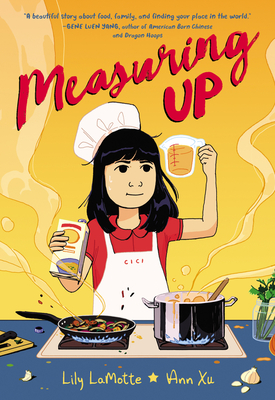
Book: “Measuring Up” by Lily LaMotte & Anne Xu (Ill.)

Publishing Info: HarperAlley, October 2020

Where Did I Get This Book: The library!

Where You Can Get This Book: WorldCat | Amazon | Indiebound

Book Description: Twelve-year-old Cici has just moved from Taiwan to Seattle, and the only thing she wants more than to fit in at her new school is to celebrate her grandmother, A-má’s, seventieth birthday together.

Since she can’t go to A-má, Cici cooks up a plan to bring A-má to her by winning the grand prize in a kids’ cooking contest to pay for A-má’s plane ticket! There’s just one problem: Cici only knows how to cook Taiwanese food.

And after her pickled cucumber debacle at lunch, she’s determined to channel her inner Julia Child. Can Cici find a winning recipe to reunite with A-má, a way to fit in with her new friends, and somehow find herself too?

Review: We have once again come upon a whim book, as I was wanting to read more graphic novels on the day that I requested “Measuring Up” by Lily MaMotte and Anne Xu. One of the other graphic novels I read recently was food based, and given how I enjoyed that one I thought I would give this one a try! Especially since it sounded like it had some other themes that it was going to tackle, along with the food.

The coming of age story at the heart of “Measuring Up” is very sweet and gentle. Cici is a preteen girl who finds herself in a new country and culture, and who is nervous about what that means for herself and for her place in the world around her. Her desperation to see her A-má again, who stayed behind in Taiwan, motivates her to sign up for a junior cooking contest, as cooking with her grandmother was a true joy and she is pretty good at it. The story is fairly simple, which makes sense for the middle grade audience, and I thought that Cici’s initial struggles with making friends and her conflicts with her parents regarding her priorities (cooking contest vs studying) were well conveyed in a middle grade narrative. At times it may have felt perhaps a little too simplistic for me, but I’m absolutely not the audience for this story so that doesn’t reflect the story as a whole. As Cici works through the cooking contest and starts to feel more at home, she is also repressing her identity because of how Taiwanese food and culture is viewed in a Western culinary world (more on that aspects in a bit), which drives her to experiment with more Western foods. This is also because of her cooking partner Miranda, whose Italian restaurant owning father has basically told her to focus on Italian food. The contrast between Miranda and Cici could be pretty start, but LaMotte finds ways to show that they may have more in common than they initially realize. Again, simplistic, but ultimately sweet.

Along with the coming of age story we get a tale about a girl who is adjusting to a new culture, while trying to keep her identity as well as finding a new one. As Cici starts to acclimate to her new home, she feels a need to keep her Taiwanese identity close to the vest, partially because of micro aggressions or flat out racism, but also because of her insecurities about herself as a tween girl. LaMotte touches upon preconceived notions of Asian food, from classmates telling Cici her lunch is ‘stinky’ to adults writing it off as low brow or cheap. I thought that LaMotte did a good job of balancing the broader themes within the story itself, and I liked that Cici had moments of pushing back, as well as moments of Cici being pleasantly surprised beyond her expectations. The important moments of Cici having to deal with micro aggressions are explained in a way that will resonate with the target audience, and I liked how Cici not only got to push back against it, but also got to pursue her own identity that may not line up with the one that her parents have laid out for her. It just felt like it all handled some complex issues in an accessible way.

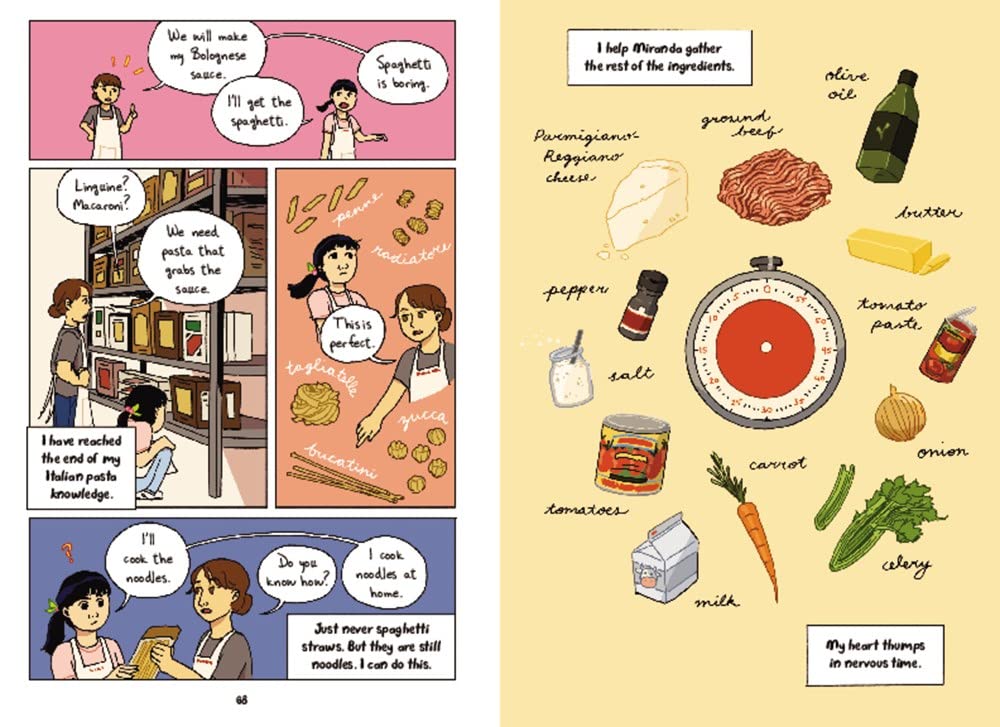
And the drawing style is cute and fits the tone. I liked the way that Anne Xu could bring out emotional moments and feelings even in the simplistic art style that will probably resonate with the target audience. And it also just made me so hungry for basically all of the foods that we were seeing on the page.

(source)

“Measuring Up” was cute and a good fit for middle grade audiences! I know exactly who I would recommend this to, and it will make the reader ready to take on some culinary adventures of their own!

Rating 7: A cute story about cooking, friendship, culture, and finding oneself.

Reader’s Advisory:

“Measuring Up” is included on the Goodreads lists “Comics About Food”, and “Culinary Fiction – Middle Grade”.

ALSO

If you are as disgusted as I am about the striking down of Roe, I’m going to post some links here that will give you information and resources to donate to.

National Network of Abortion Funds

Rewire News Group

National Abortion Federation

Plan C

Serena’s Review: “Gallant”

This post may contain affiliate links for books we recommend.  Read the full disclosure here.

Book: “Gallant by V.E. Schwab

Publishing Info: Greenwillow Books, March 2022

Where Did I Get this Book: Edelweiss+

Where Can You Get this Book: Amazon | IndieBound | WorldCat

Book Description: Everything casts a shadow. Even the world we live in. And as with every shadow, there is a place where it must touch. A seam, where the shadow meets its source.

Olivia Prior has grown up in Merilance School for girls, and all she has of her past is her mother’s journal—which seems to unravel into madness. Then, a letter invites Olivia to come home—to Gallant. Yet when Olivia arrives, no one is expecting her. But Olivia is not about to leave the first place that feels like home, it doesn’t matter if her cousin Matthew is hostile or if she sees half-formed ghouls haunting the hallways.

Olivia knows that Gallant is hiding secrets, and she is determined to uncover them. When she crosses a ruined wall at just the right moment, Olivia finds herself in a place that is Gallant—but not. The manor is crumbling, the ghouls are solid, and a mysterious figure rules over all. Now Olivia sees what has unraveled generations of her family, and where her father may have come from.

Olivia has always wanted to belong somewhere, but will she take her place as a Prior, protecting our world against the Master of the House? Or will she take her place beside him?

Review: Though some of her books have been a bit of a miss for me, V.E. Schwab is firmly on my “must read” list. Even those books that I didn’t love still always had superb writing and creative fantastical ideas. And then there’s the fact that these less liked books are far and away the more rare for me. Typically, I’ve really adored her writing and own several of her books outright. But when a book hasn’t hit for me, it’s typically come from her YA fare. So, while I was super excited to see a new book coming out, I was a bit more nervous than I typically would be when I saw that this was marketed as YA. Luckily, that wasn’t an issue here! Is that because I’d argue this might not be YA?

Olivia dreams of what every orphan child dreams of: a home and a family who want her. But at age 14, she’s well aware that all she has left in this world, truly, is her mother’s cryptic journal. So no one is more surprised than she when a letter suddenly arrives at her orphanage calling Olivia home to Gallant. But when she arrives, though she does discover family, she realizes that not only did her unwelcoming cousin Mathew not send the letter, but that he seems almost desperate for her to leave as soon as possible. When she stumbles into a shadowy world mirroring Gallant itself, she begins to suspect that there is more to the old house and her family’s history than she ever could have imagined.

This book was marketed as a Gothic “The Secret Garden,” and I can definitely see that all over this book. It’s also notable that V.E. Schwab is something of an old hand at penning these type of overlaying, mirrored worlds. This same concept is at the heart of her popular “Shades of Magic” trilogy, so it was fun seeing her return to that same fantasy element. But, true to her being a very talented author, she does so in a way that it is original and stands completely separate from that trilogy.

For one thing, I’d argue that this book is more Middle Grade than YA. The protagonist, Oliva, is definitely on the younger side of teenage-dom. And, not that all YA books require romance by any means, but the story itself is fully devoid of any love story, something that is rare in typical YA fantasy fare. The themes of the story, family, home, the understanding of choosing the way we move forward into a more adult world, are all of the sort that I think would appeal greatly to Middle Grade audiences. Some of the fantasy elements are a bit dark, but I’d think the average middle grader would be up for it.

Olivia was an excellent main character. She is a character who has grown up without the ability to communicate verbally. She can hear but must use sign language or writing to speak with those around her. It’s telling of Schwab’s abilities that she was able to write such a complex character and story while relying on minimal dialogue. Instead, she finds a variety of ways for Olivia to communicate. But while doing this, the author also explores the way that those without a voice can be easily silenced and dismissed, speaking to a power imbalance that many may not even be aware of.

I really liked Gallant and its shadow-world as well. The Gothic overtones were high, with secret passages, moldering rooms hinting of past grandeur slowly sinking into decrepitude, and haunted forms flitting in and out of rooms. The history of the house and Olivia’s family was also very interesting. I especially appreciated the use of a selection of abstract artwork that is sprinkled throughout the story to add another layer to the story unfolding on the page.

I did have to drop the rating down a bit by the time I got to the end, however. While the quality of the storytelling, world-building, and characterization were high throughout, by the time I finished the last page I was left with a sense of feeling a bit unmoored. When I think back on the book, I’m not sure I can see a real point to the story. That, and the fact that I feel like the ending didn’t so much conclude a story as re-set the board. I’m not quite sure what to make of it, honestly. But I feel like Schwab somehow missed the mark a bit here.

Overall, however, I really enjoyed this book. I definitely think it’s worth checking out for fans of Gothic fantasy. It’s also a great stand-alone story and one that doesn’t include a love story at its heart. I think it probably veers closer to Middle Grade than YA, but at a certain point that distinction blends to a point where both would likely enjoy it equally.

Rating 8: Splendidly creepy while also reflecting on deeper topics such as the choice involved in home and family.

Reader’s Advisory:

“Gallant” is on these Goodreads lists: 2022 Gothic and 2022 Anticipated Fiction Fantasy Reads.